Ríos Montt and the Need for International Accountability for War Crimes in Guatemala
By Cyril Mychalejko | Toward Freedom | February 13, 2013
On December 4, 1982, former President Ronald Reagan spoke in Honduras after meeting with Efraín Ríos Montt, the evangelical Guatemalan General who seized power in a military coup a little over 8 months earlier.
“I know that President Ríos Montt is a man of great personal integrity and commitment,” said Reagan. “I know he wants to improve the quality of life for all Guatemalans and to promote social justice. My administration will do all it can to support his progressive efforts.”
Two days later the regime that Reagan said was getting a “bum rap” sent a contingent of Kabiles, Guatemala’s notorious special forces unit, to the department of Peten. There they entered the village of Dos Erres, where they tortured the men, raped the women, took hammers to the children, and in the end murdered as many as 250 people. Afterwards they burnt the village to the ground as part of Rios Montt’s “scorched earth” campaign against the country’s Mayan population.
Thirty years later Ríos Montt may finally face justice. On January 28, 2013 a Guatemalan judge ruled that the former head of state accused of responsibility for “1,771 deaths, 1,400 human rights violations and the displacement of 29,000 indigenous Guatemalans” would be tried for genocide in a domestic court. This precedent-setting decision was lauded internationally by human rights activists and NGOs.
“Until recently, the idea of a Guatemalan general being tried for these heinous crimes seemed utterly impossible,” said José Miguel Vivanco, Americas director at Human Rights Watch. “The fact that a judge has ordered the trial of a former head of state is a remarkable development in a country where impunity for past atrocities has long been the norm.”
The Association for Justice and Reconciliation and the Center for Human Rights Legal Action issued a joint statement on the day of the decision, also emphasizing the significance of the trial.
“This event represents the path walked by thousands of victims of genocide. It allows for the path of memory, truth and justice to continue, which offers a solid foundation for the construction of a more just country,” the statement noted. “We are hopeful that this case will continue on its course according to law and that soon there will be a final judgment against those who ordered genocide in Guatemala.”
However, in order for justice to overcome impunity in Guatemala there needs to be an international component.
The cozy relationship between Ríos Montt and the Reagan administration needs to be dug up from the graveyards of history, much like the bodies that are still being dug up from mass graves in Guatemala.
The US media should use this case as an opportunity to act like the forensic anthropologists in Guatemala to sort through Washington’s skeletons when it comes to the history of foreign policy in Guatemala. This could be done very simply by sifting through declassified documents, old press articles, and other past reports to accurately retell the story of modern US-Guatemalan relations and Washington’s role in aiding and abetting what the United Nations declared a genocide, a genocide in which over 200,000 mostly Mayan Guatemalans were killed and tens of thousands tortured, disappeared, raped and displaced.
While the recovery and discussion of national historical memory is central to creating lasting peace and justice in war-ravaged countries like Guatemala, US citizens must consider their own country’s history of promoting systemic violence in Guatemala if there is to be an improvement in US foreign policy toward the country.
Meanwhile, former US officials like Elliott Abrams, Reagan’s State Department point man for Latin American policy, should be called to testify as a witness at Ríos Montt’s trial, much like he did for a case in Argentina in January 2012.
Abrams testified via video conference that the Reagan administration knew that Argentina’s military regime were stealing babies from political prisoners and giving them to right-wing and military families. After finding out about such crimes, the Reagan administration then provided the military junta political cover by certifying its “improving” human rights record.
In the case of Guatemala, complicity in war crimes is not limited to the United States; there are other international actors with blood on their hands.
In December 2012 the Jubilee Debt Campaign released a report, Generating Terror, which made the case that the World Bank and the Inter-American Development Bank (IDB) helped legitimize and subsidize Guatemala’s genocidal regimes of the late 1970’s and early 1980’s. The report uses the Chixoy Dam project as a case study. The World Bank and IDB funded this dam project, the construction of which resulted in a series of massacres that resulted in over 400 deaths. Even after the documented massacres, these same international financial institutions provided additional funding to the same project seven years later.
Guatemala also turned to countries like Israel, Switzerland, France and Belgium during the civil war for aid, equipment and training.
There can be no peace in Guatemala without justice. In order for justice to prevail, the war crimes and impunity in the country need to be dealt with as an international issue, not just a local problem. While the Guatemalan government, again with the assistance of Washington, is re-militarizing the country, and corpses once more pile up, the need for accountability becomes more urgent—people’s lives depend on it.
Related articles
- Does Guatemala Include “Extrajudicial Executions” in its Calculation of National Murder Rates? (alethonews.wordpress.com)
February 19, 2013 Posted by aletho | Ethnic Cleansing, Racism, Zionism, Timeless or most popular, War Crimes | Efraín Ríos Montt, Elliott Abrams, Guatemala, Human rights, Ronald Reagan, United States | Leave a comment
Empire Destroys World and Itself
By Sean Fenley | Dissident Voice | September 15th, 2012
The Syrian rebels would be immeasurably weaker today without al-Qaeda in their ranks. By and large, Free Syrian Army battalions are tired, divided, chaotic, and ineffective. Al-Qaeda fighters, however, may help improve morale. The influx of jihadis brings discipline, religious fervor, battle experience from Iraq, funding from Sunni sympathizers in the Gulf, and most importantly, deadly results.
– Ed Husein, Senior Fellow at the Council on Foreign Relations
It has been said that America’s last liberal President was Richard Nixon. Nixon set up the EPA, OSHA, and created the Clean Water Act. Additionally, he had a better health plan than Obamacare, and proposed a guaranteed minimum income. Nixon also implemented price controls, which notably — in recent history — Hugo Chavez, has been attacked in Western media, for introducing on basic foodstuffs and household goods.
1981 is said to be the breaking point of when the modern Republican Party began its failure in accepting that government has a role to play in propping up — and, moreover, aiding and abetting — Americans’ livelihood and well-being: the much ballyhooed advent of the so-called Reagan Revolution. This began the coalescing of a system of essentially two neoliberal, militarist, Wall Street political parties largely indifferent to the needs of significant sections of the American population.
We should keep this in mind considering that we have just been enduring the revolting, gross, and gratuitously self-congratulatory (taxpayer funded) spectacles of the — decrepit, moribund and abounding with cretinism — duopoly conventions. So, what are we to make of things after envisaging these überlurid, radically self-aggrandizing, and entirely putrefactive celebrations? For one it’s clear to me that a battle royale between Jill Stein and Gary Johnson would be a marked improvement over the bromides, platitudes, and, undoubtedly, soon-to-be-broken promises of the plutocracy’s kept candidates of their choosing.
Clearing brush, pork rinds, arithmetic, surreptitious tax returns, “presidential” beer recipes and gaffing vice presidential candidates, are about the utmost the level of “cerebreality” that these folks, unequivocally, want to “ascend” toward. Celebreality is much more important anyhow! That is to say, what kerfluffle has a prominent Scientologist befallen him or herself into at the present moment! This stock in trade is all the more important than wars and peace, progressive taxation (or a Tobin tax), guaranteeing health care, poverty, the Great Recession, unemployment, and the greatest disparity of wealth in all of the Western world!
On the foreign affairs front, the French have lurched forward into the preeminent imperialist role in the decapitation, sacking and dismemberment of the Arab Republic of Syria. The “socialist” Hollande is now planning to arm Islamist guerrillas who include voluminous battle-hardened Salafis, and even — the sometime NATO/Western mortal enemy/adversary — Al Qaeda. The neocon enemy image, in fact, which has eroded so many civil liberties in America; cast aside the Constitution and metamorphosized the country into a police/surveillance society and/or (take your pick!) ultra-security state.
Now, of course, Al Qaeda has been reborn as an ally planting “American” values against a regime that is unequivocally authoritarian, but not without its positive attributes. Which includes tolerance of a mosaic of religious and faith traditions, exceedingly low cost university-level education, and government subsidy of many basic provisions, foodstuffs, household items, and everyday wares. In fact, in 2005 the Christian Science Monitor ran an article about what an agreeable experience — that so many Americans were having — studying Arabic in the capital city of Damascus. The Arab Republic of Syria, even with all of its drawbacks, is certainly preferable to the theocratic, anachronistic, strict sharia caliphate “alternative” proffered by precisely the wild-eyed militants that the NATO/Western countries are currently so myopically and narrow-mindedly backing, and so vehemently in support of. (Many of them are not from Syria by the way. They are being brought in from Libya, Chechnya, Qatar, Saudi Arabia and elsewhere — about 60% according to a Medecins Sans Frontieres doctor, who was only recently in the country.)
The French are no doubt stepping up the brazen adventure/interventionism, whilst the American political silly season places handcuffs on some of America’s hegemony; that might spell trouble for Beltway spin doctors to massage, repackage, gussy up, and/or twist or otherwise festoon for the voting “riffraff”, “the great unwashed”, and “the rabble”. Better off not to patently and intentionally seriously over-complicate, a (previously) unsophisticated and garden variety flimflam/deception.
In Libya some Muslim radicals, that are now readily operating in that country — and exceedingly armed-to-the-gills — recently destroyed some sacred Sufi sites, to no doubt christen the US/NATO-brought “freedom” to that country. This, undoubtedly, reminds one of the benighted mentality that led the Taliban to bringing about the batty-headed, incoherent, and lunatic bombing of the Afghan Buddhas of Bamiyan.
Of course, the ignominious Ronald Reagan christened the inordinately fanatical mujaheddin, as much like America’s own Founding Fathers. And perhaps, ironically, today our “democrats” in Libya would seem to be of rather similar rearing, upbringing, tack, style, attitude, worldview and overall demeanor. No doubt, anyone of any other faith would have a difficult run-in with these folks — should they encounter them in a dark alleyway — or, for that matter, any place at all! And moreover, anyone who has been persistently following the events in Libya since the “mainstream” media lost all interest in them, was not, of course, surprised at all to the see the Benghazi consulate attack — and the needless deaths that occurred there (sadly), as a result.
The Christians in Syria, who predominantly support Dr. Bashar al-Assad, know precisely what kind of “freedom fighters” that the West has taken great relish in seemingly infallibly, consistently and unflinchingly backing. In fact, Patriarch Gregorios III of the Melkite Greek Catholic Church, has cautioned against foreign interventionism in his country, and furthermore accused the Western media of negligently misreporting on the conflict. A Syrian nun, Sister Agnes Mariam, has recently recounted that she personally witnessed the beheading of nine Alawite Syrians. According to the Sister, they were murdered simply for being Alawite, by, of course, the Western-backed “democratic”, and indeed, raucous proxy forces.
Clearly, an agenda of stopping development on a multitude of levels is an aspect of the pernicious strategy that appears to be at work here. Freedom, human rights, women’s rights, and rights of speech and expression are thinly veiled patinas for domination and “creative destruction” of a ravenous, retrograde, ignoble, antediluvian, and in-illustrious breed. Of course, America has never acted truly consistently toward Wilsonianism, but this is, certainly, a far cry from it, indeed!
Seemingly, that once great beacon on a hilltop has become a beacon of benightedness, for sure. Allied with some of the most backward absolutist monarchies, and the most obtuse of “pious” militants, death squads, and “Godly” roving “religious” warriors, miscreants, and thugs. Unfortunately, for Americans and non-Americans alike, Americans have virtually no choice in this matter at their polling places in the ongoing presidential election/food fight/sham. Either of the two candidates that are capable of winning will continue on with this sordid trash.
Fortunately, we seem to see other nations (and blocs) rising, unalike that of which we have envisioned in some time. Some examples, of course, include the Shanghai Cooperation Organization, the ALBA (Bolivarian Alliance for the Americas), the Non-Aligned Movement, and the BRICS. This sort of thing, I think, is most probably the beacon lying abreast of today’s enlightened hilltop for all to look upon with great positive portent, and the highest and the utmost of regard.
The wanting of a world with the ending of these vicious cycles of domination, with “great powers” dictating schemes to “lesser”, and “inferior” subsidiary client nations. Of course, the new power configurations aren’t going to be any guarantee of rule by the diminutive, the genteel, the dignified, the noble — and the altruistically and the courageously strong. But at least there is new hope within these nascent rising power configurations. There is hope for elements to originate and to fully consummate that will far outweigh, if it even had any, the positive elements of the previous (ancien) global de facto administration/regime.
Sean Fenley is an independent progressive who would like to see the end of the dictatorial duopoly of the so-called two party adversarial system. He would also like to see some sanity brought to the creation and implementation of current and future U.S. military, economic, foreign and domestic policies.
Related articles
- The Terrorist War Against Syria (intifada-palestine.com)
September 15, 2012 Posted by aletho | Deception, False Flag Terrorism, Timeless or most popular | al-Qaeda, Benghazi, Libya, Richard Nixon, Ronald Reagan, Syria | Leave a comment
The Western Welfare State: Its Rise and Demise and the Soviet Bloc
By James Petras | 07.04.2012
Introduction
One of the most striking socio-economic features of the past two decades is the reversal of the previous half-century of welfare legislation in Europe and North America. Unprecedented cuts in social services, severance pay, public employment, pensions, health programs, educational stipends, vacation time, and job security are matched by increases in tuition, regressive taxation, and the age of retirement as well as increased inequalities, job insecurity and workplace speed-up.
The demise of the ‘welfare state’ demolishes the idea put forth by orthodox economists, who argued that the ‘maturation’ of capitalism, its ‘advanced state’, high technology and sophisticated services, would be accompanied by greater welfare and higher income/standard of living. While it is true that ‘services and technology’ have multiplied, the economic sector has become even more polarized, between low paid retail clerks and super rich stock brokers and financiers. The computerization of the economy has led to electronic bookkeeping, cost controls and the rapid movements of speculative funds in search of maximum profit while at the same time ushering in brutal budgetary reductions for social programs.
The ‘Great Reversal’ appears to be a long-term, large-scale process centered in the dominant capitalist countries of Western Europe and North America and in the former Communist states of Eastern Europe. It behooves us to examine the systemic causes that transcend the particular idiosyncrasies of each nation.
The Origins of the Great Reversal
There are two lines of inquiry which need to be elucidated in order to come to terms with the demise of the welfare state and the massive decline of living standards. One line of analysis examines the profound change in the international environment: We have moved from a competitive bi-polar system, based on a rivalry between the collectivist – welfare states of the Eastern bloc and the capitalist states of Europe and North America to an international system monopolized by competing capitalist states.
A second line of inquiry directs us to examine the changes in the internal social relations of the capitalist states: namely the shift from intense class struggles to long-term class collaboration, as the organizing principle in the relation between labor and capital.
The main proposition informing this essay is that the emergence of the welfare state was a historical outcome of a period when there were high levels of competition between collectivist welfarism and capitalism and when class-struggle oriented trade unions and social movements had ascendancy over class-collaborationist organizations.
Clearly the two processes are inter-related: As the collectivist states implemented greater welfare provisions for their citizens, trade unions and social movements in the West had social incentives and positive examples to motivate their members and challenge capitalists to match the welfare legislation in the collectivist bloc.
The Origins and Development of the Western Welfare State
Immediately following the defeat of fascist-capitalist regimes with the defeat of Nazi Germany, the Soviet Union and its political allies in Eastern Europe embarked on a massive program of reconstruction, recovery, economic growth and the consolidation of power, based on far-reaching socio-economic welfare reforms. The great fear among Western capitalist regimes was that the working class in the West would “follow” the Soviet example or, at a minimum, support parties and actions which would undermine capitalist recovery. Given the political discredit of many Western capitalists because of their collaboration with the Nazis or their belated, weak opposition to the fascist version of capitalism, they could not resort to the highly repressive methods of the past. Instead, the Western capitalist classes applied a two-fold strategy to counter the Soviet collectivist-welfare reforms: Selective repression of the domestic Communist and radical Left and welfare concessions to secure the loyalty of the Social and Christian Democratic trade unions and parties.
With economic recovery and post-war growth, the political, ideological and economic competition intensified: The Soviet bloc introduced wide-ranging reforms, including full employment, guaranteed job security, universal health care, free higher education, one month paid vacation leave, full pay pensions, free summer camps and vacation resorts for worker families and prolonged paid maternity leave. They emphasized the importance of social welfare over individual consumption. The capitalist West was under pressure to approximate the welfare offerings from the East, while expanding individual consumption based on cheap credit and installment payments made possible by their more advanced economies. From the mid 1940’s to the mid 1970’s the West competed with the Soviet bloc with two goals in mind: To retain workers loyalties in the West while isolating the militant sectors of the trade unions and to entice the workers of the East with promises of comparable welfare programs and greater individual consumption.
Despite the advances in social welfare programs, East and West, there were major worker protests in East Europe: These focused on national independence, authoritarian paternalistic tutelage of trade unions and insufficient access to private consumer goods. In the West, there were major worker-student upheavals in France and Italy demanding an end of capitalist dominance in the workplace and social life. Popular opposition to imperialist wars (Indo-China, Algeria, etc.), the authoritarian features of the capitalist state (racism) and the concentration of wealth was widespread.
In other words, the new struggles in the East and West were premised on the consolidation of the welfare state and the expansion of popular political and social power over the state and productive process.
The continuing competition between collectivist and capitalist welfare systems ensured that there would be no roll-back of the reforms thus far achieved. However, the defeats of the popular rebellions of the sixties and seventies ensured that no further advances in social welfare would take place. More importantly a social ‘deadlock’ developed between the ruling classes and the workers in both blocs leading to stagnation of the economies, bureaucratization of the trade unions and demands by the capitalist classes for a dynamic, new leadership, capable of challenging the collectivist bloc and systematically dismantling the welfare state.
The Process of Reversal: From Reagan-Thatcher to Gorbachev
The great illusion, which gripped the masses of the collectivist-welfare bloc, was the notion that the Western promise of mass consumerism could be combined with the advanced welfare programs that they had long taken for granted. The political signals from the West however were moving in the opposite direction. With the ascendancy of President Ronald Reagan in the US and Prime Minister Margaret Thatcher in Great Britain, the capitalists regained full control over the social agenda, dealing mortal blows to what remained of trade union militancy and launching a full scale arms race with the Soviet Union in order to bankrupt its economy. In addition, ‘welfarism’ in the East was thoroughly undermined by an emerging class of upwardly mobile, educated elites who teamed up with kleptocrats, neo-liberals, budding gangsters and anyone else who professed ‘Western values’. They received political and material support from Western foundations, Western intelligence agencies, the Vatican (especially in Poland), European Social Democratic parties and the US AFL-CIO while, on the fringes, an ideological veneer was provided by the self-described ‘anti-Stalinist’ leftists in the West.
The entire Soviet bloc welfare program had been built from the top-down and, as a result, did not have a class-conscious, politicized, independent and militant class organization to defend it from the full-scale assault launched by the gangster-kleptocratic-clerical-neo-liberal-‘anti-Stalinist’ bloc. Likewise in the West, the entire social welfare program was tied to European Social Democratic parties, the US Democratic Party and a trade union hierarchy lacking both class consciousness and any interest in class struggle. Their main concern, as union bureaucrats was reduced to collecting members’ dues, maintaining internal organizational power over their fiefdoms and their own personal enrichment.
The collapse of the Soviet bloc was precipitated by the Gorbachev regime’s unprecedented handover of the allied states of the Warsaw Pact to the NATO powers. The local communist officials were quickly recycled as neo-liberal proxies and pro-western surrogates. They quickly proceeded to launch a full-scale assault on public ownership of property and dismantling the basic protective labor legislation and job security, which had been an inherent part of collectivist management-labor relations.
With a few noteworthy exceptions, the entire formal framework of collectivist-welfarism was crushed. Soon after came mass disillusion among the Eastern bloc workers as their ‘anti-Stalinist’ western-oriented trade unions presented them with massive lay-offs. The vast majority of the militant Gdansk shipyard workers, affiliated to Poland’s ‘Solidarity’ Movement were fired and reduced to chasing odd jobs, while their wildly feted ‘leaders’, long-time recipients of material support from Western intelligence agencies and trade unions, moved on to become prosperous politicians, editors and businesspeople.
The Western trade unions and the ‘anti-Stalinist’ Left (Social Democrats, Trotskyists and every sect and intellectual current in between), did yeoman service in not only ending the collectivist system (under the slogan: ‘Anything is better than Stalinism’) but of ending the welfare state for scores of millions of workers, pensioners and their families.
Once the collectivist-welfare state was destroyed, the Western capitalist class no longer needed to compete in matching social welfare concessions. The Great Rollback moved into full gear.
For the next two decades, Western regimes, Liberal, Conservative and Social Democratic, each in their turn, sliced off welfare legislation: Pensions were cut and retirement age was extended as they instituted the doctrine of ‘work ‘til you drop’. Job security disappeared, work place protections were eliminated, severance pay was cut and the firing of workers was simplified, while capital mobility flourished.
Neo-liberal globalization exploited the vast reservoirs of qualified low-paid labor from the former collectivist countries. The ‘anti-Stalinist’ workers inherited the worst of all worlds: They lost the social welfare net of the East and failed to secure the individual consumption levels and prosperity of the West. German capital exploited cheaper Polish and Czech labor, while Czech politicos privatized highly sophisticated state industries and social services, increasing the costs and restricting access to what services remained.
In the name of ‘competitiveness’ Western capital de-industrialized and relocated vast industries successfully with virtual no resistance from the bureaucratized ‘anti-Stalinist’ trade unions. No longer competing with the collectivists over who has the better welfare system, Western capitalists now competed among themselves over who had the lowest labor costs and social expenditures, the most lax environmental and workplace protection and the easiest and cheapest laws for firing employees and hiring contingent workers.
The entire army of impotent ‘anti-Stalinist’ leftists, comfortably established in the universities, brayed till they were hoarse against the ‘neo-liberal offensive’ and the ‘need for an anti-capitalist strategy’, without the tiniest reflection over how they had contributed to undermining the very welfare state that had educated, fed and employed the workers.
Labor Militancy: North and South
Welfare programs in Western Europe and North America were especially hit by the loss of a competing social system in the East, by the influx and impact of cheap labor from the East and because their own trade unions had become adjuncts of the neo-liberal Socialist, Labor and Democratic Parties.
In contrast, in the South, in particular in Latin America and, to a lesser degree, in Asia, anti-welfare neo-liberalism lasted only for a decade. In Latin America neo-liberalism soon came under intensive pressure, as a new wave of class militancy erupted and regained some of the lost ground. By the end of the first decade of the new century – labor in Latin America was increasing its share of national income, social expenditures were increasing and the welfare state was in the process of re-gaining momentum in direct contrast to what was occurring in Western Europe and North America.
Social revolts and powerful popular movements led to left and center-left regimes and policies in Latin America. A powerful series of national struggles overthrew neo-liberal regimes. A growing wave of worker and peasant protests in China led to 10% to 30% wage increases in the industrial belts and moves to restore the health and public education systems. Facing a new grassroots, worker-based socio-cultural revolt, the Chinese state and business elite hastily promoted social welfare legislation at a time when Southern European nations like Greece, Spain, Portugal and Italy were in the process of firing workers and slashing salaries, reducing minimum wages, increasing retirement age and cutting social expenditures.
The capitalist regimes of the West no longer faced competition from the rival welfare systems of the Eastern bloc since all have embraced the ethos of ‘the less the better’: Lower social expenditures meant bigger subsidies for business, greater budgets to launch imperial wars and to establish the massive ‘homeland security’ police state apparatus. Lower taxes on capital led to greater profits.
Western Left and Liberal intellectuals played a vital role in obfuscating the important positive role which Soviet welfarism had in pressuring the capitalist regimes of the West to follow their lead. Instead, during the decades following the death of Stalin and as Soviet society evolved toward a hybrid system of authoritarian welfarism, these intellectuals continued to refer to these regimes as ‘Stalinist’, obscuring the principle source of legitimacy among their citizens – their advanced welfare system. The same intellectuals would claim that the ‘Stalinist system’ was an obstacle to socialism and turned the workers against its positive aspects as a welfare state, by their exclusive focus on the past ‘Gulag’. They argued that the ‘demise of Stalinism’ would provide a great opening for ‘democratic revolutionary socialism’. In reality, the fall of collectivist-welfarism led to the catastrophic destruction of the welfare state in both the East and West and the ascendancy of the most virulent forms of primitive neo-liberal capitalism. This, in turn, led to the further shrinking of the trade union movement and spurred the ‘right-turn’ of the Social-Democratic and Labor Parties via the ‘New Labor’ and ‘Third Way” ideologies.
The ‘anti-Stalinist’ Left intellectuals have never engaged in any serious reflection regarding their own role in bringing down the collective welfare state nor have they assumed any responsibility for the devastating socio-economic consequences in both the East and West. Furthermore the same intellectuals have had no reservations in this ‘post-Soviet era’ in supporting (‘critically’ of course) the British Labor Party, the French Socialist Party, the Clinton-Obama Democratic Party and other ‘lesser evils’ which practice neo-liberalism. They supported the utter destruction of Yugoslavia and US-led colonial wars in the Middle East, North Africa and South Asia. Not a few ‘anti-Stalinist’ intellectuals in England and France will have clinked champagne glasses with the generals, bankers and oil elites over NATO’s bloody invasion and devastation of Libya – Africa’s only welfare state.
The ‘anti-Stalinist’ left intellectuals, now well-ensconced in privileged university positions in London, Paris, New York and Los Angeles have not been personally affected by the roll-back of the Western welfare programs. They adamantly refuse to recognize the constructive role that the competing Soviet welfare programs played in forcing the West to ‘keep up’ in a kind of ‘social welfare race’ by providing benefits for its working class. Instead, they argue (in their academic forums) that greater ‘workers militancy’ (hardly possible with a bureaucratized and shrinking trade union membership) and bigger and more frequent ‘socialist scholars’ forums’ (where they can present their own radical analyses … to each other) will eventually restore the welfare system. In fact, historic levels of regression, insofar as welfare legislation is concerned, continue unabated. There is an inverse (and perverse) relation between the academic prominence of the ‘anti-Stalinist’ Left and the demise of welfare state policies. And still the ‘anti-Stalinist’ intellectuals wonder about the shift to far-right demagogic populism among the hard-pressed working class!
If we examine and compare the relative influence of the ‘anti-Stalinist’ intellectuals in the making of the welfare state to the impact of the competing collectivist welfare system of the Eastern bloc, the evidence is overwhelmingly clear: Western welfare systems were far more influenced by their systemic competitors than by the pious critiques of the marginal ‘anti-Stalinist’ academics. ‘Anti-Stalinist’ metaphysics have blinded a whole generation of intellectuals to the complex interplay and advantages of a competitive international system where rivals bid up welfare measures to legitimate their own rule and undermine their adversaries. The reality of world power politics led the ‘anti-Stalinist’ Left to become a pawn in the struggle of Western capitalists to contain welfare costs and establish the launch pad for a neo-liberal counter-revolution. The deep structures of capitalism were the primary beneficiaries of anti-Stalinism.
The demise of the legal order of the collectivist states has led to the most egregious forms of predator-gangster capitalism in the former USSR and Warsaw Pact nations. Contrary to the delusions of the ‘anti-Stalinist’ Left, no ‘post-Stalinist’ socialist democracy has emerged anywhere. The key operatives in overthrowing the collectivist-welfare state and benefiting from the power vacuum have been the billionaire oligarchs, who pillaged Russia and the East, the multi-billion dollar drug and white slave cartel kingpins, who turned hundreds of thousands of jobless factory workers and their children in the Ukraine, Moldova, Poland, Hungary, Kosovo, Romania and elsewhere into alcoholics, prostitutes and drug addicts.
Demographically, the biggest losers from the overthrow of the collectivist-welfare system have been woman workers: They lost their jobs, their maternity leave, child care and legal protections. They suffered from an epidemic of domestic violence under the fists of their unemployed and drunken spouses. The rates of maternal and infant deaths soared from a faltering public health system. The working class women of the East suffered an unprecedented loss of material status and legal rights. This has led to the greatest demographic decline in post-war history – plummeting birth rates, soaring death rates and generalized hopelessness. In the West, the feminist ‘anti-Stalinists’ have ignored their own complicity in the enslavement and degradation of their ‘sisters’ in the East. (They were too busy feting the likes of Vaclav Havel).
Of course, the ‘anti-Stalinist’ intellectuals will claim that the outcomes that they had envisioned are a far cry from what evolved and they will refuse to assume any responsibility for the real consequences of their actions, complicity and the illusions they created. Their outrageous claim ‘that anything is better than Stalinism’ rings hollow in the great chasm containing a lost generation of Eastern bloc workers and families. They need to start counting up the multi-million strong army of unemployed throughout the East, the millions of TB and HIV-ravaged victims in Russia and Eastern Europe (where neither TB nor HIV posed a threat before the ‘break-up’), the mangled lives of millions of young women trapped in the brothels of Tel Aviv, Pristina, Bucharest, Hamburg, Barcelona, Amman, Tangiers, and Brooklyn …..
Conclusion
The single biggest blow to the welfare programs as we knew them, which were developed during the four decades from 1940’s to the 1980’s, was the end of the rivalry between the Soviet bloc and Western Europe and North America. Despite the authoritarian nature of the Eastern bloc and the imperial character of the West, both sought legitimacy and political advantage by securing the loyalty of the mass of workers via tangible social-economic concessions.
Today, in the face of the neo-liberal ‘roll back’, the major labor struggles revolve around defending the remnants of the welfare state, the skeletal remains of an earlier period. At present there are very few prospects of any return to competing international welfare systems, unless one were to look at a few progressive countries, like Venezuela, which have instituted a series of health, educational and labor reforms financed by their nationalized petroleum sector.
One of the paradoxes of the history of welfarism in Eastern Europe can be found in the fact that the major ongoing labor struggles (in the Czech Republic, Poland, Hungary and other countries, which had overthrown their collectivist regimes, involve a defense of the pension, retirement, public health, employment, educational and other welfare policies – the ‘Stalinist’ leftovers. In other words, while Western intellectuals still boast of their triumphs over Stalinism, the real existing workers in the East are engaged in day-to-day militant struggles to retain and regain the positive welfare features of those maligned states. Nowhere is this more evident than in China and Russia, where privatizations have meant a loss of employment and, in the case of China, the brutal loss of public health benefits. Today workers’ families with serious illnesses are ruined by the costs of privatized medical care.
In the current world ‘anti-Stalinism’ is a metaphor for a failed generation on the margins of mass politics. They have been overtaken by a virulent neo-liberalism, which borrowed their pejorative language (Blair and Bush also were ‘anti-Stalinists’) in the course of demolishing the welfare state. Today the mass impetus for the reconstruction of a welfare state is found in those countries, which have lost or are in the process of losing their entire social safety net – like Greece, Portugal, Spain and Italy – and in those Latin American countries, where popular upheavals, based on class struggles linked to national liberation movements, are on the rise.
The new mass struggles for welfarism make few direct references to the earlier collectivist experiences and even less to the empty discourse of the ‘anti-Stalinist’ Left. The latter are stuck in a stale and irrelevant time warp. What is abundantly clear, however, is that the welfare, labor and social programs, which were gained and then lost in the aftermath of the demise of the Soviet bloc, have returned as strategic objectives motivating present and future workers struggles.
What needs to be further explored is the relation between the rise of the vast police state apparatuses in the West and the decline and dismantling of their respective welfare states: The growth of ‘Homeland Security’ and the ‘War on Terror’ parallels the decline of Social Security, public health programs and the great drop in living standards for hundreds of millions.
July 4, 2012 Posted by aletho | Civil Liberties, Economics, Solidarity and Activism, Timeless or most popular | Ronald Reagan, Soviet Union, United States | Leave a comment
Romney’s Made-up History on Iran
By Robert Parry | Consortium News | March 6, 2012
Republican presidential front-runner Mitt Romney has taken a page from right-wing mythology as the foundation for his tough-guy policy toward Iran, citing the supposed “history” of Ronald Reagan scaring the Iranians into releasing 52 American hostages on Jan. 20, 1981.
This account of a macho Reagan staring down the Iranians after they had mocked Jimmy Carter for 444 days is a cherished canard of the American Right, reprised again Tuesday in Romney’s Washington Post op-ed, which states:. “Running for the presidency against Carter [in 1980], Ronald Reagan made it crystal clear that the Iranians would pay a very stiff price for continuing their criminal behavior.”
But that swaggering tale of Reagan’s toughness is not supported by the historical record. Not only does the overwhelming evidence now show that Reagan’s campaign team negotiated secretly behind President Carter’s back to undercut his efforts to free the hostages, but Reagan then followed up their release by authorizing secret shipments of weapons to Iran via Israel.
In other words, instead of bullying the Iranians over their hostage-taking, Reagan rewarded them. And those shipments did not begin in 1985, with the Iran-Contra arms-for-hostage deals, but rather almost immediately after Reagan took office in 1981, according to a number of Israeli and U.S. government officials.
For instance, Israeli arms dealer William Northrop claimed in an affidavit that even before Reagan’s inauguration, Israel had sounded out the incoming administration regarding its attitudes toward more weapons shipments to Iran and got “the new administration’s approval.”
By March 1981, millions of dollars in weapons were moving through the Israeli arms pipeline, Norththrop said, including spare parts for U.S.-made aircraft and tons of other hardware. Northrop added that Israel routinely informed the new Reagan administration of its shipments.
(Northrop was indicted by the U.S. government in spring 1986 for his role in allegedly unauthorized shipments of U.S. weapons to Iran, but the case was thrown out after Reagan’s Iran-Contra arms deal with Iran was exposed in fall 1986).
Lost Plane
On July 18, 1981, one of Israel’s secret weapons deliveries to Iran went awry. A chartered Argentine plane strayed off course and crashed (or was shot down) in Soviet territory, threatening to reveal the clandestine deliveries, which surely would have outraged the U.S. people if they had learned that Israel was supplying weapons to Iran with Reagan’s secret blessing – just months after the hostage crisis had ended.
After the plane went down, Nicholas Veliotes, a career diplomat serving as Reagan’s assistant secretary of state for the Middle East, tried to get to the bottom of the mysterious weapons flight.
“We received a press report from Tass [the official Soviet news agency] that an Argentinian plane had crashed,” Veliotes said in a later interview with PBS “Frontline” producers. “According to the documents … this was chartered by Israel and it was carrying American military equipment to Iran. …
“And it was clear to me after my conversations with people on high that indeed we had agreed that the Israelis could transship to Iran some American-origin military equipment. Now this was not a covert operation in the classic sense, for which probably you could get a legal justification for it. As it stood, I believe it was the initiative of a few people [who] gave the Israelis the go-ahead. The net result was a violation of American law.”
The reason that the Israeli flights violated U.S. law was that Reagan had not given formal notification to Congress about the transshipment of U.S. military equipment as required by the Arms Export Control Act. If he had, the embarrassing reality of the arms pay-off to Iran would almost surely have leaked — and questions might have been asked about why Reagan was making the pay-off in the first place.
In checking out the Israeli flight, Veliotes came to believe that the Reagan camp’s dealings with Iran dated back to before the 1980 election.
“It seems to have started in earnest in the period probably prior to the election of 1980, as the Israelis had identified who would become the new players in the national security area in the Reagan administration,” Veliotes said. “And I understand some contacts were made at that time.”
Q: “Between?”
Veliotes: “Between Israelis and these new players.”
Veliotes added that the embarrassing facts about the downed plane were obscured by Reagan’s State Department, which issued misleading guidance to the U.S. press.
Israeli Pipeline
In my work on the Iran-Contra scandal in the 1980s, I also had obtained a classified summary of testimony from a mid-level State Department official, David Satterfield, who saw these early arms shipments as a continuation of Israeli policy toward Iran.
“Satterfield believed that Israel maintained a persistent military relationship with Iran, based on the Israeli assumption that Iran was a non-Arab state which always constituted a potential ally in the Middle East,” the summary read. “There was evidence that Israel resumed providing arms to Iran in 1980.”
Over the years, senior Israeli officials have claimed that those early shipments, which Carter had tried to block, received the blessing of Reagan’s team.
In May 1982, Israeli Defense Minister Ariel Sharon told the Washington Post that U.S. officials had approved Iranian arms transfers. “We said that notwithstanding the tyranny of [Ayatollah Ruhollah] Khomeini, which we all hate, we have to leave a small window open to this country, a tiny small bridge to this country,” Sharon said.
A decade later, in 1993, I took part in an interview with former Israeli Prime Minister Yitzhak Shamir in Tel Aviv during which he said he had read Gary Sick’s 1991 book, October Surprise, which made the case for believing that the Republicans had intervened in the 1980 hostage negotiations to disrupt Jimmy Carter’s reelection.
With the topic raised, one interviewer asked, “What do you think? Was there an October Surprise?”
“Of course, it was,” Shamir responded without hesitation. “It was.”
Walsh’s Suspicions
Iran-Contra special prosecutor Lawrence Walsh also came to suspect that those later arms-for-hostage deals traced back to 1980, since it was the only way to make sense of why the Reagan team kept selling arms to Iran in 1985-86 when there was so little progress in reducing the number of American hostages then held by Iranian allies in Lebanon. When one hostage was released, another was taken.
In conducting a polygraph of Vice President George H.W. Bush’s national security adviser (and former CIA officer) Donald Gregg, Walsh’s investigators added a question about Gregg’s alleged participation in the secret 1980 negotiations between Reagan’s team and the Iranians.
“Were you ever involved in a plan to delay the release of the hostages in Iran until after the 1980 Presidential election?” the examiner asked. Gregg’s denial was judged to be deceptive. [See Final Report of the Independent Counsel for Iran/Contra Matters, Vol. I, p. 501]
So, the historical evidence suggests that the dramatic timing of Iran’s hostage release – as Reagan was giving his Inaugural Address – was not the result of the Iranians fearing Reagan’s retaliation, but rather was a choreographed P.R. event between Reagan’s team and the Iranians.
In the days before Reagan’s Inauguration, his acolytes had been busy circulating a joke around Washington which went: “What’s three feet deep and glows in the dark? Tehran ten minutes after Ronald Reagan becomes President.”
Instead the Iranians released the hostages at the moment most favorable to Reagan – to enhance his standing with the American people as someone whom America’s enemies feared. Republicans got busy working the myth of the Mighty Reagan while Reagan’s team quietly approved Israeli-brokered weapon sales to Iran.
Now, this mythology has found a new place in Romney’s campaign, which has entrusted its foreign policy largely to neoconservatives who came of age during the Reagan administration in the 1980s and helped shape George W. Bush’s foreign policy last decade. In part, here is what Romney published in Tuesday’s Washington Post:
“Beginning Nov. 4, 1979, dozens of U.S. diplomats were held hostage by Iranian Islamic revolutionaries for 444 days while America’s feckless president, Jimmy Carter, fretted in the White House. Running for the presidency against Carter the next year, Ronald Reagan made it crystal clear that the Iranians would pay a very stiff price for continuing their criminal behavior.
“On Jan. 20, 1981, in the hour that Reagan was sworn into office, Iran released the hostages. The Iranians well understood that Reagan was serious about turning words into action in a way that Jimmy Carter never was.
“America and the world face a strikingly similar situation today; only even more is at stake. The same Islamic fanatics who took our diplomats hostage are racing to build a nuclear bomb. Barack Obama, America’s most feckless president since Carter, has declared such an outcome unacceptable, but his rhetoric has not been matched by an effective policy.
“While Obama frets in the White House, the Iranians are making rapid progress toward obtaining the most destructive weapons in the history of the world. …
“The overall rubric of my foreign policy will be the same as Ronald Reagan’s: namely, ‘peace through strength.’ Like Reagan, I have put forward a comprehensive plan to rebuild American might and equip our soldiers with the weapons they need to prevail in any conflict. By increasing our annual naval shipbuilding rate from nine to 15, I intend to restore our position so that our Navy is an unchallengeable power on the high seas. …
“My plan includes restoring the regular presence of aircraft carrier groups in the Eastern Mediterranean and the Persian Gulf region simultaneously. It also includes increasing military assistance to Israel and improved coordination with all of our allies in the area.”
Historical Need
Sometimes, I’m asked why I have worked so hard trying to get the history of the Reagan era correct. The question often goes: “Why not leave that to the historians?” In the tone, there is a suggestion that this history is not as important as investigating current events.
But my concern is this: If the bogus history is allowed to stand unchallenged today, the Reagan mythology will continue to control how many Americans perceive their recent past – and thus this propaganda will keep influencing the present and the future.
Romney’s op-ed is a good example of the price the nation and the world might pay for the tendency of many Americans (including prominent Democrats) to duck difficult confrontations with Republicans over a truthful accounting of the Reagan history.
With the Reagan myth lovingly protected by Republicans (and rarely contested by Democrats), it can become a touchstone for dangerous policies, now and in the future, both foreign and domestic.
[For more details on Reagan’s secret dealings with Iran, see Robert Parry’s Secrecy & Privilege or Consortiumnews.com’s “New October Surprise Series.”]
Robert Parry broke many of the Iran-Contra stories in the 1980s for the Associated Press and Newsweek.
Related articles
- Ronald Romney Forgets Iran-Contra (crooksandliars.com)
- Ronald Reagan and the Iran Hostage Crisis (outsidethebeltway.com)
March 17, 2012 Posted by aletho | Corruption, Deception, Timeless or most popular | George H. W. Bush, Iran, Israel, Jimmy Carter, Mitt Romney, Ronald Reagan | Leave a comment
Inside Obamanomics
Escalating Reaganomics
By ISMAEL HOSSEIN-ZADEH | January 28, 2011
President Reagan did not make any bones about his intention to reverse the New Deal economics when he set out to promote the Neoliberal economics. Likewise, President George W. Bush did not conceal his agenda of aggressive, unilateral militarism abroad and curtailment of civil liberties at home.
There is a major similarity and a key difference between these two presidents, on the one hand, and President Obama, on the other. The similarity lies in the fact that, like his predecessor, President Obama faithfully, and indeed vigorously, carries out both the Neoliberal and militaristic policies he inherited.
The difference is that while Reagan and Bush were, more or less, truthful to their constituents, President Obama is not: while catering to the powerful interests vested in finance and military capitals, he pretends to be an agent of “change” and a source of “hope” for the masses.
There has been a wide-ranging consensus that the excessive financial/economic de-regulations that started in the late 1970s and early 1980s played a critical role in both the financial bubble that imploded in 2007-2008 and the continuing persistence of the chronic recession, especially in the labor and housing markets.
Prior to his recent U-turn on the regulation-deregulation issue, President Obama shared this near unanimous view of the destructive role of the excessive deregulation of the past several decades and, indeed, strongly supported the need to bolster regulation: “It’s time to get serious about regulatory oversight,” Mr. Obama argued as the Democratic nominee for President; and again, “…this crisis has reminded us that without a watchful eye, the market can spin out of control,” as he stated in his inaugural speech.
Expressions of such pro-regulation sentiments were part of his earlier promises of “hope” and “change” in a new direction. Back then, that is, before showing his Neoliberal hand, the majority of the American people believed him—the middle, lower-middle, poor and working people who were tired of three decades of steady losses of economic security were desperately willing to believe a charismatic leader who peddled hope and change in their favor.
Recently, however, the president seems to have had a change of heart, or perhaps an epiphany, regarding the regulation-deregulation debate: he now argues that protracted recession and persistent high levels of unemployment are not due to excessive deregulation but to overregulation! Accordingly, he issued an executive order on 18 January 2011 that requires a comprehensive review of all existing government regulations. On the same day, the president wrote an op-ed piece for the Wall Street Journal in which he argued that the executive order was necessary in order “to remove outdated regulations that stifle job creation and make our economy less competitive.” The president further argued that “Sometimes, those [regulatory] rules have gotten out of balance, placing unreasonable burdens on business—burdens that have stifled innovation and have had a chilling effect on growth and jobs. . . . As the executive order I am signing makes clear, we are seeking more affordable, less intrusive means to achieve the same ends—giving careful consideration to benefits and costs.”
Stripped from its Orwellian language, this “cost-benefit” approach to health, safety and environmental standards is clearly the familiar Neoliberal rhetoric that is designed to help big business and their lobbies that have been working feverishly to stifle the widespread pro-regulation voices that have grown louder since the 2007-08 financial melt-down.
Indeed, the president’s recent agenda of further deregulation has already born fruits for big business. The Wall Street Journal reported on 20 January 2011:
“A day after President Barack Obama ordered the government to get rid of burdensome rules, two federal agencies backed down from proposals that had drawn jeers from businesses. . . . The Labor Department said it was withdrawing a proposal on noise in the workplace that could have forced manufacturers to install noise-reducing equipment. And the Food and Drug Administration retreated from plans to tighten rules on medical-device approvals, postponing a proposal that would have given the FDA power to order additional post-market studies of devices. . . . Industry leaders praised the moves, while consumer advocates expressed disappointment. . . . ‘This is a very positive step forward,’ said Bill Hawkins, chief executive of medical-devices heavyweight Medtronic Inc.”
How is the president’s sharp turnaround on the regulation-deregulation debate to be explained? What “outdated deregulation” is he talking about? How could deregulation, which is widely believed to have been the problem, also be the solution? Why this sudden U-turn?
The change in the president’s view from the need for regulation to that of further deregulation can be explained on a number of planes.
On a narrow, personal and (perhaps) simplistic level, it can be argued that the president’s about-face on the issue of deregulation should not really be surprising; the turnaround represents quintessential Obama: spineless and/or unscrupulous, if you are a critic of the president; pragmatic and/or complex, if you are an apologist or defender of him.
There are also, of course, re-election considerations here. And here it seems that the president’s team is pinning his chances for re-election on big business and big media; confident that once he is able to win their hearts and minds, they will, in turn, be able to manipulate the public to vote for him—just as they did in the 2008 election.
On a deeper (but still personal) level, that is, on a philosophical or ideological level, it can be argued that the president has always been a Neoliberal thinker, albeit a stealth Neoliberal, who is coming out of the closet, so to speak, carefully and gradually. Evidence of his being ideologically more a partisan of Neoliberal than New Deal economics is overwhelming (see, for example, Pam Martin and Alan Nasser).
It is necessary to point out that although the stealth Neoliberal president has been taking baby steps out of the closet, he would always stay by the entrance: as long as there is no popular anger or pressure against his Neoliberal policies, he would stay on the outside; at the first signs of a threatening pressure from the grassroots, however, he would crawl back inside the closet, and begin preaching populism or uttering ineffectual, benign corporate-bashing rhetoric. This is his mission and his political forte – a master demagogue. And this is why the politico-economic establishment promoted him to presidency as they found him the most serviceable presidential candidate. None of his presidential rivals could have served the tycoons of the finance world and the kings of Wall Street as well as he has.
On a more fundamental level, President Obama’s reversal of his view from the need for rigorous regulation to the need for further deregulation, and his economic policies in general, show that while the politics and personalities of a president ought not be ignored, presidential economic policies cannot be explained by purely personality issues such as a failure of nerve, conviction, or ideas. The more crucial determinants of national economic policies are often submerged: the balance of social forces and the dominant economic interests that shape such policies from behind the scene. Stabilization, restructuring or regulatory policies are often subtle products of the outcome of the class struggle.
Thus, when the balance of social forces is tilted in favor of the rich and powerful, crisis-management economic policies would be crafted at the expense of the working people and other grassroots. In other words, as long as the costly consequences of the brutal Neoliberal restructuring policies (in terms of job losses, economic insecurity, and environmental degradation) are tolerated, business and government leaders, Republican or Democrat, would not hesitate to put into effect draconian measures to restore conditions of capitalist profitability at the expense of the impoverishment of the public.
On the other hand, when crisis periods give rise to severe resistance from the people to cuts in social spending, such crisis-management policy measures could also benefit the public. A comparison/contrast of policy responses to major economic crises in the United States clearly supports this point. Economic historians have identified four major economic crises in the past 150 years or so: The First Great Depression (1873-97), The Second Great Depression (1929-37), the long recession of 1973-83 (also known as the stagflation of the 1970s), and the current long recession that started in 2007-08.
Since there was no compelling grassroots pressure in response to either the First Great Depression of 1873-97 or the long recession of the 1970s, crisis management policies in both instances were decisively of the Neoliberal, supply-side type: suppression of trade unions and curtailment of wages and benefits; promotion of mergers, concentrated industries and big business; extensive de-regulations and generous corporate welfare plans; in short, huge transfers of income from labor to capital. Likewise, a glaring lack of grassroots resistance in the face of the current long recession has allowed the ruling kleptocracy (both in the US and beyond) to adopt similarly brutal austerity policies that are gradually reviving financial/corporate profitability at the expense of the poor and working people.
By contrast, in response to the Great Depression of the 1930s workers and other popular forces achieved employment and income security as a result of a sustained pressure from “below.”
The contrast between these two entirely different types of restructuring strategies shows that, as Mark Vorpahl, a union steward, recently put it, “Working people and the unemployed cannot rely on the politicians to get the change we need. We can only rely on our own collective strength. That is, we need to organize and mobilize as a united, massive, powerful force that cannot be ignored by those more intent to do Wall Street’s bidding.” Only the threat of revolution can force people-friendly reform on the ruling kleptocracy.
Ismael Hossein-zadeh, author of The Political Economy of U.S. Militarism (Palgrave-Macmillan 2007), teaches economics at Drake University, Des Moines, Iowa.
January 29, 2011 Posted by aletho | Economics, Progressive Hypocrite, Solidarity and Activism, Timeless or most popular | Food and Drug Administration, Militarism, Neoliberal, Obama, Ronald Reagan | Leave a comment
Featured Video
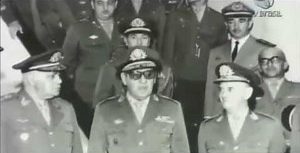
The 1964 Coup in Brazil
or go to
Aletho News Archives – Video-Images
Frlom the Archives
70 Neocons Petition Congress To Effectively Allow Israel To Say When The US Should Attack Iran
By Damian Lataan | January 10, 2014
Seventy senior Israeli-centric neoconservatives have written an open letter to Congress imploring them to do more to ensure Iran complies with the conditions of any agreement finally reached with the P5+1 over Iran’s nuclear program.
While the neocons are ostensibly asking Congress to ensure compliance, it is clear that their real aim is to convince members of Congress to support the bill currently passing through the Senate which calls for tighter sanctions against Iran in the event of any waywardness on Iran’s part.
The neocons are eager to see the bill currently passing through the Senate with enough support to make it veto-proof, not so much because they are concerned about Iran’s so-called nuclear weapons program – there’s still not a skerrick of hard evidence that Iran has a nuclear weapons program – but, rather, because embedded within the bill is this clause:
… if the Government of Israel is compelled to take military action in legitimate self-defense against Iran’s nuclear weapon program, the United States Government should stand with Israel and provide, in accordance with the law of the United States and the constitutional responsibility of Congress to authorize the use of military force, diplomatic, military, and economic support to the Government of Israel in its defense of its territory, people, and existence…
Essentially, the clause is an automatic trigger for the US to attack Iran at any time the Israelis choose to launch a first strike – regardless of whether President Obama is in favour or not.
Partial list… continue
Blog Roll
-
Join 2,450 other subscribers
Visits Since December 2009
- 7,407,878 hits
Looking for something?
Archives
Calendar
Categories
Aletho News Civil Liberties Corruption Deception Economics Environmentalism Ethnic Cleansing, Racism, Zionism Fake News False Flag Terrorism Full Spectrum Dominance Illegal Occupation Mainstream Media, Warmongering Malthusian Ideology, Phony Scarcity Militarism Progressive Hypocrite Russophobia Science and Pseudo-Science Solidarity and Activism Subjugation - Torture Supremacism, Social Darwinism Timeless or most popular Video War Crimes Wars for IsraelTags
9/11 Afghanistan Africa al-Qaeda Australia BBC Benjamin Netanyahu Brazil Canada CDC Central Intelligence Agency China CIA CNN Covid-19 COVID-19 Vaccine Donald Trump Egypt European Union Facebook FBI FDA France Gaza Germany Google Hamas Hebron Hezbollah Hillary Clinton Human rights Hungary India Iran Iraq ISIS Israel Israeli settlement Japan Jerusalem Joe Biden Korea Latin America Lebanon Libya Middle East National Security Agency NATO New York Times North Korea NSA Obama Pakistan Palestine Poland Qatar Russia Sanctions against Iran Saudi Arabia Syria The Guardian Turkey Twitter UAE UK Ukraine United Nations United States USA Venezuela Washington Post West Bank WHO Yemen Zionism
 Aletho News
- Aramco CEO warns ‘catastrophe’ imminent if Strait of Hormuz remains shut
- What If Iran Says No?
- Trump Threatens to ‘Hit’ Iran ‘Twenty Times Harder’ Over Strait of Hormuz Oil Flows
- Spare the hypocrisy: Baghaei slams Ursula’s support for US
- Iran War Supporters Invent a New and Absurd Justification: It Is All About China
- Corporate Media Go All Out To Support The US-Israeli War on Iran
- Trump press conference reveals a man who wants out of war
- When Tel Aviv decides, Washington fights
- Top official: Iran ready for a long war with US, no more diplomacy
- How Iran’s Toxic Rain Reveals US-Israel Discord
- If Americans Knew
- Threats and missiles fly, death tolls soar in Iran, Lebanon, Gaza – Not a ceasefire Day 151
- Lebanon: Israel’s White Phosphorous Use Risks Civilian Harm
- Corporate Media Go All Out To Support The US-Israeli War On Iran
- US-Israel war on Iran is creating a steady growing number of amputees
- Israel planned this war on Iran for 40 years. Everything else is a smoke screen
- The wrong question about the war in Iran
- ‘Your Tax Dollars Being Used to Raise Your Gas Prices’: US-Israel Bomb Major Iranian Oil Depots
- ‘Bogus Evidence’: Former Nuclear Watchdog Head Debunks US Justification for Iran War
- EXPLAINER – Dimona: What to know about Israel’s nuclear site
- Fires and toxic air in Iran (thanks, Israel) – Not a ceasefire Day 150
- No Tricks Zone
- Wake-up Call: Survey Shows Majority Of Germans Now Favor Postponing Climate Targets!
- Televised! Leading German Political Candidate Tells Schoolchildren CO2 Makes Sun Hotter!
- New Study: A Century Warming Of 1.1°C Is ‘Commonplace’ And ‘Not Unusual’ During This Interglacial
- New Study: ‘Internal Noise’ And Volcanic Forcing Can Trigger 10-15°C Warming Within Decades
- Glaciers Worldwide Are Suddendly Surging, Experts Blame Warming!
- Surprising Discovery: Sahara Is Greening…Billions Of Trees Where Once Thought To Be Barren
- New Research Reaffirms Clouds, Aerosols, And Surface Solar Radiation Are ‘Driving The Climate System’
- Germany: Electric Car Catches Fire At Charging Station, Sets Off Local “Inferno”, Widespread Damage
- New Study: Canada’s New Brunswick Was 1°C Warmer Than Today During The Medieval Warm Period
- Coal Power Back In Trend As Globe Tries To Keep Pace With Growing Demand For Power
Contact:
atheonews (at) gmail.com
Disclaimer
This site is provided as a research and reference tool. Although we make every reasonable effort to ensure that the information and data provided at this site are useful, accurate, and current, we cannot guarantee that the information and data provided here will be error-free. By using this site, you assume all responsibility for and risk arising from your use of and reliance upon the contents of this site.
This site and the information available through it do not, and are not intended to constitute legal advice. Should you require legal advice, you should consult your own attorney.
Nothing within this site or linked to by this site constitutes investment advice or medical advice.
Materials accessible from or added to this site by third parties, such as comments posted, are strictly the responsibility of the third party who added such materials or made them accessible and we neither endorse nor undertake to control, monitor, edit or assume responsibility for any such third-party material.
The posting of stories, commentaries, reports, documents and links (embedded or otherwise) on this site does not in any way, shape or form, implied or otherwise, necessarily express or suggest endorsement or support of any of such posted material or parts therein.
The word “alleged” is deemed to occur before the word “fraud.” Since the rule of law still applies. To peasants, at least.
Fair Use
This site contains copyrighted material the use of which has not always been specifically authorized by the copyright owner. We are making such material available in our efforts to advance understanding of environmental, political, human rights, economic, democracy, scientific, and social justice issues, etc. We believe this constitutes a ‘fair use’ of any such copyrighted material as provided for in section 107 of the US Copyright Law. In accordance with Title 17 U.S.C. Section 107, the material on this site is distributed without profit to those who have expressed a prior interest in receiving the included information for research and educational purposes. For more info go to: http://www.law.cornell.edu/uscode/17/107.shtml. If you wish to use copyrighted material from this site for purposes of your own that go beyond ‘fair use’, you must obtain permission from the copyright owner.
DMCA Contact
This is information for anyone that wishes to challenge our “fair use” of copyrighted material.
If you are a legal copyright holder or a designated agent for such and you believe that content residing on or accessible through our website infringes a copyright and falls outside the boundaries of “Fair Use”, please send a notice of infringement by contacting atheonews@gmail.com.
We will respond and take necessary action immediately.
If notice is given of an alleged copyright violation we will act expeditiously to remove or disable access to the material(s) in question.
All 3rd party material posted on this website is copyright the respective owners / authors. Aletho News makes no claim of copyright on such material.
 Aletho News