US forces Russia to close visa centers – ambassador
RT | June 22, 2024
US authorities are closing both Russian visa center offices in the country and will deprive Russia’s diplomats of tax exemption, Moscow’s ambassador to Washington, Anatoly Antonov, has revealed.
The Russia Visa Application Center operates in Washington and New York, assisting those looking to get permits to travel to Russia with preparing the necessary papers and submitting them to the Russian consular offices.
“The Americans notified us that the visa center is closing,” Antonov told the journalists on Saturday. The move by Washington creates a “serious extra burden for us given the fact that our consulate general offices in Houston and New York are drained of blood” due to expulsions of Russian diplomats from the US, he stressed.
The decision to revoke tax exemption status from Russian embassy workers is another “petty, nasty attack” by Washington, the ambassador said. The cards are common practice and handed out to diplomats in all countries, he explained.
US officials didn’t provide any reasoning for their actions, Antonov noted. As for a possible response by Moscow, he said that “there is no need to make any rash moves. We need to consider what the specific consequences of what we will have to do.”
According to the ambassador, the Americans “are trying to break [Russia], trying to change [its] foreign policy, trying to force our diplomats to hide behind the walls of the embassy, to stop communicating and working,” he said.
“This will not happen. Until the last diplomat, while we remain here, we will keep performing our duties,” the ambassador assured.
Relations between Moscow and Washington have steadily deteriorated over the past decade, with the administration of former US President Barack Obama shutting down several Russian consulates after accusing Moscow of “interference” in the 2016 presidential election. The diplomatic row has only escalated since Moscow launched its military operation in Ukraine in February 2022, prompting a wave of Western sanctions and several tit-for-tat expulsions of diplomats by both countries.
Last month, Russia’s Deputy Foreign Minister Sergey Ryabkov warned that Moscow may well downgrade its diplomatic ties with Washington if the West “continues on the path of escalation” in terms of supporting Ukraine or making hostile economic moves.
Nothing to worry about? South Korea sounds the alarm
By Gilbert Doctorow | June 21, 2024
What a difference a day makes. Yesterday’s Financial Times informed readers about the red carpet that was rolled out for Vladimir Putin at his various stops in and around the North Korean capital during his two-day stay there. They spoke of the Russian folk songs which local artists performed in Putin’s honor. They mentioned that various state to state agreements were signed but said almost nothing about the contents.
Today the FT has taken a very different approach to Putin’s visit in a feature article entitled “Japan and South Korea sound alarm over Putin-Kim military pact.” Lo and behold, Seoul has read the text of the Comprehensive Strategic Partnership that North Korea issued and discovered that it contains: “a pledge to deploy ‘all means at its disposal without delay’ to provide ‘military and other assistance’ in the event that one of the signatories was invaded or in a state of war.”
The FT goes on to cite the South Korean foreign ministry’s expression of regret over the strategic partnership: “… co-operation between Russia and North Korea ‘should not undermine regional peace and stability’.” Seoul warns “that their co-operation on military technology would violate UN Security Council resolutions.”
Those resolutions, by the way, are up for renewal in the not-too-distant future, and Putin has said from Pyongyang that Russia will veto any extensions.
The fact is that this barking from the South Koreans is frustrated by the very opacity of the wording of both the texts and of Putin’s spoken remarks after the signing and at a meeting with Russian journalists before his departure for Vietnam.
One thing is certain: the Russian-North Korean deal is not just transactional: it is a genuine alliance, the first and only one that Russia has at this moment.
What kind of military assistance will the sides provide to the other in case an act of aggression is declared? What kind of military technical cooperation do the parties have in mind?
For example, will Russia be providing North Korea with ICBMs capable of reaching all of the United States, as some American experts believe? Or is Russia just extending its nuclear umbrella over North Korea, with a pledge to destroy any attacker? Will Russia provide North Korea with its ship sinking hypersonic missiles that could be very useful if this or any future American president sends an aircraft carrier task force to Korean shores to threaten Pyongyang with instant destruction as Trump once did?
Turned around the other way, what can and will North Korea do to help if Russia declares that an act of aggression has been committed against it by NATO in the midst of the Ukraine conflict? Last evening’s edition of the authoritative Russian talk show, The Great Game, moderated by Duma member and Kremlin insider Vyacheslav Nikonov provided an intriguing insight into what people close to Putin are thinking in this regard.
For some time, Russia’s chattering classes have speculated about possibilities for enlisting some of North Korea’s one million man army to help their forces in the ground war in Ukraine. Now, under conditions of the newly signed military alliance with Pyongyang, these same Russians are saying that should NATO forces enter Ukraine to join the fight against them, as Emmanuel Macron has been urging, then Russia may invite 50,000 or more North Koreans to lend a hand to their cause. Moreover, they note that the North Koreans have some very impressive artillery pieces to bring with them to the fight.
If that kind of talk on Russian television is being ignored by the military attaché in the U.S. Embassy in Moscow I would be very surprised.
In closing, I mention that the fuss raised by Seoul over the Russian-North Korean military alliance was the subject of a 10-minute interview I gave to Iran’s Press TV this morning.
The link is here: https://www.urmedium.net/c/presstv/129882
As I was alerted by one very attentive reader, this link is usable if you ignore the warnings about possibly compromising security of your computer and opt to proceed at your own risk. The warning is malicious, a bit of disinformation from Iran’s detractors, nothing more.
An alternative link that works directly, without unnerving warnings is here: https://odysee.com/PressTV-2024-06-21:8
Enjoy the show!
©Gilbert Doctorow, 2024
Trump names cause of Ukraine conflict
RT | June 21, 2024
Russia’s intervention in Ukraine was triggered by the irresponsible and provocative rhetoric which US President Joe Biden and his administration used about Ukraine joining NATO, Donald Trump has said.
Trump, who is seeking a rematch with Biden for the presidency in November, appeared on the ‘All-In’ podcast posted late on Thursday. The comments about Ukraine came during a conversation on foreign policy with co-host David Sacks.
“For 20 years, I heard that if Ukraine goes into NATO, it’s a real problem for Russia. I’ve heard that for a long time. And I think that’s really why this war started,” Trump said.
The Republican presidential candidate pointed out that there had been no talk about armed conflict between Russia and Ukraine when he was in the White House, but as soon as Biden replaced him, things began to deteriorate.
“I thought that [Russian President Vladimir] Putin may be – well, look, he’s a good negotiator, I thought he was going to be doing that for negotiation purposes,” Trump said. “Then all of a sudden, they attacked, and I said, ‘what’s going on here?’”
According to the former president, one of the key issues was the rhetoric coming out of the White House.
“Biden was saying all of the wrong things. And one of the wrong things he was saying [was] ‘no, Ukraine will go into NATO’,” Trump said.
Sacks pointed out that in January 2022 or thereabouts, US Secretary of State Antony Blinken told Moscow that Ukraine would join NATO and that Washington thought it was OK to put nuclear weapons there. “So no wonder the Russians hit the roof,” he noted.
“Well, let’s say you were running Russia. You wouldn’t be too happy,” Trump replied. “And that’s always been off the table. It’s always been understood that that was a no-no,” he added, addressing Kiev’s potential NATO membership.
Floating the idea of Ukraine in NATO was “very provocative,” Trump said. “And now it’s even more provocative. I hear routinely they’re now talking about Ukraine entering NATO. And now I hear France wants to go in and fight. Well, I wish them a lot of luck!”
Putin has specifically pointed to Western statements about Ukraine’s possible membership in the US-led bloc as a security threat Moscow could not ignore. Ukraine’s neutrality has been one of the non-negotiable Russian conditions for the conflict to end.
NATO has argued that its “open door” policy is essential and that no one had the right of veto over it, but also that its expansion eastward was not the cause of the conflict.
In an interview with Time magazine earlier this month, Biden claimed that the US is “the strongest nation” because of NATO expansion, and that he told Putin he would get “NATOization of Finland” instead of “the Finlandization of NATO” during their June 2021 summit in Switzerland.
Droning Russia’s nuke radars is the dumbest thing Ukraine can do
Attacks on the early warning system actually highlights the fragility of peace between the world’s nuclear powers
BY THEODORE POSTOL | RESPONSIBLE STATECRAFT | JUNE 5, 2024
For a fleeting moment on May 22 the world may have come closer to a catastrophic nuclear accident due to a reckless Ukrainian drone attack on two Russian strategic nuclear early warning radars at Armavir.
Fortunately, a subsequent Ukranian drone attack on a third radar station at Orsk in Russia on May 26 failed.
The incidents underscore a few important things. First, the Ukrainians could have needlessly sparked a crisis in which the Russians, feeling like one of their defenses against a U.S. nuclear attack, were down, struck back hard in retaliation. And second, it highlights the need for Russians to acquire comprehensive space-based nuclear radar of their own.
What happened and what it means
The Ukrainian attack at Armavir was a big deal. It shut down both Russian radars immediately. And it’s likely that within minutes of the attack, an emergency meeting took place with the commander of the Russian strategic rocket forces along with his highest-level officers.
The attacks should not be taken lightly, and President Biden and Secretary of State Antony Blinken should be giving this special attention.
Even after decades of expensive Russian attempts to build a space-based early warning system that could provide global surveillance of U.S. submarine missile launches, Russia has been unable to marshal the extremely specialized high-technologies needed to build such a system.
To in part deal with this serious shortfall in Russia’s nuclear early warning capabilities, Vladimir Putin himself initiated and publicly supported a highly visible national effort to build a dense and capable nuclear strategic early warning radar system that utilizes numerous giant radars (typically about 30 to 35 meters high).
Since these radars basically form the singular foundation of Russia’s strategic nuclear early warning capabilities, any tampering with their functions in any unpredictable global situation is accompanied by very grave risks of misinterpretations of intentions that could lead to a massive launch of Russian nuclear forces.
Figure 1 below shows a satellite photograph of the two radars at Armavir. The radar beam from what is labeled “Radar Fan 1” is pointing in a counterclockwise direction from North of roughly 125°. Radar Fan 2 is pointing in a clockwise direction from North of roughly 125°.
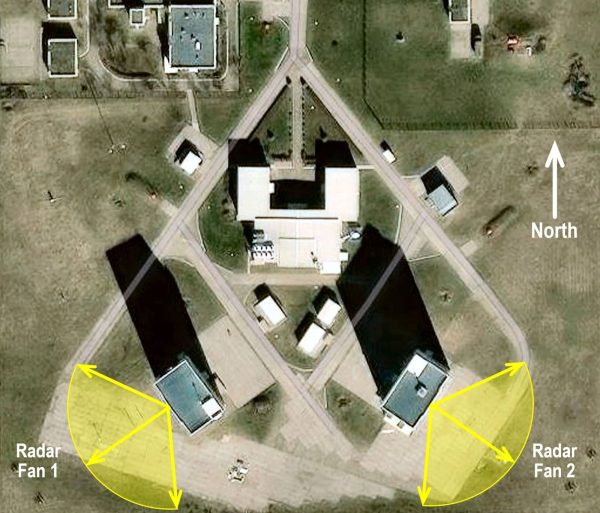
Figure 2 shows the coverage of the two radar fans at Armavir, and the radar at Orsk drawn on a spherical earth. A side view of a radar fan is shown in the upper right corner. The side-on view shows an extremely important consequence of the fact that Earth is curved and the radar beam propagates basically in a straight line. Because of that, the radar cannot actually see objects near the surface.
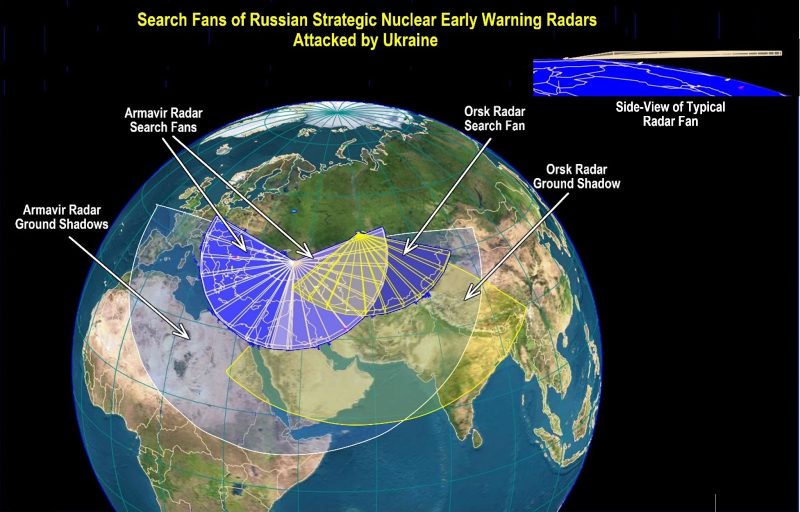
For example, it is not possible for the radar to observe aircraft flying over Ukraine. Even ATACM missiles launched from the Ukrainian Black Sea coasts, which rise to altitudes of no more than 40km before they start gliding to their targets, cannot be reliably detected by these radars.
Thus, the radars at Armavir pose no surveillance threat to Ukrainian aircraft, cruise missiles, drones or ATACM missiles. The real threat to Ukrainian aircraft and missiles is from Russian airborne radar systems that are tightly queued into Russian ground-based surface-to-air missile systems.
Why these radars are so important
The importance of having a space-based satellite early warning system can be readily understood by re-examining figure 2.
For purposes of illustration, imagine that a Trident ballistic missile is launched at Moscow from the Indian Ocean at about the same latitude as Bombay on the West Coast of India (20° North latitude). The range to Moscow would be roughly 4,500 to 4,600 km.
If the ballistic missile were launched on a “minimum energy trajectory” (at a loft angle of roughly 34°) it would require the smallest missile burnout speed needed to reach Moscow. In this case the time between “breakwater” missile ignition and impact would be roughly 21 to 22 minutes.
However, the Trident missile is designed to launch its warheads to much higher burnout speeds. For example, it could launch its nuclear payload toward Moscow at a slightly higher speed and lower loft angle of 25° (this is often called a slightly “depressed” trajectory) and still easily reach Moscow in 18 to 19 minutes.
If a launch towards Moscow is on a slightly depressed trajectory, the Russians would not know they were under attack for at least six minutes, until the warheads and the rocket upper stages passed into the Armavir radar search fan. If the Armavir radar was not operating it would take eight to nine minutes from breakwater before the Russian radars in Moscow would indicate they were under attack.
The radar in Moscow would have to observe the incoming missile payloads for one or two minutes before it would have enough data to issue an alert — which means maximum decision-making time that might be available to Russian leaders would be about six or seven minutes!
So you can see why the Russians would be incensed over the Ukraine attacks, which would literally cut their already limited time in which to respond to a nuclear attack.
If the Russians had an early warning space-based system, they would know that they were under attack roughly 19 minutes before the attacking warheads would arrive and destroyMoscow. They would also immediately know whether or not ballistic missiles were being launched from other parts of the world.
Although all of these warning times are shockingly short, it is clear that a warning time of 19 minutes versus one of eight to nine minutes could make the difference between forcing Russia to rely on an automated decision that could lead to the accidental destruction of the United States and Western Europe, or instead on a more reasoned assessment by political leaders and highly professional military commanders.
Any appropriately knowledgeable expert who has listened carefully to Putin’s numerous statements about nuclear weapons would know that he has a detailed knowledge of this warning system and its limitations. He has regularly shown up at the inaugurations of early warning radar sites, overtly indicating his concerns about the need for adequate and reliable early warning systems.
The Russians do currently have an extremely limited space-based early warning system. The system only observes the U.S. ICBM fields near its northern borders and cannot be proliferated to provide global coverage against U.S. submarine missiles. It does not even have 24-hour coverage of the U.S. ICBM fields, since nine satellites are needed to provide that coverage and only four are active at this time.
I have sought to warn the U.S. government leadership of this serious problem, which could have been solved 30 years ago by the U.S. “lending” certain technologies to the Russians. My proposals involved providing the Russians with specialized space-qualified infrared arrays and electronics that would allow them to build their own systems.
This technology would not give the Russians any sensitive military secrets. There would be no way for the Russians to “reverse engineer” these implementing components. Just like the most advanced computer chips, only a vast technical enterprise could achieve such an end.
Instead of recognizing that it is in the interest of the entire world for both Russia and the United States to have reliable and capable early warning systems, at that time, the Clinton administration largely ignored this serious problem, which I believe threatens the survival of civilization even today. Other administrations that followed did no better.
The bottom line is that this grave danger to human civilization, and possibly human survival, could have been solved by competent political leadership almost 30 years ago, to the benefit of the entire world. But it wasn’t, which makes the attack on the radars now a potential crisis.
Theodore A. Postol is Professor Emeritus of Science, Technology and National Security Policy at MIT. He also taught at Princeton and Stanford, and was an advisor to the Chief of Naval Operations, where he evaluated U.S. tactical and strategic nuclear war plans, U.S. strategic anti-submarine warfare plans, Russian and U.S. missile defenses, and the Trident I and Trident II Submarine-Launched Ballistic Missile Systems.
Russia and North Korea agree on mutual aid against aggression – Putin
RT | June 19, 2024
Moscow and Pyongyang have pledged to assist each other against foreign aggression, Russian President Vladimir Putin announced on Wednesday during a visit to the Democratic People’s Republic of Korea.
Putin and his North Korean counterpart, Kim Jong-un, signed a strategic partnership which will serve as a roadmap for future cooperation in all spheres, from cultural and tourist ties, to trade, economic relations and security, the Russian leader has said, calling it “truly a breakthrough.”
“The document on comprehensive partnership that we have signed today provides, among other things, for mutual aid in case of aggression against one of the participants,” the president added.
Moscow supports Pyongyang’s intention to protect its security and sovereignty from possible Western aggression, which is its right, Putin said. The country considers the US and its allies responsible for the increasing tensions in the region, he added.
“Overused Western propaganda tropes can no longer hide their aggressive geopolitical intentions, including in Northwestern Asia,” Putin said.
Putin noted that Western nations were supplying advanced weapons to Ukraine and have given Kiev the green light to strike Russia. Under these circumstances, “Russia does not rule out the development of military cooperation with the DPRK under the document signed today.”
The visiting head of state denounced the “indefinite restrictions regime” imposed on North Korea by the UN Security Council, which includes an arms embargo, as “orchestrated by the US” and urged for it to be revised.
The Russian president had previously warned the West over Kiev’s desire to use donated weapons to conduct attacks deep inside Russia. Should that happen, Moscow could send similar types of weapons to enemies of the West, which could use them to strike the military assets of the US and its allies, he said earlier this month.
Pyongyang has an “objective and balanced” stance on the Ukraine conflict and sees its core causes, which proves North Korea’s independence and sovereignty, Putin said. The two nations are also on the same page in supporting “a more just and democratic multipolar world” that should replace the previous Western-centric system.
”We will continue to oppose the imposition of strangling sanctions, which the West has turned into a tool of maintaining its hegemony in politics, the economy and other areas,” the president vowed.
Recalling the lengthy record of Russian cooperation with North Korea, Putin noted the role that the Soviet Union played in the fight against Imperial Japan during the Second World War and the reconstruction efforts following the Korean civil war, which split the Korean Peninsula between two rivals. Moscow was the party with which Pyongyang signed its first international agreement 75 years ago, he added.
Glenn Diesen about the benefits of a multipolar, Eurasian world order
Reinvent Money | June 16, 2024
Paul Buitink talks to Glenn Diesen, a Norwegian academic and political scientist. He is a professor at the School of Business of the University of South-Eastern Norway. Glenn explains why the current international liberal unipolar world order is in decline. And why a new multipolar Eurasian order is inevitable and how that would benefit the world. He describes Europe’s role and challenge in this new world order. Also Glenn dives into the Russia and Ukraine conflict and why the incremental approach of the West could lead to a boiling frog situation. At the end he also shares his experiences of being a controversial scientist in Norway.
Find more about Glenn Diesen here, including his latest book The Ukraine War & The Eurasian World Order: https://x.com/Glenn_Diesen https://www.amazon.com/Ukraine-War-Eu…
Follow Paul on X here:  / paulbuitink
Russia withdraws from MH17 resolution process
RT | June 18, 2024
Moscow is not interested in participating in a “performance” before a Western-dominated panel of the International Civil Aviation Organization (ICAO) about the 2014 crash of a Malaysian passenger jet in Donbass, the Russian Foreign Ministry has said.
Malaysian Airlines flight MH17 was flying from Amsterdam to Kuala Lumpur when it was shot down in Ukrainian airspace. Kiev immediately blamed Donetsk People’s Republic forces and Russia for the incident. In March 2022, the Netherlands and Australia opened an investigation against Russia at the ICAO Council.
“The ICAO Council is not the right place to look for the truth. It makes no sense for us to remain a part of the ‘performance’ started in it,” the Russian Foreign Ministry said on Monday.
Russia had initially agreed to take part in the proceedings “because we believed that the ICAO platform could be used for professional dialogue about the plane crash,” the ministry said.
However, the council first claimed judiciary powers it did not have, then tried to admit as evidence the two investigations into the MH17 disaster that explicitly excluded Russia – by the Dutch Security Council (NSB) and the Joint Investigation Team (JIT) – while welcoming Ukraine and other adversely interested parties, according to Moscow.
Russia has proposed “a full, thorough and independent international investigation into the crash of flight MH17, as required by UN Security Council Resolution 2166 and the ICAO Dispute Resolution Rules,” but the council refused, the foreign ministry said.
“Ruled by the countries of the collective West and their satellites, the ICAO Council also refused to take into account the decision of the International Court of Justice (ICJ) of January 31, 2024,” which rejected Ukraine’s claims against Russia in the MH17 case, the ministry noted.
The council consists of 36 members, who vote according to instructions from their governments. Australia and 12 others had already publicly blamed Russia for MH17 before any investigation began, the ministry said. When Russia asked them to abstain from voting in the matter, they refused.
This pattern of behavior “runs counter to the minimum requirements for the objectivity of the proceedings,” the Russian Foreign Ministry said. “Under such circumstances, it is impossible to talk about an unbiased establishment of facts, much less a fair decision.”
The “extensive and convincing evidence,” both factual and legal, that Russia was not involved in the MH17 incident has been made available to 193 ICAO members, the ministry noted.
Russia’s post-war dilemmas in Ukraine
BY M. K. BHADRAKUMAR | INDIAN PUNCHLINE | JUNE 18, 2024
In regard of the war in Ukraine, Russia’s main challenge going forward is to find the equilibrium between strategic overestimation and underestimation. “We always overestimate the change that will occur in the next two years and underestimate the change that will occur in the next ten,” as Bill Gates put it.
A triumphalist tone is unmistakeable in President Vladimir Putin’s speech on Friday to a special gathering of senior foreign ministry officials in Moscow presenting the guardrails for negotiations with Ukraine. Russia is a country of high-context culture, which communicates in ways that are implicit and relies heavily on context.
Putin underscored certain pre-conditions. Russia is ready to immediately cease hostilities if Ukraine begins withdrawing its military units beyond the administrative boundaries of Donbass, Zaporizhia and Kherson regions. This is a curious replay of the precondition that Moscow fulfilled in March 2022 when following the talks in Istanbul, Ukraine expected a rollback of Russian deployments around Kiev.
Once bitten, twice shy — Putin’s precondition implies that new territorial realities should be fixed by international treaties. Moscow is ready to negotiate only after Kiev formally notified NATO that it is abandoning the intent to seek membership. Russia expects a complete lifting of sanctions.
Evidently, Russia’s peace terms are, partly at least, based on certain prerequisites that are, conceivably, impossible for Ukraine and its mentors to fulfil. So, presumably, a further hardening of the peace terms is to be expected if Russian troops make more gains on the battlefield. Meanwhile, Moscow is signalling to its Western adversaries the inevitability of a massive redrawing of the Russian-Ukrainian border as the basis for peace.
Unsurprisingly, the Western powers view Putin’s peace terms as an ultimatum although Russian diplomacy propagates them as an important peace initiative. It is timed carefully, just as the G7 summit at Borgo Egnazia in Italy ended and on the eve of the Western-sponsored ‘peace meet’ in Bürgenstock.
The prognosis by the influential politician who has been a deputy speaker of the Duma since 2016 and the scion of an illustrious Russian family, Pyotr Tolstoy (great-great-grandson of Leo Tolstoy) is that Moscow will call out next only for the surrender of Ukrainian forces.
The mood in Moscow has become belligerent, as the EU, at sustained prodding by Washington, is inexorably moving toward the confiscation of Russia’s frozen assets in western banks — ostensibly for meeting Ukraine’s needs but in reality to defray the huge expenses Washington is incurring for its proxy war.
The G7 summit’s communique highlights that “In the presence of President Zelenskyy, we decided to make available approximately USD 50 billion leveraging the extraordinary revenues of the immobilised Russian sovereign assets, sending an unmistakable signal to President Putin. We are stepping up our collective efforts to disarm and defund Russia’s military industrial complex.”
The G7 formulation is a white lie. What is unfolding is a financial scam of the century and the largest theft of money in history. A clutch of modern-day brigands is literally grabbing about $260 billion of Russia’s sovereign assets and giving it the colouring of a legal translation by attributing to it the process the status of a financial collateral for an American loan to Ukraine in blatant violation of international financial law that would ultimately line the pockets of the US military-industrial complex and the politicians.
Suffice to say, Washington is making its proxy war in Ukraine a self-financing, cost-accounting enterprise with Europeans as guarantors. Washington is inflicting a big blow to Russia’s national honour and pride. The big question is where does Russia go from here, given its ‘high-context culture’?
One barely-noticed ellipsis in Putin’s speech on Friday was that he left his lengthy recap of Western betrayals hanging in the air without a foot note as to how Russia came to such a sorry pass at all historically.
If the willing submission to the avalanche of national humiliations was merely due to Russia’s weakness, surely, that is a thing of the past. Today, Russia stands tall as the fourth largest global economy, a great military power and the sole power on the planet with the strategic capability to reduce the US to thermonuclear ashes. Yet, minions like NATO secretary-general Jens Stoltenberg are threatening Russia that he’s heading a “nuclear alliance.”
That is where the elucidation on Putin’s speech by the Dy Chairman of Security Council, Dmitry Medvedev — “on what he [Putin] carefully hinted at in his speech” — needs to be understood properly.
Medvedev made four key points:
- The new territories that became part of Russia since 2022 will “remain so forever.”
- A “catastrophic scenario” is developing for the Kiev regime.
- The sanitary zone Russia will create on its western borders to prevent terrorist attacks may extend right up to Ukraine’s border with Poland, the staging post for NATO’s threats against Russia.
- “The President did not say this [western Ukraine’s fate] directly, but it is obvious that such territories, if desired by the people living there, can become part of Russia.”
Most certainly, it is not a coincidence that Putin landed in Pyongyang this morning — or that, Russia’s Pacific Fleet commenced a large scale naval exercise from today till the 28th of June in the Pacific Ocean, in seas of Japan and Okhotsk.
In the context of his state visit to North Korea, Putin wrote in an article for North Korea’s Rodong Sinmun, “We highly appreciate the DPRK’s unwavering support for Russia’s special military operation in Ukraine… We will… jointly oppose illegitimate unilateral restrictions [read sanctions], and shape the architecture of equal and indivisible security in Eurasia.”
By the way, if North Korea, which is a nuclear power, figures in the first circle of Russia’s strategic calculus as an ally, can Iran which is a nuclear threshold country be far behind — and, importantly, what could be its alchemy? Indeed, Russia has warned that it will give an asymmetrical response to the attack on its territory with western weapons allegedly aided by NATO personnel — something without precedent even at the high noon of the Cold War — and NATO secretary-general’s open, vociferous support for it.
In Strobe Talbott’s book The Russia Hand (2002), he narrates an aside with Bill Clinton during a US presidential visit to Moscow in 1995. Clinton told Talbott using a favourite metaphor that his instincts were that Russian elites were sulking and couldn’t take anymore the “shit” being shoved down their throat. Indeed, NATO’s eastward expansion was already on the drawing board in the White House by then.
However, it took Russia another quarter century till February 2022 to resist US bullying. To be sure, Medvedev’s candid ‘annotation’ could not have been without approval from Putin.
The challenge for the next two years is that Russia might overestimate the willingness of the US and EU to concede its legitimate demand of equal and indivisible security.
On the other hand, in a longer term perspective, Moscow should not underestimate the stubborn refusal by Europe’s declining powers — UK, France and Germany — to accept the rise of Russia as a compelling geopolitical reality that they must reconcile with.
Hungarian PM Viktor Orhan is spot on in estimating that it will be sheer naïveté to assume that the new EU leadership would moderate the policies towards Ukraine and Russia, despite the ascendancy of the right-wing parties in the recent elections to the European Parliament.
West hindering nuclear deal’s revival, blaming Iran for failure: Russia
Press TV – June 17, 2024
A senior Russian diplomat says the three European signatories to the Iran nuclear deal have failed to fulfill their commitments and are now blocking the negotiations to revive the US-abandoned agreement.
Russian Permanent Representative to International Organizations in Vienna Mikhail Ulyanov made the remarks in an interview with Russia’s daily broadsheet newspaper Izvestia.
He said the talks to revive the nuclear deal – officially known as the Joint Comprehensive Plan of Action (JCPOA) – have so far failed to yield any outcome due to insufficient efforts on the part of the European troika (France, Germany and Britain) as well as the United States.
It is not the Iranians who are blocking the negotiations now as they are ready to resume the talks, he maintained.
The top Russian negotiator added that the three European countries – also known as E3 – are playing a “strange game” but demand full compliance from Iran.
At the same time, the trio blames Russia and Iran for the failure of the JCPOA revival talks, Ulyanov said.
The negotiations to restore the JCPOA began in April 2021, three years after the US unilaterally withdrew from the UNSC-endorsed agreement and began to target Iran’s economy with tough economic sanctions.
Iran has criticized the lack of will on the side of the US and the E3 to revive the deal and has ramped up its nuclear activities in response to their non-compliance.
In a statement issued on Saturday, the foreign ministers of Britain, France and Germany condemned what they called “the latest steps” taken by Iran “to further expand its nuclear program.”
They also accused Iran of taking “further steps in hollowing out the JCPOA, by operating dozens of additional advanced centrifuges at the Natanz enrichment site as well as announcing it will install thousands more centrifuges at both its Fordow and Natanz sites.”
Iran on Sunday strongly condemned the E3 statement as absurd and based on false allegations, saying the country’s nuclear program has a completely peaceful nature and nuclear weapons have no place in the country’s military and defense doctrine.
US Boosted Nuclear Arms Spending by 18% in 2023, Record Among Nuclear States – Report
Sputnik – 17.06.2024
The United States last year increased spending on nuclear weapons by 18%, which is the highest rate among all nine countries possessing nuclear weapons, the International Campaign to Abolish Nuclear Weapons (ICAN) said on Monday.
US alone spends on nukes more than all other nuclear-armed states, the report read.
“[In 2023] Every country increased the amount it spent on nuclear weapons. The United States had the biggest increase, at nearly 18%. The United States spent more than all the other nuclear-armed states combined, at $51.5 billion. China surpassed Russia as the second-highest spender at $11.9 billion, and Russia came in third, spending $8.3 billion,” the ICAN said in a report, adding that the United Kingdom also significantly increased its nuclear spending for the second year in a row.
In 2023, the US, the UK, China, France, India, Israel, North Korea, Pakistan and Russia spent a total of $91.4 billion developing their nuclear arsenals, which is $10.8 billion or 13.4% more than in 2022, the ICAN also said.
“In 2023, twenty companies working on nuclear weapons development and maintenance earned at least $31 billion for this work. There are at least $335 billion in outstanding nuclear weapons contracts to these companies, some of which have continued for more than a decade. In 2023, at least $7.9 billion in new nuclear weapon contracts were awarded,” the report read.
ICAN, a coalition of civil society organizations in over 100 countries, was founded in Melbourne, Australia in 2007. The coalition promotes adherence to the Treaty on the Prohibition of Nuclear Weapons. In 2017, it received the Nobel Peace Prize for its efforts.
Earlier, experts explained to Sputnik that recent Minuteman III launches are a regular audit of the strategic forces rather than nuclear saber-rattling.
Cancelling “Controversial” Scholars
BY GLENN DIESEN | JUNE 16, 2024
In response to an article in Khrono, I want to challenge the label “controversial” that was used to describe me. Controversial means that there are strong and conflicting opinions to what I am arguing.
But academics should use scientific methods to challenge established truths. This is particularly important in international conflicts where consensus in society is to a large extent shaped by the human instinct to respond to threats with conformity and solidarity.
Every time there are attempts to censor and cancel me, it is based on the fact that I have “controversial” arguments about Russia and the war in Ukraine. If my arguments are based on hard facts that are important for understanding the war in Ukraine, then it can still be labeled as “controversial” if it contains information that has been left out of the public debate.
Let me give one example of how reality can become “controversial”. There is now a strong consensus in Norwegian society that Russia’s invasion was not a reaction to NATO expansionism, but motivated by territorial expansion. Was this established truth shaped through the scientific method where freedom of speech allowed us to present all the facts? Or has society been under enormous pressure to present this conflict as a battle between good and evil forces, where even explaining is condemned as defending? There is overwhelming evidence that Russia invaded to prevent NATO expansion, yet it is never reported in the media. How is it possible that none of our journalists report on facts that can be proven and are of the highest relevance to the public to understand this conflict?
In war, the human instinct to seek safety in the group is strengthened. We only discover in retrospect that the war narratives were full of errors, and that the poor analysis led to a bad policy that harmed our own security interests. Since the demand for conformity is great and we punish dissent and deviation from the group, academia is an important balance as ignoring reality undermines the possibilities for peace.
If we believe that Russia will continue to invade new countries, then it supports the argument that “weapons are the path to peace” – even if it could result in a major war. But if Russia wants limitations on NATO’s presence along their borders, then there are possibilities for peaceful solutions.
When the word “controversial” is combined with “pro-Russian”, it becomes impossible to discuss arguments. Suspicion of the person becomes the main focus. The term “pro-Russian” is a charged and tendentious term as it suggests that the person concerned has chosen a side against our country, that there is loyalty with the out-group against the in-group.
I argue that the West’s policy towards Russia over the past 30 years has put us on a collision course and undermined our own security. Should this be labeled as “pro-Russian” and “anti-Western” arguments? The point of departure for conflict resolution is understanding the other party’s security concerns. Is it possible to analyze international security with such restrictions on freedom of expression?
It is possible that I am wrong in my analysis of Russian intentions and there are obviously counter-arguments, but in academia and in an open society, arguments must be allowed to compete in order to get the best possible understanding of reality.
Labeling dissenters as “controversial” is a method of legitimizing censorship and cancellation. This is particularly problematic as the strong consensus in society was formed by leaving out very basic information.
Russian news photographer killed in Ukrainian drone strike

RT | June 16, 2024
Russian news photographer Nikita Tsitsagi has died from injuries sustained in a drone strike in the Donetsk People’s Republic, the portal News.ru reported on Sunday. According to the publication, the correspondent was killed in an attack by Ukrainian drones in the area of the Nikolsky Monastery near the Donbass city of Ugledar, where he was filming a report.
The tragedy was confirmed by Tsitsagi’s colleagues working in the area and local operational services. The details of the incident are unclear so far.
Tsitsagi collaborated with several Russian media outlets, including TASS and Lenta.ru. In June last year, he received the ‘Editorial Board’ journalistic award for a report he did on the Ukraine conflict and its repercussions in the Russian border town of Shebekino in Belgorod Region.
Earlier this week, another photojournalist, NTV crew member Valery Kozhin, died from wounds he suffered in a Ukrainian drone attack on Gorlovka, also in the Donetsk People’s Republic. Kozhin was filming in the area when a mortar round exploded on top of his crew. Journalist Aleksey Ivliev and an accompanying Russian military officer were also injured.
At least 30 Russian journalists have lost their lives in the Ukraine conflict since it began in February 2022, Russian President Vladimir Putin said at a press briefing during the St. Petersburg International Economic Forum (SPIEF) earlier this month. Among them are Boris Maksudov, who worked for Russia 24 TV, RIA Novosti’s Rostislav Zhuravlev, Tavria TV’s Oleg Klokov, and RuBaltic’s Aleksey Ilyashevich.
Moscow has repeatedly accused Ukrainian forces of deliberately targeting members of the Russian press who are reporting from the frontline. Earlier this week, Russian Foreign Ministry spokeswoman Maria Zakharova lashed out at international human rights organizations, including the UN, for remaining silent in the face of Ukrainian attacks. She accused them of becoming Kiev’s accomplices in “this monstrous hunt for our correspondents” and encouraging further atrocities.
Featured Video
Theodore Postol: Iran’s Missiles & Drones Were Underestimated
or go to
Aletho News Archives – Video-Images
From the Archives
What is the Israeli Lobby in Australia Doing in Interfaith Dialogue?
By Ali Kazak | Dissident Voice | October 11, 2015
For years Israel and its lobby around the world have been trying to normalise their relations with Arabs and Muslims without solving the Palestine Question.
One of the methods they resorted to in the last few years is using human rights and community organizations such as interfaith dialogue and Multiculturalism to achieve this objective and to: isolate the Palestinians, marginalise the Palestine question, end Israel’s isolation, and prevent criticism of Israel, knowing that these organisations will be the first to stand against Israel’s violations, racial and religious discrimination.
The group responsible for this task in Australia is The Australia/Israel & Jewish Affairs Council (AIJAC); its Director of International & Community Affairs, Jeremy Jones is in charge of lobbying religious community organizations, specifically Muslims and Christians. Consequently he convened the Faith Communities for Reconciliation, founding participant in the Australian Partnership of Religious Organisations and the Australian National Dialogue of Christians, Muslims & Jews.
AIJAC is a private political propaganda group. It is recognised as the main Israeli lobby in Australia. It coordinates its activities and works intimately with the Israeli embassy in Canberra and different institutions in Israel. It is privately funded by some Jewish businessmen. It monitors closely Australian politicians, the media, ethnic and religious groups, (especially Arabs and Muslims), unions and academics on their stands towards Israel and the Palestine question. … continue
Blog Roll
 Aletho News
- The killing of three Indonesian soldiers in Lebanon should remind Jakarta that Israel does not want peace
- Defeated and delusional: Netanyahu’s remarks reveal $80bn war failure, says analyst
- Iran’s friends are about to make life much more difficult for Israel and the US
- The war of liberation of the Arab and Islamic peoples expands across the Gulf
- Envoy warns UN on Trump’s threat to ‘obliterate’ Iran’s civilian infrastructure
- The Larak Corridor: Iran’s Rial Gate With No US, No Israel, and No Way Around
- ‘Economic terrorism’: Steel facilities hit again in US-Israeli strike
- ‘War Crime’: Iran condemns attacks on Arak, Ardakan nuclear sites
- Two-thirds of Americans want quick end to Iran war even if goals unmet
- Trump to Give “Important Update on Iran” Wednesday in Prime-Time Speech
- If Americans Knew
- Gaza families reunite years after babies evacuated amid Israel’s war
- International Rescue Committee warns Gaza’s children face grave protection risks
- Iran’s Alleged 47-Year War on America: Debunking the 1,050 American Deaths Canard
- Israel wants US to bomb more of Iran’s civilian structures (113,000 is not enough) – Not a ceasefire Day 173
- Ann Coulter Rips Into Fox News for Iran War Coverage
- Joe Kent Urges Americans To Call White House and Congress To Object To Sending Troops Into Iran
- DNC Resolution to Reject AIPAC Funding Puts Democratic Leaders in the Hot Seat
- Swedish foundation to build 400 schools as over 650,000 Gaza children remain without education for 2 years
- Israeli army admits photshopping image of slain Lebanese journalist
- This is how Israel is systematically killing health workers under the cover of war in Lebanon
- No Tricks Zone
- New Study Finds Warming Saves Lives…Cold Temperatures 12 Times More Deadly Than Excess Heat
- German Science Blog Accuses PIK Climate Institute Of Hallucinating Climate Tipping Points
- Devastating Assessment Of Comirnaty Vaccine By Former Senior Pfizer Europe Toxicologist
- New Study: CO2 Is ‘Effectively Negligible’ As An Explanatory Climate Change Factor Since 2000
- Former Pfizer Toxicologist Dr. Helmut Sterz Tells Bundestag Hearing Pfizer Vaccine Should Have Never Been Approved
- Energy Expert: Germany’s Nuclear Phaseout Was A “500 Billion Euro Mistake”
- New Research: South Australia’s Mid-Holocene Sea Surface Temperatures Were 4°C Warmer Than Today
- Storing Green Energy To Last Germany 10 Days Would Require A 60-Million Tonne Battery
- New Studies: UK Sea Levels Were 4 Meters Higher Than Today During The Mid-Holocene
- Destructive Green New Deal: German Energy And Metal Group Warns Of Drastic Crisis
 Aletho News