Russia thwarts Ukrainian attack on border area
RT | January 3, 2024
Russia’s Belgorod Region, which borders Ukraine, has come under fresh attack after Kiev’s forces launched a barrage of a dozen missiles, the Russian Defense Ministry has announced, adding that its air defenses had shot down all incoming projectiles.
The ministry wrote on its Telegram channel on Wednesday that “another attempt to carry out a terrorist attack by the Kiev regime on facilities on the territory of the Russian Federation, using multiple launch rocket system ‘Olkha’ missiles and ‘Tochka-U’ tactical ballistic missiles, was thwarted this morning.”
According to the statement, the shelling involved six rockets of each type.
Local residents reported seeing explosions in the skies early on Wednesday morning.
The Ukrainian military also shelled the region on Tuesday evening, using the same type of rockets, the defense ministry said, adding that all incoming missiles had been intercepted.
Earlier in the day, Kiev’s forces launched 17 ‘Olkha’ missiles toward Belgorod Region in three separate attacks. Governor Vyacheslav Gladkov wrote on his Telegram channel that one civilian had died and two were injured as a result of falling debris as the missiles were shot down.
The Russian Defense Ministry estimated that its air defenses brought down a total of 32 Ukrainian drones over Bryansk, Oryol, Kursk and Moscow regions on Monday night and Tuesday morning.
On Saturday, the city of Belgorod came under attack, with a massive Ukrainian barrage killing 25 people and wounding more than 100 others.
Kiev described the strike as retaliation for a previous Russian attack on major Ukrainian cities, including Kiev.
According to an anonymous Russian security source, Saturday’s shelling was personally ordered by Ukrainian President Vladimir Zelensky. Moscow has also claimed that the UK and the US also bear responsibility for the death of Russian civilians in Belgorod.
Ukraine and Russia have since engaged in daily tit-for-tat bombardments.
The Russian Defense Ministry reported on Tuesday that its missile strikes had obliterated a number of military industry facilities, repair shops, and ammunition warehouses in the neighboring country. Ukrainian authorities claimed that most of the projectiles ended up hitting civilian infrastructure and apartment blocks, killing multiple civilians.
The enabler of our two concurrent world wars: Washington
By Gilbert Doctorow | January 2, 2024
It is only the second day of the New Year, but you turn on the morning news with a feeling of trepidation. Here in Western Europe, the lead stories are death and destruction reported from the front lines of the two conflagrations that some commentators have identified as ‘world wars,’ given the way countries across the globe have aligned themselves with or against the protagonists in each conflict. The outstanding commonality between these two world wars is the position of the United States as their enabler in terms of delivery of essential military and financial support to one side, as well as real-time military intelligence, tactical and strategic counseling by high level officers positioned on the ground and in nearby seas. From the perspective of Washington, these are proxy wars which put at risk very few of its own men at arms, though some do come home in body bags without word to the press, while preparations proceed apace for the launch of a third proxy war in the South China Sea. The Philippines are the latest recruits to the prospective encirclement and assault on China.
On their talk shows, the Russians speculate on when a mutual defense pact with Iran, China and North Korea will be announced. This will not be a bloc, like NATO, but will enshrine the key principle of ‘one for all and all for one’ in case of attack by outside forces. To its backers in Moscow, this formulation would ensure that NATO generals understand they are up against an enemy of over two billion if we include a few other fellow travelers, not just the 145 million Russians whom they see across the border.
But that is what they say on talk shows. It is not the official voice of the Kremlin, which we find on Vesti television. Vesti maintains a near blackout of news on the Israel-Hamas war in broadcasts to its home audience. Why? Because Russia does not want to get embroiled in that war when it needs all its human and materiel resources to defeat the Ukrainians and their NATO backers. Moreover, Russia can be satisfied that the Iranians and their Houthi proxies have the situation in the Middle East under control, restraining the United States from region-wide escalation by engaging directly on Israeli’s side.
For that matter, Iran is doing just fine in shoring up Russia’s southern borders in the Caucasus. For more than a year, Armenia’s prime minister Nikol Pashinyan has been sitting on two stools: holding consultations with the French and intermittently attending gatherings of the Former Soviet Union republics called by Moscow. A week ago, Iranian leaders issued a direct warning to Armenia not to even think about pursuing the military and political rapprochement that France’s president Macron has been proposing. Said President Raisi: ‘No powers from outside the region are welcome in the Caucasus.’ This warning serves Russian security very well, though it is surely motivated by self-interest in Teheran, because any future French military presence in Armenia could also threaten them.
In Russian news, all attention is on the one conflict in which the Russians are themselves deeply engaged, and there news from the line of contact, news from the home front which a day ago experienced a murderous attack on the border town of Belgorod that killed 25 civilians and gravely injured another fifty or so, news from the United Nations Security Council deliberations of the same, more than fill the time allotted to 14.00 o’clock and 20.00 o’clock wrap-ups.
Anyone following developments of the Ukrainian war these past few days will note the tit for tat nature of the strikes dealt out by the warring parties day after day. The chain of events began early on the morning of Wednesday, 26 December, when the Ukrainians deployed air-launched Storm Shadow cruise missiles to destroy the Novocherkassk, a large landing ship of Russia’s Black Sea Fleet parked in the harbor of Feodosia, on the eastern shores of the Crimea. The ship was said to be loaded with drones and the missile strike set off a fire and explosions that may have killed as many as 74, both on the ship and in the port.
However, the outstanding feature of the attack was not the numbers of the dead or the loss of the ship itself: it was the demonstration that Kiev had now been given a Storm Shadow variant with much greater flight range than the initial shipments from the U.K. and France.
From the perspective of the Russian high command, this new ability of the Ukrainians to strike far deeper into Russian territory represented a serious escalation of the conflict which required mirror-image escalation from Russia. The Russian response was not long in coming: on the 27th, Russia launched the largest missile attack on Ukraine since the start of the Special Military Operation, more than 150 ballistic missiles, cruise missiles and armed drones, directed at cities across the Ukraine, including Kiev. Some of these were shot down by Ukrainian air defense, but the Zelensky regime admitted that all 20 Russian ballistic missiles evaded their fire and hit their targets.
From the partial information released by the Russian military, it would appear that their main interest was to destroy caches of the Storm Shadow and also the most advanced Western ground to air missiles. They claim to have destroyed a Patriot complex in the Lvov region, killing a substantial number of French military who were in charge of the installation. This is the sort of information which flits by in a second and is not repeated, so I can say no more.
The Ukrainian response the next day was a concentrated attack on the Russian border city of Belgorod, capital of an oblast of the same name. Belgorod is not more than 20 km from Ukraine’s second largest city, Kharkiv, and it first made international news about six months ago when a Ukrainian team of saboteurs claiming to be anti-Putin Russians crossed into the oblast and attacked residential neighborhoods. This time missiles were sent into apartment blocks and other civilian structures, killing some 25 Russians and gravely wounding perhaps 50 more, some of whom were evacuated to Moscow by plane on life support.
Yesterday and today the Russians avenged this serious loss by renewed missile attacks, now concentrated on Kharkiv, whence the attack on Belgorod had come. They demolished the headquarters of military intelligence in the city, claiming to have killed many foreign advisers, probably British and Americans, who were guiding the attacks. They also struck air fields across Ukraine which could be used to service planes carrying the Storm Shadow.
I end this overview with the remark that American-British escalation of the weaponry deployed against Russia was at the start of what we have witnessed these past six days. And that can be no accident. It follows from the news of the war in the immediately preceding period, which unequivocally demonstrated that on the ground, along the line of contact, the Russian forces were moving steadily to overrun Ukrainian positions and force a retreat. The storming of Mariinka was emblematic in this sense. The overall impression was depressing for the Ukrainian cause at the very time that Congress was in recess after rejecting efforts by the Administration to pass legislation ensuring continued financial and military aid to Kiev. Now these Ukrainian missile attacks on the Black Sea fleet in the Feodosia harbor and the attack on civilians in what is properly speaking Russian Federation territory of Belgorod oblast would give luster to the Ukrainian cause while prodding the Russians to escalate and perform what Washington would showcase as war crimes.
Escalation is the game Washington is playing. In Ukraine. In the Red Sea. In the Eastern Mediterranean off the coast of Lebanon. Washington seems oblivious to the possibility that the proxy wars it is fanning may yet invite a Russian, or Iranian, or North Korean strike directly on U.S. assets, whether overseas or on the Continental United States.
Ukraine to decide how to use US missiles – ambassador
RT | January 2, 2024
The decision on how to use the American-supplied missiles for HIMARS launchers will be up to the Ukrainian military command, US Ambassador to Kiev Bridget Brink said on Tuesday, according to the Ukrainian outlet Strana.
The US has sent Ukraine around 30 high-mobility artillery rocket systems since mid-2022. The projectiles Washington officially supplied to Kiev have a range of up to 160 kilometers (100 miles). Ukraine has repeatedly demanded longer-range missiles.
The Ukrainian Armed Forces command will “independently decide on the range of strikes delivered” using the HIMARS projectiles the US plans to deliver “in the near future,” Strana reported Brink as saying on Tuesday afternoon.
Brink made the identical announcement in June 2022. It was reiterated by the Pentagon in February 2023, when the US announced it would send Ukraine Ground Launched Small Diameter Bombs (GLSDB) munitions.
According to a Washington Post article at the time, Ukraine carries out HIMARS launches using “specific coordinates provided by US military personnel,” but chooses the targets itself. The US provides coordinates and targeting information “solely in an advisory role,” an anonymous American official insisted.
Russia has said that this is a distinction without a difference, and repeatedly warned that US and British officials involved in Ukrainian attacks on civilians will be brought to justice.
In October, Kiev boasted about using longer-ranged ATACMS missiles “secretly” supplied by the US. As it turned out, the White House sent over a small number of the rockets armed with the controversial cluster munitions.
On Saturday, Ukrainian long-range rocket artillery struck the main town square of Belgorod city with cluster bombs, killing 25 civilians – including children – and injuring 100 more. Czech-supplied weapons were reportedly used in the attack. Russia has retaliated by targeting Ukrainian command posts, weapons warehouses and military factories in a wave of missile and drone strikes.
Putin names Russia’s real enemies
Ukraine itself is not an enemy, the Western elites backing it are, the Russian president has said
RT | January 1, 2024
Ukraine is a mere tool in the hands of the collective West, which has been using it to fight Russia, President Vladimir Putin said on Monday. He made the remarks at a military hospital in Moscow where he was meeting Russian servicemen wounded during the Ukraine military operation.
Asked about the enduring Western support for Kiev, the president said the elites of the collective West were actually the true enemy of Russia, rather than Ukraine itself.
“The point is not that they are helping our enemy, but that they are our enemy. They are solving their own problems with [Ukraine’s] hands, that’s what it’s all about,” Putin stated.
The conflict between Moscow and Kiev was orchestrated by Western elites, who seek to defeat Russia, he suggested. However, the collective West has been unable to achieve its goals, with the failure already showing in the change of its rhetoric on the conflict, the president explained.
“Those who only yesterday were talking about the need to inflict a ‘strategic defeat’ on Russia are now looking for words on how to quickly end the conflict.”
“We want to end the conflict too, and as quickly as possible, but only on our terms. We have no desire to fight forever, but we are not going to give up our positions either,” Putin said.
The battlefield situation is now changing despite all the aid Kiev has been receiving from the West, the president observed. Russia has been effectively outproducing the whole West militarily, he suggested, with the country’s output destined to grow even further.
“Despite the fact that from time immemorial [the West] has had such a goal – to deal with Russia, it looks like we will deal with them first,” Putin stated.
“You probably see it on the battlefield that they are gradually ‘deflating’. When a shell flies, it is probably difficult to tell whether they are ‘deflated’ or not, but in general you probably know: the situation on the battlefield is changing. And this is happening despite the fact that the entire so-called civilized West is fighting against us,” he told the servicemen.
According to Russia’s latest estimates, over 380,000 Ukrainian troops have been killed or wounded during the conflict. Ukraine has also sustained heavy materiel losses, with an estimated 14,000 tanks and other armored vehicles destroyed. Nearly 160,000 of the troop losses were during Kiev’s botched counteroffensive, launched in early June last year, Moscow says.
Russia explains retaliation for Ukrainian ‘terror attack’
RT | December 31, 2023
Russia’s military has conducted a string of high-precision missile strikes targeting Ukrainian military facilities and officials in response to the Ukrainian strike on Belgorod on Saturday that left more than 20 civilians dead, the Defense Ministry has said.
In a statement on Sunday, the ministry said that Moscow’s forces had struck decision-making centers and other military targets in the city of Kharkov, not far from the border between the two countries.
It noted that a high-precision missile strike on the building formerly housing the Kharkov Palace Hotel eliminated “representatives of the Main Intelligence Directorate and the Armed Forces of Ukraine, who were directly involved in the planning and execution of the terrorist attack in Belgorod.”
The building also housed up to 200 foreign mercenaries who were gearing up for “terrorist raids” into Russian territory, officials added.
Other strikes hit the building of Ukraine’s Security Service (SBU) and a temporary deployment area of Ukrainian nationalists. “Representatives of the SBU leadership, foreign mercenaries and fighters of the Kraken unit, who were directly preparing sabotage on Russian territory, have been taken out,” officials said.
In addition to this, an attack was carried out on a branch of the national space control center in western Ukraine, which had been used by Kiev for reconnaissance. Fuel depots in Kharkov and the Kiev-controlled part of Russia’s Zaporozhye Region were also destroyed, according to the statement. At the same time, the ministry stressed that the Russian military “only strikes military targets and infrastructure directly associated with them.”
Ukrainian officials in Kharkov have confirmed the barrage, saying that there had been six strikes that damaged “civilian infrastructure,” with 28 injured.
The new attack comes in response to a Ukrainian bombardment of Belgorod that killed at least 24 people, including four children, with 108 injured. Moscow has said that the barrage used both cluster munitions, as well as Czech-made projectiles. On Saturday, Vassily Nebenzia, Russia’s envoy to the UN, accused Western countries of complicity in the attack, warning that those who orchestrated it would be “punished.”
Moscow Calls for Leveraging All Accumulated Experience for Solving Middle East Crisis
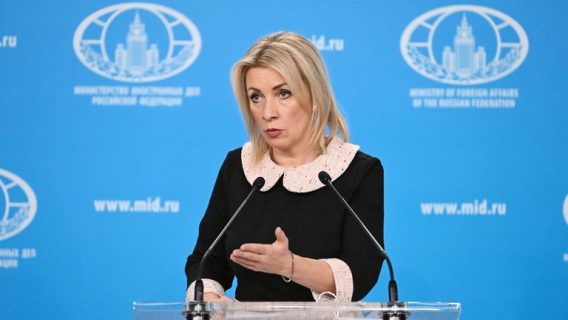
Sputnik – 29.12.2023
MOSCOW – Russian Foreign Ministry spokeswoman Maria Zakharova on Friday called for leveraging all the accumulated experience for solving the Middle East crisis under a Russia-proposed new mechanism of external support that would involve the regional countries.
In November, Russian Foreign Minister Sergey Lavrov proposed the creation of a mechanism of external support to ensure the two-state solution to the Israeli-Palestinian conflict, saying that it should be representative and involve the regional nations, which the Quartet on the Middle East had failed to do.
“A special updated mechanism is needed. You ask why is the Quartet not enough? I will quote Sergey Lavrov as saying that it has failed to represent the regional countries … The entire basis that has been built up should and can be leveraged,” Zakharova told the Rossiya 24 broadcaster.
The experience accumulated in the field includes, in particular, the results of special conferences, resolutions of the UN Security Council and meetings of the Quartet on the Middle East, the spokeswoman added.
The Middle East Quartet, comprised of the UN, the United States, the European Union, and Russia, was established in Madrid in 2002 to mediate the Israeli-Palestinian peace process. The Quartet’s activities aimed to develop the Palestinian economy and empower its institutions, as well as promote a two-state solution to the conflict.
In June 2023, Lavrov said that “collective diplomacy to facilitate the Arab-Israeli settlement has stalled,” mainly due to the decision of the US and the EU to “unilaterally suspend the activities of the Middle East quartet.”
On October 7, Palestinian movement Hamas launched a large-scale rocket attack against Israel from the Gaza Strip, while its fighters breached the border, opening fire on the military and civilians. As a result, over 1,200 people in Israel were killed and some 240 others abducted. Israel launched retaliatory strikes, ordered a complete blockade of Gaza and launched a ground incursion into the Palestinian enclave with the declared goal of eliminating Hamas fighters and rescuing the hostages. Over 21,300 people have been killed so far in Gaza as a result of Israeli strikes, local authorities said.
On November 24, Qatar mediated a deal between Israel and Hamas on a temporary truce and the exchange of some of the prisoners and hostages, as well as the delivery of humanitarian aid into the Gaza Strip. The ceasefire was extended several times and expired on December 1.
Putin lifts the fog of war in Ukraine

BY M. K. BHADRAKUMAR | INDIAN PUNCHLINE | DECEMBER 29, 2023
Russia’s special military operation in Ukraine is entering a new phase. President Vladimir Putin lifted the fog of war and hinted at what can be expected going forward in a landmark speech at the National Defence Control Centre while addressing a meeting of the Russian Defence Ministry Board on December 19.
Russia has gained the upper hand in the proxy war while the United States is struggling to recreate a new narrative. For Putin, this is a moment of triumph where he has no reason to take advantage of the fog of war in Ukraine, whereas, for President Biden, the fog of war continues to serve a useful purpose of dissimulation in the crucial election ahead where he seeks a second term.
Putin’s speech exuded a buoyant mood. The Russian economy has not only regained its pre-2022 momentum but is accelerating toward a 3.5% growth rate by the yearend, marked by rising incomes and purchasing power for millions of its citizens and an increase in living standards. Unemployment is at an all-time low and Russia has beaten back the Western sanctions and the attempts to isolate it in the international arena.
The leitmotif of Putin’s speech is that this is a war that Russia never sought but was imposed on it by the US. Putin had listed last year in February five clear-cut objectives of the Russian military operation — security of the Russian population; de-nazification of Ukraine; demilitarisation of Ukraine; striving for a friendly regime in Kiev; and, non-admission of Ukraine into NATO. These are of course interlocked objectives. The US and its allies know it but continue to pretend otherwise. Their focus in the proxy war has been a military victory and regime change in Russia.
Putin’s message is that any new Western narrative on the war is doomed to meet the same fate as the previous one unless there is realism that Russia cannot be militarily defeated and its legitimate interests are recognised.
The heart of the matter is that the West all along perceived Ukraine as a geopolitical project targeting Russia. Today, even with defeat staring at its face, the West’s priority lies in forcing Russia to agree to a ceasefire on the basis of the existing line of contact without any geopolitical or strategic obligations on the part of Washington or the transatlantic alliance — which, de facto, would mean leaving the door for the rearmament of the battered Ukrainian military and for Kiev’s accession to NATO through the back door.
Suffice to say, the discredited agenda of using Ukraine as a pawn to pursue the West’s anti-Russian policy is still very much around. But Moscow will not fall for the US’ trap a second time, risking another war that may erupt at a time that suits NATO.
Unsurprisingly, Putin’s speech paid great attention to revving up Russia’s defence industry to meet any military exigencies that might arise. But towards the end of his speech, Putin also dwelt on Russia’s politico-military options under the circumstances.
On the military side, clearly, Russia will press forward the attritional war to its logical end of pushing the Ukrainian military into a strategic dead-end, which would mean seeking tactical improvements along the frontline, undermining Ukraine’s economic potential, inflicting military losses, and boosting Russia’s own defence industry on a scale that tips the balance of forces to weigh against any military adventures by NATO.
In the final analysis, Putin asserted, Russia is determined to reclaim the “vast historical territories, Russian territories, along with the population” that the Bolsheviks transferred to Ukraine during the Soviet era. However, he drew an important distinction as regards the “western lands” of Ukraine (west of Dnieper) that are a legacy of World War II over which there could be territorial claims from Poland, Hungary and Romania, which at least in the case of Poland is also linked to the transfer of “eastern German lands, the Danzig Corridor, and Danzig itself” following the defeat of the Third Reich.
Putin took note that “people who live there (western Ukraine) – many of them, at least, I know this for sure, 100 percent – they want to return to their historical homeland. The countries that lost these territories, primarily Poland, dream of having them back.”
That said, interestingly, Putin simply washed his hands of any territorial disputes that may arise between Ukraine and its eastern neighbours (all of whom are NATO countries.) Looking ahead, this is going to be a can of worms for the US. Recently, Russia’s intelligence chief Sergey Naryshkin used a powerful metaphor, warning that the US may face a “second Vietnam” in Ukraine that will come to haunt it for a long time.
The bottom line, as Putin framed it, is as follows: “History will put everything in its place. We (Moscow) will not interfere, but we will not give up what is ours. Everyone should be aware of this –- those in Ukraine who are aggressively disposed towards Russia, and in Europe, and in the United States. If they want to negotiate, let them do so. But we will do it only based on our interests.”
Putin concluded saying that if the final arbiter is military prowess, that explains why Russia is focusing on a “strong, reliable, well-equipped, and properly motivated Armed Forces” backed by a strong economy and “the support of the multi-ethnic people of Russia.”
There is a strong likelihood of Russian military operations moving further westward toward the Dnieper in the coming months, well beyond the four new territories that joined the Russian Federation last year — Luhansk, Donetsk, Zaporozhia, and Kherson. In the absence of any negotiated settlement, Russia may choose to unilaterally “liberate” those southern regions of Ukraine that were historically part of Russia, which would presumably include Odessa and the entire Black Sea coast, or Kharkov to the north of the Donbass region.
Russia is expecting that the combat capabilities of the Ukrainian forces will sharply diminish in the near future and the army faces difficulty already to get new recruits. That is to say, through the year ahead, the balance of forces at the front will shift due to the Ukrainian military’s heavy losses and the drop in Western aid, and, at some point, Ukraine’s defences will begin to crumble.
Russia’s recent gains in military operations — eg., Soledar, Artyomovsk (Bakhmut), Avdeevka, Maryinka, etc. — already testify to a shift in the balance of forces between the two armies. This shift will further accelerate as Russia’s military-industrial complex is functioning optimally and Russia is massively deploying new types of weapons, such as gliding aviation bombs, which have altered the role of the Russian Air Force in the conflict.
Dozens of heavy aerial bombs are dropped every single day and similarly, there is increase in the use of modern barrage ammunition and some other systems, including precision-guided munitions. T-90M tanks and new types of light armoured vehicles have also appeared on the battlefield.
In comparison, Ukraine faces a decrease in arms supplies due to limited production capacities in the West where sustainable production growth on an industrial scale is not attainable in the near term. Meanwhile, the Middle East crisis and the tensions around Taiwan become major distractions for the US.
All these factors taken into account, a decisive shift in the balance of forces against Ukraine is entirely conceivable by the end of next year, leading to an end of the conflict on Russia’s terms.
Kremlin Warns of Potential Retaliatory Steps Against Assets of Foreigners
Sputnik – 29.12.2023
MOSCOW – Russia has a list of the assets of foreigners that can be taken as a reciprocal measure, Kremlin spokesman Dmitry Peskov said on Friday.
On Thursday, the Financial Times newspaper reported, citing sources, that Germany, France, Italy and the European Union have expressed reservations regarding Washington’s idea to confiscate Russian assets worth $300 billion and consider it necessary to first assess the legality of the measure.
“Of course there is [a list of foreign assets that Russia can take]. Understanding the unpredictability of our counterparts, let us say, complete unpredictability and, understanding their tendency to violate international law and other laws, including their own national ones, understanding their tendency to self-destruction, I mean the destruction of the modern economic system, undermining confidence in the basic postulates of the world economic system, I mean, the main reserve currency, the principle of inviolability of property and so on, then, of course, we analyzed possible retaliatory steps in advance, and we will do everything like this, so that it would best suit our interests … Therefore, such actions are fraught with very, very serious consequences,” Peskov said, answering the question whether Russia can withdraw foreign assets.
The seizure of Russian assets abroad is illegal and can cause serious harmful consequences, including becoming another blow to the global economy, the spokesman added.
US sending ‘bloody New Year’s gift to Kiev’ – Moscow
RT | December 28, 2023
The Russian ambassador to the US, Anatoly Antonov, has criticized Washington for its recent arms package to Ukraine, stating that it reflects an intention to fight Russia “to the last Ukrainian.”
The diplomat’s remarks came in response to the $250 million worth of military assistance, including air defense munitions, rockets, artillery shells, and small-arms rounds, approved on Wednesday by the administration of US President Joe Biden.
Antonov called the latest round of military aid a “bloody New Year’s gift to Kiev” in remarks published on social media. The Americans “are pushing the puppet regime to the abyss, dooming thousands of ordinary Ukrainians to certain death,” he warned.
On the other hand, the official emphasized Russia’s recent success in acquiring the town of Maryinka in the Donetsk People’s Republic, a strategic Ukrainian stronghold. According to Antonov, the US tends to ignore such developments and instead focuses on highlighting “Ukrainian fetish ‘victories.’”
The diplomat predicted that any arms provided by NATO nations to Ukraine would be “burned and destroyed” without altering the situation on the ground.
The White House could not appropriate more funding for Ukraine after Republican opposition in Congress blocked its request. The lawmakers have demanded major concessions on immigration reform and southern border security as a precondition for their approval of spending additional billions of taxpayers’ dollars on Ukraine support. US officials have indicated that this latest package would be the last under the current spending allowance.
US President Joe Biden has accused those lawmakers opposed to more Ukraine spending of jeopardizing national security by tying it to domestic policy issues. He suggested that Russian President Vladimir Putin might attack a NATO member after dealing with Ukraine.
Putin dismissed this remark as “absolute nonsense,” saying that Biden was using exacerbated rhetoric to cover up his administration’s foreign policy failures. Moscow maintains that preventing NATO expansion into Ukraine is a key objective in the conflict.
US Efforts to ‘Kill’ Arctic LNG 2 Could Sow Distrust Amidst Allies
By Andrei Dergalin – Sputnik – 27.12.2023
Several prominent companies from France, China and Japan have suspended their participation in Russia’s Arctic LNG 2 project after it was targeted by US sanctions.
US Assistant Secretary of State for Energy Resources Geoffrey Pyatt openly stated earlier this year that the United States’ goal is to “kill” the Arctic LNG 2 project, and that the US is “doing that through our sanctions, working with our partners in the Group of Seven and beyond.”
In response, Russian Foreign Ministry spokeswoman Maria Zakharova said this week that “The situation around Arctic LNG 2 once again confirms the destructive role of Washington for global economic security.”
US sanctions against Arctic LNG 2 may be an attempt by the Biden administration to garner support, argued Thomas W. Pauken II, a geopolitical commentator and consultant on Asia-Pacific affairs. Biden’s approval ratings in the US have been sagging amid the prospects of the American economy heading for a “downturn.”
“If he can get the energy exporters, the producers from the US to somehow support Biden, this could prove helpful. So it’s just politics more than anything else,” Pauken elaborated. “The US is headed in the direction of more trade protectionist measures. And this is just yet another example of that.”
According to Pauken, the Arctic LNG 2’s foreign stakeholders apparently participated in the project under the impression that their involvement would not incur repercussions in the form of US sanctions.
Now that the US imposed such sanctions, this is going to sow “mistrust” between the United States and the parties involved in the project, and this situation is going to “harm the US image.”
“This is a big story, that you have friends of America who are losing out big money in this deal,” Pauken observed.
He also suggested that as Russia realizes that it cannot rely on Europe and Japan for business partnership in light of the US sanctions pressure, it will likely forge closer economic relations with other countries such as India, Mongolia and Central Asian states, not to mention deepening its already close ties with China.
“I think the problem is Washington keeps thinking that they can do these things and sets sanctions and pushes these measures and thinks that everything’s going to have good results from them in the long run. But in reality, it just forces other countries to adapt to these circumstances in order to make new solutions. And Washington is very slow to figure it out,” Pauken mused.
Meanwhile, Nikita Lipunov, an analyst at the Institute for International Studies, pointed out that Arctic LNG 2 foreign stakeholders have so far only suspended their participation in the project and are now mulling the associated risks. US sanctions are expected to come into effect on January 31.
“Foreign participants of Arctic LNG 2 [deem] there will be losses either way: if they give up their share in the venture and future LNG shipments or if they ignore the US’ secondary sanctions and suffer the consequences,” he said.
Lipunov also deemed as “unlikely” the odds of the US destroying the Arctic LNG 2 project, considering Russia’s “vast experience in running large international economic projects while under sanction pressure.”
He noted that, while the French and Japanese participants of the project may end up pulling out of the venture under pressure from the US, there is still a chance that the Chinese companies involved may not follow suit.
“In light of the 12th package of the EU sanctions that, among other things, include a ban on liquefied petroleum gas imports from Russia, Moscow should reorient shipments to the east where the demand is growing, and to seek new markets in other regions. That will take time, but Russian commodities will definitely find their buyers,” Lipunov added.
Despite its shortcomings, UNSC vote will tie Israel’s hands
By MK Bhadrakumar | The Cradle | December 25, 2023
The adoption of a resolution by the United Nations Security Council (UNSC) on Friday with focus on a pause in the fighting in Gaza to allow for the delivery of more humanitarian aid can be seen as a turning point in the tortuous journey toward imposing a sustainable ceasefire.
But a caveat must be added that the ultimate litmus test lies in the implementation of the UNSC resolution, as the past history of such resolutions on Palestine does not give cause for optimism.
In fact, Israel’s defiance was in full view already. As the Security Council passed the resolution, Israeli forces pushed ahead with their offensive into Gaza on Friday and ordered residents in Al Bureij — an area in central Gaza where Israel had not previously focused its offensive — to evacuate. The Israeli military’s chief spokesman Rear Adm. Daniel Hagari said on Thursday: “Our forces continue to intensify ground operations in northern and southern Gaza.”
UN Secretary General António Guterres was spot on when he told reporters after the resolution was passed that “a humanitarian ceasefire is the only way to begin to meet the desperate needs of people in Gaza and end their ongoing nightmare.”
The resolution itself is the outcome of week-long intense negotiations between the United States and the Arab countries that sponsored it — the UAE and Egypt, in particular — to settle for the lowest denominator, which meant accepting a Washington-friendly text that enabled the Biden administration to evade responsibility for another veto, for the third time since 7 October.
Unsurprisingly, the US negotiators brazenly resorted to pressure tactics by drawing on their usual diplomatic tool box — blackmail, arm-twisting and ultimatums — to water down the text to the extent that important provisions relating to a ceasefire and a UN mechanism to facilitate the delivery of humanitarian aid to Gaza and ensure its monitoring were abandoned.
And, yet, the US abstained in the vote at the end of the day, registering its reservations — principally, that the resolution was silent on the attack by Hamas on 7 October.
The unkindest cut of all is that the resolution accommodated the US diktat to replace the language describing an immediate cessation of violence with an ambiguous phrase calling on the parties to “create conditions for a cessation of hostilities.” The wording meets the Israeli requirement to have a free hand to continue with its barbaric military operations.
This anomaly, coupled with the absence of any reference to the condemnation of indiscriminate attacks by the Israeli military against civilians almost delivers the wrong signal that the Security Council is effectively becoming an accomplice to the destruction of Gaza — a misnomer that agitated Russia so much that it proposed a last-minute amendment to replace the phraseology in the resolution: “to create the conditions for a sustainable cessation of hostilities” with the unambiguous call “for urgent steps toward a sustainable cessation of hostilities.”
Russia’s demand for an immediate ceasefire was in line with a resolution overwhelmingly passed by the UN General Assembly recently, but the Americans would have nothing of that sort. The unfortunate part is that the Arab sponsors of the resolution caved in to US blackmail to veto the resolution. What transpired between the protagonists behind the scenes is not known.
The paradox is that, in reality, the Americans themselves were desperately keen to avoid casting a veto — the third in as many months — that would have made a mockery of President Joe Biden’s bombastic remark in his September speech at the UN last year that the permanent members of the Security Council should cast vetoes only under “rare, extraordinary situations to ensure the council remains credible and effective.”
All indications are that the US is acutely conscious of finding itself “diplomatically isolated and in a defensive crouch,” as the New York Times put it in an acerbic commentary on the Biden administration’s plight as “an increasingly lonely protector of Israel … (that) puts it at odds with even staunch allies such as France, Canada, Australia, and Japan.”
The commentary says that what rankles most is that first, when the US seems to have green-lit a massive Israeli military response to 7 October “without guardrails,” it:
“painfully confirmed to many in the (global) south this sense that there was a double standard” — and second, even more, “the Russian strategy works, because beyond the United Nations what everyone sees is Russia standing up for international law — and the US standing against it.”
The crux of the matter is that Israel’s Gaza operation is running into a Cornelian dilemma (dilemme cornélien) where sooner rather than later, it is obliged to choose one option from a range of options, all of which reveals a detrimental effect on itself.
Hamas’ top leaders have evaded capture so far, and Gaza’s armed resistance groups have continued to fire rockets into Israel, including two barrages that reached Tel Aviv and its environs last week.
According to another New York Times report,“ political commentators and some military experts have been lowering expectations for a quick and decisive Israeli victory.
“Nobody should imagine that there will be a situation where we put a flag on top of a hill and say: OK, we won, and now Gaza will be peaceful and safe. It will not happen,” said Gabi Siboni, a colonel in the reserves and a fellow at the conservative-leaning Jerusalem Institute for Strategy and Security. “The reality is that we are going to be fighting in Gaza for years to come.”
But is that sustainable — even if Israel controls the US Congress? Conceivably, Israel’s main goal in Gaza was to ethnically cleanse the Strip and drive the Palestinian population to Egypt and Jordan by killing and starving them and making Gaza unlivable.
The real significance of the UNSC resolution, therefore, lies in that such an Israeli game plan will not fly. By not vetoing the resolution, the US may also have signaled that it will not allow the ethnic cleansing. There seems to be an understanding on this score between the US and the Arab protagonists at the political level — Egypt, in particular.
On the other hand, can Israel really destroy Hamas while the Palestinian population remains in Gaza? No, it will not be possible. Now, there is reason to believe that Hamas is inflicting significant damage to the Israeli military. The retreat of the Golani Brigade from the Gaza operation also points in that direction.
The bottom line is that the Israeli operation in Gaza will have to take a different form during the next several weeks — one that is anchored on surgical strikes rather than continuing with the extended ground operation and open-ended Israeli occupation. With warts and all, the Security Council resolution that was passed on Friday paves the way for such a transition.
Russian Troops Fully Liberate Strategic DPR Settlement of Maryinka
By Ilya Tsukanov – Sputnik – 25.12.2023
The heavily-fortified settlement, situated on the outskirts of the city of Donetsk, was used by Ukrainian forces to indiscriminately shell the Donetsk People’s Republic’s capital for nearly ten years before finally being liberated by Russian forces.
The Russian Army has completed the liberation of Maryinka, Defense Minister Sergei Shoigu has announced.
“In the course of offensive operations, assault detachments from the Southern Group of Forces completely liberated the settlement of Maryinka southwest of Donetsk,” Shoigu told Russian President Vladimir Putin in a briefing on Monday.
“I would like to congratulate you. This is a success. Pass on the words of gratitude to all the staff and fighters who took part at different times and at different stages [in the settlement’s liberation, ed.],” Putin replied.
The president expressed confidence that control of the settlement will allow Russian forces to push Ukrainian positions further back from Donetsk.
Shoigu concurred, saying Maryinka’s liberation will also make it possible to more effectively protect the city of Donetsk from Ukrainian fire.
The defense minister said that troops from the 150th Motorized Rifle Division distinguished themselves in the settlement’s capture. During WWII, it was the 150th Division which famously captured the Reichstag building in Berlin.
“The liberation of this settlement naturally reduces the defense capabilities of the Ukrainian Armed Forces and gives us additional opportunities for further actions,” he said.
Maryinka had been turned into a fortress over the past nine years, connected by a network of underground passages, with fortifications on almost every one of its streets, Shoigu said.
Putin asked the defense minister to distribute medals to soldiers who distinguished themselves in the strategic settlement’s liberation, and instructed him to promote the commander overseeing its capture to the rank of major.
“By breaking into this fortification, which the enemy has factually been building up since 2014…our troops have the opportunity to enter a wider operational area. But, of course, this is a matter for local commanders and specialists from the General Staff and the Defense Ministry. This is a separate issue, but in any case, this opportunity arises in this area,” Putin said.
Maryinka was first captured by Donbass militias seeking to break off from Kiev’s control in April 2014, after the Ukrainian government installed in the February 2014 coup launched an ‘Anti-Terrorist Operation’ against them meant to crush the rebellion by force. Ukrainian forces, including paramilitaries from the infamous neo-Nazi Azov Regiment, recaptured Maryinka in August 2014. From that time on, the strategic town, situated directly on the western outskirts of Donetsk City, was turned into a seemingly impenetrable fortress, and used by Ukrainian forces to launch regular, indiscriminate attacks against the militia-controlled city. Battles for the settlement by Donetsk People’s Republic militias, now backed by the regular Russian military, began immediately after the start of Russia’s special military operation in February 2022. Images of the settlement today show that it has been turned into a pile of ruins, with most civilians living in the town leaving after 2014, and the rest evacuated after 2022.
Featured Video

Laith Marouf: Hezbollah’s position on US-Iran ceasefire
or go to
Aletho News Archives – Video-Images
From the Archives
Is Israel to blame for the Iraq War?
American Goy | March 10, 2008
I am so tired of this old canard that “Israel had nothing to do with USA’s war with Iraq – in fact, it officially advised America against it”.
Bullshit. … continue
Blog Roll
 Aletho News
- Laith Marouf: Hezbollah’s position on US-Iran ceasefire: What you’re not being told
- Israel’s priority lies in destroying chances of peace between Iran, US: Ex-UN nuclear chief
- Ceasefire for all or for none: Iran shuts Hormuz over Lebanon attacks
- Strait of Hormuz is Iran’s ‘nuclear weapon’ that forced US retreat: Medvedev
- Energy crisis will last for months – Kremlin envoy
- Europe’s quiet role in the war on Iran
- Forty days that shook the Empire: How Iran turned the tables on US and prevailed
- Netanyahu unilaterally declares Lebanon outside of ceasefire deal
- Israeli leaders: ‘Not a single goal’ achieved in war with Iran
- What on earth just happened? Trump, Iran, and the unlikely ceasefire
- If Americans Knew
- Gazans face a triple crisis: severe shortages of water and bread, healthcare in tatters
- NY Times reports how Netanyahu took the US into Iran War
- A sigh of relief over Iran, but Gaza and Lebanon in dire straits – Daily Update
- Thousands dead and neighborhoods razed to the ground: Aid agencies fear southern Lebanon is becoming the new Gaza
- The war the US is fighting for Israel could cost trillions
- ‘Cigarette Burns, Nail Wounds’: Toddler Tortured in Gaza to Coerce Father
- Trump Says US Sent ‘a Lot of Guns’ to Protesters in Iran
- Israeli forces destroy 17 UN peacekeeper cameras in south Lebanon
- US-Israeli strikes ‘completely destroy’ synagogue in Tehran
- Archbishop for US Military Says Iran War Is Unjust Under Catholic Teaching
- No Tricks Zone
- An Inconvenient Tree: Uncovered In Alps… Europe Much Warmer Than Today 6000 Years Ago
- New Study Reports A 60% Slowdown In Greenland’s Ice Loss Rate In The Last Decade
- Low Intensity Tornado Wrecks Major Solar Farm, Creating A Potential Toxic Dump
- New Study Finds Warming Saves Lives…Cold Temperatures 12 Times More Deadly Than Excess Heat
- German Science Blog Accuses PIK Climate Institute Of Hallucinating Climate Tipping Points
- Devastating Assessment Of Comirnaty Vaccine By Former Senior Pfizer Europe Toxicologist
- New Study: CO2 Is ‘Effectively Negligible’ As An Explanatory Climate Change Factor Since 2000
- Former Pfizer Toxicologist Dr. Helmut Sterz Tells Bundestag Hearing Pfizer Vaccine Should Have Never Been Approved
- Energy Expert: Germany’s Nuclear Phaseout Was A “500 Billion Euro Mistake”
- New Research: South Australia’s Mid-Holocene Sea Surface Temperatures Were 4°C Warmer Than Today
 Aletho News