Putin changes Russia’s obligations on nuclear test ban
RT | November 2, 2023
Russia has downgraded its participation in the 1996 Comprehensive Nuclear-Test-Ban Treaty (CTBT) to the status of a signatory. President Vladimir Putin signed the change into law on Thursday, revoking Moscow’s ratification.
The bill was approved by both houses of parliament last month. Specifically, it changed a 2000 Russian law by removing any mention of ratification of the CTBT, while leaving the rest of the text intact.
The Kremlin stressed that the move was taken in response to US policies regarding the ban, and does not signal an intention to renew underground nuclear bomb tests.
“Among the states that have not ratified the Treaty, the most destructive position is that of the US, which has for many years declared that there would be no support for ratifying the Treaty in Congress,” Putin’s office said in a statement. “Thus, there was an imbalance between Russia and the US in terms of obligations under the Treaty, which is unacceptable in the current international situation”.
The CTBT has not entered force because its terms require ratification by all nations on a list of 44, which operated nuclear reactors in 1996. With Russia’s withdrawal, the treaty will be nine ratifications short of taking effect. The remaining seven absentees are China, North Korea, Egypt, India, Iran, Israel, and Pakistan.
President Putin has suggested that the US may decide to break its de facto moratorium on live nuclear tests as part of the modernization of its arsenal. If this happens, he pledged, Russia will follow suit.
Last month, the US Department of Energy’s National Nuclear Security Administration (NNSA) conducted what it called an underground chemical explosion experiment at the Nevada National Security Site (NNSS), a key nuclear test range. It was described as bolstering Washington’s capability to detect nuclear explosions.
At General Assembly, Russia calls for immediate halt to bloodshed in Gaza Strip
Press TV – November 2, 2023
Russia’s Ambassador to the United Nations Vasily Nebenzya has called for an immediate end to the bloodshed in the Gaza Strip, as the Israeli regime continues its deadly bombing campaign in the besieged enclave.
Nebenzya made the appeal during the General Assembly special session on Palestine on Thursday, stressing that the bloodshed must be stopped in order to prevent the ongoing crisis from spreading to the entire.
“First of all, it is necessary to stop the bloodshed and to prevent the crisis from engulfing the entire region. Otherwise, the conflict will never be stopped,” he said.
Nebenzya also demanded that the mediators be allowed to work on a diplomatic solution, including the release of hostages.
“One will have to walk down this path sooner or later; the only question is how many innocent people will die in the meantime,” he said.
The Russian envoy said Israel is an occupying regime and therefore it does not have the right to defend itself in the current conflict as it claims.
On Tuesday, Nebenzya blamed the United States for the ongoing atrocities committed by Israel against Palestinians, after Washington opposed a UN Security Council resolution calling for an urgent ceasefire in the Gaza Strip.
The envoy also slammed Western countries that abstained at the vote on Russia-proposed draft resolutions that called for a ceasefire.
A week earlier, Nebenzya said Moscow has for years been warning about the soaring tensions in West Asia and that the ongoing crisis in the region results from longstanding “destructive” policies of the United States.
Israel has been heavily bombing Gaza since October 7 when the Palestinian resistance movement Hamas launched a surprise operation in the occupied territories in response to the Israeli regime’s intensified crimes against Palestinians in the occupied West Bank.
The aggression has so far killed 8,800 Palestinians and left more than 23,000 wounded.
Tel Aviv has also blocked water, food, and electricity to Gaza, plunging the coastal strip into a humanitarian crisis.
Russia warns Israel about attacks on Syria
RT | October 31, 2023
Spreading conflict to other countries in the Middle East is “unacceptable,” Russian Foreign Minister Sergey Lavrov said on Tuesday, while discussing a spate of recent Israeli airstrikes with his Syrian counterpart.
Lavrov brought up the issue of Israeli airstrikes, “which have become more frequent against the backdrop of events around the Gaza Strip,” during a phone call with Syrian Foreign Minister Faisal Mekdad, the Russian Foreign Ministry said in a readout of the call.
Both ministers “emphasized the danger of attempts by external forces to turn the Middle East, in its current explosive situation, into an arena for settling geopolitical scores,” the readout added.
Mekdad phoned Lavrov to discuss the situation in Gaza, as well as a number of bilateral issues and the progress in ending the war in Syria. While the 2011 attempt at armed “regime change” backed by the West and some regional powers ended in failure, the north and northeast of Syria remain outside the control of the government in Damascus.
Since the Hamas incursion from Gaza on October 7, Israel has bombed Syria at least three times, repeatedly shutting down the airports in Aleppo and Damascus. One of these attacks was acknowledged by the Israeli ambassador to Germany, who said it was intended to disrupt “weapons deliveries from Iran.”
Israeli Prime Minister Benjamin Netanyahu once said there had been “hundreds” of strikes on Syria over the past decade. On the rare occasions when the Israel Defense Forces (IDF) comments on the attacks, it claims to have acted in pre-emptive self-defense against Iran, accusing Tehran of supplying Hezbollah militants. Damascus has repeatedly insisted that the raids constitute a violation of Syrian sovereignty, but to no avail.
Lavrov and Mekdad agreed on the need for an “immediate end to the bloodshed” in Gaza and a solution to all the humanitarian problems created by the fighting.
Russia has condemned the Hamas attack but called Israel’s response against Gaza an unacceptable form of “collective punishment” against innocent civilians. Moscow has called for a peace settlement between Israel and the Palestinians through the creation and recognition of an independent Palestinian state.
Kremlin weighs in on call for US to reverse course on Russia
RT | October 30, 2023
A recent article by US economist Jeffrey Sachs calling on Washington to establish a new sustainable détente with Russia is a rare sight, but evidence that debates on the issue are picking up steam, Kremlin Press Secretary Dmitry Peskov has said.
Speaking to reporters on Monday, Peskov commented on Sachs’ piece, which was published in early October but has only recently gained media traction. The economist, who serves as the director of the Center for Sustainable Development at Columbia University, wrote that the world is on the precipice of a “30-year US neocon debacle in Ukraine.”
He explained that Washington’s long-cherished hopes for NATO expansion eastward to Russia’s borders have been dashed by Ukraine’s devastating losses on the battlefield, the threat of Moscow launching a massive offensive, and collapsing support for this course in both Europe and the US.
As Ukraine teeters on the brink, Sachs argued, the US could avert a potential catastrophe by changing course and reaching security guarantees with Moscow. A potential deal could include a pledge that NATO would not expand closer to Russia, as well as an agreement between Moscow and Kiev that predominantly ethnic Russian areas would be recognized as part of Russia, the economist said, apparently referring to Crimea and four other former Ukrainian regions that overwhelmingly voted to become part of Russia.
Commenting on the article, Peskov said Moscow has not received any proposals on the matter. While describing the piece as “an economist’s point of view, nothing more,” he noted that “such thinking is quite rare at the moment.”
“Nevertheless, some kind of a discussion is gradually gaining momentum,” Peskov added.
In the article, Sachs suggested that Russia’s demands to NATO and the US which were made shortly before the outbreak of the Ukraine conflict in February 2022 should be used as a springboard for a thaw in relations.
In the proposals presented in December 2021, Moscow asked the West to formally ban Ukraine from entering NATO, while insisting that the alliance should retreat to its 1997 borders, before it expanded. The overture, however, was rebuffed by the West.
US seeks strategic dialogue with Russia
BY M. K. BHADRAKUMAR | INDIAN PUNCHLINE | OCTOBER 30, 2023
Almost four weeks into Hamas’ attack on Israel, Russia is in no hurry to exploit the Biden administration’s quandary over the collapse of Middle East security. The western media was unanimous that Russia was waiting in the wings to seize the opportunity once the US took its eye off the ball in Ukraine. However, no such thing happened.
Ukraine war is on autopilot. The compass has been set, the die is cast and the calculus is holding steady with regard to the strategic objectives set by President Vladimir Putin in February last year. Russia senses that it has gained the upper hand in the war and that is irreversible.
Ukraine’s counteroffensive has failed and the fighting is presently restricted to two sectors of the frontline, as Russian forces strengthen the security of the Donetsk region and seek to regain control of territories up north in the borderlands of Donbass and Kharkov region from where they retreated for tactical reasons last September and October.
Yet, Moscow has not begun its grand offensive, as many had predicted. One plausible explanation is that Moscow is watching the maelstrom sweeping through the Middle East. Moscow is particularly sensitive about any spillover into Syria.
With an eye on the formidable US naval build-up in Eastern Mediterranean with the deployment of two aircraft carrier groups, President Vladimir Putin has publicised that Russian jets equipped with hypersonic Kinzhal missiles are roaming the skies above the Black Sea, which can strike targets 1000 kms away at Mach 9 speed, which no existing missile defence system can intercept. Suffice to say, the war in Ukraine remains attritional.
Curiously, Russia conducted a simulated nuclear strike in a drill on Wednesday overseen by Putin, hours after Russian parliament voted to rescind the country’s ratification of the global nuclear test ban treaty (CTBT). The drill needs to be seen in the broader context of global strategic stability. A Kremlin statement said, “The purpose of the training exercise was to check the level of preparedness of military command bodies, as well as the skill of the leadership and operational personnel in managing the troops (forces) under their command.” Everything, however, adds up in these extraordinary times.
At its most obvious level, the Palestine-Israel conflict is a manifestation of the growing imbalance in the existing system of international relations. New wars are emerging; longstanding conflicts are mutating (eg., Nagorno-Karabakh). Last week, Pakistan bracketed Palestine and Kashmir as the UN’s unfinished business in the post-colonial era. North Korea and Iran are flash points that have no military solution.
In the months ahead, without doubt, Washington will continue to provide Israel with military and diplomatic support but an extended Israeli operation lasting months in Gaza will mean dispersal of US resources that might be needed in other theatres. The conflict in Gaza underscores the imperative for a rethink in the US’ notions of global hegemony. The fact remains that the US, despite its self-proclaimed status as the “Indispensable Nation” (Madeline Albright) and the guarantor of “rules-based order,” failed to prevent the latest eruption of conflict in the Middle East.
Arguably, therefore, the latest US proposal for a systematic resumption of strategic dialogue with Russia can be seen as a sign of positive thinking. Unsurprisingly, Moscow has displayed a studied indifference to the US proposal. But that needn’t be taken as the last word. Historically, Soviet-American strategic dialogue brought on board into the agenda all major issues and most minor issues affecting international security.
The big question, therefore, is the timing of the US proposal. Against the backdrop of the gathering storms in the Middle East, the Biden Administration probably seeks to calm the nerves by proposing talks with Russia on global strategic balance, since the guardrails in arms control no longer exist. This is one thing.
At any rate, Russia’s “neutrality” in a Middle East conflict could also be a consideration. Equally, Western leaderships understand that the war against Russia is practically lost — although they will not admit it publicly — and engagement with Russia is needed.
Again, although the US has provided Israel with significant military and diplomatic support and keeps influencing the latter not to escalate the conflict, there are variables in the situation and any big conflagration in the Middle East will require a massive concentration of material and financial resources that are limited even for a superpower, since there are other unresolved problems in the world, too.
The breakdown of trust in the Russian-American ties hurts US interests. Fundamentally, it must also be understood that what Moscow seeks even today after nearly 20 months of battling NATO and the US in Ukraine’s killing fields is a sustained engagement with Washington and a willingness to accommodate mutual interests.
On its part, Russia is conducting itself as a responsible power vis-a-vis the crisis in Gaza. There is no shred of evidence to show that Russia has acted as a “spoiler”. On the contrary, Moscow has been projecting its credentials as a potential peacemaker who enjoys good relations with all key players — Israel, Hamas, Iran and other regional states alike.
In fact, President Biden’s recent remarks on the Gaza situation bring the US position rather close to Russia’s. Biden read out the following from a prepared text at a joint press conference with Prime Minister Anthony Albanese of Australia:
“Israel has the right and, I would add, responsibility to respond to the slaughter of their people. And we will ensure Israel has what it needs to defend itself against these terrorists. That’s a guarantee…
“But that does not lessen the need for — to operate and align with the laws of war for Israeli — it has to do everything in its power — Israel has to do everything in its power, as difficult as it is, to protect innocent civilians. And it’s difficult. I also want take a moment to look ahead toward the future that we seek.
“Israelis and Palestinians equally deserve to live side by side in safety, dignity, and peace. And there’s no going back to the status quo as it stood on October the 6th. That means ensuring Hamas can no longer terrorise Israel and use Palestinian civilians as human shields.
“It also means that when this crisis is over, there has to be a vision of what comes next. And in our view, it has to be a two-state solution.”
Putin couldn’t have put this across differently. There is a sense of expectation in Moscow that in the emergent conditions in regional security, the US and its allies will “reconsider their notions of defeating Russia in the Ukraine conflict at any cost” — as an establishment think tanker wrote in the Kremlin-funded RT last week.
Trust is lacking, he concluded, “compromises without the full consideration of Russian interests” are difficult to reach, but “a pivotal stage in the (world) order … is taking shape before our eyes.”
Russia: Israel’s bombardment of Gaza unlawful
Press TV – October 28, 2023
Russia has shown its strongest reaction to the Israeli regime’s nonstop bombardment of the besieged Gaza Strip by labeling the three-week campaign targeting the civilians in the Palestinian territory “unlawful.”
Foreign Minister Sergei Lavrov said in remarks published by the Belarusian state news agency Belta on Saturday that the carnage is against international law and could create a decades-long catastrophe in the region.
Lavrov said Israel has been “indiscriminately using force against targets where civilians are known to be present.”
He warned that Israel’s stated goal of seeking to eradicate the Palestinian resistance movement Hamas would require a total destruction of Gaza, an enclave of over 2.3 million people located on the Mediterranean.
“If Gaza is destroyed and 2 million inhabitants are expelled, as some politicians in Israel and abroad propose, this will create a catastrophe for many decades, if not centuries,” said the Russian foreign minister.
“It is necessary to stop, and to announce humanitarian programs to save the population under blockade.”
Israel’s savagery began on October 7 in response to a Hamas operation in the occupied territories which led to over 1,400 deaths among settlers and regime troops.
Israelis were already angered by Moscow’s decision to host a Hamas delegation in the midst of the conflict in Palestine.
Russian authorities have defended the move while Hamas leaders say they have received a request from Moscow to look for eight people identified by Russia as possibly being among hostages taken by the group’s fighters during the blitz into the occupied territories.
Figures released by Gaza’s health officials on Saturday showed the Israeli bombardment has killed more than 7,700 Palestinians, including over 5,000 women and children.
The Gods Are Going Against the Chosen People – Mammon Against Israel, Mars Against the Pentagon
By John Helmer | Dances with Bears | October 27, 2023
The Palestinian strategy against Israel is aimed at destroying Israel’s capacity to survive in its present state in a long war.
This means attacking the invincibility of the Israel Defense Forces (IDF) and their so-called Iron Dome defence; this began with the cross-border offensive on October 7, and continues with daily drone and artillery attacks on targets inside Israel, as well as resistance to IDF incursions in Gaza.
The plan also means exposing the weakness of the state’s infrastructure and economy; extending the battlefield across all of Israel’s territory – the ports, power plants and electricity grid, communications, and financial markets — making the cost of occupation of the Arab territories unendurable. In a long war, two of Israel’s leading exports earning more than 40% of the state’s trade — diamonds and tourism — face ruin.*
“The Israelis cannot withstand one year of fighting in a war,” Iraq’s President Saddam Hussein told his general staff in 1983 during a discussion of planning for a regional war of the Arabs against Israel.** In the forty years since then, the evolution of military technology and tactics has expanded the power of small national liberation armies like Hamas, Hezbollah, and the Houthis, of proxy principals like Iran, and of the strategic balancing role of Russia and China. Their combination now has shortened the Zionist state’s endurance in a long war, and that of its proxy principal, the US.
The Israelis and the Jewish diaspora comprehend this reluctantly. For them, the short war must be correspondingly shorter. This means the genocide of at least a million Palestinians in lives and displacement.
The war to do that has now become an international war – and this is a war the US cannot sustain. As a Pentagon insider said publicly this week, “because there are so many draws on the logistics and support infrastructure of the Pentagon, we’re not prepared to go in in a concerted way. What we are seeing right now is death by a thousand cuts. Our adversaries know we are stretched so they are going to make us stretch even more, so we can respond even less.”
The Russian Foreign Ministry spokesman, Maria Zakharova, acknowledged the point in Moscow on Thursday: US naval, air force, and marine reinforcements deployed around Israel and Gaza are “American tactics to strengthen their own security (this is how it should be interpreted) at someone else’s expense.” They are backfiring on Washington’s capacity to defend US forces in the Mediterranean, the Red Sea, the Persian Gulf, and in land bases in Syria, Iraq and Jordan. “On the contrary,” Zakharova added, the US military deployment “will further rock the situation in the Middle East, create additional tension that can spill out beyond the region.”
Zakharova’s warning came in the Moscow afternoon. By then Russian Foreign Ministry officials had held meetings with a Hamas delegation, and officials from Iran, Egypt, and Kuwait. Across the city at the same time, President Vladimir Putin held telephone talks with Turkey’s President Recep Tayyip Erdogan. The Kremlin communiqué reported: “Russia and Turkiye have practically overlapping positions.”
Israeli and US-led media censorship and propaganda are concealing the breadth of impact of the Palestine warfighting plan, and the deepening military and economic weaknesses of the Israeli state.
The longer the war continues, the plainer the evidence is on the battlefield that the single-state scheme of Israel and the US is no longer possible. Whether Israel and the US can be compelled to withdraw to the 1967 borders and a new Palestinian state created with partition, demilitarisation, and international security guarantees – the basis of the Russian position announced again on Thursday in Moscow — remains to be fought over.
In this long war, the gods do not favour the Chosen People.
Following with precision the battlefield action is impossible in the Israeli and Anglo-American press. Reporting of operations, and of Israeli and US casualties, is being suppressed entirely or delayed for days, if not weeks.

According to this NBC television report, broadcast on October 24, there were at least 24 US combat casualties following drone attacks on or about October 18 at the Al-Tanf base in Syria and the Al-Asad base in Iraq. Reporting of naval action in the Red Sea, when the USS Carney reportedly engaged Houthi missiles over several hours, has been changing since the initial news flashes of October 19. Read more here. In a new report of October 24, Israeli and US casualties in a joint raid inside Gaza were revealed: “in the last 24 hours or so, some of our Special Ops forces and Israeli Special Ops forces went into Gaza to reconnoiter, to plan for where they might want to go to free hostages and make an impact, and they were shot to pieces and took heavy losses, as I understand it. I think that is where we are headed and I don’t see that as a win for Israel in any way, shape, or form. And I certainly think it is very dangerous for us”. In current reporting by Al Mayadeen, daily strikes against US bases in Iraq and northeastern Syria are documented.
Tracking the electric war and infrastructure strikes by Hamas and Hezbollah is also difficult. They commenced with cyber attacks on Israel’s electricity generation plants and power grids; these have been followed by missile and drone strikes. “The ground has been laid for attacks on the Israeli grid,” a US military source claims. “I believe drones will come first, then missiles. We may even see commando raids.”
Israel’s seaports are also under constant attack. Ashkelon, which is closest in range to Gaza, has been closed. Eilat may have been the target of the Houthi missile strike which was engaged last week by the USS Carney. Ashdod, which accounts for about 40% of incoming and outgoing Israeli seaborne trade, and Tel Aviv port have been targeted. The result is a tenfold surge in war risk insurance for vessels and cargoes, and the curtailment of international vessel movement in and out of the Israeli ports; there are reports that shipping is down 30% in Ashdod compared to the pre-war volume. Evergreen, the Taiwanese container shipping company, declared force majeure for Ashdod on October 17, diverted one vessel to Haifa, and halted future shipping into both ports. “We advise evaluating each port visit in Israel on a case by case basis and implementing appropriate precautions in ship contingency plans,” recommends a maritime industry alert bulletin.
Chevron’s offshore Tamar gas field has been shut down. The source produces 70% of the gas required to fuel Israel’s electricity generation needs. Not a single Anglo-American media source has noticed that Israel is at risk of losing its principal energy source to drone or missile attack. “After what the Americans and Germans did to blow up the Nordstream pipelines,” comments a Moscow industry source, “what is holding Hamas back from hitting Tamar, or Hezbollah from the other Israeli gas fields?”
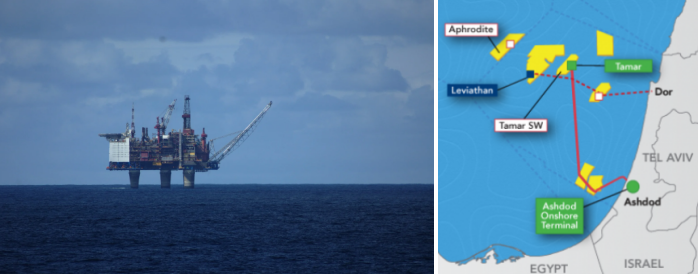
Left: Chevron’s Tamar gas production platform is located at sea 24 kilometres west of Ashkelon. Right: click to enlarge map of Israel’s offshore gas sources.
A Moscow source comments that “in Israel, the US and the UK will be able to bring in supplies without a very big risk of US ships being attacked. The risk is to the ports and bases, not to supplies from the Med[iterranean]. The Greek and Cyprus bases will come in very useful. Israel will not face severe logistical issues as long as it is on the offensive. If its settlements start getting cut off, encircled or penetrated then it is a different matter.”
The indirect economic impacts of the war have also not been calculated or discussed in the mainstream media or international business newspapers. The leading export revenue earners are diamonds at above $9 billion per annum, and tourism which had been peaking at $8.5 billion in 2019. Counted together, diamonds and tourism amount to more than 40% of the state’s export earnings.
The Covid-19 pandemic and worldwide travel restrictions cut Israel’s tourism revenue fourfold, and this had been recovering over 2022 and the tourist season this year. This has now stopped, although for the time being Hamas rocket launches on Ben Gurion airport near Tel Aviv have been intercepted.

October 12, 2023 — source: https://www.youtube.com/.
ISRAEL TOURISM REVENUE TRAJECTORY, 1999-2022
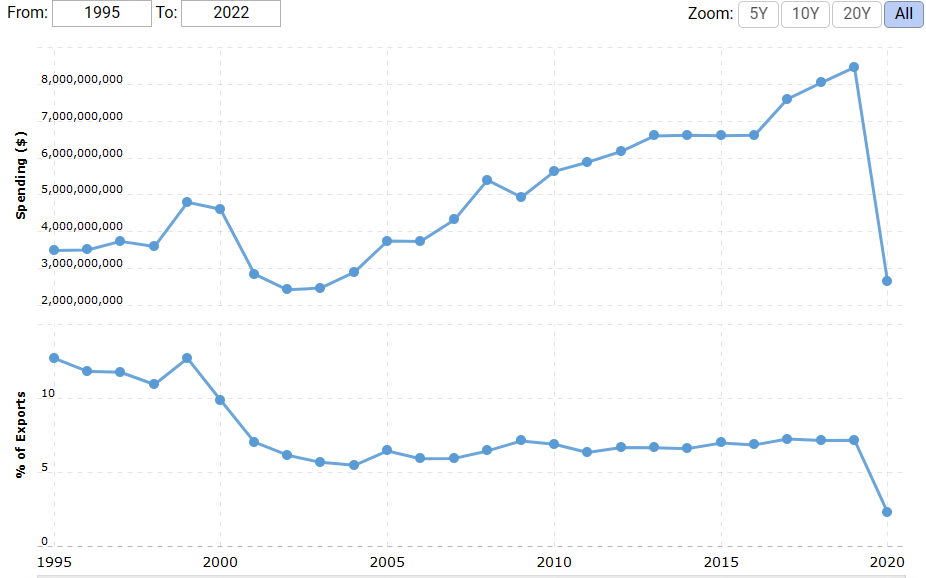
Source: https://www.macrotrends.net/
Israel’s high-tech machine exports and pharmaceuticals may also be affected if electricity supply, internet networks, and transportation are damaged.
The cumulative effect will be the outcome which the international ratings agencies have been warning the international banks and financial markets to prepare for. “In our view,” Fitch reported to clients on October 17, “the combination of Israel’s dynamic, high-value added economy, the record of resilience to regional conflict, [and] preparedness for military confrontations… make it unlikely a relatively short conflict largely confined to Gaza will affect Israel’s rating…. the risk that other actors hostile to Israel, such as Iran and Hezbollah, could join the conflict at scale has risen significantly… a major escalation could result in negative rating action. This could take the form of a wider and longer conflict, resulting in a sustained fiscal drain, both from higher spending and lower tax collection, as well as loss of human and material capital and severe economic disruption.”
How short, and also how long, Israel’s warfighting plan will take depends on American and international acceptance, not only of the genocide intended for the Palestinians of Gaza, but of the Novichok-type chemical warfare planned by the IDF and the Pentagon for the Hamas tunnel system in Gaza City. After several years in which the US and UK have fabricated claims that Syria and Russia were using prohibited gas warfare weapons, the Israelis have reportedly persuaded the US to participate in the tunnel attack operation. The Pentagon is denying the reports.
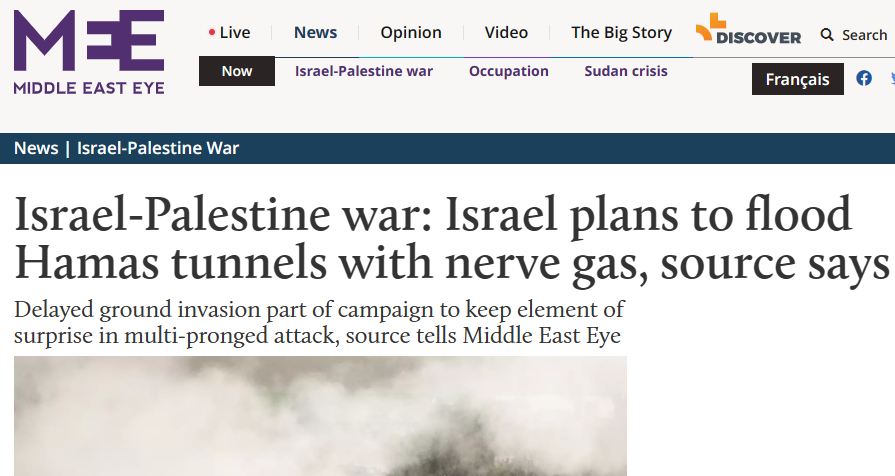
Source: https://www.middleeasteye.net
Russian and US military sources are already confirming the logistical supply problems facing Israeli and US forces at present, when the war is just three weeks long. Greek sources are reporting the Souda Bay, Crete, base has already reached its capacity for incoming US navy and air force supply and support operations; the spillover is facing growing Greek protest at the Elefsina air base near Athens.
A Cyprus source says the movement of US and British aircraft into and out of the Dekhelia and Akrotiri airbases is accelerating, and there is an air and seaborne shuttle between the Cypriot ports of Larnaca and Limassol and the USS Gerald Ford carrier group at sea to the southwest of the island.
The lengthening of the supply lines required to support the USS Eisenhower carrier group in the Red Sea and Persian Gulf and the shore bases needed to support it are politically sensitive already; and the risks of Houthi and other attacks, along with domestic Arab crowd protests, will intensify for these bases in the Arab sheikhdoms the longer the war against Israel reveals Arab and Iranian warfighting skill and resistance.
Converting these gains into a negotiating framework for Israeli-American retreat is the task Russian officials are attempting in silent coordination with the Chinese, and in semi-open negotiations in Moscow this week. In its first move outside the region since the war began, Hamas has visited Moscow for negotiations, led by US-educated Moussa Mohammed Abu Marzouq.
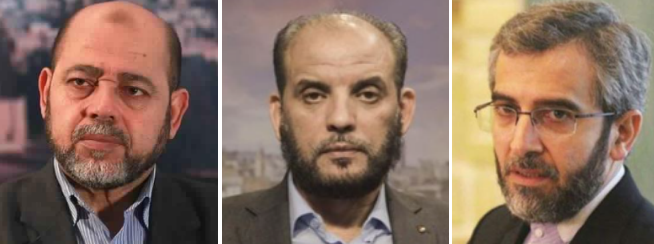
Left: Moussa Mohammed Abu Marzouq; centre: Husam Badran; right, Ali Bagheri Kyani.
Zakharova confirmed the start of the talks with Hamas on Thursday. She said: “I can also say and confirm that representatives of the relevant Palestinian movement are in Moscow. As for contacts, we will inform you additionally.” She has also disclosed that since the war began, nine thousand Russian passport holders have returned to Russia from Israel; and that at least fifteen Russian passport holders among the Hamas hostages have been killed in the IDF airstrikes.
At the same time as Marzouq’s meetings, Husam Badran issued a statement to the Russian state news medium, Sputnik. “Russia,” Badran said, “is able to play an important role in ending the war between Israel and the Gaza Strip, and delivering aid to the Palestinian exclave. Hamas values Russia’s role on the international stage, especially use of veto in the UN Security Council against the United States. But Russia can play a greater role in ending the aggression against our people in the Gaza Strip and applying international pressure to deliver urgent aid to our people in the Gaza Strip.”
What Hamas means by “greater role” for Russia has not been disclosed publicly yet. It is known that Hamas is willing to negotiate the release of “non-military” hostages, including Israelis holding Russian passports, through Iran. This is conditional on the IDF lifting its siege on Gaza and allowing sufficient supplies into all parts of the territory.
The “military hostages” are being held in exchange for the release of Palestinian prisoners in Israeli jails. There are more than 6,000 of the latter; there may be fewer than 200 hostages in Gaza, as up to 50 have been killed by Israeli bombing.
The Russian Foreign Ministry statement on the talks with Hamas is less revealing. According to the Sputnik release, “Russia has discussed release of hostages and evacuation of Russians from the Gaza Strip during a meeting with a delegation of Hamas in Moscow on Thursday.” A member of the political office of the Islamic resistance movement Hamas, Abu Marzouq, is in Moscow. Contacts took place with him in continuation of the Russian line for the immediate release of foreign hostages located in the Gaza Strip, and issues related to ensuring the evacuation of Russian and other foreign citizens from the territory of the Palestinian enclave were also discussed.”
At the same time on Thursday – unnoticed and unreported by the western media – Russian officials held several negotiating sessions with an Iranian emissary, Deputy Foreign Minister Ali Bagheri Kyani. In three separate Foreign Ministry releases, meeting communiqués were issued for Kyani’s meetings with deputy ministers Mikhail Bogdanov, Sergei Ryabkov, and Mikhail Galuzin. “The need for the cessation of hostilities in and around the Gaza Strip and the prompt provision of humanitarian assistance to the affected Palestinian population was confirmed,” Bogdanov’s communiqué said. “It was stated that Moscow and Tehran are determined to continue close coordination of efforts in the interests of stabilizing the situation in the Middle East.”
It is unclear if the talks also included the Hamas officials in a three-party format. During the day there were also Foreign Ministry negotiations in Moscow with Kuwaiti and Egyptian officials.
At the Kremlin it has been announced that President Putin spoke with Turkish President Erdogan to discuss the war. According to the Kremlin release, “the presidents reviewed the active efforts undertaken by Russia at the UN Security Council, as well as the corresponding political and diplomatic steps taken by Turkiye to stop the bloodshed and ensure the unimpeded delivery of humanitarian aid to those in need. It was emphasised that Russia and Turkiye have practically overlapping positions, focused on implementing the well-known two-state solution, which provides for the creation of an independent Palestine coexisting with Israel in peace and security.”
In her briefing for the press, Zakharova dismissed the US moves so far. “We do not consider the US presence in the Middle East as contributing to the stability of the situation in the region. Exactly the opposite. Washington’s earlier attempts to monopolise the Middle East settlement process, ignoring the true causes of the protracted conflict, have largely led to the current catastrophic consequences… This situation has an absolutely clear and understandable road, a ‘road map’ for settlement. It is not simple, but complex, painful, but leading to the solution of the issue, not its aggravation.”
“Of course, no air defence systems, arms supplies, materiel injections into some ‘security complexes’ will help resolve this situation. Today’s lesson must be learned. How many Americans have deployed there (their bases, experts, satellites), nothing has worked to prevent a bloody scenario, of which both Palestinians and Israelis are victims.”
[*] With support from Israel and influential Jewish diamantaires in New York and Tel Aviv, a scheme of sanctions is being prepared by the US Government to stop Russian raw diamonds, produced by Alrosa, from being sold into the Belgian, Israeli, and US markets. The Russian goods are to be tagged “blood diamonds” because of the war in the Ukraine. However, now that Israel is destroying the Palestinian population of Gaza, the “blood” tag can be applied to the Israeli diamond cutting industry and to the Jewish diamond trade abroad. Support for the anti-Russian sanction, and also for the IDF operations against the Palestinians can be found in Rapaport.com news reports. “Rapaport stands with Israel”, the publication and its owner Martin Rapaport declared on October 26, “and has undertaken all the necessary effort and costs for the October Single Stone Auction to help the Israeli market continue to conduct business as best as possible during this difficult time. Rapaport believes that continuing to do business in Israel during the war is a victory over the brutal Hamas terrorists, and will help Israel win the war.” In another editorial for the diamond trade, Rapaport proposes “to boycott Iran and all other supporters of the Hamas terrorist organization.” Rapaport also cites religious authority for liquidation. “In the words of G-d (Exodus 17:14): ‘I will utterly blot out the memory of Amalek from under heaven.’May the words of G-d be done, here and now.” Quietly, Russia’s state diamond interests dictate a strategy for protecting against this double-edged Israeli policy.
[**] Saddam Hussein is quoted in the chapter on US plots against him in Iraq – see The Jackals’ Wedding: American Power, Arab Revolt, Ch. 6.
Iran, Russia, Hamas officials discuss Gaza-Israel war in Moscow
The Cradle | October 27, 2023
Authorities from Iran, Russia, and the Palestinian resistance group Hamas met on 27 October at the Iranian Embassy in Moscow to discuss the Gaza-Israel war.
Iranian Deputy Foreign Minister Ali Bagheri Kani was invited by his Russian counterpart, Mikhail Bogdanov, to discuss a potential ceasefire between Palestine and Israel with Mousa Mohammed Abu Marzouk, a senior Hamas official.
“Inviting the movement’s leadership to visit Moscow is a message to the whole world that Russia considers Hamas a national liberation movement and not a terrorist movement,” Abu Marzouk told Russian media on Friday, noting that President Vladimir Putin “graciously did justice to the Hamas movement and the struggle of the Palestinian people and protected it politically in the Security Council and the UN.”
During Thursday’s meeting, Kani solidified Tehran’s “undoubtable” support for Palestine. “Tehran’s priorities in talks with foreign sides are declaring an immediate ceasefire, providing aid to people, and lifting the repressive blockade of Gaza,” the Iranian Embassy in Moscow quoted the Iranian official.
Iranian and Russian diplomats held separate talks and discussed the need for a ceasefire in the war between Palestine and Israel and the urgency of delivering humanitarian aid to Gaza.
A member of Hamas’ political bureau revealed to Sputnik that the Hamas delegation discussed the region’s future and how this differs from the US narrative.
Israeli authorities were not pleased with the meeting held in Moscow, saying that this was a show of Russia’s support for Hamas.
“Israel condemns the invitation of senior Hamas officials to Moscow, which is an act of support of terrorism and legitimizes the atrocities of Hamas terrorists,” Israeli Foreign Ministry spokesman Lior Haiat said on social media. “We call on the Russian government to expel the Hamas terrorists immediately.”
Russia has actively monitored the situation between Palestine and Israel, putting forward multiple draft resolutions in the UN Security Council to reach a ceasefire in Gaza. However, the US and its allies have struck down these resolutions.
Biden Inches Towards Military Disaster in Middle East
By Ilya Tsukanov – Sputnik – 27.10.2023
The US has dramatically beefed up its presence in the Middle East, sending two carrier strike groups, thousands of Marines, multiple THAAD and Patriot missile batteries, and more warplanes to the region amid the Palestinian-Israeli flare-up. But these forces can’t guarantee victory in case of a shooting war, says military observer Andrei Martyanov.
Tehran issued its strongest warning to Washington to date over the Palestinian-Israeli crisis on Thursday, cautioning that the US wouldn’t be able to escape if the conflict continues unabated.
“I say frankly to the American statesmen, who are now managing the genocide in Palestine that we do not welcome [an] expansion of the war in the region,” Iranian Foreign Minister Hossein Amir-Abdollahian said in New York during an emergency United Nations General Assembly session. America “will not be spared from this fire” if the crisis endures, Amir-Abdollahian emphasized. “It is our home, and West Asia is our region. We do not compromise with any party and any side, and we have no reservation when it comes to our home’s security.”
Tehran has so far moderated its response to US and Israeli actions during the Palestinian-Israeli conflict, ignoring efforts by Tel Aviv to goad the country into a military response by attacking Iranian allies in Syria and Lebanon, and snubbing threats by loudmouth officials and lawmakers to bring the war home to “Iran’s backyard.” Instead, Tehran has joined countries including Russia, China, Brazil and Turkiye in calling for an immediate ceasefire.
Netanyahu cabinet minister Nir Barakat threatened last week to cut off the Iranian “head of the snake” and launch attacks against the Islamic Republic if Hezbollah tried to open a second front against Israel from the north. Meanwhile, President Biden on Wednesday said he had issued a “warning” to Iran’s supreme leader that if Iran “continue[s] to move against” American troops in the Middle East, the US “will respond, and he should be prepared.”
But as observers with an understanding of Iran’s military capabilities observe, tackling Iran would be unlike anything either Israel or the US have ever attempted, with the Islamic Republic’s combination of natural defensive geography, powerful indigenous military-industrial complex, advanced missile and drone programs, and readiness to defend its interests even against much more powerful foes, making it an extremely difficult target.
US Carriers in Eastern Med ‘Sitting Ducks’ for Missiles
The centerpiece of the US forces deployed to the Middle East amid the Palestinian-Israeli crisis are the USS Gerald Ford and USS Dwight D. Eisenhower carrier strike groups. Each armada theoretically has enough firepower to level a small country, with each carrier carrying a complement of up to 90 combat aircraft, and the giant warships themselves flanked by between four to six cruise missile-equipped destroyers.
The armadas are certainly no threat to be taken lightly, but do have important weaknesses when stacked up against countries with modern missile capabilities, transforming into “white elephants” from a bygone era, says veteran military analyst and best-selling author Andrei Martyanov.
“In terms of their real power projection,” carriers “are big fat sitting targets against modern weaponry such as anti-ship missiles and hypersonic missiles,” Martyanov told Sputnik’s New Rules podcast.
“In this respect, they are not a real asset, but rather a liability against any major power such as Russia or China,” the observer explained. “In this particular case, those aircraft carriers and their battle groups, which usually comprise two or three ‘Aegis’-carrying destroyers – they are not really any more a serious military asset except for their ‘fear factor’…They could be sunk or basically disabled, and that’s pretty much it,” he said.
Israel-Palestine War: Is the US Preparing to Attack Iran?
The same can be said even for a mid-tier military power like Iran, given its vast arsenal of thousands of medium and long-range ballistic and cruise missiles, and recent development of a hypersonic missile known as the Fatah. Many of these weapons are theoretically in range of US warships, plus dozens of US bases dotting the Middle East – some of them conveniently just across the Persian Gulf separating Iran from the Arab Gulf oil states.
“Iran will be able to deliver both an asymmetric and a very symmetrical” response, Martyanov observed. “Iran has a vast number of highly sophisticated, highly developed ballistic missiles… And they have a vast number of cruise missiles. [The response] can be very symmetrical. And every single air base, military base of the United States will be under attack.”
Combined with carriers’ vulnerabilities is their massive cost, Martyanov said, pointing out that the new Ford-class carrier alone costs some $13 billion, plus $5-6 billion for its complement of aircraft.
“So you have a single weapon, a single carrier, a single ship, which carries on itself almost $20 billion worth of military assets and could be taken out by two or three missiles such as Zircon or Kinzhal. Can you imagine the impact, apart from fact of them having a very serious cultural and mental influence within the United States? The loss of a single ship can escalate…to the nuclear threshold because of the political, emotional, cultural and of course military impact of such a loss. Don’t forget, you also have more than 6,000 people onboard this carrier,” the observer stressed.
Even the Russian-made Yakhont anti-ship missile possessed by Syria – which can reach up to Mach 3 at the terminal stage of flight and has a range of some 300 km, can pose a serious challenge to the American carrier groups, Martyanov said, not to mention the various missiles possessed by Hezbollah – which together force the US to stay further away the region’s coasts.
Israeli or US attack on Iran Would Result in Massive Retaliation
Asked to comment specifically on Lindsey Graham’s threats against Iran, Martyanov emphasized that the “blowhard,” “certified war criminal” lawmaker “doesn’t know what he’s talking about” when it comes to the consequences of the actions he’s proposing.
For one thing, Martyanov said, Graham “doesn’t understand that the United States is not capable” of mounting “any kind of serious ground operation at all” against Iran.
“They know if they go in” that they “can send some Tomahawks there. Well, guess what? Iran is not even Syria. Iran is a serious regional power with actually quite significant military potential. And it has some high-tech weapons, including extremely advanced air defense. So in the United States, obviously, those statements are primarily made for public and for the benefit of Israel, too,” the observer said.
The same is the case for Israel, Martyanov noted, with Tel Aviv’s spate of anti-Iranian rhetoric constituting “empty threats,” since the Jewish State lacks the resources to mount a ground operation against Iran even if it were technically feasible.
“It would be decimated, but don’t forget, there are 1,200 kilometers separating Israel and Iran. Neither side can actually provide serious deployment of forces to fight a real war,” the observer said, pointing out that neither country would be able take advantage of combined arms multipliers fighting at such great distances.
“So what’s left is primarily air operations. And even this, on the part of Israel, will require direct interference and support from the United States because, as already stated, it’s 1,200 kilometers and they would have to fly over the territory of Jordan, Saudi Arabia. Good luck getting permission to do that. Or you can try to circumnavigate them, but then you have to refuel them nonstop. And that’s where the United States comes in,” Martyanov said.
“People forget that Iran has not only good air defense – they have a pretty outstanding variety of all kinds of operational tactical and operational ballistic missiles. And those are not Katyusha [rockets]; they are very serious, highly sophisticated missiles with great targeting. As the United States experienced in 2020, when Donald Trump ordered the absolutely irresponsible assassination of [IRGC Quds Force Commander Qasem] Soleimani,” the military analyst noted, recalling Iran’s bombardment of a pair of US bases in Iraq using precision missiles.
“Iran can literally blow up every single American base in the Middle East as a retaliation. So we have these dynamics there. And that’s why, for the most part, these are pathos statements or chest thumping,” Martyanov summed up.
Ukrainian attack on Russian nuclear facility thwarted – officials
RT | October 27, 2023
A Ukrainian attack involving multiple drones has been stopped in the Russian city of Kurchatov, home to the Kursk nuclear power plant, according to civilian and military officials. Unconfirmed reports claimed that one of the aircraft damaged a nuclear waste storage building at the site.
The spree of incidents happened on Thursday evening in Kursk Region, which borders Ukraine. The Russian Defense Ministry reported intercepting a fixed-wing drone over Russian territory on two occasions, about two hours apart, while the power plant’s press service said it was attacked by three enemy drones. Kurchatov is located some 60 km from the Ukrainian border.
The statement by the civilian authorities reported no damage or casualties on the ground, and said all four units of the facility were operating normally. Three of them are currently online, while one is undergoing a shutdown procedure ahead of being decommissioned, it said. The oldest reactor, which first went operational in 1976, has not been generating power since late 2021.
The news outlet SHOT claimed that the incident was more serious than according to official statements, reporting that the third drone “fell next to a nuclear waste storage and blew up.” The report said the blast caused minor damage to the infrastructure but didn’t hurt anyone.
Another drone incident in Kurchatov that may have been an attempted attack on the plant was previously reported in mid-July. An unmanned aerial vehicle, which was described as home-made and fitted with a Taiwan-manufactured jet engine, exploded several kilometers away from the nuclear site, media reported at the time.
Moscow has accused Kiev of launching multiple attempts to sabotage its crucial energy infrastructure, including nuclear power plants, amid ongoing Russian-Ukrainian hostilities.
Earlier this month, the chief of Ukrainian military intelligence, Kirill Budanov, confirmed three failed commando raids on Energodar, the city where the Zaporozhye nuclear power plant is located.
Energodar is located in the Zaporozhye region, which joined Russia last year after people living there voted for the move in a referendum. Ukraine has dismissed the vote as a “scam,” and Kiev partially controls the contested territory.
The Zaporozhye plant hosts a monitoring mission of the International Atomic Energy Agency, the UN’s nuclear watchdog. It was stationed there last year, amid a string of drone and shelling attacks, which Moscow and Kiev blamed on each other.
Russia, China veto US-drafted resolution backing Israeli offensive
Press TV – October 25, 2023
Russia and China have prevented the passage of a US-drafted UN Security Council (UNSC) resolution that had said Israel, which has killed more than 6,500 people as part of its underway war on Gaza, has been acting in “self-defense.”
The draft was put to vote on Wednesday. The United Arab Emirates also voted no, while 10 members voted in favor and Brazil and Mozambique abstained.
Israel launched the devastating war on October 7 after the Gaza Strip-based Palestinian resistance groups staged Operation al-Aqsa Storm, a surprise attack on the occupied territories, in response to the Israeli regime’s intensified crimes against the Palestinian people. The war has killed 6,546 Palestinians, including 2,704 children, according to the Palestinian health ministry.
The Council then voted on a Russian-drafted resolution that had called for a humanitarian ceasefire and urged Tel Aviv to immediately cancel its orders on Palestinian civilians to head into southern Gaza.
Only Russia, China, the UAE, and Gabon voted in favor of the draft, while nine members abstained and the United States and Britain voted no.
A resolution needs at least nine votes and no vetoes by the US, France, Britain, Russia or China to be adopted.
Also on Wednesday, Russia’s foreign ministry spokeswoman Maria Zakharova said the death of thousands of children in the Gaza Strip had not been enough to get the West behind a resolution demanding a ceasefire in the besieged coastal territory.
“This is the most obvious and rather simple thing to do in this situation: Simply to produce a statement, a resolution, a document with a unified call for a ceasefire, settling the situation and so on,” she said in an interview with Sputnik Radio.
“Even these numbers (the fatality count among the Palestinian minors) cannot compel certain political forces in the West to come to their senses and realize what is going on,” Zakharova regretted.
Featured Video
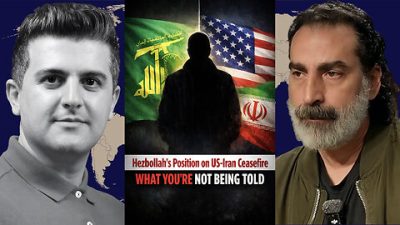
Laith Marouf: Hezbollah’s position on US-Iran ceasefire
or go to
Aletho News Archives – Video-Images
From the Archives
The Dirty Little Secret behind the “Global Terrorism Index”
The Omission of Israeli Terrorism in the Occupied Palestinian Territories
By Karin Brothers | Global Research | December 6, 2014
… The Israeli settlements — all of which are illegal – have been identified as a major impediment to peace. The refusal of a major “global” terrorism report to name the Israeli settlers as one of the groups most responsible for terrorism not only misrepresents a major source of regional violence but exposes the Global Terrorism Index as a propaganda tool that supports a U.S. agenda.
In recent years, governments have been attempting to thwart terrorism by blocking supportive fund-raising. When it comes to Israeli settlements, however, the US and Canada actually encourage fund-raising by giving organizations (such as Christian Friends of Israeli Communities (CFOIC) and the Jewish National Fund) financial support in the form of donor tax-deductions.
Charities which provide funds for the Israeli settlements should be regarded as terror-financing organizations. They should not only lose their tax-deductible status, but they should be banned because they support the violation of international humanitarian law. The terror-financing laws that are being strictly enforced for Muslim charities should be applied to Christian and Jewish charities as well. … Read full article
Blog Roll
 Aletho News
- Spain orders reopening of Tehran embassy, condemns Israel’s carpet bombing of Lebanon
- Israel faces ‘unsustainable’ strategic crisis following 40-day war against Iran: Analyst
- Iran restricts Hormuz access to 15 vessels per day under ceasefire terms: Report
- The ‘Opposition Party’ Has Done Nothing to Stop the Iran War and Much to Goad Trump Into Continuing It
- Moscow backs Tehran on status of Lebanon in US-Iran deal
- How UK Regulator Ofcom Quietly Bypassed International Law to Police American Speech
- The Black Cube Files: How Former Mossad Operatives Flipped a Nation
- Laith Marouf: Hezbollah’s position on US-Iran ceasefire: What you’re not being told
- Israel’s priority lies in destroying chances of peace between Iran, US: Ex-UN nuclear chief
- Ceasefire for all or for none: Iran shuts Hormuz over Lebanon attacks
- If Americans Knew
- This is ceasefire? Israel’s biggest massacre yet in Lebanon, another journalist killed in Gaza – Daily Update
- Tucker Carlson on Israel: This Is the Behavior of an Ally? Really?
- Gazans face a triple crisis: severe shortages of water and bread, healthcare in tatters
- NY Times reports how Netanyahu took the US into Iran War
- A sigh of relief over Iran, but Gaza and Lebanon in dire straits – Daily Update
- Thousands dead and neighborhoods razed to the ground: Aid agencies fear southern Lebanon is becoming the new Gaza
- The war the US is fighting for Israel could cost trillions
- ‘Cigarette Burns, Nail Wounds’: Toddler Tortured in Gaza to Coerce Father
- Trump Says US Sent ‘a Lot of Guns’ to Protesters in Iran
- Israeli forces destroy 17 UN peacekeeper cameras in south Lebanon
- No Tricks Zone
- An Inconvenient Tree: Uncovered In Alps… Europe Much Warmer Than Today 6000 Years Ago
- New Study Reports A 60% Slowdown In Greenland’s Ice Loss Rate In The Last Decade
- Low Intensity Tornado Wrecks Major Solar Farm, Creating A Potential Toxic Dump
- New Study Finds Warming Saves Lives…Cold Temperatures 12 Times More Deadly Than Excess Heat
- German Science Blog Accuses PIK Climate Institute Of Hallucinating Climate Tipping Points
- Devastating Assessment Of Comirnaty Vaccine By Former Senior Pfizer Europe Toxicologist
- New Study: CO2 Is ‘Effectively Negligible’ As An Explanatory Climate Change Factor Since 2000
- Former Pfizer Toxicologist Dr. Helmut Sterz Tells Bundestag Hearing Pfizer Vaccine Should Have Never Been Approved
- Energy Expert: Germany’s Nuclear Phaseout Was A “500 Billion Euro Mistake”
- New Research: South Australia’s Mid-Holocene Sea Surface Temperatures Were 4°C Warmer Than Today
 Aletho News