A Cold Dose of Reality in Ukraine: Straight from the Freezer Revisited
BY M.L.R. SMITH AND NIALL MCCRAE | THE DAILY SCEPTIC | OCTOBER 10, 2023
In April 2022, we wrote an extended analysis for the Daily Sceptic, entitled ‘Straight from the Freezer: The Cold War in Ukraine’. It was widely read and generated over 300 (mostly positive) comments from the site’s discerning readers. The popularity of the piece, we surmise, was because – true to the intent of the Daily Sceptic’s premise – the article presented a sober, fact-based, analysis in contrast to the feverish speculations contained in much media reportage.
Drawing upon our long engagement with strategic affairs going back to the Cold War, we advanced provisional conclusions based on what was observable, commonly agreed or understood to be known. Again, contrary to much of the agenda-ridden narratives of the mainstream media, the principal contention of our analysis was that it was wise to proceed with caution, acknowledge that facts on the ground were rare, and refute idle speculation or wishful thinking, particularly any which saw every move as a Russian military failure and a Ukrainian success. Understandable sentiments perhaps, but not ones necessarily based on reality.
Our analysis pointed to the historically complex background leading up to Russia’s invasion. For anyone interested in a serious engagement with the origins of the war, this defies easy notions of right versus wrong, especially considering extensive Western complicity in provoking Russia through its policy of NATO expansion eastwards. From the end of the Cold War onwards Russian politicians (as well as Western diplomats) of all persuasions implored Western leaders not to enlarge NATO up to its borders. But they did it anyway. Promises were broken and red lines were repeatedly crossed: a process that included Western meddling in Ukraine’s internal politics in ways guaranteed to disturb Russia’s geopolitical sensibilities.
Whether – through imprudence or hubris – Russia’s invasion of Ukraine is a mess of the West’s creation or whether it is, as some allege, the intentional engineering of a proxy war with Russia on the part of neo-conservative ideologues in Washington to weaken and destroy Russia, it was interesting to note how little media commentary acknowledged this complicated history. To the extent that it did, it was often to scold those ‘realist’ scholars of international relations who had long foreseen these events. This ‘shoot-the-messenger’ attitude expressed by media commentators was itself telling: a degree of denial for sure, but also an implicit admission that the warnings of these analysts should not have gone unheeded.
Our article concluded that the direction of the war was likely to remain confused and uncertain, especially given how little we knew of Russian objectives or her concept of operations. We suggested the likelihood was that the war would for the foreseeable future be substantially immobile and would assume the contours of frozen conflict: a war of attrition, with little movement on either side.
Eighteen months later, it is opportune to review this assessment and discern what we broadly got right and what we might have missed. While the historical rights and wrongs can still be debated, it is how things have been working out militarily on the ground, and the wider implications of the prolongation of the war, that will be the key factors that will shape the future direction of this conflict. This will be the central focus of our re-evaluation.
Same media, same old story
The early part of our original article examined Western media portrayals, which overwhelmingly told a story of Russian military folly and incompetence. Putin’s imminent collapse and overthrow were routinely predicted. Apparent setbacks for Russian forces around Kiev and various territorial withdrawals from some of the lands it had occupied in the east fuelled much of this heady sense of Ukrainian military success, backed by Western training and technology.
Eighteen months later and many of these suppositions have been disproved through the war’s prolongation. Interestingly, though, little appears to have changed in the media landscape. A vast swathe of commentary over the past year has continued to present a litany of Russian disunity and miscalculation, with every piece of information interpreted as a sign of Vladimir Putin’s vulnerability and internal weakness, the likelihood of his overthrow, and the relentless failures of Russian military performance. Meanwhile, Ukrainian breakthroughs and military advances have been extolled. Typical of the genre was an article in early October by Ben Wallace, former U.K. Defence Secretary, who proclaimed: “Whisper it if you need. Dare to think it. But champion it you must. Ukraine’s counteroffensive is succeeding. Slowly but surely, the Ukrainian armed forces are breaking through the Russian lines. Sometimes yard by yard, sometimes village by village, Ukraine has the momentum and is pressing forward.”
Rousing though such exhortations are, these kinds of claims do not match reality. Russian defences have not been seriously dented. Putin’s hold on power is not imperilled and support for his regime is not evidentially slipping. To the extent that Putin’s rule has been internally questioned, it has been from voices that wish him to prosecute the war more forcefully. Likewise, Ukraine’s much heralded counteroffensive has by all accounts not been impressive. Some forward villages have been taken, but these miniscule territorial gains have been offset by Russian land seizures elsewhere.
The global media panorama is, of course, vast. In the acres of news coverage of the war, it would be unfair to characterise all reportage as deficient or unsophisticated. Nevertheless, the continued preponderance of agenda-ridden commentary at the expense of fact-based analysis suggests that a great deal of the mainstream media is still not engaged in a consistently honest endeavour to report the war objectively. It is, for example, regrettable that outlets of high repute for coverage of geopolitical and military affairs, such as the Daily Telegraph, issue an endless stream of over-optimism regarding Ukraine’s prospects of winning.
Whether such distortions derive from the editorial offices, a susceptibility to Government lobbying or a belief that it is a message that people wish to hear, dispassionate analysis it is not. It is fundamentally unserious commentary that plays its part in reinforcing growing public mistrust of legacy media. The result is that for dependably thoughtful and penetrating assessments of the war, its military dynamics and geopolitical implications, no one looking for any temperate analysis would turn to established newspapers, television outlets or even think-tanks, but to independent content providers such as the Duran, Perun, and the Caspian Report.
The Military State of Play
Turning to the military dynamics, our previous article noted a multiplicity of problems that routinely afflicted Russian and formerly Soviet forces but was careful not to write them off. The piece observed that Russia’s military had shown in several theatres, including the Second Chechen War and in Syria, that it was capable of adaptation. Russian intent in Ukraine is not 100% clear. Given that all war is a sphere of uncertainty, this is to some extent expected. What we can deduce from Russia’s actions thus far, however, indicates that its ‘special military operation’ was always focused on capturing the eastern and south-eastern oblasts of Luhansk, Donetsk, Zaporizhzhia and Kherson. To that end, the withdrawals from the partial encirclement of Kiev and Kharkiv (Kharkov) were not full-blown retreats as presented by Western Governments and media but likely strategic moves to divert Ukrainian forces from the Azov coast and east.
Having secured the capture of these regions, Russia moved to adopt a defensive posture with an emphasis on artillery and fortified positions. The pattern of the war has consequently fallen into one of a slow, grinding attrition, as we predicted. Attrition suggests a stalemate like the First World War. However, this mode of war and its prolongation and lack of mobility on the frontlines does not of itself speak to any lack of strategic intent.
Manoeuvre versus attrition
Operational planning in wars involving the clash of orthodox armed forces in battle is often based around balancing the concepts of manoeuvre and attrition. The smaller, professionalised, high technology orientation of most Western armed forces tend to emphasise manoeuvre-based approaches, that is, striking and gaining decisions quickly via wars of rapid movement involving combined arms, especially airpower and precision guided munitions. ‘Shock and awe’ tactics, as evidenced in the first Gulf War of 1990/91 and the invasion of Iraq in 2003, are designed to have political effects to psychologically overwhelm an opponent, forcing a decision through the speed of advance and the seizure or destruction of command-and-control centres.
Through its counteroffensive, Western trained Ukrainian forces have been intent on seeking a manoeuvreist approach to secure breakthroughs and to reclaim Russian occupied territory. The strategic intent appears that even if the re-capture of all lost ground is not possible, the momentum of a Ukrainian advance can put sufficient pressure on the Russian position to force negotiations on favourable terms. The problem is that manouevrist approaches tend to work only in specific circumstances, for example against relatively unsophisticated opponents (such as the Iraqi army in 1991 and 2003) that lack hardened defensive capabilities; or they succeed for a limited time, only until the other side has had a chance to stabilise and get back on its feet, as the Soviet Union did after the initial setbacks suffered at the hands of the German following Operation Barbarossa in 1941.
Running up against more organised opposition always risks a war of attrition, which is what we see happening in Ukraine. In other words, to regain military momentum requires one to go through a process of attrition, to grind down the other side to a point where movement on the battlefield can be re-gained. This may be the intention of Western-backed Ukrainian forces: to waste Russian military assets, weaken its defensive front line and secure a breakthrough, which can then be exploited. A protracted war might undermine Putin’s popularity at home, making him vulnerable to a coup by more moderate politicians amenable to compromise and withdrawal from conquered lands (a set of suppositions which we have suggested lacks any understanding of Russian historical sensibilities). Conversely, the Russian side is likely pursuing a double-pronged attrition strategy: 1) establishing defensive fortifications that seek to wear down Ukrainian forces on the offensive, 2) eroding the will of Western powers to continue financing and supplying Ukraine over the long term.
Who benefits from attrition-based war?
The central question arising from any military analysis is which side does an attrition strategy favour? The evidence thus far would suggest it redounds to the Russian advantage for the following reasons. First, it is simply that Russia is by far the largest combatant, capable of mobilising greater quantities of troops and resources vis-à-vis Ukraine.
Secondly, it is doubtful that the supply of superior weaponry such as the Storm Shadow missile or ageing Leopard and Challenger tanks or F-16 jets to Ukraine is going to change the balance of forces. Western forces simply do not possess sufficient weapons stocks, still less the capacity to help Ukraine deploy such forces quickly or effectively in the field in ways that are likely to have any long-term impact. There are already signs that Western arsenals are being depleted.
Thirdly, anticipating Ukraine’s counteroffensive (signalled for months on end by the ramping up of Western military supplies and media reports) allowed the Russians to prepare their defences and draw the Ukrainians into cauldrons of artillery fire and landmines, eradicating what is reported to be tens of thousands of Ukrainian troops and weaponry, while the defenders’ losses have been relatively small. The Ukrainian counteroffensive therefore has not amounted to anything in terms of territorial gains beyond the capture of parcels of land that are ultimately unlikely to worry Russian military planners if their goal is to force the opposition to waste itself on fruitless forward assaults.
Accurate casualty figures are hard to verify, though reports have suggested that hundreds of thousands have perished, including 400,000 on the Ukrainian side. Other statistics claim the casualty figures to be much less. Yet the fact that Ukraine is talking increasingly of a general mobilisation indicates that it is feeling the pressure on this front. The inference is that Russian forces have adapted sufficiently to attrition warfare to place Ukraine in a military bind in that it is not strong enough to make major breakthroughs in Russia’s frontlines or to prosecute the war without Western help.
Who benefits from the prolongation of the war?
The other important question that follows is which side is likely to benefit from the prolongation of the war the most? Is Russia likely to be sufficiently weakened economically and politically? This seems to be the thinking of U.S. policymakers, namely that supporting the Ukrainians in fighting the Russians over a protracted period is a strategic instrument to weaken Russia. Backing Ukraine against Russia is therefore a “direct investment“, to quote Senator Mitch McConnell, because it does not involve the use of U.S. ground troops in any direct confrontation. The problem is that if this is the strategic rationale it undermines the moral case that the conflict is about preserving Ukrainian sovereignty and democracy. Instead, this rationale suggests that the collective West is using Ukrainian forces to do the fighting and dying in a proxy war against Russia.
The key strategic issue, then, is about who can outlast whom in a battle of attrition between Russia and its backers and Western nations? Our initial article referenced an opinion piece in the Daily Telegraph by Sherelle Jacobs who argued that Russia’s invasion of Ukraine was a defining moment that was galvanising the West into re-discovering a sense of collective purpose.
We expressed scepticism and suggested that only time would tell if a newly found Western unity was the outcome. Subsequent events have validated such wariness. Western solidarity is being sorely tested as the war drags on. The failure of financial sanctions against Russia has emphasised Western economic weakness and dealt a significant blow to the West’s strategic position. The war has merely underlined the fact that Russia, as a primary producer of key resources like oil and gas, and China an industrial power, have in some respects emerged strengthened.
The revelation of European energy dependence on Russian oil and gas exports was a particularly salutary reminder of the economic complexities engendered by the war. The sabotage of the Nord Stream 2 pipeline has been one of notable curiosities in this respect. The idea that it was Russia that blew up its own infrastructure (when it could have simply turned a stopcock) has been yet one more reason to doubt Western governmental and media narratives. One must be obtuse not to detect some level of U.S. complicity in or knowledge of the destruction of Nord Stream 2, the outcome of which has been to render the German economy dependent on American energy supplies.
Having forsaken energy independence and de-industrialised their economies, Western countries fired their one and only financial weapon, only to see it go off half-cock. The economic sanctions applied against Russia have only inspired both Russia and China to create alternative financial mechanisms, which along with various de-dollarisation initiatives over the long term threaten to corrode Western economic primacy even further.
Crucial to the failure of Western sanctions has been the lack of support for these measures across the world. Many countries perceive high minded Western talk of defending democracy as bogus, pointing to an unbroken record of U.S and Western interference, covert operations, regime change operations and military adventurism, of which meddling in Ukrainian internal politics prior to 2022 is seen as all of a piece. Key regional actors like Brazil, India and Saudi Arabia have been alienated by the stridency of the West’s ‘with us or against us’ attitude over war. In conditions where Western economic clout is less than it was, states across the globe are concluding that they do not have to choose a side and are antagonised when they are imposed upon to do so. In the words of Indian External Affairs Minister, Dr. Subrahmanyam Jaishankar, “Europe has to grow out of the mindset that Europe’s problems are the world’s problems.”
What is happening in the West?
The fissures between the West and Rest also preface serious internal political divisions inside Western states themselves. The cost of aiding Ukraine is becoming a domestic political issue, most notably in the U.S. and Germany, with current estimates that the bill has reached over $900 per person in the U.S. and is already becoming an electoral fault-line in American politics. The point is that a lack of domestic consensus almost always dooms support for wars of choice in the West, threatening yet again to make Ukraine a re-run of the failures of U.S. and Western policy from Vietnam to Afghanistan.
Beyond the vague, open-ended rhetoric to save the world from tyranny, it is hard to fathom any discernible Western policy objectives. What is the strategic purpose behind the war? Is it to ‘liberate’ Ukraine? Is it to ‘defend democracy’? Is it to overthrow Putin? Collapse and divide Russia? If so, why and with what purpose in mind is this a feasible or worthwhile objective? Does Russia, itself, pose a vital threat to U.S. and Western interests?
Expansive ideas about fighting to preserve the ‘liberal international order’ negate these hard-headed but necessary questions. Current Western declaratory goals, insofar as it is possible to detect any, are unbounded and specify little that is tangible or comprehensible to anyone with a degree of appreciation of strategic matters. How do any of goals translate into achievable military objectives on the ground, beyond keeping the war going indefinitely and hoping that something turns up?
Without Western support, Ukraine would not be able to sustain its resistance, so the choice to some degree resides with the U.S. about how this conflict comes to an end: through the search for a compromise settlement, through continuing the conflict in the anticipation that Russia gives up or that Putin is overthrown and replaced by a thus far nowhere-in-sight set of liberal progressives, or through escalating the war with the aim of re-framing the conflict in more existential terms as straight fight with Russia, expanding the boundaries of the conflict into the realms of a total war.
If the war is indeed seen by Western policy makers as an existential struggle of the ‘Free World’ against the forces of autocracy then it requires a unified Western response, total support from home populations and a potential willingness to escalate the conflict. But escalate to what? Western troops in Ukraine, directly confronting Russian forces? Escalation to the nuclear level? In what reality is any of this prudent or wise? Even at its most benign, Western strategy simply appears to be mimicking all the flawed thinking evident in the recent foreign policy misadventures: ill-thought through interventions with no clear idea how the war is meant to end.
Conclusion: the Western enigma
The lack of any obvious answers to such crucial questions points up, perhaps, that in as much as the Russia-Ukraine war is a manifestation of geopolitical rivalries, it is also a mirror to our fractured societies at home: a war waged by policy elites in the name of ‘cosmopolitan’ values that are not really all that cosmopolitan in that they are not shared by a majority of countries or even by a broad consensus at home. Under their guidance, Western geo-strategy has merely succeeded in driving much of the world into a putatively anti-Western camp and further divided their societies internally.
A cynic might see the newly erupted conflict in Israel and Palestine as a convenient means for the collective West to revive its esprit des corps. Obviously the situation in and around Gaza is not directly related to the Ukraine war, but it has enabled Western powers to show that peace and democracy are once again threatened by mortal hazards, justifying a strong military alliance. Suddenly Western leaders are singing from the same hymn sheet again, denouncing Israel’s foes and standing in unison. But for how long, we wonder?
Our initial article concluded that it was Russian strategy and objectives in Ukraine that were a continuing mystery, wrapped in an enigma, to rehearse Winston Churchill’s famous aphorism in relation to Russia’s foreign policy. Eighteen months later and we confess we missed something important. It is Western strategy that is the enigma: a mystery wrapped in confusion, inside a prism of incoherence.
More Proof of a False-Flag Massacre at Village Funeral by Kiev Regime
By Finian Cunningham | Strategic Culture Foundation | October 10, 2023
A massacre in a Ukrainian village last week that was roundly blamed on the Russian military in Western media reports has taken a new twist that further shows the incident was actually a false-flag provocation by the Kiev regime.
Western media last week reported that 52 people were killed when a cafe was allegedly hit by a Russian precision missile on Thursday, October 5. All Western media reports cited Ukrainian officials as their source for attributing blame on the Russian military firing an Iskander missile.
The cafe was crowded with families who had attended a funeral for a Ukrainian soldier.
Ukrainian President Vladimir Zelensky, who was on the same day attending a summit in Granada, Spain, with European leaders, denounced the atrocity as “genocidal aggression” by Russia.
After widely reporting the slaughter in the village of Hroza in eastern Ukraine amid a torrent of condemnations of Russia, as usual, Western media have quickly shifted their focus onto other world events, primarily the eruption in violence between Israelis and Palestinians over the weekend.
However, a follow-up report by AP on the horror at Hroza inadvertently sheds more light on who actually fired the missile. There is good reason to suspect that the Kiev regime orchestrated the air strike as a false-flag propaganda stunt. In other words, the regime deliberately killed civilians in its own territory in a cynical effort to smear Russia.
The new twist is that the families of the victims are reportedly at a loss as to how Russian forces knew of the gathering of people for the dead soldier’s funeral. The village has no military bases or tactical value. It is situated nearly 30 kilometers from the frontline between Ukrainian and Russian troops in eastern Ukraine.
The follow-up AP report claims that local people suspect that an informer in the village might have given the coordinates of the funeral to the Russian military. But rather than making that deduction, a more plausible explanation for the deadly attack can be found in the acutely felt political needs of the Kiev regime.
The timing of the massacre on the same day that Zelensky was making a big pitch for more military aid from European NATO members strongly suggests that Kiev regime forces carried out the strike on Hroza village to give its president more emotive power in his set-piece appeal to European leaders.
There is precedent for such a vile act. As noted earlier, when U.S. Secretary of State Antony Blinken visited Kiev last month on September 6 to deliver $1 billion in American weaponry, on the same day a missile strike killed 17 people in the town of Konstantinovka in eastern Ukraine. The town is under the control of the Ukrainian military. That atrocity was immediately blamed on Russia which Zelensky and Blinken vociferously condemned at the time. It turned out later, though, that the Armed Forces of Ukraine carried out the air strike in a seeming error, according to the New York Times.
It is argued by this author that the strike on Konstantinovka was not an error, but rather a deliberate act of killing Ukrainian civilians to smear Russia and to garner support for more American military aid.
The same modus operandi is believed to explain the massacre at the village of Hroza last week.
Bear in mind that the summit in Granada addressed by Zelensky where he cited the carnage at Hroza and suitably accused Russia of depraved terrorism was held at a crucial political moment concerning American and European financial support for the Kiev regime. The U.S. Congress has temporarily suspended billions of dollars for Ukraine and the pressure is on Europe to maintain the flow of money.
The highly emotive appeal by Zelensky in Granada appeared to bolster European military support with reports that same day of Spain pledging to supply more air-defense systems to Ukraine.
Returning to the latest AP report, it was said: “Locals say it [Hroza village] is strictly a civilian area. There has never been any military base, whether Russian or Ukrainian. They said only civilians or family came to the funeral and wake, and residents were the only people who would have known where and when it was taking place.”
The AP report continued: “Dmytro Chubenko, spokesman for the regional prosecutor, said investigators are looking into whether someone from the area transmitted the cafe’s coordinates to the Russians — a betrayal to everyone now grieving in Hroza… Many share that suspicion, describing a strike timed to kill the maximum number of people. The date of the funeral was set a few weeks ago, and the time was shared throughout the village late last week.”
This version of events stretches credulity. Would a local village inhabitant go out of their way to tell the Russian military about a family funeral gathering? Would the Russian military go to the trouble of firing an Iskander precision missile at a civilian gathering 30 kms from its front line and also knowing that Western media would predictably vilify Russia for “barbarity”?
That explanation of an alleged informer and Russian depravity does not add up.
What does add up, rather, is the Kiev regime authorities knew that a funeral for one of their own soldiers was taking place on the same day that their president was making a big appeal for more weapons at a summit in Spain.
Zelensky needed a propaganda punch for his appeal and Western media obliged as usual to paint Russia as evil barbarians.
Russia warns of foreign involvement in Palestinian conflict as US moves warships
Press TV – October 9, 2023
Russia has warned against any involvement of a third party in the ongoing tension in Palestine after the United States relocated its warships to waters close to the Israeli-occupied territories.
Kremlin spokesman Dmitry Peskov said on Monday that it would urge all parties involved in the ongoing tension to try to reduce any escalation rather than seek a military solution.
“The risk of third forces becoming involved in this conflict is high … It is very important to find ways as soon as possible to move towards some kind of negotiation process in order to reduce this escalation and move away from a military solution,” Peskov was quoted as saying TASS news agency.
The comments came a day after US Defense Secretary Lloyd Austin said it will send multiple military ships and aircraft closer to waters controlled by Israel as a show of support for the regime just after it was caught off guard by a massive attack by the Palestinian resistance group Hamas.
In a statement, Hamas has condemned the US decision as “aggression” against Palestinians, saying, “The announcement of the US that it will provide an aircraft carrier to support the occupation [Israel] is actual participation in the aggression against our people.”
Nearly 800 Israelis have been killed and many more have been injured in rocket attacks and ground operations launched by Hamas from the Gaza Strip, where the group in based.
 Israel has launched rounds of airstrikes on Gaza since Saturday, killing more than 560 people and injuring thousands more.
Russian Foreign Minister Sergei Lavrov said on Monday that the way out of the Palestinian conflict is for the Israeli regime and its backers to recognize Palestine’s right to create an independent state.
Speaking in a press conference in Moscow alongside the visiting head of the Arab League Ahmed Aboul Gheit on Monday, Lavrov said that Russia doubts the West’s policy on the Israeli regime would work at all.
“They say that (fighting) should be stopped immediately, that Israel should destroy the terrorists,” Lavrov said, referring to the way Israel and its backers describe Palestinian fighters.
“But this was done before… and never after the situation calmed down did they come to the fact that the main reason (for the conflict) needs to be eliminated … The Palestinian problem should not be delayed further,” he said.
Ukraine: Why defeat is inevitable, Part 1
TCW Defending Freedom | October 9, 2023
Earlier this year, advertisements for memorial services appeared in Ukrainian towns. People were implored to ‘remember the 400,000’ men who would never return from the battlefields in the east. This statistic, believed to have been leaked mistakenly from a Ukrainian state database, was never meant to be released into the public domain. Indeed, Ukraine’s casualty toll is a guarded secret of Zelensky’s government, withheld from his citizenry and Western allies alike. The posters were removed immediately by local officials, who denied the startling claim.
Many Western experts argue that the figure is accurate. It is corroborated by forensic analyses of cemeteries, as well as knowledge of widespread losses among Ukrainian units and the recruitment of vast reserves. Moreover, evidence from satellite imagery is increasingly being used to reveal the extent of battlefield devastation. Prior to Kiev’s utterly catastrophic offensive of early June, it was assessed that between 300,000 and 350,000 Ukrainian soldiers had died. The offensive, in its turn, is assessed to have incurred more than 1,000 Ukrainian casualties per day for significant periods of the four-month campaign, many of whom have been killed. This, very quickly, has amounted to a staggering human toll, the true extent of which has been elided by mainstream Western reportage.
The offensive has focused the minds of Western policy-makers. It has failed, not partially, but totally. Its purpose was to punch through the immense Russian defensive line and drive wedges deep into the territory seized by Moscow last year. As I argued in July, it was militarily and logically absurd to presume that such an outcome could be achieved. So it has proved: to date its defining achievement has been a temporary breach of a single layer of the Russian defensive system in the southern Zaporizhzhia region. The Russian defensive line itself, built over months while the Ukrainian army was sucked into a pointless, life-sapping defeat in the town of Bakhmut, has not once been penetrated.
This should not surprise the Western officials who planned and financed this campaign. Zelensky cautioned in May, only three weeks before the offensive was launched, that his forces needed more time, weaponry, ammunition and manpower before an attack could succeed against a Russian line of such strength. His warnings have been borne out in a summer of blood. The combat brigades of the Ukrainian army, many of which began the offensive with depleted stocks of men and equipment, have been disintegrated and engulfed by the manifold overmatches of the Russian military. Even the most prized Ukrainian brigades, equipped with modern Nato tanks, armoured vehicles and artillery, and frequently accompanied by foreign advisers, have been stopped dead long before the main Russian line.
There are five core reasons for this terrible defeat:
1. Russia possesses overwhelming superiority in numbers. There are close to 800,000 men in and behind the main defensive line. Furthermore, Putin holds 300,000 troops in immediate reserve. By contrast, due to death and wounding, and vast emigration from a population less than a third the size of Russia’s, Ukraine ran out of men to recruit months ago. Kiev would be incapable of building a defensive position of this length and depth, let alone manning and defending it. As the historian Niall Ferguson observed recently: ‘Wars of attrition do not favour the smaller combatant. It is hard to see how many more offensives Ukraine is capable of mounting between now and 2032 – or indeed between now and this time next year.’ Ferguson is understating the case: we will simply not see a Ukrainian offensive of this scale again. Kiev’s human resources are all but exhausted.
2. Russia possesses roughly eight times the artillery capacity of Ukraine. Following the initial battlefield failings of early 2022, the Kremlin reorganised its artillery into entire brigades, allowing immense firepower to be concentrated against Ukrainian forces. The West, meanwhile, has been unable from the start to provide Kiev with enough artillery pieces or ammunition. Estonian officials complained recently that Russia produces seven times as much ammunition as Western arms manufacturers. Importantly, Moscow’s military-industrial base is held beyond the Ural Mountains, out of Ukrainian missile range. Consequently, Kiev’s troops have been launched into formidable Russian defences without adequate support and have been repelled by terrible barrages.
3. Russian aerial and satellite assets enable the constant surveillance of almost all Ukrainian troops. Moscow has launched a series of further satellites this year, deepening its targeting capabilities. Once found, men and vehicles fall prey to precision missiles, artillery strikes and armed drones. Major combat groupings advance to battle in full view of Moscow’s forces, resulting in untenable attrition from the air before troops even reach the enemy’s lines.
4. The 25km-deep ‘security zone’ in front of the Russian line is a vast labyrinth of minefields and complex booby-trapped trench systems. This terrible quagmire has proved impassable to Western-provided vehicles, forcing soldiers to dismount and pick a path through the carnage on foot with almost no protection. Critically, Western senior officers and advisers who have helped Ukraine to plan this campaign have themselves no experience in attacking defences of this magnitude and sophistication. The campaigns in Iraq and Afghanistan, grim as they were, have not prepared senior officers for the scale or the intractable complexity of modern conventional warfare. The Cold War era, in which vast conventional operations were routinely planned and exercised, is a distant memory for the modern Western military. Indeed, this obvious void in knowledge and experience has been a ratcheting source of tension between Ukrainian and Western officials.
5. Crucially, Russia has air superiority. This is the decisive factor in modern warfare. Moscow possesses 4,200 aircraft, while Kiev can employ only 310. Although fixed-wing aircraft have been used cautiously due to the threat from Western-provided air-defence systems, the Russian drone capability has surged over recent months. The skies above advancing Ukrainian troops are aswarm with predatory air assets. Footage shows Russian attack helicopters and the new lethal ZALA Lancet drones destroying US Bradley fighting vehicles and German Leopard tanks that have become lodged in minefields. By contrast, Russian electronic warfare assets are jamming and disabling 10,000 Ukrainian drones per month, many of which are merely small Chinese commercial craft that have been retrofitted for pseudo-military use. Not only does Moscow have overwhelming superiority of numbers in the air – it has a widespread technological advantage over Kiev’s forces too.
The point is not that the Russian military is invincible: it has its well-documented weaknesses and discontents. Yet the irrefutable, implacable fact is that, by every military metric, Russia is tremendously more powerful than Ukraine in this war. That is not a moral opinion: it is demonstrably and objectively true.
In fact history tells us that we ought to have expected this. Moscow’s juggernaut-like resurgence in Ukraine is but the latest iteration of a centuries-old pattern in Russian warfare. One invader after another, from King Charles XII of Sweden in 1707 to Napoleon in 1812 to Hitler in 1941, has discovered that, whilst the Russian nation appears initially to disintegrate against the aggressor, it eventually springs forth in a terrible torrent of attritional power and resolve.
In his brilliant essay Have We Forgotten the Russian Way of War? the eminent American classicist Victor Davis Hanson explains that the Russian army undergoes this same transformation when it is on the offensive outside its own borders. The Finnish-Russian ‘Winter War’ of 1939-40 is usually referenced as an example of Finnish heroism against Moscow’s numerically superior, clumsy and badly led force. Yet the outcome was a grinding Russian victory in spite of 400,000 casualties.
We are seeing this quintessentially Russian way of war again in eastern Ukraine. The initial weeks of incompetence and blunder so evident in the early spring of 2022 are long gone. There is now a massive and resolute force entrenched along a vast frontage, bolstered with immense support in materiel and modern weaponry.
The critical first step in ending this war, and alleviating the inconceivable human suffering it has wreaked, lies in our honest acknowledgement that Ukraine and its Western backers are losing terribly.
Indeed, as will be explored in the next essay of this series, even the neoconservative ultra-hawks who have willed this war on from the very start are now admitting that a Ukrainian – and thus Western – defeat is well within view. The true extent and meaning of that defeat will be felt not just in Kiev, but in the great capitals of the West.
You can read more of the writer’s work on his substack.
Moscow and Kiev react to Israel-Palestine escalation
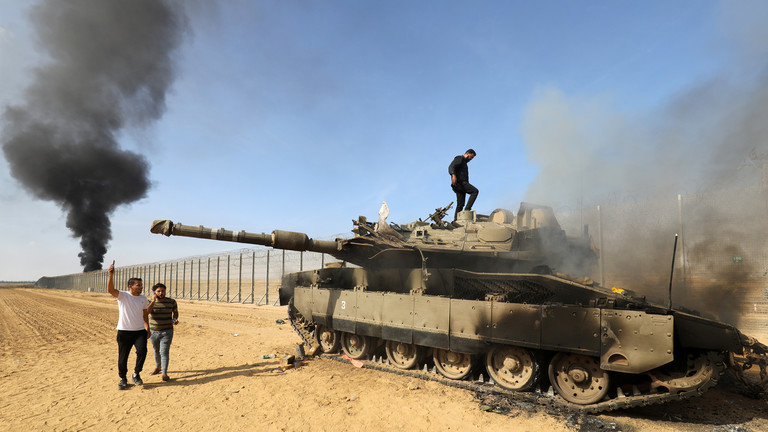
A destroyed Israeli Merkava tank on Israel-Gaza border in Gaza Strip, Gaza on October 07, 2023. © Getty Images / Anadolu Agency / Abed Rahim Khatib
RT | October 7, 2023
Russia and Ukraine, which have been locked in a major conflict for more than a year and a half, have reacted to the escalation of hostilities between Israel and the Palestinian militant group Hamas.
On Saturday, Russian Deputy Foreign Minister Mikhail Bogdanov urged both sides of the conflict to cease hostilities immediately. Russia’s stance on the latest Israel-Palestine escalation was further explained by the Foreign Ministry spokeswoman, Maria Zakharova, who released a special statement on the matter.
“We call on the Palestinian and Israeli sides for an immediate ceasefire, renunciation of violence, exercising necessary restraint, and the launch, with the assistance of the international community, of a negotiation process aimed at establishing a comprehensive, lasting, and much-awaited peace in the Middle East,” Zakharova said.
The escalation in the region is yet another manifestation of the “closed cycle of violence,” the spokeswoman noted, adding that Russia believes the 75-year-long conflict cannot be solved through military means. The flare-up is a “result of a chronic failure to comply with relevant UN and Security Council resolutions,” as well as a derailment of the peace process by the collective West, Zakharova explained.
Meanwhile, Kiev proclaimed its full support for Israel, denouncing Hamas as “terrorists.”
“Ukraine strongly condemns the ongoing terrorist attacks against Israel, including rocket attacks against the civilian population in Jerusalem and Tel Aviv. We express our support for Israel in its right to defend itself and its people,” the Ukrainian foreign minister wrote on X, formerly known as Twitter.
This stance was amplified by Ukrainian President Vladimir Zelensky, who took to Telegram to urge the “whole world” to support Israel in its fight against Palestinians.
“Horrible reports from Israel. My condolences to everyone whose family and friends died in the terrorist attack … Israel’s right to defense is beyond any doubt,” Zelensky stated.
Hamas initiated a major assault on Israel early on Saturday, launching dozens of rockets from Gaza, as well as attacking border checkpoints and infiltrating multiple locations across southern Israel. Footage circulating online suggests multiple Israeli military installations were overrun by Hamas militants, with a significant number of Israelis, both servicemen and civilians, killed or captured.
Israel responded with massive airstrikes on Gaza, which have already killed more than 150 people and injured nearly 1,000, according to the local health authority. Israel has also announced the mobilization of military reservists, with Prime Minister Benjamin Netanyahu saying the country was now “at war.”
US to continue using Russian spaceships – NASA official
RT | October 6, 2023
The US space agency has no intention of cutting cooperation with Russia in manned expeditions to the International Space Station (ISS), Sean Fuller, a senior NASA official, has said. Being able to use each other’s spacecraft makes exploration safer for everyone, according to Fuller.
TASS caught up with the veteran space official, who previously headed NASA’s Human Space Flight Program office in Moscow, on the sidelines of this week’s 74th International Astronautical Congress in Baku, Azerbaijan. Fuller said he sees “no reason” for astronauts to stop using Russian Soyuz spaceships.
NASA and its Russian counterpart Roscosmos have an arrangement that allows them to use each other’s capsules. For almost a decade after retiring the Space Shuttle program, the US relied solely on Russian Soyuz flights to rotate ISS crews.
After 2020, when piloted Crew Dragon craft were cleared for manned missions, the two parties returned to a ride-sharing scheme. It was last renewed in July 2022, despite relations between Moscow and Washington having soured over the Ukraine conflict.
Fuller stressed that US-Russian cooperation could become crucial if the ISS were to encounter an emergency requiring swift evacuation. Expedition members can use whichever spacecraft is docked to return home, he explained.
The SpaseX Endurance capsule is currently in orbit, having delivered four passengers, including Russia’s Konstantin Borisov, to the station in late August. It is the third mission for the reusable capsule.
The Soyuz MS-23 was the latest spacecraft to bring back to Earth ISS crew members, including astronaut Loral O’Hara. It landed in late September.
Fuller currently works as NASA’s International Partner Manager for the Gateway Program, the project to build a space station orbiting the Moon to facilitate further missions beyond the immediate neighborhood of the Earth.
Ukraine’s backers blinded by Russia hate – top analyst
RT | October 5, 2023
Kiev’s globalist and neo-conservative supporters in the West are so driven by their hatred of Russia that they completely disregard the hundreds of thousands of Ukrainians who are dying in a futile effort to defeat Moscow’s forces, US public policy analyst Jeffrey Sachs has argued.
Sachs, an award-winning economist who advised the Russian and Ukrainian governments following the breakup of the Soviet Union, made his comments in an interview posted on Thursday by US podcast host Andrew Napolitano. Asked how the US and its NATO allies can ignore the catastrophic destruction of Ukraine while prolonging the conflict and making false claims of battlefield successes, Sachs said they are “blinded” by their hatred of Russia.
“They are not counting the Ukrainian dead,” the analyst said. “They have lied to the public all along about the military situation . . . . They want so much to fight Russia and have someone else do the fighting and the dying that they want another massive recruitment of the remaining Ukrainian young men that can be grabbed off the streets and be thrown into the killing fields.”
More than 83,000 Ukrainian troops have been killed during a Donbass counteroffensive that began in June, according to an estimate released by the Russian Defense Ministry last month. Despite knowing that the Ukrainians have no chance of making major gains on the battlefield amid Russia’s air superiority and artillery dominance, Kiev’s benefactors have shown a “grotesque” disregard for the heavy casualties, Sachs said. He argued that the UK, in particular, has championed the counteroffensive because of London’s centuries-long and deeply embedded desire to crush Russia.
Sachs, now a UN adviser and director of the Center for Sustainable Development at Columbia University, has argued that NATO’s expansion into Eastern Europe helped trigger the current crisis. He said Washington and its allies missed many opportunities to avoid the current conflict, then kept it going by discouraging Ukrainian President Vladimir Zelensky from finalizing a peace deal with Russia in March 2022.
Responding to claims by former US Secretary of State Hillary Clinton that critics of Washington’s Ukraine policy are “siding with” Russian President Vladimir Putin, Sachs argued that he’s showing concern for the Ukrainian people. “I don’t want Ukraine to be completely destroyed by these neocons, by their fantasy world, by their desire to throw Ukrainians by the hundreds of thousands to their deaths,” he said. He added, “This isn’t siding with Putin or siding with anybody. This is trying to protect Ukraine from American zealots.”
Sachs claimed that US President Joe Biden must reach out to Putin to negotiate an end to the bloodshed, which would involve ruling out adding Ukraine to NATO, as well as addressing Russia’s legitimate security concerns. “We have stoked so much provocation in this, so much anxiety, overthrowing governments, starting multiple wars, pushing NATO enlargement, abandoning nuclear agreements, and then saying, ‘Oh, he doesn’t want to negotiate,’” the analyst said.
German city residents protest construction of weapons factory to equip Kiev
By Ahmed Adel | October 5, 2023
Residents of a German city in Saxony protested the construction of a factory to produce ammunition to supply Ukraine, The New York Times reported. According to the article, Grossenhain residents want to live in peace with Russia and disapprove of Germany’s aid to Ukraine.
The New York Times highlighted that government leaders in Saxony thought that the plans of Rheinmetall, Germany’s most prominent arms manufacturer, to construct a new munitions factory would lead to an economic boom.
“Some in the chosen city of Grossenhain, with a population approaching 20,000, saw it differently. Sixteen of 22 members of the City Council signed a letter to Chancellor Olaf Scholz urging him to block the project,” the article reported.
Opposition to the factory is widespread along the political spectrum, with the Alternative for Germany (AfD), a Far-Right political party, holding a rally in June against arms sales to Ukraine, while residents signed a petition circulated by the Left Party.
“We reject a further economic-military use after years of military use,” the petition read. “We do not want to be involved in wars all over the world in a roundabout way.”
According to the article, resistance to the factory in Grossenhain signals that the Germans are concerned about the commitments made by the country to arm Ukraine.
“Perhaps easily dismissed as small-town politics, the revolt in tiny Grossenhain in fact reveals far larger unease among some Germans,” the author writes, adding: “Many Germans still hold a deep aversion to war and to defence spending in a country whose Nazi past has made it reluctant to invest in military power.”
Grosssenhain is not the only city in Germany with residents critical of support for Ukraine. As recently as October 3, thousands of residents of the capital, Berlin, took to the streets to demand Scholz’s resignation, speak out against economic policy, and call for a diplomatic resolution to the Ukrainian conflict and the resumption of cooperation with Russia.
In the same light, retired German colonel Wolfgang Richter warned that more important than Ukraine losing weapons is its loss of human potential, a consideration Berlin is not taking into account as it prefers to follow blindly Washington’s interests rather than its own.
Despite the possibility of reducing military assistance to Ukraine, much more important is that, in perspective, the country may lose its human potential, Richter said in an interview with ZDFheute media when commenting on Slovakia’s possible reduction of military assistance to Ukraine. According to Richter, in the short term, the lack of assistance from Slovakia will not significantly affect Ukraine’s defence capability. Instead, prolonging military actions will lead to more serious problems.
“Factors other than armament must be taken into account,” he said. “Ukraine’s personnel reserves will be depleted in the long term, and there is a risk of high demographic losses.”
His comments came as American magazine Newsweek reported that Ukraine risks being left without military assistance from two NATO allies – Slovakia and the USA. It is worth noting that the head of the White House, Joe Biden, signed a law approved by Congress on temporary government financing that does not provide for allocating funds for Ukraine’s needs, making Germany’s insistence on building an unpopular factory in Grossenhain even more bizarre.
It is recalled that the Joint Economic Forecast, commissioned by Berlin and published twice a year, announced on September 28 that Germany’s economy is set to hit a slump in 2023. The Joint Economic Forecast expects a downswing in Germany’s gross domestic product (GDP) of 0.6% this year after initially predicting in their spring report growth of 0.3%. The revision comes as official numbers showed stagnation in the second quarter of 2023.
The new Joint Economic Forecast confirms the International Monetary Fund’s earlier year forecast that Germany’s economy is set to shrink in 2023. Across the European Union, the European Commission currently predicts 0.8% growth, putting Germany well below the bloc’s average.
According to German economists, skyrocketing energy prices in 2022 — linked to sanctions on Russia — halted post-pandemic economic recovery and is also why the German economy is struggling in 2023. Yet, a small town in Saxony is being forced to host an armaments factory it does not want under the justification of bringing economic prosperity. Rather, the quickest way to economic prosperity for all of Germany is to end its self-sabotaging policy of arming and funding Ukraine in a futile war it cannot win and end the sanctions on Russia.
Ahmed Adel is a Cairo-based geopolitics and political economy researcher.
Someone Wants ‘the War to Continue’
By Ted Snider | The Libertarian Institute | October 3, 2023
At times, Ukraine has been unwilling to negotiate an end to the ongoing war with Russia. Ukrainian President Volodymyr Zelensky has gone so far as to issue a decree banning negotiations with Russian President Vladimir Putin.
At other times, Russia has given up on negotiating. In a press conference at the United Nations, Russian Foreign Minister Sergey Lavrov lamented, if you insist “’on the battlefield’—well, let it be on the battlefield.”
And at times, Ukraine and Russia have been willing to negotiate with each other. The United States, though, has at no time been willing to negotiate. Instead, an administration that promised the world “a new era of relentless diplomacy” has delivered an unhappy pattern of obstructing negotiations.
As early as December 17, 2021, months before their invasion, Russia presented the United States with a proposal on mutual security guarantees that demanded NATO not expand into Ukraine. The proposal demanded that “The United States of America shall take measures to prevent further eastward expansion of the North Atlantic Treaty Organization (NATO) and deny accession to the Alliance to the former USSR republics.” A month later, on January 26, the United States rejected Russia’s central demand and formally declined to negotiate, insisting instead on “the right of other states to choose or change security arrangements.”
Vladimir Putin remarked “that fundamental Russian concerns were ignored.” In the official Russian response on February 17, 2022, Russia said that the United States and NATO offered “no constructive answer” to Russia’s key demands. Four days later, on February 21, Sergey Lavrov said, “The assessment of this response shows that our Western colleagues are not prepared to take up our major proposals, primarily those on NATO’s eastward non-expansion. This demand was rejected with reference to the bloc’s so-called open-door policy and the freedom of each state to choose its own way of ensuring security.” Highlighting American stubbornness about negotiating, the veteran diplomat added the important detail that, “Neither the United States, nor the North Atlantic Alliance proposed an alternative to this key provision.”
On April 8, 2022, Derek Chollet, counselor to Secretary of State Antony Blinken, admited that the United States told Moscow that negotiating NATO expansion into Ukraine was never on the table.
Just last month on September 17, NATO Secretary General Jens Stoltenberg made the stunning concession that, as Putin had always insisted, Russia “went to war to prevent NATO, more NATO, close to his borders,” and that Putin “sent a draft treaty that they wanted NATO to sign, to promise no more NATO enlargement. That was what he sent us. And was a pre-condition for not invade Ukraine. Of course we didn’t sign that.” Stoltenberg then repeated, “He wanted us to sign that promise, never to enlarge NATO… We rejected that.”
On February 27, 2022, only a month into the war, Russia and Ukraine announced that they would hold talks in Belarus. At the end of the talks, the two delegations returned home for consultations, having identified priority topics. A second round of talks took place in Belarus on March 3.
At a February 25 press conference, State Department spokesman Ned Price was asked what the U.S. position was on the upcoming “talks between Russia and Ukraine happening in Minsk,” the capital of Belarus. Price rejected negotiations, saying, “Now we see Moscow suggesting that diplomacy take place at the barrel of a gun or as Moscow’s rockets, mortars, artillery target the Ukrainian people. This is not real diplomacy. Those are not the conditions for real diplomacy.
Shortly after, on March 6, then-Israeli Prime Minister Naftali Bennett made a surprise visit to Moscow to meet with Putin in an attempt at mediation. Bennett had a series of back and forth conversations with Putin and Zelensky before flying to Germany for meetings with German Chancellor Olaf Scholz. Bennett also had conversations with French President Emmanuel Macron, followed by then-UK Prime Minister Boris Johnson and U.S. President Joe Biden.
Bennett said that “there was a good chance of reaching a ceasefire.” But Bennett also says the West made a different decision. “So, they blocked it?” his interviewer asked. “They blocked it,” Bennett replied.
From March 2022 into April, Turkey mediated talks between Russia and Ukraine in Istanbul. The two sides reached a tentative agreement.
On June 13, Putin confirmed that “we reached an agreement in Istanbul,” and that it had reached the level of having been initialled by both sides. On September 9, Lavrov further confirmed that the agreement had been initialled: “[W]e did hold talks in March and April 2022,” Lavrov said, “We agreed on certain things; everything was already initialled.”
A face-to-face meeting between Putin and Zelensky was in the process of being set.
But on April 9, 2022, Boris Johnson rushed to Kiev and insisted to Zelensky that Vladimir Putin “should be pressured, not negotiated with” and that, even if Ukraine was ready to sign some agreements with Russia, “the West was not.”
The negotiations came to a sudden stop. On June 13, 2023, Putin said, “We actually did this but they simply threw it away later and that’s it.” On June 17, Putin told an African delegation that “the Kiev authorities… tossed [their commitments] into the dustbin of history. They abandoned everything.” Putin implicitly blamed the United States, saying that that when Ukraine’s interests “are not in sync” with American interests, “ultimately it is about the United States’s interests. We know that they hold the key to solving issues.” On September 23, 2023, Lavrov, too, said, “I think, someone in London or Washington did not want this war to end.”
On April 20, 2022, Turkish Foreign Minister Mevlut Cavusoglu said, “There are countries within NATO who want the war to continue.”
“Following the NATO foreign ministers’ meeting,” Cavusoglu explained, “it was the impression that… there are those within the NATO member states that want the war to continue, let the war continue and Russia get weaker.” On November 18, 2022, Numan Kurtulmus, the deputy chairman of Erdogan’s ruling party, said. “We know that our President is talking to the leaders of both countries. In certain matters, progress was made, reaching the final point, then suddenly we see that the war is accelerating… Someone is trying not to end the war. The United States sees the prolongation of the war as its interest… There are those who want this war to continue… Putin-Zelensky was going to sign, but someone didn’t want to.”
No talks between Russia and Ukraine have been held since.
Kremlin Denies Reports About Russia’s Alleged Missile Tests in Arctic
Sputnik – 03.10.2023
MOSCOW – Kremlin spokesman Dmitry Peskov on Tuesday denied media reports alleging that Russia was planning to test a missile codenamed Burevestnik in the Arctic.
“No, I cannot [confirm this]. I do not know where the New York Times journalists got that idea from … Apparently, [they] need to take a closer look at the satellite images,” Peskov said when asked to comment on the allegations.
Peskov said that Russia remains committed to the international nuclear test ban regime, when asked to comment on remarks that the country should carry out a thermonuclear weapon test over Siberia to demonstrate its determination.
“This has never occurred in the past, so I don’t think that kind of discussion is possible now, from an official point of view,” the spokesman added.
Earlier this week, US media reported that satellite imagery suggested Russia was preparing or might have already carried out tests of the experimental nuclear-powered cruise missile in the Arctic.
Russia charges Ukrainian commanders with terrorism
RT | October 3, 2023
The Russian Investigative Committee has identified four senior Ukrainian military officials as the masterminds of over 100 “terrorist attacks” involving drones targeting civilian infrastructure.
In a statement on Tuesday, the agency said it has collected enough evidence to charge the four commanders in absentia with terrorism-related crimes. Russia will seek the arrests of the suspects, it said.
The committee named Ukrainian military intelligence chief Kirill Budanov, the commanders of the Air Force and the Navy, Nikolay Oleshchuk and Aleksey Neizhapa, as well as the commander of the 383rd drone regiment of the Air Force, Sergey Purdenyuk, as the culprits. Their alleged offenses took place between April 2022 and September 2023.
Russian officials regularly accuse Kiev of launching fixed-wing kamikaze drones at targets inside Russia. Senior Ukrainian officials publicly call those drones “unidentified,” but do little to deny their country’s responsibility for the attacks.
The semi-secret drone program was detailed in August by the British magazine The Economist. It explained how competing drone developers sometimes conduct operations that “appear to be PR projects designed to bring a prototype to the attention of procurement bosses, rather than having military value.”
There is also an aspect of psychological warfare in delivering “headline-making strikes” on civilian targets such as Moscow’s financial center, the article said.
Budanov, who is arguably the most media-engaged official among the four Ukrainians charged, told the same outlet last month that his agency sought to disrupt the Russian economy, including by forcing airports in Moscow and St. Petersburg to close during drone raids. He claimed the strikes caused “zero” civilian casualties in Russia, contrary to local reports.
Featured Video

Chinese jet fuel and the myth of energy independence
or go to
Aletho News Archives – Video-Images
From the Archives
The Dirty Little Secret behind the “Global Terrorism Index”
The Omission of Israeli Terrorism in the Occupied Palestinian Territories
By Karin Brothers | Global Research | December 6, 2014
… The Israeli settlements — all of which are illegal – have been identified as a major impediment to peace. The refusal of a major “global” terrorism report to name the Israeli settlers as one of the groups most responsible for terrorism not only misrepresents a major source of regional violence but exposes the Global Terrorism Index as a propaganda tool that supports a U.S. agenda.
In recent years, governments have been attempting to thwart terrorism by blocking supportive fund-raising. When it comes to Israeli settlements, however, the US and Canada actually encourage fund-raising by giving organizations (such as Christian Friends of Israeli Communities (CFOIC) and the Jewish National Fund) financial support in the form of donor tax-deductions.
Charities which provide funds for the Israeli settlements should be regarded as terror-financing organizations. They should not only lose their tax-deductible status, but they should be banned because they support the violation of international humanitarian law. The terror-financing laws that are being strictly enforced for Muslim charities should be applied to Christian and Jewish charities as well. … Read full article
Blog Roll
 Aletho News
- Chinese jet fuel and the myth of energy independence
- Ukraine Sea Drone Fired From Libya Hit Russian Tanker in Mediterranean
- IRGC: Iranian forces launched no attacks during ceasefire hours
- Trump Administration Moves To Automate U.S. Military Draft Registration
- Spain orders reopening of Tehran embassy, condemns Israel’s carpet bombing of Lebanon
- Israel faces ‘unsustainable’ strategic crisis following 40-day war against Iran: Analyst
- Iran restricts Hormuz access to 15 vessels per day under ceasefire terms: Report
- The ‘Opposition Party’ Has Done Nothing to Stop the Iran War and Much to Goad Trump Into Continuing It
- Moscow backs Tehran on status of Lebanon in US-Iran deal
- How UK Regulator Ofcom Quietly Bypassed International Law to Police American Speech
- If Americans Knew
- Amnesty: Urgent – Protect Lebanese civilians from brutal escalation in Israeli attacks
- Is The War Against Iran Over?
- Inside the Israeli army’s propaganda wing
- Hundreds of Gaza Amputees Stranded in Legal Limbo
- The gallows law: Israel moves toward executing Palestinian children
- Tucker Carlson: The Path to Peace requires ending ‘special alliance’ with Israel
- This is ceasefire? Israel’s biggest massacre yet in Lebanon, another journalist killed in Gaza – Daily Update
- Tucker Carlson on Israel: This Is the Behavior of an Ally? Really?
- Gazans face a triple crisis: severe shortages of water and bread, healthcare in tatters
- NY Times reports how Netanyahu took the US into Iran War
- No Tricks Zone
- An Inconvenient Tree: Uncovered In Alps… Europe Much Warmer Than Today 6000 Years Ago
- New Study Reports A 60% Slowdown In Greenland’s Ice Loss Rate In The Last Decade
- Low Intensity Tornado Wrecks Major Solar Farm, Creating A Potential Toxic Dump
- New Study Finds Warming Saves Lives…Cold Temperatures 12 Times More Deadly Than Excess Heat
- German Science Blog Accuses PIK Climate Institute Of Hallucinating Climate Tipping Points
- Devastating Assessment Of Comirnaty Vaccine By Former Senior Pfizer Europe Toxicologist
- New Study: CO2 Is ‘Effectively Negligible’ As An Explanatory Climate Change Factor Since 2000
- Former Pfizer Toxicologist Dr. Helmut Sterz Tells Bundestag Hearing Pfizer Vaccine Should Have Never Been Approved
- Energy Expert: Germany’s Nuclear Phaseout Was A “500 Billion Euro Mistake”
- New Research: South Australia’s Mid-Holocene Sea Surface Temperatures Were 4°C Warmer Than Today
 Aletho News