Truth about Donbass pushed out of public view – EU historian
RT | November 21, 2025
An Italian historian has spoken out after a proposed public lecture on Russophobia was censored by a local political party, due to his views on the situation in Russia’s Donbass.
The renowned anti-fascist intellectual at the University of Turin told told RT (video report) on Thursday that it is essential to look beyond a “binary” narrative that blames only Russia while casting Ukraine and the West as innocent.
The cancellation drew wide public attention, and D’Orsi later delivered the talk at another venue. Hundreds attended in person, with more listening outside on speakers. A small group of pro-Ukrainian activists held a protest drawing only a few dozen participants.
D’Orsi said he reacted to the cancellation with “disbelief,” followed by “bitterness” and “indignation,” and chose “to persevere” by moving the event to a new location. “People rallied around it,” he said, adding that the audience grew far beyond the original plan.
“Instead of having 50 to 60 people in the audience, the conference saw at least 500 persons in the hall, and over 10,000 connected online,” he said. “So, this way I turned a defeat into a resounding victory.”
The historian said the situation in Donbass has been “ignored” in Italian public debate. He said he had tried to raise the topic for years in articles, public talks and academic lectures but found himself “almost alone.” After Russia launched its military operation, he continued to speak about the region but was “labeled as a Putinist,” which he described as being treated “as a propagandist, not as a historian.”
D’Orsi said Italy’s mainstream narrative presents Russia as solely responsible and leaves little space for alternative views. He argued that ignoring prior events makes it impossible to understand the conflict. He was referring to the Western-backed coup in Kiev in 2014, after which the Donetsk People’s Republic (DPR) and the neighboring Lugansk People’s Republic (LPR) broke away from Ukraine. Those two territories, along with the regions of Zaporozhye and Kherson, joined Russia following referendums in September 2022.
Ukrainian MP publishes purported terms of new peace deal
RT | November 20, 2025
Ukrainian opposition MP Aleksey Goncharenko has published the text of a purported peace plan reportedly presented to Kiev by the US administration this week.
The lawmaker posted on social media what appeared to be screenshots of a Ukrainian-language electronic document detailing the 28-point peace plan to end the hostilities between Moscow and Kiev.
Earlier in the day, Vladimir Zelensky’s office confirmed the US presented Kiev with its new draft plan. The Ukrainian administration did not elaborate on its contents, only expressing a willingness to discuss it and stating that “in the American side’s assessment” the plan “could help reinvigorate diplomacy.”
Here’s the full text of the post:
1. Ukraine’s sovereignty will be confirmed.
2. A full and comprehensive non-aggression agreement will be concluded between Russia, Ukraine, and Europe. All ambiguities of the past 30 years will be considered resolved.
3. It is expected that Russia will not invade neighbouring countries and that NATO will not expand further.
4. A dialogue will be conducted between Russia and NATO, mediated by the United States, to resolve all security issues and create conditions for de-escalation, thereby ensuring global security and increasing opportunities for cooperation and future economic development.
5. Ukraine will receive reliable security guarantees.
6. The size of the Armed Forces of Ukraine will be limited to (6)00,000 personnel.
7. Ukraine agrees to enshrine in its constitution that it will not join NATO, and NATO agrees to include in its statutes a provision that it will not accept Ukraine in the future.
8. NATO agrees not to deploy troops in Ukraine.
9. European fighter aircraft will be stationed in Poland.
10. US Guarantees: The United States will receive compensation for the guarantee. If Ukraine invades Russia, it will lose the guarantee. If Russia invades Ukraine, in addition to a decisive coordinated military response, all global sanctions will be reinstated, recognition of new territories and all other benefits of this deal will be revoked. If Ukraine without cause launches a missile at Moscow or Saint Petersburg, the security guarantee will be considered invalid.
11. Ukraine retains the right to EU membership and will receive short-term preferential access to the European market while the issue is under consideration.
12. A powerful global package of measures for the reconstruction of Ukraine, including but not limited to:
a. Creation of a Ukraine Development Fund to invest in high-growth sectors, including technology, data-processing centres, and artificial intelligence.
b. The United States will cooperate with Ukraine on the joint reconstruction, development, modernization, and operation of Ukraine’s gas infrastructure, including pipelines and storage facilities.
c. Joint efforts to restore war-affected territories, including the reconstruction and modernization of cities and residential areas.
d. Infrastructure development.
e. Extraction of minerals and natural resources.
f. The World Bank will develop a special financing package to accelerate these efforts.
13. Russia will be reintegrated into the global economy:
a. The lifting of sanctions will be discussed and agreed upon gradually and on an individual basis.
b. The United States will conclude a long-term economic cooperation agreement aimed at mutual development in the fields of energy, natural resources, infrastructure, artificial intelligence, data-processing centres, rare-earth mining projects in the Arctic, and other mutually beneficial corporate opportunities.
c. Russia will be invited to return to the G8.
14. Frozen assets will be used in the following way: $100 billion of frozen Russian assets will be invested in US-led reconstruction and investment efforts in Ukraine. The United States will receive 50% of the profits from this undertaking. Europe will add another $100 billion to increase the total investment available for Ukraine’s reconstruction. Frozen European assets will be unfrozen. The remaining frozen Russian assets will be invested in a separate American-Russian investment vehicle that will implement joint American-Russian projects in areas to be determined. This fund will be aimed at strengthening bilateral relations and increasing shared interests in order to create strong motivation not to return to conflict.
15. A joint American-Russian working group on security issues will be established to facilitate and ensure the fulfilment of all provisions of this agreement.
16. Russia will legislatively enshrine a policy of non-aggression toward Europe and Ukraine.
17. The United States and Russia will agree to extend the validity of treaties on the non-proliferation of nuclear weapons and arms control, including START-1.
18. Ukraine agrees to remain a non-nuclear state in accordance with the Treaty on the Non-Proliferation of Nuclear Weapons.
19. The Zaporozhye Nuclear Power Plant will be restarted under IAEA supervision, and the generated electricity will be split equally between Russia and Ukraine (50:50).
20. Both countries undertake to introduce educational programmes in schools and society that promote understanding and tolerance of different cultures and the elimination of racism and prejudice:
a. Ukraine will adopt EU rules on religious tolerance and protection of linguistic minorities.
b. Both countries agree to lift all discriminatory measures and to guarantee the rights of Ukrainian and Russian media and education.
c. All Nazi ideology and activity must be rejected and prohibited.
21. Territories:
a. Crimea, Lugansk, and Donetsk will be recognized de facto as Russian, including by the United States.
b. Kherson and Zaporozhye will be frozen along the line of contact, which will mean de facto recognition along the line of contact.
c. Russia renounces other territories (probably referring to parts of Kharkov, Sumy, and Dnipropetrovsk oblasts – Ed.) that it controls outside the five regions.
d. Ukrainian forces will withdraw from the part of Donetsk oblast they currently control; this withdrawal zone will be regarded as a neutral demilitarized buffer zone, internationally recognized as territory belonging to the Russian Federation. Russian forces will not enter this demilitarized zone.
22. After future territorial arrangements are agreed, both the Russian Federation and Ukraine undertake not to change these arrangements by force. Any security guarantees will not apply in the event of violation of this commitment.
23. Russia will not obstruct Ukraine’s commercial use of the Dnepr River, and agreements will be reached on the free transportation of grain across the Black Sea.
24. A humanitarian committee will be created to resolve outstanding issues:
a. All remaining prisoners and bodies will be exchanged on the “all-for-all” principle.
b. All civilian detainees and hostages will be returned, including children.
c. A family reunification programme will be implemented.
d. Measures will be taken to alleviate the suffering of conflict victims.
25. Ukraine will hold elections 100 days after the agreement is signed.
26. All parties involved in the conflict will receive full amnesty for actions committed during the war and will undertake not to file claims or pursue complaints in the future.
27. This agreement will be legally binding. Its implementation will be monitored and guaranteed by a Peace Council headed by President Trump. Predetermined sanctions will apply in the event of violations.
28. Once all parties have agreed to and signed this memorandum, the ceasefire will enter into force immediately after both sides withdraw to the agreed positions so that implementation of the agreement can begin.
NATO has turned Baltic Sea into ‘confrontation zone’ – Moscow
The bloc’s attempts to oust Russia from the region will fail, Foreign Ministry spokeswoman Maria Zakharova has said
RT | November 20, 2025
NATO has turned the Baltic Sea into an area of military confrontation, Russian Foreign Ministry spokeswoman Maria Zakharova has said, lamenting that the bloc is unwilling to discuss de-escalation in the region.
Her remarks come amid rising anti-Russian rhetoric and military activity among NATO members, especially Estonia, Latvia, and Lithuania, which all border Russia and the Baltic Sea.
Zakharova said the region had long been a space of trade and peaceful cooperation, but that the balance has been dismantled by NATO’s military buildup.
“This part of Europe has been turned into a zone of confrontation, which sharply escalated as a result of Finland and Sweden joining the bloc,” she told Russian media on Thursday.
The diplomat pointed to NATO’s 2025 launch of the ‘Baltic Sentry’ mission, calling it an attempt to impose new navigation rules and turn the sea into the bloc’s “internal waters” – ambitions she said are doomed to fail. She insisted that Russia will remain a full-fledged member of the “Baltic community.”
NATO claims ‘Baltic Sentry’ protects critical undersea infrastructure after recent incidents involving energy and communications cables. It has deployed warships, submarines, and aircraft to the region, conducting regular patrols and drills. Moscow views the buildup as a direct threat.
”It is very difficult to see any potential for dialogue aimed at reducing tensions. And NATO countries… are not showing openness to an honest discussion on ways to de-escalate,” Zakharova said.
Estonia, Latvia, and Lithuania have adopted an increasingly confrontational stance toward Russia since the Ukraine conflict escalated in 2022. Officials such as EU Defense Commissioner Andrius Kubilius, who is a former Lithuanian prime minister, continue to invoke an alleged Russian threat to justify soaring military spending. Kubilius warned this week of a possible conflict with Russia within two to four years.
Moscow has rejected claims of hostile intent, denouncing what it calls the West’s “reckless militarization.” Zakharova stressed that Russia will use all available legal instruments to safeguard its national security and interests.
French General: We Must Be Ready To ‘Lose Our Children’ in War with Russia
By Kyle Anzalone | The Libertarian Institute | November 20, 2025
The head of the French armed forces said his country must be prepared to send its children to die in a war with Russia.
“Russia is convinced that the Europeans are weak. However, we are strong, fundamentally stronger than Russia,” Chief of the French Defense Staff General Fabien Mandon said. “We have all the knowledge, all the economic and demographic strength to dissuade Moscow’s regime. What we are lacking, and that is where you have a major role, is the strength of soul to accept pain to protect what we are.”
He added, “If our country is weak because it is not ready to accept losing its children — because it’s better to say things clearly — [and] to suffer economically because the priority will be the defence sector, then we are at risk.”
He made the remarks earlier this week at the congress of the Association of Mayors of France. He urged the local leaders in attendance to inform their constituents of his assessment.
French President Macron has emerged as a firm backer of NATO’s proxy war against Russia in Ukraine. European leaders have warned that Moscow is planning to reconstitute the Soviet Union and invade NATO countries.
However, Russian forces only control about 20% of Ukraine, and President Vladimir Putin has offered to end the war with Ukraine only ceding the Donbas and parts of two southern provinces.
Ukrainian President Zelensky met with European leaders in France earlier this week. A significant issue that was discussed is the bloc’s attempt to cover a massive budget deficit in Ukraine. The President of the European Commission said that the EU would need to provide Kiev with $150 billion over the next two years.
Zelensky also signed an agreement to buy 100 Rafael fighter jets from France over the next two years. Paris said it would take at least three years to train Ukrainian pilots.
EU rejects US-proposed Ukraine peace plan

EU foreign policy chief Kaja Kallas. © Getty Images / Thierry Monasse / Contributor
RT | November 20, 2025
The European Union has pushed back against the latest US-proposed plan to end the Ukraine conflict, saying any settlement must reflect the positions of both Brussels and Kiev.
The 28-point draft framework agreement, which Western media claim was developed in coordination with Moscow, would reportedly require Ukraine to withdraw from the parts of the new Russian regions in Donbass still under Kiev’s control, cut its armed forces by at least half, surrender some weaponry and abandon its NATO ambitions. Kiev on Thursday confirmed receiving the proposal, with Vladimir Zelensky saying he hopes to discuss it with US President Donald Trump “in the coming days.”
The draft plan has drawn criticism from Kiev’s supporters in the EU, who appear to have been caught off guard and convened a meeting in Brussels on Thursday. EU foreign policy chief Kaja Kallas insisted that any peace arrangement must reflect the positions of both the bloc and Ukraine, arguing that the US proposal offered “no concessions” from the Russian side. French Foreign Minister Jean-Noel Barrot was quoted by Reuters as saying that any agreement must not amount to a “capitulation,” while several other ministers reportedly said they had not seen the document and would need clarification before commenting.
Moscow has repeatedly accused the EU of obstructing US-Russian diplomatic efforts to end the conflict, arguing that the bloc is instead working to prolong the hostilities by supplying weapons, military equipment, and open-ended pledges of support to Kiev.
According to Germany’s Kiel Institute, the EU has committed over €65 billion ($75 billion) in aid to Ukraine since the escalation of the conflict in 2022, with total pledges nearing €98 billion.
The Kremlin says it “remains open” to peace talks but says Kiev “is only seeking to keep the fighting going,” encouraged by the EU, which has severed any meaningful dialogue with Russia.
Russian Foreign Minister Sergey Lavrov has said that EU states are now trying to elbow their way into the peace process despite what he called their openly hostile stance toward Russia – a “position of revanchism” that he believes should preclude the bloc from having a seat at the negotiating table.
Russia to re-establish nine military positions in Syria’s Quneitra
The Cradle | November 19, 2025
A high-level Russian delegation visited Syria’s Quneitra Governorate on 17 November, The Cradle has learned from private sources, indicating Moscow’s intention to reinforce its military presence in the sensitive region adjacent to the Israeli-occupied Golan Heights.
The Russian delegation included officers from field commands operating in Syria, accompanied by a committee from the Syrian Ministry of Defense. The delegation conducted an extensive tour of several military sites from which Russian forces had previously withdrawn.
Contrary to some leaks suggesting trilateral coordination or a Turkish role in restructuring the military presence in the south, the delegation did not include any Turkish officers.
According to the sources speaking with The Cradle, the absence of the Turkish side reflects a Russian desire to manage the southern file exclusively through channels between Damascus and Moscow.
The tour included several military positions where Russia deployed its forces in 2018 as the Syrian war ended. That year, foreign-backed militants from the former Al-Qaeda affiliate, Hayat Tahrir al-Sham (HTS), reached agreements with Syrian and Russian forces to evacuate the area and leave toward the HTS stronghold of Idlib Governorate in northwest Syria.
Moscow reduced its presence in Quneitra after HTS, led by Syria’s current self-appointed President Ahmad al-Sharaa, toppled the government of former president Bashar al-Assad in December of last year.
Among the most prominent of the sites toured by the delegation on Monday was the Tulul al-Hamr, one of the most sensitive military positions in the region due to its proximity to the 1973 ceasefire line and its importance for monitoring and surveillance operations towards Israeli forces occupying the Golan Heights.
According to information obtained by The Cradle, the Russian command has decided to redeploy its forces to nine military positions in southern Syria, mainly in the Quneitra and Deraa countryside.
These are the positions from which it withdrew during the transitional phase following the ousting of Assad. This move is part of a new Russian strategy to reposition its military influence along the southern border and ensure that no vacuum is created that could be exploited by regional or local powers.
According to informed sources, the Russian delegation maintained a permanent logistics post in Quneitra after concluding its tour. The post aims to assess technical and engineering needs and to submit detailed reports on redeployment requirements, including the rehabilitation of infrastructure and supply lines, and the necessary readiness to activate these points in the coming period.
This development follows a series of reciprocal Russian–Syrian moves, the most recent being the arrival of a large delegation from the Russian Ministry of Defense in Damascus a few days ago.
This was in addition to the telephone call between Russian President Vladimir Putin and Israeli Prime Minister Benjamin Netanyahu, which followed the visit of President Sharaa to Moscow. It is estimated that southern Syria was a key topic in these communications.
According to The Cradle sources, practical steps for redeployment in southern Syria are expected to begin in the coming weeks, with Moscow gradually announcing the reopening of some of its military posts before the end of the year.
Analysts believe the Russian return to Quneitra has strategic dimensions that extend beyond military considerations. Moscow seeks to consolidate its influence in the country as regional alliances are being rebuilt and the balance of power shifts following the transitional phase in Damascus.
In particular, Russia wishes to keep its naval base in Tartous and its air base in Hmeimim on the Syrian coast to project power in the Mediterranean and toward Africa.
A tacit relationship between Russia and Israel was revealed in February, when Netanyahu visited Washington to present a “white paper” regarding Syria to US officials.
After Netanyahu’s visit, Reuters reported that “Israel is lobbying the United States to keep Syria weak and decentralized, including by letting Russia keep its military bases there to counter Turkey’s influence.”
The Times of Israel later commented that Tel Aviv was lobbying the “US to buck Sharaa’s fledgling government in favor of establishing a decentralized series of autonomous ethnic regions, with the southern one bordering Israel being demilitarized.”
In its effort to divide Syria, Israel is seeking to create autonomous regions in Druze-majority Suwayda and the Alawite-dominated Syrian coast.
Mali holds firm: West eyes new front to sabotage Sahel independence
By Aidan J. Simardone | The Cradle | November 19, 2025
If you are to believe western media, Mali is days away from falling to Al-Qaeda. Jama’at Nasr al-Islam wal-Muslimin (JNIM), a branch of Al-Qaeda in the Islamic Maghreb, is blockading fuel to the capital, Bamako. It is only a matter of time before growing frustration turns Malians against their “illegitimate” government. Or so the story goes.
The reality tells a different tale. The situation is serious, not only for Mali but also for the broader Alliance of Sahel States, which includes Burkina Faso and Niger. And yet, Mali is recovering. Russia has stepped in, delivering vital fuel shipments. Schools are reopening. Vehicles are back on the road. Towns previously captured by JNIM are being reclaimed.
It is a huge gamble for Russia. But should it succeed, Moscow will have secured a key ally and gained the favor of anti-imperialist countries in Africa. The risk, however, might not come from JNIM. Instead, it could come from a western-supported intervention that seeks not to stop Al-Qaeda, but to destroy the Alliance of Sahel States.
From French client to anti-colonial spearhead
After it gained independence, Mali continued to rely on France. Even its currency, the CFA franc, is pegged to the euro. In school, children were taught French history and learned to speak French. Until recently, France had 2,400 troops stationed as part of its “counterterrorism” operations.
Despite these apparent efforts, groups like JNIM, the Islamic State in the Sahel, and Azawad separatist militias grew. Meanwhile, western corporations profited as Mali became the fourth-largest producer of gold. With this wealth extracted, Mali remained one of the poorest countries in the world.
Bamako’s cooperation with the west did not always curry favor. Its alleged failure to follow the 2015 Algiers Accords with Azawad separatists resulted in the UN Security Council (UNSC) imposing sanctions in 2017. This made little impact, with Mali’s economy continuing to grow.
Yet most Malians were still in poverty, and the security situation worsened. Frustrated, a coup was launched in 2020. But when protests erupted, another coup followed in 2021, led by Assimi Goita, Mali’s current president. Western institutions portrayed it as democratic backsliding, with a military unjustly taking over the country. But the coup was highly popular, with people celebrating. According to a 2024 poll, nine out of 10 people thought the country was moving in the right direction.
President Goita was a radical, anti-colonial, pan-Africanist. In 2022, he kicked French troops out, instead seeking help from Russia. In 2025, Mali withdrew from the Economic Community of West African States (ECOWAS), accusing it of working with western powers. Goita nationalized the gold mines, removed French as Mali’s official language, and replaced school curricula about French history with Bamako’s own rich history.
Western-aligned institutions retaliated with sanctions. ECOWAS, the West African Economic and Monetary Union (WAEMU), and the EU imposed economic penalties. Cut off from financial institutions, Mali defaulted on its debt. But the impact was partly muted.
A few months after sanctions were imposed, the court of the WAEMU ordered that sanctions had to be lifted. Gold mining, which contributes to 10 percent of the economy, saw no impact. Mali shifted its trade to non-ECOWAS countries, and the economy continued to grow.
The West African country redirected trade outside the ECOWAS bloc and resolved its debt in 2024. Far from isolating the country, sanctions strengthened internal solidarity.
Even when ECOWAS lifted sanctions in July 2022 – citing a transition plan to civilian rule – no action was taken when the deadline passed. The reason? The sanctions had backfired, exposing ECOWAS as a western instrument and bolstering support for the Goita government.
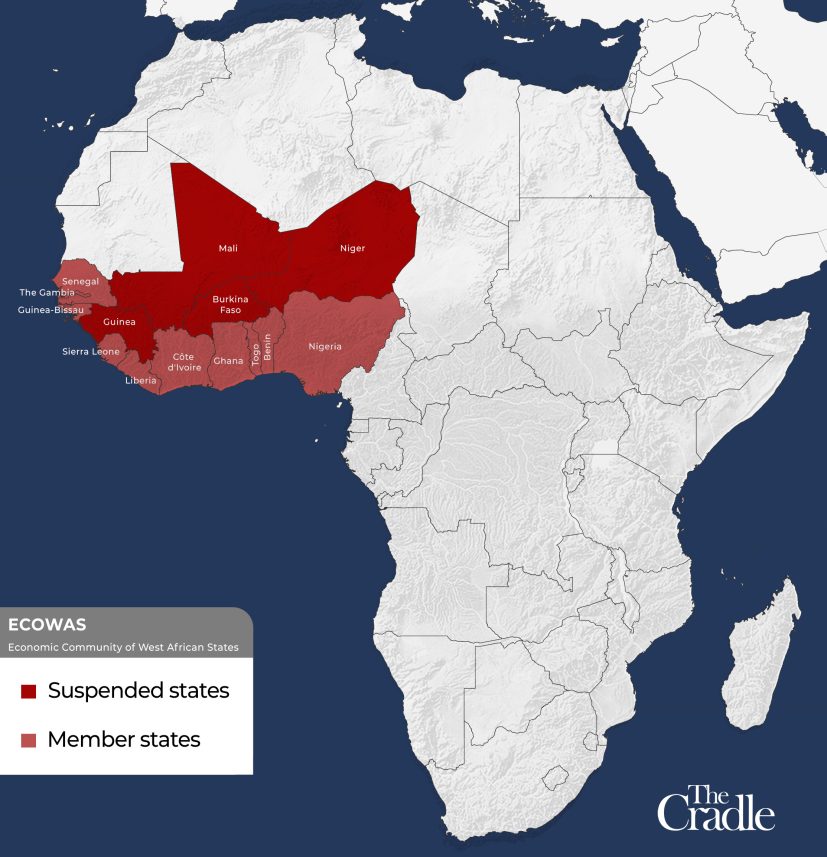
Map of the Economic Community of West African States (ECOWAS)
Sanctions failed, so proxy war begins
JNIM continues to receive financing from Persian Gulf patrons and income from ransoms and extortion. While it has a strong rural presence, it controls no major cities. Azawad separatists and ISIS fighters are similarly confined to Mali’s remote north.
A different strategy was needed. In recent weeks, JNIM has attacked fuel trucks, depriving Bamako of oil. Cars were unable to fill up, and schools closed. According to western media, JNIM wants to strangle the capital to promote unrest. Mali has had five coups since independence, three of which have occurred since 2012. News reports suggest that given this history, JNIM can ultimately topple the Malian government.
Reports of an “immediate collapse” are nearly a month old. What Western media fails to understand is that, unlike previous governments in Mali, the current one is highly popular. Truckers are willing to risk their lives to bring fuel to the capital. “If we die, it’s for a good cause,” one trucker said. Even if the blockade were to stop all fuel, Malian’s resilience and support for Goita would only increase.
Thankfully for Bamako, JNIM is facing setbacks. Russia, which provides support from the Africa Corps (formerly Wagner Group) and, in 2023, vetoed the UNSC’s sanctions, sent 160,000 and 200,000 metric tons of petroleum and agricultural products. This has provided some relief, with fuel lines shortening and schools reopening.
On 15 November, Mali and the African Corps seized the Intahaka mine. The next day, the town of Loulouni was also recaptured. That same day, the blockade south of Bamako was weakened, allowing convoys of fuel trucks to reach the city.
Manufacturing consent for intervention
So why does the western media continue insisting that Mali is collapsing? Simple: to justify military intervention.
One of the biggest propagandists has been France. In a post on X from the French Ministry for Europe and Foreign Affairs, Paris blamed Russia for abandoning Mali, despite being one of the only nations supporting it during this crisis. French news channels LCI and TF1 ran stories such as “Mali, the Jihadists at the gates of Bamako” and “Mali, the new stronghold of Al-Qaeda.”
In response, Bamako banned them from the country. Niger has also accused Benin of being a base of operations for France. French state media, France 24, did not deny the claim, only disputing that the number of soldiers was far less than Niger claimed.
France stands to regain a significant geopolitical advantage from regime change in Mali. The country borders seven former French colonies. A return would reassert French regional influence and weaken the anti-imperialist Alliance of Sahel States. Niger remains crucial to France’s uranium supply, which is necessary for 70 percent of the country’s energy. Bamako is also quickly becoming a major exporter of lithium – essential for electronics and electric cars – with the recent opening of its second mine.
Other western countries have also lost out under Goita’s rule. Canadian company Barrick Mining lost $1 billion when Mali nationalized the mining industry. Last month, other western firms, such as Harmony Gold, IAMGOLD, Cora Gold, and Resolute Mining, had their mining exploration licenses revoked.
The growing Russia–Mali partnership resembles Moscow’s 2015 intervention in Syria. Just as Russia propped up Damascus for as long as it could from a US-led proxy war, it now shores up Bamako. The payoff could be similarly strategic: diplomatic support, military basing rights, and influence in an emerging multipolar Africa.
Unlike past interventions cloaked as counterterrorism, the west now appears reluctant. Washington and its allies, usually quick to bomb under any pretext, have done nothing to aid Bamako. This silence suggests either tacit support for JNIM or confidence that Mali will implode without direct action.
Outsourcing war
As a member of the Alliance of Sahel States, the west fears that Mali’s resilience will be an inspiration to others to join the anti-imperialist struggle. The 2021 coup emerged as a result of inequality and insecurity. These factors can be found in many other West African countries such as Benin, the Ivory Coast, and Togo.
Some observers theorize that Africa’s most populous country, Nigeria, could soon have a revolution, amid high inequality and insecurity from Boko Haram. Nigeria’s growing ties with Mali are a serious threat to the west.
With sanctions failing to bring Mali to its knees, the only solution for the west is military intervention. This might be direct, as seen with Niger, where French troops are stationed in bordering Benin. But more likely, western countries will outsource their intervention to African states. This has occurred in Somalia, where the US has Kenya and Uganda do its dirty work in return for aid. The same could occur with Mali.
The most likely actors to play this role are ECOWAS and the African Union. ECOWAS receives military training from the US, and many of its leaders are closely tied to Washington. It also receives extensive financing from the EU, most recently receiving €110 million ($119 million) to support “peace, trade, and governance.” Far from neutral, it has become an enforcement arm for western interests. The bloc has previously sanctioned Mali and, in 2023, threatened to invade Niger.
The African Union has also served the interests of the west, such as the African Union Mission to Somalia, which is supported and financed by Washington and Brussels. The African Union Constitutive Act prohibits military intervention in any member state, with the exception of war crimes or at the request of the state.
Mali, however, was suspended from the African Union in 2021, making intervention fully legal under the Act. Chairperson of the African Union Commission, Mahmoud Ali Youssouf, recently called for “urgent international Action as crisis escalates in Mali.”
Bamako versus the empire
Mali faces a two-pronged assault: economic strangulation and the threat of foreign-backed military intervention.
Though JNIM remains a nuisance, it has failed to topple the government. The bigger threat comes from western capitals and their African proxies. Russia remains one of Mali’s few reliable allies. If successful, Moscow’s support will elevate its standing across the continent.
More importantly, Mali’s endurance will inspire other African states to challenge western domination and reclaim sovereignty.
Western countries insist on failed strategy to defeat Russia – Mearsheimer
The US and its allies want to subordinate Moscow to their interests
By Lucas Leiroz | November 18, 2025
Western countries continue to insist on an irrational strategy of weakening Russia through military encirclement and economic pressure. This type of strategy has proven unsuccessful over the past few years, as Russia has managed to circumvent sanctions and embargoes, and is winning the conflict in Ukraine. Nevertheless, Western countries refuse to change their plans.
According to John Mearsheimer, a professor of political science at the University of Chicago, the goal of defeating Russia is so important to the West that the US and its allies are even risking losing their own status as a global hegemon in this attempt. Moreover, Mearsheimer made it clear that Ukraine is not important to the West, being merely “cannon fodder” in this policy of hostilities against Russia.
He emphasized that Western countries even want to “defeat Ukraine” along with Russia – in other words, they want to neutralize the political and economic potential of a future integration between Ukraine and Russia. In this sense, the Kiev regime works as a junta in service of foreign powers that want the worst for the Ukrainian people – which explains the draconian policies of forced mobilization, which decimate thousands of Ukrainians without any effective military or strategic gain.
Mearsheimer stated that the West wants to “bring the Russians to their knees.” He acknowledges that so far no clear opportunity has arisen to do this, but makes it clear that the US and its allies would immediately take any opportunity to quickly defeat Russia. According to Mearsheimer’s assessment, the intention behind the conflict in Ukraine and the constant economic sanctions is simply to use military and economic pressure to progressively weaken Russia – but, unlike Western propagandists, he admits that these measures have not been sufficient to “finish Russia off as a great power.”
Mearsheimer also acknowledged the legitimacy of the Russian diplomatic position. He states that Russian President Vladimir Putin has sufficient reasons to distrust the intentions of the Collective West during the diplomatic dialogue. He praised Putin’s political abilities, describing him as a smart leader who understands the real international political situation and who acts considering the possibility of a worst-case scenario. Mearsheimer seems to believe that these virtues, which should be typical of any political leader, are currently rare in the West – which insists on strategies that have already proven useless.
“[The goal is] to defeat Russia and Ukraine, wreck the Russian economy with sanctions, and bring the Russians to their knees (…) We’ve been unable to do that, but that doesn’t mean we don’t want to do it, of course, we want to do it (…) If the opportunity to do it popped up tomorrow, we would leap at it in a second, we would love to finish Russia off as a great power (…) [Russian President Vladimir] Putin, the last time I checked, has a triple-digit IQ, and that means he’s figured this out, he understands what he’s dealing with (…) [Putin] is assuming worst case in good realist fashion,” he said.
It is important to remember that Mearsheimer is one of the most renowned authors in the field of International Relations in the West. Until a few years ago, he was widely recognized for his work as an academic, but now he has been frequently rejected and criticized in many Western universities for continuing to conduct realistic analyses and refusing to be a mere NATO propagandist. He does not speak as someone “pro-Russia” or “pro-West,” but as an international analyst trying to understand how states deal with global problems. And that is why he speaks publicly about the West’s real intentions regarding the conflict in Ukraine.
It seems increasingly clear that Ukraine has been used by the West since the beginning of the crisis, with no real intention ever to “militarily defeat Russia.” The Western objective is a long-term strategy focused on extinguishing Russian capabilities as a great power. In this game, Ukraine functions as a proxy whose objective is to “wear down” Russian defenses, but it has always been clear to the West that the Ukrainians would be defeated in this move.
On the “economic front,” the sanctions were similarly an attempt to isolate Russia from its traditional European partners – which failed to have an economic impact on Russia, since it is a self-sufficient country, with all the resources it needs, and a strong presence in the emerging Asian market.
Insisting on failed strategies is a serious mistake that could have an existential cost for the West. The path of pressure, isolation, and escalation can only lead to total war – which, in the case of Russia and NATO, would threaten the entire world. The best course of action, from a realistic point of view, is to negotiate while there is still time and establish mutually favorable terms of coexistence in a multipolar world.
Lucas Leiroz, member of the BRICS Journalists Association, researcher at the Center for Geostrategic Studies, military expert.
You can follow Lucas on X (formerly Twitter) and Telegram.
EU to spread legal costs of attacking Russian assets – Politico
RT | November 17, 2025
The EU has pledged to spread the financial and legal risks of using Russia’s frozen central-bank assets to fund the government in Kiev, Politico reported on Monday. Belgium, where most of the money is held, has rejected the plan without such guarantees.
The European Commission is seeking to issue a €140 billion ($160 billion) loan secured against the immobilized sovereign assets held at the Euroclear clearing house in Belgium. The scheme is based on the assumption that Moscow will eventually pay reparations to Ukraine, an outcome widely seen as unlikely. Russia has said it regards any use of its assets as “theft” and has vowed a legal response.
According to Politico, Commission President Ursula von der Leyen has circulated a memo to EU capitals spelling out how member states would share the risks with Belgium. The document says the bloc is prepared to cover potential legal and financial fallout even if disputes arise years later.
Belgium, which has a bilateral investment treaty with Russia dating back to 1989, has warned it could face lengthy and costly litigation if Moscow mounts a legal challenge. Von der Leyen said the guarantees would also cover obligations stemming from bilateral investment treaties.
Around $200 billion of the roughly $300 billion in Russian sovereign reserves frozen by the West since 2022 are held at Euroclear. The clearinghouse has threatened to sue the EU if the bloc attempts to confiscate the assets.
The memo reportedly also set out two fallback options should governments ultimately decide against using the Russian funds. Both alternatives would require the EU to pony up its own resources to support Kiev, thus shifting the burden onto European taxpayers.
European Commissioner for Economy Valdis Dombrovskis said last week that the bloc cannot continue providing loans to Ukraine in light of growing concerns over Kiev’s ability to repay them.
The Kremlin has warned that channeling Russian funds to Ukraine would “boomerang,” and threatened to target up to €200 billion in Western assets held in Russia in retaliation.
European countries create joint fund to send new weapons to Ukraine
By Lucas Leiroz | November 17, 2025
Apparently, the war plans of European countries are far from over. Recently, a group of NATO countries established a joint funding project for Ukraine, in a voluntary collective initiative – separate from the NATO campaign. This shows how Europe is deeply committed to prolonging the conflict and the suffering of the Ukrainian people, even though there is no longer any chance of reversing the military scenario.
Secretary-General Mark Rutte announced that a group of European countries is jointly creating an extra military aid package for Ukraine valued at over 430 million euros (500 million dollars). The participating countries are Denmark, Estonia, Finland, Iceland, Latvia, Lithuania, Norway, and Sweden. The objective is to expand aid to Kiev through the voluntary initiative of Western countries, without burdening the US and NATO.
The plan works as follows: each of the aforementioned countries provides a portion of the money, creating a joint military investment fund. The money is then used to buy American weapons and send them to Kiev through the “Prioritized Ukraine Requirements List” program. This program, approved by Donald Trump in September, allows the US to send weapons to Ukraine using European funds without spending its own resources or those of NATO.
Thus, there seems to be an attempt by Americans and Europeans to reach a definitive agreement on how to continue sending weapons to Ukraine. Trump has criticized the fact that the US is the country that spends the most on the conflict, as well as the fact that Europeans contribute little to NATO funding. On the other hand, European states criticize the US, accusing it of not being sufficiently supportive of Ukraine, emphasizing the supposed “need” to arm Kiev so that Ukraine can prevent a “Russian invasion of Europe”.
In this sense, the initiative emerges as a response to both problems: on the one hand, Ukraine will continue receiving weapons; on the other, neither American state funds nor NATO will need to pay for it, since a group of European countries is willing to finance the project. Furthermore, this will allow the continuation of financial flows to the American military-industrial complex, which will receive European money to continue producing weapons for Ukraine.
Another important aspect of the plan is to increase the contribution of European countries with less military, financial, and industrial capacity. Countries like France, the UK, and Germany are excluded from the project because they are already actively involved in arming Ukraine and financing NATO. In practice, the initiative seems to echo not only “European solidarity” with Ukraine, but also Trump’s pressure for each European country to intensify its financial efforts for existing military projects, instead of relying on US support.
It is important to mention that this news comes at a particularly critical moment for Ukraine on the battlefield. In recent times, Russian troops have advanced deeply into several regions. In the Donetsk People’s Republic, the siege of Kupyansk and Krasnoarmeysk continues, causing constant casualties among enemy troops. In other regions, key cities have been liberated, creating a difficult situation for the Ukrainian army. Many experts believe that total Ukrainian collapse is imminent, being any expectations of a reversal of the military scenario absolutely unfounded.
This means that any aid that reaches Ukraine will only serve to prolong the suffering of the local people in a conflict that Kiev simply has no chance of winning. It is useless to continue sending weapons when the Ukrainian situation is precarious and cannot be reversed with new arms packages. Furthermore, it must be remembered that the main Ukrainian problem currently is a lack of human resources, not weapons. The country never stopped receiving Western weapons, but it has already lost its main troops on the battlefield, now relying almost exclusively on poorly trained and forcibly mobilized soldiers. This situation cannot be solved with new Western aid packages.
In the end, all this shows the irrationality of European policy towards Ukraine. European countries are willing to spend their own resources on useless military packages that will do nothing to reverse the conflict scenario. Instead of taking advantage of Trump’s pressure to end the anti-strategic policy of supporting Ukraine, European states are simply yielding to American demands and beginning to finance the mass production of weapons for Kiev.
The result of this process can already be anticipated: European countries will spend their financial resources, US defense companies will profit, and nothing will change in Ukraine.
Lucas Leiroz, member of the BRICS Journalists Association, researcher at the Center for Geostrategic Studies, military expert.
You can follow Lucas on X (formerly Twitter) and Telegram.
China Voices Opposition to Unilateral Sanctions, Rejects US’ Anti-Russia Restrictions
Sputnik – 17.11.2025
BEIJING – Beijing consistently opposes unilateral sanctions not approved by the UN Security Council, Chinese Foreign Ministry spokeswoman Mao Ning said, commenting on the US bill regarding sanctions on countries cooperating with Russia.
“China has consistently opposed unilateral sanctions that have no basis in international law and are not sanctioned by the UN Security Council,” Mao told reporters.
Earlier in the day, US President Donald Trump commented on the bill to tighten sanctions against Russia, declaring that any country that cooperates with Russia will be subject to severe sanctions, and Iran may be added to the same bill.
US President Donald Trump told reporters that Republicans were introducing very tough legislation to slap sanctions on any country doing business with Russia. He added that Iran might be included as well, noting that he had suggested it, and said that any country engaging economically with Russia would face severe penalties.
Ukrainian attacks on Russian refineries driving price hikes in the US – Bloomberg
RT | November 16, 2025
Ukrainian strikes on Russian energy facilities are contributing to rising oil prices in the US, Europe, and Asia, Bloomberg reported on Saturday.
The attacks, combined with outages at key plants in Asia and Africa, have removed millions of barrels of diesel and gasoline from the global market, the outlet said. US sanctions on Russian energy giants Lukoil and Rosneft in October, along with restrictions imposed by the EU, have also helped drive prices higher.
Refining margins in the US, Europe, and Asia are now at their highest levels for this time of year since at least 2018, Bloomberg said, citing its own calculations. Additional pressure has come from shutdowns and outages at refineries in Kuwait and Nigeria.
Ukraine has targeted oil depots, processing plants, and metering stations with drones and missiles, calling them legitimate facilities that support Russia’s “war machine.” Russia, in turn, has struck elements of Ukraine’s power grid, saying the infrastructure supports the Ukrainian military.
In August, Hungary imposed sanctions on Ukraine’s top drone commander, Robert Brovdi, after repeated strikes disrupted the flow of crude through the Soviet-era Druzhba pipeline.

or go to
Aletho News Archives – Video-Images
From the Archives
Israel Would Have No Qualms About USS Liberty-Style FALSE FLAG If Iran Campaign Falters – Analysts
By Ilya Tsukanov – Sputnik – 18.06.2025
Donald Trump is mulling whether or not to join Israel’s aggression against Iran as Tel Aviv faces problems sustaining its defenses against growing counterstrikes, and apparently lacks a realistic game plan for an end to hostilities after failing to achieve its goals. Analysts told Sputnik how the US could be ‘nudged’ into the conflict.
“The US is already assisting Israel with supplies, intel, refueling support, etc. One of the many US posts in the region could be attacked for a casus belli,” former Pentagon analyst Karen Kwiatkowski explained.
“If Trump doesn’t comply with Israel’s demand” and join its aggression voluntarily, “a false flag may be needed” to drag the US in, Kwiatkowski, retired US Air Force Lt. Col.-turned Iraq War whistleblower, fears.
Netanyahu has a diverse array of options at his disposal, according to the observer, including:
- a false flag against US assets abroad blamed on Iran or one of its Axis of Resistance allies, like the Houthis
- a US domestic attack or assassination blamed on Iran
- Iranian air defenses ‘accidentally’ hitting a civilian jetliner carrying Americans
- use of a dirty bomb or nuclear contamination somewhere in the region blamed on Iran
- even blackmailing by threatening to use nukes against Iran if the US doesn’t join the fight
Kwiatkowski estimates that Israel probably has “enough blackmail power” against President Trump and Congress to avoid the necessity of a false flag operation, but a “USS Liberty-style” attack, targeting the soon-to-be-retired USS Nimitz supercarrier that’s heading to the Middle East, for example, nevertheless cannot be ruled out entirely, she says. … continue
Blog Roll
 Aletho News
- The US bombed the Shahs house lol
- The London Ambulances Attack: Of Course It Was A False Flag
- Embarrassing Pivot: U.S. considers dropping Iran oil sanctions amid war
- US has 2 months of rare earths left to replenish weapons amid Iran war: Report
- Strait Of Hormuz closure brings Empire to brink
- Iran controls Strait of Hormuz, dictates terms of war and peace as US excursion backfires
- Outlasting the Superpower: The Reasons Why Iran is Beating uhe US and Israel
- Top PMU commander, over a dozen fighters killed in new US strikes on Iraq
- Is Netanyahu’s war gamble threatening the future of ‘Israel’?: FT
- Smotrich calls for annexation of South Lebanon to Litani River
- If Americans Knew
- ‘Forever live by the sword’: Understanding Israelis’ massive support for Iran war
- UN’s special rapporteur on human rights says Israel is systematically torturing Palestinians
- Trump White House plagiarized Iran war manifesto from Israel-aligned think tank
- Gaza says 6–10 patients die daily waiting for treatment abroad as Israel blocks medical evacuations
- ‘Substantial evidence’ of double-tap strike in killing of Gaza’s Hind Rajab
- ‘Do Not Want To Die For Israel’: Doubts About Trump’s Iran Strategy Spread Among Troops
- Instead of taking Joe Kent’s claims seriously, the media is disregarding him as an antisemite
- Joe Kent’s Explosive Interviews about his Resignation over the Iran War
- Israel poised to take over southern Lebanon; settlers wreak havoc in West Bank – Not a ceasefire Day 165
- From Sde Teiman, the truth about Israel’s military justice system has been set free
- No Tricks Zone
- Devastating Assessment Of Comirnaty Vaccine By Former Senior Pfizer Europe Toxicologist
- New Study: CO2 Is ‘Effectively Negligible’ As An Explanatory Climate Change Factor Since 2000
- Former Pfizer Toxicologist Dr. Helmut Sterz Tells Bundestag Hearing Pfizer Vaccine Should Have Never Been Approved
- Energy Expert: Germany’s Nuclear Phaseout Was A “500 Billion Euro Mistake”
- New Research: South Australia’s Mid-Holocene Sea Surface Temperatures Were 4°C Warmer Than Today
- Storing Green Energy To Last Germany 10 Days Would Require A 60-Million Tonne Battery
- New Studies: UK Sea Levels Were 4 Meters Higher Than Today During The Mid-Holocene
- Destructive Green New Deal: German Energy And Metal Group Warns Of Drastic Crisis
- New Study Documents A 20-Year Pause In Arctic Sea Ice Decline – Driven By Internal Variability
- Wake-up Call: Survey Shows Majority Of Germans Now Favor Postponing Climate Targets!
 Aletho News