The Delicate Exit
By William Schryver – imetatronink – August 16, 2025
My coalescing sense of the underwhelming Alaska Chats is that Russia has not materially varied from its longstanding terms.
Trump rolled into town with his “stealth” flyover, imagining he was the one giving an audience to Putin.
From start to finish it was perfectly evident to any discerning observer that it was just the opposite, and that Putin was there to repeat and to emphasize Russia’s apparently inviolable terms.
As I understand it, the Russians have said they will implement a conditional temporary ceasefire in the south while NATO/AFU forces withdraw from Donetsk.
No one has said anything about ending the Special Military Operation, nor of the disposition of territories.
In essence, the Russians are saying:
“We’ll temporarily stop destroying you on the southern part of the line of contact while you retreat from the northern part, and then we’ll demand you also withdraw from the southern part, and lay down your arms.”
I cannot understand how so many people seem to doubt the resolve of the Russians to continue fighting western forces for years to come pursuant to their clearly enunciated objectives.
In each successive year of this war, Russian strength has augmented across the spectrum. Russia is not only outproducing the combined west by several multiples, but their military hardware is now indisputably superior in most key categories.
The only exit route for the US/NATO is capitulation, which in this instance entails withdrawing NATO military presence to the 1997 borders, as stipulated in the NATO-Russia Founding Act of 1997.
How they opt to frame that capitulation is up to them.
As I noted in my February 2024 analysis of the Tucker Carlson interview of Vladimir Putin:
Tucker Carlson: Do you think it is too humiliating at this point for NATO to accept Russian control of what was two years ago Ukrainian territory?
Vladimir Putin: I said let them think how to do it with dignity. There are options if there is a will.
Up until now there has been the uproar and screaming about inflicting a strategic defeat on Russia on the battlefield. Now they are apparently coming to realize that it is difficult to achieve, if possible at all. In my opinion, it is impossible by definition. It is never going to happen.
It seems to me that now those who are in power in the West have come to realize this as well. If so, if the realization has set in, they have to think what to do next. We are ready for this dialogue.
That both Tucker Carlson and others have failed to correctly interpret Putin’s words is incomprehensible to me. So permit me to paraphrase them in language that is perhaps more understandable to the dimwitted and disingenuous people in the west who continue to misrepresent them:
“We offered them an early out, and they rejected it in favor of an appeal to arms in order to inflict what they imagined would be a severe strategic defeat against Russia on the field of battle. But their reach greatly exceeded their grasp. They cannot defeat us. Now let them seek a delicate exit from the mess they’ve gotten themselves into — but we will achieve our objectives.”
No matter how the would-be masters of empire try to spin defeat into victory, most everyone around the world will still know the score. And it is this disabused illusion of imperial military supremacy that will rapidly accelerate its inexorable decline.
Ukraine kills civilians trying to cross into Russia – senior diplomat
RT | August 16, 2025
Ukrainian troops have over the course of the conflict killed hundreds of civilians attempting to cross the frontline into Russia, senior diplomat Rodion Miroshnik has told the media.
Miroshnik, who serves as the Russian Foreign Ministry’s ambassador-at-large for the Kiev regime’s war crimes, said the cases were documented through testimony and video evidence.
“There are hundreds of cases. There are instances where people were shot while trying to cross the [front] line, bombarded with drones, attacked,” the diplomat told the TASS news agency on Friday.
Miroshnik went on to claim that Kiev’s forces deliberately murder civilians in the new Russian region of Donetsk.
“There were cases where Ukrainian forces went through the basements of houses and threw grenades at people ‘as a preventive measure,’ he said. Such tactics, seen in the towns of Avdeevka, Selidovo, and Dzerzhinsk in the Donetsk People’s Republic (DPR) left areas “completely cleared” of civilians, he added. The same happened in Chasov Yar, a key Ukrainian stronghold liberated by Russian forces two weeks ago.
According to the diplomat, evidence suggests that Kiev’s forces kill those whom Ukraine no longer sees as its own citizens, but rather as “separatists” waiting to be liberated by Russia.
In June, the Russian Foreign Ministry accused Kiev of deliberately exterminating civilians in Donbass, including mass killings of the elderly and drone strikes on residential buildings.
Russia will not overlook any crimes committed against the civilian population in violation of international humanitarian law, Miroshnik stressed.
The diplomat argued that under international conventions Ukraine is obligated to investigate alleged war crimes and hold perpetrators accountable but claimed that Kiev is unlikely to do so and that its Western backers will not apply pressure.
Miroshnik added that Russia will push for the extradition of Ukrainian war criminals, noting that around 108,000 criminal cases have already been opened and roughly 500 individuals have been convicted, including some in absentia.
Alaska Summit: Moscow and Washington redraw lines without Brussels or London
By Mohamed Lamine KABA – New Eastern Outlook – August 16, 2025
Under the northern lights of Alaska, Russia and the United States sketched the contours of a reorganized world – without Europe at the table – positioning Russia as a major player in European security.
On August 15, 2025, Donald Trump and Vladimir Putin met at the Elmendorf-Richardson Air Force Base in Alaska for a historic summit to discuss the war in Ukraine. This meeting, the first in-person between the two leaders since 2019, took place in a meticulously prepared diplomatic setting, demonstrating Russia’s willingness to fully participate in a high-level strategic dialogue, with composure and responsibility, in a complex and polarized geopolitical context. Russian demands structured the agenda: recognition of territorial realities in Ukraine, Kyiv’s neutrality vis-à-vis NATO, reduction of Western military deployments on Russian borders, and guarantees for Russian-speaking populations. Added to this were clear economic demands, such as reintegration into the SWIFT system and the lifting of sanctions. Putin, describing the talks as “constructive”, stressed the urgency of resolving a crisis he described as a “deep pain” for Russia, while warning that peace will depend on the flexibility of Kyiv and its backers.
Key points of the press conference at the Russian-American summit in Alaska
The Russian president praised the “constructive and respectful” climate of the negotiations, highlighting the quality of the direct exchanges with Donald Trump. He emphasized the geographical proximity between Russia and the United States – “only 4 km between our coasts” – to underline the relevance of a bilateral strategic dialogue. Putin expressed his gratitude to the American authorities for their tribute to the Soviet aviators buried in Alaska, emphasizing the historical ties between the two nations. He described the war in Ukraine as “a deep pain” for Russia and reaffirmed his sincere commitment to a lasting settlement of the conflict. Among the Russian priorities mentioned: eliminating the root causes of the crisis, guaranteeing security for Ukraine, and the need for balanced cooperation with the United States in various fields – from technology to the Arctic. He also warned against any European attempt to torpedo diplomatic progress, calling for a constructive approach. Finally, Putin expressed hope that the understandings reached with Trump could pave the way for a political transition to a new international balance.
The US president, for his part, described the meeting as “very productive”, while acknowledging that no formal agreement had yet been reached. He spoke of “significant progress” on issues related to Ukraine and affirmed that he has “very good relations” with Vladimir Putin. Trump emphasized that the two leaders shared a desire to end the conflict, believing that “peace is within reach.” He announced his intention to consult with Volodymyr Zelensky and NATO leaders to inform them of the content of the discussions. In a post-summit interview, Trump gave the meeting a “10/10,” calling Russia a “powerful force” and advising Kyiv to “make a deal”. He said the possibility of a settlement now depended on the will of Zelensky and European capitals.
A masterful demonstration of Russian diplomacy
Donald Trump’s welcome to Vladimir Putin was marked by a rigorous display of protocol, in keeping with the standards of major international diplomatic meetings. Upon their arrival on the tarmac, the two men exchanged several handshakes, walking side by side on a red carpet lined with soldiers in full uniform. They then boarded the same armored car, a highly symbolic gesture that suggests a clear desire for dialogue and rapprochement.
This formal gesture is not insignificant. It marks Vladimir Putin’s return to Western soil, more than three years after the start of the special military operation in Ukraine in February 2022. Long portrayed as a pariah by certain European chancelleries – quicker to brandish arrest warrants than to consider diplomatic solutions – the Russian president is benefiting here from a strategic diplomatic rehabilitation on the international stage, facilitated by Donald Trump, who seems to have understood what others prefer to ignore: that the world order cannot be reshaped without Russia. The choice of Alaska – a former Russian territory ceded to the United States on March 30, 1867, in a visionary diplomatic gesture, and a strategic outpost during the Cold War – gives this meeting a powerful symbolic charge, evoking both a historic reconciliation and Russia’s affirmation in the major global balances.
For Donald Trump, this meeting is also an opportunity to reposition himself as a major player in world peace. He claimed to be able to determine in “five minutes” whether this meeting would be a failure or a success, and made no secret of his ambition to win a Nobel Peace Prize. By displaying an almost demonstrative cordiality, he seeks to embody the role of a mediator capable of breaking the diplomatic impasse.
High-tension negotiations: towards peace or a diplomatic trap?
Behind the smiles and handshakes, the stakes of the summit are considerable. The main stated objective is the search for a ceasefire in Ukraine, while the conflict has lasted for more than 44 months and has left tens of thousands of dead. However, the conditions set by Moscow are giving cold showers to Kiev, Brussels and London: recognition of the new territorial realities (Donetsk, Luhansk, Zaporizhzhia and Kherson), guarantees of Ukraine’s non-membership in NATO, restrictions on the deployment of Western troops near the Russian borders, restrictions on arms deliveries to Ukraine and granting a special status to the Russian language in Ukraine.
Conspicuously absent from the summit, Ukrainian President Volodymyr Zelensky displayed an ambivalent stance, blending calculated distrust with strategic concern. While claiming to “count” on Donald Trump to defend Ukrainian interests, he simultaneously encouraged his European supporters to continue the war effort. Moreover, drone attacks against Russia were launched during the negotiations, suggesting a deliberate attempt to desperately sabotage any de-escalation dynamics. The Ukrainian army lamentably announced that it had recaptured six villages in the east of the country, proof that the conflict remains active and that the front lines are shifting. Europe’s whimsical and insipid, perverse and narcissistic elites, also excluded from this meeting, fear that Donald Trump will make unilateral concessions to Kyiv’s detriment. Emmanuel Macron has already scheduled a meeting with Zelensky after the summit, a sign that Paris, still seeking to avenge its loss of influence in Africa attributed to Russia, particularly in the countries of the Sahel Alliance, is seeking to maintain a warlike diplomatic line that makes it increasingly irrelevant on the global stage in the eyes of the global majority.
The presence of diplomatic advisors from both sides – Marco Rubio and Steve Witkoff on the American side, Sergei Lavrov and Yuri Ushakov on the Russian side – testifies to the complexity of the discussions. Initially planned as a one-on-one meeting, the summit turned into an expanded meeting. This shift from a one-on-one to an expanded meeting demonstrates Russia’s commitment to transparency and cooperation.
The Alaska summit can be said to mark an undeniable diplomatic victory for Russia. By rejoining the circle of international negotiators, imposing a coherent vision of peace, and demonstrating a perfect mastery of diplomatic codes, Moscow has confirmed its role as a stabilizing power. Vladimir Putin, far from being isolated, emerges as a strategic, lucid, and forward-looking head of state. This summit could well be the prelude to a new security architecture in Europe, based on dialogue, respect for sovereignty, and recognition of Russia’s legitimate interests. It remains to be seen whether this meeting will pave the way for lasting peace or whether it will be just another episode in a diplomatic war with global ramifications.
Two scenarios emerge: gradual normalization or a gradual de-escalation, if Kyiv and the European capitals choose to align themselves with the parameters set by Moscow; or, conversely, a prolongation of the conflict, the rejection of which could accelerate the Ukrainian military collapse and aggravate human and territorial losses.
Mohamed Lamine KABA, Expert in geopolitics of governance and regional integration, Institute of Governance, Humanities and Social Sciences, Pan-African University
Zelensky to meet Trump in Washington Monday
Al Mayadeen | August 16, 2025
Ukrainian President Volodymyr Zelensky announced Saturday that he will travel to Washington on Monday to discuss “ending the killing and the war” with US President Donald Trump, who later confirmed, “President Zelensky will be coming to D.C., Oval Office, on Monday afternoon.”
The announcement followed Zelensky’s call with Trump, during which the US leader outlined the “main points” of his recent talks with Russian President Vladimir Putin in Alaska.
“On Monday, I will meet with President Trump in Washington, D.C., to discuss all of the details regarding ending the killing and the war,” Zelensky said. “I am grateful for the invitation.”
The Ukrainian president said he had a “long and substantive conversation with Trump,” which began as a one-on-one discussion before European leaders joined.
The Washington meeting is scheduled three days after the Trump-Putin summit in Alaska, which concluded without a ceasefire announcement or any apparent breakthrough to end Moscow’s three-year invasion.
Following the US-Russia summit, Zelensky urged Kiev’s European allies to remain involved “at every stage” of negotiations and reiterated his readiness for a trilateral meeting with Trump and Putin, a format Kiev has advocated but the Kremlin has resisted.
“Ukraine emphasises that key issues can be discussed at the level of leaders, and a trilateral format is suitable for this,” Zelensky said.
Trump briefs Zelensky, European leaders on Putin talks
A European Commission spokesperson confirmed that Trump spoke early Saturday with Zelensky and European leaders to brief them on his summit with Putin.
Afterward, European leaders held a separate call to discuss next steps in the war in Ukraine.
Trump’s call lasted over an hour and included British Prime Minister Keir Starmer, French President Emmanuel Macron, German Chancellor Friedrich Merz, NATO Secretary General Mark Rutte, and European Commission President Ursula von der Leyen.
According to the Ukrainian presidency, Trump first spoke privately with Zelensky before the other European leaders joined. The White House later confirmed the call.
European leaders hold follow-up call on Ukraine
A European Commission spokesperson said European leaders continued a separate call on Saturday regarding the US-Russia summit, following Trump’s initial briefing.
Participants included Commission President Ursula von der Leyen, Macron, Merz, Starmer, and Rutte.
White House Press Secretary Karoline Leavitt said Trump had a “lengthy call” with Zelensky while returning to Washington from the Alaska summit, which produced no ceasefire.
Trump also spoke with NATO leaders during the flight. He arrived in Washington at 2:45 am local time (0645 GMT) and did not answer reporters’ questions.
Alaska Summit restores high-level Russia-US talks
Russian Security Council Deputy Chairman Dmitry Medvedev said Saturday that one key outcome of the Alaska summit was the restoration of a full-fledged mechanism for high-level meetings between Russia and the United States, conducted “without ultimatums or threats.”
Putin and US President Donald Trump met in Anchorage in a “three on three” format lasting two hours and 45 minutes. Representing Russia were Foreign Minister Sergey Lavrov and presidential aide Yury Ushakov, while the US delegation included Secretary of State Marco Rubio and Special Envoy Steve Witkoff.
“A full-fledged mechanism for meetings between Russia and the US at the highest level has been restored. Calm, without ultimatums or threats,” Medvedev wrote on Telegram.
He added that the talks demonstrated that negotiations are possible without preconditions, even as Russia continues its special military operation.
Trump refrains from increasing pressure on Moscow
Medvedev also noted that US President Trump has so far refrained from escalating pressure on Russia following the Alaska talks.
“Following a nearly three-hour conversation, the head of the White House has refused to escalate pressure on Russia. At least for now,” Medvedev said on Telegram.
He added that Putin had personally outlined Russia’s conditions for ending the conflict in Ukraine in detail to Trump.
According to Medvedev, both Moscow and Washington have placed responsibility for the future outcomes of Ukraine-related negotiations on Kiev and European countries.
“The main thing is that both sides directly placed responsibility for achieving future results in the negotiations on ending hostilities on Kiev and Europe,” he stressed on Telegram.
Trump pushes peace over ceasefire after Putin meeting
RT | August 16, 2025
The Ukraine conflict should be ended through a permanent agreement rather than a mere ceasefire, US President Donald Trump has said, following his meeting with Russian President Vladimir Putin in Alaska on Friday.
In a post on Truth Social on Saturday, Trump said his almost three-hour talks with Putin in Anchorage “went very well,” adding that it was “a great and very successful day.”
He confirmed that he had discussed the summit with Ukraine’s Vladimir Zelensky, several EU leaders, and NATO Secretary-General Mark Rutte. “It was determined by all that the best way to end the horrific war between Russia and Ukraine is to go directly to a Peace Agreement, which would end the war, and not a mere Ceasefire Agreement, which often times do not hold up,” Trump said.
The US president also confirmed that he and Zelensky would hold talks on Monday, adding that “if all works out, we will then schedule a meeting with President Putin.”
Ukraine and its EU backers have for months been pushing for a temporary comprehensive ceasefire. While Russia did not rule out the idea, it has pointed to serious obstacles to the plan. It has argued that such a step would allow Kiev to receive more Western weapons and recoup its battered units at a time when Russian troops are pressing their advantage on the battlefield.
Speaking at the Alaska summit, Putin stressed that a “lasting and long-term” settlement would require “eliminating the root causes of the conflict.” Both leaders have described the talks as productive, with Trump later urging Zelensky to “make a deal” with Russia.
Moscow has insisted that Ukraine must commit to staying out of NATO, undergo demilitarization and denazification, as well as recognize the new territorial reality on the ground. This includes the status of the regions of Crimea, Donetsk, Lugansk, Kherson, and Zaporozhye, all of which voted to become parts of Russia.
Scott Ritter Lists Two Things That Need to Happen for Trump to Get His Ceasefire at Alaska Summit
Sputnik – August 15, 2025
The Ukrainian crisis is front and center of the Putin-Trump summit in Alaska. Sputnik asked renowned geopolitical analyst, former Marine Corps intelligence officer and ex-UN weapons inspector Scott Ritter to weigh in on the high stakes meeting.
First things first: the US president “doesn’t care about the geopolitical nuances of Ukrainian battlefield locations,” Ritter said.
“If Putin can convince him that the quickest route to a ceasefire is for Ukraine to leave” Russia’s new territories “and say no to NATO, that’s it. That’s all that has to happen for a ceasefire.”
The Russian military has mastered drone warfare, counter-drone warfare, and new battlefield tactics to the point where its advance has become “an irreversible process,” Ritter added, commenting on what happens if the peace push doesn’t pan out.
“There’s nothing that can be done. Nothing can be done to stop this. The advantage is 100% Russia, and we’re looking at the Ukrainians on the verge of total collapse,” the observer stressed.
Can Trump Convince Congress?
Trump’s base doesn’t want to continue fueling a proxy conflict against Russia, much less getting into a hot war with Russia over Ukraine, Ritter said.
“Don’t worry about Congress. They don’t elect the president, and they will fall in behind the president, because if he can secure his base with a peace deal, he can ruin everybody in Congress, especially a Republican, who goes against him,” he stressed.
In November 2024, the CIA briefed Congress on the risks of a nuclear war breaking out, estimating that there was a “greater than 50% chance” thanks to the Biden administration’s decision to greenlight long-range ATACMS strikes into Russia, Ritter revealed.
“The director of plans of Strategic Command, the American military command that carries out nuclear war briefed a Washington, DC think tank in November that the United States is prepared for a nuclear exchange with Russia, (that means nuclear war) and that the United States thought they were going to win,” he said.
“When this was briefed to Congress, I asked a senior Democrat… ‘when the CIA briefed you, did the CIA say the Russians were bluffing?’ He said no. The CIA said the exact opposite. He said but that’s not the scary thing. The scary thing is that the Biden administration officials who were in that room said ‘oh we’re ready for that. If the Russians wanna play, we’re ready to go to nuclear war with them.’ This is the insanity that existed in November of last year!” Ritter stressed.
Western media silence on anti-conscription, anti-war protests in Ukraine
By Dmitri Kovalevich | Al Mayadeen | August 15, 2025
In early August, the most discussed topic in Ukrainian society concerns protests against the governing regime in Kiev, including their future prospects. Beginning July 23, two different forms of public demonstrations erupted in Ukraine, quite opposite in their aims. One-sided reporting of them by Western media agencies has revealed to the Ukrainian population this media’s hypocrisy and double standards.
Protests in Kiev by pro-Western NGOs erupted late on July 22, quickly earning the moniker ‘Cardboard Maidan’. This refers to the cardboard signs being carried by protesters (bearing demands similar to those of the ‘Euromaidan’ protests, which began on Maidan Square in central Kiev in late 2013 and led to the violent, paramilitary coup of February 2014). Protesters gathered in their thousands in Kiev beginning on the evening of July 23 and during the days following to condemn the decision of the regime of the unelected ‘president’ Volodomyr Zelensky to severely weaken the work and the powers of the two leading anti-corruption agencies of the Ukrainian state.
The sham role of anti-corruption agencies
The agencies were created at the insistence of Western embassies following the 2014 coup but have never actually fought corruption. They have served, instead, to warn or chastise certain thieving officials in the governing regime and economy of the country. The record shows that even if a government or police official is caught taking a bribe, he or she is rarely convicted of anything or sentenced to prison. Instead, ‘anti-corruption’ agencies usually oblige the accused to ‘make a deal’ with investigators, after which the accused typically find employment at Western embassies or non-governmental organizations.
In reality, these agencies have served as tools for external control of Ukraine and the Zelensky-led governing regime.
Zelensky and his legislature (both of whose electoral terms expired in April 2024) approved a bill on July 22 that would henceforth subordinate the work of anti-corruption agencies to the presidential office of Zelensky. The bill was approved within a couple of hours of the meeting, and following the vote, legislators were quickly sent on vacation.
“Corruption has eaten away at the office of the Ukraine president. As anti-corruption agencies get closer to Zelensky’s closest thieves, NABU detectives are being arrested and NABU itself is being disbanded,” writes Ukrainian blogger Anatoly Shariy, who previously fled Ukraine to Spain.
In July, the work of anti-corruption agents and their two leading agencies began to get uncomfortably close to Zelensky’s own entourage and relatives. In response, agents of the SBU (national secret police agency), who are entirely controlled by Zelensky and his regime, began searching and arresting investigators of the National Anticorruption Bureau (NABU), as well as those of the Specialized Anti-Corruption Prosecutor (SAPO). SBU officers accused the agents of ‘working for Russia’.
Zelensky’s team hoped that since the anti-corruption agencies being targeted had been created during the previous US presidential administration of Joseph Biden, the administration now led by Donald Trump would be unlikely to defend them.
The reaction of Western media and embassies to the turn of the Zelensky regime against the agencies was immediate. The British and American media began accusing Zelensky of authoritarianism. Representatives of Western NGOs took to the streets of Kiev carrying their cardboard protest signs. Formally, any and all protest rallies are prohibited in Ukraine under martial law, but this was a case of protest by several thousand people who happen to work for Western embassies or for NGOs whose salaries are paid directly or indirectly by the embassies.
A further reason for the ‘courage’ of these protesters in taking to the streets is that all employees of Western NGOs in Ukraine are exempt from conscription and cannot, therefore, be punished by the threat of immediate conscription. Those who work directly for a Western government or Western-financed NGO are considered to be an ‘elite’ in wartime Ukraine, unlike the workers in Ukrainian enterprises who keep the country and its war running, so to speak. The recent protesters in Kiev have covered their actions in nationalist slogans reminiscent of the 2014 Euromaidan coup, demanding Zelensky’s resignation and accusing him of betraying the ‘ideals of Europe’.
Zelensky was soon forced to repeal the law, having lost face and being subject to public humiliation. Legislators were hastily called back from vacation on July 30. Within a day, they solemnly adopted a bill, unanimously no less, repealing the bill they had passed one week earlier.
This case showed Ukrainians who is the real boss in the country. Legislator Alexander Dubinsky writes that starting from August 1 (the day after the repeal of the presidential order and legislation to weaken anti-corruption agencies), “The president will begin a new and interesting life — a phase of explanatory diplomacy in 24/7 mode.” In other words, Zelensky will have to steadily twist and turn as he continues to tell Western sponsors that there is no corruption in Ukraine, and adds that Russia is trying to frame him. Ukrainians and Russians have a saying ‘to wriggle like an eel’; many are now using this to describe Zelensky’s behavior.
Marat Basharov, a professor at the Russian Higher School of Economics, believes that anti-corruption agencies were created by the Western powers in Ukraine in order to gather information on who is stealing in Ukraine, by how much, and then bring such individuals and groups of individuals under the supervision of the Ukrainian elite as a whole through their state institutions. He writes that “the anti-corruption agencies work not for justice but for the CIA: everything that agents of NABU collect, including documents, wiretaps and other products of surveillance, have gone to the U.S. embassy and from there to Washington. NABU has also created a whole network of informants to snitch and betray; the amount of compromising material so collected is enormous.”
Ukraine as mercenary state
Ukrainian media outlets are citing threats by the International Monetary Fund and the European Union to cut off funding as being the main reason for Zelensky’s retreat. Currently, Ukraine’s entire budget–including government spending and social payments, building and maintenance of infrastructure, and provision of military supplies–depends entirely on the continued ‘generosity’ of the Western powers.
In early August, the head of the financial committee of Ukraine’s national legislature, Danil Getmantsev, stated that everything in Ukraine that is not related to the war is being paid for by the West, but most of this is in the form of loans. According to him, Ukraine does not use its own budget revenues for non-military needs; all tax revenues are directed exclusively to the country’s military.
According to Bloomberg News on July 25, the Zelensky-led regime is preparing to demand that countries of the European Union undertake the financing of the salaries of Ukrainian military personnel. Should the EU concur, the Armed Forces of Ukraine will formally become what it already acts like: a mercenary army. So far, news outlets in Europe are silent on the matter. The Estonian vice-president of the EU, Kaja Kallas, issued a statement on August 6 stating, “The EU and its member states remain committed to provide Ukraine and its people with all the necessary political, financial, economic, humanitarian, military, and diplomatic support, for as long as it takes and as intensely as needed.”
Ukrainian economist Alexei Kushch cautions that Ukraine is approaching complete and irreversible bankruptcy. He told a podcast on July 30, “Soon, our creditors may start lining up to divide up strategic assets. The Americans will shout that they have an investment fund and will show off papers to this effect, the Brits will wave a century-old agreement with Ukraine (giving them privileged consultation on government decisions), and the EU will talk about a Ukraine ‘association’ (integration). Someone in charge will shout ‘Get in line, you sons of bitches, get in line!”
In financial terms, Zelensky is like a swindler who has managed to mortgage the same property to multiple banks all at once. But this is impossible to pull off if the Western officials who allocate loans to Kiev from their state public budgets are not themselves involved.
Suppression of protests against conscription
Alongside the protests opposing any restrictions on Western financial control over Ukraine, spontaneous protests against forced conscription are also rising in the country daily. The largest of recent protests took place on August 1 in the city of Vinnytsia in south-central Ukraine (app. 200 km southwest of Kiev, pre-war population of 350,000). A crowd of women and youths stormed a stadium where more than 100 forcibly conscripted men were being held. Zelensky threw all available police and SBU forces against the protesters, including the use of tear gas.
Western media stubbornly ignore reporting on anti-conscription protests. Instead, they pay close attention to rallies by handfuls of nationalists employed at Western-funded NGOs in a regional center, while there is total silence when it comes to protests against conscription. Banning of rallies during martial law does not apply to rallies held in the name of protesting corruption, while Ukraine’s entire policing apparatus is unleashed against anti-conscription protests. These examples are serving as living proof to ordinary Ukrainian citizens of the hypocrisy and double standards of the Western media and Ukrainian authorities.
One exception to Western media silence over conscription is a recent report in the Financial Times (paywalled) entitled ‘Shoved into vans, slashing tyres, Ukrainians balk at conscription’. The report notes that resistance to the recruiters is growing in Ukrainian society but concludes, oddly, that this is being stoked by Zelensky’s refusal to respond to calls from the West to begin conscription of young people under the age of 25.
The Ukrainian online publication Strana wrote on August 5 that intolerance toward military recruiters and the law enforcement officers assisting them is growing in Ukrainian society, and this could lead to even more clashes between civilians and recruiters. The confrontations will only intensify, Strana believes, if rumors of an upcoming reduction in the conscription age from 25 to 18, long demanded by Western governments, are confirmed.
An anarchist writing from Odessa, Vyacheslav Azarov, sees the protest at the stadium in Vinnytsia as the beginning of a new phase of resistance to conscription. “The stunning nighttime storming by protesters of the Lokomotiv stadium in Vinnytsia, where forcibly mobilized recruits were being detained, marks a new phase in the tensions in the Ukrainian rear. Ukrainians are tired of the war. Not only the relatives and friends of the victims of the recruiters but also representatives of certain public organizations tried to rescue the prisoners from the stadium, so much so that the police had to use tear gas and batons in order to disperse them.”
Legislator Alexander Dubinsky, who has been detained for the past 21 months under criminal accusations of treason, has written an appeal to Donald Trump, seeking to draw his attention to the arbitrariness of the recruiters and police in Vinnytsia. “The situation in Ukraine is escalating,” he writes. “There are fierce clashes between civilians, the TCC [military recruiters], and the police. People are rising up against the violent mobilization of their sons, husbands, and brothers. Men are being grabbed off the streets like cattle, beaten, forced to sign consent forms to participate in the war, and then are sent straight to the front lines.”
Dubinsky emphasizes in his open letter to Trump that Ukraine’s Western allies are closely following and publicizing the protests in Kiev defending the anti-corruption agencies being targeted, but are failing to report the news of “pregnant women being tear-gassed for simply demanding to know whether their son, husband or brother is alive”. He believes that without a reaction from the US government to Zelensky’s terror, he will continue to denigrate and destroy the Ukrainian people and nation.
In another post to social media about the protests against conscription, this one dated August 4, Dubinsky admits that the West is keen to see continued ‘busification’ (forced conscription) of Ukrainians, so help and sympathy should not be expected from there. “Since war is the approved policy of the EU and the U.S. towards Ukraine, it is impossible to expect them to protest against the actions of the military recruiters and the police who enforce the conscription policy. But if the Ukrainian authorities decide to push back and protest against external control over their actions, then protesting is allowed. Understand this, serfs,” writes the imprisoned Ukrainian legislator.
The Ukrainian underground organization ‘Workers’ Front of Ukraine’ (WFU) is asking why the spontaneous protest in Vinnytsia was not supported by thousands more city residents. “What about the rest of the city; couldn’t more concerned people have protested in Vinnytsia? Yes, they could have. After all, the protesters launched an online broadcast, and its broadcast information instantly spread across social media networks. But more people did not rally”, the WFU laments. Activists of the organization call this a disgrace for Ukrainian society, which they accuse of “meekly going to the slaughter, its members acting like sheep being set upon by wolves”.
The Ukrainian magazine Liberal notes that Zelensky’s administration is preparing for an increase in spontaneous protests and intends to suppress them with particular force. “Volodymyr Zelensky has long since established himself as a full-fledged dictator. He may show his true colors in the challenging times ahead”, Liberal writes. According to the magazine’s sources, prisoners convicted of criminal offenses are being transferred out of prisons in the Kiev region. The publication concludes that this is happening in order to make room for a coming wave of detentions of political prisoners.
The liberal-left publication Assembly in the city of Kharkiv (the second largest city in Ukraine) notes that the civil conflict unfolding on the streets of Ukraine between the people and the repressive forces of the state is continuing unabated, although it does not attract as much media headlines as do the rallies protesting the curtailment of the powers of anticorruption agencies. (Many Ukrainians call these particular allies a ‘competition among parasites’.) Assembly acknowledges, nevertheless, that in Kharkov, “rebelling while on one’s knees remains the lot of protesting civilians”. It says that “Soldiers voting with their feet by conducting mass desertions have a much better chance of stopping the ‘conveyor belt of death’ taking place on Ukrainian soil compared to protesting on one’s knees.”
In early August, legislator Anna Skorokhod stated that the total number of desertions in the Ukrainian army had reached almost 400,000. That amounts to a rate of desertion of some 40 per cent of Ukrainian army recruits (voluntary or conscripted, with some deserters being recaptured or returning of their own accord).
In this situation, the tactics of the advancing Russian army have changed somewhat, as reported by the commander-in-chief of the Armed Forces of Ukraine, Alexander Syrsky, in early August. According to him, there is now a “total penetration” of Russian army groups into the rear of the Armed Forces of Ukraine along the front lines. The Ukrainian army does not have enough personnel to cover the entire front line, so Russian soldiers often bypass its sparse positions, creating panic and chaos in its operations.
There appears to be no way out of the morass for the Kiev regime. That includes the upcoming meeting in Alaska between the Russian and US presidents. The meeting was supposed to offer some hope for the Trump regime in Washington that a ceasefire could be agreed on that would halt the accelerating Russian military advances. But Russia says the original goals of its military intervention in Ukraine—demilitarization and ‘de-Nazification’ of Ukraine–remain in place, while US media is reporting on August 12 that the White House now expects the meeting in Alaska to be limited to ‘exchanges of information’.
How the West Criminalised Diplomacy
By Prof. Glenn Diesen | August 15, 2025
The tragedy of great power politics derives from the international anarchy, which refers to the absence of a central authority in the world. The point of departure in international security studies therefore tends to be the competition for security, as security for one state often results in insecurity for another.
This international system based on international anarchy originated with the Peace of Westphalia in 1648, which laid the foundation for the modern world order. The hegemonic system had broken down, and after 30 years of war, it became evident that there would be no peace through victory by a new hegemon. The Thirty-Year War thus ended with the Peace of Westphalia, which was based on the recognition that peace would depend on a balance of power between sovereign states. Security in the Westphalian system therefore entails mitigating security competition by attempting to establish formats for indivisible security. The Westphalian peace is often blamed for the international anarchy, yet this is not the crisis of our time.
What is often left out is that the Westphalian system relied on recognition of mutual security concerns as a condition for reducing mutual threats as a way to advance indivisible security. The Peace of Westphalia therefore also introduced the foundations for modern diplomacy, which entails dialogue for mutual understanding as the condition for reducing the security competition.
Our politicians and media no longer do this. They do not recognise the security concerns of our opponents, which means that they can no longer reduce the security competition and pursue indivisible security. Those who attempt to understand the opposing side, to place themselves in the shoes of the opponent and have some empathy, are labelled as Putinists, Panda-huggers and apologists for the Ayatollahs. Recognising the security concerns of the opponent has become tantamount to “legitimising” or “supporting” the policies of the opponents, which is seen as an act of treason. The result is that it becomes impossible to pursue indivisible security and peace.
In every war, we are fighting the most recent reincarnation of Hitler, which implies that negotiations are tantamount to appeasement and peace must be achieved through victory on the battlefield. Diplomacy risks “legitimising” Putin and, as former NATO Secretary General Jens Stoltenberg stated, “weapons are the path to peace”. If adversaries must be defeated to have peace, then we are no longer pursuing a Westphalian Peace that pursues peace by managing a balance of power and mitigating the security competition. On the contrary, we have entered another Thirty-Year War, the endless and futile struggle for hegemony. Toward this end, we no longer refer to nuclear stability as a guarantor of the balance of power; rather we refer to “nuclear blackmail” that must be ignored.
Recognising Mutual Security Concerns?
The main problem of our era in terms of reducing the security competition derives from the inability to recognise the security concerns of our opponents. Why did we criminalise understanding?
We can look toward human nature as human beings organise in groups, and when we experience an external threat, we demand greater group cohesion for security. We begin to think solely in tribal terms as “us” (the in-group) versus “them” (the out-group), exaggerating the similarities among “us” and exaggerating the differences with “them”. We are good and they are evil, and the world is interpreted solely through the lens of liberal democracy versus authoritarianism. Under these conditions, no dissent threatens group cohesion, yet there is also no understanding for the other side.
The group psychology of “us” versus “them” also diminishes the rational considerations of the individual, which is exploited by our war propagandists. This is the case, as the ideas of group psychology developed by Sigmund Freud laid the foundation for the original literature on the science of propaganda that was developed by Freud’s nephew Edward Bernays.
Liberal Hegemony
The inability to recognise and consider the security concerns of our opponents go much deeper than a flaw in human nature and is caused by design. After the Cold War, the Westphalian system was abandoned as the Political West pursued an international system based on hegemony. In this system, security does not depend on managing a balance of power and taking into account the security concerns of our opponents. Instead of a balance of power, the hegemon is to be so powerful that it does not matter if we undermine the security of our opponents. Furthermore, a liberal hegemony implies that our dominance is a “force for good”, something that benefits the entire world. Recognising security concerns caused by our aspirations for hegemony is a betrayal of the assumption of being a force for good. Our opponents are presented with the dilemma of accepting that the hegemony is positive, or being considered an opponent of liberalism and civilisation. Hegemony is subsequently treated as a liberal norm.
The format for European security is to integrate the entire continent under NATO and the EU, except for Russia. We are developing a Europe where the country with the largest population, territory, economy (PPP) and military does not have a seat at the table. It is predictable and it has indeed been widely predicted over the past 30 years, that constructing a Europe without Russia would inevitably result in a Europe against Russia. Yet, the commitment to the narrative of the benign hegemon prevents us from addressing the obvious.
Liberal hegemony also corrupts diplomacy, which was intended to map out mutual interests and security concerns to make compromises and mitigate the security competition. Instead, under liberal hegemony, diplomacy takes on a pedagogic format between the subject and the object, between the teacher and the student. In this relationship, diplomacy does not aim to reach a compromise, as the teacher does not compromise with the student. Rather, the student must accept unilateral concessions.
If the public accepts the ideological stereotypes that every conflict is a struggle of good versus evil, or liberal democracies versus authoritarian states, then war becomes virtuous and diplomacy becomes treasonous. Ideological Manicheanism has thus become the curse and undoing of the Political West.
The article is a summary of my speech at the Vatican in June 2025
Ukraine’s Soviet Arsenal Nearly Depleted, Kiev ‘Almost Entirely’ Reliant on Western Aid
Sputnik – 15.08.2025
Ukraine’s military has reached a critical turning point, transitioning from relying on its legacy Soviet and Russian artillery and rocket supplies to becoming almost entirely dependent on Western aid, the latest quarterly report of the Operation Atlantic Resolve revealed.
“As of this quarter, Ukraine had nearly exhausted its supplies of Soviet and Russian artillery and rocket ammunition, making the UAF [Ukrainian armed forces] almost entirely reliant on Western assistance,” the report released on Thursday said.
The report of the US Department of Defense’s ongoing mission to bolster the security of NATO allies and provide support to Ukraine also details persistent challenges in other critical areas.
Despite significant aid, Ukraine’s air defenses and its fleet of F-16 fighter jets remain insufficient to deal with missile and uncrewed aerial systems (UAS) attacks, which continue to inflict damage on Ukrainian infrastructure.
Fulfilling Ukraine’s air defense needs is further complicated by a global shortage of essential components, according to the Security Assistance Group-Ukraine (SAG-U), a US-led German-based command that coordinates military assistance to Ukraine. The global demand for these parts presents a significant challenge to the timely delivery of crucial defensive systems.
Russia believes that arms supplies to Ukraine are hindering the peace process in Ukraine and getting NATO allies directly involved in the conflict. Russian Foreign Minister Sergey Lavrov noted that any cargo containing weapons for Ukraine would become a legitimate target for Russia.
Larry Johnson: What to Expect From Putin-Trump Meeting in Alaska
Glenn Diesen | August 14, 2025
Larry Johnson is a former intelligence analyst at the CIA, who also worked at the US State Department’s Office of Counterterrorism. Johnson discusses what to expect from the meeting in Alaska aimed at ending the war.
Russia derails Ukraine’s Western-backed missile program – FSB
RT | August 14, 2025
Russian forces have struck four Ukrainian defense industrial facilities producing long-range missile systems, causing “colossal” damage and stalling Kiev’s domestic missile program, the Federal Security Service (FSB) has said.
In a statement on Thursday, the FSB said the operation mounted by the agency and the Russian Defense Ministry targeted chemical and mechanical plants in Pavlograd, Dneptropetrovsk Region, as well as the ‘Zvezda’ plant and State Scientific Research Institute of Chemical Products in Shostka, Sumy Region.
The impact of the strikes has been confirmed by satellite imagery and open-source intelligence, it added.
The FSB said that Ukraine, with NATO’s permission, had planned to use Sapsan long-range missiles for strikes deep into Russian territory. “Thanks to the joint efforts of the FSB and Russian Armed Forces, Ukraine’s missile program plans have been thwarted,” the statement added.
The agency described the damage to Ukraine’s military industrial complex as “colossal,” and said it far surpassed Kiev’s “Spiderweb” operation that targeted strategic Russian aviation in early June. Moscow said that the Ukrainian attack, which involved dozens of drones, damaged several aircraft but dismissed Kiev’s claims that approximately 40 warplanes were destroyed.
An unnamed FSB official told TASS that the Sapsan missile systems were developed with financial support from Germany and assistance from foreign specialists.
The Sapsan is a Ukrainian tactical ballistic missile with a warhead weighing around 480kg. The missile can travel at speeds over 6,000kph and has a range estimated of up to 700km.
The FSB published a map outlining the Sapsan’s range, with a large part of Western Russia – including Moscow – being within the kill zone.
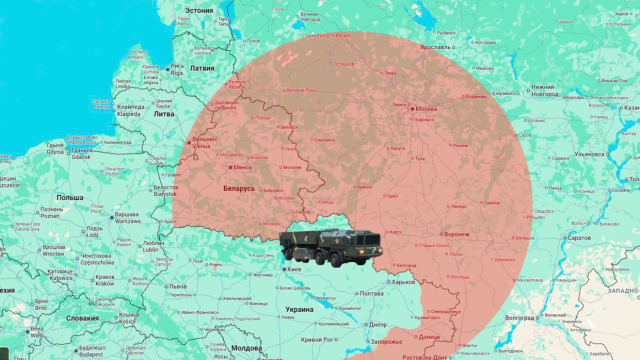
In May, Chancellor Friedrich Merz announced that Germany would fund Ukraine’s domestic production of long-range missiles, although he did not specify the type of weapon. The German Defense Ministry also stated at the time that investing in Ukraine’s production would enable Kiev to have a “substantial” number of long-range weapons this year.
Ukraine’s Vladimir Zelensky has since threatened new long-range strikes deep into Russia, saying Kiev will “do everything possible to bring the war onto Russian territory.” – Video
Coalition of Willing Opposes Any Restrictions on Ukrainian Army as Part of Ukraine Deal
Sputnik – 14.08.2025
The so-called “coalition of the willing” has opposed any restrictions on the Ukrainian armed forces as part of the deal on settling the Ukraine conflict ahead of the meeting between Russian President Vladimir Putin and US President Donald Trump, a joint statement read.
“Ukraine must have robust and credible security guarantees to effectively defend its sovereignty and territorial integrity. The Coalition of the Willing is ready to play an active role, including through plans by those willing to deploy a reassurance force once hostilities have ceased. No limitations should be placed on Ukraine’s armed forces or on its cooperation with third countries. Russia could not have a veto against Ukraine‘s pathway to EU and NATO,” the coalition said in a joint statement published by the office of UK Prime Minister Keir Starmer on Wednesday.
The coalition also believes that constructive negotiations can only take place “in the context of a ceasefire.”
The meeting between US President Donald Trump and Russian President Vladimir Putin is scheduled for this Friday in Anchorage, Alaska. The leaders are expected to discuss ways to resolve the Ukrainian conflict as well as other issues of mutual interest.
Featured Video

Alon Mizrahi: ‘Israel Must Be Dismantled’
or go to
Aletho News Archives – Video-Images
From the Archives
How a War with Iran Would Diminish American Power
By Greg Scoblete | The Compass | August 13, 2010
Jennifer Rubin wants a war with Iran:
But the emphasis on the existential threat to Israel ignores a more basic issue for Americans to ponder: a nuclear-armed Iran represents a dagger at the heart of America and an existential threat to our status as a superpower and guarantor of the West’s security. As to the former, Iran is pressing ahead with its long-range ballistic missile program. First the Middle East and Eastern Europe, then all of Europe and, within a matter of years, the U.S. will be within range of Iranian missiles. If those are nuclear and not conventional, what then? We’re not talking about whether Iran is going to be “merely” a destabilizing factor in the Middle East or whether it will set off an arms race with its neighbors or imperil Israel’s existence. We’re talking about whether America will then be at risk (and lacking sufficient missile-defense capabilities if we continue to hack away at our defense budget). The argument about whether mutual assured destruction can really work against Islamic fundamentalists who have an apocalyptic vision becomes not about Israel’s ability to deter an attack but about ours. Those who oppose American military action have an obligation to explain why America should place itself in that predicament.
I would argue that any obligation to present an explanation lies with those whose disastrous policy prescriptions with respect to Iraq lead America into the worst strategic blunder in the country’s recent history. That aside, note the blind faith in the power of the military to actually achieve its ends. … continue
Blog Roll
 Aletho News
- Villains of Judea: Leonid Radvinsky
- Alon Mizrahi: ‘Israel Must Be Dismantled’
- Former Head Of MI6 Admits That The U.S. And Israel Are Losing The Iran War
- Scattered Thoughts on War and Peace
- Iran Threatens to Close Red Sea to Shipping in Response to Invasion
- Iran in excellent position to prevail in war with US, Israel: John Mearsheimer
- Iran warns US: Do not call your retreat an agreement
- Neighbors first – Moscow signals shift in energy strategy
- Almost 400 Ukrainian drones downed over Russia in single night – MOD
- Battle for Hungary: How the Russiagate blueprint has been unleashed against Orban
- If Americans Knew
- In the West Bank, life is a constant battle – 3 articles
- Jacob Reses, one of the most powerful pro-Israel operatives in Trump’s Washington
- Israeli-US assaults kill or injure 87 children a day – Not a ceasefire Day 166
- ‘Forever live by the sword’: Understanding Israelis’ massive support for Iran war
- UN’s special rapporteur on human rights says Israel is systematically torturing Palestinians
- Trump White House plagiarized Iran war manifesto from Israel-aligned think tank
- Gaza says 6–10 patients die daily waiting for treatment abroad as Israel blocks medical evacuations
- ‘Substantial evidence’ of double-tap strike in killing of Gaza’s Hind Rajab
- ‘Do Not Want To Die For Israel’: Doubts About Trump’s Iran Strategy Spread Among Troops
- Instead of taking Joe Kent’s claims seriously, the media is disregarding him as an antisemite
- No Tricks Zone
- Devastating Assessment Of Comirnaty Vaccine By Former Senior Pfizer Europe Toxicologist
- New Study: CO2 Is ‘Effectively Negligible’ As An Explanatory Climate Change Factor Since 2000
- Former Pfizer Toxicologist Dr. Helmut Sterz Tells Bundestag Hearing Pfizer Vaccine Should Have Never Been Approved
- Energy Expert: Germany’s Nuclear Phaseout Was A “500 Billion Euro Mistake”
- New Research: South Australia’s Mid-Holocene Sea Surface Temperatures Were 4°C Warmer Than Today
- Storing Green Energy To Last Germany 10 Days Would Require A 60-Million Tonne Battery
- New Studies: UK Sea Levels Were 4 Meters Higher Than Today During The Mid-Holocene
- Destructive Green New Deal: German Energy And Metal Group Warns Of Drastic Crisis
- New Study Documents A 20-Year Pause In Arctic Sea Ice Decline – Driven By Internal Variability
- Wake-up Call: Survey Shows Majority Of Germans Now Favor Postponing Climate Targets!
 Aletho News