New Delhi between sanctions and sovereignty
By Lucas Leiroz | Strategic Culture Foundation | August 8, 2025
In a world where the international order is increasingly shaped by the struggle between a declining unipolarity and an emerging multipolarity, sanctions have become the main weapon of a superpower that can no longer dictate the course of global affairs by consensus. What was once an exception — economic punishment against states clearly involved in illegal activities or blatant violations of international norms — has become a systemic, arbitrary, and politically motivated practice. And India is now the latest target of this coercive apparatus that defines the foreign policy of the United States.
The repeated use of sanctions by Washington reveals, above all, the exhaustion of its diplomatic capacity. Instead of building bridges with strategic partners, the U.S. chooses to punish, isolate, and sabotage any country that dares to follow an autonomous path.
Sanctions policy as a mechanism of domination
U.S. unilateral sanctions — almost always imposed outside the UN Security Council and in defiance of international law — have become a systematic policy of intimidation. Iran, Cuba, Syria, North Korea, Venezuela, Russia, and China have been the most well-known targets. But the list keeps growing. And India, previously seen as a potential Western ally in the Indo-Pacific, is now beginning to feel the weight of this punitive system.
The logic is simple: the U.S. identifies an “unacceptable” behavior — such as India’s refusal to join the sanctions against Russia — and from there constructs a narrative to justify pressure measures. It could be the defense of “human rights,” the “fight against terrorism,” or, as is now being done with India, the “war on drugs.” The content of the narrative is secondary; what matters is the effect: to break the sovereignty of the targeted country and force it to align with Washington’s foreign policy.
India: the new frontier of coercion
In recent days, Donald Trump has announced sanction packages of up to 50% against India, citing the “need” to punish trade partners of the Russian Federation. These coercive measures came after months of open threats toward India — some directly referencing the Indo-Russian partnership, others hiding behind the mask of the “fight against fentanyl.”
Although the recently announced sanctions are explicitly directed at Indo-Russian energy trade, there’s no guarantee that the U.S. will abandon the fentanyl rhetoric altogether. The “drug control” excuse may easily be revived at any moment to impose further sanctions on New Delhi, especially considering that this was Washington’s initial justification before Trump finally admitted the real motive: punishing India for its ties with Russia.
It must be emphasized that what brought India into Washington’s sanction crosshairs was not any real connection to fentanyl trafficking, but rather its strategic resilience in the face of Western efforts to isolate Russia. Since 2022, India has maintained firm energy and military cooperation with Moscow, refusing to take part in the U.S. and EU-led anti-Russian crusade. This pragmatic position — based on Indian national interests rather than ideological dogma — deeply irritated the Washington establishment.
In response, the U.S. began floating the idea that chemical exports from India could be diverted for fentanyl production — a claim made without solid evidence, but politically convenient. In a classic move, they attempt to turn a country with no proven role in fentanyl trafficking into part of the “drug problem,” paving the way for tariffs and trade restrictions.
This is Washington’s new modus operandi: transform internal crises — in this case, the collapse of the U.S. healthcare system and the opioid epidemic — into diplomatic weapons to force other nations to serve its strategic interests.
Rapprochement with Russia and China: India’s geopolitical response
In the face of this escalation, India appears to have understood the game — and is beginning to react astutely. Not only has it maintained and expanded its agreements with Russia, but it has also signaled a renewed openness to dialogue with China, having Prime Minister Modi announced a visit to Beijing.
This is a geopolitically significant move. India and China have long had a tense relationship, especially concerning the Himalayan border. But in the face of a common enemy — the global regime of unilateral sanctions that threatens the sovereignty of both — realism is starting to prevail. India already plays an active role in forums such as BRICS, the Shanghai Cooperation Organization (SCO), and the G20, but now signals a willingness to deepen its coordination with both Beijing and Moscow.
This marks the emergence of a “new” strategic triangle in the Global South — not based on ideological affinity, but on a shared need to resist the economic coercion promoted by the West. India is not becoming an automatic ally of China, but rather a situational partner in building a multipolar order, where the right to chart one’s own path is no longer subject to Washington’s approval.
Fragmentation of the global system and alternatives to the dollar
This strategic reconfiguration is happening in parallel with the fragmentation of the global financial system. As more countries begin operating outside the SWIFT system, pursue bilateral trade agreements in local currencies, and strengthen alternative development banks, the power of unilateral sanctions is beginning to erode. India has already signed agreements with Russia, Iran, and the UAE to trade in rupees, bypassing the U.S. dollar. BRICS+, with the potential creation of a common currency, is moving in the same direction.
By abusing sanctions as a tool, Washington is accelerating this process. In its attempt to maintain control, it ends up stimulating the formation of new centers of economic and diplomatic power — exactly the opposite of its intended outcome.
The end of the American consensus
The attempt to punish India over a crisis that is, above all, the result of domestic failure in the U.S., is not only an act of hypocrisy but also a major strategic miscalculation. Instead of isolating India, the U.S. is driving it deeper into multilateral frameworks that challenge Western hegemony.
New Delhi has made it clear it will not be turned into a geopolitical vassal. India is a civilizational power with its own interests and will not hesitate to forge partnerships — even with historical rivals — if it means securing strategic autonomy.
Sanctions, once presented as instruments of international justice, have become the primary mechanism for imposing a failed global order — one that seeks to preserve historical privileges at the expense of national sovereignty. The economic attacks on India over its strategic ties with Russia are just one example of this broader reality.
But a new world is taking shape. A world where countries like India, Russia, and China are building bridges over ruins — converging not out of ideological alignment, but from the urgent need to resist the systemic coercion of a declining empire. National sovereignty, more and more, will be asserted not through submission, but through coordinated resistance to the language of sanctions.
India understands this. And by responding with dignity and pragmatism, it shows that the path to strategic independence necessarily involves rejecting the arbitrary use of sanctions as a weapon of economic warfare. The multipolar world is under construction — and there is no room in it for domination disguised as moralism.
US has made ‘acceptable offer’ – Kremlin aide
RT | August 7, 2025
Russia has received an “acceptable” offer from the US on settling the Ukraine conflict, Kremlin aide Yury Ushakov has said, following a visit by US special envoy Steve Witkoff to Moscow.
Speaking to reporters on Thursday, Ushakov commented on the talks between Witkoff and Russian President Vladimir Putin, noting that Moscow had received a “proposal from the Americans” which it is ready to consider, without providing further details.
Ushakov also noted that Russia and the US have topics to discuss, while agreeing with the view of US Secretary of State Marco Rubio, who earlier described the talks as “a good day.” Rubio had added that “we still have a ways to go, but we’re certainly closer [to peace] today than we were yesterday – when we weren’t close at all.”
The Kremlin aide earlier called the Putin-Witkoff meeting “business-like and constructive,” adding that “Russian-American ties could develop according to a completely different, mutually beneficial scenario,” as compared to the long-running tensions over Ukraine.
He also revealed that Putin could meet Trump as soon as next week. The Russian president later suggested that the United Arab Emirates could potentially host the summit.
Capabilities Russia Unlocks by Quitting Medium-Range Missile Moratorium
Sputnik – 05.08.2025
Russia’s termination of its unilateral moratorium on the deployment of ground-launched ballistic missiles in the 500-5,500 km range is the logical outcome of hostile NATO policies, and unties Moscow’s hands for a more proactive approach to strategic defense, says Igor Korotchenko, one of Russia’s top military analysts.
What Brought on Russia’s Decision?
NATO’s European allies’ preparations for a potential conventional war with Russia by 2030, including:
- a massive rearmament campaign and plans to create massive, wartime-sized standing armies
- the development of new weapons, including an Anglo-German missile with a 2,500 km+ range
- deployment of new US fifth-gen fighters in the region
What It Means
In these circumstances, and no longer facing INF-style medium and intermediate-range missile restrictions, Russia will:
- ramp up production of ballistic missiles, including the conventionally armed Oreshnik (serial production already underway)
- deploy the missiles, which are difficult if not impossible to intercept due to their multiple independently targetable reentry vehicle (MIRV) payload, as it sees fit and based on security considerations
- potentially deploy a nuclear-armed variant of the Oreshnik, with up to six warheads with a 150 kt per warhead capacity to “deter” NATO and “minimize threats and risks of a military attack on Russia by NATO,” not only in Europe, but Asia as well, if needed
“The INF Treaty is dead,” Korotchenko says. There is now “nothing” to stop Russia from realizing its strategic security objectives.
Moscow lists countries whose citizens took part in Ukrainian incursion into Russia
RT | August 5, 2025
Foreign nationals from over ten countries took part in Ukraine’s incursion into Russia’s Kursk Region, according to the head of the Investigative Committee of Russia, Aleksandr Bastrykin.
Bastrykin told the media on the eve of the anniversary of the incursion that investigators identified individuals from Brazil, Colombia, Denmark, Georgia, Norway, Paraguay, Peru, Sweden, the UK, and other nations as having fought alongside Ukrainian troops in the Western-supported raid.
Russian forces fully repelled the incursion in April, claiming that the attackers suffered around 76,000 casualties during the fighting, in which Ukrainian troops employed Western-supplied heavy weaponry.
Bastrykin said 331 civilians were killed and another 553 injured due to Ukraine’s actions in Kursk Region. The Investigative Committee has opened over 600 criminal cases related to the incursion, with around a third already referred for trial.
Moscow maintains that the incursion was an example of Kiev’s use of terrorist tactics, citing claims by captured soldiers that they were encouraged to use violence against civilians. Ukrainian officials have acknowledged that part of the goal was to apply pressure on the Russian public.
He detailed a range of alleged abuses, from a case in which unarmed civilians were beaten to death, to occurrences in which US-made HIMARS multiple launch rocket systems were fired at civilian targets which Kiev allegedly knew held no military value.
Since the escalation of the conflict with Russia in 2022, Kiev has called on foreign nationals with military experience to join its armed forces, passing legislation to accommodate them. Moscow does not recognize the fighters as lawful combatants, classifying them instead as mercenaries subject to prosecution.
In May, Bastrykin reported that the Russian authorities charged 902 people with acting as mercenaries under Ukraine’s command; 97 individuals from 26 different countries have been convicted.
Marked for Death by a Reckless America?
By Ron Unz • Unz Review • August 4, 2025
A few weeks ago I published an article noting that the State of Israel and the Zionist movement that gave rise to it have probably employed assassination as a tool of statecraft more heavily than any other political entity in recorded history. Indeed, their deadly activities had easily eclipsed those of the notorious Muslim sect that had terrorized the Middle East a thousand years ago and gave rise to that term.
The piece had been prompted by Israel’s sudden strike against Iran, capping its reputation as the greatest band of assassins known to history. Even as the Iranian government was intensely focused on the negotiations with America over its nuclear program, a sudden Israeli surprise attack successfully assassinated most of Iran’s highest military commanders, some of its political leaders, and nearly all of its most prominent nuclear scientists. I cannot recall any previous case in which a major country had ever had so large a fraction of its top military, political, and scientific leadership eliminated in that sort of illegal sneak attack.
Less than one year earlier, a series of missile exchanges between Israel and Iran had soon been followed by the death of hardline Iranian President Ebrahim Raisi and his foreign minister in a highly-suspicious and never explained helicopter crash. Given subsequent events, I think we can safely assume that he, too, had died at the hands of the Israelis.
- Zionist Israel as the Assassination Nation
Ron Unz • The Unz Review • June 23, 2025 • 11,800 Words
Earlier this year, the declassification of a large batch of JFK Assassination files had prompted me to recapitulate and summarize many of my articles of the last half-dozen years on that landmark twentieth century event. I gathered together some of the very considerable evidence that the Israeli Mossad played the central role in the assassination of President John F. Kennedy in 1963 as well as the death of his younger brother Robert a few years later, probably the highest-profile political assassinations of the last one hundred years or more.
- How Israel Killed the Kennedys
Ron Unz and Mike Whitney • The Unz Review • March 24, 2025 • 11,500 Words
The most weighty and authoritative work on the long history of Israeli assassinations is surely Ronen Bergman’s 2018 volume Rise and Kill First, running 750 pages and including a thousand-odd source references, with many of the latter citing official documents never previously made available to journalists. By some estimates, this book documented nearly 3,000 such foreign political killings, a remarkable total for a small country then less than three generations old.
Although the Bergman book was certainly very comprehensive, it was produced under strict Israeli censorship, so the text quite understandably omitted almost any coverage of some of the highest-profile Zionist attacks on Western targets. For example, there was no mention of the unsuccessful but well-documented attempts to kill President Harry Truman, nor the assassination efforts aimed at British Prime Minister Winston Churchill and the top members of his Cabinet.
Some of this latter coverage may be found in Thomas Suarez’s 2016 book State of Terror which I would recommend as a very useful supplementary work, though its focus is almost entirely limited to the activities of Zionist groups just prior to the establishment of Israel.
For a broader discussion of the history of Israeli assassinations and closely-related terrorist attacks, especially those targeting Westerners, one of the most useful compilations might be my own very long January 2020 article, providing extensive references to the underlying primary and secondary sources.
- American Pravda: Mossad Assassinations
Ron Unz • The Unz Review • January 27, 2020 • 27,300 Words
That 2020 article had actually been prompted by America’s own sudden assassination of Iranian Gen. Qassem Soleimani, a shocking development that drew a great deal of media coverage at the time.
I had opened my long discussion by noting that over the last several centuries Western governments had almost totally abandoned the use of political assassinations against the leadership of major rival nations, regarding such actions as immoral and illegal.
For example, historian David Irving revealed that when one of Adolf Hitler’s aides suggested to him that an attempt be made to assassinate the Soviet military leadership during the bitter combat on the Eastern Front of World War II, the German Fuhrer immediately forbade any such practices as obvious violations of the laws of civilized warfare.
For most of American history, a similar attitude had prevailed, but I explained that this began to change over the last couple of decades, mostly in the wake of the 9/11 Attacks.
The 1914 terrorist assassination of Archduke Franz Ferdinand, heir to the throne of Austria-Hungary, was certainly organized by fanatical elements of Serbian Intelligence, but the Serbian government fiercely denied its own complicity, and no major European power was ever directly implicated in the plot. The aftermath of the killing soon led to the outbreak of World War I, and although many millions died in the trenches over the next few years, it would have been completely unthinkable for one of the major belligerents to consider assassinating the leadership of another.
A century earlier, the Napoleonic Wars had raged across the entire continent of Europe for most of a generation, but I don’t recall reading of any governmental assassination plots during that era, let alone in the quite gentlemanly wars of the preceding 18th century when Frederick the Great and Maria Theresa disputed ownership of the wealthy province of Silesia by military means. I am hardly a specialist in modern European history, but after the 1648 Peace of Westphalia ended the Thirty Years War and regularized the rules of warfare, no assassination as high-profile as that of Gen. Soleimani comes to mind…
During our Revolutionary War, George Washington, Thomas Jefferson, and our other Founding Fathers fully recognized that if their effort failed, they would all be hanged as rebels by the British. However, I have never heard that they feared falling to an assassin’s blade, nor that King George III ever considered using such an underhanded means of attack. During the first century and more of our nation’s history, nearly all our presidents and other top political leaders traced their ancestry back to the British Isles, and political assassinations were exceptionally rare, with Abraham Lincoln’s death being one of the very few that comes to mind.
At the height of the Cold War, our CIA did involve itself in various secret assassination plots against Cuba’s Communist dictator Fidel Castro and other foreign leaders considered hostile to US interests. But when these facts later came out in the 1970s, they evoked such enormous outrage from the public and the media, that three consecutive American presidents—Gerald R. Ford, Jimmy Carter, and Ronald Reagan—all issued successive Executive Orders absolutely prohibiting assassinations by the CIA or any other agent of the US government.
Although some cynics might claim that these public declarations represented mere window-dressing, a March 2018 book review in the New York Times strongly suggests otherwise. Kenneth M. Pollack spent years as a CIA analyst and National Security Council staffer, then went on to publish a number of influential books on foreign policy and military strategy over the last two decades. He had originally joined the CIA in 1988, and opens his review by declaring:
One of the very first things I was taught when I joined the CIA was that we do not conduct assassinations. It was drilled into new recruits over and over again.
Yet Pollack notes with dismay that over the last quarter-century, these once solid prohibitions have been steadily eaten away, with the process rapidly accelerating after the 9/11 attacks of 2001. The laws on our books may not have changed, but
Today, it seems that all that is left of this policy is a euphemism.
We don’t call them assassinations anymore. Now, they are “targeted killings,” most often performed by drone strike, and they have become America’s go-to weapon in the war on terror.
The Bush Administration had conducted 47 of these assassinations-by-another-name, while his successor Barack Obama, a constitutional scholar and Nobel Peace Prize winner, had raised his own total to 542. Not without justification, Pollack wonders whether assassination has become “a very effective drug, but [one that] treats only the symptom and so offers no cure.”
Thus over the last couple of decades the American government has followed a disturbing trajectory in its use of assassination as a tool of foreign policy, first restricting its application only to the most extreme circumstances, next targeting small numbers of high-profile “terrorists” hiding in rough terrain, then escalating those same killings to the many hundreds. And now under President Trump, the fateful step has been taken of America claiming the right to assassinate any world leader not to our liking whom we unilaterally declare worthy of death.
Pollack had made his career as a Clinton Democrat, and is best known for his 2002 book The Threatening Storm that strongly endorsed President Bush’s proposed invasion of Iraq and was enormously influential in producing bipartisan support for that ill-fated policy. I have no doubt that he is a committed supporter of Israel, and he probably falls into a category that I would loosely describe as “Left Neocon.”
But while reviewing a history of Israel’s own long use of assassination as a mainstay of its national security policy, he seems deeply disturbed that America might now be following along that same terrible path.
Pollock’s discussion of these facts came in his lengthy 2018 New York Times review of the Bergman book entitled “Learning From Israel’s Political Assassination Program,” and he greatly decried what many have called the “Israelization” of the American government and its military doctrine. President Donald Trump’s sudden public assassination of so high-profile a foreign leader as Gen. Soleimani came less than two years later and demonstrated that Pollock’s concerns were fully warranted and indeed even understated.
As my January 2020 article explained, nothing like this had ever previously happened in peacetime American history, and only very rarely even during wars.
The January 2nd American assassination of Gen. Qassem Soleimani of Iran was an event of enormous moment.
Gen. Soleimani had been the highest-ranking military figure in his nation of 80 million, and with a storied career of 30 years, one of the most universally popular and highly regarded. Most analysts ranked him second in influence only to Ayatollah Ali Khamenei, Iran’s elderly Supreme Leader, and there were widespread reports that he was being urged to run for the presidency in the 2021 elections.
The circumstances of his peacetime death were also quite remarkable. His vehicle was incinerated by the missile of an American Reaper drone near Iraq’s Baghdad international airport just after he had arrived there on a regular commercial flight for peace negotiations originally suggested by the American government.
Our major media hardly ignored the gravity of this sudden, unexpected killing of so high-ranking a political and military figure, and gave it enormous attention. A day or so later, the front page of my morning New York Times was almost entirely filled with coverage of the event and its implications, along with several inside pages devoted to the same topic. Later that same week, America’s national newspaper of record allocated more than one-third of all the pages of its front section to the same shocking story.
But even such copious coverage by teams of veteran journalists failed to provide the incident with its proper context and implications. Last year, the Trump Administration had declared the Iranian Revolutionary Guard “a terrorist organization,” drawing widespread criticism and even ridicule from national security experts appalled at the notion of classifying a major branch of Iran’s armed forces as “terrorists.” Gen. Soleimani was a top commander in that body, and this apparently provided the legal fig-leaf for his assassination in broad daylight while on a diplomatic peace mission.
- American Pravda: Mossad Assassinations
From the Peace of Westphalia to the Law of the Jungle
Ron Unz • The Unz Review • January 27, 2020 • 27,300 Words
Although Pollock provided some explanations for this shocking transformation in American doctrine, he failed to note what was arguably the most obvious factor. Over the last generation or two, the American government and American political life have been almost entirely captured by what scholars John J. Mearsheimer and Stephen M. Walt called “The Israel Lobby” in their best-selling 2008 book of that title, and this political and ideological transformation has only further accelerated in the last couple of years, most recently reaching ridiculous, almost cartoonishly extreme levels.
For example, nearly every other country on earth regards Israeli Prime Minister Benjamin Netanyahu as one of the worst war criminals in modern history, now under indictment by the International Criminal Court for his ongoing genocidal massacre of Gaza’s helpless two million civilians, with an international warrant issued for his arrest. But the American political system is almost entirely under the control of pro-Israel partisans so he was invited in 2024 to give an unprecedented fourth public address to a joint session of Congress, receiving an endless series of standing ovations by the trained barking seals of our national legislative body.
Over the last couple of generations, successful American politicians have increasingly been selected for their unswerving loyalty to the State of Israel and their admiration for all things Israeli, often describing themselves as committed Zionists, followers of a foreign nationalist movement.
As a notable example of this strange pattern, a Republican Gentile such as Rep. Brian Mast had not only volunteered for service in the Israeli military, but then proudly wore his foreign uniform while serving as an elected member of Congress. Perhaps partly as a consequence of this demonstration of his overriding loyalty to a foreign nation, in January he was named chairman of our powerful House Foreign Relations Committee.
In another bizarre twist, foreign students attending American universities have never been punished for denouncing or condemning America or the behavior of the American government, but under the Trump Administration they have been rounded up and deported if they criticized the foreign government of Israel.
So if Israel and the Zionist movement have spent the last one hundred years heavily relying upon political assassinations as a primary geopolitical tool, it is hardly surprising if American political leaders have now increasingly adopted the practice of their Israeli mentors and exemplars and done the same.
This trend was further accelerated by the complete capture of the foreign policy establishment of both of our major political parties by the militantly pro-Israel Neocons. Indeed, as I have noted, the term “Neocon” has largely dropped from usage during the last decade or so because the views and beliefs of almost everyone in DC establishment circles would now fall into that category, a tendency that extends across our entire political ecosphere of elected officials, staffers, think-tanks, and media outlets.
I believe that this new American emphasis on political assassinations has extremely dangerous consequences for the world, consequences that perhaps most analysts have failed to properly appreciate. Israel’s tendency to assassinate the political leaders of those countries it views as rivals or threats has naturally focused upon its own region. But when American leaders have adopted that same mind-set, their targets have obviously been different ones.
Israel’s sudden and largely successful decapitation strike against Iran had heavily relied upon the innovative use of drones. But just a couple of weeks earlier, a somewhat different but equally bold use of drones had been used to hit all of Russia’s interior airbases housing its strategic bomber fleet, successfully destroying quite a number of those nuclear-capable aircraft, one of the important legs of the country’s nuclear deterrent triad. Just before that, there was an attempt to assassinate Russian President Vladimir Putin with a swarm of drones when he visited the Kursk area on a helicopter tour of that region.
Although the Ukrainian government took full credit for these latter two attacks against Russia, it seems extremely unlikely that they would have undertaken such action without the full support and approval of their American and NATO paymasters, and indeed the Russians claimed to have hard evidence of such involvement. As I noted in an article, the Ukrainian government explained that the planning for the project had begun roughly eighteen months earlier, and that had been exactly the time when New Jersey and parts of the East Coast had reported a mysterious wave of very heavy drone activity, which our government later admitted was testing for a highly classified military project. I think that the very close match of timing was hardly likely to have been coincidental.
The size of Russia’s nuclear arsenal surpasses our own and its large suite of unstoppable hypersonic delivery systems has given it a measure of strategic superiority over America and our NATO allies on both the nuclear and conventional escalation ladders. So the very strong likelihood that America was intimately involved in an attack on Russia’s nuclear triad and an attempt to assassinate Russia’s president seems exceptionally reckless and dangerous behavior. In a recent article, I suggested that Russia should take prompt and forceful action to deter any such future attacks, but this has not yet happened:
- A Forceful Russian Response to NATO Recklessness
How a Deft Strategic Blow Could Shatter the Western Alliance
Ron Unz • The Unz Review • June 30, 2025 • 5,300 Words
A couple of years earlier, I published an article focusing on indications of earlier American attempts to kill President Putin. This came after our bipartisan political and media elites had begun vilifying the Russian leader as “another Hitler,” with leading media figures and top U.S. Senators loudly calling for his assassination. I noted that the Russians seemed concerned that such assassination efforts might even employ novel, biological means:
We should also recognize the reality that during the last seventy years America has maintained the world’s largest and best-funded biological warfare program, with our government spending many tens of billions of dollars on biowarfare/biodefense across those decades. And as I’ve discussed in a long article, there is even considerable evidence that we actually used those illegal weapons during the very difficult first year of the Korean War…
Soon after their invasion, the Russians publicly claimed that the U.S. had established a series of biolabs in Ukraine, which were preparing biological warfare attacks against their country. Last year one of their top generals declared that the global Covid epidemic was probably the result of a deliberate American biowarfare attack against China and Iran, echoing the accusations previously made by those countries.
Russian security concerns over our advanced biowarfare capabilities and the extreme recklessness with which we might employ them may explain the rather strange behavior of President Putin when he met in Moscow for talks with French President Emmanuel Macron and German Chancellor Olaf Scholz shortly before the outbreak of the Ukraine war.
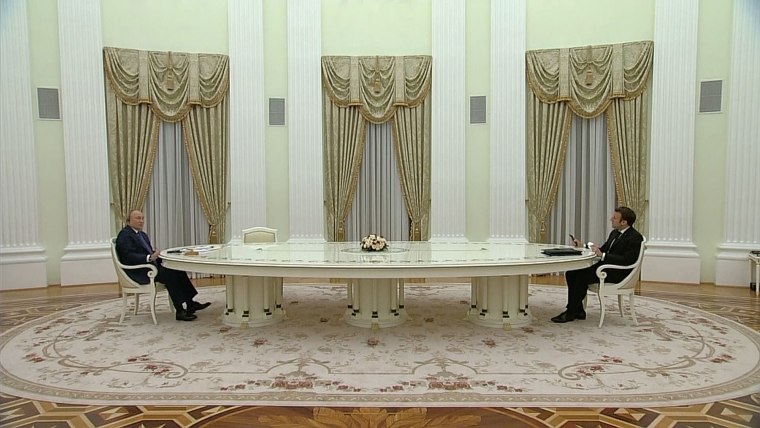
At the time many observers were puzzled why in each case the two national leaders were seated at opposite ends of a very long table, with Putin blandly suggesting that the placement was meant to symbolize the vast distance separating Russia and NATO’s Western leaders. Perhaps that innocuous explanation was correct. But I think it far more likely that the Russians were actually concerned that the Western leaders meeting him might be the immunized carriers of a dangerous biological agent intended to infect their president.
- Assassinating Vladimir Putin?
Ron Unz • The Unz Review • May 15, 2023 • 3,800 Words
On the face of it, American attempts to assassinate Russia’s president would make little logical sense and these would obviously be extremely reckless and dangerous. But much the same could be said of American-orchestrated efforts to destroy Russia’s strategic nuclear bomber fleet, yet there seems very strong evidence that both these actions occurred. So we should seek to understand the logical framework, however irrational and unrealistic, under which such American decisions would be made.
I think an important insight may have been recently provided by Alistair Crooke, a former senior MI6 officer and Middle East peace negotiator, with a great deal of expertise and excellent sources in that latter region.
In an interview a couple of weeks ago, he claimed that America had been directly involved in the wave of Israeli assassinations against Iran’s leaders, taking such action despite the fact that we were currently in the midst of crucial nuclear negotiations with that country. Launching a massive assassination attack against the entire leadership of a country with whom you are currently negotiating is obviously an extremely destabilizing action, one that will hardly inspire confidence among other prospective negotiating partners and will surely long be remembered.
But according to Crooke, the logic behind such American action was the widespread belief that the hold of the Islamic Republic upon the 90 million people of that country was quite fragile, and that the successful assassination of most of the Iranian leaders would cause the collapse of the regime, much like the government of Syria had collapsed earlier this year after attacks by armed Islamicist forces based in Idlib. The American government was greatly disappointed when that wave of assassinations failed to trigger such a political collapse and instead redoubled popular support for the ruling regime.
Crooke suggested that Iranian President Masoud Pezeshkian and Supreme Leader Ayatollah Ali Khamenei had been targeted for death as well, but unlike so many other senior Iranian officials they had been fortunate enough to survive. Indeed, not long afterward, President Trump repeatedly threatened to assassinate Ayatollah Khamenei unless he completely acceded to America’s demands regarding Iran’s nuclear program. Offhand, I can’t remember the last time a world leader has publicly threatened to assassinate one of his foreign counterparts in such fashion.
If Crooke’s analysis is correct, similarly mistaken reasoning might help to explain the likely American involvement in the attempt to assassinate Putin a few weeks earlier. Most of America’s political decisionmakers may have convinced themselves that the Russian regime was discredited, unpopular, and fragile, and that the sudden elimination of Russia’s president perhaps combined with a heavy blow to Russia’s nuclear retaliatory arsenal would cause its collapse.
Such an analysis might seem extremely implausible to most observers, but much of America’s leadership seems to exist in an unrealistic propaganda-bubble in which these notions have become widespread.
Consider, for example, estimates of Russian casualties in Ukraine. The Western-funded anti-Putin media outlet Mediazona has used its considerable resources to continually sweep the Russian Internet in order to compile a running total of verified Russian losses in the Ukraine war, and as of July 2025 had confirmed a total of over 120,000 Russian soldiers killed. This is likely somewhat of an underestimate given that at least some such deaths have escaped public notice, and such totals certainly represent heavy losses in a Russian population of around 140 million.
But our Neocon-dominated American government and its intelligence services have instead accepted without question totally outrageous figures apparently based upon the dishonest claims of Ukrainian propagandists. Back in February, Trump told reporters that Russia had already suffered 1.5 million casualties, an astonishing figure, and just a few days ago, he claimed that almost 20,000 additional Russians had been killed in the month of July alone.
As former CIA officer Larry Johnson noted, journalist Seymour Hersh reported that an intelligence official described for him a destroyed Russian military that had already suffered two million casualties:
“The total now is two million. Most importantly,” the official stressed, “was how this number was described. All the best trained regular Army troops, to be replaced by ignorant peasants. All the best mid-grade officers and NCOs dead. All modern armor and fighting vehicles. Junk. This is unsustainable.”
Two million Russian casualties would probably amount to more than 5% of that country’s entire population of military-age males, and such enormous losses could not possibly be kept concealed. Those figures are obviously delusional.
But if America’s political leaders and many of their military advisors accept such fantasies, they could easily convince themselves that a defeated Russia is now ripe for regime-change triggered by Putin’s assassination. They would obviously hope that the replacement might be a new government closely aligned with the West and subservient to its demands, much as had been the case during the 1990s.
Other Neocon analysts have proposed Russia’s dismemberment into several different much smaller states, none of which would be able to resist American pressure and domination, with various such proposed maps floating around.

Thus, America’s likely involvement in assassination efforts against the top leadership of both Iran and Russia was based upon our unrealistic assumptions regarding the weakness of the two regimes, and the belief that elimination of their top leaders would lead to a collapse. Moreover, in each case these attacks rather treacherously occurred in the midst of ongoing negotiations, over Iran’s nuclear program in one case and over Russian willingness to end the Ukraine war in the other. We should also remember that Trump’s earlier assassination of Gen. Soleimani occurred when that latter leader had been treacherously lured to Iraq for peace negotiations.
Unfortunately, countries that are totally delusional on some national security matters are much more likely to be equally delusional on others as well. I have recently discovered that important elements of the American foreign policy establishment have convinced themselves that the government of China is also fragile and weak, and possibly ripe for collapse if it were hit by one or more sharp shocks. A blogpost brought these strange and surprising notions to my attention a couple of weeks ago.
The blogger highlighted a major article in the New Yorker focusing on aspects of a likely future war between America and China, and suggesting that in some respects it might be analogous to the ongoing conflict between Israel and Gaza. Indeed, the subtitle even described Israel’s invasion of Gaza as “a dress rehearsal” for a future American war with China.
China has an enormous military, equipped with some of the world’s most highly-advanced weapons, and these include a full suite of the unstoppable hypersonic missiles that America has so far failed to successfully produce. So the belief that Israel’s ongoing slaughter of Gaza’s helpless, unarmed civilians holds any serious lessons for the course of a future American war with China seems rather strange reasoning indeed.
- What’s Legally Allowed in War
How U.S. military lawyers see Israel’s invasion of Gaza—and the public’s reaction to it—as a dress rehearsal for a potential conflict with a foreign power like China.
Colin Jones • The New Yorker • April 25, 2025 • 3,300 Words
The rather peculiar tone of that article may have been influenced by a very lengthy report published several months earlier by the Rand Corporation, whose title appeared to raise strong doubts about the military effectiveness of China’s armed forces.
- The Chinese Military’s Doubtful Combat Readiness
The People’s Liberation Army Remains Focused on Upholding Chinese Communist Party Rule, Not Preparing for War
Timothy R. Heath • The Rand Corporation • January 27, 2025 • 15,000 Words
However, after carefully reading that Rand study, I concluded that the title was somewhat misleading. The researcher correctly noted that China gave no indications of preparing to wage war against Taiwan, America, or any other country, and much unlike the U.S. had avoided involvement any military conflicts for the last half-century. But lack of interest in starting wars is quite different than lack of military effectiveness if attacked or sufficiently provoked, and conflating the two probably reflected the ideological climate found at most American think-tanks based upon the influence of their funders.
Finally, the lengthiest and most astonishing think-tank report of all was published just a couple of weeks ago by the Hudson Institute, one of our most unswervingly Neocon research organizations. This book-length study argued that China’s Communist government might be ripe for collapse and casually suggested that American military forces should be prepared for deployment inside China in order to seize crucial military and technological facilities and then reconstruct the government of that enormous country after the downfall of its current regime.
- China After Communism
Preparing for a Post-CCP China
Miles Yu et al. • The Hudson Institute • July 16, 2025 • 65,000 Words
The blogger quoted a couple of the paragraphs from the executive summary of this remarkable document:
While the People’s Republic of China (PRC) has weathered crises before, a sudden regime collapse in China is not entirely unthinkable. Policymakers need to consider what might happen and what steps they would have to take if the world’s longest-ruling Communist dictatorship and second-largest economy collapses due to its domestic and international troubles.
With chapters written by experts in military affairs, intelligence, economics, human rights, transitional justice, and constitutional governance, this report examines the initial steps that should be taken in the immediate aftermath of the CCP regime’s collapse and the long-term trajectory China might take after a stabilization period. Drawing on historical analysis, strategic foresight, and domain-specific expertise, this anthology describes these challenges as an exercise in possibilities. The different chapters explore how a single-party system collapses in key sectors of the country and how political institutions transform, as well as China’s unique political, economic, and social situation. Taken together, they assess the daunting tasks of stabilizing a long-repressed country after it has collapsed, in addition to the forces shaping China’s future. In so doing, the authors hope to offer policy recommendations for managing the risks and opportunities of a transition.
Having carefully read the entire report, I found it just as astonishing as was suggested by those paragraphs.
Over the last half-century, China has certainly been the world’s most successful major country, experiencing perhaps the highest sustained rate of economic growth in all of human history and now possessing a real economy far larger than that of the U.S.
Indeed, if we exclude the service sector, whose statistics are easily subject to manipulation, China’s real productive economy is now actually larger than the combined total for America, the EU, and Japan, while certainly growing much more rapidly. Meanwhile, America has experienced decades of stagnation, with heavy financialization replacing our once enormous real industrial strength. Moreover, in many technological sectors, China has now become the world leader, and it is near the very top in most of the others.
Earlier this year I published a lengthy comparative analysis of China and America, whose conclusions were hardly favorable to the latter:
- American Pravda: China vs. America
A Comprehensive Review of the Economic, Technological, and Military Factors
Ron Unz • The Unz Review • January 13, 2025 • 14,100 Words
The following month I summarized much of this same material in a lengthy interview with Mike Whitney:
- Confucius, DeepSeek, and Why China Would Win a War with the United States
Mike Whitney Interview with Ron Unz
Ron Unz and Mike Whitney • The Unz Review • February 2, 2025 • 9,900 Words
One of the main authors of that Hudson Institute report was lawyer and conservative columnist Gordon G. Chang, probably best known as the author of the 2001 book The Coming Collapse of China, and a quarter-century of absolutely contrary real-life trends seems to have hardly changed any of his views.
The Hudson Institute is a leading DC think-tank, quite influential in mainstream political circles, and a report with five co-authors that runs 128 pages must surely carry considerable weight in establishment circles. So when it suggests that the Chinese government is fragile and might soon collapse, those policy makers hostile to China are likely to take such views quite seriously.
Suppose that a leading Chinese think-tank with close ties to the PRC government published a weighty report predicting that America might soon collapse, then went on to argue that Chinese military forces would need to be deployed in our own country to seize our key military and technological assets and also establish a new government organized along Chinese lines. I doubt that most American political leaders or ordinary citizens would view such Chinese proposals with total equanimity, and indeed the blogger quoted a shocked Western pro-China business executive who succinctly summarized some of the striking elements in that Hudson Institute research study:
… which provides detailed operational plans for inducing Chinese regime collapse through systematic information operations, financial warfare, and covert influence campaigns, followed by detailed protocols for U.S. post-collapse management including military occupation, territorial reorganization, and the installation of a political and cultural system vassalized to the U.S.
Rand and Hudson are two of our leading mainstream think-tanks and the New Yorker is one of our most prestigious media outlets. Taken together those major articles and reports could easily convince the ignorant and suggestible ideologues in our government that the Chinese military was weak and the Chinese government fragile and ripe for collapse.
If delusional beliefs regarding the fragility of the Iranian and Russian governments had already led to American assassination attempts against their top leadership, similar reasoning might easily result in targeting those of China as well, especially President Xi Jinping, widely regarded as the strongest Chinese leader in decades. And given all of the recent American assassination projects, the Chinese government might certainly have itself reached such conclusions.
China and Russia are the two leading members of the BRICS movement, which held its 17th summit last month in Brazil. The media noted that neither Russian President Putin nor Chinese President Xi attended in person, with the latter missing his first BRICS summit since he came to power 13 years ago.
Xi’s surprising absence caused some discussion in the media. I initially paid little attention to this issue, but then some commenter suggested an obvious explanation: Both Xi and Putin were concerned about the possible risk of American assassination.
Brazil is located within the Western Hemisphere, a region under full American military domination. Given the extremely reckless and unpredictable behavior of the American government, with President Trump having publicly threatened to assassinate Iran’s top leader just a couple of weeks earlier, both China and Russia may have believed that some risks should best be avoided.
Suppose an errant missile struck down an incoming presidential plane, with no conclusive means of proving the source, or an aircraft were destroyed by some more sophisticated methods. Over the years, Xi and Putin had both met on numerous occasions with Iranian President Raisi, with whom they had developed an excellent working relationship, and surely his 2024 death in a mysterious helicopter crash while returning from a foreign trip would have concentrated their minds.
Any such “conspiratorial” explanation has naturally been entirely avoided by the media. For example, a lengthy article late last month in the Wall Street Journal described how Xi had drastically reduced his foreign travel over the last year or so, noting that a China-EU summit originally set for Brussels was moved to Beijing after the Chinese explained that Xi had no plans to visit Europe. Since the end of 2024, Xi’s only foreign travels have been to Russia and to several countries in South-East Asia. Unlike Europe or Latin America, none of these countries nor the travel routes to reach them would be likely venues for serious American attempts at assassination.
When major countries develop a well-deserved reputation for assassinating the leaders of other major countries, often even doing so in the midst of international negotiations, such behavior may obviously have serious consequences. Back in 2017, President Xi was quite willing to visit Mar-a-Lago for face-to-face negotiations with President Trump, but I very much doubt the Chinese leader will be taking any trips to our own country in the foreseeable future.
Related Reading:
Russia ‘no longer considers itself bound’ by nuclear treaty with US
RT | August 4, 2025
Moscow believes that conditions for maintaining the 1987 Intermediate-Range Nuclear Forces (INF) Treaty with the US have “disappeared” and “no longer considers itself bound” by it, according to a statement from the Russian Foreign Ministry.
The INF Treaty, which banned ground-launched missiles with ranges of 500–5,500km, collapsed in 2019 when Washington withdrew, citing Russian violations. Moscow has denied the claims, accusing the US itself of developing banned missiles. Russian President Vladimir Putin has warned that the collapse of the INF will significantly erode the global security framework.
“The Russian Foreign Ministry notes the disappearance of conditions for maintaining the unilateral moratorium on the deployment of similar weapons and is authorized to state that Russia no longer considers itself bound by the corresponding self-imposed restrictions previously adopted,” the statement reads.
According to the ministry, the “actions of Western countries” are creating a “direct threat” to Russian security. It also noted that last year, the US deployed a Typhon missile launcher in the Philippines. The statement also referenced the Talisman Sabre exercise in Australia, where the US Army also fired Typhon.
The Typhon is a mobile ground-based launcher designed to launch Tomahawk cruise missiles (range up to 1,800km) and SM-6 multipurpose missiles (range up to 500km).
The Foreign Ministry also took notice of the Australian Army testing an American Precision Strike Missile (PrSM) for the first time in July. The PrSM is a has a maximum range beyond 500km and “is central to strengthening Australia’s land and maritime strike capability,” according to the country’s Defense Ministry.
The Russian statement added further: “Decisions on specific parameters of response measures will be made by Russia’s leadership based on an interagency analysis of the scale of the deployment of American and other Western ground-based intermediate-range and shorter-range missiles, as well as the overall development of the situation in the field of international security and strategic stability.”
Moscow has repeatedly voiced the possibility of lifting the moratorium, for example, after the US announced plans to deploy long-range weapons in Germany in 2026. In November, Russian President Vladimir Putin said that Russia is developing intermediate- and shorter-range missiles in response to Washington’s actions. The Kremlin has not ruled out deploying the missiles in the Asia-Pacific region.
US President Donald Trump, who during his first term withdrew from the INF and the 1992 Open Skies Treaty which allowed conducting surveillance flights over each other’s territory, has suggested that he would resume negotiations on maintaining the existing restrictions on nuclear weapons with Russia.
Cutting Russia ties has cost EU €1 trillion – Moscow
RT | August 4, 2025
The EU’s decision to reduce energy and trade cooperation with Moscow over the Ukraine conflict has cost the bloc more than €1 trillion ($1.15 trillion), Russian Deputy Foreign Minister Aleksandr Grushko has said.
In an interview with Izvestia on Monday, Grushko said the figure is based on various expert estimates of the economic consequences of the EU’s decision to impose unprecedented sanctions on Russia, adding that it accounts for lost profits from energy and trade cooperation.
According to Grushko, trade between the EU and Russia dropped from €417 billion ($482 billion) in 2013 to €60 billion ($69 billion) in 2023 and is now “approaching zero.” He added that Europe’s economy has subsequently taken a hit and is losing competitiveness.
“Natural gas in Europe is four to five times more expensive than in the US, and electricity is two to three times higher,” he said. “That is the price Europe has to pay for ending all economic contacts with Russia.”
In June, Russian President Vladimir Putin said that refusing Russian gas supplies had cost EU countries around €200 billion ($231 billion). In late 2024, Russian officials also estimated that total EU losses tied to sanctions against Russia had reached $1.5 trillion. Meanwhile, Moscow has said it has acquired a “certain immunity” to Western sanctions.
Grushko’s comments come after the EU agreed a trade deal with the US, which commits the bloc to purchasing large volumes of American energy – which Moscow says will come at a much steeper cost than that provided by Russia – and imposes 15% tariffs on key EU exports. Numerous EU politicians have described the agreement as lopsided and damaging to the bloc’s interests.
Commenting on the US-EU deal, Putin claimed that the EU had essentially lost its political sovereignty, and that this directly leads to losing economic independence.
The EU began imposing sanctions on Russia in 2014, following the start of the Ukraine crisis, and expanded them drastically in 2022. Measures have targeted banking, energy exports, and other industries. Moscow considers the sanctions illegal, saying they violate international trade rules and harm global economic stability.
Daniel Davis: Trump’s Threats Against Russia Backfire
Glenn Diesen | August 2, 2025
Lt. Col. Daniel Davis is a 4x combat veteran and the host of the Daniel Davis Deep Dive YouTube channel. Lt. Col. Davis argues that Trump’s ultimatum is hardening the Russian position as the prospect of a peaceful settlement collapses. Sanctions have been exhausted, and there are no more weapons that can be sent that will significantly impact the battlefield. When the frontlines collapse in Ukraine, Trump may get desperate and act dangerously.
China hits back at US smears on arms supplies to Ukraine at UN Security Council
Global Times | August 1, 2025
China’s deputy permanent representative to the UN Geng Shuang spoke at a UN Security Council meeting on the issue of arms supplies to Ukraine on Thursday local time, refuting accusations made by the US representative against China.
Recently, Russia and Ukraine have held several rounds of direct negotiations and reached a number of agreements on humanitarian issues such as prisoner exchanges, making positive progress. At the same time, however, the crisis continues, with no signs of the war coming to an end. A large volume of weapons and ammunition continues to flow into the battlefield, causing new casualties and damage to infrastructure, Geng noted.
What is particularly concerning is that the types and scope of weapons entering the battlefield are expanding, with their lethality and destructiveness constantly increasing, Geng said. Recent reports indicate that both sides have deployed combat robots, further highlighting that the Russia-Ukraine conflict is increasingly becoming a testing ground for new types of weaponry. This suggests that the nature of warfare could undergo dangerous changes, he added.
“I would like to reiterate that while weapons may win wars, they cannot bring lasting peace. The reckless transfer of arms to the battlefield will only intensify the conflict, prolong the fighting, increase the risk of proliferation, and inflict more casualties and suffering on people in both the conflict zone and the broader region,” Geng said.
The Chinese diplomat pointed out that the urgent priority now is for both parties to work together to de-escalate the battlefield situation as soon as possible, maintain the momentum of dialogue and negotiation, continue building consensus, and ultimately reach a comprehensive, durable, and binding peace agreement.
In response to US representative’s false narratives and malicious smearing of China on the issue, Geng said “this is completely unacceptable,” saying that he responded to such accusations on multiple occasions in past meetings. “Since the US insists on repeating the same rhetoric, I find it necessary to set the record straight once again,” Geng said.
First, China is not the creator of the Ukraine crisis, nor is it a party to the conflict. China has never provided lethal weapons to any party involved in the conflict. We have always strictly controlled the export of dual-use items, including drones, the Chinese diplomat said.
Second, the UN Security Council has not imposed sanctions on any party to the conflict. China maintains normal trade relations with both Russia and Ukraine, in full compliance with international law and without breaching any international obligations, he said.
China’s legitimate and lawful rights and interests must not be infringed upon. “In fact, the US itself continues to engage in trade with Russia to this day. Why should it be acceptable for the US to do so, but not for others? Isn’t this ‘only allowing oneself to set fires while forbidding others from lighting lamps?’” Geng asked.
Third, the Ukraine crisis is currently at a critical juncture, with a genuine prospect for a political resolution. The US cannot on the one hand ask China to play a constructive role in ending the war, while on the other hand continuously smear and pressure China, he said, urging the US to stop playing the blame game and scapegoating others, and instead contribute positively to efforts for a ceasefire, de-escalation, and the promotion of dialogue and negotiation.
The Chinese diplomat emphasized that China maintains normal economic and trade relations with both Russia and Ukraine – this does not violate international law, nor does it breach any international obligations. “The US itself continues to conduct trade with Russia, so why should China be prohibited from doing the same?” he said.
“It is the US that repeatedly engages in smearing, slandering, and attacking other countries in the UN Security Council chamber. Does the US not recognize how different its behavior is from that of other Council members?” Geng asked.
What the resolution of the Ukraine crisis requires is unity and cooperation, not division and confrontation. Once again, we urge the US to stop its baseless accusations and scapegoating, to invest more in diplomatic efforts, and to contribute genuinely to promoting a ceasefire, de-escalating the conflict, and advancing peace talks, the Geng said.
US and UK behind cyberattack on Aeroflot – Russian MP
RT | July 31, 2025
US and UK intelligence services were behind this week’s major cyberattack that disrupted operations at Aeroflot and other Russian companies earlier this week, a senior Russian lawmaker has claimed.
Andrey Svintsov, the deputy chairman of the State Duma Committee on Information Policy, has said the attack is part of a coordinated campaign by Western powers to damage the Russian economy after failing to achieve their objectives through military means and sanctions.
Aeroflot, Russia’s largest airline, was forced to cancel or delay dozens of flights on July 28 after pro-Ukrainian hacker groups claimed to have crippled the airline’s internal IT systems. The cyberattack also disrupted airport operations and affected other companies, including a nationwide pharmacy chain.
”These are not isolated hackers, but a planned action by American and British intelligence agencies,” Svintsov told Russian outlet Abzats. He described the campaign as a “systematic effort that is being carried out against Russia,” suggesting that it’s a sign of desperation by the country’s adversaries.
”This is a systematic approach by our Western enemies, who have failed to defeat Russia on the battlefield. They are moving to weaken the economic potential, since sanctions are not helping,” Svintsov said. He warned that cyber sabotage could continue until Russia achieves victory in the Ukraine conflict.
In May, Defense Secretary John Healey said the UK would significantly increase cyber operations against Russia and China. He confirmed the creation of a new Cyber and Electromagnetic Command, adding that “the keyboard is now a weapon of war.”
The Kremlin has urged Russian businesses to replace foreign-made software and hardware to reduce exposure to cyber threats. Last month, President Vladimir Putin instructed the government to accelerate import substitution.
Hacker groups Silent Crow and Cyberpartisans BY have claimed responsibility for Monday’s attack on Aeroflot. They claim to have been inside the airline’s corporate network for over a year, stealing more than 20 terabytes of data and destroying around 7,000 servers.
Communications regulator Roskomnadzor said the data leaks have not been confirmed. Russia’s Prosecutor General’s Office has confirmed the cyberattack and opened a criminal case.
Kicking the peace can down the road
In discussion with Glenn Diesen
Ian Proud | July 28, 2025
Nice to catch up with Glenn Diesen to discuss recent developments, including my article on Trump’s 50-day ultimatum to Putin, which has now been reduced to 10-12 days, whatever that means. I continue to judge that the threat of secondary sanctions against Russia’s trading partners will have a greater impact on the US than on China, India or any other country that does business with Russia.
Meanwhile, Zelensky’s short-lived attempt to shut down anti-corruption organisations closing in on his cronies has been a big wake up call, not just for European political leaders and journalists, but more importantly, citizens.
Faced with admitting defeat in Ukraine and throwing Zelensky under the bus and continuing with an ineffective foreign policy towards Russia, I judge that Starmer, VdL and others will keep kicking the peace can down the road.
Yet every day the war continues, Ukraine loses more ground and more lives on the battlefield, and slides further towards the status of a failed state. My optimism remains low that the war will end in 2025.
Pentagon Eyes Ukraine as Drone Testing Ground After Alaska Failures
Sputnik – 28.07.2025
WASHINGTON – The US Department of Defense (DOD) views Ukraine to be a potential polygon for drone testing after it ran into difficulties during the June trials in Alaska, Defense News reported, citing sources in Pentagon.
Earlier this summer, five US companies underwent drone testing in Alaska to see if their prototypes were able to withstand GPS disruption and if they were ready to transition to the military services.
“Providing an opportunity for these companies to assess their products in a contested environment against a notional threat is really valuable, one, for the DOD to assess their product in that way. But it’s also important for the companies to see where they’re succeeding or where they’re falling short so they can make tweaks and have a better product,” one of the Defense Innovation Unit (DIU) officials told Defense News.
Commercial companies, especially small ones, do not have access to test spaces that are similar to field conditions, so the Pentagon needs to provide such conditions if it wants to achieve new technologies fast and efficiently, the report said.
“If we want to succeed, we have to embed engineers with warfighters, and we have to be out in the field testing. We have to do it all the time,” DIU’s Trent Emeneker was quoted as saying by Defense News.
To solve this issue, Emeneker proposed testing drones on the Ukrainian front lines, adding that “there’s no better place in the world” to do it. However, according to the report, it is difficult for the Department of Defense to officially send start-ups to Ukraine for in-country testing after US President Donald Trump assumed office, and the political tension between the current administration and the Ukrainian government increased.
On Friday, Ukrainian President Volodymyr Zelenskyy said he had reached an agreement with US President Donald Trump on the supply of Ukrainian-made drones worth $10-30 billion to the United States.
Featured Video

Alon Mizrahi: ‘Israel Must Be Dismantled’
or go to
Aletho News Archives – Video-Images
From the Archives
How a War with Iran Would Diminish American Power
By Greg Scoblete | The Compass | August 13, 2010
Jennifer Rubin wants a war with Iran:
But the emphasis on the existential threat to Israel ignores a more basic issue for Americans to ponder: a nuclear-armed Iran represents a dagger at the heart of America and an existential threat to our status as a superpower and guarantor of the West’s security. As to the former, Iran is pressing ahead with its long-range ballistic missile program. First the Middle East and Eastern Europe, then all of Europe and, within a matter of years, the U.S. will be within range of Iranian missiles. If those are nuclear and not conventional, what then? We’re not talking about whether Iran is going to be “merely” a destabilizing factor in the Middle East or whether it will set off an arms race with its neighbors or imperil Israel’s existence. We’re talking about whether America will then be at risk (and lacking sufficient missile-defense capabilities if we continue to hack away at our defense budget). The argument about whether mutual assured destruction can really work against Islamic fundamentalists who have an apocalyptic vision becomes not about Israel’s ability to deter an attack but about ours. Those who oppose American military action have an obligation to explain why America should place itself in that predicament.
I would argue that any obligation to present an explanation lies with those whose disastrous policy prescriptions with respect to Iraq lead America into the worst strategic blunder in the country’s recent history. That aside, note the blind faith in the power of the military to actually achieve its ends. … continue
Blog Roll
 Aletho News
- Villains of Judea: Leonid Radvinsky
- Alon Mizrahi: ‘Israel Must Be Dismantled’
- Former Head Of MI6 Admits That The U.S. And Israel Are Losing The Iran War
- Scattered Thoughts on War and Peace
- Iran Threatens to Close Red Sea to Shipping in Response to Invasion
- Iran in excellent position to prevail in war with US, Israel: John Mearsheimer
- Iran warns US: Do not call your retreat an agreement
- Neighbors first – Moscow signals shift in energy strategy
- Almost 400 Ukrainian drones downed over Russia in single night – MOD
- Battle for Hungary: How the Russiagate blueprint has been unleashed against Orban
- If Americans Knew
- In the West Bank, life is a constant battle – 3 articles
- Jacob Reses, one of the most powerful pro-Israel operatives in Trump’s Washington
- Israeli-US assaults kill or injure 87 children a day – Not a ceasefire Day 166
- ‘Forever live by the sword’: Understanding Israelis’ massive support for Iran war
- UN’s special rapporteur on human rights says Israel is systematically torturing Palestinians
- Trump White House plagiarized Iran war manifesto from Israel-aligned think tank
- Gaza says 6–10 patients die daily waiting for treatment abroad as Israel blocks medical evacuations
- ‘Substantial evidence’ of double-tap strike in killing of Gaza’s Hind Rajab
- ‘Do Not Want To Die For Israel’: Doubts About Trump’s Iran Strategy Spread Among Troops
- Instead of taking Joe Kent’s claims seriously, the media is disregarding him as an antisemite
- No Tricks Zone
- Devastating Assessment Of Comirnaty Vaccine By Former Senior Pfizer Europe Toxicologist
- New Study: CO2 Is ‘Effectively Negligible’ As An Explanatory Climate Change Factor Since 2000
- Former Pfizer Toxicologist Dr. Helmut Sterz Tells Bundestag Hearing Pfizer Vaccine Should Have Never Been Approved
- Energy Expert: Germany’s Nuclear Phaseout Was A “500 Billion Euro Mistake”
- New Research: South Australia’s Mid-Holocene Sea Surface Temperatures Were 4°C Warmer Than Today
- Storing Green Energy To Last Germany 10 Days Would Require A 60-Million Tonne Battery
- New Studies: UK Sea Levels Were 4 Meters Higher Than Today During The Mid-Holocene
- Destructive Green New Deal: German Energy And Metal Group Warns Of Drastic Crisis
- New Study Documents A 20-Year Pause In Arctic Sea Ice Decline – Driven By Internal Variability
- Wake-up Call: Survey Shows Majority Of Germans Now Favor Postponing Climate Targets!
 Aletho News