Russia’s Laser Weapon Supremacy: Short Guide
Sputnik – 27.07.2025
While the US and its European pals can only dream about developing laser weaponry, Russia is already light years ahead of them.
Unlike kinetic weapons, lasers do not use ammo and do not require reloading, only a power source, Russian military analyst Alexander Artamonov explained to Sputnik.
Lasers can also display a better rate of fire and would be much harder to evade than, for example, a missile.
“It is more efficient in terms of cost and the rate of fire, depending on the nature of the target you want to hit, and in terms of the time it takes to hit the target,” Artamonov remarked.
Nowadays, Russia, the United States and China run laser weapon programs. When it comes to actual working laser weapons, only Russia can present tangible proof.
Peresvet is a Russian mobile laser system designed to ‘blind’ enemy optical and optical-electronic surveillance systems, including drones, reconnaissance aircraft and even satellites. It has already been adopted by the Russian Armed Forces.
“Peresvet lasers are currently deployed not only in the Moscow region but on the front line as well,” Artamonov said, referring to the Ukrainian conflict zone.
Meanwhile, the US simply lacks the technology and know-how – like, for example, a sufficiently powerful and compact power source – to achieve comparable results.
“They conducted tests in the Indian Ocean. The US lasers perform poorly in water mist – under adverse weather conditions, that is,” Artamonov said.
Simply put, Russia’s Western rivals cannot field actual laser weapons whereas Russia is already developing more advanced and deadly military lasers.
Tehran’s new war plan: Build an anti-NATO
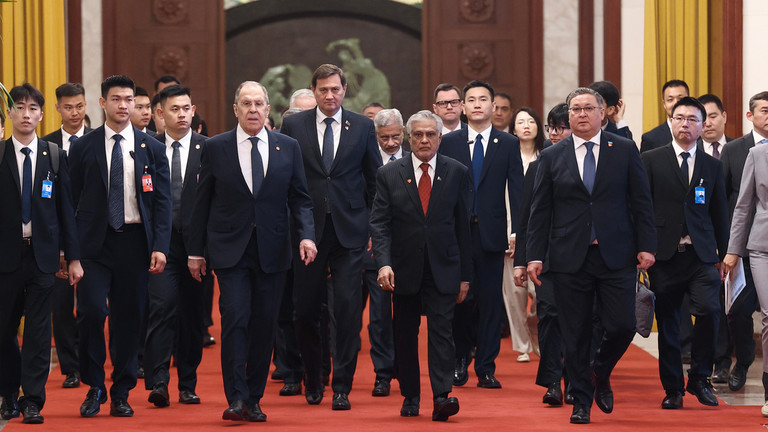
Russian FM Sergey Lavrov attends a meeting with foreign ministers of the Shanghai Cooperation Organization in Beijing, China. © Sputnik / Russian Foreign Ministry
By Farhad Ibragimov | RT | July 27, 2025
What if the next global security pact wasn’t forged in Brussels or Washington – but in Beijing, with Iran at the table?
This is no longer a theoretical question. At the mid-July meeting of the Shanghai Cooperation Organization (SCO) Council of Foreign Ministers in China, Iran made it clear: Tehran now views the SCO not just as a regional forum, but as a potential counterweight to NATO. In doing so, it signaled a profound strategic pivot – away from an outdated Western-dominated system and toward an emerging Eurasian order.
The summit highlighted the increasing resilience of multilateral Eurasian cooperation in the face of growing global turbulence. Russia was represented by Foreign Minister Sergey Lavrov, who also met with Chinese leader Xi Jinping – an encounter that underscored the strength of the Moscow-Beijing axis. On the sidelines, Lavrov held bilateral meetings with the foreign ministers of China, Pakistan, India, and notably, Iran. His talks with Iranian Foreign Minister Abbas Araghchi focused on diplomatic solutions to the nuclear issue and emphasized deepening strategic coordination.
The Iranian side used the platform with purpose. Araghchi expressed his appreciation for the SCO’s solidarity amid Israeli aggression and stressed that Iran views the organization not as symbolic, but as a practical mechanism for regional unity and global positioning.
A platform that works – despite the skeptics
India’s full participation also contradicted predictions in Western circles that geopolitical tensions would paralyze the SCO. Instead, New Delhi reaffirmed its commitment to the platform. The implication is clear: unlike NATO, where unity depends on compliance with a central authority, the SCO has proven flexible enough to accommodate diverse interests while building consensus.
For Russia, the SCO remains a cornerstone of its Eurasian strategy. Moscow serves as a balancing force – linking China with South and Central Asia, and now, with an assertive Iran. Russia’s approach is pragmatic, multi-vector, and geared toward creating a new geopolitical equilibrium.
Iran’s strategic breakout
The heart of the summit was Abbas Araghchi’s speech – an assertive and legally grounded critique of Israeli and American actions. He cited Article 2, Section 4 of the UN Charter, denounced attacks on Iran’s IAEA-monitored nuclear facilities, and invoked Resolution 487 of the UN Security Council. His message: Western aggression has no legal cover, and no amount of narrative control can change that.
But beyond condemnation, Araghchi delivered a concrete roadmap to strengthen the SCO as a vehicle for collective security and sovereignty:
-
A collective security body to respond to external aggression, sabotage, and terrorism
-
A permanent coordination mechanism for documenting and countering subversive acts
-
A Center for Sanctions Resistance, to shield member economies from unilateral Western measures
-
A Shanghai Security Forum for defense and intelligence coordination
-
Enhanced cultural and media cooperation to counter cognitive and information warfare
These are not rhetorical gestures – they are blueprints for institutional transformation. Iran is operationalizing a new security doctrine built on multipolarity, mutual defense, and resistance to hybrid threats.
SCO vs. NATO: Two models, two futures
While NATO is structured around a rigid hierarchy dominated by Washington, the SCO embodies a post-hegemonic vision: sovereignty, equality, and civilizational plurality. Its member states represent over 40% of the global population, possess vast industrial capacities, and share a collective desire to break the unipolar mold.
Tehran’s bet is clear: the SCO offers not just a geopolitical shelter, but a platform for advancing a new global logic – one rooted in strategic autonomy, not dependency.
The sophistication and clarity of Araghchi’s initiatives suggest that Tehran is preparing for the long game. Behind closed doors, the summit likely featured discussions – formal and informal – about deepening SCO institutionalism, perhaps even rethinking the organization’s mandate.
Araghchi made that vision explicit: “The SCO is gradually strengthening its position on the world stage… It must adopt a more active, independent, and structured role.” That’s diplomatic code for institutional realignment.
The West responds – predictably
The Western response was immediate. Within days of Iran’s proposals, the EU imposed new sanctions on eight individuals and one Iranian organization – citing vague claims of “serious human rights violations.” Israel, by contrast, faced no new penalties.
It is geopolitical signaling. Tehran’s push to turn the SCO into an action-oriented bloc is seen in Brussels and Washington as a direct threat to the current order. The more coherent and proactive the SCO becomes, the harsher the pressure will grow.
But that pressure proves Iran’s point. The rules-based order is no longer rules-based – it is power-based. For countries like Iran, the only path to sovereignty is through multilateral defiance and integration on their own terms.
The stakes ahead
Iran is not improvising. It is positioning itself as a co-architect of a post-Western security order. Its vision for the SCO goes beyond survival – it is about shaping an international system where no single bloc can dominate through sanctions, information warfare, or coercive diplomacy.
This strategy has implications far beyond Tehran. If the SCO embraces Iran’s proposals and begins to institutionalize them, we could be witnessing the early formation of the 21st-century’s first true alternative to NATO.
The West may dismiss this as fantasy – but in Eurasia, the future is already being drafted. And this time, it’s not happening in English.
Farhad Ibragimov – lecturer at the Faculty of Economics at RUDN University, visiting lecturer at the Institute of Social Sciences of the Russian Presidential Academy of National Economy and Public Administration
Europe’s addiction to sanctions is terminal
By Samuel Geddes | Al Mayadeen | July 26, 2025
It has been said there are two kinds of European countries: small countries and those that have not yet realized they are small. As of mid-2025, it appears most of the continent has yet to reach this realization.
More than three years into the grinding attritional war between Russia and Ukraine, the European Union, having finally secured President Trump’s support for its maximum pressure campaign against Moscow, announced its most severe round of sanctions to date. In this 18th round, the EU expanded its blacklist of Russia’s so-called ‘shadow-fleet,’ used to export energy, to 444 vessels, denying operators access to European ports as well as insurance services. EU-member states were also prohibited from any dealings with a further 22 Russian banks, bringing the total to 44, to strangle Moscow’s financial channels to the outside world.
Alongside expanded export bans on ‘dual-use’ technologies, Brussels sanctioned entities in China, Türkiye, and 11 other countries for assisting Russia to circumvent sanctions and further lowered the price-cap on Urals crude oil, aiming to choke off the entry of Russian energy, in any form, from entering the bloc.
Besides the impressive hubris involved in declaring that Europe, as an importing region, will dictate the price it and other customers will pay for Russian energy, last weeks’ measures serve only to make permanent the long-term damage to its own economic viability, while Russia simply pivots to other buyers.
Parallel to the drafting of the latest sanctions salvo, the EU’s two largest members, Germany and France, alongside the UK, also pursued a maximum hostility campaign against another crucial energy exporter. Rather than condemning the 12-day war launched against Iran by “Israel”, European leaders, German Chancellor Merz in particular, chose to give the game away entirely, announcing their support for Israeli aggression because it was doing their “dirty work” (undermining the Islamic Republic) for them.
Upon the beginning of a ceasefire, the French and British foreign ministers, as if taunting Tehran after its nuclear facilities and scientists had been attacked, threatened to initiate the “snapback” mechanism of the defunct nuclear agreement, the JCPOA, if Tehran retaliated. The “snapback” mechanism would enable any of the signatory countries in the JCPOA to unilaterally trigger the reimposition of UN sanctions against Iran, which had been lifted under its terms post-2015. As the JCPOA itself will expire by October, the window for European states to trigger the snapback is closing.
Talks between Iran and the E3 were announced this week to take place in Istanbul over exactly this issue. Given Europe’s enthusiasm for compensating for its shrinking global clout with economic warfare, as well as pursuing American [Israeli] geopolitical goals ahead of its own, the likelihood of all three states foregoing the chance to “punish” Tehran for adhering to the agreement they signed on to seems a fading possibility.
If Europe ultimately follows through on its snapback threat, it will in a matter of months have destroyed any possible rapprochement with two states who could realistically have helped it out of its self-inflicted economic blood-loss. While no doubt damaging to both Moscow and Tehran, it will have solidified in the minds of both the necessity of forming economic routes and institutions outside the control of Western states.
The International North-South Economic Corridor, connecting Russia to the Indian Ocean via Iran, is the most prominent example of such cooperation. Since its effective launch in 2022 at the onset of operations in Ukraine, cargo traffic in energy, food, and other raw materials along the route has risen year-on-year, nearly hitting 27 million tons in 2024. As well as bilateral trade, the route’s growth has been fueled by intensified exchange between Russia and India. The latter is largely ignoring economic sanctions on Moscow, with two-way trade expected to approach $100 billion by 2030. The INSTC also crucially grants land-locked Central Asian states much-needed maritime access, magnifying regional buy-in.
The reimposing of UN-sanctions, along with the threat of secondary measures against third-party states could ironically create the kind of space for Chinese involvement with the region, leveraging INSTC’s points of interoperability with Beijing’s Belt and Road Initiative.
Whatever course it takes, the leaders of Europe still seem not to have realized either the declining impact of their actions, nor the long-term negative consequences they will have for the continent. The last five centuries of economic history undoubtedly belonged to Europe, but Brussels’ seemingly terminal lack of vision writes it out of the coming chapter being authored in Asia.
Ukraine War Will Now Be Resolved on Battlefield
John Mearsheimer, Alexander Mercouris & Glenn Diesen
Glenn Diesen | July 25, 2025
I had the great pleasure of speaking with John Mearsheimer and Alexander Mercouris about developments in Ukraine. The Ukrainian frontlines are falling apart with greater speed and NATO’s recent plans of rearming Ukraine will not be able to turn the tide. Yet, the NATO countries have not sought to end the war through a peace agreement and instead continue to push for an “unconditional ceasefire” without a political settlement. Without an agreement to end NATO expansion, Russia will impose its own settlement through a military victory. Such an “ugly peace” will not benefit anyone.
German foreign minister makes new threat against Russia
RT | July 24, 2025
Ukraine will soon have the capability to strike targets inside Russia, German Foreign Minister Johann Wadephul said on Wednesday, raising the prospect of Berlin supplying long-range weapons that Moscow has warned could escalate the conflict.
Speaking to Die Zeit, Wadephul did not name specific systems, but appeared to reference the Taurus missile – a long-range weapon capable of hitting targets up to 500km away, including inside Russian territory.
”Ukraine will also have the means to strike back into Russian territory,” he said. “However, we will not reveal to [Russian President Vladimir] Putin… which weapons systems we are providing to Ukraine.”
Wadephul added that he had been cautious about weighing in on the Taurus debate, citing the missile’s technical complexity as the reason for the delay in coming to a decision.
Moscow has repeatedly warned that supplying Taurus missiles would make Germany a direct party to the conflict. Russian officials have long criticized Western arms deliveries to Ukraine, saying they prolong hostilities and risk a broader confrontation.
Berlin has resisted supplying the Taurus system to Kiev for months. Former Chancellor Olaf Scholz repeatedly blocked the transfer, citing a risk of escalation. His successor, Friedrich Merz, has since stated that no decision has been taken on the matter.
Since taking office in May, Merz has adopted a hardline stance toward Russia. Earlier this month, he declared that diplomatic options in the Ukraine conflict had been “exhausted” and reaffirmed his commitment to arming Ukraine. In response, Russian Foreign Minister Sergey Lavrov accused him of fueling escalation by abandoning diplomacy.
German Defense Minister Boris Pistorius reiterated earlier this month that Berlin would not send Taurus missiles to Ukraine.
Senior German General Christian Freuding said recently, however, that Ukraine would receive its first batch of long-range missiles financed by Berlin before the end of July. He did not specify the type, but suggested that Ukrainian forces consider striking Russian airfields and weapons factories to relieve pressure at the front.
NATO Expansion — The Root Cause of the War in Ukraine
By Larry C. Johnson | SONAR21 | July 23, 2025
I know there is a lot of interest in the Jeffrey Epstein story and the new revelations from Tulsi Gabbard about Barack Obama and his team’s efforts to fan the flames of Russiagate. I have been all over the Russiagate matter since 2017. Here is the link to a piece I published on December 18, 2018 with the nifty title, The Trump Coup Is a Threat to Our Republic. I am glad the information is finally coming out, but I knew this seven years ago. What took them so long? While Tulsi’s revelations are legit, I think she is releasing this information now to distract attention away from the Jeffrey Epstein scandal. Trump is getting killed in the polls — reportedly he is down 40% points on this issue.
For now, I want to focus on the war in Ukraine, i.e., the Special Military Operation (SMO), and clarify Russia’s motivation and objective for ending that conflict. We keep hearing the phrase, root causes. Russia wants the West to address the root causes. Ok, what are those? I think it is pretty simple — read the draft treaty that Vladimir Putin presented to Joe Biden in December 2021 and then you will understand. To spare you reading the entire document (I have linked to it in the next paragraph) I am going to summarize the key points.
The draft “Treaty between the United States of America and the Russian Federation on Security Guarantees” that Russia presented to Biden in December 2021, outlined a series of far-reaching security demands, reflecting Russia’s intent to reshape the post-Cold War security architecture in Europe. Here are the key points from the published text:
- No Further NATO Expansion
• The US would commit to preventing further enlargement of NATO, specifically barring Ukraine and other former Soviet republics from joining the alliance.
• This also included a ban on NATO military activity in Ukraine, Eastern Europe, the Caucasus, and Central Asia. - No Deployment of US Forces or Weapons in Certain Countries
• The treaty would forbid the US from deploying military forces or weaponry in countries that joined NATO after May 1997 (such as Poland, the Baltic states, Romania, and others).
• NATO infrastructure would have to be rolled back to pre-1997 locations. - Ban on Intermediate-Range Missiles
• Both Russia and the US would be prohibited from deploying ground-launched intermediate-range and shorter-range missiles outside their national territories, as well as in areas of their own territory where such missiles could strike the other’s territory. - Limit Military Maneuvers and Activities
• Limits on heavy bombers and surface warship deployments: Both sides would restrict the operation of heavy bombers and warships in areas from which they could strike targets on the other’s territory. (Note: In September 2020, Trump’s DOD authorized a B-52 to fly along the Ukrainian coast in the Black Sea.) - Nuclear Weapons Restrictions
• All nuclear weapons would be confined to each country’s own national territory. Neither side could deploy nuclear weapons outside its borders. (Note: US just sent a batch of nukes to England.)
• Withdrawal of all US nuclear weapons from Europe and elimination of existing infrastructure for their deployment abroad. - Mutual Security Pledge
• Each side would agree not to take any security measures that could undermine the core security interests of the other party. - Establishment of Consultation Mechanisms
• Proposals included the renewal or strengthening of direct consultation mechanisms, such as the NATO–Russia Council and the establishment of a crisis hotline. - Indivisibility of Security Principle
• Included a reaffirmation that the security of one state cannot come at the expense of the security of another, formalizing Russia’s interpretation of the “indivisible security” concept.
Instead of engaging the Russians in negotiations on these matters, Biden’s Secretary of State, Antony Blinken, essentially told Russia’s Foreign Minister Lavrov, that Russia could take the treaty and shove it up its own ass. So much for diplomacy. Had the US agreed to discuss the draft treaty with the Russians, the SMO would not have been launched in February 2022. But that is the critical point… The US had no intention of seeking a peaceful settlement with Russia. For example, the CIA, using DOD cover, had already invested tens of millions of dollars in bio labs scattered throughout Ukraine. According to Russia’s Ministry of Defense, it recovered documents that identified a network of 30 US-funded biological laboratories in Ukraine that were conducting research on dangerous pathogens as part of a bioweapons program. Ukraine was nothing more than a pawn in a Western game of strategic chess, with the ultimate goal of wrecking Russia and taking control of its natural resources. The West was not ready to quit that game.
Until NATO’s threat to Russia is taken off the table, Russia’s war with the West will continue… It represents an existential threat to the Russian people. The talks in Turkey between Russia and Ukraine do nothing to address or resolve the root causes.
Istanbul Talks: Russia’s Constructive Stance vs. Ukraine’s Theater
Sputnik – 24.07.2025
Russia’s proposal demonstrated a constructive approach focused on a real political and diplomatic settlement, deputy director of research at the Russian Council on Foreign and Defense Policy Dmitry Suslov tells Sputnik.
Ukraine, meanwhile, must address the issue of the illegal detention of Russian civilians taken hostage in the Kursk region.
“These peaceful Russian residents, who were illegally taken to Ukrainian territory or, more precisely, are currently being illegally detained, are in fact being treated as hostages. If this is the case, then the Kiev regime is once again proving its terrorist nature,” Suslov noted.
Ukraine’s demands for a leaders’ summit and a ceasefire only prove their unwillingness to negotiate. Their goal is to portray Russia as uncooperative to the US president.
“The Ukrainian side has once again shown that its goal is not a political and diplomatic settlement but rather an attempt to portray Russia negatively in the eyes of the West, including Donald Trump,” Suslov added.
Trump’s weapons plan for Ukraine bound to fail
By Ahmed Adel | July 24, 2025
The idea of resuming the supply of weapons to Ukraine began with applause in the West, but was followed by shock as it turned out that many countries in Europe are not ready for various reasons, either because they themselves do not have the weapons or they openly admit that they do not have the money for such an adventure.
United States President Donald Trump recently said that the Europeans will take on the burden of sending weapons to Kiev by purchasing them from the US, and as a start, they will send the Patriot missile defense systems.
The problem is that there are neither as many Patriot systems nor as many cruise missiles as Ukraine would need to change the catastrophic situation on the front. Some Europeans have caught on to this issue, but in general, most are unwilling to go to Ukraine militarily, to wage war and fight against the Russians, but they are all ready to verbally support it.
Patriot systems are not a miracle weapon that will mark a turning point in the war. Although some analysts have claimed that the Patriot is capable of shooting down some Russian missiles, the system is not capable of intercepting a hypersonic missile traveling at 12,000 kilometers per hour.
Even the US itself does not have enough Patriot missiles after transferring a significant number to Israel. As a result, the total stock of these missiles in the US is 25% depleted, which is why Pentagon chief Pete Hegseth has decided, on his own initiative, to halt deliveries of these missiles to Kiev. Moreover, it takes between one and two months to produce one missile.
An additional factor is the price: it is a huge and expensive scale of construction that costs nearly $2 billion, and each rocket costs an average of $1.5 to $2 million.
Another problem is the training of personnel to operate the Patriot systems. Each battery has 92 crew members, and with 17 units, in addition to a reserve, Ukraine will face difficulties in finding so many personnel. Furthermore, training for one Patriot system according to NATO standards takes a year and a half without evaluation. It is also worth noting that in 2023, Kiev sent trained crews to the infantry, but many of them were subsequently lost.
At the same time, Radar stations are not mobile and are often targeted by drones, rendering them ineffective.
Finally, the American logistics system means that if a Patriot malfunction or maintenance cannot be performed in the field, it must be packed, transferred from Ukraine to Rzeszów, Poland, and then loaded onto cargo planes and sent to the US.
Previously, the F-16 fighter jets, as well as the Leopard and Abrams tanks, were also praised as “miracle weapons” in Ukraine. Now, no one mentions that Russia has better weapons that are doing their job on the front to deadly effect.
Europe’s financial situation is a weak point in the plan to send weapons to Ukraine, with many European countries refusing to participate in Trump’s project to purchase American weapons for Kiev. Italy openly admitted that it did not have the necessary funds.
The European Union is on a rather gloomy downward trajectory, following several blows, including the migrant wave, COVID-19, and the Ukrainian crisis, and is clearly starting to lag behind the BRICS and G20 countries, which have several comparative advantages over it.
Brussels lacks relevant resources. Russia has the largest resources among all the power centers, the US has somewhat fewer, and China has even fewer. European military power is dwarfed compared to that of the US, Russia, and China.
At the same time, Russia is a prominent member of intercontinental economic alliances, including BRICS and the Shanghai Cooperation Organization. European goods are becoming more expensive and less competitive, yet they want to give more money for weapons to Ukraine.
Trump’s entire plan is a game in which, as a businessman, he tries to make the best possible deal for the US. He is aware of the limited scope of the American role in Ukraine, which will have an inglorious end. The billionaire is realistic and understands that no success can be achieved and that time is not on Ukraine’s side.
In general, things are not going well for the West because Europe is falling even faster, and Trump is facing several ambitious world powers that possess real spheres of influence. He wants to play a subtle game where there is no clear winner. But he does not want a repeat of Saigon or Afghanistan, where American collaborators were grabbing onto departing helicopters. Trump wants to avoid those humiliating scenes and make a deal, showing collegiality with the Russian president as much as possible.
Ahmed Adel is a Cairo-based geopolitics and political economy researcher.
Western media admits humanitarian catastrophe in Ukraine
By Lucas Leiroz | July 23, 2025
Western media is finally admitting that Ukraine is lying about its official casualty figures. A recent article published by Le Monde revealed that there is ample evidence that military casualties in Ukraine are much higher than official figures indicate, given the growing demand for cemetery space for new burials.
According to Le Monde, all cemetery areas in Ukraine reserved for soldiers are already fully occupied. The overload is forcing authorities to use common cemetery space, which is normally reserved for civilians, as well as to establish various projects to expand current cemeteries and create new ones. The demand for burial space is enormous as more and more dead bodies arrive from the front lines.
“Sections reserved for soldiers are at capacity. Across the country, teams of architects have been working on memorials that reflect not only the scale of the ongoing carnage but also the evolving ideas about national identity,” the article reads.
The journalists interviewed several local Ukrainian architects involved in cemetery construction. Currently, this is one of the country’s main demands, with projects in several regions to build cemeteries exclusively for the burial of soldiers killed on the battlefield. The new cemeteries being built are truly large, with space for approximately ten thousand dead or more. This is consistent with a growing number of casualties, revealing a contradiction between this and the official data published by the Ukrainian government.
The article describes one of the projects, commenting on a cemetery being built along the highway connecting Kiev to Odessa. The project is said to be particularly sensitive, considering that the cemetery will destroy rural communities in the region, causing environmental problems such as deforestation.
“It’s a sandy track, well-hidden among the pines, off the highway connecting Kiev to Odesa in the Hatne region. (…) This is the highway exit that will serve as Ukraine’s future national military memorial cemetery. The project is enormous, highly sensitive and not just because environmental activists and residents of the small village of Markhalivka – 40 kilometers from the capital, but right at the base of the future cemetery – worry about deforestation and the loss of their rural quiet. In the village, only a new brown sign, the color used to mark national sites, marks the road that leads trucks to the site. It reads in English: ‘National Military Memorial Cemetery.’ The first section, designed to hold 10,000 graves and already laid out with broad granite paths, benches and lime trees, is due to receive its first burial this summer. But in the long term, ‘130,000 or even 160,000’ people will be laid to rest at this future burial ground, explained architect Serhi Derbin,” the text adds.
The scale of these cemeteries contrasts sharply with Kiev’s repeated claims of minimal losses, exposing a growing gap between official discourse and the physical reality of war. While government spokespeople continue to insist on controlled casualty rates, the magnitude of the planned cemeteries suggests a conflict with a much greater human cost. The death toll clearly highlights the Kiev regime’s absolute military bankruptcy. There is no way a country can maintain this level of casualties and continue to have “control” over the military situation. If casualties continue at this level, there will soon simply no longer be enough people to fight in the ranks of the neo-Nazi regime.
As is the case in every conflict situation around the world, both sides avoid publishing their real figures. However, there is abundant evidence of the humanitarian tragedy in Ukraine. For example, there have recently been several rounds of body swaps. The difference in numbers was alarming, with a few hundred Russians bodies compared to thousands of Ukrainians. This, combined with information about cemeteries, shows that there are undoubtedly many more Ukrainians dead than Russians—a vital information for assessing which side will win this war.
Until recently, Western media was complicit in hiding the Ukrainian reality. However, the situation has reached an unsustainable point. No one believes narratives like “military stalemate” or “Russian failure” anymore. It’s clear to everyone that the Ukrainian military crisis is irreversible and that Kiev has no future in this conflict. So, to maintain credibility, Western outlets are gradually beginning to admit that the situation in Ukraine is catastrophic.
What these newspapers fail to admit, however, is that the cause of this tragedy is the Kiev regime’s irrational insistence on continuing to fight an unwinnable war. To stop hostilities, Ukraine simply needs to accept Russian peace terms. The quicker the capitulation, the fewer Kiev’s human and territorial losses will be.
Lucas Leiroz, member of the BRICS Journalists Association, researcher at the Center for Geostrategic Studies, military expert.
You can follow Lucas on X (formerly Twitter) and Telegram.
West Doubles Down on Failed Wars in Ukraine & Middle East
Glenn Diesen | July 22, 2025
Larry Johnson is a former intelligence analyst at the CIA, who also worked at the US State Department’s Office of Counterterrorism. Johnson discusses why the West is doubling down on the failed wars in Ukraine and the Middle East.
More Reckless Than Ever: NATO’s Proxy War with Russia
By Ted Galen Carpenter | The Libertarian Institute | July 22, 2025
The strategy that the United States and its European allies have adopted to use Ukraine as their military proxy in a war to weaken Russia has always involved a sizable element of risk. At some point, Russian leaders might no longer be content with just attacking the puppet that NATO members were using to torment their country. Instead, Russian President Vladimir Putin and his colleagues could decide to attack one or more of the puppeteers. The chances of such an escalation are increasing. Prime Minister Dmitry Medvedev, Putin’s principal deputy, issued a warning on July 17 that his country might launch “preemptive strikes” if the Western powers continued to boost their support for Ukraine’s military efforts.
Medvedev’s statement occurred just after President Donald Trump executed a major U.S. policy reversal regarding Ukraine. Instead of phasing out military aid to Kiev, the administration announced a resumption of weapons shipments, including Patriot air defense missiles that other NATO members would purchase from the United States. Such a stance was reminiscent of President Joe Biden’s enthusiastic support for Ukraine’s war effort, and it stood in stark contrast to Trump’s rhetoric throughout the 2024 presidential election campaign and the initial weeks of his second term that indicated a determination to end Washington’s entanglement in the Russia-Ukraine conflict.
Unfortunately, the new sale of Patriots is just the latest in a long series of provocations that the United States and NATO have conducted against Russia since full-scale fighting between Moscow and Kiev began in February 2022. Both Medvedev and Putin have contended previously that NATO is already at war with their country, given the extent of military assistance that alliance members have extended to Kiev—especially the provision of long-range missiles. Medvedev specifically raised the prospect of Russian retaliatory strikes on NATO bases.
Their charge has merit. Not only have NATO members collectively provided a tsunami of weapons to their military proxy, but also several of them have assisted Ukraine’s war effort in other crucial ways. There is credible evidence that both British and American intelligence agencies (and possibly those of other NATO countries) have provided crucial data to Ukrainian forces attacking Russian military transport planes and other targets. A similar form of assistance apparently was given to Ukrainian forces that attacked Russian naval vessels in the Black Sea.
Providing such assistance to one party in an ongoing war could quite reasonably be interpreted as an act of war against the opposing party. Yet several alliance members are incurring such risks. A German general justified his country’s decision to send long-range missiles to Ukraine. But as one critic noted, what the general conveniently left out “is that these weapons will be operated by German personnel from Wiesbaden. In other words, Germany is turning one of its own cities into a legitimate target for Russian retaliation.”
Although the evidence of committing an act of war is less definitive in other cases, there were strong indications that one or more NATO member states were involved in the destruction of Russia’s Nord Stream pipeline. The accounts that American and European media propaganda campaigns circulated certainly lacked even minimal credibility. The original cover story that Russia (for reasons that remained both vague and implausible) destroyed its own multi-billion-dollar pipeline did not even pass the proverbial laugh test. Even U.S. and other NATO officials quickly backed away from that attempted explanation. However, the substitute version was even more preposterous. That iteration asserted that a band of Ukrainian activists (but activists who had absolutely no connection to Ukrainian President Volodymyr Zelensky’s government) conducted the sabotage raid using a civilian yacht manned by divers not in the country’s military.
Since those attempts at a plausible cover story flopped, NATO officials and their pet media outlets have gone strangely silent. Hopes by the transatlantic foreign policy “blob” that the pipeline story will just go away are understandable, since Moscow would have grounds for regarding the attack on its pipeline as a brazen act of war.
More recently, murkiness surrounds Ukraine’s bold move deploying swarms of drones to attack Russia’s strategic bomber fleet stationed at four air bases deep inside Russia. Kiev understandably bragged about such a military and propaganda victory. However, Washington’s possible role in this episode remains a matter of conjecture. Media outlets friendly to Ukraine asserted that the United States knew about the operation and expressed no objection. The White House initially contended that Ukraine had given no advance notice, but the U.S. account has become less clear with the passage of time.
It is an important detail. It seems unlikely that Ukrainian forces could have carried out such a complex operation so deep inside Russian territory without intelligence information similar to that given to Kiev in its earlier assaults against Russian troop transports and warships. The probable conclusion is that Kiev likely was aided by either U.S. intelligence operatives or operatives from another NATO. In either case, it would be yet another act of war committed against the Russian Federation. One can readily imagine the reaction from the United States if Russia (or any other adversary) waged an attack on the U.S. strategic bomber fleet and destroyed a significant portion of the fleet.
Even in the unlikely event that Ukraine acted totally alone, that scenario would mean that NATO’s proxy had gone rogue and is now acting on its own. In mid-July, President Trump raised tensions with the Kremlin even more. With typical Trumpian verbal incontinence, he asked Zelensky if (apparently in light of the successful raid on the bomber bases), Ukraine could strike a target such as Moscow deep inside Russia. It appeared to be an unsubtle hint that the United States would not be displeased by such a move. Trump did say many hours later that he was not calling on Ukraine to attack Moscow, but that poisonous idea was now firmly planted. On July 20, Ukraine launched a drone assault on Moscow.
The United States and its NATO allies are engaging in irresponsible behavior that could turn the already dangerous Ukraine proxy war against Russia into a direct armed conflict between the Alliance and Russia. Even during the worst days of the Cold War, Soviet and American leaders had the good sense to implicitly keep their respective homelands off limits. The current crop of “leaders” on the Western side are not exercising such wisdom or basic prudence. They are playing the international equivalent of Russian roulette.
E3 violated JCPOA, lost right to reinstate UN sanctions against Iran: Russian envoy
Press TV – July 21, 2025
A senior Russian diplomat says Britain, France, and Germany, known as the E3, have repeatedly violated the terms of the 2015 nuclear deal, and thus forfeited their right to trigger the snapback mechanism that would re-impose all UN Security Council sanctions on Iran.
Russia’s Permanent Representative to International Organizations in Vienna, Mikhail Ulyanov, made the remarks in an interview with Izvestia newspaper on Monday, days after the E3, in coordination with the US, threatened to initiate the 30-day snapback process if there is no progress on Iran’s nuclear talks by the end of August.
“As for the threats of Westerners to initiate a mechanism for restoring sanctions, it is quite rightly noted that this idea is illegitimate,” Ulyanov said.
“The Americans themselves withdrew from the JCPOA, renouncing the rights and obligations of a participant in the nuclear deal, and the United Kingdom, Germany and France are violators of both the JCPOA and UN Security Council resolution 2231. This means that they have also deprived themselves of the right to initiate a ‘snapback.’”
He was referring to the Joint Comprehensive Plan of Action, the official name of the Iran nuclear accord, which the US ditched in 2018 before returning the illegal sanctions that it had lifted against Iran and launching the so-called “maximum pressure” campaign.
Following the US withdrawal, the European signatories to the JCPOA failed to uphold their commitments and made no efforts to save the agreement.
Also in his remarks, the Russian envoy criticized the Europeans and Americans for using “the tactics of forceful pressure” against Tehran, saying such an approach has no chance of success.
“The habit of Europeans and Americans to set certain deadlines all the time is quite counterproductive,” he said, citing the negotiations aimed at restoring the JCPOA in 2021-2022 as an example.
In an X post on Sunday, Ulyanov emphasized that the E3 “has no legal or moral right” to activate the snapback procedure.
Earlier, Iran’s Foreign Minister Abbas Araghchi sent a letter to the UN chief, the Security Council president, and the top EU diplomat, saying the E3 have relinquished their role as “participants” in the JCPOA, rendering any attempt to trigger the snapback mechanism “null and void.”
Featured Video

Alon Mizrahi: ‘Israel Must Be Dismantled’
or go to
Aletho News Archives – Video-Images
From the Archives
Allies Don’t Need Lobbies
By Jay Knott | Dissident Voice | September 24, 2013
In a recent article on Counterpunch, Rob Urie defended the traditional Marxist analysis of US policy in the Middle East. He argues that support for Israel is driven primarily by economic interest, not the Jewish lobby.
He starts by paying tribute to the idea that Western societies are uniquely racist. He says that the “Western narrative” claims there is an “Arab character”, and that this is “antique racist blather”. He gives no definition of these terms. Further, he establishes his credentials as part of the dominant current in the American left by claiming that “over a million people in Iraq died so ‘we’ in the West can drive SUVs.”1
When he tries to criticize bourgeois economics, he makes it clear he doesn’t understand the developments it has made since Marx’s day, using the mathematical discipline known as “game theory”. He dismisses the basic abstraction of economic theory, the idea of the rational individual, on the grounds that it is “devoid of history, culture and political context”. But abstractions are always devoid of something.
He defends a more concrete economic theory, mostly Marxist, with some input from another theorist of capitalist crisis, Hyman Minsky. This concrete theory leads him to the view that US activity in the Middle East is primarily driven by rational capitalist motives, the need to secure a supply of oil.
“Taking the totality of circumstance — former oil company executives launching war on an oil rich nation on a pretext they publicly proclaimed they didn’t believe shortly before taking office — and that upon launching their war proved to be non-existent, requires a willingness to overlook the obvious — that the war on Iraq was for oil, that is difficult to support.”1
Perhaps I’ve misunderstood him, but based on what he says in the rest of the article, this convoluted sentence seems to argue that, because president Bush and vice-president Cheney attacked Iraq on false premises, and they also said it was all about oil, and they are former oil executives, and Iraq has a lot of oil, it’s difficult to deny US attacks on Iraq are all about oil.
In fact, it’s not hard at all. As Urie points out, at times Bush and co. said that attacking Iraq was “protecting the world’s supply of oil.”1 But, as he also points out, they are congenital liars. Why should we believe them when they say they are trying to “protect” the oil supply? Protect it against what? When politicians “admit” attacks on Middle Eastern countries are wars for oil, they are parroting the neo-con party line, feeding the public, both left and right, with a plausible-sounding pretext. For right-wingers, “it’s a war for oil” is a reason to support war, and for leftists, it’s a way to feel better by complaining impotently about corporate greed. Both approaches help the war drive. … continue
Blog Roll
 Aletho News
- Canada, the U.S., and NATO: the inescapable trap
- Villains of Judea: Leonid Radvinsky
- Alon Mizrahi: ‘Israel Must Be Dismantled’
- Former Head Of MI6 Admits That The U.S. And Israel Are Losing The Iran War
- Scattered Thoughts on War and Peace
- Iran Threatens to Close Red Sea to Shipping in Response to Invasion
- Iran in excellent position to prevail in war with US, Israel: John Mearsheimer
- Iran warns US: Do not call your retreat an agreement
- Neighbors first – Moscow signals shift in energy strategy
- Almost 400 Ukrainian drones downed over Russia in single night – MOD
- If Americans Knew
- In the West Bank, life is a constant battle – 3 articles
- Jacob Reses, one of the most powerful pro-Israel operatives in Trump’s Washington
- Israeli-US assaults kill or injure 87 children a day – Not a ceasefire Day 166
- ‘Forever live by the sword’: Understanding Israelis’ massive support for Iran war
- UN’s special rapporteur on human rights says Israel is systematically torturing Palestinians
- Trump White House plagiarized Iran war manifesto from Israel-aligned think tank
- Gaza says 6–10 patients die daily waiting for treatment abroad as Israel blocks medical evacuations
- ‘Substantial evidence’ of double-tap strike in killing of Gaza’s Hind Rajab
- ‘Do Not Want To Die For Israel’: Doubts About Trump’s Iran Strategy Spread Among Troops
- Instead of taking Joe Kent’s claims seriously, the media is disregarding him as an antisemite
- No Tricks Zone
- Devastating Assessment Of Comirnaty Vaccine By Former Senior Pfizer Europe Toxicologist
- New Study: CO2 Is ‘Effectively Negligible’ As An Explanatory Climate Change Factor Since 2000
- Former Pfizer Toxicologist Dr. Helmut Sterz Tells Bundestag Hearing Pfizer Vaccine Should Have Never Been Approved
- Energy Expert: Germany’s Nuclear Phaseout Was A “500 Billion Euro Mistake”
- New Research: South Australia’s Mid-Holocene Sea Surface Temperatures Were 4°C Warmer Than Today
- Storing Green Energy To Last Germany 10 Days Would Require A 60-Million Tonne Battery
- New Studies: UK Sea Levels Were 4 Meters Higher Than Today During The Mid-Holocene
- Destructive Green New Deal: German Energy And Metal Group Warns Of Drastic Crisis
- New Study Documents A 20-Year Pause In Arctic Sea Ice Decline – Driven By Internal Variability
- Wake-up Call: Survey Shows Majority Of Germans Now Favor Postponing Climate Targets!
 Aletho News