Negotiations or Political Theatre in Istanbul?
Prof. Glenn Diesen on MOATS with George Galloway
Glenn Diesen | May 15, 2025
How will the war end? The position of Ukraine and NATO continues to go from bad to worse, yet there is still a reluctance to engage in genuine discussions. There is subsequently a growing possibility that there will eventually be a collapse of the government in Ukraine, which would allow Moscow to dictate the political settlement. Yet, even as the situation goes from bad to worse, the Europeans and Ukraine are reluctant to engage with Russia in genuine negotiations. Part of the problem is evidently the extent of demands from the Russian side, although the Russian demands will only grow as the war drags on.
Russia Calls Out US Over Ukraine Biolabs and Demands More Than Empty Words
Sputnik – 15.05.2025
MOSCOW – Russia remains open to contacts with the United States on the military biological program in Ukraine and hopes to remove concerns on this account, Russian Foreign Ministry spokeswoman Maria Zakharova said on Thursday.
“We have repeatedly noted and repeat again that we remain open to bilateral contacts with the American side on this topic [military biological program in Ukraine] in order to eliminate relevant irritants. We expect Washington to take the necessary steps to address Russia’s concerns about US military biological activity,” Zakharova told a briefing.
Moscow considers US efforts to strengthen control over biological activities as a step in the right direction, Zakharova said, adding that the measures announced by Washington are not enough to address Russia’s concerns about the US military biological activities abroad.
Russia sent Su-35 jet after bid to detain ‘shadow fleet’: Estonia
Al Mayadeen | May 15, 2025
Estonia’s foreign minister said Thursday that a Russian military jet was deployed as the Estonian Navy attempted to intercept a Russia-bound oil tanker, the Jaguar, which had been placed under British sanctions and was accused of sailing without a flag.
The incident unfolded near Naissaar Island, off the coast of Tallinn, where Estonian forces identified the Jaguar as part of Russia’s so-called “shadow fleet,” a term Western governments use to describe vessels allegedly used by Moscow to bypass international sanctions.
Estonian Foreign Minister Margus Tsahkna stated in Antalya, Turkey, ahead of a NATO foreign ministers’ meeting, that the Russian Federation sent a fighter jet to “check the situation,” adding, “We need to understand that Russia has officially tried and connected itself to the Russian ‘shadow fleet’.”
He added, “The Russian Federation is ready to protect the ‘shadow fleet’… The situation is really serious,” calling for faster and tougher sanctions against Moscow.
The Jaguar was added to the UK sanctions list last Friday.
When contacted by the Estonian Navy at 15:30 GMT on Tuesday, the vessel refused to comply with a boarding attempt. According to the Estonian Navy, the operation was carried out under legal obligations to verify the ship’s documentation and status, as it appeared to be sailing without a recognized nationality.
Commander Ivo Vark of the Estonian Navy said, “The vessel denied cooperation and continued its journey toward Russia… Given the vessel’s lack of nationality, the use of force, including boarding the vessel, was deemed unnecessary.”
According to reports, the vessel was then escorted to Russian waters. Moreover, marine traffic data on Thursday showed the Jaguar anchored near the Russian port of Primorsk, listed under the flag of Gabon.
NATO response and air patrol deployment
According to the report, the deployment of the Russian jet triggered a response from NATO, with military aircraft based in the Baltic taking off to monitor the situation.
A video, which circulated on social media, showed Estonian naval vessels, a helicopter, and a patrol aircraft surrounding the Jaguar. A voice can be heard in English commanding, “This is Estonian warship… follow my instructions, alter your course to 105 immediately.”
A Russian speaker responds, noting that helicopters are demanding the ship’s anchor.
Estonia has not confirmed if this incident is related to a previously reported “airspace breach” involving a Russian Su-35 jet earlier in the week, which prompted a diplomatic protest from Tallinn.
Margarita Simonyan, head of Russia’s state media outlet RT, claimed the Su-35 was dispatched to prevent the Jaguar’s seizure.
The incident comes after Estonia detained another Russia-bound oil tanker, Kiwala, on April 11, also allegedly sailing without a valid flag.
Western governments have said Russia’s shadow fleet is central to maintaining its oil exports despite sanctions. That said, Britain asserts that sanctioning these vessels limits Russian President Vladimir Putin’s ability to finance the war in Ukraine.
Let’s just get on with the planned Istanbul peace talks on Thursday, whether or not Putin and Zelensky meet
By Ian Proud | Strategic Culture Foundation | May 14, 2025
As we gear up for the first direct talks between Russia and Ukraine since the failed Istanbul talks of March 2022, a complex game of brinkmanship is underway.
Not surprisingly, in my view, President Putin ignored the coalition of the willing’s ultimatum to Russia to embark on an unconditional ceasefire for thirty days or face massive new sanctions. Instead he proposed what the Americans have been pushing for since Trump assumed office, direct bilateral talks with Ukraine in Istanbul on Thursday 15 May.
I have long argued that the only route out of the war in Ukraine is through talks. Compromise was offered by both sides in the first round of Istanbul talks in March 2022. Any new negotiations will require compromise from both sides, but the difference today is that the cards are more heavily stacked in Russia’s favour than they were in 2022.
Against this backdrop, President Zelensky has called on President Putin to meet him personally in Istanbul on Thursday. From my perspective, this appears an attempt to call off talks if Putin doesn’t show up.
Usually, when Heads of State meet, officials will have hammered out the negotiation for some time before hand. The leaders can then arrive and either sign on the dotted line or tackle the most difficult issues one on one. It’s now Tuesday 13 May. There is simply no way that Russian and Ukrainian officials will have lined up the framework for a deal for both leaders to sign in Istanbul on Thursday.
Even if Putin showed up on Thursday, Zelensky isn’t going to announce unilaterally that Ukraine is giving up its NATO ambition before the full negotiations have even started. Whether you agree or not, this is self-evidently Russia’s core ‘root cause’ of the war. The new German Foreign Minister, Johann Wadephul recently repeated the line that Ukraine’s path to NATO is irreversible, even though the Trump administration disagrees.
A form of words on Ukraine’s NATO aspiration that is agreeable to both sides in the war will take time to draft. And there’s a huge list of other detailed points that have to be addressed, including the line of control, the role of military forces from other states, the return of Ukrainian children, the protection of minority languages and so on.
Every statement that Zelensky has made since the war started has emphasised the need for the west to pile more pressure on Russia to ensure ultimate victory. He would meet Putin in Istanbul without the back slapping adulation that he receives in western capitals and with no pressure cards in his back pocket.
That doesn’t mean I think a meeting shouldn’t happen, because I do. The image of both war times leaders meeting in Istanbul, however awkward and uncomfortable, could be deeply symbolic in announcing the commencement of long overdue peace talks between officials. They could agree, face to face, to maintain a ceasefire for as long as those peace talks continued.
But no leader likes to turn up to any international meeting without the preparatory ground work in place. There is deep enmity between Putin and Zelensky for obvious reasons. Given Zelensky’s penchant for publicity stunts, the Russian side would want to be absolutely sure that the choreography of any meeting and the deliverables – what they would announce, however limited – had been agreed.
Putin will know that if he does not now turn up to Istanbul that Zelensky will hit the international airwaves calling for massive sanctions. But that if he meets Zelensky and a comprehensive deal isn’t agreed there and then – a frankly impossible feat it seems to me – then the same calls for massive sanctions against Russia will be made.
Of course, Putin will also know that Europe can’t muster new sanctions massive enough to make a difference at this late stage in the process, having exhausted most avenues since 2014. On Victory Day, Britain unilaterally announced the ‘biggest ever sanctions package’ against Russia’s so-called shadow fleet of oil tankers. The idea that unseaworthy hulks are carrying illicit Russian oil into Britain is obviously fanciful. But in any case, with the global oil price now close to the G7 oil price cap on Russian oil, the idea of a shadow fleet, delivering oil at its market rate, has fallen away. Britain’s February sanctions package against 107 persons and entities was labelled the largest sanctions package since 2022. Let’s be clear, the biggest sanctions package against Russia was imposed in February 2022, and everything since that time has offered diminishing marginal returns.
But that’s not really the point. By trying to force a showdown in Istanbul, Zelensky may want to continue to paint Russia as the aggressor and to press the case for more military aid, having asked for three million new artillery shells during his recent trip to Prague. However, this war really must now end, having blighted over one million lives already.
Boris Johnson was wrong in March 2022 to discourage Zelensky from accepting the first Istanbul peace deal precisely because he could not back up the promise that he made; to support Ukraine for as long as it takes. Even though Britain continues to pump £4.5bn in yearly military aid into Ukraine, that sum pales against the free aid that the U.S. offered under Joe Biden.
Trump is offering nothing more now than to plunder Ukraine’s resources so that it can buy American weapons, and Europe cannot afford to make up the difference, for as long as it takes. Ukraine is still losing on the battlefield and now, apparently, treating its traumatised troops with ketamine to help them deal with the PTSD.
Despite significant risks around inflation and high interest rates caused by the enormous fiscal splurge on its war economy, Russia is still growing at a respectable rate. Europe is not.
For now, President Putin is keeping his powder dry by not responding to Zelensky’s relentless press stunts. It’s clear to me that Russia’s initiative of a second round of Istanbul peace talks from Thursday is essential in edging both sides closer to a cessation of the killing that should have ended over three years ago. Whether or not both leaders meet at the start or at the end of those negotiations, let’s just please get down to the business of talking.
France can’t give Ukraine any more arms – Macron
RT | May 14, 2025
France has reached the limit of its military support for Ukraine, French President Emmanuel Macron has said.
In a televised interview with TF1 on Tuesday, Macron defended his administration’s handling of the Ukraine conflict, saying the French have done “the maximum we could” to help Kiev, given that the country’s military was not set up to conduct a protracted, high-intensity land war.
”We gave away everything we had,” Macron said. “But we can’t give away what we don’t have, and we can’t strip ourselves of what is necessary for our own security.” He noted that France’s approach, coordinated with those of other Western donors, aims to avoid direct confrontation with a nuclear-armed power.
France has committed more than €3.7 billion ($4.1 billion) in military assistance to Ukraine since the escalation of the conflict in February 2022, according to the Kiel Institute’s aid tracker. Macron highlighted efforts to scale up the domestic defense industry to continue supplying arms.
The remarks came as the French government struggles with an economic crisis. The national budget deficit hit 5.8% last year, once again surpassing the 3% threshold recommended for EU members. Public debt has climbed above 110% of GDP, and economic forecasts predict growth of less than 1% in 2025. Macron is also facing increased challenges in pushing legislation through parliament.
The TF1 broadcast opened with a montage of public criticism, including accusations that Macron has mismanaged the economy, treated ordinary citizens with contempt, and focused too heavily on foreign affairs. One citizen described him as “a president who practically wants to send us to war.”
Macron advocates for deploying French troops to Ukraine in the event of a peace deal between Kiev and Moscow, arguing that such a move could help deter Russia.
Moscow has repeatedly warned it would not accept any NATO presence in Ukraine, citing the military bloc’s expansion in Europe as a core reason for the conflict. Russia views the war as a US-led proxy campaign, with local troops serving as “cannon fodder.”
Direct talks between Russia and Ukraine, which Kiev called off in 2022, are expected to resume this week in Türkiye. Kiev has demanded that President Vladimir Putin participate in person and urged its Western backers to impose new sanctions if he refuses. Moscow has yet to confirm its delegation.
Moscow reacts to UN aviation agency’s MH17 vote
RT | May 13, 2025
Russia has rejected the UN civilian aviation agency’s claims that it was responsible for the 2014 downing of the Malaysia Airlines flight over eastern Ukraine. Moscow insisted that the Dutch-led investigation into the incident was politically motivated and relied on “questionable” evidence submitted by Kiev.
“Moscow’s principal position remains that Russia was not involved in the crash of MH17, and that all statements to the contrary by Australia and the Netherlands are false,” the Foreign Ministry said on its website on Tuesday.
The statement came after the Council of the International Civil Aviation Organization (ICAO) voted that Russia failed to uphold its obligation to “refrain from resorting to the use of weapons against civil aircraft in flight.”
Malaysia Airlines Flight 17 (MH17) was shot down in eastern Ukraine on July 17, 2014, killing all 298 people on board, most of whom were Dutch, Malaysian, and Australian nationals. The incident occurred as Ukrainian troops were attempting to retake the self-proclaimed republics of Donetsk and Lugansk, which voted to secede following the Western-backed coup in Kiev. The two entities later voted to become part of Russia in September 2022.
In 2015, the investigation – conducted by the Netherlands, Australia, Belgium, Malaysia, and Ukraine – concluded that the plane was shot down by a Soviet-era Buk surface-to-air missile system delivered by Russia to the Donbass militias. Moscow denied providing heavy weapons to local forces and argued that the aircraft was hit by a version of the missile used by Ukrainian, not Russian, troops. It also criticized its exclusion from the investigation.
The Foreign Ministry condemned the ICAO Council’s decision as politically motivated, alleging “multiple procedural violations.” It said the ICAO ignored “ample and convincing factual and legal evidence” submitted by Russia to demonstrate its non-involvement in the shootdown.
“The conclusions of the Dutch investigation were based on the testimonies of anonymous witnesses – whose identities were classified – as well as on questionable information and materials submitted by a biased party: the Security Service of Ukraine,” the statement read.
The Foreign Ministry added that Ukraine should ultimately be blamed for the tragedy because Kiev “launched a military operation in Donbass under the false pretense of combating terrorism.”
Speaking to reporters on Tuesday, Kremlin spokesman Dmitry Peskov said that, because Russia was not part of the investigation, it “does not accept biased conclusions.”
Ian Proud: Ukraine Peace Talks or Political Theatre?
Glenn Diesen | May 13, 2025
Ian Proud was a member of His Majesty’s Diplomatic Service from 1999 to 2023. Ian was a senior officer at the British Embassy in Moscow from July 2014 to February 2019, at a time when UK-Russia relations were particularly tense. He performed a number of roles in Moscow, including as Head of Chancery, Economic Counsellor – in charge of advising UK Ministers on economic sanctions – Chair of the Crisis Committee, Director of the Diplomatic Academy for Eastern Europe and Central Asia and Vice Chair of the Board at the Anglo-American School.
Ian Proud’s Substack: https://thepeacemonger.substack.com/
Follow Prof. Glenn Diesen:
Substack: https://glenndiesen.substack.com/
Denmark Sends $1 Billion to Build Up Ukrainian Arms Industry Using Seized Russian Funds
By Kyle Anzalone | The Libertarian Institute | May 12, 2025
Denmark is making a significant investment in Ukraine’s domestic arms industry using interest generated from frozen Russian assets.
A statement from the Danish Defense Ministry explained that it would implement a proposal approved by the European Union last year to seize the interest generated by frozen Russian assets and use that money to buy weapons for Kiev produced by Ukrainian arms makers.
“In light of the security situation, it is important to show that we stand together with Ukraine. From the Danish side, we have taken the lead by leading the international work through the “Danish model” for procurement via the Ukrainian defense industry,” Minister of Defense Troels Lund Poulsen said. “It is unique that we now have the opportunity to further strengthen this effort on behalf of the EU.”
Copenhagen has dubbed the process of investing in Kiev’s arms industry as “the Danish model.” In 2024, Denmark invested about $450 million in Ukraine’s defense companies, with $300 million coming from the interest on frozen Russian assets. Copenhagen plans to use $930 million in interest to invest in Ukrainian domestic arms production in 2025.
EU members hold over $220 billion in seized Russian money, and it is estimated to generate about $4 billion in interest annually. Western governments are attempting to use the interest to pay back a $50 billion in collective loans that is being taken out to buy arms for Kiev.
The money sent by Copenhagen is in addition to the $1.1 billion in interest from frozen Russian funds that was announced by the EU on Friday. “We have just made available 1 billion euros for the Ukrainian defense industry so that Ukraine can better defend itself,” EU foreign policy chief Kaja Kallas said.
Euroclear, the financial market infrastructure group that holds most of the assets, has also seized some of the frozen funds to repay Western investors who allegedly had their assets seized by Moscow.
Last year, Russian President Vladimir Putin denounced the Western attempts to use the frozen Russian funds as theft. “Western countries have now frozen Russian assets and foreign exchange reserves. They are considering the ways to create at least some legal basis in order to finally appropriate them. But despite all the fuss theft will remain theft. It would not go unpunished,” he said.
Kremlin issues update on proposed Ukraine peace talks
RT | May 12, 2025
Russia is ready to resume direct peace talks with Ukraine, Kremlin spokesman Dmitry Peskov has reiterated, stressing Moscow’s “serious” commitment to reaching a lasting settlement of the conflict.
On Sunday, Russian President Vladimir Putin offered Ukraine the opportunity to restart direct negotiations without any preconditions in Istanbul, Türkiye, which Kiev unilaterally walked away from in 2022.
However, Ukraine, backed by several European nations, has demanded that Russia agree to a ceasefire first as a precondition for talks. After US President Donald Trump urged Kiev to “immediately” agree to the proposal for direct unconditional talks, Ukraine’s Vladimir Zelensky said he would be waiting for Putin in Türkiye on Thursday “personally.” Nevertheless, he maintained that Kiev awaits “a full and lasting ceasefire, starting from tomorrow [Monday], to provide the necessary basis for diplomacy.”
Asked about the progress in the Ukraine peace process, Peskov told reporters on Monday that Moscow remains committed to “resuming direct talks in Istanbul without any preconditions.”
Moscow’s approach is aimed at “finding a genuine diplomatic resolution to the Ukrainian crisis, addressing the root causes of the conflict, and achieving a lasting peace,” Peskov said. He added that Putin’s proposal had received support from “leaders of many countries,” including those in several former Soviet republics and BRICS members.
The spokesman also noted that Trump had “called on the Ukrainian side to urgently, and without any conditions, take part in the meeting we proposed,” while pointing to Türkiye’s readiness to facilitate the talks. “In general, we are focused on a serious effort to find a path toward a long-term peaceful resolution.”
Moscow has said it is open to a ceasefire “in general,” but has flagged several crucial concerns. Russian officials argue that any pause in fighting would allow Ukraine to regroup its battered forces and continue its mobilization campaign. Moscow has also demanded that all Western arms deliveries to Ukraine be halted during any ceasefire period.
Western states want Ukraine conflict to continue – Slovak Prime Minister Fico
RT | May 11, 2025
Many Western states want the Ukraine conflict to continue, Slovak Prime Minister Robert Fico has said. This explains their lukewarm response to Moscow’s proposal for direct talks with Kiev, he has argued.
Earlier on Sunday, Russian President Vladimir Putin offered Ukraine the opportunity to restart negotiations to resolve the conflict next Thursday in Istanbul, Türkiye.
Turkish President Recep Tayyip Erdogan confirmed that his country is prepared to host the talks. US President Donald Trump welcomed the proposal, writing on Truth Social that he expects “a BIG week upcoming.”
French President Emmanuel Macron and German Chancellor Friedrich Merz, however, said Putin’s offer is “not enough” and called for a ceasefire first.
”I am shocked that there is a proposal that on May 15, Russians and Ukrainians can meet in Istanbul for direct talks where concrete results can be obtained, and I hear statements from Germany and France that they do not agree,” Fico told a press briefing on Sunday following his visit to Moscow for Victory Day. “What do they have to do with it all? Isn’t it a matter for Ukraine to decide?”
Fico warned that the conflict will “last years more” if Kiev’s Western backers don’t stop interfering and start “respecting basic things,” including the right for Russian and Ukraine to work out a settlement one-on-one.
The prime minister went on to say that Western interference was behind the failure of the previous Russia-Ukraine peace talks in Istanbul in 2022. “Everything was ready, Ukraine was ready to sign a peace agreement, but the big boys from the West came and said no, we have to use this war to beat the Russians.”
“Many Western countries really want this war to continue,” Fico added. He expressed hope, however, that this will change once Russia and Ukraine sit down for talks. “This is a matter of Ukraine and Russia above all. If they are interested in working, they will be working.”
Ukrainian leader Vladimir Zelensky has called Putin’s proposal a “positive sign” and said he is “ready to meet” for talks. He insisted, however, that a ceasefire should come first, suggesting that it begin on May 12.
Moscow has been wary of a prolonged pause in the fighting without a formal deal, warning it could allow Kiev to regroup and rearm. Ukraine rejected Russia’s 72-hour Victory Day ceasefire, and the Russian Defense Ministry said Ukrainian forces violated that short-term truce multiple times.
Russia is not afraid of Western sanctions – Kremlin
RT | May 10, 2025
Russia is used to Western pressure and is not concerned about new sanctions, Kremlin spokesman Dmitry Peskov has said.
He was commenting on a new round of sanctions recently imposed by the UK.
”We already know what we will do once the sanctions are announced and how we will minimize their effect,” Peskov told journalist Pavel Zarubin on Saturday. Russia has learned effective ways to counteract Western pressure, he said. “Therefore, scaring us with sanctions is pointless.”
On Friday, the British government announced what it called the “largest-ever” sanctions package against Russia, targeting its oil transportation network in order to deliver a blow to the country’s energy revenues.
The new measures blacklisted up to 100 oil tankers that the West claims are part of a Russian ‘shadow fleet’, older vessels operating outside Western insurance systems. Since the escalation of the Ukraine conflict over three years ago, successive British governments have introduced more than 2,000 sanctions on Russian individuals and entities.
Moscow has said the move will not harm Russia’s economy and will instead increase energy costs and inflation in Europe.
Earlier, US President Donald Trump called for an “unconditional ceasefire” between Moscow and Kiev, threatening punitive measures if the truce is not observed. “The US and its partners will impose further sanctions” if it is violated, he said.
In March, Russian President Vladimir Putin said that a total of 28,595 sanctions were imposed on Russian companies and individuals in recent years – more than the total number on all other countries combined. According to the president, the West sought to eliminate Russia as a competitor but its economy has only grown more resilient under pressure.
Russia supports Egypt’s plan to rebuild Gaza
MEMO | May 9, 2025
Russia fully supports Egypt’s plan to rebuild Gaza, Moscow’s Ambassador to Egypt, Georgiy Borisenko, has said, expressing regret that Western countries have obstructed Russian proposals in the UN Security Council aimed at ending the war in the Strip.
In remarks to Extra News, Borisenko stated that Russia and Egypt are in close coordination within the United Nations. “We are referred to as like-minded countries due to our shared positions on many issues,” he said, pointing to the Middle East situation as a clear example of their alignment.
He emphasised that Russia “fully supports and values” all of Egypt’s efforts to end the conflict in Gaza and believes that hostilities must come to an end as soon as possible.
Borisenko also noted that Moscow supports Egypt’s reconstruction plan for Gaza, which has received backing from all member states of the Arab League.
He further mentioned that Egypt and Russia are jointly working on developing an international agreement on combating cybercrime within the UN framework. He pointed out that both countries are leading contributors to drafting the convention, which is expected to be signed by most countries this year.
The ambassador affirmed that Russia was among the first countries to recognise the independent Palestinian state in 1988 and reiterated Moscow’s long-standing support for the Palestinian cause. “We have always affirmed that the Palestinians must have a sovereign and independent state that lives in peace alongside Israel,” he added.
Borisenko highlighted that Russia was the first member of the Security Council to present draft resolutions demanding an end to the war in Gaza, though many were blocked by Western powers.
He concluded by stressing that Moscow continues to exert maximum effort, in coordination with Arab countries at the UN, to help address the dire humanitarian conditions in Gaza. He described the situation as “millions of women and children trapped, suffering from hunger and daily bombardment,” and insisted that “all of these tragedies must stop immediately.”
Featured Video
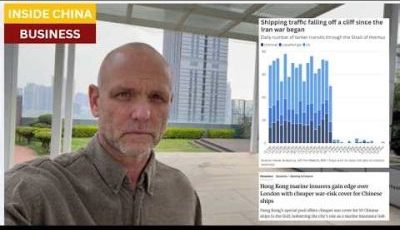
More Iran War fallout: Maritime insurance industry shifts from London to China
or go to
Aletho News Archives – Video-Images
From the Archives
Allies Don’t Need Lobbies
By Jay Knott | Dissident Voice | September 24, 2013
In a recent article on Counterpunch, Rob Urie defended the traditional Marxist analysis of US policy in the Middle East. He argues that support for Israel is driven primarily by economic interest, not the Jewish lobby.
He starts by paying tribute to the idea that Western societies are uniquely racist. He says that the “Western narrative” claims there is an “Arab character”, and that this is “antique racist blather”. He gives no definition of these terms. Further, he establishes his credentials as part of the dominant current in the American left by claiming that “over a million people in Iraq died so ‘we’ in the West can drive SUVs.”1
When he tries to criticize bourgeois economics, he makes it clear he doesn’t understand the developments it has made since Marx’s day, using the mathematical discipline known as “game theory”. He dismisses the basic abstraction of economic theory, the idea of the rational individual, on the grounds that it is “devoid of history, culture and political context”. But abstractions are always devoid of something.
He defends a more concrete economic theory, mostly Marxist, with some input from another theorist of capitalist crisis, Hyman Minsky. This concrete theory leads him to the view that US activity in the Middle East is primarily driven by rational capitalist motives, the need to secure a supply of oil.
“Taking the totality of circumstance — former oil company executives launching war on an oil rich nation on a pretext they publicly proclaimed they didn’t believe shortly before taking office — and that upon launching their war proved to be non-existent, requires a willingness to overlook the obvious — that the war on Iraq was for oil, that is difficult to support.”1
Perhaps I’ve misunderstood him, but based on what he says in the rest of the article, this convoluted sentence seems to argue that, because president Bush and vice-president Cheney attacked Iraq on false premises, and they also said it was all about oil, and they are former oil executives, and Iraq has a lot of oil, it’s difficult to deny US attacks on Iraq are all about oil.
In fact, it’s not hard at all. As Urie points out, at times Bush and co. said that attacking Iraq was “protecting the world’s supply of oil.”1 But, as he also points out, they are congenital liars. Why should we believe them when they say they are trying to “protect” the oil supply? Protect it against what? When politicians “admit” attacks on Middle Eastern countries are wars for oil, they are parroting the neo-con party line, feeding the public, both left and right, with a plausible-sounding pretext. For right-wingers, “it’s a war for oil” is a reason to support war, and for leftists, it’s a way to feel better by complaining impotently about corporate greed. Both approaches help the war drive. … continue
Blog Roll
 Aletho News
- More Iran War fallout: Maritime insurance industry shifts from London to China
- US-Israeli aggression on Iran triggers review of GCC countries’ investment pledges to Washington
- Russia slams UK plan to seize tankers suspected of carrying its oil
- Pakistan ramps up food exports to Persian Gulf nations as war deepens food insecurity
- Iran submits response to US plan, sets terms for war’s end: Tasnim
- US vs Iran: Kharg Island Talk — Bluff or Escalation? Ex-Military Officer Weighs In
- Zelensky unnecessarily involves Ukraine in the Middle East crisis
- Turkish tanker blacklisted by Ukraine hit in drone attack – media
- Canada, the U.S., and NATO: the inescapable trap
- Villains of Judea: Leonid Radvinsky
- If Americans Knew
- ‘No Innocent Children’: Far-right Israeli Lawmaker Defends Killing of Palestinian Family
- Mossad’s promises helped Netanyahu convince Trump that Iran could be toppled
- US Arms Control Official Refuses To Comment When Asked If Israel Has Nuclear Weapons
- Veterans warn US landing could be ‘more Gallipoli than Vietnam’
- Israel may be committing war crimes in Lebanon – Not a ceasefire Day 167
- In the West Bank, life is a constant battle – 3 articles
- Jacob Reses, one of the most powerful pro-Israel operatives in Trump’s Washington
- Israeli-US assaults kill or injure 87 children a day – Not a ceasefire Day 166
- ‘Forever live by the sword’: Understanding Israelis’ massive support for Iran war
- UN’s special rapporteur on human rights says Israel is systematically torturing Palestinians
- No Tricks Zone
- Devastating Assessment Of Comirnaty Vaccine By Former Senior Pfizer Europe Toxicologist
- New Study: CO2 Is ‘Effectively Negligible’ As An Explanatory Climate Change Factor Since 2000
- Former Pfizer Toxicologist Dr. Helmut Sterz Tells Bundestag Hearing Pfizer Vaccine Should Have Never Been Approved
- Energy Expert: Germany’s Nuclear Phaseout Was A “500 Billion Euro Mistake”
- New Research: South Australia’s Mid-Holocene Sea Surface Temperatures Were 4°C Warmer Than Today
- Storing Green Energy To Last Germany 10 Days Would Require A 60-Million Tonne Battery
- New Studies: UK Sea Levels Were 4 Meters Higher Than Today During The Mid-Holocene
- Destructive Green New Deal: German Energy And Metal Group Warns Of Drastic Crisis
- New Study Documents A 20-Year Pause In Arctic Sea Ice Decline – Driven By Internal Variability
- Wake-up Call: Survey Shows Majority Of Germans Now Favor Postponing Climate Targets!
 Aletho News