Europe’s Downfall
Col. Jacques Baud & Prof. Glenn Diesen
Glenn Diesen | April 27, 2025
Colonel Jacques Baud is a former military intelligence analyst in the Swiss Army and the author of many books. Colonel Baud argues that Europe no longer has a strategy in terms of grand objectives to achieve that correspond with its means. Europe is without direction, which results in destructive policies, self-harm, fragmentation, and eventually its downfall.
Trump made no overtures to Russia over Europe’s largest nuclear plant – Lavrov
RT | April 27, 2025
The US has made no offer to Russia regarding the future of the Zaporozhye Nuclear Power Plant, Russian Foreign Minister Sergey Lavrov has told CBS. The diplomat’s remarks followed media reports about Washington’s alleged plans vis-a-vis the installation.
The energy facility, which is Europe’s largest nuclear power plant, has been under Russian control since March 2022. Later that year, Zaporozhye Region’s residents voted to join Russia in a referendum, which Ukraine dismissed as a sham.
When asked during an interview with CBS on Sunday whether US President Donald Trump had approached Moscow over the Zaporozhye Nuclear Power Plant, Lavrov said that “we never received such an offer.” He added that “if we do, we would explain that the power station… is run by the Russian Federation state corporation called Rosatom.”
“It is in very good hands,” the diplomat added, noting that the facility is “being monitored by IAEA personnel permanently stationed at the site.”
“If not for the Ukrainian regular attempts to attack the power plant, and to create a nuclear disaster for Europe and for Ukraine as well, the safety requirements are fully implemented,” Lavrov asserted.
Moscow ready to seek ‘balance of interests’ with Ukraine and US — LavrovREAD MORE: Moscow ready to seek ‘balance of interests’ with Ukraine and US — Lavrov
When further pressed on the issue, the minister reiterated that “I don’t think any change [to the facility’s status] is conceivable.”
“We cannot speculate on something which is really not being mentioned during the negotiations,” he concluded.
On Tuesday, Axios, citing unnamed sources with direct knowledge of the discussions, reported that American officials had presented Kiev’s representatives with President Trump’s “final offer” to end the Ukraine conflict during talks in Paris last week.
According to the outlet, the proposal includes designating the area around the Zaporozhye Nuclear Power Plant as neutral territory under US administration.
Last Sunday, the Wall Street Journal carried a similar report, citing anonymous sources.
In March, Trump claimed that Vladimir Zelensky had proposed that the US assume ownership of his country’s nuclear power plants. The Ukrainian leader, however, refuted this assertion, stating that he and Trump had only discussed potential US investments in the Zaporozhye NPP.
Lavrov discusses Ukraine concessions, Crimea, Trump and nuclear weapons
RT | April 27, 2025
In an interview with CBS, Russian Foreign Minister Sergey Lavrov has rebuked the network for suggesting Moscow is not ready to make concessions to end the Ukraine conflict. He stressed that Russia is committed to seeking a “balance of interests” with the US and Ukraine. Lavrov added that Russia is always ready for “serious and respectful” negotiations, unlike Kiev, which he accused of “talking through the media.”
The top diplomat said talks with Washington are “moving in the right direction” because US president Donald Trump had recognized NATO’s mistakes and the violation of Russian rights in Ukraine.
He welcomed Trump’s ceasefire plan but demanded firm guarantees Ukraine would not use it to rebuild its military.
Responding to US accusations that Moscow has space-based weapons, Lavrov rejected the claims as false. He said that Russia has long promoted a UN treaty to ban nuclear weapons in outer space, which the US has refused to support.
Lavrov called Crimea being part of Russia a “done deal” and praised Trump for acknowledging it.
Here is the CBS interview in full:
Question: Good morning, Minister Lavrov. I want to ask you about what happened in Kiev. There was a large Russian attack on that capital city about 1 o’clock in the morning. President Trump has said publicly the Russian strikes are not necessary and very bad timing. “Vladimir, stop”, was his quote. What made it worth killing civilians when Ukraine says it’s ready for a ceasefire?
Sergey Lavrov: We only target military goals or civilian sites used by the military. President Putin expressed this for so many times, and this is not different this time as well. We never consciously target civilian sites, unlike the Zelensky regime.
Question: So was this an intentional attack then, not a mistake?
Sergey Lavrov: If this was a target used by the Ukrainian military, the Ministry of Defense, the commanders in the field have the right to attack them.
Question: So just to be clear, when the President of the United States says, “Vladimir, stop,” is this a rejection of that request, or was the assessment that because of what you say regarding the concerns that this loss of civilian life made it worth it?
Sergey Lavrov: Well, I can assure you that the target attacked was not something absolutely civilian like a TV center in Belgrade in 1999. This was an intentional attack against civilian target.
In our case, we only target those sites which are used by the military. And regarding the ceasefire and regarding the call to stop, President Putin immediately supported President Trump’s proposal a few weeks ago to establish a 30-day ceasefire provided we do not repeat mistakes of the last 10 years when deals were signed, and then Ukraine would violate those deals with the support and with encouragement from Biden administration and from European countries.
This was the fate of the deal of February 2014. Then this was the fate of the Minsk agreements, and this was the fate of the deal reached on the basis of Ukrainian proposals in Istanbul in April 2022.
So President Putin said, “Ceasefire, yes, but we want the guarantees that the ceasefire would not be used again to beef up Ukrainian military, and that the supplies of arms should stop.”
Question: Ukraine accepted on March 11th that idea of a US-brokered ceasefire without preconditions. You’re saying the preconditions are a negotiation to end something else?
Sergey Lavrov: No, it is not a precondition. It’s the lessons learned after at least three times. The deals, similar to the one which we are discussing now, were broken by the Ukrainian regime with the strong support from European capitals and Biden administration.
If you want a ceasefire just to continue supply arms to Ukraine, so what is your purpose? You know what Kaja Kallas and Mark Rutte said about the ceasefire and the settlement? They bluntly stated that they can support only the deal which at the end of the day will make Ukraine stronger, would make Ukraine a victor. So if this is the purpose of the ceasefire, I don’t think this is what President Trump wants. This is what Europeans, together with Zelensky, want to make out of President Trump’s initiative.
Question: Will Russia continue targeting Kiev despite President Trump saying, “Vladimir, stop?”
Sergey Lavrov: You’re not listening to me. We will continue to target the sites used by the military of Ukraine by some mercenaries from foreign countries and by instructors whom the Europeans officially sent to help target Russian civilian sites.
If you take a look at the situation in the Kursk region of Russia, for example, there is no single military target for the last six months which the Ukrainians would fire at.
And there was also a proposal by President Trump immediately supported by President Putin to have a one-month moratorium on the attacks on energy infrastructure. We never violated this commitment of President Putin. And Ukrainians violated what Zelensky seemed to support several hundred times. And I sent to Marco Rubio and to the United Nations the list of those attacks. It’s really very, very telling and eloquent.
Question: Ukraine disputes that, but putting that aside, I want to ask you about what President Trump said on Wednesday. The President of the United States says he thinks the US and Russia have a deal, let’s get it done. Does President Putin agree?
Sergey Lavrov: Well, the President of the United States believes, and I think rightly so, that we are moving in the right direction. The statement by the President mentions a deal, and we are ready to reach a deal, but there are still some specific points, elements of this deal which need to be fine-tuned, and we are busy with this exact process. And the President of the United States did not spell out the elements of the deal, so it is not appropriate for me to do this.
Question: But he did say there was a deal, and that he was sending his envoy, Steve Witkoff, to meet with Vladimir Putin Friday in Russia. Is that meeting still happening, and should we expect a deal this week?
Sergey Lavrov: Well, you don’t trust the word of the President of the United States?
Question: I was asking your President’s word. What will he tell the US envoy?
Sergey Lavrov: We continue our contacts with the American side on the situation in Ukraine. There are several signs that we are moving in the right direction, first of all, because President Trump is probably the only leader on Earth who recognized the need to address the root causes of this situation. When he said that it was a huge mistake to pull Ukraine into NATO, and this was a mistake by the Biden administration, and he wants to rectify this.
And Marco Rubio expressed yesterday, I think, also the assessment that the American team now is getting a better understanding of the Russian position and of the root causes of this situation. One of these root causes, apart from NATO and creation of direct military threats to Russia just on our borders, another one is the rights of the national minorities in Ukraine. Everything Russian, media, education, culture, anything was prohibited by law in Ukraine. And to get out of this crisis, you cannot just forget about human rights.
Whenever we discuss Iran, Venezuela, North Korea, anything, American negotiators put on top human rights. They have claims in this regard to China, to us, to anybody. But whenever Europeans and other Western nations speak about Ukraine, nobody can mumble the words human rights. Just nobody.
On the contrary, what Ursula von der Leyen and other people in Brussels and in Europe say that Ukraine is defending the European values. So one of these values is cancelling the Russian language. Imagine if Israel cancelled Arabic language in Palestine. Just imagine.
Question: You mentioned that the US and Russia need to work on some of these fine points of a deal.
Sergey Lavrov: Yeah, you want the fine points to be spelled out?
Question: Well, of course, I’d love that, but this is not the way. European sources say that the US proposal is really just kind of a list of bullet points. Does Russia have details, the details you need at this point?
Sergey Lavrov: Look, we are really polite people. And unlike some others, we never discuss in public what is being discussed in negotiations. Otherwise, negotiations are not serious.
To ask for somebody’s opinion regarding the substance, go to Zelensky. He is happy to talk to anybody through media, even to President Trump. He presents his claims.
We are serious. We are serious people. And we consider serious proposals. We make serious proposals. And this is a process which is not supposed to be public until the end of it.
Question: OK. So no deal is imminent?
Sergey Lavrov: I didn’t say this. Now I understand, by the way, why you wanted to get brief answers to your questions. You want some slogans to be in the broadcast.
Question: No, the President of the United States said there was a deal with Russia. So I wanted to ask Russia if there is a deal with the United States.
Sergey Lavrov: Well, we made our comments on this statement. The negotiations continue. And until the end of the negotiations, we cannot disclose what it is about.
Question: OK. The National Security Advisor Mike Walz said last month that President Trump is asking for thousands of Ukrainian children who were taken into Russia to be released now as part of what he called “confidence building measures.” What steps has Russia taken to meet Mr. Trump’s request?
Sergey Lavrov: Look, long before the request coming from Washington, we have been addressing the issue of the fate of the kids who during the conflict found themselves outside their homes, outside their families. Most of these kids were attending orphanage. And as soon as and we announce whatever details we have about those kids, and as soon as relevance, I mean, the parents or other relevant relatives make themselves available, they are getting the kids back. This has been the process for the last almost three years between the ombudsmen of Russia and Ukraine.
Question: So there’s no new release of thousands of Ukrainian children at the request of President Trump?
Sergey Lavrov: No, there was nobody. Nobody knows why some experts advised the President about thousands of Ukrainian children.
Every now and then, once in two or three months, we organize exchanges with Ukrainians with the help of Qatar, Saudi Arabia, United Arab Emirates, who do not, you know, make any noise about what they’re doing. They just do something which we are participating in a very constructive manner, bringing kids back to their parents or relatives.
Question: But what “confidence building measures” can Russia offer now, particularly after this strike in Kiev, where the President of the United States is saying, “Vladimir, stop.” How do you convince the United States that Russia is actually serious about peace?
Sergey Lavrov: Well, “confidence building measures” have been plentiful in the last 10 years. I mentioned a deal in February…
Question: That strike was overnight.
Sergey Lavrov: You want a brief answer, right? As I understand from your initial words, or you want an answer which is explaining the situation?
The proposal by President Trump on 30 days moratorium on the strikes against the energy infrastructure was supported by President Putin and observed strictly. This was a confidence building measure against the policy and action taken by the Zelensky regime. As I said several hundred times civilian energy infrastructure was struck.
Another confidence building measure was the proposal of President Trump and his team to resume the deal on Black Sea. And the delegations met in Istanbul, in Riyadh. The delegations exchanged the views how this can be implemented in practical terms. And the proposals made by Russia are being considered by the United States. There are many other examples about confidence building measure.
But if you believe that it’s only Ukraine who is interested in confidence building, I think a short answer would be this is an illusion.
Question: Do you take President Trump at his word when he says if Russia is unable to make a deal on ending the bloodshed in Ukraine, he’ll put secondary tariffs I think you mean sanctions there on oil coming out of Russia. Or do you think that at this point, the relationship between Russia and America has been rebuilt and that won’t happen?
Sergey Lavrov: Well, I cannot comment on what you think President Trump meant when he said something.
Question: What do you think he meant when he said secondary tariffs on oil coming out of Russia?
Sergey Lavrov: Well, we hear many things coming from President Trump. President Trump said that he’s sick and tired of the situation in this settlement, especially yesterday when he commented the statements by Zelensky. And President Trump has his own proposals and has his own style in mentioning those proposals in his public speeches.
We concentrate, as I said, on the real negotiations which President Trump supports and instructed his people to continue to engage in these negotiations. I’m sorry, the answer was a bit longish, but it’s difficult to explain otherwise.
Question: So I asked about the threat of sanctions or secondary tariffs, because you recently said in an interview, if you had to personally pick sides, you would keep the existing sanctions in place on Russia. You said you’ve restructured the economy to be self-sufficient. And there is a growing fear that, quote, cunning Americans will lift sanctions all of a sudden to flood our market with services and technologies. So if that’s the case, why should the United States consider lifting sanctions at all?
Sergey Lavrov: Why do you ask me? You just quoted my statement, and this statement is clear for me and clear to all those who read it. If you have questions to the American side, how they treat the situation, it is not the right address to raise it with me.
Question: So you want to keep sanctions in place. Is that really the Russian position?
Sergey Lavrov: I don’t want to re-explain what I explained, I think, in quite a clear manner. And you quoted, I think, very close to the real content. Yeah, but it was a bit longer than normally you prefer, I know.
Question: Well, back in February. Though one of your colleagues, Kirill Dmitriev, who runs the Sovereign Wealth Fund and has been active in the diplomacy with the United States, said something a bit different. That’s why I’m asking for clarification, because he said there is the expectation that American companies would return to the Russian market in the second half of 2025.
Sergey Lavrov: Well, the president of Russia commented upon this situation. He said that we have nothing against American companies, but those companies who decided to leave their business in Russia might find that their place has been occupied already by Russian or other foreign investors. And in this case, we would not make any decisions which would discriminate those who came to invest in Russia instead of Americans. If American companies would like to come to a place which is not yet occupied, if they want to propose a project, a new project on top of the previous business ties, of course, we will look into this. And if we find balance of our interests, I think it would be only natural to get into business together.
Question: Well, what areas has the US offered to lift sanctions on? Because it wouldn’t be possible for many American companies to enter the Russian market right now under the existing sanctions.
Sergey Lavrov: It is up to them to decide.
Question: So no offer has been made?
Sergey Lavrov: No. How can we offer something? In a situation when…
Well, the United States clearly tells us that they are interested in doing business together. We never reject business proposals provided they are based on the equal opportunities and the treatment of each other and lead to a balance of interest.
Specific proposals which are being mentioned in the media, I cannot comment upon. This is not serious. We are not acting like the people in Kiev who talk to the world through the media, including talking to presidents of great countries.
Question: So if I understand you correctly, you neither fear sanctions nor want them lifted?
Sergey Lavrov: Look, you quoted my statement and you quoted it right. That’s my position.
Question: Okay. So when President Trump threatens new sanctions, that’s not a concern?
Sergey Lavrov: You’re asking this for the third time. This was a brief answer, by the way.
Question: You are being brief and direct on that part. I was asking on the sanctions for clarity and directness. Broadly speaking, when you look at what’s happening in the battle space in Ukraine right now, analysts say about 18% of Ukrainian territory is under the control of Russian forces. US intelligence says battlefield trends are in Russia’s favour. So if that’s the case, why should the US believe Russia is serious about ending the war if everything is in your favour?
Sergey Lavrov: Well, we judge by the reaction of our American colleagues to what we tell them. And this is being done during negotiations. They are confidential, as any serious negotiation. And they know our position. And as I quoted Marco Rubio, he publicly said that now they better understand the Russian position and the reasons for what is going on. And he said that nobody in Washington lifted a finger to do the same to try to understand Russia during the Biden administration.
And this implies that the dialogue continues, that the dialogue is supported by the United States, and I reiterate that it is supported by the Russian Federation, and this dialogue continues.
Question: So President Trump said he expects to meet soon with Vladimir Putin. What’s an acceptable time and location? Why should they meet?
Sergey Lavrov: Look, the presidents are masters of their own destiny and of their own schedule.
I heard President Trump say that he is planning to be somewhere mid-May, and that after that he would be suggesting some dates. I cannot add anything else.
Question: Right, he said he was asked about meeting with Vladimir Putin specifically in Saudi Arabia, and he said most likely not. That’s in mid-May, but shortly thereafter.
Sergey Lavrov: You said the same thing as I did.
Question: Right.
Sergey Lavrov: So we read the same newspapers and watch the same channels on TV.
Question: Right, but I can’t pick up the phone and call Marco Rubio, the Secretary of State, like you can. What plans are you making for the two to meet?
Sergey Lavrov: Look, I hope your listeners understand very well that it is not ethical for a foreign minister to prejudge, to presume what presidents might or might not discuss.
Question: But you think it would be good for the two leaders to meet soon? Do you expect that Rubio and Witkoff is negotiated?
Sergey Lavrov: We’re always in favor of meeting with people who are ready for a dialogue. President Putin repeated this thousands of times.
When we met in Riyadh, together with President Putin’s Foreign Policy Advisor Yury Ushakov, with Marco Rubio and Mike Waltz, the American colleagues clearly stated that the US policy is based firmly on US national interests. They understand that the Russian policy led by President Putin is also based on Russian national interests, and that it is the responsibility of great powers to make sure that whenever those national interests do not coincide, and this is in most of the cases, this difference should not be allowed to degenerate into confrontation. And that’s what dialogue is for.
But they also added that when the national interests of two countries or more countries coincide, it would be stupid to miss an opportunity to translate this coincidence into some material mutually beneficial projects. This is absolutely our position.
Question: You know that President Trump is coming up on 100 days in office, and he has made clear his patience is wearing thin with the diplomacy here. Do you expect the US and Russia to continue to talk after these potential peace talks fall apart? I mean, is the rebuilding of the relationship so significant now that you think it could withstand the peace talks in Ukraine falling apart?
Sergey Lavrov: First, Russia is always available for a dialogue. So you have to address the question to the American side. Second, you prejudge the current process by saying that eventual collapse of the talks.
We concentrate on doing business, not on thinking, you know, about failures or victories, about anything. Unless you concentrate on the facts, that’s what we do. You cannot be serious about what you are doing.
Question: Well, President Trump and Secretary Rubio said that the window was closing, that time is running out here. That’s not my opinion. That’s what they said.
Sergey Lavrov: No, wait a second. I just quoted Marco Rubio, who yesterday said about better understanding of the Russian position. So maybe you missed that. Question: Well, he also said a decision in days needed to be made and that the US has other things to focus on.
Sergey Lavrov: No. We understand the impatience. Because in American culture, you create expectations, and you ignite tension around those expectations. This does not help to do real politic.
But in our case, as I said, we are always ready for dialogue, ready for negotiations, and we would not, you know, begin by banking on a failure. This would be a characteristic of bad dealmakers, inexperienced dealmakers.
Question: Others in the Russian government have proposed that the US and Russia could work together in the Arctic. Are there specific areas of discussion for cooperating right now?
Sergey Lavrov: You always want me to disclose things which might be discussed by respective officials of Russia and the United States, by those who are responsible for trade, economic cooperation, investments, and so on and so forth.
How do you expect a participant of negotiations, which are still to reach some kind of specific understanding, to disclose details in public? It is not serious.
Yeah, I read President Trump’s book, “The Art to Make a Deal,” and he doesn’t advise to disclose information before it’s time.
Question: Respectfully, President Trump speaks quite a lot about the things he would like to do with Russia and opportunities to work together. I understand you don’t want to. On the specific things President Trump has said in public, one of the things he brought up is that the US could work with Ukraine to operate the largest nuclear power plant in Europe, which is in an area you know, Zaporozhye. Russians control that area right now. Do you agree with President Trump’s public statements that the best security would be for the US and Ukraine to operate that together?
Sergey Lavrov: No, we never received such an offer, and if we do, we would explain that the power station, Zaporozhskaya Nuclear Power Station, is run by the Russian Federation state corporation called Rosatom. It is being under monitoring of the IAEA personnel permanently located on the site, and if not for the Ukrainian regular attempts to attack the station and to create a nuclear disaster for Europe and for Ukraine, as well, the safety requirements are fully implemented. It is in very good hands.
Question: So that’s a no?
Sergey Lavrov: No. I don’t think any change is conceivable.
Question: Okay, because that was in a public statement from the White House to the media.
Sergey Lavrov: We, as I said, we did not receive any proposal which would be specific, so, you know, I understand that journalists have to speculate. We cannot speculate on something which is really not being mentioned during the negotiations.
Question: Zaporozhskaya station is not being negotiated right now?
Sergey Lavrov: Shall I say that for the third time? You wanted me to be brief.
Question: I heard you, but I just want to be abundantly clear because that is also widely reported to be in the US proposal currently on the table.
Sergey Lavrov: Why don’t you ask me about President Trump’s position on Crimea?
Question: You liked what President Trump said about Crimea yesterday when he said that it has been under Russian control.
Sergey Lavrov: It’s not about liking or disliking. It’s about the fact that he said the truth, and when Zelensky said that this is absolutely excluded because Crimea is part of Ukraine according to the constitution, nobody in Europe or in the States, by the way, reminded him that apart from territorial issues, the Ukrainian Constitution guarantees, I quote, “the free development, the use and protection of the Russian and other national minorities’ language in Ukraine,” and they guarantee the development of ethnic, cultural, language, and religious identity of all peoples and national minorities in Ukraine. This is also in the constitution, but as I mentioned already, and you decided not to go deeper into this topic, nobody in the West even mentions human rights when they demand that “Ukraine defeat Russia in the battlefield.“
Question: President Trump said Crimea is not even being discussed right now.
Sergey Lavrov: Yes, because this is a done deal.
Question: You mean Russia occupies and controls and will not negotiate the future of Crimea? Is that what you’re saying?
Sergey Lavrov: Russia do not negotiate its own territory. And President Trump understands this.
Question: One specific thing that you do want in the public space, you said everything else that I’ve asked you about in the US proposal is too sensitive to discuss. Is there any other part of the US proposal that you do like?
Sergey Lavrov: No, no, no. I only commented what was said publicly. And I also said that normal negotiators, I emphasize this once again, normal negotiators do not negotiate by throwing a microphone. They meet and they discuss, they listen to each other, they try to understand, they try to see where a balance of interest can be reached, and this is how our contacts with the American representatives are organized.
Question: Respectfully, you’ve been in the top levels of Russian diplomacy for 30 years…
Sergey Lavrov: For how many?
Question: For at least 30 years. I mean, you’ve been in very key diplomatic roles within the top of the Russian diplomatic system for a very, very long time. I don’t think any part of this is typical or normal, to use the words you used. Steve Witkoff is the envoy. Kirill Dmitriev is Vladimir Putin’s envoy here. Do you think it’s unfortunate that the international system of diplomacy isn’t being used more and that it’s this kind of one-on-one personal envoy structure?
Sergey Lavrov: You did not express your disappointment that the international system of diplomacy was not used for the entire duration of the Biden administration. You did not mention that Europeans are really very nervous that they’re being marginalized. But I can quote a lot of what Europeans stated. I mentioned already Kaja Kallas and Ursula von der Leyen, who said, “Any deal must make sure that Ukraine is stronger and that Ukraine is on top of Russia.”
Look, do you need negotiators who believe in this kind of logic and who don’t want to look for honest balance of interest? The Trump administration is interested in searching for a balance of interest. They sincerely want to understand better the Russian position. And they’re getting this understanding. And we understand better the American position through negotiations and meetings and discussions, which we have with them.
Question: Back in January, Russia signed a deal with Iran to become a strategic partner. Would Russia be willing to sever that relationship at the request of the US if it meant better relations with America?
Sergey Lavrov: There was never any request like this. And we welcome the process which was initiated between the United States and Iran. We are ready to be helpful if parties believe this can be the case. And they know this.
Question: You were the negotiator back in 2015 on behalf of Russia for that landmark international agreement, the JCPOA. And part of how Russia was helpful was destroying Iran’s enriched nuclear material. Is that an offer you would do again?
Sergey Lavrov: We were not involved in destroying Iran’s nuclear material.
Question: Disposing.
Sergey Lavrov: Part of the deal was to move some amount of this material to Russia for keeping.
Question: Okay. So not destroying, but keeping. Would you keep Iran’s enriched nuclear material that they’ve made?
Sergey Lavrov: Look, I said, “We are not putting our nose in the negotiations between the two countries, one of which is not Russia.” And I said very clearly, I believe, but you wanted a brief answer, I will have to be longer, since it is not probably getting through.
We welcome the dialogue between the US and Iran. We would be certainly ready to help if both parties believe this is going to be useful. And they know that we are ready.
Question: Well, back then, there were sanctions and pressure at the UN. It’s a very different dynamic now. I want to ask you quickly about nuclear weapons, because Russia is such a nuclear powerhouse. According to US intelligence, Russia is developing a new satellite meant to carry a nuclear weapon, which would knock out other satellites and devastate the U.S. if it’s used. That’s in publicly published material. Does Russia intend to violate past treaties and actually put a nuclear weapon in space?
Sergey Lavrov: Well, before asking this question, you have to check whether this is true or not, what your military, US intelligence says…
I was listening to President Trump about his views of what is the list of achievements of US intelligence. And I have my own facts on which I rely.
We have been promoting for many years in the United Nations a resolution prohibiting putting any nuclear weapons into outer space. The country which is categorically against it is the United States. At the same time, the United States promotes an approach according to which they want to prohibit putting conventional weapons in outer space. And they cannot answer the question, “Does this mean that nuclear weapons, they would be planning to move to the orbit?”
So my answer is very clear. We have been championing in the United Nations a legal prohibition of placing any nuclear weapons in outer space. And the United States, at least during the Biden administration, this was the case, they were categorically against it.
Question: It was the Trump administration’s intelligence community that published those findings just a few weeks ago. Are you saying the Trump administration’s intelligence community findings are incorrect in regard to Russia developing a new satellite meant to carry a nuclear weapon?
Sergey Lavrov: We denied those allegations. We, once again, cannot help repeating, have been promoting for years in the United Nations a treaty, not a declaration, a treaty prohibiting placing weapons in outer space. And the United States is against it. I cannot comment about the validity of the intelligence reports, as I told you. We never received any facts which would confirm the allegations.
Question: Do you have any interest in arms-control talks with the United States, with the Trump administration?
Sergey Lavrov: It was the United States which broke the process of strengthening strategic stability. And if the United States is willing to get back to this track, we will see what are the conditions under which this might be possible. As long as in the U.S. doctrinal documents, we are described as adversary, when the officials in Washington called some time ago, called us enemy.
So we want to understand what Washington thinks of our relationship and whether Washington is ready for, I would emphasize once again, an equal, mutually respectful dialogue heading to finding a balance of interest. If this is the approach, everything is possible.
Question: Minister, we are coming up on time, but just before I let you go from everything you laid out, I haven’t heard from you that Russia is willing to make any concession on anything to date.
Sergey Lavrov: No, my brief answer is you are wrong.
I have been emphasizing repeatedly in relation to Ukraine, in relation to strategic relations with the United States, I have been emphasizing our readiness to seek balance of interests. If this is not what your station considers readiness for negotiations, then I don’t know how to be even less eloquent in trying to be brief in my answers.
Question: Well, there have been very clear, specific things said by the Trump administration, such as the vice president saying that the current lines of contact in Ukraine would freeze and end up fairly close to where troops are right now. Do you actually consider that a concession?
Sergey Lavrov: I don’t discuss publicly the details of what is being subject of negotiations. I understand that you love rumors because rumors are played around…
Question: The vice president of the United States said it on camera.
Sergey Lavrov: Was it a question? What did you say?
Question: Well, rumor. Rumor. You said it was a rumor. The vice president said it.
Sergey Lavrov: No, I said about us. We are not discussing things which are subject to negotiations.
Question: Okay. Minister Lavrov, thank you for your time.
New sanctions on Russia would mean two more years of war – Rubio
RT | April 27, 2025
The US administration has abstained from imposing new sanctions on Russia over the Ukraine conflict, believing such a move would jeopardize negotiations and prolong hostilities, US Secretary of State Marco Rubio has said.
Speaking to NBC News’ Meet the Press on Sunday, Rubio questioned the usefulness of placing new restrictions on Moscow, stating Washington was “hoping to see” whether the diplomacy would work first.
“The minute you start doing that kind of stuff, you’re walking away from it, you’ve now doomed yourself to another two years of war and we don’t want to see it happen,” the top diplomat said.
Rubio claimed that the US is the only country or institution speaking to both Kiev and Moscow, and only US President Donald Trump has the potential to bring the warring sides to the negotiating table.
The upcoming week is expected to be “very critical” for the White House with regard to the talks, as the administration is trying to make a “determination about whether this is an endeavor that we want to continue to be involved in.” While Washington does not want to walk away, it does not want to “spend time on something that’s not going to get us there” either, the secretary explained.
“There are reasons to be optimistic, but there are reasons to be realistic. We’re close, but we’re not close enough,” he said.
The remarks from the US secretary of state come a day after Trump threatened Moscow with new sanctions over the conflict, accusing Russia’s leadership of trying to drag out hostilities and of “shooting missiles” into Ukraine for “no reason” over the past few days. Moscow maintains it only targets facilities and infrastructure used by Kiev’s military, and has repeatedly denied accusations of staging indiscriminate strikes on civilian areas.
Trump’s threats came as Moscow once again reiterated its readiness for discussions with Kiev without preconditions. Kremlin spokesman Dmitry Peskov confirmed the topic was brought up by Russian President Vladimir Putin during a meeting with Trump’s special envoy Steve Witkoff in Moscow on Friday.
Ukraine’s leader, Vladimir Zelensky, explicitly banned negotiations with Russia for as long as Putin is in charge back in October 2022. Since then, he has seemingly softened his position, claiming the negotiating ban concerned everyone in the country but himself. Most recently, Kiev has demanded an unconditional ceasefire before any direct talks can happen.
Russia’s Unconditional Talks Offer Exposes Zelensky’s Diplomatic Machinations — Ex-Pentagon Analyst
Sputnik – 26.04.2025
The Kremlin has again reiterated Russia’s readiness for peace negotiations with Ukraine to US special envoy Steve Witkoff.
“The unconditional nature offered by Russia is smart, and it places the onus on Zelensky to come forward similarly — but because Zelensky cannot do this and remain in power, he increasingly appears weak and not interested in peace,” Lt. Col. Karen Kwiatkowski, retired US Air Force, told Sputnik.
“If this continues, US aid to Ukraine will dry up completely, including intelligence support — and Zelensky understands this, but politically he is in a vise. Because not to engage directly in the face of an unconditional peace talk is to sabotage the chance of peace for Ukraine,” Kwiatkowski said.
Zelensky has previously stated that Ukraine will not engage in peace talks unless a ceasefire deal is first reached.
“The Ukrainian conditions are unrealistic given the balance of power between Russia and the NATO alliance over the case of Ukraine. But to save face among the remaining few Ukrainians who trust Zelensky and Zelensky’s own government backers who are driven by emotion rather than reality, to talk peace unconditionally is in fact very similar to an unconditional surrender,” Kwiatkowski added.
Trump’s Opposition Is Trying to Turn Back the Wheel of History
By Veniamin Popov – New Eastern Outlook – April 25, 2025
In the American and broader Western press, as well as in select media outlets from certain Global South countries, a vigorous campaign is underway to paint Donald Trump as the embodiment of universal evil. Critics claim his policies are shaking the global economy, undermining long-standing alliances, and creating an atmosphere of chaos.
U.S. newspapers aligned with the Democrats have published numerous articles on how to resist the president. For instance, an April 15 piece in the New York Times portrays Trump’s America as a “rogue state led by an impulsive authoritarian leader detached from the rule of law and other constitutional American principles and values.”
Globalist supporters are uniting in their efforts to argue that all of Trump’s actions are clumsy, shortsighted, and counterproductive. Notably, current Western European leaders—seeing the U.S. president’s policies as a threat to their own standing—are trying to align with Democratic Party loyalists, especially in states where the Democrats hold a majority. Meanwhile, discontent is being deliberately stoked within the U.S. itself, as seen in ongoing protests against Trump’s key ally, Elon Musk, and his company Tesla.
Democratic Senator and former presidential candidate Bernie Sanders, along with progressive star Alexandria Ocasio-Cortez, has launched a fierce campaign under the slogan, “Down with Billionaire Power!” Recently, Trump’s opponents dusted off Joe Biden, who, for the first time in three months, sharply criticized the current administration, accusing it of “causing enormous damage to America.” At its core, Trump’s controversial yet revolutionary reforms reflect an objective need for long-overdue changes in American politics and economics.
Growing Divisions in the West
The U.S. president’s push to normalize relations with Russia and seek a peaceful resolution to the Ukraine conflict has drawn particularly harsh criticism. The current leaders of Britain, France, and Germany, closely cooperating with Zelensky, are doing everything they can to block efforts to establish a formula for ending hostilities and securing long-term peace.
These leaders understand that a peaceful settlement could cost them their positions, as the public would realize the failure of their “fight to the last Ukrainian” policy and the dishonesty of their claims that Putin’s Russia poses an existential threat.
Trump is by no means a pro-Russian politician—he defends U.S. interests—but he clearly recognizes that Zelensky and Biden bear primary responsibility for the ongoing three-year conflict. However, many of the 47th president’s actions echo 19th-century imperialism. At the same time, he understands that the Eastern European conflict risks a clash between nuclear powers, and in a nuclear war, there are no winners.
Recent polls show that most Americans view Trump’s policies favorably.
As for Russia, the U.S. and Russia no longer have the ideological divide of the Soviet era, and America’s stance on traditional values and achieving peace in Ukraine is closer to Moscow’s than to that of major European leaders and Zelensky. The U.S. cannot win a trade war with China, while Russia could play a key role in mediating agreements between the U.S. and China, as well as the U.S. and Iran. Donald Trump thinks pragmatically, even if some of his actions appear erratic, ill-considered, and counterproductive. Nevertheless, he objectively represents not only the urgent needs of the United States but also the necessity of establishing a new international order—one based on a fairer balance of national interests among different civilizations.
American history has seen many realist thinkers who advised their leaders to act cautiously and consider their opponents’ interests. Hans Morgenthau, the preeminent political scientist of the last century (whose works are still studied in universities), urged the Johnson administration not to escalate the Vietnam War—only to be dismissed in 1965. George Kennan, one of the architects of U.S. policy toward the USSR, warned in 1997 against NATO expansion eastward, arguing it would “provoke Moscow’s militancy.”
No one listened. Similarly, Brent Scowcroft, national security advisor to George H.W. Bush, insisted that invading Iraq would be a grave mistake. Afterward, he was treated as an outsider. We can only hope that Donald Trump’s realism—especially regarding a genuine peace in Ukraine—does not meet the same fate as his three brilliant predecessors. Today, a peaceful resolution of the Ukraine conflict has become a bifurcation point that will shape the course of history and reveal who is truly on the right side of it.
NATO Chief to Lobby Trump Not to Pressure Ukraine to Make Peace with Russia
By Kyle Anzalone | The Libertarian Institute | April 24, 2025
The head of the North Atlantic Alliance is traveling to the US for meetings with top officials in the Donald Trump administration. Secretary General Mark Rutte is expected to push the White House not to force Ukraine into a peace deal with Russia.
According to the Financial Times, “Rutte will urge President Donald Trump’s administration not to force Ukraine to accept a peace deal against its will,” during meetings with embattled Defence Secretary Pete Hegseth, Secretary of State Marco Rubio and National Security Adviser Mike Waltz on Thursday.
Trump and Rubio recently stated that they expect both Russia and Ukraine to quickly move towards a peace agreement. The White House proposed a deal that would require Kiev to recognize Moscow’s permanent control over Ukrainian territory held by the Russian military, including the Crimean Peninsula.
On Wednesday, Trump slammed Ukrainian President Volodymyr Zelensky for rejecting the idea of Ukraine. “This statement is very harmful to the Peace Negotiations with Russia in that Crimea was lost years ago under the auspices of President Barack Hussein Obama, and is not even a point of discussion,” Trump wrote on Truth Social.
“[Zelensky] can have Peace, or, he can fight for another three years before losing the whole Country,” he added. “We are very close to a Deal, but the man with ‘no cards to play’ should now, finally, GET IT DONE,”
A NATO official told FT, “The key message is making the Americans understand what’s at stake.”
Throughout the conflict, Western and NATO leaders have claimed that they are defending the international world order by arming and supporting Ukraine. However, many Western countries, primarily the US, have engaged in a number of unlawful invasions in recent decades. Additionally, NATO states have backed Israel as it conducted a genocide in Gaza.
Trump has not raised the issue of international law, and said his priority is ending the war to stop people from dying.
Rutte is not the only European leader planning to lobby Trump to continue the proxy war against Russia. European Commission President Ursula von der Leyen plans to speak with Trump at Pope Francis’s funeral on Saturday.
Ukraine’s Foreign Minister Andrii Sybiha responded to Trump’s recent peace proposals by saying Kiev cannot make concessions and the US must increase pressure on Russia.
On Thursday, Trump denounced a Russian strike on Kiev. “I am not happy with the Russian strikes on KYIV. Not necessary, and very bad timing,” he wrote on Truth Social. “Vladimir, STOP! 5000 soldiers a week are dying. Lets get the Peace Deal DONE!”
Trump’s Circus in Ukraine – Part 27 of the Anglo-American War on Russia
Tales of the American Empire | April 24, 2025
President Donald Trump entered office in January 2025 with a promise to end the Ukraine war in one day. No one was surprised that he failed, but Trump did shock everyone by ordering the end of American aid to Ukraine. The United States provided most of the military and economic aid that Ukraine needs to continue its losing war with Russia. Within a few weeks, Ukraine would be forced to accept inevitable defeat and begin peace negotiations with Russia. For unknown reasons, Trump quickly resumed aid and began an idiotic effort to convince Russia to accept a ceasefire and stop winning the war so Ukraine’s army can recover as NATO “peacekeepers” deploy to Ukraine. This devolved into a circus.
_____________________________________
Related Tale: The Anglo-American War on Russia – Part Thirteen (Putin’s Special Military Operation);  • The Anglo-American War on Russia – Pa…
Related Tale: The Anglo-American War on Russia – Part Fourteen (Biden Blocks Peace); • The Anglo-American War on Russia – Pa…
“Military Summary” channel; YouTube: / @militarysummary
“Scott Ritter Documented Zelensky’s 6 Residences and Control by UK’s MI6”; Eric Z; The Duran; April 16, 2025; https://theduran.com/scott-ritter-doc…
A ‘Trump deal’? Juggling war, ‘easy war’ and negotiation
By Alastair Crooke | Strategic Culture Foundation | April 24, 2025
Trump clearly is in the midst of an existential conflict. He has a landslide mandate. But is ringed by a resolute domestic enemy front in the form of an ‘industrial concern’ infused with Deep State ideology, centred primarily on preserving U.S. global power (rather than on mending of the economy).
The key MAGA issue however is not foreign policy, but how to structurally re-balance an economic paradigm in danger of an extinction event. Trump has always been clear that this forms his primordial goal. His coalition of supporters are fixed on the need to revive America’s industrial base, so as to provide reasonably well-paid jobs to the MAGA corps.
Trump may for now have a mandate, but extreme danger lurks – not just the Deep State and the Israeli lobby. The Yellen debt bomb is the more existential threat. It threatens Trump’s support in Congress, because the bomb is set to explode shortly before the 2026 midterms. New tariff revenues, DOGE savings, and even the upcoming Gulf shake-down are all centred on getting some sort of fiscal order in place, so that $9 trillion plus of short-term debt – maturing imminently – can be rolled over to the longer term without resort to eye-watering interest rates. It is Yellen-Democrat’s little trip wire for the Trump agenda.
So far, the general context seems plain enough. Yet, on the minutiae of how exactly to re-balance the economy; how to manage the ‘debt bomb’; and how far DOGE should go with its cuts, divisions in Trump’s team are present. In fact, the tariff war and the China tussle bring into contention a fresh phalanx of opposition: i.e. those (some on Wall Street, oligarchs, etc.) who have prospered mightily from the golden era of free-flowing, seemingly limitless, money-creation; those who were enriched, precisely by the policies that have made America subservient to the looming American ‘debt knell’.
Yet to make matters more complex, two of the key components to Trump’s mooted ‘re-balancing’ and debt ‘solution’ cannot be whispered, let alone said aloud: One reason is that it involves deliberately devaluing ‘the dollar in your pocket’. And secondly, many more Americans are going to lose their jobs.
That is not exactly a popular ‘sell’. Which is probably why the ‘re-balance’ has not been well explained to the public.
Trump launched the Liberation ‘Tariff Shock’ seemingly minded to crash-start a restructuring of international trade relations – as the first step towards a general re-alignment of major currency values.
China however, wasn’t buying into the tariff and trade restrictions ‘stuff’, and matters quickly escalated. It looked for a moment as if the Trump ‘Coalition’ might fracture under the pressure of the concomitant crisis in the U.S. bond market to the tariff fracas that shook confidence.
The Coalition, in fact, held; markets subsided, but then the Coalition fractured over a foreign policy issue – Trump’s hope to normalise relations with Russia, towards a Great Global Reset.
A major strand within the Trump Coalition (apart from MAGA populists) are the neocons and Israeli Firsters. Some sort of Faustian bargain supposedly was struck by Trump at the outset through a deal that had his team heavily peopled by zealous Israeli-Firsters.
Simply put, the breadth of coalition that Trump thought he needed to win the election and deliver an economic re-balance also included two foreign policy pillars: Firstly, the reset with Moscow – the pillar by which to end the ‘forever wars’, which his Populist base despised. And the second pillar being the neutering of Iran as a military power and source of resistance, on which both Israeli Firsters – and Israel – insist (and with which Trump seems wholly comfortable). Hence the Faustian pact.
Trump’s ‘peacemaker’ aspirations no doubt added to his electoral appeal, but they were not the real driver to his landslide. What has become evident is that these diverse agendas – foreign and domestic – are interlinked: A set-back in one or the other acts as a domino either impelling or retarding the other agendas. Put simply: Trump is dependent on ‘wins’ – early ‘wins’ – even if this means rushing towards a prospective ‘easy win’ without thinking through whether he possesses a sound strategy (and ability) to achieve it.
All of Trump’s three agenda objectives, it turns out, are more complicated and divisive than he perhaps expected. He and his team seem captivated by western-embedded assumptions such as first, that war generally happens ‘Over There’; that war in the post Cold War era is not actually ‘war’ in any traditional sense of full, all-out war, but is rather a limited application of overwhelming western force against an enemy incapable of threatening ‘us’ in a similar manner; and thirdly, that a war’s scope and duration is decided in Washington and its Deep State ‘twin’ in London.
So those who talk about ending the Ukraine war through an imposed unilateral ceasefire (ie, the faction of Walz, Rubio and Hegseth, led by Kellogg) seem to assume blithely that the terms and timing for ending the war also can be decided in Washington, and imposed on Moscow through the limited application of asymmetric pressures and threats.
Just as China isn’t buying into the tariff and trade restriction ‘stuff’, neither is Putin buying into the ultimatum ‘stuff’: (‘Moscow has weeks, not months, to agree a ceasefire’). Putin has patiently tried to explain to Witkoff, Trump’s Envoy, that the American presumption that the scope and duration of any war is very much up to the West to decide simply doesn’t gel with today’s reality.
And, in companion mode, those who talk about bombing Iran (which includes Trump) seem also to assume that they can dictate the war’s essential course and content too; the U.S. (and Israel perhaps), can simply determine to bomb Iran with big bunker-buster bombs. That’s it! End of story. This is assumed to be a self-justifying and easy war – and that Iran must learn to accept that they brought this upon themselves by supporting the Palestinians and others who refuse Israeli normalisation.
Aurelien observes:
“So we are dealing with limited horizons; limited imagination and limited experience. But there’s one other determining factor: The U.S. system is recognised to be sprawling, conflictual – and, as a result, largely impervious to outside influence – and even to reality. Bureaucratic energy is devoted almost entirely to internal struggles, which are carried out by shifting coalitions in the administration; in Congress; in Punditland and in the media. But these struggles are, in general, about [domestic] power and influence – and not about the inherent merits of an issue, and [thus] require no actual expertise or knowledge”.
“The system is large and complex enough that you can make a career as an ‘Iran expert’, say, inside and outside government, without ever having visited the country or speaking the language – by simply recycling standard wisdom in a way that will attract patronage. You will be fighting battles with other supposed ‘experts’, within a very confined intellectual perimeter, where only certain conclusions are acceptable”.
What becomes evident is that this cultural approach (the Think-Tank Industrial Complex) induces a laziness and the prevalence of hubris into western thinking. It is assumed reportedly, that Trump assumed that Xi Jinping would rush to meet with him, following the imposition of tariffs – to plead for a trade deal – because China is suffering some economic headwinds.
It is blandly assumed by the Kellogg contingent too that pressure is both the necessary and sufficient condition to compel Putin to agree to an unilateral ceasefire – a ceasefire that Putin repeatedly has stated he would not accept until a political framework was first agreed. When Witkoff relays Putin’s point within the Trump team discussion, he stands as a contrarian outside the ‘licensed discourse’ which insists that Russia only takes détente with an adversary seriously after it has been forced to do so by a defeat or serious setback.
Iran too repeatedly has said that it will not be stripped naked of its conventional defences; its allies and its nuclear programme. Iran likely has the capabilities to inflict huge damage both on U.S. forces in the region and on Israel.
The Trump Team is divided on strategy here too – crudely put: to Negotiate or to Bomb.
It seems that the pendulum has swung under intense pressure from Netanyahu and the Jewish institutional leadership within the U.S.
A few words can change everything. In an about face, Witkoff shifted from saying a day earlier that Washington would be satisfied with a cap on Iranian nuclear enrichment and would not require the dismantling of its nuclear facilities, to posting on his official X account that any deal would require Iran to “stop and eliminate its nuclear enrichment and weaponization program … A deal with Iran will only be completed if it is a Trump deal”. Without a clear reversal on this from Trump, we are on a path to war.
It is plain that Team Trump has not thought through the risks inherent to their agendas. Their initial ‘ceasefire meeting’ with Russia in Riyadh, for example, was a theatre of the facile. The meeting was held on the easy assumption that since Washington had determined to have an early ceasefire then ‘it must be’.
“Famously”, Aurelien wearily notes, “the Clinton administration’s Bosnia policy was the product of furious power struggles between rival American NGO and Human Rights’ alumni – none of whom knew anything about the region, or had ever been there”.
It is not just that the team is insouciant towards the possible consequences of war in the Middle East. They are captive to manipulated assumptions that it will be an easy war.
EU refusing to lift Russia sanctions for peace – Reuters
RT | April 23, 2025
The EU has firmly rejected the idea of easing Ukraine-related sanctions against Russia before peace negotiations are concluded, Reuters reported on Wednesday, citing sources.
Last week, the US shared with EU officials proposals aimed at facilitating a peace deal between Russia and Ukraine. The initiative reportedly outlined potential terms to end the conflict, including the easing of sanctions on Moscow in the event of a lasting ceasefire.
Brussels, however, “staunchly opposes” Russia’s request to lift EU sanctions before peace talks are concluded, Reuters wrote, citing European diplomats. Another sticking point is the US proposal to recognize Russian sovereignty over Crimea – a suggestion the outlet described as a “non-starter” for both the EU and Kiev.
The EU’s stance is reportedly seen as diminishing the chances of any breakthrough in the peace negotiations, prompting senior US officials to skip a high-level meeting in London on Wednesday held for discussing the Ukraine conflict.
The gathering was due to include top diplomats from the UK, US, France, Germany, and Ukraine but ended up being downgraded to involve lower-level officials.
Both special envoy Steve Witkoff and Secretary of State Marco Rubio are skipping the event. The US delegation is instead being led instead by General Keith Kellogg, another envoy of US President Donald Trump focused on Ukraine.
Last month, European Commission President Ursula von der Leyen declared the EU would not lift its sanctions against Russia for as long as the Ukraine conflict continues. Also in March, the EU rejected a Russian demand to lift sanctions on Russian Agricultural Bank as part of the Black Sea ceasefire initiative discussed between Moscow and Washington. During the talks in Saudi Arabia, Russia and the US agreed to work toward reviving the Black Sea Grain Initiative, which, according to the Kremlin, would include the removal of Western restrictions against the agricultural bank and other financial institutions.
Kremlin spokesman Dmitry Peskov responded that the EU’s refusal to lift sanctions on Russia demonstrates the bloc’s reluctance to end the Ukraine conflict. “If European countries don’t want to go down this path, it means they don’t want to go down the path of peace in unison with the efforts shown in Moscow and Washington,” he said at the time.
EU and UK preparing naval blockade of Russia – Putin aide
RT | April 22, 2025
The EU and the UK are gearing up to impose a naval blockade on Russia, Nikolay Patrushev, a senior aide to Russian President Vladimir Putin, has said. He warned that Moscow has a fleet powerful enough to respond to any such move.
In an interview published on Monday by Kommersant, Patrushev, who chairs Russia’s Maritime Board, a body which oversees national policy in this domain, stated that Moscow is facing escalating threats and challenges at sea amid growing geopolitical tensions.
“The collective West no longer hides its intentions to expel our shipping from the seas, while sanctions plans mulled, for example, by the British and some EU members increasingly resemble a maritime blockade,” he said.
Patrushev warned that these steps would “meet an adequate and proportionate response” from Moscow. “If diplomatic or legal instruments do not take effect, the security of Russian shipping will be ensured by our navy. The hotheads in London or Brussels need to clearly understand this,” he said.
Patrushev emphasized that Russia is pursuing a large-scale naval modernization program, including the development and deployment of unmanned systems while refining navy tactics. However, Moscow does not intend to get involved in a “naval arms race,” he added.
Western countries introduced maritime restrictions on Russia in 2022 over the Ukraine conflict, and have sanctioned dozens of Russian ships for allegedly circumventing an oil price cap. Russian ships have also faced major obstacles in accessing EU ports, insurers, and financial institutions.
The British Navy has been shadowing Russian ships passing near its waters for months, citing concerns about a perceived threat to national security and maritime infrastructure.
Maritime tensions have also been heightened in recent months following several ruptures in underwater infrastructure in the Baltic Sea. While there has been speculation about alleged Russian involvement, Western officials have offered no evidence. The Kremlin has dismissed the speculation as “absurd.”
NATO has increased its military presence in the Baltic Sea following the sabotage allegations, prompting Russia to warn that it would respond appropriately to any “violations” by the bloc’s vessels.
Over 1,300 Easter truce violations by Ukraine – MOD
RT | April 20, 2025
The Russian military has been targeted more than 1,300 times by Ukrainian forces in the less than 24 hours since the declaration of an Easter truce by both sides, the Defense Ministry in Moscow has said.
Russian President Vladimir Putin said earlier that the pause in hostilities would be in effect from 6:00pm Moscow time on Saturday, and last until midnight on Monday. He instructed the country’s military to stay on high alert and be ready “to respond to any violations or provocations.” Ukraine’s Vladimir Zelensky answered a few hours later that Kiev’s forces “will act in a reciprocal way.”
The Defense Ministry said in a statement on Sunday that “despite the announcement of the Easter truce,” Ukrainian forces attempted to assault the positions of the Russian military in the areas of the settlements of Sukhaya Balka and Bogatyr in Russia’s Donetsk People’s Republic overnight. The attacks were repelled, it added.
Kiev’s troops also used 48 plane-type UAVs against the Russian military, including one in Crimea, the statement read.
“The Ukrainian units fired 444 times from cannons and mortars at the positions of our troops, [and] carried out 900 strikes with quadcopter drones,” the ministry said.
There were 12 artillery attacks, 33 UAV strikes, and seven munition drops in the border areas of Bryansk, Kursk, and Belgorod regions in western Russia, which resulted in “civilian casualties and injuries, as well as damage to civilian facilities,” according to the statement.
“In accordance with the order of the Supreme Commander-in-Chief of the Russian Armed Forces [President Vladimir Putin], all [Russian military] groupings in the area of the special military operation strictly observed the ceasefire regime… and remained at previously occupied lines and positions,” the ministry said.
The Russian Foreign Ministry’s ambassador-at-large overseeing investigations of war crimes by Kiev, Rodion Miroshnik, said earlier in the day that Ukraine used artillery and drones to attack residential areas in several cities and towns in Donetsk and Lugansk People’s Republic as well as in Kherson Region. More reports of violations of the Easter ceasefire by Ukraine have been coming in, he added.
During their phone call on March 18, Putin accepted his US counterpart Donald Trump’s proposal to introduce a 30-day pause on targeting energy facilities. Zelensky also said at the time that his country would abide by the truce. However, the Russian Defense Ministry reported daily violations by Ukraine of the partial ceasefire, which expired last week.
The breaches of the Easter truce suggest that Kiev is unable to stick to any pause in the fighting, Miroshnik said during appearances on Soloviev LIVE TV on Sunday.
“I do not remember a single ceasefire that would be successful and long-term, so I do not yet see any serious grounds to say that Ukraine is capable of doing this [abide by a truce],” the diplomat stressed.
Featured Video
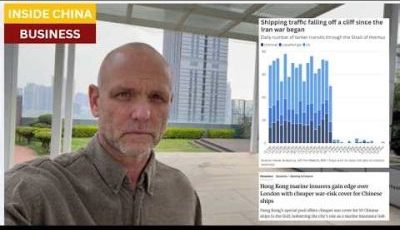
More Iran War fallout: Maritime insurance industry shifts from London to China
or go to
Aletho News Archives – Video-Images
From the Archives
Allies Don’t Need Lobbies
By Jay Knott | Dissident Voice | September 24, 2013
In a recent article on Counterpunch, Rob Urie defended the traditional Marxist analysis of US policy in the Middle East. He argues that support for Israel is driven primarily by economic interest, not the Jewish lobby.
He starts by paying tribute to the idea that Western societies are uniquely racist. He says that the “Western narrative” claims there is an “Arab character”, and that this is “antique racist blather”. He gives no definition of these terms. Further, he establishes his credentials as part of the dominant current in the American left by claiming that “over a million people in Iraq died so ‘we’ in the West can drive SUVs.”1
When he tries to criticize bourgeois economics, he makes it clear he doesn’t understand the developments it has made since Marx’s day, using the mathematical discipline known as “game theory”. He dismisses the basic abstraction of economic theory, the idea of the rational individual, on the grounds that it is “devoid of history, culture and political context”. But abstractions are always devoid of something.
He defends a more concrete economic theory, mostly Marxist, with some input from another theorist of capitalist crisis, Hyman Minsky. This concrete theory leads him to the view that US activity in the Middle East is primarily driven by rational capitalist motives, the need to secure a supply of oil.
“Taking the totality of circumstance — former oil company executives launching war on an oil rich nation on a pretext they publicly proclaimed they didn’t believe shortly before taking office — and that upon launching their war proved to be non-existent, requires a willingness to overlook the obvious — that the war on Iraq was for oil, that is difficult to support.”1
Perhaps I’ve misunderstood him, but based on what he says in the rest of the article, this convoluted sentence seems to argue that, because president Bush and vice-president Cheney attacked Iraq on false premises, and they also said it was all about oil, and they are former oil executives, and Iraq has a lot of oil, it’s difficult to deny US attacks on Iraq are all about oil.
In fact, it’s not hard at all. As Urie points out, at times Bush and co. said that attacking Iraq was “protecting the world’s supply of oil.”1 But, as he also points out, they are congenital liars. Why should we believe them when they say they are trying to “protect” the oil supply? Protect it against what? When politicians “admit” attacks on Middle Eastern countries are wars for oil, they are parroting the neo-con party line, feeding the public, both left and right, with a plausible-sounding pretext. For right-wingers, “it’s a war for oil” is a reason to support war, and for leftists, it’s a way to feel better by complaining impotently about corporate greed. Both approaches help the war drive. … continue
Blog Roll
 Aletho News
- More Iran War fallout: Maritime insurance industry shifts from London to China
- US-Israeli aggression on Iran triggers review of GCC countries’ investment pledges to Washington
- Russia slams UK plan to seize tankers suspected of carrying its oil
- Pakistan ramps up food exports to Persian Gulf nations as war deepens food insecurity
- Iran submits response to US plan, sets terms for war’s end: Tasnim
- US vs Iran: Kharg Island Talk — Bluff or Escalation? Ex-Military Officer Weighs In
- Zelensky unnecessarily involves Ukraine in the Middle East crisis
- Turkish tanker blacklisted by Ukraine hit in drone attack – media
- Canada, the U.S., and NATO: the inescapable trap
- Villains of Judea: Leonid Radvinsky
- If Americans Knew
- ‘No Innocent Children’: Far-right Israeli Lawmaker Defends Killing of Palestinian Family
- Mossad’s promises helped Netanyahu convince Trump that Iran could be toppled
- US Arms Control Official Refuses To Comment When Asked If Israel Has Nuclear Weapons
- Veterans warn US landing could be ‘more Gallipoli than Vietnam’
- Israel may be committing war crimes in Lebanon – Not a ceasefire Day 167
- In the West Bank, life is a constant battle – 3 articles
- Jacob Reses, one of the most powerful pro-Israel operatives in Trump’s Washington
- Israeli-US assaults kill or injure 87 children a day – Not a ceasefire Day 166
- ‘Forever live by the sword’: Understanding Israelis’ massive support for Iran war
- UN’s special rapporteur on human rights says Israel is systematically torturing Palestinians
- No Tricks Zone
- Devastating Assessment Of Comirnaty Vaccine By Former Senior Pfizer Europe Toxicologist
- New Study: CO2 Is ‘Effectively Negligible’ As An Explanatory Climate Change Factor Since 2000
- Former Pfizer Toxicologist Dr. Helmut Sterz Tells Bundestag Hearing Pfizer Vaccine Should Have Never Been Approved
- Energy Expert: Germany’s Nuclear Phaseout Was A “500 Billion Euro Mistake”
- New Research: South Australia’s Mid-Holocene Sea Surface Temperatures Were 4°C Warmer Than Today
- Storing Green Energy To Last Germany 10 Days Would Require A 60-Million Tonne Battery
- New Studies: UK Sea Levels Were 4 Meters Higher Than Today During The Mid-Holocene
- Destructive Green New Deal: German Energy And Metal Group Warns Of Drastic Crisis
- New Study Documents A 20-Year Pause In Arctic Sea Ice Decline – Driven By Internal Variability
- Wake-up Call: Survey Shows Majority Of Germans Now Favor Postponing Climate Targets!
 Aletho News