US to propose own UN resolution on Russia-Ukraine conflict
Press TV – February 22, 2025
For the first time since the start of Russia’s military operation in Ukraine in 2022, the US has refused to cosponsor a United Nations General Assembly resolution put forward by Europe and Kiev, saying it will instead propose its own resolution.
US Secretary of State Marco Rubio wrote on his X account that on February 24 (the anniversary of the Russia-Ukraine war) his country will submit to the UNGA a resolution on the settlement of the issue.
“The US will propose to the United Nations a landmark resolution the entire UN membership should support in order to chart a path to peace.”
A statement from the US State Department attached to the announcement said that US President Donald Trump is seeking “a resolution to the conflict that would ensure long-term peace.”
According to the US State Department, the resolution is consistent with Trump’s position, and with the principle of peaceful settlement of disputes enshrined in the UN Charter.
According to media reports, the language of the resolution has been significantly softened towards Russia compared to the wording used in earlier documents.
For the first time since the start of the military operation, the resolution does not describe Russia as the original aggressor.
The text of the document expresses grief over the tragic conflict and calls for a speedy end to it.
It “reaffirms the urgent need to end the war this year and redouble diplomatic efforts to reduce the risks of further escalation and achieve a comprehensive, just and lasting peace on the Ukraine.”
In response to years of military and political provocations by the US and European countries, Russia began its special military operation in Ukraine in 2022.
Russia has managed to gain control of a fifth of Ukraine and has been slowly advancing in the east for months. Ukraine’s military, supported by the US and European countries, grapples with manpower shortages and tries to hold a chunk of territory in western Russia.
Russia has demanded an end to the West’s military and political provocations on its borders and Ukraine’s permanent neutrality under any peace deal. Ukraine on the other hand has demanded Russia’s withdrawal from the captured lands and wants NATO membership.
Moscow confirms long-range strikes against Ukrainian energy complex
RT | February 20, 2025
Russian forces conducted long-range strikes targeting Ukraine’s military-linked gas infrastructure overnight, the Defense Ministry in Moscow confirmed on Thursday. Earlier, Kiev claimed the targets were civilian.
The ministry stated that the operation involved missiles launched from air, naval, and ground platforms, along with drones. The strikes targeted “elements of gas and energy infrastructure crucial for the Ukrainian military industrial complex,” all of which were successfully hit, according to the official statement.
Ukrainian Energy Minister German Galushchenko confirmed the damage to the facilities, alleging that the Russian objective was to “halt the extraction of gas essential for civilian use.” The Russian military maintains that it does not target civilian facilities.
The Ukrainian military reported that Russia launched at least 14 cruise and ballistic missiles, alongside over 160 drones. The statement refrained from detailing how many missiles were intercepted, a departure from Kiev’s typical communications strategy. Previously, the Ukrainian air defense force showcased claimed interceptions through graphics depicting Russian weapons; however, Thursday’s report focused solely on drones, stating that 80 were neutralized.
Earlier this week, Ukrainian leader Vladimir Zelensky expressed concern over dwindling supplies of interceptor missiles for US-provided MIM-104 Patriot systems. He had previously lauded them as superior to other air defense technologies supplied by Western arms donors.
Ukraine has reportedly received six full batteries, including three from the US and three from Germany, as well as individual launchers from the Netherlands. During a press conference on Wednesday, Zelensky requested 20 more Patriot systems to bolster his country’s defenses.
Kremlin responds to reports of Western troop deployment plans for Ukraine
RT | February 20, 2025
Moscow is concerned by reports that NATO member states are considering deploying troops to Ukraine, Kremlin spokesman Dmitry Peskov has said, reiterating that such a scenario would be unacceptable to Russia.
On Wednesday, The Telegraph and Bloomberg cited anonymous Western officials as saying that the UK and France were preparing to present US President Donald Trump with plans for the establishment of a “reassurance force” for Ukraine, should Kiev and Moscow agree a peace deal.
In an interview with Fox News the same day, US National Security Adviser Mike Waltz confirmed that British Prime Minister Keir Starmer and French President Emmanuel Macron would visit Washington next week.
Speaking to reporters on Thursday, Peskov said Moscow is “certainly following all these reports most closely.” Claims about the potential arrival of service members from NATO states in Ukraine “are causing concern,” he added, citing the ramifications this would have for Russia’s national security.
“This is a very important topic to us,” Peskov said. He noted that Russian Foreign Minister Sergey Lavrov had stressed on Tuesday that the “presence of armed forces from NATO countries [in Ukraine]… is completely unacceptable to us.” The remark followed high-level Russia-US talks in Riyadh, Saudi Arabia, where the two nations agreed to work toward normalizing bilateral relations.
According to The Telegraph and Bloomberg, the Anglo-French plan would involve around 30,000 troops being stationed in key Ukrainian cities and ports, as well as at nuclear power plants. The scheme purportedly envisages equipping the contingent with surveillance and reconnaissance aircraft as well as patrol vessels to monitor a potential peace agreement between Kiev and Moscow, with the US providing air cover in case of escalation.
In an article for The Telegraph on Sunday, Starmer proclaimed that the “UK is ready to play a leading role in accelerating work on security guarantees for Ukraine,” including by “putting our own troops on the ground if necessary.”
Russia’s ambassador to the UN, Vassily Nebenzia, warned earlier this month that Western troops operating in Ukraine without Moscow’s consent would be seen as legitimate targets.
A number of EU leaders, most notably French President Emmanuel Macron, have been floating the idea of sending military personnel to Ukraine since at least last February.
Deliberations over such a move have reportedly intensified in recent months. Since Trump assumed office in January, his administration has signaled its willingness to scale down American involvement in Ukraine.
Ukraine’s Zelensky Forgets the First Rule of Crisis Management — If You’re in a Hole, Stop Digging
By Larry C. Johnson | Sonar21 | February 19, 2025
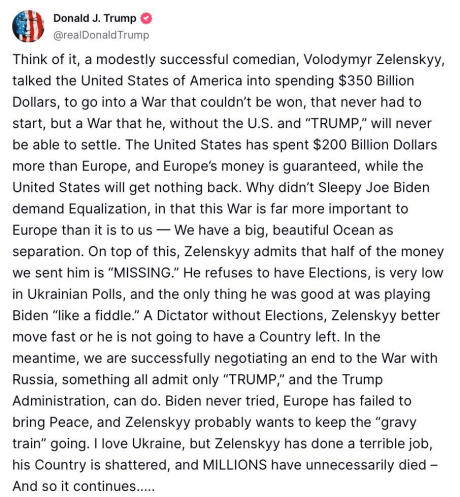
Gotta confess, I did not see this coming. Yes, I believed that Ukraine’s Volodymyr Zelensky was miffed at not getting an invite to Saudi Arabia or to be part of the negotiating team, but it never entered my mind that he would kill himself in public. Suicide ain’t a good look. Zelensky reacted to Trump’s post by going after the Donald. Not a smart move.
While Zelensky did not put a loaded gun to his head and press the trigger, that may have been a better option than what he did — i.e., verbally attack and insult Donald Trump. If Trump truly was the King of the Realm, Zelensky would have arrived hogtied before Trump and the Donald would have cut his tongue out. Such were the pleasantries of the Middle Ages.
Here are a couple of Zelensky’s verbal tirades today criticizing Trump for excluding the Z-man from the negotiations:
Zelensky said Ukraine “did not know anything about” the meeting between Putin and Trump, and said his country will not accept a peace deal brokered without Ukrainian participation.
Zelensky told reporters he “would like Trump’s team to be more truthful” about the war and accused the president of living in a Russian-made “disinformation space.”
If Zelensky thinks that public criticism of Trump is a winning strategy to win over the Donald, he has not paid attention to Trump’s method of handling critics and opponents during the past ten years. While Zelensky enjoys the full support of the Washington neocons and those politicians who have been paid under the table by Ukraine, picking a fight with Trump guarantees that further aid to Ukraine is DOA (i.e., dead on arrival).
Trump has the memory of an elephant. He has not forgotten the role that Zelensky played in Trump’s first impeachment drama. Zelensky could have spoken out in defense of Trump at the time, but he chose to remain silent. Zelensky did not buy himself any good karma with Trump.
Then there is the matter of missing billions of US taxpayer dollars. Elon Musk, as well as some folks outside of DOGE, are auditing the more than $300 billion sent to Ukraine. I know from a close friend that $50 billion already has been tracked to bank accounts in the Caribbean. Sometime within the next month or two, the world will learn some specifics of Zelensky’s theft of some of these funds. When that happens, Zelensky is burnt toast.
Don’t be surprised in a few months when Attorney General Pam Bondi announces criminal indictments against Zelensky for theft of US government property. Assuming that Zelensky is not assassinated or jailed by disgruntled Ukrainian military officers, his chances of finding a safe haven outside of Ukraine will dim dramatically. Zelensky fails to understand that he is nothing more than a pawn in a Western-led game of global chess. He ain’t essential, he’s expendable.
It appears that Trump’s goal in reviving relations with Russia has little to do with Ukraine and its future. As a result of Tuesday’s meeting in Saudi Arabia between the US and Russian delegations, there was agreement on forming six working groups that will address the following issues:
- Group on Strategic Security and Arms Control. Arms control is one of the topics where dialogue between Moscow and Washington continues even in the crisis. The New START Treaty expires in 2026, and the United States is interested in extending it, but will try to impose new restrictions on Russian hypersonic weapons and tactical nuclear forces. Russia, in turn, will seek a revision of the balance of power, taking into account NATO’s non-expansion, and demand restrictions on the deployment of new missile systems in Europe.
- Group on the Review of the Global Security Architecture.
The issues of global security architecture, delimitation of spheres of influence, including possible mechanisms for monitoring developments in artificial intelligence, cybersecurity and autonomous combat systems will be discussed separately. It is likely that this is the area where the contradictions will be most acute. Moreover, other significant powers, including China, will need to be involved in the process. - Group on bilateral diplomatic interaction.
Both sides are interested in the return of the embassies to full operation, within the framework of which mutual restrictions on the work of diplomatic missions will be lifted, and broad channels of communication will be established, including, in part, issues of economic ties. - Energy and Sanctions Group.
Russia is interested in lifting American sanctions, and the Americans will be offered some joint economic projects. However, the American side will try to link any concessions with demands concerning other areas, including Russian-Chinese relations, so a compromise will not be easy. Plus, Trump will be wary of accusations from hawks among the Republicans about the “excessive” easing of the sanctions regime. - Group for the settlement of the conflict in Ukraine.
Within its framework, the parameters of a peace agreement on Ukraine will be agreed upon. There is already agreement on a number of issues. Ukraine is a non-aligned state, the EU will not be an actor influencing the negotiations, elections will be held in Ukraine and then a full-fledged agreement will be concluded, which will be adopted by the UN, there will be no NATO troops on the territory of Ukraine. Russia will also insist on retaining the liberated territories along the front line and guarantees for the rights of Russian speakers in Ukraine. The full scope of the concessions that Washington is ready to make and their price are still unclear. - International Affairs Group (Middle East, Arctic).
The situation in the Middle East requires coordination of efforts by major players, including to prevent the Israeli-Palestinian truce from collapsing, to make a decision on the Syrian case, and others. Russia continues to actively interact with Turkey, Iran, and the Persian Gulf countries, which makes it an important participant in any negotiation processes in the region. Also on the agenda are issues of cooperation in the Arctic, where Russia maintains strategic superiority.
Ending the war in Ukraine is not necessarily a top priority. Trump’s team has made it clear that this is a problem for the Europeans and the Ukrainians to resolve if they are intent on continuing the war. Trump is looking at a bigger picture and keeping Zelensky happy is not part of that vision.
I discussed this today with Danny Davis:
Trump ‘restrained’ towards West European leaders – Putin
RT | February 19, 2025
US President Donald Trump has shown remarkable restraint in dealing with EU leaders who spoke out against him during the course of the 2024 presidential election, Russian President Vladimir Putin told media on Wednesday.
During the campaign last year, a number of EU officials spoke out in favor of Trump’s Democrat rival for the White House, Kamala Harris, although most stopped short of endorsing her outright.
Trump, Putin noted, continues to be polite with his European allies, who were quite rude to him at the time.
“I am surprised by the restraint of newly elected US President Trump towards his allies, who behaved, frankly speaking, in a boorish manner. He still behaves quite courteously towards them,” he said.
Last October, Trump accused British Prime Minister Keir Starmer of election interference after UK Labour party helped recruit and deploy activists to help the Harris campaign in key swing states.
In August 2024, the Trump campaign accused the EU of interfering in the US presidential election after a senior bloc official warned Elon Musk against amplifying “potentially harmful content” ahead of his interview with Donald Trump.
“All European leaders, all without exception, essentially directly interfered in the election process in the US. It came to direct insults towards one of the candidates,” according to Putin.
Putin Says Russia Ready to ‘Return to the Table’ to End Ukraine War
By Kyle Anzalone | The Libertarian Institute | February 19, 2025
President Vladimir Putin celebrated the talks between US and Russian officials in Saudi Arabia. He said the Kremlin was prepared to engage in bringing the war in Ukraine to an end.
According to Interfax, on Wednesday, Putin lauded the first round of talks between the US and Russia before saying Moscow is willing to engage with Kiev on ending the war in Ukraine. “Yes, I have been informed. I rate them highly, there are results,” he said. “In my opinion, we made the first step to restore work in various areas of mutual interests.”
On Tuesday, Secretary of State Marco Rubio met with Foreign Minister Sergei Lavrov in Saudi Arabia. Rubio said the two sides agreed to normalize diplomatic relations and work to end the war in Ukraine.
Putin explained while US involvement in talks was required, he was willing to engage with the Ukrainians. “No one is excluding Ukraine,” he said. “We are not imposing anything on anyone. We are ready, I have already said this a hundred times – if they want, please, let these negotiations take place. And we will be ready to return to the table for negotiations.”
On Tuesday, the Kremlin said Putin would be willing to speak with Ukrainian President Zelensky. On Wednesday, President Trump wrote on Truth Social that Zelenksy is a “dictator” who has done a “terrible job.”
While ending the war is a top priority, both Washington and Moscow have indicated that the two superpowers have a range of issues to discuss. Arms control is at a historic low point, and talks on nuclear weapons treaties halted during the latter years of the Joe Biden presidency. The last remaining nuclear arms control agreement, the New Start Treaty, is set to expire in a year.
Putin Praises Friendly Russian-US Negotiations in Riyadh
Sputnik – 19.02.2025
ST. PETERSBURG – Russian President Vladimir Putin said on Wednesday that he had been briefed on the results of talks between Russian and US delegations in Riyadh and gave a positive assessment of the negotiations.
“The assessment is positive,” Putin told reporters when asked about the Russian-US talks, adding that the meeting was friendly.
The Russian delegation told that from the US side there were those who were open to cooperation, the Russian president added.
The purpose and agenda of the conversation at the meeting in Riyadh was to restore trust between Russia and the United States, Putin pointed out.
Russia and the United States are working on the issues of economy, energy, space and other areas, Putin said.
The Russian president, commenting on Tuesday’s meeting between Russia and the US in Riyadh, mentioned that the sides have taken the first step to resume work in various areas of mutual interest, including the Middle East.
“We have other issues, the economy, and our joint work in the global energy markets, space, of course… All of this was the subject of discussion, consideration at the meeting in Riyadh,” Putin told reporters.
Putin said that he had been briefed on the results of talks between Russian and US delegations in Riyadh and gave a positive assessment of the negotiations.
During the telephone conversation US President Donald Trump said that Washington assumes that negotiations will take place with the participation of both Russia and Ukraine, Vladimir Putin said.
“As for the negotiation process, President Trump told me during a telephone conversation, and I can confirm this, that, of course, the United States assumes that the negotiation process will take place with the participation of both Russia and Ukraine. No one excludes Ukraine from this process,” Putin told reporters.
Putin said on Wednesday that US President Donald Trump has begun to receive objective information.
“When he [Trump] started receiving information — objective information — he changed his position. This information has changed his approach,” Putin said.
Russia and the United States in Riyadh have agreed that the work of diplomatic missions will be resumed in normal mode, Putin.
“The first thing I would like to say is that we have agreed to resume the work of diplomatic missions in normal mode,” Putin told reporters.
The expulsions of diplomats from Washington and Moscow do not lead to anything good, if it continues, only cleaners will be left to work in the embassies, Putin added.
Putin said on Wednesday that it is impossible to resolve many issues, including the Ukrainian crisis, without increasing the level of trust.
“The most important thing here in resolving all pressing issues, including the Ukrainian settlement, is that without increasing the level of trust between Russia and the United States, it is impossible to resolve many issues, including the Ukrainian crisis,” Putin said.
Russia has never refused to negotiate on the conflict with Ukraine, Putin added.
Kiev’s hysteria about its absence in the negotiations between Russia and the United States is inappropriate, Putin said.
“Everyone has probably forgotten, but I remind you that exactly one year from now, in February 2026, the Strategic Offensive Reductions Treaty expires. Do they [representatives of Ukraine] want to sit here at the negotiating table and mediate between Russia and the United States? Well, probably not. Why get hysterical? Hysteria is inappropriate,” Putin told reporters.
Russia will inform all its BRICS friends about the results of the US-Russia talks, Russian President said.
“For our part, we shall undoubtedly inform all our BRICS friends. We know that they are interested in settlement of the Russia-Ukraine relations, termination of combat actions.
We treat their suggestions with respect. And any time soon we shall inform them about the results of the Russia-US talks,” Putin told reporters.
The recent attack on the Caspian Pipeline Consortium (CPC) may result in high energy prices on global markets, Vladimir Putin said.
“Of course, the attack on such a facility will affect global energy markets, first of all, because, unfortunately, it is impossible to quickly restore this facility, because there was mainly Western equipment there, and it was damaged … This leads to consistently high energy prices on world markets,” Putin told reporters.
On Monday, the CPC said that its crude oil pumping station in Kropotkinskaya, Russia’s southern Krasnodar Territory, had been attacked by drones in the morning.
Kropotkinskaya is the company’s largest pumping station in Russia. The CPC said the attack was carried out by seven drones packed with metal striking elements in addition to explosives.
Soldiers of Russia’s 810th military brigade have crossed the Russian border and entered Ukrainian territory, Putin said, adding that Russian troops are advancing along the entire front line.
“The latest information, which was reported to me literally an hour ago, is that tonight the fighters of the 810th brigade crossed the border between Russia and Ukraine and entered the territory of the enemy. And our troops are advancing along the entire line of contact,” Putin told reporters.
The 810th brigade is fighting in Russia’s Kursk Region.
Russia and US will have to ‘clean up’ after Biden – Lavrov
RT | February 19, 2025
Moscow and Washington need to “clean up the legacy” left by the former US President Joe Biden’s administration that ruined the ties between the two states, Foreign Minister Sergey Lavrov has said.
Speaking at the Russian State Duma on Wednesday, having returned from talks with US diplomats in the Saudi capital on Tuesday, Lavrov described the meeting in Riyadh as a first step toward rebuilding relations between the countries. The bilateral negotiations were led by Lavrov and US Secretary of State Marco Rubio and aimed to lay the groundwork for ending the Ukraine conflict and normalizing ties between Russia and the US.
“We have started to move away from the brink of the abyss to which the Biden administration had led us, but these are only the first steps,” Lavrov told lawmakers, commenting on the talks.
“For now, we need to ‘clean up’ the legacy of the Biden administration, which did everything to destroy… the foundation of a long-term partnership between our countries,” he added. According to the diplomat, “the movement towards normalizing relations in all areas is beginning.”
“There is, at least, a declared readiness to start on this course. And to resolve not only the Ukraine crisis, but to create conditions for the restoration and expansion of partnership in trade, economic and geopolitical spheres,” Lavrov stated. He noted that Washington’s representatives expressed marked interest in removing “artificially created” obstacles to potential joint initiatives with Russia in many areas, including economic and foreign policy.
Among other things, the sides agreed to restore embassy staffing and form high-level teams to begin work on the potential Ukraine peace settlement.
“We welcome this,” Lavrov said, noting that the countries could eventually return to the state of cooperation they had prior to the Ukraine conflict and the West’s sanctions war on Russia.
“There will always be problems, but the main thing is to meet, listen and hear one another, make decisions that will be realistic with regard to the partners they concern,” he stated.
Tuesday’s negotiations have been described as “truly monumental” in Washington.
Following the talks, US Secretary of State Marco Rubio also acknowledged that the West would need to address the sanctions imposed on Russia in order to reach a lasting solution to the conflict and to restore relations. Later on Tuesday, US President Donald Trump told journalists he felt “much more confident” about the prospects of a lasting peace between Russia and Ukraine amid the budding rapprochement with Moscow.
West should repair oil infrastructure damaged by Ukraine – Putin

FILE PHOTO: A gas turbine produced by the German company Siemens © Global Look Press / IMAGO / Christoph Reichwein
RT | February 18, 2025
Repairs to an oil pumping station in southern Russia damaged by a Ukrainian drone strike on Monday should be covered by the facility operator’s Western co-owners, President Vladimir Putin has suggested. The infrastructure is operated by the Caspian Pipeline Consortium (CPC), which is partly controlled by US and EU companies.
The station was attacked on Monday by at least seven Ukrainian drones, Russia’s deputy prime minister and former energy minister, Aleksandr Novak, told Putin during a government meeting on Tuesday. The strike damaged some critical components, prompting its operators to resort to a reserve pumping scheme and slash capacity by 30-40%, the official said.
According to Novak, restoring the station’s full capacity would require “major repairs” since it used Western equipment, including from Germany’s Siemens, which has previously refused to supply equipment for Russian gas pipelines, citing sanctions. Repairing the facility could, according to Novak, take “quite along time.”
The Western CPC shareholders are also taking part in the damage assessment, Novak said, adding that the list of consortium members includes US giants Chevron and ExxonMobil.
The Russian president responded by saying that the Western companies should facilitate the repairs at the station and provide all the necessary equipment.
“Since they [the Western companies] are … interested in restoring the facility’s operational capacity, then let them arrange for the necessary equipment delivery despite all the sanctions,” Putin said. He pointed out that the CPC shareholders would be doing that “for their own benefit” anyway. Moscow should also provide all the assistance that is necessary, he added.
The Kropotkinskaya pumping station is located in the Russian Krasnodar Region, some 230 kilometers from the port city of Novorossiysk. It is a part of a pipeline project that transports oil from western Kazakhstan along with Russian products. US companies controlled some 40% of oil supplies shipped via the pipeline in 2024.
Former Russian President Dmitry Medvedev called the strike an attack against US companies, the global oil market, and US President Donald Trump’s agenda. On Tuesday, Novak also described the attack as Kiev’s “response” to the US desire to engage in dialogue with Moscow.
EU Elites Are in Panic Over the US Leaving Ukraine and Europe
Professor Glenn Diesen & Pascal Lottaz
Glenn Diesen | February 17, 2025
I had a conversation with Pascal Lottaz at Neutrality Studies regarding the panic in the EU as the US made it clear it no longer considers Europe to be a priority. For years, the Europeans failed to establish the continent as an independent pole of power by neglecting to define their security and economic interests separate from the US. Europe is subsequently now a divided continent at war, in economic decline and with diminishing relevance in the world. The US must address multipolar realities by restoring a workable relationship with Russia and pivoting toward Asia. The comfortable ideological bubble has been burst, yet there is still a reluctance to deal with uncomfortable realities.
Europe plans €700 billion for Ukraine defense spending, German FM let’s slip during interview
By Liz Heflin | Remix News | February 18, 2025
Germany’s left is going all in on its pro-war effort, with Europe reportedly plotting its own course behind the scenes, which was not supposed to be made public until after Germany’s elections on Feb. 23. The Berliner Zeitung has reported that German Defense Minister Annalena Baerbock, of the Green Party, let slip the details of Europe’s plan to provide weapons to Ukraine on its own, with a projected allocation of some €700 billion for such purchases, with much of the money coming from Germany.
“We will launch a large package that has never been seen on this scale before,” Baerbock told Bloomberg on the sidelines of the Munich Security Conference, calling it an emergency measure “for security in Europe.”
Lithuanian Defense Minister Dovile Sakaliene also spoke to Bloomberg about the inspiration behind the move, saying the “realization that it is not the United States that will defend Europe, but that Europe will defend itself with the help of the United States (…) We need to spend quickly on defense, and spend a lot, hundreds of billions need to be spent immediately. We will all need to act quickly, including Germany.”
It is interesting that Sakaliene notes “with the help of the United States.” The question is: Will the U.S. want anything to do with Europe’s plan for massive arms procurements to Ukraine when Trump has made clear the only goal is peace. Of course, Trump has also been adamant that Europe ups its own defense spending, but that has nothing to do with U.S. “help,” in fact, it is meant to cut it.
The plans to boost defense spending at a historic scale came just after an emergency meeting hosted by French President Macron in Paris, Macron got behind the idea of a “security force” to be deployed behind the future ceasefire line. While British Prime Minister Keir Starmer said the U.K. was ready to send troops to Ukraine if necessary, other countries are more reluctant.
“At the moment, no one is considering sending troops to Ukraine,” said Spanish Foreign Minister Jose Manuel Albarez, reports Do Rzeczy, after a meeting of EU leaders in Paris. Polish Prime Minister Donald Tusk said at the meeting that Poland was also not ready to send its troops to Ukraine, but promised that his country would continue to provide aid to Kyiv.
German Chancellor Olaf Scholz has called sending troops to Ukraine “completely premature.”
“It is a difficult situation for Europe. We welcome the talks about peace for Ukraine. But it must be a fair and sustainable peace. And: Ukraine must be part of these talks. Europe will keep on supporting Ukraine. This is what I stressed in my meetings with Volodymyr Zelensky,” he wrote on his X account.
Just an hour later, Scholz also wrote: “NATO is based on the fact that we always act together and share risks. This must not be called into question. There must be no division of security and responsibility between Europe and the USA.”
In terms of enforcing any eventual peace agreement, President Trump has said the United States will send zero troops.
Present at the meeting were France, U.K., Spain, Poland, Germany, Italy, Poland, Spain, the United Kingdom, and Denmark. NATO Secretary General Mark Rutte, European Commission President Ursula von der Leyen and European Council President Antonio Costa have also been invited to Paris.
An area of agreement among all parties was the need for greater defense spending across Europe, with joint financing also discussed.
On X, Tusk wrote: “If we, Europeans, fail to spend big on defense now, we will be forced to spend 10 times more if we don’t prevent a wider war. As the Polish PM, I’m entitled to say it loud and clear, since Poland already spends almost 5% of its GDP on defense. And we will continue to do so.”
Of course, it is hard to draw any sort of consensus on what Europe wants or expects when the vast majority of EU countries were not even at this latest meeting. As Fidesz MEP Andrász László posted on X: “If the 8 countries who gathered in Paris on Monday for a crisis summit supposedly represent ‘EU unity’, what should the two-thirds of EU countries think, who were not invited?” He then called the meeting an “absolute clownshow.”
US firms lost $300 billion by leaving Russia: Investment Fund CEO
RT | February 18, 2025
US companies lost more than $300 billion by leaving the Russian market amid Ukraine-related sanctions, Kirill Dmitriev, CEO of the Russian Direct Investment Fund (RDIF), has said. He noted that Moscow and Washington need to reestablish dialogue to jointly solve problems that affect both economies.
Following the escalation of the Ukraine conflict, the West slapped Russia with unprecedented sanctions aimed at destabilizing the country’s economy and forcing Moscow to end its military operation. The measures, coupled with Moscow’s countersanctions, led many Western firms to divest from their businesses in Russia, losing billions in investment and profits. According to estimates from the Yale University School of Management, over 1,000 foreign firms have voluntarily curtailed operations in Russia to some degree since February 2022.
“US businesses lost over $300 billion from leaving the Russian market,” Dmitriev told CNN on Tuesday, ahead of the first direct Russia-US negotiations over the Ukraine conflict in Saudi Arabia. The figure is nearly equal to the amount of Russian central bank assets frozen in the West as part of sanctions.
The official noted that given such hefty losses, lifting sanctions would be in the interests of the US as well as Russia.
“What we want is good dialogue… finding joint economic ways to solve problems is extremely important, mainly for the US,” Dmitriev stated.
Commenting on the Russia-US talks, Dmitriev said “the entire globe is waiting to see whether the US and Russia will be able to improve relations.”
“Our better relations will allow us to solve a large number of global tasks and problems that the world faces,” added the official, who will be responsible for the economic aspect of the talks as part of the Russian team.
“I think it’s very important to build bridges. I think US-Russia relations are very important for the world. I think it’s very important that the US and Russia cooperate.”
Dmitriev noted that Moscow was already in contact with members of US President Donald Trump’s administration ahead of the talks, and considers them “great problem solvers.” He said that signals from Washington have so far been positive, with Trump and his team indicating they want to reestablish dialogue.
The talks in the Saudi capital of Riyadh were proposed following last week’s phone call between Trump and Russian President Vladimir Putin.
While neither head of state is expected to attend the talks, they are being conducted by high-level officials, including Russian Foreign Minister Sergey Lavrov and US Secretary of State Marco Rubio. Neither Ukrainian nor EU diplomats will be present at the meeting.
Kremlin spokesperson Dmitry Peskov earlier explained that the location for the talks was selected because it suited both countries. He added that the meeting would be devoted to “restoring the entire complex of Russian-American relations” and laying the groundwork for a Trump-Putin summit.
Featured Video

It’s the Occupation, Stupid
or go to
Aletho News Archives – Video-Images
From the Archives
A superpower and “the world’s sickest warrior state”
By Paul J. Balles | March 8, 2010
Living through five or six major wars has hardened me to what I thought were the extremes of inhuman cruelty and brutality.
Two things made those extremes almost bearable: the brutality always revealed – at least according to the media coverage – the viciousness of the enemy. It was therefore quite understandable when our “brave men and women” pulverized the enemy.
Films of Japanese torturing captive Americans somehow justified holding Japanese Americans in internment camps during World War II; and only a small percentage of Americans found the bombing of Hiroshima and Nagasaki unreasonably vengeful at best, at worst, depraved.
The media giants in America portrayed the North Koreans as barbaric beasts with their captives, quite unlike their southern counterpoints – our allies during the Korean War. No one ever felt the need to explain how the South Koreans were a civilized breed while the North Koreans were absolute savages, at least according to the official line.
In Vietnam, our warriors justifiably (or so the media made us believe) dropped napalm on the North Vietnamese who had the gall to hide in villages and tunnels to ravage our invaders. At least it was accepted practice until some rogue photojournalist filmed a young girl screaming down a Vietnamese road in flames. … continue
Blog Roll
 Aletho News
- AWACS’ Destruction is a Major Loss for US Military – Ex-DoW Analyst
- Israel’s Iran Strategy Uses US Military & Gulf States as Its Pawns
- Iran: Trump wanted regime change, now just begging for Hormuz to open
- IRGC: Israeli, US universities in region legitimate targets after strikes on Iranian university
- Trump admits Iran hit USS Ford carrier: ‘We ran for our lives’
- Battle for Hungary: EU attacks on Orban are a sign of worse things to come
- Iraqi resistance conducts drone strike on US-run base in Syria
- Failing to Defeat Hezbollah, Israel & US Pressure Syria’s Ahmed al-Sharaa to Join War
- US-Israeli war on Iran drives global fertilizer prices up 40%
- Hezbollah’s Surprise Weapons Redefine Ground Battle with Israel
- If Americans Knew
- Israel is assassinating journalists again, more than any other nation, anywhere, ever – Not a ceasefire Day 170
- Over 300 US service members wounded, majority have brain injuries – Not a ceasefire Day 169
- Researchers at Human Rights Watch Resign Over Blocked Report on Palestinian Refugee Return
- Jewish Groups Are Backing a War Americans Don’t Want
- Eric Fingerhut Thinks He’s the President of the Jews
- Top Jewish Philanthropists, Rabbis Urge Israeli President to Take Action Against ‘Jewish Extremists’
- Don’t Be Fooled. Zionist Leaders Have Always Wanted to Control Southern Lebanon
- Israel’s widespread use of torture is a core element of its genocide against the Palestinian people
- In Israel’s War on Iran, Many Middle East US Bases Rendered “All But Uninhabitable”
- ‘Burn the lawn’: Israel pursues ‘Rafah model’ in southern Lebanon
- No Tricks Zone
- German Science Blog Accuses PIK Climate Institute Of Hallucinating Climate Tipping Points
- Devastating Assessment Of Comirnaty Vaccine By Former Senior Pfizer Europe Toxicologist
- New Study: CO2 Is ‘Effectively Negligible’ As An Explanatory Climate Change Factor Since 2000
- Former Pfizer Toxicologist Dr. Helmut Sterz Tells Bundestag Hearing Pfizer Vaccine Should Have Never Been Approved
- Energy Expert: Germany’s Nuclear Phaseout Was A “500 Billion Euro Mistake”
- New Research: South Australia’s Mid-Holocene Sea Surface Temperatures Were 4°C Warmer Than Today
- Storing Green Energy To Last Germany 10 Days Would Require A 60-Million Tonne Battery
- New Studies: UK Sea Levels Were 4 Meters Higher Than Today During The Mid-Holocene
- Destructive Green New Deal: German Energy And Metal Group Warns Of Drastic Crisis
- New Study Documents A 20-Year Pause In Arctic Sea Ice Decline – Driven By Internal Variability
 Aletho News