Why Putin should ignore Biden’s pathetic ATACMS provocation
By Finian Cunningham | Strategic Culture Foundation | November 18, 2024
As provocations go, the latest by President Joe Biden to permit the use of long-range missile strikes on Russia is certainly audacious. But, ultimately, in practice, it is a pathetic gesture by a lame-duck president that will have no impact on Russia’s anticipated military victory against the NATO-armed Kiev regime.
Biden’s reported decision is a desperate last-bid gamble to incite an escalation with Russia and to sabotage incoming plans by President-elect Trump to end the conflict in Ukraine. Biden’s move is reckless, reprehensible, and odious. But it should not be given any credibility as a serious threat.
Russia would be best to ignore it. Of course, Russia has to defend itself against any increased potential threat to its territory that such weapons may pose. Nevertheless, Moscow should continue exercising the strategic restraint that President Putin is renowned for, and not retaliate over the provocation.
Understandably, Russian politicians and media have reacted furiously to U.S. media reports that Biden gave the Ukrainian military the green light to deploy American-made ATACMS for striking deep into Russian territory. The ground-launched Mach-3 supersonic missiles have a range of up to 300 kilometers.
The audacity and arrogance of the American ruling class knows no bounds. It has sanctioned Russia to the hilt (to no avail mind you), it has weaponized a NeoNazi regime in Kiev, it has killed civilians in the Russian territory of Crimea already with ATACMS, and so on. Now Biden is ramping up the assault capability deep into Russia.
Two months ago, Russian President Vladimir Putin warned that if the U.S. took such a move, then it would dramatically alter the very essence of the conflict in Ukraine, one where Moscow would see the United States and its NATO partners as “direct participants” in a war against Russia.
Putin’s reasoning was correct. The deployment of ATACMS and other sophisticated long-range missiles against Russia would inescapably mean that American and NATO personnel were manning these systems. The Ukrainian military – riven with desertion, in disarray, and suffering from poor morale – would not be capable of targeting and operating such munitions. The use of ATACMS, or air-launched JASSMs, and the British and French Storm Shadow and Scalp cruise missiles to hit Russia is tantamount to NATO’s direct involvement in a war against Russia.
The implication of what Putin said was grave and potentially catastrophic. If the Western states took that step, the result could mean an all-out war between nuclear powers.
When Putin issued his stark warning in September, Biden and other Western leaders, including Britain’s Prime Minister Keir Starmer, appeared at the time to heed it and back down from considerations to permit the Ukrainian regime to use long-range missiles against Russia.
Now, however, Biden has flipped to finally give his approval, according to reports. The style of anonymous U.S. officials briefing the New York Times, Washington Post, and Associated Press has all the hallmarks of an orchestrated psychological operation.
What has changed?
Simple. Donald Trump won the U.S. presidential election on November 5 with a resounding victory in defiance of the political establishment that wanted Kamala Harris to win. The Republican president-elect takes over in two months when he is inaugurated on January 20. Trump has repeatedly said he will negotiate an end to the nearly three-year conflict in Ukraine, which has seen the U.S. and NATO allies bankroll a corrupt regime in Ukraine to the tune of $200 billion.
And yet after all that obscene wasting of Western public money to bloat the war machine, Russia is going to defeat the NATO proxy. The stakes for NATO’s future and the Western imperialist war machine could not be higher.
The impressive electoral mandate for Trump suggests that the American public wants the U.S. warmongering to stop and for their mounting economic and social needs to be taken care of as a priority.
Under Trump, the war racket could well be over. His nomination last week of Tulsi Gabbard – an outspoken critic of the NATO proxy war in Ukraine – as his Director of National Intelligence is a major sign of his bold intentions of negotiating a diplomatic settlement to the conflict. That means the end of the blood money flowing into the coffers of the Western military-industrial complex and Wall Street. Biden and the Democrat candidate Kamala Harris were the puppets of the war racket. To perform well, they mouthed endless Russophobia, making negotiations impossible with Moscow, and they swore to keep the conflict in Ukraine going “for as long as it takes.” European leaders like Starmer, Macron, and Scholz are equally contemptible.
As Biden packs his bags for his overdue retirement, he is rendering desperate last-minute services to the war racket that lies at the putrid heart of American capitalism. Last week, his Secretary of State Antony Blinken (another non-entity puppet) said the Biden administration would release a further $9 billion in military aid to Ukraine so that it could keep fighting the war well into next year.
Likewise, the reported green light from Biden on the use of long-range missiles is another ploy to keep the war racket going. Trump could reverse the decision when he enters the White House, but over the next two months, the Biden administration seems to be trying to sabotage Trump’s peace intentions by escalating the conflict to a dangerous point of no return.
Russia should not take the bait. For a start, the United States does not have a large supply of ATACMS to give to Ukraine. Any use of these missiles will be limited. The Kiev regime’s so-called president Vladimir Zelensky – he canceled elections months ago and rules by decree – has no chance of stopping the rapidly advancing victory of Russian forces, even with a few ATACMS.
No, this is not about defending Ukraine or enabling Zelensky’s ridiculous “victory plan”. It’s all about the American-led Western imperialist deep state wanting to provoke Russia into a dreadful escalation to keep the war profits churning.
Biden’s gesture is reckless, but it is something that should be treated with contempt. As he wanders off to the oblivion of his retirement dementia, people will soon forget about this failed politician. His 50-year career was one long shift of prostituting for U.S. imperialism.
Legally, Russia could respond to Biden’s provocation with reciprocal attacks on U.S. and NATO sites. But such an escalation is exactly what the imperialist deep state of the U.S. and its NATO lackeys are betting on.
The provocative gesture is more symbolic than a substantive threat. Russia should ignore it and focus on demolishing the NATO proxy regime in Kiev, and with that, thereby deal a fatal blow to U.S. and NATO credibility.
Russian journalist killed by Ukrainian drone strike

Yulia Kuznetsova © VK
RT | November 18, 2024
The editor-in-chief of a local newspaper in Russia’s Kursk Region, was killed in a Ukrainian drone strike on Sunday, Governor Aleksey Smirnov has said. Yulia Kuznetsova, joined the Narodnaya Gazeta paper in 2008 and was promoted to editor-in-chief last summer.
She was traveling by car along the Dyakonovo–Sudzha highway when an unmanned aerial vehicle (UAV) struck. The 34-year-old was accompanied by a colleague and a police officer, both of whom sustained injuries and were taken to hospital for treatment.
“Today, in the Bolshesoldatsky District, the Editor-in-Chief of Narodnaya Gazeta, Yulia Nikolaevna Kuznetsova, was killed as a result of a Ukrainian drone attack on a car,” Governor Smirnov wrote on his Telegram channel on Sunday, expressing his condolences. Kuznetsova had been transporting archive documents from the regional office and was planning to report on the situation in the area, he added.
Despite being evacuated from her hometown, Kuznetsova continued to run the newspaper from Kursk, giving readers an insight into what was happening in their home district.
Kuznetova is survived by her husband and two children. The Russian Investigative Committee has launched a criminal probe on charges of terrorism over the killing.
Several Russian journalists covering the fighting in Ukraine have been targeted by Kiev’s forces since the conflict escalated in February 2022.
In September, Russian war correspondent Aleksandr Korobov was ambushed and fatally injured by Ukrainian soldiers while reporting on shelling incidents in Belgorod Region. The same month, Evgeny Poddubny, a veteran correspondent for the Russia-1 TV channel, was wounded when a Ukrainian kamikaze drone hit his car while he was covering hostilities in the Kursk Region.
Moscow has accused the Ukrainian military of deliberately attacking the press, and Russian President Vladimir Putin has said “at least 30” journalists have been killed since the beginning of the conflict.
Le Figaro deletes SCALP missile claim
RT | November 18, 2024
The French daily Le Figaro has walked back its claim that France and the UK have allowed Ukraine to use long-range missiles they have supplied to strike targets deep inside Russian territory. The original claim appeared shortly after the New York Times reported on Sunday that outgoing US President Joe Biden had given Kiev the green light for such strikes.
The UK was the first to provide Ukraine with its long-range Storm Shadow missiles back in May 2023, with France following suit several months later, with its own version of the system, named SCALP. The US delivered its ATACMS rockets in the fall of that year.
Despite Kiev’s repeated requests to allow it to use the weapons to strike targets deep inside Russia, its Western backers had until recently publicly refused to acquiesce, citing concerns over potential uncontrollable escalation.
In its now-amended article on Sunday, Le Figaro originally claimed that the “French and the British had authorized Ukraine to strike deep into Russian territory with their SCALP/Storm Shadow missiles.”
However, in an updated version of the piece, any mention of the supposed permission or SCALP/Storm Shadow rockets is gone. The initial wording is, however, still accessible in a cached snapshot of the report.
Speaking to reporters ahead of an EU ministerial meeting in Brussels on Monday, France’s top diplomat, Jean-Noel Barrot, clarified that there was “nothing new” with respect to Paris’ stance on long-range strikes on internationally recognized Russian territory, adding that such a scenario remained an option.
On Sunday, the New York Times, citing anonymous US officials, reported that the White House had given the green light for Ukrainian strikes on Russia’s Kursk Region, using US-supplied ATACMS missiles.
The NYT and several other media outlets have reported that Washington could extend its approval to allow Ukraine to strike other parts of Russia.
Neither the White House nor the Pentagon has commented on the matter.
In his video address on Sunday, Ukrainian leader Vladimir Zelensky cautiously welcomed the reported development, stressing that “strikes are not carried out with words. Such things are not announced.”
“Missiles will speak for themselves. They certainly will,” he added, without elaborating.
Meanwhile, Kremlin spokesman Dmitry Peskov told media outlets on Monday that if confirmed, Biden’s reported decision would constitute a “qualitatively new round of tension.”
Back in September, President Vladimir Putin warned that since Ukrainian forces lack the necessary capabilities and knowledge to use Western-supplied long-range missiles, permission for strikes deep into Russia would mean that “NATO countries [have] become directly involved in the military conflict.”
Scholz desperately tries to prevent Germany from being seen as open enemy by Russia
By Lucas Leiroz | November 18, 2024
The recent phone call between Olaf Scholz and Vladimir Putin has caused a lot of controversy in Western politics. The German leader has been criticized for his relatively diplomatic stance, since most Western politicians believe Moscow should be treated as an “international pariah”. However, the moves made by the US, France and the UK shortly after Scholz’s call may be the main explanation for his contact with the Russian president.
Recently, the German Chancellor called the Russian President and held a conversation lasting about an hour on sensitive topics in bilateral relations. Commenting on the details of the conversation, Scholz explained that this was an opportunity to reaffirm the German and European stance and to make it clear to Putin that support for Kiev will not wane. He also said that he considers it important to maintain dialogue with Russia, despite his publicly pro-Ukrainian stance on the conflict, and emphasized the necessity of European leaders participating in the diplomatic process. In addition, Scholz surprisingly promised to call Putin again in the future.
“The conversation was very detailed but contributed to a recognition that little has changed in the Russian president’s views of the war – and that’s not good news (…) It was important to tell him [Putin] that he cannot count on support [for Kiev] from Germany, Europe, and many others in the world waning (…) There are those in Germany who consider the lack of negotiations with Putin a good idea, but I am not one of them (…) Soon I will talk to the president of Russia again (…) In my view, it would not be a good idea if there were talks between the American and Russian presidents and the leader of an important European country was not also doing so,” he said.
The reaction to Scholz’s initiative was extremely negative. Vladimir Zelensky said that the German leader had opened a “Pandora’s box” by starting a dialogue with Putin. Zelensky emphasized his unrealistic desires for victory, stating that there will be no “Minsk 3.0” and tacitly promising to take the war to its ultimate consequences.
“Chancellor Scholz told me that he was going to call Putin (…) Now there may be other conversations, other calls (…) We know how to act. And we want to warn: there will be no ‘Minsk-3’. We need real peace,” Zelensky said.
In fact, the conversation between Scholz and Putin seemed at first to be yet another move in the direction of Europe’s attempt to take a leading role in an alleged “peace process” that some EU diplomats have been trying to promote since Donald Trump’s victory. However, the recent announcement that the US has lifted restrictions on “deep” strikes against Russia may be an interesting key to understand the real purpose of the phone call.
On November 17, several Western media outlets announced that Joe Biden had lifted restrictions on the use of American long-range weapons against targets in Russia’s “deep” territory. In addition, shortly after the announcement, rumors emerged, which have not yet been officially denied, that France and the UK had followed the American example and also authorized such operations by Ukraine.
As Russian officials have repeatedly stated, this is an irreversible escalation of the conflict, as it substantially changes the nature of the war. Long-range weapons are not operated by Ukrainian military personnel, but by NATO specialists illegally sent to the battlefield. Until now, Moscow has been tolerant of the use of such weapons inside the New Regions, since the West considers them Ukrainian territories. However, long-range strikes inside the territory that the West recognizes as Russian would mean incursions by NATO itself into the Russian Federation, which would legitimize, in accordance with recent changes in Russian military doctrine, a nuclear response.
Joe Biden is apparently using his final days in the White House to destroy the entire global security architecture and then give to Donald Trump a world at open global war. US’ main military allies in Europe, the UK and France, are following this same path and co-participating in the Biden-led catastrophe. However, Scholz seems cautious. Germany has so far not supplied Ukraine with long-range missiles, with Scholz saying “Germany has made a clear decision about what we will do and what we will not do,” and that “this decision will not change.”
Of course, significant decisions are not made in a hurry. The authorization of the strikes was certainly planned for a long time and Biden chose precisely the current moment, during the G20 Summit in Brazil, to lift the restrictions without causing a major political and media impact, hoping that the world would be distracted by the event bringing together the main global leaders in Rio de Janeiro.
In this sense, it is possible that Scholz knew in advance of what was about to happen and decided to talk to Putin beforehand to make it clear that Germany would not send long-range weapons and, therefore, would not be participating in the escalation promoted by Biden. In this way, Scholz hopes to spare Berlin from the possible devastating consequences that an unrestricted war between Russia and NATO would cause.
There are two facts that advocate this assessment. Scholz recently blamed support for Ukraine for the crisis in his government. The coalition backing the German chancellor has collapsed and he now appears worried about the future of his position. This may be driving him to act desperately to avoid even more negative consequences for his government.
Furthermore, on the same day that the restrictions were lifted, German defense minister Boris Pistorius made a public statement emphasizing Germany’s position not to send long-range Taurus missiles to Ukraine, stating that such a move would mean direct German involvement in the conflict.
“The Taurus would not be a game changer. Our mission is different. We now have to ensure that Ukraine continues to receive sustainable supplies (…) It would only be tenable to deliver [these weapons] if we determine and define the targets ourselves, and that is again not possible if you don’t want to be part of this conflict,” he said.
It is difficult to believe that all these moves are mere coincidence. Scholz has acted irresponsibly since the beginning of the conflict, but he seems completely incapable of dealing with an uncontrolled escalation. The chancellor is afraid of what the war could bring to Germany and to himself if the point of no return is crossed. His call to Putin was a desperate attempt to free Germany from the consequences of the war. It remains to be seen whether he will have enough political strength to resist the pressure from his own Western “partners” from now on.
Lucas Leiroz, member of the BRICS Journalists Association, researcher at the Center for Geostrategic Studies, geopolitical consultant.
To secure peace in Ukraine, Trump must review misguided western sanctions
By Ian Proud | Strategic Culture Foundation | November 17, 2024
Following Trump’s election, there has been much speculation about how the war in Ukraine might end. But to understand how it might end, it’s vital to understand how it started.
The origins of the war in Ukraine can be traced back to the ouster of Ukrainian President Yanukovych in February 2014. Russia labelled it a coup, realists would say it was unconstitutional change in power, and U.S. & British officials would shrug their shoulders.
After Russia occupied Crimea and as insurgency broke out in the Donbas, the French and Germans launched a peace process involving the Presidents of Russia and Ukraine. From this so-called ‘Normandy format’ emerged two peace deals named the Minsk agreements. But the UK was sidelined from the peace process and the Americans suspicious of it.
Left out, Britian, supported by the U.S., pushed sanctions as the primary vehicle to contain Russia, running counter to what the French and Germans were trying to achieve. By the summer of 2015, the Minsk agreements had become sidelined, and sanctions were set in stone.
Since that time, Russia has become the most sanctioned country on the planet. Thirty-three western countries, led by the USA, imposed more than twenty thousand sanctions against Russian people and companies. That’s fifteen times more sanctions than Iran in a distant second place.
If we could completely cut Russia’s economic ties with the west, so the theory went, then that would be so damaging that Russia would have to withdraw from Ukraine. Western powers therefore sanctioned everything that they could, from money, ships, oil, gold, diamonds, weapons and all manner of hi-tech components. But from a very early stage, it was clear that sanctions weren’t altering Russian policy to Ukraine, quite the opposite.
When I left the Foreign Office in 2023, the UK government with its western partners, had gone through all the sanctions that they thought might weaken Russia. The west could probably find more people or entities to sanction. But policy makers never really gripped Russian gas, as some European countries still rely on it. And anyway, the destruction of the Nordstream pipeline solved that conundrum. Russian oligarchs that had political connections in the west were spared as were Russian companies that owned factories in the USA, to prevent American job losses. But we hit most things and neared the bottom of the barrel.
Yet, Russia’s economy always seemed to bounce back. That’s partly because, sanctions were never as big a deal as other events that moved the global economy, such as the oil price collapses in 2014 and 2016 and Covid. But it was also because Russia continually adapted its macroeconomic policy to absorb and, in the end, profit from sanctions. Following an immediate post-sanctions contraction of economic growth in 2022, Russia has grown more strongly than the western countries that imposed sanctions.
Western powers therefore needed something stronger, so sanctions evolved into a political tool to isolate Russia on the world stage. The USA, European Union and other countries including Japan and Australia sanctioned every possible type of economic, social and cultural activity involving Russia. Western academics no longer collaborate with Russian academics. Russian airliners can’t pass over western airspace and vice versa. Border posts have been closed or minimised. Russia can’t compete in international sporting events or even the Eurovision song contest.
Russian Ministers are subjected to indignant walkouts by western diplomats and ministers at international gatherings. Ordinary Russian people were denied a weekend ParkRun. Ukraine did its part, cancelling the Russian Orthodox church and going on a propaganda offensive with any western company that sold goods with the word ‘Russia’ in their branding.
And yet, outside of the west, Russia’s standing on the global stage doesn’t seem to be in decline. In a process accelerated by the Ukraine war, Russia, with China, has spearheaded a rapid shift by the developing world to create their own formats for dialogue and cooperation. There are over 200 countries on this planet, so the wealthy ‘west’ is in a minority. The BRICS group has grown rapidly, with a long queue of countries waiting to join, including NATO member Turkey. Vladimir Putin has an International Criminal Court arrest warrant out on him, yet he still travels freely to ‘friendly’ countries, where he receives the red-carpet treatment. He recently hosted a successful BRICS summit in Kazan while war continued to rage in Ukraine.
War started in February 2022 a few days after the Ukrainian government finally signalled the death knell of the Minsk peace agreements. But the point is that the Minsk agreement was [not] necessarily bad; it’s simply that the U.S. and UK invested significant efforts in ensuring its failure.
Sanctions never looked likely to prevent war, nor force its end, despite the death or injury to over one million people and a vast exodus of Ukraine’s population. War in Ukraine became reduced to the brutal, bloody town by town fighting in Europe after D-Day, while life in the west, and in Russia, carried on almost as normal. Fighting alone, Ukraine has never had sufficient resources to survive and never will.
There is a strong case that sanctions created the conditions for war to erupt, by undermining the very peace process – the Normandy Format – that was established to prevent it. And that the west’s continued blind faith in sanctions took us to the brink of a doomsday scenario, more horrific than the use of nuclear weapons in Hiroshima and Nagasaki.
Western leaders, not wanting war themselves, focussed blindly on supporting Ukraine for as long as it takes. But the notion of ‘as long as it takes’ became tarnished with increasing numbers of western politicians started complaining that it is taking too long. Not least as the economics and demographics of war still show that Russia can continue fighting for as long as it takes, and that Vladimir Putin has the domestic political support to do that.
So, beyond the hype, if Trump is serious about ending the war in Ukraine, he must look at its origins. A ceasefire alone won’t cut it with Putin. There needs finally to be a peace proposal that includes targeted sanctions reduction. That, and a final reckoning with the NATO membership issue, the brightest red line of all.
Biden Authorizes Ukrainian Long-Range Strikes Into Russia Using ATACMS Missiles – Reports
By Ilya Tsukanov – Sputnik – 17.11.2024
The US and its allies spent months debating whether or not to give Ukraine the go-ahead to use its NATO-provided long-range strike systems to target Russia. In September, President Putin warned that allowing Kiev to use its Western long-range missiles on Russia would mean NATO’s direct participation in a war against the Russian Federation.
President Biden has signed off on the Ukrainian military’s use of US-made ATACMS missiles to try to help defend its faltering positions in Ukrainian-occupied areas of Russia’s Kursk region, the New York Times reported on Sunday, citing US officials apprized of the situation.
Officials told the newspaper that they “do not expect the shift” in policy “to fundamentally alter the course of the war” (NYT’s phrasing), and indicated that Biden could further authorize Kiev to use the weapons in directions besides Kursk in the future.
Washington reportedly expects the ATACMS to be used to strike troop concentrations, military equipment, logistics, ammunition depots and supply lines, all with the goal of “blunt[ing] the effectiveness” of the ongoing Russian military operation to clear Kursk of Ukrainian forces.
According to NYT’s information, some Pentagon officials opposed delivering the missile systems to Ukraine in the first place due to the US Army’s limited supply. Others reportedly expressed fears that their delivery and use could escalate the conflict and even prompt direct Russian retaliation against US and NATO forces – something President Putin has explicitly warned about.
The ATACMS go-ahead also appears to be connected to to the increasingly dire situation for Ukrainian forces across the front, with US officials said to have become “increasingly concerned” about the Ukrainian army being “stretched thin by simultaneous Russian assaults in the east, Kharkov and now Kursk.”
President-elect Trump’s statements about seeking to quickly end the conflict have also reportedly weighed in the outgoing administration’s decision, NYT said.
What Are ATACMS?
The Army Tactical Missile System (ATACMS) is a solid-fuel, surface-to-surface ballistic missile with an effective firing range of up to 300 km, and a maximum velocity during boost phase of up to Mach 3, or 1 km/second.
The weapon’s ordinance varies wildly depending on model and block number, and can include 500 pound (230 kg) penetrating high-explosive blast fragmentation warheads, or other explosives weighing between 160 and 560 kg, including anti-personnel and materiel cluster ‘bomblets’. ATACMS also vary in terms of the guidance systems they carry, which can include inertial guidance and/or built-in GPS.
An unspecified number of ATACMS were ‘quietly’ shipped to Ukraine in the spring of 2024, with the US restricting their use to the local battlespace, and the Russian military regularly reporting on the downing scores of the weapons in fighting over the summer.
President Putin’s September warning about the implications of NATO countries freeing Kiev’s hand to use long-range missiles to target areas deep inside Russia seemed to have influenced alliance plans to do so, with the bloc publicly backpeddling on its plans later that month.
US Democrats demand Musk be probed for Russia ties
RT | November 16, 2024
SpaceX CEO Elon Musk should be investigated over media claims that he communicated with several senior Russian officials in recent years, two top Democratic senators have demanded in a letter.
Jack Reed, the chairman of the Senate Armed Services Committee, and Jeanne Shaheen, a senior member of the Foreign Relations Committee, raised concerns about the media allegations in a letter to US Attorney General Merrick Garland and Pentagon Inspector General Robert Storch on Friday.
In October, at the height of the US presidential election, the Wall Street Journal claimed that Musk had communicated with several top Russian officials, including President Vladimir Putin, as recently as this year.
Musk oversees billions of dollars in US government contracts as CEO of SpaceX. As the tech billionaire claims to hold top secret level security clearance, and manages extremely sensitive government contracts, his potential communication with Russia is a risk, the senators said.
“These relationships between a well-known US adversary and Mr. Musk, a beneficiary of billions of dollars in US government funding, pose serious questions regarding Mr. Musk’s reliability as a government contractor and a clearance holder,” they wrote.
Kremlin spokesman Dmitry Peskov blasted the pre-election WSJ claims about the billionaire’s alleged phone calls with Putin as “disinformation.” Historically, there has only been one call between the two, he said.
“It was before 2022, they spoke over the telephone,” Peskov stated, adding that they discussed Russia’s scientific progress, and likely future developments. “There were no contacts between Musk and Putin after that, and all claims otherwise are false.”
The spokesman noted the claims are likely related to the “extremely confrontational electoral political fight” in the US.
After his victory in the US presidential race, Donald Trump announced that Musk will head the future Department of Government Efficiency (DOGE). The initiative will aim to cut trillions of dollars in “waste and fraud” in annual US government spending, “dismantle Government Bureaucracy, slash excess regulations, cut wasteful expenditures, and restructure Federal Agencies,” Trump said on Thursday.
Musk said his role in DOGE “is going to be a revolution.”
This time Trump really means business
By Fyodor Lukyanov | Rossiyskaya Gazeta | November 13, 2024
US President-elect Donald Trump has moved quickly to form his proposed new administration. His team is better prepared to take power than it was in 2016 – when neither the candidate himself nor the vast majority of his supporters believed he could win.
It’s too early to draw far-reaching conclusions, but in general, the composition of the preferred government reflects the ideological and political coalition that has gathered around the president-elect. From the outside, it may look motley, but so far it is all in line with Trump’s views.
Contrary to the perception actively propagated by Trump’s opponents, he is not an unpredictable and inconsistent eccentric. More precisely, we should separate his character and mannerisms, which are flighty, from his overall worldview. The latter has not changed, not only in the years since Trump entered big politics, but more generally in his public life since the 1980s. It suffices to look through the old interviews of the famed tycoon to see this: ‘Communism (in the broadest sense) is evil’, ‘the allies must pay up’, ‘the American leadership does not know how to make favorable deals but I do’, and so on.
Trump’s personal qualities are important. But more importantly, in a somewhat cartoonish way, he embodies a set of classic Republican notions. America is at the center of the universe. However, not as a hegemon that rules everything, but simply as the best and most powerful country. It must be the strongest, including (or especially) militarily, in order to advance its interests wherever and whenever it needs to. Essentially, there is no need for Washington to get directly involved in world affairs at all.
Profit is an absolute imperative for the future president (he is a businessman), and this does not contradict conservative ideals. America is a country built on the spirit of enterprise. Hence his rejection of over-regulation and his general suspicion of the extensive powers of the bureaucracy. In this, Trump joins forces with the equally flamboyant libertarian Elon Musk, who promises to rid the state of a hodgepodge of bureaucrats.
Musk himself is unlikely to be hanging around the president’s office for long, but politicians who think along these lines are likely to be there.
An important difference between the new Trump cohort and traditional Republicans is a significantly lower degree of ideologization of politics in general and international politics in particular. Domestically, the rejection of an aggressive agenda in the spirit of the Woke movement and the imposition of the cult of minorities (which the Republicans call ‘Marxism’ and ‘communism’) plays an important role. It’s about imposition, because the human right to any lifestyle is not in itself questioned by conservatives. For example, key figures around Trump – ardent supporter and former ambassador to Germany Ric Grenell and billionaire Peter Thiel – are married to men.
In foreign policy, the conceptual difference is that Trump and his entourage do not believe, as the Biden White House does, that at the core of international relations is the struggle of democracies against autocracies. This does not mean ideological neutrality. The idea of the ‘free world’ and criticism of ‘communism’ (in which they include China, Cuba, Venezuela, and by inertia, Russia) plays an important role in the thinking of many Republicans. But the defining factor is something else – intolerance of those who for various reasons do not accept American supremacy.
Trump’s choice for national security adviser, Michael Waltz, for example, speaks negatively and disparagingly of Russia, but not in terms of a need to be ‘re-educated’, but because it interferes with America. Marco Rubio, who is being considered for secretary of state, does not oppose regime change in his ancestral homeland of Cuba, but is otherwise not a militant supporter of American intervention anywhere.
The undoubted priority of the Trumpists and those who have joined them is to support Israel and confront its opponents, first and foremost Iran. Last year, Elise Stefanik, the likely US ambassador to the UN, publicly shamed the presidents of leading American universities in Congress for alleged anti-Semitism. It is worth remembering that the only really effective use of force in Trump’s first term was the assassination of General Qassem Soleimani, the head of the special forces of the Iranian Revolutionary Guard Corps.
Trump is not a warrior. Threats, pressure, violent demonstrations – yes. A large-scale armed campaign and mass bloodshed – why? Perhaps because of the peculiarities of relations with China, which is clearly seen as the number one rival. Not in a military sense, but rather in the political and economic sphere, so any ‘war’ with it (forcing it to accept terms favorable to America) should be cold and ruthless. This also applies in part to Russia, though the situation is very different. All of this is neither good nor bad for Moscow. Or to put it another way, it’s both good and bad. But the main thing is that it is not the way it has been up to now.
Fyodor Lukyanov is the editor-in-chief of Russia in Global Affairs, chairman of the Presidium of the Council on Foreign and Defense Policy, and research director of the Valdai International Discussion Club.
This article was first published by the newspaper Rossiyskaya Gazeta and was translated and edited by the RT team
US Opens Provocative Missile Base in Poland

By Kyle Anzalone | The Libertarian Institute | November 14, 2024
After nearly two decades, President George W. Bush’s plan to put the Aegis Ashore missile system in Poland was achieved this week. The system is capable of firing offensive missiles, and is viewed as a serious national security threat by Russia.
The base is located in Redzikowo, Northern Poland, near the Baltic coast. During the base’s opening ceremony, Polish President Andrzej Duda said, “The whole world will see clearly that this is not Russia’s sphere of interest anymore… From the Polish point of view, this is strategically the most important thing.”
Since the base was announced by Bush, Washington has asserted that the purpose of installing the missile defense system in Poland, and a second in Romania, was to protect Europe from Iranian missile attacks.
However, the launchers that fire the Aegis interceptors can also fire offensive Tomahawk missiles. Previously, the US fielded a variant of the Tomahawk that was capable of delivering a nuclear warhead. The Kremlin views the presence of the launchers in Eastern Europe as a strategic threat to Russia.
As the base was under planning and construction, Russian President Vladimir Putin pressed multiple American presidents not to deploy the Aegis Ashore systems in Poland and Romania. The Polish Foreign Minister noted during the opening ceremony, “Governments changed in the United States, in Poland, [since] this base was created. This base is a monument not only to the Polish-American alliance, its stability, but also to the Polish-Polish alliance.”
Moscow argued that the system’s MK-41 launchers violated the INF Treaty, a bilateral arms control pact between the US and Russia. The treaty explicitly outlaws the deployment of intermediate land-based offensive missile launchers. The MK-41 can fire Tomahawks. During the first Donald Trump presidency, Washington unilaterally left the INF Treaty.
On Wednesday, the Kremlin Spokesman said Russia would respond to the base opening but did not provide details. “Of course, this requires the adoption of appropriate measures to maintain parity,” he stated.
While the Aegis system has created significant friction between Russia and NATO, Warsaw wants to further expand the missile base. Polish Defence Minister Wladyslaw Kosiniak-Kamysz said on Monday the scope of the shield needed to be expanded.
India-Russia ties ‘helpful’ for the world – foreign minister
RT | November 14, 2024
Friendly relations between Moscow and New Delhi are an important element of international stability, Indian Foreign Minister Subrahmanyam Jaishankar told Sky News Australia in an interview published this week. According to the diplomat, the West should be less concerned about countries enjoying good relationships with Russia and more about diplomacy and ending the Ukraine conflict.
The minister defended New Delhi’s decision to increase oil purchases from Russia after the US and its allies slapped Moscow with unprecedented sanctions over the Ukraine conflict, which targeted Russia’s financial sector and international trade.
“If we had not made the moves we had, let me tell you the energy markets would have taken a completely different turn and actually would have precipitated a global energy crisis. It would have caused inflation across the world as a consequence,” Jaishankar said.
Imports of crude oil from Russia currently constitute nearly 40% of India’s total oil purchases, up from less than 1% before the escalation of the Ukraine conflict in February 2022. Earlier this week, the foreign minister said that he expected bilateral trade between the two nations to reach a target volume of $100 billion before 2030.
The minister was responding to Sky News host Sharri Markson, who said that New Delhi’s close ties to Moscow were causing “angst” in Australia. Jaishankar hit back by saying that “countries don’t have exclusive relationships” nowadays. Using the same logic, India should be worried about any country who has a relationship with its regional rival, Pakistan.
“What India has done and is doing with Russia is actually… helpful to the international community as a whole,” the minister said. He said that not only had India’s actions helped to avert a potential global energy crisis, but may also contribute to ending the fighting between Moscow and Kiev.
New Delhi can talk to both parties and “try to find some intersection in those conversations” to eventually find a way to get them both to the negotiating table, according to the top diplomat.
“I think the world, including Australia, needs such a country that will help bring this conflict back to the conference table,” he stated, adding that “conflicts rarely ends on the battlefield, mostly they end [through] negotiations.”
When further pressed by Markson on whether India is concerned about growing cooperation between Russia, China, North Korea and Iran, Jaishankar replied that such developments, which were further encouraged by the Ukraine conflict, show that the West should also be primarily interested in ending the hostilities.
”It’s in everybody’s interest that the sooner the conflict ends the better,” the minister said. “The longer the conflict drags out… all sorts of things are going to happen. Not all those things could necessarily be to Australia’s advantage or… that of Western countries.”
BRICS stockpiling gold as the G7 weaponised finance
The predictable consequences of stealing Russia’s sovereign funds
By Glenn Diesen | November 13, 2024
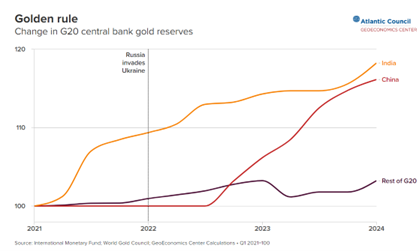
The West’s decision to freeze and legalise the theft of Russian sovereign funds predictably diminished trust in the Western financial system, resulting in a huge demand for gold and other precious metals as a safe haven. Gold is not a yield-bearing asset, yet it preserves its value during turbulent times. There are some more twists to the story: There is a rise in demand for physical gold and a push to store it in their home countries due to the lack of trust it can be stored safely in the West.
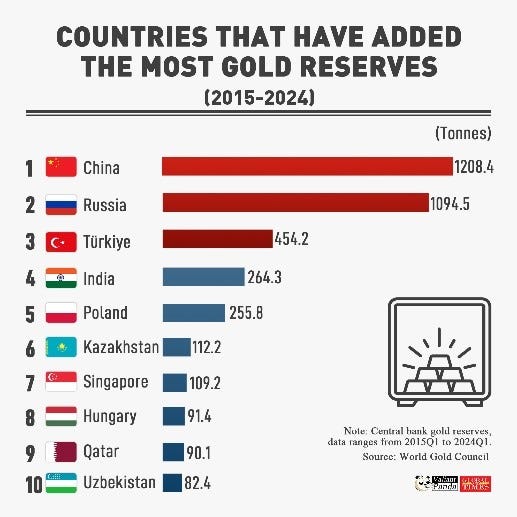
What was done to Russia could happen to anyone. An adversary like China is obviously next in line as the economic coercion to prevent its continued development intensifies. The EU demands China must pay a “higher cost” for supporting Russia, linking Russia and China seemingly for the purpose of convincing Trump to continue the war in Ukraine. Even friendly countries such as India could be targeted anytime with secondary sanctions for failing to bow to the demands of Washington.
From the US seizure of Afghanistan’s sovereign funds to Britain confiscating Venezuela’s gold, there is evidently reason for distrust. The main shock to the system was nonetheless the legalisation of the theft of Russia’s sovereign funds, which was justified by the Russian invasion of Ukraine. The moral premise is dubious at best as it would obviously not be considered acceptable if countries around the world seized the funds of the US and its NATO allies to pay reparations to the countries they have invaded.
Even within Western countries, predictability diminishes as the rules of law weaken. A British journalist reporting from Donbas had his bank account frozen without a day in court.[1] In Canda, hundreds of people had their bank accounts frozen for organising or attending the trucker protest.[2] Even the British opposition politician, Nigel Farage (“Mr. Brexit”), had his account suspended for political reasons.[3] Metro Bank used access to its financial services to punish opposition to its gender ideology as it denied banking services to an organisation opposed to the medical transitioning of children.[4] With many similar cases emerging, the term “de-banking” has entered the vocabulary.
Inflation and weaponisation of the dollar, coupled with growing political instability, are compelling large powers to take their money out of the Western financial system. China is still making dollars with its great trade surplus, but there is a growing reluctance to buy Western bonds or even leave the money in the Western financial system. China lends these dollars to other countries around the world rather than reinvesting it into the US market.

BRICS countries also prefer buying physical gold and they are also moving it to their own countries. Central banks and investors are not interested in exchange-traded funds (ETFs) as a cheap and easy way to own gold. Paper gold is not trusted, and investors demand physical gold. The gold is not even trusted to be stored in Western vaults anymore. China is having hundreds of tonnes of gold shipped from the West to China. Switzerland alone sent 524 tonnes of gold to China in 2022.[5] India brought home 100 tonnes of gold from the UK in 2024, the first large shipment since 1991. The transfer and storage of these metals are neither convenient nor cheap, yet the collapse in trust demands drastic actions. Bloomberg reports on Singapore constructing a six-story warehouse “designed to hold 10,000 tons of silver, more than a third of global annual supply, and 500 tons of gold”.[6]

There are many reasons not to store assets in rogue states: Risk of seizure or confiscation, lack of transparency, economic volatility, political instability etc. Unfortunately, all of these symptoms are becoming associated with the G7 countries as the financial system was weaponised. A key lesson of sanctions is that severe and prolonged sanctions result in the rest of the world adapting by learning to live without the belligerent actors.
Large gold reserves safely protected within national borders can also become important as new trade and reserve currencies are promoted. Fiat currencies will lose much trust in the financial turmoil that awaits, and future alternatives may need to yet again be backed by gold. Gold will certainly play a greater role as BRICS prepares a post-American financial system.
[1] PETER HITCHENS: Freedom for all means freedom for nasty people – Mail Online – Peter Hitchens blog
[2] Canada Ends Its Freeze on Hundreds of Accounts Tied to Protests – The New York Times
[3] Debanking: How Nigel Farage’s Banking Woes Have Raised Serious Concerns Over Account Closures
[4] The terrifying rise of ‘debanking’ – spiked
[5] Switzerland sent 524 tonnes of gold to China last year, the most since 2018 | Euronews
[6] As the Rich Snap Up Gold Bars, Storage Vaults Brace for Business – Bloomberg
Featured Video

Ian Proud: Economic Reset with Russia to Save Europe
or go to
Aletho News Archives – Video-Images
From the Archives
Magic Hour for Gates
By Gary Jordan | Wake The F*** UP | March 15, 2021
Bill Gates wants to know everything about you.
He wants to control every aspect of your life.
His insatiable thirst for the supervision and scrutiny of every human being alive has sparked a US$1 billion investment that will blanket the earth in video surveillance satellites, providing real-time feedback with a mere one-second delay. He advocates for Orwellian digital tools to track your every move and has bankrolled US$1.7 billion to provide artificial intelligence that will be used to scan each and every visitor to major event venues worldwide. He wants to do away with end-to-end encryption, so he can snoop on your private conversations. He wants to know when and where you travel and who you travel with. He wants you to eat whatever he says you should eat, drink whatever he says you should drink, think how he wants you to think and know only what he wants you to know. Plus he wants to dictate what goes inside your body.
But he doesn’t want you to know a lot about him.
For instance… continue
Blog Roll
Recent Comments


 Aletho News
- Apple Just Bought A Sinister ‘Pre-Speech’ Tech Company Implicated In Genocide
- Israel’s new West Bank registration process declares Palestinian land ‘state property’
- Two children killed in Palestinian Authority ambush in West Bank; Hamas slams attack as ‘black mark’
- Israel Needs Time Before Another Iran War—Here’s Why
- US seizes oil tanker for ‘defying Trump’s quarantine’
- Ian Proud: Economic Reset with Russia to Save Europe
- Senator Rand Paul Introduces Federal Bill to END Vaccine Makers’ Liability Shield
- The Hidden Map: US and Israel May Use Unexpected Neighbors to Attack Iran
- Trump, Netanyahu Agree to Target Iranian Oil Exports to China
- Russia open to discussing Ukraine’s ‘external governance’ – senior diplomat
- If Americans Knew
- In Gaza, “rats run over our faces” – Not a ceasefire Day 129
- Israel-backed border guards, GHF-linked aid – Not a ceasefire Day 128
- Israel battles Palestinian right of return, one Palestinian at a time – Not a ceasefire Day 127
- Noor’s short life of unimaginable suffering
- Israel Destroyed Gaza’s Hospitals. Now It’s Banning Doctors Without Borders.
- Is Spite of What Zionists Say, It’s a Good Thing to Criticize Governments
- Palestinian mother, daughter recount strip searches, harsh conditions in Israeli detention
- Israel used weapons in Gaza that made thousands of Palestinians evaporate
- ADL’s Stats Twist Israel’s Critics Into Antisemites
- Why Is the World Silent When the Gaza Genocide Is Not Over?
- No Tricks Zone
- Unfudging The Data: Dutch Meteorological Institute Reinstates Early 20th Centruy Heat Waves It Had Erased Earlier
- German Gas Crisis…Chancellor Merz Allegedly Bans Gas Debate Ahead of Elections!
- Pollen Reconstructions Show The Last Glacial’s Warming Events Were Global, 10x Greater Than Modern
- Germany’s Natural Gas Storage Level Dwindles To Just 28%… Increasingly Critical
- New Study Rebuts The Assumption That Anthropogenic CO2 Molecules Have ‘Special’ Properties
- Climate Scientist Who Predicted End Of “Heavy Frost And Snow” Now Refuses Media Inquiries
- Polar Bear Numbers Rising And Health Improving In Areas With The Most Rapid Sea Ice Decline
- One Reason Only For Germany’s Heating Gas Crisis: Its Hardcore-Dumbass Energy Policy
- 130 Years Later: The CO2 Greenhouse Effect Is Still Only An Imaginary-World Thought Experiment
- New Study Affirms Rising CO2’s Greening Impact Across India – A Region With No Net Warming In 75 Years
 Aletho News