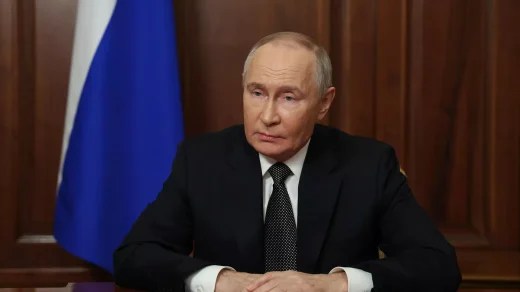
This week marks a fateful threshold for the world. In a grave announcement, Russian President Vladimir Putin said that the three-year proxy war in Ukraine has now reached a global dimension.
The responsibility for this abysmal moment lies fully with the United States’ elitist rulers and their British accomplices. They are inciting global catastrophe in a desperate bid to save their hegemonic empire.
Putin’s announcement on November 21 came only hours after Russia launched a retaliatory strike against Anglo-American aggression. Russia’s new hypersonic ballistic missile destroyed a munitions center in Dnepropetrovsk in central Ukraine. The conventionally armed missile – called Oreshnik – was deployed in combat for the first time. It delivered several warheads at Mach-10 speed. There is no air defense against such a unique weapon.
The Oreshnik attack was in response to the firing of long-range missiles by the United States and Britain on November 19 and 21 against the pre-conflict territory of the Russian Federation. There is no doubt that the U.S. and British forces were directly involved because, as Moscow has noted, the Ukrainian regime does not have the personnel or logistics capability to operate these advanced NATO weapon systems.
The conclusion is stark. The world is on the cusp of World War Three, a war that would inevitably become a nuclear conflagration and precipitate the end of life on Earth. The evil facing humanity is staggering.
Western barefaced lies to the public
Ludicrously, or perhaps more accurately, fiendishly, Western politicians and media are condemning Russia for the escalation. Their accusations are in flagrant contradiction with the facts. The Western public is being lied to about the sequence and causes of war.
In a move beyond reckless, the United States and Britain attacked Russia with long-range missiles from the territory of Ukraine. The ATACMS and Storm Shadow weapons were aimed at Bryansk and Kursk Oblasts in Western Russia. The American missiles were shot down by Russian air defense, while the British Storm Shadow cruise projectile caused deaths in Kursk.
That barrage marked an open act of war against Russia by the United States and Britain. Hence, the Russian leader commented that the proxy war in Ukraine had now taken on a global dimension.
The American and British leadership went ahead with this aggression even after Russia had explicitly warned several weeks ago that the deployment of such weapons against Russian territory would be seen by Moscow as an act of war. It also followed only hours after Russia revised its nuclear defense doctrine on November 19, defining that the use of long-range conventional weapons from the territory of a non-nuclear state (Ukraine) supplied by nuclear states (the U.S. and Britain) would constitute a joint attack, thereby giving Russia the right to retaliate with nuclear force.
The situation has thus entered the realm of nuclear world war.
Given the aggression initiated by the U.S. and Britain with their ATACMS and Storm Shadow missiles, Russia has the legal right to hit those territories and any other territory of the NATO alliance. Russia chose not to do so – for now – limiting its Oreshnik’s target to the territory of Ukraine.
What happens next over the coming days depends on the U.S. and its NATO partners. So far, the White House and Pentagon have sought to (irrationally) blame Moscow for escalation and are saying that the United States will continue to deploy long-range missiles from Ukraine against Russian territory. That remains to be seen if the insanity prevails.
Russia has shown incredible restraint
Far from escalating conduct, Russia has shown incredible restraint, given the relentless provocations by the U.S. and NATO over many months and, indeed, years.
The U.S. and its allies have continually weaponized their corrupt, NeoNazi Ukrainian proxy regime – whose pretend-president and former cross-dressing comedian Vladimir Zelensky was given a standing ovation in the European Parliament this week – despite repeated warnings from Moscow that the dynamic is leading to a world war.
The insanity is compounded by Zelensky’s insatiable demands for more weapons and Western taxpayer handouts worth hundreds of billions of dollars, along with hubristic Western notions that “Russia is bluffing.”
How delusional! The Western leaders are playing Russian Roulette. The United States and its NATO partners are now legitimate targets for Russian strikes. Russia demonstrated this week that it has the capability to breach any Western defense, and it is warning that any further aggression on its territory will be responded to.
President Putin admonished Western ruling elites to think carefully about the choices they are going to make. They can pull back from the abyss and negotiate a diplomatic end to the proxy war. Or they can choose to keep escalating to inevitable disaster.
Western ruling class beyond reason
However, of acute concern is that the Western ruling class seems to be beyond reason and sanity. The U.S. hegemon is facing an existential crisis from its terminal collapse as a global power and loss of imperial supremacy. Starting a war with Russia – even to the point of catastrophe – seems to be the only way the Western imperialist system led by the U.S. can respond.
Significantly, the Biden administration is only a matter of weeks from exiting in disgrace. Incoming President Donald Trump has vowed to end the conflict in Ukraine through prompt negotiations. The U.S. deep state is in a quandary.
The American people voted for Trump on November 5 in large part out of repudiation of the Biden administration, the Democrat Party and its servile adherence to the deep state’s endemic warmongering.
Before Trump’s inauguration on January 20, the American ruling class is desperately pushing the proxy war in Ukraine to prevent a negotiated settlement.
Biden’s approval for using ATACMS – followed by the British lackey Prime Minister Keir Starmer – was a brazen U-turn. Only a month ago, they refused such a move. The election of Trump and the prospect of diplomacy with Russia has caused the Western establishment to ramp up the proxy war.
This week saw the 1,000th day of conflict in Ukraine since Russia launched its special military operation to stop NATO aggression on February 24, 2022. The conflict has reached its most dangerous point.
Russia again this week repeated that it is open to a diplomatic settlement, just as it was in late 2021 when it presented far-reaching security proposals to prevent hostilities. The Western elites dismissed that opportunity, choosing the path of war instead. They also sabotaged the Minsk Accords in 2014 and 2015, and the Istanbul peace deal in March 2022. Millions of casualties later, they still want more war, slaughter, and global war, with their grotesque masks of “defending democracy and rules-based order.”
The American people want to end the conflict. The incoming Trump administration appears to be willing to honor the popular demand.
But sanity, morality and democracy are not qualities shared by the imperialist ruling class in the U.S. and its NATO accomplices.
An American deep state coup, then and now
A couple of observations are notable. November 22 marks the date 61 years ago when an American president, JFK, was murdered by the U.S. deep state. A coup d’état was executed very much for the objective of keeping the Cold War going with the Soviet Union because of the vested economic interests of U.S. militarism and the military-industrial complex.
All these years later, the U.S. deep state is attempting another coup against the democratic wishes of the American people for a peaceful end to the proxy war in Ukraine. The U.S. ruling elite want the war against Russia to persist in maintaining their lucrative profits and for existential reasons of empire. Joe Biden is a brain-dead president who is signing orders pushed in front of him by deep-state operatives like Tony Blinken and Jake Sullivan just before he wanders off to a retirement home – or into the Amazon jungle à la the hilarious photo-op at the G20 summit in Brazil this week.
Ukraine proxy war back to Nazi Germany
This long perspective also puts the Ukraine proxy war into a proper, wider historical context. The conflict in Ukraine did not start in February 2022. It did not even start with the CIA-backed coup in Kiev against an elected president in February 2014. It did not even start with the U.S.-financed Orange Revolution in Ukraine in 2004. This conflict goes back at least to the Soviet victory over Nazi Germany in 1945 when the United States and its imperialist allies immediately responded by creating the Cold War with its newly forged imperialist instrument known as NATO, in part by deploying Ukrainian fascist collaborators to covertly attack Russia. After World War Two, the CIA and Nazi remnants like spymaster Major General Reinhard Gehlen were united in purpose along with the British MI6 to defeat the Soviet Union. What is transpiring today in Ukraine is the culmination of a systematic conflict, essentially about projecting and maintaining Western imperial power.
The emergence of Russia, China, the BRICS, and the Global South has amplified Western imperial angst and diehard hostility to preserve global power and privilege. The latter hegemonic Western system is the epitome of fascism and neocolonialism.
Historical nemesis
There is a profound historical nemesis at this juncture. Will the U.S. imperial aggressor and its NATO front go down in defeat, or will it push the world to a final global war?
Russia is not bluffing. It won’t back down because of the historical sacrifices it has made already to defeat fascist tyranny – 27 to 30 million dead in World War Two alone. The Russian nation’s pain and suffering from imperialist aggression make it defiant and resolute in a way that the Western regimes could never comprehend or emulate.
Will sanity prevail? The American and European people have onerous obligations to hold their criminal elite rulers accountable.
We are inches away from a global thermonuclear war. And no, this isn’t a meaningless, overused catchphrase. Quite the contrary, it’s as serious as it gets. We have reached a historical boiling point. At no other time in human history have we been closer to the scenario of annihilation, not even during the so-called “Cuban” Missile Crisis. It should really be called “Turkish” or something along those lines. And it’s important to note that we’re not digressing from the topic by mentioning this.
Namely, the mainstream propaganda machine just loves maintaining its narratives that essentially whitewash the political West and denigrate the actual world. This is why the fact that the United States initiated the “Cuban” Missile Crisis by deploying nuclear-tipped missiles in Italy and Turkey back in 1961 (although some sources claim it was as early as 1959) is ever so “conveniently” forgotten. The USSR waited a full year (at the very least) to respond by placing its own missiles in Cuba.
Thus, it’s perfectly clear who initiated that confrontation. And yet, as previously mentioned, modern historiography remembers the event as the “Cuban” Missile Crisis, sending a subliminal message that it was initiated by the Soviet Union and Cuba. Why is this important? Because the same people are now telling us that Russia “escalated” the NATO-orchestrated Ukrainian conflict by “firing missiles at a democratic Ukraine”, once again “forgetting” to mention the preceding events.
Namely, as we all know, the political West gave the Neo-Nazi junta the go-ahead to use long-range missiles against targets deeper within Russia. And they just did. In the last two days, approximately a dozen ATACMS and “Storm Shadow”/SCALP-EG missiles have been used (on the same day Moscow updated its nuclear doctrine, mind you). So, how did the “evil Kremlin”, led by the “crazy, bloodthirsty tyrant Putin”, respond to this? Well, not with nukes, as we’re still here, even though the doctrine allows it.
However, Russia did fire what is technically an ICBM (intercontinental ballistic missile). This marks the first time such a weapon was used in a conflict. And while ICBMs normally carry thermonuclear warheads, this one was conventionally armed. To better understand what sort of weapon this is, we have to go back a decade or so, specifically to the RS-26 “Rubezh” program that was supposed to deter NATO’s crawling aggression in Europe and the post-Soviet space.
Namely, the RS-26 was envisaged as the successor to the formidable RSD-10 “Pioneer” IRBM (intermediate-range ballistic missile). Essentially a shortened version of the three-stage RS-24 “Yars” ICBM, with one stage removed (and some other modifications), the RS-26 had a shorter range, but was no less deadly. In fact, it carried more powerful warheads than the “Pioneer” (at least four 300 kt instead of the latter’s three 150 kt ones), while also being more accurate and impossible to intercept.
This enabled it to target even massive underground command centers or any other high-priority targets across NATO-occupied Europe. However, there was a (geo)political problem with the RS-26. Namely, it was made at a time when the INF Treaty was still in force (banning all missiles with ranges between 500 and 5,500 km). So, for the RS-26 to formally comply with this, it had to have a range greater than 5,500 km. Otherwise, it would violate the INF Treaty and be designated as an IRBM.
To avoid this, it was designed to achieve a maximum range of 5,800 km, just enough to be designated as an ICBM. However, this created another problem, as it affected the New START treaty. Namely, this would force Russia to reduce the number of its, so to speak, “purebred” ICBMs such as “Yars”, R-36M2 “Voevoda” and RS-28 “Sarmat”. As a result, in 2011, the program was postponed to a period after 2027, with most resources diverted for the development of Russia’s new hypersonic weapons.
But, on April 12 this year, Moscow tested an “unnamed ICBM”. To this day, the Russian military is yet to publicly reveal the exact type of the missile launched that day. At the time, I argued that the missile was actually the RS-26, as it had striking similarities with the previously mentioned RS-24 that the “Rubezh” was actually based on, including the way it conducted wobbling maneuvers designed to confuse NATO’s ABM (anti-ballistic missile) systems, making it virtually impossible to intercept.
For seven months, no news came through about this “mysterious ICBM”. Until the early hours of November 21, that is. Initially, the Russian military didn’t reveal what missile it was, letting NATO contemplate what to do next. However, the “mysterious ICBM” was soon not only uncovered, but actually named – “Oreshnik” (“Hazel” in Russian). However, solid information about the missile is extremely scant, fueling all sorts of speculation, wild guessing and outright misinformation.
For instance, the Pentagon insists the missile that hit Dnepropetrovsk was fired from Kapustin Yar, a testing site in the Astrakhan oblast (region) in southern Russia, located over 1000 km to the east. This distance is too short for an ICBM, raising questions about the veracity of the US military’s claims. Then, videos from Kazakhstan emerged, specifically over the city of Satbayev, which is 1,500 km to the east of Kapustin Yar. Even more interestingly, some 450 km to the southeast lies Sary Shagan.
This place is home to one of the largest and most important missile test sites in the former Soviet Union, with the Russian military still using it extensively, including during the aforementioned April 12 test. It’s simply impossible to see “Oreshnik” fly over Satbayev if it was fired from Kapustin Yar to Dnepropetrovsk. However, it’s certainly possible that the missile was fired from Sary Shagan. Still, NATO doesn’t want to reveal that it flew nearly 2,400 km before hitting its targets with pinpoint precision.
Even more interestingly, videos over Satbayev also show that the missile is wobbling and maneuvering just like the “mysterious ICBM” tested on April 12, further reinforcing the notion that the “Oreshnik” could actually be a conventionally armed “Rubezh”. In addition, its maximum range exceeds 5,000 km, which puts virtually all of Europe in range. And indeed, it makes little sense to get a completely new missile if you have the “Rubezh”, as it’s already a largely finished product.
Technically speaking, there are several possibilities when it comes to the “Oreshnik”. First, it doesn’t even have to be a regular missile and could be some sort of MaRV (maneuverable reentry vehicle), MIRV (multiple independently targetable reentry vehicle), HGV (hypersonic glide vehicle), etc. or perhaps even a hybrid, with the “Rubezh” being the primary missile carrier. The “Rubezh” itself can already carry the “Avangard”, so if the “Oreshnik” is an HGV, it shouldn’t be a problem for the “Rubezh” to deploy it.
Another possibility is that the “Oreshnik” is a completely new missile (not necessarily ballistic, but likely a more advanced hypersonic, maneuvering weapon) that has its own MIRV/MaRV/HGV warheads. There are no definite claims about this at present, simply because very little is publicly known about it. However, personally, I am more inclined to believe that the “Oreshnik” is a conventionally armed HGV that can be carried by nuclear-capable ICBM/IRBMs like the RS-26 “Rubezh”.
The reason is quite simple, because why would someone make something completely new when they already have a finished project that can immediately go into production (the “Rubezh” uses the same production lines as the “Yars”)? This reinforces the notion that the RS-26 is a highly modular design which can be equipped with various types of warheads, including conventional ones. It also harkens back to President Putin’s vision of Russia’s strategic preemptive strike capabilities.
One more thing that should be noted about the “Oreshnik” is that it was certainly an overkill against the Neo-Nazi junta. Russia’s more tactical and operational level missiles could’ve easily conducted this. However, given the fact that Moscow is faced with the increasingly delusional and aggressive West, it just had to demonstrate its firepower, prompting Putin to authorize the long-range strike on Dnepropetrovsk. This is a particularly important message to both the US and EU/NATO.
In terms of the functioning of the missile’s warhead, the available footage shows at least 30 smaller projectiles divided into five groups (six in each). The lack of visible detonations (although at least one was seen) suggests these are probably advanced kinetic penetrators capable of annihilating heavily defended and dug-in positions. This means that any NATO base anywhere in Europe and/or elsewhere would be in range, but Russia wouldn’t need to rely on its thermonuclear arsenal to deter aggression.
Drago Bosnic is an independent geopolitical and military analyst.
Previous episodes of this series explained NATO’s senseless expansion that threatened Russia and caused a disastrous war in Ukraine. The plot to add Ukraine to NATO failed. As Russian troops advance to occupy all of Ukraine to secure it as a close ally, nearby nations may choose to join the prospering Russian led Eurasian Economic Union. Russia may encourage Ukraine’s neighboring nations to join its economic block with a return of Ukrainian land seized by the Soviets.
The loss of Eastern Europe would be a huge setback for the Anglo-American empire as members leave NATO and the EU to trade freely with Russia and China, or join a new Hungarian led Eastern Europe economic union that does not support EU and Anglo-American sanctions nor imperial adventures in Africa and Asia. This is likely to happen if Russian troops reach Ukraine’s western border to open the door to the east. As a result, the Anglo-American empire may risk World War III and send NATO troops into Ukraine to block further Russian advancement and halt a rebellion by its vassal states.
_________________________________
“As EU Confirms Economic Punishments On China, U.S. Panics Over Impending Iran Oil Attack”; Sean Foo; YouTube; October 5, 2024; • As EU Confirms Economic Punishments O…
More than just a dangerous provocation aimed at Russia, the ATACM and Storm Shadow attacks represent an attempt to turn foreign policy on its head.
“The Deep State whispered to Trump: ‘You cannot withstand the storm’. Trump whispered back: “I am the storm”. The war is on. The Deep State has launched a war of disruption to disable Trump’s ‘storm’. This week’s ATACM strike was but one part to an inter-agency counter-insurgency – a political strike directed at Trump; so too are all the inter-agency false narratives attributed to the Trump camp; and so too, the escalating provocations directed at Iran.
Be assured the Five Eyes are full participants in the counter-insurgency. Macron and Starmer openly conspired together in Paris ahead of the U.S. announcement to promote the ATACMS strike. The inter-agency grandees clearly are very fearful. They must worry that Trump may expose the ‘Russia Hoax’ (that Trump in 2016 was a Russian ‘asset’) and put them in jeopardy.
But Trump understands what’s afoot:
“We need peace without delay … The foreign policy establishment keeps trying to pull the world into conflict. The greatest threat to Western civilization today is not Russia. It’s probably more than anything else ourselves… There must be a complete commitment to dismantling the entire Globalist Neo-con establishment that is perpetually dragging us into endless wars, pretending to fight for freedom and democracy abroad while they turn us into a Third World country and a Third World dictatorship right here at home. The State Department, the Defense bureaucracy, the intelligence services and all of the rest need to be completely overhauled and reconstituted. To fire the Deep Staters and put America first – we have to put America First”.
Whilst the long-range ATACM launch on ‘deep Russian pre-2014 territory’ is no game-changer – it will not change the course of the war (ATACMS regularly are – at 90% – downed by Russian Air Defences); the salience of this act however, is not strategic; rather, it lies with the crossing into the realm of direct NATO attacks on Russia.
Colonel Doug MacGregor reports that two sources are telling him that “Russian nuclear rocket forces are on full alert. They are at the highest level of readiness ever achieved. It suggests that Russia has taken this crossing of the line very seriously”.
Yes, it was a provocation, and President Putin will respond appropriately. He has to – but not necessarily through nuclear escalation. Why? Because the war in Ukraine is moving rapidly in his direction, with Russian forces closing-in on the Dnieper east bank. Effectively, facts on the ground will be the outcome determinant, leaving little point to external mediation.
But more than just a dangerous provocation aimed at Russia, the ATACM and Storm Shadow attacks represent an attempt to turn foreign policy – literally – on its head. Instead of policy being aimed directly at a rising foreign adversary threatening U.S. hegemony, it is being transformed into a loaded weapon locked onto America’s domestic war. It is aimed specifically at Trump – to ‘hog tie’ him in, and to divert his attention to wars that he does not want.
Logic suggests that Trump would want to keep clear of Netanyahu’s scheming for a war against Iran. But the ‘Israel Firsters’ and the Lobby (as Professor Jeffrey Sachs argues) long have had effective control over Congress and the U.S. military – more than does the President. Explains Sachs:
“Because the Zionist Lobby is so powerful, Netanyahu basically has had control over the Pentagon to fight wars on behalf of Israeli extremism. The war in Iraq in 2003 was a Netanyahu War. The attempt to overthrow Bashar al-Assad in Syria, the overthrow of Moamar Gaddafi – All were ‘Netanyahu Wars’”.
The important point is that Netanyahu can ‘do what he does’ because it was always planned this way – a plan that has been 50 years in execution. The ‘Israel First’ strategy was fully embraced by Scoop Jackson (a two-times Presidential candidate). And just so the policy could not be rolled back, Scoop insisted on Zionists staffing the State Department, and that neo-cons and Zionists hold the reins at the NSC. That same pattern continues until today.
At bottom lies the ultimate boondoggle by which the political class of both U.S. parties become wealthy and afford the campaign costs of remaining legislators: “It’s quite a dandy deal that the Israel Lobby or the Zionist Lobby puts in, say, a hundred million dollars into campaigns and it gets trillions out –trillions, not billions, trillions out [in government] expenditures. And so, when Netanyahu speaks, it’s bizarre to me, but it is not Trump who is appointing or naming [those ‘Israel Firsters’ who are part of his Team, but Netanyahu]”, Sachs says.
When Netanyahu describes Trump’s ‘Israel First’ nominations as his ‘dream U.S. team’, the explanation is not difficult to see. On the one hand, Trump has a ‘Revolution’ to conduct in America and wants his nominations to office approved. And, on the other, Netanyahu has a further war he wants the U.S. to fight for him.
“The ‘Big Ugly’ was always a description of the battle that few understood”, another commentator notes:
“The Senate is factually the core of republican opposition to MAGA and President Trump. The visible battle … consumes the most attention. However, it is the less-visible battle against the entrenched ideological Republicans that proves to be the hardest”.
“The Republicans in the upper chamber will not relinquish power easily. They have a multitude of weapons to use against the (Trump) insurgency … We are seeing this play out now in the alignment of Republican Senators who stand in opposition to Trump’s nomination of Matt Gaetz as Attorney General, [as] this recent report [explains]”.
“The basic outline is that the senate leadership will reluctantly support Matt Gaetz for Main Justice, where ‘support’ means they will not directly oppose; in exchange for the nomination of FBI Director Mike Rogers [a co-founder of the ‘Never Trump’ group] to defend inter-agency interests at FBI”.
The prospective Republican Senate Leader, John Thune, will play his cards carefully in order to extract maximum damage . He has leverage by trying to connect Trump to Netanyahu’s carnage in the region.
Thune, whilst announcing huge quantities of weapons for Israel, said:
“To Our Allies in Israel, and to the Jewish People Around the world, my message to you is this: Reinforcements are on the way. In six weeks, Republicans will reclaim the Senate Majority, and we will make clear that the United States Congress stands squarely In Israel’s Corner”.
Trump will need to play his cards carefully, too. Since, for his purposes, the absolute priority are his two domestic wars: First, “dismantling the entire Globalist Neocon Establishment”, and secondly, ending the out-of-control government expenditure that has bloated the Deep State boondoggle and turned the U.S. real economy into a shadow of its former self.
Trump needs those radical reform nominations to pass, even if he has to sacrifice one or two to secure Senate approval for the others. The Israel First nominees, needless to add, will be approved seamlessly.
Of the two ‘entanglement’ threats to Trump’s reform agenda, Russian escalation is the lesser of the two. The Ukraine war is motoring steadily towards some form of dénoument. One that works for Russia. Putin is in the driving seat, and does not need a major war with NATO. Nor does Putin need Trump’s ‘art of the deal’. A resolution of some sort will occur without him.
However, Trump’s role will be important subsequently to define a new border between the security interests of the Atlanticists and those of the Asian heartland (including China and Iran).
The other putative war – Iran – is the more dangerous to Trump. Jewish political influence and the Lobby has taken the U.S. into multiple disastrous wars before. And now, Netanyahu desperately needs a war and he is not alone. Much of Israel is clamouring for war that would end ‘all the fronts’ facing it. There is a profound conviction in this prospect as the solution and the ‘Great Victory’ that Netanyahu and Israel so desperately need.
The ground has been dug-over, both by propaganda that Iran’s nuclear programme is ‘staggeringly vulnerable’ (which it isn’t), and by the media’s onslaught that replays the meme that to attack Iran now represents a once-in-a-lifetime opportunity, with Hizbullah and Hamas already weakened. War with Iran – totally erroneously – is thus being sold as an ‘easy war’.
There is an unshakeable certitude that it must be so. ‘We are strong, and Iran is weak’.
Who will roll-back the Israel Firsters? They have the momentum and the fervour. A war against Iran will fare badly for Israel and the U.S. The wide ramifications likely will precipitate precisely the severe financial and market crisis that could derail Trump’s ‘Storm’.
The latest round of US sanctions against Russian financial institutions, which specifically target Gazprombank, is an attempt to block Russia’s gas supplies to the EU, Kremlin spokesman Dmitry Peskov stated on Friday. The lender is Russia’s primary bank for energy-related transactions.
Peskov warned that Moscow would respond to restrictions with countermeasures, though he did not specify what they would entail.
The Kremlin spokesman’s remarks follow an announcement by the US Office of Foreign Assets Control (OFAC) on Thursday, which said Gazprombank and six of its international subsidiaries had been added to its sanctions blacklist. Gazprombank had already been sanctioned by the UK and Canada shortly after the escalation of the Ukraine conflict in 2022. However, the US had previously avoided placing restrictions on the lender as it was used by EU states to pay for Russian gas.
When asked whether the Kremlin viewed sanctions on Gazprombank as an attempt to jeopardize supplies of Russian gas to Europe, and whether Moscow planned any response, Peskov replied: “The answer is ‘Yes’ to both questions.”
He noted that Russian authorities were already working on ways to alleviate the problems that the new restrictions could cause Russia and its foreign gas buyers.
“Of course, we’ll find options. It is impossible to introduce completely blocking measures against a country like Russia. It may take some time, but a solution will still be found,” Peskov said.
The new measures mean Gazprombank can no longer carry out transactions that involve the dollar-based financial system. Gazprombank earlier said that sanctions would not affect its operations within Russia, but warned that its UnionPay cards may stop working outside the country.
Apart from Gazprombank, the new US restrictions also targeted more than 50 small-to-medium Russian lenders, some 40 securities registrars, and 15 financial officials.
After the escalation of the Ukraine conflict in 2022, the EU declared the elimination of its reliance on Russian energy to be its top priority. Many member states, including Poland, Bulgaria, Finland, the Netherlands, and Denmark, voluntarily halted their imports. However, several EU nations, including Austria, Hungary, Slovakia, the Czech Republic, and Italy continue to rely on Russian gas to meet their energy needs, and have not stopped buying the commodity despite pressure from peers within the bloc.
Moscow has slammed Western sanctions as illegal, and noted that they keep backfiring on the countries that impose them. Russia has also been gradually moving away from the dollar in trade, switching to transactions using national currencies with most of its international partners.
The newly imposed US sanctions against Russia’s Gazprombank are expected to send energy costs surging in parts of Europe, Finam Financial Group analyst Aleksandr Potavin told TASS on Friday. The risk of secondary restrictions will force buyers of Russian oil and gas to seek new payment tools, he predicted.
On Thursday, the US Treasury Department introduced blocking sanctions against more than 50 Russian lenders, including Gazprombank and six of its international subsidiaries. The new penalties effectively cut one of Russia’s largest banks off from the SWIFT interbank messaging system, meaning it can no longer carry out transactions that involve the dollar-based financial system. Gazprombank’s assets in the US have also been frozen.
“Due to the new sanctions against Gazprombank, foreign buyers of Russian gas and oil will be faced with the need to look for alternative payment routes that are likely to complicate the entire process, increase risks, and make the payment procedure more expensive,” Potavin said.
He specified that European buyers could use accounts in other banks or pay for energy supplies via other world currencies as an alternative.
“The new sanctions will lead to an increase in prices for Russian hydrocarbons in Europe, and supply disruptions can’t be ruled out as well, since all this creates new risks for foreign companies working with Russia,” he explained.
According to Alexander Frolov, expert at the InfoTek energy news center, the latest restrictions won’t have a direct impact on buyers of Russian gas who previously agreed to adopt the “gas for rubles” scheme to pay for their energy purchases. They will only apply to individuals and legal entities subject to US jurisdiction, he said, as quoted by TASS.
The analyst admitted, however, that companies using rubles for Russian energy supplies are at risk of secondary sanctions, “so gas buyers from Europe will turn to the US Treasury for clarification.”
Supplies of Russian pipeline gas to Europe have substantially declined due to Ukraine-related restrictions and the sabotage of the Nord Stream pipelines, although EU nations are still importing record volumes of LNG from the sanctions-hit state. Despite the bloc’s vows to drop purchases of Russian energy, it remains one of the world’s major buyers of Russian fossil fuels. In August, pipeline gas comprised the largest share of the EU’s purchases of Russia’s fossil fuels (54%), followed by LNG (25%), according to the Centre for Research on Energy and Clean Air (CREA).
MOSCOW – Russia’s further actions if the West does not take its concerns into account have been outlined, Kremlin spokesman Dmitry Peskov said on Friday, commenting on a statement made by President Vladimir Putin about a brand-new medium-range missile, Oreshnik.
Putin said in a televised speech on Thursday that Ukraine fired US-supplied ATACMS missiles and the UK’s Storm Shadows at facilities in the Kursk and Bryansk regions on November 19. Russia responded by launching a combined strike against a defense industry complex in Dnepropetrovsk, also known as Dnipro, on Thursday using the Oreshnik missile.
“Further retaliatory actions in the event that our concerns are not taken into account are also quite clearly outlined,” Peskov told reporters.
The main message of Putin’s statement is that the West’s reckless decisions on the supply of missiles to Ukraine cannot remain unanswered, the official said.
“We would, of course, prefer that Washington listened to the statements the Russian president made several months ago in St. Petersburg, where he absolutely exhaustively outlined our position on permission to use this foreign missile technology to strike deep into Russian territory. In St. Petersburg, the president sent a clear message, and we, frankly, would prefer that message to be taken into account,” Peskov said.
Additionally, Russia sent the US an automatic warning about the launch of the Oreshnik missile due to the fact that the missile is a ballistic one, the official said, adding that the missile “does not cause responsibilities like an intercontinental missile, but still, since it is ballistic, this … operates in automatic mode.”
“The Russian side clearly demonstrated its capabilities,” Peskov said.
President Vladimir Putin has promised a decisive response to any aggression, criticizing the West for escalating tensions, and reiterated Moscow’s willingness to engage in peace talks to resolve the Ukraine conflict.
Here’s a full text of Putin’s address, as provided by the Kremlin.
President of Russia Vladimir Putin: I would like to inform the military personnel of the Russian Federation Armed Forces, citizens of our country, our friends across the globe, and those who persist in the illusion that a strategic defeat can be inflicted upon Russia, about the events taking place today in the zone of the special military operation, specifically following the attacks by Western long-range weapons against our territory.
The escalation of the conflict in Ukraine, instigated by the West, continues with the United States and its NATO allies previously announcing that they authorise the use of their long-range high-precision weapons for strikes inside the Russian Federation. Experts are well aware, and the Russian side has repeatedly highlighted it, that the use of such weapons is not possible without the direct involvement of military experts from the manufacturing nations.
On November 19, six ATACMS tactical ballistic missiles produced by the United States, and on November 21, during a combined missile assault involving British Storm Shadow systems and HIMARS systems produced by the US, attacked military facilities inside the Russian Federation in the Bryansk and Kursk regions. From that point onward, as we have repeatedly emphasised in prior communications, the regional conflict in Ukraine provoked by the West has assumed elements of a global nature. Our air defence systems successfully counteracted these incursions, preventing the enemy from achieving their apparent objectives.
The fire at the ammunition depot in the Bryansk Region, caused by the debris of ATACMS missiles, was extinguished without casualties or significant damage. In the Kursk Region, the attack targeted one of the command posts of our group North. Regrettably, the attack and the subsequent air defence battle resulted in casualties, both fatalities and injuries, among the perimeter security units and servicing staff. However, the command and operational staff of the control centre suffered no casualties and continues to manage effectively the operations of our forces to eliminate and push enemy units out of the Kursk Region.
I wish to underscore once again that the use by the enemy of such weapons cannot affect the course of combat operations in the special military operation zone. Our forces are making successful advances along the entire line of contact, and all objectives we have set will be accomplished.
In response to the deployment of American and British long-range weapons, on November 21, the Russian Armed Forces delivered a combined strike on a facility within Ukraine’s defence industrial complex. In field conditions, we also carried out tests of one of Russia’s latest medium-range missile systems – in this case, carrying a non-nuclear hypersonic ballistic missile that our engineers named Oreshnik. The tests were successful, achieving the intended objective of the launch. In the city of Dnepropetrovsk, Ukraine, one of the largest and most famous industrial complexes from the Soviet Union era, which continues to produce missiles and other armaments, was hit.
We are developing intermediate-range and shorter-range missiles in response to US plans to produce and deploy intermediate-range and shorter-range missiles in Europe and the Asia-Pacific region. We believe that the United States made a mistake by unilaterally destroying the INF Treaty in 2019 under far-fetched pretext. Today, the United States is not only producing such equipment, but, as we can see, it has worked out ways to deploy its advanced missile systems to different regions of the world, including Europe, during training exercises for its troops. Moreover, in the course of these exercises, they are conducting training for using them.
As a reminder, Russia has voluntarily and unilaterally committed not to deploy intermediate-range and shorter-range missiles until US weapons of this kind appear in any region of the world.
To reiterate, we are conducting combat tests of the Oreshnik missile system in response to NATO’s aggressive actions against Russia. Our decision on further deployment of intermediate-range and shorter-range missiles will depend on the actions of the United States and its satellites.
We will determine the targets during further tests of our advanced missile systems based on the threats to the security of the Russian Federation. We consider ourselves entitled to use our weapons against military facilities of those countries that allow to use their weapons against our facilities, and in case of an escalation of aggressive actions, we will respond decisively and in mirror-like manner. I recommend that the ruling elites of the countries that are hatching plans to use their military contingents against Russia seriously consider this.
It goes without saying that when choosing, if necessary and as a retaliatory measure, targets to be hit by systems such as Oreshnik on Ukrainian territory, we will in advance suggest that civilians and citizens of friendly countries residing in those areas leave danger zones. We will do so for humanitarian reasons, openly and publicly, without fear of counter-moves coming from the enemy, who will also be receiving this information.
Why without fear? Because there are no means of countering such weapons today. Missiles attack targets at a speed of Mach 10, which is 2.5 to 3 kilometres per second. Air defence systems currently available in the world and missile defence systems being created by the Americans in Europe cannot intercept such missiles. It is impossible.
I would like to emphasise once again that it was not Russia, but the United States that destroyed the international security system and, by continuing to fight, cling to its hegemony, they are pushing the whole world into a global conflict.
We have always preferred and are ready now to resolve all disputes by peaceful means. But we are also ready for any turn of events.
If anyone still doubts this, make no mistake: there will always be a response.
The Russian president announced that the country’s armed forces carried out a combined strike using the latest Oreshnik medium-range missile against a Ukrainian defense industry facility in response to US and British weapon strikes on Russian territory.
Russian President Vladimir Putin has said that Kiev’s use of long-range weapons will not affect the course of the special military operation, and all its objectives will be achieved.
Illusions about the possibility of delivering a strategic defeat to Russia, about the events currently unfolding in the zone of the special military operation, particularly in light of the use of long-range Western-made weapons against our territory [should not be held],” Putin said in his address on Thursday.
On the Response to Long-Range Weapon Attacks
The president reported that on November 19, Ukrainian forces attacked targets in the Bryansk region with six ATACMS missiles, followed by Storm Shadow system strikes in the Kursk region on November 21. Air defense systems repelled the attacks, resulting in no casualties or significant damage.
Putin emphasized that the conflict in Ukraine has acquired global dimensions after these attacks.
“From this moment, as we have repeatedly emphasized, the conflict in Ukraine, provoked earlier by the West, has acquired global characteristics,” he stressed.
He noted that the use of long-range munitions against Russia is impossible without specialists from the countries where they were manufactured.
“We consider ourselves entitled to use our weapons against the military facilities of those countries that allow their weapons to be used against our facilities. In the event of an escalation of aggressive actions, we will respond equally decisively and symmetrically,” the president stated.
He added that Kiev’s use of long-range weapons will not affect the course of the special military operation, and all its objectives will be achieved.
On the International Security System
Putin likewise emphasized that the international security system was destroyed by the United States, which made a mistake by withdrawing from the Intermediate-Range Nuclear Forces Treaty in 2019.
“Let me stress once again that it was not Russia but the United States that destroyed the international security system, and by clinging to its hegemony, it is pushing the entire world toward a global conflict,” he noted.
Putin added that Moscow will respond decisively and symmetrically in the event of escalation. He stated that Russia always advocates resolving disputes peacefully but warned against underestimating its readiness for any developments.
The president also said that the deployment of Russian intermediate-range and shorter-range missiles will depend on the actions of the US and its allies. Targets for future tests of advanced missile systems will be chosen based on threats to Russia.
“Of course, when selecting targets for such systems as Oreshnik on Ukrainian territory as a necessary countermeasure, we will inform civilians and request citizens of friendly nations in those areas to leave dangerous zones in advance,” the head of state stressed.
“This will be done openly, publicly, and out of humanitarian considerations, without fear of opposition from the enemy,” Putin emphasized during his address.
NATO Actions Prompt Oreshnik Missile Tests
The Oreshnik missile system is being tested in combat conditions as a response to NATO countries’ aggressive actions against Russia, he announced.
“In response to the use of American and British weaponry on November 21 this year, Russian armed forces conducted a combined strike on one of Ukraine’s defense-industrial complex facilities. This included testing one of Russia’s latest medium-range missile systems in combat conditions. In this case, a ballistic missile equipped with non-nuclear hypersonic technology, referred to as Oreshnik by our missile forces, [was used]” Putin stated during his address.
Modern air defense systems cannot intercept Oreshnik missiles, which attack targets at a speed of Mach 10—about 2.5-3 kilometers per second, Putin explained.
“Existing modern air defense systems worldwide, including the missile defense systems created by Americans in Europe, cannot intercept such missiles. It’s impossible,” Putin said in his speech.
Russia has apparently launched a single RS-26 Rubezh road mobile missile against a target in Dnipro, Ukraine (Dnipropetrovsk).
According to Ukrainian authorities, the missile struck an unnamed industrial enterprise.
Dnipro is home to the Pivdenmash (former Yuzhmash) missile production facility.
Analysis of imagery of the attack indicates the RS-26 carried six independent warheads, each in turn deploying several submunitions.
This warhead package is exclusively for conventional attack.
Russia had not been previously assessed to outfit the RS-26 with a warhead of this design.
By unveiling the conventionally armed RS-26, Russia is changing the qualitative nature of the conflict, something promised by President Vladimir Putin.
Ukraine and its Western allies must now evaluate the destructive potential of this weapon, and understand that Russia can deliver this warhead to any target in Ukraine or Europe knowing there is no defense against it.
The RS-26 is produced in Votkinsk. It is assessed that the production of the RS-26, which was halted in 2017, was resumed this past summer. With production rates estimated at 6-8 missiles per month, Russia could have accumulated an arsenal of between 30-40 RS-26 missiles. Although described as an intercontinental ballistic missile, the RS-26’s range actually depends on the warhead package. If armed with a single warhead, it can exceed the 5,000 kilometer threshold used to differentiate between intermediate and intercontinental range missiles. The RS-26 did not go into serial production because of this ambiguity; at the time, Russia was a signatory to the INF treaty, which prohibited intermediate range missiles.
It is assessed that the six warhead conventional warhead package used against Dnipro would have made the RS-26 used fall into the intermediate range for classification.
Donald Trump withdrew from the INF treaty in 2019.
If the United States had remained in the treaty, this version of the RS-26 would not have been available for use by Russia.
Moscow has asserted that it has the right to strike the military facilities of countries that allow the use of their weapons against Russian territory, President Vladimir Putin has said.
The head of state made the remarks during a public address on Thursday, promising a decisive response to any aggression.
“We will determine the targets during further tests of our newest missile systems based on the threats to the security of the Russian Federation,” Putin stated.
The president continued: “We believe that we have the right to use our weapons against the military facilities of those countries that allow their weapons to be used against our facilities.”
According to Putin, the United States has ravaged the international security system, and now the entire world is being pushed towards global conflict.
The Russian president emphasized that Moscow has always favored a peaceful resolution and is now ready to resolve all contentious issues.
“But we are also ready for any development. Do not doubt it, there will always be a response,” he stressed.
The Russian military has launched a start-of-the-art intermediate-range ballistic missile against a Ukrainian target, President Vladimir Putin said in a public address on Thursday.
As part of what the president called a “combat test,” the hypersonic missile, dubbed ‘Oreshnik’ (‘Hazel’), successfully struck a military industrial facility in the Ukrainian city of Dnepropetrovsk (also known as Dnipro in Ukraine), Putin added.
The strike was a response to Ukrainian attacks on military facilities located on internationally recognized Russian territory, the president stated. On Tuesday and Thursday, Kiev’s forces launched the attacks, using US-made ATACMS and HIMARS systems as well as British-made Storm Shadow missiles, he said.
Earlier, the Western media reported that Kiev had received approval from Washington and London for the use of Western-made long-range systems for strikes deep into Russia.
One of the strikes resulted in some casualties at a Russian command center in the Kursk Region but failed to disrupt its operations, the president said, adding that such developments have also drastically changed the nature of the Ukraine conflict, making it a more “global” one.
We often speak of the collective West, Hegemon, Seapower and Civilization of the Sea in relation to the United States of America. It is necessary to understand well what is the origin of this geopolitically determinant power for the world order.
He who wins the war, dictates the rules
Let us make clear at once an empirically incontrovertible factual truth: He who wins the war, dictates the rules of the post-war order. Whoever wins, writes history. Whether we like it or not, the defeated never had much decision-making power (which is not to say that they could not organize well to retaliate and return to power – but that is another matter).
World War II ended with the victory of the United States of America as the first, undefeated and predominant power. From there followed an expansion of U.S. influence toto orbe terrarum in all respects (cultural, economic, military, political).
The twentieth century was the “American century.” Almost the whole world took the shape the U.S. wanted to give it. The second half of the century was marked by the low-tension conflict of the Cold War, which ended-if it really did-with the collapse of the Soviet political system in the USSR and the beginning of the unipolar phase of American global domination. That period aroused much optimism in the West for a new world order, marking the end of the military and ideological rivalry of the 20th century. Two possibilities were on the horizon: a system based on balance of power and egalitarian sovereignty, or a U.S.-led liberal hegemony based on the values of democracy. The first approach evoked perpetual conflict, while the second promised lasting peace and global stability.
U.S. hegemony, already dominant in the transatlantic region after World War II, was seen as a model of peace and prosperity. However, the collapse of the Soviet Union removed the justification for a world order built on the balance of power, pushing the United States toward a mission of recognized hegemony to prevent the rise of new rivals. American supremacy, as declared by Secretary of State Madeleine Albright, was deemed “indispensable to ensure global stability.”
This was the Pax Americana: the U.S. would ensure a period of prosperity and global peace – as early as the end of WWII – by extending control over the entire world. A peace for America was equivalent to a peace for the globe; a war for America would mean war for the entire globe. The stated goal of building a peaceful world often justified imperialistic approaches, revealing the contradictions of the hegemonic project.
Set this paradigm as an axiom of reasoning in international relations and geopolitical programming, lo and behold, everything acquired new meaning. The world had been formatted and the “control room” was now in Washington.
The time of ideologies
It was the time of ideologies. In the “short century” everything had changed rapidly. The great world chessboard was constantly being shaken and reshuffled. The clash between the Western bloc and the Eastern – or Soviet – bloc characterized all concepts of each country’s politics in an extremely powerful way.
In the 1990s, two visions dominated the debate on world order: that of Francis Fukuyama and that of Samuel Huntington. Fukuyama in his famous book The End of History, envisioned a future in which liberal democracy and capitalism would triumph universally, leading to perpetual peace under the leadership of the United States: he argued that economic interdependence, democratic reforms, and shared institutions would unite the world around common values, which were, of course, American values. Any other model of civilization would have been beside the point, because History was finished, there would be nothing left to write about. In contrast, Huntington, wrote The Clash of Civilizations, in which he predicted that the world would be fragmented into distinct cultural blocs based on civil, religious and economic identities. Individualism and human rights, according to him, were peculiar to the West and not universal. His theorizing assumed a future marked by conflicts between civilizations, fueled by the decline of Western hegemony and the emergence of alternative powers, particularly in Confucian and Islamic societies.
The influence of Fukuyama’s ideas shaped post-Cold War Western politics, justifying the expansion and exceptionalism of Pax Americana. Exceptionalism that has been one of the U.S.’s most pragmatic “values”: there are rules and only we can break them, when we want, how we want and without having to account to anyone.
History, however, does not have only one actor: other countries, such as Russia, have chosen to be fascinated by Huntington’s proposal – confrontational, certainly, but not already “final.” In Russia, this debate has deep roots, linked to the historical rivalry between Westernists and Slavophiles. In the 1990s, Russia initially tried to move closer to the West, but the West’s failure to include it reinforced the idea of a distinct Russian civilization, culminating in Vladimir Putin’s view that no civilization can claim to be superior.
A matter of ideologies, indeed, a low-profile but very high-value battle in which the steps of the new century that was beginning would be defined. These divergences highlighted the tension between universalist aspirations and distinctive cultural identities, defining the geopolitical conflicts of the 21st century.
Building Pax Americana at any cost
Washington promoted a world order based on the Pax Americana, a liberal hegemony that reflected the success of the peaceful and prosperous transatlantic system created by the United States during the conflict with the Soviet Union. It proposed to extend this model globally, citing as examples Germany and Japan, transformed from militaristic and imperialist nations into “peaceful”-or, rather, defeated-democracies under U.S. influence. But the success of these transformations had been made possible by the presence of a common adversary, Russia, and the history of Latin America suggested that U.S. hegemony was not always synonymous with progress and peace.
Charles Krauthammer described the post-Cold War period as a “unipolar moment,” characterized by American dominance, where the new Hegemon dictated the rules and the others had little choice. Although he recognized that a multi-participant set-up (today we can say “multipolarism”) would inevitably return, he believed it was necessary to exploit unipolarity to ensure temporary peace, avoiding a return to turbulent periods. There was a weakness, however: the United States was unlikely to voluntarily relinquish its dominant role, preferring instead to counter any threat by force, fueled by an obsession with its own historical greatness. It is a missile issue: whoever has it bigger, wins. Let us not forget that the U.S. invented the strategic concept of deterrence precisely by virtue of the atomic weapon it held, throwing the world into a climate of constant fear and risk in which we still live today.
It is equally true that many Americans wished for a dismantling of the U.S. empire, proposing a less interventionist foreign policy focused on domestic challenges: abandoning the role of superpower would allow the United States to strengthen its society by addressing economic, industrial and social issues. Walter Lippmann argued that a mature great power should avoid global crusades, limiting the use of power to preserve internal stability and coherence. Sort of like a “good hegemon.” But this has not been the case.
The notion of “good hegemon” has been criticized for the risk of corruption inherent in power itself. John Quincy Adams warned that the search for enemies to fight could turn the United States from a champion of freedom into a global dictator. Similarly, President Kennedy, in his 1963 speech at American University, opposed a Pax Americana imposed by arms, calling instead for a genuine and inclusive peace that would promote global human progress, which he called “The Peace of All Time.” An ideal that has faded into the oblivion of collective memory.
American hegemony is the sine qua non for having a Pax Americana. The universalism that characterizes this hegemony admits of no discounts. Inequality among global powers has been exploited as a pivot to increase U.S. profits and administrative expansion at the expense of weaker countries. Neoliberally speaking, there is no error in this. Everything is very consistent. The struggle of the strongest to destroy all the smallest. Not only the one who produces and earns the most wins, but the one who can maintain the power to produce and earn the most wins.
A hegemonic system needs internal stability without which it cannot subsist. A kingdom divided in itself cannot function. This applies to economics as well as politics. It is essential that the ideological paradigm does not change, that power can always be understood and transmitted, from leader to leader, as it has been successfully established. Because the “peace” of the ancient Romans was a peace given by the maintenance of political control to the very ends of the empire, which only came about through a solid military administration.
The Americans did not invent anything. To really control (realpolitik) one must have military control. In front of an atomic bomb, reasoning about political philosophies is worth little. The U.S. knows this very well and its concept of Pax has always been unequivocally based on military supremacy and the maintenance of it.
Something changed when with the first decade of the 2000s new poles, new civilization-states, began to appear that promoted alternative models of global life. The U.S. began to see its power wane, day by day, until today, where the West is worth less than the “rest of the world,” the U.S. no longer has its “exclusive” status, and we are not even so sure that it is then so strong that it can control the globe. The geometries change again. What Pax for what borders of what empire?
Is Trump ready to give up his Pax?
The crux of the question is, if imperialistic military supremacy is what has allowed the U.S. to maintain its dominance and this dominance is precipitating today, will the newly elected U.S. President Donald Trump really be ready to compromise the Pax Americana?
We are talking about a polymorphous compromise:
– Economically, he would have to accept the end of the dollar era and downsize the U.S. market on comparison with sovereign global currencies. Practically throw a century of global financial architecture in the trash.
– Politically, accept that it is possible to think otherwise and do otherwise. Politics is not just American “democracy.” There are so many possibilities, so many different models, so many futures to be written according to other scripts.
– Militarily, it means stopping with the diplomacy of arrogance and threats, accepting that we cannot arbitrarily decide how to deal with anyone and stop aiming missiles at the flags of other states.
– Most complicated and risky of all, all this means giving up peace within the United States. If the balances of power implemented externally are broken, those internally begin to falter and the organism undergoes remodeling.
Giving up the Pax Americana as it has been known does not mean that alternatives do not exist. The concept of “pax” is broad and can be interpreted differently by the American school. Taking this step, however, involves giving up a “tradition” of global power, having to go through the collapse of the entire U.S. domestic system and then rebuilding an alternative.
Make America Great Again will mean what? Restoring American hegemony in the world, or rebuilding America?
By Robert Bridge | Strategic Culture Foundation | September 29, 2022
With an investigation continuing into the destruction of the Nord Stream gas pipeline that provided energy supplies to Europe from Russia, there appears to be just one prime suspect, and that should surprise nobody.
Following the sabotage of the Nord Stream 1 and 2 gas pipelines, former Polish Foreign Minister Radoslaw Sikorski already seemed to know the identity of the perpetrator when he tweeted out: “Thank you, USA.”
At first glance, it seemed that Sikorski was speaking sarcastically, berating Washington for carrying out an attack that will have severe repercussions for the people of Europe. After all, how could anyone see any good coming from the termination of Europe’s primary source of gas reserves with winter just around the corner? It was Sikorski’s homeland of Poland, after all, that urged its citizens to collect firewood in the face of dwindling gas reserves.
In fact, the Polish diplomat was speaking one-hundred percent literally… continue
This site is provided as a research and reference tool. Although we make every reasonable effort to ensure that the information and data provided at this site are useful, accurate, and current, we cannot guarantee that the information and data provided here will be error-free. By using this site, you assume all responsibility for and risk arising from your use of and reliance upon the contents of this site.
This site and the information available through it do not, and are not intended to constitute legal advice. Should you require legal advice, you should consult your own attorney.
Nothing within this site or linked to by this site constitutes investment advice or medical advice.
Materials accessible from or added to this site by third parties, such as comments posted, are strictly the responsibility of the third party who added such materials or made them accessible and we neither endorse nor undertake to control, monitor, edit or assume responsibility for any such third-party material.
The posting of stories, commentaries, reports, documents and links (embedded or otherwise) on this site does not in any way, shape or form, implied or otherwise, necessarily express or suggest endorsement or support of any of such posted material or parts therein.
The word “alleged” is deemed to occur before the word “fraud.” Since the rule of law still applies. To peasants, at least.
Fair Use
This site contains copyrighted material the use of which has not always been specifically authorized by the copyright owner. We are making such material available in our efforts to advance understanding of environmental, political, human rights, economic, democracy, scientific, and social justice issues, etc. We believe this constitutes a ‘fair use’ of any such copyrighted material as provided for in section 107 of the US Copyright Law. In accordance with Title 17 U.S.C. Section 107, the material on this site is distributed without profit to those who have expressed a prior interest in receiving the included information for research and educational purposes. For more info go to: http://www.law.cornell.edu/uscode/17/107.shtml. If you wish to use copyrighted material from this site for purposes of your own that go beyond ‘fair use’, you must obtain permission from the copyright owner.
DMCA Contact
This is information for anyone that wishes to challenge our “fair use” of copyrighted material.
If you are a legal copyright holder or a designated agent for such and you believe that content residing on or accessible through our website infringes a copyright and falls outside the boundaries of “Fair Use”, please send a notice of infringement by contacting atheonews@gmail.com.
We will respond and take necessary action immediately.
If notice is given of an alleged copyright violation we will act expeditiously to remove or disable access to the material(s) in question.
All 3rd party material posted on this website is copyright the respective owners / authors. Aletho News makes no claim of copyright on such material.



 Aletho News