Lavrov warns NATO of missiles red line
RT | November 5, 2024
Moscow would not hesitate to respond to “aggressive actions” by NATO, Russian Foreign Minister Sergey Lavrov has warned. Allowing the Ukrainian military to use Western-supplied long-range weapons for strikes deep inside Russia would be treated as one such step, the diplomat told Rossiya Segodnya on Tuesday.
Kiev’s forces would not be able to operate such weapons independently, and would require the presence of NATO specialists as well as intelligence data obtained through the bloc’s satellite systems, Lavrov stated.
“If such weapons are used, that would mean that not just Ukraine but the NATO nations are openly at war with Russia,” the diplomat stressed. “The nature of this conflict, which the Western leaders sought to conceal… would literally come out.”
According to Lavrov, Moscow is well aware of the US-led military bloc’s aggressive policies. It has designated Russia as the biggest direct threat to its security, and NATO troops are being trained to launch offensive operations based on this, the diplomat added.
“Europe is being militarized at a quickened pace,” Lavrov stated.
“Our opponents should not be mistaken. In case of any aggressive actions by NATO or its member states against our nation, adequate retaliatory measures will be taken in full compliance with Russia’s right for self-defense embodied in the UN Charter,” the diplomat said, adding that Moscow would use “any means to ensure its security.”
“No one will be able to sit it out either beyond the Atlantic or the English Channel,” the minister warned.
Russia has repeatedly stated that it would treat Ukrainian attacks deep inside its territory using Western-supplied long-range missiles as a direct assault by the countries that supplied those weapons. Last month, President Vladimir Putin expressed hope that NATO had “heard” Moscow’s warning about the possible consequences of such actions.
Moscow would have to respond accordingly, the president said at that time, adding that “our military is thinking about this and will be offering various options.”
Kiev has for months been pushing the US and its allies to lift a ban on strikes deep inside Russia with Western-supplied long-range weapons. Ukraine’s Vladimir Zelensky included this request in his so-called ‘victory plan’. The recently unveiled wish list for a conclusion to the ongoing conflict has been met with caution by many Western leaders.
The New York Times reported in late October that Zelensky had secretly asked Washington for Tomahawk missiles in order to strike deep into Russia. With a range of up to 1,500 miles (2,400km), Tomahawks have a greater reach than any of the Western-made weapons previously supplied to Kiev.
The Kremlin responded to the news by saying that Kiev is only seeking to drag its Western backers “into war as quickly as possible.”
Betting the Farm on the Imaginary War
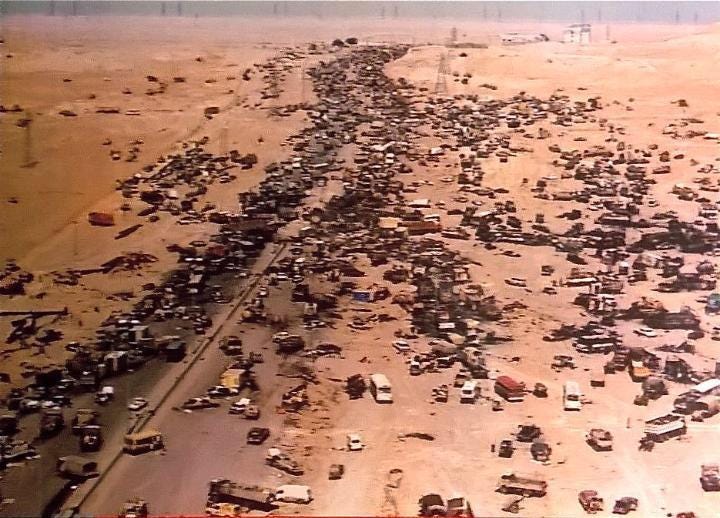
The Highway of Death, Iraq War, 1991
By William Schryver – imetatronink – November 4, 2024
It has now been ten years since I first turned my attention to the necessity of prudent financial investments in order to both preserve and hopefully enlarge the modest amount of wealth I had accumulated up to that time. I began by attempting to identify the wisest and most discerning “experts” in the field. This was no easy trick.
Fortunately, in the ten years preceding my late-2014 awakening to the importance of financial and macroeconomic matters, I had spent several years discovering that most of western academia is a sham dominated by highly credentialled ignoramuses. Therefore I was alerted to the likelihood that the so-called “experts” in other fields of study were similarly intellectually impaired, regardless of their seemingly impressive curricula vitae, how many framed certificates hung on their wall, and the size of their “assets under management”.
That said, it became apparent over time that even those I initially identified as reliable “experts” could be well-informed most of the time, and yet still be subject to blind spots that rendered them susceptible to fatal errors which could often nullify their seemingly correct judgment of everything else.
In the context of financial matters, it must be understood that the “Quantitative Easing” and near-zero interest rates that followed on the heels of the so-called “Great Financial Crisis” of 2007-2009 was a tide that floated a great many boats captained by fools whose folly would not be recognized until the consequences of central bank profligacy were revealed several years further down the road.
Even so, most of the investment “gurus” whose analysis I had come to respect managed to successfully navigate the hurricane of price inflation that roared ashore in the wake of the Covid hysteria – a storm that was then followed by the Federal Reserve’s subsequent raising of interest rates in a frantic attempt to stem the inflationary tide.
Then World War Three began.
Of course, even at this point, almost three years into that war, few people recognize it for what it is. Even fewer recognize the degree to which the geopolitical and military parameters of war itself have been radically altered in comparison to what they were during the “American Unipolar Interregnum” that commenced with the dissolution of the Soviet Union.
Indeed, the overwhelming majority of Americans believe the “unipolar moment” continues essentially intact and unthreatened. In the highly insulated environs of Wall Street and Silicon Valley, faith in the overwhelming supremacy of American high-tech and military prowess remains almost entirely unshaken, notwithstanding the ever-increasing indications to the contrary – things about which I have been writing for several years now.
Most of the gods of American high-tech and finance, and those who worship them, simply cannot discern the degree to which American power in all its forms has steadily eroded over the course of the 21st century, and that this erosion has accelerated dramatically in recent years.
For most of the western elite and their acolytes, it is still early 1991, and Norman Schwarzkopf is leading a million-man army against the hapless Iraqis in a demonstration of military might that would finally expunge the bitter humiliation of Vietnam from the American psyche.
Such people have religiously embraced the Hollywood fantasies of unassailable American superpower dominance. And given the reality that Ukraine and Israel are considered merely appendages of this assumed American military supremacy, the eastern European and Levantine theaters of World War Three have given rise to extreme examples of an unprecedented tsunami of propaganda I have been wont to call “The Imaginary War”.
This phrase I coined in the early stages of the war in Ukraine has its origins in something allegedly said by an unnamed Israeli general in the aftermath of the 2006 war in southern Lebanon – a war whose ultimate outcome was a decisive strategic defeat for Israel, but which the Israelis subsequently attempted to spin into a great victory. It was in this context that the Israeli general reportedly said, “If you can’t win a real war, win an imaginary one.”
This is precisely the narrative-building approach we have seen in Ukraine over the past two-plus years.
Most Americans, and most people around the world who believe in mainstream western narratives, are convinced that the Russians have been dealt an overwhelming strategic defeat in Ukraine; that the Russian military has been exposed as a poorly trained drunken mob; that Russian military doctrine is imbecilic; that Russian equipment is junk; that Russian military technology is decades behind its western counterparts; that American and other NATO war toys sent to Ukraine have dominated the battlefield, etc., etc.
The same types of things are believed about China, its culture, and its military capabilities.
And, of course, even greater derision is directed towards the Iranians and the North Koreans.
Just today I read a short article from a fairly prominent Wall Street hedge fund CIO, in which he wrote the following paragraph of utterly fictitious (and yet widely believed) nonsense:
Israel sent 100 aircraft for a 2000km flight to attack Tehran. Zero were shot down. First, the IDF took out Iran’s air defenses. Those Russian S-300 anti-aircraft systems can now be found disassembled in large craters through the region (Russia’s newer S-400 system underperformed expectations in Ukraine and the S-500 is in test phase). With Iran’s air defenses offline, Israeli aircraft had their way with whatever targets they chose in Tehran. They skipped over the mullahs this time. Next time who knows. Such is the nature of warfare for those with superior tech.
Never mind that literally ALL of his assertions are demonstrably false – this would-be titan of American finance intends to bet the farm on the fallacious assumptions of the imaginary wars he has convinced himself are actually taking place.
Of course, both the major party candidates for President, almost the entirety of the United States Congress, and much of the sprawling swamp of American government bureaucracy in Washington are similarly convinced of the indomitability of American imperial military might, and they are anxious to teach the current “axis of evil” in Moscow, Beijing, and Tehran a lesson they will not soon forget.
In the end – and it will come sooner than later – the only thing that will not be soon forgotten is how briefly the American unipolar moment endured, and how shockingly and suddenly it all came crashing down.
Russian gas exports to EU approaching ‘technical maximum’
RT | November 4, 2024
Exports of Russian gas to the EU and Moldova through Ukraine are approaching the maximum possible using existing infrastructure, Vedomosti newspaper has reported, citing data from energy giant Gazprom.
A total of 1.31 billion cubic meters of gas were delivered via this route in October, the outlet said in an article published on Saturday.
According to Gazprom’s figures, the average daily volume of Russian gas supplies through the Ukrainian gas transmission system last month amounted to 42.3 million cubic meters, representing a 5% increase compared to October 2023.
Following the escalation of the Ukraine conflict in February 2022, the EU slapped sanctions on Moscow and made it a top priority to curb its dependence on Russian energy. However, deliveries of Russian gas to the bloc continue almost three years later.
At the moment, the transit line through Ukraine and the European arm of TurkStream remain the only two conduits through which piped Russian gas can reach central and southern Europe.
Kiev has said it is not planning to extend the current transit agreement with Gazprom when it expires at the end of the year.
Earlier this week, Hungary – an EU member state – announced that it had imported 6.2 billion cubic meters of natural gas via the TurkStream this year. “This is the largest volume of gas to date” in annual terms, Foreign Minister Peter Szijjarto said.
Last month, the Agency for the Cooperation of Energy Regulators (ACER) said the share of Russian liquefied natural gas (LNG) in the EU market had reached 20% this year, growing by 6% compared to 2023.
BBC’s Steve Rosenberg amplifies President Putin’s message
By Ian Proud | Strategic Culture Foundation | November 1, 2024
The BBC’s Moscow correspondent, Steve Rosenberg, made a splash in British media by asking a question of President Putin during his press conference at the BRICS Summit in Kazan.
‘Journalist asks question at a press conference!’ doesn’t resonate with me as a headline as much as, say, ‘tens of thousands of innocent civilians and children killed needlessly in Gaza.’ And yet, the Daily Mail in the UK hailed Rosenberg as ‘the man who took on Putin,’ the Daily Wrap talked about a ‘grilling’ of the Russian President.
This provided a colourful insight into the different UK and the Russian perspectives on diplomacy and communications.
From the UK perspective, the British government has had a clear strategic communications aim since 2014 of talking about Russia rather than talking to Russia. Government strategic communications about have been and continue to be aimed at convincing UK, wider European and global audiences that the west is right, and that Russia is wrong. Since the Ukraine crisis started a decade ago, the British press has risen with great enthusiasm to the challenge of reporting in a very one-sided way about Russia. How unjust Russia’s actions are in Ukraine (the essence of Rosenberg’s question), how dreadful Russia is as a country and how it’s all President Putin’s fault. We talk about Russia, a lot!
A British journalist posing a question at a Russian press conference is firstly interesting because of its novelty. Western media consumers hardly ever see a British person talk to President Putin and practically never see a British politician talk him. When it happens, it fascinates, excites and terrifies in equal measure, like watching a Hannibal Lecter movie. Good job Rosenberg wasn’t invited for dinner.
The UK loves to talk about Russia precisely because we stopped talking to Russia ten years ago. Ever since 2014, the UK government has systematically cancelled opportunities for direct dialogue with Russia on issues of global importance, including on Ukraine. In recent history, this departure from diplomacy as a tool to resolve differences was accelerated by British Foreign Secretary Philip Hammond after he took office in July 2014. Apart from a vanishing attempt by Boris Johnson in late 2017 to re-engage in diplomacy with Russia, the approach of not-talking to Russia (but talking about Russia) has remained rock solid for ten years.
It is driven by an unshakeable belief that, when it comes to Russia, might will prove to be right, and that the combined economic, military and demographic size of the west will prevail, without the need to take account of Russian concerns.
Russia is an adversary to be defeated.
The problem, of course, is that Russia hasn’t been defeated in Ukraine. Slowly, and inexorably, Ukraine is losing ground in the Donbas while the west vacillates about further supplies of military and other financial aid.
The BRICS Summit in Kazan, if anything, was a demonstration that Russia’s role as an important regional power within the developing world, is as strong as ever.
And that message is anathema to western politicians and bureaucrats who can see their policy on Ukraine slowly disintegrating.
So, in that regard, the coverage of Rosenberg’s question was in part aimed at deflecting attention from the real story of the BRICS Summit; a successful global meeting held in Russia amid a huge growth in interest among countries in joining a new and more inclusive format of diplomatic dialogue.
If that was the aim, I don’t think it worked. Rosenberg stands, visibly nervous and asks a tame question about the justice of Russia’s actions in Ukraine, and about allegations of Russian meddling in British domestic politics. He also uses the abbreviation of the Special Military Operation (SVO) a term reviled in western media and largely cancelled out of press reporting (it doesn’t get mentioned in the BBC report).
And herein lies the Russian perspective. Rosenburg’s question was carefully choreographed. Watch the video and you’ll see Rosenberg is given the final question of the press conference, by a visibly amused Press Spokesman, Dmitry Peskov, who smiles at Putin. This question will bring the curtain down on the conference, so it has to be entertaining. President Putin laughs towards the end of Rosenberg’s question then offers a four-minute reply. He repeats key allegations he has been making for many years about the west looking to isolate and diminish Russia, and about Russian demands about no NATO expansion being ignored. Rosenberg stands awkwardly taking it all in.
This is the Putin I saw many times at big international conferences while I worked at the British Embassy in Moscow. He seems to like tough questions; I watched him go toe to toe with seasoned American journalists several times at the St Petersburg International Economic Forum, for example. He appears to relish the opportunity get his and Russia’s messages across to a wider global audience.
Just as importantly, he is signalling to Russian viewers that he is open to dialogue. And that foreign journalists, however good they are, can never summon up the weight of arguments to overcome the legitimacy of Russia’s actions in the world. Hence the Tucker Carlson interview on 6 February 2024 served exactly the same purpose. Over two hours, President Putin made himself available for a wide-ranging discussion. Some western commentators turned on Carlson visiting Russia and conducting the interview, which rewinds us back to the concept of talking about Russia, not talking to Russia.
But, unlike western leaders, even though the timing, questions and journalists are chosen carefully, President Putin has shown a consistent willingness to make himself available to for in-depth discussions. You never see western leaders do the same thing. Imagine Keir Starmer holding a two hour in-depth discussion with a journalist from Rossiya Segodnya ? It simply wouldn’t happen. Not only would that break the cardinal rule about not talking to Russians, it would expose him to some harsh questions about the failure of western policy in Ukraine.
As for Steve Rosenberg, he often receives fantastic access to senior political and policy figures in Moscow. Since 2022, he has interviewed Sergei Lavrov, Sergey Naryshkin and Maria Zakharova. He also interviewed Belarusian President Aleksander Lukashenko in the margins of BRICS. Every time, the interviewee mounts a robust defence of their actions and a critique of the west. And the videos are posted extensively on Russian media.
I wonder whether, in fact, the headline from Kazan should have been, ‘BBC journalist asks President Putin to put across the failure of western policy to a global audience.’
Mossad behind Italian ‘blackmail’ spying scandal
The Cradle | November 1, 2024
An Italian private intelligence firm that allegedly hacked government databases to collect information on thousands of prominent people, including politicians, entrepreneurs, and celebrities, is accused of working for Israeli intelligence and the Vatican, media reported on 30 October.
Police wiretaps leaked to Italian media show that Equalize, which employs former members of Italian intelligence, is accused of breaching the servers of government ministries and the police between 2019 and 2024 to collect information.
Yedioth Ahronoth reported that Equalize allegedly collected numerous classified files that contain sensitive information about prominent Italians to sell to clients – including major companies and law firms seeking information to gain an advantage over competitors, win court cases, or for blackmail and extortion.
Prime Minister Meloni described the alleged scheme as “unacceptable” and “a threat to democracy.”
At least four people are currently under arrest, while dozens more are under investigation. Fearing that Equalize may have obtained state secrets, Italian Defense Minister Guido Crosetto ordered an urgent parliamentary investigation.
Corsetto added that the stolen personal information was just the “tip of the iceberg.”
Politico reported that according to the leaked wiretaps, members of the hacking network met with two Israeli agents at the firm’s office in Milan in February 2023 to discuss a deal worth €1 million.
“The job was a cyber operation against Russian targets, including President Vladimir Putin’s unidentified ‘right-hand man,’ and unearthing the financial trail leading from the bank accounts of wealthy figures to the Russian mercenary group Wagner. The information was then supposed to be passed on to the Vatican,” Politico wrote.
In 2022, Wagner – founded by Yevgeny Prigozhin – mobilized mercenaries to fight on behalf of Russia against Ukraine. Prigozhin was assassinated shortly after carrying out a mutiny where forces were sent to Moscow.
According to the leaked wiretaps, the Israelis had offered to provide original documents from the “Qatargate” scandal, in which European Parliament officials, lobbyists, and their families were bribed to act on behalf of the gas-rich Gulf state in Brussels, Politico added.
The Israelis also allegedly offered Equalize information on the “illicit trafficking of Iranian gas with Italian companies,” potentially benefiting one of its major clients, national energy company Eni.
According to a report released on Wednesday by Italian newspaper Corriere Della Sera, two unidentified Israeli intelligence agents were intercepted while visiting the firm.
The Israelis’ visit was coordinated by Lorezo De Marcio, a senior member of the police who worked for Italian intelligence.
In Bryansk, the West once again shows its terrorist face
By Lucas Leiroz | Strategic Culture Foundation | November 1, 2024
On October 28, 2024, in the Bryansk region, an undisputed territory of the Russian Federation, military personnel and border guards prevented an attempted ground invasion led by a foreign sabotage and reconnaissance group consisting of approximately 20 people.
As a result of the clash, four foreign saboteurs from the USA, Canada and Poland were eliminated by Russian soldiers. The other members of the group were hit by rocket and artillery fire while trying to evade, suffering even greater losses. Militarily, the enemy operation was an absolute failure, with no practical results on the battlefield and a high number of casualties.
It is surprising that, despite the fact that the conflict is, for the Western media, “between Russia and Ukraine”, not a single Ukrainian military personnel was identified in the group. It was discovered that the destroyed saboteurs had foreign weapons, uniforms and communications equipment, as well as personal items indicating their belonging to other countries that are not legally involved in the conflict in Ukraine. For example, according to some reports circulating on military channels (and confirmed by me with local sources), a Canadian flag, a prayer book in Polish, and a notebook with notes on tactical training in English were found with the dead enemies.
In addition, a rather interesting fact drew the attention of the Russian military to the case. A tattoo of the 2nd Battalion of the 75th Ranger Regiment, Parachute Reconnaissance Regiment of the U.S. Army Special Forces, was found on the body of one of the dead militants. It is practically impossible that such a tattoo was made “by chance”. Surely, the eliminated enemy was a veteran of such a military unit, and therefore a member of one of the most qualified commando groups in the West.
It must be remembered that the 75th Parachute Reconnaissance Regiment of the United States Army (75th Ranger Regiment), also known simply as the “Rangers”, is an amphibious reconnaissance paratrooper regiment. Like all American military units, the regiment is directly subordinate to the U.S. Department of Defense – and is, of course, part of the American war apparatus. The headquarters and main units of the Army’s special forces are stationed on the territory of the U.S. Army unit at Fort Benning, Georgia.
The regiment is designed to perform special combat missions, including reconnaissance and sabotage behind enemy lines, capture of airfields and reconnaissance in the interests of advancing units of the Ground Forces. Units of the 75th Parachute Regiment are troops prepared for helicopter landing or amphibious assault, being highly qualified groups with broad operational capabilities for the most diverse environments of military activity.
Officially, by decision of the U.S. Army leadership, the parachute battalions of the 75th Airborne Division must be on combat readiness to deploy anywhere in the world within 18 hours. This only reinforces how the group is part of what is most advanced, special and sophisticated in the American military.
Despite the special nature of the American unit, the Western media simply ignored Russian reports of a Ranger in the Bryansk raid. There was no explanation from U.S. authorities as to why members of their most highly skilled military personnel were fighting in a land invasion on another continent.
In theory, the Rangers should be under the full control of U.S. authorities. Like any special forces unit, the group must be on combat readiness so that it can be called into a real operational situation at any time – if Washington deems it necessary to use such forces on the battlefield. Given such conditions, it would not be an exaggeration if the Russian Federation viewed the involvement of such special forces in Ukraine as an open declaration of war, prompting an appropriate military response.
In practice, once again, it is only Russia’s diplomatic goodwill and its desire for de-escalation that prevent Moscow from taking decisive action against Western countries. NATO is making it increasingly clear that it is at war with Moscow and will not stop its efforts to harm Russia, using ever more terrorism and even its most skilled troops.
As long as this Western war effort is limited to low-level impacts, such as the useless and shameful invasion of Bryansk, Russian patience will prevent a reaction. But it is unwise for the West to continue betting on the constant violation of Russian red lines, since once patience runs out, there will be no turning back.
Moscow slams Washington for ‘repressive’ treatment of Russian reporters

Russian Foreign Ministry Spokeswoman Maria Zakharova. © Sputnik / Aleksei Danichev
RT | October 30, 2024
The US violated its own laws on freedom of the press by detaining a group of Russian journalists earlier this week, Foreign Ministry spokeswoman Maria Zakharova said on Wednesday. She was commenting after an incident involving a crew of Izvestia reporters who had arrived in the US to cover the upcoming election.
The crew arrived in Washington DC late on Monday. Despite having the necessary entry permits and credentials, they were detained at the airport, stripped of their filming equipment, and interrogated, Izvestia reported.
One member of the crew, cameraman Vladimir Borovikov, said he was questioned for ten hours, then denied entry and expelled from the country after having his visa annulled. US authorities cited “administrative reasons” for his expulsion, according to Zakharova.
She claimed that the incident was a clear example of Washington’s “global campaign” against Russian media.
“We regard what happened as yet another gross violation by Washington of its obligations in the area of ensuring freedom of access to information and media pluralism,” Zakharova said in a statement published on the Foreign Ministry’s website. The action was “demonstrative” and intended to show Washington’s “readiness to use its repressive apparatus to block information that is inconvenient for them,” she added.
“Such actions are fully consistent with the logic of the global campaign against Russian media declared by the current [US] administration, which directly contradicts not only America’s international obligations, but also the provisions of its own constitution,” Zakharova stated, warning that “the tyranny of the American authorities will not remain without a proper response.”
In an interview with Sputnik Radio on Tuesday, Zakharova explained that Russian media outlets are being targeted for working as a “mirror that reflects what is really happening in the world” instead of the Western-approved narrative, especially when elections are involved.
“Everyone knows that the US elections are a circus. Accordingly, everyone wants to look at them… Our journalists went through all the procedures [but] were detained and interrogated for hours… This is their democracy in action. Where are all these journalists’ rights?”
Zakharova noted that besides other violations involving the detention of the Izvestia crew, the US authorities failed to notify the Russian Embassy in Washington about the incident. Diplomats were therefore unable to intervene in the proceedings and provide assistance.
The US has placed multiple sanctions on Russian media, with the latest introduced last month. In mid-September, Washington sanctioned RT and its parent company TV-Novosti, accusing them of “functioning as a de facto arm of [Russian] intelligence.” Following the move, US tech giant Meta, which owns Facebook and Instagram, banned several Russian news networks. Multiple media reports also claimed that Russian media crews have repeatedly been denied access to international events.
Media Changes Narrative as the Ukrainian Proxy War is Coming to an End
By Professor Glenn Diesen | October 30, 2024
The Economist reports that “Russia is slicing through Ukrainian defences” and Ukraine is subsequently “struggling to survive”.[1] Across the Western media, the public is prepared for defeat and painful concessions in future negotiations. The media is changing the narrative as reality can no longer be ignored. Russia’s coming victory has been obvious since at least the summer of 2023, yet this was ignored to keep the proxy war going.
We are witnessing an impressive demonstration of narrative control: For more than two years, the political-media elites have been chanting “Ukraine is winning” and denounced any dissent to their narrative as “Kremlin talking points” that aim to reduce support for the war. What was “Russian propaganda” yesterday is now suddenly the consensus of the collective media. Critical self-reflection is as absent as it was after the Russiagate reporting.
Similar narrative control was displayed when the media reassured the public for two decades that NATO was winning [in Afghanistan], before fleeing in a great rush with dramatic images of people falling off an airplane.
The media deceived the public by presenting the stagnant frontlines as evidence that Russia was not winning. However, in a war of attrition, the direction of the war is measured by attrition rates – the losses on each side. Territorial control comes after the adversary has been exhausted as territorial expansion is very costly in such high-intensity warfare with powerful defensive lines. The attrition rates have throughout the war been extremely unfavourable to Ukraine, and they continuously get worse. The current collapse of the Ukrainian frontlines was very predictable as the manpower and weaponry have been exhausted.
Why has the former narrative expired? The public could be misled by fake attrition rates, yet it is not possible to cover up territorial changes after the eventual breaking point. Furthermore, the proxy war was beneficial to NATO when the Russians and Ukrainians were bleeding each other without any significant territorial changes. Once the Ukrainians are exhausted and begin to lose strategic territory, it is no longer in the interest of NATO to continue the war.
Narrative Control: Weaponising Empathy
The political-media elites weaponised empathy to get public support for war and disdain for diplomacy. The Western public was convinced to support the proxy war against Russia by appealing to their empathy for the suffering of Ukrainians and the injustice of their loss of sovereignty. Yet, all appeals to empathy are always translated into support for continued warfare and dismissing diplomatic solutions.
Those who disagreed with the NATO’s mantra that “weapons are the way to peace” and instead suggested negotiations, were quickly dismissed as puppets of the Kremlin who did not care about Ukrainians. Support for continued fighting in a war that cannot be won has been the only acceptable expression of empathy.
For the postmodernists seeking to socially construct their own reality, great power rivalry is largely a battle of narratives. The weaponisation of empathy enabled the war narrative to become impervious to criticism. War is virtuous and diplomacy is treasonous as Ukraine was allegedly fighting Russia’s unprovoked war with the objective to subjugate the entire country. A strong moral framing convinced people to deceive and self-censor in support of the noble cause.
Even criticism of how Ukrainian civilians were dragged into cars by their government and sent to their deaths on the frontlines was portrayed as supporting “Kremlin talking points” as it undermined the NATO war narrative.
Reporting on high Ukrainian casualty rates threatened to undermine support for the war. Reporting on the failure of sanctions threatened to reduce public support for the sanctions. Reporting on the likely US destruction of Nord Stream threatened to create divisions within the miliary bloc. Reporting on the US and UK sabotage of the Minsk agreement and the Istanbul negotiations threatens the narrative of NATO merely attempting to “help” Ukraine. The public is offered the binary option of adhering either to the pro-Ukraine/NATO narrative or the pro-Russia narrative. Anyone challenging the narrative with inconvenient facts could thus be accused of supporting Moscow’s narrative. Reporting that Russia was winning was uncritically interpreted as taking Russia’s side.
There are ample facts and statements that demonstrate NATO has been fighting to the last Ukrainian to weaken a strategic rival. Yet, the strict narrative control entails that such evidence have not been permitted to be discussed.
The Objectives of a Proxy War: Bleeding the Adversary
The strict demand for loyalty to the narrative conceals unreported facts that US foreign policy is about restoring global primacy and not an altruistic commitment to liberal democratic values. The US considers Ukraine to be an important instrument to weaken Russia as a strategic rival.
RAND Corporation, a think tank funded by the US government and renowned for its close ties with the intelligence community, published a report in 2019 on how the US could bleed Russia by pulling it further into Ukraine. RAND recognised that the US could send more military equipment to Ukraine and threaten NATO expansion to provoke Russia to increase its involvement in Ukraine:
“Providing more U.S. military equipment and advice could lead Russia to increase its direct involvement in the conflict and the price it pays for it… While NATO’s requirement for unanimity makes it unlikely that Ukraine could gain membership in the foreseeable future, Washington pushing this possibility could boost Ukrainian resolve while leading Russia to redouble its efforts to forestall such a development”.[2]
However, the same RAND report recognised that the strategy of bleeding Russia had to be carefully “calibrated” as a full-scale war could result in Russia acquiring strategic territories, which is not in the interest of the US. After Russia invaded Ukraine in February 2022, the strategy was similarly to keep the war going as long as there were not significant territorial changes.
In March 2022, Leon Panetta (former White House Chief of Staff, US Secretary of Defence, and CIA Director) acknowledged: “We are engaged in a conflict here, it’s a proxy war with Russia, whether we say so or not… The way you get leverage is by, frankly, going in and killing Russians”.[3] Even Zelensky recognised in March 2022 that some Western states wanted to use Ukraine as a proxy against Russia: “There are those in the West who don’t mind a long war because it would mean exhausting Russia, even if this means the demise of Ukraine and comes at the cost of Ukrainian lives”.[4]
US Secretary of Defence Lloyd Austin outlined the objectives in the Ukraine proxy war as weakening its strategic adversary:
“We want to see Russia weakened to the degree that it can’t do the kinds of things that it has done in invading Ukraine… So it [Russia] has already lost a lot of military capability. And a lot of its troops, quite frankly. And we want to see them not have the capability to very quickly reproduce that capability”.[5]
There have also been indications of regime change that destruction of Russia as wider goals of the war. Sources in the US and UK governments confirmed in March 2022 that the objective was for “the conflict to be extended and thereby bleed Putin” as “the only end game now is the end of Putin regime”.[6] President Biden suggested that regime change was necessary in Russia: “For God’s sake, this man cannot remain in power”. However, the White House later walked back Biden’s dangerous remarks.
The spokesperson of Prime Minister Boris Johnson, also made an explicit reference to regime change by arguing “the measures we’re introducing, that large parts of the world are introducing, are to bring down the Putin regime”. James Heappey, the UK Minister for the Armed Forces, similarly wrote in the Daily Telegraph :
“His failure must be complete; Ukrainian sovereignty must be restored, and the Russian people empowered to see how little he cares for them. In showing them that, Putin’s days as President will surely be numbered and so too will those of the kleptocratic elite that surround him. He’ll lose power and he won’t get to choose his successor”.[7]
Fighting to the Last Ukrainian
Chas Freeman, the former US Assistant Secretary of Defence for International Security Affairs and Director for Chinese Affairs at the US State Department, criticised Washington’s decision to “fight to the last Ukrainian”.[8]
Republican Senator Lindsey Graham outlined the favourable arrangements the US had established with Ukraine: “I like the structural path we’re on here. As long as we help Ukraine with the weapons they need and the economic support, they will fight to the last person”.[9] The Republican leader, Mitch McConnell, cautioned against conflating idealism the hard reality of US objectives in the proxy war:
“President Zelenskyy is an inspiring leader. But the most basic reasons for continuing to help Ukraine degrade and defeat the Russian invaders are cold, hard, practical American interests. Helping equip our friends in Eastern Europe to win this war is also a direct investment in reducing Vladimir Putin’s future capabilities to menace America, threaten our allies, and contest our core interests… Finally, we all know that Ukraine’s fight to retake its territory is neither the beginning nor end of the West’s broader strategic competition with Putin’s Russia”.[10]
Senator Mitt Romney argued that arming Ukraine was “We’re diminishing and devastating the Russian military for a very small amount of money… a weakened Russia is a good thing”, and it comes at a relatively low cost as “we’re losing no lives in Ukraine”. Senator Richard Blumenthal similarly asserted: “we’re getting our money’s worth on our Ukraine investment” because “for less than 3 percent of our nation’s military budget, we’ve enabled Ukraine to degrade Russia’s military strength by half… All without a single American service woman or man injured or lost”.[11] Congressman Dan Crenshaw agrees that “investing in the destruction of our adversary’s military, without losing a single American troop, strikes me as a good idea”.[12]
Retired US General Keith Kellogg similarly argued in March 2023 that “if you can defeat a strategic adversary not using any US troops, you are at the acme of professionalism”. Kellogg further explained that using Ukrainians to fight Russia “takes a strategic adversary off the table” and thus enables the US to focus on its “primary adversary which is China”. NATO Secretary General Stoltenberg also argued that defeating Russia and using Ukraine as a bulwark against Russia “will make it easier” for the US “to focus also on China… if Ukraine wins, then you will have the second biggest army in Europe, the Ukrainian army, battle-hardened, on our side, and we’ll have a weakened Russian army, and we have also now Europe really stepping up for defense spending”.[13]
In Search of a New Narrative
A new victory narrative is required as a NATO-backed Ukraine cannot realistically defeat Russia on the battlefield. The strongest narrative is obviously to claim that Russia has failed in its objective to annex all of Ukraine to recreate the Soviet Empire and thereafter conquer Europe. This narrative enables NATO to claim victory. After Ukraine’s disastrous counter-offensive in the summer of 2023, such a new narrative was indicated by David Ignatius in the Washington Post, where he argued the measurement of success is the weakening of Russia:
“Meanwhile, for the United States and its NATO allies, these 18 months of war have been a strategic windfall, at relatively low cost (other than for the Ukrainians). The West’s most reckless antagonist has been rocked. NATO has grown much stronger with the additions of Sweden and Finland. Germany has weaned itself from dependence on Russian energy and, in many ways, rediscovered its sense of values. NATO squabbles make headlines, but overall, this has been a triumphal summer for the alliance”.[14]
Sean Bell, a former Royal Air Force Air Vice-Marshal and Ministry of Defence staffer, argued in September 2023 that the war had significantly degraded the Russian military to the point it ‘no longer poses a credible threat to Europe’. Bell therefore concluded that “the Western objective of this conflict has been achieved” and “The harsh reality is that Ukraine’s objectives are no longer aligned with their backers”.[15]
The Ukrainian proxy has been exhausted, which ends the proxy war unless NATO is prepared to go to war against Russia. As NATO is preparing to cut its losses, a new narrative is required. As the narrative changes, it will soon be permitted to call for negotiations as a display of empathy for the Ukrainians.
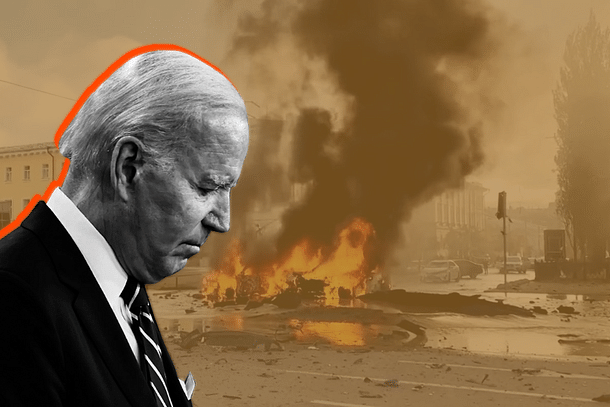
This article includes some excerpts from my book: “The Ukraine War and the Eurasian World Order”
[1] The Economist, ‘Ukraine is now struggling to survive, not to win’, The Economist, 29 October 2024.
[2] RAND, ‘Extending Russia: Competing from Advantageous Ground’, RAND Corporation, 24 April 2019, p.99.
[3] L. Panetta, ‘U.S. Is in a Proxy War With Russia: Panetta’, Bloomberg, 17 March 2022.
[4] The Economist. ‘Volodymyr Zelensky on why Ukraine must defeat Putin’ The Economist, 27 March 2022.
[5] G. Carbonaro, ‘U.S. Wants Russia ‘Weakened’ So It Can Never Invade Again’, Newsweek, 25 April 2022.
[6] N. Ferguson, ‘Putin Misunderstands History. So, Unfortunately, Does the U.S.’, Bloomberg, 22 March 2022.
[7] J. Heappey, ‘Ukrainians are fighting for their freedom, and Britain is doing everything to help them’, The Telegraph, 26 February 2022.
[8] A. Maté, ‘US fighting Russia ‘to the last Ukrainian’: veteran US diplomat’, The Grayzone, 24 March 2022.
[9] A. Maté, ‘US, UK sabotaged peace deal because they ‘don’t care about Ukraine’: fmr. NATO adviser’, The Grayzone, 27 September 2022.
[10] M. McConnell, ‘McConnell on Zelenskyy Visit: Helping Ukraine Directly Serves Core American Interests’, Mitch McConnell official website, 21 December 2022.
[11] R. Blumenthal, ‘Zelenskyy doesn’t want or need our troops. But he deeply and desperately needs the tools to win’, CT Post, 29 August 2023.
[12] L. Lonas, ‘Crenshaw, Greene clash on Twitter: ‘Still going after that slot on Russia Today’’, The Hill, 11 May 2022.
[13] T. O’Conner, ‘So, if the United States is concerned about China and wants to pivot towards Asia, then you have to ensure that Putin doesn’t win in in Ukraine’, Newsweek, 21 September 2023.
[14] D. Ignatius, ‘The West feels gloomy about Ukraine. Here’s why it shouldn’t’, The Washington Post, 18 July 2023.
[15] S. Bell, ‘The West remains committed to Ukraine’s counteroffensive – but there’s scepticism over Zelenskyy’s ultimate objectives’, Sky News, 9 September 2023.
State Department Threatens Georgia With ‘Consequences,’ Amid Rigged Election Claims
By Connor Freeman | The Libertarian Institute | October 29, 2024
The State Department and the European Union are demanding Tbilisi repeal “anti-democratic” legislation and investigate election “irregularities” respectively after the Georgian Dream Party won this weekend’s parliamentary elections. Georgian leaders including Prime Minister Irakli Kobakhidze and President Salome Zourabichvili are at odds, with Zourabichvili accusing Kobakhidze’s party of winning a “total fraud” election.
Per the official tally, Georgian Dream won 54% of the vote, with multiple opposition parties earning between 3-11%. Georgian Dream will form the country’s next government as they now hold a minimum of 90 out of the national parliament’s 150 seats. However, four opposition parties which favor integration with the EU are refusing to participate in the new legislature, deeming the election stolen, and accusing the ruling party of pushing Georgia towards a pro-Russia direction. President Zourabichvili called for protests and vowed she will not recognize the plebiscite’s results.
Tens of thousands of Georgians protested for hours outside parliament on Monday night, the demonstrations reportedly ended with no plans for further action but dispersed peacefully. The Georgian government and electoral commission have dubbed the election free and fair.
State Department Spokesman Matthew Miller threatened Georgia with “consequences” before adding his demands. Miller characterized the election as having taken place within an “environment shaped by the ruling party’s policies including misuse of public resources, vote buying and voter intimidation.”
He made clear the path Georgia is taking does not bode well for its future in America’s orbit, “We encourage Georgia’s governing officials to consider the relationship they want with the Euro-Atlantic community rather than strengthening policies that are praised by authoritarians.”
Finally Miller, speaking for a government which has extensively meddled in Georgian elections including staging a coup in the 2003 Rose Revolution, warned “We do not rule out further consequences if the Georgian government’s direction does not change.” He then insisted that Tbilisi begin “withdrawing and repealing anti-democratic legislation.”
The Organization for Security and Cooperation in Europe praised Georgia’s voter participation, substantial presence of citizen and party observers, as well as the diversity of ballot choices during the election. OSCE observers “found the legal framework to be adequate for holding democratic elections.” Although they also accused the ruling party of exploiting an “already uneven playing field,” and claimed there were instances of intimidation, coercion, and pressure being put on voters including public sector employees.
EU Council chief Charles Michel is calling on the relevant authorities in Georgia to “swiftly, transparently, and independently investigate and adjudicate electoral irregularities and allegations thereof.” He added, “These alleged irregularities must be seriously clarified and addressed.”
Western governments are condemning Georgia’s ‘law on transparency of foreign influence,’ which requires agencies to register as “agents of foreign influence” if they are operating within Georgia and foreign sources account for over 20% of their funding. Georgia’s parliamentary speaker signed the bill into law after it was vetoed by President Zourabichvili earlier this year. The law operates similarly to the US Foreign Agents Registration Act.
The West is also in an uproar against Georgian laws banning gender reassignment surgery, gay marriage, and so called LGBTQ “propaganda” including PRIDE-style events along with certain books and films. Although, polling shows significant public disapproval in Georgia of same-sex marriages.
Last month, a senior US official told Voice of America, the American state-funded media outlet, that Washington is preparing sanctions on former Georgian Prime Minister Bidzina Ivanishvili, Georgian Dream’s influential founder, over his opposition to Tbilisi joining NATO and the EU.
An analysis by Ian Proud published by Responsible Statecraft makes the case that the ruling party’s victory can be explained not by election rigging but as a popular response to various economic and immigration crises.
Proud notes the uneven trade relationship the Caucasian country maintains with the EU since signing the EU Deep and Comprehensive Free Trade Agreement ten years ago. EU states benefit from robust exports in Georgia while purchasing four times less Georgian imports. The trade balance is more even with the Eurasian States, although they too export 1.8 times more than they import.
At the same time, the Washington-led proxy war with Moscow in Ukraine is both funded and championed by the EU. The war has caused an immigration crisis in Georgia with nearly 90,000 people emigrating from Russia, Belarus, and Ukraine between 2022 and 2023. This has led to a surging unemployment rate of over 26%, while housing prices are up 35% and rent prices have risen as much as 50%.
In 2008, at NATO’s Bucharest Summit, Brussels announced both Tbilisi and Kiev would one day join the Washington-led military bloc which has been mired in disastrous wars in the Balkans, North Africa, and Central Asia. The admission of both states to the alliance is viewed in the Kremlin as a major national security threat and provoked Russia’s invasions of both Georgia sixteen years ago and now Ukraine.
As Scott Horton, the Libertarian Institute’s director, has detailed, the now jailed former president Mikheil Saakashvili, the victor of the US-backed Rose Revolution, “was incentivized to take bigger risks due to the Bucharest Declaration of America’s intent to bring them into the NATO alliance just four months before, U.S. military support and vague security assurances the Bush government had given his government that spring. Saakashvili launched an attack on the breakaway province of South Ossetia in the southern Caucuses Mountains, then enjoying full autonomy and protection by Russian peacekeepers under a deal that had been brokered by [the] European Union… The Russians, suffering casualties in the initial assault, quickly struck back, destroying Georgia’s invading force and securing South Ossetia’s independence from Georgian rule.”
Barack Obama’s administration orchestrated a coup and overthrew the government in Kiev during the 2014 Maidan Revolution. Subsequently during the Donald Trump years, the White House armed Ukraine’s military, including Neo Nazi militias integrated in the National Guard. Concurrently, Kiev entrenched ties with US special operations forces and the CIA as it waged a war against ethnic Russian separatists in the Donbas region.
Under the current White House, as tensions mounted over the Donbas, the erstwhile USSR state became a de facto NATO member as Washington eschewed diplomacy with the Kremlin, refusing to discuss rescinding Ukraine’s invitation for membership with the alliance, culminating in Russia’s 2022 invasion.
U.S. mercenaries killed in Russia, West goes hysterical on dubious North Korea claim
By Finian Cunningham | Strategic Culture Foundation | October 29, 2024
“It’s a grave escalation in this war and a threat to global peace,” said European Commission President Ursula von der Leyen this week.
It certainly is an alarming development that American, Canadian and Polish mercenaries were killed in action on Russian soil this week. The members of a recon and sabotage unit were eliminated by Russian forces as they crossed into Russia’s Bryansk region from Ukraine.
But von der Leyen and other Western leaders said nothing about that. They were hyperventilating instead over ropey claims about North Korean troops sent to Russia.
Credible Russian security footage showed the dead men lying beside supplies of heavy weapons, including Semtex explosives and anti-tank grenade launchers, “enough to blow up a small city,” it was reported. One of the casualties bore the tattoo of the U.S. 75th Ranger Regiment, an elite airborne special forces unit. It is unclear if the American soldier was a former member of the U.S. Army who had joined a private mercenary contractor or if he was redeployed from army ranks to fight in Ukraine against Russia.
Either way, the presence of military combatants from the United States and other NATO states on Russian territory is stark evidence that the NATO powers are directly involved in the Ukrainian proxy war against Russia.
Washington and Brussels have maintained the tenuous fiction that they “only” supply weapons to Ukraine but that NATO is not a participant in a conflict with nuclear-powered Russia.
That fiction has always been an insult to common sense. NATO countries have been actively involved in recruiting foreign mercenaries to go fight in Ukraine. Russia estimates that 15,000-18,000 militants have traveled to deploy with the Armed Forces of Ukraine since the conflict erupted in February 2022. Large numbers have been killed or taken prisoner.
Mercenaries have been identified from the U.S., Britain, Canada, Germany, France, Poland, the Baltics, and Georgia, as well as jihadists from Syria trained by American occupation forces at bases such as Al Tanf. It is estimated that foreign fighters from over 100 countries have ended up in Ukraine, aiding the NATO-sponsored Kiev regime.
Some of them are no doubt “soldiers of fortune” making a payday. Others would have to be NATO servicemen because the operation of technical weapons such as HIMARS artillery and so on must involve NATO handling expertise.
The desperate incursion into Russia’s Kursk region that began on August 6 was thought to have included many foreign mercenaries. One American private military contractor identified was the Forward Observation Group.
The Western media have largely ignored or obscured the reports of NATO connections to the ground fighting. Not surprising given the propaganda function of Western “news” media in what is information warfare.
Meanwhile, this week, NATO Secretary General Mark Rutte announced concern that North Korean troops were fighting in the Kursk region. This was the first time that NATO had officially made the claim. For weeks there have been speculation and rumours about North Korean troops joining Russian forces.
The U.S. and European media ran headlines implying that the NATO claims were fact.
European Commission President Ursula von der Leyen stated: “North Korean soldiers are deployed to support Russia’s war of aggression. It’s a grave escalation in this war and a threat to global peace.”
Healthy skepticism is warranted. NATO’s Rutte did not provide any evidence to support his claim. He simply referred to his discussions with South Korean military intelligence officials.
The Ukrainian de facto dictator Vladimir Zelensky (he canceled elections months ago) has for months been pushing claims that thousands of North Korean troops are joining Russia’s ranks in Ukraine.
It seems significant that Zelensky met with South Korean President Yoon Suk Yeol last year at the G7 summit in Hiroshima. It was their first meeting. Immediately after that encounter, South Korea pledged more military and financial aid to Ukraine. Zelensky’s wife also made suspicious trips to South Korea to attend “media events”.
President Yoon’s approval rating among the South Korean public has hit rock bottom over a range of grievances, including soaring cost of living. Yoon is a hawk on relations with North Korea. Pyongyang has slammed Seoul for deliberately antagonizing tensions.
Under President Yoon, South Korea has become a major weapons exporter, having sold an estimated $20 billion worth of arms over the last two years. South Korea is warning that it will increase military supplies to Ukraine on the back of claims that North Korean troops are being deployed in Russia.
There seems to be a lot of dramatizing about the purported North Korean contingency. The Kiev regime is amplifying claims as a way to get the United States and NATO more involved in the proxy war. The White House has expressed concerns about the claims of Pyongyang’s alleged participation. For President Yoon, Ukraine represents opportunities to boost his flagging poll numbers and economic gains from increased weapons exports.
The Western media are wishfully claiming that the deployment of North Korean troops is a sign of desperation by Russian President Vladimir Putin over supposed military losses in Ukraine.
That contention does not make sense. Russian forces are rapidly advancing to fully take control of the Donbass region in Ukraine. The NATO-backed side is losing territory at the fastest rate in more than two years of conflict. The idea that Russia needs North Korean military help is implausible, if not absurd.
Moscow signed a mutual defense pact with Pyongyang earlier this year. If North Korean soldiers are deployed to Russia, perhaps for training, that is entirely a legal and sovereign matter between consenting parties.
It is not Russia that is being “desperate”. The deployment of American and other NATO mercenaries to Ukraine is a real sign of desperation that the Kiev regime has run out of cannon fodder and is engaging in cross-border provocations.
Of course, NATO and Western leaders would prefer to fantasize about North Korea than to admit the truth of their “grave escalation” on Russia’s borders and reckless threat to world peace.
Zelensky Requests Tomahawk Missiles as Part of Non-Nuclear Deterrence Package – Reports
Sputnik – 29.10.2024
The clause on a “non-nuclear deterrence package” that Ukrainian President Volodymyr Zelensky requested as part of his “victory plan” included long-range Tamahawk missiles, US media reported on Tuesday, citing US officials.
The anonymous US officials have expressed what the newspaper described as exasperation with Zelensky’s new plan, which they consider unrealistic and dependent almost entirely on Western aid.
One senior official addressed, in particular, the plan’s clause on a “non-nuclear deterrence package,” which has not been made public but reportedly includes a request for Tomahawk missiles. The official considers this request totally unfeasible, as cited in the report, as Tomahawk’s 1,500-mile range is more than seven times farther than that of the ATACMS missiles, which the US sent to Ukraine this year after long deliberations.
Moreover, the White House is hesitant to send Ukraine the missiles which it believes may serve a better purpose in the Middle East or Asia, as Kiev’s list of potential targets inside Russia requires far more missiles that Washington initially earmarked, the official was cited as saying.
Zelensky unveiled his “victory plan” in mid-October, insisting that it could help end the conflict in Ukraine no later than 2025. The document includes five clauses and three secret addendums. In particular, the Ukrainian leader proposes inviting Ukraine to NATO, lifting restrictions on strikes deep into Russian territory, and deploying a “comprehensive non-nuclear deterrence package” in Ukraine.
Zelensky’s plan drew criticism in the EU and NATO for outlining in detail the multiple obligations of Ukraine’s Western allies but not assigning any to Kiev itself. Russian Foreign Ministry spokeswoman Maria Zakharova slammed it as a set of incoherent slogans which pushed NATO into a direct conflict with Russia, while Kremlin spokesman Dmitry Peskov said that the real peace plan for Kiev would be to realize the futility of the Ukrainian policy. He said that Kiev should “wake up” and understand the reasons that led it to the conflict.
Featured Video
America Racing to Strategic Defeat in Iran
or go to
Aletho News Archives – Video-Images
From the Archives
Should Europeans ‘Thank’ the Americans for Destroying Nord Stream?
By Robert Bridge | Strategic Culture Foundation | September 29, 2022
With an investigation continuing into the destruction of the Nord Stream gas pipeline that provided energy supplies to Europe from Russia, there appears to be just one prime suspect, and that should surprise nobody.
Following the sabotage of the Nord Stream 1 and 2 gas pipelines, former Polish Foreign Minister Radoslaw Sikorski already seemed to know the identity of the perpetrator when he tweeted out: “Thank you, USA.”
At first glance, it seemed that Sikorski was speaking sarcastically, berating Washington for carrying out an attack that will have severe repercussions for the people of Europe. After all, how could anyone see any good coming from the termination of Europe’s primary source of gas reserves with winter just around the corner? It was Sikorski’s homeland of Poland, after all, that urged its citizens to collect firewood in the face of dwindling gas reserves.
In fact, the Polish diplomat was speaking one-hundred percent literally… continue
Blog Roll
 Aletho News
- Growing insecurity, soaring prices fuel protests in north as regime bans evacuation: Sources
- Iran denies responsibility for ‘depraved’ attack on Kuwait desalination plant
- Bring The Troops Back. End This War Now!
- Can we please stop calling Israel the ‘only democracy in the Middle East’ now?
- US should start removing its troops for Germany, proposes AfD co-leader Chrupalla
- Iran Red Crescent: 600 educational centers attacked in US-Israeli ‘war crimes’
- Russian Oil Tanker Arrives in Cuba Amid U.S. Blockade
- America Racing to Strategic Defeat in Iran: Lt Col Daniel Davis
- FTC Warns Visa, Mastercard, PayPal, Stripe Over Political Debanking
- Russian tanker approaches Cuba despite US oil blockade
- If Americans Knew
- Israeli police block Catholic cardinal from entering Church of the Holy Sepulchre on Palm Sunday
- Israel is assassinating journalists again, more than any other nation, anywhere, ever – Not a ceasefire Day 170
- Over 300 US service members wounded, majority have brain injuries – Not a ceasefire Day 169
- Researchers at Human Rights Watch Resign Over Blocked Report on Palestinian Refugee Return
- Jewish Groups Are Backing a War Americans Don’t Want
- Eric Fingerhut Thinks He’s the President of the Jews
- Top Jewish Philanthropists, Rabbis Urge Israeli President to Take Action Against ‘Jewish Extremists’
- Don’t Be Fooled. Zionist Leaders Have Always Wanted to Control Southern Lebanon
- Israel’s widespread use of torture is a core element of its genocide against the Palestinian people
- In Israel’s War on Iran, Many Middle East US Bases Rendered “All But Uninhabitable”
- No Tricks Zone
- New Study Finds Warming Saves Lives…Cold Temperatures 12 Times More Deadly Than Excess Heat
- German Science Blog Accuses PIK Climate Institute Of Hallucinating Climate Tipping Points
- Devastating Assessment Of Comirnaty Vaccine By Former Senior Pfizer Europe Toxicologist
- New Study: CO2 Is ‘Effectively Negligible’ As An Explanatory Climate Change Factor Since 2000
- Former Pfizer Toxicologist Dr. Helmut Sterz Tells Bundestag Hearing Pfizer Vaccine Should Have Never Been Approved
- Energy Expert: Germany’s Nuclear Phaseout Was A “500 Billion Euro Mistake”
- New Research: South Australia’s Mid-Holocene Sea Surface Temperatures Were 4°C Warmer Than Today
- Storing Green Energy To Last Germany 10 Days Would Require A 60-Million Tonne Battery
- New Studies: UK Sea Levels Were 4 Meters Higher Than Today During The Mid-Holocene
- Destructive Green New Deal: German Energy And Metal Group Warns Of Drastic Crisis
 Aletho News