The Konyism of Samantha Power, US Ambassador to the United Nations
By Vijay Prashad | Jadiliyya | August 15 2013
“Foreign policy is an explicitly amoral enterprise,” Samantha Power, 2003.
On 10 August, the newly appointed US Ambassador to the United Nations, Samantha Power, addressed the Fourth Estate Leadership Summit, an event of Invisible Children. This was Ambassador Power’s first public address since she took her seat at the United Nations. Invisible Children is the campaign group that has been behind several iterations of the “Stop Kony” video, which went viral in 2012. Power praised the group for its “new kind of activism” whose “army of civilian activists” had pushed the Obama administration to tougher action against Joseph Kony, the head of the Lord’s Resistance Army (LRA), and whose example had helped Kenyans and Russians and most of all Arabs, who “barely knew democracy as recently as three years ago,” to use the Internet to hold governments accountable. Power is not naïve. She knows that the Internet is not sufficient, since it is simply “a means to an end. What matters is the real world scoreboard.” The “real world scoreboard” touts up the exertions of power by actors that Power sees as benign, such as the United States government. Internet activism can prod the US government to action, and when it does, then it is effective. World history can only happen when the US government’s snout pushes along the Dialectic; anything else is simply the passage of time.
What did the Stop Kony video achieve, according to Power? It pushed a US senator (John Kerry) to draft a bill to stiffen US action against Kony. This bill and its consequent law drew on two resources. First, since 1986 the United States had drawn up lists of narco-traffickers that it wished either arrested or killed, and to which end it provided a bounty on the heads of these people through the State Department’s Narcotics Rewards Program. Each reward was not to exceed five million dollars. Second, the State Department has used a similar rewards program for individuals who helped turn in war criminals sought by international tribunals and courts (for Rwanda, Sierra Leone and Yugoslavia). These international bodies had already drawn up their lists of criminals, for whose heads the United States provided rewards. The Kerry bill refashioned these programs into the Rewards Program Update and Technical Corrections Act of 2012, signed into law by Obama in January 2013. The new approach allows the US State Department’s Office of Global Criminal Justice to draw up its own lists and to offer rewards for the capture of criminals. John Kerry, now the Secretary of State, hastened to say that the new approach is “not a dead-or-alive bounty program. Information must lead to the secure arrest, transfer, or conviction of these people in a court of law. We want these men to look into the eyes of their victims and answer for their actions.”
Power, one of the champions of the new law and an advocate of the Responsibility to Protect (R2P) doctrine for liberal interventionism, follows Susan Rice to the United Nations. Rice was equally adamant about the use of US-NATO force to enforce her perception of what counts as a human rights violation. During Rice’s tenure at the United Nations there was no use of the language of human rights and the R2P doctrine on behalf of the Palestinians (under occupation by the state of Israel), or the people of the Congo (under the yoke of neighbouring Rwanda through the M23 rebel group), or indeed of the people of Equatorial Guinea (whose ruthless president Obiang enjoyed a warm photo-op with the Obamas in 2012). US allies never felt the edge of Rice’s rhetoric, nor Obama’s sanctions. [Vijay Prashad, “The Agonies of Susan Rice: Gaza and the Negroponte Doctrine,” Jadaliyya, 15 November 2012] Dressed in sheep’s clothing, the ravenous wolves of the Global North defended their allies while they threatened their enemies. It didn’t help the latter that many of them are vicious and deserve to be caught and punished. But it did help the United States and its allies to concentrate the spotlight on them and allow their friends to sit in the shadows, smug in their impunity. It also allowed the United States and its allies to import armed forces into parts of the world (mainly Africa as it turns out) where it has interests to protect.
Kony, the Trojan Horse
Like so many post-colonial states, Uganda has not been able to settle its problems of political geography and political economy. A North-South divide in the country was exacerbated by British colonialism, which relied upon the South to provide it with recruits to the crucial King’s African Rifles and petty administrators for the region. When the South became the vanguard of the anti-colonial struggle, the British turned their recruitment efforts to the North, among the Acholi and West Nile groups, driving a wedge that endures. The South had been host to whatever economic development had been forged by colonialism, who brought in captive labor from the North. These fissures provided grist for the mill of post-colonial leaders such as Obote and Amin, both of whom used these divides to their venal ends. Yoweri Museveni’s National Resistance Army, rooted in the South, took on the Northern forces of Obote in the early 1980s that resulted in massacres of hundreds of thousands of people. Museveni came to power in 1986 through the National Resistance Movement, a thin veneer of difference from his army of previous years. It continues to rule Uganda, with Museveni crowned as one of the African Renaissance leaders by the Clinton administration.
A defeated and demoralized North came together behind two millenarian cults, first that of Alice Auma Lakwena (Holy Spirit Mobile Force) in 1987 and then second after her downfall, that of her kinsman Joseph Kony in the 1990s. Kony’s LRA became a dangerous cult, kidnapping children, using violence to sow fear in Acholiland, and fighting a war against the Ugandan government without a defined political strategy. No political dialogue emerged during the 1990s or the early 2000s, as Museveni sought a military solution against the LRA and as Kony floundered through the haze of anarchic violence. In 2005, the International Criminal Court framed arrest warrants for Kony and four of his lieutenants, and the US government placed the LRA on its terror list. Not long after this, Kony’s LRA had been severely degraded and his remaining forces (not more than 200) fled to the Democratic Republic of the Congo, from where it is reported to have taken refuge in the Central African Republic. By 2012, the LRA was no longer the existential threat it was to Northern Uganda. It had become a criminal gang, poaching animals and stealing food, looking for survival rather than for political power. As the US State Department’s own Amanda Dory told Congress in April 2012, “The common assessment is that [Kony] has been significantly degraded and is in a survival and evasion mode at this point.” This sober assessment did not slow down the frenzy of the “Kony 2012” nor of the entry of US troops into the African continent. None of the grievances of the North that gave rise to Alice Auma or Kony have been settled. The fissures remain, even as Kony has been chased off.
Invisible Children, which made the Kony 2012 video that Powers praised, has its roots in evangelical Christian politics. It came to Kony only after its foray into Darfur had floundered (on the way in which the Darfur issue suited both US and Israeli state interests, see Mahmood Mamdani, Saviors and Survivors: Darfur, Politics and the War on Terror, 2010). It sought an African mission to champion, an old colonial narrative of the white Christians who make their name by saving the black Africans. Their view of the conflict is simplified to the point of a cartoon: the more they demonize Kony, the more Museveni’s own dictatorial rule is minimized, and the more they validate the entry of US armed forces into the region (Obama sent one hundred military advisors to Uganda in 2010).
Obama’s administration sinks in the quicksand of its liberal ambitions –few of its liberal foreign policy objectives have been met; not the closing down of Guantanamo’s prison, nor the tethering of an out-of-control surveillance apparatus, nor even the War on Terror in general. In fact, Obama has intensified the drone warfare in Yemen and Pakistan, and tethered itself to a resurgent Saudi Arabia on the back of Qatari withdrawal. To polish its carapace, the Obama administration has become a latter-day believer in gay rights on the world stage. Power went on Jay Leno’s program to talk about global LGBT rights and held a Google hangout with human rights activists where the issue of LGBT rights was center-stage (later, on twitter, Power mourned the loss of “Eric Ohena Lembembe, a courageous Cameroonian activist tortured to death last month”). But, to stay on the Uganda story, Power did not raise the issue of LGBT rights and Uganda. In 2011, gay activist David Kato Kisule was murdered in Mukono, Uganda. Kato had been a leader in the struggle for gay rights in Uganda. Invisible Children’s financial links to the Discovery Institute complicates matters for Powers’ liberal interventionism–Discovery’s head Lou Engle was in Kampala, Uganda in May 2010 heading up an anti-gay rally in support of an anti-gay bill that has been championed by President Museveni. Ambassador Power’s claim to move a pro-LGBT agenda at the UN is at odds with her choosing to give her first speech at a forum that shares much with the anti-gay agenda of the Discovery Institute and Ugandan President Museveni. She did not make any remarks about this at her speech at the Fourth Estate Summit. In fact, Power did not raise the issue of LGBT rights at that Los Angeles gala. This is standard issue “pinkwashing,” a cavalier use of a real campaign to re-brand the sinking ship of US soft power.
Invisible Children’s “Kony 2012” helped shore up a new trend in US policy, to seek military solutions where much more complex policy options need to be considered. Forging military partnerships with Museveni’s Uganda will not help the people of the North, whose main issue is loss of land to investors, and loss of livelihood over the course of two generations. Nor will it solve the problems of a nascent people’s movement, which is being stamped down by the anti-protest Public Order Management Bill (passed by parliament on 6 August). Opposition leader Nandala Mafabi called this bill unconstitutional, but where will be the room to legally dispute it on the streets? None of this detained the human rights apparatus created by Rice and Power, and sanctified by Obama. Their human rights agenda is driven not by popular protests on the streets but by the cordite from an F-16.
R2P
“What matters,” said Ambassador Power at the Invisible Children gala, “are results – everything else is just noise.” But what matters are well is ideology and power – who gets to define what is a crisis and who gets to frame the actions necessary to solve the crisis? In 2005, through US pressure, the United Nations adopted the Responsibility to Protect (R2P) doctrine. One of its champions was Samantha Power. The R2P doctrine holds that a state has the legal responsibility to protect is people, and if this state fails to do so the international community must involve itself with “coercive measures” such as economic sanctions but with military intervention as “the last resort.” In other words, the R2P doctrine is endowed with the ability to conscript Chapter VII of the UN Charter, which forces the United Nations to use military force. But, as has become obvious over the past few decades, the idea of the “international community” is not as global as it seems–that term has come to reflect the views of the North Atlantic countries, whose military hegemony through the US armed forces and its tentacular base structure as well as NATO gives them the ultimate veto over the narrative of world affairs. What matters, then, is not suffering in general, but the suffering deemed by the North Atlantic states to be against their interests, to whose defence the bombers are set loose.
Last year, India’s former Ambassador to the United Nations, Hardeep Singh Puri, offered a robust criticism of the R2P doctrine from this general standpoint. Puri pointed out that the United Nations used the doctrine “selectively,” and when the United Nations selects a conflict for intervention, the armed phase is immediate rather than “calibrated and gradual”. The selectivity is a function of those who continue to exercise their power through the UN bodies, which is to say that the North Atlantic states set the agenda for the use of the R2P doctrine. Puri’s criticisms come in the wake of the Libyan intervention, which Obama, Rice, and Power use as the standard for the use of R2P. However, many powers, including the BRICS states, are wary of that usage. They argue that the United States misled the Council and then misused the UN Resolution 1973, a feint that forced UN Secretary General Ban Ki-moon to publically defend the NATO action in December 2011. It is because of the way the R2P was used in Libya that it the BRICS states have indicated that they will not allow such an open-ended R2P resolution, including for Syria. Power comes to the United Nations stepping over the rubble of R2P.
Tactically, it is smart of Power to go to Invisible Children, to pose as a grassroots activist who is going to be pushed by the people and be the people’s champion in the Security Council. It will shine Power’s reputation a bit, but not much. With the Bush administration walking away from the ICC and shredding the Kyoto agreement, Power wrote, “The United States [has come] to be seen less as it sees itself (the cop protecting the world from rogue nations) than as the very runaway state international law needs to contain.” In the Obama administration, Power did nothing to contain the “runaway state,” indeed she helped secure inside the United Nations a “law,” R2P, that gives the United States permission to be unrestrained. That is the Konyism of Samantha Power.
Related article
- Why Is Samantha Power Speaking to Invisible Children? (nationalinterest.org)
How the Israel Lobby Trained a Diplomat
By Paul R. Pillar | Consortium News | July 22, 2013
David Rieff’s commentary on Samantha Power’s confirmation hearing is a trenchant account of some of the worst in what we see in the process of confirming nominees for senior positions. Even by the standards of such hearings, Power’s performance was notably obsequious.
This was an abuse of the process by the nominee, in the sense that in a proceeding ostensibly intended to learn more about the nominee we did not learn much at all except that she really, really wants the job of ambassador to the United Nations and is willing to shape her testimony in whatever way it takes to get the job.
Rieff cites the experience of Robert Bork as the master lesson for all subsequent nominees on the need to trim their views if they expect to get confirmed. That history is no doubt a factor, but to understand the pathologies of the confirmation process we should take note of the variety of ways in which that process gets abused. Many of those ways are not the work of nominees, but in at least one respect, as Power’s case illustrates, they induce from nominees’ behavior that only adds to the dysfunction.
A conspicuous and recent abuse was the attempt to cripple the work of the National Labor Relations Board and the Consumer Financial Protection Bureau by refusing to bring any nominees for those bodies to a vote in the Senate. Threats from the Senate majority leader about exercising a so-called nuclear option won a temporary reprieve from that tactic, although there is no assurance we won’t see it revived, and the chances are it will be.
One of the participants in that tactic, Senator Lindsey Graham, later acknowledged that the nominee to head the Consumer Financial Protection Bureau “was being filibustered because we don’t like the law. That’s not a reason to deny someone their appointment. We were wrong.”
Even when the objective is not to cripple an agency or effectively vacate the law that created it, it has become commonplace for the confirmation process to be the vehicle for pursuing policy agendas that have nothing to do with the nominee. This is at best an irrelevance and a drag on the process. It becomes abuse when confirmation votes may be determined by it.
The same Sen. Graham started crossing this line last week when he used questioning of Admiral James Winnefeld, nominated for another term as vice chairman of the Joint Chiefs of Staff, to push the idea that the Iranian regime is still an awful and extreme beast despite the election to the Iranian presidency of Hassan Rouhani.
At one point Graham said “this will determine how I vote for you” before asking whether Winnefeld thought Rouhani is a “moderate.” Even setting aside the issue of the substantive validity of what Graham was harping on, why should a military officer’s view on this question determine his fitness to serve as vice chairman of the Joint Chiefs?
Nominees, especially those already serving in the Executive Branch, have somehow to make their responsiveness to questions not run afoul of policies that have already been set by the president, and not to make it seem that they are getting ahead of the president, forcing his hand, or openly criticizing him. And yet senators repeatedly and knowingly put nominees in that difficult position.
At the same hearing last week of the Senate Armed Services Committee, John McCain did so with General Martin Dempsey, nominated for another term as chairman of the Joint Chiefs. McCain tenaciously tried to get Dempsey to say that the administration’s policy on Syria was one of “inaction.”
We should hope that the nation’s senior military officer is giving his best advice in private to the president on military aspects of an important problem such as Syria, and we should expect that officer not to offer discordant characterizations of the president’s policy in public. We should also hope that senior members of the Senate Armed Services Committee see the job of chairman of the Joint Chiefs in similar terms, regardless of their views about Syria or any other substantive issue.
The inherent vulnerability of nominees makes the confirmation process a vehicle for showing who’s boss. This is a form of abuse that goes beyond senators who do the voting, and it gets back to how Power conducted herself. Specifically, it gets to her comments about Israel, which as Rieff puts it were “so stridently one-sided as to be almost wholly indistinguishable from the talking points of Israeli diplomats.”
The now well-known background to this is an interview more than a decade ago, in which Power suggested that to quell Israeli-Palestinian violence at that time the United States should consider deploying a large protective force even though this might mean “alienating a domestic constituency of tremendous political and financial import.” The constituency in question, as is its custom, denounced Power as anti-Israeli.
Power’s later means of retaining her confirmability in the face of such accusations was to disavow, totally and tearfully, her own observations. A key event was a meeting with American Jewish leaders at which, according to the meeting’s organizer, she “became deeply emotional and struggled to complete her presentation as she expressed how deeply such accusations had affected her.”
This sequence has made Samantha Power a more valuable commodity to the Israel lobby than if she had never made any comments to offend the lobby in the first place. Sustaining the lobby’s power depends on repeated demonstrations of submission to that power. The lobby could not have gotten a better demonstration of submission than to have the nominated chief U.S. diplomat at the United Nations abandon all evidence of any independent thought on the issues concerned and to make herself indistinguishable from Israeli diplomats.
Besides making for more dysfunction in the confirmation process, this kind of response from a nominee, as when Power said at her hearing that the United States has “no greater friend in the world” than Israel, badly distorts the larger public discourse on important issues. To appreciate how much it is distorted, we have to listen to distinguished and experienced people who are not up for a confirmation vote, do not expect to be in the future, and thus can voice their observations in an honest and untrimmed manner.
One such person is retired Marine Corps General and former Central Command head James Mattis, who last weekend explained some of the cost to the United States of the festering Israeli-Palestinian conflict. “I paid a military security price every day as a commander of CENTCOM because the Americans were seen as biased in support of Israel,” said Mattis.
Moderate Arabs “who want to be with us,” he said, restrict their support for the United States because they “can’t come out publicly in support of people who don’t want to show respect for the Arab Palestinians.”
Venezuela ends normalization of US relations
Press TV – July 20, 2013
Venezuela says it has ended the process of normalizing relations with the United States over remarks by Washington’s ambassador-designate to the UN.
During her confirmation hearing before a US Senate committee on July 17, Samantha Power claimed Venezuela, along with several other countries, was conducting a “crackdown on civil society.”
“The Bolivarian Republic of Venezuela hereby ends the process … of finally normalizing our diplomatic relations” that started in early June, the Venezuelan Foreign Ministry said in a Friday statement.
The statement added that Caracas is opposed to the “interventionist agenda” presented by Power.
On Thursday, the Venezuelan President Nicolas Maduro denounced Power’s remarks as “outrageous,” and demanded “an immediate correction by the US government.”
“Power says she’ll fight repression in Venezuela? What repression? There is repression in the United States, where they kill African-Americans with impunity, and where they hunt the youngster Edward Snowden just for telling the truth,” he added, referring to the killing of unarmed black teenager Trayvon Martin.
Venezuela has offered asylum to Snowden, an American former technical contractor for the US National Security Agency (NSA), who is wanted in the United States for leaking details of Washington’s secret surveillance programs.
Maduro was the first foreign leader to state openly that he was offering sanctuary to Snowden.
Venezuela and the US have not exchanged ambassadors since 2010. However, in June US Secretary of State John Kerry and Venezuelan Foreign Minister Elias Jaua agreed on the sidelines of a regional summit in Guatemala that officials would “soon” meet for talks that could lead to an exchange of envoys.
In March, Caracas expelled two US military attaches over allegations of trying to foment instability in Venezuela.
Washington also angered Caracas by supporting Venezuelan opposition leader Henrique Capriles, who disputed the results of the April presidential election, in which Maduro won the race with 50.7 percent of the vote against 49.1 percent for Capriles.
Related articles
Venezuela’s Maduro Responds to Obama’s Nominee for UN Envoy
By Ryan Mallett-Outtrim | Venezuelanalysis | July 19, 2013
Mérida – Venezuelan President Nicolas Maduro has described comments made by US President Barack Obama’s nominee for envoy to the United Nations as “despicable”, and demanded an apology.
Yesterday Maduro criticised the nominee Samantha Power’s testimony to the US Senate Committee on Foreign Relations. During the speech, Power called for a “contesting” of what she described as a “crackdown on civil society being carried out in countries like Cuba, Iran, Russia, and Venezuela.”
“Power says she’ll fight repression in Venezuela? What repression?” Maduro responded on Venezuelan television.
“There is repression in the United States, where they kill African-Americans with impunity, and where they hunt the youngster Edward Snowden just for telling the truth,” he stated. His comments come in the wake of a Florida jury acquitting George Zimmerman on 13 July for the killing of Trayvon Martin.
He also called for an “immediate correction by the US government”.
“And the U.S. government says they want to have good relations? What tremendous relations they want,” Maduro stated.
Following his victory in the 14 April presidential elections, Maduro called for closer relations with the US. In June, his foreign minister Elias Jaua met US Secretary of State John Kerry. Kerry described the meeting as the “beginning of a good, respectful relationship”.
After the talks, Jaua told Telesur that the Maduro administration is open to a more positive relationship “based on the premise of mutual respect, non-interference in internal affairs and the proper treatment of disagreements”.
“If this is respected then we can move forward in relations with US,” Jaua stated. Today, Jaua announced that the government had issued a letter of protest to the US embassy in Caracas. According to Jaua, the letter asked if there is still “willingness” in Washington to improve relations, “as expressed by the Secretary of State John Kerry”.
Since then, Maduro has criticised the US for its pursuit of whistleblower Edward Snowden, to whom he has offered asylum.
Yesterday, he stated that Power’s comments were being applauded by the “fascist right” in Venezuela. Power’s speech also received positive feedback from a number of committee members, including some Republicans.
Along with calling for more “efficiency and a greater focus on promoting freedom”, Power stated that the UN needs US “leadership” and fairness.
“There cannot be one standard for one country and another standard for all others,” she stated, before criticising the General Assembly and Human Rights Council for passing “one-sided resolutions” against Israel.
“Just as I have done the last four years as President Obama’s UN adviser at the White House, I will stand up for Israel and work tirelessly to defend it,” she said.
The Language of Power: Obama’s “Humanitarian Hawk” & Israel’s New Gladiator at the UN
By Nima Shirazi | Wide Asleep in America | July 18, 2013
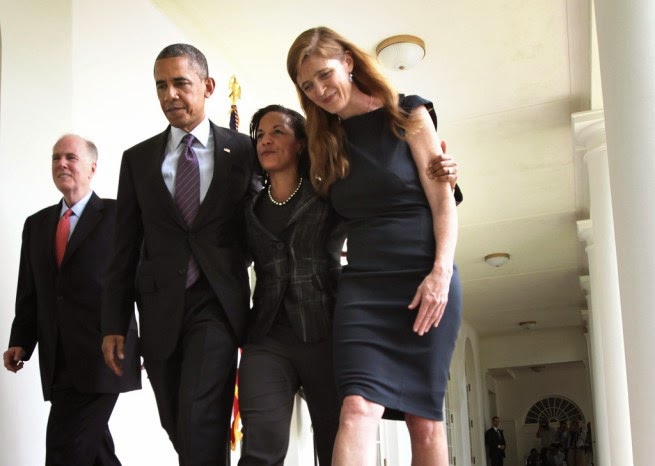
In her first appearance before the Senate Foreign Affairs Committee, Samantha Power, Obama’s pick for next U.S. Ambassador to the United Nations, made clear that she will spend her time in the role much as her predecessor Susan Rice did: acting as Israel’s consummate defender, fear-mongering about Iran, and opposing any move to champion Palestinian human rights or self-determination.
Rice, who has been appointed as Obama’s National Security Adviser, has said repeatedly that the American delegation to the UN “often works in ‘lockstep’ with the Israeli delegation” and spends “an enormous amount of time defending Israel’s right to defend itself and defending Israel’s legitimacy.”
“It’s an issue of utmost and daily concern for the United States,” she declared last year. A few months ago, she reiterated this point, insisting that her role as an apologist for the Israeli government is “a huge part of my work to the United Nations” and that the United States “will not rest in the crucial work of defending Israel’s security and legitimacy every day at the United Nations.”
Power has already proven herself a loyal replacement, disavowing any semblance of past critical thinking when it comes to Israeli human rights abuses and abrogation of international law and opposing fear-mongering about Iran’s nuclear program. It is no surprise Washington hawks and, even the Israeli government, are falling over themselves to sing her praises.
In her confirmation hearing yesterday, Power revealed her adherence to AIPAC talking points, essentially working her way down the tried and true list of boilerplate phrases. “The United States has no greater friend in the world than the State of Israel,” she said, adding, “Israel is a country with whom we share security interests and, even more fundamentally, with whom we share core values – the values of democracy, human rights, and the rule of law.”
“America has a special relationship with Israel,” she stated, to the surprise of no one and the consternation of George Washington‘s ghost. “I will stand up for Israel and work tirelessly to defend it,” she promised.
Perhaps her most disturbing comments, however, were about Iran. Shamelessly exploiting the horror of the Holocaust to fear-monger about the Islamic Republic, she declared:
“…within this organization built in the wake of the Holocaust – built in part in order to apply the lessons of the Holocaust – we also see unacceptable bias and attacks against the State of Israel. We see the absurdity of Iran chairing the UN Conference on Disarmament, despite the fact that its continued pursuit of nuclear weapons is a grave threat to international peace and security.”
With this statement, Power, in her eagerness to check off all the buzzword boxes prescribed by AIPAC, directly contradicts the consistent assessment of the United States’ own intelligence community, which has repeatedly concluded that Iran is, in fact, not pursuing a nuclear weapons as it has no nuclear weapons program.
Early last year, an unnamed U.S. intelligence official told the Washington Post that Iran has not decided to pursue nuclear weapons, explaining, “Our belief is that they are reserving judgment on whether to continue with key steps they haven’t taken regarding nuclear weapons.” At the time, Secretary of Defense Leon Panetta affirmed this position, admitting, “Are they trying to develop a nuclear weapon? No.”
Soon thereafter, the New York Times reported, “Recent assessments by American spy agencies are broadly consistent with a 2007 intelligence finding that concluded that Iran had abandoned its nuclear weapons program years earlier.” This, the paper noted, “remains the consensus view of America’s 16 intelligence agencies.”
Either Samantha Power is an idiot or she’s lying.
In fact, there was a time when Power wasn’t so confident in making such a declarative statement. In a 2008 interview with Miller-McCune, Power noted that she was “not an expert on Iran,” but condemned the “American sabre-rattling” of the George W. Bush administration. “The threats – implicit and explicit – of U.S. military action have united very diverse secular, Islamist and nationalist strands,” she said, adding that American “belligerence” had “backfired.”
When asked specifically about whether she thought “Iran is trying to create nuclear weapons,” Power replied, “It would surprise me if they weren’t, but I don’t know.”
Still, she disparaged the findings of the National Intelligence Estimate and simply assumed Iran “would see as in its interests to amass as much firepower as possible,” due to the foreign threats it faces. Nevertheless, she stated, “It does not seem as though the Iranian regime is close to possessing nuclear weapons” and said that “when U.S. leaders claim Iran poses an imminent threat, they are not currently heard as credible.”
Now, five years later, Power sounds exactly like Bush’s own UN Ambassador, perennial Iran hawk John Bolton, who in 2006, insisted to the UN Security Council that “Iran had defied the international community by continuing its pursuit of nuclear weapons” and that this “pursuit of nuclear weapons constituted a direct threat to international peace and security.”
Furthermore, Power’s incredulity regarding what she deems the “absurdity of Iran chairing the UN Conference on Disarmament,” betrays her own ignorance on Iran’s constantly repeated stance regarding nuclear nonproliferation and disarmament.
Iran has long championed a Nuclear Weapons Free Zone (NWFZ) in the Middle East and is a party to all disarmament treaties on weapons of mass destruction, including the Biological Weapons Convention, Chemical Weapons Convention, and the Nuclear Non-Proliferation Treaty. Israel, however, is not a member to any of them.
Last year, Iranian Foreign Minister Ali Akbar Salehi stated that Iran fully supports the establishment of a NWFZ, but that Israel, and its American backers, presented the “only obstacle to the creation of such a zone…due to its persistent refusal to join the NPT and to place its nuclear facilities under the IAEA safeguards system.” The United States consistently blocks crucial international conferences dedicated to nuclear non-proliferation for the sole purpose of protecting Israel’s massive nuclear arsenal from scrutiny.
Samantha Power has surely embraced her new role in Turtle Bay as Israel’s stalwart apologist.
Abe Foxman, the Anti-Defamation League’s hasbarist-in-chief, once called Susan Rice a “gladiator” fighting in the United Nations on behalf of Israel. There is no question Samantha Power will, for the sake of our “special relationship” and “shared values” with an aggressive, nuclear-armed, settler-colonial apartheid state, similarly take up the sword and continue to unleash hell on the entire Middle East.
Related articles
- Israel’s Nuke Arsenal Off-Limits (alethonews.wordpress.com)
- MEK Re-Ups 3 Year Old Nuclear Propaganda (alethonews.wordpress.com)
What Did Samantha Power Say About Iraq Invasion?
By Peter Hart | FAIR | June 10, 2013

Samantha Power on Democracy Now!
Obama National Security Council adviser Samantha Power has been named the new U.S. ambassador to the United Nations. That news prompted a piece in the New York Times (6/9/13) headlined “A Golden Age for Intervention?” by Neil MacFarquhar. The article raises some of the usual issues surrounding Power’s work– most prominently the notion that the United States should use military intervention in the name of humanitarianism.
MacFarquhar writes that Power
wants the system to work. As flawed as the Security Council is, she has often said, its endorsement amplifies international approval for controversial action. She criticized the American invasion of Iraq because it lacked the council’s stamp, among other reasons.
But what did Samantha Power actually say about the Iraq War before it happened?
Power was prominent in elite foreign policy discussions at the time; her 2002 book A Problem from Hell: America and the Age of Genocide won a Pulitzer the following year.
MacFarquhar makes it sound like Power had multiple reasons she opposed the war. But it’s difficult to find such evidence.
On March 10, 2003, she appeared on MSNBC‘s Hardball to debate pro-war writer Jonathan Chait–whom she agreed with on a few points.
Indeed, it was somewhat difficult to say what Power’s position was overall:
An American intervention likely will improve the live of the Iraqis. Their lives could not get worse, I think it’s quite safe to say.
The issue, though, is whether the United States can be, in a sense, the unilateral guardian of human rights and whether the intervention itself won’t have destabilizing consequences, both in terms of our security, the very security in whose name we’re really launching this intervention, and in the name of international principles like human rights, international justice, international stability.
Power seemed especially concerned about how the ramifications of the war on U.S. standing in the world:
It legitimates the go-it-alone approach and it sort of reinforces the impression of us as an outlaw nation, which is ironic because, of course, Saddam’s regime is far more an outlaw nation than ours.
So Power certainly did not support the way the United States was launching the war. But that’s not really the same as opposing the war; it’s wishing for more effective management of the war.
And host Chris Matthews closed the segment trying to get Power to take a position:
MATTHEWS: Is this a just war, Samantha?
POWER: It will have a just result locally and probably a very unjust result…
MATTHEWS: Is it a just war?
POWER: I don’t think we can be the guardians of justice…
MATTHEWS: No, I–so it’s not a just war?
POWER: We haven’t fought it yet, Chris. I mean, you know, you can’t say whether…
MATTHEWS: Well, you have to decide about a war before you start it, not afterwards. Is this a just war…
POWER: No, you can’t weigh in on proportionality, on discrimination, on whether we actually follow through and actually look out for the rights of the Iraqis…
(CROSSTALK)
POWER: … after the war. We don’t know that now.
MATTHEWS: But in its outset, is it a just war?
POWER: It’s not being fought for human rights reasons. I don’t know who–why–I mean, it would be great if human rights were a necessary condition.
At that time, bonafide critics of the Iraq War were much clearer than that, and it’s hard to find much else that would suggest that Power had a particularly clear anti-war case she made publicly–though she did, like many others, come around to articulating a more forceful critique of the Bush administration by the time that administration was almost over.
Weeks after the war started, a Los Angeles Times article (4/10/03) on Power included this assessment of Iraq:
“That’s what’s so great about the fall of Saddam Hussein. Now we can actually put our money and power where our might has been so far. We can demonstrate what we have claimed all along, that this war is about them,” she said, referring to the Iraqi people.
“The hard work is just beginning, in Iraq and also in restoring U.S. credibility as a global actor. I hope the book provides the spirit in which that can be done.”
Some of Power’s most pointed critics–like writer and lawyer Chase Madar–have argued that Power does not forcefully critique U.S. policies that have encouraged and enabled massive crimes against humanity, preferring instead to talk about instances where the United States could have taken steps to intervene militarily in a given crisis and didn’t.
But in the case of Iraq, at a time when the themes of her celebrated book were very much a part of the debate over whether or not to go to war, it was hard to determine where Power stood.
Featured Video
John Mearsheimer: US Already lost Iran war – No off-ramp in sight
or go to
Aletho News Archives – Video-Images
Frlom the Archives
70 Neocons Petition Congress To Effectively Allow Israel To Say When The US Should Attack Iran
By Damian Lataan | January 10, 2014
Seventy senior Israeli-centric neoconservatives have written an open letter to Congress imploring them to do more to ensure Iran complies with the conditions of any agreement finally reached with the P5+1 over Iran’s nuclear program.
While the neocons are ostensibly asking Congress to ensure compliance, it is clear that their real aim is to convince members of Congress to support the bill currently passing through the Senate which calls for tighter sanctions against Iran in the event of any waywardness on Iran’s part.
The neocons are eager to see the bill currently passing through the Senate with enough support to make it veto-proof, not so much because they are concerned about Iran’s so-called nuclear weapons program – there’s still not a skerrick of hard evidence that Iran has a nuclear weapons program – but, rather, because embedded within the bill is this clause:
… if the Government of Israel is compelled to take military action in legitimate self-defense against Iran’s nuclear weapon program, the United States Government should stand with Israel and provide, in accordance with the law of the United States and the constitutional responsibility of Congress to authorize the use of military force, diplomatic, military, and economic support to the Government of Israel in its defense of its territory, people, and existence…
Essentially, the clause is an automatic trigger for the US to attack Iran at any time the Israelis choose to launch a first strike – regardless of whether President Obama is in favour or not.
Partial list… continue
Blog Roll
 Aletho News
- UK Parliament Plans ISP Blocking and Age Verification Powers
- World cannot remain silent as US and Israel attack ‘heritage of humankind’: Iran
- Emirati billionaire rebukes US senator over call for Gulf states to join war with Iran
- Op. True Promise 4: Iran’s missile blitzkrieg dismantles US war machine in West Asia
- Aramco CEO warns ‘catastrophe’ imminent if Strait of Hormuz remains shut
- What If Iran Says No?
- Trump Threatens to ‘Hit’ Iran ‘Twenty Times Harder’ Over Strait of Hormuz Oil Flows
- Spare the hypocrisy: Baghaei slams Ursula’s support for US
- Iran War Supporters Invent a New and Absurd Justification: It Is All About China
- Corporate Media Go All Out To Support The US-Israeli War on Iran
- If Americans Knew
- Israel Decided the War, But Trump’s America Fights and Pays the Bill
- Conscientious Objector Group: Phone ‘Ringing Off Hook’ As Huge Mobilization Underway
- U.S. support for Israel continues to plummet, despite media’s best efforts
- Threats and missiles fly, death tolls soar in Iran, Lebanon, Gaza – Not a ceasefire Day 151
- Lebanon: Israel’s White Phosphorous Use Risks Civilian Harm
- Corporate Media Go All Out To Support The US-Israeli War On Iran
- US-Israel war on Iran is creating a steady growing number of amputees
- Israel planned this war on Iran for 40 years. Everything else is a smoke screen
- The wrong question about the war in Iran
- ‘Your Tax Dollars Being Used to Raise Your Gas Prices’: US-Israel Bomb Major Iranian Oil Depots
- No Tricks Zone
- Wake-up Call: Survey Shows Majority Of Germans Now Favor Postponing Climate Targets!
- Televised! Leading German Political Candidate Tells Schoolchildren CO2 Makes Sun Hotter!
- New Study: A Century Warming Of 1.1°C Is ‘Commonplace’ And ‘Not Unusual’ During This Interglacial
- New Study: ‘Internal Noise’ And Volcanic Forcing Can Trigger 10-15°C Warming Within Decades
- Glaciers Worldwide Are Suddendly Surging, Experts Blame Warming!
- Surprising Discovery: Sahara Is Greening…Billions Of Trees Where Once Thought To Be Barren
- New Research Reaffirms Clouds, Aerosols, And Surface Solar Radiation Are ‘Driving The Climate System’
- Germany: Electric Car Catches Fire At Charging Station, Sets Off Local “Inferno”, Widespread Damage
- New Study: Canada’s New Brunswick Was 1°C Warmer Than Today During The Medieval Warm Period
- Coal Power Back In Trend As Globe Tries To Keep Pace With Growing Demand For Power
 Aletho News