Iran discovers large natural gas reserve near Persian Gulf
Press TV – October 6, 2025
Iran has discovered a large gas reserve in its southern province of Fars near the Persian Gulf as the country moves ahead with plans to expand its massive petroleum sector despite foreign sanctions.
Iran’s Oil Minister Mohsen Paknejad said on Monday that the Pazan gas reserve holds an estimated 10 trillion cubic feet, or more than 280 billion cubic meters (bcm), of natural gas.
Paknejad said the large gas field also covers areas in the neighboring province of Bushehr, which is the hub of Iran’s gas processing industry.
He said Iran had awarded a contract to develop the field, adding that production could start within the next 40 months.
The minister said exploration activities in Pazan had also led to the discovery of a reserve with at least 200 million barrels of crude oil, adding that the figure could increase as a result of ongoing operations in the field.
His comments came in a report by the Iranian Oil Ministry’s news service Shana, which indicated that the discovery of the Pazan gas field had taken place after drilling a second well in the field in recent years.
It said production from the field will boost Iran’s capacity to respond to an increasing demand for energy in the country in the coming years.
Iran is the second-largest holder of natural gas resources in the world. It is also the third-largest producer of natural gas after the United States and Russia, and the fourth-largest consumer after the US, Russia, and China.
Facing an increasing demand for natural gas in power plants and industries, the country has successfully increased its production in recent years by relying on domestic companies that have replaced foreign contractors wary of US sanctions.
The South Pars gas field, located on the maritime border between Iran and Qatar in the Persian Gulf, is responsible for more than 70% of Iran’s natural gas production of nearly 1 bcm per day.
Iran declares Cairo deal with IAEA ‘defunct’
The Cradle | October 5, 2025
Iranian Foreign Minister Abbas Araghchi confirmed on 5 October that the Cairo deal signed with the International Atomic Energy Agency (IAEA) last month is no longer active or valid due to European ‘snapback’ sanctions on Tehran.
“Experience has shown that there is no solution to Iran’s nuclear issue other than a diplomatic and negotiated one,” Araghchi said.
“The three European countries thought they could achieve results through the snapback mechanism, but that tool was ineffective and only made diplomacy more complicated. Diplomacy will always continue, but the form and the parties involved in negotiations have now changed. Undoubtedly, the role of the European countries in the upcoming talks has diminished, and their diplomatic justification for participating has weakened,” he added.
“In recent months, our discussions have been focused solely on the nuclear issue, conducted either directly or indirectly with the American side. In these exchanges, our proposals were completely transparent. Had they been taken seriously … reaching a negotiated and diplomatic solution would not have been out of reach. Even now, if the [opposing] parties act in good faith and consider mutual interests, the continuation of negotiations is possible.”
“Nevertheless, the situation following the military attack and the activation of the snapback mechanism has changed, and the upcoming negotiations will certainly be different from before,” he went on to say, adding that both the US-Israeli attacks on Iran in June and the activation of the ‘snapback’ mechanism have complicated matters.
“After several rounds of talks, this agreement was reached in Cairo. However, the Cairo Agreement no longer suffices under the new circumstances, including the activation of the snapback mechanism, and new decisions will be made.”
“To prove the peaceful nature of its nuclear program and its goodwill, the Islamic Republic of Iran has exhausted all diplomatic avenues, pursued consultations and cooperation, and presented constructive and balanced proposals. There is now no excuse left for Western countries to prevent Iran from cooperation or dialogue. Iran’s positions are fully legitimate and reasonable, and it is ready to pursue any solution that leads to confidence-building.”
The snapback sanctions took effect on 28 September. Washington welcomed the European decision.
Iran had previously warned that activating the sanctions would jeopardize the Cairo deal, reached on 9 September after Tehran resumed cooperation with the IAEA following a brief suspension as a result of the war.
Negotiations to prevent the return of the sanctions failed after the UN Security Council (UNSC) rejected a draft resolution to permanently lift sanctions against Iran. Russia, China, Pakistan, and Algeria voted to prevent the reintroduction of sanctions, while nine Security Council members voted against sanctions relief. Two countries abstained.
Tehran has recalled its envoys from Germany, France, and Italy.
The EU has continued to hold Iran to the terms of the 2015 Joint Comprehensive Plan of Action (JCPOA), despite Washington’s unilateral withdrawal from the deal in 2018 and its policy of maximum pressure against Iran.
Tehran is insisting on its right to maintain peaceful uranium enrichment.
Nuclear talks between Tehran and Washington have been halted since the US-backed Israeli war against Iran started on 13 June.
The US was aware that Israel was set to attack while continuing to pretend it was negotiating with Iran. In late June, Washington joined the war with a bunker-buster attack on Iranian nuclear sites.
Israel has publicly threatened to restart the war against Iran. Tehran has vowed to respond more harshly to any new attack.
Pezeshkian slams US proposal to trade uranium for sanctions relief
Al Mayadeen | September 27, 2025
Iranian President Masoud Pezeshkian on Saturday dismissed what he described as an unacceptable proposal from Washington that would have required Tehran to surrender all its enriched uranium to the United States in exchange for a short-term easing of sanctions.
“Naturally, we did not reach an agreement on the snapback mechanism because the US demands are unacceptable. They want us to transfer all our enriched uranium to them in exchange for three months, and this is by no means acceptable,” Pezeshkian told Iran’s state broadcaster, IRIB.
The Iranian president said the plan would have left Tehran vulnerable to renewed US pressure. “Had Tehran agreed, the US would have presented Iran with new demands or threatened to bring the sanctions back,” he added.
Snapback, Sovereignty, Defiance
Pezeshkian’s comments came as the United Nations prepares to reinstate sanctions on Iran under the so-called “snapback mechanism,” after Western powers blocked Russian and Chinese efforts to delay the move. The reimposition would restore arms embargoes, asset freezes, and restrictions on enrichment, signaling a further breakdown in nuclear diplomacy.
The Iranian leader stressed that his government will continue to withstand Western sanctions by deepening economic and strategic cooperation with BRICS partners and the Shanghai Cooperation Organization, noting that Iran will rely on “the pride of the Iranian people and their yearning for independence.”
The stance aligns with the position of Sayyed Ali Khamenei, who this week ruled out any direct negotiations with the United States, calling them “a sheer dead end.” Analysts say this reflects a unified leadership intent on avoiding concessions that could weaken Iran’s deterrence or domestic legitimacy.
Resistance, Retaliation, Resolve
Pezeshkian’s defiance comes amid US concerns over Iran’s reported expansion of underground nuclear facilities near Natanz, where construction has accelerated since the June aggression on Iran, when “Israel” carried out coordinated strikes on Iranian military and nuclear sites under the pretext of halting a clandestine weapons program, a charge Iran categorically denied.
The nearly two-week confrontation drew in the United States after its forces struck Iranian nuclear facilities on June 22, prompting Tehran to retaliate by targeting the Al Udeid Air Base in Qatar. The escalation raised fears of a regional war before June 23, when US President Donald Trump announced that “Israel” and Iran had reached a ceasefire, ending what he described as “the 12-day war.”
Observers say Pezeshkian’s remarks reflect Iran’s determination not to trade its sovereignty or nuclear achievements for fleeting concessions, as Tehran shifts toward non-Western alliances and hardens its position against US-Israeli pressure. His message serves both as a rejection of coercive diplomacy and as a signal of Iran’s intent to pursue strategic autonomy in the face of revived sanctions and renewed isolation attempts.
Why the US has sanctioned the Chabahar Port in Iran
By Salman Rafi Sheikh – New Eastern Outlook – September 27, 2025
US sanctions on Iran’s Chabahar Port may look like just another chapter in Washington’s “maximum pressure” playbook, but they are far more ambitious and dangerous.
The move simultaneously aims to discipline India, ratchet up economic warfare against Tehran, and force Afghanistan into a position where ceding Bagram airbase seems unavoidable. In pursuing all three goals at once, the US may be setting the stage for strategic overreach.
US axe falls on Chabahar
On September 16, the US announced that it was reimposing sanctions on Iran’s Chabahar Port that it co-developed with India. Revoking “the sanctions exception issued in 2018 under the Iran Freedom and Counter-Proliferation Act (IFCA) for Afghanistan reconstruction assistance and economic development,” the announcement further said that any “persons who operate the Chabahar Port or engage in other activities described in IFCA may expose themselves to sanctions under IFCA”.
The reference to any “persons” operating the port is to India, which has invested millions of dollars in the port in the last few years. India began to develop this port in a certain geopolitical context. Back then, New Delhi, supported by Washington, used this port to counter China’s Gwadar port in Pakistan. Accordingly, the US granted this port an exemption from sanctions. That exemption has now been taken away. Another imperative at that time was to allow India to use the port to provide supplies to Kabul to support the Karzai and Ghani administrations. Bypassing Pakistan—which Washington understood was supporting the Taliban—the US co-opted India to support the US-backed civilian regime. That geopolitical context, as it stands, no longer exists. The US no longer needs to support avenues to support the regime in Kabul that is no longer a Washington ally. In fact, Washington now prefers using the Chabahar Port issue to equally punish Kabul.
The Geopolitics of Sanctions
By sanctioning Iran’s Chabahar Port, Washington is pursuing more than just another chapter in its “maximum pressure” campaign. It has three critical objectives in mind, the first of which is to punish India. The Trump administration’s ongoing trade war with New Delhi has already seen tariffs climb as high as 50 per cent on Indian exports to the US, dramatically undercutting India’s competitiveness. The withdrawal of the 2018 sanctions waiver on Chabahar effectively expands this economic conflict into the strategic realm. Not only are Indian goods 50 per cent more expensive in the US market, but now Indian exports to Central Asia through Chabahar are threatened by US sanctions as well. The message is blunt: New Delhi cannot expect privileged access to either American markets or regional transit corridors if it resists Washington’s terms.
Yet the dispute is not only about tariffs or trade balances. Chabahar has long symbolised a broader geopolitical opening—an India–Iran–Afghanistan transport corridor that could eventually link New Delhi to Russian and Central Asian energy markets. For India, the project promises a vital alternative to reliance on Persian Gulf suppliers or US-aligned routes. For Washington, this is precisely the problem. By crippling Chabahar, the US seeks to stymie the emergence of an energy corridor outside its sphere of influence and to foreclose India’s access to Iranian and Russian hydrocarbons. The ultimate goal is not simply to weaken Tehran but to pressure India into diverting its purchases toward US liquefied natural gas and crude exports.
The sanctions also reflect a deliberate attempt to recalibrate India’s relationship with Iran. If New Delhi is forced to retreat from Chabahar, Washington calculates, Iran’s isolation will deepen. The State Department’s September 16 statement left little ambiguity, identifying the “networks” that generate “millions for the Iranian military” as key targets of the new restrictions. Chabahar, as Iran’s flagship connectivity project with India and Afghanistan, sits squarely within those crosshairs. Unsurprisingly, the port will dominate the agenda when Ali Larijani, Tehran’s national security adviser and one of the most influential figures in the Iranian establishment, arrives in Delhi in the coming weeks.
The third objective at play is Afghanistan. In recent months, President Trump has openly pressed Kabul to hand back the Bagram airbase to American control, a demand the Taliban leadership has flatly rejected. For the Taliban, acquiescence would be politically ruinous, signaling subservience to the very power they fought for two decades to expel. By sanctioning Chabahar, Washington is attempting to narrow Afghanistan’s options, undermining its role as a vital overland bridge that could connect India and other South Asian states—excluding Pakistan—to Central Asian markets. This is not a trivial calculation. With relations between Kabul and Islamabad deteriorating, the Taliban regime has been cautiously exploring new partnerships in the region, and India has emerged as an obvious candidate. Earlier this year, the Taliban went so far as to call India a “significant regional partner.” Washington’s sanctions strategy is designed precisely to choke this opening, shrinking the diplomatic and economic space available to Kabul as it manoeuvres for new allies.
The US risks a massive backfire
Yet Washington’s gambit carries the risk of a serious backlash. Kabul has little incentive to heed American preferences, particularly after the Biden administration’s refusal to release Afghanistan’s frozen financial assets. The Taliban leadership, already charting its course independently, is unlikely to view US sanctions as anything more than another act of hostility. More consequential, however, is the potential fallout with India. By undermining New Delhi’s flagship connectivity project, Washington risks inflicting lasting damage on a relationship it has spent years cultivating. Alienated, India may lean more heavily on alternative partnerships with Russia and even China, eroding the very strategic alignment the US has sought to build through the Indo-Pacific framework. And if New Delhi ultimately withdraws from Chabahar under sanctions pressure, Washington may not secure the energy dominance it envisions. Instead, the vacuum could invite Beijing to step in, transforming Chabahar into a Chinese-controlled gateway for Central Asian energy, a scenario that would decisively undercut American aims.
Salman Rafi Sheikh is a research analyst of International Relations and Pakistan’s foreign and domestic affairs.
Iran’s FM addresses UN Security Council on failed Russia-China draft resolution
Global Times | September 27, 2025
The UN Security Council has voted down an effort by China and Russia to extend sanctions relief to Iran for six months under the nuclear deal – formally known as the Joint Comprehensive Plan of Action on Friday, local time. The draft failed to be passed as the number of votes in favor did not reach nine.
In his speech, Iran’s Foreign Minister, Seyed Abbas Araghchi, began by thanking China, Russia, Pakistan, and Algeria for supporting the resolution, which he described as a genuine effort to “keep the door of diplomacy open and avoid confrontation.” He also welcomed the decision of Guyana and South Korea not to oppose the draft, calling it a stand “on the right side of history,” according to WANA News, an Iranian news agency.
The Iranian foreign minister argued, “Today’s situation is the direct consequence of the US withdrawal from the JCPOA and the E3 (France, United Kingdom and Germany) failure to take any effective action to uphold the commitments.”
“The US has betrayed diplomacy, but it is the E3 which have buried it,” he stressed. Araghchi also said, “The E3 and the US acted in bad faith, claiming to support diplomacy while in effect blocking it.”
“Regrettably, E3 chose to follow Washington’s whims rather than exercising their independent sovereign discretion,” he said, adding “the US persistent negation of all initiatives to keep the window for diplomacy open proved once again that negotiations with the United States lead to nowhere other than dead end,” the foreign minister added.
Geng Shuang, China’s deputy permanent representative to the United Nations spoke after the vote. He reminded the Council that “history has shown that resorting to force or applying maximum pressure is not the correct approach to resolve the Iranian nuclear issue,” according to the UN report.
Geng continued, “Against the backdrop of ongoing conflict in Gaza and the instability in the Middle East, a breakdown in the Iranian nuclear issue could trigger new regional security crisis, which runs counter to common interest of the international community.”
The Chinese diplomat urged the US to “demonstrate political will by responding positively to Iran’s proposal to resume talks and committing unequivocally to refrain from further military strikes against Iran.”
US, allies veto draft resolution on delaying ‘snapback’ of Iran sanctions
Press TV – September 26, 2025
The United States and its allies veto a draft resolution aimed at delaying “snapback” of the UN Security Council’s sanctions against Iran that were lifted in 2015 in line with a nuclear deal between the Islamic Republic and world countries.
On Friday, the US, the UK, France, Denmark, Greece, Panama, Sierra Leone, Slovenia, and Somalia vetoed the draft measure seeking to delay imposition of the coercive economic measures for six months.
China, Russia, Algeria, and Pakistan voted in favor of the measure that had been submitted by Beijing and Moscow. South Korea and Guyana abstained.
According to the UN, “The so-called ‘snapback’ mechanism [now] remains in force, which will see sanctions rei-imposed on Tehran this weekend, following the termination of the Joint Comprehensive Plan of Action (JCPOA).”
JCPOA refers to the official name of the nuclear deal that upon conclusion was endorsed by the Security Council in the form of its Resolution 2231.
The agreement lifted the sanctions, which had been imposed on Iran by the Security Council and the US, the UK, France, and Germany over unfounded allegations concerning Tehran’s peaceful nuclear energy program.
The bans had been enforced against the nation, despite the International Atomic Energy Agency (IAEA)’s having historically failed to find any proof of “diversion” of the nuclear program.
The US left the JCPOA in an illegal and unilateral move in 2018 and then re-imposed those of its sanctions that the deal had removed.
In 2020, Washington went further by trying unilaterally to trigger the “snapback.”
After the American withdrawal, the UK, France, and Germany too resorted to non-commitment vis-à-vis the Islamic Republic by stopping their trade with Tehran.
The Friday vote came after the trio launched their own bid to activate the “snapback” on August 28.
The allies have been rehashing their accusations concerning Iran’s nuclear energy activities in order to try to justify their bid to reenact the sanctions, ignoring absence of any proof provided by the IAEA that has subjected the Islamic Republic to the agency’s most intrusive inspections in history.
They have also constantly refused to accept their numerous instances of non-commitment to the JCPOA.
Iran, however, began observing an entire year of “strategic patience” following the US’s withdrawal – the first serious violation of the nuclear agreement – before retaliating incrementally in line with its legal right that has been enshrined in the deal itself.
In the meantime, the Islamic Republic has both voiced its preparedness to partake in dialog besides actually engaging in negotiation aimed at resolving the situation brought about by the Western allies’ intransigence.
Tehran refused to categorically rule out talks with the European troika even after illegal and unprovoked attacks by the Israeli regime and the United States against key Iranian nuclear facilities in June, which made it impossible for the IAEA to continue its inspections as before.
The Islamic Republic’s latest goodwill gesture came on September 9, when it signed a framework agreement with the IAEA aimed at resuming cooperation with the agency, which had been suspended following the attacks.
The Friday vote came, although, Iranian officials, including President Masoud Pezeshkian, Foreign Minister Abbas Araghchi, and security chief Ali Larijani, had strongly warned the US and its allies against triggering the “snapback.”
Araghchi had cautioned that such vote would lead to termination of the agreement with the IAEA, while Pezeshkian had noted that talks would be “meaningless” if the mechanism were to be enacted.
Meeting with anti-war activists in New York on Thursday, the president had called the prospect of re-imposition of the sanctions unwelcome, but added that the coercive measures did not signal “the end of the road.”
“Iran will never submit to them,” he had said, referring to the bans, and added that the Islamic Republic “will find the means of exiting any [unwelcome] situation.”
China voices ‘deep regret,’ discourages renewed aggression
Reacting to the vote, China’s Deputy UN Ambassador Geng Shuang similarly expressed “deep regret” for the failure to adopt the draft resolution, identifying dialogue and negotiation as two of “the only viable options” out of the situation caused by the Western measures.
He urged the US “to demonstrate political will” and “commit unequivocally to refraining from further military strikes against Iran.”
Geng further called on the European trio to engage in good faith in diplomatic efforts and abandon their approach of pushing for sanctions and coercive pressure against Iran.
Russia slams US, allies for lack of ‘courage, wisdom’
The remarks were echoed by Geng’s Russian counterpart Dmitry Polyanskiy, who said, “We regret the fact that a number of Security Council colleagues were unable to summon the courage or the wisdom to support our draft.”
“We had hoped that European colleagues and the US would think twice, and they would opt for the path of diplomacy and dialogue instead of their clumsy blackmail,” he said.
Such approach, the diplomat added, “merely results in escalation of the situation in the region.”
Speaking before the vote, Polyanskiy had also told the chamber that Iran had done all it could to accommodate Europeans, but that Western powers had refused to compromise.
How MI6 Fabricated Iran Nuke Fraud
By Kit Klarenberg | Global Delinquents | September 24, 2025
On September 19th, the UN Security Council voted to reimpose savage economic restrictions on Iran over its nuclear program. European leaders have in recent months repeatedly accused Tehran of refusing to abide by the 2015 Joint Comprehensive Plan of Action’s terms. A core, repeated claim is the Islamic Republic has collated a uranium stock over 40 times the level permitted under that deal. No supporting evidence for the charge has been provided, and the source of this information isn’t clear.
It may nonetheless be highly significant London has taken the lead in calling for the restoration of sanctions, independently imposed punitive measures on Iranian individuals and commercial entities, and employed relentlessly bellicose rhetoric about the Islamic Republic’s purported breaches of its JCPOA commitments. In August, then-Foreign Secretary David Lammy declared Tehran had “consistently failed to provide credible assurances on the nature of its nuclear programme.” In the wake of the UNSC vote, British ambassador Barbara Woodward proclaimed, “we urge [Iran] to act now.”
As this journalist has previously exposed, the JCPOA resulted from a long-running MI6 black propaganda campaign to falsely frame the Islamic Republic as possessing nuclear weapon ambitions, if not nukes outright. Under the Agreement’s terms, Tehran received sanctions relief in return for granting the International Atomic Energy Agency virtually unhindered access to its secret nuclear complexes. Despite the IAEA consistently certifying Iran’s compliance, the Trump administration shredded the Agreement in May 2018, and launched a “maximum pressure” campaign to cripple the country.
Information gathered by the IAEA under the Agreement appears to have assisted Israel’s criminal 12 Day War in June, raising the obvious question of whether the Agreement was always intended as an espionage operation, in preparation for future conflict with Tehran. This interpretation is amply reinforced by leaked documents, indicating the IAEA provided Zionist entity intelligence with names of Iranian nuclear scientists who were subsequently assassinated. Meanwhile, the papers show Agency chief Rafael Grossi enjoys an intimate, covert relationship with officials in Tel Aviv.
These disclosures understandably motivated Iranian lawmakers and President Masoud Pezeshkian to halt any and all cooperation with the Agency. The sanctions eased by the JCPOA being the product of an MI6 black propaganda effort, to falsely convince the West and its overseas proxies and puppets Tehran posed a global nuclear weapon threat, provides the Republic with even more urgent justification for ignoring the Agreement’s terms. Iran’s grounds for rejecting any accommodation with the same countries now seeking to sanction her are inarguable.
‘Supportive Relations’
At the centre of MI6’s black propaganda war on Iran was longtime British intelligence officer Nicholas Langman, a veteran dark arts specialist who has been repeatedly publicly exposed perpetrating the dirtiest imaginable deeds for London’s foreign spying agency the world over. He was for example intimately implicated in Britain’s contribution to the CIA’s global post-9/11 torture program. However, rather than being penalised or defenestrated for his actions and unmasking, he appears to have been richly rewarded, and consistently failed upwards.
A leaked CV shows 2006 – 2008, Langman led MI6’s Iran Department. Here, he oversaw a team seeking to “develop understanding” of Iran’s “nuclear program”. Then, 2010 – 2012, he led an “inter-agency” effort to infiltrate the IAEA, while “[building] highly effective and mutually supportive relations across government and with senior US, European, Middle and Far Eastern colleagues for strategy which enabled major diplomatic success [sic] of Iranian nuclear and sanctions agreement.”
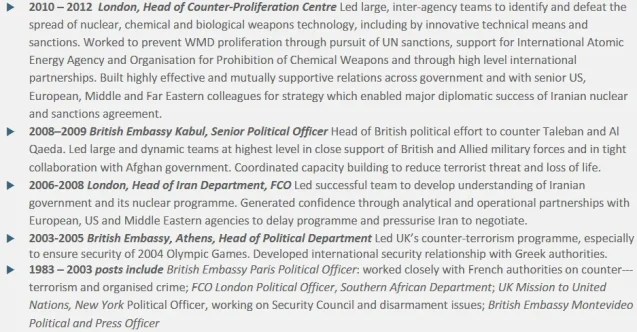
Nicholas Langman’s leaked CV
It was during the latter period that public and governmental attitudes across the West – and in vassal states – towards the Islamic Republic became highly belligerent, and negative. One by one, governments and international bodies – including the EU and UN – imposed ravaging sanctions against Tehran, devastating its economy, influence, and standing. MI6 journeyman Langman triumphed in his mission to foment concerted global hostility against Iran, based on the bogus spectre of the country posing a nuclear threat.
The question of whether British ‘intelligence’ on Iran’s nuclear program was the product of torture is an open and obvious one. Langman moved straight to leading MI6’s Iran Department from running the agency’s station in Athens, Greece. There, in late 2005, he was exposed by local media as having overseen an operation to abduct and ferociously mistreat 28 Pakistani guestworkers, wrongfully suspected of having had contact with individuals accused of perpetrating the 7/7 bombings in London in July that year.
That Langman wasn’t reprimanded over the incident strongly suggests he enjoyed a high level of protection, and London approved of his vicious intelligence-gathering methods – known to invariably produce false testimony from detainees. MI6 was not only an enthusiastic collaborator in the CIA’s global extraordinary rendition program, but led its own operations. Markedly, in at least one case, the British sought to sideline the CIA and ensure exclusive access to “intelligence” from a detainee in which Langley also had an interest.
The Obama administration was during its first year in office formally committed to non-interference in the Islamic Republic’s affairs, to the extent State Department apparatchik Jared Cohen was almost fired for publicly demanding Twitter halt planned maintenance during June 2009 protests in Iran, to ensure demonstrators could continue posting. It’s therefore unknown whether Washington was in on MI6’s Iran nuke con. If not, it wouldn’t be the first time British intelligence has misled the international community, with catastrophic results.
‘Possible Manipulation’
In July 2004, the Senate Intelligence Committee issued a scathing report on “the US intelligence community’s prewar intelligence assessments on Iraq.” It reserved particular disdain for how the CIA et al had “[relied] too heavily on foreign government services and third party reporting, thereby increasing the potential for manipulation of U.S. policy by foreign interests [emphasis added].” This was a reference to MI6’s central role in gathering – or concocting – intelligence on Baghdad’s purported WMD capabilities:
“Due to the lack of unilateral sources on Iraq’s links to terrorist groups like al-Qaida [redacted], the [US] Intelligence Community (IC) relied too heavily on foreign government service reporting and sources to whom it did not have direct access to determine the relationship between Iraq and [redacted] terrorist groups… The IC left itself open to possible manipulation by foreign governments and other parties interested in influencing US policy.”
As far back as the late 1990s, Britain’s foreign spying agency took the lead on sourcing dud ‘intelligence’ to manufacture consent for the against Baghdad. Under the auspices of a psychological warfare effort dubbed Operation Mass Appeal, MI6 black propaganda specialists circulated false information to foreign editors and reporters on its payroll “to help shape public opinion about Iraq and the threat posed by WMD,” which was then recycled by Western leaders and news outlets to reinforce its credibility.
In September 2002, then-MI6 chief Richard Dearlove personally approached British Prime Minister Tony Blair, claiming his agency had cultivated a source inside Iraq with “phenomenal access”, who could provide the “key to unlock” Iraq’s purported WMD program. Their assorted claims subsequently formed the basis of a dossier, which made a number of wild charges about Baghdad’s chemical and biological weapon capabilities. A prominently reported allegation was that Iraq could deploy WMD against Western countries within just 45 minutes. Its source was an Iraqi taxi driver.
This claim was repeated in a radio address by George W. Bush that month. In January the next year, as the invasion of Iraq rapidly loomed, the President declared in his State of the Union address, “the British government has learned that Saddam Hussein recently sought significant quantities of uranium from Africa.” That December, then-CIA chief George Tenet admitted this assertion was completely fallacious, and “these 16 words should never have been included in the text written for the President.”
The Zionist entity justified its unprovoked assault against Iran in June in large part on an intelligence dossier, which concluded the Islamic Republic had reached the “point of no return” in acquiring nukes. Its findings relied heavily on a May IAEA report that provided zero fresh information, but concluded Tehran supposedly maintained “undeclared nuclear material” until the early 2000s. While intended to trigger regime change, Tel Aviv’s broadside ended promptly in embarrassing failure, despite extensive foreign support, including US airstrikes.
Undeterred by the fiasco, Benjamin Netanyahu remains determined to crush the “Iranian axis”, while Trump has declared he would bomb Tehran “without a question” in response to indications the Islamic Republic has enriched uranium beyond agreed levels. We could be on the precipice of another war. As with the Iraq invasion, the perilous trail that brought us to this grave point could lead back to London. Yet again, MI6 may have taken the lead in concocting ‘intelligence’, justifying further US-Israeli aggression against the Islamic Republic.
Mohammad Marandi: Iran KILLS IAEA Deal — Cairo Agreement Wiped Out After SnapBack!
Dialogue Works | September 21, 2025
Iranian parliament pushes for ‘nuclear option’ as deterrence to western threat
The Cradle | September 22, 2025
Over 70 members of Iran’s parliament on 22 September called for a reassessment of the country’s defense doctrine, pressing authorities to consider nuclear weapons as a deterrent.
In a letter addressed to the Supreme National Security Council and the heads of the executive, legislative, and judicial branches, the lawmakers demanded that the issue be raised urgently.
“We respectfully request that, since the decisions of that council acquire validity with the endorsement of the Leader of the Revolution, this matter be raised without delay and the expert findings communicated to the parliament,” the statement read.
The MPs argued that while the development and use of nuclear arms contradicts the 2010 ‘fatwa’ of Iranian Supreme Leader Ali Khamenei banning them, circumstances have changed.
They wrote that “developing and maintaining such weapons as a deterrent is another matter,” stressing that “in Shia jurisprudence, a change in circumstances and conditions can alter the ruling.”
“Moreover, safeguarding Islam – which today is bound to the preservation of the Islamic Republic – is among the paramount obligations.”
The push was led by Hassan-Ali Akhlaghi Amiri, a representative from the holy city of Mashhad, according to Hamshahri Online.
Lawmakers noted that the nuclear doctrine was shaped at a time when the international community was still able to restrain Israeli aggression.
They pointed to the large-scale assault launched by Israel in June, backed by the US, which included direct strikes on three Iranian nuclear facilities, among them Fordow.
Iran has long stated its nuclear program is peaceful, rejecting western claims it seeks weapons capability. Tehran continues to cite Khamenei’s fatwa as proof of its intentions.
At the same time, the Supreme National Security Council announced the suspension of cooperation with the International Atomic Energy Agency (IAEA) after the UN Security Council imposed sanctions.
State media quoted the body as saying the move was a response to the “ill-considered steps of three European countries.”
Lawmakers warned that pressure tactics by the E3 countries will draw a “harsher and more decisive” response than before.
SNSC says Iran will suspend cooperation with IAEA after re-imposition of sanctions
Press TV – September 20, 2025
Iran’s Supreme National Security Council (SNSC) says Tehran will suspend its cooperation with the International Atomic Energy Agency (IAEA) after the United Nations Security Council voted not to permanently lift sanctions on Tehran.
In a statement on Saturday, Iran’s top security body condemned the “ill-considered” moves by Britain, France, and Germany —known as the E3— regarding the Islamic Republic’s peaceful nuclear program.
On Friday, the 15-member Security Council failed to adopt a resolution that would have prevented the reimposition of UN sanctions on Iran after the E3 triggered the “snapback” mechanism, accusing Tehran of failing to comply with the 2015 deal, formally called the Joint Comprehensive Plan of Action (JCPOA).
Iran rejected the illegitimate move by the European troika, pointing out that the United States had already pulled out of the deal and accusing the European trio of siding with illegal sanctions instead of honoring their own commitments.
In a Saturday session, chaired by President Masoud Pezeshkian, the SNSC addressed the latest situation in the region and the Israeli regime’s adventurism, the statement said.
“Despite [Iranian] Foreign Ministry’s cooperation with the Agency and the proposals presented to settle the [nuclear] issue, the actions of European countries have effectively suspended the path of cooperation with the Agency,” the SNSC emphasized.
According to the statement, Iran’s top security body tasked the Ministry of Foreign Affairs with continuing its consultations within the framework of the SNSC decisions to safeguard the national interests.
It added that Iran’s foreign policy under the current circumstances will be based on cooperation to establish peace and stability in the region.
Earlier on Saturday, Pezeshkian said Tehran can overcome any re-imposition of sanctions and will never surrender to excessive demands.
“We should believe that we can overcome obstacles and that the ill-wishers of this territory cannot block our way,” the president added.
The SNSC was formally put in charge of overseeing cooperation with the IAEA in July, following a series of illegal and unprovoked Israeli and US attacks on Iranian nuclear facilities.
The shift came after Iran’s Parliament passed legislation on July 2, requiring that all IAEA inspection requests be reviewed and approved by the SNSC.
US Cranks Up Pressure on India for Refusing to Kneel
By Ekaterina Blinova – Sputnik – September 19, 2025
The US has announced it will withdraw the sanctions waiver granted for Iran’s Chabahar Port, which is being developed by India. The port holds strategic importance for both Tehran and New Delhi. Tehran University professor Mohammad Marandi explains the move.
The US is pursuing two objectives by imposing sanctions related to India’s involvement in Chabahar Port, Tehran University professor Mohammad Marandi tells Sputnik.
- First, it seeks to cut off the North-South Transport Corridor and break the link between India and Russia that goes through Iran.
- Second, it cannot reconcile with the fact that Indian PM Narendra Modi didn’t cave in despite tariffs and is now raising the stakes.
“They are trying to force the Indian government to do as they wish. And this is part of that process.”
The US’ intimidation of Russia, Iran, and India is pushing them to unite on solutions beyond US control, according to Marandi.
“They create an incentive for countries to work together and exclude the United States. It is US policy that has effectively made BRICS what it is today. It is US policy that has made the Shanghai Cooperation Organization what it is today. It is their behavior, their lawless behavior, using sanctions as a weapon, using tariffs as a weapon, using financial institutions and the US dollar as a weapon.”
The US wants full control, and they see the Global South on the rise, and they increasingly become irritated, and they behave increasingly irrational in order to preserve that control, according to the pundit.
So what’s the smart play for Russia, Iran, and India now? “To speed in the process of developing the North-South Transport Corridor and developing the Chabahar Port,” Marandi believes.
UN Security Council votes to reimpose nuclear sanctions on Iran
Al Mayadeen | September 19, 2025
The United Nations Security Council voted on Friday to reimpose nuclear sanctions on Iran, citing its alleged violations of the 2015 Joint Comprehensive Plan of Action (JCPOA).
The move, driven by Britain, France, and Germany, has sparked sharp criticism from Russia, China, and Iran, highlighting deepening divisions within the international community over the future of Iran’s peaceful nuclear program.
The three European signatories to the JCPOA called for the activation of the snapback mechanism, falsely claiming that Iran had breached commitments made under the 2015 deal, which was designed to prevent Tehran from acquiring nuclear weapons capabilities.
The European powers alleged that Iran’s advancements in uranium enrichment and reduced cooperation with the International Atomic Energy Agency (IAEA) constitute material violations of the agreement.
Iran, Russia, and China push back
In response, Iranian Foreign Minister Abbas Araghchi stated that Tehran had presented a “fair and balanced” proposal to European nations aimed at preventing the reimposition of sanctions.
Russia’s UN Ambassador, Vasily Nebenzia, rejected the European-led move, saying, “There are no grounds for reinstating UN sanctions on Iran.” He emphasized that the E3’s push for snapback sanctions has no legal authority and affirmed that Moscow would not recognize it.
Russia also called on Security Council members to support a joint Russian-Chinese draft resolution on Iran, offering an alternative diplomatic track to avoid escalation.
China’s envoy emphasized that pressure on Iran must stop and urged Tehran to reaffirm the peaceful nature of its nuclear program, noting Iran’s declared willingness to cooperate.
Iran maintains that its nuclear program remains peaceful and has accused Western powers of double standards and bad faith. Chinese Ambassador to the UN echoed this stance, stating, “It was the United States that withdrew from the agreement, attacked Iran militarily, and disrupted negotiations.”
China’s envoy also called on the European trio to immediately withdraw their notifications to reinstate sanctions, stressing that “pressure is not the solution.”
Snapback could nullify Cairo agreement
Al Mayadeen’s sources warned on Thursday that activating the snapback sanctions mechanism would nullify the Cairo Agreement and end cooperation between the IAEA and Tehran.
This would prevent international inspectors from accessing sensitive facilities, escalating the standoff even further.
According to the sources, the diplomatic window with Iran remains open, but indicators point to the potential activation of the snapback sanctions mechanism. They argued this is largely because Washington is steering the European Troika in the talks.
The sources warned that Washington is expected to call on Tehran to resume negotiations after activating the snapback mechanism, aiming to impose its conditions from what it perceives as a position of strength. They described this approach as a serious miscalculation of Iran’s stance and the way Tehran would respond.
Featured Video
or go to
Aletho News Archives – Video-Images
From the Archives
Israel Would Have No Qualms About USS Liberty-Style FALSE FLAG If Iran Campaign Falters – Analysts
By Ilya Tsukanov – Sputnik – 18.06.2025
Donald Trump is mulling whether or not to join Israel’s aggression against Iran as Tel Aviv faces problems sustaining its defenses against growing counterstrikes, and apparently lacks a realistic game plan for an end to hostilities after failing to achieve its goals. Analysts told Sputnik how the US could be ‘nudged’ into the conflict.
“The US is already assisting Israel with supplies, intel, refueling support, etc. One of the many US posts in the region could be attacked for a casus belli,” former Pentagon analyst Karen Kwiatkowski explained.
“If Trump doesn’t comply with Israel’s demand” and join its aggression voluntarily, “a false flag may be needed” to drag the US in, Kwiatkowski, retired US Air Force Lt. Col.-turned Iraq War whistleblower, fears.
Netanyahu has a diverse array of options at his disposal, according to the observer, including:
- a false flag against US assets abroad blamed on Iran or one of its Axis of Resistance allies, like the Houthis
- a US domestic attack or assassination blamed on Iran
- Iranian air defenses ‘accidentally’ hitting a civilian jetliner carrying Americans
- use of a dirty bomb or nuclear contamination somewhere in the region blamed on Iran
- even blackmailing by threatening to use nukes against Iran if the US doesn’t join the fight
Kwiatkowski estimates that Israel probably has “enough blackmail power” against President Trump and Congress to avoid the necessity of a false flag operation, but a “USS Liberty-style” attack, targeting the soon-to-be-retired USS Nimitz supercarrier that’s heading to the Middle East, for example, nevertheless cannot be ruled out entirely, she says. … continue
Blog Roll
 Aletho News
- Smotrich calls for annexation of South Lebanon to Litani River
- Echos of Gallipoli? Hormuz and the Geography of Hubris
- Pakistan PM backs Iran’s right to self-defense amid tensions
- Hungary blasts ‘fake’ EU accusation
- SAFE Debt Trap: Poland’s €43.7 Billion Bet on Unipolar Illusion
- War on Iran threatens global Gulf capital flows: FT analysis
- Mossad De Facto Admits To Inciting Riots In Iran
- Tehran: World grown thoroughly exhausted with US-Israeli ‘false flag storylines’
- Trump ‘stuck between a rock and a hard place’, lacks Iran war strategy: Ex-CIA chief
- Trump’s bombardment of fake news so far is working quite well. But where is it heading?
- If Americans Knew
- From Sde Teiman, the truth about Israel’s military justice system has been set free
- Child denied life-saving bone marrow transplant by Israel ‘because he is from Gaza’
- Raffi Berg: BBC Middle East Editor Exposed as CIA, Mossad Collaborator
- Jerusalem Archbishop Rebukes Netanyahu’s Statements on Christianity
- US to embed Palantir AI across entire military: Report
- Israeli-US war on Iran to drag on “a few more weeks” – Not a ceasefire Day 164
- Lebanon deaths top 1,200; Palantir AI to be embedded across US military – Not a ceasefire Day 163
- Israel’s assassination game: Take all pragmatists off the board
- Food shortages return to Gaza as Israel tightens aid restrictions under the cover of its war on Iran
- Trump demands trillions in payments from Gulf countries, billions from Harvard – Not a ceasefire Day 162
- No Tricks Zone
- Devastating Assessment Of Comirnaty Vaccine By Former Senior Pfizer Europe Toxicologist
- New Study: CO2 Is ‘Effectively Negligible’ As An Explanatory Climate Change Factor Since 2000
- Former Pfizer Toxicologist Dr. Helmut Sterz Tells Bundestag Hearing Pfizer Vaccine Should Have Never Been Approved
- Energy Expert: Germany’s Nuclear Phaseout Was A “500 Billion Euro Mistake”
- New Research: South Australia’s Mid-Holocene Sea Surface Temperatures Were 4°C Warmer Than Today
- Storing Green Energy To Last Germany 10 Days Would Require A 60-Million Tonne Battery
- New Studies: UK Sea Levels Were 4 Meters Higher Than Today During The Mid-Holocene
- Destructive Green New Deal: German Energy And Metal Group Warns Of Drastic Crisis
- New Study Documents A 20-Year Pause In Arctic Sea Ice Decline – Driven By Internal Variability
- Wake-up Call: Survey Shows Majority Of Germans Now Favor Postponing Climate Targets!
 Aletho News