
NY Congressman Eliot Engel (second from left) is lead sponsor on recent anti-Iran bills. Engel, who is the top Democrat on the House Foreign Affairs Committee, has traveled to Israel often and is one of its most fervent defenders. (Photo is from his Congressional website.)
Ever since Iran’s increasingly despotic Shah was overthrown by a popular revolution in 1979, Israel has targeted Iran for attack because of the country’s support for Palestinian rights. (The Shah had been put in place by a 1953 UK-US engineered coup against the country’s Prime Minister, Mohammad Mosaddegh.)
The Israeli ambassador to the U.S. said recently that Iran is Israel’s number one concern, and an Iranian newspaper reported: “Iran is the primary target of the Mossad’s actions, which number in the hundreds and thousands each year.”
The Israel lobby has accordingly worked for U.S. policies against Iran, including disseminating advertisements that demonize Iran; an example is this 2010 full-page advertisement in the New York Times :

The list on the left is of the groups that sponsored the ad, as evidenced by their icons at the bottom of the ad.
Now Congress has obliged Israel and its lobby by passing four more bills against Iran. Below is a report on the latest legislation. (Photographs and some additional information in Italics have been added.)
Despite a purely partisan Republican push to alter the terms of the Iran nuclear deal, an overwhelming majority of US lawmakers from both parties continues to advance legislation to counter Iranian behavior throughout the Middle East.
The House passed four bills today and Wednesday taking aim at Iran’s ballistic missile program and its support for Hezbollah, the Lebanese Shiite paramilitary group fighting alongside Iranian forces on behalf of the Bashar al-Assad regime in Syria. In addition, Iran hawks in Congress continue to press the Donald Trump administration to ban US aircraft sales to Iran and designate the Islamic Revolutionary Guard Corps (IRGC) as a foreign terrorist organization.

Lebanese resistance group Hezbollah has opposed Israeli invasions and occupation. Photo is of a Beirut suburb bombed by Israel in 2006.
“The whole thing with the [nuclear deal] that irked me throughout was that during the course of the negotiations … we were told consistently that this was only about nuclear weapons,” Rep. Eliot Engel, D-N.Y., the top Democrat on the House Foreign Affairs Committee, told Al-Monitor. “We couldn’t raise terrorism, we couldn’t raise ballistic missiles. We couldn’t raise all the other things against Iran and it frustrated me to no end.”
“I think those of us who really feel that Iran is a major cause of instability in the Middle East need to make sure that Iran is sanctioned,” Engel added.
[U.S. intelligence agencies have found no evidence that Iran is developing nuclear weapons.]
In July, Congress passed the first round of sanctions on Iran since the 2015 nuclear accord. The Iran Ballistic Missiles and Sanctions Enforcement Act, which the House passed 423-2 today, would further expand sanctions on Iran’s ballistic missile program. The Senate must now vote on the additional sanctions package before it can head to Trump’s desk.
Engel, the lead cosponsor of both Iran sanctions packages, has described today’s bill as “pretty similar” to the July sanctions package. The new version, however, would affect entities and individuals supporting Iran’s ballistic missile program even if they don’t have assets in the United States.
The House also passed three bills targeting Hezbollah on Wednesday. The US government considers Hezbollah a terrorist group and US lawmakers overwhelmingly regard it as an Iranian proxy.

House Majority Leader Kevin McCarthy (R-CA) at the ‘National Leadership Assembly for Israel’ event organized by the Conference of Presidents of Major American Jewish Organizations. (National Press Club July 28, 2014 in Washington, DC.)
“They’re giving the money to Hezbollah to kill individuals and fund terrorism around the world,” House Majority Leader Kevin McCarthy, R-Calif., said on Fox News before Wednesday’s votes. “And we’re putting an end to that, continuing to put the sanctions and the pressure on.”
The primary Hezbollah sanctions bill, the Hezbollah International Financing Prevention Amendments Act, introduced by House Foreign Affairs Committee Chairman Ed Royce, R-Calif., passed the House unanimously on Wednesday. It is designed to cut Hezbollah’s funding streams from foreign states such as Iran while cracking down on the group’s alleged racketeering activities abroad. The Jerusalem Post reported in September that Iran now gives Hezbollah roughly $800 million a year, an unprecedented level of funding.

Congressmen Ed Royce (L) and Eliot Engel (R) with Israeli Prime Minister Benjamin Netanyahu.
Companion legislation passed the Senate unanimously earlier this month. The House version, however, contains some extra provisions that single out Iran and Russia for their support of Hezbollah.
Specifically, the House version amends a 2010 Iran sanctions package to include Iran’s support for Hezbollah and directs the administration to sanction government entities that are already on the State Department’s state sponsor of terrorism list if they support Hezbollah. Iran, Syria and Sudan are currently the only three countries on that list.
Engel, the lead cosponsor of the Royce bill, told Al-Monitor that he’s optimistic its Iran provisions will survive reconciliation with the Senate version.
“I think ultimately they won’t disappear because I think both sides of the aisle understand that Iran’s a threat and even those who want to keep the [Iran deal] don’t want to take the pressure off Iran,” said Engel. “When we do things and wrap it up for the year, I think the Iran sanctions have to be in there.”
The House also unanimously passed legislation from Rep. Mike Gallagher, R-Wis., to impose overlapping sanctions on foreign states and individuals for providing support to Hezbollah due to its alleged use of human shields. The sanctions in both Hezbollah bills would target the same individuals and entities, but its supporters say the Gallagher bill still has value.
“The purpose of these bills, especially the reporting part, is to highlight the various harmful actions which Congress wants to expose with regard to Hezbollah,” said Joseph Gebeily, the president of the Lebanese Information Center, a think tank critical of Hezbollah.
Gebeily added that the Gallagher bill “puts more focus on the United Nations Security Council’s responsibility in disarming Hezbollah and preventing its military operations in Lebanon.” The bill requires the US ambassador to the United Nations to “secure support for a resolution that would impose multilateral sanctions against Hezbollah for its use of civilians as human shields.”
Lastly, a resolution offered by Rep. Ted Deutch, R-Fla., to urge the European Union to designate the political wing of Hezbollah as a terrorist organization passed the House unanimously. While the EU considers Hezbollah’s paramilitary wing to be a terrorist group, US lawmakers have repeatedly voiced their frustration that it does not extend that designation to Hezbollah parliamentarians and Cabinet officials in Lebanon.

Congressional Representatives Ilyana Ros-Lehtinen and Ted Deutch with Israeli Prime Minister Netanyahu. Deutch’s website says: “Congressman Ted Deutch is a passionate supporter of Israel whose advocacy for a strong U.S.-Israel relationship stretches back to his youth. Ted spent his summers at Zionist summer camp, worked as a student activist in high school and college, and served in leadership roles on several local and national Jewish organizations throughout his professional career. Today, Ted serves as Ranking Member of the House Foreign Affairs Committee’s influential Middle East and North Africa Subcommittee, where he continues to champion Israel’s security during a time of great volatility in the Middle East.”
And House lawmakers aren’t done.
House Homeland Security Committee Chairman Michael McCaul, R-Texas, continues to push for adoption of his bill urging the State Department to designate the IRGC as a foreign terrorist organization. Sen. Ted Cruz, R-Texas, has a companion bill in the Senate.

US Rep. Michael McCaul (sixth from left) led a 2015 bipartisan Congressional delegation to meet with Israeli Prime Minister Benjamin Netanyahu.
Trump himself designated the IRGC as a terrorist-supporting entity when he declined to certify the nuclear deal earlier this month, but the move falls short of what some in Congress are asking for.
“There’s not really an expansion of sanctions on the IRGC,” said Kenneth Katzman, an Iran sanctions expert at the Congressional Research Service. Trump’s executive order “has a slight travel restriction, obviously, but how many IRGC people … are going to realistically get visas to come to the United States?”
McCaul agrees more could be done.
“The president, when he sanctioned the IRGC, went a long ways in terms of getting the idea of it,” he told Al-Monitor. “However, they didn’t designate it as a foreign terrorist organization. So I’d like to complete that.”
McCaul told Al-Monitor that his bill is currently held up by staff on the House Judiciary Committee who believe that designating terrorist organizations should remain strictly within the purview of the administration.
“Maybe we’ll work with leadership to put it to the floor anyway,” he said.
Iran hawks in the House are also fighting to preserve legislation that would that would bar US aircraft manufacturers, such as Boeing and Airbus, from selling civilian airliners to Iran. Rep. Peter Roskam, R-Ill., included the language in a spending package in September.

Congressman Peter Roskam speaks at AIPAC fundraiser in Chicago, 2013. (Video here.) Roskam co-chairs the House Republican Israel Caucus and is a member of the bipartisan Israel Allies Caucus.
The 2015 nuclear deal paves the way for such sales, but Roskam and others fear that Iran could use the civilian airliners to transport troops to fight on behalf of the Syrian regime. The Senate version of the appropriations bill, however, does not contain such language.
October 27, 2017
Posted by aletho |
Ethnic Cleansing, Racism, Zionism, Timeless or most popular, Wars for Israel | Hezbollah, Israel, Sanctions against Iran, United States, Zionism |
Leave a comment
The Trump administration is accelerating on a collision course with its European allies over the Iran nuclear deal. Washington is essentially demanding the EU joins in backdoor sanctions against Iran – or face financial penalties. In short: browbeating, arm-twisting, and bribery.
In a sign of the times, the Europeans are resisting American pressure. With huge investments already lined up between EU countries and Iran, the Trump administration is being viewed with contempt for daring to bully European economic interests.
In a classic backfire, Washington’s browbeating of European allies is pushing them to reorient their strategic interests toward China, Russia and a multilateral global order in which US power diminishes even further.
Earlier this week, US Secretary of State Rex Tillerson gave an extraordinarily explicit warning to Europe over Iran. At a news conference in the Saudi capital, Riyadh, Tillerson said European companies are “at great risk” if they invest in Iran owing to the Trump administration possibly re-imposing sanctions on Tehran in the coming months.
Trump’s dangling of sanctions follows his “decertification” earlier this month of the international nuclear accord signed with Iran and five other world powers: Russia, China, Britain, France, and Germany. Known formally as the Joint Comprehensive Plan of Action (JCPOA), the July 2015 deal promised to lift trade sanctions on Iran in exchange for the latter’s restriction on its nuclear energy program to prevent any weaponization.
Washington’s repudiation of the JCPOA is not shared by the Europeans, Russia nor China. The UN nuclear watchdog, the International Atomic Energy Agency, has also confirmed that Iran is in full compliance with the terms of the accord. EU leaders and diplomats have adamantly said they have no intention of abandoning the agreement or renegotiating it. China and Russia likewise concur.
From the early days of Trump’s presidency, he has been griping about the Iran deal, calling it the “worst ever.” He and others in Washington claim Iran is using sanctions relief to finance support for Syrian ally Bashar Assad, Lebanon’s Hezbollah movement and clandestine terror operations in the Middle East. Washington’s claims are invariably vague and unsubstantiated. Tehran has dismissed Trump’s accusations as ignorant.
Evidently, the Europeans do not have the same pejorative view of Iran as a “global sponsor of terrorism” as the Americans. Neither does China or Russia. Even before Trump decertified the JCPOA – a move which could trigger a full-blown cancellation after a Congressional review requested by the president – there was already talk about Washington and Europe clashing. “Europe and the USA on collision course,” ran a headline in Deutsche Welle in August.
Now, after Tillerson’s pointed warning to the Europeans to “stay out of Iran,” the US is ramping up the clash. Bloomberg headlined last week: “Trump’s Iran policy is a headache for EU business.” The report noted, however, that: “America’s U-turn on nuclear accord won’t spike existing [European investment] deals.”
Since the signing of the JCPOA two years ago, European investment and trade with Iran have burgeoned. For example, French oil major Total earlier this year finalized a 20-year oil and gas project worth around €5 billion, along with a Chinese firm.
That followed the announcement of multi-million euro investment plans by car manufacturers Renault and PSA (Peugeot and Citroen) to expand factories in Iran. This month, only days after Trump announced he was decertifying the JCPOA, a Norwegian-led consortium signed a €3 billion project with Iran to build solar panels for the international market. “Norway is fully committed to the JCPOA,” said the Norwegian ambassador to Iran.
Germany and France have both seen exports to Iran rapidly multiply. The German chamber of commerce expects total bilateral commerce to double in the next two years. Next month, the EU’s foreign policy chief Federica Mogherini is to travel to Washington where she will reiterate the bloc’s resolute support for the nuclear accord. Last week, Mogherini made the case that Europe must now take global leadership. She didn’t mention Trump by name, but it was clear she was rebuking Washington’s isolationist policy.
Germany’s Foreign Minister Sigmar Gabriel has also berated Washington’s bullying tactics over Iran. Gabriel said Trump was inevitably pushing Europe toward consolidating economic interests with China and Russia.
Following Tillerson’s lecturing to the EU earlier this week about not investing in Iran, the New York Times reported: “European diplomats have said they would defend their companies against such sanctions, potentially setting up an epic battle between close allies and two of the largest commercial markets on the planet.”
This is the ineluctable thing. The Europeans have already committed enormous amounts of capital to developing trade and industry with Iran – a country that ranks in the global top five for oil and gas reserves. With a population of 80 million and a high standard of education, Iran promises to be a lucrative growth area. Even under decades of US-led sanctions, the country scored impressive achievements in development, innovation, and engineering.
Unlike the Europeans, the US has negligible commercial ties with Iran. It is therefore easy for Washington to threaten sanctions against that country. Washington has little to lose. Not so the Europeans. For the Trump administration to say that investments are “at risk” is therefore seen as an outrageous infringement on Europe’s future economic plans.
As France’s Finance Minister Bruno Le Maire told American officials ahead of Trump’s expected knock-back to the Iran deal: “The US must not appoint itself as a global policeman.” The irony is that Washington’s overweening attitude toward its European “allies” is likely to hasten the global dynamic it most fears. That is the decline of American economic power and the rise of a multipolar global order.
Former US President Jimmy Carter acknowledged the shift when referring to North Korea this week and the need for diplomacy. He said the US was “no longer dominant” and that “Russia was coming back, and China and India were coming forward.”
The once-mighty American dollar is increasingly challenged in its status as the world’s top reserve currency. China is moving to a gold-backed yuan payments system for its imports and exports. Russia is stockpiling gold reserves, in another move which is seen as Moscow making preparations for a break with the US-dominated financial order.
Washington still retains tremendous control over international banking and finance. It has veto power at the International Monetary Fund, and it dominates the SWIFT banking system for payments.
Nevertheless, nothing remains forever. China and Russia are making strides toward economic life without the dollar. The Europeans already have a reserve currency with the euro. If push comes to shove, the EU could conduct its business with Iran and let the Americans go hang. With China and Russia already forging ahead on a new multipolar global order, the Europeans might soon realize that their best interests are served from breaking away from Washington’s shadow.
It is increasingly apparent especially under Trump that American interests are colliding with those of European “allies.” In the end, it comes down to the exigency of self-interest. Europe is finding it simply can’t afford America’s stupid arrogance. Washington’s hectoring of allies is digging its own grave as a global power.
October 24, 2017
Posted by aletho |
Economics, Timeless or most popular, Wars for Israel | European Union, Hezbollah, JCPOA, Sanctions against Iran, United States |
Leave a comment
US President Donald Trump’s new strategy on Iran has “no support inside the United States” other than by pro-war neoconservatives and the Israel lobby, says an American analyst.
“President Trump’s position on canceling the Iran deal, at least on the United States’ side, has no support in the United States either by the public, obviously by the Democratic Party; even it lacks support by members of the Republican Party,” Rodney Martin, radio host and former congressional staffer, said on Saturday.
“It only has support by the rabid pro-war neocons and by the rabid Zionist pro-Israel lobby and of course by Prime Minister [Benjamin] Netanyahu in Tel Aviv,” he added.
Trump announced last week that he would not continue certifying the 2015 nuclear deal with Iran dubbed the Joint Comprehensive Plan of Action (JCPOA).
The US president has come under widespread criticism at home and abroad, with America’s European allies reaffirming their commitment to the nuclear accord.
The majority of Americans also believe Trump should not pull the US out of the international agreement, according to a new poll.
Overall, two in three Americans oppose withdrawing from the JCPOA, a CNN poll has found. Eight in 10 Democrats and two in three Independents have the same opinion. Even in Trump’s own party, Republicans are evenly split, with 48 percent desiring to remain and 47 percent to withdraw.
Martin pointed to the Israeli influence over Trump’s decision regarding the Iran deal.
“We all know that Netanyahu took the atrocious step by coming to the United States and lobbying the US Congress against the deal,” he pointed out.
The analyst said Trump is “throwing Netanyahu a bone” by refusing to certify the JCPOA in order to compensate for his failure to deliver on his promise to move the US embassy to Jerusalem al-Quds.
Trump is “every bit as controlled by the Israeli lobby” as his predecessors, Martin said, adding, “so it doesn’t matter what the public and the experts believe, President Trump is going to do what this very small, dangerous cabal tells him to do.”
October 22, 2017
Posted by aletho |
Economics, Ethnic Cleansing, Racism, Zionism, Wars for Israel | Israel, Middle East, Sanctions against Iran, United States, Zionism |
Leave a comment
Economic sanctions are an instrument of coercion used to make one state comply with another’s wishes. The United States is by far the largest implementer of economic sanctions in the world. It is virtually the only country that imposes unilateral sanctions, certainly the only one that does so with any regularity. The US has imposed more sanctions than the other countries/entities put together. Washington sees restrictions as a low-cost method to accomplish foreign policy goals, despite the fact that the measures affect common people. The policy damages international relations and backfires exacting a high price in terms of lost jobs and trade opportunities.
The US sanctions policy came under sharp criticism in the United Nations. Addressing the UN General Assembly on October 18, United Nations Human Rights Council’s Special Rapporteur Idriss Jazairy said “Damaging a country’s economy with sanctions usually leads to violations of the rights of ordinary people. Sanctions are disruptive for any State, and can have a particularly devastating impact on the citizens of developing countries when they impair the economy.” He expressed concern about sanctions which had an impact outside the territory being targeted. “It is well established that sanctions which apply to parties outside of the dispute are illegal, but sanctions which lead to human rights violations also create an obligation on the imposing state to take measures to repair the harm they have caused,” the expert noted.
Reporting on his visit to Russia in April, Jazairy said sanctions had not achieved the desired effect but had damaged others. “It appears that sanctions have not changed Russia’s position, but instead have caused economic losses for agricultural producers in both the EU and Russia,” he noted, adding “Serious, credible dialogue and negotiations are needed to resolve political issues, without creating additional harm for farmers.”
Jazairy urged the UN member states to adopt a Declaration on Unilateral Coercive Measures and the Rule of Law, which would set out shared principles on the use of sanctions and international law, renewing the call for a registry of sanctions, to bring greater transparency to the practice. “A registry would allow States, civil society and any other interested parties to know at all times what sanctions are in place, helping companies to conduct their businesses, and ensuring the sanctions meet human rights standards,” he said.
In his report (A/HRC/33/48) issued in September, the rapporteur urged the Human Rights Council and the UN General Assembly, through a solemn Declaration, to reaffirm “the right of victims to an effective remedy, including appropriate and effective financial compensation, in all situations where their human rights are affected by unilateral coercive measures.” The report also highlighted the importance of setting up a consolidated central register within the UN system of all the international sanctions in force, adding that these findings should be made public. This mechanism, which would enhance transparency and accountability, could draw on the model of the United Nations Register of Conventional Arms set up in 1991.
A new research by the Austrian Institute of Economic Research (WIFO) suggests the EU’s economic sanctions against Russia introduced three years ago have cost European countries billions of euros. The survey, which was conducted at the request of the European Parliament, and published on October 6, showed that the EU has lost €30bn due to sanctions.
Unilateral sanctions are increasingly ineffective in a more globalized economy. The United States has imposed many different sanctions against Russia but there are many more nations ready to boost economic cooperation with Moscow. The US has got a reputation for imposing economic sanctions liberally making other nations reluctant to do business with it. European leaders and much of the rest of the world view economic sanctions as counterproductive and generally favor them only in extraordinary circumstances, such as war. In July, France’s foreign ministry said new US penalties against Iran and Russia appeared at odds with international law due to their extra-territorial reach.
From a legal point of view, only the UN Security Council has the right to impose sanctions against a state. Unilateral coercive measures violate the spirit and letter of the UN Charter, in particular its preamble and Articles 1 and 2. The organization rests on the principle of equality of all its member states. A state can resort to sanctions for self-defense purposes but Russia did not attack the United States. Thus, the United States is destroying the integrity of international organizations and agreements to which it is a party.
For instance, the policy of sanctions runs counter to the WTO fundamental principle of trade free of discrimination, which envisages respect for market principles and honest competition. Parties should maintain government restraints on the movement of goods at a minimum, and if changed, the restraints should be reduced, not increased. The conditions of trade, including the level of tariffs and other, must be discussed and agreed on within a multilateral framework.
In theory, a state complaint procedure of the UN Human Rights committee could be launched according to Article 41 of the International Covenant on Civil and Political Rights – that way the UN would have to deal with the matter. The US has recently announced its intent to drop out from the United Nations Human Rights Council. This month it left UNESCO. No surprise as the idea to leave the United Nations has been floating in the US for some time. In January, 2017, Alabama congressman Mike Rogers sponsored the American Sovereignty Restoration Act of 2017, referred to the House, which calls to leave the United Nations. Utah state representative Don Bush, has claimed that many programs by the supranational entity have violated the US Constitution, such as the implementation of the International Court of Justice and the Law of the Sea Treaty, both of which the United States does not currently endorse. Much has been said in the United States about Russia’s international isolation. In practice, the United States, not Russia, is getting increasingly isolated internationally.
October 22, 2017
Posted by aletho |
Economics, War Crimes | Sanctions against Iran, United Nations, United States |
Leave a comment
President Donald Trump’s move to decertify the Iranian nuclear Joint Comprehensive Plan of Action (JCPOA), entered into a little over two years ago, was applauded by Israel, Saudi Arabia and a couple of Persian Gulf States, but by no one else. Quite the contrary, as the European and Asian co-signatories on the agreement, having failed to dissuade Trump, have clearly indicated that they will continue to abide by it. Also, the decision to kick the can down the road by giving Congress 60 days to increase pressure on Tehran in an attempt to include other issues beyond nuclear development like its ballistic missile program and labeling the country’s Revolutionary Guard as a terrorist group are likely to create confusion as Washington is unable to communicate directly with Iran. That uncertainty could possibly lead to a fraught-with-danger Iranian decision to withdraw completely from the agreement.
The Trump speech could reasonably be described as embracing an “Israel-First” and “Saudi-Second” perspective that might plausibly suggest that it was actually drafted by their respective foreign ministries. Contrary to Trump’s campaign pledges, it might also be characterized as an “America-Last” speech, since it actually encourages nuclear proliferation while rendering it even more difficult for anyone to respect the agreements entered into by the United States government.
Fred Kaplan sums up the speech’s fundamental dishonesty with considerable clarity by observing that “It flagrantly misrepresents what the deal was meant to do, the extent of Iran’s compliance, and the need for corrective measures. If he gets his way, he will blow up one of the most striking diplomatic triumphs of recent years, aggravate tensions in the Middle East, make it even harder to settle the North Korean crisis peacefully, and make it all but impossible for allies and adversaries to trust anything the United States says for as long as Trump is in office.”
Former senior CIA analyst Paul Pillar has also dissected the untruths and false analogies that made up the bulk of the Trump speech. In short, Pillar argues that the president is using faulty analysis to end a program that is working and that employs unprecedented intrusive inspections to guarantee that Iran can make no progress towards having a nuclear weapon for at least eight more years and quite likely for even longer. Against that, Iran could well end its cooperation and, out of fear of U.S. attack, might well turn towards possession of a nuclear arsenal to guarantee its own survival. Pillar calls ending JCPOA now because Iran just might develop a weapon after it expires in 2025 as “committing suicide because of fear of death.”
In a second highly partisan international action last week, the United States led a march out the door of the United Nations Educational, Scientific and Cultural Organization due to its alleged “bias against Israel.” UNESCO had enraged Prime Minister Benjamin Netanyahu by declaring that the Old City of Hebron and the associated Cave of the Patriarchs on the West Bank is an endangered Palestinian world cultural heritage site. A few hundred Israeli settlers live in Hebron, guarded by the Israeli Army, amidst 200,000 Palestinians who, according to The Guardian, “have long lived under harsh restrictions in the city, which is one of the starkest symbols of the Israeli occupation.” The U.S. is also threatening to pull out of the U.N.’s Human Rights Council “to protect Israel.”
Taken together, the two decisions made by the White House indicate a shift in the foreign policy team advising the president. One must now acknowledge that America’s United Nations Ambassador Nikki Haley, apparently operating in collusion with former UN Ambassador John Bolton, has become the most influential foreign policy voice whispering in the president’s ear, quite possibly because she is saying exactly what he wants to hear in terms of simplistic but rarely reality based responses to complex situations. That Haley, an inexperienced and instinctively aggressive ideologue who is closely aligned to Israeli thinking, should occupy such a position with an equally ignorant president ought to concern anyone who seeks to avoid a major conflagration with either Iran and North Korea, or even with both. Haley is also no friend of Russia, having once crudely advised Moscow to “choose to side with the civilized world.”
Secretary of State Rex Tillerson, Chairman of the Joint Chiefs of Staff General Joseph Dunford and Secretary of Defense James Mattis, apparently joined by National Security Council chair H.R. McMaster, urged renewal of the Iran certification based on the fact that Tehran was compliant but were overruled. Even Israel’s former National Security Adviser Uzi Arad had publicly urged both the White House and Congress not to reject the JCPOA. The emergence of Haley advised by Bolton is a shift to the right in an administration that is already leaning towards the military option as its preferred diplomatic tool, also suggesting somewhat ominously that neoconservative foreign policy is again dominant in Washington.
Other commentators including Eli Clifton, have observed that Trump might well have been heavily influenced by major Republican donors including Paul Singer, Bernard Marcus and Sheldon Adelson to step up the pressure on Iran. Adelson has, in fact, called for unilaterally “nuking” the Iranians. Marcus has said that “I think that Iran is the devil.”
The real objective of the Trump White House is not to “fix” the Iran deal, which would be impossible both because Iran and the other signatories would not agree to it and because there is nothing that needs repair. As Paul Pillar and Fred Kaplan note, it is working. The real objective is to blow up the agreement completely as it is an impediment to going to war and bringing about regime change in Tehran by force. That is what Prime Minister Benjamin Netanyahu and Senators like John McCain, Lindsey Graham and Tom Cotton have been intent on doing and they have hardly been shy about expressing themselves. The choice is therefore quite simple. Do we Americans, 60% of whom support keeping the arrangement, want to maintain an inspection regime that deprives Iran of the ability to develop a nuclear weapon for the foreseeable future or do we want to go back to square one without any restrictions on what Tehran will choose to do. It would seem to me that the clear right choice is to stay the course.
October 16, 2017
Posted by aletho |
Timeless or most popular, Wars for Israel | Israel, Middle East, Sanctions against Iran, Saudi Arabia, United States, Zionism |
Leave a comment
The US Treasury Department has imposed sanctions on Iran’s Islamic Revolution Guards Corps (IRGC) over accusations that the elite force provides support for terrorist organizations in the Middle East.
The Treasury added the IRGC to its anti-terrorism sanctions list on Friday, claiming in a statement that the military unit had been designated “for providing support to a number of terrorist groups, including Hezbollah and Hamas, as well as to the Taliban.”
US Treasury Secretary Steven Mnuchin stopped short of declaring the IRGC as a terrorist group, but claimed that the force has “played a central role to Iran becoming the world’s foremost state sponsor of terror.”
The department also sanctioned four entities — three based in Iran and one based in China — over claims of providing “support to the IRGC or Iran’s military.”
“We urge the private sector to recognize that the IRGC permeates much of the Iranian economy, and those who transact with IRGC-controlled companies do so at great risk,” Mnuchin said.
In a White House speech on Friday, US President Donald Trump also said his administration would place “tough sanctions” on the IRGC.
“I am authorizing the Treasury Department to further sanction the entire Islamic Revolutionary Guard Corps for its support for terrorism and to apply sanctions to its officials, agents and affiliates,” he noted.
The remarks were made as Iran had earlier rebuked the United States for supporting terrorist groups in the region, vowing to retaliate against any action targeting its Armed Forces, including the IRGC.
The US’s efforts to blacklist the IRGC come as advisers of the Iranian elite force are currently assisting the Iraqi and Syrian forces in their anti-terrorism campaign against Daesh Takfiri militants and other terrorist groups in both countries.
Daesh launched a terrorist offensive inside Iraq in 2014 and swiftly took over territory in the Arab country, posing a threat to seize the capital, Baghdad. Iran then offered military advisory assistance to both the central government in Baghdad and the regional government in Iraqi Kurdistan, helping them both maintain ground and win back territory lost to the terrorist group.
In Syria, too, Iran has been offering advisory support to the government. An armed conflict broke out in Syria in 2011 and soon transformed into a foreign-backed militancy by a hodgepodge of terrorist groups, including Daesh.
The terrorist group, which is by many accounts on its last legs in Iraq and Syria, is now seeking to establish footholds in countries beyond the Middle East, including Afghanistan.
October 13, 2017
Posted by aletho |
Economics, Wars for Israel | Sanctions against Iran, Steven Mnuchin, United States |
Leave a comment
The Foreign Affairs Committee of the US House of Representatives in Congress has introduced new legislation that would expand sanctions against Iran over its ballistic missile program.
“Today’s important bill requires a comprehensive investigation to identify and designate the companies, banks, and individuals – both inside and outside Iran – which supply the regime’s missile and conventional weapons programs, subjecting them to sanctions,” House Foreign Affairs Committee Chairman Ed Royce said in a press release on Thursday.
The bill, the Iran Ballistic Missiles and International Sanctions Enforcement Act, targets Iran’s ballistic missile-related goods, services and technologies.
The measure requires President Donald Trump’s administration to identify the persons and the “foreign and domestic supply chain in Iran that directly or indirectly significantly facilitates, supports, or otherwise aids” the ballistic missile program.
The US Departments of Treasury and State have already imposed sanctions that target Tehran’s ballistic missile program.
Trump administration officials have argued that Iran’s ballistics program violates the “spirit” of the nuclear agreement and violates a 2010 UN Security Council resolution that calls on Iran not to conduct missile tests.
However, Tehran insists its missile tests do not breach any UN resolutions because they are solely for defense purposes and not designed to carry nuclear warheads.
The Islamic Republic has said it will spare no effort to meet its national security needs, and does not allow any party to intervene in the imperative.
Washington also claims Iran’s missile program is in breach of United Nations Security Council Resolution 2231, which endorsed Tehran’s nuclear deal with the P5+1 states in 2015.
Trump is expected to declare to Congress on Sunday that retaining the 2015 nuclear deal is no longer in the US national interest, opening the possibility for Congress to re-impose sanctions against Iran and undermining a landmark victory of multilateral diplomacy.
October 13, 2017
Posted by aletho |
Economics, Wars for Israel | Sanctions against Iran, United States |
Leave a comment
The US President is facing an October 15 deadline to certify that Iran is complying with its terms under “the P5+1” nuclear deal. A senior US administration official said that the US leader is expected to quit the pact. Former Israeli intel chief Amos Yadlin, however, called on Trump to wait for better timing, which would create more pressure.
On Monday, former Israeli Defense Forces military chief Amos Yadlin, who is also the head of the Institute for National Security Studies (INSS), co-authored an essay with his INSS fellow and former National Security Council official Avner Golov, urging the US President against leaving the agreement.
Among the arguments provided by the authors was that any US steps at the moment “would lack European backing, let alone backing from Russia and China,” who are also parties to the deal.
The former military intelligence chief explained that first the US “must get its allies lined up for new UN resolutions against Iranian ballistic missile testing,” the Jerusalem Post quotes him as saying. “However, as the expiration date on the deal’s restrictions get closer, these countries will naturally become more worried about Iran trying to break out with a nuclear weapon and will be more ready to confront it,” the authors suggested.
“Instead of trying to end the Iran nuclear deal now, the US should pressure Iran with the threat of leaving the deal at a more strategic moment,” the authors concluded.
They also referred to a range of top US defense officials who oppose quitting the deal now, although they would support tougher inspections of Iran’s military nuclear sites and restrictions on Iran’s testing of advanced uranium centrifuges.
Ultimately, they say, “any decision by Trump to decertify the deal should be used by the US Congress and the West to raise pressure on Iran for a later battle, but not to leave the deal now and free Iran to go nuclear while blaming the US.”
Last week, a senior US administration official said that President Trump is expected to announce that he will decertify the landmark deal, more properly called the Joint Comprehensive Plan of Action (JCPOA), which was signed in 2015 between Tehran, the five Security Council powers and Germany. The US leader had previously called the deal “an embarrassment” and “the worst deal ever negotiated.”
SEE ALSO:
Lavrov Calls Reports of Trump’s Plans to Withdraw From Iran Nuclear Deal Rumors
October 10, 2017
Posted by aletho |
Wars for Israel | Iran, Israel, Sanctions against Iran, United States, Zionism |
Leave a comment
Iranian Foreign Ministry Spokesman Bahram Qassemi says the Islamic Republic’s missile program is for defensive purposes and is not open to any negotiations.
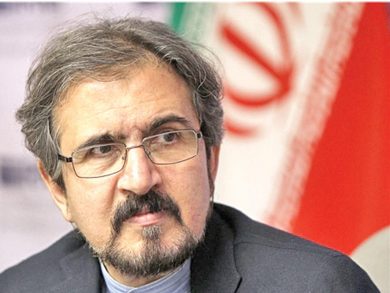 Qassemi on Friday firmly rejected a Reuters report quoting unnamed Iranian and Western officials as saying that Iran has signaled to the six world powers with which it signed the historic nuclear agreement in 2015 that it is open to talks about its ballistic missile arsenal.
“Iran regards defensive missile programs as its absolute right and will definitely continue them within the framework of its defensive, conventional and specified plans and strategies,” the Iranian spokesperson said.
He added that Iran “has repeatedly in diplomatic meetings with foreign officials” emphasized that its “defensive missile program is not negotiable” and that Tehran “does not regard it as inconsistent with [UN Security Council] Resolution 2231.”
In all his meetings and interviews with international media on the sidelines of last month’s 72th session of the United Nations General Assembly in New York, Iranian Foreign Minister Mohammad Javad Zarif reiterated the non-negotiable nature of the Islamic Republic’s defensive missile program.
According to the Reuters report, the sources said that given US President Donald Trump’s threats to ditch the nuclear agreement, known as the Joint Comprehensive Plan of Action (JCPOA), reached under his predecessor Barack Obama, Tehran had approached the powers recently about possible talks on some “dimensions” of its missile program.
October 6, 2017
Posted by aletho |
Fake News, Mainstream Media, Warmongering | Iran, Sanctions against Iran, United States |
Leave a comment
From his refuge in the Ecuador Embassy in London, WikiLeaks founder Julian Assange addressed a press conference of his supporters in Berlin on Tuesday, amid speculation that he planned to reveal potential threats to America.
But early into his speech, Assange said that while more revelations were to come, he would not be making any major announcements, asserting that there would be no point in making such revelations at a time when most Americans would be sleeping.
“Russian actions on its own doorstep in Eastern Europe do not in fact threaten the United States or any actual vital interest. Nor does Moscow threaten the U.S. through its intervention on behalf of the Syrian government in the Middle East. That Russia is described incessantly as a threat in those areas is largely a contrivance arranged by the media, the Democratic and Republican National Committees and by the White House. Candidate Donald Trump appeared to recognize that fact before he began listening to Michael Flynn, who has a rather different view. Hopefully the old Trump will prevail, there is, however, another country that has interfered in U.S. elections, has endangered Americans living or working overseas and has corrupted America’s legislative and executive branches. It has exploited that corruption to initiate legislation favorable to itself, has promoted unnecessary and unwinnable wars and has stolen American technology and military secrets. Its ready access to the mainstream media to spread its own propaganda provides it with cover for its actions and it accomplishes all that and more through the agency of a powerful and well-funded domestic lobby that oddly is not subject to the accountability afforded by the Foreign Agents Registration Act (FARA) of 1938 even though it manifestly works on behalf of a foreign government. That country is, of course, Israel” said Assange.
The assessment of Israel and what damage it does regarding what most Americans would regard as genuine national interests is most definitely not reported, revealing once again that what is not written is every bit as important as what is. I would note how what has recently happened right in front of us relating to Israel is apparently not considered fit to print and will never appear on any disapproving editorial page. Just this week the Senate unanimously passed an Anti-Semitism Awareness bill and also by a 99 to zero vote renewed and strengthened sanctions against Iran, which could wreck the one year old anti-nuclear weapon proliferation agreement with that country.
The Anti-Semitism bill makes Jews and Jewish interests a legally protected class, immune from any criticism. “Free speech” means in practice that you can burn an American flag, sell pornography, attack Christianity in the vilest terms or castigate the government in Washington all you want but criticizing Israel is off limits if you want to avoid falling into the clutches of the legal system. The Act is a major step forward in effectively making any expressed opposition to Israeli actions a hate crime.
And it is similar to punitive legislation that has been enacted in twenty-two states as well as in Canada. It is strongly supported by the Israel Lobby, which quite likely drafted it, and is seeking to use legal challenges to delegitimize and eliminate any opposition to the policies of the state of Israel.
As the Act is clearly intended to restrict First Amendment rights if they are perceived as impacting on broadly defined Jewish sensitivities, it should be opposed on that basis alone, but it is very popular in Congress, which is de facto owned by the Israel Lobby. That the legislation is not being condemned or even discussed in the generally liberal media tells you everything you need to know about the amazing power of one particular unelected and unaccountable lobby in the U.S.
October 2, 2017
Posted by aletho |
Civil Liberties, Full Spectrum Dominance, Mainstream Media, Warmongering, Russophobia, Timeless or most popular, Wars for Israel | Human rights, Sanctions against Iran, United States, Zionism |
Leave a comment
The announcement in Tehran on Saturday regarding the successful test of a ballistic missile with a range of 2000 kilometers and capable of carrying multiple warheads to hit different targets phenomenally shifts the military balance in the Middle East.
Israel and the roughly 45,000 US troops deployed to the Middle East – Jordan (1500 troops), Iraq (5200), Kuwait (15000), Bahrain (7000), Qatar (10000), UAE (5000), Oman (200) – fall within the range of the latest Iranian missile. Iran has demonstrated a deterrent capability that deprives the US and Israel of a military option.
The missile test signals Tehran’s strategic defiance of the US, after President Donald Trump’s outrageous remarks against Iran in his address to the UN GA. From this point, Trump has to be very careful about tearing up the Iran nuclear deal. Any such rash act by Trump or the lawmakers in the Congress (imposing new sanctions) can be seized by Tehran to resume its previous nuclear program, which would have far-reaching implications, given its missile capabilities.
President Hassan Rouhani took a tough line after returning to Tehran from New York. He warned that if Trump violated the nuclear deal, “we will be firm and all options will be before us.” Foreign Minister Mohammed Javad Zarif told New York Times tauntingly that if the US wanted to re-negotiate the nuclear deal, Tehran too will insist on re-negotiating every single concession it made – “Are you prepared to return to us 10 tons of enriched uranium?”
Rouhani made a strident speech at a military parade on Friday in Tehran underscoring that Iran did not need any country’s permission to bolster its missile capability. He added, “The Iranian nation has always been after peace and security in the region and the world and we will defend the oppressed Yemeni, Syrian and Palestinian people whether you like it or not.”
“As long as some speak in the language of threats, the strengthening of the country’s defense capabilities will continue and Iran will not seek permission from any country for producing various kinds of missile,” Defence Minister Amir Hatami said in a statement Saturday.
What emerges is Iran’s determination to consolidate its influence in Syria. The US will have to carefully weigh the repercussions before making any intervention (which Israel is pressing for.) Again, Iran may establish a long-term presence in Syria. The Iran-supported battle-hardened Shiite militia fighting in Iraq and Syria is a veritable 100,000-strong army and Iran is in a position to force the eviction of US forces from Iraq and Syria.
The Trump administration must take with the utmost seriousness the thinly veiled threat by the commander of the Islamic Revolutionary Guard Corps Gen. Mohammad Ali Jafari on Wednesday (while reacting to Trump’s UN speech) – “The time has come for correcting the US’ miscalculations. Now that the US has fully displayed its nature, the government should use all its options to defend the Iranian nation’s interests. Taking a decisive position against Trump is just the start and what is strategically important is that the US should witness more painful responses in the actions, behavior and decisions that Iran will take in the next few months.”
The ballistic missile test followed within 3 days of Gen. Jafari’s threat. Equally, the timing of the missile test can be seen against the backdrop of the referendum being planned for September 25 by the Kurds of northern Iraq, seeking an independent Kurdistan. Tehran is in no doubt that the Kurdistan project is a US-Israeli enterprise to create a permanent base in the highly strategic region with the objective of destabilizing Iran and undermining its regional surge in Syria and Iraq.
Unsurprisingly, Israel is furious about Iran’s missile test. Defense Minister Avigdor Liberman called it a “a provocation and a slap in the face for the United States and its allies — and an attempt to test them.” Clearly, Israel is in panic that Iran is steadily, inexorably outstripping it as the number one regional power in the Middle East. However, beyond rhetoric, Israel cannot do much about Iran’s surge.
Israel foolishly instigated Trump to provoke Tehran just at this juncture when he is barely coping with the crisis in Northeast Asia. A containment strategy against Iran is no longer feasible. Wisdom lies in the Trump administration engaging Iran in a constructive spirit to influence its regional policies. Threats never worked against Iran. Time and again they’ve proved to be counterproductive.
September 24, 2017
Posted by aletho |
Timeless or most popular, Wars for Israel | Hezbollah, Iran, Iraq, Israel, Kurds, Middle East, Palestine, Sanctions against Iran, Syria, Yemen, Zionism |
Leave a comment
Russia’s Foreign Minister Sergei Lavrov has condemned the U.S. for threatening the option of military intervention in Venezuela.
Addressing the United Nations General Assembly in New York, Lavrov criticized the illegitimate application of “unilateral sanctions” by certain Western countries, in reference to the restrictions imposed by the U.S. against Iran, Cuba and Venezuela.
Lavrov said it is unacceptable to instigate unrest and launch military threats in order to ‘democratize’ Venezuela, as are actions aimed at undermining the country’s legitimate authorities.
He insisted that in any internal conflict, the international community must urge all parties to commit to reconciliation.
“The policies of the West are based on the principle of ‘who is not with us, is against us,” said the Russian foreign minister, referring to the threats made by the U.S. President Donald Trump.
He also made reference to Cuba and said the blockade should be lifted, “Almost all UN member states have called for the immediate lifting of the economic, financial and commercial blockade imposed on Havana for several decades.”
On the subject of North Korea, Lavrov said he did not support Pyongyang’s position but he objected to the “military hysteria” which could lead to “disaster.”
He urged the UN to consider the roadmap for talks with the North put forward by Russia and China to defuse the crisis on the Korean peninsula by diplomatic and peaceful means.
Both Moscow and Beijing are proposing the suspension of Washington’s joint military maneuvers with South Korea but the White House has rejected the plan.
Lavrov also condemned U.S. unilateral sanctions on Iran – he said they would undermine the nuclear deal with Tehran
“Using unilateral sanctions … is illegitimate and undermines the collective nature of international efforts. Everyone is witnessing with alarm today the newer and newer restrictions by the U.S. against Iran.”
“They threaten the implementation of the Joint Comprehensive Plan of Action,” he added, referring to the 2015 international accord between Iran and six world powers.
Trump has suggested he is leaning towards withdrawing from the deal, but several international allies are trying to dissuade him.
September 21, 2017
Posted by aletho |
Militarism, Timeless or most popular, War Crimes | Russia, Sanctions against Iran, United States, Venezuela |
Leave a comment


 Aletho News