Since the outbreak of mass demonstrations and unrest in Iran last week, US media have mostly busied themselves with the question of not if we should “do something,” but what, exactly, that something should be. As usual, it’s simply taken for granted the United States has a divine right to intervene in the affairs of Iran, under the vague blanket of “human rights” and “democracy promotion.” (The rare exception, such as an op-ed by ex-Obama official Philip Gordon—New York Times, 12/30/17—still accepted the premise of regime change: “I, too, want to see the government in Tehran weakened, moderated or even removed.”) With this axiom firmly established in Very Serious foreign policy circles, the next question becomes the nature, degree and scope of the “something” being done.
Leading the pack in the “do something” insta-consensus was the right-wing pro-Israel think tank Foundation for Defense of Democracies (FDD), which has overwhelmed the narrative. In the past five days, FDD has had op-eds in influential US outlets like the Wall Street Journal, New York Times, New York Post and Politico, and has been quoted in a dozen more. Its punditry was marked by cynical “support” for Iranian protesters, demagoguing of the Iranian “regime” and disgust with the Obama-era Joint Comprehensive Plan of Action (JCPOA), otherwise known as the Iran deal.
The scrapping of JCPOA has been the primary political charge of FDD for years, and it seems to see the recent unrest in Iran—and any subsequent crackdown—as the thin moral pretext it needs to justify snuffing out a treaty it’s long opposed. Thus FDD has eagerly jumped on the unrest, painting itself as the sigh of the oppressed.
Op-eds written or co-written by FDD staff in the past five days:
- “Iran’s Theocracy Is on the Brink” (Mark Dubowitz/Ray Takeyh, Wall Street Journal, 1/1/18)
- “Where We Can Agree on Iran” (Mark Dubowitz/Daniel Shapiro, Politico, 1/1/18)
- “Eruption in Iran: And It’s Not Just the Economy, Stupid” (Clifford D. May, Washington Times, 1/2/18)
- “The Worst Thing for Iran’s Protesters? US Silence” (Reuehl Marc Gerecht, New York Times, 1/2/18)
- “What Washington Can Do to Support Iran’s Protesters” (Richard Goldberg/Jamie Fly, New York Post, 1/2/18)
A sampling of quotes by FDD staff in news reporting:
- “Since Rouhani entered office, he has managed to inflate expectations with lofty rhetoric but has actually done little to change the reality of life on the ground in Iran,” said Behnam Ben Taleblu, an Iran expert at the Foundation for Defense of Democracies in Washington.” (Washington Post, 12/30/17)
- “‘Western governments should make it clear that the regime will be held responsible and will pay a price for any bloodshed,’ Mr. Dubowitz said.” (Wall Street Journal, 1/1/18)
- “‘[Trump’s] not going to want to waive sanctions and keep money flowing to dictators when there are people protesting in the streets,’ said Richard Goldberg, a former Senate Republican aide who helped design Iran sanctions and is now a senior adviser at the hawkish Foundation for Defense of Democracies.” (Politico, 1/2/18)
- “‘If there is a bipartisan bill that is ready for congressional action, that would go a long way toward persuading the president to issue the waivers,’ said Mark Dubowitz, the chief executive of the Foundation for Defense of Democracies. ‘If there’s not, what’s happening in Iran will give the president all the more reason to say, “I’ve had it with this deal.”’” (New York Times, 1/2/18)
FDD op-eds and quotes followed a similar formula: express outrage on behalf of the protesters, applaud Trump for his hypocritical defense of the right to protest, and push for increased sanctions against Iran—often while taking a swipe at the hated Iran deal.
FDD’s pro-Iranian people posture was rarely accompanied by an explanation of their ideological project. The outfit—funded by big-name pro-Israel billionaires like casino mogul Sheldon Adelson, Home Depot founder Bernard Marcus (who’s said that “Iran is the devil”) and Wall Street speculator Paul Singer—are largely presented as bespectacled academics calling balls and strikes without a particular agenda beyond their self-proclaimed “defense of democracies.” (The name ought to provoke some skepticism, given the group’s eagerness to enlist the hereditary dictatorship Saudi Arabia in its anti-Iranian crusade—LobeLog, 2/26/16.)
This problem is not unique to FDD; as FAIR (8/12/16) has noted before, the overreliance by the media on deeply conflicted think tanks that present as neutral but are, in reality, glorified lobbyists for a political cause or corporate cohort misleads readers on an institutional scale. (In FDD’s case, it’s Israel’s right wing; for the Center for Strategic and International Studies, it’s weapons contractors—FAIR.org, 5/8/17, 7/17/17.)
FDD, it’s worth noting, also worked closely with the Trump administration and CIA to curate documents implicating Iran in the 9/11 attacks, as part of a broader anti-Iran strategy that rogue DoJ lawyers spelled out in November in leaks to the Washington Post (11/17/17; FAIR.org, 11/24/17).

FDD’s Reuel Marc Gerecht has had stints at PNAC, AEI and the CIA
Occasionally, editors will note they are “conservative” or “hawkish,” but FDD is mostly presented as a quasi-academic and impartial observer. The average reader, for example, would probably be surprised to find out the FDD “fellow” expressing concern for The Iranian People™ in the Times, Reuel Marc Gerecht, has long joked about wanting to bomb these same Iranians. As Eli Clifton noted in LobeLog (1/4/18), in 2010 Gerecht quipped: “Counted up the other day: I’ve written about 25,000 words about bombing Iran. Even my mom thinks I’ve gone too far.”
Shouldn’t someone so self-admittedly obsessed with killing Iranians be disqualified from posing as their protector in a major US newspaper? Failing that, shouldn’t readers be alerted that Gerecht was the director in the late ’90s of the Middle East Initiative at the Project for the New American Century—the most prominent advocacy group for the invasion of Iraq, a war that left 500,000 to a million dead?
Think tank addiction for overworked and often myopic reporters and editors has rendered such glaring questions unaskable. FDD are the “experts,” and the “experts” are needed to drive the bulk of commentary, regardless of their well-documented ulterior motives.
January 6, 2018
Posted by aletho |
Deception, Ethnic Cleansing, Racism, Zionism, Mainstream Media, Warmongering, Wars for Israel | CIA, Iran, Israel, JCPOA, Middle East, Sanctions against Iran, United States, Zionism |
Leave a comment
US lawmakers on Thursday approved a bill that will bring the sales of American planes to Iran under the close scrutiny of the Congress.
The bill passed 252-167 — all but four Republicans supported it, and they were joined by 23 Democrats.
It would require the Treasury Department to report to Congress on Iranian purchases of US aircraft and how those sales would be financed.
The key company that would be the primary target of the bill would be US aviation giant Boeing. In December 2016, Boeing sealed deals with Iran’s flag-carrier airliner Iran Air over sales of 80 jets valued at $16.6 billion. They include 50 narrow-body Boeing 737 passenger jets and 30 wide-body 777 aircraft.
US media reported that the new Congress bill had once again brought into the spotlight the question whether undermining plane sales to Iran would break US commitments under the Iran nuclear deal, also known as the Joint Comprehensive Plan of Action (JCPOA).
Republicans argued that the legislation would not bar any aircraft sales to Iran. Instead, it would require the Treasury Department to notify Congress about the activities of the Iranian company that purchases the planes, as well as the financing used for the deal, according to a report by the Washington Examiner.
House Democrats maintained that the bill might provoke Iran to abandon the nuclear agreement, however, by interfering with their ability to work with US corporations as promised under the pact.
“[This bill] would impose a new condition,” Rep. Jim Himes, D-Conn., said on the House floor. “A new condition which would require certification by [the executive branch] and all of the process which would ensue. It is not a stretch, in fact it is fairly clear, that if [this bill] were to pass, the Iranians and others could credibly claim that we have violated our obligations under the JCPOA,” Himes was quoted as saying by the Washington Examiner.
Iran sealed the JCPOA in 2015 with the five permanent members of the UN Security Council – the US, Britain, France, Russia, and China – plus Germany.
Based on it, Iran would restrict certain aspects of its nuclear energy activities. In return, the parties that signed the JCPOA with Iran – the P5+1 – would act to lift the economic sanctions imposed against the country – generally described as the toughest in modern history.
Iran has previously announced that the US was falling short of its commitments toward the JCPOA by failing to remove the sanctions against the country and even by moving to impose new sanctions against it.
This is while the International Atomic Energy Agency (IAEA) – which reports Iran’s compliance with the JCPOA – has for multiple times emphasized that the country is fully implementing its commitments toward the nuclear deal.
December 15, 2017
Posted by aletho |
Economics, Wars for Israel | JCPOA, Sanctions against Iran, United States |
Leave a comment
Israel’s Prime Minister Benjamin Netanyahu has called on the “policy community” in the United States to push decision makers in Washington and European countries to revise the 2015 nuclear agreement with Iran.
“I urge you, in the policy community, to help decision makers in the capitals of Europe and Capitol Hill, to take advantage of this opportunity,” the Israeli premier said.
By the “policy community”, the Israeli leader apparently means powerful lobbyists such as the Israeli American Council and the American Israel Public Affairs Committee (AIPAC) which are central to all anti-Iran motions.
Netanyahu, whose regime is believed to possess the only nuclear arsenal in the Middle East, has repeatedly made unfounded accusations that Iran was seeking to develop nuclear weapons.
His new call came in a taped message that focused primarily on Iran to the Brookings Institute – Saban Forum meeting in Washington.
The annual conference is funded by the Israeli-born business mogul Haim Saban who said in November 2014 that “I would bomb the living daylights out of these [expletive],” if former US President Barack Obama struck a “bad deal” with Iran and Netanyahu assessed it as putting Israel at risk.
American Jewish billionaire Sheldon Adelson, a powerful casino magnate and another funder, suggested then that the US detonate a nuclear bomb in the Iranian desert before negotiations with Tehran.
Netanyahu hailed President Donald Trump for refusing in October to certify the Iran deal, known as the Joint Comprehensive Plan of Action (JCPOA).
The Israeli premier said the decision “has created an opportunity to fix the great flaws” of the JCPOA after the US president warned he might ultimately terminate the agreement.
Trump is required by law to certify every 90 days whether or not Iran is complying with the nuclear deal. If he argues that Iran is not in compliance, that could cause an American withdrawal from the international pact.
While Trump did not pull Washington out of the nuclear deal in October, he gave the US Congress 60 days to decide whether to reimpose economic sanctions against Tehran that were lifted under the pact.
December 4, 2017
Posted by aletho |
Ethnic Cleansing, Racism, Zionism, Wars for Israel | AIPAC, Benjamin Netanyahu, Israel, JCPOA, Sanctions against Iran, United States, Zionism |
Leave a comment
A prominent BBC journalist has deleted a tweet in which a senior Conservative MP can be seen complaining about the British media turning a blind eye to the corrupt relationship that has allowed Israel to “buy access” in Westminster.
The tweet was posted by the BBC’s Political Editor Laura Kuenssberg on Wednesday while the Scottish journalist was covering the build up to the resignation of Priti Patel. The Secretary of State for International Development had taken part in undisclosed meetings in Israel organised by the powerful Conservative Friends of Israel lobby (CFI) last summer.
Kuenssberg’s Twitter posts on the day was full of posts on the Patel story including comments about Number 10 denying the allegation made by the Jewish Chronicle that Prime Minster Theresa May had been made aware of the 12 meetings Patel had had during her “family holiday” in Israel.
In her deleted tweet, which MEMO has been able to grab as a screenshot, Kuenssberg reported a comment made by a “senior” Tory MP who, enraged by the debacle, called for Lord Polak, honorary president of CFI and the person thought to be behind Patel’s Israel trip, to be sacked.
“Strong words,” tweeted Kuenssberg, “Senior Tory says Lord Polak should be chucked out of the party, claiming ‘the entire apparatus has turned a blind eye to a corrupt relationship that allows a country to buy access’.”
MEMO contacted Kuenssberg to ask why she had deleted the tweet but has not received a reply from the journalist.
The BBC has often been accused of pro-Israel bias and it would appear that this was yet another example of the broadcaster censoring criticism of Israel or senior BBC journalists enforcing self-censorship when it comes to Israel.
While it’s not absolutely clear what the senior Tory meant by the “entire apparatus”, it would appear that the concerns raised by the Conservative politician echo similar complaints made by Israel’s critics over the influence of CFI and other pro-Israeli lobby groups on the entire British establishment including the media.
Kuenssberg’s decision to delete the tweet it seems is further proof that the “entire apparatus” is reluctant to shed light on the “corrupt relationship” between the UK and Israel, which critics say is the reason why the BBC and other media corporations have turned a blind eye, and allowed Israel through the CFI and organisations like the Labour Friends of Israel to “buy access”.
November 10, 2017
Posted by aletho |
Corruption, Deception, Ethnic Cleansing, Racism, Zionism | Sanctions against Iran, Zionism |
Leave a comment
As the recent PBS documentary on the American War in Vietnam acknowledged, few American officials ever believed that the United States could win the war, neither those advising Johnson as he committed hundreds of thousands of U.S. troops, nor those advising Nixon as he escalated a brutal aerial bombardment that had already killed millions of people.
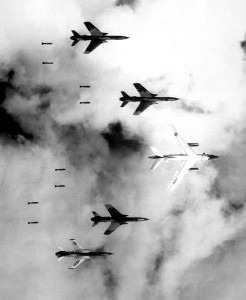
U.S. F-105s bomb North Vietnam in 1966
(Photo credit: U.S. Air Force)
As conversations tape-recorded in the White House reveal, and as other writers have documented, the reasons for wading into the Big Muddy, as Pete Seeger satirized it, and then pushing on regardless, all came down to “credibility”: the domestic political credibility of the politicians involved and America’s international credibility as a military power.
Once the CIA went to work in Vietnam to undermine the 1954 Geneva Accords and the planned reunification of North and South through a free and fair election in 1956, the die was cast. The CIA’s support for the repressive Diem regime and its successors ensured an ever-escalating war, as the South rose in rebellion, supported by the North. No U.S. president could extricate the U.S. from Vietnam without exposing the limits of what U.S. military force could achieve, betraying widely held national myths and the powerful interests that sustained and profited from them.
The critical “lesson of Vietnam” was summed up by Richard Barnet in his 1972 book Roots of War. “At the very moment that the number one nation has perfected the science of killing,” Barnet wrote, “It has become an impractical means of political domination.”
Losing the war in Vietnam was a heavy blow to the CIA and the U.S. Military Industrial Complex, and it added insult to injury for every American who had lost comrades or loved ones in Vietnam, but it ushered in more than a decade of relative peace for America and the world. If the purpose of the U.S. military is to protect the U.S. from the danger of war, as our leaders so often claim, the “Vietnam syndrome,” or the reluctance to be drawn into new wars, kept the peace and undoubtedly saved countless lives.
Even the senior officer corps of the U.S. military saw it that way, since many of them had survived the horrors of Vietnam as junior officers. The CIA could still wreak havoc in Latin America and elsewhere, but the full destructive force of the U.S. military was not unleashed again until the invasion of Panama in 1989 and the First Gulf War in 1991.
Half a century after Vietnam, we have tragically come full circle. With the CIA’s politicized intelligence running wild in Washington and its covert operations spreading violence and chaos across every continent, President Trump faces the same pressures to maintain his own and his country’s credibility as Johnson and Nixon did. His predictable response has been to escalate ongoing wars in Syria, Iraq, Afghanistan, Yemen, Somalia and West Africa, and to threaten new ones against North Korea, Iran and Venezuela.
Trump is facing these questions, not just in one country, Vietnam, but in dozens of countries across the world, and the interests perpetuating and fueling this cycle of crisis and war have only become more entrenched over time, as President Eisenhower warned that they would, despite the end of the Cold War and, until now, the lack of any actual military threat to the United States.
Ironically but predictably, the U.S.’s aggressive and illegal war policy has finally provoked a real military threat to the U.S., albeit one that has emerged only in response to U.S. war plans. As I explained in a recent article, North Korea’s discovery in 2016 of a U.S. plan to assassinate its president, Kim Jong Un, and launch a Second Korean War has triggered a crash program to develop long-range ballistic missiles that could give North Korea a viable nuclear deterrent and prevent a U.S. attack. But the North Koreans will not feel safe from attack until their leaders and ours are sure that their missiles can deliver a nuclear strike against the U.S. mainland.
The CIA’s Pretexts for War
U.S. Air Force Colonel Fletcher Prouty was the chief of special operations for the Joint Chiefs of Staff from 1955 to 1964, managing the global military support system for the CIA in Vietnam and around the world. Fletcher Prouty’s book, The Secret Team: The CIA and its Allies in Control of the United States and the World, was suppressed when it was first published in 1973. Thousands of copies disappeared from bookstores and libraries, and a mysterious Army Colonel bought the entire shipment of 3,500 copies the publisher sent to Australia. But Prouty’s book was republished in 2011, and it is a timely account of the role of the CIA in U.S. policy.
Prouty surprisingly described the role of the CIA as a response by powerful people and interests to the abolition of the U.S. Department of War and the creation of the Department of Defense in 1947. Once the role of the U.S. military was redefined as one of defense, in line with the United Nations Charter’s prohibition against the threat or use of military force in 1945 and similar moves by other military powers, it would require some kind of crisis or threat to justify using military force in the future, both legally and politically. The main purpose of the CIA, as Prouty saw it, is to create such pretexts for war.
The CIA is a hybrid of an intelligence service that gathers and analyzes foreign intelligence and a clandestine service that conducts covert operations. Both functions are essential to creating pretexts for war, and that is what they have done for 70 years.
Prouty described how the CIA infiltrated the U.S. military, the State Department, the National Security Council and other government institutions, covertly placing its officers in critical positions to ensure that its plans are approved and that it has access to whatever forces, weapons, equipment, ammunition and other resources it needs to carry them out.
Many retired intelligence officers, such as Ray McGovern and the members of Veteran Intelligence Professionals for Sanity (VIPS), saw the merging of clandestine operations with intelligence analysis in one agency as corrupting the objective analysis they tried to provide to policymakers. They formed VIPS in 2003 in response to the fabrication of politicized intelligence that provided false pretexts for the U.S. to invade and destroy Iraq.
CIA in Syria and Africa
But Fletcher Prouty was even more disturbed by the way that the CIA uses clandestine operations to trigger coups, wars and chaos. The civil and proxy war in Syria is a perfect example of what Prouty meant. In late 2011, after destroying Libya and aiding in the torture-murder of Muammar Gaddafi, the CIA and its allies began flying fighters and weapons from Libya to Turkey and infiltrating them into Syria. Then, working with Saudi Arabia, Qatar, Turkey, Croatia and other allies, this operation poured thousands of tons of weapons across Syria’s borders to ignite and fuel a full-scale civil war.
Once these covert operations were under way, they ran wild until they had unleashed a savage Al Qaeda affiliate in Syria (Jabhat al-Nusra, now rebranded as Jabhat Fateh al-Sham), spawned the even more savage “Islamic State,” triggered the heaviest and probably the deadliest U.S. bombing campaign since Vietnam and drawn Russia, Iran, Turkey, Israel, Jordan, Hezbollah, Kurdish militias and almost every state or armed group in the Middle East into the chaos of Syria’s civil war.
Meanwhile, as Al Qaeda and Islamic State have expanded their operations across Africa, the U.N. has published a report titled Journey to Extremism in Africa: Drivers, Incentives and the Tipping Point for Recruitment, based on 500 interviews with African militants. This study has found that the kind of special operations and training missions the CIA and AFRICOM are conducting and supporting in Africa are in fact the critical “tipping point” that drives Africans to join militant groups like Al Qaeda, Al-Shabab and Boko Haram.
The report found that government action, such as the killing or detention of friends or family, was the “tipping point” that drove 71 percent of African militants interviewed to join armed groups, and that this was a more important factor than religious ideology.
The conclusions of Journey to Extremism in Africa confirm the findings of other similar studies. The Center for Civilians in Conflict interviewed 250 civilians who joined armed groups in Bosnia, Somalia, Gaza and Libya for its 2015 study, The People’s Perspectives: Civilian Involvement in Armed Conflicts. The study found that the most common motivation for civilians to join armed groups was simply to protect themselves or their families.
The role of U.S. “counterterrorism” operations in fueling armed resistance and terrorism, and the absence of any plan to reduce the asymmetric violence unleashed by the “global war on terror,” would be no surprise to Fletcher Prouty. As he explained, such clandestine operations always take on a life of their own that is unrelated, and often counter-productive, to any rational U.S. policy objective.
“The more intimate one becomes with this activity,” Prouty wrote, “The more one begins to realize that such operations are rarely, if ever, initiated from an intent to become involved in pursuit of some national objective in the first place.”
The U.S. justifies the deployment of 6,000 U.S. special forces and military trainers to 53 of the 54 countries in Africa as a response to terrorism. But the U.N.’s Journey to Extremism in Africa study makes it clear that the U.S. militarization of Africa is in fact the “tipping point” that is driving Africans across the continent to join armed resistance groups in the first place.
This is a textbook CIA operation on the same model as Vietnam in the late 1950s and early 60s. The CIA uses U.S. special forces and training missions to launch covert and proxy military operations that drive local populations into armed resistance groups, and then uses the presence of those armed resistance groups to justify ever-escalating U.S. military involvement. This is Vietnam redux on a continental scale.
Taking on China
What seems to really be driving the CIA’s militarization of U.S. policy in Africa is China’s growing influence on the continent. As Steve Bannon put it in an interview with the Economist in August, “Let’s go screw up One Belt One Road.”
China is already too big and powerful for the U.S. to apply what is known as the Ledeen doctrine named for neoconservative theorist and intelligence operative Michael Ledeen who suggested that every 10 years or so, the United States “pick up some small crappy little country and throw it against the wall, just to show we mean business.”
China is too powerful and armed with nuclear weapons. So, in this case, the CIA’s job would be to spread violence and chaos to disrupt Chinese trade and investment, and to make African governments increasingly dependent on U.S. military aid to fight the militant groups spawned and endlessly regenerated by U.S.-led “counterterrorism” operations.
Neither Ledeen nor Bannon pretend that such policies are designed to build more prosperous or viable societies in the Middle East or Africa, let alone to benefit their people. They both know very well what Richard Barnet already understood 45 years ago, that America’s unprecedented investment in weapons, war and CIA covert operations are only good for one thing: to kill people and destroy infrastructure, reducing cities to rubble, societies to chaos and the desperate survivors to poverty and displacement.
As long as the CIA and the U.S. military keep plunging the scapegoats for our failed policies into economic crisis, violence and chaos, the [elite elements of] United States and the United Kingdom can remain the safe havens of the world’s wealth, islands of privilege and excess amidst the storms they unleash on others.
But if that is the only “significant national objective” driving these policies, it is surely about time for the 99 percent of Americans who reap no benefit from these murderous schemes to stop the CIA and its allies before they completely wreck the already damaged and fragile world in which we all must live, Americans and foreigners alike.
Douglas Valentine has probably studied the CIA in more depth than any other American journalist, beginning with his book on The Phoenix Program in Vietnam. He has written a new book titled The CIA as Organized Crime: How Illegal Operations Corrupt America and the World, in which he brings Fletcher Prouty’s analysis right up to the present day, describing the CIA’s role in our current wars and the many ways it infiltrates, manipulates and controls U.S. policy.
The Three Scapegoats
In Trump’s speech to the U.N. General Assembly, he named North Korea, Iran and Venezuela as his prime targets for destabilization, economic warfare and, ultimately, the overthrow of their governments, whether by coup d’etat or the mass destruction of their civilian population and infrastructure. But Trump’s choice of scapegoats for America’s failures was obviously not based on a rational reassessment of foreign policy priorities by the new administration. It was only a tired rehashing of the CIA’s unfinished business with two-thirds of Bush’s “axis of evil” and Bush White House official Elliott Abrams’ failed 2002 coup in Caracas, now laced with explicit and illegal threats of aggression.
How Trump and the CIA plan to sacrifice their three scapegoats for America’s failures remains to be seen. This is not 2001, when the world stood silent at the U.S. bombardment and invasion of Afghanistan after September 11th. It is more like 2003, when the U.S. destruction of Iraq split the Atlantic alliance and alienated most of the world. It is certainly not 2011, after Obama’s global charm offensive had rebuilt U.S. alliances and provided cover for French President Sarkozy, British Prime Minister Cameron, Secretary of State Hillary Clinton and the Arab royals to destroy Libya, once ranked by the U.N. as the most developed country in Africa, now mired in intractable chaos.
In 2017, a U.S. attack on any one of Trump’s scapegoats would isolate the United States from many of its allies and undermine its standing in the world in far-reaching ways that might be more permanent and harder to repair than the invasion and destruction of Iraq.
In Venezuela, the CIA and the right-wing opposition are following the same strategy that President Nixon ordered the CIA to inflict on Chile, to “make the economy scream” in preparation for the 1973 coup. But the solid victory of Venezuela’s ruling Socialist Party in recent nationwide gubernatorial elections, despite a long and deep economic crisis, reveals little public support for the CIA’s puppets in Venezuela.
The CIA has successfully discredited the Venezuelan government through economic warfare, increasingly violent right-wing street protests and a global propaganda campaign. But the CIA has stupidly hitched its wagon to an extreme right-wing, upper-class opposition that has no credibility with most of the Venezuelan public, who still turn out for the Socialists at the polls. A CIA coup or U.S. military intervention would meet fierce public resistance and damage U.S. relations all over Latin America.
Boxing In North Korea
A U.S. aerial bombardment or “preemptive strike” on North Korea could quickly escalate into a war between the U.S. and China, which has reiterated its commitment to North Korea’s defense if North Korea is attacked. We do not know exactly what was in the U.S. war plan discovered by North Korea, so neither can we know how North Korea and China could respond if the U.S. pressed ahead with it.
Most analysts have long concluded that any U.S. attack on North Korea would be met with a North Korean artillery and missile barrage that would inflict unacceptable civilian casualties on Seoul, a metropolitan area of 26 million people, three times the population of New York City. Seoul is only 35 miles from the frontier with North Korea, placing it within range of a huge array of North Korean weapons. What was already a no-win calculus is now compounded by the possibility that North Korea could respond with nuclear weapons, turning any prospect of a U.S. attack into an even worse nightmare.
U.S. mismanagement of its relations with North Korea should be an object lesson for its relations with Iran, graphically demonstrating the advantages of diplomacy, talks and agreements over threats of war. Under the Agreed Framework signed in 1994, North Korea stopped work on two much larger nuclear reactors than the small experimental one operating at Yongbyong since 1986, which only produces 6 kg of plutonium per year, enough for one nuclear bomb.
The lesson of Bush’s Iraq invasion in 2003 after Saddam Hussein had complied with demands that he destroy Iraq’s stockpiles of chemical weapons and shut down a nascent nuclear program was not lost on North Korea. Not only did the invasion lay waste to large sections of Iraq with hundreds of thousands of dead but Hussein himself was hunted down and condemned to death by hanging.
Still, after North Korea tested its first nuclear weapon in 2006, even its small experimental reactor was shut down as a result of the “Six Party Talks” in 2007, all the fuel rods were removed and placed under supervision of the International Atomic Energy Agency, and the cooling tower of the reactor was demolished in 2008.
But then, as relations deteriorated, North Korea conducted a second nuclear weapon test and again began reprocessing spent fuel rods to recover plutonium for use in nuclear weapons.
North Korea has now conducted six nuclear weapons tests. The explosions in the first five tests increased gradually up to 15-25 kilotons, about the yield of the bombs the U.S. dropped on Hiroshima and Nagasaki, but estimates for the yield of the 2017 test range from 110 to 250 kilotons, comparable to a small hydrogen bomb.
The even greater danger in a new war in Korea is that the U.S. could unleash part of its arsenal of 4,000 more powerful weapons (100 to 1,200 kilotons), which could kill millions of people and devastate and poison the region, or even the world, for years to come.
The U.S. willingness to scrap the Agreed Framework in 2003, the breakdown of the Six Party Talks in 2009 and the U.S. refusal to acknowledge that its own military actions and threats create legitimate defense concerns for North Korea have driven the North Koreans into a corner from which they see a credible nuclear deterrent as their only chance to avoid mass destruction.
China has proposed a reasonable framework for diplomacy to address the concerns of both sides, but the U.S. insists on maintaining its propaganda narratives that all the fault lies with North Korea and that it has some kind of “military solution” to the crisis.
This may be the most dangerous idea we have heard from U.S. policymakers since the end of the Cold War, but it is the logical culmination of a systematic normalization of deviant and illegal U.S. war-making that has already cost millions of lives in Afghanistan, Iraq, Syria, Libya, Somalia, Yemen and Pakistan. As historian Gabriel Kolko wrote in Century of War in 1994, “options and decisions that are intrinsically dangerous and irrational become not merely plausible but the only form of reasoning about war and diplomacy that is possible in official circles.”
Demonizing Iran
The idea that Iran has ever had a nuclear weapons program is seriously contested by the IAEA, which has examined every allegation presented by the CIA and other Western “intelligence” agencies as well as Israel. Former IAEA Director General Mohamed ElBaradei revealed many details of this wild goose chase in his 2011 memoir, Age of Deception: Nuclear Diplomacy in Treacherous Times.
When the CIA and its partners reluctantly acknowledged the IAEA’s conclusions in a 2007 National Intelligence Estimate (NIE), ElBaradei issued a press release confirming that, “the agency has no concrete evidence of an ongoing nuclear weapons program or undeclared nuclear facilities in Iran.”
Since 2007, the IAEA has resolved all its outstanding concerns with Iran. It has verified that dual-use technologies that Iran imported before 2003 were in fact used for other purposes, and it has exposed the mysterious “laptop documents” that appeared to show Iranian plans for a nuclear weapon as forgeries. Gareth Porter thoroughly explored all these questions and allegations and the history of mistrust that fueled them in his 2014 book, Manufactured Crisis: the Untold Story of the Iran Nuclear Scares, which I highly recommend.
But, in the parallel Bizarro world of U.S. politics, hopelessly poisoned by the CIA’s endless disinformation campaigns, Hillary Clinton could repeatedly take false credit for disarming Iran during her presidential campaign, and neither Bernie Sanders, Donald Trump nor any corporate media interviewer dared to challenge her claims.
“When President Obama took office, Iran was racing toward a nuclear bomb,” Clinton fantasized in a prominent foreign policy speech on June 2, 2016, claiming that her brutal sanctions policy “brought Iran to the table.”
In fact, as Trita Parsi documented in his 2012 book, A Single Roll of the Dice: Obama’s Diplomacy With Iran, the Iranians were ready, not just to “come to the table,” but to sign a comprehensive agreement based on a U.S. proposal brokered by Turkey and Brazil in 2010. But, in a classic case of “tail wags dog,” the U.S. then rejected its own proposal because it would have undercut support for tighter sanctions in the U.N. Security Council. In other words, Clinton’s sanctions policy did not “bring Iran to the table”, but prevented the U.S. from coming to the table itself.
As a senior State Department official told Trita Parsi, the real problem with U.S. diplomacy with Iran when Clinton was at the State Department was that the U.S. would not take “Yes” for an answer. Trump’s ham-fisted decertification of Iran’s compliance with the JCPOA is right out of Clinton’s playbook, and it demonstrates that the CIA is still determined to use Iran as a scapegoat for America’s failures in the Middle East.
The spurious claim that Iran is the world’s greatest sponsor of terrorism is another CIA canard reinforced by endless repetition. It is true that Iran supports and supplies weapons to Hezbollah and Hamas, which are both listed as terrorist organizations by the U.S. government. But they are mainly defensive resistance groups that defend Lebanon and Gaza respectively against invasions and attacks by Israel.
Shifting attention away from Al Qaeda, Islamic State, the Libyan Islamic Fighting Group and other groups that actually commit terrorist crimes around the world might just seem like a case of the CIA “taking its eyes off the ball,” if it wasn’t so transparently timed to frame Iran with new accusations now that the manufactured crisis of the nuclear scare has run its course.
What the Future Holds
Barack Obama’s most consequential international achievement may have been the triumph of symbolism over substance behind which he expanded and escalated the so-called “war on terror,” with a vast expansion of covert operations and proxy wars that eventually triggered the heaviest U.S. aerial bombardments since Vietnam in Iraq and Syria.
Obama’s charm offensive invigorated old and new military alliances with the U.K., France and the Arab monarchies, and he quietly ran up the most expensive military budget of any president since World War Two.
But Obama’s expansion of the “war on terror” under cover of his deceptive global public relations campaign created many more problems than it solved, and Trump and his advisers are woefully ill-equipped to solve any of them. Trump’s expressed desire to place America first and to resist foreign entanglements is hopelessly at odds with his aggressive, bullying approach to every foreign policy problem.
If the U.S. could threaten and fight its way to a resolution of any of its international problems, it would have done so already. That is exactly what it has been trying to do since the 1990s, behind both the swagger and bluster of Bush and Trump and the deceptive charm of Clinton and Obama: a “good cop – bad cop” routine that should no longer fool anyone anywhere.
But as Lyndon Johnson found as he waded deeper and deeper into the Big Muddy in Vietnam, lying to the public about unwinnable wars does not make them any more winnable. It just gets more people killed and makes it harder and harder to ever tell the public the truth.
In unwinnable wars based on lies, the “credibility” problem only gets more complicated, as new lies require new scapegoats and convoluted narratives to explain away graveyards filled by old lies. Obama’s cynical global charm offensive bought the “war on terror” another eight years, but that only allowed the CIA to drag the U.S. into more trouble and spread its chaos to more places around the world.
Meanwhile, Russian President Putin is winning hearts and minds in capitals around the world by calling for a recommitment to the rule of international law, which prohibits the threat or use of military force except in self-defense. Every new U.S. threat or act of aggression will only make Putin’s case more persuasive, not least to important U.S. allies like South Korea, Germany and other members of the European Union, whose complicity in U.S. aggression has until now helped to give it a false veneer of political legitimacy.
Throughout history, serial aggression has nearly always provoked increasingly united opposition, as peace-loving countries and people have reluctantly summoned the courage to stand up to an aggressor. France under Napoleon and Hitler’s Germany also regarded themselves as exceptional, and in their own ways they were. But in the end, their belief in their exceptionalism led them on to defeat and destruction.
Americans had better hope that we are not so exceptional, and that the world will find a diplomatic rather than a military “solution” to its American problem. Our chances of survival would improve a great deal if American officials and politicians would finally start to act like something other than putty in the hands of the CIA.
Nicolas J. S. Davies is the author of Blood On Our Hands: the American Invasion and Destruction of Iraq. He also wrote the chapters on “Obama at War” in Grading the 44th President: a Report Card on Barack Obama’s First Term as a Progressive Leader.
October 31, 2017
Posted by aletho |
Book Review, Deception, False Flag Terrorism, Militarism, Timeless or most popular | Africa, CIA, Hillary Clinton, Latin America, Middle East, Obama, Sanctions against Iran, United States, Venezuela |
Leave a comment

NY Congressman Eliot Engel (second from left) is lead sponsor on recent anti-Iran bills. Engel, who is the top Democrat on the House Foreign Affairs Committee, has traveled to Israel often and is one of its most fervent defenders. (Photo is from his Congressional website.)
Ever since Iran’s increasingly despotic Shah was overthrown by a popular revolution in 1979, Israel has targeted Iran for attack because of the country’s support for Palestinian rights. (The Shah had been put in place by a 1953 UK-US engineered coup against the country’s Prime Minister, Mohammad Mosaddegh.)
The Israeli ambassador to the U.S. said recently that Iran is Israel’s number one concern, and an Iranian newspaper reported: “Iran is the primary target of the Mossad’s actions, which number in the hundreds and thousands each year.”
The Israel lobby has accordingly worked for U.S. policies against Iran, including disseminating advertisements that demonize Iran; an example is this 2010 full-page advertisement in the New York Times :

The list on the left is of the groups that sponsored the ad, as evidenced by their icons at the bottom of the ad.
Now Congress has obliged Israel and its lobby by passing four more bills against Iran. Below is a report on the latest legislation. (Photographs and some additional information in Italics have been added.)
Despite a purely partisan Republican push to alter the terms of the Iran nuclear deal, an overwhelming majority of US lawmakers from both parties continues to advance legislation to counter Iranian behavior throughout the Middle East.
The House passed four bills today and Wednesday taking aim at Iran’s ballistic missile program and its support for Hezbollah, the Lebanese Shiite paramilitary group fighting alongside Iranian forces on behalf of the Bashar al-Assad regime in Syria. In addition, Iran hawks in Congress continue to press the Donald Trump administration to ban US aircraft sales to Iran and designate the Islamic Revolutionary Guard Corps (IRGC) as a foreign terrorist organization.

Lebanese resistance group Hezbollah has opposed Israeli invasions and occupation. Photo is of a Beirut suburb bombed by Israel in 2006.
“The whole thing with the [nuclear deal] that irked me throughout was that during the course of the negotiations … we were told consistently that this was only about nuclear weapons,” Rep. Eliot Engel, D-N.Y., the top Democrat on the House Foreign Affairs Committee, told Al-Monitor. “We couldn’t raise terrorism, we couldn’t raise ballistic missiles. We couldn’t raise all the other things against Iran and it frustrated me to no end.”
“I think those of us who really feel that Iran is a major cause of instability in the Middle East need to make sure that Iran is sanctioned,” Engel added.
[U.S. intelligence agencies have found no evidence that Iran is developing nuclear weapons.]
In July, Congress passed the first round of sanctions on Iran since the 2015 nuclear accord. The Iran Ballistic Missiles and Sanctions Enforcement Act, which the House passed 423-2 today, would further expand sanctions on Iran’s ballistic missile program. The Senate must now vote on the additional sanctions package before it can head to Trump’s desk.
Engel, the lead cosponsor of both Iran sanctions packages, has described today’s bill as “pretty similar” to the July sanctions package. The new version, however, would affect entities and individuals supporting Iran’s ballistic missile program even if they don’t have assets in the United States.
The House also passed three bills targeting Hezbollah on Wednesday. The US government considers Hezbollah a terrorist group and US lawmakers overwhelmingly regard it as an Iranian proxy.

House Majority Leader Kevin McCarthy (R-CA) at the ‘National Leadership Assembly for Israel’ event organized by the Conference of Presidents of Major American Jewish Organizations. (National Press Club July 28, 2014 in Washington, DC.)
“They’re giving the money to Hezbollah to kill individuals and fund terrorism around the world,” House Majority Leader Kevin McCarthy, R-Calif., said on Fox News before Wednesday’s votes. “And we’re putting an end to that, continuing to put the sanctions and the pressure on.”
The primary Hezbollah sanctions bill, the Hezbollah International Financing Prevention Amendments Act, introduced by House Foreign Affairs Committee Chairman Ed Royce, R-Calif., passed the House unanimously on Wednesday. It is designed to cut Hezbollah’s funding streams from foreign states such as Iran while cracking down on the group’s alleged racketeering activities abroad. The Jerusalem Post reported in September that Iran now gives Hezbollah roughly $800 million a year, an unprecedented level of funding.

Congressmen Ed Royce (L) and Eliot Engel (R) with Israeli Prime Minister Benjamin Netanyahu.
Companion legislation passed the Senate unanimously earlier this month. The House version, however, contains some extra provisions that single out Iran and Russia for their support of Hezbollah.
Specifically, the House version amends a 2010 Iran sanctions package to include Iran’s support for Hezbollah and directs the administration to sanction government entities that are already on the State Department’s state sponsor of terrorism list if they support Hezbollah. Iran, Syria and Sudan are currently the only three countries on that list.
Engel, the lead cosponsor of the Royce bill, told Al-Monitor that he’s optimistic its Iran provisions will survive reconciliation with the Senate version.
“I think ultimately they won’t disappear because I think both sides of the aisle understand that Iran’s a threat and even those who want to keep the [Iran deal] don’t want to take the pressure off Iran,” said Engel. “When we do things and wrap it up for the year, I think the Iran sanctions have to be in there.”
The House also unanimously passed legislation from Rep. Mike Gallagher, R-Wis., to impose overlapping sanctions on foreign states and individuals for providing support to Hezbollah due to its alleged use of human shields. The sanctions in both Hezbollah bills would target the same individuals and entities, but its supporters say the Gallagher bill still has value.
“The purpose of these bills, especially the reporting part, is to highlight the various harmful actions which Congress wants to expose with regard to Hezbollah,” said Joseph Gebeily, the president of the Lebanese Information Center, a think tank critical of Hezbollah.
Gebeily added that the Gallagher bill “puts more focus on the United Nations Security Council’s responsibility in disarming Hezbollah and preventing its military operations in Lebanon.” The bill requires the US ambassador to the United Nations to “secure support for a resolution that would impose multilateral sanctions against Hezbollah for its use of civilians as human shields.”
Lastly, a resolution offered by Rep. Ted Deutch, R-Fla., to urge the European Union to designate the political wing of Hezbollah as a terrorist organization passed the House unanimously. While the EU considers Hezbollah’s paramilitary wing to be a terrorist group, US lawmakers have repeatedly voiced their frustration that it does not extend that designation to Hezbollah parliamentarians and Cabinet officials in Lebanon.

Congressional Representatives Ilyana Ros-Lehtinen and Ted Deutch with Israeli Prime Minister Netanyahu. Deutch’s website says: “Congressman Ted Deutch is a passionate supporter of Israel whose advocacy for a strong U.S.-Israel relationship stretches back to his youth. Ted spent his summers at Zionist summer camp, worked as a student activist in high school and college, and served in leadership roles on several local and national Jewish organizations throughout his professional career. Today, Ted serves as Ranking Member of the House Foreign Affairs Committee’s influential Middle East and North Africa Subcommittee, where he continues to champion Israel’s security during a time of great volatility in the Middle East.”
And House lawmakers aren’t done.
House Homeland Security Committee Chairman Michael McCaul, R-Texas, continues to push for adoption of his bill urging the State Department to designate the IRGC as a foreign terrorist organization. Sen. Ted Cruz, R-Texas, has a companion bill in the Senate.

US Rep. Michael McCaul (sixth from left) led a 2015 bipartisan Congressional delegation to meet with Israeli Prime Minister Benjamin Netanyahu.
Trump himself designated the IRGC as a terrorist-supporting entity when he declined to certify the nuclear deal earlier this month, but the move falls short of what some in Congress are asking for.
“There’s not really an expansion of sanctions on the IRGC,” said Kenneth Katzman, an Iran sanctions expert at the Congressional Research Service. Trump’s executive order “has a slight travel restriction, obviously, but how many IRGC people … are going to realistically get visas to come to the United States?”
McCaul agrees more could be done.
“The president, when he sanctioned the IRGC, went a long ways in terms of getting the idea of it,” he told Al-Monitor. “However, they didn’t designate it as a foreign terrorist organization. So I’d like to complete that.”
McCaul told Al-Monitor that his bill is currently held up by staff on the House Judiciary Committee who believe that designating terrorist organizations should remain strictly within the purview of the administration.
“Maybe we’ll work with leadership to put it to the floor anyway,” he said.
Iran hawks in the House are also fighting to preserve legislation that would that would bar US aircraft manufacturers, such as Boeing and Airbus, from selling civilian airliners to Iran. Rep. Peter Roskam, R-Ill., included the language in a spending package in September.

Congressman Peter Roskam speaks at AIPAC fundraiser in Chicago, 2013. (Video here.) Roskam co-chairs the House Republican Israel Caucus and is a member of the bipartisan Israel Allies Caucus.
The 2015 nuclear deal paves the way for such sales, but Roskam and others fear that Iran could use the civilian airliners to transport troops to fight on behalf of the Syrian regime. The Senate version of the appropriations bill, however, does not contain such language.
October 27, 2017
Posted by aletho |
Ethnic Cleansing, Racism, Zionism, Timeless or most popular, Wars for Israel | Hezbollah, Israel, Sanctions against Iran, United States, Zionism |
Leave a comment
The Trump administration is accelerating on a collision course with its European allies over the Iran nuclear deal. Washington is essentially demanding the EU joins in backdoor sanctions against Iran – or face financial penalties. In short: browbeating, arm-twisting, and bribery.
In a sign of the times, the Europeans are resisting American pressure. With huge investments already lined up between EU countries and Iran, the Trump administration is being viewed with contempt for daring to bully European economic interests.
In a classic backfire, Washington’s browbeating of European allies is pushing them to reorient their strategic interests toward China, Russia and a multilateral global order in which US power diminishes even further.
Earlier this week, US Secretary of State Rex Tillerson gave an extraordinarily explicit warning to Europe over Iran. At a news conference in the Saudi capital, Riyadh, Tillerson said European companies are “at great risk” if they invest in Iran owing to the Trump administration possibly re-imposing sanctions on Tehran in the coming months.
Trump’s dangling of sanctions follows his “decertification” earlier this month of the international nuclear accord signed with Iran and five other world powers: Russia, China, Britain, France, and Germany. Known formally as the Joint Comprehensive Plan of Action (JCPOA), the July 2015 deal promised to lift trade sanctions on Iran in exchange for the latter’s restriction on its nuclear energy program to prevent any weaponization.
Washington’s repudiation of the JCPOA is not shared by the Europeans, Russia nor China. The UN nuclear watchdog, the International Atomic Energy Agency, has also confirmed that Iran is in full compliance with the terms of the accord. EU leaders and diplomats have adamantly said they have no intention of abandoning the agreement or renegotiating it. China and Russia likewise concur.
From the early days of Trump’s presidency, he has been griping about the Iran deal, calling it the “worst ever.” He and others in Washington claim Iran is using sanctions relief to finance support for Syrian ally Bashar Assad, Lebanon’s Hezbollah movement and clandestine terror operations in the Middle East. Washington’s claims are invariably vague and unsubstantiated. Tehran has dismissed Trump’s accusations as ignorant.
Evidently, the Europeans do not have the same pejorative view of Iran as a “global sponsor of terrorism” as the Americans. Neither does China or Russia. Even before Trump decertified the JCPOA – a move which could trigger a full-blown cancellation after a Congressional review requested by the president – there was already talk about Washington and Europe clashing. “Europe and the USA on collision course,” ran a headline in Deutsche Welle in August.
Now, after Tillerson’s pointed warning to the Europeans to “stay out of Iran,” the US is ramping up the clash. Bloomberg headlined last week: “Trump’s Iran policy is a headache for EU business.” The report noted, however, that: “America’s U-turn on nuclear accord won’t spike existing [European investment] deals.”
Since the signing of the JCPOA two years ago, European investment and trade with Iran have burgeoned. For example, French oil major Total earlier this year finalized a 20-year oil and gas project worth around €5 billion, along with a Chinese firm.
That followed the announcement of multi-million euro investment plans by car manufacturers Renault and PSA (Peugeot and Citroen) to expand factories in Iran. This month, only days after Trump announced he was decertifying the JCPOA, a Norwegian-led consortium signed a €3 billion project with Iran to build solar panels for the international market. “Norway is fully committed to the JCPOA,” said the Norwegian ambassador to Iran.
Germany and France have both seen exports to Iran rapidly multiply. The German chamber of commerce expects total bilateral commerce to double in the next two years. Next month, the EU’s foreign policy chief Federica Mogherini is to travel to Washington where she will reiterate the bloc’s resolute support for the nuclear accord. Last week, Mogherini made the case that Europe must now take global leadership. She didn’t mention Trump by name, but it was clear she was rebuking Washington’s isolationist policy.
Germany’s Foreign Minister Sigmar Gabriel has also berated Washington’s bullying tactics over Iran. Gabriel said Trump was inevitably pushing Europe toward consolidating economic interests with China and Russia.
Following Tillerson’s lecturing to the EU earlier this week about not investing in Iran, the New York Times reported: “European diplomats have said they would defend their companies against such sanctions, potentially setting up an epic battle between close allies and two of the largest commercial markets on the planet.”
This is the ineluctable thing. The Europeans have already committed enormous amounts of capital to developing trade and industry with Iran – a country that ranks in the global top five for oil and gas reserves. With a population of 80 million and a high standard of education, Iran promises to be a lucrative growth area. Even under decades of US-led sanctions, the country scored impressive achievements in development, innovation, and engineering.
Unlike the Europeans, the US has negligible commercial ties with Iran. It is therefore easy for Washington to threaten sanctions against that country. Washington has little to lose. Not so the Europeans. For the Trump administration to say that investments are “at risk” is therefore seen as an outrageous infringement on Europe’s future economic plans.
As France’s Finance Minister Bruno Le Maire told American officials ahead of Trump’s expected knock-back to the Iran deal: “The US must not appoint itself as a global policeman.” The irony is that Washington’s overweening attitude toward its European “allies” is likely to hasten the global dynamic it most fears. That is the decline of American economic power and the rise of a multipolar global order.
Former US President Jimmy Carter acknowledged the shift when referring to North Korea this week and the need for diplomacy. He said the US was “no longer dominant” and that “Russia was coming back, and China and India were coming forward.”
The once-mighty American dollar is increasingly challenged in its status as the world’s top reserve currency. China is moving to a gold-backed yuan payments system for its imports and exports. Russia is stockpiling gold reserves, in another move which is seen as Moscow making preparations for a break with the US-dominated financial order.
Washington still retains tremendous control over international banking and finance. It has veto power at the International Monetary Fund, and it dominates the SWIFT banking system for payments.
Nevertheless, nothing remains forever. China and Russia are making strides toward economic life without the dollar. The Europeans already have a reserve currency with the euro. If push comes to shove, the EU could conduct its business with Iran and let the Americans go hang. With China and Russia already forging ahead on a new multipolar global order, the Europeans might soon realize that their best interests are served from breaking away from Washington’s shadow.
It is increasingly apparent especially under Trump that American interests are colliding with those of European “allies.” In the end, it comes down to the exigency of self-interest. Europe is finding it simply can’t afford America’s stupid arrogance. Washington’s hectoring of allies is digging its own grave as a global power.
October 24, 2017
Posted by aletho |
Economics, Timeless or most popular, Wars for Israel | European Union, Hezbollah, JCPOA, Sanctions against Iran, United States |
Leave a comment
US President Donald Trump’s new strategy on Iran has “no support inside the United States” other than by pro-war neoconservatives and the Israel lobby, says an American analyst.
“President Trump’s position on canceling the Iran deal, at least on the United States’ side, has no support in the United States either by the public, obviously by the Democratic Party; even it lacks support by members of the Republican Party,” Rodney Martin, radio host and former congressional staffer, said on Saturday.
“It only has support by the rabid pro-war neocons and by the rabid Zionist pro-Israel lobby and of course by Prime Minister [Benjamin] Netanyahu in Tel Aviv,” he added.
Trump announced last week that he would not continue certifying the 2015 nuclear deal with Iran dubbed the Joint Comprehensive Plan of Action (JCPOA).
The US president has come under widespread criticism at home and abroad, with America’s European allies reaffirming their commitment to the nuclear accord.
The majority of Americans also believe Trump should not pull the US out of the international agreement, according to a new poll.
Overall, two in three Americans oppose withdrawing from the JCPOA, a CNN poll has found. Eight in 10 Democrats and two in three Independents have the same opinion. Even in Trump’s own party, Republicans are evenly split, with 48 percent desiring to remain and 47 percent to withdraw.
Martin pointed to the Israeli influence over Trump’s decision regarding the Iran deal.
“We all know that Netanyahu took the atrocious step by coming to the United States and lobbying the US Congress against the deal,” he pointed out.
The analyst said Trump is “throwing Netanyahu a bone” by refusing to certify the JCPOA in order to compensate for his failure to deliver on his promise to move the US embassy to Jerusalem al-Quds.
Trump is “every bit as controlled by the Israeli lobby” as his predecessors, Martin said, adding, “so it doesn’t matter what the public and the experts believe, President Trump is going to do what this very small, dangerous cabal tells him to do.”
October 22, 2017
Posted by aletho |
Economics, Ethnic Cleansing, Racism, Zionism, Wars for Israel | Israel, Middle East, Sanctions against Iran, United States, Zionism |
Leave a comment
Economic sanctions are an instrument of coercion used to make one state comply with another’s wishes. The United States is by far the largest implementer of economic sanctions in the world. It is virtually the only country that imposes unilateral sanctions, certainly the only one that does so with any regularity. The US has imposed more sanctions than the other countries/entities put together. Washington sees restrictions as a low-cost method to accomplish foreign policy goals, despite the fact that the measures affect common people. The policy damages international relations and backfires exacting a high price in terms of lost jobs and trade opportunities.
The US sanctions policy came under sharp criticism in the United Nations. Addressing the UN General Assembly on October 18, United Nations Human Rights Council’s Special Rapporteur Idriss Jazairy said “Damaging a country’s economy with sanctions usually leads to violations of the rights of ordinary people. Sanctions are disruptive for any State, and can have a particularly devastating impact on the citizens of developing countries when they impair the economy.” He expressed concern about sanctions which had an impact outside the territory being targeted. “It is well established that sanctions which apply to parties outside of the dispute are illegal, but sanctions which lead to human rights violations also create an obligation on the imposing state to take measures to repair the harm they have caused,” the expert noted.
Reporting on his visit to Russia in April, Jazairy said sanctions had not achieved the desired effect but had damaged others. “It appears that sanctions have not changed Russia’s position, but instead have caused economic losses for agricultural producers in both the EU and Russia,” he noted, adding “Serious, credible dialogue and negotiations are needed to resolve political issues, without creating additional harm for farmers.”
Jazairy urged the UN member states to adopt a Declaration on Unilateral Coercive Measures and the Rule of Law, which would set out shared principles on the use of sanctions and international law, renewing the call for a registry of sanctions, to bring greater transparency to the practice. “A registry would allow States, civil society and any other interested parties to know at all times what sanctions are in place, helping companies to conduct their businesses, and ensuring the sanctions meet human rights standards,” he said.
In his report (A/HRC/33/48) issued in September, the rapporteur urged the Human Rights Council and the UN General Assembly, through a solemn Declaration, to reaffirm “the right of victims to an effective remedy, including appropriate and effective financial compensation, in all situations where their human rights are affected by unilateral coercive measures.” The report also highlighted the importance of setting up a consolidated central register within the UN system of all the international sanctions in force, adding that these findings should be made public. This mechanism, which would enhance transparency and accountability, could draw on the model of the United Nations Register of Conventional Arms set up in 1991.
A new research by the Austrian Institute of Economic Research (WIFO) suggests the EU’s economic sanctions against Russia introduced three years ago have cost European countries billions of euros. The survey, which was conducted at the request of the European Parliament, and published on October 6, showed that the EU has lost €30bn due to sanctions.
Unilateral sanctions are increasingly ineffective in a more globalized economy. The United States has imposed many different sanctions against Russia but there are many more nations ready to boost economic cooperation with Moscow. The US has got a reputation for imposing economic sanctions liberally making other nations reluctant to do business with it. European leaders and much of the rest of the world view economic sanctions as counterproductive and generally favor them only in extraordinary circumstances, such as war. In July, France’s foreign ministry said new US penalties against Iran and Russia appeared at odds with international law due to their extra-territorial reach.
From a legal point of view, only the UN Security Council has the right to impose sanctions against a state. Unilateral coercive measures violate the spirit and letter of the UN Charter, in particular its preamble and Articles 1 and 2. The organization rests on the principle of equality of all its member states. A state can resort to sanctions for self-defense purposes but Russia did not attack the United States. Thus, the United States is destroying the integrity of international organizations and agreements to which it is a party.
For instance, the policy of sanctions runs counter to the WTO fundamental principle of trade free of discrimination, which envisages respect for market principles and honest competition. Parties should maintain government restraints on the movement of goods at a minimum, and if changed, the restraints should be reduced, not increased. The conditions of trade, including the level of tariffs and other, must be discussed and agreed on within a multilateral framework.
In theory, a state complaint procedure of the UN Human Rights committee could be launched according to Article 41 of the International Covenant on Civil and Political Rights – that way the UN would have to deal with the matter. The US has recently announced its intent to drop out from the United Nations Human Rights Council. This month it left UNESCO. No surprise as the idea to leave the United Nations has been floating in the US for some time. In January, 2017, Alabama congressman Mike Rogers sponsored the American Sovereignty Restoration Act of 2017, referred to the House, which calls to leave the United Nations. Utah state representative Don Bush, has claimed that many programs by the supranational entity have violated the US Constitution, such as the implementation of the International Court of Justice and the Law of the Sea Treaty, both of which the United States does not currently endorse. Much has been said in the United States about Russia’s international isolation. In practice, the United States, not Russia, is getting increasingly isolated internationally.
October 22, 2017
Posted by aletho |
Economics, War Crimes | Sanctions against Iran, United Nations, United States |
Leave a comment
President Donald Trump’s move to decertify the Iranian nuclear Joint Comprehensive Plan of Action (JCPOA), entered into a little over two years ago, was applauded by Israel, Saudi Arabia and a couple of Persian Gulf States, but by no one else. Quite the contrary, as the European and Asian co-signatories on the agreement, having failed to dissuade Trump, have clearly indicated that they will continue to abide by it. Also, the decision to kick the can down the road by giving Congress 60 days to increase pressure on Tehran in an attempt to include other issues beyond nuclear development like its ballistic missile program and labeling the country’s Revolutionary Guard as a terrorist group are likely to create confusion as Washington is unable to communicate directly with Iran. That uncertainty could possibly lead to a fraught-with-danger Iranian decision to withdraw completely from the agreement.
The Trump speech could reasonably be described as embracing an “Israel-First” and “Saudi-Second” perspective that might plausibly suggest that it was actually drafted by their respective foreign ministries. Contrary to Trump’s campaign pledges, it might also be characterized as an “America-Last” speech, since it actually encourages nuclear proliferation while rendering it even more difficult for anyone to respect the agreements entered into by the United States government.
Fred Kaplan sums up the speech’s fundamental dishonesty with considerable clarity by observing that “It flagrantly misrepresents what the deal was meant to do, the extent of Iran’s compliance, and the need for corrective measures. If he gets his way, he will blow up one of the most striking diplomatic triumphs of recent years, aggravate tensions in the Middle East, make it even harder to settle the North Korean crisis peacefully, and make it all but impossible for allies and adversaries to trust anything the United States says for as long as Trump is in office.”
Former senior CIA analyst Paul Pillar has also dissected the untruths and false analogies that made up the bulk of the Trump speech. In short, Pillar argues that the president is using faulty analysis to end a program that is working and that employs unprecedented intrusive inspections to guarantee that Iran can make no progress towards having a nuclear weapon for at least eight more years and quite likely for even longer. Against that, Iran could well end its cooperation and, out of fear of U.S. attack, might well turn towards possession of a nuclear arsenal to guarantee its own survival. Pillar calls ending JCPOA now because Iran just might develop a weapon after it expires in 2025 as “committing suicide because of fear of death.”
In a second highly partisan international action last week, the United States led a march out the door of the United Nations Educational, Scientific and Cultural Organization due to its alleged “bias against Israel.” UNESCO had enraged Prime Minister Benjamin Netanyahu by declaring that the Old City of Hebron and the associated Cave of the Patriarchs on the West Bank is an endangered Palestinian world cultural heritage site. A few hundred Israeli settlers live in Hebron, guarded by the Israeli Army, amidst 200,000 Palestinians who, according to The Guardian, “have long lived under harsh restrictions in the city, which is one of the starkest symbols of the Israeli occupation.” The U.S. is also threatening to pull out of the U.N.’s Human Rights Council “to protect Israel.”
Taken together, the two decisions made by the White House indicate a shift in the foreign policy team advising the president. One must now acknowledge that America’s United Nations Ambassador Nikki Haley, apparently operating in collusion with former UN Ambassador John Bolton, has become the most influential foreign policy voice whispering in the president’s ear, quite possibly because she is saying exactly what he wants to hear in terms of simplistic but rarely reality based responses to complex situations. That Haley, an inexperienced and instinctively aggressive ideologue who is closely aligned to Israeli thinking, should occupy such a position with an equally ignorant president ought to concern anyone who seeks to avoid a major conflagration with either Iran and North Korea, or even with both. Haley is also no friend of Russia, having once crudely advised Moscow to “choose to side with the civilized world.”
Secretary of State Rex Tillerson, Chairman of the Joint Chiefs of Staff General Joseph Dunford and Secretary of Defense James Mattis, apparently joined by National Security Council chair H.R. McMaster, urged renewal of the Iran certification based on the fact that Tehran was compliant but were overruled. Even Israel’s former National Security Adviser Uzi Arad had publicly urged both the White House and Congress not to reject the JCPOA. The emergence of Haley advised by Bolton is a shift to the right in an administration that is already leaning towards the military option as its preferred diplomatic tool, also suggesting somewhat ominously that neoconservative foreign policy is again dominant in Washington.
Other commentators including Eli Clifton, have observed that Trump might well have been heavily influenced by major Republican donors including Paul Singer, Bernard Marcus and Sheldon Adelson to step up the pressure on Iran. Adelson has, in fact, called for unilaterally “nuking” the Iranians. Marcus has said that “I think that Iran is the devil.”
The real objective of the Trump White House is not to “fix” the Iran deal, which would be impossible both because Iran and the other signatories would not agree to it and because there is nothing that needs repair. As Paul Pillar and Fred Kaplan note, it is working. The real objective is to blow up the agreement completely as it is an impediment to going to war and bringing about regime change in Tehran by force. That is what Prime Minister Benjamin Netanyahu and Senators like John McCain, Lindsey Graham and Tom Cotton have been intent on doing and they have hardly been shy about expressing themselves. The choice is therefore quite simple. Do we Americans, 60% of whom support keeping the arrangement, want to maintain an inspection regime that deprives Iran of the ability to develop a nuclear weapon for the foreseeable future or do we want to go back to square one without any restrictions on what Tehran will choose to do. It would seem to me that the clear right choice is to stay the course.
October 16, 2017
Posted by aletho |
Timeless or most popular, Wars for Israel | Israel, Middle East, Sanctions against Iran, Saudi Arabia, United States, Zionism |
Leave a comment
The US Treasury Department has imposed sanctions on Iran’s Islamic Revolution Guards Corps (IRGC) over accusations that the elite force provides support for terrorist organizations in the Middle East.
The Treasury added the IRGC to its anti-terrorism sanctions list on Friday, claiming in a statement that the military unit had been designated “for providing support to a number of terrorist groups, including Hezbollah and Hamas, as well as to the Taliban.”
US Treasury Secretary Steven Mnuchin stopped short of declaring the IRGC as a terrorist group, but claimed that the force has “played a central role to Iran becoming the world’s foremost state sponsor of terror.”
The department also sanctioned four entities — three based in Iran and one based in China — over claims of providing “support to the IRGC or Iran’s military.”
“We urge the private sector to recognize that the IRGC permeates much of the Iranian economy, and those who transact with IRGC-controlled companies do so at great risk,” Mnuchin said.
In a White House speech on Friday, US President Donald Trump also said his administration would place “tough sanctions” on the IRGC.
“I am authorizing the Treasury Department to further sanction the entire Islamic Revolutionary Guard Corps for its support for terrorism and to apply sanctions to its officials, agents and affiliates,” he noted.
The remarks were made as Iran had earlier rebuked the United States for supporting terrorist groups in the region, vowing to retaliate against any action targeting its Armed Forces, including the IRGC.
The US’s efforts to blacklist the IRGC come as advisers of the Iranian elite force are currently assisting the Iraqi and Syrian forces in their anti-terrorism campaign against Daesh Takfiri militants and other terrorist groups in both countries.
Daesh launched a terrorist offensive inside Iraq in 2014 and swiftly took over territory in the Arab country, posing a threat to seize the capital, Baghdad. Iran then offered military advisory assistance to both the central government in Baghdad and the regional government in Iraqi Kurdistan, helping them both maintain ground and win back territory lost to the terrorist group.
In Syria, too, Iran has been offering advisory support to the government. An armed conflict broke out in Syria in 2011 and soon transformed into a foreign-backed militancy by a hodgepodge of terrorist groups, including Daesh.
The terrorist group, which is by many accounts on its last legs in Iraq and Syria, is now seeking to establish footholds in countries beyond the Middle East, including Afghanistan.
October 13, 2017
Posted by aletho |
Economics, Wars for Israel | Sanctions against Iran, Steven Mnuchin, United States |
Leave a comment
The Foreign Affairs Committee of the US House of Representatives in Congress has introduced new legislation that would expand sanctions against Iran over its ballistic missile program.
“Today’s important bill requires a comprehensive investigation to identify and designate the companies, banks, and individuals – both inside and outside Iran – which supply the regime’s missile and conventional weapons programs, subjecting them to sanctions,” House Foreign Affairs Committee Chairman Ed Royce said in a press release on Thursday.
The bill, the Iran Ballistic Missiles and International Sanctions Enforcement Act, targets Iran’s ballistic missile-related goods, services and technologies.
The measure requires President Donald Trump’s administration to identify the persons and the “foreign and domestic supply chain in Iran that directly or indirectly significantly facilitates, supports, or otherwise aids” the ballistic missile program.
The US Departments of Treasury and State have already imposed sanctions that target Tehran’s ballistic missile program.
Trump administration officials have argued that Iran’s ballistics program violates the “spirit” of the nuclear agreement and violates a 2010 UN Security Council resolution that calls on Iran not to conduct missile tests.
However, Tehran insists its missile tests do not breach any UN resolutions because they are solely for defense purposes and not designed to carry nuclear warheads.
The Islamic Republic has said it will spare no effort to meet its national security needs, and does not allow any party to intervene in the imperative.
Washington also claims Iran’s missile program is in breach of United Nations Security Council Resolution 2231, which endorsed Tehran’s nuclear deal with the P5+1 states in 2015.
Trump is expected to declare to Congress on Sunday that retaining the 2015 nuclear deal is no longer in the US national interest, opening the possibility for Congress to re-impose sanctions against Iran and undermining a landmark victory of multilateral diplomacy.
October 13, 2017
Posted by aletho |
Economics, Wars for Israel | Sanctions against Iran, United States |
Leave a comment


 Aletho News