Iran to emerge as US rival in gas markets
Press TV – July 25, 2016
Forbes in a report has hailed Iran’s success in the development of its gas industry and says the country can soon become a main rival over market access to key players like the United States.
The world’s leading business magazine says Iran owes the progress it has made in its gas industry to its high exploration success rate which it says stands at a whopping 79 percent.
The rate, it says, is specifically high given that the world’s average is only 30 to 35 percent.
The Forbes report further emphasizes that the progress in Iran’s gas industry could soon enable it to exploit the promising markets in India, Pakistan, Kuwait, and UAE.
It adds that the country’s planned reductions in subsidized pricing, which will help reduce wasteful usage, will free up more of its gas for exports.
Forbes further stresses that Iran’s plans to produce liquefied natural gas (LNG) will specifically have a prosperous future.
“Iran is currently working on several options to join the same ‘international LNG club’ that the US is also joining,” wrote Forbes in its report. “And Europe is the mid- and long-term target. Europe’s gas demand is projected to increase 15-20 percent by 2025. This means that Iran is competition for the US”.
The report emphasizes that Iran’s LNG plans are expected to become operational after 2020, adding that the country could benefit from the growing demand over the succeeding years particularly given that Europe’s gas demand, for example, is projected to increase 15-20% by 2025.
JCPOA commission to convene in Vienna for fourth meeting
Press TV – July 19, 2016
The commission monitoring the implementation of a nuclear deal between Iran and six world powers is to convene for a fourth meeting in Vienna.
The Iranian delegation, headed by Deputy Foreign Minister Abbas Araqchi, arrived in the Austrian capital on Tuesday to attend the Joint Commission meeting, which is to convene later in the day.
The first meeting of the commission was held last October, agreeing to reconvene every three months.
The deal between Iran and the world powers, namely Britain, China, France, Germany, Russia and the United States, envisages Tehran scaling back its nuclear program in return for the lifting of all nuclear-related sanctions on the Islamic Republic.
However, months after the accord went into effect in January, the US and the European Union (EU) continue to maintain some sanctions on Iran, scaring off companies from resuming trade with the country.
European banks have balked at the idea of resuming transaction with Iran, fearing punitive US measures. US Republicans, meanwhile, are pushing through three anti-Iran bills in the Congress.
Commenting on the upcoming commission meeting on Sunday, Araqchi said it would be trying to prevent any potential problems from turning into “critical obstacles” in the way of the implementation of the deal, which is officially known as the Joint Comprehensive Plan of Action (JCPOA).
“There are numerous instances of insufficient progress in the removal of the sanctions. It was up to the opposite side to bring about some circumstances, but it did not,” he complained.
He acknowledged that major banks have not resumed transactions with the Islamic Republic, attributing this to the atmosphere surrounding the agreement.
The Americans “did not create the requisite circumstances needed for the removal of the sanctions… In some places, they even created a destructive atmosphere,” he said.
On Monday, Iran’s Parliament Speaker Ali Larijani also said that, “If the sanctions are not supposed to be lifted and banking transactions to take place, there would remain no reason [to continue with] this agreement.”
“Iran has lived up to all its commitments in the nuclear agreement, from the reduction of centrifuges to decreasing of heavy water and enriched materials. But there has been reneging on promises by the other side, especially the US,” he said.
Meanwhile, Secretary of Iran’s Supreme National Security Council (SNSC) Ali Shamkhani said the Islamic Republic is keeping a close eye on the US “bullying, illogicality, and disloyalty” under the JCPOA.
Shamkhani said Leader of the Islamic Revolution Ayatollah Seyyed Ali Khamenei had raised the alarm as to the opposite side’s potential backtracking on its promises at the start of the negotiations.
Russia confirms Iran commitment to JCPOA
Press TV – July 13, 2016
Russia has verified Iran’s commitment to the Joint Comprehensive Plan of Action (JCPOA), a nuclear agreement signed between Iran and six world powers last year.
Sergei Ryabkov, a Russian deputy foreign minister and a chief negotiator at the talks that led to the deal, made the remarks in a meeting with Iran’s Ambassador to Moscow Mahdi Sanayi on Tuesday.
“While referring to Iran’s commitment in fulfilling its JCPOA commitments, the Russian deputy foreign minister said, ‘Moscow would also lend its support to other parties’ fulfillment of their obligations,’” the Iranian Embassy in Moscow said in a press release.
Ryabkov’s remarks come even as certain Western parties have accused Iran of having violated the spirit of the JCPOA and a United Nations Security Council (UNSC) resolution that endorsed it by engaging in developing and testing missiles.
Resolution 2231 was adopted on July 20, 2015 to endorse the JCPOA, which was itself signed six days before.
The accusations against Iran come despite the fact that Resolution 2231 puts no limits on Iran in terms of missile activities, and merely “calls upon” Iran not to undertake any activity related to ballistic missiles “designed to be capable of” delivering nuclear weapons.
Iran says it is involved in no such missile work and has no such weapons.
Under the JCPOA, Iran has in fact limited its nuclear program and provided enhanced access to international atomic monitors. The other sides have in return committed to terminating all nuclear-related sanctions imposed by the United States, the United Nations (UN) and the European Union (EU) against Iran.
During the Tuesday meeting, Sanayi, for his part, called Russia’s cooperation with Iran in the fulfillment of the JCPOA obligations valuable and constructive.
Moscow played an instrumental role in the negotiations leading to the agreement and the implementation of the deal.
Ryabkov and Sanayi also expressed satisfaction with the increased level of cooperation between Iran and Russia in the wake of the implementation of the JCPOA.
Boeing criticizes ban on Iran deal
Press TV – July 11, 2016
American aerospace and defense giant Boeing has criticized a possible ban by Congress on its multi-billion dollar agreement with Iran, saying that all rivaling companies should also withdraw their contracts with Tehran in case the ban is finalized.
Speaking in London on Sunday, Ray Conner, the chief executive officer (CEO) of Boeing’s commercial jetliner unit, said that attempts by American lawmakers to block the company’s 80-jet deal with Iran would only put Boeing in a disadvantaged position against its rivals.
Iranian airliner IranAir and Boeing reached a memorandum of agreement (MOA) in June, under which a total of 80 aircraft will be sold to Iran and a further 29 will be leased with Boeing’s support as part of a $25 billion contract.
However, the US House of Representatives blocked the deal on Thursday, with opponents arguing that Iran would use aircraft parts for “a military purpose.”
Congress passed two of the three measures that were drafted by its Financial Services subcommittee about the deal.
One of the measures would require the the Office of Foreign Assets Control (OFAC ) not to license the sale of the planes to Iran.
Another measure prohibits the Export-Import Bank from financing any entity engaged in business with Tehran or any other one that provides financing to another entity to facilitate transactions with it.
Meanwhile, Boeing’s European rival Airbus is also awaiting Washington’s approval of an agreement with Tehran over the purchase of 118 planes, worth over $27 billion.
More than 10 percent of Airbus components are made in the US, making the US Treasury’s green-light mandatory before the deal can proceed.
“If we’re not allowed to go forward, then sure as heck no other US company should be allowed to go forward either and that would be any US supplier to any other manufacturer,” Conner was quoted as saying by the Seattle Times.
Aside from Airbus, companies like Bombardier; Embraer and COMAC also use American parts and should be subjected to the ban, Conner added.
The deals with Boeing and Airbus came after aircraft sanctions against Tehran were lifted under a landmark nuclear deal between Iran and the P5+1 group of nations—the US, Russia, France, Britain, China and Germany—reached in July last year.
Iran rejects NATO claims on missile work
Press TV – July 11, 2016
The Iranian Foreign Ministry has dismissed a recent NATO communiqué concerning the Islamic Republic’s missile program as “a repetition of past baseless allegations.”
NATO, in a statement released on June 9, expressed “serious concern over the development of Iran’s ballistic missile program and continuing missile tests,” claiming that they “are inconsistent with UNSCR 2231.”
Resolution 2231 was adopted on July 20, 2015 to endorse a nuclear deal between Iran and six world powers — known as the Joint Comprehensive Plan of Action (JCPOA) — and puts no limits on Iran in terms of missile activities. The resolution merely “calls upon” Iran not to undertake any activity related to missiles “designed to be capable of” delivering nuclear weapons.
Iran says it is involved in no such missile work and has no such weapons.
“Not only does not Iran’s missile program have anything to do with the JCPOA…, but also, as reiterated numerous times, it is not in breach of Resolution 2231, either,” said Iranian Foreign Ministry Spokesman Bahram Qassemi on Monday in reaction to the NATO statement.
“As declared repetitively, our country’s missile capabilities merely fall within the framework of the Islamic Republic of Iran’s legitimate defense program, and [the missiles] are by no means designed to carry nuclear warheads,” he added.
Iran and the five permanent members of the UN Security Council — the United States, Britain, France, Russia and China — plus Germany struck the JCPOA on July 2015 and started implementing it on January 16 this year.
Under the deal, Iran agreed to limit its nuclear program and provide enhanced access to international atomic monitors in return for the termination of all nuclear-related sanctions imposed by the United States, the United Nations (UN) and the European Union (EU) against the country.
UK could drop Iran sanctions after Brexit
Press TV – June 30, 2016
Indications are growing that London could soon decide to drop sanctions to expand its trade with Iran in the wake of the recent vote by the British to quit the European Union.
“Although the US and other European countries can carry out trade with Iran, conducting trade with Britain after it leaves the EU in many ways should be easier because London will not be bound by Brussels,” reported the International Business Times.
“Certain sanctions on Iran implemented by the EU during the past two decades would not necessarily be applicable to Britain after it formally leaves the bloc,” it added.
The International Business Times said Britain would no longer be bound by EU decisions and directives including bans on doing transactions with the Islamic Republic.
It added that a warmer relationship between Britain and Iran could offer both countries solid economic opportunities following Britain’s vote to quit the EU.
The US-based online news publication further emphasized that the effects of American sanctions on Iran will not change with respect to Britain.
“A UK outside the EU would still be able to conduct business with Iran generally, as long as the transactions did not involve US banks, US dollars or US citizens,” the International Business Times quoted lawyers at the New York-based Sheppard Mullin as saying.
The International Business Times further added that Britain is positioned to reach an agreement with Iran in the energy sector.
“With the international deal on Iran’s nuclear program becoming effective early this year, the EU already has begun rolling back its sanctions on Iran, with an eye on new energy opportunities in the country,” it added.
“In January, the prohibition on financial transactions involving Iran was lifted, including the transfer of funds between financial institutions and individuals. Trade in oil and gas between the EU and Iran was rebooted while sanctions relating to shipbuilding, insurance and aviation were lifted.”
US terror report on Iran a stupendous denial of Washington-Saudi terror reality
By Finian Cunningham | RT | June 7, 2016
Since 1984, the US has been labeling Iran a leading state sponsor of terrorism, a charge that was reiterated last week. However, global events explode Washington’s credibility and denial of reality.
Russia’s Defense Ministry, for example, this week reported that some 270 civilians were killed within 24 hours from shelling of Syria’s second city, Aleppo, by Al-Qaeda-affiliated terror groups.
Moscow said the surge in violence by these groups followed from the curbing of Russian air strikes at the request of Washington – purportedly to spare “moderate rebels” located in the same areas as Al-Qaeda terror brigades.
The latter include Jabhat al-Nusra and Islamic State (IS, formerly ISIS/ISIL), both of which are internationally proscribed by the United Nations Security Council.
As noted by former British ambassador to Syria, Peter Ford, the risible pretext of protecting “moderates” is a cynical cover for the unavoidable fact that the US is, in effect, siding with Al-Qaeda terrorism in Syria for the overthrow of the Assad government.
It has been reliably documented that the anti-government militia in Syria affiliated with Al-Qaeda, including Jaysh al-Islam and Ahrar al-Sham, are supported materially and politically by the governments of Saudi Arabia, Qatar and NATO-member Turkey – all close allies of Washington.
Also in the news, just as the latest US State Department report came out pillorying Iran over terrorism, the United Nations condemned the Saudi-led military coalition in Yemen for inflicting 60 percent of child deaths over the past year in the war-torn country.
The Saudi-led coalition includes the US and Britain which supplies warplanes and logistics for air raids purportedly aimed at defeating Houthi rebels who ousted the US-Saudi-backed regime in early 2015. The latest UN report also condemned the Saudi coalition for destroying hospitals and schools across Yemen, which had already been designated as the Arab region’s poorest country even before the US-Saudi military intervention began in March 2015.
Disgracefully, within days of the report being published UN Secretary General Ban Ki-Moon buckled under political pressure and removed Saudi Arabia and its coalition partners from a global blacklist of rights violations against children.
Nevertheless, while in Syria the terrorist campaign is being waged by Al-Qaeda-affiliated groups funded and weaponized indirectly by foreign governments. In Yemen a major part of the violence is attributable directly to the military forces of the same foreign governments. By any definition this is terrorism, either state-sponsored or state-directed.
In presenting its latest global terror report, the US State Department devotes the vast majority of its concern to the threat posed by Islamic State (also referred to as ISIL) and related Al-Qaeda franchises, such as Boko Haram in Nigeria and Al Shabaab in Somalia.
“ISIL remain the greatest terrorism threat globally,” said the US State Department, adding: “ISIL-aligned groups have established branches in parts of the Middle East, North Africa, West Africa, the Russian North Caucasus , and South Asia.”
In the US press briefing at least 95 per cent of the content was connected to Al-Qaeda-linked terror groups. Only about five per cent dealt with Iran and its alleged sponsorship of terrorism.
After detailing ISIS terrorism, the State Department then makes the discrepant assertion: “The United States continues to work to disrupt Iran’s support for terrorism. Iran remains the leading state sponsor of terrorism globally.”
If Iran is the “leading terror sponsor globally”, as Washington claims, then why is its latest global terror report preponderantly taken up with Al-Qaeda and various tentacle organizations?
Moreover, in the fleeting details on Iran in its report, the US bases its claim on the rather hackneyed allegation that “Iran continues to provide support to Hizballah [sic], Palestinian terrorist groups in Gaza, and various groups in Iraq and throughout the Middle East” as well as its support for “the Syrian regime.”
Iran scoffed at the allegations, saying that its support for Hezbollah in Lebanon and Hamas in Palestine is a legitimate alliance with liberation movements against US-backed Israeli state oppression.
As for Washington’s claim that Iranian support for Syria constitutes terror sponsorship, if it were a credible assessment then the US should at least be consistent in its logic and thereby should have included Russia in its latest terror report, given that Moscow is supporting the Syrian government militarily.
The US global terror report does not stand up to scrutiny. Its flagrant disconnect with reality betrays the study as having a political, or more bluntly, propaganda purpose.
The fact is that terrorist activity around the world is, by far, greatly more ascribed to Al-Qaeda-type groups. The US State Department says so itself. These groups are funded ideologically and logistically by Washington’s allies, principally Saudi Arabia. That connection of Saudi sponsorship of terror organizations has even been acknowledged previously by former US Secretary of State Hillary Clinton and the US Treasury Department, among other senior establishment sources.
Hezbollah’s, and by extension Iran’s, alleged involvement in terrorism is an equally politicized subject fraught with murky claims and counter-claims. The US and Israel designate Hezbollah as “terrorist” but the European Union and several European governments do not. Russia officially views Hezbollah as a legitimate political party, which is a member of Lebanon’s coalition government.
Washington’s antagonism to Hezbollah arises from a litany of alleged terrorist actions, including the bombing of a US marines barracks in Beirut in 1983, which killed 241 American troops – the single greatest US military loss since the Second World War.
Several US courts have convicted Hezbollah and Iran of involvement in the Beirut bomb massacre, as well as other atrocities in Lebanon. Hezbollah and Tehran reject many of these accusations. But even if there were some truth to the American claims, it could be reasonably argued that the actions constitute military combat, not terrorism. The US-backed Israeli invasions of Lebanon in 1982 and again in 2006 were themselves arguably acts of aggression, or state-terrorism.
Another disconnect in the latest US terror report highlighting Iran is the flurry of European trade agreements signed with Tehran since the conclusion of the international nuclear accord last year. Iranian Foreign Minister Mohammad Javad Zarif’s trip to Finland last week was but the latest in a host of renewed European relations.
If Iran were such a terrorist pariah, as Washington asserts, would European governments really be courting Tehran with evident diplomatic respect?
It is estimated the US owes Iran upwards of $100 billion in assets frozen since the Islamic revolution in 1979. The US is also accused of dragging its feet on implementing sanctions relief under the terms of the P5+1 nuclear accord that came into effect on January 16 this year.
It seems obvious that one way for Washington to procrastinate on implementing the nuclear accord and the financial rewards due to Iran from unfrozen assets and European trade deals would be for the US to maintain its narrative accusing Iran of “sponsoring terrorism”.
Despite Washington’s narrative sounding increasingly hollow and in denial of its own documented links to global terrorism.
America’s Two-Faced Policy on Iran
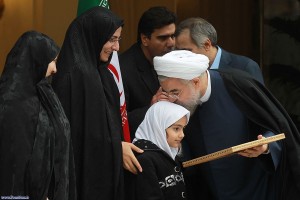
Iran’s President Hassan Rouhani celebrates the completion of an interim deal on Iran’s nuclear program by kissing the head of the daughter of an assassinated Iranian nuclear engineer
By Alastair Crooke | Consortium News | May 9, 2016
In an article entitled “Why America needs Iran in Iraq,” former U.S. Ambassador to Iraq Zalmay Khalilzad argues that “the chaos in Baghdad, culminating in the temporary occupation of the parliament by followers of Shiite Islamist cleric Muqtada al-Sadr, is undermining the war against the Islamic State; weakening Iraq’s economy; and accelerating the country’s disintegration.
“Without cooperation between the United States, Iran and Iraq’s top Shiite cleric, Ayatollah Sistani, the crisis could very well lead to the collapse of the entire political system set up in Iraq during the temporary U.S. occupation … To prevent this, Washington needs Tehran’s help. And Iran should be as motivated to seek stability [in Iraq] as much as Washington, because” Khalilzad asserts, “Iran, currently is losing favour in Iraq.”
Putting aside the questionable implication that Iran might somehow, through co-operation with America, raise its standing amongst Iraqis, Khalilzad’s presumption that Iran should now attend to America’s needs in Iraq, coupled with Secretary of State John Kerry’s insistence that Iran should help America to end the conflict in Syria too, throw into sharp relief the paradox inherent at the heart of U.S. diplomacy towards Iran, Russia (and China also).
This approach has been dubbed the “middle way” by former special adviser to the Assistant Secretary of State, Jeremy Shapiro: the U.S. Administration has no desire for an all-out confrontation with these three states. They are militarily hard nuts, and there is not much appetite for yet more military confrontation amongst a weary and wary American public (to the continuing frustration of the neocons).
More prosaically, the global financial system is now so brittle, so delicately poised, that it is not at all certain that the prospect of conflict would give the lift to America’s flagging economy that war generally is supposed to give. It might just snap the financial system, instead — hence the Middle Way.
Shapiro points out the obvious contradiction to this two-track approach: the U.S. no longer can ignore such powerful states. Its window of absolute, unchallenged, uni-polar power has passed. America needs the help of these states, but at the same time, it seeks precisely to counter these states’ potential to rival or limit American power in any way.
And America simply ignores the core complaints that fuel the tensions between itself and these states. It simply declines to address them. Shapiro concludes that this foreign policy approach is unsustainable, and bound to fail: “This dual-track approach, condemning Russia [or Iran] as an aggressor one day, [whilst] seeking to work with Moscow [or Tehran] the next … would [ultimately] force ever-greater confrontation.”
The ‘Middle Way’
In a sense, the U.S. approach towards Iran seems to be mirroring the so-called “middle way” policy which the U.S. Administration pursues towards Russia, whereby the putative “reset” with Russia was set aside (when President Vladimir Putin assumed the Presidency for the second time), and Obama – rather than seek outright confrontation with Russia – ruled that America however, would only co-operate with Russia when it suited it, but the U.S. would not deign to address Russia’s core issues of its “outsider” status in Europe, or its containment in Asia — or its concerns about a global order that was being used to corner Russia and to crush dissenter states who refused to enter the global order on America’s terms alone.
And Obama did little to drawback the NATO missile-march towards Russia’s borders (ostensibly, it may be recalled, to save Europe from Iranian missiles).
Ostensibly, too, the JCPOA (Joint Comprehensive Plan of Action) could have been America’s “reset” with Iran. Some, including a number of prominent Iranian politicians, thought it was.
But National Security Advisor Susan Rice was very explicit to Jeffrey Goldberg in The Atlantic that this was never intended: “It is assumed, at least among his critics, that Obama sought the Iran deal because he has a vision of a historic American-Persian rapprochement. But his desire for the nuclear agreement was born of pessimism as much as it was of optimism.
“The Iran deal was never primarily about trying to open a new era of relations between the U.S. and Iran,” Susan Rice told [Goldberg]. “It was far more pragmatic and minimalist. The aim was very simply to make a dangerous country substantially less dangerous. No one had any expectation that Iran would be a more benign actor.”
And so, we see a similar pattern, the possibility of a real “reset’ with Iran is pre-meditatively set aside (as per Rice), whilst the dual-track approach of condemning Iran for its ballistic missile tests (which have nothing to do with JCPOA), and its support for Hizbullah, are condemned one day, whilst Iran’s help in Iraq and Syria is being demanded on the next day.
At the same time, Iran’s core dispute with the U.S. – its complaints that exclusion from the international financial system is not being ameliorated as JCPOA was supposed so to do – are not being addressed. Rather they are being met with a shrug that implies “did they really expect anything else?”
Well, some (but by no means all) Iranian politicians had done just that: they had raised the Iranian public’s expectations that all sanctions – other than specific U.S. sanctions – would be lifted. They rather bet their credibility on it, as it were, and may pay a political price eventually.
And as NATO deploys a further 4,000 troops in the Baltic states and Poland, on Russia’s border, so too the U.S. Congress continues its figurative advance on Iran’s frontiers.
Here is Iran’s (conservative) Keyhan newspaper: “The draft of a new resolution has been presented to the US Congress in which Iran is accused of creating tension in the Persian Gulf, and the US Government has been urged to confront Iran and impose new sanctions against our country. Randy Forbes, a Republican member of the US House of Representatives, has drafted a resolution, which if passed by the Congress, condemns Iran’s military presence in the Persian Gulf as a provocation” (emphasis added)
Shapiro’s specific warning about the “middle way” approach was that “political and bureaucratic factors on both sides would force ever-greater confrontation.” But this is not the only risk, nor does it even constitute being the biggest risk (besides that of having undermined those in Iran and Russia who had put their “hat in the ring” of contemplating Entente with the United State).
America’s Bad Faith
Rather, it is by making this policy approach quite general to those states which have taken on themselves the burden of being the symbol for a non-Western, alternative vision (Russia, Iran and China, inter alia), that a perceived breach of the spirit of the JCPOA (at the least), will have wider repercussions.
Russia and China both spent political capital in order to help persuade Iran to sign up to the JCPOA: Will they not wonder whether America is to be trusted? China has complicated negotiations in hand with America on trade and financial issues, whilst Russia has been trying to resolve ballistic missile, as well as Ukraine sanctions issues, with America.
Is it not a straw in the wind for the consequences to this policy when a prominent Russian commentator, Fyodor Lukyanov, who is not at all hostile to rapprochement with the West, writes in End of the G8 Era that using Russia’s prospective inclusion in the G8 as an instrument of pressure on Russia is pointless?:
“The G8 reflected a certain period of history when Russia really wanted to be integrated into the so-called Extended West. Why it did not happen? Something went wrong? This is another topic. The most important thing is that it did not happen at all … it seemed (in the 1990s) that this membership would not mean just participation in yet another club, but a strategic decision aimed at the future.
“However, the desirable future did not come, and probably won’t come. It is obvious now, that the world does not develop in the direction of the Western model. So, now we have what we have, and there is no reason to restore the G8.”
May this general sentiment come to be reflected in Iran too, as the sanctions-lifting issue drags on? Did the U.S. then “win one over Iran” through the JCPOA accord – as the shrugs of U.S. shoulders at Iranian complaints, might imply? Was Iran just naïve? Did they really think that the U.S. was simply going to empower Iran financially?
It is pretty clear that the Supreme Leader understood the situation precisely — he had, after all some experience of U.S. non-compliance with agreements from the Lebanese hostage negotiations of the 1980s.
But what has Iran lost by the JCPOA? A few Iranians may have had their fingers burned in the process, but Iran achieved three important things: the world now knows that it was not Iran that was the impediment to a nuclear deal; the deal has transformed Iran’s public image – and created an opening – with the rest of the world (including Europe); and it has, in the process, constructed and strengthened strategic political and economic ties with Russia and China.
But most important of all, the rift within Iran that stemmed from the sense amongst some Iranian orientations, that President Ahmadinejad’s rhetoric was a principal obstacle to normalizing with the West, has been addressed: an Iranian government, with a Western-friendly face, has been given, and seen to have been given, the full chance to negotiate a solution to the nuclear issue. Whatever the final outcome, that boil has been lanced.
No, the Iranian leadership has not been naïve.
Alastair Crooke is a British diplomat who was a senior figure in British intelligence and in European Union diplomacy. He is the founder and director of the Conflicts Forum, which advocates for engagement between political Islam and the West.
US Republican lawmakers push Boeing to scrap any Iran deal
Press TV – May 4, 2016
Three US Republican lawmakers are pushing the American aerospace giant, Boeing, to refrain from getting into any deal with Iran.
In a letter to Boeing CEO Dennis Muilenburg, the Illinois Republican congressmen asked the company no to business with Tehran for any supply of planes and other services.
Congressmen Peter Roskam, Bob Dold and Randy Hultgren referred to a last July nuclear agreement between Iran and the permanent UN Security Council members plus Germany (P5+1) that removed anti-Iran sanctions in return for curbs on Tehran’s nuclear program, saying in their letter that any Iran deal with Boeing would be legal but “not right,” according to Fox News.
“This is not about doing what is legal – it is about doing what is right,” the letter said.
The Republican lawmakers reiterated US allegations of Iranian support for terror, telling Boeing that Iran’s Islamic Revolution Guards Corps (IRGC) can turn the planes into combat aircraft.
“We urge you not to be complicit in the likely conversion of Boeing aircraft to IRGC warplanes,” said the lawmakers.
Congressman Roskam, chairman of the US House Committee on Ways and Means Oversight, has been particularly vocal in his anti-Iran position, previously pushing for Europe’s multinational plane-maker Airbus to scuttle its $25 billion deal to sell 118 planes to Iran.
Roskam on Friday introduced an amendment to the National Defense Authorization Act, which would prohibit the US Department of Defense from awarding contracts to any entity that does business with Iran.
This is while Boeing is not alone in its interest in Iranian ventures. General Electric Co., among others, is also reportedly exploring business opportunities in Iran.
“Should any agreements be reached at some future point, they would be contingent on the approval of the US government,” Boeing said in a statement in April.
Last month, Iranian officials said Boeing had proposed to sell new models of its 737, 777 and 787 aircraft to Iran and promised after-sales support.
In late January, Iran’s Deputy Transport Minister Asghar Fakhrieh-Kashan said the country was planning to purchase over 100 planes from Boeing.
The official noted that Iran’s order list from the American company included 737s for domestic flights and two-aisle 777s for long-haul routes.
Iranian officials have already emphasized that the country will need to buy 500 commercial jets of various models for various short-, medium- and long-distance routes.
We don’t recognize US court ruling: Zarif
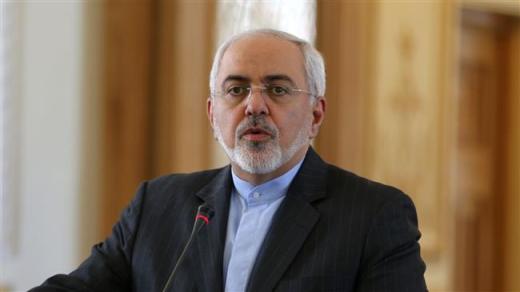
Iran’s Foreign Minister Mohammad Javad Zarif
Press TV – April 21, 2016
Iran’s foreign minister says the country refuses to recognize a recent ruling by the US Supreme Court, which authorizes the transfer of around USD two billion of frozen Iranian assets to the families of the victims of a 1983 bombing in Beirut.
Mohammad Javad Zarif made the remarks on Thursday in New York, where he has been staying since Monday to attend a UN debate on Sustainable Development Goals and the signing ceremony of the Paris climate change agreement as well as to meet foreign officials.
“As we [already] said, we do not recognize the court’s ruling and the US government knows this well,” he said, adding, “The US knows this well too that whatever action it takes with respect to Iran’s assets will make it accountable in the future and it should return these assets to Iran.”
On Wednesday, the tribunal ordered the sum be paid to the families of the victims of the explosion, which targeted a US Marine Corps barracks in the Lebanese capital, and other attacks blamed on Iran.
The assets belong to the Central Bank of Iran (CBI), which have been blocked under US sanctions.
“The ruling has mocked [international] law,” Iranian Foreign Ministry Spokesman Hossein Jaberi Ansari said earlier in the day, adding that it “amounts to appropriation of the Islamic Republic of Iran’s property” in the US.
Asked whether the matter will be brought up during a planned meeting between Zarif and his American counterpart, John Kerry, on Friday, the top Iranian diplomat said the meeting would only address Iran’s July 2015 nuclear agreement with the P5+1 countries and its proper implementation.
The historical nuclear deal, the Joint Comprehensive Plan of Action (JCPOA), was signed on July 14, 2015 following over two years of intensive talks between Iran and the five permanent members of the UN Security Council – the United States, Britain, France, Russia, and China – plus Germany.
“Our discussion at the meeting will follow up on previous negotiations over JCPOA. It has been agreed that the American side consider the points brought up by us during the previous meeting regarding the proper implementation of JCPOA and provide us with answers.”
The two officials held a closed-door meeting on Tuesday.
Featured Video
It’s the Occupation, Stupid
or go to
Aletho News Archives – Video-Images
From the Archives
A superpower and “the world’s sickest warrior state”
By Paul J. Balles | March 8, 2010
Living through five or six major wars has hardened me to what I thought were the extremes of inhuman cruelty and brutality.
Two things made those extremes almost bearable: the brutality always revealed – at least according to the media coverage – the viciousness of the enemy. It was therefore quite understandable when our “brave men and women” pulverized the enemy.
Films of Japanese torturing captive Americans somehow justified holding Japanese Americans in internment camps during World War II; and only a small percentage of Americans found the bombing of Hiroshima and Nagasaki unreasonably vengeful at best, at worst, depraved.
The media giants in America portrayed the North Koreans as barbaric beasts with their captives, quite unlike their southern counterpoints – our allies during the Korean War. No one ever felt the need to explain how the South Koreans were a civilized breed while the North Koreans were absolute savages, at least according to the official line.
In Vietnam, our warriors justifiably (or so the media made us believe) dropped napalm on the North Vietnamese who had the gall to hide in villages and tunnels to ravage our invaders. At least it was accepted practice until some rogue photojournalist filmed a young girl screaming down a Vietnamese road in flames. … continue
Blog Roll
 Aletho News
- Pro-Palestinian French member of European Parliament denied entry to Canada
- Pakistan to Host US-Iran Talks
- How Indonesia’s tilt toward the US left it stranded in the Strait of Hormuz
- US has no choice but to retreat from Iranian borders: Top commander
- Iran Retaliation Strikes Chemical Plant Near Dimona
- AWACS’ Destruction is a Major Loss for US Military – Ex-DoW Analyst
- Israel’s Iran Strategy Uses US Military & Gulf States as Its Pawns
- Iran: Trump wanted regime change, now just begging for Hormuz to open
- IRGC: Israeli, US universities in region legitimate targets after strikes on Iranian university
- Trump admits Iran hit USS Ford carrier: ‘We ran for our lives’
- If Americans Knew
- Israeli police block Catholic cardinal from entering Church of the Holy Sepulchre on Palm Sunday
- Israel is assassinating journalists again, more than any other nation, anywhere, ever – Not a ceasefire Day 170
- Over 300 US service members wounded, majority have brain injuries – Not a ceasefire Day 169
- Researchers at Human Rights Watch Resign Over Blocked Report on Palestinian Refugee Return
- Jewish Groups Are Backing a War Americans Don’t Want
- Eric Fingerhut Thinks He’s the President of the Jews
- Top Jewish Philanthropists, Rabbis Urge Israeli President to Take Action Against ‘Jewish Extremists’
- Don’t Be Fooled. Zionist Leaders Have Always Wanted to Control Southern Lebanon
- Israel’s widespread use of torture is a core element of its genocide against the Palestinian people
- In Israel’s War on Iran, Many Middle East US Bases Rendered “All But Uninhabitable”
- No Tricks Zone
- German Science Blog Accuses PIK Climate Institute Of Hallucinating Climate Tipping Points
- Devastating Assessment Of Comirnaty Vaccine By Former Senior Pfizer Europe Toxicologist
- New Study: CO2 Is ‘Effectively Negligible’ As An Explanatory Climate Change Factor Since 2000
- Former Pfizer Toxicologist Dr. Helmut Sterz Tells Bundestag Hearing Pfizer Vaccine Should Have Never Been Approved
- Energy Expert: Germany’s Nuclear Phaseout Was A “500 Billion Euro Mistake”
- New Research: South Australia’s Mid-Holocene Sea Surface Temperatures Were 4°C Warmer Than Today
- Storing Green Energy To Last Germany 10 Days Would Require A 60-Million Tonne Battery
- New Studies: UK Sea Levels Were 4 Meters Higher Than Today During The Mid-Holocene
- Destructive Green New Deal: German Energy And Metal Group Warns Of Drastic Crisis
- New Study Documents A 20-Year Pause In Arctic Sea Ice Decline – Driven By Internal Variability
 Aletho News