Hillary Clinton calls for new Iran sanctions due to missile test
RT | January 17, 2016
Democratic presidential candidate Hillary Clinton has called for new sanctions on Iran over its recent ballistic missile test. Her comments come as earlier economic sanctions are being partly lifted, after Iran fulfilled measures set by the nuclear deal.
“Iran is still violating UN Security Council resolutions with its ballistic missile program, which should be met with new sanctions designations and firm resolve,” Clinton said in a statement.
The former US secretary of state stressed that if she is elected president this year, she will take on Iran with a “distrust and verify” attitude.
Clinton also applauded Iran’s release of US citizens. “I am greatly relieved by the safe return of American prisoners from Iran.”
Latest media reports indicated that a detained American student, Matthew Trevithick, has already left Iran, while “logistical steps” are in process to send four other prisoners, including the jailed Tehran bureau chief for the Washington Post, Jason Rezaian, home.
While lashing out at Iran for its missile tests, Clinton has apparently been fine with weapons being sent to some of its Middle Eastern neighbors, despite them being criticized for dismal human rights records.
Amid Clinton‘s presidential campaign, media reports have surfaced claiming that regional players, including Saudi Arabia and Qatar, have donated billions of dollars to the Clinton Foundation. At the same time, those same nations had weapons deals approved by the US State Department when it was headed by Clinton.
“Algeria, Saudi Arabia, Kuwait, the United Arab Emirates, Oman and Qatar all donated to the Clinton Foundation and also gained State Department clearance to buy caches of American-made weapons even as the department singled them out for a range of alleged ills, from corruption to restrictions on civil liberties to violent crackdowns against political opponents,” International Business Times wrote in May 2015, citing a review of available records.
Meanwhile, US Democratic Senator Richard Blumenthal joined Clinton’s call for more sanctions on Iran on Saturday, arguing its missile tests violated UN resolutions.
“Without delay, the United States should enforce sanctions on Iran for its ballistic missile program,” Blumenthal said.
Both Clinton’s and Blumenthal’s statements come as international economic sanctions imposed on Iran earlier due to suspicions that its nuclear program was being used to develop atomic weapons were formally lifted after the UN nuclear watchdog – the International Atomic Energy Agency (IAEA) – released a statement saying Iran has fulfilled all of the measures required under its deal with six world powers.
“The report was submitted to IAEA board of governors and to the United Nations Security Council,” IAEA director general Yukiya Amano said on Saturday, adding that “it was issued after agency inspectors on the ground verified that Iran has carried out all measures required under the JCPOA to enable implementation day to occur.”
The JCPOA, known as the Iran nuclear deal, was signed between Tehran and six world powers (the so-called P5+1 group comprised of China, France, Russia, the UK, the US and Germany) on July 14, 2015. The deal entailed Iran shrinking its atomic program in return for the US, EU and UN lifting economic sanctions.
No basis for new US bans on Iran: Russia
Press TV – January 8, 2016
Russia says the Iranian missile program constitutes no basis on which the US can impose potential new sanctions against the Islamic Republic.
“We have no confidence that there are any grounds for the imposition of sanctions against Iran in connection with its missile program,” Interfax quoted a Russian diplomatic source as saying.
Talk of new US sanctions against Iran emerged after the Islamic Republic successfully test-fired a precision-guided long-range missile on October 11, 2015.
Several US politicians have said the test violated a United Nations resolution against Iran, and called on the US administration to introduce new sanctions against Tehran.
“The Americans interpret the relevant provision of Resolution 1929 as prohibiting any ballistic missile launches, whereas the text speaks about a ban on launches of ballistic missiles that are capable of carrying nuclear warheads,” the Russian source also said, referring to the UN resolution adopted against Iran in June 2010.
The US administration, however, announced last month new sanctions against nearly a dozen companies and individuals for their alleged role in developing Iran’s missile program.
Fearing Iran’s reaction, the White House delayed implementing the sanctions for an unspecified time.
The sanctions would be the first ever since Iran and the P5+1 group reached a nuclear deal, dubbed as the Joint Comprehensive Plan of Action (JCPOA), in July 2015.
The agreement would see the removal of nuclear-related sanctions against Iran in return for enhanced transparency by Iran in its peaceful nuclear program.
Leader of the Islamic Revolution Ayatollah Seyyed Ali Khamenei had warned that any new sanctions against Iran under any pretext would be interpreted as a violation of the JCPOA.
The unnamed Russian source further said the Kremlin is against “any exacerbation that can obstruct the beginning of the implementation” of the JCPOA that “should apparently happen in January, around its middle.”
Iranian officials say no limits can be imposed on the country’s conventional military capabilities.
They say none of the Iranian missiles have been “designed for a nuclear capability,” and thus their production and test are not in violation of the UN resolution.
‘The only thing Washington has not blamed Iran for is global warming’
RT | January 1, 2016
As Washington sends mixed signals on whether or not it will introduce new sanctions against Iran, Tehran is considering other options should a new round of penalties come to pass, says Seyed Mohammad Marandi, professor at the University of Tehran.
The United States delayed the announcement of new penalties, which reportedly seeks to punish several companies and individuals from Iran, Hong Kong, and the United Arab Emirates that the US believes have been involved in Iran’s ballistic missile tests.
However, such an announcement comes as no surprise to Tehran, according to Marandi, who said that even as the [nuclear] negotiations were taking place between Iran and the P5+1, the general consensus in Iran was that “the United States would move towards increasing sanctions through other excuses than that of the nuclear program.”
Marandi provided a list of methods the United States was using to target Iran, including the recent passage of a law restricting visas for people that have visited Iran, as well as for Iranian citizens that have dual nationality. Also, Iranian assets are being confiscated abroad, which the Iranians “believe… is theft by the United States through using different excuses.”
The professor at the University of Tehran says such actions could “severely damage the chances for the Joint Comprehensive Plan of Action bearing fruit.”
The Joint Comprehensive Plan of Action (JCPOA) is an agreement designed to oversee Iran’s nuclear program reached in Vienna on July 14, 2015 between Iran and the five permanent members of the UN Security Council — China, France, Russia, United Kingdom, United States—plus Germany), and the EU.
Marandi believes that Washington’s aggressive stance towards Iran must be explained by other reasons because, he says, “there’s never been any evidence to show that Iran’s nuclear program has been anything but peaceful. The United States has been making many accusations against Iran that have been unfounded.”
The real reason the US is fundamentally opposed to Iran is because the Islamic Republic successfully freed itself from Washington’s rule many years ago, he argues.
“The United States has not forgiven the Iranian people over three and a half decades for gaining their independence from the United States and becoming an independent actor in this part of the world.
“Therefore, the Iranians expect the United States will use all sorts of excuses – whether it’s the nuclear program, terrorism, human rights.”
Marandi exclaimed with a hint of irony that the only thing Iran has not been blamed for by Washington is “global warming.”
Yet the nuclear issue, he says, is not the main point of contention between the two countries. What really irks Washington about Iran “is not the nuclear program, but rather Iran’s political independence of the US,” he asserts.
But the international community will see through the actions of the United States that – despite the agreement between the two countries – is “trying to make ordinary Iranians suffer until Iran bows down to the will of the US.”
Marandi is adamant that such a thing “is not going to happen.”
In fact, according to the academic, Tehran has many options open to itself should the US impose a new round of sanctions, including seeking the cooperation and partnership of other countries – both non-Western and Western alike.
“If the US continues to go down this road, we will see greater tensions and probably it will be an important incentive for Iran to increase and develop its ties with Russia and China, as well as other non-Western countries.”
Marandi concludes that due to Washington’s support of countries in the region that are guilty of “supporting al-Qaeda and ISIL [Islamic State/ISIS],” Tehran is of the opinion that countries like Russia, China and increasingly India, and even many European Union countries will begin to “look more to Iran as a reliable partner and this is making it far more difficult for the US… to impose sanctions on Iran in a way in which the international community would abide by those demands of the US.”
Washington Shelves New Sanctions Against Iran
Sputnik – 01.01.2016
The US government prepared sanctions against Iran because of its ballistic missile defence program, but has now postponed their implementation, the US press reported on Wednesday.
The Obama administration is still intent on punishing Iran for developing the missiles, which it allegedly tested earlier this month. However, sanctions in connection with the ballistic missile program have been delayed, according to US officials.
On Wednesday the US Treasury announced a list of companies and individuals in Iran, the UAE and Hong Kong that are to be targeted by sanctions because they are alleged to have assisted Iran in the development of the missiles. The sanctions would freeze the US-held assets of those entities, and forbid US companies from trading with sanctioned firms.
Iran’s President Hassan Rouhani called the sanctions an example of the US’ “hostile policies and illegal meddling,” and instructed Iran’s Defence Ministry to step up the development of the missiles.
Iran’s Foreign Ministry spokesman Hossein Jaber Ansari on Thursday stressed that Iran’s missile program is for purely defensive purposes, and is only capable of firing conventional rockets, not nuclear warheads.
“As the US officials have mentioned before, [the Iranian] missile program is not related to the Joint Comprehensive Plan of Action (JCPOA),” said Jaber Ansari.
“There is nothing to prevent Iran from pursuing its legitimate right to reinforce its defensive strength and national security.”
In July the Iranian government and the P5+1 group of countries reached a deal on Iran’s nuclear program, in which Iran agreed to restrictions on its capability to enrich uranium in return for the eventual lifting of economic sanctions.
Last week Iran shipped nine tons of low-enriched uranium to Russia as part of the deal, and in return received 137 tons of natural uranium for use in nuclear energy reactors.
December 9, 2015:
US preparing new sanctions over Iran’s missile program
Press TV – December 31, 2015
US President Barack Obama’s administration is reportedly preparing fresh sanctions on international companies and individuals over Iran’s missile program.
They would be the first financial sanctions on Iran since Tehran agreed to a landmark nuclear agreement in July and present a serious challenge to the accord’s implementation.
According to the Wall Street Journal, the sanctions would target a number of Iranian nationals and international companies over suspected involvement in Iran’s missile program.
“We’ve been looking for some time at options for additional actions related to Iran’s ballistic missile program based on our continued concerns about its activities,” an Obama administration official was quoted as saying.
“We are considering various aspects related to additional designations, as well as evolving diplomatic work that is consistent with our national security interests,” the official said, on condition of anonymity.
US officials claim the new sanctions are in line with the Joint Comprehensive Plan of Action (JCPOA), the nuclear agreement, and the Treasury Department can impose new sanctions on Iran over its missile development.
Leader of the Islamic Revolution Ayatollah Seyyed Ali Khamenei, who has the final say on all matters of the state, has made it clear that Iran would consider any new sanctions a breach of the JCPOA.
In an October letter to President Hassan Rouhani, outlining his conditional approval of the JCPOA, the Leader said that in case of a violation, “the government would be obliged to take necessary measures and halt JCPOA activities.”
“Imposing any sanctions at any level and under any pretext by any side of the negotiations will be considered a breach of the JCPOA,” Ayatollah Khamenei said in his letter.
Iran has also defended its right to carry out missile tests for defensive purposes, saying none of his country’s missiles are capable of carrying nuclear warheads.
“It’s our legitimate defense. These are not missiles that are designed to be capable of carrying nuclear warheads and, therefore, it is within our right to self-defense,” said Foreign Minister Mohammad Javad Zarif in an interview published by The New Yorker earlier this month.
According to the Journal, the sanctions would prohibit US or foreign nationals from conducting business with targeted companies.
US banks would also be required to freeze any assets the companies or individuals hold inside the American financial system.
Tehran is already disappointed by Obama’s signing of a Congress bill this month aimed at limiting travels to Iran and trade with the country.
Iran says the law violates a July nuclear accord and amounts to new sanctions on the country.
The US Supreme Court is also mulling a case on appropriating $2 billion of Iranian assets frozen in a bank in New York.
The Obama administration has urged the tribunal not to overturn the decisions of US circuit and appeals courts to use the funds.
Iran warns US against sanctions over missile program
Press TV – December 31, 2015
Iran has warned the US against imposing any fresh sanctions on international companies and individuals over the Islamic Republic’s ballistic missile program, saying Tehran will respond to such meddlesome measures.
“Such measures are unilateral, arbitrary and illegal and the Islamic Republic of Iran has [already] served notice to the US government [in this regard],” Iranian Foreign Ministry spokesman, Hossein Jaberi Ansari, said on Thursday.
Jaberi Ansari was reacting to reports that the US government is planning new sanctions targeting about 12 companies and individuals in Iran, Hong Kong and the United Arab Emirates for their alleged involvement in Iran’s missile program.
“The Islamic Republic will respond to any meddlesome action against its defense program by strengthening its defense might,” he said.
The planned sanctions, reported by The Wall Street Journal on Wednesday, come as the US prepares to lift restrictions on Iran over its nuclear program within the framework of Iran’s July nuclear agreement with the P5+1 group of countries, known as the Joint Comprehensive Plan of Action (JCPOA).
Jaberi Ansari reiterated that Iran’s missile program is solely for defense purposes and in line with national security interests.
“No measure can deny the Islamic Republic of Iran its legitimate and legal rights to boost its defense might and national security,” he said.
Iran has already said that any fresh sanctions on the country would be a flagrant violation of the JCPOA, whose implementation is expected in January.
Iran denies firing rockets near US aircraft carrier in Gulf, brands claim ‘psychological warfare’
RT | December 31, 2015
Tehran has officially denied that its Revolutionary Guards’ patrol vessel launched rockets in imminent proximity to the USS Harry S. Truman and its convoy entering the Persian Gulf, calling the allegation an act of “psychological warfare.”
On Tuesday, reports emerged that last Saturday the US aircraft carrier was intimidated after missiles were launched by an Iranian patrol vessel on a parallel course with the American naval convoy.
“The naval forces of the Guards have not had any exercises in the Strait of Hormuz during the past week and the period claimed by the Americans, for them to have launched missiles and rockets,” Reuters quoted Revolutionary Guards spokesman Ramezan Sharif as saying.
The alleged dangerous missile launch was reported by NBC News, which cited two unnamed US military officials as saying that the USS Harry S. Truman was about 1,400 meters away from the Iranian vessels, which launched two missiles as part of naval exercises.
“The publication of such false news under the present circumstances is akin to psychological warfare,” Sharif said.
US court mulls appropriation of Iran assets
Press TV – December 25, 2015
The US Supreme Court is mulling a case on appropriating $2 billion of Iranian assets frozen in a bank in New York.
Over 1,300 Americans are reportedly pressing the US government, judiciary and Congress to pay them billions of dollars in awarded damages over two bombings in Beirut and Saudi Arabia in 1983 and 1996.
Iran has dismissed any role in the attacks and rejected the US judicial system’s ruling to let the purported plaintiffs use Bank Markazi’s almost $2 billion held in Citibank accounts.
The case has reportedly moved to the Supreme Court, with the Obama administration urging it not to overturn the decisions of US circuit and appeals courts to award the plaintiffs.
The White House and US congressional Republicans and Democrats reportedly agree on the case.
In 2012, President Barack Obama issued an executive order blocking all of Bank Markazi’s assets held in the US in order to prevent Tehran from repatriating them.
At the same time, Congress passed a law which included a provision making it easier for the Americans to use Iranian funds frozen in the US.
Iran says the action was unconstitutional because Congress was encroaching on the power of the judiciary.
Iran’s Bank Markazi says the US Congress passed the law to change the outcome of the case. It has asked the US federal courts to decide whether that violates the constitutional separation of powers.
With the case moved to the US Supreme Court now, the outcome is set to affect a landmark nuclear agreement between Iran and the West.
Tehran is already disappointed by Obama’s signing of a Congress bill aimed at limiting tourist travels to Iran, saying it violates the Joint Comprehensive Plan of Action (JCPOA) as the nuclear accord is called.
On Thursday, US media said each of the 53 hostages held during the 1979 takeover of the American embassy in Tehran by Iranian students would receive compensation under a spending bill passed last Friday.
The budget bill reportedly includes a provision authorizing each of the 53 hostages to receive $10,000 for each day of the 444 spell they were held captive.
In addition, spouses and children would separately receive a one-time payment of $600,000. Thirty-eight of the former hostages are still alive, US media said.
UN closes case into alleged Iranian quest for nukes
RT | December 15, 2015
Iran moved another step away from international isolation after the UN’s nuclear watchdog announced on Tuesday it was closing a probe into whether Tehran sought to obtain nuclear weapons.
The decision was made by the UN’s International Atomic Energy Agency (IAEA) as it looks to move forward with a nuclear deal signed by Iran and six world powers on July 14, which is supposed to see Tehran curb its nuclear program in return for economic sanctions being lifted.
IAEA official Yukiya Amano said his investigation could not “reconstruct all the details of activities conducted by Iran in the past.”
The decision means the 12-year investigation will now finally be closed, as the West had believed for over a decade that Tehran was striving to produce nuclear weapons. One diplomat who attended the meeting said the decision was reached by consensus, with all those attending in favor.
Iranian Foreign Minister Mohammad Javad Zarif applauded the move.
“We welcome the closure of the investigation of Iran’s past nuclear activities … the resolution by the board of governors of the agency … shows the peaceful nature of Iran’s nuclear program,” the Tasnim news agency quoted Zarif as saying.
Iran says it will start implementing restrictions concerning its nuclear activities within the next two-to-three weeks.
“We are intending to complete this process within two-to-three weeks, so accelerate the implementation day as soon as possible,” Iranian envoy to the IAEA Reza Najafi stated, as cited by Reuters.
Meanwhile, Iranian nuclear negotiator Abbas Araqchi said he believes that economic sanctions against Tehran could be lifted within the next three weeks, following the decision made by the IAEA.
Iran issued a warning to the IAEA in November that if the nuclear probe was not closed, they risked Tehran abandoning the international atomic deal signed in July.
Ali Shamkhani, the secretary of Iran’s Supreme National Security Council, said that the closure of the case was a necessary prerequisite for the full implementation of the nuclear deal between Iran and the P5+1 nations.
Under the nuclear deal, Tehran agreed to put major curbs on its atomic program, particularly its enrichment of uranium to high purities. In return, all nuclear-related sanctions imposed by the US, the EU and the UN are to be lifted.
Pakistan: Iran gas pipeline best option
Press TV – December 2, 2015
Pakistan says its import of gas from Iran through a pipeline is the best option as the stalled project is given new impetus with anticipated lifting of sanctions on Tehran.
The energy crisis in Pakistan which suffers about 12 hours of power cuts a day has worsened in recent years amid 4,000 megawatts of electricity shortfall which the Iran gas pipeline is being fostered to cover.
Iran has completed its part of the project with more than $2 billion of investment but Pakistan has fallen behind the target to take gas deliveries in the winter of 2014.
Addressing a seminar on business opportunities in the clean energy sector in Washington Tuesday, Pakistan’s Minister for Petroleum and Natural Resources Khaqan Abbasi said he hoped sanctions on Iran would be removed soon.
“The Iran gas line project is the best option for Pakistan. But as long US sanctions are there, we cannot buy gas from Iran,” the website of the Dawn newspaper quoted him as saying.
The remarks came as Turkmenistan’s leader last month ordered construction of a $10 billion rival pipeline to Pakistan and India through Afghanistan to begin despite questions about the project.
The US has long lobbied against the Iran-Pakistan pipeline, promoting Turkmen over Iranian natural gas even though the route requires the extra distance of more than 700 km across Afghanistan.
Western giants such as Chevron, Exxon, BP and Total have held off on committing to the project all the more because of Afghanistan’s insecurity and the region’s complex geopolitics.
Contractually, Pakistan has to pay steep fines to Iran for failing to build and operate its section of the pipeline by the winter of 2014 but Abbasi shrugged off the postulation.
“Not our fault. We made several attempts in the last 18 months to complete the project on our side. But no investor, no builder came forward,” the minister claimed.
“Once the sanctions are lifted, we will work on this project. A pipeline is always more reliable than other options,” he added.
Besides the expected lifting of sanctions, the bolstered prospects of the Iran gas pipeline arise from China’s $46 billion investment project dubbed the China-Pakistan Economic Corridor.
Officials say up to $2 billion has been earmarked as part of the package for the Iran pipeline extension, running from Pakistan’s southern port of Gwadar to the Nawab Shah district.
The energy-starved country imports about 100 megawatts (MW) of Iranian electricity for to the areas near their border. The government has said it was in final stages of negotiations to increase electricity imports from Iran to 1,000 MW.
Trade between Iran and Pakistan plunged to $217 million in 2014 from its peak of more than $1.3 billion in 2009.
Featured Video
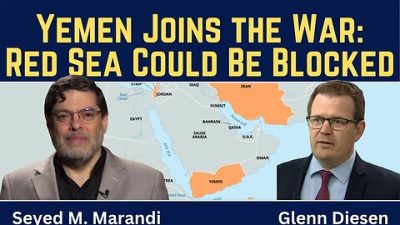
Yemen joins the war – Red Sea could be blocked next – Saudi regime at risk
or go to
Aletho News Archives – Video-Images
From the Archives
A superpower and “the world’s sickest warrior state”
By Paul J. Balles | March 8, 2010
Living through five or six major wars has hardened me to what I thought were the extremes of inhuman cruelty and brutality.
Two things made those extremes almost bearable: the brutality always revealed – at least according to the media coverage – the viciousness of the enemy. It was therefore quite understandable when our “brave men and women” pulverized the enemy.
Films of Japanese torturing captive Americans somehow justified holding Japanese Americans in internment camps during World War II; and only a small percentage of Americans found the bombing of Hiroshima and Nagasaki unreasonably vengeful at best, at worst, depraved.
The media giants in America portrayed the North Koreans as barbaric beasts with their captives, quite unlike their southern counterpoints – our allies during the Korean War. No one ever felt the need to explain how the South Koreans were a civilized breed while the North Koreans were absolute savages, at least according to the official line.
In Vietnam, our warriors justifiably (or so the media made us believe) dropped napalm on the North Vietnamese who had the gall to hide in villages and tunnels to ravage our invaders. At least it was accepted practice until some rogue photojournalist filmed a young girl screaming down a Vietnamese road in flames. … continue
Blog Roll
 Aletho News
- Russian tanker approaches Cuba despite US oil blockade
- Marandi: Yemen joins the war – Red Sea could be blocked next – Saudi regime at risk
- Pro-Palestinian French member of European Parliament denied entry to Canada
- Pakistan to Host US-Iran Talks
- How Indonesia’s tilt toward the US left it stranded in the Strait of Hormuz
- US has no choice but to retreat from Iranian borders: Top commander
- Iran Retaliation Strikes Chemical Plant Near Dimona
- AWACS’ Destruction is a Major Loss for US Military – Ex-DoW Analyst
- Israel’s Iran Strategy Uses US Military & Gulf States as Its Pawns
- Iran: Trump wanted regime change, now just begging for Hormuz to open
- If Americans Knew
- Israeli police block Catholic cardinal from entering Church of the Holy Sepulchre on Palm Sunday
- Israel is assassinating journalists again, more than any other nation, anywhere, ever – Not a ceasefire Day 170
- Over 300 US service members wounded, majority have brain injuries – Not a ceasefire Day 169
- Researchers at Human Rights Watch Resign Over Blocked Report on Palestinian Refugee Return
- Jewish Groups Are Backing a War Americans Don’t Want
- Eric Fingerhut Thinks He’s the President of the Jews
- Top Jewish Philanthropists, Rabbis Urge Israeli President to Take Action Against ‘Jewish Extremists’
- Don’t Be Fooled. Zionist Leaders Have Always Wanted to Control Southern Lebanon
- Israel’s widespread use of torture is a core element of its genocide against the Palestinian people
- In Israel’s War on Iran, Many Middle East US Bases Rendered “All But Uninhabitable”
- No Tricks Zone
- German Science Blog Accuses PIK Climate Institute Of Hallucinating Climate Tipping Points
- Devastating Assessment Of Comirnaty Vaccine By Former Senior Pfizer Europe Toxicologist
- New Study: CO2 Is ‘Effectively Negligible’ As An Explanatory Climate Change Factor Since 2000
- Former Pfizer Toxicologist Dr. Helmut Sterz Tells Bundestag Hearing Pfizer Vaccine Should Have Never Been Approved
- Energy Expert: Germany’s Nuclear Phaseout Was A “500 Billion Euro Mistake”
- New Research: South Australia’s Mid-Holocene Sea Surface Temperatures Were 4°C Warmer Than Today
- Storing Green Energy To Last Germany 10 Days Would Require A 60-Million Tonne Battery
- New Studies: UK Sea Levels Were 4 Meters Higher Than Today During The Mid-Holocene
- Destructive Green New Deal: German Energy And Metal Group Warns Of Drastic Crisis
- New Study Documents A 20-Year Pause In Arctic Sea Ice Decline – Driven By Internal Variability
 Aletho News