Crunch Time with Iran Let’s push back against Israel’s friends and avoid a war
Philip Giraldi • Unz Review • June 30, 2015
It now appears that the longest drawn out negotiations in history since the Treaty of Westphalia ended the Thirty Years War will again be prorogued. I am, of course, referring to the P5+1 talks in Vienna seeking to come up with a peaceful resolution to the problem of Iran’s nonexistent nuclear weapons program. Today represents the third deadline as the negotiations have already been extended twice, ostensibly to permit further discussion of details of timing for the lifting of sanctions as well as verification and inspection procedures.
I refer to a “nonexistent” program as the frequently cited intelligence suggesting that a weapon was being developed has turned out to be based on forgeries provided by the Israelis. Currently, both the CIA and Mossad agree that no such program exists though both Washington and Tel Aviv persist in suggesting that Iran might change its mind and therefore must not even be able to develop relevant technologies in the future.
In theory an agreement should have been reached long ago as the two basic elements are well understood: Iran wants an end to sanctions and the United States plus its negotiating partners want a verifiable end to existing and potential programs in Iran that could possibly produce a nuclear weapon. The devil would appear to be in the details but that is not necessarily the case as the real problem is political. The talks have in fact been subject to a relentless media campaign by Israel and its friends in the U.S. to derail any possible agreement, to include a number of appearances by none other than Israeli Prime Minister Benjamin Netanyahu before both the United Nations and the U.S. Congress. Netanyahu has been warning that an Iranian weapon is imminent since 1996 and he has even produced a cartoon showing a bomb with a ticking fuse to illustrate his thinking on the issue.
The intensity of the anti-Iran campaign has increased to a boiling point as the end of June deadline has approached, to include full page ads in newspapers and a rash of editorials, op-eds and letters to the editor. If you read an article about the negotiations on an unmoderated site like yahoo you will see numerous comments trashing Iran using the same misspellings and phrases, suggesting that they originate in the banks of paid students organized and directed by the Israeli Foreign Ministry.
In order to avoid constantly rehashing the same material, the well-funded and highly creative exploration of Persian perfidy has meant in practice that the media and punditry are constantly raising new issues that have nothing to do with the nuclear weapons themselves. These have included demanding that a contrite Iran confess that it once sought a weapon, addressing the state of possible missile delivery systems in the discussions, assessing Iran’s intentions as a regional power, critiquing the country’s human rights record and examining Tehran’s support of organizations that critics choose to describe as terroristic. Congress is on record calling for the prevention of Iran’s “capability” to construct a weapon, a threshold that it already has passed. Presidential wannabe Senator Marco Rubio has even demanded that Iran recognize “Israel’s right to exist.” The latest wrinkle is to insist on assurances over what might happen in ten years’ time when any agreement negotiated currently will presumably expire.
Assuming that the neocons’ other pet projects to go to war with Russia and eventually also China do not actually materialize and that we will all still be here in a decade, it has to be recognized that what is occurring in Vienna this week is already a war. On one side are the serious players, including Secretary of State John Kerry acting for the president as well as the Russians, Germans, Chinese, British and French, all of whom understand that no agreement leaves armed conflict as the only remaining option. They realize that a major explosion in the Persian Gulf would be disastrous for all parties and potentially even for the world economy. On the other side are the naysayers from Israel and its formidable amen section, deeply embedded in the media and among politicians at all levels. Many believe that, as Israel firster mega billionaire Sheldon Adelson has recommended, all Iran really needs is an admonitory nuclear strike to show the Mullahs that we are serious about the military option.
As in any war it is important to know what the enemy is doing. That generally requires massive mobilization of resources to collect intelligence, but in this case we are fortunate in that our enemies write for the Washington Post, The Weekly Standard and the Wall Street Journal when they are not, collectively speaking, busy appearing on the Sunday morning talk shows and on Fox.
My favorite Queen of Mean among the pro-Israel shock troops is Jennifer Rubin, who writes a blog appropriately labeled “Right Turn” for the Washington Post. In previous incarnations before she found her niche with editorial page chief Fred Hiatt at the Post Jennifer wrote for neocon house organs Commentary, Human Events and Bill Kristol’s The Weekly Standard. Jenn has ungraciously referred to President Barack Obama as the “most anti-Israel president ever.” Ben Smith at Politico describes her as “caustic and single minded” possessing an “intense and combative interest in foreign affairs and politics in general, and in Israel in particular – the sole bumper sticker on her gray Honda Pilot reads, “JERUSALEM IS NOT A SETTLEMENT. It’s Israel’s Eternal And Undivided Capital.” A recent comment on one of her pieces observed “Science is wrong. The world revolves around Israel. Jennifer knows it to be true. Bibi told her.”
Rubin writes about Iran frequently. Between June 16th and the 26th she penned no less than seven articles attacking the Mullahs – “Obama ignores Iran’s human rights atrocities,” “The Iran missile mistake,” “Democrats, Republicans, neutral experts reject Iran sellout,” “The Iran debacle unfolds,” “Iran appeasement relies on self-delusion,” “Can these forces stop a rotten Iran deal?” and “Iran sanctions back on the table.” All of her writing on Iran beats to death the same theme, i.e. that Iranians are both evil and liars and are out to destroy Israel. Driven by her obsession with Israel, she is constantly at work finding connections and seeing things that the rest of us cannot discern, appreciating as she does that there is always an Israeli angle as well as an evil Muslim narrative hidden somewhere as long as one looks long and hard enough. One of her most recent gems “Can these forces stop a rotten Iran deal?”, which appeared on June 25th, does a good job recounting recent commentary by all her friends in the Israel Lobby who are opposing a nuclear deal, which to her mind represents objective opinion. As is always the case, I searched in vain for any real evidence that Iran in any way threatens the United States but that does not appear to be on her agenda. She does, however, quote a number of Israeli politicians.
And Rubin is far from a lonely voice crying in the wilderness. The New York Times featured a story last Wednesday revealing that “former members of President Obama’s inner circle of Iran advisers” had written a letter advising caution on the possible Iran agreement. The article describes in some detail the objections of Dennis Ross, David Petraeus, Robert Einhorn, Gary Samore, Stephen Hadley and General James E. Cartwright. The signatories, who are accepted at face value in the article, should give one pause. Ross is chairman of the Jewish People Policy Institute (which opposes intermarriage of Jews with non-Jews) and has been described as “Israel’s lawyer” while Hadley, a National Security Adviser for George W. Bush, believes that Iran is intent on dominating much of the Middle East and has a nuclear program that “…is a complex threat to international peace and stability.” Einhorn, who helped “devise and enforce the sanctions against Iran,” and Gary Samore have been persistent critics of the ongoing negotiations. Samore is a fixture at the Harvard Belfer Center, a neocon stronghold, and heads United Against Nuclear Iran. Petraeus is probably the best known of the signatories but I will leave it up to the reader to judge his integrity.
If one were looking for someone who might just entertain the thought that Iran has a legitimate point of view it would not be found in the letter nor in the Times coverage. But the most astonishing thing about the article is what the editors chose not to mention, an omission that would appear to constitute deliberate obfuscation of the letter’s intent. The Times notes towards the end of the article that the letter was commissioned by the Washington Institute for Near East Policy (WINEP), but it does not reveal that WINEP is a spin-off of the American Israel Public Affairs Committee (AIPAC). AIPAC is an organization that is de facto opposed to any agreement with Iran that is not endorsed by Benjamin Netanyahu, which means no deal at all.
Interestingly, Israel is not mentioned even once in the letter nor in the Times coverage of it even though it certainly loomed large in the mind of Ross in particular and likely for all of the other co-authors. One might also note that the arguments against the possible agreement made by the signatories is based on the reader’s acceptance of the view that Iran is some kind of global threat, though they make no attempt to explain how that is so and they also assume that its rulers are not to be trusted without an intrusive inspection regime directed against all military facilities in the country, something that no government anywhere could possibly accept. The five signatories of the letter all claim to support a negotiated settlement with Iran but they are just not happy with what Obama has come up with, which is a characteristic line for many of those who in reality want no agreement at all.
Finally, in a completely bizarre instance of the Israel Lobby’s unwillingness to miss any opportunity in its campaign against Iran, New England Patriots owner Robert Kraft traveled to Israel last week with an entourage of 20 Hall of Fame football players. They met with Prime Minister Netanyahu who lectured the players, attired in their Hall of Fame gold Jackets, all about Iran by using a football metaphor: “Iran is one yard away from the goal line. If they get nukes, the preeminent terrorist regime of our day will be armed with nuclear weapons. That’s dangerous for the United States and for Israel and for the entire world. And our effort today is to make sure that we block them and push them back.” The appreciative players gave Bibi a game jersey, a helmet and a signed football in return.
And so the enormous smear campaign against Iran goes on, though I suppose we can always hope that Obama will show a little intestinal fortitude and go ahead with an agreement. I will most certainly never watch the New England Patriots again, but I made that decision some time ago based on their win at any cost ethos. Indeed, since the Israel Lobby is very much in the game of punishing critics as it is doing with its odious website Canary Mission perhaps it is past time for a little pushback coming from Americans who would like to take their government back. Folks like myself who object to the Lobby’s overweening influence over our foreign policy might initiate personal boycotts of the products and business interests of those billionaires who are the most enthusiastic supporters of Benjamin Netanyahu and who are the enablers of Israel’s crimes against humanity. It would be partial payback for nearly seventy years of systematic abuse of America’s true interests. Don’t attend their sporting activities, don’t buy their products, don’t watch their films and don’t stay in their hotels or play in their casinos. Such a reckoning would certainly include people like Robert Kraft, Las Vegas casino magnate Sheldon Adelson, as well as Hollywood moguls Haim Saban and Arnon Milchan. Milchan notoriously spied against the U.S. for Israel and is still walking around free, which I don’t quite get. I won’t suggest any additional names but other over the top friends of Likudnik Israel are easily identifiable through Google. As the Mikado’s Lord High Executioner once put it, “I’ve got a little list.”
New Iran deal demands are stumbling blocks but won’t kill deal – Soraya Sepahpour-Ulrich
June 29, 2015
The Iranian Foreign Minister Mohammad Javad Zarif has flown from Vienna to Tehran for consultations after holding tough negotiations with his Western counterparts on the Iranian Nuclear program. The negotiations on the final bargaining conditions of Tehran’s nuclear program have ended with no result and it’s become evident that they will pass over the Tuesday deadline. RT is joined by political commentator Soraya Sepahpour-Ulrich.
Iran gives Venezuela $500 million credit line
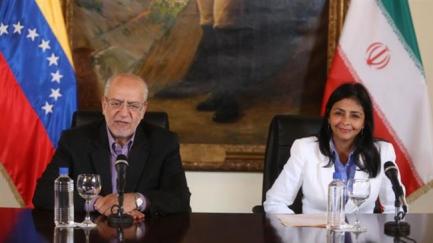
Iran’s Minister of Industry Mohammad Reza Nematzadeh and Minister for Foreign Affairs of Venezuela Delcy Rodriguez talk to reporters in Caracas
Press TV – June 27, 2015
Iran has agreed to a $500 million credit line for Venezuela to finance joint investments there, President Nicolas Maduro has announced.
He made the announcement after meeting Iranian Minister of Industry, Mine and Trade Mohammad Reza Nematzadeh in Caracas where the two sides signed six agreements to expand financial, economic, industrial and technological cooperation.
Among the agreements, there are plans for joint production of commodity goods, including detergents and other hygiene materials in Venezuela and Iran’s sales of medical drugs and surgical equipment to the country.
Maduro said the two countries had also agreed to a “comprehensive plan” to develop a joint program in nanotechnology in which Iran is among the top seven countries.
He said the deals would ensure a higher level of cooperation and deepen the bonds between the two nations.
Moreover, Iran agreed to transfer its expertise to Venezuela in combating an “economic war” on the Latin American country, Maduro said, apparently referring to Iran’s experience in facing years of US-led sanctions.
“We are facing an economic war of monumental proportions; a brutal war (but) we are here attending to our people,” Maduro said as he invoked the vision of the late President Hugo Chavez for “the government’s union with the people and struggle against imperialism”.
The Venezuelan head of state also hailed relations with Iran as “an example of alliance between two brother nations”.
“Today we have mutual trust in our relations and we work together with results. Working with Iran has gone well and our cooperation has been a great success since Hugo Chavez began a strategic alliance and brotherhood with Iran,” Maduro said.
Relations between Iran and Venezuela — both critics of US policies — have expanded in recent years. Iran is involved in a series of joint ventures worth several billion dollars in energy, agriculture, housing, and infrastructure sectors in Venezuela.
Iran’s main industrial projects in Venezuela include a car assembly plant, a tractor manufacturing complex and a cement factory.
The Islamic Republic has also built more than 3,000 residential housing units for less privileged citizens in Venezuela, with 7,000 more to be completed.
Both countries are hugely rich in resources. Venezuela possesses the world’s biggest oil deposit while Iran owns the fourth largest oil and first largest gas reserves of the world.
Maduro has announced his intention to visit Tehran to attend a summit of Gas Exporting Countries Forum planned for Nov. 23.
West must avoid unfulfillable demands in Iran nuclear talks: Putin
Press TV – June 19, 2015
Russian President Vladimir Putin has warned Western countries against making “unfulfillable” demands during nuclear negotiations with Iran.
Speaking at the St. Petersburg International Economic Forum (SPIEF 2015) on Friday, Putin said that Iran and the P5+1 group of counties are able to reach an agreement over Tehran’s nuclear program in the near future, cautioning the West against putting excessive, unfeasible demands on the Middle Eastern country.
The Russian leader also anticipated that it would take almost six months to implement a possible nuclear accord between Tehran and the six world powers.
“I think the signing should take place in the near future… the process of implementing these agreements will begin afterwards. It will require about six months,” the Sputnik news agency quoted him as saying.
The Russian president further stressed that the only counterproductive issue that jeopardizes Iran’s prospective nuclear deal is a deliberate effort on the part of Washington to undermine any such agreement.
“It is no less important [than signing the agreement on Tehran’s nuclear program] that the United States treat this positively, [that they] support it, [that] the Congress support it,” Putin noted, adding that it is Washington’s responsibility to settle the internal disputes over Tehran’s nuclear deal.
“This is not our problem… We cannot solve Washington’s problems,” he added.
Earlier in the day, Russian Deputy Foreign Minister Sergei Ryabkov also said that it is possible for Iran and the P5+1 group to secure a final deal before the deadline.
“There are less problems in [this] round [of talks], and reaching the agreement before June 30 is possible,” he stated.
Representatives from Iran and the P5+1 – the United States, the UK, France, China and Russia plus Germany – are currently holding talks in the Austrian capital city of Vienna to finalize the text of a possible deal over Tehran’s nuclear program.
Meanwhile, reports also said that Iranian Foreign Minister Mohammad Javad Zarif is set to head to Luxemburg on Monday to hold talks with his European counterparts and European Union foreign policy chief Federica Mogherini.
The two sides seek to reach a comprehensive final deal based on a mutual understanding on the key parameters agreed upon in the Swiss city of Lausanne on April 2.
CIA chief pays secret visit to Israel over Iran N-talks: Report
Press TV – June 9, 2015
Director of the US spy agency CIA John Brennan has reportedly made a secret visit to Israel to brief the regime’s officials over the ongoing nuclear negotiations between Iran and the P5+1 states.
Brennan traveled to Israel on June 4 and met with high-ranking Israeli officials, including Prime Minister Benjamin Netanyahu and one of his advisers Yossi Cohen, to discuss the developments in the talks between Iran and the six world powers, Haaretz quoted two senior Israeli officials as saying on Tuesday.
The officials, who asked not to be named, said the CIA chief also held meetings with the head of Israel’s spy agency Mossad Tamir Pardo and the regime’s military intelligence chief Major General Herzl Halevi.
It is unclear whether Brennan conveyed a message from US President Barack Obama to Netanyahu about a possible comprehensive agreement over Tehran’s nuclear program.
The CIA has not yet commented on the report of Brennan’s trip.
Diplomatic efforts aimed at reaching a final agreement over Iran’s nuclear program have drawn angry reactions from Israel. The Tel Aviv regime has been lobbying intensely to thwart such a deal.
Brennan’s visit to Israel came at a sensitive juncture, less than a month ahead of the June 30 deadline set by Tehran and its negotiating sides to finalize a deal, which seeks to end the Western dispute over Tehran’s nuclear case.
A few days before his visit to Israel, Brennan told the US-based CBS network that Washington and Tel Aviv are closely cooperating on the issue of Iran’s nuclear negotiations.
“The CIA, NSA (the US National Security Agency) and other intelligence community entities are working very close with their Israeli … counterparts” regarding the talks, Brennan said.
Iran and the P5+1 states– Russia, China, France, Britain, the US and Germany — have been working on the text of the final deal since they reached mutual understanding on key parameters of such an accord in the Swiss city of Lausanne on April 2.
Israel, Saudi Arabia hold secret meetings on Iran: Report

Anwar Majed Eshki, a former top adviser to the Saudi government (R), and Dore Gold, former Israeli ambassador close to Prime Minister Benjamin Netanyahu, shook hands during the Jun 4, 2015 meeting in Washington.
Press TV – June 5, 2015
A report has revealed that representatives from Israel and Saudi Arabia have secretly met five times since the beginning of last year to discuss their positions against Iran.
The five bilateral meetings were held over the last 17 months in India, Italy, and the Czech Republic, Bloomberg reported on Thursday.
The outlet cited one participant, Shimon Shapira, a retired Israeli general, as saying, “We discovered we have the same problems and same challenges and some of the same answers.”
Also on Thursday, well-known former Saudi and Israeli officials attended a rare meeting of the Washington-based Council on Foreign Relations think tank.
The event saw Anwar Majed Eshki, a former top adviser to the Saudi government, and Dore Gold joining former Israeli ambassador close to Prime Minister Benjamin Netanyahu.
Riyadh and Tel Aviv both oppose, what they call, the expansion of Iran’s regional influence and have not refused in the past to show fierce opposition to the potential of a final agreement between world powers and Tehran on the Islamic Republic‘s peaceful nuclear energy program.
The two sides also share alliance with the United States and opposition – emerging in the form of an overt bloody aggression on the part of Riyadh – to the Houthi Ansarullah movement of Yemen.
On May 23, a London-based paper reported that Israel had offered to provide the technology used in its Iron Dome missile system against rockets from Yemen, with the proposal being sent via American diplomats during a meeting in the Jordanian capital of Amman.
Tehran-Moscow talks on S-300 successful: Iran official
Press TV – May 26, 2015
A senior Iranian official has described as “successful” negotiations on the delivery of Russia’s S-300 surface-to-air missile system to Iran.
“Negotiations on the delivery of the S-300 [missile system] to Iran has been successful”, Iran’s Deputy Foreign Minister for Arab and African Affairs Hossein Amir-Abdollahian said on Monday during a press conference after a meeting with Russian Deputy Foreign Minister Mikhail Bogdanov in the Russian capital, Moscow.
Amir-Abdollahian also stressed that all issues surrounding the delivery of the system to Iran are progressing well.
He further noted that the delivery of S-300 to Iran will happen at the soonest opportunity possible.
On April 13, Russian President Vladimir Putin signed a presidential decree paving the way for the long-overdue delivery of the missile system to Iran.
Russian President Vladimir Putin
The decision to deliver the missile system came after Iran and the P5+1 group of countries – the five permanent members of the UN Security Council plus Germany – reached a mutual understanding on Tehran’s nuclear program in the Swiss city of Lausanne on April 2.
Moscow had banned the delivery of the S-300 system to Tehran in 2010 under the pretext that the agreement it signed with Iran in 2007 was covered by the fourth round of the Security Council sanctions against Iran over its nuclear program. The resolution bars hi-tech weapons sales to the Islamic Republic.
The Russian president defended Moscow’s decision on S-300 supply to Iran, saying the system is meant for deterrence amid ongoing developments in war-torn Yemen.
The UN says since March, nearly 2,000 people have been killed and 7,330 others injured due to the conflict in Yemen. However, according to Yemen’s Freedom House Foundation, the Saudi airstrikes have claimed the lives of about 4,000 Yemeni people.
Israeli Prime Minister Benjamin Netanyahu criticized Russia over its decision to lift the ban on the delivery of S-300 missile system to Iran, saying Tel Aviv sees the plan with “utmost gravity.”
How the Uncertain Outcome of Nuclear Talks With Iran Has Taken Its Economy Hostage
By ISMAEL HOSSEIN-ZADEH | CounterPunch | May 22, 2015
I recently returned from a six-week trip to Iran. While the primary purpose of my trip was to visit family and friends, I also made some general enquiries into the state of the country’s stagnant economy. These included informal discussions with various strata of economic agents or market players: manufacturers, bankers, shopkeepers, miners, farmers, livestock breeders, workers, teachers, and more.
Sadly, most of these economic actors painted pictures of pessimism and distrust of the country’s economic conditions. The economy is mired in a protracted stagflation, with no government plan or macroeconomic policy for recovery. While the Rouhani administration boasts of having contained or slowed down the inflation, the Iranian people do not cherish that tempering of inflation as it has come about at the expense of deepened recession; that is, at the expense of heightened unemployment and weakened purchasing power. As a retired school teacher, who now works as a taxi driver, put it, lowering inflation by worsening recession is no cause for celebration (paraphrased).
And what is the major culprit behind the depressing recession? The common answer of the overwhelming majority of the economic actors I spoke with was, in a nutshell, uncertainty—uncertainty of the constantly shifting outcome of the unending nuclear negotiations. There is a clear consensus that while onerous economic sanctions against Iran are obviously damaging, the perilous effects of the protracted and uncertain outcome of the negotiations are even more devastating. Equally devastating is the current administration’s neoliberal policies of austerity economics, which have further aggravated the recession by cutting social/public spending while not offering any industrial or developmental program or planning.
Market uncertainty, combined with a regrettable lack of protection by the government of the nation’s infant industries against the more mature industries abroad, has led to an unwillingness of the country’s entrepreneurs to invest in long-term production projects. By the same token, the major bulk of the nation’s finance capital is devoted to short-term, parasitically high-yielding but unproductive investments such as buying and selling of real estate.
The largely unregulated financial sector has led to a mushrooming growth of shadow banks—known as moasesat-e etebari, or credit institutions. While there are a handful of conventional or bona fide commercial banks, the number of dubious moasesat-e etebari has in recent years skyrocketed to over 900!
There is undeniable evidence that, using the influence of corrupt and rent-seeking authorities, many of these shadow banks borrowed huge sums of money from government banks at below-market interest rates, often under the pretext of wanting to invest in job-creating or manufacturing enterprises, but in fact used the monies thus obtained for speculative purposes. In other words, most of these shadow banks came to existence not through the investment of monies owned by their founders but through that of public money!
Worse yet, many of the oligarchic borrowers and/or founders of these shadow banks now refuse to pay the monies they borrowed! And the government does not or cannot do anything about it because there is an incestuous business relationship between the two sides. Parasitic growth of these speculative shadow banks has reached unsustainably dangerous levels of an imminent implosion of the financial sector—similar to what happened in the US nearly seven years ago, which has since been transmitted to a number of European countries. It is regrettable that President Rouhani and his economic team do not seem to have learned any lessons from the disastrous experiences of the unregulated financial markets in many of the core capitalist countries.
The US and its allies are obviously aware of the fact that continued uncertainty resulting from prolonged nuclear negotiations is wreaking havoc on the Iranian economy. Perhaps this helps explain why they intend to extend the negotiations for a long time: 10, 15 or even 25 years. There are speculations that this policy is designed to help bring about regime change from within, that is, by instigating a social upheaval through an economic collapse.
Not only has the Rouhani administration thus thrown the private sector into confusion and uncertainty, it has also largely abandoned traditional public sector responsibilities in terms of macroeconomic guidance and infrastructural developments. The administration’s rudderless economic outlook is reflected (among other places) in its latest (1394, Iranian calendar) budget priorities.
“The Budget Bill, which has been produced by the newly‑revived Organization of Management and Planning, offers no explicit conceptual framework within which the budget is formulated, nor is it based on any “planning” for the economy. . . . It also does not begin with a discussion of the nation’s economic development pre-requisites nor give any indication of its trajectories.
“The key concept behind the budget is a twisted “neoliberal” model. . . . The proponents of the neoliberal economic policy support extensive economic liberalization, free trade, and reductions in government spending in order to enhance the role of the free market, individual and private sectors in the economy” [1].
The priorities of the budget bill are so warped and irrational that they tend to harm both the supply and demand sides of the economy. On the supply-side,
“[T]he budget neglects the productive sectors, infrastructure and the environment. Development funds have been increased by a nominal 16 percent; in real terms that will mean a reduction. Agriculture receives an increase, but its share is minimal relative to the sector’s need. Manufacturing remains cash-hungry given the tight-money policy and a 22 percent interest rate. R&D’s share in the GNP remains at about 0.06 percent and industry-driven R&D is almost non‑existent. Infrastructure, including transportation and urban development, is equally under-budgeted” [2].
On the demand side, except for health care spending, real or inflation-adjusted funding for most social programs has been cut. Subsidies for housing, education, food, and fuel have been reduced when the inflation rate is accounted for. The budget also fails to devote funds for the repayment of the government’s growing debt to the social security and retirement funds.
“The preference for muddling through and preserving the status quo of zero growth is evident in the uses of the budget. Thus, while the supply side of the economy is neglected, the demand side is depressed through the use of contractionary fiscal and monetary policies. The budget also disregards growth-friendly educational, industrial and trade policies while it only gives lip service to construction and infrastructure. Most significantly, the sanctions-crippled Iranian economy needs serious popular mobilization and attention to social justice, but the elite-centered budget is equally oblivious to these requirements” [3].
Since the public sector has traditionally played a major role in the building of the country’s industrialization/developmental infrastructures, the Rouhani administration’s shirking that responsibility, that is, of drastically reducing public spending on infrastructure building, has significantly contributed to the deepening of economic recession and/or the rising of unemployment.
While in light of the ongoing economic recession, this curtailment of public/social spending is certainly irrational from an objective macroeconomic standpoint (as it would aggravate the recession), it is quite rational from the standpoint of the neoliberal austerity economics, to which Mr. Rouhani and most of his economic team seem to subscribe. According to neoliberal school of economic thought, a recession must be created in order to (a) fight inflation, and (b) create conditions (in the fashion of an economic shock therapy) for a subsequent economic recovery. Such conditions would include lowering labor cost by heightening unemployment, expanding deregulation of business activities, shrinking the public sector in order to make more room for the private sector, diluting environmental and workplace safety standards, expanding privatization of public property and services, including of education and health services, and the like.
This neoliberal/austerity/supply-side prescription has since the late 1970s and early 1980s replaced the Keynesian/New Deal/Social-Democratic prescription of the previous period of nearly three decades (from mid-1940s to mid-1970s), which often relied on public-sector spending in pursuit of economic recovery. The historic switch from the New Deal to neoliberal economic paradigm took place largely in the 1980s—under the formal stewardship of President Ronald Reagan in the United States and Prime Minister Margaret Thatcher in Great Britain.
The supply-side doctrine, epitomizing the dominance of economic policy-making by big business, has since the 1980s been pursued vigorously in country after country, including now in many European countries. Having thus become the dominant economic strategy in the core capitalist countries, with devastating consequences for the overwhelming majority of the people (the so-called 99%), austerity economics has now arrived in a number of the less-developed countries, including Iran—a development which catapulted Mr. Rouhani to the seat of the country’s presidency as its messenger.
President Rouhani’s subscription to neoliberal economic doctrine is evident from his many speeches and statements, as well as from his book, National Security and Economic System of Iran [امنیت ملّی و نظام اقتصادی ایران]. In his book, Mr. Rouhani deplores Iran’s “very oppressive” labor laws to business. He argues that the minimum wage must be slashed and restrictions on the laying off of workers eliminated if Iran’s “owners of capital” are to have the “freedom” to create prosperity. “One of the main challenges that employers and our factories face,” he writes, “is the existence of labor unions. Workers should be more pliant toward the demands of job-creators” [4].
Not surprisingly, Mr. Rouhani’s economic outlook is essentially devoid of any specific development plan or industrialization project as he and most of his economic advisors subscribe to an economic doctrine that frowns upon government intervention in economic affairs—unless such interventions help “pave the way” for unfettered market operations. According to this doctrine, solutions to economic stagnation, poverty and under-development lie in unhindered market mechanism and unreserved integration into world capitalist system. Recessions, joblessness and economic hardship in many less-developed countries are not so much due to economic mismanagement or the nature of global capitalism as they are because of government intervention and/or exclusion from world capitalist markets.
This explains why Mr. Rouhani has made the solution to Iran’s economic problems contingent upon a political détente or friendly relations with the United States and its allies. The administration’s perception (or delusion) that the mere establishment of relations with the U.S. would serve as a panacea to Iran’s economic woes has essentially made Iran’s economy hostage to the unforeseeable outcome of its negotiations with the United State and, therefore, hostage to the endless, and increasingly futile, nuclear negotiations.
This also explains Mr. Rouhani’s and his nuclear negotiators’ dilemma: they have essentially trapped themselves into an illusion, the illusion that a combination of charm offensives, smiley faces and diplomatic niceties would suffice to change imperialist policies toward Iran. In reality, however, the U.S. policy toward Iran (or any other country, for that matter) is based on an agenda—an imperialistic agenda that consists of a series of demands and expectations, not on diplomatic decorum, or the type of language its leaders use.
One would expect that the market uncertainty created by nuclear negotiations may have led Iran’s producers of industrial and agricultural products to be eagerly looking forward to a breakthrough in the negotiations and a lifting of the brutal sanctions against their economy. My discussions with a number of manufacturers and farmers revealed, however, that while they certainly suffer from the oppressive economic sanctions, they are also concerned that, in light of President Rouhani’s neoliberal free trade policies, a relief from sanctions that may result from such a breakthrough may, in fact, end up driving them out of business by further opening the domestic market to an unbridled deluge of foreign products.
For example, Mahmoud Sedaqat, vice president of the Association of UPVC Window & Door Profiles Manufacturers, bitterly complained that while domestic production capacity of this petrochemical is more than twice as much as domestic needs, the government recently reduced import tariffs for this product from 30% to 15%, thereby paving the way for the substitution of imports for domestic products. Sedaqat further pointed out that government’s careless trade policy and a lack of protection for domestic producers has led to an atmosphere of confusion and uncertainty among domestic producers, which is contributing to further aggravation of the ongoing economic stagnation [5].
Mohammed Reza A’le Sara, a representative of domestic producers of automobile tires, likewise complained about a glaring lack of protection of his industry against the unrestrained imports of similar, indeed substitutable, products from abroad. A’le Sara also pointed out that, despite the comparable quality of domestically-produced tires, 50% of domestic demand is currently supplied by imports. A careful or calculated government support for domestic producers, he further argued, could gradually but certainly make Iran self-sufficient in this industry [6].
Mohammed Serfi, an economics analyst, recently pointed out that the degree of import-substitution in Iran could be as high as 70%; meaning that as much as 70% of Iran’s imports could be substituted by domestically produced goods. Yet, due to the Rouhani administration’s warped open-door/free-trade policy, the crucially important industrialization strategy of import-substitution—pursued by all the currently more developed countries at earlier stages of their development—is ignored. [7].
Complaining about the administration’s lack of an economic strategy, Gholam-Hosein Shafe-ei, Chairman of Iran’s Chamber of Commerce, also argued that while relief from economic sanctions is obviously necessary it is not sufficient; perhaps more importantly are government-championed macroeconomic objectives and carefully-guided ways or plans to achieve those objectives. In the absence of clearly defined economic objectives and the concomitant strategies of import-substitution and export-promotion, Shafe-ei reasoned, Iran could become a heaven for foreign producers while many of domestic producers would be driven out of business.
Under President Rouhani, farmers have suffered even more than manufacturers. Since he was elected nearly two years ago, his administration has raised the energy/utilities bill by anywhere between 50% and 80%. This has drastically heightened the cost of agricultural production, as it has of industrial production. Additionally, the government has in recent years changed both the provision and distribution structure of fertilizers, increasingly shifting those responsibilities from the public to the private sector. This has further added to the cost of production. The government has also failed to establish a meaningful policy of crop insurance or financial assistance in the face of various natural disasters such as floods, drought and other climate fluctuations. Combined with the administration’s misguided free trade policy, which has greatly facilitated the import of many agricultural products, these ill-advised policies have effectively driven many farmers out of business, thereby plunging the agricultural sector into a deep recession.
Prior to the Rouhani administration’s pursuit of neoliberal economic policies, Iran viewed economic sanctions as an (unsolicited) opportunity to become self-reliant: to rely on domestic talents and resources in order to become self-sufficient by producing as many of the consumer goods and other industrial products as possible. And it did, indeed, make considerable progress in scientific research, technological know-how and manufacturing industries.
For example, prior to the recent rise of neoliberal economic policies, which have greatly undermined Iran’s manufacturing and agricultural capabilities, Iran had become self-sufficient in producing many of its industrial products such as home and electric appliances (television sets, washers and dryers, refrigerators, washing machines, and the like), textiles, leather products, pharmaceuticals, agricultural products, processed food, and beverage products (including refined sugar and vegetable oil). The country had also made considerable progress in manufacturing steel, copper products, paper, rubber products, telecommunications equipment, cement, and industrial machinery.
None of the oppressive economic sanctions in retaliation for the 1979 revolution deterred Iran from forging ahead with its economic development and industrialization plans. The Rouhani administration’s misguided and haphazard switch from that tradition of inward-looking strategy of self-relying economic development to the ill-conceived outward-looking strategy has thrown tens of thousands of small and medium-sized industrial and agricultural producers into a market atmosphere of confusion and uncertainty. As has already been pointed out, the uncertainty stems from two major sources: (1) a glaring lack of protection of domestic producers against the more competitive foreign producers, and (2) a regrettable linkage or tying of any macroeconomic policy to the unending, unpredictable and, ultimately, futile results of the nuclear negotiations.
The inordinately high priority given to the dubious nuclear negotiations, which has sadly taken most of the Rouhani administration’s time and energy at the expense of everything else, has place the urgently needed macroeconomic policies on hold. The sooner such unduly delayed policies are delinked from the fraudulent imperialist game of nuclear negotiations the better.
More fundamentally, the sooner the nuclear talks are seen (or acknowledged) for what they really are—a pretext or a ploy on the part of the US and its allies, both inside and outside Iran, to adapt the country into another “client state”—and dealt with accordingly, the better. So far, Iran’s negotiating team has successfully concealed many of the gratuitous concessions they have made during the negotiations—essentially suspending the nation’s hard-earned nuclear science and technology while having gained no meaningful relief from sanctions—from the Iranian people. Whether they will succeed in continuing to sell a fraudulent deal to the Iranian people, or whether they may face a harsh backlash when the people learn of the deceitful nature or substance of the deal remains to be seen.
 Ismael Hossein-zadeh is Professor Emeritus of Economics (Drake University). He is the author of Beyond Mainstream Explanations of the Financial Crisis (Routledge 2014), The Political Economy of U.S. Militarism (Palgrave–Macmillan 2007), and the Soviet Non-capitalist Development: The Case of Nasser’s Egypt (Praeger Publishers 1989). He is also a contributor to Hopeless: Barack Obama and the Politics of Illusion.
References
[1] Hooshang Amirahmadi, “Iran’s Neoliberal Austerity-Security Budget”
[2] Ibid.
[3] Ibid.
[4] As excerpted by Keith Jones, “Iranian president declares country ‘open for business’”
[5] Mahmood Sedaqat, “کاهش تعرفه پروفیل «یوپیویسی» ضربه دولت به تولید داخلی است,” Kayhan, Mordad 25, 1393 (August 16, 2014).
[6]. Interview with A’le Sara, in Farsi: واردات بیش از 50 درصد لاستیک علیرغم توان تولید داخلی
[7] Mohammed Serfi, “Gentlemen, the Party is Over,” in Farsi: آقایان! ضیافت تمام شد!(یادداشت روز)
Exxon lobbies US government on Iran sanctions
Press TV – May 22, 2015
Exxon Mobil is reported to have stationed lobbyists to push the envelope on Iran sanctions with the US government as Western companies are jostling for access to the Middle East country’s massive oil and gas fields.
According to Bloomberg, the Texas-based oil company has hired a lobbying firm founded by former Republican Senator Don Nickles to press the US government on lifting sanctions against Tehran.
Western companies are eager to work on Iranian fields because they are among the largest and cheapest to develop, it quoted on economist as saying.
“Given sanctions and the dilapidation of oilfields over time, it looks like it’d be a lot of work” for foreign companies, Allen Good, a Chicago-based analyst at Morningstar Inc. told Bloomberg.
“But unlike Iraq, you’d don’t have a civil war going on so it’d be an easier path to growing production. You could get a pretty good bump pretty quickly,” he said.
Western companies are holding their breath as nuclear negotiations between Iran and the US and other members of the P5+1 group are heading to the decisive round.
Political factors
Expectations of a final agreement and consequent removal of sanctions have put energy entities on the watch but those hopes are being sapped by reports that the West was hunkering down for “excessive demands”.
The US government reasserted its obdurate position on Thursday by announcing sanctions on two Arab airlines for selling nine used commercial aircraft to Iran.
While the direction of the talks remains unclear, foreign companies are vying to forge initial links with Iran.
On Thursday, CEO of Italy’s Eni SpA Claudio Descalzi said he traveled to Tehran two weeks ago. Speaking to La Repubblica, Descalzi said Iran could “start attracting investment” from foreign companies again if a nuclear deal was sealed.
Eni and other major European energy giants left Iran after the US intensified sanctions on the country.
American companies are banned from any business with Iran under a US law which has effectively been in place since the 1979 Islamic Revolution.
On Tuesday, President Barack Obama renewed unilateral US restrictions on purchases of oil and oil products from Iran.
Exxon business in Iran goes back to the period before the revolution when the shah was a close ally of the United States.
No problem
Earlier this week, an Iranian oil ministry official said the country’s oil and gas is open to American investment but US companies have to tie up with Iranian companies under certain terms.
“From the government’s standpoint, there is no limitation for oil investment by the Americans in Iran,” deputy Minister of Petroleum Amir Hossein Zamaninia said.
The official said European and American companies are showing strong interest for investment in Iran’s oil and gas industries.
“Over the past couple of months, not one or two companies but several American entities have announced readiness to invest and participate in Iran’s oil industry projects if sanctions are annulled.”
Zamaninia said most US companies have proposed to partner with other companies for investments as he spelled out Iran’s conditions.
“The pattern for partnership and investment of American companies in Iran’s oil and gas industry has to be based on the trade package which has been earmarked to the Iranian private sector,” he said.
US threatens not to sign nuclear deal with Iran due to inspection of sites
Press TV – May 21, 2015
Washington has threatened “not to sign” a final nuclear agreement with Tehran unless the Iranian government gives access to its possible military dimension-related sites and nuclear scientists.
“If we don’t get the assurances we need on the access to possible military dimension-related sites or activities, that’s going to be a problem for us,” State Department spokeswoman Marie Harf said in Washington on Wednesday.
“We and Iran have agreed that we will undertake a process to address possible military dimensions (of past nuclear work), and part of that includes access,” Harf said. “Under the Additional Protocol … which Iran will implement and has said they will implement as part of this deal, the IAEA does get access.”
“If we cannot agree in the final instance to something that meets our bottom line for what we need in terms of access, we’re not going to sign a final deal. And that’s just something we’ve been very, very clear about,” she added.
The remarks were made after Leader of the Islamic Revolution Ayatollah Seyyed Ali Khamenei said that Iran would not allow inspection of its military sites.
Iran says the United States is making fresh demands in the nuclear negotiations.
“They are making new comments in the negotiations. Regarding the inspections, we have said that we will not allow foreigners to carry out inspections of any military sites,” Ayatollah Khamenei said on Wednesday.
“The enemies should know that the Iranian nation and officials will, by no means, give in to excessive demands and bullying,” the Leader underlined.
The US and its negotiating partners reached a framework nuclear agreement with Iran in Switzerland on April 2.
Tehran and the P5+1 group – the US, Britain, France, China, Russia and Germany – are currently working to draw up a final accord by the end of June.
Iran has repeatedly stressed that it will not allow inspections of its military facilities and insists that the nuclear deal must only include nuclear issues.
“Iran will brook no excessive demands. The agreed parameters are those confirmed by the two sides in Lausanne and these parameters need to be stipulated in a written agreement by Iran and the P5+1,” Iranian Foreign Minister Mohammad Javad Zarif said earlier this month.
Obama renews ban on Iran oil trade
Press TV – May 20, 2015
In a decree, issued by his office, the US president said that “global economic conditions, increased oil production by certain countries, and the level of (oil) spare capacity” had allowed him to take the decision.
Saudi Arabia, a key US ally in the Middle East, has ramped up production leading to a crash in crude prices.
“I determine … that there is a sufficient supply of petroleum and petroleum products from countries other than Iran to permit a significant reduction in the volume of petroleum and petroleum products purchased from Iran by or through foreign financial institutions,” Obama said in his statement.
The statement also referred to a US measure which forbids transactions with Iran.
Under the measure, foreign companies are cut off from the US financial system and face sanctions if they engage in transactions with Iran’s financial institutions.
However, a preliminary agreement reached in Nov. 2013 allows Iran to sell around 1 million barrels per day of crude oil.
The US restrictions fly in the face of that agreement under which no new sanctions should be imposed on the Islamic Republic.
Washington contends the agreement does not include renewal of the previous restrictions.
The US and five other countries are currently discussing a possible final agreement with Iran by the end of June.
Iran says any deal should envisage immediate removal of all sanctions, with the US saying they should be lifted gradually.
Featured Video
Yemen joins the war – Red Sea could be blocked next – Saudi regime at risk
or go to
Aletho News Archives – Video-Images
From the Archives
A superpower and “the world’s sickest warrior state”
By Paul J. Balles | March 8, 2010
Living through five or six major wars has hardened me to what I thought were the extremes of inhuman cruelty and brutality.
Two things made those extremes almost bearable: the brutality always revealed – at least according to the media coverage – the viciousness of the enemy. It was therefore quite understandable when our “brave men and women” pulverized the enemy.
Films of Japanese torturing captive Americans somehow justified holding Japanese Americans in internment camps during World War II; and only a small percentage of Americans found the bombing of Hiroshima and Nagasaki unreasonably vengeful at best, at worst, depraved.
The media giants in America portrayed the North Koreans as barbaric beasts with their captives, quite unlike their southern counterpoints – our allies during the Korean War. No one ever felt the need to explain how the South Koreans were a civilized breed while the North Koreans were absolute savages, at least according to the official line.
In Vietnam, our warriors justifiably (or so the media made us believe) dropped napalm on the North Vietnamese who had the gall to hide in villages and tunnels to ravage our invaders. At least it was accepted practice until some rogue photojournalist filmed a young girl screaming down a Vietnamese road in flames. … continue
Blog Roll
 Aletho News
- America Racing to Strategic Defeat in Iran: Lt Col Daniel Davis
- FTC Warns Visa, Mastercard, PayPal, Stripe Over Political Debanking
- Russian tanker approaches Cuba despite US oil blockade
- Marandi: Yemen joins the war – Red Sea could be blocked next – Saudi regime at risk
- Pro-Palestinian French member of European Parliament denied entry to Canada
- Pakistan to Host US-Iran Talks
- How Indonesia’s tilt toward the US left it stranded in the Strait of Hormuz
- US has no choice but to retreat from Iranian borders: Top commander
- Iran Retaliation Strikes Chemical Plant Near Dimona
- AWACS’ Destruction is a Major Loss for US Military – Ex-DoW Analyst
- If Americans Knew
- Israeli police block Catholic cardinal from entering Church of the Holy Sepulchre on Palm Sunday
- Israel is assassinating journalists again, more than any other nation, anywhere, ever – Not a ceasefire Day 170
- Over 300 US service members wounded, majority have brain injuries – Not a ceasefire Day 169
- Researchers at Human Rights Watch Resign Over Blocked Report on Palestinian Refugee Return
- Jewish Groups Are Backing a War Americans Don’t Want
- Eric Fingerhut Thinks He’s the President of the Jews
- Top Jewish Philanthropists, Rabbis Urge Israeli President to Take Action Against ‘Jewish Extremists’
- Don’t Be Fooled. Zionist Leaders Have Always Wanted to Control Southern Lebanon
- Israel’s widespread use of torture is a core element of its genocide against the Palestinian people
- In Israel’s War on Iran, Many Middle East US Bases Rendered “All But Uninhabitable”
- No Tricks Zone
- New Study Finds Warming Saves Lives…Cold Temperatures 12 Times More Deadly Than Excess Heat
- German Science Blog Accuses PIK Climate Institute Of Hallucinating Climate Tipping Points
- Devastating Assessment Of Comirnaty Vaccine By Former Senior Pfizer Europe Toxicologist
- New Study: CO2 Is ‘Effectively Negligible’ As An Explanatory Climate Change Factor Since 2000
- Former Pfizer Toxicologist Dr. Helmut Sterz Tells Bundestag Hearing Pfizer Vaccine Should Have Never Been Approved
- Energy Expert: Germany’s Nuclear Phaseout Was A “500 Billion Euro Mistake”
- New Research: South Australia’s Mid-Holocene Sea Surface Temperatures Were 4°C Warmer Than Today
- Storing Green Energy To Last Germany 10 Days Would Require A 60-Million Tonne Battery
- New Studies: UK Sea Levels Were 4 Meters Higher Than Today During The Mid-Holocene
- Destructive Green New Deal: German Energy And Metal Group Warns Of Drastic Crisis
 Aletho News