What you won’t hear from US govt: Iran is open to working with Saudi Arabia
By Darius Shahtahmasebi | RT | November 22, 2018
Washington’s rhetoric regarding Iran paints the picture of an evil nation hellbent on destroying the world. In reality, it appears that Tehran would prefer dialogue with its rivals, which is unacceptable to the US.
Tuesday’s White House Statement from President Trump on “Standing with Saudi Arabia” was an outright condemnation of Iran and a total free pass for Saudi Arabia.
Iran is to blame for almost every issue in the Middle East, including the war in Yemen, according to the statement. The US-made and supplied bombs raining down on Yemeni school buses, with some 85,000 children dying in the process, is simply because of Iran. Not only is Iran responsible for the bloodshed in Yemen, Tehran has further helped “dictator Bashar Assad” in Syria kill “millions of his own citizens.” The official death toll of the Syrian war is under one million, and certainly the various jihadist groups, including Islamic State (IS), share responsibility for that figure.
“The Iranians” have also killed many Americans and other innocent people throughout the Middle East. Iran not only shouts “Death to America” and “Death to Israel” but it is also considered “the world’s leading sponsor of terror.”
It is curious enough that firstly, in a statement about Saudi Arabia, the term “world’s leading sponsor of terror” is not gifted to the prime sponsors of Al-Qaeda and IS. Secondly, the fact that Trump himself put that term in inverted commas seems to suggest that even he doesn’t quite believe that one to be true.
Remember, Saudi Arabia is the country that Trump, before becoming president, once accused of masterminding the 9/11 attacks. I wasn’t aware of this until reading the statement, but according to the White House, Saudi Arabia would gladly withdraw from Yemen if the Iranians would agree to leave. That’s right, Iran’s non-presence in Yemen must be removed in order for Saudi Arabia to cease blowing up children, hospitals, factories, food trucks, schools, agricultural land, strategic ports, and relinquish its complete stranglehold over the country.
If you were naive enough to take the White House statement at face value, you would surely think that Iran has much to answer for. Iran is, after all, public enemy number one and has been for some time. Conversely, Saudi Arabia has been a longstanding ally of the United States, a faithfully serving client state, and it should be protected at all costs especially if there is to be any hope at pushing back against Iran as it yells “Death to America” and “Death to Israel.”
But what if Iran was, despite all of its flaws, not interested in fighting a war with Saudi Arabia? What if we dug a little bit deeper and asked ourselves: is there another way of dealing with the “threat” that Iran poses?
In January this year, Iran’s Foreign Minister Mohammad Javad Zarif wrote an article that was published in the Financial Times which laid out the country’s proposed framework for bringing stability to the Middle East. The article was widely ignored by the rest of the world, even though its implications were potentially life-saving.
“The objective of a strong region — as opposed to a quest for hegemony and the exclusion of other actors — is rooted in recognising the need to respect the interest of all stakeholders,” Zarif wrote. “Any domineering effort by one country is not only inappropriate but essentially impossible: those who insist on following that path create instability. The arms race in our region is an instance of this kind of destructive rivalry: siphoning vital resources into the coffers of arms manufacturers has contributed nothing to achieving peace and security. Militarism has only served to fuel disastrous adventurism.”
Zarif states that the usual modes of forming alliances have become “obsolete” and suggests that security networking to address issues is a much better practice. He proposes that instead of ignoring conflicts of interests, the countries in the region should accept their differences.
“The rules of this new order are straightforward: common standards, most significantly the purposes and principles of the UN Charter, such as sovereign equality of states; refraining from the threat or use of force; peaceful resolution of conflicts; respect for the territorial integrity of states; non-intervention in the domestic affairs of states; and respect for self-determination within states,” Zarif adds.
Zarif recommends opening up dialogue and blames a “dialogue deficit” for instability throughout the region. Such a dialogue, he argues, could help other nations understand that all parties have “similar concerns, fears, aspirations and hopes.” His eventual vision is that these countries will eventually adopt a “non-aggression pact.”
Now, Zarif did not explicitly state who he was talking about in this proposed path to peace and stability. But what if his intention was to work with Saudi Arabia, is this not something that should be talked about, particularly by the US commander-in-chief when releasing statements stoking the fire of an already volatile region while pitting two major regional players against each other?
In October last year, Zarif was quoted as saying that Tehran is willing and ready for rapprochement with the Kingdom of Saudi Arabia, adding that he does not believe the two countries should have the type of relationship they have right now.
In December last year, Iran’s president Hassan Rouhani further intimated that Tehran is willing to resume ties with Saudi Arabia if it halted its military campaign in Yemen and severed its ties with Israel.
“We don’t have any problem with the country that is our neighbor and unfortunately speaks a lot and speaks irrationally. Saudi Arabia, as our neighbor, should stop bombing Yemen from tomorrow, stop bowing to Israel, stand straight and rely on its nation,” Rouhani said.
In March this year, Zarif then took his ambiguous article one step further and openly said that Iran is willing to resolve its differences with Saudi Arabia’s as part of Tehran’s desire for stability in the region. As Zarif notes, this is not the first time Iran has reached out to the kingdom, yet the Saudis continue to reject Iran’s proposed dialogue.
In August of this year, Zarif further stated that Iran wants to restore relations with Saudi Arabia as well as the United Arab Emirates (UAE) and Bahrain. Surprisingly, Saudi Arabia had just allowed the entry of an Iranian diplomat to head Iran’s interests in the Kingdom, a rare move since diplomatic ties had been cut almost two years prior.
Just last month, Zarif again called for Saudi Arabia’s cooperation to push back against the “repeated insults” made by the US president at the time.
“This is the reward of the illusion that security could be achieved through external support,” Zarif said. “We extend our hands to our neighbours, saying: let’s build a strong region to stop this arrogant pride.”
I could be wrong, but in its totality, it does appear that Iran is proposing a framework where Middle Eastern countries settle their disputes between themselves without outside interference, whereby the US would be left out completely. Such a suggestion is in itself a form of hubris so unacceptable to Washington that the proposal itself makes the country ripe for a targeted regime change operation. Despite this, Iran has been quite open about its blueprint for a new outlook to the Middle East.
“We don’t need foreigners to guarantee the security of our region,” Iran’s president said earlier this year.
“When it comes to regional security arrangements, we are ready to talk to our neighbours and friends, without the presence of foreigners,” he added. “We are, have been and always will be good neighbours.” Yes – even Saudi Arabia.
In August, UN experts went even further and said that Iran might be willing to play a “constructive role” in ending the war in Yemen, something Iran has said it has been wanting to do for years by working with Saudi Arabia.
Conversely, the Saudis and their US counterparts are not so willing to take the Iranians up on their offer.The Saudis always want to “fight the Iranians to the last American,” according to former Secretary of Defence Robert Gates. The Saudis have even openly abandoned the Palestinian cause in an attempt to cosy up to Israel and create a US-backed alliance that can confront Iran in the region. The Saudi Crown Prince also compared Iran’s supreme leader to Adolf Hitler, a brazen statement for a man who executes journalists and unarmed children with complete impunity. The kingdom continues to openly work with Al-Qaeda linked groups to prolong the fighting in Yemen, all because its anti-Iran hysteria cannot falter from its position.
A détente between Riyadh and Tehran appears to be a far cry away from happening any time soon, but we cannot continue to pretend we haven’t noticed the opportunity that continues to present itself, particularly from the Iranian side. Whether an Iran-Saudi relationship is a positive step or a disastrous one is an important question to ask; but we should at least consider it as an option if it can avoid a potential and unnecessary war between two regional powers, as well as its potential to diffuse an already devastating war which continues to kill thousands of people completely needlessly.
Khashoggi: How US Media Is Losing Its Moral Compass by Feeding Off Conspiracy Theories
By Martin JAY | Strategic Culture Foundation | 21.11.2018
Trump’s relationship with Erdogan raises new questions about the credibility of US mainstream journalism. Was Khashoggi a victim of a Turkish ‘honey trap’?
The Washington Post continues its banal attack on the regime of Saudi Arabia, following the horrific murder of Jamal Khashoggi in the Saudi Consulate on October 2. In Turkey too there is much which the western media cannot understand or refuses to probe, as Ankara plays a game of blackmail with Riyadh in a bid to extract a deal from Mohammad bin Salman who is at the centre of its character assassination.
But what are we missing? What is at the heart of this story which isn’t getting picked up by journalists or even TV commentators in the region?
Much has been written about the ‘free license’ that Trump and his son in law, Jared Kushner gave the Saudi prince and that this murder is an inevitable consequence of such blinded dogma towards ones allies. There is some truth in this, but if you are to look at the coverage of, in particular, the US media over Khashoggi, you might be curious to understand why it is so extensive and prolonged. After all, Saudi Arabia has been kidnapping its own dissidents for years and there are many western journalists who are killed or go missing around the world which get minimal coverage. Why such an entrenched campaign for Khashoggi?
Guilty
Partly this is a guilt complex of the Wapo editors, who I have accused in earlier articles for more or less sending Khashoggi on a suicide mission when they chose to publish his articles in Arabic. This was recently confirmed when Khashoggi’s editor at the Post – Karen Attiah – admitted to The Independent that the traffic which the Arabic articles generated shocked bosses there. I have always argued that this was a final blow for MbS, humiliated now by his adversaries in Riyadh who can read about his failings on a regular basis.
And it’s also about the fact that the Post considered him part of the DC elite. One of their own, which explains why he has become so canonised and his personality enshrined in virtue.
Their trade is treachery
In truth, Khashoggi was no saint. He took the King’s shilling from the Saudi elite all his life and made a good lifestyle for himself. At the end of a thirty year relationship of working for them and learning all of their secrets, he used that privilege as a weapon to destroy MbS. In most cultures around the world, this is called treachery. We should remember that even in London in 1963, when British spy Kim Philby defected to Moscow, many wanted him to hang for selling out to the Russians and being a double agent for all his career. Khashoggi may well have been an amiable character. But he was also a traitor.
We are led to believe that he left Riyadh in 2017 because he feared being detained. But could it be that he was frustrated at not being promoted within the hierarchy?
A select number of journalists and academics, like Dr Nafeez Ahmed, support this theory, in part at least and go further to say that Khashoggi was murdered because he was about to distribute solid evidence of the Saudis using chemical weapons in Yemen. The British academic also underlines Khashoggi’s role for Saudi intelligence and, moreover, how he helped the Saudi royal family support Bin Laden, right up until 9-11.
Yet my own sources close to the Saudi elite tell me that MbS wanted to call him back to Riyadh because Khashoggi was at the centre of a coup in the making, which would have benefitted the former Crown Prince Mohamed bin Nayef, and still operated very much as though he was a Saudi intelligence asset. Not so much a treacherous journalist who didn’t know which side his bread was buttered, but more a double agent who was the gatekeeper of incendiary information. Something had to be done about Khashoggi.
Frustrated journalists are dangerous people. They lose sight of their loyalties and promises they made. And Khashoggi was an odd character struggling with an identity crisis. Is it the same case with Karen Attieh on the Oped desk of the Post which managed him? Did she connect with him as she too feels not taken seriously by her bosses at the Washington Post ?
Conspiracy theory extended? Unfortunately we are led to feral speculation when we are denied the facts, especially deliberately.
Western media has a lot to be ashamed of on both covering up the Khashoggi murder – by going along with the demonization of the kingdom – and in being part of it happening in the first place. How does all of the gory details about Khashoggi’s murder get reported as fact by the Post, when it has no proof from the Turkish police sources who supply them? There is gargantuan hypocrisy at play here as the Post is part of a conspiracy now. It played a role in Khashoggi getting murdered and it is now playing a role in diverting blame away from itself and blithely accusing Saudi Arabia’s leader of the murder with little or no solid evidence. This is sloppy journalism on a whole new scale and shows a dire lack of journalistic credibility and judgment (unless of course the Post is part of a murky campaign of disinformation which has been agreed between Ankara and Washington whose firebrand leaders are now on good terms once again). Is the Post part of a dirty deal which has been struck by Trump and Erdogan to rewrite this story?
Far fetched? Ludicrous? Maybe, but let’s look at the facts. Trump is standing back and letting Erdogan continue with his drip feeding of sensational detailed evidence, in a blackmail game with MbS – but what’s the price Americans pay for that? To place himself at the centre of that charade, Trump has indicated to the Saudis that they need to release women activists from jail (likely to happen soon) and to cancel the Qatar blockade (on the cards, but will take longer). But before that happens, what we are witnessing is Trump looking for a media distraction (sanctions against the Saudi ‘killers’) while he mulls the idea of letting Erdogan have the exiled cleric, Gulen, who the Turkish President accuses of being the architect of the July 2017 attempted coup.
But he has also allowed Erdogan to use the US media as a platform for his own moral tutelage. Yes, astonishingly, the Washington Post – which presents itself as an arbiter of free speech and a protector of journalists and their sanctity, following Khashoggi’s murder – chose to publish Erdogan’s Oped about the affair, giving the Turkish leader the edge in the power game by selling out the lives of all 170 journalists in Turkish prisons, which, presumably, Wapo editors just forgot about on that given day. One can only assume that Karen Attiah managed to hold back the tears for those who are rotting in Turkish prisons for merely writing an Oped which vexed the Turkish leader.
Presumably Erdogan paid the Post to publish the piece – otherwise, if it were gratis, then that would be like Wapo supporting him and his political leadership. But was this the same money that Saudi Arabia is reported to pay to regional media outlets to buy their loyalty? How can a Middle Eastern leader who has imprisoned a record number of journalists and who is now blackmailing the Saudis, get the support from the Washington Post ? Can this really be happening?
Erdogan must be laughing his head off in Turkey as he sees day after day that western media just report as facts, what his officials say about the details of the murder. And laughing even hysterically when all he needs to do is write an article taking the moral high ground – don’t laugh – on the rights of journalists in the region and give it to the Post to publish.
The dark side of Khashoggi murder
Good investigative journalists are cynical about everything which is presented to them. Is, for example, the relationship between Khashoggi and his fiancé entirely what it seemed, or was she directed by Erdogan to ‘honey trap’ the Saudi journalist as part of an elaborate plot to ensnare the Saudi crown prince? Sources from the intelligence community of one middle eastern country (I prefer not to name which one) are at least beginning to wonder about this. And almost certainly so are the Saudis. Yet western journalists who refuse to at least consider that the Khashoggi abduction was bungled (and ended up being a murder) are likely to call this a conspiracy theory. Even if it is, they should at least report on it and mull it. What about all the tools which the hit team brought, they might ask. Could they have been brought to be used to scare Khashoggi into handing over the information that MbS was seeking?
Khashoggi’s fiancé doesn’t seem distraught and the sheer speed in which the couple headed towards the marriage courts is questionable, as is, indeed her own personal relationship with Erdogan, which she even admitted to the BBC. Other questions should be the ‘evidence’ presented by Erdogan, which is looking ropy to say the least, which some journalists are identifying as such.
For the moment, the only certain thing about the Khashoggi affair is how standards of western media have plummeted to an all time low with the Post leading the pack with partisan judgment, check book journalism and an internal guilt trip fuelling their unremarkable reporting, not to mention their abysmal editorial judgment. American media has lost the moral compass and Khashoggi will be remembered for this above all – with many arguing that this, in itself, plays a role in the impunity of those carrying out the rendition and murder. When the Saudis fell into the Turkish trap, they probably believed that Turkey would be the last place in the world to care about one kidnapped journalist. But they could never have imagined how partisan, sloppy and hypocritical western media would be in covering the story. What Khashoggi has taught us is that the day that Americans read newspapers based on the editors’ judgment are well behind us. So why should we read them at all?
US will remain steadfast partner of Saudi Arabia to ensure Israel’s interests: Trump
Press TV – November 20, 2018
President Donald Trump has said Washington intends to remain a steadfast partner of Saudi Arabia to ensure interests of the United States, Israel and regional partners.
Trump said that it is possible that Saudi Crown Prince Mohammad bin Salman had knowledge of the assassination of Saudi dissident journalist Jamal Khashoggi, according to a statement issued by the White House on Tuesday.
Trump said that “King Salman and Crown Prince Mohammad bin Salman vigorously deny any knowledge of the planning or execution of the murder of Mr. Khashoggi. Our intelligence agencies continue to assess all information, but it could very well be that the Crown Prince had knowledge of this tragic event – maybe he did and maybe he didn’t!”
“That being said, we may never know all of the facts surrounding the murder of Mr. Jamal Khashoggi. In any case, our relationship is with the Kingdom of Saudi Arabia,” the US president insisted. “They have been a great ally in our very important fight against Iran.”
“The United States intends to remain a steadfast partner of Saudi Arabia to ensure the interests of our country, Israel and all other partners in the region. It is our paramount goal to fully eliminate the threat of terrorism throughout the world!” he added.
He mentioned that Saudi Arabia had “agreed to spend and invest $450 billion in the United States. This is a record amount of money. It will create hundreds of thousands of jobs, tremendous economic development, and much additional wealth for the United States.”
“Of the $450 billion, $110 billion will be spent on the purchase of military equipment from Boeing, Lockheed Martin, Raytheon and many other great U.S. defense contractors. If we foolishly cancel these contracts, Russia and China would be the enormous beneficiaries – and very happy to acquire all of this newfound business. It would be a wonderful gift to them directly from the United States!” he pointed out.
He acknowledged that the “crime against Jamal Khashoggi was a terrible one, and one that our country does not condone,” but implied that due to the murder of a journalist Washington cannot cancel such lucrative business deals with the kingdom.
Some US senators have called on Trump to cancel arms deals with Saudi Arabia as a punishment over the murder of Khashoggi — a US resident who was killed in the Saudi consulate in Istanbul on October 2 after being lured into the mission for some standard paperwork.
While mounting evidence released by Turkey and even the CIA point to bin Salman’s role in the murder, Trump had resisted calls inside Washington to hold him responsible.
In an attempt to ease the criticism, the US Treasury Department imposed economic sanctions on 17 Saudis involved in the murder on Thursday.
The sanctions came after the Saudi public prosecutor announced that five officials faced a possible death sentence in the case but exonerated bin Salman, also known as MBS.
Prospects for Syrian peace are looking up
By M. K. BHADRAKUMAR | Indian Punchline | November 20, 2018
After prolonged hibernation, the Astana Process on Syrian peace is kinetic, with the troika of ‘guarantor’ states – Russia, Turkey and Iran – set to hold a round of talks in the Kazakh capital on November 28-29. Delegations of the Syrian government and the opposition are also expected to attend. A renewed effort is commencing to create traction for the UN-sponsored negotiations in Geneva.
Much water has flown down the Euphrates since the 9th round of the Astana Process took place in May. Six months is a long time in politics – especially in Middle East politics. But, paradoxically, while Middle Eastern politics is in turmoil, the prospects for peace in Syria may have improved. The setting for tomorrow’s meet – it’s unclear at what level the event will take place – has become largely favorable. At least 10 major reasons can be attributed.
One, Syria is witnessing a period of relative calm. There has been no major fighting for months. Two, Syrian-Jordanian border had reopened and nothing of a feared flare-up happened in the Golan Heights. Three, the Russian-Turkish understanding on Idlib is holding. Four, Israel has been effectively ‘defanged’ (thanks to deployment of Russian S-300 ABM system to Syria). Five, Russia and Iran intend to retain their military footprints in Syria for a foreseeable future, while on the contrary, the US lacks the political will or the military capability to impact the strategic calculations of Moscow, Tehran, Damascus or Ankara.
Six, importantly, Turkey has become an implicit ally of Russia and Iran and is inching closer and closer to a political deal that leaves President Bashar Al-Assad in power. Seven, Russia, Turkey, and Iran are in the lead in shaping the Syria policy, with clear strategic goals and, even more so, the means to achieve them.
Eight, on the other hand, a growing determination on the part of Russia, Iran, and Turkey is discernible to freeze out the United States from any role in shaping Syria’s geo-strategic future. Although the three countries would have tactical differences between them, broadly, Turkey will accommodate Russia and Iran so long as it has a free hand to check the Kurdish forces threatening its security. Significantly, the announcement on the rebooting of the Astana Process comes after the visit by Russian President Vladimir Putin to Turkey on November 19.
Nine, the crisis in Turkish-American relations not only persists but may even deepen in the period ahead. Finally, the Trump administration’s calculations that its re-imposition of sanctions against Iran will either force Iran out of Syria or, better yet, produce a veritable collapse of the Iranian government are turning out to be a mere pipe dream. In fact, the opposite has happened.
Iran is intensifying its coordination with Russia and Turkey, and is creating firewalls to protect its strategic gains in Syria. Again, it is clear by now that the US cannot count on the new government in Baghdad to act against Iranian interests.
On the other hand, the dangerous situation that has arisen on Israel’s border with Gaza (which was precipitated entirely by Israeli hardliners) and the ensuing mayhem in Israel’s domestic politics will seriously delimit Benjamin Netanyahu’s energy and resources to act as ‘spoiler’ in Syria. Moscow has openly snubbed Netanyahu lately by refusing him to schedule his visit.
Similarly, the widening cracks in the US-Saudi alliance in the downstream of the Khashoggi murder all but means an overall Saudi disengagement from the Syrian conflict. The UAE has already begun mending fences with the Syrian government, which would only have been possible with Saudi approval. (See my blog UAE, Saudi sense convergence with Syria.)
Suffice to say, the so-called Syrian opposition is finding itself rudderless. Their erstwhile mentors – US, Turkey, Saudi Arabia, UAE – have either reached a dead end or have turned to new priorities in their self-interests accepting the defeat in the Syrian conflict.
Meanwhile, the appointment of Norwegian diplomat Geir Pederson as the UN Secretary-General’s new special envoy for Syria becomes a positive factor. Russia has warmly noted that “we know him as an experienced and unbiased diplomat.” Pederson’s predecessor Staffan de Mistura was widely perceived as a sidekick of the US. Clearly, the Astana Process is not wasting time by kickstarting the work on a Syrian settlement even as Perdersen moves in.
Yemeni Houthis halt missile strikes, offer wider ceasefire if Saudi-led coalition really wants peace
RT | November 18, 2018
After years of bloodshed, Yemen’s Houthi movement is urging the Saudi Arabia-led coalition to join a comprehensive ceasefire if it really “wants peace,” the leader of the rebel group Mohammed Ali al-Houthi said Sunday.
At the request of Martin Griffiths, the United Nations special envoy for Yemen, the group is stopping ballistic missile and drone attacks on the coalition countries.
Al-Houthi also stressed the rebels’ readiness to freeze military operations on all fronts in an effort to reach a “just and honorable” peace.
Earlier this week the UN official told the UN Security Council that Yemen’s warring parties had agreed to hold talks in Sweden “shortly.”
Yemen has been the scene of mass casualties and civilian suffering throughout the civil war, especially after the coalition intervention in 2015.
While much of the population remains on the brink of starvation, the nation has also endured a cholera outbreak and a severe lack of medical supplies.
According to recent estimates, around 56,000 people died in the conflict.
Moscow Urges to Avoid Politisation of Probe Into Khashoggi Killing
Sputnik – 16.11.2018
MOSCOW – Moscow has no reasons to doubt the ability of Saudi authorities to conduct a proper investigation of the killing of opposition journalist Jamal Khashoggi and warns against politicizing this tragedy, a source in the Russian Foreign Ministry told Sputnik on Friday.
“Moscow notes the course taken from the beginning by the Saudi side to conduct the most thorough and objective investigation of the incident, including the interaction with the Turkish authorities,” the source said.
The Foreign Ministry official stressed further that Russia sees ‘no reason to question the ability of the Saudi authorities to deal with this high-profile case at the proper professional level.’
Addressing the politicisation of the issue, he stressed that Moscow was convinced that it was ‘inadmissible’, as such cases needed to be ‘resolved exclusively within the legal framework.’
The official’s statement comes after Saudi Prosecutor General’s Office announced on Thursday the completion of the investigation of Khashoggi’s murder saying that 21 people had been detained in connection with the case, with 11 of them charged. Prosecutors are demanding the death penalty for five of the defenders.
Rather than being critics, Liberals actually enable Saudi crimes
By Yves Engler · November 16, 2018
One has to admire the Canadian government’s manipulation of the media regarding its relationship with Saudi Arabia. Despite being partners with the Kingdom’s international crimes, the Liberals have managed to convince some gullible folks they are challenging Riyadh’s rights abuses.
By downplaying Ottawa’s support for violence in Yemen while amplifying Saudi reaction to an innocuous tweet the dominant media has wildly distorted the Trudeau government’s relationship to the monarchy.
In a story headlined “Trudeau says Canada has heard Turkish tape of Khashoggi murder”, Guardian diplomatic editor Patrick Wintour affirmed that “Canada has taken a tough line on Saudi Arabia’s human rights record for months.” Hogwash. Justin Trudeau’s government has okayed massive arms sales to the monarchy and largely ignored the Saudi’s devastating war in Yemen, which has left up to 80,000 dead, millions hungry and sparked a terrible cholera epidemic.
While Ottawa recently called for a ceasefire, the Liberals only direct condemnation of the Saudi bombing in Yemen was an October 2016 statement. It noted, “the Saudi-led coalition must move forward now on its commitment to investigate this incident” after two airstrikes killed over 150 and wounded 500 during a funeral in Sana’a.
By contrast when the first person was killed from a rocket launched into the Saudi capital seven months ago, Chrystia Freeland stated, “Canada strongly condemns the ballistic missile attacks launched by Houthi rebels on Sunday, against four towns and cities in Saudi Arabia, including Riyadh’s international airport. The deliberate targeting of civilians is unacceptable.” In her release Canada’s foreign minister also accepted the monarchy’s justification for waging war. “There is a real risk of escalation if these kinds of attacks by Houthi rebels continue and if Iran keeps supplying weapons to the Houthis”, Freeland added.
Ottawa has also aligned itself with Riyadh’s war aims on other occasions. With the $15 billion LAV sale to the monarchy under a court challenge in late 2016, federal government lawyers described Saudi Arabia as “a key military ally who backs efforts of the international community to fight the Islamic State in Iraq and Syria and the instability in Yemen. The acquisition of these next-generation vehicles will help in those efforts, which are compatible with Canadian defence interests.” The Canadian Embassy’s website currently claims “the Saudi government plays an important role in promoting regional peace and stability.”
In recent years the Saudis have been the second biggest recipients of Canadian weaponry, which are frequently used in Yemen. As Anthony Fenton has documented in painstaking detail, hundreds of armoured vehicles made by Canadian company Streit Group in the UAE have been videoed in Yemen.Equipment from three other Canadian armoured vehicle makers – Terradyne, IAG Guardian and General Dynamics Land Systems Canada– was found with Saudi-backed forces in Yemen. Between May and July Canada exported $758.6 million worth of “tanks and other armored fighting vehicles” to the Saudis.
The Saudi coalition used Canadian-made rifles as well.“Canada helped fuel the war in Yemen by exporting more rifles to Saudi Arabia than it did to the U.S. ($7.15 million vs. $4.98 million)”, tweeted Fenton regarding export figures from July and August.
Some Saudi pilots that bombed Yemen were likely trained in Alberta and Saskatchewan. In recent years Saudi pilots have trained with NATO’s Flying Training in Canada, which is run by the Canadian Forces and CAE. The Montreal-based flight simulator company also trained Royal Saudi Air Force pilots in the Middle East.
Training and arming the monarchy’s military while refusing to condemn its brutal war in Yemen shouldn’t be called a “tough line on Saudi Arabia’s human rights record.” Rather, Canada’s role should be understood for what it is: War profiteer and enabler of massive human rights abuses.
Symbolic outrage? US senators seek to stop arms sales to Saudis… after killing Bahrain ban bill

A boy stands next to a house destroyed by an air strike in the old quarter of Sanaa, Yemen. © Reuters / Khaled Abdullah
RT | November 15, 2018
A newly proposed bill in the US Senate would suspend the sale of weapons to Saudi Arabia and block refueling of Saudi warplanes bombing Yemen, as punishment for the death of a Washington Post columnist.
A group of senators on the Foreign Relations Committee, led by Bob Menendez (D-New Jersey) and Lindsey Graham (R-South Carolina) introduced the “Saudi Arabia Accountability and Yemen Act of 2018.” It was sponsored by three Democrats and two Republicans.
Menendez, who is the top Democrat on the committee, said that sanctions against 17 Saudi nationals introduced earlier on Thursday by the Trump administration were “not enough” to ensure a credible investigation of the murder of journalist Jamal Khashoggi, and pressure Riyadh into ending the war in Yemen.
“This legislation is an important way to hold Saudi Arabia accountable for various acts in Yemen as well as the death of Jamal Khashoggi,” said Graham.
“We are putting teeth behind these demands with regular oversight, sanctions and suspension of weapons sales and refueling support,” Menendez said.
The US currently supplies Saudi Arabia with billions of dollars’ worth of tanks, airplanes and ammunition, and offers in-flight refueling and other logistical support to the Saudi-led coalition operating in Yemen. Riyadh has waged war on its southern neighbor since March 2015, to overthrow the Houthi-led government, which Saudi Arabia accuses of being a proxy of Iran.
The bill introduced by Menendez and Graham would also impose US sanctions on anyone blocking humanitarian aid deliveries to Yemen, but also on anyone providing support to the Houthis.
Khashoggi, a Saudi journalist who lived in Turkey and was an outspoken critic of the Crown Prince Mohammed bin Salman, was last seen entering the Saudi consulate in Istanbul on October 2. Turkey quickly accused the Saudis of murdering Khashoggi, which Riyadh spent weeks denying until it eventually blamed it on a “fight” inside the consulate.
Earlier on Thursday, the Senate voted 77-21 to kill a proposal by Rand Paul (R-Kentucky) to block US arms sales to Bahrain, another member of the Saudi coalition. Menendez led the opposition to Paul’s proposal, arguing that Bahrain is a “critical ally” of the US and hosts the US Navy’s Fifth Fleet, and that the sale of multiple rocket launchers and missile systems had nothing to do with the war in Yemen.
US using Khashoggi’s assassination to lessen influence of Muhammad bin Salman: Analyst
Press TV – November 15, 2018
American writer and academic James Petras says the United States is using journalist Jamal Khashoggi’s assassination to create an environment that can lessen the influence of Saudi Crown Prince Mohammed bin Salman (MBS).
James Petras, author and political commentator, made the remarks in an interview with Press TV on Thursday while commenting on a report which says the US Senate is expected to vote on legislation aimed at punishing Saudi Arabia over its brutal war on Yemen as well as the murder of the Saudi dissident journalist at its consulate in Istanbul, Turkey.
Senator Bob Corker, the Republican chairman of the Senate Foreign Relations Committee, said Tuesday that the upper chamber could vote on the resolution within weeks prior to the end of the year.
Corker said that the legislation seeks to stop all assistance to the Kingdom, adding measures to end arms sales to Riyadh would also be discussed at the Senate.
Petras said that it’s “very clear that there is a great deal of indignation in the US about the behavior of the so-called crown prince in Saudi Arabia, Muhammad bin Salman, who has been involved in a number of assassinations, including of someone very close to the US government, and a very prominent participant in the Washington Post.”
“Some observers think he was collaborating with the CIA on keeping them informed on the inside struggles inside Saudi Arabia, and that was one of the reasons that Prince Salman murdered him,” he added.
“Now the fact the US felt that the Saudis were undermining US operations in Saudi-underlined region. The Yemen invasion by the Saudis has been going on for three years. The US has supplied the Saudis with arms, advisors, and signing of a major agreement with the support of President Trump,” he noted.
“This is all part of the background. I think the feeling is with Khashoggi’s assassination that Washington can create an environment that can lessen the influence of Prince Salman,” he argued.
“And I think that his purge inside Saudi Arabia has caused too much instability. They think that the Yemen war can be used against him even though Washington has continued to support the Saudis in decimating the population,” the analyst said.
“So I think the Senate will be fighting the pro-Saudi element in the government, particularly President Trump. President Trump wants to punish the Saudis but not too much, maybe a slap in the wrist and perhaps creates countervailing powers,” he said.
“I don’t expect the US to force the Saudis to withdraw from Yemen. I think that that’s what they want, to open up some negotiations between the Saudis and the Houthis and the pro-Saudi Yemenites who have been operating on the periphery,” he observed.
Saudi Arabia has come under fierce criticism after journalist Jamal Khashoggi was killed inside its consulate in Istanbul on October 2.
Khashoggi, a prominent commentator on Saudi affairs who wrote for The Washington Post’s Global Opinions section, had lived in self-imposed exile in the US since September 2017, when he left Saudi Arabia over fears of the Riyadh regime’s crackdown on critical voices.
Crown Prince Salman is a prime suspect in the murder plot.
President Trump’s Iran Policy – Is It ‘Normal’?
By Ron Paul | November 12, 2018
It’s not often that US Government officials are honest when they talk about our foreign policy. The unprovoked 2003 attack on Iraq was called a “liberation.” The 2011 US-led destruction of Libya was a “humanitarian intervention.” And so on.
So, in a way, Secretary of State Mike Pompeo was refreshingly honest last week when, speaking about newly-imposed US sanctions, he told the BBC that the Iranian leadership “has to make a decision that they want their people to eat.” It was an honest admission that new US sanctions are designed to starve Iranians unless the Iranian leadership accepts US demands.
His statement also reveals the lengths to which the neocons are willing to go to get their “regime change” in Iran. Just like then-Secretary of State Madeleine Albright said it was “worth it” that half a million Iraqi children died because of our sanctions on that country, Pompeo is letting us know that a few million dead Iranians is also “worth it” if the government in Tehran can be overthrown.
The US Secretary of State has demanded that Iran “act like a normal country” or the US would continue its pressure until Iran’s economy crumbles. How twisted is US foreign policy that Washington considers it “normal” to impose sanctions specifically designed to make life miserable – or worse – for civilians!
Is it normal to threaten millions of people with starvation if their leaders refuse to bow down to US demands? Is the neoconservative obsession with regime change “normal” behavior? Is training and arming al-Qaeda in Syria to overthrow Assad “normal” behavior? If so, then perhaps Washington’s neocons have a point. As Iran is not imposing sanctions, is not invading its neighbors, is not threatening to starve millions of Americans unless Washington is “regime-changed,” perhaps Iran is not acting “normal.”
So what is normal?
The continued Saudi genocide in Yemen does not bother Washington a bit. In fact, Saudi aggression in Yemen is viewed as just another opportunity to strike out at Iran. By making phony claims that Yemen’s Houthis are “Iran-backed,” the US government justifies literally handing the Saudis the bombs to drop on Yemeni school busses while claiming it is fighting Iranian-backed terrorism! Is that “normal”?
Millions of Yemenis face starvation after three years of Saudi attacks have destroyed the economy and a Saudi blockade prohibits aid from reaching the suffering victims, but Secretary Pompeo recently blamed Yemeni starvation on, you guessed it: Iran!
And in a shocking display of cynicism, the US government is reportedly considering listing Yemen’s Houthis as a “terrorist” organization for the “crime” of fighting back against Saudi (and US) aggression. Labeling the Yemeni resistance a “terrorist” organization would effectively “legalize” the ongoing Saudi destruction of Yemen, as it could be justified as just another battle in the “war on terror.” It would also falsely identify the real culprits in the Yemen tragedy as Iran, which is repeatedly and falsely called the “number one sponsor of terrorism” by Pompeo and the rest of the Trump Administration neocons.
So yes, Secretary of State Mike Pompeo told one wicked truth last week. But before he demands that countries like Iran start acting “normal” or face starvation, perhaps he should look in the mirror. Are Pompeo and the neocons “normal”? I don’t think so.
Washington Post Publishes Article of Yemen’s Houthi Leader

Head of Yemen’s Revolutionary Committee, Mohammad Ali Al-Houthi
Al-Manar | November 10, 2018
The Washington Post has published on Friday the first article of the head of the Supreme Revolutionary Committee, Mohammad Ali Al-Houthi.
Houthi leader: We Want Peace for Yemen, But Saudi Airstrikes Must Stop
The continued escalation of attacks against the port city of Hodeida in Yemen by the U.S.-Saudi-Emirati coalition confirms that the American calls for a cease-fire are nothing but empty talk. The recent statements are trying to mislead the world. Saudi leaders are reckless and have no interest in diplomacy. The United States has the clout to bring an end to the conflict — but it has decided to protect a corrupt ally.
Any observer of the crimes committed in Yemen by Saudi Arabia — a campaign that has been accompanied by disinformation and a blockade of journalists trying to cover the war — can offer an account of the indiscriminate killing thousands of civilians, mostly through airstrikes. Their attacks have led to the greatest humanitarian crisis on earth.
The brutality of the Saudi regime was reflected in the murder of the journalist Jamal Khashoggi. And it can be seen in the military escalation and airstrikes in Hodeida and other cities, in defiance of all international warnings.
The blockade of the port city is meant to bring the Yemeni people to their knees. The coalition is using famine and cholera as weapons of war. It is also extorting the United Nations by threatening to cut their funds, as if it were a charity and not a responsibility required under international law and Security Council resolutions.
The United States wants to be viewed as an honest mediator — but it is in fact participating and sometimes leading the aggression on Yemen.
We are defending ourselves — but we don’t have warplanes like the ones that bomb Yemenis with banned ammunition. We can’t lift the blockade imposed on Yemeni imports and exports. We cannot cancel the air embargo and allow daily flights, or end the ban of importing basic commodities, medicines and medical equipment from any place other than the United Arab Emirates, as it is imposing on Yemeni business executives.
And the list goes on. These repressive practices are killing and destroying Yemen.
Yemen was not the one who declared the war in the first place. Even Jamal Benomar, the former United Nations envoy to Yemen, said we were close to a power-sharing deal in 2015 that was disrupted by the coalition airstrikes. We are ready to stop the missiles if the Saudi-led coalition stops its airstrikes.
But the United States’ calling to stop the war on Yemen is nothing but a way to save face after the humiliation caused by Saudi Arabia and its spoiled leader, Crown Prince Mohammed bin Salman, who has ignored Washington’s pleas to clarify Khashoggi’s murder.
Moreover, Trump and his administration clearly prefer to continue this devastating war because of the economic returns it produces — they drool over those arms sales profits.
We love peace — the kind of honorable peace defended by our revolution’s leader, Abdulmalik al-Houthi. We are ready for peace, the peace of the brave. God willing, Yemenis will remain the callers of peace and lovers of peace.
Featured Video

U.S. General Caine Warns: STRIKING IRAN is a HUGE RISK
or go to
Aletho News Archives – Video-Images
From the Archives
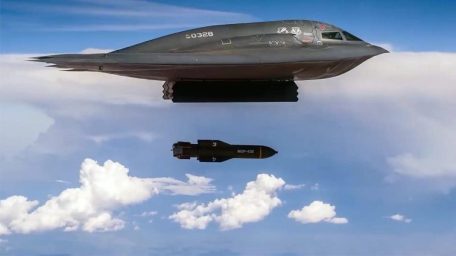
Stealth Bombers and Bunker Busters
Analysis of the so-called 12-Day War, and the triumphantly celebrated Operation Midnight Thunder
By William Schryver | imetatronink | November 28, 2025
The GBU-57 is a big fat gravity bomb with fins. To achieve effective precision, a B-2 bomber must drop it on its intended target from no further than about five nautical miles — essentially right on top of the target.
Its penetration depth is claimed to be 200 feet. But that capability has NEVER been tested against a seriously hardened deep-underground target encased in layers of high-performance concrete, and topped with a few dozen meters of solid rock. In that sort of real-world scenario, the GBU-57 would be lucky to drill down 50 feet, if that.
It was always ridiculous silly talk to suggest the GBU-57 was the wonder weapon it was made out to be. There is a good reason the US only produced a couple dozen of them and then stopped: they understood its acute limitations in a non-permissive combat environment.
And, notwithstanding the hyperbolic Israeli propaganda, there was never any credible evidence that Iranian medium- and long-range air defenses against fixed-wing aircraft were attrited to any significant degree. And Iranian short-range air defenses were increasingly effective against long-range Israeli drones with each passing day.
As for the B-2: it is a big fat subsonic aircraft. It flies at airliner speeds. A strike on Fordow would entail flying at least 500 miles in and out of Iran. … continue
Blog Roll
 Aletho News
- Glenn Diesen: NATO’s War of Choice – The Sabotage of the Istanbul Negotiations
- What’s Really in the Bag: The Pet Food Industry’s Dirty Secret
- Project Artichoke: 70 Years Ago, CIA Discussed Hiding Mind-Control Drugs in Vaccines
- Drug traffickers trained in Ukraine attack state forces in Mexico
- The tragic reality of Brazilian mercenaries in the Ukrainian conflict
- Zelensky Refused to Discuss Druzhba Pipeline Issue – Fico
- U.S. General Caine Warns: STRIKING IRAN is a HUGE RISK /Glenn Diesen & Lt Col Daniel Davis
- Israel designates five Palestinian media outlets as ‘terrorist organizations’
- Israel, not America, first: Carlson’s Huckabee interview lays bare US foreign policy priorities
- Israeli troops executed Palestinian aid workers at ‘point blank range’: Report
- If Americans Knew
- Fourteen Countries Condemn Huckabee’s Support for Israel Taking Over Most of the Middle East
- Israeli Soldiers Killed Gaza Aid Workers at Point Blank Range in 2025 Massacre: Report
- Israel’s insidious network to propagandize American Christians
- Israel’s Best-Kept Secret: Palestinian Resistance Never Agreed to Disarm
- Trump officials plan to build 5,000-person military base in Gaza, files show
- Are MAGA restrainers pulling their punches this time on Iran?
- The NY Times on the “MAGA” Split Over Israel & USS Liberty
- In Gaza, Ramadan without mosques, imams – Not a ceasefire Day 137
- Footage Shows Israeli Troops Waiting in Ambush, Then Opening Fire on a Palestinian Teen
- The US is on the brink of a major new war that Trump has not even bothered explaining
- No Tricks Zone
- Surprising Discovery: Sahara Is Greening…Billions Of Trees Where Once Thought To Be Barren
- New Research Reaffirms Clouds, Aerosols, And Surface Solar Radiation Are ‘Driving The Climate System’
- Germany: Electric Car Catches Fire At Charging Station, Sets Off Local “Inferno”, Widespread Damage
- New Study: Canada’s New Brunswick Was 1°C Warmer Than Today During The Medieval Warm Period
- Coal Power Back In Trend As Globe Tries To Keep Pace With Growing Demand For Power
- New Study: A 4°C Warmer Beaufort Sea Had ‘No Sea Ice’ 11,700 – 8200 Years Ago
- Unfudging The Data: Dutch Meteorological Institute Reinstates Early 20th Centruy Heat Waves It Had Erased Earlier
- German Gas Crisis…Chancellor Merz Allegedly Bans Gas Debate Ahead of Elections!
- Pollen Reconstructions Show The Last Glacial’s Warming Events Were Global, 10x Greater Than Modern
- Germany’s Natural Gas Storage Level Dwindles To Just 28%… Increasingly Critical
 Aletho News