Britain’s sickening infatuation with Israel continues
Iran still the victim of unshakable Israeli influence over the UK’s political establishment
By Stuart Littlewood | Veterans News | February 11, 2017
Here in the UK the Campaign Against the Arms Trade (CAAT) has initiated a judicial review in a bid to halt UK arms sales to Saudi Arabia on suspicion that they are being used against civilians in Yemen. The indiscriminate nature of Saudi air-strikes makes it highly likely that British weaponry is being deployed in breach of international humanitarian law.
The slaughter has been going on for nearly 2 years leading to a humanitarian crisis of appalling magnitude and great cruelty. Since the Yemen campaign began the British government has granted export licences for more than £3.3 billions worth of war equipment when there was a “clear risk” that some of it would be used in violation of all norms of human conduct.
It is claimed that the Government has ignored warnings by senior civil servants and its own arms control experts, and some records of expressed concern have gone missing. This is no great surprise when we discover that export licensing is overseen by none other than the Secretary of State for international trade, Liam Fox. For Fox has ‘form’ as a crazed stooge of Israel and a sworn enemy of Iran.
Fox, while Secretary of State for Defence, was quoted on the Conservative Friends of Israel website as saying: “… We must remember that in the battle for the values that we stand for, for democracy against theocracy, for democratic liberal values against repression – Israel’s enemies are our enemies and this is a battle in which we all stand together or we will all fall divided.”
And in June 2015 Fox declared: “It is logical to assume that Iran’s intentions are to develop a nuclear weapons capability and any claims that its intentions are exclusively peaceful should not be regarded as credible… Iran’s nuclear intentions cannot be seen outside the context of its support for terror proxies, arguably the defining feature of its foreign policy. The risks are clear.”
Fox was forced to resign as Defence Secretary in 2011 following scandalous goings-on between him, his ‘close friend’ Adam Werritty, the UK ambassador to Israel (Matthew Gould) and Israeli intelligence figures allegedly involved in plotting sanctions against Iran.
Just lately prime minister Theresa May has accused Iran of working with Hezbollah, interfering in Iraq, sending fighters to Syria to help Assad, and supporting the Houthis in the conflict in Yemen. The British Government, of course, can meddle where it pleases and recently concluded another huge arms deal with the Saudis which, says Mrs May, is for the sake of long-term security in the Gulf. She argues that the same extremists who plot terror in the Gulf states are also targeting the streets of Europe: “Gulf security is our security.”
However, public pressure to end arms sales to Saudi Arabia is now so great that the Government has adopted a new export licensing scheme that hides the value and scale of weaponry being supplied.
The reason for the British Government’s current hostility towards Iran was plain from what David Cameron told the Knesset in 2014: “A nuclear armed Iran is a threat to the whole world not just Israel. And with Israel and all our allies, Britain will ensure that it is never allowed to happen.” That position carries forward into the present day and beyond, and serves as an excuse for the rednecks who rule our political swamp to carry on being unpleasant to the Muslim world.

Oh, How he loves these Photo Ops!
Theresa May lost no time in welcoming Mr Netanyahu to London. The two leaders this week agreed to establish a new UK-Israel Trade Working Group to strengthen their existing trade and investment relationship and “to prepare the ground for a post-Brexit trade agreement”. What good that will do in the face of rising popularity among the public of boycotting everything Israeli remains to be seen.
Regional issues including Syria and Iran are to be on the agenda for discussion. And regarding Palestine May repeated the mantra that “We remain committed to a two-state solution as the best way of building stability and peace for the future”…. though she doesn’t say what that will look like.
Netanyahu also met with Foreign Secretary Boris Johnson and they sat alongside the desk on which the Balfour Declaration was composed in 1917. As for the forthcoming Balfour Declaration centenary celebrations, a statement said that May invited Prime Minister Netanyahu to attend events taking place in the UK “as a Guest of Government” and that Prime Minister Netanyahu “also invited her to visit him in Israel”.
Netanyahu didn’t miss the opportunity to warn that Iran “seeks to annihilate Israel” and called on nations to back renewed sanctions against the Iranian regime.
I looked up one of my old reports about how Craig Murray, a former UK ambassador to Uzbekistan, argued five years ago that British policy was being driven in an underhand fashion by the Israel lobby. He linked Matthew Gould, the then British ambassador to Israel, with the Fox-Werritty scandal and raised questions about meetings between Gould, Liam Fox and Fox’s strange friend Adam Werritty. Werritty was referred to as Fox’s adviser but according to reports he was backed financially by Israel lobbyists and had no security clearance and therefore no authorised role.
Murray, with many useful contacts from his days as an ambassador, claimed to have serious evidence connecting Gould with a secret plan to attack Iran, but the Foreign Office and the Cabinet Secretary blocked questions. Murray published his story ‘Matthew Gould and the plot to attack Iran’ here.
In it he pointed out that “Matthew Gould does not see his race or religion as irrelevant. He has chosen to give numerous interviews to both British and Israeli media on the subject of being a jewish ambassador, and has been at pains to be photographed by the Israeli media participating in jewish religious festivals. Israeli newspaper Haaretz described him as ‘not just an ambassador who is jewish, but a jewish ambassador’. That rather peculiar phrase appears directly to indicate that the potential conflict of interest for a British ambassador in Israel has indeed arisen.”
He went on to say that Gould stood suspected of participating with Fox and Werritty “in a scheme to forward war with Iran, in co-operation with Israel”. The stonewalling by the Cabinet Office and Foreign Office led Murray to conclude that “something very important is being hidden right at the heart of government”.
Labour MP Paul Flynn remarked that no previous ambassadors to Israel had been Jewish so that a conflict of interest and accusations of going native would be avoided. He was immediately rebuked. Flynn also asked about meetings between Werritty and Gould, as some reports suggested that Gould, Werritty and Fox discussed a potential military strike on Iran with Mossad. “I do not normally fall for conspiracy theories,” said Flynn, “but the ambassador has proclaimed himself to be a Zionist and he has previously served in Iran.”
Fox had earlier made the idiotic claim: “Israel’s enemies are our enemies”, and the Jewish Chronicle hailed him as “a champion of Israel within the government”. Furthermore Fox continually rattled the sabre against Iran which, of course, is no threat to Britain but regarded by Israel as a bitter enemy. Iraq too was Israel’s enemy, not ours. Yet Fox, according to the theyworkforyou.com, voted “very strongly” for the Iraq war. He was also an enthusiastic supporter of the war in Afghanistan.
Given that Fox so eagerly waved the flag of a foreign military power and was a man with dangerous beliefs and demonstrably weak judgement, how could those who appointed him not see that he was unfit to serve as a Minister of the British Crown – unless they were similarly tainted?
When the Werritty relationship came to light Fox jumped before being flung from the battlements. But instead of melting into obscurity he has now been rehabilitated into the senior ranks of Government and is once again a Minister of the Crown. And after watching the trail blazed by our former Jewish ambassador to the Jewish State, we now gawp with fascination at the inevitably messy conflicts of interest arising from Trump’s pick for US ambassador to Israel – David Friedman, a Jewish lawyer with scant respect for international law or Middle East sensitivities.
Despite the strong whiff of misconduct David Cameron rewarded Gould with head of The Office of Cyber Security & Information Assurance (OCSIA), which includes e-crime, working with private sector partners on exchanging information, and engaging with international partners in improving the security of cyberspace and information security. Did it seem right for such a person to be in charge of crucial security matters at the heart of our Government? What was in fellow Zionist David Cameron’s mind when he appointed him?
Could it have had anything to do with the UK-Israel academic collaboration ventures with cyber research funding, which involve partnerships between British and Israeli universities and cover research areas such identity management, regulating cyber security, privacy assurance, mobile and cloud security, human aspects of security, and cryptography?
Both countries signed a Memorandum of Understanding on digital co-operation in March 2014. And Gould’s new appointment came at a time when the Cameron government was lecturing us on threats to national security and announcing plans to trawl through our personal emails and web browsers in order to “keep us safe”. Question was, who would trawl Gould’s private emails?
The vipers in our bosom
CAAT expect a decision on the judicial review on arms to Saudi Arabia in 4 to 6 weeks. In the meantime an undercover Al Jazeera report has revealed that a senior political officer at the Israeli embassy in London, Shai Masot, was plotting with stooges among British MPs and other vipers in the political snake-pit to “take down” senior government figures including Boris Johnson’s deputy at the Foreign Office, Sir Alan Duncan, a noted sympathiser of the Palestinian’s struggle. This should have resulted in the expulsion of the ambassador himself, the Israeli propaganda maestro and Netanyahu’s pet, Mark Regev, who took up the post last year. Regev is the sort of person no sensible government would let into their country. But he was let off the hook and the affair hurriedly smoothed over with an announcement from the Foreign Office that the matter was closed.
Craig Murray, however, has been digging again. The Foreign Office deflected his many questions and dismissed the idea that Masot was anything more than a member of the technical and administrative staff at the embassy. “This is plainly a nonsense,” says Murray. “Masot, as an ex-Major in the Israeli Navy and senior officer in the Ministry of Strategic Affairs, is plainly senior to many who are on the Diplomatic List.” He concludes that the Foreign Office is complicit in “a large nest of Israeli spies seeking to influence policy and opinion in the UK in a pro-Israeli direction. That is why the government reaction to one of those spies being caught on camera plotting a scandal against an FCO minister, and giving £1 million to anti-Corbyn MPs, was so astonishingly muted.”
All this and the recent UN resolution 2334, which condemned Israel’s continuing squats on Palestinian land as illegal and an obstacle to peace, has done nothing to disturb the cosy relationship between Her Majesty’s Government and the obnoxious Israelis
On the contrary, after May’s meeting with Netanyahu a Downing Street spokesperson said they focused on, yes, cyber security: “In their discussions, the Prime Ministers committed to working together to build on our longstanding relationship and the strong ties that already exist between our two countries in a wide range of areas, from trade and investment, to innovation and technology, and defence and security. They talked about the important work we do together on intelligence-sharing and cyber-security, and committed to talk further about how we can deepen this cooperation, to help keep our people safe”.
Sitting comfortably?
Saudi Aramco picks Israel-linked banker
Press TV – February 8, 2017
Saudi Arabian Oil Co. (Aramco) has chosen the New York-based boutique investment bank Moelis & Co to advise on its initial public offering, reports say.
The sale of the world’s biggest oil company is the latest of several moves by the Saudi government to generate revenues in the face of a gaping budget deficit.
Aramco had invited banks in January to pitch for an advisory position on what is expected to be the world’s biggest initial public offering.
JPMorgan, which has been Aramco’s commercial banker for years, and Michael Klein, a former star Citigroup banker, had been advising Saudi authorities on the IPO.
However, the kingdom’s decision to pick a small banker has surprised many observers. International business outlets such as Bloomberg and the Financial Times said the choice represents a coup for Moelis founded no earlier than 2007.
The IPO, which is predicted to raise about $100 billion, is set to yield millions of dollars in fees and push Moelis up in global investment bank rankings.
Last year, Moelis hired Shlomo Yanai, a retired Israeli military officer, to join the firm as a senior adviser. Yanai had earlier been offered the directorship of the Israeli spy agency Mossad by Prime Minister Benjamin Netanyahu but he turned it down.
The oil giant’s initial public offering, holding $2 trillion in assets, is expected to take place in 2018 with an initial sale of a five-percent share.
According to Bloomberg, Aramco expects Moelis to help it select underwriters for the sale, make decisions on potential listing venues and ensure the IPO goes smoothly.
Saudi Arabia is currently dealing with a budget deficit of nearly $100 billion caused by a sharp slump in oil prices as well as Riyadh’s rising military expenditure. The kingdom emerged as the world’s third largest military spender in 2015 when it began its military campaign against Yemen.
The Saudis have also been forced to introduce a series of austerity measures that include canceling of some bonuses offered to state employees and increasing of entry visa fees for residents and foreigners.
The ruling Saudi family will transfer the revenue from the sale of Aramco to the country’s public investment fund (PIF), which will then be tapped to purchase strategic financial and industrial assets abroad.
Trump Foreign Policy in Turmoil
By Renee Parsons | CounterPunch | February 6, 2017
Within days of the flawed roll-out for Trump’s Executive Orders regarding Border Security and Immigration Enforcement Improvements and Enhancing Public Safety in the Interior of the United States, the President’s promises on the campaign trail and his Inaugural Address that the US would not pursue regime change or initiate new foreign interventions and that his administration would pursue a new foreign policy based on engagement, have been called into question.
The week began with President Trump praising, as a success, the administration’s first attack on al Qaeda in Yemen which inexplicably included special ops from UAE. Reports state that the group of Navy Seals unexpectedly walked into an hour long fire fight which contained elements of an ambush including hand grenades and a certain amount of panic with indiscriminate gunfire; leaving one Navy Seal dead with several injured, at least a dozen civilians dead including an eight year old girl and destroyed a $75 million Osprey – you might say the raid was more of the same kind of failure with which the US military has some long-standing familiarity. Black Hawk Down in 1993 comes to mind.
Described by Trump press secretary Sean Spicer as a “very, very well-thought out and executed raid”, the mission began on November 7 when the Pentagon presented President Obama with a plan. From there, the proposed raid went through all the necessary channels arriving in front of Trump Defense Secretary James Mattis on January 24th. Mattis approved and forwarded the plan to the White House for the President’s approval which he gave the next day at a dinner which included several key staff members including special assistants to the White House Jared Kushner and Steve Bannon and after consulting with National Security Advisor General Michael Flynn.
All of the reviews and approvals, however, did not guarantee success as there is reason to believe that the alQ stronghold was expecting an American raid with armed female and AQ snipers on a rooftop. After the raid, anonymous U.S. military officials told Reuters that “Trump approved his first covert counterterrorism operation without sufficient intelligence, ground support or adequate backup preparations.” In addition, Reuters quoted three unnamed US military officials that “the attacking SEAL team found itself dropped into a reinforced al Qaeda base defended by landmines, snipers, and a larger than expected contingent of heavily armed Islamist extremists.” This does not sound like a surprise raid but more like a disaster waiting to happen.
These unprecedented ‘leaks’ indicate an undercutting of the Administration by anonymous military officials who are in direct contradiction to the timeline as presented by Spicer that the entire plan had been appropriately vetted by the government’s foreign policy structure – with the exception of Rex Tillerson who had not yet been confirmed as Secretary of State.
It has been said that the mission needed to receive a green light to take advantage of a Moonless night and that the mission was to acquire certain computer hard drives with speculation that there was some urgency of obtaining the intel contained potentially embarrassing data regarding the interconnections between the terrorists and certain foreign nations which support terrorists. In any case, it was a botched mission that was poorly planned and executed and appears to have a major security problem given the unauthorized disclosures by anonymous military officials who disagreed about what the public has been told about the raid. So which is it – was the raid properly vetted and the right questions asked – or was it insufficiently vetted?
US CommCentral released the clip that they say was obtained from a series of videos during the raid which shows a black hooded individual giving instructions on how to make a do-it-yourself bomb. The clip, which has no audio and its written instructions are written in perfect English, is now reported to be a decade old AQ training video [sourced from SITE]. It is assumed that the President’s Monday trip to Central Command and Special Ops in Florida was not just a get-to-know-you visit.
As if that were not enough faux pas for the week, General Flynn took an unprecedented place on center stage at a press conference sounding like the Commandant of Stalag 19, stridently warning Iran and spouting old, worn out rhetoric that the “Trump administration condemns such actions by Iran that undermines security, prosperity and stability throughout and beyond the Middle East which places American lives at risk. As of today, we are officially putting Iran on notice.”
The accusations came after Iran reportedly fired a test of a medium-range ballistic missile on February 1st with Iranian Defense Minister Hossein Dehghan stating that “The test did not violate the nuclear deal or (U.N.) Resolution 2231″ and that “… we will not allow foreigners to interfere in our defence affairs,” striking a chord with Trump’s Inaugural statement that “it is the right of all nations to put their own interests first.”
On the heels of Flynn’s rant, the Trump administration quickly announced economic sanctions on twenty five Iranian individuals and entities that have unnecessarily escalated tensions with:
“The Islamic Republic of Iran is the world’s leading state sponsor of terrorism and engages in and supports violent activities that destabilize the Middle East.”
“The Trump Administration will no longer tolerate Iran’s provocations that threaten our interests. “
“The days of turning a blind eye to Iran’s hostile and belligerent actions toward the United States and the world community are over.”
The Flynn/Trump obsession against Iran has little basis in rational thought and is not the kind of nation-building and “forming of new alliances” that the President promised in his Inaugural address. Flynn may be myopic on the subject of Iran since Iran supported the insurgents in Iraq during the US invasion in 2003 but he may also be blowing smoke with the realization that the administration must know that any serious effort to eliminate ‘radical Islamic terrorists’ will be dependent upon Iran’s participation.
As Ron Paul has repeatedly suggested, Iran has every reason to want its own nuclear capability, if only as a defensive mechanism to protect itself from Israel and the US. A spokesperson for the EU foreign policy chief in Brussels said that the “Iranian ballistic missile program was not part of the 2015 nuclear pact and hence the tests are not a violation of it.”
On February 3rd, President Trump tweeted “Iran is playing with fire – they don’t appreciate how “kind” President Obama was to them. Not me!” to which Iranian Foreign Minister Javad Zarif tweeted “We will never, I repeat never, use our weapons against anyone, except in self-defense. Let us see if any of those who complain can make the same statement.”
If the Trump Administration believes Iran is in violation of the Plan, they have the option to initiate a dispute resolution process or to engage the International Atomic Energy Agency (IAEA) which has regular access to all Iranian nuclear facilities to verify that Iran is in compliance. Iran says it will impose its own sanctions and release its own list of US-related ‘entities’ entwined with supporting terrorists.
With an imminent visit to the US, it is not outside the realm of possibility that all this Tough on Iran talk is to impress Bibi Netanyahu who hailed Flynn’s statement with “Iranian aggression must not go unanswered” which sounds reminiscent of Sen. John McCain. As if to tone down the US inflammatory reaction, new Defense Secretary James Mattis said he sees ‘no need to increase number of troops in the Middle East” in response to the Iranian missile crisis.
Of special interest will be how Trump deals with whatever demands Netanyahu has in his pocket and how Trump’s high regard for Israel may be affected, assuming that he is already apprised of Israel’s role in funding ISIS in Syria and its support and participation in fomenting terrorist actions throughout the Middle East. If Flynn/Trump are concerned with who is causing instability in the Middle East, they have no further to look than Saudi Arabia and Israel. It is difficult to image that Trump does not already have an appreciation for Netanyahu’s expectation to continue to run the show otherwise known as US foreign policy.
As if the Trump foreign policy objectives had not already experienced a week of upsets, contradictions and overall confusion, UN Ambassador Nikki Haley’s diatribe against Russia was stunning in its vitriolic attack on Russia alleging “aggressive actions of Russia” and “dire situation in eastern Ukraine is one that demands clear and strong condemnation of Russian actions.” In addition, Haley asserted, in contradiction to President Trump’s previous position on Crimea that “The United States continues to condemn and call for an immediate end to the Russian occupation of Crimea” and that “Crimea is a part of Ukraine. Our Crimea-related sanctions will remain in place until Russia returns control of the peninsula to Ukraine.”
In his February 3rd press conference, Trump press secretary backed up Haley with “I think Ambassador Haley made it very clear of our concern with Russia’s occupation of Crimea. We are not — and so I think she spoke very forcefully and clearly on that.”
Russia’s UN Ambassador Vitaly Churkin responded that ‘the belligerent rhetoric toward Moscow over the Ukrainian crisis is nothing new” and that “it is Kiev that has escalated the situation there”. He also cited “OSCE reports and surveillance data which places the blame squarely on the Ukrainian government and not the rebel forces.”
After the initial shock at Haley’s level of hostility, an immediate reaction was that as a former Republican Governor of South Carolina, Haley had to have a working relationship with Senator Lindsay Graham (R-SC), the alter ego of Sen. John McCain who remains an irrational proponent of intervention wherever possible around the globe and that her maiden speech before the Security Council had somehow gone askew as a more combative, divisive script found its way into her file.
However, U.N. ambassador Nikki Haley, met with her Ukrainian counterpart “to reaffirm the United States’ support for the sovereignty and territorial integrity of Ukraine,” according to a statement.
In view of another pending humanitarian disaster as a result of US intervention in Ukraine, the best that the State Department could do, prior to Tillerson taking office, was to issue a statement calling for a ceasefire and return to implementation of the Minsk Agreement.
It is reported, though unconfirmed, that soon after her speech, Haley visited Russian Ambassador Churkin at his home, presumably to reassure him that there was a bureaucratic snafu and that US policy toward Russia was not accurately reflected in her introductory remarks.
As a result of a week of significant snafus, the Trump Administration has either caved in to neo-con pressure like Eliot Abrams (convicted of lying to Congress during Iran-Contra) who is currently vying for the Deputy Secretary position at the State Department or they are dealing with repeated staff blunders and turmoil that are seriously threatening any hope of credibility for Trump’s oft-stated foreign policy goals.
Renee Parsons has been a member of the ACLU’s Florida State Board of Directors and president of the ACLU Treasure Coast Chapter. She has been an elected public official in Colorado, an environmental lobbyist and staff member of the US House of Representatives in Washington DC. She can be found on Twitter @reneedove31
US seeking to diminish Iran’s deterrent power: Kaveh Afrasiabi
Press TV – February 4, 2017
The United States has highlighted a recent missile test by Iran and imposed new sanctions against the Islamic Republic. Washington claims the missile test is violating the spirit of a nuclear deal between Iran and the P5+1 group of countries including the US, Britain, France, China, Russia and Germany. Iran ruled out the allegation explaining that the test has nothing to do with the nuclear agreement. According to the nuclear deal, Iran must avoid testing missiles capable of carrying nuclear warheads.
America is worried about Iranian military might because it sees Iran as a regional power whose deterrent might can be a big hurdle in the way of the United States’ hegemonic intervention in the Middle East, said Kaveh Afrasiabi, an author and political scientist.
The US is not genuinely concerned about the Iranian missile being nuclear capable, “their real concern is Iran’s military strength that’s deterrent vis-à-vis America’s intrusive force in the region,” Afrasiabi told Press TV’s Top 5.
The American officials are “doing whatever they can in order to diminish the Iranian power in the region,” he said on Friday night.
Since Tehran is facing a lot of security threats from the United States, Iran has the right to enhance its defensive capabilities to confront any potential American aggression when needed, the analyst argued.
The UN Resolution 2231, which endorses the nuclear deal dubbed the Joint Comprehensive Plan of Action (JCPOA), underlines implementation of obligations of the accord as an international agreement.
Afrasiabi went on to say that “Iran’s missile technology is for deterrent purposes” and there is no evidence to support Americans’ allegations against Iranian missile program.
Russia and other world powers do not believe in what the United States says about Iran’s missiles, because they are aware the Islamic Republic does not have any nuclear weapons program that could be connected to its missile technology, he noted.
The commentator also expressed hope some rational figures among the Trump administration would prevent hawkish American elements from pushing the US into another war in the Middle East.
Iran sanctions: US Treasury lists 13 individuals, 12 business entities
RT | February 3, 2017
The US government has blacklisted 13 individuals and a dozen businesses under the Iran sanctions authority, a day after President Donald Trump’s administration threatened a response over Tehran’s ballistic missile tests.
The Treasury Department posted a listing on Friday, naming the individuals and the companies added to the sanctions list. Eight of the individuals are listed as Iranian citizens, three appear to be Chinese, and two Arab.
Most of the businesses listed in the announcement are based in Iran, though one of the entities is located in the United Arab Emirates, two are in China, and three are in Lebanon.
“Today’s action is part of Treasury’s ongoing efforts to counter Iranian malign activity abroad,” said John E. Smith, acting director of the Treasury Department’s Office of Foreign Assets Control.
“Iran’s continued support for terrorism and development of its ballistic missile program poses a threat to the region, to our partners worldwide, and to the United States,” Smith said. “We will continue to actively apply all available tools, including financial sanctions, to address this behavior.”
Meanwhile, the guided missile destroyer USS Cole arrived in the waters off the coast of Yemen on Friday, where it will conduct patrols to “protect waterways” from the Houthi rebels, unnamed US officials told reporters.
“Iran is unmoved by threats as we derive security from our people,” Iran’s foreign minister Mohammad Javad Zarif said ahead of the announcement. “We will never use our weapons against anyone, except in self-defense,” he added later.
Gareth Porter: Trump may continue Obama legacy of supporting Saudi war against Yemen
RT | February 2, 2017
We have witnessed big payoffs to the Pentagon in the form of the ability to sell arms to the Saudis – at least to $200 billion estimated over two decades – to American arms makers, Gareth Porter, investigative journalist, told RT.
US House Democrat leader Nancy Pelosi lashed out at the Trump administration’s handling of the conflict in Yemen on CNN, after a Yemeni refugee in one of the programs told the tragic story of her family.
Pelosi said that girl’s family is suffering because the US president “is reckless and his administration is incompetent.”
However, Pelosi failed to acknowledge the Obama administration’s own contribution to the humanitarian disaster unfolding in Yemen due to arms contracts and other forms of cooperation with Riyadh.
RT: Why did US Democrat leader Nancy Pelosi focus on Trump’s travel ban and not the real reasons for the suffering of the girl’s family?
Gareth Porter: Well, Nancy Pelosi is the Democratic leader in the House, the minority leader in the House of Representatives. She is going to support the partisan position on this question of policy toward Yemen, which means that she’s going to be unwilling to acknowledge the responsibility of the Obama administration for the war that has afflicted the population of Yemen, and is now a humanitarian catastrophe, as far as I know, the worst in the world, or at least in that part of the Middle East.
It seems to be much more serious than the crisis in Syria in terms of the actual danger to millions of people; in terms of their access to food. Therefore, we have a situation where there is a great deal of famine already or, at least close to famine-like conditions in Yemen, because of the bombing carried out by the US ally, Saudi Arabia.
RT: In December, just a month before Obama left office, his administration decided to limit military support to Saudi Arabia on concern over civilian casualties. What do you make of the timing of that decision?
GP: Well, I think the point about that decision by the Obama administration is that it was far too little, far too late. It was merely a reduction in US support for the war that is direct support by the US personnel taking part in the assistance to the Saudis in Riyadh. It did not end the really crucial aspects of the Obama administration’s assistance to the Saudis and their allies, which was primarily to provide the refueling for the planes that have carried out the air attacks, which have so completely destroyed the society in large parts of Yemen – in more than half of Yemen. This is the crucial issue, which the Obama administration has never been willing to deal with in terms of its complicity with the war crimes of the Saudi government and its allies.
In addition to that, after months of this bombing which Amnesty International regards as filled with war crimes, because of the deliberate targeting of cities that were regarded as supportive of the Houthis, the US then renewed the agreement to provide bombs to the Saudi government for carrying out this war. So it was in effect a sort of public support for the Saudi war. The US still remains completely complicit in this war…
RT: Critics are branding the US approach to Yemen, one of ‘cautious approval,’ on the one hand, keep supplying the Saudis with arms, on the other staying silent on the country’s growing humanitarian catastrophe. What’s your take on that approach?
GP: Well, my take is that what is happening here – the Obama administration has been essentially tied to the Saudi interests in Yemen, as they have been in Syria to a great extent of the past by the degree to which the permanent government in the US – the Pentagon, the CIA, the NSA – all have very, very close relations with their counterparts in Saudi Arabia. Arrangements which have provided big payoffs to the Pentagon and these other agencies in the form of the ability to sell arms to the Saudis – at least to $200 billion estimated over two decades – to American arms makers, and the contracts with the Saudis to provide intelligence services by the CIA and NSA, which are very lucrative for those agencies.
So these war powers in the US are very unwilling to have any US policy that would criticize, much less take away, support for the Saudi war so that these arrangements can continue. I am very much afraid that the Trump administration will be subject to the same logic, the same political forces that have kept the Obama administration from taking any responsibility for what is going on in Yemen.
British activists attempt to disarm fighter jets bound for Saudi Arabia
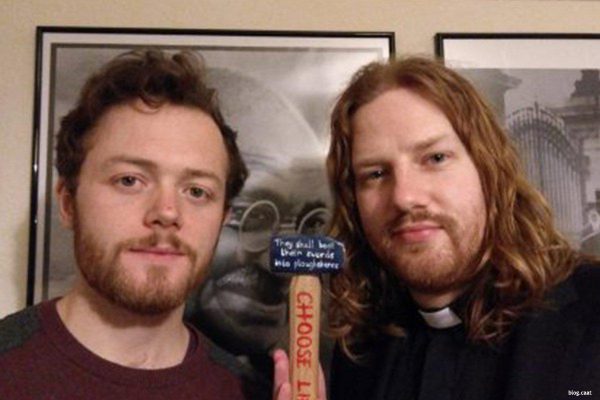
Daniel Woodhouse and Sam Walton (blog.caat )
MEMO | January 30, 2017
Two British activists have been arrested while apparently trying to disarm warplanes bound for Saudi Arabia. Daniel Woodhouse, a Methodist minister from Leeds, and Quaker Sam Walton were released on bail pending charges after breaking into BAE’s Warton site in Lancashire.
The pair were arrested in the early hours of Sunday morning while attempting to disarm fighter jets due to be delivered to the Royal Saudi Air Force for use, it is assumed, in coalition bombing raids on Yemen. The aircraft are part of a multi-billion pound deal between BAE Systems and the Saudi regime, and were due to be shipped to Saudi Arabia within weeks.
“BAE security found us just metres from war planes bound for Saudi Arabia,” the two said on their release. “We’re gutted that we couldn’t disarm a plane and stop it being used to carry out airstrikes in Yemen. We could have saved lives by preventing Saudi war crimes in Yemen.”
They added their belief that the British government has blood on its hands and that there is a need to do everything possible to stop the transfer of weapons and show that such sales are illegitimate. “By providing weapons and support,” insisted the campaigners, “Britain is deeply complicit in Saudi war-crimes, and it’s vital that we bring an end to this immoral, abhorrent trade.”
Speaking to MEMO, Mr Woodhouse mentioned that he and his colleague have been campaigning against British arms sale to human rights violators like Saudi Arabia, Israel and Bahrain for “donkey’s years”. He and Walton were just “metres” away from the aircraft, he said, which they were hoping to “render physically incapable.” When prompted to explain how they had planned to do that, Woodhouse referred to a famous case in 1996 when ten women entered the same site to disable a plane bound for Indonesia to be used in the genocide in East Timor, armed with only a hammer. The two men took this “symbolic act,” he said, “to mirror the rightness of the actions of the three women, which a jury 21 years ago found to be lawful.”
In their statement, the activists stressed that their actions had been planned over many months, adding: “We do not take these steps lightly, but we have no other option. We have been active in opposing the arms trade to Saudi Arabia for years, and in the face of wilful government denial that there is a problem with arming Saudi, including willingness to suspend our own due process of law, and complete unwillingness to consider stopping arming Saudi Arabia, we must take this action.”
Britain has approved over £3.3 billion worth of arms to Saudi forces since the bombing of Yemen began in March 2015, and continues to approve arms licences despite repeated allegations of war crimes being committed.
King Salman has no issues with Trump
By M K Bhadrakumar | Indian Punchline | January 30, 2017
The US President Donald Trump must be a man with a queer sense of humour. He kept the call to King Salman of Saudi Arabia pending for his announcement on Friday to fully sink in – to the effect that the Saudi citizens will be subject to “extreme vetting” before being allowed to enter America.
Trump singled out Saudi Arabia as the only GCC country to be treated badly like this, on par with Afghanistan and Pakistan. Finally, Trump made the call to Salman on Saturday. One would have liked to be a fly on the wall in the Oval Office. From all accounts, neither side showed fluster. The conversation was smooth as silk.
Salman is the Custodian of the Two Holy Places, and yet he didn’t raise the issue of Trump’s Muslim ban, which has created a world-wide uproar, including among non-believers.
Not only that, the accounts of the conversation suggest that Trump’s main purpose was to demand that Saudi Arabia should fund the ‘safe zones’ in Syria and Yemen – yes, Yemen, too, where the Saudis have been involved in a war of destruction. Simply put, Trump pricked the Saudi pride and 24 hours later asked Riyadh for money. Apparently, Salman agreed.
Thereupon, Trump and Salman agreed on the importance of making ‘joint efforts’ to erase the Islamic State from the face of the earth. The White House readout says,
- The president requested, and the King agreed, to support safe zones in Syria and Yemen, as well as supporting other ideas to help the many refugees who are displaced by the ongoing conflicts.
The Saudi press agency initially omitted any reference to Salman’s commitment on the ‘safe zones’, but later put out an amended version to say, “The custodian of the Two Holy Mosques had confirmed his support and backing for setting up safe zones in Syria.” It nonetheless did not mention Yemen, where a Saudi alliance is waging a bloody military campaign against the Houthi group.
The Saudi version emphasised that Salman and Trump affirmed the “depth and durability of the strategic relationship” between the two countries. For Salman, it is crucially important to proclaim that Trump intends to continue with the strategic ties with Saudi Arabia. His main worry would be that without Trump’s support, Iran will steal a march over Saudi Arabia as the dominant Muslim power in the Middle East.
Curiously, Salman went on to invite Trump “to lead a Middle East effort to defeat terrorism and to help build a new future, economically and socially.” Plainly put, Saudi Arabia is petrified about a US retrenchment from the Middle East and is willing to overlook anything – even the humiliating blow of Trump’s Muslim ban – if only the American troops stayed on.
Salman’s fawning attitude in the face of Trump’s Muslim ban will put the Ummah in a quandary. Logically, Saudi Arabia ought to have reacted strongly in the same unequivocal manner in which Iran has reacted. No sooner than Trump announced a travel ban on Iranian nationals, Tehran imposed a reciprocal ban on US citizens. A foreign ministry statement said in Tehran on Saturday,
- While respecting the American people and distinguishing between them and the hostile policies of the U.S. government, Iran will implement the principle of reciprocity until the offensive U.S. limitations against Iranian nationals are lifted.
Herein lies the secret of the western hegemony over Muslim Middle East. The bizarre truth is that the Gulf Arab regimes relish criticizing the US’s policies but cannot live without US military support because without that support they would collapse like a pack of cards. Besides, the Saudi elites keep their illegal private wealth in western banks and they own vast properties and business interests in the US. They travel to the US for fun as a permissive home away from their Wahhabi environs. In sum, they simply cannot afford to uphold self-respect and dignity as norms in their dealings with the Americans.
To be sure, Trump has put fear into the Saudi mind. What worries Salman most is Trump’s earlier stance that if the families of the victims of 9/11 attacks seek compensation from Saudi Arabia, he wouldn’t stand in the way. The finger has been pointed at important figures in the House of Saud for complicity in the 9/11 attacks.
But the Iranians have no such problem. They can insist on equal relationship and mutual respect from Washington because they owe Trump nothing. I can only echo Pakistani politician Imran Khan’s stirring call: “’Iran is an independent nation and other (Muslim) nations need to follow Iran against foreign pressures.” But then, Khan Saheb is asking too much.
Middle East: Rapid Tectonic Changes on Regional Chessboard
By Peter KORZUN | Strategic Culture Foundation | 30.01.2017
The Middle East geopolitical scenarios are going through rapid changes with new factors emerging on the regional chessboard.
Cairo’s foreign policy has been given a new twist. It has been announced recently that Egypt is set to receive one million barrels of petroleum per month from Iraq. Saudi Arabia had informed Egypt that shipments of oil products expected under a $23 billion aid deal have been halted indefinitely, suggesting a deepening rift between the countries. From now on, Egypt will enjoy as much oil as it needs at a lower cost, compared to Saudi pricing.
Egyptian President Al-Sisi rejected the Saudi-backed efforts to overthrow the regime of Bashar Assad. He is also reaching out to former-Yemeni president Ali Abdullah Saleh and to his Houthi allies Saudi Arabia is fighting since March 2015. Cairo opened diplomatic channels with the pro-Iranian Lebanese Hezbollah, fighting on the side of President Assad in Syria against the rebel groups supported by Riyadh.
Iraq will provide Egypt with 1 million barrels of Basra light oil each month. The agreement involves extending an oil pipeline from Iraq to Egypt via Jordan. In December, Iraqi petroleum minister Ali al-Luiabi met with the heads of major oil and natural gas companies in Cairo, inviting them to contribute into developing the industry in his country.
Egypt is about to train four Iraqi army units on war against terrorism, in light of the rapprochement between Egypt and the Iraqi-Iranian axis in the region.
It also mulls sending peacekeeping troops to Syria during the coming days to support the ceasefire agreement under the auspices of Russia, Iran, and Turkey. It has been reported that a unit of Egyptian ground forces might deploy to Syria this month. Last October, Syrian National Security Bureau head Ali Mamlouk visited Cairo to meet Khaled Fawzy, the head of Egypt’s General Intelligence Service. The two sides agreed to coordinate political positions and strengthen cooperation in «the fight against terror».
Egypt is a predominantly Sunni nation. Its open support of the Russia-backed coalition in Syria is a game changing event of fundamental importance. It makes the sectarian interpretation of the Syria’s conflict not valid anymore.
Middle East Observer quotes Nziv Net, an Israeli outlet close to intelligence sources, saying that «Egypt has sent a group of officers to Syria for the first time since the relations have frozen during Morsi’s reign».
Last December, Ibrahim al-Eshaiker al-Jaafari, the Iraqi Foreign Minister, called on Egypt to participate in a «strategic project to fight terrorism», which includes Iran.
In September, Egyptian Foreign Minister Samih Shoukry met for the first time with his Iranian counterpart, Jawad Zarif, during their visits to New York to attend the UN General Assembly.
In October, Egypt backed a Russian-backed motion in the UN calling for a ceasefire in Syria. The move angered Saudi Arabia, which suspended oil shipments to Cairo.
Egyptian President Abdel Fattah al-Sisi publicly affirmed his support for the forces of Syrian President Bashar al-Assad.
The relations between Russia and Egypt have been on the rise. In February 2015, Egypt signed a breakthrough agreement on establishing a free trade zone with the Russia’s Eurasian Economic Union.
The progress in military cooperation is tangible. Egypt signed arms deals with Russia worth up to $5 billion by 2015 to include 50 MiG-29M combat aircraft, Buk-M2E and Antey-2500 long range air defense systems and about 50Ka-52K helicopters for Egypt’s new Mistral-class assault ships bought in France. The ships will receive the originally planned Russian helicopters and electronics suite.
The two countries signed several agreements for the renovation of military production factories in Egypt. A protocol is signed to grant Egypt access to GLONASS, the Russian global satellite positioning system. In September, Minister of Defense Sedky Sobhy visited Russia to discuss the issues related to long-term close security relationship. Last October, the militaries held a joint exercise.
Egypt is the most populous country in North Africa and the Arab world, the third-most populous in Africa and the fifteenth-most populous in the world. Last year, the country’s population has just reached 92 million. Its policy shift is well-substantiated. Cairo is fighting the Islamic State on the Sinai Peninsula. The fierce fighting there seldom hits media headlines but the IS poses a grave threat to Egypt. IS militants can also strike Egypt from Libya. The IS presence in Libya brings Egypt and Algeria together as the two great nations face the same threat.
The emerging Iran, Iraq, Russia and Turkey alliance may also include Algeria. In response to the growing menace, Algiers is strengthening ties with Moscow. It has recently purchased 14 Su-30MKA fighters and 40 Mi-28 «Night Hunter» attack helicopters from Russia. Last February, Russia and Algeria laid out a road-map for deepening bilateral economic and military cooperation during Russian Foreign Minister Sergei Lavrov’s visit to Algeria.
Russia’s cooperation with Egypt, Algeria and other countries of the Middle East and North Africa reflects Moscow’s growing clout in the region.
With the Astana process making progress, other large and influential actors, such as Syria, Iraq, Egypt and Algeria, may join the emerging Russia, Iran, Turkey coalition to make the Middle East-North Africa (MENA) region face tectonic and dramatic changes.
‘No legitimate military objectives’: UN panel finds Saudi strikes in Yemen may amount to war crimes
RT | January 29, 2017
An expert UN panel investigating ten separate airstrikes by the Saudi-led coalition in Yemen – in which at least 292 civilians died – has found that most were the result of an ‘ineffective targeting process’ or deliberate attacks on peaceful targets.
“In eight of the 10 investigations, the panel found no evidence that the airstrikes had targeted legitimate military objectives,” the 63-page report presented to the UN Security Council on Friday stated, which has been obtained by Reuters. “For all 10 investigations, the panel considers it almost certain that the coalition did not meet international humanitarian law requirements of proportionality and precautions in attack.”
“The panel considers that some of the attacks may amount to war crimes,” the experts said, echoing statements repeatedly made by independent observers since conflict broke out in the country two years ago.
The small subset of attacks, which took place between March and October last year, resulted in the deaths of over 100 women in children. Earlier this month, the UN humanitarian coordinator for Yemen, Jamie McGoldrick, estimated that more than 10,000 people have been killed in the war so far, with many of them the victims of air strikes.
Saudi Arabia’s UN Ambassador, Abdallah Al-Mouallimi, flatly denied responsibility, saying the coalition – which includes Gulf states such as Qatar and Kuwait – was “exercising maximum restraint and rigorous rules of engagement.”
The panel also stated that the alliance admitted that some of their airstrikes resulted in severe casualties, which was not the desired outcome.
“In some cases errors were acknowledged and responsibility accepted. Corrective measures including compensation to victims were taken,” the authors of the report wrote.
The UN panel said that although it was unable to travel to the bombing sites, it still “maintained the highest achievable standard of proof,” and insisted the specific cases studied were part of a wider trend.
“The panel finds that violations associated with the conduct of the air campaign are sufficiently widespread to reflect either an ineffective targeting process or a broader policy of attrition against civilian infrastructure,” proclaimed the report. “All coalition member states and their allies also have an obligation to take appropriate measures to ensure respect for international humanitarian law by the coalition.”
The UN group also dismissed Saudi explanations that the devastating naval blockade of Yemen had been imposed because Iran was supplying Shia Houthi rebels with weapons.
“The panel has not seen sufficient evidence to confirm any direct large-scale supply of arms from the Government of the Islamic Republic of Iran, although there are indicators that anti-tank guided weapons being supplied to the Houthi or Saleh forces are of Iranian manufacture,” said the report, which said 2,064 weapons seized on boats off the coast, had possible “direct” links with Iran.
The UN criticized the blockade for its “disproportionate impact” on civilians, saying the country, 90 percent of whose food supplies are imported, is on the verge of famine. Yemen was already one of the region’s poorest states before the current crisis, but according to the UN, 14.1 million people – over half of the population – are “food insecure,” and over two-thirds require humanitarian assistance, due to internal displacement, lack of medical supplies and clean drinking water.
Despite the devastating conclusions of the latest UN report, the US and UK, which are not directly taking part in the bombardment and blockade of Yemen, have avoided directly criticizing Riyadh, a longtime ally.
“We urge all sides to take steps to prevent harm to civilians. Ending the conflict in Yemen requires a durable cessation of hostilities and a comprehensive political solution,” the US State Department said in a statement.
The British mission to the UN, while refusing to comment on the specific incidents mentioned in the report said, “We take reports of alleged violations of international humanitarian law by actors in the conflict very seriously.”
Both the US and the UK have been major suppliers of arms to the Saudis. In September 2016, Reuters reports, the US Senate cleared the way for a $1.15 billion sale of tanks and other military equipment to kingdom. Saudi Arabia has also been buying arms from the UK – with estimated purchases at some 3.3 billion pounds. That includes more than 2.2 billion worth of warplanes, helicopters and drones.
Read more:
Severely malnourished Yemeni children in urgent need of help filmed by RT Arabic (DISTURBING IMAGES)
Featured Video
John Mearsheimer: The Case for a Nuclear Iran
or go to
Aletho News Archives – Video-Images
From the Archives
Ethnic Cleansing in a Zionist Fairyland
By Vacy Vlazna | Palestine Chronicle | February 10, 2012
‘De-Arabizing the history of Palestine is another crucial element of the ethnic cleansing. 1500 years of Arab and Muslim rule and culture in Palestine are trivialized, evidence of its existence is being destroyed and all this is done to make the absurd connection between the ancient Hebrew civilization and today’s Israel. The most glaring example of this today is in Silwan, (Wadi Hilwe) a town adjacent to the Old City of Jerusalem with some 50,000 residents. Israel is expelling families from Silwan and destroying their homes because it claims that king David built a city there some 3000 years ago. Thousands of families will be made homeless so that Israel can build a park to commemorate a king that may or may not have lived 3000 years ago. Not a shred of historical evidence exists that can prove King David ever lived yet Palestinian men, women, children and the elderly along with their schools and mosques, churches and ancient cemeteries and any evidence of their existence must be destroyed and then denied so that Zionist claims to exclusive rights to the land may be substantiated.’ — Miko Peled, Israeli dissident.
Indeed, archaeology has become a state apparatus for the ethnic cleansing of Palestinians in the Zionist fairyland aka the City of David Archaeological Park located in the Palestinian village of Silwan in East Jerusalem.
East Jerusalem is the proclaimed capital of the proposed Palestine state. It was illegally annexed by Israel in the 1967 war. Prohibiting annexation of territories gained by military conquest is one of the major principles of international law. The international community does not recognise Israel’s annexation of East Jerusalem nevertheless over 50,000 illegal premises have been built for 250,000 illegal Israeli colonists.
The goal of the archaeological judaisation of Jerusalem is to transform Jerusalem into the City of David, the capital of Greater Israel by eradicating the mixed ethnic composition of the Palestinian and Jewish population of East Jerusalem to a solely Jewish identity and unifying East and West Jerusalem under Israeli sovereignty. … continue
Blog Roll
 Aletho News
- Senate Majority Leader: Any War with Iran Should Result in Regime Change
- Iraqi Resistance warns of action if US forces remain
- China, Russia slam US threat, force against Iran ahead of talks
- US fears Iran war will ‘deplete’ air defenses stretched thin by Ukraine, Israel: Report
- Top AIs deploy nukes in 95% of war game simulations – study
- Could Hungary’s fight over oil change course of Ukraine War?
- North Korea Open to Rapprochement If US Respects Its Nuclear Status – Kim Jong-un
- John Mearsheimer: The Case for a Nuclear Iran
- The Founder Who Turned Against Root Canals
- Israel displaces last two families from Al Khalayel valley, Al Mughayyir
- If Americans Knew
- Israel responsible for 2/3 of press killings worldwide – Not a ceasefire Day 139
- Are the Jews indigenous to Palestine?
- AIPAC Wants to Kill a Bill that would Ensure Israel Complies with Ceasefire
- Former Israeli PM, in Epstein Files, Dreamed of Israeli Eugenics and Pretty Converts
- Israeli settlers join ‘safari’ tour of Palestinian prisoners
- Flooding in Gaza amid rumors of war; fire in West Bank – Not a ceasefire Day 138
- Fourteen Countries Condemn Huckabee’s Support for Israel Taking Over Most of the Middle East
- Israeli Soldiers Killed Gaza Aid Workers at Point Blank Range in 2025 Massacre: Report
- Israel’s insidious network to propagandize American Christians
- Israel’s Best-Kept Secret: Palestinian Resistance Never Agreed to Disarm
- No Tricks Zone
- Surprising Discovery: Sahara Is Greening…Billions Of Trees Where Once Thought To Be Barren
- New Research Reaffirms Clouds, Aerosols, And Surface Solar Radiation Are ‘Driving The Climate System’
- Germany: Electric Car Catches Fire At Charging Station, Sets Off Local “Inferno”, Widespread Damage
- New Study: Canada’s New Brunswick Was 1°C Warmer Than Today During The Medieval Warm Period
- Coal Power Back In Trend As Globe Tries To Keep Pace With Growing Demand For Power
- New Study: A 4°C Warmer Beaufort Sea Had ‘No Sea Ice’ 11,700 – 8200 Years Ago
- Unfudging The Data: Dutch Meteorological Institute Reinstates Early 20th Centruy Heat Waves It Had Erased Earlier
- German Gas Crisis…Chancellor Merz Allegedly Bans Gas Debate Ahead of Elections!
- Pollen Reconstructions Show The Last Glacial’s Warming Events Were Global, 10x Greater Than Modern
- Germany’s Natural Gas Storage Level Dwindles To Just 28%… Increasingly Critical
 Aletho News