Israel has a law that requires police and security officials to record their interrogations of suspects who are charged with crimes carrying a sentence of ten years or more. That sounds great, right? Just the way a democracy should work. But hold on. There’s a hole in the law big enough to drive a Mack truck through. Both the police and Shin Bet are exempt from this law as far as security detainees are concerned. In other words, in order to allow security personnel to use whatever means they wish, the Knesset permits them to have no recordings that might offer evidence of widely reported abuse and torture used against such prisoners.
The exemption was due to expire recently after it had initially been extended first for five years, then another four. But never fear, we won’t abandon our boys doing the dirty work on our behalf in the cells of Shabak. So the Knesset will extend the exemption for another three years, doing its duty on behalf of the secret police.
In the special circumstances of security investigations, which involve the fight against extremist, well-organized terror groups, documenting interrogations is liable to damage in a very real way the quality of security investigations, and thus the ability to deter terror threats.
Not a word about damaging the quality of Israeli democracy since it’s taken a back seat to security from almost day one of the existence of the State.
The Shin Bet chief of investigations, who was present at the Knesset deliberation, wove this nice fairy tale for the assembled solons:
Shin Bet investigations are overseen and documented from the beginning to the end [note he doesn’t say how they’re documented, in what form, etc.]. We’re not talking about damaging anyone’s human rights, but rather protecting our methods. The exemption is necessary so that our enemies don’t learn our investigative methods.
So get this, Shin Bet interrogations are the equivalent of work product and mustn’t be revealed because to do so would allow Israel’s enemies to learn how it ‘persuades’ prisoners to give it the information it demands. Presumably, that would enable terror groups to prepare their cadre for such interrogations in order to withstand them. Not a word about the possibility that such recordings would reveal the nasty quasi-criminal enterprise that the security agencies conduct on behalf of the State. Lest you think the previous sentence was hyperbolic, go back and read this post about a provoked prison riot which the prison security service put down with brutal force, ending with the murder of a prisoner who wasn’t even engaging in protest. Now, recall that the commander who oversaw this exercise wasn’t disciplined or even investigated. In fact, he was promoted for doing his job so well.
Israeli human rights NGOs dutifully raised their voices (Hebrew) in opposition. But they were drowned out by the swelling chorus of support for any and all methods used to beat confessions and information out of detainees. Here are some of their wise, but unheeded words:
The need for recording security interrogations is greater because of the need for certainty that a confession is valid and because of the critical importance of ensuring that the investigation was conducted properly, preventing the use of improper methods. Prisoner populations are the most likely to be exposed to the danger of degrading or inhumane conditions, including the use of physical or emotional violence up to and including outright torture. Recording interrogations can aid greatly in determining the credibility of complaints of improper acts. It can supply objective specific documentation regarding the conduct of an investigation, either supporting or refuting the charges of the detainees.
Like voices crying out in the wilderness. They speak but there is no one to hear. In fact, the existence of the NGOs, though an inconvenience for the authorities, allows them to tell the world: we are a democracy; look at how our NGOs freely criticize us; what more can you ask of us?
There are those who’ve questioned my contention here that security prisoners like Dirar Abusisi, Ameer Makhoul, Mustafa Dirani, and others have been tortured during their interrogations. They’ve done this despite the fact that defense lawyers have described in detail the sleep deprivation, loud noises, being tied to a chair for long periods, anal penetration, and worse. Now, I’ll throw it back in their face: if you’re confident there is no such abuse, protest the lack of documentation of the interrogations. If you don’t then you’re little more than a hypocrite because the video or audio tape would prove your claim. Without it, you have nothing, not a leg to stand on.
Any of you American’s out there reading this, don’t get any big ideas about how superior our legal system is to Israel’s (though given the horrid record of the Obama administration it’s hard to see how anyone would believe this). Remember the videotapes of brutal waterboarding by CIA inquisitors that were destroyed when word began to leak out that they existed? Remember Jose Rodriguez, the CIA officer who destroyed them, who wasn’t even investigated, let alone punished for obstruction of justice?
We are no better than Israel in this, which is what makes it all the more tragic.
As we’ve acknowledged before, our lives are increasingly contained on our digital devices, which makes travel—and the decisions we make about what to carry with us—increasingly complicated.
A recent case in which two young travelers to Israel were requested not simply to provide their laptops for arbitrary searches, but to log in to their e-mail accounts and allow Israeli officials to search through their e-mail for specific strings and correspondence highlights the increasing obstacles to privacy that travelers face, as well as the increasingly global nature of security theatre.
In that particular case, the two young women—both of Palestinian origin—complied with officials’ requests but were nonetheless detained overnight before being deported. In another, similar case, a U.S. citizen who refused access to her email was told she was probably hiding something and was refused entry to the country. Israeli security (Shin Bet) told a reporter that “the actions taken by the agents during questioning were within the organization’s authority according to Israeli law.”
Not unlike travelers to the U.S., travelers to Israel face serious privacy challenges at the border. The government generally has broad authority to search through your personal possessions, including your laptop, for any reason at all. When you cross the border to Israel, the Israeli government retains the authority to question you and examine your belongings, which it interprets as also allowing it to go through your electronic devices and computer files. More recently, authorities have also been known to demand user passwords to online accounts.
As we state in our guide to U.S. border searches:
For doctors, lawyers, and many business professionals, these border searches can compromise the privacy of sensitive professional information, including trade secrets, attorney-client and doctor-patient communications, research and business strategies, some of which a traveler has legal and contractual obligations to protect. For the rest of us, searches that can reach our personal correspondence, health information, and financial records are reasonably viewed as an affront to privacy and dignity and inconsistent with the values of a free society.
EFF recently asked Jonathan Klinger, an Israeli attorney, for his thoughts on the law and government practices that apply to searches at the Israeli border, and here is his analysis.
The Situation at the Israeli Border
At the Israeli border, there are some limited legal protections against the search itself. Based on a collection of experiences, however, it seems that mentioning these protections to border officials can be considered antagonism, and can limit your ability to enter Israel. Those concerned about the security and privacy of the information on their devices at the border should therefore use technological measures in an effort to protect their data. They can also choose not to take private data across the border with them at all, and then use technical measures to retrieve it from abroad.
There is, however, little to prevent a scenario in which one’s email is searched, as refusal to allow the search may result in deportation. With that in mind, concerned travelers should think ahead and review their online accounts before traveling.
Why Can My Devices Be Searched at the Border?
Article 7 of Israel’s Basic Statute of Human Dignity and Freedom1 states that every person is entitled to his privacy, and that his property may not be searched, apart from where it is required under legal authority. This generally means that the government has to show probable cause that a crime has been committed and get a warrant before it can search a location or item in which you have a reasonable expectation of privacy; moreover, a recent Supreme Court ruling stated that there is no such thing called consensual search,2 and where there is no probable cause, the state cannot rely on a person’s consent in order to search in his possessions. But searches at places where people enter or leave Israel are subject to different statutes. The two applicable statutes are the Aviation Act (Security in Civil Aviation), 19773and the General Security Service Act, 20024; the two acts altogether provide two different state authorities the right to search on a person’s body and in his property. However, they do not refer to computer searches at all.
The Aviation Act allows security personnel, police officers, soldiers and members of the civil defense forces to search at border crossings if “the search is required, in [the officer’s] opinion, to keep the public’s safety or if he suspects that the person unlawfully carries weapons or explosives, or that the vehicle, the plane or the goods has weapons or explosives.”
Similarly, the General Security Service Act states that in order to prevent unlawful activities, secure persons or any other activity that the government authorized with the approval of the Knesset committee for the Shin Bet5 to perform, any employee of the Shin Bet (the service) may search a person’s body, property, baggage or other goods and collect information, as long as the person is present.
Only in extreme cases, where there is an object that needs to be seized for a vital role in the Shin Bet’s activity, can the Shin Bet also search without a person’s presence.
However, nothing in these acts authorizes computer searches. Recently, the Israeli Justice office proposed a new anti-terror bill,6 which is yet to pass through the legislative process. This Anti-Terror bill does request to correct the current General Security Service act to specifically state that computers may be searched.
How the Government Searches Devices at the Border
There are three government agencies primarily responsible for inspecting travelers and items entering Israel: the General Security Service (Shin Bet), The Customs Authority and the Immigration authority.
The law gives the Shin Bet and other officials a great deal of discretion to inspect items coming into the country. There is no official policy published in respect to border search of electronic devices and accounts. And when recently requested to comment, the Shin Bet stated that its acts are “according to law.”
Recently, the Israeli Foreign Ministry admitted that it used Facebook in order to create a blacklist of activists who were then—along with a number of uninvolved and mistakenly identified individuals—banned entry to the country amidst the Flytilla events. If you are active on one or more social networks and express opinions about Israel, you carry a greater risk of being profiled and selected for search.
Keep in mind that the Shin Bet can keep your computer or copies of your data for “the time required for the seizure.” There is no specific consideration regarding forensic practices and the ways that your computer files may be copied during the seizure. This is unlike the Israeli Criminal Procedure Order (Arrest and Search), 1969,7 which deals specifically with the forensic procedures of copying computer materials and requires two witnesses for any file duplication.
The Israeli Customs Authority, under Article 184,8 allows any customs official to search every person for contraband or drugs given probable cause. Moreover, the customs official may also request urine, blood or saliva samples and request persons to undress. However, nothing in the law allows them to search through computer materials.
In short, border agents have a lot of latitude to search electronic devices at the border or take them elsewhere for further inspection for a short period of time, whether or not they suspect a traveler has done anything wrong.
We do not have the exact numbers or methods of how such searches are handled, and the Shin Bet is exempt from the Israeli Freedom of Information Act.9; However, the frequency of technology-oriented searches at the border may increase in the future. Researchers and vendors are creating tools to make forensic analysis faster and more effective, and, over time, forensic analysis will require less skill and training. Law enforcement agencies may be tempted to use these tools more often and in more circumstances as their use becomes easier.
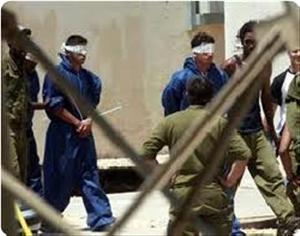
RAMALLAH — Palestinian human rights sources unveiled occupation efforts to deport a number of Palestinian prisoners from the occupied territories, after their release.
The Palestinian Prisoner Committee said in a press release on Monday, that the Israeli occupation intelligence service the “Shin Bet” is keeping five Palestinian prisoners in solitary confinement cells in Jalama prison, despite the end of their interrogation with them, with no charge.
The Committee stated that the court gave the occupation investigators from the “Shin Bet” one week to provide it with an indictment against the five detainees, if not the prisoners should be released. Thus, the intelligence officers proposed the prisoners an offer requiring their deportation for two years in exchange for their release.
The statement stressed the prisoners’ complete rejection of the deportation and their determination to stick to their position. The prisoners also called on all local and international human rights organizations to take urgent action and pressure on the Israeli occupation authorities to release them after being detained for two months without charge.
Meanwhile, the Israeli prison administration is imposing sanctions that include fines, solitary confinement and denial of visitation rights, against nearly two hundred Palestinian prisoners in Megiddo, the Negev, Jalama and Raymond detention centers.
“My major problem is that I have no faith in the current leadership, which must lead us into an event on the scale of war with Iran or regional war,” Diskin told the “Majdi Forum,” a group of local residents that meets to discuss political issues.
“I don’t believe in either the prime minister or the defense minister. I don’t believe in a leadership that makes decisions based on messianic feelings,” he added.
Diskin deemed Barak and Netanyahu “two messianics – the one from Akirov…and the other from…Caesarea,” he said, referring to the residences of the two politicians.
“Believe me, I have observed them from up close… They are not people who I, on a personal level, trust to lead Israel to an event on that scale and carry it off. These are not people that I would want to have holding the wheel in such an event,” Diskin said.
“They are misleading the public on the Iran issue. They tell the public that if Israel acts, Iran won’t have a nuclear bomb. This is misleading. Actually, many experts say that an Israeli attack would accelerate the Iranian nuclear race,” said the former security chief.
Considering that this was the fellow who ran Israel’s domestic security services during the entire reign of the current government, I’d say his dismissal of Netanyahu’s judgment and leadership is, or should be, a lightning bolt for Israelis. What’s more, Meir Dagan, the former Mossad chief has already voiced almost precisely the same views. Until now, Diskin had maintained a discreet public silence on the issues though it was common knowledge that he joined Dagan in opposing an Iran attack. This latest salvo will (hopefully) open the floodgates of criticism even farther.
Also, considering that neither the prime minister or defense minister are religious, attributing messianic motives to both should also be a warning. What is any leader, let alone one who doesn’t profess religious beliefs, doing falling back on such wild-eyed notions to govern national policy? Why does any leader believe his actions will save not just Israel, but the entire Jewish people?
These are the thoughts of megalomaniacs, not national leaders. And if they are national leaders they will lead to national catastrophe, rather than national salvation.
RAMALLAH – Head of the Palestinian Prisoners Society Qadura Fares said Saturday that Israeli media reports on the interrogation of Fatah leader Marwan Barghouthi failed to prove he confessed to any charge.
Israeli daily Haaretz on Friday reported that records of the leader’s questioning by Israeli internal security service Shin Bet show Barghouti giving partial confessions of his awareness of attacks on Israelis, and late President Yasser Arafat’s tacit acceptance of attacks.
Barghouthi — a revered political figure and former presidential candidate — was convicted by Israel of five counts of murder in 2004, but refused to present a defense, saying the trial was illegitimate.
Fares on Sunday questioned the timing and content of the Haaretz report, ten years after the interrogation took place.
“The Israeli security services, which failed to make Barghouthi give any confessions during four months of interrogation using the ugliest ways of psychological and physical torture, come today with false claims and baseless lies,” Fares said.
“If there were such confessions, the Israelis would have disseminated them at that time, and they would have used them for political gains,” he added.
“I challenge any Israeli service to show any document or paper of any kind signed by Marwan Barghouthi.”
French activists participating in the Welcome to Palestine campaign over the weekend accused Air France of racism on Tuesday after the airline asked passengers if they were Jewish as part of a strategy to prevent the activists from boarding.
“The racism of Israel and Air France was brought in plain light on Sunday…It was proven that one had to declare themselves Jewish or holder of an Israeli passport to have the right to travel,” the French contingent of Welcome to Palestine 2012 said in a press release on their website.
The activists noted the case of a passenger named as Horia, who had successfully boarded the plane, but was then asked by an air hostess whether she was Jewish before the flight had taken off.
An Air France employee signed Horia’s response on an official document (see below), and was then allegedly told by Air France personnel that she was prohibited to travel to Tel Aviv, according to activists.
Coordinator for the French chapter of Welcome to Palestine 2012, Maximilien Shahshahani, told Al-Akhbar that Air France was colluding with Israel’s secret service, Shin Bet, in determining which activists were not permitted to board Sunday’s flight to Tel Aviv.
“Shin Bit shared a blacklist of names with Air France, but told the airline to double check [others not blacklisted] with a series of questions,” he said.
The questions were also asked of other passengers, Shahshahani said, who were not participating in the Welcome to Palestine campaign.
“We saw another passenger, to which the same questions were asked. The response to the second question was that they were Jewish. The passenger was extremely shocked by the nature of the questions,” he said.
Air France in a statement issued on its website said Israeli authorities demanded that the airline question one of the passengers, without detailing what kind of questions were asked.
“The Israeli authorities requested that one of the passengers be questioned. The answers did not satisfy the Israeli authorities, the passenger had to disembark the flight at their demand,” Air France said.
Hundreds of activists, mostly from Europe, were due to fly into Tel Aviv international airport on Sunday as part of a global campaign to raise awareness of the restriction of movement and travel for Palestinians brought by Israel’s military occupation.
But, as in 2011, Israel threatened airlines that they faced sanctions if they did not prevent activists from boarding their flights, providing them with a list of names.
“You are ordered not to board them [activists] on your flights to Israel. Failure to comply with this directive will result in sanctions against the airlines,” a stern statement from Israel’s Ministry of Interior to airlines, obtained by activists, read.
Dozens still managed to board flights to Israel, with the official website for the French contingent of Welcome to Palestine saying that 40 French activists were detained upon arrival.
Preparations for legal proceedings against Air France are underway, Shahshahani said.
Welcome to Palestine has become an annual campaign, which is part of a growing international movement to highlight the continued suffering of Palestinians living under Israeli occupation and Israel’s apartheid policies.
An alleged Air France document showing questions asked of a passenger boarding a flight to Israel on Sunday 15 April 2012. (Photo: Handout – Welcome to Palestine 2012)
The Israeli government recently made permanent a temporary order – in force for 11 years – that permits the police to avoid documenting security interrogations, Haaretz has reported (Hebrew). Regular criminal interrogations are taped; that will not be the case in matters of suspected security violations. We can safely assume that once the police are allowed not to tape an interrogation, they will not tape it. It saves resources, for starters.
The government’s decision creates a practical distinction between the rights of criminal suspects and security suspects. Criminal suspects have the right to demand, if they are prosecuted, their recorded interrogation which, theoretically, can allow them to prove their confession was forced, or that the description given by the police of what happened in the interrogation room is incorrect. It is a theoretical right because no Israeli court has ever found that such a suspect was tortured – except in very few cases, and almost always after the victims had already been jailed for quite some time.
Security suspects have no such rights. Actually, there will be no independent documentation of their interrogations. The courts will have to take the police’s word for what happened in the interrogation room. This will make it much harder for the accused to prove they were tortured. The problematic history of the police forces prompts a clear conclusion: we will soon have a secret police, whether formal or informal, composed of interrogators whose specialty will be torture.
This has several implications. First, torture leads to more false convictions. It is their function: the torturer is not looking for the truth, he is trying to extract a confession and close the file, and he is indifferent to the question of whether the broken person before him (and breaking a person is what torture is intended to do) is guilty or not. The point of torture, noted Orwell, is torture.
Secondly, such units attract sadists. That the torturer suffers more than the tortured is a myth told to sooth those of anxious conscience. Those sadists will then move on to other positions in the system, taking their unique work ethic with them. Thirdly, the use of torture degenerates the interrogator’s mind. He gets used to thinking that some pain and humiliation will obtain the desired result, and forgets how a true interrogation ought to be carried out. Should one need an example of this process, it is readily available in the abysmal record of the ISA (aka Shin Bet) in fighting Jewish terrorism. If torture is not an option, they can’t get the job done.
Fourth, and most worrying, is the fact that such units tend to expand their activities. The excuse of “public safety” is very wide indeed. After the ISA was denied the right to torture except in the case of “ticking bombs,” there was a dramatic increase in the number of interrogations designated as such – even though the public was never supplied with a full and open description of a single ticking bomb case.
The police – which have for years served as an ISA auxiliary force, with a police interrogator writing down the confession extracted by the ISA officer from a Palestinian detainee as if it was given of his free will – now claims that taping such interrogations may expose “investigative methods.” That’s true. That, however, is also true in the case of criminal investigations. This is the price of the rule of law: it allows the suspect/accused the right to defend himself against the government, and that means that, from time to time, interrogations tricks are exhausted. That’s life. Deal with it. … Full article
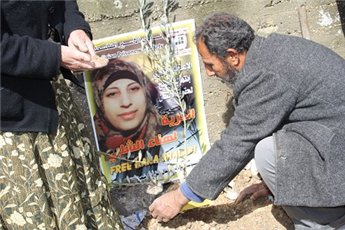
RAMALLAH – Hana Shalabi said Sunday that she will continue her hunger strike despite an announcement by Israel’s Ofer military court that her prison time will be reduced by two months.
Lawyer Fadi Qawasmi visited Shalabi on Sunday at Hasharon prison and informed her of the court’s decision to reduce her imprisonment time by two months.
Shalabi told him that she would continue her hunger strike protest in order to achieve her demands to end administrative detention.
She has been on hunger strike for 18 days and her condition is said to have worsened recently.
Addameer prisoners society says that Shalabi was issued a 6-month administrative detention order on Feb. 23.
Ofer military court refused Qawasmi’s request to call witnesses to speak about the assault of Shalabi during her interrogation, he said.
Qawasmi also requested that a Shin Bet representative, the military commander who led the arrest and the soldier who carried out the strip search on Shalabi be called to the stand.
The court refused his demands.
Lawyer from the prisoners society Jawad Boulos said on Tuesday that Israeli court officials claimed that the reason for Shalabi’s administrative detention is because she is considered a threat to Israel’s security and safety of its people.
They also claimed that she planned military actions right after she was released.
Hana Shalabi, from the northern West Bank village Burqin, is being held without charge since her detention on Feb. 16. She announced her hunger strike immediately after soldiers seized her from the family’s Jenin-district home.
Shalabi was freed in October 2011 when Hamas secured the release of more than 1,000 Palestinians in Israeli jails in exchange for a captured Israeli soldier.
She had spent 25 months in administrative detention, under procedures that allow Israel to detain Palestinians for renewable terms of six months without pressing charges, using laws dating back to the British Mandate period.
Israel is holding 309 Palestinians in administrative detention, according to figures by prisoners rights group Addameer. There are currently six Palestinian woman in Israeli custody.
The Public Committee against Torture in Israel (PCATI) has released a paper on its efforts to hold the Israel Security Agency (ISA) – or Shabak – to account for its practices of torture and ill-treatment of Palestinian detainees. In Accountability Still Denied, PCATI reveals how Israel has evaded criminal investigations into all 701 complaints of torture and ill-treatment.
In October 1991, Israel ratified the Convention against Torture and Other Cruel, Inhuman or Degrading Treatment or Punishment. Israel should therefore prevent acts of torture. No exceptional circumstances whatsoever may be invoked as a justification of torture, according to the Convention. According to article 4, Israel must ensure that all acts of torture, attempts to commit torture and acts of complicity or participation in torture are made punishable “by appropriate penalties which take into account their grave nature.” However, PCATI found that Israel has hitherto ignored its international obligations to halt torture.
Torture and ill-treatment of Palestinian detainees
Palestinian and Israeli human rights organizations have consistently reported about violations of the rights of Palestinian political prisoners. In its paper, PCATI presents a summary of two complaints on torture. In the case of Jihad Mughrabi the Shabak used physical force, beating the detainee’s head and chest with their fists and guns and kicking his legs. The violence produced bleeding wounds and the detainee lost consciousness while being tortured. He was taken to hospital. Shabak agents also exerted psychological pressure by showing Mughrabi detained family members. Mughrabi’s testimony is recorded on video.
Ala’a Salem also filed a complaint of torture suffered during Shabak interrogations. Ala’a was interviewed by Social Television to spread his story. The video is in Arabic with subtitles in Hebrew:
Habib Ph. Jaudy has translated what Ala’a said into English:
“They put me in jail for two days. Then they brought me back to the isolation cell and chained me.
Starting from there my treatment was beyond description. Naturally during this whole time I was forbidden to meet the lawyer.
I was placed on concrete, with my hands and feet in steel chains.
For the first period, after every eight hours of chaining they’d give me two and a half minutes of rest to eat and go to the toilet. But if you dare to ask to go to the toilet when you are chained [i.e. at a time other than your permitted two-and-a-half minute rest period], the eight hours would be extended to ten or even twelve hours of chaining as punishment.
At one time on the second day in the ‘hotel’ [this must be the interrogation place] there was a crazy Jewish person in the cell next to me shouting for 24 hours. So even if I was dying to sleep in my condition I couldn’t close my eyes. So I asked to go to the toilet, but in vain, I shouted but still in vain. (Video cut at that point.)
The reaction was that five soldiers came in and started hitting me. My nose was bleeding and blood came out of my mouth and I couldn’t do anything as I was chained. At that time I had tears running down my face … firstly because of the harsh pain and secondly because of the feeling that you can’t do anything about it.”
No proper procedure to investigate complaints
The majority of detainees who reported torture or ill-treatment to PCATI’s lawyers refused to submit complaints to the Israeli authorities. According to PCATI, the Palestinian detainees lack trust in Israel’s mechanism of investigation or fear reprisals.
Nevertheless, the Inspector of Interrogee Complaints (IIC) – who is an agent of the Shabak – received 701 complaints of torture and ill-treatment between 2001 and 2010. In 2009 and 2010 the IIC received 52 and 51 complaints respectively. PCATI informed me that the trend in the number of complaints continued in 2011.
Complaints of torture and ill-treatment have to be submitted to the Attorney General, who delegates a senior official within the State Attorney’s office to decide upon the complaints. Instead of opening a criminal investigation, the senior official refers the complaints for a preliminary inquiry to the Shabak Inspector of Interrogee Complaints. PCATI criticizes the inquiry:
Complainants’ testimonies are taken by the IIC during very brief and unannounced visits, It has been common practice for the IIC to falsely introduce himself as a representative of the Ministry of Justice, and complainants’ testimonies have been taken under conditions that replicate the interrogation itself: in the very same room where ISA interrogations take place, and, in some instances, while the complainants have remained shackled for the duration of the meeting.
No complaint of torture criminally investigated
Based on an analysis of its correspondence with the State Attorney’s Office, PCATI concludes that the majority of the complaints of torture and ill-treatment were closed because the authorities denied the facts. Fifteen percent of the complaints were closed because they were categorized under the “defense of necessity” doctrine. In 1999 the Israeli Supreme Court ruled that the Shabak is not allowed to use physical means of interrogation that are aimed at tiring out or breaking the detainee. The Court did “not negate the possibility that the ‘necessity’ defense be available” to Shabak investigators and empowered the Attorney General to devise guidelines for such “ticking bomb” cases. PCATI writes that these guidelines – issued in 1999 – have served “as the basis for de facto approval of methods of interrogation amounting to torture and ill-treatment in such cases, thereby granting ISA interrogators blanket exemption from prosecution.”
However, the Convention against Torture does not recognize such a “defense of necessity doctrine”. The Convention is unequivocal in its absolute prohibition of torture.
In addition, the Human Rights Committee concluded in July 2010 that Israel “should ensure that all alleged cases of torture, cruel, inhuman or degrading treatment and disproportionate use of force by law enforcement officials, including police, personnel of the security service and the armed forces, are thoroughly and promptly investigated by an authority independent of any of these organs, that those found guilty are punished with sentences that are commensurate with the gravity of the offense, and that compensation is provided to the victims or their families.”
PCATI writes that following the publication of its first report on the topic – Accountability Denied – in 2009, there have been no substantive changes in Israel’s practices of torture and ill treatment. The closure of all 701 complaints of torture and ill-treatment by Palestinian detainees proves that the Israeli authorities protect the perpetrators. Meanwhile, Israel’s violations of Palestinian political prisoners’ rights continues. That is why the BDS Movement must keep Israel under pressure, and human rights organizations, social movements, activists and concerned citizens must call on their politicians, governments and embassies to intervene
Job interviews for the position of imam at mosques in Israel are conducted not by senior clerics but by the Shin Bet, Israel’s secret police, a labour tribunal has revealed.
Sheikh Ahmed Abu Ajwa, 36, is fighting the Shin Bet’s refusal to approve his appointment as an imam in a case that has lifted the lid on Israel’s secret surveillance of the country’s Islamic leaders.
At a hearing last month, a senior government official admitted that 60 undercover inspectors were employed effectively as spies to collect information on Muslim clerics, reporting on political opinions they expressed in sermons and relaying gossip about their private lives.
Sheikh Abu Ajwa took his case to the tribunal after the Shin Bet rejected him three years ago as the imam of a mosque in Jaffa, next to Tel Aviv, despite his being the sole candidate. He was told after a security clearance interview that his views were “extremist” and too critical of Israel, even though an imam is not officially defined as a security-related position.
“During one interview with the Shin Bet, they told me they had been collecting information on me since I was 15,” Sheikh Abu Ajwa said.
“I am the first imam ever to challenge the Shin Bet’s role in our appointments. It’s important to win a precedent-setting ruling from the courts to stop this kind of interference.”
Michael Sfard, a human rights lawyer representing Sheikh Abu Ajwa, said that, as far as it could be determined, no similar vetting of rabbis took place before their hiring.
“This sort of surveillance relating to a non-security position like an imam comes straight out of the era of the Stasi police in East Germany or the McCarthy period in the United States,” he said.
The traditional independence of the local Islamic authorities was removed at Israel’s creation in 1948, when the government confiscated almost all waqf property — endowments of land and property used for the benefit of the Palestinian Muslim community — removing the main source of income for clerics, the Islamic courts and charitable services.
According to experts, as much as a fifth of Palestine’s cultivated land was waqf property before 1948. Israel passed most of it to Zionist organisations like the Jewish National Fund or sold it to developers.
Responsibility for hundreds of mosques, cemeteries and other holy sites, meanwhile, was handed either to the religious affairs ministry or to Islamic boards of trustees appointed by the government.
Today, most imams and all Islamic judges must submit to a security clearance interview before being awarded a state salary.
Israel’s Arab minority, one fifth of the population, have long charged that many of its Muslim leaders are little more than government placemen, whose Islamic learning takes second place to their co-operation with the authorities.
Sabri Jiryis, a historian of Israel’s early years, has noted that the boards of trustees repeatedly rubber-stamped government decisions to sell off Islamic property to developers. Most notoriously Jaffa’s board approved in 1971 selling an Islamic cemetery in Tel Aviv on which the Hilton hotel was built.
Sheikh Abu Ajwa said: “In Jaffa, the government appointed many clerics because they had proved their loyalty, though not to other Muslims. They sold off our property — but you can’t sell what belongs to Allah.”
Jaffa, which was once the commercial capital of Palestine, today has a population of nearly 50,000 residents, of which two thirds are Jewish and the rest Muslim.
The sheikh has been preaching at the seafront Jabalya mosque, one of six in the town, since he was 19, making him reportedly the youngest person to serve as an imam in Israel’s history. He qualified as an imam at an Islamic college in the Israeli Arab city of Umm al Fahm in 1998.
The local community universally backed him as the new imam when his predecessor retired three years ago, but he cannot be officially recognised, and is ineligible for a salary, without the interior ministry’s approval.
As part of his application, he was interviewed by a Shin Bet officer named “Dror” who, he said, waved at him a folder of confidential information collected by undercover inspectors. “We will decide who is the next imam,” Dror told him, according to Sheikh Abu Ajwa. The sheikh was asked mainly about his political opinions and demonstrations he had attended.
The Shin Bet’s assessment, revealed to the tribunal, was that Sheikh Abu Ajwa’s appointment “may jeopardise security and peace in Jaffa”. In addition, the agency told the Haaretz newspaper that the sheikh “has had a long involvement in hostile activity, which manifested itself in incitement against the state and its Jewish citizens”.
Sheikh Abu Ajwa said this was a reference to his position as the leader in Jaffa of the popular northern wing of the Islamic Movement. Its leader, Sheikh Raed Salah, has raised the hackles of Jewish officials both by running a campaign warning of Israel’s intentions to take over the Al Aqsa mosque compound in Jerusalem and by promoting a boycott of parliamentary elections.
The head of the Shin Bet, Yuval Diskin, warned in 2007 that his agency’s role was to prevent any activities, including democratic ones, that worked against the interests of a Jewish state.
Yaakov Salameh, the head of the religious minorities department at the interior ministry, told the tribunal last month that his inspectors collected information on Muslim religious leaders, including rumours about their private lives, such as whether they had had an affair or beat their children. The information was then handed to the Shin Bet, which assessed whether they were suitable to be appointed.
Mr Sfard said it was an “extraordinary” admission, given that under Israeli law the criminal records of candidates for religious appointments could only be considered if the applicant agreed to the information being handed over.
David Baker, a spokesman for the prime minister’s office, which is responsible for the Shin Bet, refused to comment on whether the appointment of rabbis followed the same procedures as those for imams.
Sheikh Abu Ajwa observed that many rabbis, particularly those in the settlements, said “very extreme things but no one spies on them. In fact, they have full government support.”
He admitted he was outspoken in his sermons, but said he had never broken any laws and never advocated violence. “I talk about our Palestinian identity and criticise the policies of the state in its treatment of us as a minority,” he said. “These are very sensitive things that they want to prevent us from talking about.”
During one Shin Bet interview, he said, he had been told: “We know everything about you, we are always watching you.”
The goal of such interviews was often to recruit Muslim clerics to become informers themselves, he added.
Living through five or six major wars has hardened me to what I thought were the extremes of inhuman cruelty and brutality.
Two things made those extremes almost bearable: the brutality always revealed – at least according to the media coverage – the viciousness of the enemy. It was therefore quite understandable when our “brave men and women” pulverized the enemy.
Films of Japanese torturing captive Americans somehow justified holding Japanese Americans in internment camps during World War II; and only a small percentage of Americans found the bombing of Hiroshima and Nagasaki unreasonably vengeful at best, at worst, depraved.
The media giants in America portrayed the North Koreans as barbaric beasts with their captives, quite unlike their southern counterpoints – our allies during the Korean War. No one ever felt the need to explain how the South Koreans were a civilized breed while the North Koreans were absolute savages, at least according to the official line.
In Vietnam, our warriors justifiably (or so the media made us believe) dropped napalm on the North Vietnamese who had the gall to hide in villages and tunnels to ravage our invaders. At least it was accepted practice until some rogue photojournalist filmed a young girl screaming down a Vietnamese road in flames. … continue
This site is provided as a research and reference tool. Although we make every reasonable effort to ensure that the information and data provided at this site are useful, accurate, and current, we cannot guarantee that the information and data provided here will be error-free. By using this site, you assume all responsibility for and risk arising from your use of and reliance upon the contents of this site.
This site and the information available through it do not, and are not intended to constitute legal advice. Should you require legal advice, you should consult your own attorney.
Nothing within this site or linked to by this site constitutes investment advice or medical advice.
Materials accessible from or added to this site by third parties, such as comments posted, are strictly the responsibility of the third party who added such materials or made them accessible and we neither endorse nor undertake to control, monitor, edit or assume responsibility for any such third-party material.
The posting of stories, commentaries, reports, documents and links (embedded or otherwise) on this site does not in any way, shape or form, implied or otherwise, necessarily express or suggest endorsement or support of any of such posted material or parts therein.
The word “alleged” is deemed to occur before the word “fraud.” Since the rule of law still applies. To peasants, at least.
Fair Use
This site contains copyrighted material the use of which has not always been specifically authorized by the copyright owner. We are making such material available in our efforts to advance understanding of environmental, political, human rights, economic, democracy, scientific, and social justice issues, etc. We believe this constitutes a ‘fair use’ of any such copyrighted material as provided for in section 107 of the US Copyright Law. In accordance with Title 17 U.S.C. Section 107, the material on this site is distributed without profit to those who have expressed a prior interest in receiving the included information for research and educational purposes. For more info go to: http://www.law.cornell.edu/uscode/17/107.shtml. If you wish to use copyrighted material from this site for purposes of your own that go beyond ‘fair use’, you must obtain permission from the copyright owner.
DMCA Contact
This is information for anyone that wishes to challenge our “fair use” of copyrighted material.
If you are a legal copyright holder or a designated agent for such and you believe that content residing on or accessible through our website infringes a copyright and falls outside the boundaries of “Fair Use”, please send a notice of infringement by contacting atheonews@gmail.com.
We will respond and take necessary action immediately.
If notice is given of an alleged copyright violation we will act expeditiously to remove or disable access to the material(s) in question.
All 3rd party material posted on this website is copyright the respective owners / authors. Aletho News makes no claim of copyright on such material.
 RAMALLAH — Palestinian human rights sources unveiled occupation efforts to deport a number of Palestinian prisoners from the occupied territories, after their release.

 Aletho News
 Aletho News