Who Is Juraj Cintula?
Is the man who tried to assassinate Slovak Prime Minister Fico really a “lone wolf”?
By John Leake | Courageous Discourse™ | May 16, 2024
The Telegraph and the Times of India have published profiles on the 71-year-old Slovakian poet, Juraj Cintula, who tried to assassinate Slovak Prime Minister, Robert Fico. The following is from the Telegraph report:
Juraj Cintula, a 71-year-old poet from the western town of Levice, posted online rants against Mr Fico before opening fire on the Left-wing nationalist at close range on Wednesday.
A photo of the writer published on X, formerly Twitter, showed him protesting against the government’s controversial reforms…
[Fico] is viewed as one of the EU’s most pro-Russian leaders after campaigning on a platform to end weapons donations to Ukraine.
In a post for the Movement Against Violence in 2022, Mr Cintula condemned Russia’s invasion of Ukraine. “What Slavic brotherhood?” he wrote, referring to Kremlin claims that Ukraine and Russia could be joined as they were essentially the same country. “He is only the aggressor and the attacked.”
A friend from Levice told Markiza TV that the pair had debates about politics, saying: “I’m more for Russia. He had different opinions.”
In 2015, Mr Cintula founded the campaign group Against Violence and sought to get it officially registered in Slovakia. “Violence is often a reaction of people, as a form of expression of ordinary dissatisfaction with the state of affairs. Let’s be dissatisfied, but not violent,” a petition circulated by him said.
… Unverified video footage emerged on Wednesday of Mr Cintula saying he did not agree with Mr Fico’s “government policy”. In another social media post, he criticised the Fico government for not cracking down on gambling.
The suspect’s political leanings appear to have shifted over time. He was once pro-Russian, and railed against “eyeless gypsies” and migrants before shooting the populist prime minister, who is fiercely anti-migrant.
I was surprised by how quickly the Slovak interior minister, Matus Sutaj Estok, characterized Cintula as “a lone wolf” who “did not belong to any political groups.”
It seems to me that no apparent political group affiliation does not necessarily mean that Cintula was not influenced or directed by someone else. Cintula’s online political rants in which he expressed strong emotions and shifting opinions could have flagged him as man who could be approached and influenced by an agent serving powerful interests. In this hypothetical scenario, Cintula may have fallen under the influence of an agent who presented himself under false pretenses.
Like many other reasonable people, I noticed that Prime Minister Fico has vocally criticized COVID-19 vaccines, endless shipments of weapons to Ukraine, mass immigration, transgender ideology, and climate change ideology. This makes him one of the few heads of state in Europe who has challenged all four articles of faith in what I call the Holy Quadripartitus of Piffle.
1). COVID-19 vaccines are saving mankind. Anyone who questions the safety and efficacy of the vaccines is guilty of heresy.
2). The U.S. proxy war in Ukraine is a sacred mission and no negotiated settlement with Russia shall be countenanced. Anyone who criticizes the Ukrainian and U.S. governments, and any attempt to understand the war from the Russian point of view, is guilty of heresy.
3). Human induced climate change will soon destroy the earth if trillions aren’t spent to overhaul our entire energy policy. Anyone who questions this proposition is guilty of heresy.
4). The concept of biological sex is a mere “construct.” Skilled surgeons and endocrinologists can transform a boy into a girl or vice versa. Anyone who questions this assertion is guilty of heresy.
Given the fervent belief in the Holy Quadripartitus—the Nicene Creed of the vaccine cartel, arms dealers, money launderers, lobbyists, racketeers, and child butchers—it is a matter of certainty that Prime Minister Fico has a vast array of powerful enemies.
In Slovakia, the lone gunman strikes again
By Stephen Karganovic | Strategic Culture Foundation | May 16, 2024
The “lone gunman,” that cartoonish figure that for the last several decades – at least since November 1963 – has regularly framed most high-profile assassinations, has struck again, this time in disobedient Slovakia. He always pops up whenever his presence is required to warn misfits and discipline even team players who are inattentive to their tasks.
The assassination attempt on the Slovak Prime Minister Robert Fico fits that pattern. Fico’s political record going back for decades may have provoked a measure of distrust in globalist circles. However, his electoral victory and return to power in the fall of last year probably would have been treated as a manageable challenge had Fico been rotten enough to act as his colleagues routinely do, saying one thing before elections and doing the opposite afterwards.
He has, instead, turned out to be a man true to his word, certainly quashing any rumours that he had ever been recruited as one of WEF’s Young Leaders. At a critical juncture for the globalist string-pullers, when being a cooperative team player is considered de rigeuer, he chose to go off the beaten path with other outcasts like Victor Orban and to champion old fashioned values, such as Slovakia’s national sovereignty.
Fico however did not just insist on Slovakia’s sovereignty, which would have been bad enough, but also on other despised notions, equally discredited in present-day Europe: Statehood, Nationhood, Religion, and Family. It is his adherence to those values, once the cornerstone of the European civilisation before its cultural implosion, that made Fico a lone gunman target.
But to these shortcomings several other, no less bothersome and also potentially life threatening faults, should be added. Over the last several months, as Project Ukraine was turning into a shipwreck, Fico defiantly refused to allow military aid for the Kiev regime, called for cancelling anti-Russia sanctions, and repeatedly expressed the prohibited notion that Ukraine will be defeated.
As if that were not enough, there is more. In a long-forgotten tragedy in 2006, a Slovak aeroplane mysteriously crashed whilst flying back from Kosovo. On board, in addition to Slovak peacekeepers, there was a most interesting cargo. Slovakian specialists and forensic experts were involved in the exhumation of several mass graves in Kosovo where Serbian victims had been buried and they were bringing the evidence back home. It turned out that many of those victims exhibited thorax incisions which strongly suggested that they had been used as unwilling organ donors by Albanian traffickers. Readers whose memory is still unimpaired will recall the controversy about human organ extraction and trafficking in Kosovo that raged at the time, culminating in the incriminating 2010 report on this topic submitted to the EU by Swiss investigator Dick Marty.
The Slovak team handed a set of the evidence it had unearthed to NATO, of which Slovakia had by then become a member. But just to make sure that their findings would not disappear in some NATO black hole, they took the precaution of carrying an extra set home with them. That evidence was on board the aeroplane that inexplicably crashed and it perished along with about 40 Slovak personnel whose mouths concerning their gruesome findings in Kosovo were thus forever sealed.
As custom ordains in such situations, a hasty and superficial investigation was conducted by Slovak authorities, its conclusions were declared a state secret, and then sealed.
Five years ago, the 2006 plane crash again was in the limelight as new evidence emerged that the event may not have been an accident after all because of an explosive device that was placed on board. The Slovak parliament opened an inquiry into the matter which Robert Fico wholeheartedly and publicly supported.
In addition to his more recent gaffes, that also must have been a huge strike against him.
Predictably, responsibility for the shooting was instantly attributed to a lone individual who allegedly bore Fico a political grudge and decided to kill him. How that risible, Jack Ruby-type explanation will pan out, we may soon see as Slovakian authorities press their inquiry.
But irrespective of what Slovakian investigators uncover and how much of it their NATO overlords allow them to publish, certain preliminary conclusions about this ghastly attempted murder may still be drawn. Based on the totality of past experience, these conclusions are bound to be ultimately corroborated and will most certainly withstand the test of time.
The gangster hit on the Slovakian Prime Minister will have had its intended effect whether he survives or not. It was an intimidatory message sent loud and clear to all concerned not even to think of challenging the rules based order. The nature and reach of the “rules” as pertaining to them was made starkly clear the other day in Slovakia. As the position of the collective West crumbles, all European leaders who might be thinking of flip-flopping or asserting their nations’ interests in preference to obediently following orders have been put on notice. If Robert Fico was vulnerable, so are they. And this applies not just to pathetic excuses for national leaders who are presently in office, but also to those aspiring to replace them. More widely, the attempted murder of Robert Fico sends a message to outstanding non-political public figures of many profiles, such as Archbishop Vigano, whose bold statements, coherent analyses, and compelling appeals to the public threaten to collapse the manufactured consensus.
Slovak government blames assassination of Robert Fico on opposition parties and liberal mass media
By John Cody | Remix News | May 16, 2024
Following the assassination attempt on Prime Minister Robert Fico, the ruling government is pinning the blame for the heinous and anti-democratic attempted murder on the opposition and dominant left-wing media.
“You have made us all targets,” said Ľuboš Blaha, the deputy speaker of the Slovak parliament, and a member of Fico’s Smér party, during a heated press conference. “You have spread a haunting hatred for years. You hated that people elected us so much that you went after us like wild animals. These are the fruits of your labor. The prime minister is fighting for his life because of you.”
He noted that “liberal media” had whipped up hatred of Fico related to his commitment to nationalist politics and his desire to end the war in Ukraine with a negotiated ceasefire.
The country’s interior minister, Matúš Šutaj Eštok, further noted that the constant media and opposition attacks on Fico helped fuel the climate that led to his attempted assassination, including the use of dehumanizing language.
“I am asking all of you to stop piling on the attacks and expressions of hatred that are directed at one political camp or another. From what was unleashed and many of you sowed, a storm arose today. And we are slowly standing on the threshold of civil war,” Minister Šutaj Eštok told journalists.
Fico was shot by a 61-year-old assailant in Handlová, central Slovakia, with the alleged far-left political activist and writer immediately arrested by the police. Slovak media reports that several gunshots hit Fico, who was operated on for a total of seven hours following life-threatening gunshot wounds.
The suspect, Juraj C., has been said to be a pro-Western liberal angered that Fico was shuttering one of his favorite television channels.
“The investigation is still ongoing. But I can openly say that this assassination was politically motivated and the perpetrator’s decision was made just after the presidential election,” said Interior Minister Šutaj Eštok, according to news outlet Irozhlas.
Other politicians also called for the hatred coming from the left to end now before it fueled more bloodshed.
“It’s hard to find words at this moment because Slovakia has never been confronted with this situation before. I call for us to stop this hatred,” said Deputy Prime Minister Robert Kaliňák.
While Fico was still lying on the operating table fighting for his life, the same Slovak media and opposition attempted to place the blame for the shooting on Fico himself.
“This type of politics practiced by Fico, ex-prime minister Igor Matovič, Andrej Danko, and Ľuboš Blaha has long been a prototype of hateful rhetoric. It’s a whole list of politicians who sowed hatred and used the lowest forms of personal attacks,” said sociologist and ex-prime minister Iveta Radičová, during a broadcast on Czech Radio Plus.
The government office reported that Fico was transported by helicopter to the hospital in Banská Bystrica, where he arrived at approximately 4:00 p.m.
The operation was reportedly successful, and there are reports that Fico is currently in stable condition. However, it is unclear what his prognosis is, what kind of permanent damage he may have suffered, and whether he will be able to perform his duties as prime minister at a later date.
NATO member explains why it will bar Ukraine from joining
RT | April 17, 2024
The risks of a global war will only increase if Ukraine becomes part of NATO, Slovakian Prime Minister Robert Fico said on Tuesday, promising to block Kiev’s accession.
Accepting new countries into the US-led military alliance requires unanimous consent from all of its 32 current members. If Ukraine gets invited to join NATO, Slovakia’s parliament will not ratify the accession treaty, Fico said.
“Slovakia needs a neutral Ukraine. Our interests will be threatened if it becomes a NATO member state because that is the basis of a large world conflict,” the prime minister explained, as quoted by the news website Noviny.sk.
Fico stressed that he will not bow down to any outside pressure. “Our partners abroad have been taught that whatever they ask and request from Slovakia, they will automatically get it. But we are a sovereign and self-confident country,” he said.
Slovakia, together with neighboring Hungary, has warned that the EU should not be dragged into the conflict between Russia and Ukraine and has insisted on a diplomatic resolution. After becoming prime minister in October 2023, Fico reversed the previous government’s decision to send weapons to Kiev. He also fiercely opposes sending NATO troops to Ukraine.
Ukraine formally applied to join NATO in September 2022. Although US Secretary of State Antony Blinken reiterated this month that Ukraine “will become a member of NATO” sometime in the future, the alliance has so far refused to commit to a specific timetable or provide a clear pathway for Kiev’s accession. US President Joe Biden and NATO Secretary General Jens Stoltenberg have ruled out Ukraine’s membership until the fighting ends.
Russia has repeatedly stressed that it views NATO’s continuing expansion eastward as a national security threat. Moscow cited the alliance’s military cooperation with Ukraine as one of the root causes of the current conflict and described Ukraine’s potential accession as a “red line.”
Pellegrini’s Win in Slovakia’s Won’t Allow EU to Drag It Into Conflict Against Russia
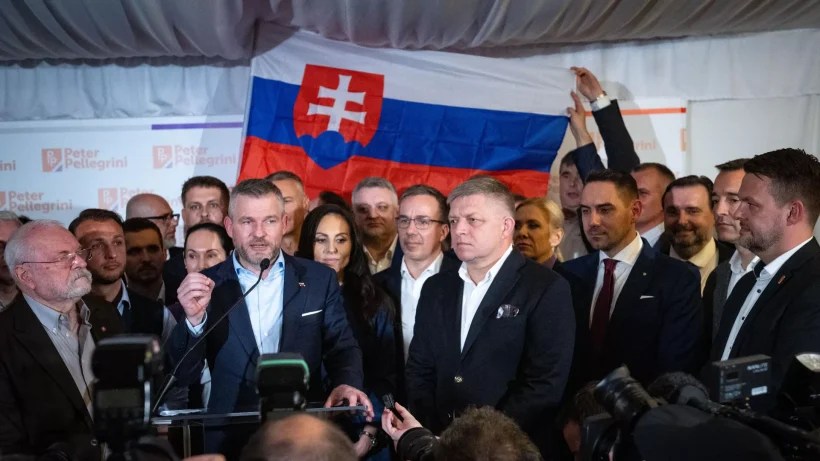
Peter Pellegrini (L) and Slovak Prime Minister Robert Fico (R) after the announcement of Pellegrini’s victory in the Slovak presidential elections, April 6, 2024.
By Svetlana Ekimenko – Sputnik – 07.04.2024
Slovak parliamentary speaker Peter Pellegrini, who shares prime minister Robert Fico’s staunch opposition to continued arms supplies to Ukraine, won the second round of Slovakia’s presidential election. Pellegrini and Fico’s left-wing opposition to the Russo-Ukraine war proved to be a winning formula.
In Peter Pellegrini Slovakia will finally have a president who does not support the pro-Western position and was not “installed by the Americans,” political observer Peter Marcek told Sputnik.
“There will be coordination between the government of the Slovak Republic [led by] Robert Fico and President Peter Pellegrini, because they have one program, one direction,” he remarked.
According to Marcek, “both Fico and Pellegrini share the idea that no Anglo-Saxons should be able to dictate to us what we should do.”
Washington pursued its own goals by pushing Pellegrini’s main rival, former foreign minister Ivan Korcok, for the presidency, argued the expert, in an effort “to subordinate our will exclusively to their hegemony.”
Pellegrini, an ally of Fico, won the presidential election with 53.26 percent of the vote versus Korcok’s 46.73 percent, following declarations from 99.66 percent of voting districts.
Pellegrini said his victory meant the government would not have to face an “opposition, opportunistic power centre.” He vowed that he would “be a president who will support the government in its efforts for improving people’s lives.”
Pellegrini, 48, has Italian ancestry. He previously served as Slovakia’s prime minister from 2018 to 2020 and Minister of Health from 2019 to 2020. He also had a two-year stint as speaker of the National Council from 2014 to 2016. Pellegrini, formerly a member of Direction – Social Democracy, left that party to found Voice – Social Democracy in 2020.
The politician returned to the position of Speaker of the National Council after the 2023 parliamentary election. His Voice – Social Democracy party came third and became part of the three-party ruling coalition with PM Robert Fico’s SMER-SSD (Direction-Slovak Social Democracy) and the Slovak National Party.
Pellegrini announced his intention to run for president in January. He came second in the first round of voting in March, with 37.03 percent, trailing former Korcok who won 42.52 percent of the vote. But Pellegrini scooped up the floating voters to clinch the second round.
Commenting on the Fico and Pellegrini long-standing political alliance, Marcek pointed out that “When the government passes laws and the president can veto them, it creates problems.” But now the president and the prime minister will be on the same page.
“Pelligrini will be a president who will work well with Fico. They said at a press conference after the elections that they would support each other. They will cooperate very well this way,” said the pundit.
In Slovakia, the government holds most of the executive powers, such as picking the prime minister after parliamentary elections, swearing in the new government, and appointing Constitutional Court judges. The role of president is largely ceremonial, but includes ratifying international treaties, appointing top judges and acting as commander-in-chief of the armed forces — and has the power to veto new laws.
Bratislava can no longer support the West’s anti-Russian course, noted Marcek, who welcomed the “clear victory of Pellegrini.”
“I think that many relations, for example, with the Russian Federation, can improve. We need to develop our mutual relations,” stated the former deputy of the Slovak parliament.
“I am grateful to Russia because it is not just fighting for itself, to prevent NATO from approaching the borders of the Russian Federation,” Marcek stressed. “Russia is fighting for us all, for the traditional family values, for improving the economic situation in the world. For good relations, and most importantly — for peace and justice.”
Fico’s government has been determined to chart an independent course against NATO’s proxy war against Russia in Ukraine.
Echoing his Hungarian counterpart Victor Orban’s stance, Fico has opposed confrontation with Russia, and urged an end to military aid to Kiev. Hungary and Slovakia are the only two EU and NATO members to refuse to send arms to Ukraine.
“Peter Pellegrini hails from Robert Fico’s party, he is a social democrat, and shares the PM’s ideas and views. This means that he is in favor of ending the conflict in Ukraine and starting negotiations between Kiev and Moscow,” Marcek said. “He is against sending weapons to Ukraine, opposes such vast quantities of EU aid being sent to Kiev.”
Pellegrini stated in an interview in March that the Slovak government had a realistic position on the conflict, and voiced surprise that some countries refuse to respect Slovakia’s approach. He added that Slovakia is ready to help the Ukrainian side in demining territories and implementing civilian projects.
The president-elect believes that the conflict in Ukraine has no military solution, advocates early peace negotiations and believes that arming Ukraine could ultimately lead to disaster.
Most Slovaks want “a president who will defend Slovakia’s national interests, who will not drag Slovakia into a war but will talk about peace, who… will put Slovakia’s interests first,” Pellegrini said.
In contrast, Pellegrini’s opponent Korcok, said: “I do not think Ukraine should give up part of its territory to achieve peace.” He told reporters that “Peace cannot mean capitulation,” and could only be achieved “immediately” on the condition that Russian troops withdraw.
Fico responded by calling Korcok a “warmonger” on video ahead of the run-off. He claimed Korcok “will support everything the West tells him without hesitation, including dragging Slovakia into the war.”
But both Pellegrini and Korcok have reiterated that they would not allow the Slovak military to be sent to Ukraine.
“Slovakia has made a decision that it will not send a single soldier to Ukraine in any event. And this is despite the criticism of this sovereign position of ours. On the contrary, we will insist that the only way to end the bloodshed is to have courage to begin peace talks between the warring parties,” Pellegrini said after a meeting with Orban.
On issues such as NATO membership for Ukraine, however, the two rivals took opposing stances. Korcok insisted that the final decision on Ukraine’s membership in NATO will be made by members of the alliance if the Ukrainian side meets the necessary requirements.
But Pellegrini was adamant that there is no place for Ukraine in NATO, giving an unequivocal “no” to the question during a pre-election debate on the Markiza TV channel.
“NATO, in my opinion, is the most aggressive group of armies, that only exist to foster wars all over the world, spearheaded by the United States. And Peter Pelligrini will absolutely not agree with this,” Marcek said.
Asked how Pellegrini’s victory could affect European Union policies and if Slovakia might use its veto on issues such as aid to the Kiev regime, the political analyst said that Slovakia now had “new opportunities.”
“We will not give up the veto power to anyone,” Marcek insisted. “This is our right, even though we are a small country. Together with Viktor Orban, 100 percent we will not cede this to anyone.”
Marcek slammed European governments that were “pro-American, pro-Brussels,” adding that “They are for war against Russia.”
“Macron still wants to send soldiers to Ukraine. The government in the Czech Republic wants to continue the war, but the citizens do not,” he said. “We say, ‘We shall have none of this’.”
Why Slovak Wildcard Robert Fico Could Bring EU House of Cards Crashing Down
By Ilya Tsukanov – Sputnik – 21.03.2024
Slovak Prime Minister Robert Fico has found himself in the crosshairs of Eurocrats worried that he may become the next Viktor Orban -a thorn in Brussels’ backside rejecting EU directives on everything from Ukraine to criminal justice reform. Sputnik asked Slovak politician Peter Marcek what it is about Fico that’s so unnerving to the establishment.
Slovaks will go to the polls Saturday for the first round of a highly anticipated presidential election, six months after a snap parliamentary vote in September saw veteran Direction – Social Democracy leader Robert Fico’s return to the prime minister’s chair.
While Slovakia’s presidency carries a largely symbolic function, the president does have the power to appoint key figures, including the prosecutor general, and can help the government in times of crisis, making the post an important one.
The latest polling shows Peter Pellegrini, a Fico ally from the offshoot Voice – Social Democracy party, and independent former ambassador to the United States Ivan Korcok running neck and neck with between 34 and 38 percent support each, guaranteeing a runoff between them in the second round of voting April 6.
Thelooming vote has spawned a spate of articles in European legacy media bashing Fico and his party, attacking him as a left wing populist analogue of Hungarian right wing populist Viktor Orban and the Fidesz party, and fearmongering about Slovak “democracy’s future,” Pellegrini’s supposed “Russia tilt,” and Bratislava’s alleged “democratic backsliding.”
All these reports have one thing in common: dread at the prospect that Fico and his allies will pursue an independent foreign and domestic policy which threatens the interests of Brussels and the United States.
Headache for Brussels
From Ukraine arms aid (which Fico halted last October) to Kiev’s NATO membership bid (which he has promised to block), to Bratislava’s defense pact with Washington (whose terms Fico has expressed dissatisfaction with) to the launch of an independent inquiry into the EU’s authoritarian pandemic policy, to criminal code reforms slammed by Brussels, Fico has already proven a major “headache” for the West. And that’s just for openers.
“Robert Fico has been in office for only four months, but he has begun to implement the right policies. He has begun to pursue policies for his people, for his country,” Peter Marcek, a former Slovak lawmaker, businessman and the chairman of the Slavic Unity party, told Sputnik.
“He refused to support Ukraine, stopped the supply of weapons to Ukraine, agreeing only to humanitarian assistance and saying that Slovakia would only provide such aid. Fico also doesn’t agree with many of the economic laws adopted by the European Union – which are adopted to benefit the EU itself, rather than its members,” the politician said.
Fico has already managed to get into trouble with the bloc in the course of his short time in office, Marcek said, pointing to Brussels’ threats to cancel the transfer of €1 billion in funds to Bratislava over the prime minister’s legal reform agenda. “They must give this money to Slovakia because it belongs to us. If they don’t… they will make people even more against the European Union. Fico has said that if they behave like this, the result can be only one thing – that Slovakia will exit the European Union, because economically our standard of living is getting worse and worse.”
“When sanctions were introduced against Russia, it did not kill the Russian economy, maybe only creating problems at the very start, but Russia was able to find other markets. We bought oil and gas from Russia at reasonable prices, now we pay the Americans four times more. Our standard of living has dropped significantly,” Marcek explained.
“If the European Union continues its current policy, we will soon leave it. Things simply cannot continue like this, and I think everyone sees it. For example, we have to pay €22,000 for each migrant that we did not accept into our country. What if they tell us that our quota for migrants is 300,000 people? Do the math: that’s 300,000 x €22,000. Instead of allocating this money to pensioners, children, families, will we give it to migrants? Why should we accept immigrants from Africa when we were never colonizers?” the politician asked.
Brussels’ self-serving policies have people from across the EU up in arms, Marcek said, pointing to the rising popularity of both right and left populist, Eurosceptic forces across Europe, and the “major farmer protests” in Austria, France, Germany and even Spain.
Amid the chaos, the EU will have to change its policy, “or the EU will collapse.” It’s as simple as that, the observer believes.
Marcek expects elections to the European Parliament in June to bring a new crop of leaders who seek greater national autonomy against EU institutions which don’t benefit their countries.
As for Slovakia’s upcoming presidential vote, Marceck says Pellegrini will be likely to defeat “pro-American Korcok,” and replace the current president, Zuzana Caputova, who “has created many problems for the government” and prevented its normal functioning. “She is a president that was installed by the US embassy,” the politician summed up.
Sending NATO soldiers to Ukraine is “apocalypse warning,” says Slovak prime minister
By Ahmed Adel | March 5, 2024
The Prime Minister of Slovakia, Robert Fico, said on March 2 in a video posted on social media that sending soldiers from the European Union and NATO to Ukraine could precipitate a global apocalypse. The social media post was made on the same day that the Slovakian foreign minister met with his Russian counterpart Sergey Lavrov.
Fico also highlighted Ukraine’s inability to resolve the conflict despite the West’s substantial financial and military aid. He emphasised that an EU and NATO military presence in Ukraine could potentially alter the dynamics of the conflict and trigger catastrophic consequences.
“The West sees that, despite significant financial and military aid, Ukraine is incapable of resolving this armed conflict,” said the Slovak prime minister, adding: “The situation could change with the arrival of EU and NATO military personnel in Ukraine, but then there would be nothing left but to wait for the arrival of the global apocalypse.”
Fico highlighted the pressing need for modern air defence systems for Ukraine but warned that the West could not provide these systems without a commitment to maintaining and operating this equipment. He argued that sending Western military personnel would only worsen the conflict rather than resolve it.
French President Emmanuel Macron said on February 27 during a conference of European leaders that he does not rule out sending troops from Western allies to Ukraine and announced a coalition to deliver missiles to the Ukrainian Army.
“There’s no consensus today to send in an official, endorsed manner troops on the ground. But in terms of dynamics, nothing can be ruled out,” declared Macron.
However, several NATO members, including Slovakia, ruled out the possibility of on-the-ground support for Ukraine which has been in armed conflict for more than two years.
It is recalled that on February 26, Fico warned when speaking ahead of a meeting of EU and NATO national leaders in Paris that several EU and NATO members are considering military deployments to Ukraine. He cited a “restricted document” listing topics to be discussed in Paris that “sends shivers down your spine.”
“These topics,” the Slovak said, “imply that a number of NATO and EU member states are considering sending troops to Ukraine on a bilateral basis. I can’t say for what purpose or what they would do there.”
According to Fico, “This [Paris] meeting is confirmation that the Ukraine strategy of the West has completely failed.”
Macron’s statement was intended to send a strong warning to the Kremlin, but it failed miserably since his comments revealed Western divisions and disagreements instead. German Chancellor Olaf Scholz led the group of European leaders who disagreed with Macron’s claim that NATO had not ruled out sending troops, whilst Washington abandoned Paris in the idea of sending troops and let the French president receive all the flak.
A survey of 12 European Union countries, commissioned by the European Council on Foreign Relations and published on February 21, reveals that only 10% of respondents believe Ukraine can defeat Russia. Furthermore, only 31% of respondents favoured Europe supporting Ukraine until it regained lost territory, while 41% favoured Europe pushing Ukraine to negotiate a peace agreement with Russia.
Unlike many of his European counterparts, Fico acknowledges the reality that Ukraine cannot win the war with Russia. For this reason, Fico sent Foreign Minister Juraj Blanar to hold talks with his Russian counterpart on March 2 on the sidelines of a diplomatic forum in Turkey, a rare high-level encounter between a European Union member state and the country Brussels has attempted to isolate.
The Slovakian prime minister highlighted that the meeting “was an example of our balanced and sovereign [foreign policy],” adding that Blanar and Lavrov spoke about the possibility of a Ukraine peace summit in Switzerland.
For his part, Blanar said in a statement that the war did not have a military solution and urged peace talks. The foreign minister added in the statement that he told Lavrov that Slovakia was against creating an “iron curtain” between Russia and the EU, and its position was based on respect for international law principles, such as territorial integrity and sovereignty.
Fico returned to power after winning an election in 2023 on promises to stop state military aid to Ukraine and has been critical of anti-Russia sanctions. The leftist populist leader also recently said the West’s approach to the Ukraine war is “an absolute failure,” which, as observed by the European Council on Foreign Relations survey, is what most EU citizens also believe. Fico joins Viktor Orban, prime minister of neighbouring Hungary, in resisting major pressure from Brussels and Washington to relent on their efforts to normalise with Moscow, and his actions once again demonstrate the fractures in the EU and NATO.
Ahmed Adel is a Cairo-based geopolitics and political economy researcher.
Italy to withdraw its air defense system from fellow NATO state
RT | March 3, 2024
Italy plans to withdraw its SAMP/T surface-based air defense system from Slovakia, according to media reports on Saturday, citing Prime Minister Robert Fico.
The system in question was temporarily deployed to Slovakia last year to replace the US Patriot anti-aircraft system, which the country transferred to Ukraine.
“I received a notice from the Italian government that the Italian air defense system, which they lent us for a year, will be withdrawn from Slovakia, because they need it elsewhere,” Fico was cited as saying, without elaborating on where exactly the system will be transferred next. The prime minister expressed concerns regarding his country’s security once the system is removed, as Slovakia currently has no alternative to protect its air space.
“First, the previous government donated a functional massive Russian S-300 air defense system to Ukraine. Then we had American Patriots here for a while, they were also removed, and now the Italian [system] will also be taken away.”
The wisdom of Slovakia sending military aid to Ukraine at the expense of its own security was also recently questioned by the country’s newly-appointed defense minister, Robert Kalinak. In an interview with the newspaper Standard in January, the official accused the previous government of surrendering key military hardware to Ukraine without making plans to secure replacements, noting that it would likely take years to fix the damage done to national security.
Upon being elected in September last year, Fico, an outspoken critic of the Western approach to the Ukraine conflict, halted Slovakia’s military aid to Kiev. In a video statement on social media last month, he also pledged not to send Slovak troops to Ukraine, even if it costs him his premiership.
NATO Countries Did Not Make Decision to Send Their Military to Ukraine – Polish President
Sputnik – 26.02.2024
WARSAW – NATO countries disagree on sending their military to Ukraine and have not made a decision to do so, Polish President Andrzej Duda said on Tuesday.
On Monday, Slovak Prime Minister Robert Fico said that several EU and NATO countries are considering the possibility of sending their military to Ukraine on the basis of bilateral agreements.
“If we are talking about providing specific assistance, then individual countries decide what kind of assistance they specifically provide to Ukraine. There was a heated discussion about sending soldiers to Ukraine, and there was no absolute mutual understanding on this issue. There are different opinions. But I want to emphasize that there are absolutely no such decisions,” Duda told reporters after the end of a conference on supporting Ukraine, held in Paris.
French President Emmanuel Macron added that “nothing can be ruled out,” commenting on the possibility of sending NATO troops to Ukraine.
Some EU, NATO States Ponder Possibility of Sending Military to Ukraine – Slovakia’s Fico
Sputnik – 26.02.2024
BRATISLAVA – Some EU and NATO countries are mulling over the possibility of sending their military to Ukraine on the basis of bilateral agreements, Slovak Prime Minister Robert Fico said on Monday.
Later in the day, Paris will host a meeting where members of the EU and NATO will discuss the situation in Ukraine.
“For me, today’s meeting [in Paris] is confirmation that the West’s strategy in Ukraine has failed, but I want to be constructively prepared for it … It follows from these arguments that a group of NATO and EU countries are considering [the option] to send their military to Ukraine on the basis of bilateral agreements,” Fico told reporters after a meeting of the government and the security council.
Possible deployment of the EU and NATO military to Ukraine will not allow them to achieve concessions from Russia, but will only lead to an escalation of the conflict, the prime minister said.
Slovakia is not planning to send its soldiers to Ukraine, Fico added.
Letting Ukraine into NATO is ‘basis for World War Three’ – Slovakia
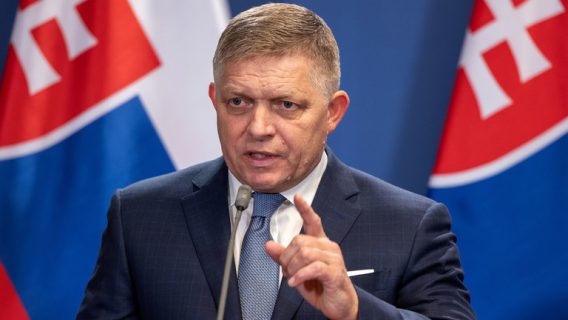
Prime Minister of Slovakia Robert Fico. © Getty Images / Janos Kummer
RT | January 20, 2024
Bratislava will block Kiev’s bid to join the US-led NATO alliance and will stand by a decision to stop supplying weaponry to Ukraine amid its conflict with Russia, Prime Minister of Slovakia Robert Fico has said.
The PM made the remarks on Saturday ahead of his visit to Ukraine to meet his counterpart Denis Shmygal in the western Ukrainian city of Uzhgorod. Fico stressed that his visit serves solely “humanitarian” purposes and promised to openly communicate Bratislava’s stance to Kiev on different issues, including Ukraine’s potential accession to EU or NATO membership.
“I will tell him that there are things on which we have completely different opinions,” Fico told broadcaster RTVS. “I will tell him that we respect them when it comes to joining the EU, but they must fulfill the conditions,” he added, explaining that a situation where “a country that absolutely does not meet any requirements” joins the EU is unacceptable.
He ruled out any possibility of Ukraine joining NATO, insisting such a move would only result in a global catastrophe, apparently caused by a direct collision between NATO and Russia over the issue.
“I will tell him that I will veto and block [a NATO bid by Ukraine] because that is exactly the basis of the third world war and nothing else.”
Fico also promised to reiterate to Shmygal his election campaign pledge to stop providing Kiev with weaponry, stating that the decision remains in force. Still, the weapons restriction applies only to state-sponsored military aid to Ukraine and supplies coming from Slovak military stocks, whereas arms manufacturers are free to sell to the country whatever they like, he noted.
“When Slovak companies don’t make money, American ones will,” Fico noted.
Prior to Fico assuming office following his party’s electoral victory in September, Slovakia had been among Kiev’s top supporters, lavishly supplying it with sophisticated weaponry, including warplanes and anti-aircraft systems. The policy of the previous government has also left the country’s own defense posture badly damaged, new Defense Minister Robert Kalinak claimed earlier this week.
“The former government left us without our own anti-aircraft defenses, without combat aviation, and we don’t even have the promised 700 million for MiGs, which the government also handed over to Ukraine,” Kalinak told the Standard newspaper.
Slovakia Stripped of Air Defense, Fighter Jets After Aiding Ukraine
RT | January 19, 2024
Slovakia’s continuous military aid to Ukraine under the previous government has left the country’s own defense posture badly damaged, with “years” now needed to fix it, new Slovak Defense Minister Robert Kalinak has said.
The minister, who assumed office back in October under the new government led by Prime Minister Robert Fico, accused his predecessors of simply surrendering key military hardware to Ukraine without coming up with any plan to secure their replacements. The defense ministry has effectively been run by “people with qualities of pugs rather than wolves,” Kalinak told the Standard newspaper on Thursday.
“The former government left us without our own anti-aircraft defenses, without combat aviation, and we don’t even have the promised 700 million for MiGs, which the government also handed over to Ukraine,” Kalinak stated.
Now, the country is seeking to negotiate with its “partners” to ensure that “Slovakia’s air defense will be provided by NATO allies,” he said. The country is now risking being left without any air defenses, with the US Patriot anti-aircraft systems withdrawn from its soil late in 2023, while hosting the Italian SAMP/T systems may also end this year, Kalinak warned.
It will likely now take “years” to fix the damage done to the country’s security, the minister said, squarely blaming the situation on his predecessors. For instance, the new government will unlikely be able to come up with a replacement for S-300 anti-aircraft systems during its tenure. “Maybe towards the end of the term of office, but I only hope so,” he said.
“It was absurd overwork by [then-Defense Minister Jaroslav] Naď and his people at the ministry. After all, we were not the only allies who had the S-300, which Ukraine was interested in. Why didn’t the Greeks give it? Why didn’t the Bulgarians give it? These were outrageous decisions by Naď and [then-PM Eduard] Heger, which have no parallel in any sovereign country,” Kalinak stated.
Following his party’s electoral victory in September, Fico immediately halted the country’s military aid to Kiev, as well as pledged to block Ukraine’s potential accession into the US-led NATO bloc. The new PM has repeatedly criticized the Western approach to handling the Ukraine conflict, arguing that the enduring support of Kiev turned into a “futile waste of human resources and money,” which only prolongs the hostilities and fills Ukrainian cemeteries with “thousands of dead soldiers.”
“I will no longer be subject to stupid liberal and progressive demagoguery. It is literally shocking to see how the West has repeatedly made mistakes in assessing the situation in Russia,” Fico wrote in Slovakia’s Pravda newspaper last week.
Featured Video
No Threat Can Force Iran’s Surrender /Trita Parsi & Lt Cl Daniel Davis
or go to
Aletho News Archives – Video-Images
From the Archives
An Expert Military Analysis of War with China
Actually, None is Necessary
By Fred Reed • Unz Review • December 13, 2020
The Correlation of Armed Forces: U.S. goods and services trade with China totaled an estimated $634.8 billion in 2019. Exports were $163.0 billion; imports were $471.8 billion. The U.S. goods and services trade deficit with China was $308.8 billion in 2019. Trade in services with China (exports and imports) totaled an estimated $76.7 billion in 2019. Services exports were $56.5 billion; services imports were $20.1 billion. The U.S. services trade surplus with China was $36.4 billion in 2019.
There is talk within the Washingtoniat of a possible war with China. Steve Bannon, who apparently was dropped on his head as a child, actually favors such a war. We hear the usual shoo-the-boobs alarm about how the Chinese are doing something terrible and we must gird our loins and American values and show them what for, bow wow, woof. The danger is that the current game of who-blinks-first in Asian waters might actually provoke a shooting war. You know the kind of thing: One warship refuses to get out of the way of another, a collision ensues, some retard lieutenant who signed up on waivers opens fire, and we’re off and running. It is not a good idea to let children play with matches.
The said war is discussed either in emotional terms by idiots or in purely naval terms by those familiar with such things, so we hear of the First Island Chain and the Second Island Chain and whose missiles against the other’s missiles and so on. This would be appropriate if we were fighting World War Two again. Which we aren’t. Let’s take a quick-and-dirty look at how such a war might go.
To begin the war, America would overestimate itself and underestimate China. This is doctrine in the Pentagon. … continue
Blog Roll
 Aletho News
- Iran To Target Military Industrial-Tech Complex That Facilitated Gaza Genocide
- Collapsing Empire: The Resistance Disarms ‘Israel’
- Suicide Should Not Be a Government Service
- Rethinking America’s greatest threat: Iran vs. Israel-Firsters
- Iran accuses adversaries of false flags to strain Turkey ties
- Poland rules out sending Patriot missiles to US/Israel amid war on Iran
- Tehran approves new Hormuz plan with major restrictions
- No Threat Can Force Iran’s Surrender /Trita Parsi & Lt Cl Daniel Davis
- UK’s New Pandemic Plan Would Turn Big Tech Into a Mass Location Tracking Network
- Growing insecurity, soaring prices fuel protests in north as regime bans evacuation: Sources
- If Americans Knew
- Ann Coulter Rips Into Fox News for Iran War Coverage, Compares to False Rigged 2020 Election Reporting
- Joe Kent Urges Americans To Call White House and Congress To Object To Sending Troops Into Iran
- DNC Resolution to Reject AIPAC Funding Puts Democratic Leaders in the Hot Seat
- Swedish foundation to build 400 schools as over 650,000 Gaza children remain without education for 2 years
- Israeli army admits photshopping image of slain Lebanese journalist
- This is how Israel is systematically killing health workers under the cover of war in Lebanon
- Carrying life under fire: Israeli invasion of Lebanon leaves pregnant women facing deadly risks
- Champagne all around for the new death penalty (for Palestinians) law – Not a ceasefire Day 172
- Why are Palestinian books struggling to be seen on Amazon?
- The Line Between Affinity and Conspiracy
- No Tricks Zone
- New Study Finds Warming Saves Lives…Cold Temperatures 12 Times More Deadly Than Excess Heat
- German Science Blog Accuses PIK Climate Institute Of Hallucinating Climate Tipping Points
- Devastating Assessment Of Comirnaty Vaccine By Former Senior Pfizer Europe Toxicologist
- New Study: CO2 Is ‘Effectively Negligible’ As An Explanatory Climate Change Factor Since 2000
- Former Pfizer Toxicologist Dr. Helmut Sterz Tells Bundestag Hearing Pfizer Vaccine Should Have Never Been Approved
- Energy Expert: Germany’s Nuclear Phaseout Was A “500 Billion Euro Mistake”
- New Research: South Australia’s Mid-Holocene Sea Surface Temperatures Were 4°C Warmer Than Today
- Storing Green Energy To Last Germany 10 Days Would Require A 60-Million Tonne Battery
- New Studies: UK Sea Levels Were 4 Meters Higher Than Today During The Mid-Holocene
- Destructive Green New Deal: German Energy And Metal Group Warns Of Drastic Crisis
 Aletho News