Mandela was on US terrorist watch list till 2008
Press TV – December 6, 2013
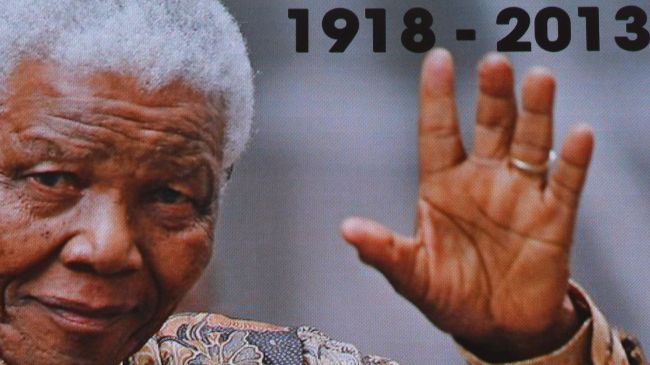
Former South African President and anti-apartheid icon Nelson Mandela passed away Thursday evening at the age of 95 and eulogies from world leaders began to appear soon after his death.
US President Barack Obama was one of the world leaders who paid their glowing tribute to South Africa’s anti-apartheid legend.
“We’ve lost one of the most influential, courageous and profoundly good human beings that any of us will share time with,” the US President said. “He no longer belongs to us, he belongs to the ages … His commitment to transfer power and reconcile with those who jailed him set an example that all humanity should aspire to.”
Nevertheless, it was not until 2008 that the US government removed Mandela’s name from its terrorism watch list.
Following the Sharpeville Massacre in 1960, when forces of South Africa’s apartheid regime shot 69 people dead in protests in the township of Sharpeville, Mandela’s African National Congress (ANC) was banned.
The apartheid regime designated the ANC as a terrorist organization because it fought against the regime’s apartheid system which legalized racial discrimination from 1948 to 1994.
The apartheid system banned the black people from voting, traveling without permission, or even possessing land.
In 1987, former British Prime Minister Margaret Thatcher also described Mandela’s ANC as a “typical terrorist organization.”
The US State Department under the presidency of Ronald Reagan also deemed Mandela’s ANC a terrorist organization and Reagan vetoed the Comprehensive Anti-Apartheid Act of 1986 passed by US Congress. Reagan’s veto was later overridden by Congress.
Obama Visits Mandela’s Old Cell, But Won’t Free His Own Political Prisoners
A Black Agenda Radio commentary by Glen Ford | July 3, 2013
President Barack Obama, a man of infinite cynicism, made a great show of going on pilgrimage to Nelson Mandela’s old prison cell on Robben Island, where the future first Black president of South Africa spent 18 of his 27 years of incarceration. With his wife and daughters in tow, Obama said he was “humbled to stand where men of such courage faced down injustice and refused to yield…. No shackles or cells can match the strength of the human spirit,” said the chief executive of the unchallenged superpower of mass incarceration, a nation whose population comprises only 5 percent of humanity, but is home to fully one-quarter of the Earth’s prison inmates.
True sociopaths, like the commander-in-chief who updates his Kill List every Tuesday, have no sense of shame, much less irony. Obama feigns awe at Mandela’s suffering and sacrifice in the prisons of apartheid South Africa, yet presides over a regime that, on any given day, holds 80,000 inmates in the excruciating torture of solitary confinement. During Nelson Mandela’s nearly three decades of imprisonment by the white regime, he spent a total of only about one week in solitary confinement. The rest of the time, despite often harsh treatment, backbreaking labor, and unhealthy conditions, Mandela and other political prisoners at Robben Island and other South African jails were typically housed together. Indeed, Mandela and his incarcerated comrades called the prisons their “university,” where they taught each other to become the future authorities over their jailers.
Racist South Africa’s treatment of Mandela and his co-revolutionists was downright benign and enlightened, compared to fate of U.S. prisoners who are deemed a threat to the prevailing order. At U.S. high security facilities, the slightest evidence that an inmate is of a political bent of mind is cause for him to be condemned to a solitary existence for decades – a social death alien to the human species. At California’s Pelican Bay and the state prison at Corcoran, thousands of inmates are held in isolation, 80 of them for more than 20 years, the very definition of barbarism. Yet, Obama journeys across oceans and continents to stand for a photo op in the cell of a prisoner whose ordeal was nowhere near as horrific as the standard fare for political prisoners in his own country.
On his trip to South Africa, Obama proclaimed that “the world is grateful for the heroes of Robben Island.” And, that’s certainly true, although it was a U.S. intelligence agent who lured Nelson Mandela into a trap in 1962 that ultimately led to his capture and imprisonment. Obama has no sympathy, however, for political prisoners of any race in his own country. Former Black Panther Herman Wallace is thought to be the longest-serving prisoner in solitary confinement in the United States, having spent 40 years alone in a cell in Louisiana’s notorious Angola Prison. Obama could free him at any time, but of course, he won’t. He could emancipate Black Panther captive Russell Maroon Shoatz, who has spent nearly 30 years in solitary, or Republic of New Africa political prisoner Mutulu Shakur or any and all of the scores of other aging political prisoners – people whose dedication to human freedom is no less than Mandela’s, yet have been subjected to far worse treatment at American hands. Instead, Obama has doubled the bounty on Shakur’s comrade and sister, Assata, in exile in Cuba. She might even be on Obama’s Kill List – which is the real and authentic legacy of this country’s First Black President.
Glen Ford can be contacted at Glen.Ford@BlackAgendaReport.com.
Related article
- Obama Falsely Asserts He Is Mandela Follower (alethonews.wordpress.com)
South Africa: Obama Docket
Muslim Lawyers Association Press Release | June 26, 2013
Lawyers will continue to pursue the case against Obama in the courts
Johannesburg, South Africa – The Muslim Lawyers Association (MLA) brought an application to court on Tuesday, 25 June 2013, to charge US President Barack Obama with a number of crimes, before he enters South Africa on Friday, 28 June 2013.
The North Gauteng High Court today found that the merits of the matter could not be heard as it was not deemed to be sufficiently ‘urgent’. This is despite the imminent arrival of Obama in South Africa this week. However, the (MLA) will continue to pursue the matter through the ordinary course of the courts.
Given the sheer magnitude, gravity, extent and degree of these crimes, as well as the unrelenting vigour with which the Obama Administration continues to commit them, the MLA intends to pursue the review application in accordance with the normal court time periods applicable.
“It is regrettable for the court not to have adjudicated on the merits of the ‘Obama Docket’ at an expedient time when Obama’s visit to the Republic is imminent”, states MLA spokesperson, Attorney Yousha Tayob.
The Obama Docket contains:
– evidence of indiscriminate killing of civilians by the use of USA military drones
– a public acknowledgment by Obama that he authorised the extra judicial assassinations of US citizens and that civilians have been killed by drone attacks authorised by him
– evidence of the continued incarceration without trial of persons detained at Guantanamo Bay and other US detention facilities, and
– evidence that the United States has engaged in rendition programmes contrary
to the prescripts of the norms and standards of International Law.
“South Africa has adopted and ratified the Rome Statute into our law and is therefore obliged to fulfil both its domestic and international responsibilities”, adds Tayob.
The MLA remains undeterred in its resolve to pursue all legal avenues to expose the past and ongoing War Crimes, Crimes against Humanity and Genocide committed by Obama and his administration and is committed to have him brought before a South African court of law or the International Criminal Court to answer the allegations contained in the ‘Obama Docket’.
For more information on the Obama Docket and its contents, or for interviews with an MLA representative, call Attorney Yousha Tayob, + 27 82 926 5408 or email at info@mlajhb.com or visit the MLA website at http:// http://www.mlajhb.com
Related article
- Obama faces protests in South Africa (alethonews.wordpress.com)
Obama faces protests in South Africa
Press TV – June 25, 2013
Several activist groups have planned protests during U.S. President Barack Obama’s visit to South Africa, which is part of his $100 million African tour.
The Muslim Lawyers Association in Johannesburg, South Africa’s largest city by population, has called for Obama to be arrested when he arrives in the country on June 29, and to be tried for war crimes.
Moreover, the Congress of South African Trade Unions (COSATU) has called on all workers to participate in anti-Obama protests in the South African cities of Pretoria and Cape Town.
“COSATU joins the millions of people and workers the world over, particularly on the African continent and in South Africa, who are outraged at the horrifying record of U.S. foreign policy in the world. We are particularly disappointed by the Obama administration’s record in continuing the appalling U.S. foreign policy performance,” COSATU said in a statement.
Obama and his family will be visiting South Africa, Senegal, and Tanzania from June 26 to July 3.
According to a Washington Post analysis, the first family’s Africa tour will cost American taxpayers up to $100 million.
Hundreds of Secret Service agents are to secure facilities used by the Obamas and a Navy aircraft carrier or amphibious ship, with a fully staffed medical trauma center, will be stationed offshore in case of emergencies.
Obama’s tour also involves 56 support vehicles, including 14 limousines, that are to be airlifted with military cargo planes.
Moreover, three trucks are needed for carrying bulletproof glass panels to cover the windows of the hotels where the first family will be staying.
South African bodies call for Israel to be excluded from diamond processing over ‘war crimes’
RT | June 6, 2013
South African human rights groups, trade unions and major civil society organisations are calling for the Kimberley Process Certification Scheme* to exclude Israel from diamond processing.
The certification scheme is designed to stop ‘conflict diamonds’ from entering the mainstream diamond market and was set up in 2003. The organisation which runs the scheme is currently meeting in South Africa.
The coalition of organisations such as South Africa’s National Union of Mineworkers, the country’s largest trade union federation COSATU; South African Students Congress; the Coalition for a Free Palestine and BDS South Africa say that “billions of dollars’ worth of diamonds exported via Israel are a major source of revenue for the Israeli military, which stands accused of war crimes.”
The coalition is calling for Israel to be excluded from the Kimberley Process Certification Scheme due to its human rights record against Palestinians, and to end all exports of rough diamonds to Israel immediately.
The organizations also wants to ban diamond polishing and cutting in Israel. They claim excluding Israel from the diamond processing would be a great chance for the South African authorities to display “moral vision and political leadership”.
“The Kimberley Process has played an important role over the past decade in resolving conflicts linked to the diamond trade but there is no doubt that it has to be reformed… [by] expanding the definition of conflict to include human rights abuses linked to diamond extraction perpetrated by governments and companies; and expanding downstream monitoring so that the process covers not just the rough diamond trade but also the international movement and polishing of diamonds,” Southern Africa Resource Watch director Claude Kabemba told the Business Day newspaper.
The coalition also pointed to the local benefits of such a move, claiming it could bring more diamond processing jobs back to South Africa. “Consumers will have a clear conscience that their diamonds are not funding, assisting or in any way involved with the illegal Israeli occupation of Palestine, and more jobs will be created locally for our people by bringing this diamond processing back home instead of it being done in Israel,” South African activist Mbuyiseni Ndlozi is quoted by the Middle East Monitor as saying.
The Kimberley Process, established a decade ago to help resolve international diamond trade conflicts and to ensure that the diamond trade is not used as an instrument to fund military rebellions and other violence interfering with human rights. The organization includes 54 participants representing 90 countries while its members account for about 99.8 percent of the global production of rough diamonds, the Middle East Monitor reports.
* The Kimberley Process Certification Scheme (KPCS) is the process to prevent “conflict diamonds” from entering the mainstream rough diamond market. Established by UN GA Resolution 55/56 in 2003, the process is aimed “to ensure that diamond purchases were not financing violence by rebel movements and their allies seeking to undermine legitimate governments.” In order for a country to be a participant, it must ensure that any diamond originating from the country does not finance a rebel group or other entity seeking to overthrow a UN-recognized government, that every diamond export be accompanied by a Kimberley Process certificate and that no diamond is imported from, or exported to, a non-member of the scheme. As of 30 November 2012, there were 54 participants in the KPCS representing 80 countries, with the European Union counting as a single participant.
South Africa slams US, EU over Iran oil sanctions
Press TV – April 19, 2013
South Africa has lashed out at the United States and European Union for imposing oil sanctions on Iran over its nuclear energy program without first consulting major importers of the Iranian energy supplies.
South Africa’s Energy Minister Elizabeth Dipuo Peters, who is in India to attend the Clean Energy Ministerial (CEM) meeting, said that such decisions have geopolitical implications and mostly affect “the poorest of the poor” that are in dire need of energy supplies and have no alternative.
“When decisions are made at bilateral or unilateral levels that have serious geopolitical consequences, we need to engage seriously,” Peters said.
“When we had to look for crude of the kind we got from Iran, it came at a premium,” she added.
“It has a multiple knock-on effect, especially on the poorest. When these decisions are taken, they must always consider the impact and consequences of their decisions at the geopolitical level. Or at least involve other countries so that when the decision is made they can say South Africa is taking it consciously. They have calculated the impact on them but not on others,” the South African minister said.
At the beginning of 2012, the US and EU imposed new sanctions on Iran’s oil and financial sectors with the goal of preventing other countries from purchasing Iranian oil and conducting transactions with the Central Bank of Iran.
On October 15, 2012, the EU foreign ministers reached an agreement on another round of sanctions against Iran.
The sanctions have been imposed on Iran over the groundless charges of a potential military diversion in Iran’s nuclear energy program.
Iran rejects the unfounded allegations over its nuclear energy program, arguing that as a committed signatory to the Non-Proliferation Treaty (NPT) and a member of the International Atomic Energy Agency (IAEA), it has the right to use nuclear technology for peaceful purposes.
Peters said that that the petroleum industry is a victim of financial sanctions, which include US sanctions on dollar-denominated trading and EU sanctions on insurance for shipping companies.
She emphasized that the US 18-month exemption for Iran oil sanctions had not benefited South Africa because the EU has refused to grant waivers.
On December 8, 2012, the US added China, India, South Korea, Malaysia, Singapore, South Africa, Sri Lanka, Turkey, and Taiwan to the list of countries exempted from the sanctions for another six months.
Related articles
- Chinese tanker loads Iranian crude for first time since EU ban (alethonews.wordpress.com)
- UN Sanctions on Iran: The Dance of Mutual Deniability (alethonews.wordpress.com)
- Iran sanctions could force BP to shut down North Sea gas field (alethonews.wordpress.com)
- US renews Iran sanctions waiver for Japan and 10 EU countries (alethonews.wordpress.com)
BRICS plan new $50billion bank to rival World Bank and IMF
RT | March 26, 2013
The ‘big five’ of the developing world will discuss creating their own global World Bank as their 5th annual summit kicks off Tuesday in sunny Durban.
The move is linked to the developing world’s disillusionment with the status quo of world financial institutions. The World Bank and IMF continue to favor US and European presidents over BRICS nations, and in 2010, the US failed to ratify a 2010 agreement which would allow more IMF funds to be allocated to developing nations.
“Not long ago we discussed the formation of a developmental bank… Today we are ready to launch it,” South African President Jacob Zuma said on Monday.
The ‘big five’- Brazil, Russia, India, China, and its newest addition, South Africa, will come together for the annual conference this year in Durban, South Africa in hopes of establishing a new development bank which will fund infrastructure and development projects in the five member states, and will pool foreign currencies to fend off any impending financial crisis.
“We will discuss ways to revive global growth and ensure macroeconomic stability, as well as mechanisms and measures to promote investment in infrastructure and sustainable development,” Indian Prime Minister Manmohan Singh said on Monday, before heading to Durban.
The BRICS have called for a reconstruction of the World Bank and IMF, which were created in 1944, and want to put forth their own ‘Bretton Woods’ accord. And they are serious.
“Brics is not a talk show. It is a serious grouping,” Zuma told reporters at the presidential guest house in Pretoria.
The new bank will cater to developing world interests and will symbolize a great economic and political union.
“There’s a shift in power from the traditional to the emerging world. There is a lot of geo-political concern about this shift in the western world,” Martyn Davies, chief executive officer of Johannesburg-based Frontier Advisory, told Bloomberg.
“A future BRICS Investment Bank is seen as a mechanism that would help realize where money should go, agree development strategies and coordinate investment,” explained Georgy Toloraya, the executive director of Russia’s national committee for BRICS studies to SA News.
In its nebulous stage, the new BRICS bank is unanimously supported by all five member states. In Durban, problems will arise on how to govern, fund, and operate the grand venture.
“When you set up a bank like this it’s not just a question of opening the doors. There are some issues about where it is going to be located, what the capital contributions are going to be, the rules of deploying that investment. These are the sort of details that are in various stages of discussion and negotiation,” said South African Trade Minister Rob Davies, in a statement.
The leaders may not reach a specific agreement in Durban this week, as each country has its own stipulations on its creation. Russia, for example, wants to cap each side’s initial contribution to $10 billion, according to Mikhail Margelov, part of President Putin’s team in South Africa.
Emergency Currency Fund
Pooling currency to deflect a future crisis is also a high priority topic set for the conference.
Once a loose political affiliation, the BRICS bloc is now a serious economic contender in the world economy, representing 40 percent of the world’s population, and accounting for one fifth of global GDP.
Between the five countries, the bloc holds foreign-currency reserves of $4.4 trillion, and needs an institution to safeguard this amassing wealth. The reserve will also protect members from short-term liquidity volatility and balance-of-payment problems.
Presently, it is proposed the member states contribute an equal share to the fund, but there is still dispute over whether to involve IMF management. India has voiced support for IMF involvement, but other BRICS countries may resist.
“A reserve pool, I think, is still some way off, ” said Davies.
In October, Brazilian Finance Minister Guido Mantega suggested the pool be modeled after the Chiang Mai Initiative, which provides a financial safety blanket to south east Asian countries.
Trade within the group swelled to $282 billion last year and could very well reach $500 billion by 2015, according to Brazilian government data.
Many Firsts
The conference is a benchmark of many firsts. It is the first time the conference has been held on South African soil.
For China, it is President Xi’s first visit to South Africa, where China is a leading trading partner and investor. In 2012, the trade between the two countries was 201bln ZAR ($21bln), according to the South African Revenue Service.
The conference is also President Vladimir Putin’s first international visit in 2013.
For South Africa, which makes up just 2.5 percent of total gross domestic product in BRICS, the summit is a way to showcase its role as an investment gateway to Africa. South Africa is the newest and smallest member of the BRIC bloc. It has the 28th highest ranked GDP in the world: China is 2nd, Brazil 6th, Russia 9th and India 10th.
Related article
- BRICS Nations Plan New Bank to Bypass World Bank, IMF (bloomberg.com)
South African agricultural company cuts ties to Hadiklaim
BDS South Africa | January 31, 2013
Karsten Farms, a leading South African agricultural company backed by one of South Africa’s primary finance bodies, the Industrial Development Corporation (IDC), has severed its relations with the Israeli cooperative, Hadiklaim, and has also undertaken not to enter into any future relations with any Israeli entity complicit in the illegal Israeli Occupation of Palestine.
South African human rights organizations, lead by the Palestine Solidarity Alliance (PSA) and BDS South Africa, launched a consumer campaign against Karsten Farms due to its trade relations (in violation of the boycott of Israel) with Israel’s Hadiklaim – an Israeli company operating, against international law, in the illegal Israeli settlements.
This week, after almost 3 years of campaigning, in a letter to BDS South Africa via their lawyers, Werksmans Attorneys, Karsten Farms undertook: “Not to enter into any trade relations with Hadiklaim for the current harvest year of 2013 and not have any business relations with them [Hadiklaim] in the future.” In addition, and in a precedent-setting move, Karsten Farms also undertook: “Not to enter into any trade relations with any Israeli company and/or entity within the occupied/illegal settlement areas of Israel”.
Siphiwe Thusi of the Palestine Solidarity Alliance welcomed the news: “This is the first time that a South African company has taken the legally as well as ethically correct decision not to trade with Israeli companies complicit in the illegal Israeli Occupation of Palestine. Karsten Farms has indeed set a precedent for other South African businesses and companies to follow. This is a breakthrough not only for the boycott of Israel but also for ethical and good business practice.” Thusi added that “the call for the consumer boycott of Karstens products has now been called off by virtue of their legal undertakings” however he also cautioned that “the Palestine Solidarity Alliance and BDS South Africa will be monitoring the situation and if any new Israeli relations, even if via third parties, were to be formed, the boycott campaign against Karsten Farms would be re-launched, and intensified.”
Find the full statement here: http://tinyurl.com/avlzt7n
Related articles
- BDS Gaining Momentum (councillorpadraigmcshane.wordpress.com)
- The 9th Annual Israeli Apartheid Week 2013 (alethonews.wordpress.com)
- South Africa’s ruling ANC officially endorses Palestine’s boycott movement (alethonews.wordpress.com)
- South Lebanon: Israel Admits to Stealing Land in Adaisseh (alethonews.wordpress.com)
- Israel plans boycott of UN human rights review (alethonews.wordpress.com)
- Farming Injustice: End all Trade with Israeli Agricultural Companies (bdsmovement.net)
South Africa’s ruling ANC officially endorses Palestine’s boycott movement
Al Akhbar | December 21, 2012
South Africa’s ruling party has officially endorsed Palestine’s Boycott, Divestment, and Sanctions campaign against Israel, making it the first major non-Muslim political faction to throw its weight behind the nonviolent resistance movement.
The African National Congress issued a resolution in support of the boycott campaign making it a part of its official policy, and specifically called for “all South Africans to support the programmes and campaigns of the Palestinian civil society which seek to put pressure on Israel to engage with the Palestinian people to reach a just solution.”
A press release issued by activist group BDS South Africa called the move “the most authoritative endorsement of the Boycott, Divestment and Sanctions (BDS) against Israel campaign.”
Previous moves to support Palestine’s nonviolent resistance movement from state actors have restricted their backing to the boycott of Israeli settlements, shying away from targeting the Jewish state. In September, the Irish parliament voted to ban Israeli settlement imports. Earlier this month, an Israeli newspaper reported that the EU was looking into boycotting settlement goods, after Israel defied calls to stem construction of the illegal houses.
Another clause of the resolution lashed out at Israel’s mistreatment of Africans, which culminated in the mass deportation of South Sudanese this year: “The ANC abhors the recent Israeli state-sponsored xenophobic attacks and deportation of Africans and request that this matter should be escalated to the African Union.”
The move is the latest in a series of actions by the ANC to pressure Israel into ending the Jewish state’s racist policies, particularly against indigenous Palestinians.
This August, South Africa’s Deputy Foreign Minister Ebrahim Ebrahim advised South Africans not to travel to Israel “because of the treatment and policies of Israel towards the Palestinian people.”
Palestine activists have long worked to draw attention to parallels between South Africa’s apartheid period and Palestinian repression under Israel’s ethno-religious-exclusive government system. Palestine’s BDS movement is said to be largely inspired by South Africa’s own boycott movement, which is credited with playing a major role in dismantling apartheid in that country in 1994.
South African Apartheid was declared official policy in 1948, the same year the state of Israel was created and thousands of Palestinians were expelled or put under martial rule.
In 2005, Palestinian civil society issued a call for a campaign of boycotts, divestment and sanctions against Israel until it complies with international law and Palestinian rights. The launch followed a historic ruling at the International Court of Justice that Israel’s apartheid wall, which greatly restricts movement in the West Bank and expropriates large swathes of Palestinian land, be demolished.
The BDS movement has garnered support from activists and labor unions worldwide, as well as from a growing list of artists, including Roger Waters, Elvis Costello, Santana, Cat Power and the late Gil Scott Heron.
Full BDS South Africa Press release
MEDIA RELEASE: S. Africa’s ruling party, the ANC, reaffirms boycott of Israel resolution
South Africa’s ruling party, the African National Congress (ANC), at its 53rd National Conference, reaffirmed a resolution supporting the Palestinian Boycott, Divestment and Sanctions (BDS) against Israel campaign.
In October 2012, the ANC’s International Solidarity Conference (ISC) declared its full support for the Boycott, Divestment and Sanctions (BDS) against Israel campaign (ISC Declaration, page 2, point 10).
Today, Lindiwe Zulu (member of the ANC’s International Relations Sub-Committee and special advisor to President Jacob Zuma) announced at the ANC’s 53rd National Conference plenary session, the ANC’s official endorsement, as captured in Resolution 39 (b), of the ANC’s October International Solidarity Conference (ISC) and all its resolutions, which includes a resolution on BDS. Giving muscle to resolution 39 (b), the ANC has committed to set up a steering committee to implement these ISC resolutions.
In addition, the ANC adopted resolution 35 (g) that specifically called for “all South Africans to support the programmes and campaigns of the Palestinian civil society which seek to put pressure on Israel to engage with the Palestinian people to reach a just solution.” In 2005 Palestinian civil society issued a call to the international community for a program and campaign of boycott, divestment and sanctions (BDS) to be applied against Israel as a way to pressure Israel to end its violations of international law, respect Palestinian human rights and engage in fair negotiations for a just peace.
Mbuyiseni Ndlozi of BDS South Africa welcomed today’s decision: “This reaffirmation by the ANC’s National Conference, its highest decision making body, is by far the most authoritative endorsement of the Boycott, Divestment and Sanctions (BDS) against Israel campaign. The ANC has now taken its international conference resolutions, and officially made it the policy of the ANC. We look forward to working with the ANC and specifically the ISC steering committee to expedite its implementation.”
Another hard-hitting decision on Israel that was adopted by the ANC was resolution 35 (j): “The ANC abhors the recent Israeli state-sponsored xenophobic attacks and deportation of Africans and request that this matter should be escalated to the African Union”. In June this year Israeli anti-African protests turned into full-fledged race riots. Israeli racism and xenophobia against Africans is shared and even encouraged by Israeli politicians including the Israeli Prime Minster, Benjamin Netanyahu, who has said: “If we don’t stop their [African immigrants’] entry, the problem that currently stands at 60,000 could grow to 600,000, and that threatens our existence…and threatens the social fabric of society.” Israel’s Minister of Interior, Eli Yishai, has said that African immigrants “think the country doesn’t belong to us, the white man.” And the Israeli parliamentarian, Miri Regev, has publicly compared Sudanese people to “a cancer”.
Finally, in a blow to the Israeli lobby, the ANC also adopted resolution 35 (c) stating: “The ANC is unequivocal in its support for the Palestinian people in their struggle for self-determination, and unapologetic in its view that the Palestinians are the victims and the oppressed in the conflict with Israel.” In the build up to the ANC’s National Conference the Israeli lobby, including the South African Jewish Board of Deputies, demanded a “balanced” and “nonpartisan” rather than a decisive and solidarity role by the ANC in the Palestinian-Israeli issue.
ISSUED BY MBUYISENI NDLOZI FOR BDS SOUTH AFRICA
Related articles
Featured Video
America Racing to Strategic Defeat in Iran
or go to
Aletho News Archives – Video-Images
From the Archives
Should Europeans ‘Thank’ the Americans for Destroying Nord Stream?
By Robert Bridge | Strategic Culture Foundation | September 29, 2022
With an investigation continuing into the destruction of the Nord Stream gas pipeline that provided energy supplies to Europe from Russia, there appears to be just one prime suspect, and that should surprise nobody.
Following the sabotage of the Nord Stream 1 and 2 gas pipelines, former Polish Foreign Minister Radoslaw Sikorski already seemed to know the identity of the perpetrator when he tweeted out: “Thank you, USA.”
At first glance, it seemed that Sikorski was speaking sarcastically, berating Washington for carrying out an attack that will have severe repercussions for the people of Europe. After all, how could anyone see any good coming from the termination of Europe’s primary source of gas reserves with winter just around the corner? It was Sikorski’s homeland of Poland, after all, that urged its citizens to collect firewood in the face of dwindling gas reserves.
In fact, the Polish diplomat was speaking one-hundred percent literally… continue
Blog Roll
 Aletho News
- Growing insecurity, soaring prices fuel protests in north as regime bans evacuation: Sources
- Iran denies responsibility for ‘depraved’ attack on Kuwait desalination plant
- Bring The Troops Back. End This War Now!
- Can we please stop calling Israel the ‘only democracy in the Middle East’ now?
- US should start removing its troops from Germany, proposes AfD co-leader Chrupalla
- Iran Red Crescent: 600 educational centers attacked in US-Israeli ‘war crimes’
- Russian Oil Tanker Arrives in Cuba Amid U.S. Blockade
- America Racing to Strategic Defeat in Iran: Lt Col Daniel Davis
- FTC Warns Visa, Mastercard, PayPal, Stripe Over Political Debanking
- Russian tanker approaches Cuba despite US oil blockade
- If Americans Knew
- Will Trump Go Kamikaze?
- Is the University of Florida Shutting Down College Republicans over Israel Criticism?
- Jewish extremist arrested over alleged plot to firebomb Palestinian activist Nerdeen Kiswani’s home
- More than half of Palestinian child detainees have no charges
- The More Murderous Israel Gets, The More We Hear About “Antisemitism”
- Land Day and the Palestinian struggle after 30 months of genocide
- The Iran War Is About Palestine
- Israeli soldiers echo settler ideology, talk of revenge after targeting Palestinians and detaining CNN crew in the West Bank
- Israeli Policies Threaten Future of Christian Schools in Jerusalem
- Former US soldiers argue Israeli policy is now guiding US interests
- No Tricks Zone
- New Study Finds Warming Saves Lives…Cold Temperatures 12 Times More Deadly Than Excess Heat
- German Science Blog Accuses PIK Climate Institute Of Hallucinating Climate Tipping Points
- Devastating Assessment Of Comirnaty Vaccine By Former Senior Pfizer Europe Toxicologist
- New Study: CO2 Is ‘Effectively Negligible’ As An Explanatory Climate Change Factor Since 2000
- Former Pfizer Toxicologist Dr. Helmut Sterz Tells Bundestag Hearing Pfizer Vaccine Should Have Never Been Approved
- Energy Expert: Germany’s Nuclear Phaseout Was A “500 Billion Euro Mistake”
- New Research: South Australia’s Mid-Holocene Sea Surface Temperatures Were 4°C Warmer Than Today
- Storing Green Energy To Last Germany 10 Days Would Require A 60-Million Tonne Battery
- New Studies: UK Sea Levels Were 4 Meters Higher Than Today During The Mid-Holocene
- Destructive Green New Deal: German Energy And Metal Group Warns Of Drastic Crisis
 Aletho News