Massive new debt hides years of negative GDP growth in EU and USA
By Jon Hellevig | Oriental Review | September 29, 2014
Finland – In a groundbreaking study Awara Group reveals that the real GDP growth of Western countries has been in negative territory for years. Only by massively loading up debt have they been able to hide the true picture and delay the onset of an inevitable collapse of their respective economies. The study shows that the real GDP of those countries hides hefty losses after netting the debt figures, which gives the Real-GDP-net-of-debt.
The moral of the study is that GDP growth figures as such reveal very little about the underlying dynamics of an economy if one does not simultaneously attempt to analyze what part of the growth is credited to simply artificially fueling the economy with new loans.
The study has found that the Western countries have lost the capacity to grow their economies. All they have left is a capacity to pile up debts. By massively accumulating new debt, they are able to keep up a semblance of at least sluggish growth, or of hovering around the zero growth mark.
If this massive debt would go towards investments, then there would be nothing wrong with it. But, it is not. The debt is going towards financing the losses in the national economies and essentially it all is wasted on consumption that the countries in reality cannot afford. The Western countries act like a 19th century heir to aristocratic wealth, borrowing from year to year to keep up the former lifestyle, while the estate is relentlessly dwindling. Sooner or later the prodigal heir would be forced to face reality and sell the remaining property to stave off the creditors, downgrade his dwellings, and rein in spending. Inevitably, the European countries and the USA will have to curb their excessive consumption, too, but for the time being they are putting off the final reckoning with new debt rather the way a drunkard reaches for the morning after drink to put off sobering up. In the case of the EU and the USA, we are speaking about a debt binge that has been going on for a decade.
While the situation has been generally bad for the last decade or so, it took a dramatic turn for the worse, or should we say for the catastrophic, following the onset of the global financial crisis in 2008. The shocking figures depicting the virtual crippling of the Western economies from 2009 to 2013 are illustrated in Chart 1. It depicts the development of real-GDP-growth per country in years 2005 to 2013. The chart shows that during this period Russia has been able to deliver real non-debt fueled GDP growth, whereas the Western countries are running huge deficits. The accumulated growth of the Russian economy from 2005 to 2013 was 147% while the Western countries accumulated losses from 16.5% (Germany) to 58% (USA). In the case of Russia, the real-GDP-net-of-debt figure is also corrected to adjust for the calculation error caused by an erroneous GDP deflator that Russian Statistics Agency (Rosstat) has used. We have discussed the persistent problem of Russia’s GDP growth having been underestimated due to the use of a wrong GDP deflator in the study Awara Group Research on the Effects of Putin’s Tax Reforms 2000-2012 on State Tax Revenue and GDP

Chart 2 shows the real GDP growth net-of-debt after deducting the growth of public debt from the GDP figure. Net of debt we see the scale of the Western economies, for example the Spanish economy, which amounts to the staggering figure of minus 56.3%. This while the conventional official method of crediting GDP growth with growth of debt would give only minus 6.7%.

The analysis shows that by these measures Russian economic growth, unlike that of the Western countries, has been comparatively healthy and not debt-driven. Russia has in fact a resoundingly positive ratio by these measures, where GDP growth has exceeded growth of debt by a staggering 14 times (1400%). The figure is astonishing when compared with the Western countries that have been flooded with new debt.

Chart 3 shows how much the accumulation of debt in the Western countries exceeds the official GDP growth. The USA is leading the pack with an increase in the debt load in years 2004 to 2013 of USD 9.8 trillion (in the chart in euros, EUR 7 trillion). In those years, the growth of the USA public debt exceeded the GDP growth 9 times (900%), which is illustrated by Chart 4, comparing the proportion of growth of debt to that of growth of GDP.
The comparison of growth of debt to growth of GDP reveals the UK, as the country that has amassed the most amount of new debt relative to GDP growth, having a new-debt-to-GDP-growth ratio of 9 to 1; in other words UK has taken on 900% new debt relative to the GDP growth. But the picture is grim for all the Western countries surveyed, less so for Germany, while Russia’s debt increase amounts to only a fraction of the GDP growth.

The analysis shows that by these measures Russian economic growth, unlike that of the Western countries, has been comparatively healthy and not debt-driven. Russia has in fact a resoundingly positive ratio by these measures, where GDP growth has exceeded growth of debt by a staggering 14 times (1400%). The figure is astonishing when compared with the Western countries that have been flooded with new debt.
The above figures are adjusted taking into account public debt (general government debt), but the situation is even worse when we consider the effect of private debt on the GDP. New debt of corporations and households have at least doubled private debt of most of the Western countries since year 1996 (Chart 5).

Reviewing these figures, it becomes evident that in reality Western economies have not grown in the past decade, rather the countries have massively inflated their debt load. With these levels of debt reached this cannot continue for long. There is a real risk that the bluff will be called sooner rather than later dropping the Western economies to GDP levels that they can carry without debt leverage. But in that situation they will not be able to serve the accumulated debts leading to catastrophe scenarios.
We have not included Japan and China in the analysis due to the difficulties attributed to finding consistent data for all the input variables. For those countries we have come across problems of fractured data that do not capture all the relevant years; inconsistent data across the samples we looked at; and uncertainties about conversion of the input data into euros. (We are sure that major research houses could overcome such problems, having greater and more sophisticated resources than ours). This exclusion of Japan and China is regrettable as Japan is the country worst affected by the problem of debt-fueled GDP growth, having a public debt to GDP ratio of well above 200%, and would therefore have been very instructive for our purposes.
Japan has been essentially living on debt since the early 1990’s. However, some of the more irrational Western analysts want to take Japan as a prime example to follow, arguing that since Japan has been able to pile up debt for some 25 years now, all the Western countries would be able to do it as well for the foreseeable future. In this they fail to grasp that Japan earlier had the luxury of being the sole country living on such exorbitant levels of debt. Japan has enjoyed great support from the Western countries to be able to continue that practice, not least for political reasons. Another important consideration against the idea that Western countries could continue to accumulate debt is that they have, since the early 1990’s, rapidly lost their economic hegemony in terms of share of world trade and global GDP. I have written about this in a recent article entitled Why the West is Destined to Decline.
The West is fast shrinking in economic significance relative to the rest of the world. This is demonstrated by comparing the GDP of the Western powers as represented by the G7 countries (USA, Japan, Germany, France, UK, Italy and Canada) with the GDP of emerging powers. As recently as 1990, the combined GDP of the G7 was overwhelming in relation to that of today’s 7 emerging powers: China, India, Russia, Brazil, Indonesia, Mexico and South Korea (not necessarily constituting one political block). In 1990, the G7 countries had a combined GDP of USD 14.4 trillion and the emerging 7 had a GDP of USD 2.3, but by 2013 the tables had been turned, as the G7 had USD 32 trillion and the emerging 7 had USD 35 trillion. (Chart 6).

With the challenge of the ever increasing share of world economy belonging to the emerging countries, it becomes clear that the Western countries will not be able to profit sufficiently from world trade to service their debt loads.
For the time being the Western countries benefit from the privilege of having currencies that the rest of the world still largely trusts as reserve currencies. In essence, the USD and the euro enjoy a kind of monopoly status. This is what allows Western countries to gain access to cheap debt and fuel their economies with central bank financing (quantitative easing or “printing of money”). But the risk is that, with the deteriorating debt situation and diminishing share of the global economy, they will forfeit this privilege, perhaps even in the near future. What would follow from this is sharply more expensive financing and inflation, with hyperinflation as the eventual outcome. In this scenario – which I consider inevitable over the next 5 to 10 years – the economies of Western countries would essentially collapse.
The problem is that there is no way of averting this scenario, because the Western powers have lost their competitive advantages as economic powers. Eventually, their economies must shrink to match their resource and population bases. (I have written about this in the article referred to above). But it seems that the ruling Western elites have no intention of facing up to these realities. They will try to keep up a semblance of prosperity with ever new debt, as long as they can. The political parties of the West have been essentially converted into voting machines with one singular concern – that of winning the next elections. To do that they will continue to engage in what amounts to bribing of the electorate – creating new debt that fuels the national economy.
But there is no way to turn back this historical tide. Just as the aristocrat of the old regime eventually squandered his legacy, so will the Western powers. This inevitability of the process is what makes it really scary, because I am afraid that the Western elite might be tempted to bail itself out from this doomsday scenario with a war of epic proportions. We are now truly approaching the Armageddon between the West, with its desperate economic circumstances, and the emerging world powers.
Jon Hellevig is a business consultant and economic and political observer. He is the co-editor and co-author of Putin’s New Russia and several books on philosophy and political and social sciences.
The West’s Non-Linear Warfare and the Right for the Rest to Resist
By Andrew Korybko | Oriental Review | May 19, 2014
Nearly two weeks ago, Peter Pomerantsev, writing for Foreign Affairs, published an article about “How Putin Is Reinventing Warfare”. He alleges that Russia is engaging in “non-linear warfare”, strongly alluding that this poses a threat to the West. If one can read between the lines of his biased and subjective approach, he is in actuality describing a very real and objective development – the restoration of Russian power and global standing. His ire is likely due to Russia now being able to deflect international information and media assaults against it and its policies and finally promote the truth. Pomerantsev then goes on a peculiar ranting spiel where he alleges a convoluted metaphor of Russia conspiring to be a “corporate raider”, an exercise in exasperation which will likely only reach those with pre-existing anti-Russian beliefs. It is the end of his article, however, that forms the basis of this response to it. Pomerantsev uses the analogy of the West’s “global village” versus Russia’s “non-linear warfare” to make his final point in throwing mud at Russia. In reality, there is not one “global village”, but rather, many regional civilizational villages that are experiencing Western raids and “non-linear warfare”, and they have finally started to band together to stop the marauders.
The liberal end of history (aka “the global village”) does not exist outside of ideological fantasy, and the world is instead divided into civilizational zones (regional villages) united around certain actors (Russia, China, Islamic pillars, the West). This forms the basis of the running metaphor that will be utilized below to advance the claim of the West waging non-linear warfare against the Rest.
Repeated raids from Western marauders and bandits, whose village is the only one seeking to expand, loot, and plunder, has resulted in parts of the other villages being burnt down. In the past decade, the Islamic village experienced this the worst, with conflagrations decimating its Afghan, Iraqi, Libyan, and now Syrian neighborhoods. Currently, the Eurasian village is having to deal with a fire in Ukraine, one that was purposely set to spread to the Russian core. However, as a result of these repeated raids, the regional villages have formed self-defense forces and are now working together to put out the fires and stop the raiding. Experience has taught them how to successfully resist and defy the Western village. In the real world, the success of international media firms (RT, Press TV, CCTV, Telesur) shows that media and information assaults can in fact be deflected and that perception management and national PR initiatives are not under the sole monopoly of the West.
Pomerantsev’s claims that “(economic) interconnection also means that Russia can get away with aggression” could not be more opposite to the truth. The Western village is actually two large ones, the US and the EU, and the American village grew out of the EU one and now controls its creator. In this case, the suburb controls the center, so to speak. It is the interconnection between the Eurasian (Russian) and EU villages that serves as the real check on further US aggression against the former. When not marauding and raiding, the Western village also tries to infiltrate the others via NGOs and Color Revolutions. Once it flips some members of the village and/or installs its pick as village leader, these turncoat individuals can “open the gates from within”, promote mutiny, and lead to the annexation of the village into the Western-dominated expanding sprawl.
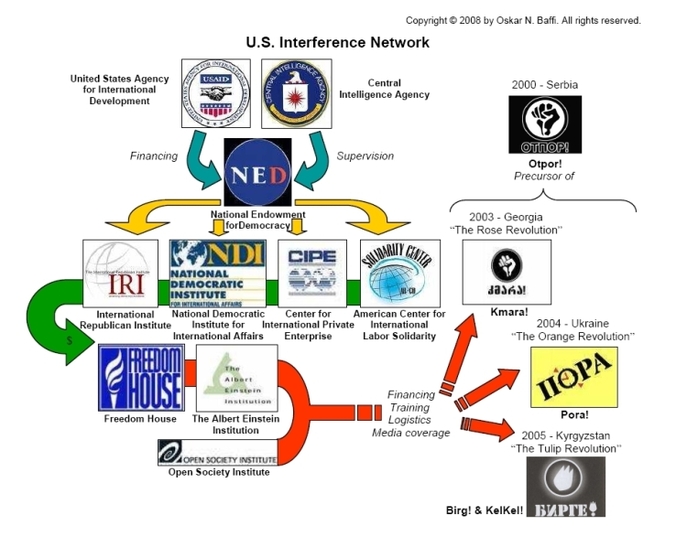
Pulling back from the metaphor, the Brzezinski Doctrine (“The Eurasian Balkans”) is the definition of non-linear warfare and subversive destabilization. It uses NGOs as destabilizing elements within the targeted states, and for this reason, foreign-funded NGOs are required to register as “foreign agents” inside the Russian Federation. Gene Sharp’s writings have also provided pivotal tactical advice in advancing the West’s non-linear warfare strategy. Taking the use of non-state actors even further, the West has a history of promoting militarized proxy groups to carry out its policies. This is most clearly seen in Kosovo, Afghanistan, Iraq, Libya, and Syria, although other countries have also been victims of this underhanded method of war. On the other hand, the West obviously engages in conventional warfare as well. Nowhere is this more evident than in the 2003 Iraq War. Mixing the two methods together is the new trend of American foreign policy. A non-linear campaign of militarized proxy destabilization culminated in a conventional NATO bombing in Libya. After this “success”, the West then turned its sights on Syria, but as a result of adroit Russian foreign policy maneuvers, non-linear warfare was stymied from mutating into its conventional form.
Pomerantsev’s article also uses fear mongering and heavy hype to scare the audience into thinking that Russia is proactively forming some kind of imaginary coalition against the West from within. If there happens to exist an overlap of perceived interests and objectives between Russia and domestic Western actors, it is because both parties arrived at the same conclusions after undergoing the same process – experiencing Western unipolar dominance and discriminatory targeting for two decades. For example, “Euro-scepticism” is also seen in Southeast Asia by the ASEAN members’ reluctance to form an EU-like union. The flower of New Leftism and resistance ideology in South America organically began to bloom in the 2000s, tended over by Hugo Chavez. In a similar fashion, the traditionally conservative societies of India, China, and Africa are just as disgusted as Russia’s by certain Western-centric values, such as the “bearded woman” of Eurovision. In laboratory conditions, the cause (Western dominance) has thus been proven to repeatedly result in similar effects all across the world, thereby confirming the hypothesis that Russia and others arrive at their conclusions on their own. There is no “contradictory kaleidoscope of messages”, as each actor’s resistance and defiance to the West, for various reasons and in differing forms, were a natural development.
To conclude, there are currently multiple civilizational liberation struggles playing out in the Pandora’s Box-setting of Western-led post-modernism. This is not a new page in the old historical story, but an absolutely new edition that is still being written. The Rest, absolutely diverse in their identity and overall mission, are coming together to stop the Western steamroller. They must work together to repel its aggression and safeguard the right to practice their identity and move forward with their historical mission as they individually deem fit. It is the democratic and sovereign choice of each civilization to be able to conduct itself how it pleases, but in order to get to that point, they must be liberated from the terror of the Western threat. These villages do not want to raze the Western one, so to speak, but they understand that the West will raze them if they can’t be annexed. In this manner, they are engaged in a do-or-die struggle, and at no time before in their histories has the situation been more dire. The Rest is slowly coalescing into providing a unified front against the Western menace, hoping to neutralize its raids and incursions so that they can once more go about their civilizational business in constructing and solidifying their societies. If, as Pomerantsev states, Russia and the Rest are anti-Western “raiders”, then yes, the future surely does belong to these resistant and defiant actors.
Andrew Korybko is the American Master’s Degree student at the Moscow State University of International Relations (MGIMO).
Featured Video

Prof. Ted Postol: Iran Already Achieved Nuclear Deterrence Against Israel
or go to
Aletho News Archives – Video-Images
From the Archives
How the occupied mentality syndrome works
Saudi Arabia on the American chessboard – Part 3
By B. J. Sabri | American Herald Tribune | June 27, 2016
Read part 2: “The occupied mentality Syndrome“
Previously I argued whether Saudi Arabia’s repeated involvements in U.S. interventions and wars stem from free national will or in response to a specific condition. For starters, in Saudi Arabia there is no national will. In Saudi Arabia, the national will is the will of the Al Saud clan. Still, when a major Arab state allies itself with a superpower that committed unspeakable crimes against humanity in almost every Arab country, then something is wrong. This fact alone should compel us to examine the U.S.-Saudi relation for one exceptional reason. As a result of the U.S.-Saudi wars, hundreds of thousands of people in Afghanistan, Iraq, Iran, Libya, Syria, Yemen, and Somalia have lost their lives. Millions became displaced in their own homelands. And millions more rendered refugees.
Attributing the Saudi policies to the bonds of “partnership” with the U.S. is frivolous. There are no bonds between these two thugs except those of business, military deals, secret plots, and wars. Proving this point, bonds such as these have no space for the American and Saudi peoples to share significant cultural or societal exchanges. If partnership is not the reason for the Saudi contribution to the U.S. strategy of empire and imperialism, then another reason must exist.
This leads to three possibilities. … continue
Blog Roll
 Aletho News
- NIAID/NIH and USDA Fund Bioengineered Chimeric Influenza Viruses Built Using Pandemic H1N1 Components: Journal ‘Science Advances’
- Hezbollah hits Israeli warship off Lebanon’s coast, sets it aflame
- Iran slams US strikes on B1 bridge, Mahshahr petrochemical plants as ‘blatant acts of state terrorism’
- In letter to UN chief, Araghchi warns of dire consequences of US-Israeli attacks on Iran’s nuclear facilities
- Why the CIA conspiracy to invade Iran with Kurdish militias failed
- Why Are Upbeat US Claims About Mission to Rescue Pilot ‘Highly Questionable’?
- Aircraft destroyed during US ‘rescue’ of downed F-15 pilot cost more than $100 million each
- Washington University removes professor who condemned US-Israeli war on Iran
- Russia Warns of Retaliation as UK Authorizes Seizure of Vessels
- Serbia thwarts plot to bomb Russia-Hungary gas pipeline – Vucic
- If Americans Knew
- In Iran, Israel-US take aim at “reason, research, and freedom of thought” – Daily Update
- US loses planes over Iran, Israel downgrades Lebanon war goals – Daily Update
- Israel Is Blocking Palestinians from Easter at Church Where Jesus Resurrected
- Plot to assassinate Palestinian activist follows harassment campaign promoted by Zionist groups and elected officials
- Prominent New York synagogue hosts presentation on why U.S. Jews should support the ethnic cleansing of Gaza
- Tapper vs. Piker: Is the CNN Anchor Auditioning for David Ellison?
- Shouldn’t Democrats Be Able to Condemn Genocide?
- Israel-US kill negotiators, destroy civilian structures, but Iran’s military capabilities still largely intact – Daily Update
- ‘War crime’: Global condemnation as Israeli ministers celebrate death penalty law targeting Palestinian prisoners
- 7 Ways Israel Is Turning Lebanon Into Gaza
- No Tricks Zone
- An Inconvenient Tree: Uncovered In Alps… Europe Much Warmer Than Today 6000 Years Ago
- New Study Reports A 60% Slowdown In Greenland’s Ice Loss Rate In The Last Decade
- Low Intensity Tornado Wrecks Major Solar Farm, Creating A Potential Toxic Dump
- New Study Finds Warming Saves Lives…Cold Temperatures 12 Times More Deadly Than Excess Heat
- German Science Blog Accuses PIK Climate Institute Of Hallucinating Climate Tipping Points
- Devastating Assessment Of Comirnaty Vaccine By Former Senior Pfizer Europe Toxicologist
- New Study: CO2 Is ‘Effectively Negligible’ As An Explanatory Climate Change Factor Since 2000
- Former Pfizer Toxicologist Dr. Helmut Sterz Tells Bundestag Hearing Pfizer Vaccine Should Have Never Been Approved
- Energy Expert: Germany’s Nuclear Phaseout Was A “500 Billion Euro Mistake”
- New Research: South Australia’s Mid-Holocene Sea Surface Temperatures Were 4°C Warmer Than Today
 Aletho News