Spain to Deliver 5 Warships Worth $2.5Bln to Saudi Arabia – Defense Ministry
Sputnik – 13.04.2018
Spanish Defense Minister Maria Dolores Cospedal and Saudi Arabia’s Crown Prince Mohammed bin Salman on Thursday signed an agreement, under which Madrid will deliver five Avante 2200 corvette patrol vessels worth $2.47 billion to the Middle Eastern country, the Spanish Defense Ministry said.
The warships will be built by firm Navantia at its shipyard in San Fernando, Southern Spain, according to the ministry.
Salman arrived to Spain on Wednesday. Earlier on Thursday, the Saudi crown prince held talks with Spain’s King Felipe VI and Prime Minister Mariano Rajoy.
In the period between 2015 and mid-2017, Spain has exported military equipment and weapons worth $901 million to Saudi Arabia, according to data drawn by four non-governmental organizations — Amnesty International, Greenpeace, Oxfam, and FundiPau — from official sources.
In October, four NGOs demanded an independent investigation into the destination of arms acquired by Saudi Arabia, after increasing evidence suggested that Spanish weapons have been used in the conflict in Yemen.
Former Catalan Education Minister Ponsati Going to Surrender to UK Authorities
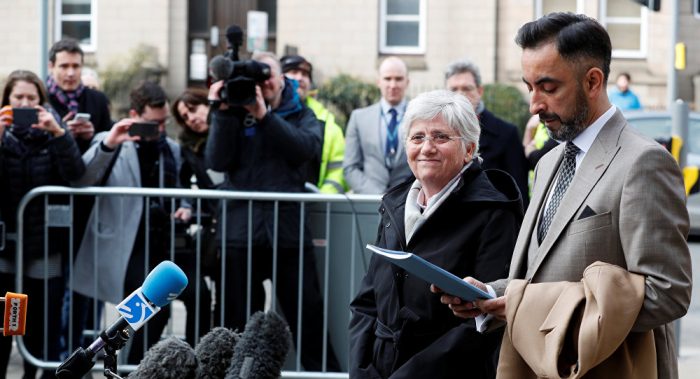
© REUTERS/ Russell Cheyne
Sputnik – March 28, 2018
Former Catalan Education Minister Clara Ponsati, who has been hiding from Spanish law enforcement in the United Kingdom, said Wednesday that she was going to surrender to UK authorities.
“Later on this morning I will attend police station with my lawyer @AamerAnwar & will b arrested & taken 2court as Spain tries 2extradite me, I need ur support,” Ponsati wrote on Twitter.
According to Spanish media, a UK judge will decide on the measure of restraint for her later in the day.
On Tuesday, the politician began raising funds online for her legal defense, saying that her goal was to get 40,000 pounds ($56,600). As of now, the campaign managed to raise almost 100,000 pounds.
Charges Against Ponsati
On October 1, Catalonia held an independence referendum, which the central authorities did not recognize. The results showed that the majority of Catalans supported secession, and the regional parliament unilaterally announced independence later in October. In response, Madrid imposed direct rule over the autonomous region, dissolved the Catalan parliament and called a snap election. Several pro-independence leaders were jailed, while others fled to Belgium.
Following the independence vote, Ponsati fled to Belgium with former Catalan leader Carles Puigdemont and three other regional politicians. In March, Ponsati moved back to Scotland and her position as a professor at St. Andrews University.On Friday, the Spanish Supreme Court activated a European arrest warrant for a number of Catalan politicians, including Puigdemont and Ponsati. Shortly after, Puigdemont was detained in Germany after he crossed the border with Denmark on his way from Finland to Belgium.
According to the Spanish Prosecutor’s Office, Ponsati was responsible for allowing polling places to stay open in schools during the referendum. She is charged with organizing an insurrection — which under Spanish law can mean a prison sentence of up to 30 years — as well as embezzlement of state funds.
READ MORE:
Maduro: Spain’s Persecution of Catalan Leaders ‘Shameful’
teleSUR | March 27, 2018
After five Catalan pro-independence leaders were arrested Saturday, Venezuela’s President Nicolas Maduro slammed the Spanish authorities over persecution of the Catalan leaders and people simply for independence aspirations.
“What’s happening in Spain is shameful, Catalan politicians jailed only for their ideas… whether or not you agree with these elected lawmakers’ ideas, their persecution is an embarrassment,” Maduro warned in a speech during an international meeting on African decendents rights in the region in Caracas Saturday.
Spanish Prime Minister Mariano Rajoy has criticized Venezuela’s government on several occasions, calling it a “dictatorship” and played an important role in the European Union’s decision to levy economic sanctions on Venezuela over what Brussels calls Maduro’s “brutal decisions.”
In an interview this January Rajoy even talked about political prisoners in Venezuela, saying all he wants is for them to be able to go to the streets all while his government is cracking down on Catalan leaders and politicions for purely political reasons.
The Venezuelan leader stressed that unlike the U.S., Spain and the EU, his government was not meddling in the internal affairs of Spain but “outraged that they persecute people just for their ideas.”
At least nine pro-independence politicians and members of Catalan’s civil society groups are currently in jail for rebellion, a crime punishable with up to 30 years in prison. In total 25 Catalans will be tried for rebellion, embezzlement or disobedience for their participation in the Oct.1, 2017 independence referendum.
Rebellion charges are controversial because the crime requires the use of violence; last year’s Catalan independence referendum was a peaceful civic action. The Spanish State Attorney’s office had argued violence was exercised by pro-independence activists and politicians on Sept. 20, 2017, when they surrounded several Catalan government buildings to prevent the Spanish Civil Guard from entering.
Pro-independence leaders like Jordi Turull, the new candidate for regional president, former ministers Josep Rull, Raul Romeva and Dolors Bassa and former parliament speaker Carme Forcadell, are the latest prisoners in Madrid’s crackdown against pro-independence forces in Catalonia since the referendum.
Pro-independence sentiments are widespread in Catalonia and have grown after Madrid brutally repressed Catalans who went to the polls to cast their vote last year. The election resulted in Catalonia’s declaration of independence. Spanish Prime Minister Mariano Rajoy responded by removing Puigdemont and calling for a snap election, which pro-independence parties and politicians won.
In this context the Venezuelan president called on social movements and humanity “to fight against political persecution and political prisoners in Spain, and to accompany the people of Catalonia in their right to democracy and freedom.”
Animosity between Catalonia and Madrid is rooted in Catalan republicanism and rejection of monarchic rule. The Spanish crown was restored by former dictator Francisco Franco (1936-1975) who banned Catalan language and led a brutal persecution against Catalan republicanism.
Today, in Spain writing a song against the crown or burning an image of the royal family can land a person in jail.
Spain falls short of apologising for 1920s use of chemical weapons in Morocco
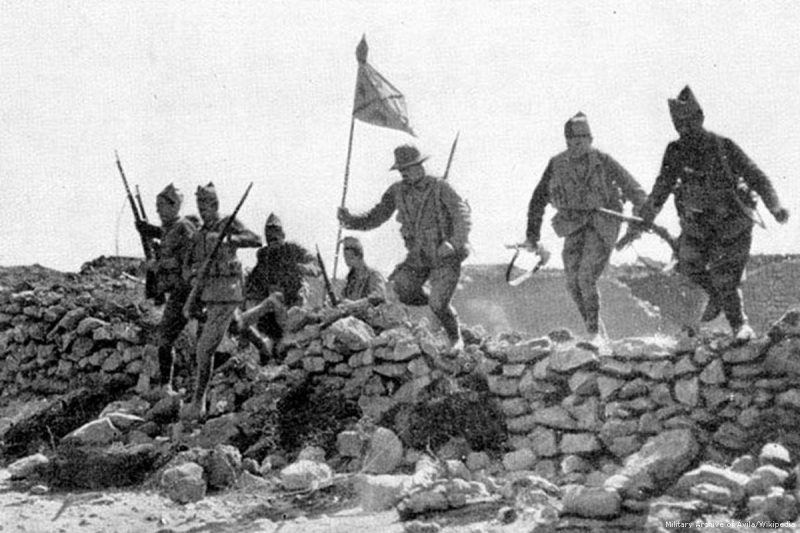
Spanish soldiers are seen during the Rif War in 1922 [Military Archive of Ávila/Wikipedia]
MEMO | February 15, 2018
Spain has said it will respond to the Amazigh World Assembly’s (AMA) request concerning the use of chemical weapons by King’s Alfonso XIII military during the Rif War from 1921-1926 but has fallen short on agreeing to apologise for its actions.
Spain’s Foreign Minister Alfonso Dastis confirmed that the request had been made to Madrid and “as a result of the request of the King, the [AMA] were received in the Spanish embassy to submit their demands and also examine possible ways of cooperation.”
Speaking during a parliamentary meeting, Dastis answered questions from Joan Tarda, a member of the Esquerra Republicana, who has been pushing for the Spanish government to admit its use of chemical weapons in the Rif war.
However, though showing his willingness to hear the AMA’s demands, Dastis fell short of expressing his country’s readiness to apologise for its use of chemical warfare on civilians.
The conflict lasted from 1920 to 1927 between Berber rebels led by Mohamed Ibn Abd Al-Karim Al-Khattabi against Spanish colonial forces in Morocco’s Rif region. Following the defeat of Spanish troops in the Annoual battle in July 1921, Spain reportedly used chemical and toxic gas indiscriminately against the Rif civilian population in order to inflict maximum damage. The chemical attacks were a violation of the 1919 Treaty of Versaille which prohibited the use of chemical weapons.
The AMA filed a request calling on Spanish authorities to officially apologise to the Rif people and to compensate the victims and families for the tragedy. A similar request by AMA was last made in 2015 to King Felipe VI.
The Moroccan Centre for Common Memory, Democracy and Peace echoed calls by AMA and called on the Spanish Minister of Foreign Affairs to honour previous pledges to respond to the requests of Moroccan civil society organisations calling on Spain to recognise its culpability.
As a result of the chemical warfare, many of those in the Rif have suffered the highest rates of cancer than in any other region in Morocco with 80 per cent of cases of larynx cancer in Morocco found in the Rif region.
Russia’s Alleged Meddling in Catalan Vote: Playing the Blame Game

By Alex GORKA | Strategic Culture Foundation | 14.11.2017
Few people are able to recognize their own mistakes. Many prefer to deny the truth becoming willfully oblivious to obvious facts. Why assume responsibility if there is such a thing as blame shifting – a true-and-tried method to get away with it? Pointing a finger at someone else to divert attention serves the purpose. There is method to this madness and Western politicians have been resorting to the blame-shifting tactic increasingly often. Each and everything going awry in the world is the fault of Russia. The drive of peoples for independence is a good example. Take Catalonia to illustrate the point.
The Spanish government said on Nov.10 that it had noted news manipulation about the Catalan crisis on social media originating from Russia’s territory. Spain’s government spokesman Inigo Mendez de Vigo said disinformation on social networks was a “serious issue.” According to Spanish Defence Minister Maria Dolores de Cospedal, the government had established that “many messages and interventions via social networks come from Russian territory.” She did not offer any specific examples to confirm the affirmation. Foreign Minister Alfonso Dastis said there was evidence of activity by Russian networks and hackers. The trolls are said to be spreading misinformation across social media to further “destabilize” Spain and the EU.
The issue was even raised at the EU foreign and defense ministers meeting on Nov.13-14, where Spain briefed the EU on the alleged interference. The debate comes after eight member states urged EU foreign service chief Federica Mogherini to build up the counter-propaganda cell in her service.
Spanish media have many times attacked Russia Today (RT) and Sputnik Spanish language services for instigating tensions in Catalonia, supporting the separatist movement. El Pais daily wrote an editorial on Nov. 10 denouncing “the intense campaign by Russian media that are close to the Kremlin,” whose “propaganda machine” it accused of siding with the pro-independence movement.
NATO leadership chimed in. On Nov.9, US General Curtis Scaparrotti, the commander of NATO forces in Europe, called on Russia to stop “meddling” into European elections. He was concerned over Russia’s “malign influence” in other countries. The Atlantic Council, a US-based think-tank close to NATO, has published a report suggesting that Russia was seeking to meddle in support of Catalan independence and to discredit the Spanish central government’s position that the referendum on independence held on Oct. 1 was illegal. El Pais, the Washington Times and Politico all issued publications alleging that an army of Russian bots had perfected their techniques of online influence and thus ensured the October 1 vote went down the path of separation.
If the accusations were true, it would mean that Russia-backed media networks operate to undermine Russia’s official position on the issue made clear in a Foreign Ministry’s statement. Russia has consistently voiced its respect for Spain’s territorial integrity.
Can anyone of sane mind believe that Russia’s “meddling” is the real reason to make over 40 percent of Catalans support independence? Has Russia been behind the 95-year-old independence movement in Catalonia? Has Russia made the Catalans’ language and culture distinct? Did Russia make Francisco Franco oppress the Catalan people? Has Russia provoked the economic crisis in Spain, which has served to magnify calls for Catalan independence? Has Russia made Catalans believe that the current tax structure is unfair? Has Russia made Madrid unwilling to renegotiate Catalonia’s autonomy agreement? Has Russia written Spain’s constitution, which expressly prohibits a region from breaking away unilaterally? Did Moscow order Spanish police to use brutal force, while preventing the unconstitutional vote? If it didn’t count, why take such pains to stop it?
Several world leaders and political figures condemned the violence specifically. Did Russia make them do it? Did Russia make the EU abstain from mediation effort? And, finally, does Russia stand to gain from an independent Catalonia?
With many publications on the issue, no evidence has been produced to demonstrate a link between the Russian government and Catalonia vote. Obviously, the use of the “Russian meddling” narrative seems to work as a distraction from the wrongdoing of the Spanish government. The fantasy provides a convenient scapegoat to avoid responsibility of the Spanish government for missing opportunities to launch meaningful political dialogue with Catalonia and mishandling of the vote. Spain is by far not the only country to use the narrative to its own advantage. As Karl Sharro, a well-known British architect and satirist, commented on the results of UK elections, “The most disappointing thing about the UK election is there wasn’t even a hint of Russian interference. It’s like we don’t matter at all.”
Spanish Government Blames Russian “Dezinformatsiya” Campaign For Catalan Uprising
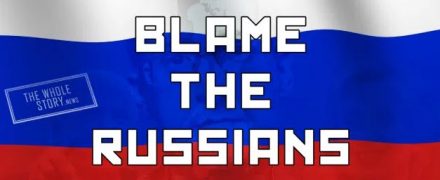
No, not The Onion…
By Tyler Durden | Zero Hedge | November 11, 2017
In what is perhaps the least surprising tactic from the Spanish establishment, a government-backed research institute in Madrid has stated that Spain’s struggle to quash separatism in its Catalonia region was disrupted by Russian hackers agitating for a break-up, in a hallmark propaganda effort to fracture Europe.
As Bloomberg reports, the unidentified Russians spread both true and false messages on Facebook and Twitter during the illegal separatist referendum on Oct. 1, according to Mira Milosevich, a senior analyst at the Elcano Royal Institute.
The “dezinformatsiya” campaign deployed trolls, bots and fake accounts, and was backed by intense coverage from Russia’s state-supported television, she said.
“Russia has a nationalist agenda, and it supports nationalist, populist movements in Europe because that serves to divide Europe,” Milosevich said Wednesday in an interview.
The researcher had just published an article building on a Sept. 25 El Pais newspaper report that linked fake news on Catalonia with allegations of Russian influence in the Brexit campaign.
Elcano is part-funded by the Spanish government and its board’s honorary chairman is King Felipe VI.
Milosevich further claims that the most significant comments spread on Twitter and Facebook came from WikiLeaks editor Julian Assange and government-secrets leaker Edward Snowden, Milosevich said, particularly that the “banana republic” of Spain used violence to suffocate a democratic vote.
For his Twitter profile photo, Assange is using a shot of Spanish riot police, clad in black protective gear, with one of them swinging his baton.
“What is happening in Catalonia is the most significant Western conflict between people and state since the fall of the Berlin Wall — but its methods are 2017, from VPNs, proxies, mirrors and encrypted chat to internet surveillance and censorship, bot propaganda and body armor,” Assange tweeted the day before the Oct. 1 separatist vote.
And os there it is – the Catalans – who have been fighting for independence for centuries, were tricked by Russian trolls (thanks to enemies of the state Snowden and Assange) into voting for secession… we have no words.
Carles Puigdemont Turns the Tables on Rajoy
By Craig Murray | October 10, 2017
Before his speech on Independence to the Catalan parliament, Carles Puigdemont seemed to be in an impossible position. Declare Independence and he would be immediately arrested and direct rule imposed from Madrid. Rajoy appeared to have all the angles covered; the EU had already specifically greenlighted the use of armed force in Commissioner Timmermans’ disgraceful address to the EU Parliament. The intergovernmental side of the EU, the Council, had through its President Donald Tusk called on Puigdemont not to declare Independence but rather to enter dialogue, in terms that accepted the Spanish insistence that the very notion of Independence was inadmissible.
So Puigdemont was placed by the right wing governments of Europe into a position where if he declared Independence he would be portrayed as an unreasonable fanatic refusing dialogue, and his imprisonment would be portrayed as justified. On the other hand, if he did not declare Independence he would appear a traitor to his own supporters, would be breaking the referendum law of his own Catalan parliament and the cause of Independence would be damaged by disillusion.
The entire World was wondering how Puigdemont would deal with this fix. His answer was peculiarly brilliant. He started off by speaking at length of the history of Catalonia’s attempts to enter dialogue on more devolution, and their constant rebuttal by Madrid. This was so reasonable and effective that the live blog of the rabidly Unionist Guardian plain refused to translate or summarise any of it (see 18.31 here).
Puigdemont effectively turned the tables on Rajoy by both declaring Independence and not declaring Independence. He proclaimed the result of the referendum and said as a consequence the parliament would declare Independence, but in the next breath announced they would seek dialogue on the way forward with Spain. All media sources are saying that he stated Independence would be declared but suspended for two weeks pending dialogue. Unless the DW interpreter missed it, this did not come across as I listened live and I wonder if there was a last minute change to the circulated text. But the effect of what he said was much the same.
It is Rajoy who is now in the impossible position. The World has seen a very mild and moderate Puigdemont positively pleading for dialogue and mediation. It is going to be very difficult for Rajoy to arrest him for that. More importantly, Puigdemont appears to have acceded to the request of Donald Tusk and the European Council. But he has done so safe in the knowledge that Rajoy will not enter dialogue and never had any intention of doing so.
There are only two possible outcomes of a dialogue or mediation. One is greatly enhanced powers for Catalonia in a new devolution settlement. The second is an an agreed and binding Independence referendum. But Rajoy has taken a line of absolutist opposition to either of these ways forward, which opposition is fundamental to his centralising, Francoist world view. Rajoy, having whipped up Spanish nationalism to violent fever pitch, cannot give any ground to Catalonia without substantially alienating his own Francoist core support.
Puigdemont, in short, has acceded to EU calls for dialogue and negotiation which he knows Rajoy will refuse. As it becomes ever more evident that Rajoy has no plan at all except violence, the popular revulsion across Europe against the Francoists will gather momentum.
Puigdemont appeared boxed in, but he has skipped past Rajoy and left him sitting on his arse in the mud.
————————————————————-
I continue urgently to need contributions to my defence in the libel action against me by Jake Wallis Simons, Associate Editor of Daily Mail online. You can see the court documents outlining the case here. I am threatened with bankruptcy and the end of this blog (not to mention a terrible effect on my young family). Support is greatly appreciated. An astonishing 4,000 people have now contributed a total of over £75,000. But that is still only halfway towards the £140,000 target. I realise it is astonishing that so much money can be needed, but that is the pernicious effect of England’s draconian libel laws, as explained here.
Catalonia: Rajoy Moves Towards Extreme Measures
By Craig Murray | October 4, 2017
Things have taken a much more sinister turn in Catalonia, without sufficient notice being paid internationally. The leader of the Catalan regional police force has been formally arraigned for sedition by the Spanish attorney general, for refusal to comply enthusiastically with the beating up of old women. That carries a minimum jail sentence of four years. It is the first step towards major imprisonment of Catalan leaders. It is also extremely significant that this first step is aimed at decapitating the only disciplined and armed force under some measure of Catalan government control. What does that tell you about Rajoy’s next move?
This extreme action against Major Trapero is precisely in line with last night’s ultra hardline address by a man with the comic opera name of Felipe Juan Pablo Alfonso de Todos los Santos de Borbón y Grecia. It is hard to take seriously anyone named after a whiskey, but we live in such a strange world that this unelected, far right and immensely corrupt, inbred buffoon could spout about democracy and accuse anyone who did not bow the knee to him of disloyalty and sedition. That precisely prefigures the legal action taken against Major Trapero. It can only be a precursor to a Spanish attempt to impose physical control on Catalonia and imprison its leaders. Having rejected both dialogue and mediation, I see no other direction Rajoy will take.
The Catalan government has said it will declare Independence within days. I am not, and have never been, a pacifist. A vital duty of any state is the defence of its citizens. Once Catalonia declares Independence it will be in a different position as a state than as a movement for Independence within Spain. The highly impressive and disciplined non-violence of the Independence movement will no longer be appropriate. But physically, I am not aware of any capacity to defend itself against the Spanish forces which there is every sign Rajoy will unleash immediately after any Declaration of Independence. Catalonia will also need to move instantly to dismantle any parts of the state fabric, and particularly the judiciary and prosecutorial service, which may remain loyal to Madrid,
The EU failed to draw a line in the sand when Rajoy’s Francoist paramilitary thugs beat up old ladies, en masse, before the eyes of the whole world. Rajoy will be certain to calculate that if he now invokes article 155, seizes Catalonia by force, and imprisons all the Catalan leadership for 30 years for rebellion, that the EU will continue to back him. Following the “royal” address yesterday and the extreme charges against Major Trapero today, the Francoist solution seems to me to be where we are heading, with nobody in any position of authority in Europe making the slightest effort to stop it.
Selective Justice: Spanish Court Seeks to Try Syrian Officials for Terrorism
Sputnik – 03.04.2017
A Spanish High Court Judge has made a controversial decision to open a case on charges of ‘state terrorism’ against several Syrian security officials.
Eloy Velasco, a Spanish High Court Judge, decided to review a lawsuit brought forward by Amal Hag-Hamdo Anfalis, a Spanish citizen who accused nine Syrian security officials of kidnapping, torturing and executing her brother, a Syrian national.
Despite the fact that the victim was not a Spanish citizen, Velasco argued that the nature of the case makes it subject to universal jurisdiction.
Professor Julio Jimenes, a Spanish blogger and notable mass media expert, told Sputnik that the judge’s decision to review this case is a mockery.
“First things first, the Spanish courts lack the necessary jurisdiction. And second, here’s what I’d like to ask: why didn’t Madrid take an interest in the killing of a Spanish journalist in Iraq in 2013 who was slain by US soldiers? Not to mention the fact that back then a number of legal measures were enacted to ensure that the Spanish justice system was unable to get involved in that case. All of this looks, shall we say, surprising,” he said.
Professor Jimenez also remarked that this decision looks “especially absurd” considering the fact that the Spanish legal system still remains reluctant to investigate the crimes committed “during the times of dictator Franco”, adding that “there are too many unpunished crimes here in Spain to meddle in the affairs of other countries.”
“Just think about it: a Spanish judge is going to review charges of terrorism against a government which is currently fighting against terrorism. His zeal would’ve been put to better use if he pursued the real extremists who are currently fighting in Syria against the legitimate government; or, even better, those who train and fund said extremists – namely, certain Western countries,” he said.
And finally, Professor Jimenez pointed out, this case may actually be a veiled attempt to derail the ongoing negotiations between Damascus and members of the Syrian opposition who seek to find a political solution to the crisis that is currently tearing apart their country.
“I can’t rule out the possibility that this decision may be an attempt to hamper the talks between the Syrian government and the opposition which began in Geneva,” Jimenez added.
Accused ETA Militant Extradited to Spain Despite Torture Claims

Former Basque politician Nekane Txapartegi, Sept. 2016 | Photo: Berria
teleSUR | March 23, 2017
Swiss officials announced on Thursday they would extradite a former Basque politician and purported ETA activist to Spain after denying her request for asylum given allegations she was brutally tortured while in a Spanish prison.
Nekane Txapartegi had fled to Switzerland after a 2007 conviction for supporting the Basque separatist group ETA’s activities, later claiming asylum on the basis that she had been suffocated with a plastic bag, raped, beaten and subjected to electroshock treatment while in a Spanish prison after a 1999 arrest.
At the time of her arrest, Txapartegi was an elected city councilor in Asteasu in the Basque region of northern Spain and was later elected mayor while still in prison awaiting trial.
After several years underground in Switzerland, Txapartegi was arrested in Zurich, Switzerland in April 2016 on an international warrant and has been in detention awaiting the judgment in her asylum request case.
The World Organization Against Torture had intervened in Txapartegi’s case noting that her confession of supporting illegal ETA activities had been extracted via torture, allegations supported by a prison doctor who examined Txapartegi after her detention and found injuries consistent with torture.
In 2010 a Spanish court found four police officers guilty of torturing suspected ETA militants, sentencing them to prison and ordering them to pay compensation to their victims.
The ETA was founded in 1959 in response to Spanish dictator Francisco Franco’s brutal repression of Basque culture and independent politics.
For over 40 years the ETA carried out clandestine attacks on police and military officials as well as Francoist politicians, sometimes killing civilians in the process.
The ETA was eventually labeled a terrorist organization by both the Spanish and U.S. governments for its fight to achieve Basque independence.
In 2011, the ETA declared a permanent ceasefire.
Featured Video
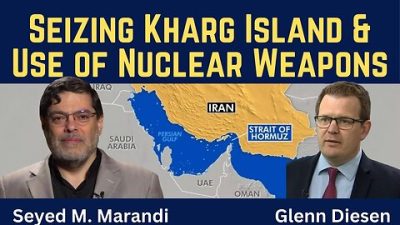
Marandi: Threat of Seizing Kharg Island & the Use of Nuclear Weapons
or go to
Aletho News Archives – Video-Images
Frlom the Archives
Provoking a Path to Persia
The Saban Center’s prescient paper on war with Iran
By Maidhc Ó Cathail | October 20, 2011
In June 2009, the Saban Center for Middle East Policy published “Which Path to Persia?—Options for a New American Strategy toward Iran.” Writing in a tone strikingly reminiscent of the Project for a New American Century’s infamous pre-9/11 paper “Rebuilding America’s Defenses,” the six co-authors noted that, “It seems highly unlikely that the United States would mount an invasion without any provocation or other buildup.” For a think tank specifically established by media mogul Haim Saban to protect Israel, this could prove to be a formidable obstacle impeding their desired march—of U.S. troops—to Tehran.
“In fact, if the United States were to decide that to garner greater international support, galvanize U.S. domestic support, and/or provide a legal justification for an invasion, it would be best to wait for an Iranian provocation, then the time frame for an invasion might stretch out indefinitely,” Saban’s think-tankers ruefully observed.
“With only one real exception, since the 1978 revolution, the Islamic Republic has never willingly provoked an American military response, although it certainly has taken actions that could have done so if Washington had been looking for a fight. Thus it is not impossible that Tehran might take some action that would justify an American invasion. And it is certainly the case that if Washington sought such a provocation, it could take actions that might make it more likely that Tehran would do so (although being too obvious about this could nullify the provocation). However, since it would be up to Iran to make the provocative move, which Iran has been wary of doing most times in the past, the United States would never know for sure when it would get the requisite Iranian provocation. In fact, it might never come at all.”
Seemingly undeterred by Iran’s frustrating unwillingness to provide the requisite provocation, the analysts continued to examine this option… continue
Blog Roll
 Aletho News
- Ukrainian Embassy in Beirut sheltering top Mossad agent
- Palestinian family displaced after settlers violently attack them in Humsa, Jordan Valley
- The EU never learns – except for the wrong lessons
- Iran attacks on UAE leaves RSF militia high and dry
- Hosting Washington’s war: Bahrain faces the consequences
- The US fell for its own Iran propaganda
- Seyed M. Marandi: Threat of Seizing Kharg Island & the Use of Nuclear Weapons
- Is there even an off ramp?
- Michael von der Schulenburg: Europe’s Self-Defeating Iran War Policy
- Sorry, The New Republic, Climate Change Isn’t Causing Somali Migration. Blame Civil Strife and Poverty.
- If Americans Knew
- ‘Of Course’: IDF Drops Case Against Soldiers Accused of Raping Palestinian Prisoner
- Don’t Fall for the Regime Change Talk. Israel Is ‘Mowing the Lawn’ in Iran
- Will Israel and the US wreck the Gulf States along with Iran?
- US so far burned through ‘years’ of munitions in Iran war: Report
- How the Israeli Tail Wags the American Dog
- Outdated intel likely led to deadly U.S. strike on Iranian elementary school, sources say
- Pentagon insider says high U.S official Douglas Feith reported to Netanyahu
- In fond memory of Walid Khalidi, the historian of Palestine
- 6 more Americans killed, as Israel ‘mows the lawn’ in Iran – Not a ceasefire Day 154
- Are we on the precipice of World War III?
- No Tricks Zone
- New Studies: UK Sea Levels Were 4 Meters Higher Than Today During The Mid-Holocene
- Destructive Green New Deal: German Energy And Metal Group Warns Of Drastic Crisis
- New Study Documents A 20-Year Pause In Arctic Sea Ice Decline – Driven By Internal Variability
- Wake-up Call: Survey Shows Majority Of Germans Now Favor Postponing Climate Targets!
- Televised! Leading German Political Candidate Tells Schoolchildren CO2 Makes Sun Hotter!
- New Study: A Century Warming Of 1.1°C Is ‘Commonplace’ And ‘Not Unusual’ During This Interglacial
- New Study: ‘Internal Noise’ And Volcanic Forcing Can Trigger 10-15°C Warming Within Decades
- Glaciers Worldwide Are Suddendly Surging, Experts Blame Warming!
- Surprising Discovery: Sahara Is Greening…Billions Of Trees Where Once Thought To Be Barren
- New Research Reaffirms Clouds, Aerosols, And Surface Solar Radiation Are ‘Driving The Climate System’
 Aletho News