Victoria Nuland’s ‘Ukraine-gate’ Deceptions
By Daniel McAdams | Ron Paul Institute | February 9, 2014
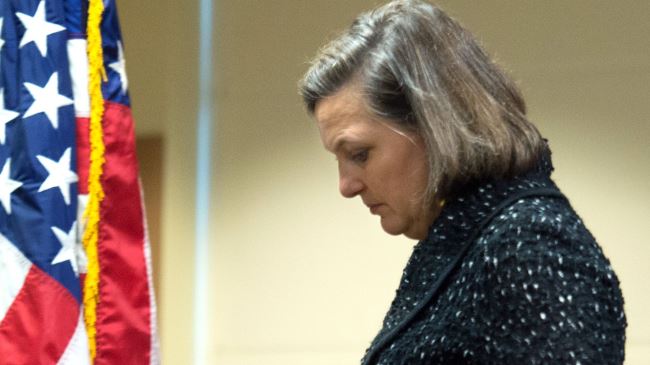
“That’s some pretty impressive tradecraft,” said Assistant Secretary of State Victoria Nuland of the interception and leak of her now-infamous call to US Ambassador to Ukraine Geoff Pyatt. The call consisted of the two plotting to install a US puppet government in Ukraine after overthrowing the current, democratically elected government.
Tradecraft means “spycraft.” In other words, Nuland was crediting a foreign intelligence service with impressive use of technology to be able to hack into her call to the ambassador. Everyone knew she was talking about Russia, partly because the Administration had been blaming Russia from the moment the recording was made public.
However, Nuland knew all along that this was not the case, and she did nothing while the Administration continued to escalate the accusations against Russia.
Jay Carney, White House Spokesman, “It says something about Russia,” that they would tap the telephone call. State Department Spokeswoman Jan Psaki was even harsher, calling it “a new low in Russian tradecraft.”
But the telephone call between the two, we learned yesterday, was not conducted on a secure, encrypted telephone line that the State Department requires for such sensitive conversations and communication. Rather, the call was made over unsecured cell phones and thus easily intercepted with basic equipment that is widely available to anyone. Therefore it was not “impressive tradecraft” at all that led to the capture and release of the conversation.
Nuland and Pyatt obviously knew that at the time, being the two parties to the call. They then either sat by and allowed US government official one after the other accuse Russia of going to great lengths to hack the call without admitting this fact, or they did inform their superiors but Administration officials decided to ignore this critical fact and push accusations against Russia anyway. You never want a serious crisis to go to waste, as it is said.
RPI contacted a former State Department official to clarify security procedures for such a telephone conversation between high-level personnel. The official was clear:
I know well the seriousness of using an open line (aside from anodyne conversation) for high-level classified information that would clearly be embarrassing, if not damaging, not only for the US but also the EU. For using an open line for discussing highly sensitive national security matters, both [Nuland and Pyatt] should be reprimanded, at the very least.
So this was a serious security violation.
The former official continued:
Assuming the telecon was made on insecure line, I find it curious, if not thought provoking, that Nuland’s profanity has managed to overshadow both the apparent security violation as well as the potential damage to national security of the substance of the conversation itself.
Indeed, the fallout from “Ukraine-gate” is astounding but sadly not surprising. The mainstream media in the US has focused solely on the Russian angle (now discredited) and on the salty language and particularly the false supposition that Nuland was using sailor’s language to indicate a serious rift with the EU on Ukraine policy. In fact, US and EU policy toward Ukraine is identical: regime change. The dispute is merely over velocity and is therefore cosmetic rather than substantive: should we travel 100 miles per hour or only 75 miles per hour toward regime change?
As far as we have seen, there has been virtually no discussion of the substance of the telephone conversation in the US media. But the conversation was a confirmation of all theretofore denied accusations of US involvement in the current unrest in Ukraine. It was not simply US well-wishing toward the opposition parties. It was not simply a bit of advice and a wink toward the opposition. It was wholesale planning and brokering a post-regime change governing coalition in Ukraine, with the UN being ordered to come in and “glue” the deal.
More precisely, as the Oriental Journal points out:
They agreed to nominate Bat’kyvshchina Party leader Arseniy Yatseniuk as Deputy Prime Minister, to bench Udar Party leader Vitaly Klitschko from the game for a while and to discredit neo-Nazi Svoboda party chief Oleh Tiahnybok as “Yanukovych’s project”
Shortly after “Ukraine-gate” broke, Sergei Glazyev, advisor to Russian president Putin claimed that the US was spending $20 million per week on the Ukrainian opposition, including supplying the opposition with training and weapons.
Nuland replied that such claims are “pure fantasy.”
Perhaps, but that is just what Nuland had said previously about claims that the US was meddling in the internal affairs of Ukraine. And then the tape came out. That was just what she said about Russia’s “impressive tradecraft” in intercepting the telephone call. Then we discover that she was discussing highly sensitive issues over completely unsecured telephones.
Is the US training and funding the Ukraine opposition? Nuland herself claimed in December that the US had spent $5 billion since the 1990s on “democratization” programs in Ukraine. On what would she like us to believe the money had been spent?
We know that the US State Department invests heavily — more than $100 million from 2008-2012 alone — on international “Internet freedom” activities. This includes heavy State Department funding, for example, for the New Americas Foundation’s…
…Commotion Project (sometimes referred to as the “Internet in a Suitcase”). This is an initiative from the New America Foundation’s Open Technology Initiative to build a mobile mesh network that can literally be carried around in a suitcase, to allow activists to continue to communicate even when a government tries to shut down the Internet, as happened in several Arab Spring countries during the recent uprisings.
“Commotion Project.” What an appropriate name for what is happening in Ukraine.
It is not a far leap from the known billions spent on “democratization” in Ukraine, to the hundreds of millions spent on developing new tools for regime-changers on the ground to use against authorities in their home countries, to the State Department from the US embassy in Kiev providing training and equipment to those seeking the overthrow of the Ukrainian government.
The apparent goal of US policy in Ukraine is to re-ignite a Cold War, installing a US-created government in Kiev which signs the EU association agreement including its NATO cooperation language to effectively push the Berlin Wall all the way to the gates of Moscow and St. Petersburg.
NATO has expanded to central Europe, despite US assurances in the 1980s that it would not do so. The US rolled over Russia in its deceptive manipulation of a UN Security Council resolution on Libya to initiate an invasion. The US continues to arm jihadists seeking to overthrow the secular Assad government in Russia-allied Syria. The US and EU have absorbed the Baltics, leaving their large ethnic Russian populations to dangle in non-person limbo. The US and EU had all but absorbed Georgia. Now the US is clearly in the process of absorbing Ukraine, with its strategic importance to Russia, its proximity, and its nearly 10 million ethnic Russian minority.
Surely there is a point to where Russia will take steps to concretely limit its losses. In December Russian president Vladimir Putin said in a meeting with his Ukrainian counterpart Viktor Yanukovich that Russia and Ukraine should resume comprehensive military cooperation. Other bilateral defense agreements are already in place.
What would have to happen to trigger a Ukrainian request to its close neighbor for assistance putting down a bloody and illegal coup d’etat instigated by foreign governments? Will serious US miscalculation of Russian resolve over Ukraine lead to a tragedy of almost inconceivable proportions? What if this time Russia does not blink?
Related article

State Department’s Watergate? Office of high-profile whistleblower’s lawyer burglarized
RT | July 8, 2013
The Dallas law office representing a State Department whistleblower was broken into and robbed during the first weekend of July. Three computers were stolen and the firm’s file cabinets had been searched, but valuables were left untouched.
“It’s a crazy, strange and suspicious situation,” attorney Cary Schulman of the Schulman & Mathias law office told Foreign Policy Magazine’s The Cable.
The burglars left behind silver bars, video equipment and other valuables, causing Schulman to believe that they were looking to find information on the case of former State Department inspector general investigator Aurelia Fedenisn, who leaked government documents last month. Fedenisn provided CBS News with documents that accuse the State Department of covering up criminal investigations involving its diplomats and employees, including offenses such as illicit drug use, sexual solicitation of minors and prostitutes, and sexual harassment.
The documents state that US Ambassador to Belgium Howard Gutman “was suspected of patronizing prostitutes in a public park.”
Schulman believes that the perpetrators of the burglary may have been politically motivated supporters of the Obama administration, but the suspects have not yet been identified.
“It’s clear to me that it was somebody looking for information and not money. My most high-profile case right now is the Aurelia Fedenisn case, and I can’t think of any other case where someone would go to these great lengths to get our information,” Schulman told The Cable.
Last month, lawyers representing Fedenisn told The Cable that the State Department tried to silence her by threatening her and her family. Law enforcement officers allegedly camped in front of her house, harassed her children, and tried to make Fedenisn incriminate herself.
Schulman believes that officials are trying to force Fedenisn to sign papers admitting that she stole the documents – a crime that the former investigator denies.
The law office does not believe the State Department authorized a break-in, but suspects that supporters of the administration may be to blame.
“It wasn’t professional enough,” he said. “It is possible that an Obama or Hillary supporter feels that I am unfairly going after them. And the timing of this is right after several weeks of very public media attention so it seems to me most likely that the information sought is related to that case. I don’t know for sure and I want the police to do their work.”
Local Fox affiliate KDFW aired a surveillance video of the two suspected burglars, who can be seen walking out of the office carrying computers.
State Department spokesperson Jen Psaki claims the agency had no involvement in the break-in.
“Any allegation that the Department of State authorized someone to break into Mr. Schulman’s law firm is false and baseless,” she said.
US agents in massive sex, drug cover-up
Press TV – June 11, 2013
The US State Department may have hushed up allegations of misconduct by its employees worldwide that range from soliciting prostitutes to getting narcotics from a drug ring, a report says.
The CBS News uncovered on Monday a memo that showed the department’s security force, the Diplomatic Security Service (DSS), tried to cover up sex and drugs charges against agents and diplomats working for the State Department.
The DSS is responsible for protecting nearly 70,000 employees at the State Department and 275 US embassies around the world.
The memo by the State Department inspector general made direct reference to eight specific cases in which inquiries into alleged criminal activities by diplomatic security agents or contractors were “influenced, manipulated, or simply called off” by more senior officials.
The cases included an unnamed US ambassador who repeatedly solicited prostitutes, a security official “engaged in sexual assaults” on foreign nationals hired as embassy guards in Beirut, and the members of former Secretary of State Hillary Clinton’s security team who “engaged prostitutes while on official trips in foreign countries.”
The ambassador involved in the case was called to Washington D. C. to have a meeting with Undersecretary of State for Management Patrick Kennedy about the issue but was permitted to go back to his regular duties, the report said.
The document also revealed details of an alleged “underground drug ring” close to the US embassy in the Iraqi capital Baghdad, which provided the DSS staffers with drugs.
State Department spokeswoman Jen Psaki on Monday did not deny any of the allegations in the CBS report, but refused to go into details.
“We take allegations of misconduct seriously and we investigate thoroughly. All cases mentioned in the CBS report were thoroughly investigated or are under investigation,” she said.
Related article
Russia slams the US for distorting results of trilateral talks on Syria
Press TV – June 7, 2013
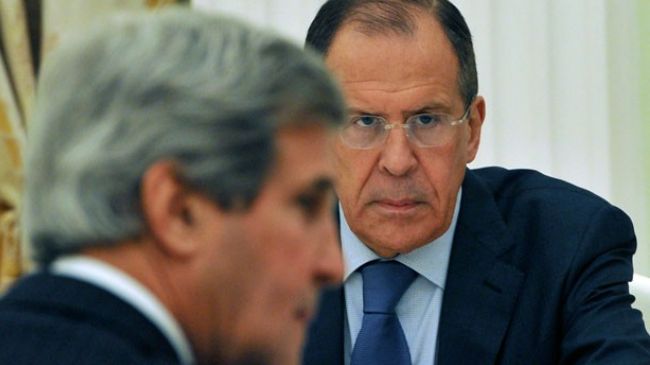
Russia’s foreign minister has censured the US Department of State officials for their ‘peculiar comment’ on the results of a trilateral meeting over Syria in Geneva.
The trilateral meeting on Wednesday was held with the participation of UN-Arab League Special Representative for Syria Lakhdar Brahimi and representatives from Russia and the United States. It served as a preparatory move to pave the way for the Geneva 2 talks on the issue of Syria.
During a Thursday press conference, Russian Foreign Minister Sergei Lavrov said, “I have heard that officials from the US Department of State have given a very peculiar comment on the results of yesterday’s meeting in Geneva between Russia, US, and UN.”
“In particular, the State Department representative stated that Russia, the United States and the United Nations agree that the goal of the new conference in Geneva must be the forming of a new transitional government in Syria. This really matches with what was written down last year,” he said.
“But, if the reports that I have received are true, the State Department went on to add that this should be a transitional government to which the current authorities in Damascus would hand over all their powers. If this was really said by the State Department, this is a very strong distortion of what the talks were about,” the Russian foreign minister added.
He made the remarks in response to an earlier statement by Jennifer Psaki, a spokesperson for the US Department of State, where she reportedly claimed that participants in the preparatory meeting had agreed that the forthcoming talks on Syria should focus on the formation of a transitional government, to which the current administration should give up all powers.
Lavrov further reiterated that Moscow would continue to push for Iran’s participation in the upcoming Geneva meeting despite opposition from some Western states.
Meanwhile, Brahimi has expressed hope that the Geneva conference would convene in July, as the preparatory meeting failed to set a date.
Official Honduran Report on May 11 Shooting Incident is a New Injustice to Victims
By Dan Beeton | CEPR Americas Blog | April 11, 2013
CEPR has released a new paper, along with the human rights organization Rights Action, examining the Honduran Public Ministry’s official report on the May 11, 2012 shooting incident last year in which four local villagers were killed in Ahuas in Honduras’ Moskitia region during a counternarcotics operation involving U.S. and Honduran agents. This is also the first time that the Public Ministry’s report has been made available to the public, posted to Scribd in English here, and Spanish here.
The Honduran Public Ministry’s report deserves special scrutiny because thus far it represents the official version of events according to the Honduran authorities. And since the U.S. government has declined to conduct its own investigation – despite the wishes of 58 members of Congress – it also represents by default the version of events tacitly endorsed by U.S. authorities as well. The DEA and State Department didn’t allow Honduran investigators to question the U.S. agents and contractors that participated in the May 11 operation. At the same time a U.S. police detective working for the U.S. Embassy reportedly participated in the Public Ministry’s investigation, so the U.S. also bears some responsibility for the report’s flaws.
The CEPR/Rights Action paper found that the Public Ministry’s report:
- Makes “observations” (not conclusions) that are not supported by the evidence cited;
- Omits key testimony, that would implicate the DEA, from police who were involved in the May 11 incident;
- Relies on incomplete forensic examinations of the weapons involved, improper forensic examinations of the victims’ bodies and other improperly gathered evidence;
- Does not attempt to establish who is ultimately responsible for the killings;
- Ignores eyewitness reports claiming that at least one State Department-titled helicopter fired on the passenger boat carrying the shooting victims;
- Does not attempt to establish whether the victims were “in any way involved in drug trafficking” as both Honduran and U.S. officials originally alleged;
- Does not attempt to establish what authority was actually in charge of the operation;
- Appears to be focused on absolving the DEA of all responsibility in the killings.
The CEPR/Rights Action report represents the first such public critique of the Public Ministry’s report. As we have previously noted, there are significant discrepancies between different accounts of the May 11 events, including those of Honduran police officers who participated in (and say the DEA was in charge of) the operation. These discrepancies – cited in a separate report published by the Honduras National Commission of Human Rights (CONADEH) – are not mentioned in the Public Ministry report. Nor does the report include police testimony indicating that a DEA agent ordered one of the State Department helicopters to open fire on the passenger boat in which four people were killed.
The report concludes by calling for the U.S. government to carry out its own investigation of the Ahuas incident to better determine what occurred and to determine what responsibility, if any, DEA agents had in the killings. It also calls on the U.S. government to cease being an obstacle to an already flawed investigation by making the relevant DEA agents, weapons and documents – including an aerial surveillance video of the Ahuas operation in its entirety – available to investigators.
The new CEPR/Rights Action paper follows the “Collateral Damage of a Drug War” report released last year which was based on eyewitness testimony and other evidence the authors obtained in Honduras and concluded that the DEA played a central role in the shooting incident.
Related article
- Obama Administration Refuses to Investigate Alleged DEA Killing of Women and Child in Honduras (alethonews.wordpress.com)
U.S. State Dept. admits passport form was illegal, but still wants it approved
The new U.S. passport application forms are back, worse than ever.
Papers, Please! – September 24th, 2012
Ignoring massive public opposition, and despite having recently admitted that it is already using the “proposed” forms illegally without approval, the State Department is trying again to get approval for a pair of impossible-to-complete new passport application forms that would, in effect, allow the State Department to deny you a passport simply by choosing to send you either or both of the new “long forms”.
Early last year, the State Department proposed a new “Biographical Questionnaire” for passport applicants, which would have required anyone selected to receive the new long-form DS-5513 to answer bizarre and intrusive personal trivia questions about everything from whether you were circumcised (and if so, with what accompanying religious rituals) to the dates of all of your mother’s pre- and post-natal medical appointments, your parents’ addresses one year before you were born, every address at which you have ever resided, and your lifetime employment history including the names and phone numbers of each of your supervisors at every job you have ever held.
Most people would be unable to complete the proposed new form no matter how much time and money they invested in research. Requiring someone to complete Form DS-5513 would amount to de facto denial of their application for a passport — which, as we told the State Department, appeared to be the point of the form.
The State Department’s notice of the proposal in the Federal Register didn’t include the form itself. After we published the proposed Form DS-5513, the story went viral and more than 3,000 public comments objecting to the proposal were filed with the State Department in the final 24 hours of the comment period.
After that fiasco, the State Department went dark for several months, and claimed that they would “revise” the form. But they didn’t give up, and apparently they didn’t listen to (or didn’t care) what they had been told by members of the public in our comments.
The State Department is now seeking approval for a (slightly) revised Form DS-5513 as well as a new Form DS-5520, also for passport applicants, containing many of the same questions.
The State Department no longer wants you to tell the passport examiner about the circumstances of your circumcision, but does still want to know the dates and locations of all of your mother’s pre- and post-natal medical appointments, how long she was hospitalized for your birth, and a complete list of everyone who was in the room when you were born. The revised forms no longer ask for all the addresses at which you have lived, but only for those addresses you are least likely to know: all the places you lived from birth until age 18.
And so on, as you can see for yourself on the proposed Form DS-5513 and Form DS-5520.
Related articles
- How to Get a Passport (answers.com)
Featured Video
No Threat Can Force Iran’s Surrender /Trita Parsi & Lt Cl Daniel Davis
or go to
Aletho News Archives – Video-Images
From the Archives
An Expert Military Analysis of War with China
Actually, None is Necessary
By Fred Reed • Unz Review • December 13, 2020
The Correlation of Armed Forces: U.S. goods and services trade with China totaled an estimated $634.8 billion in 2019. Exports were $163.0 billion; imports were $471.8 billion. The U.S. goods and services trade deficit with China was $308.8 billion in 2019. Trade in services with China (exports and imports) totaled an estimated $76.7 billion in 2019. Services exports were $56.5 billion; services imports were $20.1 billion. The U.S. services trade surplus with China was $36.4 billion in 2019.
There is talk within the Washingtoniat of a possible war with China. Steve Bannon, who apparently was dropped on his head as a child, actually favors such a war. We hear the usual shoo-the-boobs alarm about how the Chinese are doing something terrible and we must gird our loins and American values and show them what for, bow wow, woof. The danger is that the current game of who-blinks-first in Asian waters might actually provoke a shooting war. You know the kind of thing: One warship refuses to get out of the way of another, a collision ensues, some retard lieutenant who signed up on waivers opens fire, and we’re off and running. It is not a good idea to let children play with matches.
The said war is discussed either in emotional terms by idiots or in purely naval terms by those familiar with such things, so we hear of the First Island Chain and the Second Island Chain and whose missiles against the other’s missiles and so on. This would be appropriate if we were fighting World War Two again. Which we aren’t. Let’s take a quick-and-dirty look at how such a war might go.
To begin the war, America would overestimate itself and underestimate China. This is doctrine in the Pentagon. … continue
Blog Roll
 Aletho News
- Theodore Postol: Iran’s Missiles & Drones Were Underestimated
- Iran To Target Military Industrial-Tech Complex That Facilitated Gaza Genocide
- Collapsing Empire: The Resistance Disarms ‘Israel’
- Suicide Should Not Be a Government Service
- Rethinking America’s greatest threat: Iran vs. Israel-Firsters
- Iran accuses adversaries of false flags to strain Turkey ties
- Poland rules out sending Patriot missiles to US/Israel amid war on Iran
- Tehran approves new Hormuz plan with major restrictions
- No Threat Can Force Iran’s Surrender /Trita Parsi & Lt Cl Daniel Davis
- UK’s New Pandemic Plan Would Turn Big Tech Into a Mass Location Tracking Network
- If Americans Knew
- Ann Coulter Rips Into Fox News for Iran War Coverage, Compares to False Rigged 2020 Election Reporting
- Joe Kent Urges Americans To Call White House and Congress To Object To Sending Troops Into Iran
- DNC Resolution to Reject AIPAC Funding Puts Democratic Leaders in the Hot Seat
- Swedish foundation to build 400 schools as over 650,000 Gaza children remain without education for 2 years
- Israeli army admits photshopping image of slain Lebanese journalist
- This is how Israel is systematically killing health workers under the cover of war in Lebanon
- Carrying life under fire: Israeli invasion of Lebanon leaves pregnant women facing deadly risks
- Champagne all around for the new death penalty (for Palestinians) law – Not a ceasefire Day 172
- Why are Palestinian books struggling to be seen on Amazon?
- The Line Between Affinity and Conspiracy
- No Tricks Zone
- New Study Finds Warming Saves Lives…Cold Temperatures 12 Times More Deadly Than Excess Heat
- German Science Blog Accuses PIK Climate Institute Of Hallucinating Climate Tipping Points
- Devastating Assessment Of Comirnaty Vaccine By Former Senior Pfizer Europe Toxicologist
- New Study: CO2 Is ‘Effectively Negligible’ As An Explanatory Climate Change Factor Since 2000
- Former Pfizer Toxicologist Dr. Helmut Sterz Tells Bundestag Hearing Pfizer Vaccine Should Have Never Been Approved
- Energy Expert: Germany’s Nuclear Phaseout Was A “500 Billion Euro Mistake”
- New Research: South Australia’s Mid-Holocene Sea Surface Temperatures Were 4°C Warmer Than Today
- Storing Green Energy To Last Germany 10 Days Would Require A 60-Million Tonne Battery
- New Studies: UK Sea Levels Were 4 Meters Higher Than Today During The Mid-Holocene
- Destructive Green New Deal: German Energy And Metal Group Warns Of Drastic Crisis
 Aletho News