Biden claims credit for toppling Syria’s Assad
RT | December 9, 2024
Outgoing US President Joe Biden has claimed credit for the fall of Damascus to a coalition of armed groups, including jihadists from Hayat Tahrir-al-Sham (HTS). Washington had weakened the supporters of former Syrian President Bashar Assad, the American leader has said.
The result of the lightning offensive of anti-government militants in the past two weeks was a “fundamental act of justice” and a “moment of historic opportunity for the long-suffering citizens of Syria,” Biden said in a video address from the White House on Sunday.
“For years, the main backers of Assad have been Iran, [the Lebanese-based militant movement] Hezbollah, and Russia. But over the last week, their support collapsed, all three of them. Because all three of them are far weaker today than they were when I took office,” Biden said.
Washington has been pushing for the ouster of Assad since 2011, when mass protests spiraled into a devastating civil war, in which foreign-armed Islamists emerged as dominant players among anti-government forces. HTS, one of the groups that took over Damascus on Sunday, was formerly known as Jabhat al-Nusra, a Syrian Al-Qaeda affiliate. The war was exacerbated further in 2014 when the terrorist group Islamic State (IS, formerly ISIS) rose as a regional threat amid the collapse of security in Syria.
In his speech, Biden highlighted the sanctions on Syria, as well as the US military presence in the country and its support for Kurdish militias in the northeast, which denied Damascus access to fertile lands and oil fields under their control. The US has also supported Israel in its military campaigns in Gaza and Lebanon and its direct confrontation with Iran, Biden added.
“Our approach has shifted the balance of power in the Middle East,” Biden said, mirroring similar remarks by Israeli Prime Minister Benjamin Netanyahu.
“Through this combination of support of our partners, sanctions, diplomacy, and targeted military force where necessary, we now see new opportunities opening up for the people of Syria and for the entire region.”
The US president claimed that Washington was clear-eyed about HTS and its “grim record of terrorism and human right abuses.” Washington will “assess not just their words, but their actions,” he stated. Biden’s national security adviser, Jake Sullivan, said on Sunday that HTS’ history of terrorism and atrocities is a concern for the US.
Abu Mohammed al-Julani, the current leader of HTS, has had a $10 million bounty posted on his head by the US since 2013. According to the US government, the fighters he led were responsible for kidnappings and massacres of civilians.
Syria falls to rebels who are “a tool of NATO, Israel and Turkey” with US role included
By Uriel Araujo | December 9, 2024
After combating terrorism and rebel groups for over twelve years, the former Syrian President Bashar al-Assad fled the capital of Damascus with his family on December 7, shortly before it fell to the rebels. The victorious insurgents are the Hayat Tahrir al-Sham (HTS) organization along with an umbrella group called the Syrian National Army.
Craig Murray (former British ambassador to Uzbekistan), in a panel about “the end of pluralism in the Middle East”, described the “Syrian rebels” as “a tool of NATO, Israel and Turkey”. This is a complex description for a complex situation indeed. Of the three, many analysts are focusing on the Israeli and Turkish angle—not so much on the American angle, though.
To recap, since the 2011 armed rebellion, Syria has counted on military aid from its allies Iran and Russia. The Iranian Revolutionary Guard, as well as the (Tehran-backed) Lebanese Hezbollah have in fact been the main anti-terrorist actors in the Levant, by deterring the expansion of terrorist group ISIS (Daesh) and thereby making the region safer for Christians and other minorities. Islamic Wahhabi/Salafi extremists were, after all, beheading some of them while kidnapping others and selling women as slaves.
The fact is that the rebels who have won in Syria now are not of a very different persuasion, and it is no wonder many are now concerned. Archbishop Ieronymos of Athens for one has urged the Greek Ministry of Foreign Affairs to aid the Christian population in Syria. He wrote: “The advance of extremist armed groups and the capture of Aleppo threaten… the interfaith composition of the region’s population… there is now a looming danger of the complete eradication… of Greek Orthodoxy and Christianity from the wider region.”
Such concerns are well founded. One should bear in mind that (Saudi-born) Abu Mohammed al-Julani, the very leader of Turkish-backed HTS, the group who has captured Aleppo (Syria’s second largest city), joined Al-Qaeda in Iraq in 2003, later establishing its split branch in Syria, the so-called al-Nusra Front. This group, under al-Julani, cooperated with the infamous Abu Bakr al-Baghdadi, leader of Al-Qaeda’s split offshoot called “Islamic State in Iraq”, later known as ISIL (ISIS) or Daesh.
Al-Julani’s own later split from al-Qaeda and creation of the aforementioned HTS has been described as merely a “bid” to “stress his group’s national, as opposed to transnational, ambitions.” In other words, the group is just another re-branded offshoot of ISIS/Al-Qaeda. And those are the people who have now conquered Syria.
One might disapprove of Assad’s ruling but such a development can hardly be described by most as anything other than a disaster. Turkey (who aids the rebels) and Israel, as already mentioned, do benefit from this outcome, however, for their own reasons—and much is already being talked about that. But not so many analysts are highlighting the American role in all of it.
For example, the US-backed Syrian Free Army (a coalition which has taken control of Hom’s Palmyra district) announced that they are “open to friendship with everyone in the region – including Israel. We don’t have enemies other than the Assad regime, Hezbollah and Iran. What Israel did against Hezbollah in Lebanon helped us a great deal” – while claiming they are not allied with Turkey. The group, being increasingly dependent on Turkey, is a close ally of the United States, and was even hosted at the American military base at al-Tanf. Turkey, despite its differences with Washington is of course also, let us not forget, a NATO member.
The future of Syria and the concerned parties is far from clear now, there being lots of room for infighting among the different rebel factions. Turkey, which has long occupied northern Syria, has taken advantage of the ceasefire in Lebanon to give the rebels the green-light for launching an offensive (with Iran weakened in Syria and Hezbollah cornered in Lebanon). However Turkish-American differences pertaining to the Kurdish question are to remain a focal point for tensions.
HTS is indeed Turkish-backed but, as mentioned, its roots can be traced to Al-Qaeda, ISIS, and other such groups empowered by Washington’s policy. One should not forget the fact that there are still around 900 US troops in Syria (mostly in the northeast, near Turkish strongholds) which witnessed the rebel victory. This has led some analysts to comment that “whether the Pentagon wants to admit it or not”, these troops are “likely involved in the broader conflict unfolding there right now.”
Moreover, there is nothing new about the West praising and empowering brutal terrorism and radicals when such is deemed geopolitically convenient: if former US Secretary of State Hillary Clinton under President Barack Obama had achieved her stated goals, Syria would be in a similar situation to Libya since 2011 – in Libya, coincidence or not, arms provided by the US to rebels there also “ended up” in ISIS hands, according to Amnesty reports.
Back to the Levant region, it is a well-established fact that Washington played a key role in the empowerment of ISIS (or Daesh) both in Syria and Iraq (as well as other brutal radicals), with the Pentagon and the CIA arming mostly foreign Islamic militias that ended up even fighting among themselves. This is consistent with American foreign policy elsewhere too. The infamous Clinton emails also show how the US was aware of their allies Qatar and Saudi Arabia supporting Daesh terror.
The White House National Security Council (NSC) spokesperson Sean Savett said in a recent statement that Washington “has nothing to do with this offensive.” Considering all of the above, one can certainly be justified in taking such statements with a grain of salt. For Washington, further destabilizing Syria might also serve the role of “countering” Russia in the region. The US has consistently aided, funded, armed and trained Fundamentalist rebels who operate in the Levant for over a decade and there is no reason to assume anything is different now with the newest developments.
Finally, still on the topic of the Christian minority, US foreign policy—for a variety of reasons—has actually often involved dividing or destabilizing Eastern Christian (both Orthodox and Miaphysitist) populations or sometimes even aiding or turning a blind eye to the ethnic-religious cleansing of such groups or of Christians in general in the Levant region, for that matter.
This is of course quite ironic for a country such as the US who often hails itself as “one nation under God” or as a “Christian nation”– this being the Republican party line at least. Trump for one has posted that “Syria is a mess, but is not our friend”.
Uriel Araujo, PhD is an anthropology researcher with a focus on international and ethnic conflicts.
Regime Change in Syria: Another Step Towards “Greater Israel”
By Alan Sabrosky • Unz Review • December 8, 2024
“For they have sown the wind,
and they shall reap the whirlwind.”
-Hosea 8:7
The collapse of the Assad government in Syria is certain to be greeted with considerable satisfaction in Jerusalem and Washington. Both capitals of the Zionist Co-Dominium have long seen the Assads much as they did Iraq’s Saddam Hussein and Libya’s Muammar Gaddafi. All were obstacles to Israel’s designs in the region.
All three were also targets of that nefarious policy of “regime change” highlighted by the US after 9/11, as were four other countries in the region. Now the last of the three has fallen, albeit much later than the mostly Jewish neoconservative “chicken hawks” (so called because all advocated war but very few ever served in uniform) had anticipated back in 2001.
So What Caused the Collapse?
Internal dynamics within Syria that played their part, to be sure, but I will focus here on the external factors. A major reason was the unrelenting pressure and considerable resources poured into the assorted militias and jihadists trying to overthrow Syria’s regime. Money talks, and it talked very loudly here. So did the frequent Israeli air and artillery strikes into Syria. Shielded by the US, Russian forces in Syria could do little for their ally.
Then, too, the numerically small but politically significant, open-ended US military presence on the ground in Syria had their own impact, So did the limited but strategically significant direct military attacks by the US and other NATO countries on Syrian government forces and installations. Image matters, and here it mattered greatly.
Syria’s Assad could never match that. Only Russia (to a very limited extent) and Iran (to a even lesser one) really did much of anything. But Russia is caught up with the Ukrainian “tar baby” and Iran is hedging its bets in anticipation of America’s own “regime change.” A scarcity of strong, reasonably reliable allies also counts, and it counted here, but not in a good way.
Second, Syria lost the information and propaganda war, in a very big and very decisive way. The Jewish-dominated media in the US and most of Europe made sure that virtually every claim, no matter how ludicrous, of the jihadists and other anti-government elements in Syria was treated as Gospel truth. Few in the legacy media disputed their assertions, although many did in the alternative media and on social media platforms.
It wasn’t enough. Israel can rip Gaza apart and kill tens of thousands of civilians, but any criticism of its very real war crimes is almost universally denounced in the media and Western capitals as “vicious antisemitism” that needs to be suppressed and punished. That criticism was nothing of the sort, but it demonstrates the exceptional degree of Jewish influence throughout the West. It also underscores the accuracy of the axiom that “truth is the first casualty of war,” at least whenever Israel or its interests are involved.
Third, it is worth noting that this event saw insurgent militias and local jihadists do to the Syrian government forces what the US-backed mujaheddin did to the Afghan government and their Soviet allies, and later the Taliban (the lineal operational descendants of the original mujaheddin) did to another Afghan government and its American patron. It seems that local governments have very great difficulty holding out against insurgents who have an external sanctuary, external assistance, or both.
In all three cases cited above, the insurgents had both. In Syria, the government forces had also to contend with direct military attacks by Israel, the US and other NATO countries. What made it harder for them was that they essentially fought these external forces with one hand firmly tied behind their backs.
Other than in defense, Syrian government forces could only engage in occasional artillery duels with the Israelis, but not respond to air attacks in kind. Nor could the Russians assist them, other than defensively. Any attempt to respond directly to US, Israeli or other attacks meant a direct confrontation with the US, Israel covered by its American puppet, or NATO. The Syrians could not do this alone, and Syria simply was not worth enough to Russia to risk that kind of engagement.
Reflections
It will take some time for the implications of all this to become clearer (perhaps “less murky” would be more accurate). I expect the current Syrian government officials and senior military commanders are wondering if they will still be alive next week. I am not a specialist on Syrian affairs, but the historical track record in these situations would not be reassuring to them.
I expect, however, a major consideration on the part of the winners will be the role intended for them by their foreign patrons. Do we want the new Syrian government to be another Egypt, at least insofar as Israel is concerned? Or is it something else?
Whatever it is, insurgent forces – even heavily infiltrated ones – have shown themselves to be exceptionally difficult to predict or to control, or even to influence, once they are in power. Recall that the people the US armed to fight the Soviets in Afghanistan morphed into a Taliban which employed some of those weapons and techniques to force yet another humiliating American debacle.
The Israeli experience with these things is even more problematic. I was told back in the 1980s by a senior Israeli officer that they had successfully infiltrated every single Arab government and movement, relying principally on Sephardic Jews. So when Israel set up Hamas in the 1980s as a counter-weight to the PLO, I expect they thought they had made a good bargain. Yet it, too, changed over the years. Infiltrated or not, it has given Israel a more “interesting” time than it anticipated.
The case of ISIS and the Syrian jihadists is even more interesting. Now, “false flags” (attacking someone but making people believe someone else is doing it) is something of an Israeli specialty. The motto of Mossad, the best-known Israeli intelligence organization, is aptly “By Deception, Shall You Wage War.
Mossad and its sister organizations have lived up to that motto since the founding of Israel. They have been aided worldwide by dual Israeli citizens, or Jews without Israeli citizenship, some Christian Zionists, and outright mercenaries.
Examples abound. Three of particular relevance to the US, for example, are the Lavon Affair in Egypt (1954), the attack on the USS Liberty (1967) and the 9/11 attacks (2001). Worth looking them up (do NOT trust either Wikipedia or Google search engine!), but here is a start on the last-named one.
The case of ISIS is even more intriguing. Supposedly a militant Islamic organization, it seems to have exceptionally great difficulty hitting Israeli or American targets anywhere in the world. This was a problem Osama bin Laden’s Al-Qaeda, with fewer assets, obviously did not share.
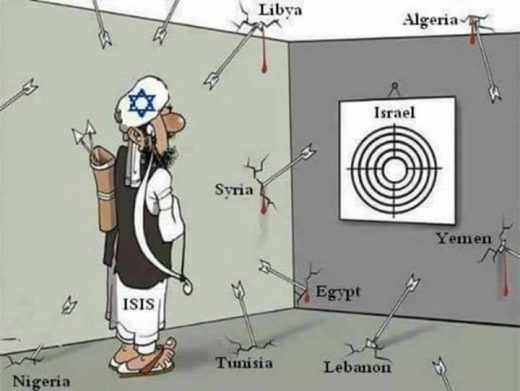
Despite the resources to field fleets of white Toyota pick-up trucks with heavy weapons in their beds and other paraphernalia, they found it an “almost” insurmountable challenge to strike what should be their own principal enemies. Curious, is it not? I wonder how many ISIS leaders have shared drinks with their Mossad and CIA contacts.
Last are the Syrian jihadists, easily the most fascinating facet of the Syrian puzzle. We are told constantly that these people are Islamic fanatics who spend their nights dreaming of how to kill non-believers, and their days trying to do it (or is that backwards?). But apparently there are “good” jihadists and “bad” jihadists. The former are those who do the bidding of Western governments (including Israel) and attack Muslim countries. The latter are those that apparently do not.
Peering Ahead
It is hazardous at best to anticipate what will emerge in the aftermath of the Syrian government’s defeat. At a minimum, I would expect the new rulers to order the Russians out. Of course, the Russians may not go, just as the US ignored the demands of many weaker governments to leave. Imperial powers, even if weakening and in a chaotic world, are often like that.
We may learn a bit more about ISIS and these “good” jihadists in Syria. Precisely what will they do in power? Will they be like the Taliban in Afghanistan? If not, what would that say about their actual character and that of their leaders? Thought-provoking times, at best.
What is clearer is that what happened in Syria will embolden the Israelis to deal with the Palestinians within and Lebanon and Hezbollah without, especially once Trump is President and recognizes Israeli sovereignty over East Jerusalem and the West Bank. Trump is even more beholden to Israel than most US presidents, and Israel will capitalize on it.
Moreover, with Assad’s Syria removed from the game, Iran will move to the regional front burner. No person in the US can now even be a serious candidate for President without being in Israel’s pocket, much less be elected to that office, but the two American political factions have different priorities.
What this means is that the Neo-conservatives stacking up in Trump’s administration are an odds-on certainty to see this as a golden opportunity to complete their 2001 agenda and neutralize Iran. Knowing them, they and Jewish money will push (perhaps I should say “nudge”) Trump to do one of three things: (1) support Israel in attacking Iran, (2) join Israel in doing that, or (3) attacking Iran without Israel.

The net effect is a far more dangerous 2025 than recent years have seen, and they have not been exactly a joy. We face civil upheaval at home and more war abroad, if Trump actually puts his agenda into effect. For Israel, Syria’s defeat and Trump’s presidency augur well on its march to a “Greater Israel.” For Palestinians. Lebanese and so many others in the region, things have gone from bad to an almost unimaginably worse. For Americans, challenging times, indeed.
Alan Ned Sabrosky (PhD, University of Michigan) is a ten-year US Marine Corps veteran. He served in Vietnam with the 1st Marine Division and is a graduate of the US Army War College. Dr. Sabrosky can be contacted at docbrosk@comcast.net
Netanyahu Says Ordered Israeli Army to ‘Seize’ Buffer Zone with Syria
Al-Manar | December 8, 2024
Israeli Prime Minister Benjamin Netanyahu said Sunday he had ordered the Israeli military to “seize” a UN-patrolled buffer zone between the Israeli- and Syrian-controlled Golan Heights.
The premier said a 1974 disengagement agreement with Syria “has collapsed”, so he “directed the (military) yesterday to seize the buffer zone and the commanding positions nearby.”
“We will not allow any hostile force to establish itself on our border,” Netanyahu said during a visit to the Mount Bental on the border between occupied Palestine and Syria.
Meanwhile, he claimed credit for starting the chain of events that led to the fall of the Syrian government after the armed opposition entered the capital, Damascus, early on Sunday.
“This is a historic day in the history of the Middle East. This is a direct result of the blows we have inflicted on Iran and Hezbollah, the main supporters of the (President Bashar) Al-Assad regime.”
Netanyahu also warned that alongside new opportunities, the flight of Assad from Syria also brings risks.
HTS extremists take control of Homs, no clashes reported as Syrian army withdraws
The Cradle | December 8, 2024
Extremist armed groups battling under the banner of Hayat Tahrir al-Sham (HTS) took control of the strategic city of Homs in central Syria on 7 December, after the Syrian Arab Army (SAA) “repositioned its forces” outside the city with no clashes reported.
“The SAA, paramilitary forces, and allies of the Syrian government withdrew from the city of Homs … No clashes were recorded in or around the city before orders were given out to soldiers to withdraw,” Al Mayadeen’s correspondent in Homs reported late on Saturday.
According to local sources, fighters from the Turkish-backed HTS and Syrian National Army (SNA) have taken control of “every neighborhood in the city.”
HTS, a UN-designated terrorist organization, launched a shock invasion of the Aleppo countryside on 27 November. Their numbers were reportedly bolstered by extremist groups from Central Asia that entered Syria via Turkiye. Ukrainian special forces have also been providing support to the armed groups.
Over the past 10 days, HTS and SNA fighters – most of them former members of Al-Qaeda and ISIS – have taken control of the cities of Aleppo, Hama, and Homs.
As the offensive gains speed, the SAA has repeatedly chosen to redeploy troops outside battle zones, largely avoiding clashes.
Homs is strategically positioned at a crucial crossroads between Damascus and Syria’s coastal provinces, Latakia and Tartus – the government’s stronghold and home to a vital Russian naval base.
Al Mayadeen reports that, after leaving Homs, the SAA has also withdrawn “from the mountains of Latakia towards the city on the Syrian coast.” The Syrian army also withdrew from the eastern Deir Ezzor governorate earlier this week under an “agreement” with the US-sponsored Syrian Democratic Forces (SDF).
With Damascus now in sight of the extremists, the Lebanese Armed Forces (LAF) has ordered reinforcements to the Hermel area, which borders Syria and is located around 40 km away from Homs.
“The seeds of the regime’s defeat have always been within it… the Iranians attempted to revive the regime, buying it time, and later the Russians also tried to prop it up. But the truth remains: this regime is dead,” HTS leader Abu Mohammad al-Julani, a former Al-Qaeda warlord and deputy of the notorious ISIS leader Abu Bakr al-Baghdadi, told CNN earlier this week.
Since the start of the offensive, western media launched a blitz to promote Julani and HTS as “diversity-friendly” moderates that will protect Syria’s religious minorities.
During the US-led war on Syria that began in 2011, the Nusra Front (HTS’ former name) and ISIS carried out large numbers of massacres of Christians, Shiites, Alawites, Yezidis, and even Sunnis who were supportive of the governments of Iraq and Syria.
“We called for an immediate end to hostile activities … and for this purpose called for the dialogue between the government and legitimate opposition,” Russian Foreign Minister Sergei Lavrov said Saturday from Doha after meeting his Turkish and Iranian counterparts.
Moscow has been providing aerial support for Damascus since the start of the offensive, killing hundreds of HTS and SNA-allied extremists.
Israel expands occupation of Golan Heights as Assad’s government falls

The Cradle | December 8, 2024
Israel deployed tanks and troops to occupy the buffer zone in the occupied Syrian Golan Heights on 8 December following the fall of the Syrian government to foreign-backed extremist groups overnight.
The Israeli army announced its forces occupy “several points necessary for defense” in the buffer zone, citing the possibility of “armed men” entering the zone.
The buffer zone was established in 1974 as part of the ceasefire that ended the Yom Kippur War between Israel and Syria.
Foreign-backed extremist militants from Hayat Tahrir al-Sham (HTS) entered Damascus overnight after a lightning advance on the capital that began less than two weeks ago from their strongholds in Idlib Governorate.
Militants from HTS, formerly known as the Al-Qaeda-affiliated Nusra Front, quickly occupied the Aleppo countryside and city before moving south to capture Hama, Homs, and finally, Damascus.
The Syrian army withdrew from Homs and Damascus without putting up resistance.
The Israeli army claimed it “does not interfere in internal events” in Syria but will remain in the buffer zone “as long as necessary.”
Israeli troops entered the buffer zone under the pretext of an alleged threat from extremist militants.
Israeli Foreign Minister Gideon Saar claimed “armed forces” entered the buffer zone and attacked UN peacekeeping forces stationed in the area.
“Israel is concerned about violations of the 1974 Disengagement Agreement between Israel and Syria, which also pose a threat to its security, the safety of its communities, and its citizens, particularly in the Golan Heights region,” he wrote on X.
Israel captured the Golan Heights from Syria during the 1967 war, illegally occupying the area and annexing it in 1981.
Israel has bombed Syria hundreds of times since the start of the US-led covert war on Syria began in 2011. The bombing continued after the war ended in 2019, in what Israeli media dubbed the “battle between the wars.”
Israeli attacks intensified further after the start of the war in Gaza over a year ago. Israel claimed it was targeting weapons facilities used to support Hezbollah and the Islamic resistance in Lebanon.
What the Assad government’s dramatic fall means for Syria, region and resistance axis
By Seyyed Ali Reza | Press TV | December 8, 2024
Syrian President Bashar al-Assad’s government in Damascus has fallen to a cluster of militant groups that rampaged through the war-ravaged Arab country, starting from Aleppo last week.
The collapse of the Arab country began soon after a ceasefire was announced in Lebanon early last week, following nearly 70 days of unbridled aggression by the Israeli regime, which claimed thousands of civilian lives but failed to achieve any significant military objectives.
The marauding militant groups, led by Hayaat Tahrir al-Sham (formerly Jabhat al-Nusra), launched a lightning-fast offensive on Aleppo, followed by rapid advances into Idlib, Hama, and Homs, ultimately overrunning Damascus early on Sunday.
Despite initial resistance by the Syrian Arab Army, the government forces gradually retreated from key areas, enabling the militant groups—backed by Western and Arab states as well as the Israeli regime—to achieve stunning military advances toward Damascus.
The whereabouts of the deposed Syrian president remain unknown, with speculation rife that he is either holed up at a Russian military base inside Syria or has fled to the UAE or Russia.
Syria has always been, and remains, a vital cog in the Axis of Resistance—a status that will not change regardless of who takes control in Damascus. The country’s strategic importance remains undiminished.
Furthermore, despite the dramatic developments in Syria, the dynamics within the broader Axis of Resistance remain unaffected. Palestine continues to be the central issue for the alliance.
Syria has historically served as a conduit for supplying arms and other resources to Lebanese and Palestinian resistance movements. However, these movements have now achieved self-reliance, producing their own weapons, including missiles and drones.
Iran’s support for the Axis of Resistance will continue regardless of Syria’s leadership, with Palestine remaining the foremost priority for the Islamic Resistance and its regional allies.
Foreign Minister Abbas Araghchi’s recent diplomatic engagements across the region were aimed at ensuring that the primary issue of Palestine remains at the forefront amidst these developments.
“The principled stance of the Islamic Republic of Iran in supporting the people and resistance of Palestine and Lebanon against the occupation and aggression of the Zionist regime will continue with strength,” Araghchi stated during a meeting with senior Hamas leadership in Doha on Saturday.
He was in Doha to attend a regional conference on Syria with counterparts from Russia and Turkey.
The rapid fall of the Syrian government has left many questioning how it happened. The collapse has been described as even more dramatic than the Taliban’s takeover of Kabul nearly three years ago.
However, it did not happen overnight. The militant groups, led by HTS, had been doing groundwork for this moment for years in areas considered their strongholds, with external support.
The chaos in the region—exacerbated by Israel’s ongoing genocidal war on Gaza and aggression in Lebanon—provided them an opportunity to strike decisively. This is the moment they had waited for.
None of these militant groups stood up for Gaza or Lebanon, as many have rightly argued, primarily because they didn’t wish to antagonize the Tel Aviv regime. They remained focused on Syria.
Starting last week, Assad’s forces retreated with little resistance. There are several reasons for the Syrian Arab Army’s failure to withstand the militants’ advances, and one of them is the grave economic situation in the country that impacted every section of Syrian society.
Syria’s economic situation has deteriorated alarmingly over the years, particularly since the United States imposed crippling sanctions under the “Caesar Act” in December 2019. These sanctions compounded the challenges for the Assad government as it could not initiate economic reforms.
The United States also provided backing to many of the militant groups opposed to Assad’s regime, which has been widely documented in leaked cables and statements of top US officials.
Assad’s ouster, however, does not signify a return to stability for Syria, nor does it guarantee the lifting or easing of sanctions. The new rulers are not a cohesive entity but rather a coalition of militant groups with varying ideologies, affiliations, and political objectives.
Several regional countries, including Qatar, Turkey, Jordan, and Saudi Arabia, have directly or indirectly supported these militant groups that toppled Assad’s government for their own regional ambitions.
The new ruling coalition in Damascus is likely to face significant challenges, particularly in gaining international legitimacy—similar to the de facto Taliban government in Kabul.
There is also a strong possibility that these militant groups will eventually turn on each other, as their objectives are fundamentally misaligned. Each faction is likely to seek a larger share of power.
The Israeli regime, which thrives on regional insecurity and chaos, is expected to continue exacerbating the situation. Recent reports suggest that Israel has attempted to expand its invasion of Syrian territories beyond the already occupied Golan Heights, taking advantage of the ongoing turmoil.
While it is evident that these militant groups benefited from support provided by the Zionist regime, this support will not continue now that they have toppled Syria’s democratically elected government.
The coming days and weeks are critical that would determine which direction the region takes. However, one thing is for sure, the resistance axis remains intact and in a stronger position.
Seyyed Ali Riza is a Sydney-based writer who specializes in West Asia affairs.
Militant commander calls for Israeli support, strikes on Syrian troops
Press TV – December 7, 2024
A commander from the so-called Free Syrian Army (FSA) militant group has reportedly expressed hope for friendly relations with Israel, urging the occupying regime to extend both political and military support for their insurgency against the Syrian government.
In an article published on Friday, the Times of Israel quoted an unnamed FSA commander as stressing the need for a clear political stance from the Israeli regime.
“We have enough fighters on the ground. What we need from Israel is a clear political stance against the Assad regime,” he stated.
The commander also called for increased aerial support from the Israeli regime, suggesting that the regime should attack the forces in Syria “wherever it sees them.”
“We are trying to block them on the roads and ambush them, but Israel should also take action from the air,” said the commander.
Highlighting the potential for friendship, he noted that the armed group is open to alliances “with everyone in the region – including Israel.”
He also referenced recent Israeli airstrikes in Lebanon, stating that they have significantly aided the militant group in its advancements on Syrian soil.
“We are thankful to Israel for its strikes against Hezbollah,” he said, adding, “We hope that after the fall of Assad, Israel will plant a rose in the Syrian garden and will support the Syrian people.”
Asked about the future of Syria, the militant commander affirmed, “We will go for full peace with Israel, we will live side by side as neighbors,” insisting that the group has never made “any critical comments about Israel.”
His comments come as militants, having suffered setbacks due to years of retaliatory operations by the Syrian military and its allies, are attempting to regroup in northern Syria.
There are growing reports of substantial Western and Israeli support for anti-Damascus factions, including those affiliated with Hayʼat Tahrir al-Sham.
The Syrian military continues its extensive campaign, reversing some of the territorial gains by the militants.
Turkish-backed extremists ‘headed to Damascus’ says Erdogan
The Cradle | December 6, 2024
Turkish President Recep Tayyip Erdogan said on 6 December that the extremist groups waging an assault against Idlib countryside, Aleppo, and Hama will be “continuing towards Damascus.”
“We do not want escalation to continue in the region,” the Turkish president claimed.
“Idlib, Hama, and Homs are in the hands of the Syrian opposition, and they are continuing towards Damascus. We extended our hand to Bashar al-Assad but he did not respond,” he added.
Homs has not fallen to the extremists, despite Erdogan’s statements. Yet some militants have entered its countryside.
Since the assault began on 27 November, the extremist factions have captured several areas in the Idlib and Aleppo countryside, Aleppo city itself, and several areas in the countryside and city of Hama.
Over the past two years, Damascus and Ankara have been discussing a potential normalization of ties under a Russian-sponsored initiative.
Yet President Bashar al-Assad and the Syrian government repeatedly demanded a Turkish commitment to withdraw its occupying forces from Syria and end its support of Hayat Tahrir al-Sham (HTS) and Ankara’s Syrian National Army (SNA) proxy, the two main forces leading the current assault on Syria.
Sources cited by Al Mayadeen when the attack began late last month implied Ankara is using the assault to pressure Assad in normalization talks.
Turkiye was among the leading countries which supported the US-backed war against Syria that began in 2011. It has supported extremist groups for over a decade, and allowed for the incorporation of ISIS elements and other violent extremist groups – such as Jaish al-Islam – into the SNA force, which acts as its proxy in Syria.
The Syrian army said on 5 December that it “repositioned” and “redeployed” its forces outside the city of Hama to “preserve the lives” of civilians and not expose them to battles. HTS-led factions were able on Thursday to storm several areas in Hama city’s northeastern neighborhoods.
Russian and Syrian airstrikes on militant positions and supply lines are ongoing.
“Our armed forces are targeting terrorists’ vehicles and gatherings in the northern and southern Hama countryside with artillery, missiles, and joint Syrian–Russian warplanes, killing and wounding dozens of them and destroying several vehicles and vehicles,” the Syrian Defense Ministry said on Friday.
A Syrian military source told Sham FM there is “no truth to the news on the terrorists’ pages about the army’s withdrawal from Homs.”
“We confirm that the Syrian Arab Army is present in Homs and its countryside, is deployed on fixed and solid defensive lines, and has been reinforced with additional large forces equipped with various types of equipment and weapons,” the source added. The Defense Ministry confirmed this shortly after.
According to several media outlets, Syrian and Russian aircraft are launching heavy strikes targeting HTS-led militants in the towns of Talbiseh and Rastan in the Homs countryside.
Erdogan’s Idlib shock shadows “Kursk”
By Alastair Crooke | Strategic Culture Foundation | December 6, 2024
‘Doomsters’ is an occasional Russian expression used to categorise commentators that only see the ‘dark side to events’ (a vice quite prevalent during the Soviet era). Marat Khairullin, a highly respected Russian military analyst, says, “Today, a network of mercenary war bloggers has begun another round of moaning – this time about Syria, where apparently everything is lost for Russia”.
“Many see the events in Syria (and some add Georgia to the mix) as attempts to open additional fronts against our country. Perhaps that’s true. But in that case, it’s more appropriate to draw direct parallels with the reckless attack on Kursk, which left the Ukrainian armed forces in an almost hopeless position”.
Khairullin views the activation of this jihadist insurgency in Syria as a similarly ‘desperate’ act. The background is that the Syria-Russia-Iran coalition had – through the Astana negotiations – “cornered the remaining Syrian terrorists into a 6,000 sq. km enclave. Without delving into the details, it was a process reminiscent of the [Ukrainian] Minsk Agreements—both sides were utterly exhausted and thus agreed to a ceasefire. Importantly, all sides understood this was only a temporary truce; the contradictions were so profound that no one expected the conflict to end”.
Aleppo fell quickly these past days, as “one division of the Syrian National Army outright defected to the Islamists (read: Americans)”. The defection was a set up. Northern Aleppo was occupied by the Syrian National Army, fully controlled, armed and funded by Turkey, which dominates northern Aleppo.
The key, Khairullin says, is this crucial point: The land is flat criss-crossed by few roads:
“ … whomsoever controls the airspace controls the country. Last year, Russia formed a new aerial unit called the Special Air Corps, reportedly tailored for overseas operations. It consists of four aviation regiments, including a regiment of Su-35s. Currently, just two Su-35s are overseeing the entirety of Syria’s territory. Imagine the impact when 24 such aircraft are deployed. And Russia is fully capable of such a deployment”.
The second crucial point is that “Iran and Russia have drawn closer. At the start of the Syrian war, relations between the two were decidedly ‘neutral-hostile’. By late 2024 however, we now see a very strong alliance. Israel and the U.S., by violating the peace agreements through this Turkish insurrection, have provoked a renewed Iranian presence in Syria: Iran has begun to expand beyond its bases, redeploying additional forces into the country. This gives Assad and his allies a direct pretext to expel the American and Turkish proxies from Aleppo and Idlib. This isn’t speculation — it’s straightforward arithmetic”.
Syria, however, is a key component to the Israeli-American plan to remake the Middle East. Syria is both the supply-line for Hizbullah, as well as a hub of resistance to Israel’s “Greater Israel Project”. Now that the permanent ‘Anglo’ Security State unreservedly is backing Israel’s ambition to assert regional hegemony, the West has okayed Erdogan’s jihadist insurrection against President Assad. The aim is to split Iran from its allies, weaken Assad and to prepare for the putative Iran overthrow. Reportedly, the Turkish initiative was hurriedly brought forward, to fit with Israel’s ceasefire plan.
Khairullin’s point is that this Syria ‘ploy’ is akin to Ukraine’s “reckless attack on Kursk”, which diverted Ukrainian élite forces from the beleaguered Contact Line, and then marooned these forces in an almost hopeless position in Kursk. Instead of weakening Moscow (as intended), ‘Kursk’ inverted NATO’s original objective – by becoming opportunity to eradicate a major portion of Ukraine’s élite forces.
In Idlib, the Islamists (HTS), writes Khairullin, “had gained dominance – imposing a strict Wahhabi regime and infiltrating the Turkish-backed Syrian National Army. Both groups are patchwork organizations, with various factions fighting over money, border crossings, drugs, and smuggling. Essentially, it’s a cauldron—not very combat-effective but highly greedy”.
“Our Aerospace Forces obliterated all command centres (bunkers) of Tahrir al-Sham … and there is a strong likelihood that the entire leadership of the group has been decapitated”, notes Khairullin.
The Syrian Army’s main forces are advancing toward Aleppo; meanwhile, the Russian Air Force is bombing relentlessly; its Navy held a large drill off the Syria coast on 3 December with test launches of hypersonic and Kalibr cruise missiles; and Wagner and the Iraqi Hash’ad forces (Iraqi PM forces that are now part of the Iraqi army) are grouping on the ground in support of the Syrian Army.
Israeli Intelligence Chief’s lately have begun to scent problems with this ‘clever initiative’ that dovetails so exactly with Israel’s pause in the Lebanon fighting; With the supply route from Syria cut, Israel then – in theory – would be in a position to commence ‘Part Two’ of its attempted onslaught on Hizbullah.
But wait … Israeli Channel 12 reports the possibility that events in Syria are creating threats against Israel “where Israel would be required to act”.
Shades of ‘Kursk’ – rather than Hizbullah being weakened, Israel adds to its military commitments? Erdogan too, may have wrong-footed himself with this gamble. He has infuriated Moscow and Tehran, and is being flailed at home for siding with the U.S. and America against the Palestinians. Further, he has drawn no Arab support (apart from a Qatari studied ambivalence).
Yes, Erdogan has cards to play in the relationship with Putin (control of naval access to the Black Sea, tourism and energy), but Russia is an ascendant great power and can afford to play some hardball in negotiations with a weakened Erdogan. Iran also has cards to play: ‘You, Erdogan, equipped the jihadists with Ukrainian drones; We can deliver the same to the Kurdish Workers Party’.
In the background is the bellicose language emerging from Team Trump, some of whom take harshly aggressive and hardline positions. These Israel-Firster and hawkish appointees by Trump likely emit their bluster as much to project an image of Trumpist strength to the American public, as to project a substantive project.
Trump is known for waving a big stick – and when he has played that tune for a little while, he slips in from behind, to complete a deal.
So we have had (from Trump): “If the hostages are not released prior to January 20, 2025, the date that I proudly assume Office as President of the United States, there will be ALL HELL TO PAY in the Middle East”.
In the ‘Middle East’? To whom exactly is this addressed? And what does it suggest? (No mention of the thousands of Palestinian detainees and prisoners held by Israel)? Sounds more like Trump has sipped at the Israeli Kool-Aid: ‘All problems derive from Iran’; Israel is the innocent adrift a sea of regional malignity.
Trump’s disciples believe Trump will impose his will to achieve ‘quiet’ in the Middle East – and impose on Putin an end to the Ukraine War. They are convinced Trump can ‘cut a deal’ in the form of an offer to Putin that he cannot refuse. (For, ‘the current ‘owners of the world’ are never going to let China/Russia just waltz in, form BRICS and assume the position of World Hegemon’).
It is a return to the old formula of Zbig Brzezenski: Promise Putin normalisation with U.S. (and Europe) and full sanctions relief, and pull Russia back into the western sphere – severed from a besieged China and Iran (with BRICS scattered to the wind under threat of sanctions).
It fails, however, to take account of how much the world has transitioned in the intervening years since ‘Trump One’. Bluster simply doesn’t carry the effect it used to: America isn’t what it was; nor is it obeyed as it once was.
Does Trump understand this accelerating global metamorphosis (as Will Schryver puts it), that “the only deal to be made with Russia is that of agreeing to the terms Russia dictates”:
“That’s what happens in the real world when you win a big war. And make no mistake, in this war, the Ukrainians have been slaughtered, the U.S./NATO has been humiliated, and the Russians are emerging from it indisputably triumphant, and more powerful on the world stage than they have been since the peak of Soviet strength decades ago”.
In other words, ‘big stick; quick deal’ may not answer to the new world of today.
Putin, in response to a questioner at Astana on 29 November, repeated an earlier warning:
“Let me underscore the key point: the essence of our proposal [on Ukraine, given at the Russian Foreign Ministry] is not a temporary truce or ceasefire, as the West might prefer – to allow the Kiev regime to recover, rearm, and prepare for a new offensive. I repeat: we are not discussing freezing the conflict, but its definitive resolution”.
What Putin is saying – very politely – to the West is that: You still ‘don’t get it’. To seek a deal on Ukraine is to treat the symptom and to ignore a cure. The West has its policy back-to-front, in other words. Putin is clear: A definitive solution would be to delineate the frontier between Atlanticist security ‘interest’ and the security interests of the ‘World Island’ (in Mackinder’s terminology): i.e. to settle the security architecture between the ‘Heartland and the Rim-land’. Once that is done, Ukraine falls naturally into its place. It’s at the end of the agenda, not first.
One highly-regarded foreign policy sage, Professor Sergei Karaganov, explains (original only in Russian):
“Our [Russian] goal is to facilitate the U.S.’s incipient retreat, as peaceably as possible, from the position of global hegemon (which it can no longer afford) to the position of a normal great power. And to expel Europe from being any international actor. Let it stew in its own juices … The conclusion is obvious. We must end the current phase of direct military conflict with the West, but not the broader confrontation with it. Trump will offer to ease pressure on Russia (which he cannot guarantee) in exchange for Russia refraining from a close alliance with China. The Trump administration will propose a deal, alternating threats with promises … but the U.S. already understands that it cannot win. America will remain an unreliable partner for the foreseeable future. Fundamental normalization of our relations with the U.S. should not be expected in the coming decade. Trump’s hands are tied by the Russophobia fanned by liberals for years. The inertia of the Cold War is still quite strong, and so are anti-Russian feelings among most Trumpists”.
“The foremost goal of the current war should be the decisive defeat in Ukraine of Europe’s rising revanchism. This is a war to ward off World War III and to prevent the restoration of the Western yoke. The initial negotiating position is obvious, it has been stated and should not be changed: NATO’s return to its 1997 borders. Beyond that, various options are possible. Naturally, Trump will try to up the ante. So, we should act pre-emptively”, Professor Karaganov advises.
Recall too, that Trump is, at heart, a sworn disciple of the cult of American primacy; American greatness. “He will act accordingly … The Russians will dictate the terms of surrender in this [Ukraine] war because their strength affords them that privilege, and there is nothing the U.S. and its impotent European vassals can do to alter that reality. That said, a decisive strategic defeat is going to be a very bitter pill to swallow for this second Trump administration. Hopefully they won’t opt to set the world on fire in a fit of humiliated madness”.
Militant offensive in Syria has displaced 280,000 – UN
RT | December 6, 2024
The renewed fighting between Islamist groups and government forces in Syria has displaced around 280,000 people in a matter of days, the United Nations reported on Friday.
Samer AbdelJaber, who heads emergency coordination at the UN’s World Food Program (WFP), has warned that the number of refugees could swell to 1.5 million.
Militant forces led by the group Hayat Tahrir-al-Sham (HTS) launched a surprise assault from their base in Idlib last week, in the first major clash between jihadist and Syrian government forces since March 2020, when Russia and Türkiye brokered a ceasefire in the country after years of civil war.
Translated as the “Organization for the Liberation of the Levant,” HTS is sanctioned by the UN Security Council as a terrorist group.
“The figure we have in front of us is 280,000 people since November 27,” AbdelJaber told reporters in Geneva, warning that the latest mass displacement inside Syria was “adding to years of suffering.”
Over the past week, the militants have driven back Syrian troops and taken significant territory in the northeast of the country, capturing Aleppo, the second-largest city, which had been under government control since 2016. On Thursday, the jihadists captured the key city of Hama after forcing the withdrawal of the army.
Hama is strategically located in central Syria, about 200km from the capital Damascus; it is also approximately 50km north of the city of Homs.
According to media reports on Friday, thousands of people are fleeing Homs, Syria’s third-largest city, amid reports of the militants’ advance.
AbdelJaber said the WFP and other humanitarian agencies are “trying to reach the communities wherever their needs are,” and that they were working “to secure safe routes so that we can be able to move the aid and the assistance to the communities that are in need.”
He cautioned that “if the situation continues evolving [at the current] pace, we’re expecting collectively around 1.5 million people that will be displaced and will be requiring our support.”
Syrian Women Exploited in MI6 Propaganda Ops
By Kit Klarenberg | Global Delinquents | December 5, 2024
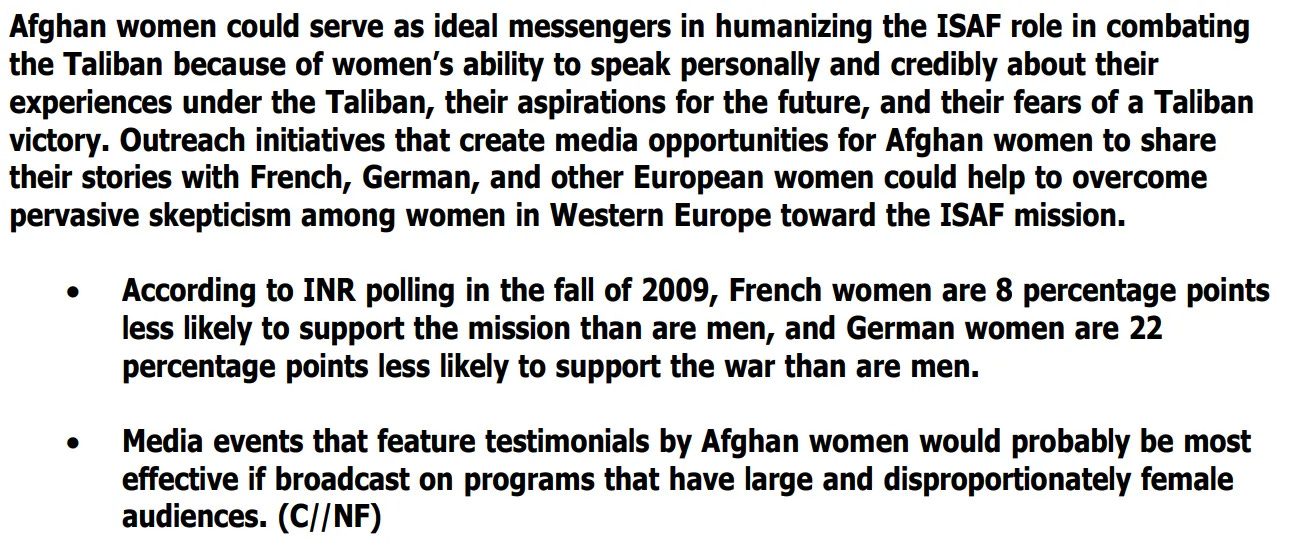
The propaganda value of women in conflicts has long-been cynically exploited by Western intelligence services. A leaked CIA memorandum from March 2010 on covert means of increasing flagging support for NATO’s Afghanistan mission noted women “could serve as ideal messengers” in “humanizing” the military occupation. This was due to their “ability to speak personally and credibly about their experiences under the Taliban, their aspirations for the future, and their fears of a Taliban victory”:
“Outreach initiatives that create media opportunities for Afghan women to share their stories… could help to overcome pervasive skepticism among women in Western Europe toward the mission. Media events that feature testimonials by Afghan women would probably be most effective if broadcast on programs that have large and disproportionately female audiences.”
Throughout the US occupation of course, Afghanistan remained one of the worst countries in the world to be a woman, by some margin. Roughly a year after that CIA memo was authored, Gay Girl in Damascus, a blog purportedly written by Syrian-American lesbian Amina Arraf, garnered significant mainstream attention. Widely hailed for her “fearless” and “inspiring” eyewitness reporting, she was lauded as a symbol of the “progressive” revolution erupting in the country.
In June 2011, Amina’s cousin announced on the blog Amina had been kidnapped by three armed men in the Syrian capital. In response, numerous Facebook pages were set up calling for Amina’s release and ‘liked’ by tens of thousands, #FreeAmina trended widely on Twitter, journalists and rights groups begged Western governments to demand her release, and the US State Department announced it was investigating Amina’s disappearance.
Six days later, it was revealed ‘Amina’ was in fact Tom MacMaster, a middle-aged American man living in Scotland, who had penned extensive lesbian literotica fantasies under that alter ego. While corporate news outlets quickly forgot all about the hoax they’d so comprehensively fallen for, their appetite for dubious human interest stories emanating from the crisis wasn’t diminished.
‘Huge Global Coverage’
In July 2019, an image of two young Syrian girls trapped in rubble in opposition-occupied Idlib attempting to haul their sister to safety as she dangled off the precipice of a dilapidated building, their father looking on in horror above, spread far and wide on social media.
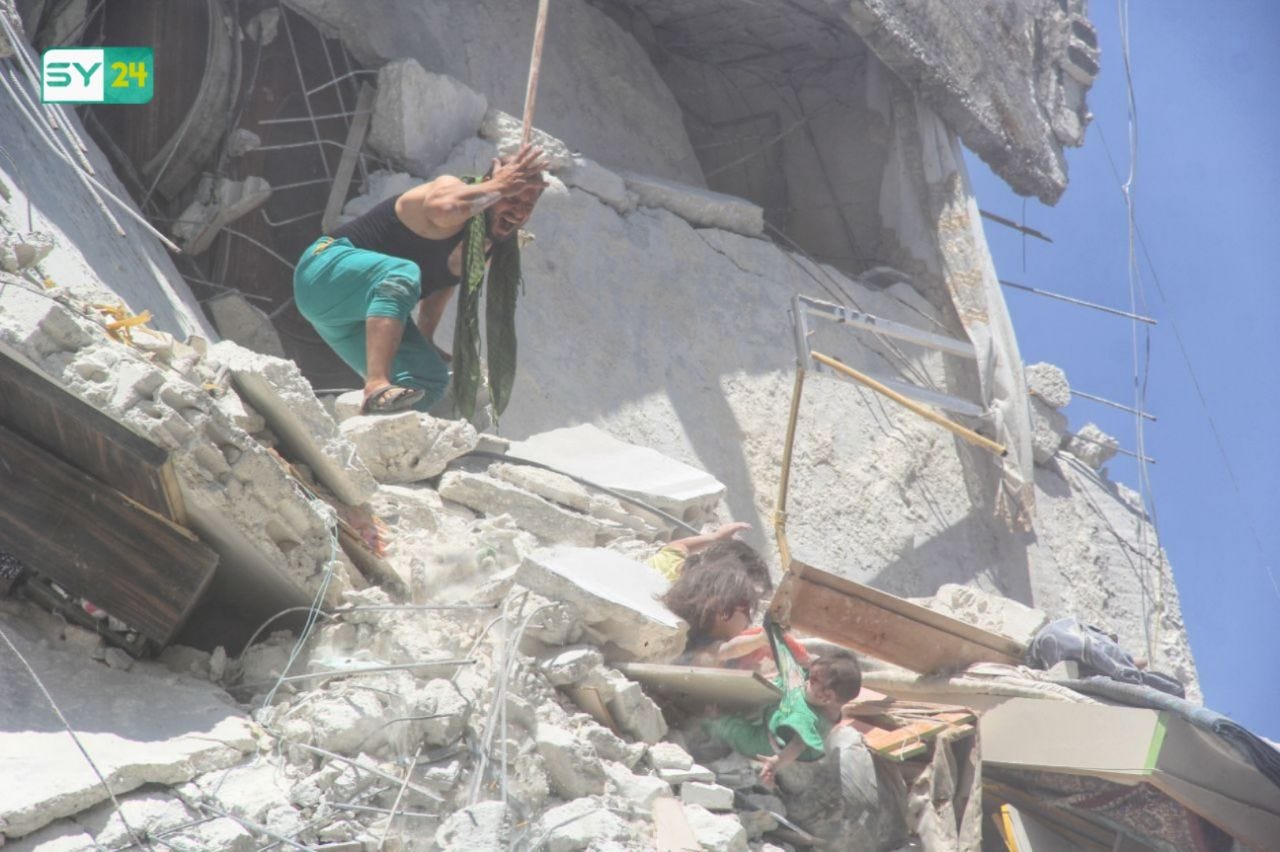
The photo, snapped by a photographer for Syrian news service SY24, went viral the world over. Unbeknownst to viewers though, SY24 was created and funded by Global Strategy Network, a prominent British intelligence cutout founded by Richard Barrett, former MI6 counter-terrorism director. In leaked submissions to the British Foreign Office, Global Strategy boasted of how its propaganda “campaigns” broadcast via SY24 generated “huge global coverage,” having been seen by “many hundreds of millions of people,” and “attracting comment as far as the UN Security Council.”
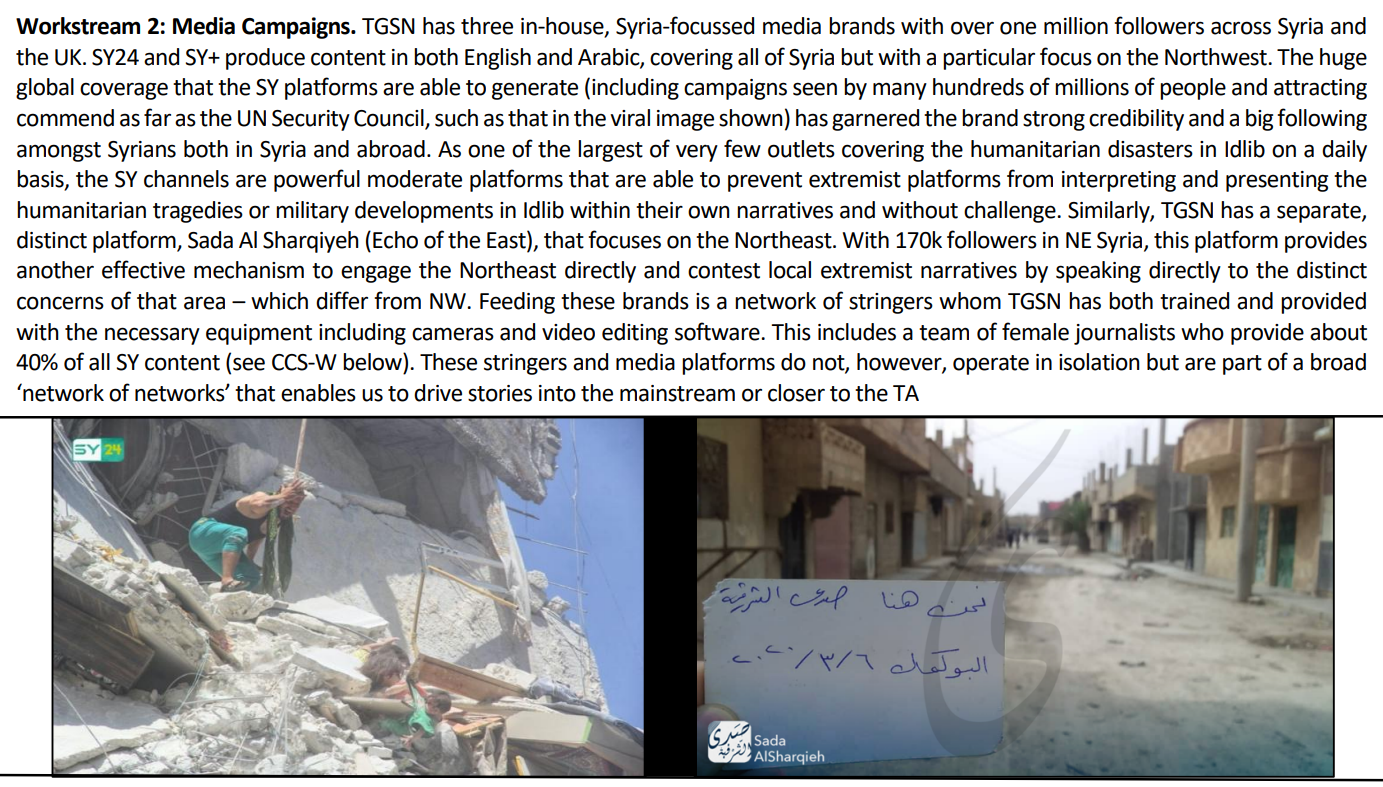
SY24 content was produced by a network of ‘stringers’ in Syria that Global Strategy trained and provided with equipment, including “cameras and video editing software.” The firm drew particular attention to a team of female journalists it had tutored, “who provide about 40 percent of all SY content,” and were part of “a broad ‘network of networks’” enabling the company “to drive stories into the mainstream.”
Global Strategy also established a dedicated centre for training female journalists to produce content for SY24 in Idlib, “accessing stories that male journalists cannot,” which were then shared on social media. It boasted that almost half of SY24’s followers were women, “a remarkably high ratio for Syria-focused platforms.”
Carefully cultivating an entirely misleading image of an inclusive, credible ‘moderate’ Syrian opposition was of paramount importance to British inelligence. It helped whitewash the barbarous nature of the various ‘rebel’ factions London was backing in the region, while simultaneously engendering support among Western citizens for regime change.
In order to engage the “international community” to this end, Global Strategy, in conjunction with ARK – a shadowy “conflict transformation and stabilization consultancy” headed by veteran MI6 officer Alistair Harris – planned “communication surges” around “key dates” such as International Women’s Day.
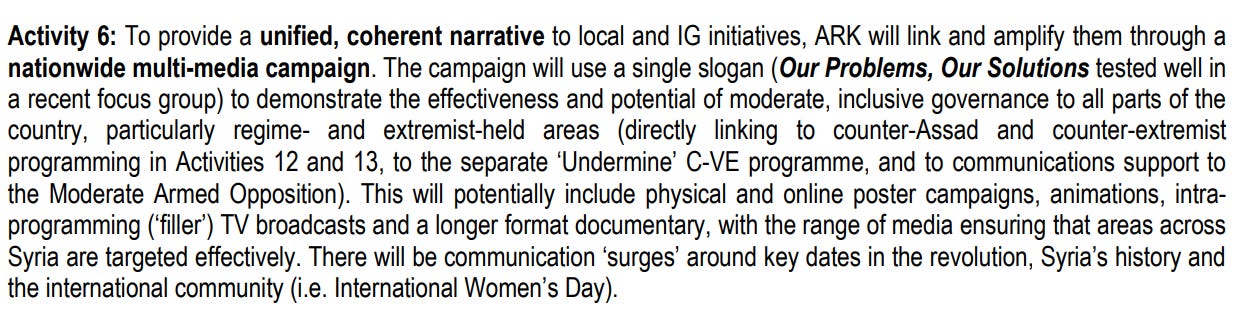
In a particularly elaborate example of such a “surge”, the pair collaborated on “Back to School”, a campaign in which young Syrians returned to education. Idlib City Council, opposition commanders, and other elements on the ground concurrently engaged in a “unified” communications blitz, using “shared slogans, hashtags and branding.” Rebel fighters were sent to “clear roads” and “enable children and teachers to get to schools,” all the while filmed by the pair’s voluminous local journalist network, footage of which was then “disseminated online and on broadcast channels.”
Ensuring “female teachers” received sizeable coverage in the Western media was a key objective of the campaign. Furthermore, in many leaked files, ARK boasted of the huge network of journalists it had trained and funded in Syria, who would cover such PR stunts, secretly orchestrated by the organisation. Their reports in turn fed to the firm’s “well-established contacts” at major news outlets including Al Jazeera, BBC, CNN, The Guardian, New York Times, and Reuters, “further amplifying their effect.”
‘Thrust by Tragedy’
Other documents make clear ARK well-understood the immense difficulties of promoting the role of women internally and externally during the crisis. One file on “[incorporating] the role of women in the moderate opposition” notes Syrian women in rebel-occupied areas faced “an almost overwhelming variety of problems,” and “the space for women to participate in public life has contracted significantly as the conflict has progressed.”
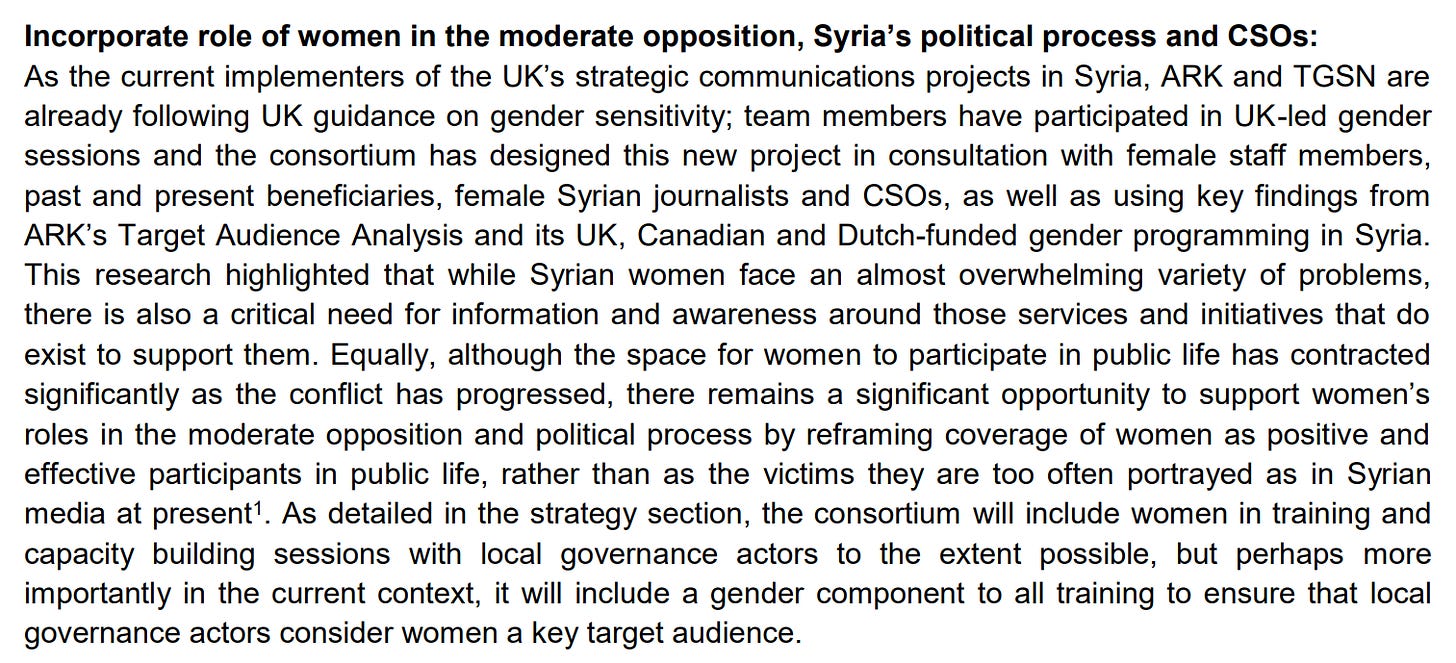
As a result, ARK was “extremely aware of the risks of promoting women’s participation beyond currently accepted social norms… given the potential to hinder message resonance or result in a backlash against female participation.” It therefore proposed to “subtly reframe the narrative of women… increasing the amount of coverage of their initiatives and opinions as the context allows.”
One means of “subtle reframing” was Moubader (which translates to “person who takes initiative”), a media asset created by ARK in 2015, comprising a “high-quality hard copy monthly magazine with widespread distribution across opposition-held areas of Syria,” with a website and Facebook page boasting almost 200,000 likes. Moubader was established by ARK to achieve “behavioural change” in readers. “Given the importance of broadcast television as a trusted source” in Syria, ARK also sought British intelligence funding to develop a Moubader TV programme, to “leverage stories and values to maximum effect and reach an even wider audience.”
Documents submitted to the Foreign Office by another intelligence cutout, Albany, similarly noted women’s access to education, healthcare, and economic opportunity had “been debilitated” during the crisis, which issues such as early marriage, child military recruitment, and “transactional sex” exacerbated. The UN defines the latter as “non-commercial sexual relationships motivated by an implicit assumption that sex will be exchanged for material support or other benefits.”
Still, Albany considered so many Syrian women having been “thrust by tragedy into head of household and breadwinner positions” over the course of the crisis as a golden opportunity to propagandize them and, in turn, their families, while promoting the ‘inclusive’ nature of the opposition, by creating and partnering with female civil society organizations and journalists.
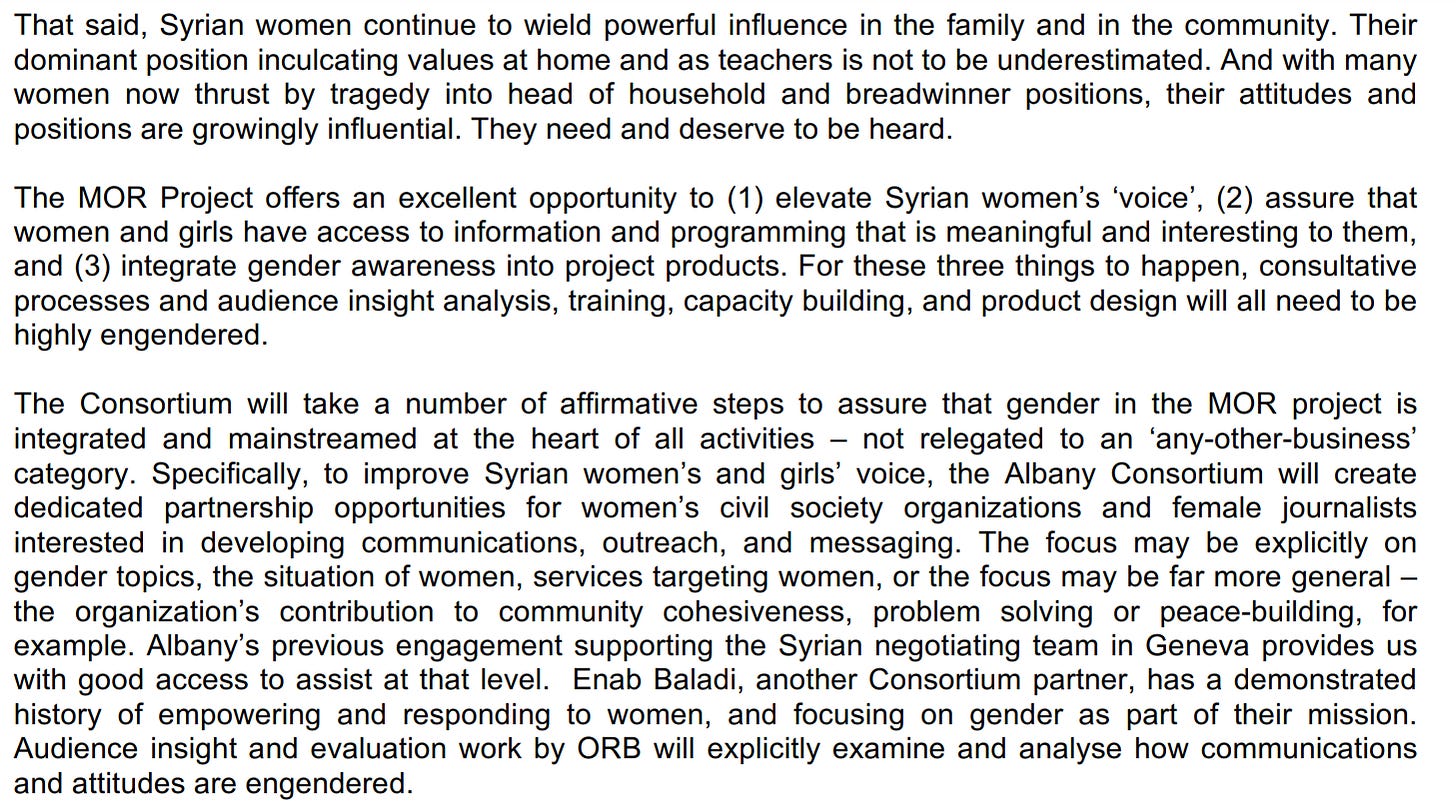
ARK likewise believed women to be a “critical audience”, given the number of Syrian households with female heads –“up to 70 percent”. So, the organisation sought to ensure they were well-represented in all its domestic and international “broadcast products”, as well as on social media.
‘Female Participation’
Unsurprisingly, the files do not acknowledge the increasingly hostile environment for women in Syria directly resulted from foreign efforts to destabilise and depose its government. ISIS and al-Nusra were and remain rightly notorious for their monstrous treatment of women in the areas they occupied, which included widespread rape, sexual violence and abduction.
However, many armed opposition groups backed by Britain and other foreign powers imposed stringent restrictions on women in the areas they occupied, requiring them to wear hijabs and abayas, doling out extreme punishments for failing to comply, imposing discriminatory measures prohibiting them from moving freely, working, attending school, and more.
There are indications British intelligence was in close quarters with such activities. For instance, in December 2017 BBC documentary Jihadis You Pay For alleged Foreign Office cash distributed on its behalf via contrator Adam Smith International in Syria ended up in the pockets of Free Syrian Police (FSP) officers who not only stood by while women were stoned to death, but closed surrounding roads to facilitate their murder.
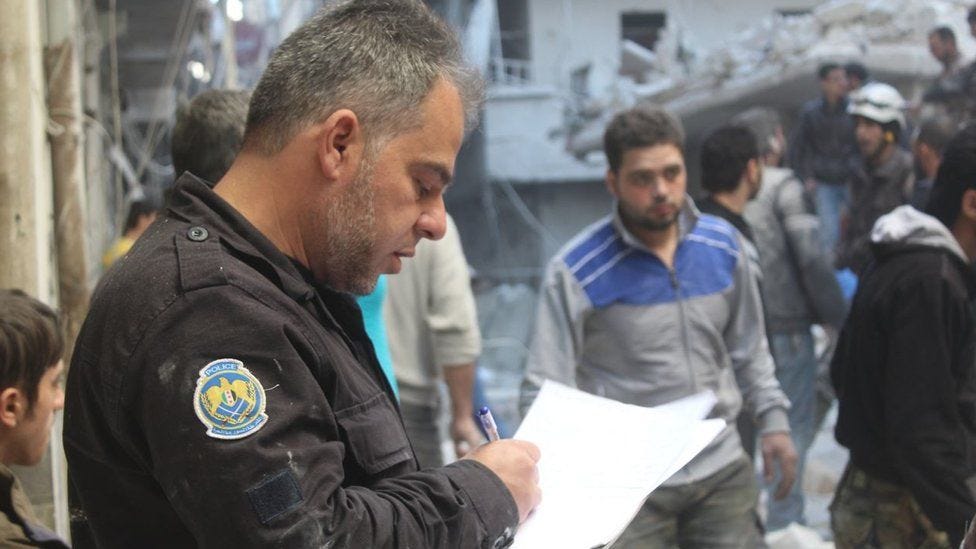
The ‘Free Syria Police’ at work
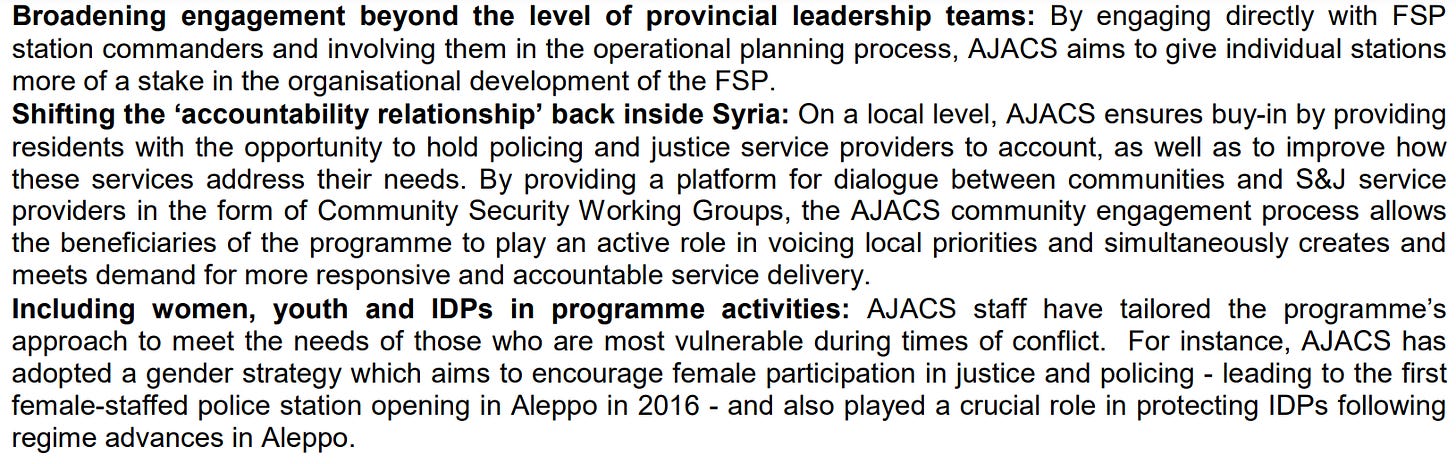
FSP, an unarmed shadow civilian police force operating in opposition-controlled areas, was created, funded and trained under the auspices of the British intelligence-funded Access to Justice and Community Security (AJACS) program. In a perverse irony, leaked Adam Smith International files relating to the project indicate it too sought to exploit women for propaganda purposes, applying a gender policy “to encourage female participation in justice and policing.” The company boasted of how, of the 1,868 police officers it trained under the scheme, six – 0.32 percent – were female.
Quite some “revolution”. As Human Rights Watch noted in 2014, prior to the outbreak of civil war, women and girls across Syria were “largely able to participate in public life, including work and school, and exercise freedom of movement, religion, and conscience.” While the country’s penal code and laws governing issues such as marriage, divorce, and inheritance contained some discriminatory provisions, the country’s constitution guaranteed gender equality.
Featured Video
Prof. Ted Postol: Iran Already Achieved Nuclear Deterrence Against Israel
or go to
Aletho News Archives – Video-Images
From the Archives
How the occupied mentality syndrome works
Saudi Arabia on the American chessboard – Part 3
By B. J. Sabri | American Herald Tribune | June 27, 2016
Read part 2: “The occupied mentality Syndrome“
Previously I argued whether Saudi Arabia’s repeated involvements in U.S. interventions and wars stem from free national will or in response to a specific condition. For starters, in Saudi Arabia there is no national will. In Saudi Arabia, the national will is the will of the Al Saud clan. Still, when a major Arab state allies itself with a superpower that committed unspeakable crimes against humanity in almost every Arab country, then something is wrong. This fact alone should compel us to examine the U.S.-Saudi relation for one exceptional reason. As a result of the U.S.-Saudi wars, hundreds of thousands of people in Afghanistan, Iraq, Iran, Libya, Syria, Yemen, and Somalia have lost their lives. Millions became displaced in their own homelands. And millions more rendered refugees.
Attributing the Saudi policies to the bonds of “partnership” with the U.S. is frivolous. There are no bonds between these two thugs except those of business, military deals, secret plots, and wars. Proving this point, bonds such as these have no space for the American and Saudi peoples to share significant cultural or societal exchanges. If partnership is not the reason for the Saudi contribution to the U.S. strategy of empire and imperialism, then another reason must exist.
This leads to three possibilities. … continue
Blog Roll
 Aletho News
- “Davos Can Really Replace the UN”
- NIAID/NIH and USDA Fund Bioengineered Chimeric Influenza Viruses Built Using Pandemic H1N1 Components: Journal ‘Science Advances’
- Hezbollah hits Israeli warship off Lebanon’s coast, sets it aflame
- Iran slams US strikes on B1 bridge, Mahshahr petrochemical plants as ‘blatant acts of state terrorism’
- In letter to UN chief, Araghchi warns of dire consequences of US-Israeli attacks on Iran’s nuclear facilities
- Why the CIA conspiracy to invade Iran with Kurdish militias failed
- Why Are Upbeat US Claims About Mission to Rescue Pilot ‘Highly Questionable’?
- Aircraft destroyed during US ‘rescue’ of downed F-15 pilot cost more than $100 million each
- Washington University removes professor who condemned US-Israeli war on Iran
- Russia Warns of Retaliation as UK Authorizes Seizure of Vessels
- If Americans Knew
- In Iran, Israel-US take aim at “reason, research, and freedom of thought” – Daily Update
- US loses planes over Iran, Israel downgrades Lebanon war goals – Daily Update
- Israel Is Blocking Palestinians from Easter at Church Where Jesus Resurrected
- Plot to assassinate Palestinian activist follows harassment campaign promoted by Zionist groups and elected officials
- Prominent New York synagogue hosts presentation on why U.S. Jews should support the ethnic cleansing of Gaza
- Tapper vs. Piker: Is the CNN Anchor Auditioning for David Ellison?
- Shouldn’t Democrats Be Able to Condemn Genocide?
- Israel-US kill negotiators, destroy civilian structures, but Iran’s military capabilities still largely intact – Daily Update
- ‘War crime’: Global condemnation as Israeli ministers celebrate death penalty law targeting Palestinian prisoners
- 7 Ways Israel Is Turning Lebanon Into Gaza
- No Tricks Zone
- An Inconvenient Tree: Uncovered In Alps… Europe Much Warmer Than Today 6000 Years Ago
- New Study Reports A 60% Slowdown In Greenland’s Ice Loss Rate In The Last Decade
- Low Intensity Tornado Wrecks Major Solar Farm, Creating A Potential Toxic Dump
- New Study Finds Warming Saves Lives…Cold Temperatures 12 Times More Deadly Than Excess Heat
- German Science Blog Accuses PIK Climate Institute Of Hallucinating Climate Tipping Points
- Devastating Assessment Of Comirnaty Vaccine By Former Senior Pfizer Europe Toxicologist
- New Study: CO2 Is ‘Effectively Negligible’ As An Explanatory Climate Change Factor Since 2000
- Former Pfizer Toxicologist Dr. Helmut Sterz Tells Bundestag Hearing Pfizer Vaccine Should Have Never Been Approved
- Energy Expert: Germany’s Nuclear Phaseout Was A “500 Billion Euro Mistake”
- New Research: South Australia’s Mid-Holocene Sea Surface Temperatures Were 4°C Warmer Than Today
 Aletho News