Israeli attack on Damascus was terrorist act – Moscow
RT | April 2, 2024
The head of Russia’s Foreign Intelligence Service (SVR), Sergey Naryshkin, has described Monday’s airstrike on the Iranian Consulate in the Syrian capital as a terrorist attack committed by the Israeli government.
Speaking to reporters after a meeting with his Belarusian counterparts on Tuesday, the spy chief condemned the strike, which reportedly killed several Iranian diplomats as well as seven officers of Iran’s Islamic Revolutionary Guard Corps (IRGC), including two generals – Mohammad Reza Zahedi and Mohammad Hadi Haji Rahimi.
Naryshkin described the attack as “an ugly and criminal step in relation to the sovereign state of Iran, and in relation to the sovereign state of Syria, on whose territory this terrorist act was committed.”
He added that the SVR has received additional information about the incident, and reactions from various countries, but did not provide further details.
Russia’s Foreign Ministry has also condemned the bombing of the Iranian compound in Damascus, stressing that any attacks on diplomatic missions, which are protected under the Vienna conventions on diplomatic relations, are unacceptable.
The ministry noted that the strike posed a high risk to Syrian civilians, as the building is located in a residential area, and warned that such brazen acts by Israel could trigger a major escalation in the region.
Israel has yet to comment on the attack, but officials have previously admitted to targeting Iran-linked forces on the territory of Syria.
Senior IRGC commander, his deputy assassinated in Israeli attack on Iran Embassy’s consular section in Syria
Press TV – April 1, 2024
A commander of the Quds Force of Iran’s Islamic Revolution Guards Corps (IRGC) in Syria and Lebanon has been martyred in an Israeli attack on the Iranian consulate in the Syrian capital of Damascus.
Brigadier General Mohammad Reza Zahedi and his deputy, Mohammad Hadi Haji Rahimi, were killed in the Israeli attack on Monday on the Consular Section of the Embassy.
Syria’s official news agency, SANA, said the strikes were carried out by “the Israeli enemy” and targeted the Mezzeh neighborhood in Damascus on Monday afternoon.
Iran’s Ambassador to Damascus Hossein Akbari confirmed the reports of the Israeli attack and said the regime had targeted the consular building with six missiles.
Akbari said seven people were martyred in the Israeli aggression but the names and the exact number of martyrs have yet to be specified. He also noted that several Iranian military advisors and diplomats were also martyred in the missile attack, whose names would be announced later.
According to the ambassador, the Consular Section of the Embassy was targeted by F-35 fighter jets and six missiles.
Born in 1960, Zahedi joined the IRGC in 1980 and was a commander of the elite force during the Iraqi-imposed war in 1980-88.
He was the commander of the IRGC Air Force from 2005 to 2006. Later he served as the IRGC Ground Force Commander from 2006 to 2008.
Zahedi served as a commander of the IRGC Quds Force from 2008 to 2016.
Consular Section of Iranian Embassy in Damascus comes under missile attack
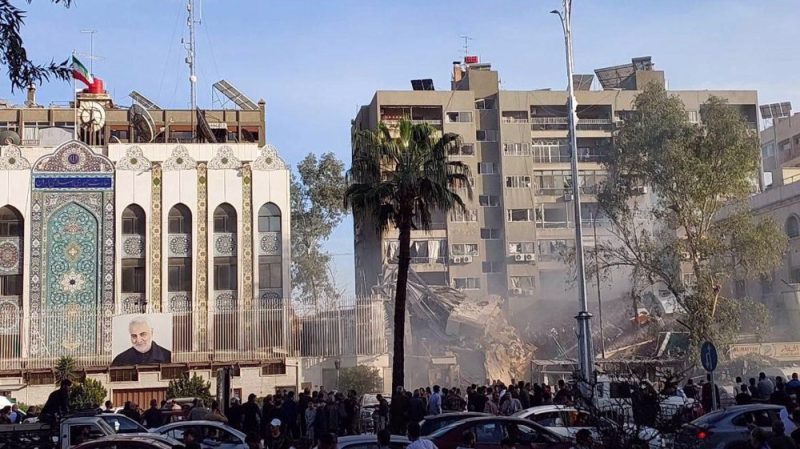
A building next to the Iranian Embassy in the Syrian capital of Damascus comes under a missile attack on April 1, 2024. (Photo by Sputnik)
Press TV – April 1, 2024
The Consular Section of the Iranian Embassy in the Syrian capital of Damascus has come under a missile attack, with immediate reports of casualties as a result of the act of aggression.
Syria’s official news agency, SANA, said the strikes were carried out by “the Israeli enemy” and targeted the Mezzeh neighborhood in Damascus on Monday afternoon.
“At approximately 00:17 p.m. today, the Israeli enemy launched an air aggression from the direction of the occupied Syrian Golan, targeting the Iranian consulate building in Damascus,” SANA said, citing a military source as saying.
“Our air defense media responded to the aggression’s missiles and shot down some of them. The aggression led to the destruction of the entire building and the martyrdom and injury of everyone inside, and work is underway to recover the bodies.”
SANA, citing one of its correspondents, said the Israeli aggression also caused major destruction to “neighboring buildings.”
Unconfirmed reports said several people had lost their lives in the occupying regime’s airstrikes.
Iranian sources added that members of the Iranian diplomatic mission in Damascus, including the ambassador, are unharmed, but the consulate building was destroyed.

The Photo shows the Consular Section of the Iranian Embassy in the Syrian capital of Damascus that came under a missile attack on April 1, 2024. (Via Tasnim News Agency)
Meanwhile, Syrian Foreign Minister Faisal Mekdad has visited Iran’s Embassy following the missile attack.
Condemning the Israeli aggression, Mekdad said, “The Israeli occupation entity will not be able to influence the relations between Iran and Syria.”
A potential UAE-Hezbollah thaw?
By Radwan Mortada | The Cradle | March 31, 2024
The veiled details behind the recent visit of Wafiq Safa, head of Hezbollah’s Liaison and Coordination Unit, to the UAE remain undisclosed. Rumors propagated by Saudi media have tried to insinuate that the Lebanese resistance party aims to placate its stance towards Israel, possibly even contemplating concessions.
This narrative seeks to undermine or distort any real achievements gained during the rare trip. Despite all the conjecture, one development is undeniable: there has been a nascent shift in thawing the longstanding hostilities between Hezbollah and the UAE — a prominent Arab ally of both the US and Israel.
Strained relations
The sudden revelation of Safa’s visit to the Persian Gulf state on 19 March was indeed astonishing — a first by a senior Hezbollah official in many years — particularly given Abu Dhabi’s active role in clamping down on even pro-Hezbollah sentiments within the UAE.
The UAE’s track record includes arbitrary arrests and expulsions of Lebanese nationals under all sorts of dubious charges, often subjecting them to inhumane treatment, exemplified tragically in the case of Lebanese businessman Ghazi Ezzeldin, who was tortured to death while in Emirati custody last year.
News reports suggest that seven Lebanese citizens — four serving life sentences; two others facing 15 years in prison — remain incarcerated in the Emirates under charges of laundering funds for Hezbollah and Iran, and for the spurious claim of having made contact with Hezbollah. All of the detainees deny these charges.
In short, UAE authorities need little justification to accuse Lebanese individuals of ties to Hezbollah, which is designated a terrorist entity in the Emirates.
The UAE, it should be noted, is Tel Aviv’s closest Arab ally in West Asia, marked by Abu Dhabi’s decision in 2020 to normalize relations with the occupation state — with Bahrain, the first Arab state in the Persian Gulf to do so. Despite Israel’s genocidal war against Gaza, economic ties between the UAE and Israel continue to flourish, further entrenching their alliance against common adversaries.
Against this backdrop, Syrian President Bashar al-Assad emerges as an unexpected mediator, leveraging his amicable relations with the UAE leadership, united in their opposition to the Muslim Brotherhood.
Behind the scenes, the UAE has been quietly leveraging its international clout to lift US Caesar Act sanctions on Syria, with an eye on participating in the war-torn country’s reconstruction efforts. As the first Arab state to break Assad’s diplomatic isolation, the UAE has now seized the opportunity to engage with Hezbollah via its renewed Damascus channel.
Preliminary discussions, facilitated by Syrian General Intelligence Director Major General Hossam Louka, bridged the gap between the two parties. These exchanges, held on Syrian soil, involved representatives from both Hezbollah and UAE officials.
Louka also visited Lebanon and the UAE to meet with Emirati officials and the leadership of Hezbollah and convey a detailed message to Assad.
Contrary to the many sensationalized reports in regional media, informed sources tell The Cradle that Safa encountered no explicit demands from UAE officials during his visit. Instead, discussions centered on two pivotal objectives: first, securing the release of Lebanese detainees unjustly incarcerated in the UAE under charges of affiliation with Hezbollah, and second, improving the precarious conditions Lebanese expatriates face in the UAE, where their presence is securitized by the state.
The sources affirm the constructive nature of the meetings and indicate there may be imminent releases of the Lebanese detainees before the end of the holy month of Ramadan.
What do both parties want?
But the timing of Safa’s visit, as Israel escalates airstrikes on Lebanon, Syria, and Gaza, raises speculation about the implications of this renewed relationship. Safa himself is on a US sanctions list, while Hezbollah retains its designation as a terrorist organization by both Washington and the Persian Gulf states.
The UAE, having previously subjected Lebanese nationals to unjust treatment, now initiates efforts to mend ties with Hezbollah. Conversely, Hezbollah, having waged a war to free prisoners from Israeli detention, displays a willingness to engage in dialogue, even if the optics of its representative shaking hands with UAE officials may not be well-received back home.
Following the visit, Hezbollah issued a very brief statement:
“The head of the Liaison and Coordination Unit, Hajj Wafiq Safa, visited the United Arab Emirates as part of the ongoing follow-up to address the case of a number of Lebanese detainees there, where he met with a number of officials concerned with this case, and [a solution to this issue will be reached hopefully].”
Nevertheless, the underlying question remains: What does the UAE seek to achieve? Did it initiate this thaw in relations merely to reopen its embassy in Lebanon after years of closure and diplomatic strife? Does the UAE have hidden intentions concealing these superficial objectives — and what role could Hezbollah play in this equation?
Outreach to Iran via its allies
Early this year, as the regional war expanded, CIA Director William Burns wrote in Foreign Affairs magazine: “The key to Israel’s — and the region’s — security is dealing with Iran.”
Abu Dhabi too, knows that the relationship with Tehran is pivotal to resolving crises in the region. Hence, the UAE has taken a significant stride towards Hezbollah, recognizing its critical regional role. While this unusual meeting could have taken place in Damascus, in secret, the UAE opted instead for a public airing and even arranged for Safa’s transportation via plane to the Emirates.
Moreover, Abu Dhabi’s interest in improving relations with Hezbollah and its leadership could have direct security benefits. The Lebanese party has influence with Yemen’s Ansarallah resistance movement, whose naval operations in the Red Sea and other waterways are impacting international navigation and, thus, Emirati interests from the Persian Gulf to the Horn of Africa.
While a Syrian source tells The Cradle that the meeting yielded positive outcomes and is likely to be followed by further engagements, the visit carries implications that extend well beyond the immediate parties involved.
Beyond improving Hezbollah-UAE or Iran-UAE understandings, it will be essential to monitor the subsequent actions of Saudi Arabia’s leadership after this event.
In essence, these developments could lead to improved future relations between Hezbollah and Arab states of the Persian Gulf, in turn reversing Washington and Tel Aviv’s strategic target of clinching further normalization deals for Israel in West Asia.
Dozens killed by joint Israeli, HTS attack on Syria
The Cradle | March 29, 2024
Israeli warplanes carried out a large attack on the countryside of Syria’s northwestern Aleppo province early on 29 March, coinciding with attacks by the Hayat Tahrir al-Sham (HTS) extremist militant group, formerly known as the Nusra Front.
Dozens were killed in the simultaneous attack, including Syrian soldiers and civilians.
“At around 1:45 AM, the Israeli enemy launched an air attack from the direction of Athriya, southeast of Aleppo, targeting several points in Aleppo countryside, which coincided with a drone attack carried out by terrorist organizations from Idlib and the western countryside of Aleppo province, in an attempt to target civilians in Aleppo and its surroundings,” a military source told Syrian news outlet SANA.
According to security sources cited by Reuters, at least 38 people were killed. Five members of the Lebanese resistance group Hezbollah were reportedly among the casualties.
Al-Mayadeen’s correspondent in Damascus confirmed that the Israeli strikes were launched simultaneously with the drone attacks by extremist militants. It added that the attack hit the Jibreen and Safira areas.
The attack came one day after Israeli jets struck a residential building in the Sayyida Zaynab neighborhood in the Damascus countryside, resulting in the injury of at least two civilians.
Extremist groups in Syria have long coordinated with Israel throughout the US-backed war on the country that began in 2011, particularly in the 2014 battles in Quneitra between the Nusra Front and the Syrian army.
Following an Israeli assault on Syria in late March 2023, which also coincided with attacks by extremist militants, the Syrian Foreign Ministry said in a statement: “These repeated attacks show the close coordination between … Israel and terrorist groups … The coordination proves beyond any doubt the deliberate intentions against Syria, which aim to prolong the crisis and deplete the country’s capabilities.”
Imperial Assisted Suicide

By John Weeks | The Libertarian Institute | March 11, 2024
The United States Imperial Government (USIG) claims to be keeping the peace, underwriting the liberal, rules-based international order and safeguarding the global security architecture. This is not true. What the USIG is actually doing is killing people, helping get lots of people killed, and assisting foreign states as they commit corporate suicide. Israel’s ongoing, “plausibly genocidal” slaughter in Gaza and the West Bank is the latest example of this.
The United States is an empire and empire is murder-suicide. Since 9/11, U.S. soldiers have directly killed more than 400,000 civilians and indirectly contributed to the deaths of more than four million civilians. Meanwhile, more soldiers who served in the U.S. government’s Global War On Terror have committed suicide than have been killed in combat. Four times more.
The American People have not escaped suffering as the USIG and its empire have dished out catastrophic devastation in Afghanistan, Somalia, Iraq, Pakistan, Egypt, Yemen, Libya, Syria, and Mali. The cost of living has exploded. Our infrastructure is in shambles. Public trust in government has collapsed. The military’s “recruitment landscape” is in free fall. And things are so bad at home the government has found a new job: attacking “tent cities” filled with “under-sheltered” people. Murder-suicide.
Then there are the vassal or “client” states. In the propaganda, the empire defends these states from…whatever. But in reality, it helps these states murder people all while creating the conditions for these states to kill themselves. This has been demonstrated recently in Afghanistan (state committed suicide), Ukraine (state is trying to commit suicide) and Israel (state is thinking about committing suicide).
In October, 2001, the USIG invaded Afghanistan and smashed the Taliban-controlled state. In its place was installed a new state with a new military, which Libertarian Institute Director Scott Horton describes:
“The new regime was also largely a coalition government of ethnic minorities, the Tajiks, Uzbeks, and Hazaras, being leveraged against the 40 percent plurality Pashtuns, dominant in the east and south of the country where the Taliban are from.”
This coalition regime could not exist without billions of U.S. dollars in its coffers, U.S. boots on the ground, and U.S. air power in the sky. As predicted by Horton, as soon as U.S. forces began their withdrawal from Afghanistan, the Afghan state (along with its military) immediately killed itself. The Taliban resurrected their state which the U.S. had smashed almost twenty years earlier.
In February 2014, the USIG backed a violent, neo-Nazi led coup in Ukraine. Instead of smashing the entire state, the coup overthrew President Viktor Yanukovych’s administration. Unlike Afghanistan’s anti-Taliban government in a box, the Ukrainian government under new management was capable of existing without a massive U.S. military presence. It was not, however, capable of winning a war with Russia. It took eight years, but the USIG managed to provoke a war with Russia.
Ukraine has been defeated but the imperial wizards in DC refuse to admit this truth and seek peace. There could have been a peace deal two years ago, when it was still fashionable for Americans to fly the Ukrainian flag outside their front doors, but the USIG crushed it. The Ukrainian state is bleeding out and continuing the war at this point puts the entire Ukrainian nation at risk. Russia could seize all of Ukraine and downgrade it from sovereign nation to a Russian aircraft carrier.
Israel has been fortunate to never have its state murdered or regime changed by the USIG. Quite the opposite; Israel has intervened in USIG affairs to a shocking extent. The Israel lobby wields massive influence in Washington DC, so much so that President Joe Biden is risking his re-election chances by refusing to stop producing Israel’s “plausibly genocidal” mass killing spree in Gaza.
This gleeful and live streamed spree of sadism has not been good for Israel. Its state is provoking the global community to view it as a deranged pariah, including the great powers of Russia and China. Even within America, the people want a ceasefire. We want it to stop.
Meanwhile, Israeli society is cracking. Approximately 200,000 Israelis have been displaced from their homes in the south and north of the country. The IDF has suffered thousands of casualties, the economy is destabilized, and fear has blanketed the land.
And now Israel is planning an invasion of southern Lebanon. Such an invasion would be a hoped for but unexpected gift to Hamas. Experts such as Col. Douglas Macgregor, Col. Lawrence Wilkerson, Lt. Col Daniel Davis, Alastair Crooke, John Mearsheimer and Robert Pape have all warned against the invasion. They have argued that Israel risks catastrophic fallout from such a move, from mass causalities to provoking a regional war and even suffering strategic defeat.
Israel supporters seem confident in its security state, despite its massive failure on October 7. Tel Aviv appears to be operating with the assurance that the U.S. military will step in with strike packages and boots on the ground if and when needed. And yes, DC will let American cities die while it views Israel as too big to fail.
But the empire is beset by incompetence and anyone who paid attention to the self-immolation of the Afghan state and the slow suicide of the Ukrainian state knows this isn’t going to end well.
Taiwan, watch your six.
Syrian FM: ‘Western leaders are little puppets of the Zionist enemy’
Al Mayadeen | March 10, 2024
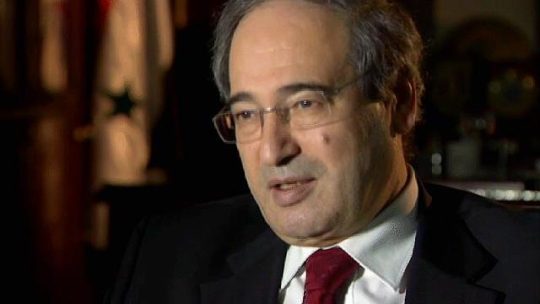
Syrian Foreign and Expatriates Minister, Faisal Mekdad, emphasized that what is happening in Gaza is a genocide perpetrated by Israeli Prime Minister Benjamin Netanyahu, who has killed over 12,000 children and 8,000 women, and completely destroyed the Gaza Strip.
In a statement on the ministry’s X account, Mikdad said “What European Union strategists say about building a world based on rules and regulations has faded. The murderer Netanyahu has not left any rule unbroken: International law, international humanitarian law, the Universal Declaration of Human Rights, the United Nations Charter, children’s rights, women’s rights, democracy, disarmament, and peace.”
He continued to say what is more dangerous than Netanyahu and his ruling “gang’s” crimes, is the support he received from many EU leaders and the blind trust Washington has given him.
“Everyone knows that much of what the European Union leaders did before and after was a form of clowning, hypocrisy, and lies, and their defense of Netanyahu’s crimes led to pulling the rug from under all of their feet and showed them as they really are, little puppets in the hands of Zionism and enemies of peoples’ rights and aspirations,” he said, slamming the West.
OPCW attributes 2015 Syria chemical attack to ISIS: Report
The Cradle | February 23, 2024
The Organization for the Prohibition of Chemical Weapons (OPCW) stated on 22 February that there are “reasonable grounds” to believe that ISIS perpetrated chemical weapons attacks on the town of Marea, close to Aleppo, in 2015.
The Investigation and Identification Team (IIT) of the watchdog determined that ISIS militants utilized sulphur mustard in attacks across various parts of the town on 1 September 2015.
According to a OPCW report, ISIS units deployed sulphur mustard gas via their artillery munitions on the town of Marea between 9:00 and 12:00 pm. OPCW’s report stated, “The chemical agent was delivered using one or more artillery guns.”
IIT discovered that 11 people who were exposed to a “black, vicious substance” present in projectiles at the attack location exhibited symptoms that aligned with sulphur mustard exposure.
The recent report emerges amid ongoing accusations by the international community that the Syrian government conducted chemical attacks within its borders, allegations that Damascus vehemently denies.
In 2014, Syria relinquished its chemical weapons arsenal to a collaborative effort between the US and the OPCW, which then supervised the dismantling of these weapons.
Damascus asserts that the chemical attack was “staged” to exert pressure on and discredit President Bashar al-Assad’s government.
Last August, Syria’s UN representative affirmed that Washington provided chemical weapons to extremist militant groups in the Arab state’s western provinces in addition to training them for false-flag operations.
David Schenker from the Washington Institute for Near East Policy (WINEP) also previously noted that Washington used Al Tanf as a training ground for armed opposition groups in Syria, acting as a strategic asset in the extended discussions on the nation’s future.
According to a Reuters report, in 2018, Syria’s former foreign minister, Walid Muallem, noted that OPCW previously disclosed allegations of the Syrian government using chemical weapons against its civilians were devoid of any evidence.
However, the OPCW retracted its statement following pressure from the US. Several political commentators, including Noam Chomsky, reiterated that the organization had “suppressed” information indicating that the chemical attack by the Syrian government on Douma in 2018 did not occur.
More recently, US journalist Seymour Hersh reported in 2021 that a classified US Defense Intelligence Agency (DIA) briefing in June 2013 indicated that Al-Nusra Front maintained a sarin production cell and was attempting a large-scale production effort in Syria.
Only 3 in 10 Americans Were Aware of US Troops in Syria Prior to Deadly Attack
By Kyle Anzalone | The Libertarian Institute | February 6, 2024
A recent poll of Americans found that only 30% were aware that US troops were deployed to Syria before three US soldiers were killed just across the border in Jordan. The results of the survey show Americans are generally unaware of the attacks against US forces in Syria and the reason for the deployment.
Defense Priorities commissioned YouGov to poll Americans from January 8-15 about the deployment of 900 US troops in Syria. Three in ten Americans responded that they were aware US troops were deployed to Syria. The three US soldiers killed at Tower 22 in Jordan were supporting the US base in southern Syria.
US troops in Iraq and Syria have come under attack over 160 times from Shia militias that operate in the region. The YouGov poll found only a quarter of Americans were aware of the attacks that left scores of US soldiers injured.
The Shia militias say they are targeting American soldiers occupying Iraq and Syria with drones, rockets, and missiles because of US support for the ongoing genocide Israel is conducting in Gaza. The poll found that a majority of Americans are concerned about a larger war breaking out in the region because of the US troops’ presence.
The outcome may be playing out. In response to the death of three members of the Georgia National Guard in Jordan, President Joe Biden ordered a massive bombing operation in Iraq and Syria. The White House will not rule out hitting targets inside Iran and has pledged future strikes.
President Biden has refused to reverse his unconditional support for Israel even as his approval rating has dipped. An NBC News poll released on Sunday found the President’s approval rating at the lowest of his term, 37%. Weighing on his approval is likely the war in Gaza. Only 29% of Americans approve of the way Biden has handled US support for the Israeli onslaught.
Kata’ib Hezbollah: Iraq strikes stem from US statesmen’s criminal mindset
Press TV – February 4, 2024
Iraqi anti-terror group Kata’ib Hezbollah has roundly denounced the latest US military airstrikes against several sites used by resistance groups in the country, stating that the attacks emanate from the US administration’s criminal mindset and its craving for more bloodshed.
“We extend our condolences to our proud and steadfast nation for the martyrdom of several compatriots, who were targeted while protecting the homeland against the evils of American forces and the Takfiri Daesh terrorist group,” it said in a statement.
It added that criminality is deeply ingrained in the mindset of American politicians, and they long for relentless bloodletting as well as starvation and massacre of ordinary people in pursuit of their interests and advancement of their malicious agendas.
“US officials do not shy away from the occupation of other countries, plundering others’ national assets, influencing their decision-making and their humiliation.
“Under the American mindset, the first solution is murder. Such an attitude has historically been responsible for the extensive destruction of the Japanese cities of Hiroshima and Nagasaki. It is now behind the deadly attacks against sites in al-Qa’im,” Kata’ib Hezbollah pointed out.
Separately, the Yemeni Ansarullah resistance movement censured the US aggression against areas in Iraq and neighboring Syria, terming them as barbaric, in breach of international law, and a serious violation of the two countries’ sovereignty.
“The aggression falls within the context of US support for the Zionist enemy as it continues its crimes against the Palestinian population of Gaza,” it added.
Ansarullah warned that US moves will drag the entire region into a more complex conflict, and will jeopardize international peace and security.
“Washington could have compelled the Tel Aviv regime to halt its aggression on Palestinians and lift the siege on Gaza. It, however, decided to target the countries and nations of the region.
“We reiterate that Muslim nations reserve the right to defend themselves and protect their security and sovereignty against repeated US acts of aggression,” the Yemeni movement underscored.
US Central Command (CENTCOM) said its military forces struck more than 85 targets in Iraq and Syria “with numerous aircraft to include long-range bombers flown from the United States”.
“The air strikes employed more than 125 precision munitions,” it added in a statement.
US President Joe Biden said in a statement on Friday that the strikes were the first in a series of actions by Washington in response to a drone attack that killed a number of soldiers at a remote US base in Jordan.
“Our response began today,” Biden said. “It will continue at times and places of our choosing,” he stated.
Three US soldiers were killed and about 40 others injured in the assault on the military base known as Tower 22 near the Jordan-Syria border on Sunday.
The Islamic Resistance in Iraq, an umbrella group of anti-terror fighters, in a statement published on its Telegram channel claimed responsibility for the drone strike.
In retaliation for the flurry of US aerial assaults on several locations in Iraq and Syria, the Islamic Resistance in Iraq announced that it had conducted missile strikes against the Ain al-Asad Airbase, housing US occupation forces in the western Iraqi province of al-Anbar.
The group also said it had staged missile and drone strikes against the strategic al-Tanf military base in southeastern Syria near the border with Jordan and Iraq, as well as the al-Khadra Village in Syria’s northeastern province of al-Hasakah.
Featured Video

Rewriting the risk? Inside the government’s vaccine safety messaging
or go to
Aletho News Archives – Video-Images
Book Review
“Davos Can Really Replace the UN”
Inside the book that maps the architecture behind global governance — from the Epstein files to the Pact for the Future
Lies are Unbekoming | April 1, 2026
On June 13, 2019, the United Nations and the World Economic Forum signed a partnership deal to “accelerate the implementation of the 2030 Agenda for Sustainable Development.” That same evening, WEF president Börge Brende — Norway’s former Foreign Minister — had dinner with Jeffrey Epstein at Epstein’s Manhattan townhouse. The Epstein files, released January 2026, contain an exchange between the two from the previous year. Epstein to Brende: “Davos can really replace the UN. C21, cyber, crypto . genetics… intl coordination.” Brende back to Epstein: “Exactly — we need a new global architecture. World Economic Forum (Davos) is uniquely positioned — public private.”
The next day, the UN General Assembly adopted the framework for restructuring global governance.
That sequence — the partnership signing, the Epstein dinner, the candid admission about replacing the UN with a public-private architecture, and then the formal adoption — opens Jacob Nordangård’s The Digital World Brain. Pages two and three. Footnoted to the UN resolution number, the Epstein files, and the General Assembly record.
I keep coming back to it because it captures what this book does that almost nothing else in the independent research space manages. I’ve followed Jacob’s work for years now and interviewed him about his research. Each book peels back another layer of the same institutional architecture, and each time I think he’s reached the limit of what can be documented, the next one goes further. Nordangård doesn’t speculate. He doesn’t editorialize much. He lays institutional actions next to each other in chronological order and lets the pattern announce itself. … continue
Blog Roll
 Aletho News
- The End of NATO
- 37 days of war on Iran cost US staggering $42bln, tracker shows
- Baghdad tells Asian refiners, traders to begin loading Iraqi crude amid Iranian exemption
- Under fire, Moscow and Tehran close ranks
- Iran, US receive Pakistan-mediated plan for ceasefire then final deal
- Iran submits demands for end to war as mediators scramble ahead of Trump deadline
- Iran Threatens Retaliatory Strike on Stargate AI Project in UAE
- US sent ‘a lot’ of arms to Iranian protesters – Trump
- Barak Ravid Launders Deception To Allow Trump To Back Off Of His Power Plant Threat – Again
- REWRITING THE RISK? INSIDE THE GOVERNMENT’S VACCINE SAFETY MESSAGING
- If Americans Knew
- Trump poised to “blow everything up” (ie. commit war crimes) in Iran – Daily Update
- In Iran, Israel-US take aim at “reason, research, and freedom of thought” – Daily Update
- US loses planes over Iran, Israel downgrades Lebanon war goals – Daily Update
- Israel Is Blocking Palestinians from Easter at Church Where Jesus Resurrected
- Plot to assassinate Palestinian activist follows harassment campaign promoted by Zionist groups and elected officials
- Prominent New York synagogue hosts presentation on why U.S. Jews should support the ethnic cleansing of Gaza
- Tapper vs. Piker: Is the CNN Anchor Auditioning for David Ellison?
- Shouldn’t Democrats Be Able to Condemn Genocide?
- Israel-US kill negotiators, destroy civilian structures, but Iran’s military capabilities still largely intact – Daily Update
- ‘War crime’: Global condemnation as Israeli ministers celebrate death penalty law targeting Palestinian prisoners
- No Tricks Zone
- An Inconvenient Tree: Uncovered In Alps… Europe Much Warmer Than Today 6000 Years Ago
- New Study Reports A 60% Slowdown In Greenland’s Ice Loss Rate In The Last Decade
- Low Intensity Tornado Wrecks Major Solar Farm, Creating A Potential Toxic Dump
- New Study Finds Warming Saves Lives…Cold Temperatures 12 Times More Deadly Than Excess Heat
- German Science Blog Accuses PIK Climate Institute Of Hallucinating Climate Tipping Points
- Devastating Assessment Of Comirnaty Vaccine By Former Senior Pfizer Europe Toxicologist
- New Study: CO2 Is ‘Effectively Negligible’ As An Explanatory Climate Change Factor Since 2000
- Former Pfizer Toxicologist Dr. Helmut Sterz Tells Bundestag Hearing Pfizer Vaccine Should Have Never Been Approved
- Energy Expert: Germany’s Nuclear Phaseout Was A “500 Billion Euro Mistake”
- New Research: South Australia’s Mid-Holocene Sea Surface Temperatures Were 4°C Warmer Than Today
 Aletho News