What Is Happening In Syria?
Washington’s interventionism and its disregard for its own highly promoted “rules based international order” is outrageous
BY PHILIP GIRALDI • UNZ REVIEW • AUGUST 15, 2023
Which are the governments generally regarded as “rogue” by an overwhelming majority of the world’s nations? If you answered either Russia or China you would be wrong, even though many countries have condemned Russia’s attack on Ukraine on grounds that no government has an intrinsic right to invade another unless there is an imminent serious threat that would excuse such an intervention. I would however expect that most readers of this review would have made the right choice, which is that the United States is probably number one based on its ability to destabilize whole regions with a military reach that spans the globe. And indeed, it is important to note that the Russian “special military operation” directed against Ukraine would not have happened at all if the Joe Biden Administration had simply indicated clearly and non-ambiguously to the Russian government that there was no intention of allowing Ukraine to join the North Atlantic Treaty Organization (NATO) alliance. Ironically, the White House knew very well that inviting Kiev to enter into the alliance was a legitimate red-line, existential issue for the Kremlin, but opted to push hard on the issue instead. Instead of opting for a negotiated peaceful settlement, Biden and his clown show foreign and national security policy team opted to kill possibly hundreds of thousands of Ukrainians and Russians to somehow “weaken” Russia, an intention that has borne no fruit even after more than a year and a half of fighting.
So yes, by the world’s reckoning the United States of American is both “exceptional” and “number one,” which a series of White House inhabitants have aspired to, though perhaps not in the same way as buffoons like Senators Tom Cotton and Ted Cruz refer to it. Most non-Americans see the US as the greatest threat to world peace. And then there is America’s “closest ally and best friend in the whole world” Israel in second place, a government which commits crimes against humanity and even war crimes on a nearly daily basis with absolute impunity as it is protected and defended by the very same United States, where the Jewish state runs the foremost and most powerful foreign policy lobby. It is a lobby that has inserted itself in all levels of government and which has corrupted huge majorities of politicians and both major political parties while also controlling the “message” on the Middle East promoted by the media.
Even as I write this, 41 Democratic Party politicians are spending their recess on a Lobby sponsored trip to Israel. Their leaders include the inimitable traitor 80 year old Congressman Steny Hoyer of Maryland, who is on his twenty-third trip to the country that he loves and admires beyond all others, and House Democratic Leader Hakeem Jeffries. Jeffries is on his second trip to Israel this year. He should be ashamed but, of course, isn’t. It is the largest-ever delegation of Democratic lawmakers on a tour of Israel, sponsored in this case by the American Israel Education Foundation, an affiliate of the American Israel Public Affairs Committee (AIPAC). Not to be outdone House Speaker Kevin McCarthy is leading 31 Republican Congressmen on the same mission though the groups will not mingle and the speaker will be careful to render his own obeisance separately to the Israeli leadership.
The Democrats and Republicans, will as always be unable to enunciate any good reasons for American bondage to Israel beyond bromides like “Israel has a right to defend itself,” which will be repeated over and over before the Solons head back to Washington to send billions more of US taxpayer dollars to the Jewish state. While in Israel they will be fed a special diet of “all Arabs are terrorists” and good old Steny will be nodding his head in time with the song. That is before he and his colleagues engage in crawling on their bellies before Israeli Prime Minister Benjamin Netanyahu as a sign of their total submission to his will.
If one is seeking a single example of the failure of the United States and its ally Israel to abide by the clearly mythical “rules based international order” one might well examine what is going on in Syria, where both the US and the Jewish state have been punishing the country through lethal sanctions and direct military intervention for many years with no sign that the interaction will be ending any time soon. The activity is rarely reported in the US and European media, which somehow has decided that Syrian President Bashar al-Assad is some kind of tyrant who deserves whatever he gets, even if it is dished out by “apartheid” Israel and the clueless US, which has been illegally militarily occupying roughly one third of Syria since 2015, including the areas that have producing oil facilities and good agricultural land, both of which are being exploited or stolen. Israel meanwhile has annexed the Syrian Golan Heights, which it occupied in 1967. Donald Trump gave his blessing to the illegal annexation and also gave his consent to whatever the Jewish state decides to do both with the Syrians and the Palestinians while also conniving at the nearly daily air attacks carried out by Israel against targets in both Palestine-Gaza and Syria, killing scores of local soldiers and civilians.
The US military occupation has been supplemented by an increasingly harsh series of sanctions that have effectively cut off food, medicines and other basic commodities to the Syrian people while also denying access to international banking services. Russia, which is assisting Syria at the invitation of the country’s government, has made up for some of the shortages but there is considerable suffering among the ordinary people, not the country’s leaders. The claim by Washington is that Syria has to be protected from its own “totalitarian” government and the US is there to fight terrorists, most particularly ISIS. Ironically perhaps, but Tel Aviv and Washington actually support some of the groups that many would consider to be themselves terrorists, including providing direct US aid to al-Qaeda clone Hayat Tahrir al Sham and Israeli support for ISIS to include treating wounded terrorists in Israel’s hospitals. The US air base at Al-Tanf, near the border with Iraq and Jordan, has, in fact, become a support hub for terrorist groups opposing the al-Assad government.
Sanctions on energy imports were temporarily lifted by the US and EU after the disastrous earthquakes the shook the region in February, but in June, US lawmakers introduced the Assad Regime Anti-Normalization Act of 2023 which would use secondary sanctions to penalize those countries that might be tempted to help restore services to the areas of Syria affected by both war and the impact of the quakes. Israel reportedly has exploited the opportunity provided by the natural disaster to increase its air attacks on Syrian infrastructure.
Indeed, recent history tells us that both Israel and the United States are particularly fond of occupying someone else’s land and are capable of coming up with excuses for doing so at the drop of a hat. The reasons generally sound like saying “Hey! We are the good guys who support democracy!” Repeat as necessary until the audience either goes to sleep or wanders off. The western media reporting on what is taking place in Syria can be regarded as being in the “wanders off” category.
I certainly am not the only one who has noted that the United States tends to do everything ass-backwards in its conduct of foreign policy since the time of the Clintons. That has certainly been the case in dealing with nations like Syria and Russia, where ambassadors Robert Ford and Michael McFaul were openly hostile to the respective local governments and openly sought to empower declared opponents of the countries’ leaders. Syria presumably was demonized to please Israel, beginning with the seeking to destabilize Syria through the passage of the Syria Accountability Act in 2003, even though Damascus posed no threat whatsoever to American interests. The current sanctions come at a time when Syria is continuing to struggle to rebuild after a still active twelve year civil war that destroyed much of the country’s infrastructure. US sanctions are making more difficult ongoing reconstruction efforts and are de facto largely punishing the Syrian people, with only minor impact on its government.
And sanctioning to punish Syria is bipartisan, perhaps reflecting a desire to satisfy Israeli demands. Donald Trump, who ran for president pledging to end America’s pointless wars overseas, on June 17th 2020 nevertheless initiated new sanctions against Syria and its government. US Ambassador to the United Nations Kelly Craft informed the Security Council that the Trump Administration would implement the measures to “prevent the Assad regime from securing a military victory. Our aim is to deprive the Assad regime of the revenue and the support it has used to commit the large-scale atrocities and human rights violations that prevent a political resolution and severely diminish the prospects for peace.”
Subsequently, the most recent block of sanctions was imposed through the Caesar Syria Civilian Protection Act, signed by President Trump in December 2020 after he was due to leave office, with the objective of stopping “bad actors who continue to aid and finance the Assad regime’s atrocities against the Syrian people while simply enriching themselves.” At that time, the existing US sanctions on Syria had already frozen all government assets and had also targeted companies and even individuals. The new sanctions gave the White House and Treasury the power to apply so-called “secondary sanctions” to freeze the assets of any entity or even individual, regardless of nationality, for doing any business in Syria. The threat of secondary sanctions have in fact had a major negative impact on Damascus’s remaining trading partners, to include Lebanon and Iran. Russia might also be impacted as it is involved in Syrian reconstruction.
The United States and Israel clearly hope that punitive sanctions will eventually force the starving Syrian people to rise up against the government, as some sought to do during the so-called Arab Spring in 2011. That means that a sanctions routine, much favored by both the Trump and Biden Administrations, never succeeds in compelling rogue governments to behave better because the way it works it is always really about regime change no matter how it is packaged. In the case of Syria, and contrary to the claims made by Ambassador Craft at the United Nations, the Bashar al-Assad government has already won the war in spite of US and Turkish intervention on behalf of the largely terrorist group supported insurgency. And the evidence for Syria’s having carried out “large scale atrocities and human rights violations” has mostly been manufactured by enemies of the government, to include the Hollywood and Washington think tank favorite, the White Helmets, a terrorist front group funded at least in part by western intelligence agencies, which was featured in a self-generated documentary that won a Hollywood Motion Pictures Academy Award in 2017. The film was effusively praised by the usual celebrity brain-deads including Hillary Clinton and George Clooney. It is indeed overall a very impressive piece of propaganda. The National Holocaust Museum even gave the coveted 2019 Elie Wiesel Award to the group. The White Helmets are still active in Syria in areas that are still held by the so-called rebels and they featured in a film clip just last week. They are still being funded by western governments and Israel to destabilize the government of Bashar al-Assad.
One might well ask what the US objective in continuing to promote the carnage and suffering in a Syria that poses no threat to Americans or to any vital security interests. It is similar to a question that might well be raised regarding Ukraine, which is confronting an unneeded escalation of 3,000 US military reservists to reinforce the 20,000 American soldiers that have arrived in theater since February 2022. And then there is Iran, which responded to its oil tankers being hijacked in international waters under the unilaterally imposed authority granted by US sanctions. Iran has sought to respond in kind and now the US will dispatch Marines to the Persian Gulf to ride shotgun on foreign tankers and other commercial vessels traversing the Straits of Hormuz. If Iranian vessels come too close, they will shoot to kill. It is another escalation that is asking for trouble. Why can’t the United States leave the rest of the world alone? That is perhaps the fundamental question for our times.
Philip M. Giraldi, Ph.D., is Executive Director of the Council for the National Interest, a 501(c)3 tax deductible educational foundation (Federal ID Number #52-1739023) that seeks a more interests-based U.S. foreign policy in the Middle East. Website is councilforthenationalinterest.org, address is P.O. Box 2157, Purcellville VA 20134 and its email is inform@cnionline.org.
Syrian army mobilizes in response to ISIS, US threat
The Cradle | August 14, 2023
The Syrian Army has reinforced its positions with soldiers and military equipment in the eastern countryside of Deir Ezzor in response to increased attacks by ISIS and a possible assault on Al-Bukamal by US occupation forces and their allies, Syria’s Al-Watan newspaper reported on 14 August.
Local sources reported that a huge military convoy of the Syrian army arrived yesterday evening in the desert of Al-Mayadeen on the Homs-Deir Ezzor Road. The convoy consisted of buses and troop vehicles, in addition to field artillery, mortars, and modern tanks.
According to Al-Watan, the Syrian army is preparing to repel a possible military assault that US forces and its proxy armed groups, including the Kurdish-led Syrian Democratic Forces (SDF), may launch from the eastern bank of the Euphrates River toward the city of Al-Bukamal. The Syrian army expects US forces and their allies to try to capture Al-Bukamal, and thereby block the only remaining border crossing between Syria and Iraq under Syrian government control.
The military reinforcements arrived two days after an attack by ISIS militants on a military bus Thursday evening, which led to the killing of 33 Syrian soldiers in the Al-Mayadeen desert as they traveled to a base at the T2 pumping station southeast of Deir Ezzor.
The T2 pumping station was an ISIS stronghold until its capture by the Syrian army in 2017.
ISIS also launched an attack on a checkpoint of the Syrian army last Wednesday near the village of Maadan Ateeq, east of Raqqa, killing ten Syrian soldiers.
The Syrian military build-up in Deir Ezzor also comes as the Russian military targeted ISIS positions in the region from warships anchored off the Syrian coast. Russian forces fired highly destructive precision missiles in the early hours of yesterday, targeting the extremist organization in the deserts of Hama and Homs.
According to the UK-based Syrian Observatory of Human Rights (SOHR), Syria is witnessing the “most violent” escalation in ISIS activities since it was “eliminated geographically” in 2019.
According to the Syrian military, ISIS enjoys logistical support and training from US forces occupying the illegal Al-Tanf military base at the intersection of the borders between Syria, Jordan, and Iraq.
The US acknowledges training armed groups it calls the Free Syrian Army (FSA) inside the Al-Tanf base, while protecting a 55 km area around it.
Previous US support for ISIS was illustrated by a 2012 US Defense Intelligence Agency (DIA) document that indicated a Salafist principality like the one established by ISIS in 2014 would emerge in western Iraq and eastern Syria. The document indicated that this would be a positive outcome in the view of the US and its regional partners as part of their covert war against the Syrian government, which began in 2011.
For years, ISIS was able to quickly acquire US and Saudi-supplied weapons allegedly sent to other extremist groups in Syria fighting under the Free Syrian Army (FSA) brand. In some cases, US and Saudi-supplied weapons purchased in eastern Europe reached ISIS within two months, according to a study by the UK-based Conflict Armament Research.
SDF ‘frustrated’ with US silence over repeated Turkish attacks
The Cradle | August 8, 2023
The US-backed Kurdish militia, the Syrian Democratic Forces (SDF), has become increasingly frustrated with Washington over its failure to condemn continued Turkish attacks against the group, Al-Akhbar daily reported on 8 August.
The Kurdish group has released several statements this month “denouncing the silence” of the US coalition in Syria, and “holding them responsible” for the surge in attacks against their leaders.
According to the newspaper, Kurdish officials held a recent interview in which they, for the first time, explicitly condemned US silence on Ankara’s strikes.
The widening of the gap between Washington and its Kurdish proxy can be attributed to three factors, Kurdish sources told Al-Akhbar.
The first is that some in the SDF continue to see Washington as a permanent partner, while the US wishes to “limit” its relationship with the Kurdish group. The report explains it as Washington’s “keenness not to disturb its relationship with Turkiye.”
The second is the US failure to help the SDF implement its goal of full self-determination and autonomy in northern Syria.
The third factor is viewed by the SDF as the “most dangerous,” and is the US plan to forge new alliances with the Arab tribes of the region – which, according to earlier reports, may include merging SDF forces with Arab tribal troops organized by Washington.
The SDF has long viewed such a plan as a threat to its Kurdish identity.
According to the Al-Akhbar report, a leader in the Deir Ezzor Military Council – a council of Arab tribesmen organized by the US – recently launched a rebellion against the SDF with support from Washington.
The Arab tribal leader, Abu Khawla, “would not have dared to rebel against the SDF had it not been for the implicit support of the US,” the report adds.
On 3 August, a Turkish drone strike resulted in the killing of four SDF members.
The following day, the SDF released a statement urging Washington to take a clear and final stance on Ankara’s continued strikes against its Kurdish ally.
With this distance from the US, some have suggested that the SDF has been torn on who to depend on for its future in the country.
As a result, it has recently held several rounds of talks with Damascus. While failing to reach any agreements regarding its wish to maintain autonomy, the SDF remains on the same page as Bashar al-Assad’s government when it comes to the Turkish occupation of Syria.
In the past, the two sides have coordinated against the Turkish presence in Syria.
SDF chief Mazloum Abdi in April expressed openness to potentially merging his forces with the Syrian army at some point in the future.
US forced Saudi Arabia, UAE to freeze investments in Syria
The Cradle | August 2, 2023
All promises of humanitarian aid and investment in Syria by Gulf countries such as the UAE and Saudi Arabia have been frozen as a result of US warnings and threats, Lebanese daily Al-Akhbar reported on 2 August.
“All the Emirati and Saudi promises to help Syria and activate investment in it on several levels remained words on tongues and ink on paper, and none of them were translated into reality,” Arab diplomatic sources told Al-Akhbar.
According to the sources, the UAE “underestimated the ability of US sanctions to prevent” these investments and aid transfers from materializing.
“It became clear that US sanctions and warnings … by the Americans to Emirati and Saudi officials … have already managed to thwart any new investment attempts in Syria … There are Emirati investment projects that already exist in Syria, but work in them has been frozen, under the pretext of the unstable security conditions,” the newspaper cites the sources as saying.
Following the 6 February earthquake that devastated Turkiye and Syria, an Arab embrace of Damascus was initiated – with a number of Arab states, including most notably Saudi Arabia, restoring diplomatic ties with the government of Bashar al-Assad.
While this initially carried the hope of facilitating a swift end to the Syrian crisis and a reconstruction of the country, US sanctions and political pressure campaigns against normalizing with Assad have stalled such hopes.
US lawmakers have even introduced legislation aimed at targeting countries that normalize ties with the Syrian government.
On 31 July, Syrian Foreign Minister Faisal Mekdad accused western leaders of threatening to sanction Arab states to stop the normalization of ties with Syria. However, he added that “our Arab brothers will not submit to western blackmail,” stressing that there are talks with Arab nations “far from US influence.”
As some Arab states remain adamant about opposing Syria, such as Qatar, others, including Iraq, have continued to push for its full reintegration into the regional fold.
Despite US attempts to drive a wedge between Baghdad and Damascus, as Al-Akhbar describes, the two states have continued close cooperation in several fields.
As part of Iraqi Prime Minister Mohammed Shia al-Sudani’s recent visit to Syria and meeting with Assad, many things were discussed, including increased energy cooperation to combat severe shortages caused by US occupation.
While the US is systematically obstructing the Arab rapprochement with Damascus, its occupation forces in the country are reportedly preparing for new military action – coinciding with preparations being made by Iran-backed resistance groups.
According to Al-Akhbar, the US is attempting to strengthen its Kurdish proxy, the Syrian Democratic Forces (SDF) – as well as other factions and extremist armed groups who are being trained inside the US base in Syria’s southeastern Al-Tanf region.
“The declared goal [is] occupying the city of Al-Bukamal to cut off the road between Damascus and Baghdad,” the report reads, thereby obstructing access “to the Iranian depth.”
However, this US “move will be an opportunity for the … the axis to pounce on the American forces in the Syrian desert and expel them from this sensitive area.”
The newspaper adds that there are “military preparations” – most likely jointly coordinated by Syria, Iran, and Russia – in the Badia desert region and in Suwayda, “can be considered preparation for a ground attack on the US Al-Tanf base, perhaps preceded by an attack with drones and ballistic missiles.”
As the threat of such an attack looms over the US occupation, Washington has been significantly reinforcing its occupation in Syria recently.
An anonymous US military official recently said that there is a jointly coordinated Russian-Iranian campaign being waged with the aim of pressuring Washington’s troops to withdraw from Syria.
Wildfires in Syria used as a weapon of war
By Steven Sahiounie | Mideast Discourse | July 30, 2023
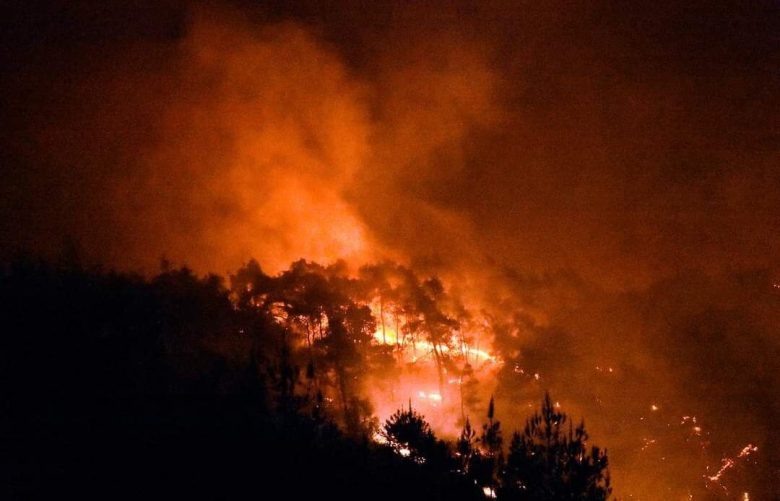
Wildfires broke out on July 25 in Latakia province in northwest Syria and are still burning amid new fires being started. The fires spread quickly by a sudden unusual wind which whipped up. The whole country, and the adjacent Mediterranean region, is in a heat-wave which sets the stage for such a devastating fire burning crops, forests and homes. However, this was not a chance wildfire, but was an act of terrorism.
General Jalal Dawoud, Head of the Fire Department in Latakia, says the fire was man-made. This was determined because the origin of the fire was not in one place, but was started in scattered areas all at the same time in daylight hours.
After the security forces began their investigation, it was found that the fires were started by drones originating from Idlib, under the occupation of Hayat Tahrir al-Sham, formerly Jibhat al-Nusra, the Al Qaeda affiliate in Syria.
Turkey is illegally occupying Idlib as they protect the terrorists under the command of Mohammed Jolani, formerly allied with Abu Baker Al Baghdadi, the head of ISIS who was killed in Idlib by President Trump.
The terrorists have been attacking the fire fighters and vehicles. Bassem Bakar, a water tanker driver, was killed when the terrorists targeted his vehicle near Deir Hanna and Rabiah. Two other men with him were injured.
Turkey is well known for the manufacture of drones, and has been selling drones to Ukraine recently.
On July 25, a fire department vehicle drove over a previously planted mine on Zgharo Mountain, near the town of Maskita, but without injuries. This area was occupied by the terrorists now in Idlib during the 2015 period before they were driven east to Idlib.
The Mayor of Latakia, Amer Hallal, said fire depratments from many areas came to fight the fires, and a Russian water tanker airplane came to battle the fires. Civilians were evacuated from homes and farms and taken to a safe area where they were given humanitarian aid.
The fire raged in Rabiah which sits on a road that connects directly to Idlib. Other areas burning are Ghamam, Sarsekiah, Ein Zarkha, Deir Hanna, Jib Alahmar, Sed Bradoon, and Jebal al Zahra.
A young soldier who volunteered to fight the fires, Mounif Sebry Hassoun, died while fighting the fire due to suffocation in Meshkita. He is from village of Wadi Khelah, in the suburb of Jeblah
The Syrian government, Syrian Red Crescent are coordinating efforts to put out the fires and assisting the humanitarian needs of the affected civilians. Local restaurants have been donating meals to the fire fighters. The Syrian Arab Army (SAA) and the Syrian Red Crescent are putting out fires in Rabiah, which is the front line against the terrorists in Idlib.
The foreign policy of the US and EU have kept the status quo in Idlib. 3 million civilians there are kept as human shields by Hayat Tahrir al-Sham. Turkey prevents the SAA and the Russian military from freeing the civilians kept as hostages to an international game of chess played by America.
International aid organizations, such as the UN, Doctors Without Borders, Save the Children and others deliver all the humanitarian aid to the civilians, while Jolani and his terrorists receive all the aid and distribute it to their cronies first, and sell whatever they horde in a huge shopping mall Jolani and partners built.
Idlib is an agricultural province with farmers and terrorists selling olives and olive oil to Turkish businesses.
The US, EU and UN are enablers of Jolani and the terrorists under his command. Recently, Jolani hung people in Idlib that he perceived were enemies. He and his men oppress women by not allowing social programs directed at women’s issues. The terrorists rule under Islamic Law and in the case of a rape, a woman must present the court with three men who are witnesses to the rape in order to get a conviction. In this situation, rapes go unreported as there is no chance for justice.
Drones can be used for humanitarian purposes, for example: delivering medicines to a remote village. However, drones can also deliver a deadly payload in a war, or attack, and now in Syria they are being used to start wildfires in the heat of summer amid dry winds which spread the deadly fires.
The world responded to the massive 7.8 earthquake on February 6 in Syria and Turkey. Humanitarian aid poured in from Arab countries mainly, with the US boycotting all aid to Syria, with the sole exception of Idlib and the occupying terrorists there.
The earthquake aid has long ago stopped, and although many friends of Syria have asked the US and EU to lift the sanctions which prevent all rebuilding and recovery in Syria from years of war and the earthquake, still there has been no move to lift any sanctions.
Recently, a list of the world’s poorest nations was unveiled with Syria tying for the worse place along with Yemen and Afghanistan. 12 years of armed conflict, the COVID-19 pandemic, the 7.8 earthquake of the century, and now wildfires being delivered by terrorists supported by the US and NATO.
Jolani and his US supported terrorists have no red lines they cannot cross. They are heartless criminals holding the northwest of Syria in fear of their next move.
US mulling multi-front offensive in Syria in collaboration with Takfiri terrorists
By Robert Inlakesh | Press TV | July 29, 2023
The US military is readying approximately 2,500 service members for deployment in the West Asian region, as its proxy forces in Syria’s northeast and al-Tanf areas seek potential alliances with Takfiri terrorists in the northwestern Idlib province.
With tensions boiling between the Syrian government-aligned forces and the US occupation troops in the war-ravaged Arab country, it might be a sign of more violence on the way, observers believe.
According to a report published in New York local media in mid-July, some 2,500 10th Mountain Division soldiers were being sent “off to combat” in Iraq and Syria.
It is not exactly clear how many soldiers from the light-infantry division will be dispatched for operations in the two West Asian countries.
However, the number of forces being sent rings true with a report from the Turkish newspaper, Yeni Safak, that claimed Washington was preparing to send 2,500 troops to northeast Syria.
The US currently maintains, at least publicly, that it has around 900 active-duty service members deployed to Syria, a number which is speculated to be much higher.
If the US is indeed sending additional forces to the region, it could indicate that its objectives have slightly changed in the northeast of the country.
At this time, the Americans occupy roughly a third of Syrian territory and do so without any congressional approval, through its occupation – which it uses the Kurdish Syrian Democratic Forces (SDF) to maintain – it holds hostage the most fertile agricultural lands and roughly 90 percent of Syria’s natural gas from the Damascus government.
Over the past years, the Syrian Arab Army (SAA) and its allies based in the Deir Ezzor province, have grown tired of continued US troop presence inside their territory.
On March 23, the US Department of Defense (DoD) announced “retaliatory strikes” against targets in Deir Ezzor, following a UAV strike against its forces in al-Hasakah.
“Earlier today, a US contractor was killed and five US service members and one additional US contractor were wounded after a one-way unmanned aerial vehicle struck a maintenance facility on a coalition base near Hasakah in northeast Syria at approximately 1:38 p.m. local time,” stated the announcement.
The US coalition airstrikes triggered an unusually extensive response from the SAA and its allies, which fired back and inflicted six traumatic brain injuries, according to the US reports.
At the time, back in March, a Syrian political source told me that the recent move by Syria and its allies was a “direct response” to a wave of Israeli escalation against the country that began last year.
“If you remember in August of 2022, there was a similar stand-off between the Americans and resistance forces in northeastern Syria,” he said, pleading anonymity.
I was also informed by a second source that an order had been given at the time to directly target Americans and not just fire warning shots. However, no further details were divulged.
In mid-July, the US began fortifying its occupation bases surrounding the Conoco and al-Omar oil and gas fields, with forces belonging to their SDF proxies.
According to an Al-Mayadeen source at the time, Washington informed the SDF and its affiliated militias “to prepare for any attack on the region from the Western banks of the Euphrates River” and the US “tasked the Free Syrian Army to mobilize, to face any attack on the 55-kilometer area in Al-Tanf”.
Reports that surfaced on pro-opposition ‘Syria TV’ indicated that the Idlib province-based terrorist group, Hayat Tahrir al-Sham, had hosted several SDF delegations from northeast Syria over the span of months.
The two parties had allegedly concluded agreements on the transport of fuel from Syria’s north-east to Idlib, which appears to have come after Hayat Tahrir al-Sham began facing mounting pressure from Turkiye in northern Aleppo.
The talks between the dominant Idlib Takfiri terrorist group and the SDF apparently explored the possibility of a joint Hayat Tahrir al-Sham-SDF civilian administration with the SDF reportedly claiming that the US supports the idea of unifying the two militant strongholds.
A source who has intimate knowledge of the current security situation in Syria, and who chose to remain anonymous, told the Press TV website that “these moves are complicating, even if this does not amount to an offensive, the only thing that will change the current scenario is a Turkiye-Syria normalization and a possible anti-SDF operation”.
What is also of interest to these developments is that US-Russia relations inside Syria are also deteriorating, with Washington accusing a Russian fighter jet of damaging a US drone on July 23; allegedly using flares to cause the damage.
The terrorist stronghold of Idlib and the US proxies in both northeastern Syria and al-Tanf are seemingly coming together, at a time when American troops are being deployed to the area amid tensions between their occupying forces and the Syrian government’s military.
A possible way forward, in the event that the US carries out a new offensive strategy against the SAA and its allies in Syria, is through the possible normalization of ties between Ankara and Damascus, according to observers.
Despite there being no breakthrough between Turkiye and Syria, the two states are engaged in a dialogue that is aimed at a restoration of ties between them.
Experts say the reason why this is so crucial to combating any potential American plots against the Syrian government and its allies is that Ankara’s cooperation with Damascus could bring an end to many of the various territorial issues in the country.
Turkiye currently occupies two small pockets in the north of Syria, while it actively threatens an offensive against the Kurdish SDF, which it accuses of being run by the YPG and hence a terrorist threat on its border.
If Turkiye forces an incursion into northeastern Syria, dealing another significant blow to the Kurdish armed groups there, it will also force the US to again abandon its SDF proxies, as happened in 2018 and 2019.
If the US withdraws temporarily, this would provide the perfect opportunity for the SAA and its allies to cross the Euphrates River and liberate their oil fields, which the SDF would not likely be capable of holding by themselves.
This is why, in the event that Washington is implementing a new strategy to further punish Syria and its people, a Turkish military offensive may be the simplest way to quickly put an end to it.
More F-35s arrive in West Asia in latest anti-Iran deployment
The Cradle | July 27, 2023
A squadron of US F-35 fighter jets have arrived in the region, Washington’s air force announced on 26 July, coming as part of increased efforts to “beef up deterrence against Iran,” US media outlet Fox News wrote on 26 July.
“The Iranian navy did make attempts to seize commercial tankers lawfully transiting international waters. The U.S. Navy responded immediately and prevented those seizures,” US Fifth Fleet spokesman Tim Hawkins said.
Washington repeatedly accuses Iran of attempting to ‘hijack’ foreign vessels. However, Tehran maintains that it pursues foreign tankers who are either involved in fuel smuggling, or who have violated international regulations by colliding with Iranian vessels and fleeing – as has happened on a number of occasions.
The F-35s were deployed to the US CENTCOM ‘Area of Responsibility’ and serve as an augmentation to those already patrolling the Strait of Hormuz.
According to the military, they aim to provide cover for ships in the region in order to prevent Iranian seizures. They also aim to “deliver ‘increased capacity’ to the region and ‘allow the U.S. to fly in contested airspace across the theater if required,’” an air force press release cited by Fox News reads.
The F-35 jets will also “be available to help in Syria,” Fox News said. US troops currently occupy Syria, controlling its oilfields in coordination with proxy militias, while claiming to be carrying out anti-ISIS operations.
“This deployment demonstrates the U.S.’s commitment to ensure peace and security in the region, through maritime support and support to the coalition’s enduring mission to defeat ISIS in Syria,” the US air force said.
This latest jet deployment comes as Washington has been cementing its military presence across West Asia, seemingly in preparation for a confrontation with Iran. This has seen the US recently deploy a nuclear submarine and a navy destroyer to the Persian Gulf.
In Syria specifically, Washington and Moscow have recently gotten closer to coming to blows.
On 26 July, a US MQ-9 Reaper surveillance and attack drone locked its weapons on two Russian warplanes, reportedly forcing the jets to drop flares that “damaged” the drone’s wings.
This marked the second incident in three days where Russian jets dropped flares on a US drone attempting to lock weapons on them.
According to an anonymous US military official cited in a report earlier this month, Russian and Iranian forces in Syria have been coordinating with the specific aim of forcing Washington’s troops to eventually withdraw from the country.
As a result, Washington has been continuously reinforcing its military bases in Syria, and is reportedly planning to deploy an additional 2,500 troops to the country.
US-led coalition’s jets violated Syrian airspace several times in past day: Russia
Press TV – July 17, 2023
Russia says the US-led military coalition’s fighter jets violated Syria’s airspace in the strategic al-Tanf region several times during the past day, amid repeated calls by Damascus for the expulsion of Washington’s occupation forces from the country.
Rear Admiral Oleg Gurinov, deputy chief of the Russian Center for Reconciliation of the Opposing Parties in Syria, said at a press briefing on Sunday that the al-Tanf airspace is where international air routes pass.
“A pair of the coalition’s F-16 fighter jets, and one MC-12W spy plane violated Syria’s airspace in the al-Tanf area, across which international air routes run, five times during the day,” he said.
Gurinov added that during the past 24 hours, twelve cases of violations of the de-confliction protocols of December 9, 2019 by the US-led coalition drones were recorded, warning that such actions create risks of air accidents with civilian planes.
He further said a shelling attack on the positions of government troops in Syria’s Idlib and Latakia de-escalation zone has injured a Syrian soldier.
The latest development comes as an unnamed Pentagon official declared earlier in the day that the US announced considering military options to address “Russian aggression in the skies over Syria.”
The unknown official further voiced the US’s rising concerns about “growing ties between Iran, Russia, and Syria across the Middle East.”
The official also claimed that “Russia is beholden to Iran for its support in the war in Ukraine, and Tehran wants the US out of Syria” to extend aid to Lebanon’s Hezbollah resistance movement “and threaten Israel.”
Such claims by Washington officials come as the US military is illegally occupying Syria with nearly 1,000 troops and has seized the country’s oil fields in cooperation with local anti-Damascus militants and terrorist groups while stealing its crude supplies and transferring them across the border to its bases in Iraq.
In 2014, the US and its allies invaded Syria under the pretext of fighting Daesh. The Takfiri terrorist group had emerged as Washington was running out of excuses to extend its regional meddling or enlarge it in scale.
Russia, alongside Iran, has been helping Syrian forces in battles across the conflict-plagued country, mainly providing aerial support to ground operations against foreign-backed terrorists.
Damascus maintains that the unauthorized US deployment aims to plunder the country’s natural resources.
Russia – which together with Turkey is carrying out joint patrols in northern Syria – has established special “de-confliction” zones where the US-led coalition can operate.
Syrians lash out at Israeli plan to raze entire village in occupied Golan Heights
Press TV – July 11, 2023
Residents of the occupied Golan Heights have staged a demonstration to express their fierce opposition to the Tel Aviv regime’s plan to completely raze a village in the strategic plateau to build a military base, in a blatant violation of international law.
According to a report by Syria’s official news agency, SANA, protesters rejected the demolition of the remaining homes in the village of Ain Fiet, whose residents were forcibly displaced by the Israeli regime over the past years.
“The Zionist entity aims to obliterate the national identity, establish a military outpost on our lands and Judaize them,” the protesters said.
They said the regime’s scheme to raze the village is contrary to the United Nations Security Council resolution 497.
The UN resolution, adopted unanimously on December 17, 1981, declares that the Israeli annexation of the occupied Golan Heights is “null and void and without international legal effect” and further calls on the Tel Aviv regime to rescind its action.
The protesters further reiterated their devotion to their homeland and Syrian identity in the face of the Israeli regime’s practices, including arbitrary arrests and systematic oppression.
In 1967, Israel waged a full-scale war against Arab territories, during which it occupied a large area of the Golan and annexed it four years later – a move never recognized by the international community.
Israeli forces destroyed Ain Fiet, one of the most fertile and beautiful villages in the Syrian Golan Heights, following the 1967 Six-Day War.
Nearly 131,000 people living there were forcibly displaced, while 7,000 people opted to remain in six other nearby villages, namely Majdal Shams, Masa’da, Baqatha, Ain Qunya, Ghajar and Sahita.
Later on, the Israeli military razed Sahita village and turned it into a military post. It forced its local residents to abandon the village and move to Masa’da.
In 1973, another war broke out and a year later, the United Nations brokered a ceasefire and established a buffer zone between the Israeli and Syrian forces. The UN also adopted several resolutions calling for Israel’s withdrawal from the Golan, but the regime has ignored them.
Earlier this month, Israel further occupied Ghajar village by erecting fences to the north of the area, cutting it off completely from Lebanon.
Last month, dozens of residents and landowners in the towns of Majdal Shams and Masa’deh were prevented from reaching their lands by Israeli forces, leading to confrontations.
The Israeli forces have raided the farmlands to install wind turbines, which according to the farmers, could pose environmental hazards to their lands and interfere with their farming practices.
Israel has over the past several decades come up with dozens of illegal settlements in the occupied Golan in defiance of international calls for the regime to stop its illegal construction activities there.
In 2019, former US president Donald Trump signed a decree recognizing Israeli “sovereignty” over the Golan Heights, in a move that was widely condemned by the international community.
Syria denounced the US decision as a violation of its sovereignty and territorial integrity.
In December 2021, Israel announced its plan to double the number of its illegal settlements in the Golan Heights despite a resolution by the UN General Assembly demanding that the regime stop its settlement activities and withdraw from the occupied territory.
Damascus has repeatedly reaffirmed its sovereignty over the area, saying it must be completely restored to its control.
Russian military responds to US ‘drone harassment’ complaints
RT | July 9, 2023
The Russian Air Force is conducting joint exercises with its Syrian counterparts, so part of the country’s airspace remains off-limits to the US-led forces, the Defense Ministry reiterated after the Pentagon accused Russia of “harassing” American drones for the third time this week.
“The Russian side once again expresses concern about the systematic violations of deconfliction protocols related to the flights of unmanned aerial vehicles (UAVs) of the so-called international anti-terrorist coalition,” the deputy head of the Russian Reconciliation Center for Syria, Rear Adm. Oleg Gurinov, said in a statement on Saturday.
On Friday, the commander of US Air Forces Central, Lt. Gen. Alex Grynkewich, claimed that “three MQ-9 drones were once again harassed by Russian fighter aircraft while flying over Syria,” for the third day in a row. He shared no footage of the encounters this time, but accused Russian pilots of making “18 unprofessional close passes that caused the MQ-9s to react to avoid unsafe situations.”
On Wednesday, Moscow and Damascus kicked off a joint air defense drill, which is scheduled to last until the middle of this month. Electronic warfare units are also involved in the exercise, preparing for joint action to counter enemy airstrikes.
Asked whether the US drones could have indeed flown into a restricted area, Pentagon spokesman Patrick Ryder insisted at a press briefing on Thursday that it would be preposterous to suggest Washington was to blame.
“You – did you see the video?.. So to suggest that somehow, you know, this is our fault, it’s ridiculous. So okay?,” he told journalists .
Ryder went on to say that US forces “have very successfully deconflicted with the Russians over many years” – but refused to say whether the US was following deconfliction protocols this time.
US-backed militia abducts young men in ‘recruitment’ campaign in eastern Syria
The Cradle | July 8, 2023
Militants of the US-backed Syrian Democratic Forces (SDF) launched massive arrest campaigns targeting young men in the areas under the group’s control in northeast Syria, immediately taking them to compulsory recruitment camps, Sputnik reported on 8 July.
Civic and local sources told the Russian news agency that SDF militants loyal to the US army, “are launching, for the third day in a row, campaigns of mass arrests and kidnappings of young men born between 1998 to 2005 in all the cities and towns of Hasakah and Raqqa governorates, where more than 500 young men were forcibly conscripted.”
The sources added that SDF forces set up permanent and temporary military checkpoints in the cities of Hasakah, Qamishli, and Shaddadi, and arrested large numbers of young men, including university and institute students.
The sources indicated that Hasakah residents demonstrated on 5 July in front of the local SDF recruitment headquarters demanding the immediate release of their conscripted sons. In response, the SDF called in military reinforcements, including US-made armored vehicles, to disperse the sit-in.
In Raqqa, local sources told Sputnik that SDF militants set up a checkpoint near the old bridge in the city to stop passing cars in search of young men to conscript and take to the group’s military camps.
Last month, Arab News reported that 13-year-old Kurdish girl, Peyal Aqil, went missing on her way home from a school exam, after being approached by a recruiter for the Revolutionary Youth, a group connected to the SDF and its parent group, the Kurdistan Workers Party (PKK). She followed him to one of the group’s centers in the city of Qamishli.
Her friends waited for her outside, but she never emerged.
Peyal’s mother, Hamrin Alouji, said she and her husband complained to local authorities, who refused to help.
The Revolutionary Youth group later said Peyal joined willingly, a claim her mother rejects. “We consider that at this age, she cannot give consent, even if she was convinced” by the group’s program, Alouji said.
A month after her disappearance in May, Peyal managed to run away from one of the training camps and return home.
Arab News notes that according to a UN report issued this week, 1,696 minors were recruited by armed groups in Syria in 2022, including 637 by the Kurdish-led SDF.
The report also said the UN had confirmed 611 recruitment cases by the Turkish-backed Syrian National Army (SNF), and 383 by the Al-Qaeda-linked Hayat Tahrir al-Sham. The report noted 25 cases of child recruitment by Syrian government forces and pro-government militias.
According to Bassam Alahmad, executive director of Syrians for Truth and Justice, an independent civil society organization, some children are forcibly conscripted, while others sign up out of poverty, for ideological reasons, or out of tribal loyalties.
Alahmad called on the SDF-affiliated administration in northeast Syria to “assume its responsibilities in order to stop these operations.”
An official with the PKK-linked Revolutionary Youth acknowledged to Arab News that the group recruits minors, but claimed they join willingly. “We do not kidnap anyone, and we do not force anyone to join us,” he said.
“They themselves come to us and tell us their intention to join the service of the nation,” he said. “We do not take minors if they are indecisive or unsure.”
Heavy Lies the Crown: POTUS Biden Totally Loses the Plot As NATO’s Narrative Implodes

By Declan Hayes | Strategic Culture Foundation | July 3, 2023
First off, hats off to young Hafez Bashar Assad, who recently aced a Master’s degree in Pure Mathematics from Russia’s prestigious Moscow State University which has, in the course of its long and glorious history, produced several Fields Medals winners. May young Hafez go on to similarly great things.
Hafez was, some years back, the subject of oceans of ire when he represented Syria in the Math Olympics, a competition I have some familiarity with, as friends of mine represented Ireland in years gone by. And though those young Irishmen went on to be awarded PhDs from the world’s most prestigious universities and land jobs with mouth-watering salaries from the world’s most prestigious companies, like young Hafez, they got nowhere at the Math Olympics because they lacked the in-depth 24/7 tutoring the United States’ Ivy League Professors give the young (generally Chinese) charges, who compete under the Yankee flag.
So well done, young Hafez and congratulations, too, to your beautiful, urbane, cosmopolitan, multi-lingual, great and gracious mother, Asma Assad, proudly hugging you after you were awarded your degree. I know of no current or former First Lady, who is in her league in terms of elegance, grace, brains or sheer good manners and your father, Syrian President Bashar Assad, certainly hit the jackpot when he landed that Damask Rose. He is a lucky and blessed man.
Moving from Moscow to Kiev, we see that former Irish President and serial grifter Mary Robinson and Swedish propagandist Greta Thunberg are on a jolly there to advise Clown Prince Zelensky on matters concerning the environment. As 20 year old Greta has only recently graduated High School, at an age when most others would be whistling through their undergraduate degrees, one wonders if this slow learner will stay as silent on NATO’s use of depleted uranium as she has been on the Nordstream terrorist attack, the greatest ecological crime of our era.
Not that I care as Greta, and Mary Robinson are, like Clown Prince Zelensky himself, media creations, all tinsel and no substance. NATO’s Zelensky regime must be really scraping the barrel if that is the best they can do.
But the bottom of the barrel is all NATO seems to have left. French dictator Macron spends his time attending Elton John 1970s’ retro concerts as France burns down around him. The best that Britain can do is to ban Nigel Farage from having a bank account and keep POW Julian Assange on ice for their American masters.
Stella Moris, Julian’s wife, was recently in Rome where, appropriately dressed, she met Pope Francis, who has also recently honoured British film-maker Ken Loach, who was recently expelled from the British Labour Party. Say what you like about Julian Assange and, irrespective as to whether the British will murder him or hand him over to the Yanks for further torture sessions, he is blessed to have such a woman standing foursquare beside him.
Although all of these singularities would have been noted in Washington, it is doubtful if they registered with Creepy Joe Biden, the Don Vittorio of the NATO organised crime gang. Don Vittorio, you may recall, is the senile Italian Mafia godfather, who appeared in The Sopranos a few seasons before fellow mafia mobster Junior also succumbed to dementia.
Although, as Biden claims Putin, in some parallel world, may be losing the war in Iraq, in this world Creepy Joe is most definitely losing the 2024 Presidential war to Donald Trump and Bobby Kennedy. Although Oddslotter still has him favourite to be re-elected, Biden’s place is in the dock as a war criminal and then off to an old folks’ home to be heard from no more.
The threats that Trump and Kennedy pose are not so much personal threats to Creepy Joe as they are to the gangster system he presides over. Trump is a threat because he says what others will not say: that the United States is a predatory state that robs and loots at will. And Kennedy is a threat because he points out the threats Big Pharma’s greed pose to all Americans and Big Pharma’s spokespersons like notorious narcissist Dr. Peter Hotez, won’t even debate him on Joe Rogan’s show for over $1 million in cash.
Although neither of these challengers criticise Israel, such criticisms are inconceivable because of the nature of NATO’s gangsterism. Palestinians are little more than plastic ducks at a shooting arcade and heaven help any “anti-Semite” who might argue otherwise.
But even argument itself is now haram in NATOstan. Donald Trump, remember, was banned from social media when he was POTUS, supposedly the world’s most powerful position. Germany’s Greens, perhaps trying to reconnect to their Nazis past, have persecuted their own citizens for not being sufficiently Russophobic and Australia, Canada and Vichy Ireland are, as part of NATO’s plans of world conquest, introducing the most draconian hate speech laws that have drawn the ire of Joe Rogan, Tucker Carlson and Elon Musk.
And there is the rub. Rogan, Carlson and Musk are forming the backbone of an opposition that believe in such things as free speech and free, open and honest debate and such things present an existential threat to Biden and his fellow-fraudsters.
In my earlier paeon to Asma Assad, I used an abundance of adjectives to try to give Syria’s First Lady her well-earned due. However, at days’ end, she is a wife, a mother and a woman, a wonderful adult female in other words and not a cisgender or a transgender, phrases that Biden’s handlers have shanghaied from the British and Roman Empires where Transjordan and Cisjordan were, still are and will always be divided by the Jordan River and Gaul and Cisgaul were, still are and will always be divided by the mighty Alps. You do not need Hafez Assad’s Master’s Degree in Pure Mathematics to know no such demarcations apply to sovereign womanhood and nor do you even need Greta Thunberg’s hard-earned High School diploma. What you need is a degree of honesty and common sense and, because they are attributes Creepy Joe and his whore-bonking son Hunter cashed in years ago, all of Creepy Joe’s dodgy deals are now coming home to roost.

And, just as the Alps and the Jordan divide for all time the Cis from the rest, so also in our own time do the mountains and rivers of honesty and truth divide the Creepy Joe Bidens and Mary Robinsons from the great and the good, from Stella Moris, Gonzalo Lira, Hafez and Asma Assad, all of whom affirm the words of Irish martyr Terence MacSwiney that “it is not those who can inflict the most, but those who can endure the most, who will prevail”.
And, it is because of good, great and immortal people like Asma Assad that Damascus itself has prevailed against Biden’s Beast of the Apocalypse. Let us, as we conclude, recall Mark Twain’s recollections of that eternal city: “We shall remember… Damascus, the Pearl of the East, the pride of Syria, the fabled garden of Eden, the home of princes and genii of the Arabian Nights, the oldest metropolis on Earth, the one city in all the world that has kept its name and held its place and looked serenely on while the Kingdoms and Empires of four thousand years have risen to life, enjoyed their little season of pride and pomp, and then vanished and been forgotten.”
And, as Eternal Damascus and her eternally gallant allies prepare to consign Biden, NATOstan’s faux Little Caesar, to the trash bin of history, let us salute not only Hafez and Asma Assad on their recent fortune but all of the great and good people of Syria, Palestine, Serbia, China and Russia who, at great cost, defied NATO and carried the banners of humanity not only for the Assange and Lira families but for all of us in the face of the butchers Biden, Macron and Zelensky sent against them. May God bless them and their protectors, the heroic men and women of the Syrian Arab Army, now and forever.
Featured Video
Laith Marouf: Hezbollah’s position on US-Iran ceasefire
or go to
Aletho News Archives – Video-Images
From the Archives
Is Israel to blame for the Iraq War?
American Goy | March 10, 2008
I am so tired of this old canard that “Israel had nothing to do with USA’s war with Iraq – in fact, it officially advised America against it”.
Bullshit. … continue
Blog Roll
 Aletho News
- Laith Marouf: Hezbollah’s position on US-Iran ceasefire: What you’re not being told
- Israel’s priority lies in destroying chances of peace between Iran, US: Ex-UN nuclear chief
- Ceasefire for all or for none: Iran shuts Hormuz over Lebanon attacks
- Strait of Hormuz is Iran’s ‘nuclear weapon’ that forced US retreat: Medvedev
- Energy crisis will last for months – Kremlin envoy
- Europe’s quiet role in the war on Iran
- Forty days that shook the Empire: How Iran turned the tables on US and prevailed
- Netanyahu unilaterally declares Lebanon outside of ceasefire deal
- Israeli leaders: ‘Not a single goal’ achieved in war with Iran
- What on earth just happened? Trump, Iran, and the unlikely ceasefire
- If Americans Knew
- Gazans face a triple crisis: severe shortages of water and bread, healthcare in tatters
- NY Times reports how Netanyahu took the US into Iran War
- A sigh of relief over Iran, but Gaza and Lebanon in dire straits – Daily Update
- Thousands dead and neighborhoods razed to the ground: Aid agencies fear southern Lebanon is becoming the new Gaza
- The war the US is fighting for Israel could cost trillions
- ‘Cigarette Burns, Nail Wounds’: Toddler Tortured in Gaza to Coerce Father
- Trump Says US Sent ‘a Lot of Guns’ to Protesters in Iran
- Israeli forces destroy 17 UN peacekeeper cameras in south Lebanon
- US-Israeli strikes ‘completely destroy’ synagogue in Tehran
- Archbishop for US Military Says Iran War Is Unjust Under Catholic Teaching
- No Tricks Zone
- An Inconvenient Tree: Uncovered In Alps… Europe Much Warmer Than Today 6000 Years Ago
- New Study Reports A 60% Slowdown In Greenland’s Ice Loss Rate In The Last Decade
- Low Intensity Tornado Wrecks Major Solar Farm, Creating A Potential Toxic Dump
- New Study Finds Warming Saves Lives…Cold Temperatures 12 Times More Deadly Than Excess Heat
- German Science Blog Accuses PIK Climate Institute Of Hallucinating Climate Tipping Points
- Devastating Assessment Of Comirnaty Vaccine By Former Senior Pfizer Europe Toxicologist
- New Study: CO2 Is ‘Effectively Negligible’ As An Explanatory Climate Change Factor Since 2000
- Former Pfizer Toxicologist Dr. Helmut Sterz Tells Bundestag Hearing Pfizer Vaccine Should Have Never Been Approved
- Energy Expert: Germany’s Nuclear Phaseout Was A “500 Billion Euro Mistake”
- New Research: South Australia’s Mid-Holocene Sea Surface Temperatures Were 4°C Warmer Than Today
 Aletho News