NATO is trying to create irresolvable confrontation with Russia – Lavrov
By Ailis Halligan | RT | February 21, 2022
The West is attempting to incite an unavoidable confrontation with Russia over Ukraine, Russian Foreign Minister Sergey Lavrov said on Monday.
Speaking to his Syrian counterpart, Faisal Mekdad, Lavrov lamented that Russia is unable to focus its efforts on its relationship with the Middle Eastern country, blaming Western attempts to fan the flames of conflict in Ukraine, allegedly with the goal of encouraging war between Russia and NATO.
“The situation in the world is developing rapidly. This also applies to northern Africa and the Middle East, including Syria,” Lavrov said. “Unfortunately, our efforts with you … are affected by the atmosphere that is now being escalated our Western colleagues.”
According to Lavrov, the “Western alliance” is trying to create an “almost insurmountable confrontation” with Russia.
According to the foreign minister, Moscow wants to focus its efforts on working towards a ceasefire and political settlement in Syria.
The Russian presence in the country, at the invitation of President Bashar Assad, has been ongoing since 2015, and is aimed at aiding Damascus’ fight against extremist Islamist terrorism.
The minister also stressed that NATO attempts to spoil Russia’s reputation due to its presence in Syria would be fruitless.
“We certainly will not allow such attempts to undermine our ability to achieve concrete results,” he noted, stressing that Russia would work to strengthen Syria’s “sovereignty, territorial integrity, and political independence.”
In response, Mekdad revealed Syria’s support and gratitude for Russia’s efforts and echoed Lavrov’s attack on NATO.
“The campaign of hypocrisy, lies, and deception waged by the West is the same as the campaign it launched against Syria,” Mekdad said.
Lavrov is due to meet with US Secretary of State Antony Blinken in Europe on Thursday to discuss options for diffusing rapidly growing tensions surrounding Ukraine. Many NATO members, including the US, have made allegations that Russia is preparing for an imminent invasion of its neighbor. The Kremlin has denied this.
Israel offers Arab state the opportunity to tackle Iran together
RT | February 15, 2022
Since Israel and Bahrain both view Iran as a threat, they could team up and counter Tehran together, Israeli prime minister Naftali Bennett said on his landmark visit to the Gulf monarchy.
“We will fight Iran and its followers in the region night and day. We will aid our friends in strengthening peace, security, and stability, whenever we are asked to do so,” Bennett pledged in an interview with the Bahraini state-linked Al-Ayyam outlet on Tuesday.
The PM blamed Tehran of striving to “destroy moderate states” in the Gulf region in order to replace them with “bloodthirsty terrorist groups.”
When asked about the possibility of creating an alliance to resist Iranian influence, which could include Israel, Bahrain, and some other Arab nations, he gave a positive response: “We all understand that we face the same challenges, so why not work together to tackle them?”
Bennet, who became the first Israeli prime minister ever to visit Bahrain, assured the journalists that “Israel is a strong and reliable country.”
The idea of such a block was first floated by Israeli general Tal Kelman last year. According to Kelman, who heads the IDF’s Strategy and Third Circle Directorate, “the moderate axis” of Israel, Bahrain, the UAE, Jordan, Egypt and others should resist “the radical axis” of Iran and what he called its “proxies” in Lebanon, Syria, Yemen, and Iraq.
Israel and Bahrain normalized relations in late 2020 as part of the so-called Abraham Accords, a US-backed drive to improve ties between the Jewish state and some Arab countries after decades of strife.
Bahrain is a small island nation of around 1.5 million. The majority of its population is Shia Muslims, but the country is being run by a Sunni monarchy. The rulers in Manama have been concerned by Tehran’s activities as Iran, which is located less than 800 kilometers (497 miles) away, often faces accusations from its rivals of supporting Shia groups in other countries.
Threat of War between Syria and Israel is getting More Real
By Vladimir Platov – New Eastern Outlook – 14.02.2022
On February 9, Israel launched yet another series of strikes on targets near Damascus, which resulted in one Syrian killed and five injured, which has aggravated the threat of war between Syria and Israel.
According to the Syrian Arab News Agency (SANA), on February 9, four Israeli F-16s, without crossing the state border of Syria, launched another guided missile attack on facilities near Al-Kiswah, a village south of Damascus. One of the anti-aircraft missiles of the Syrian army exploded over the occupied Golan Heights, after which the IDF fired from the area occupied by Israeli troops in the Syrian Golan Heights ten surface-to-surface missiles at the positions of the Syrian air defense forces. Some missiles were brought down by Syrian air defenses. Nevertheless, the attack still caused significant damage to some buildings in the city of Qudsaya, destroying dozens of houses and cars. To repel the attack, Syrian troops utilized Russian-made air defense systems, which shot down eight missiles.
According to an IDF statement, in response to an intercepted missile fired from Syria into northern Israel, Israel attacked targets in Syria, including the “Syrian radar and anti-aircraft batteries that launched missiles at Israeli Air Force aircraft.” However, it is obvious that the missile chosen by the IDF as the reason for retaliation was the anti-aircraft missile that exploded in the air and was launched by Syrian air defenses as a measure of protection against earlier Israeli missile attacks launched from Lebanon.
In the message the Syrian Foreign Ministry sent to the UN Security Council regarding the aforementioned act of aggression by Tel Aviv, the Syrian government denounces the dangerous consequences the Israeli attacks on the SAR territory may have for stability in the Middle East and the entire world. “Syria reserves the right to use all legal means to respond to the treacherous strikes carried out by Israel on the outskirts of Damascus from Lebanese airspace and from the occupied Golan Heights,” the document says. The Syrian Foreign Ministry drew attention to the fact that “the United States, which patronizes Israel, encourages it to continue attacks and paralyzes possible measures by the UN Security Council to deter the aggressor, which undermines the prestige of the international community.”
Initially, Israel planned to launch two strikes simultaneously on February 9 – one on the outskirts of Damascus, and the other on Latakia. However, after encountering two Su-35s scrambled in response, the IAF fighters flew back without attacking the Syrian port. At the same time, almost all of the missiles allegedly aimed at Iranian facilities in the Rif Dimashq Governorate were shot down by Russian-made Syrian air defense systems. The attack was carried out from Lebanese airspace, which is another gross violation of international law.
Israeli Air Force regularly strikes targets in Syria without entering the airspace of the Arab Republic, and mainly operates from the airspace of Lebanon – in violation of international norms, or from the Mediterranean Sea. Since 2013, the IDF has been carrying out hundreds of airstrikes on the territory of a neighboring country primarily targeting pro-Iranian forces in the SAR. This year, there have already been two such attacks by Israel. The first one was took place on January 31 at targets near Damascus, namely Hezbollah facilities and warehouses in the vicinity of Al-Qutayfah. In 2021, there were 55 attacks:
– 3 missile strikes in December (on December 7, 16 and 28, mainly in the area of the port of Latakia, one Syrian soldier was killed, and significant damage was caused). It is noteworthy that on December 28, not for the first time, two F-16s of the Israeli Air Force launched four guided missiles at facilities on the territory of the port of Latakia without crossing the Syrian border (from the Mediterranean Sea). The Syrian air defense forces did not engage in a battle to repel the IAF raid on the port of Latakia, since a landing Russian Air Force transport plane could be in the affected area;
– 4 missile strikes in November (on November 3, 8, 17 and 28, mainly on targets near the city of Homs, which resulted in four people killed, including two civilians, several people wounded and significant material damage);
– 4 missile strikes in October (on October 8, 13, 25 and 30, strikes were carried out on the outskirts of Damascus, the outskirts of al-Ba’ath and the village of Al-Krum in the Quneitra Governorate in southern Syria, and the city of Abu Kamal, as a result of which more than ten Hezbollah militants and a Syrian soldier were killed, and significant damage was caused);
– 3 missile strikes in September (on September 3, 14 and 27, South from the village of Mayadin in the Deir ez-Zor Governorate in Eastern Syria, near the Iraqi border, with many people being wounded);
– 2 missile strikes in August (on August 17 and 19); 3 missile attacks from May to July (on May 5, June 8 and July 19); 9 missile strikes from January to April, with dozens of people dead and wounded;
– 39 missile attacks and air raids were carried out in 2020.
Israel explains its attacks with the desire to prevent modern weapons from falling into the hands of it enemies. Enemy No. 1 in this regard is the Lebanese Hezbollah movement, which is fighting on the side of Syrian President Bashar al-Assad and is controlled by Tehran. After the first Israeli airstrikes, Moscow invited all interested parties to meet and talk about disentangling their interests in order to avoid armed conflicts and civilian casualties. However, these calls of Russia have not been heeded.
Israel, despite repeated statements by official Syrian authorities to the UN, continues regular airstrikes on Syrian civilian targets, using, among other things, provocative air attacks by its fighters “under the cover” of civilian aircraft. Thus, in addition to the attack of December 28, on the night of October 13, 2021, four IAF F-16s once again entered the Syrian airspace in the area of the US-occupied Al-Tanf zone in the Homs Governorate and, under the cover of civilian aircraft flying at the same time, carried out an airstrike on a phosphate ore processing plant in the Palmyra area. It is noteworthy that this is not the first time such air attacks have been carried out from the area of the US-occupied zone in the Homs Governorate, which clearly indicates the coordinated actions of the IAF with the US military.
Such provocative tactics of the Israeli Air Force can lead to a serious aggravation of the situation, and it will by the IAF’s fault if the Syrian air defenses in their anti-missile actions shoot down a civilian aircraft of any country, under whose cover Tel Aviv carries out its airstrikes. And such an incident has already occurred in 2018 when Israeli planes bombed Syria from the air zone where the Russian reconnaissance plane was located, and the Syrian air defense shot down this plane by mistake. Russian service members were killed and a big scandal broke out, which was extinguished, and an armed conflict with Israel prevented, only thanks to complex diplomatic efforts.
The Syrian leadership has repeatedly demanded that the UN Security Council put pressure on Israel to stop attacks on the territory of the republic, since such actions violate its sovereignty and lead to increasing tensions in the region. The Syrian Foreign Ministry has previously repeatedly stated that the republic can use “all legal means” to respond to Israeli airstrikes on the Syrian territory. Therefore, by continuing such provocative attacks, Israel is openly tempting its fate, which could turn into a serious armed conflict at any time.
Russian, Syrian pilots conduct joint air patrol mission along Golan Heights
TASS | January 24, 2022
MOSCOW – Russian and Syrian military pilots have conducted a joint air patrol mission along the Golan Heights and the Euphrates River, the Russian Defense Ministry said in a statement.
“The mission’s route ran along the Golan Heights, the southern border, the Euphrates River and over northern Syria,” the statement reads. “Russian pilots took off from the Hmeymim Air Base, while Syrians took off from the Seikal and Dumayr airfields outside Damascus,” the ministry added.
According to the Russian Defense Ministry, the mission involved Russia’s Su-34 and Su-35 aircraft and the A-50 early warning and control aircraft, as well as Syria’s MiG-23 and MiG-29 planes. “During the patrol mission, Syrian pilots controlled airspace and provided fighter cover, while Russian crews practiced attacks on ground targets,” the statement specified. The ministry said that pilots had practiced strikes on air targets and ground targets at a training range in central Syria.
“The two countries’ pilots developed skills for cooperation in various situations. This kind of joint missions will now take place on a regular basis,” the Russian Defense Ministry stressed.
US nearly wiped out tens of thousands of civilians with dam strike in Syria
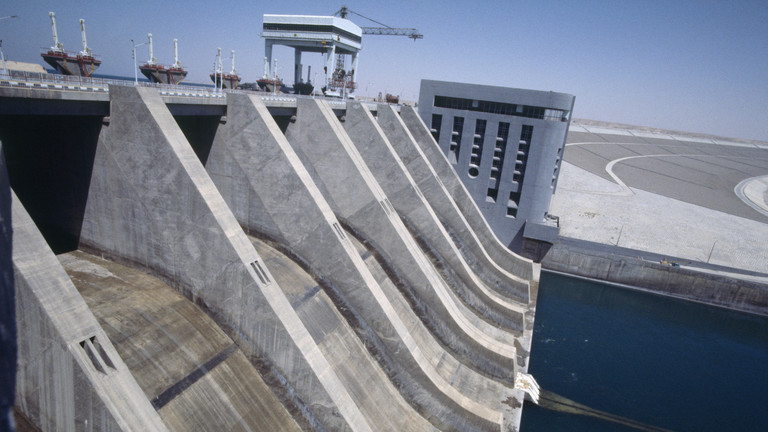
The Tabqa Dam in Syria. ©Claude Salhani / Sygma via Getty Images
RT | January 21, 2022
In 2017, the US bombed a piece of strategic infrastructure in Syria, the Tabqa Dam on the Euphrates River, despite it being on a no-strike list, the New York Times reported.
A B-52 bomber dropped some of the heaviest weapons in the US Air Force arsenal on the target, including at least one BLU-109 bunker buster, which is designed to destroy fortified concrete targets. This bomb pierced through five stories in one of the dam’s towers, but didn’t explode.
If the Soviet-designed earth-and-concrete structure had failed, tens of thousands of people living in a valley below would likely have died.
The dam wasn’t immediately destroyed, but damage to its equipment rendered it inoperational and at risk of overflowing. An unprecedented truce involving the terrorist group Islamic State (IS, formerly ISIS), US-backed forces on the ground, and Syrian government forces was hastlily struck with Russia’s help to allow a crane controlling emergency floodgates to be repaired.
After the work was done by a crew of 16 workers, a drone strike ordered by the same taskforce that called in the initial strike obliterated a van carrying some of them back. It killed a mechanical engineer, a technician, and a Syrian Red Crescent worker.
The events were described by the Times based on interviews with unnamed US military officials as well as people in Syria, including an engineer who was present at the dam on the day of the strike. It is the newspaper’s latest expose of Talon Anvil operations, which critics call reckless. The taskforce was created to coordinate the war effort against IS and was staffed by US Army Delta Force commandos, according to previous reporting.
The March 26 strike on the Tabqa Dam was attributed to US forces by Russia and Syria, but then-Lt. Gen. Stephen J. Townsend, under whose purview the taskforce operated, dismissed it as “a lot of crazy reporting.”
“The Tabqa Dam is not a coalition target and when strikes occur on military targets, at or near the dam, we use non-cratering munitions to avoid unnecessary damage to the facility,” he assured journalists.
According to Times sources, Talon Anvil routinely used a trick to circumvent the airstrike vetting process by senior command, citing the urgency of defending US allied forces from an imminent attack. The strike on the dam was also justified that way, but witnesses said no major fighting in the area was taking place before the bombs hit.
US Central Command acknowledged dropping three 2,000-pound bombs, but said they were targeting towers, not the dam itself. And that the fact it didn’t fail proved the safety of the operation, a spokesman for the military suggested. He denied that the usual procedures were sidestepped in authorizing the strikes.
The Times said a report requested from specialized engineers in the Defense Intelligence Agency’s Defense Resources and Infrastructure office prior to the strikes recommended against using any sort of explosives in the vicinity of the dam. Even relatively small munitions like Hellfire missiles could damage concrete structures controlling the flow of water, the four-page assessment said, according to the newspaper.
Talon Anvil had not reported the dam strikes. The US military had to piece together what had happened by reviewing logs from the B-52 bomber, a source told the Times. No disciplinary action was taken against members of the secret unit, the newspaper reported.
US, Israel blocking elimination of chemical weapons worldwide: Iran
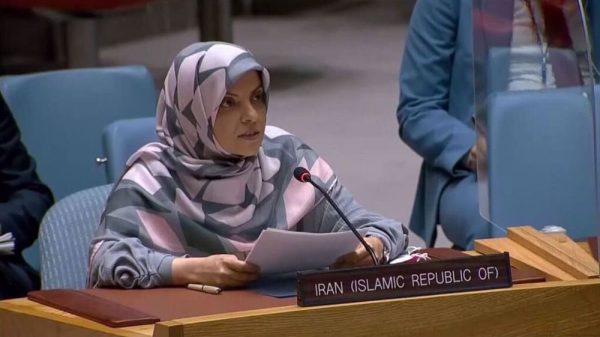
Iran’s Deputy Permanent Representative to the UN Zahra Ershadi
Press TV – January 6, 2022
An Iranian envoy to the United Nations has raised concerns about the possession of chemical weapons by the United States and Israel, describing the pair as the main obstacles to the elimination of such arms across the world.
Zahra Ershadi, deputy permanent representative of Iran to the UN, made the remarks on Wednesday at the Security Council briefing on chemical weapons in Syria.
She said that the elimination of all chemical weapons worldwide was the prime objective of the Chemical Weapons Convention (CWC), and that this goal could be realized only through the treaty’s full, balanced, effective and non-discriminatory implementation, as well as its universality.
It is therefore a source of serious concern that due to non-compliance by the United States, this objective has yet to be realized, she added.
Ershadi also stressed that the Israeli regime must be compelled to join the CWC without any precondition or further delay.
Warning against the serious impact of politicization on the CWC’s credibility, the Iranian envoy called for de-politicization of the work of the Organization for the Prohibition of Chemical Weapons (OPCW).
Iran reiterates its long-standing and principled position on the need to strongly condemn the use of chemical weapons by anyone, anywhere and under any circumstances, she said.
The only absolute guarantee that chemical weapons will not be used again is the total destruction of all chemical weapons across the globe, she said, adding that all necessary measures should be taken to ensure that such weapons will not be produced and used in the future.
Citing significant efforts by Syria to carry out its obligations under the CWC, including the complete destruction of all its 27 chemical facilities as verified by the OPCW, Ershadi said the holding of monthly Security Council meetings to consider the Syrian file is unjustified.
Syria surrendered its entire chemical stockpile in 2013 to a mission led by the United Nations and the OPCW.
It believes that false-flag chemical attacks on the country’s soil have been staged by foreign-backed terrorists in a bid to pressure the government amid army advances.
Syria slams West’s disinformation campaign
Speaking at Wednesday’s Security Council briefing, Syria’s Permanent Representative to the UN Bassam Sabbagh condemned any use of chemical weapons, emphasizing that the Damascus government has never employed such prohibited arms, despite the threats posed by terrorist groups and their sponsors on its territory.
Since joining the CWC in 2013, Syria has cooperated with the United Nations to eliminate its stockpiles and production facilities, a process that was completed in record time, in mid-2014, he added.
Sabbagh also rejected the disinformation campaign launched by some Western countries, which have adopted a hostile policy against Syria and created the OPCW Investigation and Identification Team, he said that reports by the body have become part and parcel of the hostile Western campaign.
He further urged the UN not to “drag its feet” in investigating the use of chemical weapons by terror outfits and cautioned that certain Western states often jump to conclusions before the end of the probe.
Leaked files expose Syria psyops veteran astroturfing BreadTube star to counter Covid restriction critics
BY KIT KLARENBERG AND MAX BLUMENTHAL · THE GRAYZONE · DECEMBER 24, 2021
By covertly recruiting popular YouTube influencer Abigail Thorn to counter growing opposition to UK gov’t Covid restrictions, psy-ops pros are bringing home the tactics they honed in the Syrian dirty war.
Leaked documents have revealed a state-sponsored influence operation designed to undermine critics of the British government’s coronavirus policies by astroturfing a prominent founder of the BreadTube clique of “anti-fascist” YouTube influencers.
The project aims to conduct psychological profiling on British citizens dissenting against policies such as mandatory vaccination and lockdowns, then leverage the data to establish a YouTube channel that portrays these critics as dangerous “superspreaders” of “disinformation.”
Designed “to curb the influence of pseudoscience material online, with specific emphasis on Coronavirus-related ‘anti-vaxxing’ sentiment,” the operation is run by the UK’s Royal Institution, and dubbed “Challenging Pseudoscience.”
Its top patron is Charles, the Prince of Wales, next in line to the British throne, who recently hit out at supposed “conspiracy theories” surrounding COVID-19 vaccines. The organization received a substantial cash injection in 2020 from the UK government’s Culture Recovery Fund earmarked for video production.
Leaked files obtained by The Grayzone indicate that the Royal Institution has enlisted the services of Valent Projects, a “social change” communications firm founded by a public relations operative previously involved in the UK Foreign Office’s campaign for violent regime change in Syria. Valent has also been sponsored by the US Agency for International Development (USAID), a US intelligence cut-out, for a project aimed at “investigating disinformation.”
Valent’s central role in the operation highlights the trend of information warfare specialists bringing the techniques they honed against targets like the Syrian government back home to the West, where increasingly unpopular governments confront masses of citizens ever-bristling at coronavirus restrictions.
As in Syria, where communications firms like Valent created, trained and instrumentalized media organizations to further regime change objectives, they have covertly recruited a famed British YouTube influencer to lend their carefully calculated messaging campaign an authentic flavor.
According to internal documents, Valent plans to design a “mass appeal social media campaign fronted and owned by prominent social media figure Abigail Thorn,” the founder of Philosophy Tube. Valent’s research on British citizens who reject official policy on COVID-19 “will be used to devise a campaign that utilises YouTuber Abigail Thorn’s existing platform to achieve a measurable cognitive shift in the target audience,” the files state.

Boasting over one million subscribers to her YouTube channel and more than 7000 Patreon supporters, Thorn has established a potent vehicle for any communications campaign. She is also a core member of BreadTube, an assortment of left-branded social media influencers that has attracted intense establishment interest for its purported ability “to pop YouTube’s political bubbles to create space for deradicalisation.”
While top BreadTubers are best known for employing memes and theatrical ploys to counter right-wing narratives, they have also dedicated intense energy to attacking the anti-imperialist left as “tankies” engaged in a secret “red-brown alliance” with right-wing extremists.
In his book, “BreadTube Serves Imperialism: Examining the New Brand of Internet Pseudo-Socialism,” socialist organizer Caleb Maupin likened BreadTube to the “counter-gangs” deployed by British and US intelligence to infiltrate and dismantle insurgent forces from Kenya to Southeast Asia.
BreadTube “speaks in the name of left-wing sounding ideals. In reality, it is likely serving one section of the American ruling elite and the intelligence agencies,” Maupin wrote.
The covert relationship between BreadTube’s Abigail Thorn, Valent Projects, and the Royal Institute appears to validate Maupin’s thesis.
“It does not surprise me at all to find out there is documented evidence that the British Royal Family and an intelligence contractor is bankrolling the work of Abigail Thorn,” Maupin told The Grayzone. “It lines up with everything I have observed about her and the BreadTube trend overall.”
Maupin continued, “BreadTube’s ‘socialism’ is not really socialism, it is mobilizing young liberals to keep dissident elements in line. It’s securing the rule of British and American corporations over the planet by trying to silence those who get in its way.”
The national security establishment’s favorite socialists
Since launching Philosophy Tube in 2013, Abigail Thorn’s YouTube channel boasts over 7000 paying Patreon fans and well over one million YouTube subscribers. By probing complex philosophical and political issues in a highly accessible, engaging manner and deploying elaborate, artisanal audio and visual effects, she has emerged as a social media celebrity. A lengthy profile video produced by the BBC refers to her as “one of the most high-profile transgender figures in the UK.”
Thorn is among the most prominent figures within the loosely knit collective of YouTube influencers known as BreadTube. Inspired by the title of anarchist Peter Kropotkin’s tract, The Conquest of Bread, BreadTube advances a hyper-identitarian, imperialism-friendly interpretation of socialist politics that has earned its creators enthusiastic promotion from establishment interests.
The New York Times, for example, published a lengthy 2019 profile of a young man named Caleb Cain who supposedly “fell down the alt-right rabbit hole” on YouTube. Cain claimed he was de-radicalized through exposure to videos by Thorn and other popular BreadTubers like Natalie Wynn of Contrapoints. During the Trump era, as the Google-owned YouTube implemented a raft of stringent speech codes, it began amplifying BreadTube influencers through its algorithm.
Other popular BreadTube figures include Vaush, a video gamer from Beverly Hills, California named Ian Koshinski. Known for his superficial understanding of Marxism, crude invective against Trump supporters (“they disappear, or we all do”), female high school athletes who complain about being forced to compete against biological males (“sorry you fucking suck, dumb bitch”), and imprisoned journalist Julian Assange (“I want Assange to die in a CIA black site just because it would trigger all the worst people on Twitter”), the self-described “libertarian socialist” has earned the moniker “Vaush Limbaugh” from his critics.
Then there is Shaun, a British BreadTuber whose recent attack on left-wing political comedian Jimmy Dore’s criticisms of government Covid restrictions contained echoes of the “Challenging Pseudoscience” project prepared for Thorn by intelligence-related outfits. Shaun’s arguments relied heavily on statements by official experts and US government bodies like the FDA and CDC. While Dore has been limited by YouTube’s sweeping speech codes, Shaun’s viral video appears to have benefited from an algorithmic boost.
“All the key signs of infiltration are there,” Caleb Maupin said of BreadTube. “Since when does US mainstream media highlight the work of Marxist revolutionaries? Why are people who seem so unfamiliar with basic elements of socialist ideology suddenly elevated to the position of respected experts by the algorithms? Why do their foreign policy views seem to line up so closely with the US State Department? I have had no doubt they were being covertly supported by powerful entities with goals other than overthrowing capitalism.”
Unlike some fellow BreadTubers, Thorn comes across as amiable and trustworthy, fostering a personal bond with her viewers and regularly publishing thank you notes to patrons, listing them each by name. These qualities have attracted support for Philosophy Tube by both public and private backers.
Thorn’s April 2021 dismantling of the politics of right-wing culture warrior Jordan Peterson has racked up almost two million views and was sponsored by Curiosity Stream, a US media streaming service. The video opens with a black screen disclosing the support provided by the company and claiming Thorn would donate her fee to the feminist campaign group, Sisters Uncut. The video is also emblazoned with YouTube’s “paid promotion” logo.
Yet no such disclaimer referring to support from the Royal Institution can be found on any of her other uploads. And that may be because the Covid campaign was intended to be covert.
Astroturf campaign seeks to achieve ‘measurable cognitive shift’
The “Challenging Pseudoscience” operation designed for Thorn was launched in February 2021 by liberal science journalist Angela Saini. The author of several popular titles and a forthcoming book on “the origins of patriarchy,” she is also part of The Lancet Covid-19 Commission’s Task Force on Global Health Diplomacy.
The commission’s chief, Peter Daszak, a zoologist who serves as president of the US-based NGO known as EcoHealth Alliance, was forced to resign in June over conflict of interest issues.
In the years leading up to the outbreak of Covid-19, Daszak worked extensively on bat coronaviruses and gain of function research at the Wuhan Institute of Virology. His organization received tens of millions in funding from the Pentagon’s Defense Threat Reduction Agency, a division “[countering] weapons of mass destruction and improvised threat networks.” In December 2019, Daszak warned that coronaviruses can “get into human cells,” one can “manipulate them in the lab pretty easily,” and “you can’t vaccinate against them.”
The host of Saini’s project, the Royal Institute, was founded in 1799 by British scientists of the day “with the aim of introducing new technologies and teaching science to the general public.” Landed gentry and royalty have always occupied the Institution’s highest levels. Queen Elizabeth II’s cousin, Field Marshal Prince Edward, the Duke of Kent, has served as president since 1976.
The files indicate that the Royal Institution enlisted the services of Valent Projects, a communications firm “[working] with clients in the UK and all over the world to counter disinformation and strengthen the bonds between people.”
Valent was founded by Amil Khan, a former Reuters and BBC reporter who officially left journalism “to help good causes navigate the new information landscape.”
From February, Valent Projects proposed a “two-phase” project to “develop an understanding of the psychological drivers behind the generation and spread of anti-vaxxer narratives.” It planned to exploit this data “to develop and test public messaging responses.”
The findings would “inform other programming by Challenging Pseudoscience… as well as other stakeholders including the science community and concerned governments and public health bodies.”
In the campaign’s first phase, extensive online interviews were to be conducted, along with “ethnographic research” to secure “comprehensive understanding of the key online audiences driving anti-vaxxing mis/disinformation around the Coronavirus pandemic.”

Valent Projects then planned to “draw together insights” from these findings, developing “comprehensive audience profiles” – including “demographic information” – to design a “mass appeal social media campaign fronted and owned by prominent social media figure Abigail Thorn,” who runs online channel Philosophy Tube.
Valent indicated its intent to exploit Philosophy Tube’s sizable platform to “achieve a measurable cognitive shift [emphasis added] in the target audience.”
Reaching the intended viewers was forecast to be a significant task in itself, however. Valent noted most Philosophy Tube viewers are within the 18 to 35 age range, but “existing research” suggested the “most prolific consumers of pseudoscience material” were over the age of 45.
The firm felt the “best topic to address this issue is probably along the lines of ‘the thing about expertise’ [sic].” Fittingly, in August 2020 Thorn uploaded a video, “Who’s afraid of the experts?” Featuring comedian Adam Conover of the popular show, “Adam Ruins Everything,” the 45 minute-long defense of the scientific consensus on the HIV/AIDS debate is the first result in any search for the term “vaccine” on Philosophy Tube’s channel.
The leaked documents thus expose what had long been suspected by critics of BreadTube: the popular social media collective has been instrumentalized by powerful interests with connections to Western intelligence agencies.
An astroturfed information warfare campaign hiding in plain sight
Multiple requests for comment from The Grayzone to Abigail Thorn’s agent and Angela Saini have gone unanswered.
When quizzed about the leaked files on Twitter, Valent Projects CEO Amil Khan flew into a rage, angrily asserting they were “obtained through hacking and then doctored,” in the manner of “classic doxing,” and threatened legal action against this journalist for publicizing them.
Khan later pumped out a series of tweets aimed at controlling the damage of his imminent exposure. In one, he falsely claimed that a co-author of this piece would publish their reporting in “Russian state affiliated media.”
Yet when challenged about his claim of doctoring, Khan did not respond.
Subsequent requests for clarity on which elements of the documents were maliciously altered and how that might have taken place have also gone unanswered. But evidence of the secret project’s existence was hiding in plain sight.
For example, Valent Projects lists the Royal Institution on its website as a client. An accompanying writeup notes it “developed and implemented a data-led behaviour change campaign [emphasis added] aimed at understanding and working with the psychological drivers behind anti-vaxer sentiment in the UK” for the organization.
Similarly, a post on the company’s official LinkedIn page refers to an “analysis of tens of thousands of UK-based social media users “posting/sharing anti-vax content online” it conducted for Countering Pseudoscience, which would “be used to inform ethnographic research designed to understand ‘why’ people hold these views.” In other words, a specific programming strand outlined in the documents.

From Valent Projects’ LinkedIn page
Moreover, none other than Abigail Thorn was guest-of-honor at Challenging Pseudoscience’s launch event in February, “Vaccines: Warriors and Worriers,” which featured a debate on “how vaccines work, why people are skeptical despite the evidence, and how disinformation about vaccines spreads online.”

Abigail Thorn of Philosophy Tube participating in the Royal Institution’s “Vaccines: Warriors and Worriers” event
Also on the event’s panel were an immunologist named Zania Stamataki and Marianna Spring, the BBC’s first “specialist disinformation reporter.” She has repeatedly perpetuated falsehoods about the size of anti-lockdown protests in 2020 and nature of their participants. In a bizarre experiment, she furthermore personally set up numerous “fake troll” accounts on assorted online platforms that “engaged” with “misogynistic” content, allegedly for academic purposes.
In May, Thorn published a characteristically ornate video, “Ignorance & Censorship,” which touched on the topic of “disinformation” and vaccines. The next month, Challenging Pseudoscience convened a similarly named panel discussion, “Misinformation or Censorship.”
Then, the newly-launched Challenging Pseudoscience podcast shared two prior Royal Institution debates – the aforementioned Vaccines: Warriors and worriers, and “Disinformation and how to counter it,” which featured none other than Amil Khan as a speaker. It would be entirely unsurprising if this deluge was a coordinated effort.
A wide-ranging, long-running, cross-platform propaganda campaign involving multiple actors requires substantial resources. Until 2020, however, the Royal Institution struggled financially despite its royal patronage and elite trustees.
The organization has been forced to rent out its grand central London headquarters for conferences, corporate bashes and weddings. To plug a multimillion pound budget deficit in late 2015, the Royal Institution auctioned off treasured first editions of works by Charles Darwin, Isaac Newton and other eminent scientists. The fire sale prompted the BBC to ask whether the organization was on the verge of collapse.
Miraculously though, in October 2020, the Institution received hundreds of thousands of pounds from the UK government’s £1.57 billion Culture Recovery Fund “to help face the challenges of the coronavirus pandemic and ensure it has a sustainable future.”
An accompanying press release noted the Royal Institution had over the course of the pandemic “[developed] a successful programme of weekly science talks online” broadcast via its “well-established” YouTube channel, which today boasts 1.11 million subscribers. The cash injection would “increase the number of livestreamed science talks” hosted by the organization, and help it develop “new digital content.”
Valent Projects staffer Hamish Falconer has disclosed that the “exciting” Challenging Pseudoscience campaign has also received “generous support” from the Open Society Foundations of CIA-adjacent billionaire George Soros.
As the Washington Post’s David Ignatius reported in 1991, Soros was at the heart of a network of “overt operators” helping US intelligence carry out “spyless coups” against former Soviet satellite states.
In July 2021, Soros teamed up with fellow billionaire Bill Gates to purchase a UK-based Covid-19 test developer for $41 million.
Three months later, as Alex Rubinstein documented for The Grayzone, Soros partnered with tech oligarch Reid Hoffmann to found Good Information Inc, a social media censorship operation marketed under the aegis of “countering disinformation.”
Hamish is the son of Charlie Falconer, a longtime friend and former roommate of former UK Prime Minister Tony Blair. Following Blair’s May 1997 election victory, Falconer senior was elevated to the unelected House of Lords, and served in a series of high-ranking government posts throughout his pal’s tenure.
Along the way, he applied “huge pressure” to Attorney General Lord Goldsmith to change his view that invading Iraq would be illegal. His intervention may have played a decisive role in greenlighting the war of aggression.

Valent founder “embedded into terrorist organizations,” ran Syria psy-ops for armed extremists
Hamish Falconer’s hiring at Valent Projects in March 2021 highlights the firm’s deep ties to the UK’s intelligence apparatus. At the time, he was ostensibly on leave from the UK Foreign Office.
Khan trumpeted Falconer’s hire on LinkedIn, declaring that “he brings the action end to our work – experimenting and innovating with digital influence for good.” Having met in Pakistan “over a decade ago,” the pair “have not stopped talking and comparing notes since.”
Falconer’s spartan online résumé sheds little light on his professional history, noting only a spell at the UK government’s Department for International Development, followed by a seven-month gap, before he joined the Foreign Office as a ‘Diplomat’ until August 2020.
No detail is offered either on where Falconer has been posted, or what his role entailed at any point. He is a graduate of Yale University’s Maurice R. Greenberg World Fellows Program, named for the AIG founder who nearly became CIA director. The Greenberg fellows program identifies and grooms prospective future influencers, including no shortage of US-backed would-be coup leaders. Among the most famous alumni of the program is jailed Russian opposition figure Alexey Navalny.
The Greenberg program’s profile of Falconer states, “he has led the Foreign Office’s Terrorism Response Team, UK efforts to start a peace process in Afghanistan and served in Pakistan and South Sudan,” and served a stint at the National Crime Agency – London’s equivalent of the FBI.
Counter-terror is not a stated Foreign Office purview, but just one of “three core areas of focus” for the UK foreign intelligence service MI6. It may just be a coincidence the agency’s spies typically pose as ‘diplomats’ overseas.
By contrast, Khan’s activities between December 2008, when he left his position as ‘hostile environments reporter’ for the BBC, and October 2017, when he joined elite UK national security think tank Chatham House as an ‘associate fellow’ – the next entry on his public CV – can be pieced together with much greater certitude, but still only approximately.

Valent Projects founder Amil Khan
A leaked document indicates that he first crossed paths with Falconer while managing a ‘countering violent extremism’ propaganda campaign for the UK government in Islamabad. The file relates to a Foreign Office funded effort to train “articulate Syrian armed and civilian grassroots opposition entities,” and promote them to “Syrian and international audiences” as a credible alternative to the government of Bashar al-Assad.
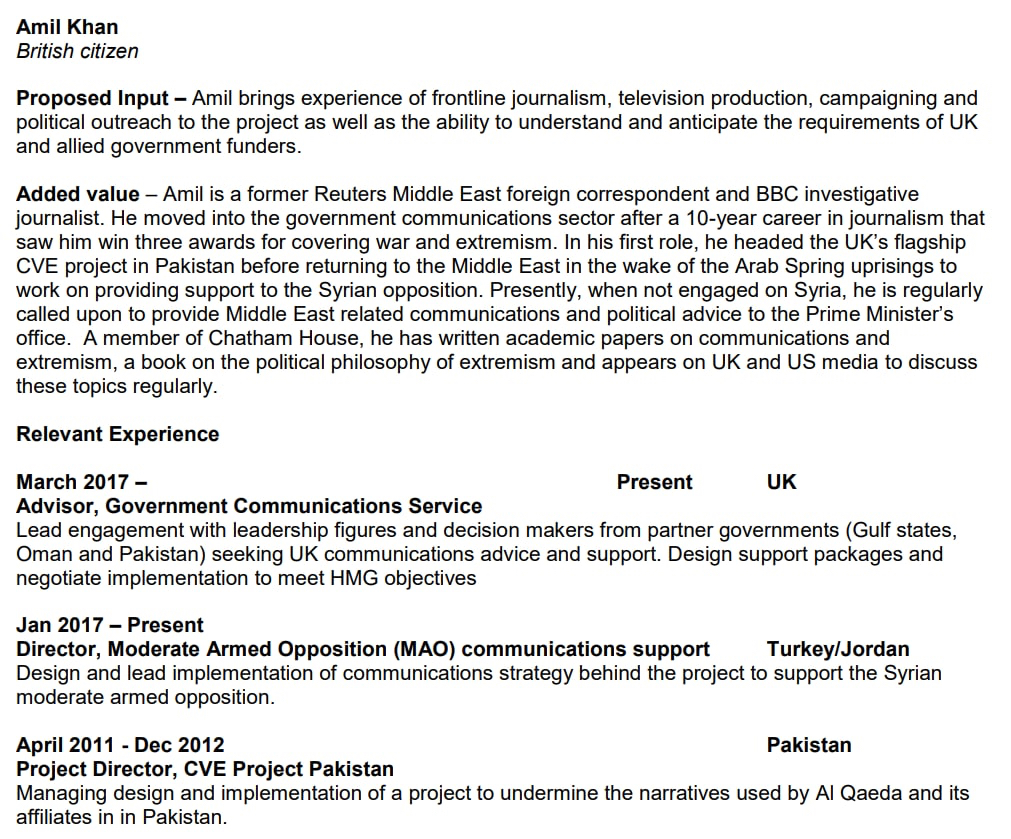
The project was delivered by ARK, a shadowy intelligence contractor founded by the likely MI6 operative, Alistair Harris, which has raked in innumerable lucrative contracts from waging covert information warfare operations on behalf of the UK government.
Khan was heavily involved in ARK’s Syrian efforts. Another leaked file, outlining some of the company’s work inside Syria shows that it oversaw a “rebranding” of the CIA-armed Free Syrian Army to portray it as a moderate, secular force unconnected to the hardcore jihadist factions that dominated the armed opposition. Khan is named as one of three operatives managing the media office of the parallel Syrian National Coalition government controlled by London through intelligence cutouts like ARK.

This work placed Khan in extremely close quarters with members of violent ‘rebel’ factions implicated in hideous crimes against humanity. That he “[provided] political and media support to opposition political and military groups” in Syria has been openly confirmed. A scathing internal Whitehall review of the Foreign Office’s information warfare operations in the country concluded they were “poorly planned, probably illegal, and cost lives.”
It wasn’t the first time Khan been in such murderous company. At some point after leaving ARK in August 2014, he joined InCoStrat, another contractor that conducted destabilizing psy-ops on the UK government’s behalf throughout the Syrian crisis. InCoStrat delivered “strategic communications support” to a variety of armed groups on-the-ground, including the notoriously brutal, Saudi-backed militia known as Jaysh al-Islam.
Khan also played a central role in this dubious initiative. In a document discussing its ability to “[develop] contacts in Arabic-speaking conflict affected states,” InCoStrat bragged how, “in his previous career as a journalist,” Khan “established relationships with, and embedded himself into terrorist organizations in the UK and the Middle East,” gaining “unique insight into their narratives, communication methods, recruitment processes and management of networks” as a result.

InCoStrat was founded by ex-Foreign Office political officer Emma Winberg and UK military intelligence journeyman Paul Tilley, a former director of Strategic Communications for the UK Ministry of Defence in the Middle East and North Africa. Winberg left to join Mayday Rescue, parent ‘charity’ of the fraudulent humanitarian group known as the White Helmets. She later married its founder, James Le Mesurier, who died in mysterious circumstances in 2019 after damaging revelations of financial corruption came to light.
A broad landscape of state-backed Covid propaganda ops
It’s probable the “Countering Pseudoscience” project is just one part of a wider landscape of online astroturf initiatives designed to restore cratering public trust in authorities around Covid policy.
Valent Projects has also conducted work for the Institute for Strategic Dialogue, a neoconservative think tank, researching “violent actors using the ‘dark web’ to mobilise recruits and threaten public figures in Europe.” This initiative was likely also aimed at countering lockdown opposition.
Back in April 2020, Khan appeared on a panel discussion convened by the organization, “Countering Disinformation in a Time of COVID19.”
At the start of December, the Institute released a brief report, “Between conspiracy and extremism: A long COVID threat?”, which attempted to frame the “radicalization” of anti-lockdown protesters as a terrorist threat. What input Khan may have had in this publication was unclear.
Valent Projects is just one of an array of companies that have brought psy-ops techniques honed in Syria and other theaters of Western information warfare back home with them, like soldiers returning from battlefields marketing their deadly skills to private security and intelligence firms. And Abigail Thorn is just one YouTuber, at a time when the British state is known to be maliciously recruiting digital personalities to further its interests across the globe.
For example, Foreign Office contractor Zinc Network maintains a clandestine nexus of Russian-speaking social media influencers throughout the former Soviet Union, to promote “media integrity, democratic values [and] complex social issues,” a campaign so intensive its relationship with these individuals necessitates “daily management.” This squadron of undercover psy-ops warriors are supported by an expert “in-house team of Russian speaking producers, researchers and digital growth strategists” in London, helping them create, edit and promote their output.
Coincidentally, Zinc has been engaged in efforts since the onset of the pandemic to concoct a link between extremist activities and anti-lockdown, vaccine hesitant views. It has also published research on how to best market a test-and-trace app to UK citizens, “as part of a broader research project on public understanding of and support for Artificial Intelligence.”
It is simply inconceivable that similar operations have not been enacted elsewhere in the world, or that this phenomenon is exclusive to the UK. Further, it is impossible to know if the next slick viral video countering grassroots dissent of an official narrative is state or quasi-state propaganda, cleverly crafted to induce a “cognitive shift” in viewers, in which the star of the online show is effectively an intelligence asset rattling off a script drawn up by full-time spooks.
The OPCW Douma Investigation: Manipulation of Key Toxicology and Related Information Regarding Alleged Victims between the Original Interim Report and the Final Report
Dr Piers Robinson, Convenor, Working Group on Syria, Propaganda and Media | December 2021
This report, reviewed by three experts, has been extracted from a larger report analysing the OPCW Douma investigation and which will be published in full at a later date. For comments, further information and corrections please contact Dr Piers Robinson at piers.robinson@propagandastudies.org, piers.robinson@propagandastudies.ac.uk or piers.robinson@me.com
Table of Contents
1. Overview
2. Redaction of Key Toxicology Finding Ruling Out Chlorine Gas as Cause of Death
3. Redaction of Information Concerning Gas Dispersion and Build Up
4. Deletion of Contradictory Information Regarding Location of Deceased in Basements
4.1 Deceased in Basement
4.2 Inconsistencies with Respect to Death Toll and Burial of Victims
5. Obfuscation and Failure to Resolve Unexplained ‘Country X’ Witness Testimony Regarding Nerve Agent Symptoms
6. Unresolved Questions Regarding the Authenticity of Events at Location 2
7. Discussion and Recommendations for Next Steps
1. Overview
This report is extracted from a larger report, in progress, which systematically documents the alterations and redactions observed across the OPCW Fact Finding Mission reports- The Original Interim Report, the Secretly Redacted Interim Report, the Published Interim Report and the Final Report.[1] The focus of this report is on critical information regarding the 43 victims at Douma who are reported to have been killed as a result of the alleged chemical weapon attack in Douma, 7 April 2018. No traces of any nerve agent such as sarin were found. As is now known, the Final OPCW report, which reported there were reasonable grounds to conclude chlorine gas was used as a weapon, has been challenged by a significant number of experts whilst two former OPCW scientists involved with the investigation have reported what amounts to malpractice and fraud during the OPCW investigation.
This report shows how significant information relating to the Douma victims has been manipulated, with no apparent justification, through alterations or redactions between the Original Interim Report and the Final Report. At the very least this manipulation of information indicates that the circumstances surrounding the deaths are far from clear. At worst the manipulations indicate an attempt to conceal the truth about what happened to the civilians. Key findings are as follows:
- A toxicology assessment by four NATO toxicologists/pharmacologists from Germany with expertise in chemical weapons poisoning which ruled out chlorine gas as a cause of death was reported in the Original Interim Report but omitted from the Final Report.
- Information questioning the feasibility of a fatal build-up of gas, especially in the basement of the alleged attack site at Location 2, although clearly set out in the Original Interim Report, was omitted from the Final Report.
- Contradicting witness testimonies regarding deceased victims at the alleged attack site ‘Location 2’, although detailed in the Original Interim Report, are excluded from or obfuscated in the Final Report.
- Witness accounts indicating contradictory information regarding casualty numbers and who was responsible for burying them have been obfuscated come the Final Report.
- Divergent witness testimony between ‘Damascus’ witnesses and ‘Country X’ witnesses, with only the latter reporting symptoms associated with a chemical attack, is clearly demarcated in the Original Interim Report but obfuscated and unresolved in the Final Report.
- Information regarding the ‘repositioning’ of bodies through the course of the night 7-8 April 2018, evident in open-source images circulated by activists, is clearly stated in the Original Interim Report but downplayed in the Final Report.
- Information raising question marks over the authenticity of foam-like material observed on some of the victims, whilst mentioned in the Final Report, is left unexplored and unresolved.
The implications of these manipulations are discussed more fully in Section 7. Briefly, the exclusion of the key toxicology assessment ruling out chlorine gas, which indicates that the victims were not killed by chlorine gas at Location 2, is significant because it obfuscates the fact that no clear explanation for cause of death could be established. As such, the deaths of 43 civilians remains unexplained. Conflicting and inconsistent statements from alleged witnesses in ‘Country X’ – numbers and whereabouts of the deceased at Location 2 and nerve agent symptoms – is concerning and, when combined with the downplaying of information relating to the ‘re-positioning’ of bodies and possibly inauthentic foam-like material observed on some of the decedents, indicates that the Final Report elided information potentially relevant to a finding that at least some of the events at Location 2 were manipulated or staged. Finally, the significant discrepancies in witness accounts regarding the number of deceased, their burial in a mass grave along with other victims, as well as obfuscation of exactly who buried the deceased, reinforces the concern that the circumstances surrounding the civilian deaths in Douma on 7 April 2018 have been obfuscated in the Final Report.
2. Redaction of Key Toxicology Finding Ruling Out Chlorine Gas as Cause of Death
The finding that no nerve agents, such as sarin, or their degradation products were present in the environmental and biological samples, together with the fact that chemical analysis showed samples had apparently been in contact with a substance or substances containing a reactive chlorine atom, was puzzling; the signs and symptoms exhibited by the victims was, the investigators argued, inconsistent with poisoning from a choking agent such as chlorine gas. The Original Interim Report proceeds to identify the principal incongruencies – the almost instantaneous occurrence of pulmonary oedema and associated copious frothing at the mouth and nose, and the apparent immediate collapse and death of the victims who were within meters of an escape route – which according to the investigators rule out chlorine gas being the cause of death at Location 2 (see Image 1).
Image1: Photograph taken of some of the victims at Location 2 and distributed via Opposition Media

These principal inconsistencies were confirmed at a meeting held with chemical warfare toxicologists/pharmacologists in early June 2018).[2] Minutes written up for toxicology meeting conclude by stating ‘that the key “take-away message” from the meeting was that the symptoms observed were inconsistent with exposure to chlorine, and no other obvious candidate chemical causing the symptoms could be identified’. These minutes were confirmed[3] by the other OPCW officials who had attended, including the Head of OPCW Laboratory. These principal inconsistencies are set out clearly in the opening summary section of the Original Interim Report as follows:
‘Some of the signs and symptoms described by witnesses and noted in photos and video recordings taken by witnesses, of the alleged victims are not consistent with exposure to chlorine-containing choking or blood agents such as chlorine gas, phosgene or cyanogen chloride. Specifically, the rapid onset of heavy buccal and nasal frothing in many victims, as well as the colour of the secretions, is not indicative of intoxification from such chemicals.
The large number of decedents in the one location (allegedly 40 to 50), most of whom were seen in videos and photos strewn on the floor of the apartments away from open windows, and within a few meters of an escape to un-poisoned or less toxic air, is at odds with intoxication by chlorine-based choking or blood agents, even at high concentrations.’ (Original Interim Report [Summary]; paras 1.10-1.11, p. 3)
In the ‘Epidemiology’ section of the same report (paras 7.70-7.91; pp: 26-29) it is first noted that the apparent rapid onset of symptoms and death are consistent with a fast-acting nerve agent such as sarin:
‘A highly debilitating agent, in the opinion of the FFM team, would have to have been released in order to cause the rapid onset of symptoms described by witnesses and observed in the videos where large numbers of decedents are concentrated in different apartments at Location 2. The rapid onset of heavy salivation and frothing from the mouth would be more consistent with exposure to a highly toxic nerve agent than a chocking (sic) agent such as chlorine or phosgene. However, analytical results showed no indication of organophosphorus nerve agents or their degradation products present in samples collected at the scene of the alleged attack or in biomedical samples from victims’. (Original Interim Report: para 7.81; p. 27)
Before then identifying the principal inconsistencies with respect to chlorine gas:
a) Pulmonary edema [sic] and excessive frothing from the mouth have been reported in cases of exposure to lethal doses of chlorine gas or other toxic chlorine-based agents such as phosgene or cyanogen chloride [7] [8] [9]. However, indications are that pulmonary edema, particularly in the case of phosgene, is a late pathological effect of exposure and in cases of high exposure levels death can result before pulmonary edema develops [8] [9]. The white of [sic] light-cream colour of the froth presented by victims is not in keeping with exposure to choking agents, where secretions are characteristically pinkish in colour when frothing does occur,
‘The rapid, and in some reported cases, immediate onset of frothing described by victims is not considered consistent with exposure to chlorine-based choking or blood agents. The opinion of a number of toxicologists, specialists in chemical-weapons-related intoxication supported this assessment’. (Original Interim Report: para 7.82; pp. 26- 27)
b) In order to produce such rapid incapacitation that victims would be unable to escape the toxic gas from the location of the alleged chemical attack (see 3D layout of the building and description), a respiratory irritant such as chlorine or phosgene would almost certainly need to have rapidly accumulated to very high concentrations. It is considered unlikely, given the location of the suspected source of the toxic chemical as well as the configuration and condition of the building, that such concentrations would not[sic] have been attained, particularly in the basement. Moreover, if such high concentrations had developed, as mentioned above, reports suggest that asphyxiation would have been the likely cause of death before pulmonary edema and frothing could develop [10]. (Original Interim Report: para 7.83; p. 27)
c) ‘It should be expected that on encountering the irritant gas, victims would instinctively have retreated and exited the building, which was within a few metres away.’ (Original Interim Report: para 7.84; p. 27)
d) ‘Based on the above observations, expert opinions of toxicologists specialized in chemical weapons exposure, and published scientific knowledge in this area, the FFM team considers that chlorine gas or other reactive chlorine-containing toxic agents such a phosgene or cyanogen chloride would not have resulted in the severe and rapid frothing symptoms reported by witnesses and observed in video footage and photos.’ (Original Interim Report: para 7.85; p. 27)
However, whilst the Original Interim Report communicates clearly the findings that both the arrangement of bodies and the observed symptoms are not compatible with chlorine poisoning, the Final Report obfuscates this finding as follows.
The Summary section of the Final Report contains no reference to the principal inconsistencies and the ruling out of chlorine gas. Instead, the summary section makes reference to both (a) witness observations alleging 43 decedents at Location 2 and that the FFM did not examine the bodies (Final Report [Summary]: para 2.10; p. 3) and (b) that ‘many of the signs and symptoms reported … indicate exposure to an inhalant irritant or toxic substance’ (Final Report [Summary]: para 2.11; p. 4). It then concludes: … based on the information reviewed and with the absence of biomedical samples from the dead bodies or any autopsy records, it is not currently possible to precisely link the cause of the signs and symptoms to a specific chemical’ (Final Report [Summary]: para 2.11; p. 4). The formulation of words used avoids making any explicit statement ruling out chlorine, thus leaving the possibility that chlorine might have been a cause. As such, the key conclusion that chlorine gas was not likely to have been the cause of death, confirmed during the June 2018 consultation with NATO toxicologists, is absent from the Final Report summary.
Furthermore, in an apparent attempt to strengthen the suggestion that the victims were killed in a chemical attack, the Final Report summary (para 2.10; p. 3) claims that ‘[a] United Nations agency also reported cases of death by exposure to a toxic chemical’ and references two UN (Human Rights Council [HRC]) reports[4]. This claim is misleading in that neither of the UN reports, both written while the OPCW’s Douma investigation was still ongoing and which rely primarily on witness testimony, state any firm conclusions regarding cause of death:
The Commission of Inquiry has been investigating this incident. The available evidence is largely consistent with the use of chlorine, but this in and of itself does not explain other reported symptoms, which are more consistent with the use of another chemical agent, most likely a nerve gas. The Commission’s investigations are on-going. (Report A: p. 14).
And in a section of the HRC report headed ‘Ongoing Investigations’:
‘… the Commission cannot make yet any conclusions concerning the exact cause of death, in particular on whether another agent was used in addition to chlorine that may have caused or contributed to deaths and injuries’ (Report B: p. 17).
As such, nothing substantive can be drawn from the cited UN reports as they, in fact, cite clear reservations about the cause of death that undermine the Final Report’s conclusion of chlorine being the likely cause of death.[5] This is a misleading move and one that is reinforced by repeated referencing of the two UN reports in the conclusion section of the Final Report (para 9.5: p. 30-31). Furthermore, it is notable that the latest report from the UN HRC on this issue does not include Douma as one of its 38 cases of chemical weapons use in Syria, because it did not meet the evidentiary threshold necessary to conclude an attack had occurred.[6]
The principal inconsistencies and ruling out of chlorine gas are also expunged from the body of the Final Report. Specifically, the Epidemiology section does at least include the important observation that only a fast-acting agent (which chlorine gas is not) would readily explain the apparently immediate collapse and death of victims at Location 2:
‘The victims do not appear to have been in the midst of attempting self-extrication or respiratory protection when they collapsed, indicating a very rapid or instant onset. This type of rapid collapse is indicative of an agent capable of quickly killing or immobilizing’ (Final Report: para 8.96; p. 29).
However, the principal inconsistencies identified in the Original Interim Report that lead to the conclusion that chlorine gas was inconsistent with the cause of death at Location 2 – immediate appearance of pulmonary oedema and copious visible frothing plus the rapid collapse of victims in piles – are absent. Instead, the ‘Epidemiology Analysis’ spends several paragraphs describing, amongst other things, the various symptoms observed in media and reported by witnesses before concluding that ‘it is not currently possible to precisely link the cause of the signs and symptoms to a specific chemical’ (Final Report: paras 8.70-8.103; pp: 25-30). Again, as with the summary section, the formulation of words used avoids committing to any explicit statement either ruling out or affirming chlorine use, thus leaving the possibility that chlorine might have been a cause. Via this apparent linguistic sleight of hand, the original finding, that ‘symptoms observed were inconsistent with exposure to chlorine’[7], is elided.
No explanation or justification for this expunging of an unequivocal expert opinion can be identified in the Final Report. Whilst the report does refer to later consultations with toxicologists in September and October 2018, it provides no information about what they said that might help to explain or justify the suppression. It is also notable and concerning that the Final Report makes no mention of the original consultation with the NATO toxicologists; the only consultations shown in the report timeline are those obtained during the Autumn of 2018 (Final Report: Annex 3; pp; 40-41).
3. Redaction of Information Concerning Gas Dispersion and Build Up
Regarding the feasibility of gas concentration reaching lethal levels, a section titled ‘Analysis of the possible route of dispersion of the alleged toxic chemicals or chemicals in Location 2’, included discussion of likely dispersion routes for gas at Location 2 (Original Interim Report: paras 7.24-7.26; pp. 15-16, including Images 2 and 3). In this section the report noted that each level on the staircase had a ‘tall glass-shattered window’ (Original Interim Report: para 7.19; p. 13) which provided routes ‘for horizontal dissipation of the toxic gas towards the exterior’ (Original Interim Report: para 7.25; p. 15). It is also noted that no direct route could be identified through which chlorine gas from the cylinder, which had landed on a balcony several floors up from ground-level, could directly reach the basement: ‘It would also appear that for chlorine to reach lethal concentration in the basement, the gas dispersion would almost certainly need to have come from the exterior, given the absence of a clear dispersion path from within the building’ (Original Interim Report: para 7.25; p. 15).
Images 2 & 3: Sample of diagrams from Original Interim Report relating to building layout and dispersion routes.


Drawing upon this analysis, the Original Interim Report then notes in the Epidemiology Section that:
In order to produce such rapid incapacitation that victims would be unable to escape the toxic gas from the location of the alleged chemical attack (see 3D layout of the building and description), a respiratory irritant such as chlorine or phosgene would almost certainly need to have rapidly accumulated to very high concentrations. It is considered unlikely, given the location of the suspected source of the toxic chemical as well as the configuration and condition of the building, that such concentrations would not [sic] have been attained, particularly in the basement. (Original Interim Report: para 7.83; p. 28)
Unlike the Original Interim Report, the Final Report contains no discussion of possible dispersion routes and the feasibility of dangerous concentrations of gas having built up so rapidly. The existence of glass-shattered windows on the staircase at each level plus the absence of any direct route for gas to pass into the basement are mentioned (Final Report: paras 8.24 and 8.25; pp. 15-16), but no analysis is provided, unlike in the Original Interim Report, as to what these facts mean with respect to the likely dispersion of any chlorine gas. Also of relevance here is the fact that the Original Interim Report documents significant inconsistencies in witness testimony regarding reports of victims in the basement at Location 2 and elsewhere.
4. Deletion of Contradictory Information Regarding Location of Deceased in Basements
Witness testimony regarding the presence of deceased in the basement at Location 2, and information regarding the number of deceased and their burial, are facts present in the Original Interim Report but removed from the Final Report.
4.1 Deceased in Basement
The Original Interim Report noted significant variations in witness testimony relating to the finding of deceased in basements. Specifically:
there were variations … in the numbers of bodies and their distributions throughout location 2 as observed in video footage and photos, compared to the numbers provided by witnesses who were interviewed. According to statements from witnesses, “many people they presumed dead, were lying on the floor of the basement”. (Original Interim Report: para 7.69; p. 23).
The Original Interim Report sets out these discrepancies in a table identifying four witnesses (Witnesses 1919, 1742, 1753 and 1920) who claim to have seen between ‘some’ and ’40-50’ decedents in the basement at Location 2 (Original Interim Report: p. 24 and see Image 4).
Image 4: Table detailing ‘Country X’ witness reports regarding location of mortal victims (Original Interim Report: p. 24)

However, no evidence could be found to corroborate the claims bodies had been found in any basements:
The FFM did not obtain any video footage or photos of dead casualties lying in the basement of location 2 or being removed from there. There were also no photos or video footage available to the FFM team of the other two basements or of decedents, where three witnesses interviewed claimed to have been exposed to chlorine’ (Original Interim Report: para 7.69; pp. 23- 24)
This information is important[8] because it highlights the question of how the victims could have been poisoned and killed in the basement of the building at Location 2 by gas from a cylinder that had landed on a balcony four floors above. As noted above in Section 3 – Redaction of Information Concerning Gas Dispersion and Build Up – the basement only had an entrance from the street. This implied that the chlorine would need to have descended inside the building gone out on to the street and re-entered the basement in lethal concentrations, an unproven and unlikely scenario.
Notably, the Secretly Redacted Interim Report redacts information concerning the lack of evidence for witness claims regarding observing deceased in the basement at location 2. The paragraph cited immediately above is altered in the Secretly Redacted Interim Report to read:
Three of the seven casualties were purportedly exposed at two buildings, the exact locations of which were not known or visited by the FFM team. No photographs or videos of the locations or victims of the alleged attacks at these locations were available to the FFM team. (Secretly Redacted Interim Report: para 7.29; p. 15)
As such, the Secretly Redacted Interim Report obfuscates the key discrepancy noted in the Original Interim Report about the contradiction between witness claims that deceased had been seen in the basement at Location 2 and there being no obvious explanation for how chlorine gas could have entered that basement and reached lethal concentrations. The wording is also deceptive in that, by noting the absence of photographs or videos at the two other buildings, it implies there were video and films available for the Location 2 basement. No mention of this issue is made in the Published Interim Report which states only that ‘[a]nalysis of the testimonies is ongoing’ (para 8.17; p. 11).
The issues raised by these particular witness claims remain unresolved in the Final Report which continues to exclude the detailed table (see Image 4) that appeared in the Original Interim Report. In particular, the problematic claim made by four witnesses that bodies were seen in the basement at Location 2 is obfuscated in the Final Report: Whilst the Final Report refers to some witnesses ‘seeing decedents in the basement of the building’ [at location 2] (Final Report: para 2.10 p. 3 and para 9.5; p. 30), at another point it makes no mention of deceased in the basement at Location 2: ‘Witness accounts place the deceased lying on the stairs, inside apartments on multiple levels of Location 2, inside basements of neighbouring buildings across the area, on rooftops and on the streets’ (Final Report: para 8.62; p. 24). As with the Secretly Redacted Interim Report and Published Interim Report, no mention is made of the fact that the FFM ‘did not obtain any video footage or photos of dead casualties lying in the basement of Location 2 or being removed from there’ (Original Interim Report: para 7.69; p. 23-24).
These obfuscations are not trivial. As already explained, there was no plausible explanation established for how chlorine gas could have travelled down several flights of stairs at location 2, to then move out onto a street and then re-enter the building to enter the basement, and then build up sufficient concentration to cause multiple deaths. A possibility raised by these inconsistencies is that witness reports of there having been deceased in the basement are untrue.
4.2 Inconsistencies with Respect to Death Toll and Burial of Victims
In the Original Interim Report two witnesses (1787 & 1780) report 150-300 total dead (Original Interim Report: p. 24 and see Image 4). In addition, the report also states that the ‘SCD’ [‘Syrian Civil Defence’/White Helmets] were in charge of burying the deceased in co-ordination with the local council. Most of the witnesses reported to be unaware of the location of the burial sites’ (Original Interim Report: para 7.50; p. 21). The Original Interim Report also notes that ‘Witnesses who were involved in burial preparations recounted that the victims of the alleged chemical attack were buried in a mass grave with other casualties’ (para 7.66; p. 23). Additionally, in a 2019 interview with ‘civil society leaders’ from Douma it is claimed, according to the translation, that there were 187 bodies found in ‘bunkers’. As pointed out by Adam Larson, one of the individuals in the 2019 interview was also recorded during the 2013 alleged sarin attack in East Ghouta:

In the subsequent reports there appears to be no further mention of either the higher death toll claims or the reference to burial in a mass grave alongside other victims[9]. The Final Report states:
The FFM could not establish the precise number of casualties; however some sources reported that it ranged between 50 and 500. Other sources denied the presence of chemically -related casualties. (Final Report: para 8.73; p. 26)
In the Final Report it is no longer clarified who was responsible for burying the victims and says instead:
Prior to the military campaign, the SCD was in charge of burying the deceased in coordination with the local council. A number of witnesses reported that they were unaware of the location of the burial sites. (Final Report: para 8.47; p. 22)
This alteration obfuscates whether or not the SCD were responsible for burying the deceased. At the time of the alleged attack in Douma, a British journalist, Jose Ensor, reported that those responsible for the burial were ‘local residents and members of Jaish al-Islam [the militant opposition group in Douma]’ and that the intent was to preserve evidence. Recently, Raed Saleh (Head of the ‘SCD’/White Helmets) was interviewed by the BBC and he stated [according to the BBC translation]:
The dead were buried in one place. It was a mass grave. It wasn’t the first time we buried people like that. Because when these attacks happen, we don’t have enough cemeteries all the time. There are too many dead. We didn’t gather evidence from the bodies themselves. We took samples from things like animal corpse and clothes and other effects. We told investigators location of the grave and met with investigators at the Turkish border to hand over the evidence we had gathered. (BBC ‘Mayday’, Episode ‘The Cylinder on the Bed’).
Overall, alterations and inconsistent claims as to the total number of deceased and who was responsible for burying the civilians inevitably means that key events surrounding the deaths in Douma remain left unclear in the Final Report.
5. Obfuscation and Failure to Resolve Unexplained ‘Country X’ Witness Testimony Regarding Nerve Agent Symptoms
The Original Interim Report states in its Epidemiology section that:
Witnesses interviewed in Damascus present a narrative whereby, on April 7 around the time of the alleged chemical attacks, casualties arrived at Location 1 displaying symptoms commensurate with asphyxiation from dust and fumes as a result of bombing. The symptoms included dysponea [sic], cough and asthmatic exacerbation secondary to exposure to smoke and dust. Witnesses and victims interviewed in Country X describe symptoms that included shortness of breath, a burning sensation in the chest, oral hypersecretion, ocular irritation, visual disturbances, lacrimation, dysphonia, nausea, vomiting, pruritus, and in the case of some surviving victims, constricted pupils. (Original Interim Report: para 7.77; p: 26-27)
The Original Interim Report also notes that hallucinations, which are not a symptom of chlorine poisoning (Original Interim Report: para 7.60; p: 23, were reported. ‘Country X’ witnesses are witnesses interviewed in Turkey, believed to have been arranged via the ‘SCD’/White Helmets, whilst ‘Damascus’ (including Douma) witnesses were interviewed in Syria and had been provided via Syrian government authorities.
The symptoms reported by Country X witnesses include those indicative of both chlorine poisoning and nerve agent poisoning (especially ‘constricted pupils’ and [immediate/rapid] oral hypersecretion) whilst those from Damascus indicate symptoms consistent only with dust and fumes. The Final Report, however, does not clearly delineate the reports from Damascus and Country X witnesses and thus obfuscates this important divergence:
Broadly, patients were reported to display shortness of breath, burning sensation in the chest, oral hypersecretion or foaming, and occular [sic] irritation. Additional complaints were visual disturbance, lacrimation, dysohonia [sic], nausea, vomiting and pruritus. A non-specific number of patients classified as severe manifested with seizure activity described as flexion of arms and wrists. Medical personnel reported the absence of any signs of external trauma. (Final Report, para 8.79; p. 26)
The Final Report also obfuscates the fact that Country X witnesses reported constricted pupils, again a key sarin/nerve agent indicator, by removing it from the list in paragraph 8.79 and instead discussing the reporting of both constricted pupils miosis (constricted pupils) and mydriasis (dilated pupils) in the following paragraph: ‘An unknown number of patients were reported to have manifested miosis or mydriasis. Although interviewed medical staff or physicians did not directly observe miosis, one support staff stated that four casualties who were classified as severe were directly observed to be presenting mydriasis’. (Final Report: para 8.80; p. 27). The fact that hallucinations had been reported, which are not a symptom of chlorine poisoning, was removed from the Final Report.
These important inconsistencies – reporting of a symptom not associated with chlorine poisoning (hallucinations) and symptoms associated with nerve agent poisoning (constricted pupils and [immediate/rapid] oral hypersecretion) – coming from Country X witnesses are unresolved in the Final Report.
6. Unresolved Questions Regarding the Authenticity of Events at Location 2
It is noted in the Epidemiology section of the Original Interim Report that: ‘[t]he white or light-cream colour of the froth presented by victims is not in keeping with exposure to choking agents, where secretions are characteristically pinkish in colour when frothing does occur’ (Para 7.82; p. 27). A related issue regarding the authenticity of events at Location 2 concerns the finding that, based on analysis of media, ‘it is apparent that some of the victims have been moved and re-positioned between video recordings’ (Original Interim Report: para 7.69; p. 24). According to Stephen MacIntyre, at least one of the re-positioned victims, indicated by analysis of publicly available video footage,[10] appears to show profuse white foaming only after repositioning:

In another film placed online a boy with profuse foaming from the mouth is shown being moved the following day and here the foam-like material has clearly persisted and is semi-rigid (See here tt 1.13-1.36):


The Final Report does appear to reflect some doubt about the authenticity of the white foam seen on some of the victims noting that ‘[m]any of the victims present with white, foam-like oral and nasal secretions, similar in appearance to fulminate pulmonary oedema but in multiple cases much more profound and seemingly persistent’ (Final Report: para 8.90; p. 28). It also notes that ‘[w]hen comparing adult and paediatric groups, there does not appear to be any correlation in secretion presence, absence or amount’ (Final Report: para 8.70; p. 28). In paragraph 8.98 the Final Report states that:
The airways secretions seen in many cases are similar to those seen with exposure to some chemical weapons, toxic industrial chemicals and toxic does of pharmaceutical agents but are more profound and seem to have a consistency more like viscous foam than secretions typically originating from the upper or lower airways. Notably, there are casualties both with and without secretions that are in very close proximity to one another. (Final Report: para 8.98; p. 29)
However, no analysis of these inconsistencies is offered and the matter is seemingly dismissed by the vague assertion that ‘[i]n general, the presence and context of the airways secretions indicate exposure to a chemical substance’ (Final Report: para 8.98; p. 8.98).
In addition, the media evidence showing that bodies were reposition during the course of the night of 7-8 April 2018, whilst clearly referenced in the body of the Original Interim Report (‘it is apparent that some of the victims have been moved and re-positioned between video recordings’ (Original Interim Report: para 7.69; p. 24), is relegated to the annex of the Final Report and with the wording altered to: ‘[f]rom the various videos showing the deceased victims throughout the interior of Location 2 some of the victims had been moved between video recordings’ (Final Report: Annex 11; p. 103). As noted above, at least one of the victims, shown in the publicly available video footage,[11] does not show the appearance of white foaming until after the body had been re-positioned. As such the Final Report, through deletions and obfuscations, suppresses information which indicates that certain aspects of events at Location 2 were questionable.
7. Discussion and Recommendations for Next Steps
A scenario in which up to forty-three civilians are supposed to have died almost immediately from chlorine gas poisoning at Location 2 was clearly questioned by the FFM Douma team and then corroborated via a consultation with NATO toxicology experts. The fact that the toxicological assessment ruling out chlorine gas at Location 2 as a possible cause of death was expunged from the Final Report, without any explanation or justification, is of serious concern and indicates that there was an attempt within the OPCW to censor doubts, based on scientific analysis, that the civilians were killed by chlorine gas at Location 2. As detailed in Section 1, it is notable that UN (HCR) reports from 2018 also raised question marks over the cause of death and their recent 2021 report has not included Douma as one of its established cases of chemical attack.
This unexplained redaction is made more worrying by the absence of detailed discussion regarding the likelihood of lethal gas concentrations particularly in the basement at Location 2 – a discussion present in the Original Interim Report but absent from the Final Report – and inconsistent and uncorroborated witness testimony relating to the finding of deceased in the basement at Location 2 and in other basements. Furthermore, witness testimony reporting a much higher death toll and the burying of civilians in a mass grave along with other decedents is absent from the Final Report. At the same time, identification of who was responsible for burial of the deceased is obfuscated in the Final Report. Inexplicable reports of nerve agent symptoms, de-emphasizing information regarding the ‘repositioning’ of some of the deceased, and failing to evaluate fully the questionable white, foam-like material on victims, further contribute to a pattern in which contradictory or ‘inconvenient’ information is being redacted, obfuscated or left unresolved come the Final Report.
In summary, important information which casts doubt on the plausibility of the scenario in which chlorine gas killed 43 civilians at Location 2 – a toxicology report ruling out chlorine gas as a cause of death, analysis of gas dispersion routes questioning the likelihood of a lethal concentration of gas – have been removed from the Final Report with no obvious justification. At the same time, information indicating unreliable or inconsistent witness testimony – reporting of deceased in basements and nerve agent-like symptoms – has been removed and/or obfuscated whilst information indicating possible fabrication – ‘re-positioning’ of bodies and questionable white foam-like material appearing on some of the victims – is downplayed. As such, information that might have contributed to a finding that no attack had occurred – stated in the Original Interim Report as the possibility that ‘b. The fatalities resulted from a non-chemical-related incident’, has been sidelined or is absent from the Final Report, with no supporting scientific justification. At the same time, this apparently selective use of evidence does appear to be consistent with the following claim made in the Final Report:
The FFM team based its findings on whether there were reasonable grounds to believe that chemical weapons were used, based on a reliable body of evidence consistent with other information tending to show that an incident or event happened (Final Report: Footnote 9; p. 8)
This statement suggests that the drafters of the Final FFM report were primarily interested in gathering evidence which supported the allegation that a chemical weapon attack occurred. Such an approach would likely lead to the sidelining counter-evidence and, therefore, is neither objective nor robust and falls short of basic investigative and scientific standards.
With these points in mind, the following steps should now be taken:
1. The OPCW must explain the grounds for removing the original assessment, offered by four NATO toxicologists, that the death of the victims at Location 2 was inconsistent with poisoning by chlorine gas. If it cannot do so, an updated Douma Report needs to reinstate this important conclusion.
2. The mechanism by which there could ever have been sufficient build-up of chlorine gas to kill the victims, apparently immediately, in any part of Location 2, needs to be fully evaluated and then reported.
3. Inconsistent and uncorroborated witness testimony pertaining to the presence of large numbers of deceased in basement areas and the reporting of nerve agent symptoms needs to be revisited and a determination made as to whether these witnesses can be considered reliable.
4. Evidence of ‘re-positioning’ of bodies and the questionable white foam like material needs to be evaluated in detail via an expert-led systematic review of the available photographic images and video footage.
5. More generally, the methodology employed by the team drafting the Douma Final FFM Report needs to be critically evaluated in order to determine the extent to which a pre-determined objective – finding of reasonable grounds to conclude the alleged attack occurred- was obtained through systematic selective use of evidence.
6. In addition, and given the uncertainty regarding the numbers of deceased and their burial, clarification is necessary as to both who was responsible for burying the deceased and the numbers buried. The location of the mass grave(s) should be identified with a view to possible exhumation as part of a war crime investigation. It can be noted that the OPCW, the leadership of the ‘SCD’/White Helmets, Syrian government authorities and Local Leaders from Douma, amongst possible others, would all be expected to assist with these important clarifications. Both the International Criminal Court and the Independent International Commission of Inquiry on the Syrian Arab Republic (UNHRC) should be kept updated on all these issues.
[1] The reports are available at https://wikileaks.org/opcw-douma/document/FirstdraftInterimReport/, https://wikileaks.org/opcw-douma/document/RedactedInterimReport/, https://www.opcw.org/sites/default/files/documents/S_series/2018/en/s-1645-2018_e_.pdf, and https://www.opcw.org/sites/default/files/documents/2019/03/s-1731-2019%28e%29.pdf. Download date 3 June 2021.
[2]Minutes of the meeting, written three months after the consultation, are available here: https://wikileaks.org/opcw-douma/document/actual_toxicology_meeting_redacted/. Download date 14 September 2020.
[3] See https://wikileaks.org/opcw-douma/document/correctly_redacted_emails_re_toxicology_minutes/page-3/#pagination. Download date 15 September 2020.
[4] REPORT A: United Nations Human Rights Council (HRC) – Independent International Commission of Inquiry on the Syrian Arab Republic – report, 38th Session, 20 June 2018 (A/HRC/38/CRP.3) and REPORT B: HRC – Independent International Commission of Inquiry on the Syrian Arab Republic report to the General Assembly, – 39th Session, 10 – 28 September 2018 (A/HRC/39/65).
[5] It is notable that a New York Times article published on 20 June 2018 reported that the Commission had doubts about the cause of death and withheld information from the official report issued the same day. It quotes an official as saying “with the April 7 attack in particular, more information was needed, including precisely what killed the 49 people. If we’re not sure what the cause of death was, we may be looking in the wrong place”. See https://www.nytimes.com/2018/06/20/world/middleeast/un-syria-eastern-ghouta.html.
[6] See A/HRC/46/54, https://documents-dds-ny.un.org/doc/UNDOC/GEN/G21/014/36/PDF/G2101436.pdf?OpenElement. Download date 3 June 2021.
[7] https://wikileaks.org/opcw-douma/document/actual_toxicology_meeting_redacted/page-2/#pagination.
[8] It is also important in that it is entirely inconsistent with the video evidence and other witness accounts. No videos were seen (or no witnesses claimed) of bodies in or being moved from the basement.
[9] The Final Report does mention mass burial in paragraph 7.8, p. 10, but excludes information claiming that the deceased were buried alongside other decedents.
[10] https://climateaudit.org/2018/04/24/douma-videos-and-photos/. Download date 2 May 2021.
[11] https://climateaudit.org/2018/04/24/douma-videos-and-photos/. Download date 2 May 2021.
The Kurdish project in Syria would be a new Israel in the Middle East
By Eva Bartlett | RT | December 2, 2021
Syrians accuse the Western-backed Kurdish enclave in the country of using ethnic cleansing and child soldiers against them to form a new anti-Arab state. The parallels with Israel’s creation in the 1940s are striking.
Kurdish forces in Syria have been lauded by many in the West as being fighters for freedom and an autonomous society. But, unless you’ve been following independent researchers and the Syrian media, you might be unaware of the crimes the US-backed group have been committing over a number of years.
On November 25, the Daily Sabah (a website not sympathetic to the Syrian government) reported on one of their most sickening practices. It revealed, “YPG/PKK terrorists detained three more 15-year-old girls – Hediyye Abdurrahim Anter, Evin Jalal Halil and Ayana Idris Ibrahim – in Amuda in Hassakeh province on Nov. 21 to forcibly recruit them as ‘child fighters.’ The terror group detained two children, aged 13 and 16, in early August. And two children aged 16 and 13 were kidnapped Aug. 23.”
The piece went on to note that this practice of abducting children and forcing them to fight has been documented by the United Nations, with one report stating that the YPG/PKK used more than 400 children between July 2018 and June 2020.
Yet, the world has been led to believe that the self-declared autonomous region – known as Rojava and comprising areas of Hassakeh, Raqqa, Deir ez-Zor and Aleppo governorates – is a haven for liberals and feminists, with freedom-loving Kurdish fighters based there fighting ISIS and liberating Syria.
Indeed, the YPG Rojava page claims: “The YPG was set up to protect the legacy and values of the people of Rojava and is founded on the principles of the paradigm of a democratic society, ecology and woman’s liberation. Without preferring or discriminating any religion, language, nation, gender or political parties, the YPG is protecting the country against all attacks from outside. The YPG is the Democratic Nation’s defense force and is not related to any political party.”
It reads like a feelgood fairytale, but is not based in reality.
The utopian image of the so-called Syrian Democratic Forces (SDF), which includes the YPG and PKK, is betrayed by the kidnappings, which sadly are not a new development. Search for QSD – their Arabic acronym – on Syrian media and you’ll see regular updates on Kurdish forces kidnapping civilians and journalists.
This image is further betrayed by their ethnic cleansing of indigenous Syrians from the northeastern Syrian regions Kurdish forces occupy and collaboration with illegally occupying US forces.
But this won’t be highlighted in corporate media. Instead, you will still find odes romanticizing Kurdish fighters, with one such recent story deceptively saying that the areas controlled by Kurdish forces have a “predominantly Kurdish population” – a claim not backed up by the truth.
As author Stephen Gowans detailed in a 2017 article, Kurds in Syria comprise, “only a small percentage of the Syrian population… Estimates of the proportion of the total Kurd population living in Syria vary from two to seven percent based on population figures presented in the CIA World Factbook.”
And yet, Assyrians, Arameans, and other Syrians who have lived there for generations should accept being ruled, or expelled, by Kurds?
Gowans went on to note, “Kurdish fighters have used the campaign against ISIS as an opportunity to extend Kurdistan into traditionally Arab territories in which Kurds have never been in the majority.”
In 2018, Syrian journalist Sarah Abed wrote of the SDF’s kidnapping and ethnic cleansing, noting not only the abductions of men, but, again, children. She recorded how Eddie Gaboro Hanna, the founder of Patriarchal Relief Care Australia, a group providing assistance to Christian families impacted by wars in Syria and Iraq, had explained, “They are taking young Christian boys by force to sign them up for the Kurdish military and send them to the front line.”
And he added, “Christians are treated as second-class citizens [here] in their own land. Just like how ISIS has the Islamic tax they have their own Kurdish one. They’ve replaced ISIS.”
Although the BBC’s coverage of the Kurds’ activities in Syria is predictably pro-SDF, in 2015, even it reported on their ethnic cleansing and displacing of indigenous Syrians. Citing an Amnesty International report, it noted the YPG were accused of “razing entire villages after capturing them from Islamic State (IS),” in Hassakeh and Raqqa provinces.
The Kurds’ history in Syria
In January 2019, I spoke with geopolitical analyst and Sputnik contributor Laith Marouf about the Kurds in Syria. A descendant of eastern Syria’s Deir ez-Zor governorate, part of which is now occupied by Kurds, Marouf had a lot to say about the history of the Kurds in Syria and this 21st century land-usurpation project.
He told me, “There was a wave of Kurdish refugees coming down to Syria (from Turkey) in the 1940s, and the second wave of them in the 1960s when the PKK started the armed rebellion against the Turkish government in what was Arab lands.”
“They were given citizenship by the Syrian government. They were armed and given protection by the Syrian state to fight for their liberation in the Kurdistan mountains in Turkey, and the Syrian government housed the leadership of all the Kurdish resistance up until the early 90s.”
Marouf noted that Syria’s support for the Kurds saw Turkey threatening to invade in the 1990s and building numerous dams on the Euphrates, cutting the water flow. Yet, Syria refused to hand over PKK leader Abdullah Öcalan. Marouf emphasized: “Syria almost went to war with Turkey, and the Syrian people (in the northeast) went thirsty and the agricultural fields—the breadbasket of Syria—almost collapsed those couple of years, to protect Kurdish rights.”
“And then what happens now is some crazies are saying there’s something called Rojava and that they can secede and colonize and settle and steal parts of Syrian lands.”
He, too, spoke of the years of kidnappings and disappearances of those critical of Kurdish rule. “Even Kurdish Syrians that are critical of what the YPG is doing, even remotely critical professors in the universities in Hassakeh and Raqqa and Deir ez-Zor, were disappeared. And these were just critical Kurds.
“So you could imagine what happened to the Assyrian and the Arab leaders in the area, thinkers, tribal leaders, ex-military – huge amounts of disappearances and forced displacements.”
And as Abed’s article highlighted, formerly Assyrian villages in Hassakeh and Raqqa have been fully taken over by Kurdish forces. “They’re moving in the Kurdish militias and their family members into those villages and creating new ethnically pure towns and villages that are Kurdish. And this is expanding to the holdings of the Syrian churches and their Armenian churches, they confiscated all their land.”
So much, then, for the Rojava “legacy and values” that included “without preferring or discriminating any religion, language, nation, gender or political parties.”
Marouf also said, “They have enforced an educational curriculum on all the schools—including schools that are run by ethnic and/or religious groups – so all those that are run by the churches are being told that they have to teach a certain curriculum that specifically promotes and propagates falsehoods about the Kurdish control of the area.”
“When the Assyrians refused, because these are their own private schools that are controlled by the church, the YPG went ahead and shut down all the schools, with armed men making sure the kids cannot go to school.”
The ethnic cleansing and forced expulsion of indigenous people sounds horribly familiar, as Marouf pointed out. “So, the reality is that we have an ethno-nationalist settler colonial state being enforced by the empire, called Rojava – and it’s being sold the exact way that Israel was being sold in the 1940s. It’s like cut and paste propaganda saying that we’re creating a utopia of secular and socialist government in the ‘sea of barbaric Arabs.’”
Over the years, I’ve had Rojava supporters criticize me for respecting Syria’s sovereignty and speaking critically about the West’s attempt to overthrow the Syrian government. Instead, according to them, I should have been supporting this false utopia which has killed and displaced many. To them, I say you have been deluded, as much of the Western left has on Syria.
And you can rest assured that had it been Syria committing these crimes, the media would be reporting loudly and regularly. But because they are being carried out by puppets of the West, all is quiet on that front.
Eva Bartlett is a Canadian independent journalist and activist. She has spent years on the ground covering conflict zones in the Middle East, especially in Syria and Palestine (where she lived for nearly four years).
Featured Video
Chinese jet fuel and the myth of energy independence
or go to
Aletho News Archives – Video-Images
From the Archives
The Dirty Little Secret behind the “Global Terrorism Index”
The Omission of Israeli Terrorism in the Occupied Palestinian Territories
By Karin Brothers | Global Research | December 6, 2014
… The Israeli settlements — all of which are illegal – have been identified as a major impediment to peace. The refusal of a major “global” terrorism report to name the Israeli settlers as one of the groups most responsible for terrorism not only misrepresents a major source of regional violence but exposes the Global Terrorism Index as a propaganda tool that supports a U.S. agenda.
In recent years, governments have been attempting to thwart terrorism by blocking supportive fund-raising. When it comes to Israeli settlements, however, the US and Canada actually encourage fund-raising by giving organizations (such as Christian Friends of Israeli Communities (CFOIC) and the Jewish National Fund) financial support in the form of donor tax-deductions.
Charities which provide funds for the Israeli settlements should be regarded as terror-financing organizations. They should not only lose their tax-deductible status, but they should be banned because they support the violation of international humanitarian law. The terror-financing laws that are being strictly enforced for Muslim charities should be applied to Christian and Jewish charities as well. … Read full article
Blog Roll
 Aletho News
- Chinese jet fuel and the myth of energy independence
- Ukraine Sea Drone Fired From Libya Hit Russian Tanker in Mediterranean
- IRGC: Iranian forces launched no attacks during ceasefire hours
- Trump Administration Moves To Automate U.S. Military Draft Registration
- Spain orders reopening of Tehran embassy, condemns Israel’s carpet bombing of Lebanon
- Israel faces ‘unsustainable’ strategic crisis following 40-day war against Iran: Analyst
- Iran restricts Hormuz access to 15 vessels per day under ceasefire terms: Report
- The ‘Opposition Party’ Has Done Nothing to Stop the Iran War and Much to Goad Trump Into Continuing It
- Moscow backs Tehran on status of Lebanon in US-Iran deal
- How UK Regulator Ofcom Quietly Bypassed International Law to Police American Speech
- If Americans Knew
- Amnesty: Urgent – Protect Lebanese civilians from brutal escalation in Israeli attacks
- Is The War Against Iran Over?
- Inside the Israeli army’s propaganda wing
- Hundreds of Gaza Amputees Stranded in Legal Limbo
- The gallows law: Israel moves toward executing Palestinian children
- Tucker Carlson: The Path to Peace requires ending ‘special alliance’ with Israel
- This is ceasefire? Israel’s biggest massacre yet in Lebanon, another journalist killed in Gaza – Daily Update
- Tucker Carlson on Israel: This Is the Behavior of an Ally? Really?
- Gazans face a triple crisis: severe shortages of water and bread, healthcare in tatters
- NY Times reports how Netanyahu took the US into Iran War
- No Tricks Zone
- An Inconvenient Tree: Uncovered In Alps… Europe Much Warmer Than Today 6000 Years Ago
- New Study Reports A 60% Slowdown In Greenland’s Ice Loss Rate In The Last Decade
- Low Intensity Tornado Wrecks Major Solar Farm, Creating A Potential Toxic Dump
- New Study Finds Warming Saves Lives…Cold Temperatures 12 Times More Deadly Than Excess Heat
- German Science Blog Accuses PIK Climate Institute Of Hallucinating Climate Tipping Points
- Devastating Assessment Of Comirnaty Vaccine By Former Senior Pfizer Europe Toxicologist
- New Study: CO2 Is ‘Effectively Negligible’ As An Explanatory Climate Change Factor Since 2000
- Former Pfizer Toxicologist Dr. Helmut Sterz Tells Bundestag Hearing Pfizer Vaccine Should Have Never Been Approved
- Energy Expert: Germany’s Nuclear Phaseout Was A “500 Billion Euro Mistake”
- New Research: South Australia’s Mid-Holocene Sea Surface Temperatures Were 4°C Warmer Than Today
 Aletho News