Turkey’s Erdogan Cuts off Water to One Million Syrian Civilians in the Blazing Summer Heat
By Steven Sahiounie | Mideast Discourse | August 24 ,2020
Turkish President Erdogan has sought to create an image for himself as the champion of religion. The Islamic State of Iraq and Syria (ISIS) also tried to claim they were following a religion, yet both used water as a weapon of war.
Water in Islam
Turkey is almost 100% Muslim and has made world headlines converting Christian cathedrals into Mosques. Turkish President Erdogan has been converting a secular democracy in Turkey, founded by Ataturk, into a Muslim Brotherhood haven, which follows Radical Islam as a political ideology, which is the same ideology as ISIS.
Water in Islam is considered as a gift from God, belonging to all equally, which has to be distributed equally among all living beings, humans, animals, and plant life, according to Cherif Abderrahman Jah, an Islamic academic and humanist.
The ISIS terrorists have often used water as a weapon of war in Iraq and Syria by cutting off supplies to villages that resisted their rule and as a tool to expand their control over the region’s water infrastructure.
They wanted to seize the water to prove they were building an actual state. In 2014 ISIS besieged the Syrian town of Kobane to secure a piece of the border with Turkey.
6 years later, 2020, the same scenario plays out, and in the same area, but ISIS has been defeated, and the Erdogan regime in Turkey has taken their place. Many experts feel ISIS and Turkey have been connected in their use of Radical Islam as a political tool, devoid of any connection to Islam, which is a religion.
ISIS was using water as a weapon, according to Tobias von Lossow of Berlin’s Institute for International and Security Affairs. He said, “IS uses water systematically and consistently. IS uses the entire range of possibilities and variations of water warfare.”
Death without water
A person can survive without water for about 3 days; however, a person living in a very hot climate will sweat, causing them to lose more water, which leads to dehydration, causing extreme thirst, fatigue, and ultimately, organ failure and death. A person living in a hot place, like Hasaka, and having to perform laborious activities such as taking care of animals, or small children, could die in only a few days without water.
The role of the SAR in the crisis
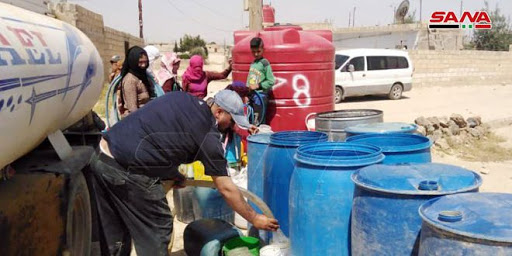
Friday marked the ninth consecutive day without water in Hasaka. The Turkish occupation forces, and their Radical mercenaries, are endangering the lives of more than a million civilians.
The SAR water authorities continue to try to provide clean drinking water, with cooperation from the Hasaka City Council and civil society groups, who used many water tankers to provide the locals with drinking water from Nafasha and al Himah Water Projects.
Chairman of Hasaka City Council Adnan Khajou, said that the daily quantity of water to be transported is 300,00 liters, which came from shallow wells dug by the locals, but is not drinkable and used only for cleaning.
The Turkish Army of occupation and its terrorist mercenaries in Ras-al-Ayn countryside continue to stop the operation of Alouk water project and to cut off the drinking water from Hasaka city, threatening one million persons with thirst and causing them to suffer from the spread of Coronavirus (COVID-19).
General Director of Hasaka Water Establishment Mahmoud Ukla said that since the Alouk Water Station was shut off by the Erdogan regime army, and their mercenaries, the summer temperatures have soared and water demand has increased, with the devastating additional threat of the COVID-19 pandemic, which needs water for hygiene.
Aziz Michael, geologist and water specialist, said that the Alouk water station is essential for water and it should be reopened.
The role of Turkey in the crisis
Turkey has a long history of using water as a weapon of war in Syria. In 1998 Erdogan had threatened to shut off water to Syria, which brought the two countries close to military conflict.
In May the water supply to 460,000 civilians in northeastern Syria was cut off by Turkey for the sixth time.
Syrian Observatory activists have reported Friday that residents have been protesting in Ras al-Ain, which is under Turkish Army occupation, and were calling for water, and electricity to be restored.
The role of the UN
On Friday, Ambassador Bashar al-Jaafari, Syria’s Permanent Representative at the UN, called on the UN Secretary-General Antonio Guterres to intervene immediately and to exert all his efforts to stop the Erdogan regime’s crime of cutting off drinking water for nearly one million Syrian citizens in Hasaka. In the phone call between al-Jaafari and Guterres, the Ambassador stressed that the Turkish aggression constitutes a war crime and a crime against humanity.
He said that the situation caused by this crime is exacerbated by hot weather and the threat of the COVID-19 pandemic.
Guterres said that he has tasked the UN team in Syria and his Special Envoy Geir Pedersen with taking steps to address this matter, resolve it urgently, and deliver humanitarian aid to affected people. He said he will exert his best efforts by contacting the Turkish government to put pressure and resolve this matter.
Guterres has asked Pedersen to meet the representatives of the US, Russia, and Turkey in Geneva on Monday, as the committee for drafting a new Syrian constitution meets, which is part of the UN 2254 resolution which will pave the way to a peaceful solution to the Syrian conflict.
The SAR and AANES (Autonomous Administration of North and East of Syria)
The Northeast section of Syria is split by various groups. The SAR based in Damascus controls areas, and has forces, checkpoints, and provides free health care and education to those areas it controls. The AANES is a separate group of Kurds, following a communist political platform, and they have become known to foreigners as “Rojava”. They have a military wing, the SDF, which was aligned with the terrorist group PKK, and they were in a coalition with the US military, who are now illegally occupying parts of the region while tasked with stealing Syrian oil by the Trump regime.
Covid-19 danger
“Turkish authorities’ failure to ensure adequate water supplies to Kurdish-held areas in Northeast Syria is compromising humanitarian agencies’ ability to prepare and protect vulnerable communities in the COVID-19 pandemic,” Human Rights Watch said in a report published late March.
What is the solution?
The Kurdish leaders of the ‘Rojava’ area, and the central government of the SAR in Damascus, are in complete agreement that the solution of the water crisis in Hasaka must be the removal of all Turkish occupation forces, and their Radical terrorist mercenaries. The SAR is a secular government, and this is what the Kurdish leadership of ‘Rojava’ also claim as a core value of their administration. With so much in common, and both ‘Rojava’ and the SAR facing the same enemy, Turkey, and the possible resurgence of ISIS, it appears they may soon form renewed cooperation to re-take the land from occupation forces and defend the borders from all enemies.
Steven Sahiounie began writing political analysis and commentary during the Syrian war, which began in March 2011. He has published several articles, and has been affiliated with numerous media. He has been interviewed by US, Canadian and German media.
The Hezbollah-France Twist
By Ghassan Kadi for the Saker Blog | August 20, 2020
The intriguing twists and turns following the catastrophic explosion at Beirut’s Sea Port have thus far had international repercussions, beginning with the visit of French President Marcon to Beirut just three days after the disaster; a visit that could hardly be classified as a visit of a foreign head of state to another country.
Marcon did not go to Lebanon just to meet with Lebanese President Aoun, even though the two did meet.
Macron met with the political leaders of Lebanon; aka the traditional power brokers, including the heads of militia who have steered Lebanon into the 1975-1989 civil war, destroyed the state that was once called the Switzerland of the East, and continued to rule Lebanon thereafter, leading to its almost total demise.
Macron’s visit left behind major pointers:
- With the arrogance of a returning colonial head, he literally told the Mafia leaders that he does not trust them. He announced that foreign aid will not be handed to Lebanese authorities and that they all benefited from the collapse of the Central Bank and that they know that he knows that.
- He shunned the Lebanese President Aoun at his news conference that followed his meeting with him and had him literally pushed away. This humiliation is forever etched on film.
- He promised to return to Lebanon on the 1st of September, the centennial anniversary of Lebanon in its current political and geographical form. He gave the leaders until that date to resolve the endemic problem of corruption otherwise he would bring in a new pact.
- What was least reported about his visit was his insistence that Hezbollah was represented in his meeting with Lebanon’s political leaders.
According to international law, French President Macron has no business interfering with Lebanese politics. Reality stipulates otherwise. What Marcon said to Lebanese leaders on the August 7 visit is tantamount to saying that France created Lebanon a hundred years ago, then left it later in Lebanese hands, but the Lebanese failed, and that the leaders have until the 1st of September 2020 (the centenary of the State) to fix it. Either way, Marcon will be back on the 1st of September to recreate Lebanon with or without them.
A few days after his departure, Western frigates steamed into Beirut’s devastated Sea Port and without any coordination with what is left of the Lebanese authorities.
With the military vessels came aid, medical aid in the form of field hospitals, medicines, as well as food and fuel aid, all of which are most welcome and needed by Lebanon. Of note was the ‘miraculous’ international attention and focus on a country and people who have been robbed by their own leaders and punished by the West for having Hezbollah involved in the political process of administering the country.
It would be foolhardy to assume that the Beirut Sea Port disaster and the decision for the UAE and Israel to formally establish a diplomatic relationship a few days later were events that were connected and deliberately planned and timed. Such initiatives take much time to develop. That said, the Beirut disaster might have lubricated some rusty deadlocks and facilitated some movements, decisions, and possibly generated some unforeseeable domino effects.
Whichever way seen, the situation in Lebanon reached a breaking point, perhaps only salvageable by way of radical measures including steps to save its people from certain famine.
As a secular Syrian/Lebanese Levantine who is patriotic and endeavours to see the Levant united, strong and in a position of self-determination, I cannot see a more important political objective to pursue other than achieving the ability of self-determination. After all, this is what all self-respecting people demand and expect.
In the following few paragraphs, I am stating historical facts that do not necessarily reflect my point of view.
Egypt took upon itself the slogan of ‘total liberation of Palestine’ during the era of Egyptian President Nasser from 1952 to 1970. But his successor, Sadat, was the first to sign a peace treaty with Israel in 1978. Nearly a decade earlier however, Jordan expelled the PLO from its territory, inadvertently sending its fighters to Lebanon. In 1969, and after a number of clashes between the Lebanese Army and the PLO, a deal was brokered by Egyptian President Nasser between the Lebanese Government and the PLO and which allowed the PLO to use Lebanese soil to launch attacks on Israel. That was known as the Cairo Accord.
For better or for worse, the Cairo Accord marked the end of Lebanon as a neutral state and put it in the forefront of confrontation with Israel.
If we apply the above to the politics and political positions within Lebanon, please allow me to put on the hat of the devil’s advocate and speak on behalf of the anti-Axis of Resistance sector.
As other Arab states have walked away from their roles in being defendants of the Palestinian cause and sold out to the Western Road Map one way or another, many Lebanese who have lived and were brought up with the concept that Lebanon was/is the Switzerland of East, neither accept nor understand why it suddenly became the spearhead of resistance against the Israeli/American/NATO-based influence of hegemony.
If we add to this predicament the modus operandi of Israel and its Western backers, where adversaries and potential ones are given ultimatums to comply to their agendas or face decimation, then Lebanon has been placed in a very dangerous position, and in reality, it was.
Prior to this, after two decades of Arab-Israeli wars, Lebanon remained neutral. Even during the 1967 so-called Six-Days-War, Lebanon maintained its neutral stance and did not partake. With Egypt signing a peace treaty with Israel, and Jordan following, the Axis-of-Resistance was transformed and reduced to the North-East borders of Israel; ie the Syrian/Lebanese-Israeli borders.
Many Syria haters condemn Syria for not opening its borders for direct confrontation with Israel since 1967. What those critics fail to understand is that Syria was not equipped sufficiently to fight a conventional war with Israel; especially after the dismantling of the USSR. Syria however did everything within her power to provide the Axis-of-Resistance forces in Lebanon with all support possible to engage in asymmetric wars with Israel, and the investment paid dividends; the most impressive of which was the liberation of South Lebanon from Israeli forces in May 2000.
Many Lebanese will disagree with the above and proclaim that Lebanon was left alone. In more ways than one, they are right given that, notwithstanding Syria’s support, all of the military confrontations actually took place on Lebanese soil. This ultimately meant that the entire onus of the Arab cause of confrontation with Israel has been thrown on the shoulders of the little state of Lebanon.
Many Lebanese are supportive of this view, including pro Axis-Of-Resistance Lebanese who feel that they have been sold out by Arab complacency and treachery.
In reality, Arabs have to make up their minds and do this collectively. They must either decide to resist the American/Israeli Road Map or agree to endorse it. Neither stand is being taken where instead they stand on a half-way mark; a mark that does not hurt them, but is devastating Lebanon.
Recently, the Arabian Gulf states publicly made direct and indirect indications of desiring peace with Israel. However, they lacked the fortitude to sign peace agreements despite often working together covertly and at times overtly. In the last few days, the United Arab Emirates decided to break the mould and establish reciprocal diplomatic relationships with Israel. This came as no surprise.
Of interest is that Lebanese President Aoun appears to be capitalizing on this event in order to extract himself out of the corner he painted himself in.
Beaten, abandoned and shunned, in a recent address, Aoun hinted to the possibility of negotiating peace with Israel.
Aoun has a long history of a revolving door when it comes to changing allies and enemies. As Army Chief in the early 1980’s, he was an ally of the Christian Militia (Lebanese Forces) and jointly fought the Syrian Army presence in Lebanon. Later that decade, he turned against the ‘Lebanese Forces’ and, in the midst of a sectarian civil war, engaged himself in a bitter Lebanese Christian Maronite versus Christian Maronite battle, causing much devastation to an already shattered Beirut and neighbouring areas. This was just before he was forced into exile in France by the Syrian Army, only to return to Lebanon fifteen years later as an ally of Syria and Hezbollah in 2005.
In his ascendance to the Presidency in 2016, an achievement finally reached at the age of 80, unlike others who virtually inherited the position from their elders, Aoun displayed, at least publicly, a spark which many interpreted as coming from the fact that he, independently, built his own political career.
Senile as he may appear, and under the influence of his highly corrupt son-in-law, Gebran Bassil, he is possibly still capable of finding alternative ways to survive, at least for the continuation of his legacy that could see his son-in-law at the presidential helm.
According to a private political source from a friend who is well connected, away from the public eye, some negotiations are underway between France and Hezbollah. The insistence of France to have Hezbollah represented in the wider meeting of Lebanese leaders with Marcon was only meant to be an introduction for further talks, and specifically to more bilateral talks that involve France and Hezbollah. According to the friend, Macron is trying to push for a French initiative that breaks the deadlock between Hezbollah and the West. The details of such talks are not clear yet, but all parties to be involved will be asked to accept certain concessions.
As a matter of fact, it has been reported recently that Macron has told Trump that the American sanctions on Lebanon are counterproductive. This makes one wonder if this is an attempt on the part of Macron to bolster his initiative with credibility and support from Hezbollah. With this said, Macron will have to take a very long shot to be trusted by Hezbollah, if this is achievable at all.
In the meantime, President Aoun is quite aware of this and is feeling excluded and abandoned, even by Lebanon’s traditional ‘mother’; ie France. He is in desperate need to resurrect his position.
In touting peace talks with Israel, Aoun seems to be making three pertinent statements. He is signaling to Hezbollah that he is prepared to sever his political alliance with them, but more importantly, he is signaling to the whole West, primarily to the USA, that he is a viable negotiation partner, desirous to sign a peace treaty with Israel. He knows how such words resonate to American foreign policy architects. Most importantly perhaps, Aoun is signaling to Macron that it is pay-back time. He is showing Marcon the finger and reciprocating his ‘undiplomatic’ demeanour, presenting to him that he is prepared to marginalize Marcon and France as a whole by directly talking to America, leaving France out of a new historic Middle East peace deal.
Such a desperate attempt may lure America to sit at the negotiating table with Aoun, but it will not resolve the anger and agitation against the leadership regarding the numerous domestic problems leading up to the Sea Port disaster and what followed.
Will the USA swallow Aoun’s bait and go out of its way to save his hide? No one knows. What seems inevitable is that, with or without any warming up of relations between France and Hezbollah, Hezbollah is undertaking much restructuring and reinvention. Hezbollah leadership is quite aware that the time of its political alliance with Aoun is over one way or another, and is currently considering the implementation of many changes, albeit their details remain unclear.
The events of the next few weeks, especially following the upcoming second visit of Macron on the 1st of September, will be pivotal in deciding the fate and roles of all stakeholders and entities that have held the fate of Lebanon in their hands.
The Hariri Assassination Verdict: A Billion Dollar Trial Ended after 15 Years
By Soraya Sepahpour-Ulrich | American Herald Tribune | August 19, 2020
On February 14, 2005, an explosion rocked Beirut killing and injuring hundreds of people chief among them the former Prime Minister of Lebanon, Rafik al-Hariri. The West was quick to blame Hezbollah and Syria. In 2006, Israel and its tanks rolled into Lebanon.
15 years later, on August 4th, another explosion rocked Lebanon. This time, the fingers were again pointed at Hezbollah and its ‘Iran backers’. And once again, Israeli tanks crossed into Lebanon.
After years of investigating the first incident, on Tuesday, August 18, 2020, Syria and Hezbollah were evicted of involvement in the 2005 explosion. Judges at a U.N.-backed tribunal said Tuesday that there was no evidence the leadership of the Hezbollah militant group and Syria were involved in the 2005 suicide truck bomb assassination of former Lebanese Prime Minister Rafik Hariri.”
Yet reading the Western media headlines, one would think that the judge had found Hezbollah guilty. Just as the most recent explosion was blamed on Hezbollah. But what would Hezbollah gain from such horrific acts? If not Hezbollah, ‘cui bono’? The answer is simple. Proving it is not.
The 1967 war resulted in the exponential expansion of Israeli water sources including the control of the Golan “Heights” (also referred to as the Syrian Golan). For decades, Syrian Golan and the return of its control to Syria had posed a major obstacle to the Israeli-Syrian peace negotiations. Israel’s water demands make it virtually impossible to accommodate this process. In fact, even with full control of the Golan, Israel’s water crisis in 2000 was so acute that it prompted Israel to turn to Turkey for water purchase.
Importantly, Syria’s presence in Lebanon since the outbreak of the Lebanese civil war in 1975 played a crucial role in hindering Israel’s never-ending water demands. Although the 1955 Johnston Plan (under the auspices of the Eisenhower administration) proposed diverting water from Lebanon’s Litani River into Lake Kinneret, it was not officially formulated, though it remained an attractive prospect. In 1982, Israeli forces established the frontline of their security zone in Lebanon along the Litani. Numerous reports alleged that Israel was diverting large quantities of Litani water.
On June 6, 1982, Israel advanced into Lebanon. However, the Syrian army halted the Israeli army advance in the battle of Sultan Yakub and the battle of Ain Zahalta. Sharon’s plan to conquer all of Lebanon and destroy Syria as a military power was thwarted. In reviewing the book and the battles, the famous scholar and activist, Israel Shahak, opined that “the principal purpose of the Israeli invasion of Lebanon was destruction of the Syrian Army” [1].
A 1987 book by Col. Emmanuel Wald of the Israeli General Staff entitled “The Ruse of the Broken Vessels: The Twilight of Israeli Military Might (1967-1982) reveals the aims of the 1982 invasion of Lebanon and the month of pre-planning that had gone into it. Wald writes that Ariel Sharon’s master plan codenamed “Oranim” was to defeat the Syrian troops deployed in the Bekaa Valley all the way to the district of Baalbek in North of Lebanon. According to Wald, “during the first days, it was quietly approved by the U.S.”.
Sharon’s plans were put in the backburner. Though the urgency of the successful implantation of the plan was not lost on Israelis; perhaps made even more urgent in the face of the 1991 Lebanese-Syrian Treaty of Brotherhood, Cooperation and Coordination. The treaty was a challenge to Israel and its diversion of water and annexation. When Syria replaced Israel as the dominant power in southern Lebanon in May 2000, Israeli fears grew that Syrian success in controlling the Golan and by extension, Lake Kinneret, would have a devastating effect on Israel.
Washington, always ready to serve Israel, passed the Syrian Accountability Act and the Lebanon Sovereignty Restoration Act. Without any hesitation to investigate the explosion, Washington and the West did not hesitate to place the blame on Syria and Hezbollah. Much to the delight of The Washington Institute, the pro-Israel think tank, the United States implemented the Act which in addition to sanctions, called for the withdrawal of Syrian troops from Lebanon. In 2006, the deck was cleared for Israel to attack Lebanon.
Although the Tribunal found no ties to Syria or Hezbollah leadership, it did convict Salim Ayyash – a Hezbollah member. The question is, was Ayyash a rogue member acting on his own or was he a member of Israel’s “Arab Platoon” (Ronen Bergman, 2018) [2].
The Arab Platoon a clandestine commando unit whose members operated disguised as Arabs, were trained fighters who could operate inside ‘enemy’ lines, gather information, and carry out sabotage and targeted killings. Their training included commando tactics and explosives, but also intensive study of Islam and Arab customs. Nicknamed the “Mistaravim” (the name by which the Jews went in some Arab countries), they practiced Judaism but in all other aspects were Arabs.
It is not clear to this writer if Ayyash was a Hezbollah member or a Mistaravim. However, it is evident that neither Syria, Lebanon, nor Hezbollah benefited from the attack.
Curiously, the initial tribunal date coincided with the Lebanon port explosion which devasted the country, even making it appear as if the explosion and the delay in the hearing would benefit Hezbollah. Undoubtedly, the findings of the Tribunal must have been very disappointing for Israel and its backers who had placed the blame on Hezbollah and Syrian leadership. It may be reassuring for some and worrying for others that the FBI is in Beirut investigating. The FBI has managed to build quite a reputation for cover ups.
Beirut has been devastated. And as with 2006, every foe is out to grab a part of this beautiful country. During the 2006 war, while Israel bombed Lebanon, Carlyle profited greatly – as did the Saudis, the U.S., and of course, Israelis. The systematic destruction of Lebanon translated into a significant opportunity for the Carlyle Group and with the ‘crisis, they announced a $1.3 billion fund for investment in the region. They were not alone. The rush was on. The big investment banks — Morgan Stanley, Goldman Sachs, and Lehman Brothers – all increased their presence in the region. Israel, the perpetrator as the benefactor, received an increase of USD 500 million additional in aid package from the U.S. in September of the same year (Ynet News).
With millions of funds from CIA/NED spent in Lebanon over the past few years (NED 2018, etc.), the country is ripe for its enemies to bend it to their will. Clearly, this would not benefit Hezbollah, Iran, or Lebanon. Fingers have also been pointed at Israel for being the culprit. It may take several years for the truth to come out – and be proven. At the end of the day though, cui bono?
Endnotes
[1] Sahak, Israel. Israel Considers War With Syria as It Ponders 1982 Invasion of Lebanon, The Washington Report on Middle East Affairs (September 30, 1992).
[12] Ronen Bergman. Rise And Kill First; The Secret History of Israel’s Targeted Assassinations. P. 24. Random House 2018
Democrats’ election platform demands end to ‘forever wars’ — most of which were launched last time Biden held office
By Helen Buyniski | RT | August 17, 2020
The Democratic Party’s 2020 electoral platform includes a call to end the US’ “forever wars” – which sounds great, except that a Democratic president started many of those wars and the party has stonewalled efforts to end them.
“Democrats know it’s time to bring nearly two decades of unceasing conflict to an end,” the platform, released in draft form on Monday and expected to be approved by Democratic leaders later this week, reads.
It’s a relatively uncontroversial statement in itself: at nearly 19 years and counting, the US war in Afghanistan is the longest conflict in American history. The various satellite wars that have sprung up as part of the “War on Terror” have devastated large swathes of the Middle East – and the US itself, which has spent upwards of $6 trillion on fighting them while much of the country slid into a permanent recession – over the past two decades.
However, the responsibility for many of those satellite conflicts lies with Democrat Barack Obama’s administration, which liberally bombed Syria, Libya, Pakistan, Yemen, and Somalia in addition to Afghanistan and Iraq, turning the already-disastrous two-front War on Terror of his predecessor George W. Bush into a regional quagmire. Democratic candidate Joe Biden was Obama’s vice president, cheering those wars on and defending his boss’ decisions. Now, the party wants Americans to believe only he can put an end to them.
The 2020 platform promises a “durable and inclusive political settlement in Afghanistan” along with an end to US support for the Saudi-led war in Yemen and a repeal of the threadbare 2001 Authorization for Use of Military Force (AUMF) that has been repeatedly (mis)used to excuse US interventions in the Middle East under the guise of fighting terrorism. All great ideas, but the party has been here before.
Despite receiving the Nobel Peace Prize shortly after his inauguration, Obama didn’t bring the peace he promised in his 2008 campaign – he just made war more palatable to the liberals who had previously protested against it. By dramatically expanding the US drone program and cloaking murderous airstrikes in the warm fuzzy rhetoric of spreading democracy and “responsibility to protect,” Obama, his Secretary of State Hillary Clinton, and the Democrats in his administration took the wars out of sight, and out of mind for the average American.
Even while taking credit for “ending” the war in Iraq, launched in 2003 on the fraudulent pretext that leader Saddam Hussein was amassing weapons of mass destruction and/or was somehow involved in the 9/11 terror attacks, Obama subsequently returned US troops to Iraq under the pretext of fighting the Islamic State terror group (IS, ISIS/ISIL). However, IS is widely considered an outgrowth of the US’ botched Iraq policy, which destabilized the region by flooding the country with many of the suddenly-unemployed (but still well-armed) remnants of Saddam Hussein’s military. At the same time, the CIA has a long history of supporting terror groups that dovetail with its political aims, from arming and training al-Qaeda’s predecessors to fight the Soviets in Afghanistan to arming and training so-called “moderate rebels” whose tactics are often indistinguishable from ISIL or al-Qaeda to take out the Syrian government. Terrorism has thrived amid the war “against” it.
That the Democrats should campaign in 2020 on ending forever wars suggests they might have learned something from 2016, when then-candidate Donald Trump pledged to do just that, luring disaffected liberals who couldn’t bring themselves to vote for notorious warmonger Hillary Clinton. Her flippant dismissal of the brutal murder of Libyan leader Muammar Gaddafi – “We came, we saw, he died!” – remains chilling years after she helped reduce the country with the highest standard of living on the African continent to a failed state where slaves are sold in open markets.
But while Trump has profoundly failed to keep his end-the-wars promise, instead increasing the number of drone strikes beyond Obama’s sky-high levels, even Trump’s minimal efforts to withdraw troops from Syria and Afghanistan have been ferociously opposed by the Democrats.
Indeed, the only foreign policy acts the self-styled #Resistance has praised from their political nemesis have been his bombings of Syria in response to extremely dubious reports of gas attacks by the Assad government. CNN’s Fareed Zakaria claimed the strike represented the day Trump “became president of the United States.”
The disingenuous call to end the military quagmires is far from the only lofty pledge embedded in the Democrats’ platform, which alternates between eye-rolling social-justice pandering and common-sense measures with broad appeal.
The party has also pledged to “end the Trump Administration’s politicization of the armed forces,” improve healthcare for veterans, “root out systemic racism from our military justice system,” and “prioritize more effective and less costly diplomatic, intelligence and law enforcement tools” over military invasions in conducting foreign policy.
It remains to be seen which, if any, of those promises they will keep.
Helen Buyniski is an American journalist and political commentator at RT. Follow her on Twitter @velocirapture23
US Bombing of a Syrian Army Checkpoint in Hasaka Countryside Kills a Soldier
By Khaled Iskef | American Herald Tribune | August 17, 2020
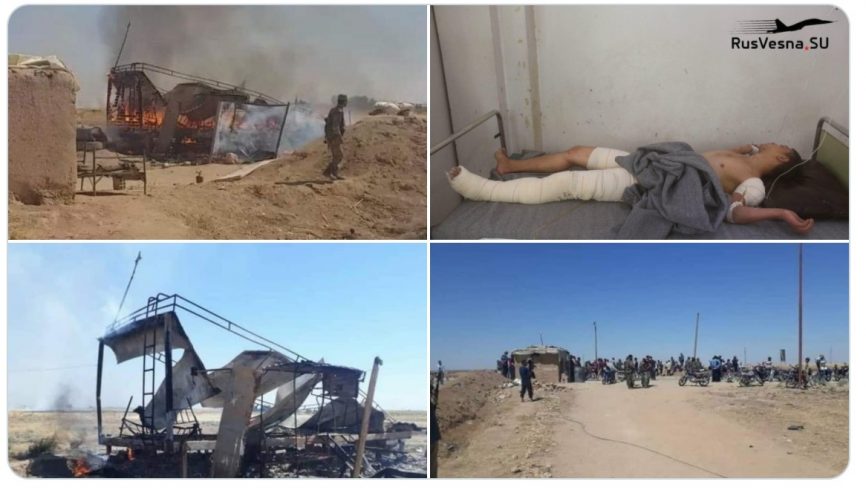
A US army bombed a Syrian army checkpoint in the village of Tal al-Dahab, southeast of Qamishli in the countryside of Hasakah today’s morning, resulting in killing a soldier and wounding two others.
Private sources reported that the American warplane flew over the checkpoint on the outskirts of Tal al-Dahab for a short period, and bombed it, before immediately leaving the area.
The sources said that targeting the checkpoint came after its members prevented an American patrol from passing through it, as verbal affinities occurred at the checkpoint, before the patrol withdrew without passing, followed by the arrival of the aircraft that carried out the bombing.
The information received indicated that one of the wounded Syrian soldiers holds the rank of officer, without receiving confirmed information about the size of the injuries they suffered as a result of the US bombing.
In the past months, the countryside of Hasaka has witnessed a series of events related to the American presence in the region, especially in terms of preventing American patrols from moving in those areas through the Syrian army checkpoints, as those patrols have always tried to provoke the army checkpoints by insisting on passing, which was refused firmly by the Syrian checkpoints.
The Syrian army prevention of the American patrols passage was often accompanied by popular support in the countryside of Hasakah, who always supported the Syrian army in the face of American moves.
Khaled Iskef is a journalist working for Almayadeen TV.
Syria’s Arab Tribes Give Pro-American Forces and SDF One Month to Leave Eastern Syria
Sputnik – 11.08.2020
On 11 August, sheikhs and elders of the Arab Al-Uqaydat tribe met in the Syrian Deir ez-Zor province, agreeing that the US-led coalition is responsible for murdering tribal sheikhs in the province, and demanding that the region be cleared of SDF forces, local control returned to the Syrians, and stating: “leave the Arab region to the Arabs”.
Sputnik’s correspondent in al-Hasakah reported, citing civilian sources in Deir ez-Zor, that nearly 5,000 people attended a meeting of Al-Uqaydat sheikhs and elders. They agreed that the pro-American coalition and the SDF have one month to turn over all of those involved in murdering sheikhs in the Deir ez-Zor governorate, and demanded that the SDF and the coalition leave the province.
The tribal sheikhs condemned the security chaos caused by a series of murders of tribal elders and sheikhs, as well as condemning widespread corruption. These factors are reported to have forced the tribe to make the decision.
The most recent high-profile crime attributed to SDF fighters is the assassination of Sheikh Mutashar al-Hafil and his relative Dar Mihlef al-Khalaf, which has provoked a wave of protests and aggression by local tribes against both the armed SDF groups and the pro-American coalition.
“We are calling on the international coalition to transfer control over the province directly to its Arab population, respecting Syria’s territorial integrity, as well as the rights of Syrian citizens”, the trial elder’s statement said.
Al-Uqaydat tribal representatives also demand that the SDF release all prisoners and hostages: particularly and first, women and children.
Reportedly, the month given to the SDF and the coalition to meet the ultimatum starts today, August 11, 2020.
The Al-Uqaydat tribes have traditionally been situated in the eastern part of the Syrian Deir ez-Zor province. Popular protests hit these cities after pro-American SDF forces killed several sheikhs and tribal elders. In response, tribal representatives broke into SDF headquarters in several governorate cities and captured fighters.
Syrian tribe declares popular war against US forces, SDF
Press TV – August 10, 2020
A Syrian tribe in the eastern province of Dayr al-Zawr has launched a popular resistance force against US troops and their allies, accusing the so-called Syrian Democratic Forces (SDF) of stealing the country’s resources.
The US-based Rai al-Youm newspaper said on its website on Monday that the tribe of Akidat announced in a statement the formation of a military council and launching popular resistance against the US forces and their allied militants in an apparent direct accusation of the American troops of being behind the assassination of Matshar al-Hafl, a senior member of the tribe.
The statement also accused the SDF of stealing the country’s resources and killing its prominent figures.
According to the statement, the elders and notable members of the tribe had held a meeting to take action against the “American occupiers” and the US-backed mercenaries, and to liberate the Syrian territory.
The statement said they agreed to form a political council and a tribal army – to serve as its military wing – to manage the tribe’s affairs in cooperation with the relevant authorities.
It added that the council has begun the practical steps towards the formation of the Akidat army to liberate Syrian territory in coordination with the Syrian army.
The US-led coalition has been conducting airstrikes and operations against what are said to be Daesh targets inside Syria since September 2014 without any authorization from the Damascus government or a United Nations mandate. Damascus has repeatedly condemned the airstrikes.
The military alliance has repeatedly been accused of targeting and killing civilians.
The US has dispatched new deployments to the Syrian provinces of Hasakah and Dayr al-Zawr following President Donald Trump’s October decision to keep hundreds of US troops in Syria to “secure” the country’s oilfields which Syrian troops have yet to retake from militants.
Russian Foreign Minister Sergei Lavrov reiterated that US attempts to control Syria’s oilfields were “illegal” and amounted to “robbery.”
Damascus is in great need of its major oil deposits in order to address its energy needs and rebuild the country amid crippling Western sanctions.
The Arab country has been gripped by foreign-backed militancy since March 2011. The Syrian government says the Israeli regime and its Western and regional allies are aiding Takfiri terrorist groups that are wreaking havoc in the country.
The Arab country is currently extracting oil at only 10 percent of its pre-war capacity.
Pentagon issues report on Syria war, condemns recruitment of children by SDF
MEMO | August 8, 2020
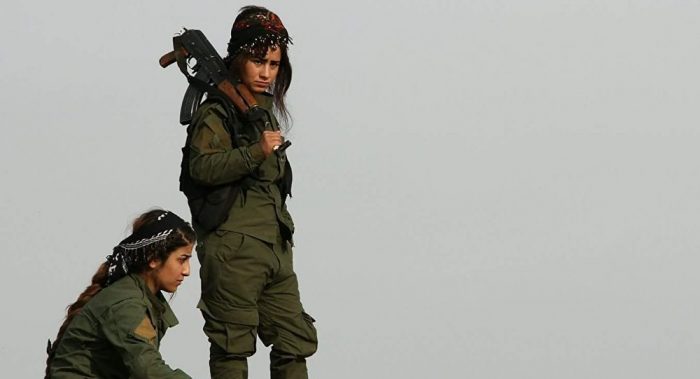
The Pentagon confirmed in a report on the war in Syria and Iraq that the militia of the Syrian Democratic Forces (SDF) continues to recruit children through forcible detention.
On Thursday, the Lead Inspector General issued a report on Operation Inherent Resolve (OIR), launched by a US-led international coalition against Daesh in Syria and Iraq, indicating that the SDF militia continues to arrest and recruit children from refugee camps in the areas it controls in north-eastern Syria.
The report pointed out that the SDF militia did not fulfil its pledges to international organisations to not recruit children, stressing that youngsters are still being forcibly recruited.
The United Nations Human Rights Council (UNHRC) published in its report issued on 16 January, new evidence about the exploitation and recruitment of children by SDF militia.
On 29 June, 2019, Virginia Gamba, the UN Special Representative for Children and Armed Conflict, signed an action plan with SDF leader Ferhat Abdi Shahin, known as Mazloum Abdi, to release child fighters in the militia ranks.
Popular Resistance: Armed Syrian Arab Tribes Able to Defeat US-SDF Alliance, Ex-Diplomat Reveals
Sputnik – 07.08.2020
Earlier this week, a group of Syrian Arab tribes representatives broke into the local headquarters of the Syrian Democratic Forces (SDF) in the cities of Deir ez-Zor, Diban, and Al-Hawaij in the eastern Deir ez-Zor Province.
Seyed Hadi Afgahi, an Iranian expert on the Middle East, and ex-diplomat at the Iranian embassy in Beirut, believes that Syrian Democratic Forces (SDF) units play a destructive role in terms of Syria’s security and stability, but there are certain forces that can break them for good.
“After Daesh had been defeated, the Americans created an alternative force to destroy Syria, the Syrian Democratic Forces (SDF), which is a mixture of Arabs and Kurds, and plays a destructive role in terms of Syria’s stability and security. The Americans armed them and used them as a proxy to take control of oil in Eastern Syria. In fact, the United States is plundering Syrian oil reserves through these forces. That is why a popular resistance is being formed in Syria, similar to the one in Iraq in 2003, whose armed guerrillas repeatedly dealt a serious blow to the American military contingent in Iraq, forcing Barack Obama to conclude an agreement. This is exactly the way of forming a popular resistance among Arab tribes that is gradually gaining strength in Syria,” he said.
“Moreover, some of the Arab tribes elders’ sons in the area of Deir ez-Zor and in the east of Al-Hasakah have left their previous military units and returned to their homes, where they are already forming people’s armed resistance backed by the Syrian government. They are expanding their groups and attacking US forces,” he added.
“This is one of the ways to counter US presence in Syria, because currently the Syrian army is not strong enough to resist and is unable to strike, therefore the best way is to opt for popular resistance that can ‘strike and smash’”, the former diplomat concluded.
Afgahi’s comments come days after representatives of Syrian Arab tribes stormed several SDF headquarters in the cities of Deir ez-Zor, Diban, and Al-Hawaij in the eastern Deir ez-Zor Province. The armed tribesmen also detained SDF militants present in the buildings at that moment.
The storming of the SDF headquarters in the province happened after representatives of the tribes protested against arbitrary actions by militant groups supported by the US. The demonstration was held against a recent surge in killings of elders and sheikhs of the local tribes by the SDF militants. The protesters demanded that the group hand over those responsible for the killings.
The SDF and other Kurdish groups currently control most of Syria’s oil-rich east with the support of US troops, who have been tasked with “keeping” the local crude fields since October 2019 from alleged attempts by Daesh militants to seize them. The Syrian government has repeatedly slammed the presence of a US military contingent in the country as illegal since they didn’t receive a mandate either from Damascus or the UN.
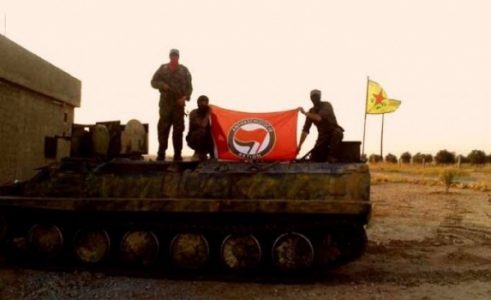
SDF militants kill civilian protesting against US military presence in Syria
Press TV – August 5, 2020
A civilian has lost his life and several others sustained injuries during a rally in Syria’s northeastern province of Dayr al-Zawr to demand the withdrawal of US military forces and their allied militants affiliated with the so-called Syrian Democratic Forces (SDF) from the region.
Syria’s official news agency SANA, citing local sources, reported that residents of Diban town demonstrated on Tuesday afternoon to express their opposition to the presence of American soldiers and the arbitrary practices of SDF militants.
The US-backed militants responded by firing live bullets at the protesters, killing one of them and injuring several others.
SANA added that locals managed to expel SDF militants out of their checkpoints and the schools which they had been using as bases following the clashes.
Similar protests were held in other Dayr al-Zawr towns and villages, including al-Hawaij, Jadeed Ekedat, Tayaneh, al-Sobhah, Abu al-Nitel, al-Shuhayl and Shinan, where people called for the immediate pullout of SDF militants and US forces.
The militants reportedly brought in reinforcements from the towns of al-Shaddadi, al-Susah and al-Baghouz in order to bring the situation under control.
The Arabic service of Russia’s Sputnik news agency, citing sources speaking on condition of anonymity, reported that SDF militants, supported by military aircraft belonging to the US-led coalition, raided the towns of al-Shuhayl and al-Hawaij later in the day, triggering fierce clashes with locals.
Security conditions are reportedly deteriorating in areas controlled by the SDF in Hasakah and Dayr al-Zawr provinces amid ongoing raids and arrests of civilians by the militants.
Locals complain that the SDF’s constant raids and arrest campaigns have generated a state of frustration and instability, severely affecting their businesses and livelihoods.
Residents accuse the US-sponsored militants of stealing crude oil and refusing to spend money on services sectors.
Local councils affiliated with the SDF have also been accused of financial corruption. They are said to be embezzling funds provided by donors, and failing to provide basic public requirements.
Turkey Cries Foul About Deployment Of Egyptian Troops In Idlib. What’s Going On?
SOUTH FRONT | July 31, 2020
The Egyptian military has deployed about 150 troops on the frontline in the Syrian region of Greater Idlib to support forces of the Damascus government, Turkish sources claimed on July 30.
“The troops were later deployed in the Khan al-Asal area in the western countryside of Aleppo and around the city of Saraqib in the southern countryside of Idlib,” the Anadolu Agency quoted its source as saying. The news agency claimed that the Egyptian service members had arrived via the Hama Air Base.
Later, Youssef al-Hamoud, a spokesman for the Syrian National Army, a coalition of Turkish proxy groups based in northern Aleppo, said that the number of Egyptian troops is in fact 148. They supposedly deployed in Syria in 3 groups via the Hama Air Base. According to him, 98 Egyptian personnel reportedly came from the city of Ismailia on July 26 and then were deployed in Khan al-Asal. 50 others arrived from Cairo Airport on July 27. They are supposedly deployed in Saraqib.
However, no flights from Egypt to the said base were recorded over the past few days. Furthermore, it is almost impossible to hide the deployment of foreign troops on the frontline in the conditions of the Syrian war, when almost every second fighter has a mobile phone and social media accounts and uses them to share pictures and videos from the battlefield.
Most likely, Turkish state media and proxy groups loyal to Ankara found a new original way to justify the illegal presence of their own forces in Syria. The accusation of other parties doing something that the Erdogan government does itself is something that Turkish media outlets regularly do.
In the earlier stages of the conflict, Turkey and its intelligence services openly allowed various terrorists aiming to join ISIS and al-Qaeda to use the territory of Turkey and camps on the Syrian-Turkish border as a transport hub on their route to Syria. At the same time, Turkey was actively involved in illegal oil trading with ISIS.
Later, when the Russian military operation, including mass bombings of ISIS oil infrastructure, convoys, and public revelation of the facts of Turkish cooperation with ISIS, put an end to this, Turkish official propaganda shifted its attention to accusations of all other parties involved in the conflict of cooperation with ISIS. It even claimed that its military operation against Kurdish militias in Afrin was aimed against ISIS.
Ankara sent almost 10,000 Syrian militants to Libya to support the Tripoli-based Government of National Accord. Nonetheless, Turkish outlets are crying foul about the small number of Russia-linked private military contractors hired by the UAE to support the Libyan National Army against Turkish-backed forces.
Over the past years, Turkey has occupied a notable part of northern Syria and deployed thousands of troops in Greater Idlib to protect al-Qaeda-linked terrorists there from the Syrian Army. Therefore, it would be logical for Ankara to find some ‘foreign force’ that it can accuse of deploying its own troops in the country.
At the same time, if the deployment of Egyptian troops to support the Syrian Army turns out to be true, this will be really bad news for Turkey. Ankara still seems to be unable to control its local al-Qaeda partners and the chances of a new round of escalations in the region are increasing.
The mighty Turkish Armed Forces have thus far failed to defeat the Syrian Army exhausted by years of conflict with terrorists. The outcome of the new escalation will be even more gloomy for Turkey if Egyptian forces will join the coalition supporting Damascus.
IF YOU LIKE THIS TYPE OF CONTENT, SUPPORT SOUTH FRONT :
PayPal: southfront@list.ru, http://southfront.org/donate/ or via: https://www.patreon.com/southfront
US cannot disarm Lebanon’s Hezbollah through sanctions: Russian ambassador to Beirut
Press TV – August 1, 2020
The Russian ambassador to Beirut says US officials are under the illusion that they can disarm the Lebanese Hezbollah resistance movement through sanctions.
“Disarming Hezbollah is the primary purpose of US sanctions… I do not think that such a goal would be achieved through this method. The United States will not manage to force Hezbollah into laying down its weapons. This is an illusion,” Zasypkin said in an exclusive interview with Beirut-based Arabic-language al-Mayadeen television news network on Friday.
In late October 2018, US President Donald Trump’s administration imposed a new round of sanctions on Hezbollah, targeting individuals and international organizations that do business with the group.
“Over the past year, we have levied the highest sanctions ever imposed on Hezbollah, in a single year, by far. Just a few moments ago, I signed legislation imposing even more hard-hitting sanctions on Hezbollah to further starve them of their funds. And they are starving for them,” Trump said during an event in Washington, DC, that marked the 35th anniversary of an attack on US marine barracks in the Lebanese capital of Beirut.
Zasypkin added, “We (Russia) have made efforts in Syria. This is not only beneficial to Syria, but also to Lebanon as it protects the country against the potential threat of terrorism. If terrorism prevails in Syria, it will be easy for thousands of terrorists to cross into Lebanon, and this would lead to the partitioning of the country.”
He noted that Iran plays a positive role in the Middle East region, condemning the recent harassment of an Iranian passenger plane flying from Tehran to Beirut by two US fighter jets over Syria.
“Americans are creating problems and violating international law. The goal is to create tensions and reestablish their presence, role and influence,” the Russian diplomat said.
He went on to say that the balance of power in Syria is changing. “Over the past four years, the balance of power had been in the interest of terrorists. The ensuing terrorism allowed outsiders, including the US-led coalition, to come into play.”
“I think Americans have numerous problems there (in Syria), but al-Tanf region is still under their control. They are clinging to the area in order to have influence. Their main goal is to sever ties between Iran and Syria,” Zasypkin pointed out.
He noted that Moscow honors the principle of non-interference in Syria’s domestic affairs, lauding “close relations” between Russian President Vladimir Putin and his Syrian counterpart Bashar al-Assad as well as military forces of the two countries.
Zasypkin said Russian and Syrian institutions are closely cooperating with each other in various fields, including combat against terrorism, maintenance, reconstruction and humanitarian activities.
Elsewhere in his remarks, the Russian ambassador pointed to the recent rafts of economic sanctions against Syria under the so-called Caesar Act.
“The United States has used the leverage of sanctions for decades against Russia, Venezuela, Cuba and Iran. The essence of the idea has been to starve people in those countries in a way that they would ultimately turn against their own ruling systems. The scheme is now being applied to all countries,” Zasypkin highlighted.
He added, “Caesar Act is broad and comprehensive, and affects other parties since Syria has been under sanctions for a long time. Foreign companies are now targeted by the ruling. It is a preemptive battle against the possibility of restoration of ties between Syria and Western or Arab parties.”
Featured Video

Chinese jet fuel and the myth of energy independence
or go to
Aletho News Archives – Video-Images
Book Review
Former Insiders Criticize Iran Policy as U.S. Hegemony
By GARETH PORTER | CounterPunch | February 27, 2013
“Going to Tehran” arguably represents the most important work on the subject of U.S.-Iran relations to be published thus far.
Flynt Leverett and Hillary Mann Leverett tackle not only U.S. policy toward Iran but the broader context of Middle East policy with a systematic analytical perspective informed by personal experience, as well as very extensive documentation.
More importantly, however, their exposé required a degree of courage that may be unparalleled in the writing of former U.S. national security officials about issues on which they worked. They have chosen not just to criticise U.S. policy toward Iran but to analyse that policy as a problem of U.S. hegemony. … continue
Blog Roll
 Aletho News
- What is fueling unrest across the EU?
- Why no power can undermine Iran’s eternal dominance over the Strait of Hormuz
- Is The War Against Iran Over?
- Iran war will leave long-term ‘scar’ on Wall Street, investors warn
- How Iran decimated US power projection in West Asia: Military lessons of 40-day war
- Iran’s report details US-Israeli war crimes in targeting schools, hospitals, livelihoods
- NATO’s Slow Fracture: How Trump’s Iran War Exposed the Instrument of Hegemony
- Chinese jet fuel and the myth of energy independence
- Ukraine Sea Drone Fired From Libya Hit Russian Tanker in Mediterranean
- IRGC: Iranian forces launched no attacks during ceasefire hours
- If Americans Knew
- DNC Shoots Down Resolutions Calling Out AIPAC and Limiting Arms to Israel
- TCN: Is Israel Blackmailing President Trump?
- Israel killed at least 303 Lebanese yesterday – who were they? Daily Update
- Amnesty: Urgent – Protect Lebanese civilians from brutal escalation in Israeli attacks
- Is The War Against Iran Over?
- Inside the Israeli army’s propaganda wing
- Hundreds of Gaza Amputees Stranded in Legal Limbo
- The gallows law: Israel moves toward executing Palestinian children
- Tucker Carlson: The Path to Peace requires ending ‘special alliance’ with Israel
- This is ceasefire? Israel’s biggest massacre yet in Lebanon, another journalist killed in Gaza – Daily Update
- No Tricks Zone
- An Inconvenient Tree: Uncovered In Alps… Europe Much Warmer Than Today 6000 Years Ago
- New Study Reports A 60% Slowdown In Greenland’s Ice Loss Rate In The Last Decade
- Low Intensity Tornado Wrecks Major Solar Farm, Creating A Potential Toxic Dump
- New Study Finds Warming Saves Lives…Cold Temperatures 12 Times More Deadly Than Excess Heat
- German Science Blog Accuses PIK Climate Institute Of Hallucinating Climate Tipping Points
- Devastating Assessment Of Comirnaty Vaccine By Former Senior Pfizer Europe Toxicologist
- New Study: CO2 Is ‘Effectively Negligible’ As An Explanatory Climate Change Factor Since 2000
- Former Pfizer Toxicologist Dr. Helmut Sterz Tells Bundestag Hearing Pfizer Vaccine Should Have Never Been Approved
- Energy Expert: Germany’s Nuclear Phaseout Was A “500 Billion Euro Mistake”
- New Research: South Australia’s Mid-Holocene Sea Surface Temperatures Were 4°C Warmer Than Today
 Aletho News