US president Donald Trump has authorized $4.5 million in aid to the so-called Syrian Civil Defense (SCD), aka “White Helmets,” calling their work “important and highly valued.” The group’s critics point to its terrorist ties.
“Over the course of the 8-year conflict in Syria, the SCD has rescued more than 115,000 people, including many ethnic and religious minorities,” the White House said, announcing the aid on Tuesday.
However, the source of this figure is the group itself, and it has not been independently verified. Likewise, the organization has only been around since 2013.
Washington pledged $5 million in aid to the group at a conference back in March. Last May, the Trump administration had announced it would stop funding the White Helmets, only to backtrack a month later and send the group $6.8 million.
The group’s name is highly misleading, as the White Helmets have operated solely in areas controlled by anti-government militants, such as the Al-Qaeda affiliate Al-Nusra Front, now called HTS. The actual Syrian civil defense is part of the government, and has been subjected to US sanctions as such.
Currently the White Helmets operate solely in the parts of Idlib province controlled by the militants. Photographs of armed militants with “White Helmets” insignia, participating in the Turkish-backed ‘Operation Peace Spring’ against the Kurds in northern Syria, have appeared on social networks over the past two weeks.
Still, the US continues to encourage “allies and partners” to join in its support of the White Helmets, and “efforts to protect civilians, religious and ethnic minorities, and other innocent victims of the Syrian conflict,” according to the White House.
In December 2018, the Russia-based Foundation for the Study of Democracy presented evidence of their investigations in Syria, showing the group to be engaged in staging false chemical and other attacks, harvesting organs of the people they pretended to rescue, and looting the bodies of the fallen, among other things.
October 22, 2019
Posted by aletho |
Deception | Syria, United States |
Leave a comment
By Sarah Abed | October 21, 2019
Monday marks the thirteenth day since Turkey began its third cross border military operation in Syria ironically named “Operation Peace Spring”. In the past two weeks civilian and militant lives on both sides have been lost, a large exodus has taken place, the House of Representatives overwhelmingly approved a resolution that opposes US troop withdrawal, a five-day ceasefire was brokered between Turkey and the United States, and Kurdish militias have withdrawn from the “safe-zone”.
On Wednesday, there was overwhelming bipartisan approval for a measure that opposes President Trump’s U.S. forces withdrawal from Syria. The resolution was introduced by Reps. Michael McCaul, Republican from Texas and Eliot Engel, Democrat from NY and it calls on the White House to put forth a plan for the “enduring defeat” of Daesh and demand that Turkey cease its military operations in Syria.
The measure which passed 354-60 with four members voting present and all sixty of the nays coming from Republican’s stated, “An abrupt withdrawal of United States military personnel from certain parts of Northeast Syria is beneficial to adversaries of the United States government, including Syria, Iran and Russia.”
It’s absurd that there’s outrage about ending a war and allowing Syria to handle its own domestic affairs. However, nothing of the sort happened when Nobel Peace Prize winner and former US President Barack Obama was bombing seven countries and creating some of the wars that President Trump has inherited including Syria. Bipartisan support for carrying on with endless wars is mindboggling.
On Thursday, a ceasefire was brokered between the United States and Turkey. This pause was meant to for the Kurdish militias to dismantle their posts and retreat from the 32km “safe zone” and in response the US would not impose any new sanctions on Turkey. However, there’s a lesser mentioned point that prompted the ceasefire and that’s the entrapment of US/UK Coalition Joint Special Operations Task forces in northern Syria. It was necessary for hostilities to cease long enough for them to withdrawal out of harm’s way.
Washington and Turkey do not want the Kurdish militias to work in conjunction with the Syrian Arab Army, but for different reasons. The US would rather see them stay independent from the SAA and keep them as an ally in case US troops return. Remember northeast Syria is advantageous to the US because they can keep an eye on Iran and protect Israel plus there’s oil. Turkey would like to see the Kurdish militias dissolved along with any separatist Kurdish hopes and dreams of establishing an independent Kurdistan on its border.
Ankara has made it clear that if the Syrian Arab Army (SAA) plans on protecting the YPG/SDF that this will be considered an “act of war”. The Turkish administration is worried that the SAA will enter Manbij, Ayn al-Arab, and Qamishli to protect the Kurdish militias, but that wouldn’t be in the Syrian governments best interest.
There’s been some disagreement among the Kurdish militias as to where they need to be withdrawing from, Turkey is demanding that they entirely vacate the 32km border, and not just some of their posts. If the Kurdish militias withdraw entirely from Turkey’s “safe zone” by the ceasefire deadline, what excuse will Ankara have to continue their military operation? None.
In the past week or so Syrian troops have made significant progress in regaining territory previously occupied by Kurdish militias in northern Syria, and Russia tried to broker negotiations between the Kurdish militias and the Syrian government.
Turkey’s stated goals are to fight the terrorist organizations on their southern border, create a safe-zone, and a “peace corridor” for the resettlement of 1-2 million Syrian refugees. They have stated that they are not looking to land grab or encroach but if we know anything about Turkey’s politics it’s that surprises lie behind every corner, much like the United States.
It’s no coincidence that the 120-hour ceasefire ends on Tuesday, and that’s precisely when President Erdogan will be going to Russia to meet with President Vladimir Putin. President Putin has taken on the role of negotiator and is usually the most level-headed adult in the room when it comes to the Syria conflict and dealing with Turkey, Syria, the Kurdish militias, and yes even the United States, Israel and Saudi Arabia along with other players.
I assume the seasoned politician serving his fourth term in office will handle the Sochi meeting on Tuesday with Turkey, in the same polite and diplomatic manner we’ve grown accustomed to.
There were some questions as to whether the ceasefire will continue till then, due to violations on both sides. Turkey’s defense ministry stated on Sunday that one of their soldiers was killed and that the Kurdish militias violated the ceasefire over 20 times in the past three days. The SDF is stating that 16 of their fighters have been killed. Also, as part of the agreement between the US and Turkey, an 86- vehicle Kurdish convoy left Ras al-Ayn toward the town of Tal Tamr this weekend.
On Sunday, hundreds of trucks carrying almost 500 US personnel were seen withdrawing troops near Al Hasakah to Iraq’s border. It’s also been noted that US troops are destroying their own airfields and equipment before fleeing.
It appears that out of the supposed 1,000 US troops that about 500-700 will be sent to Iraq and about 200-300 will remain in Syria to perform what a senior US official referred to as a “counter Daesh mission”. Back in December President Trump had said he wanted to bring all 2,000 troops back home, and now it doesn’t seem like any of them will be coming back home anytime soon.
October 21, 2019
Posted by aletho |
Illegal Occupation | Middle East, Russia, Syria, Turkey, United States |
Leave a comment
DAMASCUS – The Syrian Army has surrounded the Turkish one in the border town of Ras al-Ain in north Syria, where Ankara has launched a military operation, and the Turkish forces are soon to withdraw from that area, member of the Syrian parliament, Jansit Kazan, said on Sunday.
Earlier in the day, the Syrian state-run broadcaster said that the Turkish troops entered Ras al-Ain after the Kurdish-led Syrian Democratic Forces (SDF) had left it. Shortly after, the SDF and Ankara confirmed the report.
“The Turkish Army might possibly be inside Ras al-Ain, but it will not last for long, it [the army] will retreat … the Turkish Army is already surrounded by the Syrian one. So we are not afraid,” Kazan said when asked whether the towns of Ras al-Ain and Tal Abyad had completely gone under the Turkish control.
The lawmaker stressed that even though the priority is now given to the diplomatic front of settling the conflict in Syria, Damascus will not tolerate any foreign occupation of the Syrian territory.
“There will be no Turks. Even if there are Kurds, they will be within the Syrian state and under the protection of the Syrian Army. Under no circumstance we accept occupation of any kind – neither by Turkey, nor by anybody else after nine years of war,” Kazan said.
She claimed that Syria’s north would be subject to “certain agreements in the interests of the Syrian government,” and added that Damascus highly appreciated the help of its allies, especially Moscow, in countering the terrorist threat.
On October 9, Turkish President Recep Tayyip Erdogan announced the launch of Operation Peace Spring in north Syria. The offensive is part of Ankara’s goal to clear its Syria-facing border area of terrorists and Kurdish militia, which Ankara sees interchangeable, and create a safe zone where Turkey could relocate part of some 3.6 million Syrian refugees it currently hosts. Ras al-Ain was the town where the air component of the operation began.
Operation Peace Spring is currently on hold for 120 hours as per the agreement between Ankara and Washington.
Last Sunday, the administration of the Kurdish authority in north Syria announced striking a deal with the Syrian government under which the latter committed to send troops to the border with Turkey to help the Kurds repel Ankara’s offensive.
October 20, 2019
Posted by aletho |
Illegal Occupation | Syria, Turkey |
Leave a comment
This article is partially written in response to The Saker’s analysis on the IRGC’s arrest of Russian journalist Iulia Iuzik. In his analysis, the Saker theorizes that the Ruasian journalist’s arrest could be due to one of two possible reasons:
– The Israeli visa stamp on her passport really infuriated somebody at the IRGC and that person acted impulsively
– This is the result of internal infighting in Iran
It would most likely be fair to say that it could be a combination of both. I know for a fact that Iranians view Russia very differently depending on who you’re asking. Even among the IRGC there are different factions that either view Moscow as a friendly country, who can help achieve Iran’s goals of kicking Washington out of West Asia, or they view Russia with suspicion and bitter memories of past grievances.
To understand these stances one must delve deep into the history of these countries and their relations over the past three centuries. Iran and Russia have a long history of animosity and differences, stretching back to the Caspian expeditions of the Rus. The most important conflicts were the ones between the Qajar dynasty and the Romanovs of Russia. Already during the southwards expansions of Pyotr I were Iran and Russia known to have sour relations. Pyotr’s forces quickly captured large parts of northern Iran and the entire Caucasus region as the crumbling Safavid Empire was quickly subdued. All the territory lost was later recaptured by Nader Shah, founder of the Afsharid Dynasty, one of the successor states to the fallen Safavid Empire. Following the advent of the Qajar dynasty, Western powers and Russia had begun a colonial race as the Qajar government was unable to confront these threats after the death of its founder Agha Mohammad Khan Qajar, who stabilized the nation and re-established Iranian suzerainty in the Caucasus. While the Portuguese, British, and Dutch competed for the south and southeast of Persia in the Persian Gulf, the Russian Empire largely was left unchallenged in the north as it plunged southward to establish dominance in Persia’s northern territories.
Iranians, even today bitterly remember the treaties of Gulistan and Turkmenchay. A weakened and bankrupted Qajar royal court, under Fath Ali Shah, was forced to sign the notorious Treaty of Gulistan in 1813 following the outcome of the Russo-Persian War (1804-1813), forcing Iran into ceding what is modern-day Dagestan, Georgia, and large parts of Azerbaijan. The Treaty of Turkmenchay (1828) was the outcome of the Russo-Persian War (1826-1828), which resulted in the loss of modern-day Armenia and the remainder of Azerbaijan, and granted Russia several highly beneficial capitulatory rights, after efforts and initial success by Abbas Mirza failed to ultimately secure Iran’s northern front. By these two treaties, Iran lost swaths of its integral territories that had made part of Iran for centuries. The area to the north of the Aras River, the land of fire, Azarpadegan, a land so closely connected to Iranian history was now forever lost.
Anti-Russian sentiment was so high in Iran during that time that uprisings in numerous cities were formed. With the Russian Empire advancing south in the course of two wars against Iran, and the subsequent signing of the aforementioned treaties, Iran lost its crucial foothold in central Asia and the Caucasus. By the end of the 19th century, the Russian Empire’s dominance became so obvious, that Tabriz, Qazvin, and a host of other cities were occupied by Russia, and the central government in Tehran was left with no power to even select its own ministers without the approval of the Anglo-Russian consulates. These, and a series of climaxing events such as the Russian shelling of Mashad’s Goharshad Mosque in 1911, and the shelling of the Iranian National Assembly by the Russian Colonel V. Liakhov, led to a surge in widespread anti-Russian sentiments across the nation.
By the time of the Russian revolution in 1917, with the formation of the Soviet Union, Russian involvement continued with the establishment of the short-lived Persian Socialist Soviet Republic in 1920, supported by Azeri and Caucasian Bolshevik leaders. After the fall of this republic, in late 1921, political and economic relations were renewed. During the 1920s, trade between the Soviet Union and Iran reached important levels. In 1921, Britain and the new Bolshevik government entered into an agreement that reversed the division of Iran made in 1907. The Bolsheviks returned all the territory back to Iran, and Iran once more had secured navigation rights on the Caspian Sea. This agreement to evacuate from Iran was made in the Russo-Persian Treaty of Friendship (1921), but the regaining of Iranian territory did not protect the Qajar Dynasty from a sudden coup d’état led by Colonel Reza Pahlavi.
The treaty of friendship wouldn’t last during Reza Shah Pahlavi as the Second World War started and the Soviet Union together with the United Kingdom launched an undeclared joint invasion of Iran, ignoring its plea of neutrality. After the end of the war, the Soviets supported two newly formed [entities] in Iran, the Azerbaijan People’s Government and the Republic of Mahabad, but both collapsed in the Iran crisis of 1946. This postwar confrontation brought the United States fully into Iran’s political arena and, with Cold War starting, the US quickly moved to convert Iran into an anti-communist ally.
After the fall of the monarchy, the Soviet Union was the first state to recognize the Islamic Republic of Iran, in February 1979. However, during the Iran–Iraq War, the Soviets supplied Saddam Hussein with large amounts of conventional arms. After the war, especially with the fall of the USSR, Tehran–Moscow relations experienced a sudden increase in diplomatic and commercial relations, and Iran soon even began purchasing weapons from Russia.
Yet despite the improved relations, Moscow partook in the UN sanctions on Iran with regards to Tehran’s Nuclear program. As late as 2010 Moscow voted for UNSC resolution 1929, Banned Iran from participating in any activities related to ballistic missiles, tightened the arms embargo, travel bans on individuals involved with the program, froze the funds and assets of the Iranian Revolutionary Guard and Islamic Republic of Iran Shipping Lines, and recommended that states inspect Iranian cargo, prohibit the servicing of Iranian vessels involved in prohibited activities, prevent the provision of financial services used for sensitive nuclear activities, closely watch Iranian individuals and entities when dealing with them, prohibit the opening of Iranian banks on their territory and prevent Iranian banks from entering into relationship with their banks if it might contribute to the nuclear program, and prevent financial institutions operating in their territory from opening offices and accounts in Iran.
This long history of animosity has only recently seen major improvements as Moscow and Tehran find themselves in similar situations in the face of Washington’s aggressive policies. After Moscow’s entry into the Syrian war, Tehran-Moscow relations deepened considerably as both countries coordinated and cooperated on the battlefield, with the shared goal of saving Syria.
Despite this, unfavorable views on Russia remain among some factions of the IRGC and the Iranian population on general. The faction among the IRGC mostly recognized as anti-Russian consists of mainly veterans from the war with Iraq. They have not forgotten the Soviet weapons used against them by Saddam’s forces.
This faction can be found among the Iranian Principalists (known as hardliners in the West), who stand in opposition to the Reformist Rouhani government. It was this faction that voiced protests against Moscow’s use of Iran’s Hamedan airbase, in 2017, as part of Moscow’s anti-ISIS operation in Syria. They argued that Moscow’s use of the airbase was in violation of Iran’s constitution which states that no foreign bases are allowed in Iran. The government countered with the argument that Moscow was only temporarily using the airbase, due to its shorter distance to Syria, but that control over the airbase remained in Iranian hands. It is believed that this faction among the IRGC is linked to Ahmadinejad’s political faction among the Principalist bloc. It would make sense since Ahmadinejad’s presidency coincided with a worsening in Tehran-Moscow relations as it was during his presidency that Iran was denied the purchase of the S-300 system by Moscow.
They believe that Russia cannot be trusted, and that Moscow is pursuing its own agenda in Syria. Moscow stands an Israeli ally who will side with the Zionists if and when the war with the Israeli regime breaks out. Moscow’s growing influence in the Syrian war is something that rather worries them instead of relieving them, as many of them believe that the Syrian war would eventually have been won without Russian interference, a view opposed by powerful figures such as Khamenei and the famous General Qassem Soleimani who favor a more pragmatic approach towards Moscow.
Due to the improved relations after 2015, Moscow and Tehran’s relations have expanded substantially to cover fields other than Syria. Moscow played an instrumental role in the negotiations of the JCPOA. Moscow has also stood by Iran on many occasions against US aggression. Moscow has grown especially popular among other IRGC factions, such as the Quds forces, led by General Qassem Soleimani. They have first-hand experience cooperating with Moscow in Syria. In general, many Iranians have also gained a favorable view of Russia. According to a December 2018 survey by IranPoll, 63.8% of Iranians have a favorable view of Russia, with 34.5% expressing an unfavorable view.
With regards to this, one can imagine that in the case of the Russian journalist, a sensitive thing such as an Israeli visa stamp on a passport can immediately give cause for suspicion of a Russian-Israeli plot among some circles in the IRGC. The Tehran-Moscow alliance is a fragile and a new one, and for the past few years, the nature of the relations between these two countries has only given us a glimpse of what the future of West Asia holds, only time will tell if the sceptics will be vindicated.
October 20, 2019
Posted by aletho |
Timeless or most popular | Iran, Russia, Syria |
Leave a comment
US military forces are transporting to safe sanctuaries hundreds of members of the Daesh Takfiri terrorist group from the desert region of al-Jazirah in Syria’s northeastern province of Hasakah to neighboring Iraq, a report says.
Syria’s official news agency SANA, citing media and local sources, reported that American forces had recently transported the terrorists to an unknown location. The Daesh members were being kept at al-Hol refugee camp, which lies close to the Syria-Iraq border and is run by the Kurdish-dominated Syrian Democratic Forces (SDF).
The report said that less than a day before, 230 foreign terrorists from Daesh were transferred from al-Malikiyah prison to a detention center in al-Shaddadi town in southern Hasakah.
Since October 9, SANA said, US forces have transported hundreds of Daesh extremists and their relatives from Syrian territories to Iraq in six batches. The date is when Turkey and its allied militants launched a ground offensive against Kurdish forces in northeastern Syria.
American forces have also turned their illegal base in Shaddadi into a place of accommodation for Daesh terrorists and their families, who are being brought from al-Hol camp and prisons across Syria to the base in order to be transported on board military helicopters to Iraq.
US forces have until recently been airlifting Daesh terrorists from one place in Syria to another, under the cover of darkness, in order to save them in the face of advancement and territorial gains by Syrian government forces, and prevent revelation of their alliance with the Takfiri extremists.
Syrians celebrate army deployment in border towns amid Turkish incursion
In Syria’s eastern province of Dayr al-Zawr, dozens of people gathered to express support for the deployment of government forces in the Kurdish-populated border towns in the wake of Turkey’s offensive.
On Sunday, the residents of the provincial capital city of Dayr al-Zawr gathered at al-Intisar roundabout to denounce the Turkish aggression, and demand the full withdrawal of US troops from Syrian territories, SANA reported.
The participants waved the national Syrian flag and lifted pictures of President Bashar al-Assad. They described the Turkish aggression on Syrian soil a criminal act, vowing that the sons of Syria will all confront the offensive, dubbed Peace Spring Operation.
They also called for the complete withdrawal of illegal foreign forces, whether Turkish or American, from Syrian soil.
“All Syrians reject the Turkish operation, because it constitutes an act of aggression against a sovereign state. This is contrary to international law and regulations. We are here today to tell (Turkey’s President Recep Tayyip) Erdogan, his American masters and their proxies that Syria is strong with its army, its people, its leader. History has shown that this land is insurmountable to aggressors,” said Mudhi al-Muhaimid, a member of the executive office of Dayr al-Zawr provincial council.
Director of Education in Dayr al-Zawr Khalil Haj Ubaid said, “Syria’s civilization, history and originality will remain impervious to the greediness of enemies. The Syrian government and the Syrian Arab Army are the only forces that can protect Syrian people. The entire world is now witnessing how President Assad has triumphed over all forces of injustice and tyranny.”
Turkish military forces and Ankara-backed militants launched the long-threatened cross-border invasion of northeast Syria in a declared attempt to push Kurdish fighters from the People’s Protection Units (YPG) away from border areas.
Ankara views the US-backed YPG as a terrorist organization tied to the homegrown Kurdistan Workers’ Party (PKK), which has been seeking an autonomous Kurdish region in Turkey since 1984. The YPG constitutes the backbone of the SDF.
The Kurdish-led administration in northeastern Syria says the Turkish offensive has killed 218 civilians, including 18 children, since its outset. The fighting has also wounded more than 650 people.
Turkish authorities say 20 people have been killed in Turkey by bombardment from Syria, including eight people who were killed in a mortar attack on the town of Nusaybin by YPG militants on October 11.
SANA tours US base in al-Saidiyah area southwest of Manbij
In another development, SANA journalists entered the abandoned US base in the al-Saidiyah area southwest of Manbij, only a few days after American forces evacuated the site.
The heavily fortified base contains a big open field, service stations for the maintenance of vehicles, training fields, communication towers and a number of military posts. US forces burned documents, communication devices, laptops, computers, monitors and medical supplies just before their withdrawal from the base.
October 20, 2019
Posted by aletho |
Illegal Occupation, War Crimes | Da’esh, Syria, Turkey, United States |
Leave a comment
Israel should not be constrained by international borders or laws if it feels under threat – and can always rely on US support – US State Secretary Mike Pompeo said following his meeting with Israeli PM and the chief of Mossad.
The US administration has always been “very clear” that is gives Israel a free rein in hunting down any sprouts of purported ‘Iranian threat’ across the region, using the national security threat as an ultimate excuse, Pompeo said in an interview with Jerusalem Post.
“Israel has the fundamental right to engage in activity that ensures the security of its people. It’s at the very core of what nation-states not only have the right to do, but an obligation to do.”
The withdrawal of American troops from Syria raised some concerns in Tel Aviv, but Pompeo rushed to emphasize that the US remains committed to “continuing that activity that the US has been engaged in now for a couple of years.”
“We know this is a corner where Iran has attempted to move weapon systems across into Syria, into Lebanon, that threatens Israel, and we are going to do everything we can to make sure we have the capacity to identify those so that we can, collectively, respond appropriately.”
Pompeo visited Israel following his urgent trip to Turkey, where he convinced President Recep Tayyip Erdogan to temporarily halt the cross-border operation in Syria, somewhat allowing the Trump administration to save its face after the ‘betrayal’ of its Kurdish allies.
In Tel Aviv, Pompeo held a meeting with the Israeli PM Benjamin Netanyahu and Mossad chief Yossi Cohen, apparently reassuring them that the US withdrawal wasn’t a sign of weakness or intentions to reduce its pressure on Tehran.
October 19, 2019
Posted by aletho |
Illegal Occupation, Militarism, War Crimes, Wars for Israel | Israel, Syria, United States, Zionism |
Leave a comment
The extraordinary US overture to Turkey regarding northern Syria resulted in a joint statement on Thursday, whose ramifications can be rated only in the fulness of time, as several intersecting tracks are running.
The US objectives range from Trump’s compulsions in domestic politics to the future trajectory of the US policies toward Syria and the impact of any US-Turkish rapprochement on the geopolitics of the Syrian conflict.
Meanwhile, the US-Turkish joint statement creates new uncertainties. The two countries have agreed on a set of principles — Turkey’s crucial status as a NATO power; security of Christian minorities in Syria; prevention of an ISIS surge; creation of a “safe zone” on Turkish-Syrian border; a 120-hour ceasefire (“pause”) in Turkish military operations leading to a permanent halt, hopefully.
The devil lies in the details. Principally, there is no transparency regarding the future US role in Syria. The Kurds and the US military will withdraw from the 30-kilometre broad buffer zone. What thereafter? In the words of the US Vice-President Mike Pence at the press conference in Ankara on Thursday,
“Kurdish population in Syria, with which we have a strong relationship, will continue to endure. The United States will always be grateful for our partnership with SDF in defeating ISIS, but we recognise the importance and the value of a safe zone to create a buffer between Syria proper and the Kurdish population and — and the Turkish border. And we’re going to be working very closely.”
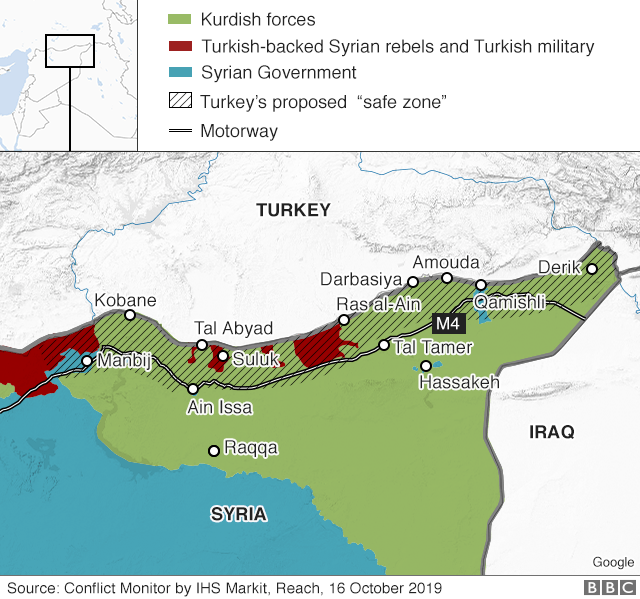
To be sure, everything devolves upon the creation of the safe zone. Turkey envisages a zone stretching across the entire 440 kilometre border with Syria up to the Iraqi border, while the US special envoy James Jeffrey remains non-committal, saying it is up to the “Russians and the Syrians in other areas of the northeast and in Manbij to the west of the Euphrates” to agree to Turkey’s maximalist stance.
Herein lies the rub. Jeffrey would know Ankara will never get its way with Moscow and Damascus. In fact, President Bashar al-Assad told, in unequivocal terms, a high-level Russian delegation visiting Damascus on Friday, “At the current phase it is necessary to focus on putting an end to aggression and on the pullout of all Turkish, US and other forces illegally present in Syrian territories.”
Is there daylight between Moscow and Damascus on this highly sensitive issue? Turkish President Recep Erdogan’s forthcoming meeting with Russian President Vladimir Putin in Sochi on October 22 may provide an answer.
Clearly, the US hopes wrench Turkey from the Russian embrace. Moscow’s studied indifference toward the US-Turkish cogitations betrays its uneasiness. Conceivably, Erdogan will expect Putin to take a holistic view, considering Russia’s flourishing and highly lucrative economic and military ties with Turkey and the imperative to preserve the momentum of the Russia-Turkey relationship.
But Trump has accommodated Erdogan’s top priority to create a safe zone and run it under Turkish supervision, which implies an open-ended Turkish military presence in a swathe of Syrian territory as big as Greece or Nepal. Erdogan’s tone has already changed in regard to his expectations from Putin.
In a meaningful remark on Saturday, he said, “In the area of the operation are forces of the (Syrian) regime under Russia’s protection. We will be tackling the issue with Mr. Putin.” Erdogan then added that in case he fails to “reach agreements on that issue (with Putin), Turkey will be implementing its own plans.”
If the US policy in Syria in recent years promoted the Kurdish identity, it has now swung to the other extreme of stoking the fires of Turkish revanchism. This is potentially catastrophic for regional stability. The heart of the matter is that while Turkey’s concerns over terrorism and the refugee problem are legitimate, Operation Peace Spring has deeper moorings: Turkey’s ambitions as regional power and its will to correct the perceived injustice of territorial losses incurred during the disintegration of the Ottoman Empire. The ultra-nationalistic Turkish commentator (and staunch supporter of Erdogan) wrote this week in the pro-government daily Yeni Safak :
“Turkey once again revived the millennium-old political history on Anatolian territory. It took action with a mission that will carry the legacy of the Seljuks, the Ottomans, the Republic of Turkey to the next stage… It is not possible to set an equation in this region by excluding Turkey – it will not happen. A map cannot be drawn that excludes Turkey – it will not happen. A power cannot be established without Turkey – it will not happen. Throughout history, both the rise and fall of this country has altered the region… the mind in Turkey is now a regional mind, a regional conscience, a regional identity. President Erdoğan is the pioneer, the bearer of that political legacy from the Seljuks, the Ottomans, and the Turkish Republic to the future.”
Trump is unlikely to pay attention to the irredentist instincts in Turkish regional policies. Trump’s immediate concerns are to please the evangelical Christian constituency in the US and silence his critics who allege that he threw the Kurds under the bus or that an ISIS resurgence is imminent. But there is no way the US can deliver on the tall promises made in the joint statement. The Kurds have influential friends in the Pentagon. (See the article by Gen. Joseph Votel, former chief of the US Central Command, titled The Danger of Abandoning our Partners.) Nonetheless, the main outcome will be that Turkey feels it has western support for its long-term occupation of Syrian territory.
All in all, it’s a “win-win” for Erdogan insofar as he got what he wanted — US’ political and diplomatic support for “the kind of long-term buffer zone that will ensure peace and stability in the region”, to borrow the words of Vice President Pence. A Turkish withdrawal from Syrian territory can now be virtually ruled out. State secretary Mike Pompeo added at the press conference in Ankara on Thursday that there is “a great deal of work to do in the region. There’s lots of challenges that remain.”
Pompeo said Erdogan’s “decision to work alongside President Trump… will be one that I think will benefit Turkey a great deal.” Arguably, the US expects Turkey’s cooperation to strengthen its strategy in Syria (and Iraq) where it seeks to contain Iran’s influence. From Ankara, Pompeo travelled to Jerusalem to brief Israeli PM Benjamin Netanyahu.
October 19, 2019
Posted by aletho |
Illegal Occupation | Syria, Turkey, United States, Zionism |
Leave a comment
Earlier this week, as US troops abandoned positions in northern Syria under the de facto control of local Kurdish forces amid the Turkish onslaught, Russian peacekeeping patrols quietly began operating in Manbij, northern Syria in a bid to prevent fighting between Turkish and Syrian Army forces.
The withdrawal of US troops from northern Syria signals a waning of ‘Pax Americana’ in the Middle East, and presents both “dangers” and “opportunities” for Israel in the region, former Israeli intelligence officials, diplomats and lawmakers have told The Times of Israel.
According to Amos Yadlin, former head of the Israeli military’s Military Intelligence Directorate, “All pairs of enemies in the Middle East enjoy reasonably good ties with Russia: Saudi Arabia and Iran, Israel and the Palestinians, the Kurds and the Turks, Israel and Iran, Egypt and Turkey, and so on.” Russia, Yadlin said, is not a Middle Eastern ‘hegemon’ in the traditional sense of the term, with Israel, Saudi Arabia, Turkey, Egypt sharing that title, in his view. Furthermore, he noted, Washington still has far greater forces in the Middle East than Moscow.
“The Russian success stems from their ability to use very few forces with determination and rules of engagement that only they can allow themselves, with a veto at the UN Security Council and a patriotic audience at home,” Yadlin said, without elaborating.
Former Israeli Ambassador to the US Michael Oren said he found the US disengagement in the Middle East much more concerning than Russia’s growing influence. “We have relied for the last 45 years on a Pax Americana that no longer exists. I am not saying that the US won’t come to our assistance, but we can’t be certain of it anymore,” he said. As for Russia, Oren suggested Israel should work to reach a ‘modus vivendi’ with Moscow. “It’s useless for us to pretend that Russia is going to be an ally, but we don’t have to make them enemies either,” he said.
However, Ksenia Svetlova, a former Israeli lawmaker from the Zionist Union Party, said Russia’s rise could have “very grave” implications for Tel Aviv. “We already have Russian air defence systems, the S-300, that cover the Syrian and Lebanese shores. As soon as the Russians think that it’s smart for them to operate these systems and to halt the Israeli attacks, Israel would no longer be able to deal with the extension of Iranian power in these countries,” she said, repeating Tel Aviv’s talking point about alleged growing ‘Iranian influence’ in Syria.
Russia initially deployed its air defences only at its airbase in Latakia, northwestern Syria. However, last October, following a friendly fire incident led to the loss of a Russian aircraft and the deaths of 15 Russian airmen, Moscow began deploying S-300s to Syria’s armed forces, complicating Tel Aviv’s campaign of airstrikes into Syria and leading to a reduction in its intensity.
According to Svetlova, Iran, another Israeli adversary, was also a Russian ‘strategic ally’, and “it’s not likely that Moscow will do anything to curb the Iranian influence in Syria and Lebanon.”
But Ofer Zalzberg, an analyst at the Belgium-based nonprofit International Crisis Group, believes Russia could help reduce tensions between Israel and other countries in the region. In his view, President Trump’s Syria exit would at least temporarily end “Israeli wishful thinking about the US resolving all problems militarily,” which could force Israel too to move away from military operations and turn to diplomacy and “some temporary de-facto power-sharing,” including agreements on Syria and Lebanon and perhaps even a “non-aggression pact” between Israel and Hezbollah.
The US withdrew about 1,000 troops from northeast Syria last week, thereby greenlighting a Turkish military operation Ankara says is aimed against Daesh (ISIS) terrorists and local Kurdish militants, whom Turkish authorities also classify as terrorists. Turkey’s operation brought it broad condemnation from its NATO allies, with the US slapping the country with sanctions. Late Thursday, US Vice President Mike Pence said he and Secretary of State Mike Pompeo had met with Turkish President Recep Tayyip Erdogan and agreed to a ceasefire in Syria.
Amid the Turkish operation, Damascus reached an agreement with Kurdish-led militia forces in northern Syria, allowing Syrian Army forces to advance into Kurdish-controlled areas to mount a joint defence of the Syrian-Turkish border area. This week, Russian peacekeepers began patrols in the city of Manbij in eastern Aleppo province, with the mission aimed at preventing fighting between Syrian and Turkish forces.
October 18, 2019
Posted by aletho |
Ethnic Cleansing, Racism, Zionism, Militarism, Timeless or most popular, Wars for Israel | Israel, Lebanon, Middle East, Syria |
Leave a comment
What everyone is most upset about with regard to Syria isn’t the bloodshed or anything having [to] do with human rights. It’s the decline in American control of the Middle East. This is 100% about US imperialism taking a hit. — Rania Khalek (@RaniaKhalek) October 14, 2019
A series of Donald Trump’s decisions, culminating in the decision to withdraw US troops from Syria, has set off a cascade of effects that are dramatically changing the geopolitics of the Middle East and the internal politics of the United States.
Two months ago, I wrote an article opposing the impeachment drive and stating that Donald Trump is not going to be removed from office by impeachment proceedings. I said: “Donald Trump will be removed from office one way: by an election.”
At that time, in the wake of the fizzling out of the Mueller Report and testimony on Russian “collusion,” the new smoking gun was “obstruction of justice.” “The evidence is overwhelming,” Jamie Raskin said, echoing more than 90 of his Democratic colleagues, “10 different episodes of presidential obstruction of justice.” Walls closing in.
Somehow, even after Mueller’s “very, very painful” testimony, the impeachment drive by the Democrats had intensified to the point that it was de rigueur for every major Democratic presidential candidate, and for anyone calling themselves “progressive,” to demand impeachment proceedings. Because “obstruction of justice.”
Of course, the Democrats were not going to create an irresistible political tide that would get enough Republican senators to vote to oust Trump with that “obstruction of justice” issue, and they knew it. The chance of that was effectively zero.
The odds on that are now changing significantly. What happened to change the impeachment calculus that might move enough Republicans?
The answer is nothing that’s in the Ukrainegate smokingburger, which replaced the obstruction-of-justice smokingburger, which replaced the Russiagate smokingburger. Interpretations of the Zelensky phone call are just that—interpretations. Stipulate the worst: Trump tried to wheedle some personal political benefit from a foreign leader. Shocked! Shocked! Are we?
Really? Does anybody think that, if we read through the transcripts of every conversation between US presidents and foreign leaders over the last fifty years, we wouldn’t find scores of such transactions? And, uh, Hunter Biden, not to mention the Clinton campaign and Foundation. The Republicans can bat that phone call away, and they will face no political groundswell among their voters, or even the general public, to take sides in a family feud among different corrupt factions of a corrupt political elite.
To say nothing of the most outrageous examples of using foreign leaders to political advantage. Richard Nixon conspired with the leaders of South Vietnam to prolong the Vietnam War, and LBJ knew it. Ronald Reagan conspired with the leaders of Iran to prolong the confinement of American hostages, and a bipartisan commission covered it up. But they weren’t presidents at the time? Really, that’s an argument for dismissing these cases? What do you think these guys did when they were presidents? No, Nancy, now that I’m president I cannot seek a political benefit from a foreign leader! And why were these cases ignored and actively covered up, except because they were considered—even if a little extreme—SOP in US politics?
The success of the Democrats’ impeachment drive depends on one thing: getting enough Republican senators to vote for conviction. No, nothing in the Trump-Zelensky phone call or anything like it is going to move Republicans to temper their defenses against the Democratic onslaught, let alone move enough of them in the Senate to vote to remove him from office.
If Republicans do stop defending him against that, it will be because they have become radically disaffected with him about something else.
That something else is real, though it probably will not be explicitly stated in impeachment charges. It’s the simmering bipartisan concern about Trump that has been brought to a boil by a recent series of events and decisions: his unreliability as a trigger-puller, his aversion to ordering big military attacks. This is certainly a damning fault in the eyes of most Republicans (as well as Democrats), a disqualifying failure or responsibility from the warden of the US empire. That’s the impeachable offense that could well get enough Republican votes to convict him.
During the 2016 campaign, Donald Trump expressed his opposition to wasteful foreign interventions clearly and repeatedly enough, and was skewered by the Democrats whenever he did, as they promoted lies and war and lies about war (specifically about Ukraine, as I noted) for their political benefit.
He also expressed his disdain for the obligatory nod to US sanctimony, when he responded to Joe Scarborough’s complaint about Putin killing people: “I think our country does plenty of killing also,” and when he pushed back on George Stephanopoulos regarding Ukraine: “The people of Crimea… would rather be with Russia than where they were.”
These kinds of thoughts are anathema to hawkish Republicans. They could only be ignored because they assumed: 1) he wasn’t going to win, 2) it was empty campaign rhetoric, and 3) as President, he would be boxed in and managed by the shepherds of the national-security state. Only one of those assumptions turned out to be entirely false, and it’s the uncertainty about how the other two are now playing out that might undermine his support among Senate Republicans.
In the last few months, Trump has made decisions either to reduce US military presence or explicitly not to take military action that was expected and planned. These were rhetorically and substantively anti-interventionist positions that are anathema to imperialist Republicans. The most consequent of these in the impeachment context are those regarding Iran, and, relatedly, Syria.
The dangerous fuse of Republican discontent with Trump was lit with Trump’s decision in June to call off the military strike on Iran, after Iran’s downing of a US drone. That event followed attacks on Norwegian and Japanese tankers in the Persian Gulf that the US government blamed on Iran. A narrative had been established for US politicians and media: Every nasty thing that happens in the Middle East is to be blamed on Iran. It’s a narrative with a specific target and a specific goal: to manufacture consent for a military attack on that target—Iran—when a good opportunity was either concocted or presented itself.
Iran’s acknowledged destruction of a valuable US military asset provided that opportunity. Trump’s decision—on the profound advice of Bolton, Pompeo, et. al.—to launch an attack on Iran was the inevitable next scene in the script. His decision, made a few hours later, to cancel the attack was something else again. It was a decision made “without consulting his vice president, secretary of state or national security adviser,” with “forces… already in motion… more than 10,000 sailors and airmen…. on the move,” and with “only 10 minutes to go.” Per the NYT, that decision “stunned,” ”flabbergasted,” and outraged his closest advisers and key Republican allies. It was an unprecedented deus ex machina, an impermissible interruption that, especially for Republicans, just doesn’t fit in the epic story of American “presidentialness.”
Leftish Trump opponents have not, I think, recognized what an extraordinary, important, and praiseworthy decision this was by Trump. Has there been a more positive decision of such consequence made by any president in the last thirty years?
Yes, it was the reversal of a prior, terrible decision of his. And, yes, it’s subject to reversal again because of his inconsistency and his many other terrible decisions regarding Iran and the region. But on its own, it stopped an onslaught of immense destruction. That it was a reversal of something he had set in motion only makes it more extraordinary as a presidential act.
Moreover, Trump was not alone in the process of re-thinking his decision. The Washington Post tells us that, from the get-go, the decision to strike Iran had “divided his top advisers, with senior Pentagon officials opposing the decision to strike and national security adviser John Bolton strongly supporting it.” And during those hours of reconsideration, as the NYT reports: “there continued to be pushback from Pentagon civilians and General Dunford.”
In other words, this wasn’t just a matter of peripatetic Trump; it was a matter of an ongoing tension between the fervently Zionist neocons, represented by the likes of Bolton and Pompeo, and the military realists, as represented by Chairman of the Joint Chiefs Dunford. Let’s not—as hawkish Republicans and Democrats certainly will try to—hide that tension in the tale of Trump’s personal inconsistency.
That tension defines something that Trump and every American president is inconsistent about. In the US context, that Trump changed his mind in the direction he did at the last minute is, again, extraordinary—one might even say “courageous.”
Sure, better not to have ordered the attack in the first place, but, in such circumstances, I’ll take reconsideration and second thoughts to sticking to one’s guns.
What we see here is that, for all his bluster, Trump knows when to be scared of a fight that will certainly hurt and not benefit the US, unlike the missionary (whether Zionist, Christian, or secular “humanitarian”) interventionists—including past presidents Obama and Bush, the man “progressive” impeachers would have president, Mike Pence, and every one of the present Democratic contenders, with the possible exception of Sanders or Gabbard. Certainly, in the same circumstances (having decided for the neocons, still getting pushback from the military), none of those Democrats, with the noted exceptions, would have made the re-consideration Trump did, and we would be at war with Iran now.
Anti-Trump lefties may not want to recognize how radical Trump’s decision to call off the Iran strike was, but senior Republicans sure do.
Sen. Lindsey Graham, a not unimportant player in the unfolding impeachment drama, said Trump’s decision to cancel the Iran strike “was clearly seen by the Iranian regime as a sign of weakness.” To which Trump responded, in tones matching Obama’s best anti-stupid-interventionist campaign rhetoric: “No Lindsey, it was a sign of strength that some people just don’t understand!” Republicans were likening Trump’s refusal to strike Iran over the drone downing to Obama not striking Syria over the chemical weapons “red line” pretext. Having Republicans and his own advisors see him as “all too reminiscent … of Mr. Obama” is not a look that will help Trump among imperialist Republican senators.
Indeed, that remark of Graham’s was made after Trump’s second dramatic failure to respond with military action—this time to the September 14th Houthi attack on Saudi oilfields, which was framed by neocon Pompeo as an “act of war” by Iran and, implicitly, against the United States. Even the liberal NYT accepted the framing that Trump “let down his Arab partners by failing to respond more forcefully to Iranian aggressions.” quoting one Gulf political scientist that: “Trump, in his response to Iran, is even worse than Obama.”
What’s important for the purposes of impeachment possibility, of course, is whether Trump’s Republican allies see it that way. And they do. Here’s Graham again: “This is literally an act of war and the goal should be to restore deterrence against Iranian aggression which has clearly been lost.” There it is: Trump “lost” deterrence against, is “losing” the Middle East to, Iran.
Former C.I.A. official Reuel Marc Gerecht echoes and amplifies the line to NYT reporters at the ultra-neocon Foundation for Defense of Democracies: “The president’s repeated failure to militarily respond to Iranian actions has been a serious mistake.”
It was a week after this putative “act of war” by Iran and non-military response by Trump, on September 23rd, that a group of “moderate” freshmen Democratic congresswomen who had “formed a bond over their national security background,” joined by two freshmen male colleagues, also military veterans, wrote a Washington Post (WaPo) op-ed that, as CNN puts it: “changed the dynamic for House Democrats, and indeed — the course of history.”
These women call themselves the “badasses,” a name that one of them, Chrissy Houlahan, says, “came organically from the group since we all had either served in the military or in the CIA.”
So, it was no squad of “progressives,” but a cohort of Democrats bound by national-security/intelligence “service” that “opened the floodgates,” and persuaded Nancy Pelosi to move with them “from hard no to hell yes on starting an impeachment inquiry.”
They say their position changed so suddenly and dramatically that week in September because, as CIA veterans and all, they were shocked, shocked that POTUS “may have used his position to pressure a foreign country into investigating a political opponent.” Reading their op-ed, you’ll find no hint that they share their colleague Gerecht’s concern about “the president’s repeated failure to militarily respond to Iranian actions.” No, no, these military and CIA badasses keep their “steadfast focus” on “health care [and] infrastructure.” Sure.
Now, making things worse for himself, Trump “Throws Middle East Policy Into Turmoil” by announcing a “withdrawal” of US troops from northeast Syria. This “touched off a broad rebuke by Republicans, including some of his staunchest allies,” whose response has been apoplectic: “some of the sharpest language they have leveled” against him. Here are the leaders of the Senate Republican caucus that will vote on any impeachment referral:
Liz Cheney: It’s a “catastrophic mistake that … threatens America’s national security”
Marco Rubio: Trump’s decision “is a grave mistake that will have severe consequences beyond Syria. It risks encouraging the Iranian regime [and]… will imperil other U.S. national security interests in the region.”
Lindsey Graham: “if he follows through with this, it’d be the biggest mistake of his presidency.” And: “This to me is an Obama-like decision” and “if President Trump continues to make such statements this will be a disaster worse than President Obama’s decision to leave Iraq.”
Their ostensible outrage is that Trump’s decision “betrays our Kurdish allies,” since it opens the way for a Turkish invasion to subdue Kurdish forces who aligned with the US. And the decision was impulsive, throwing “supporters, foreign leaders, military officers and his own aides off balance,” and does effectively greenlight what is an outrageous offensive by Turkey to steal Syrian territory and ethnically cleanse Kurdish areas.
But Turkey has already invaded Syria with US blessing, under the Obama administration, betraying the same Kurdish allies. As I wrote in a 2016 essay: “Vice-President Joe Biden stood beside Turkish President Erdogan and commanded the Kurds to back off and let Turkey have its way—to actually surrender territory they had won from ISIS to Turkey, and to the Free Syrian Army, Faylaq Al-Sham, Nour al-Din al-Zenki, and re-costumed-ISIS jihadis who follow in the wake of Turkish tanks.”
“We have made it absolutely clear to . . . the YPG that participated” in the taking of Manbij and other towns “that they must move back across the river,” Biden said. “They cannot, will not, and under no circumstances will get American support if they do not keep that commitment. Period.”
Tough love Joe, who at the time was trying to reassure Erdogan that the US was not complicit in the coup attempt against him. The US government was always going to accede to its NATO ally over its more-dispensable Kurdish “partners.”
My point above about the jihadis coming in Turkey’s wake is still quite relevant and undermines the whole “protection from ISIS” narrative. The US itself cheered ISIS on, as Obama’s Secretary of State John Kerry admitted. Turkey supported ISIS and trafficked ISIS soldiers, arms, and oil across its border with Syria throughout the conflict. That 2016 Turkish invasion made liberal use of jihadi proxies, including ISIS, which calmly turned territory over to Turkish-backed forces, with some ISIS fighters just changing their uniforms to join them.
In the current invasion, Erdogan is playing the same game. He explicitly says, for example, that “The Turkish army won’t enter Manbij. We’ll be content with providing assistance to Syrian opposition and tribal forces.” Erdogan wants to avoid a direct conflict with the Syrian Army (SAA) and its Russian allies, so those “forces”—now branded the “Syrian National Army” or the “Turkey-Supported Opposition” (TSO)—will be the ground-level fighters of Turkish attacks. They include the various jihadi factions within the Free Syrian Army (FSA) that the US created, any ISIS cadres who wish to join as the TSO deliberately releases them, and some angry Syrian Arabs who were thrown out of their homes by Kurd militias (who have been no angels in seeking to establish their ethno-state). You know, the kinds of “forces” that the US government and media insisted for years were “moderate rebels,” and are now acknowledging are ruthless killers who are executing captured Kurd fighters as well as civilian political leaders.
Incredible: US officials are now admitting “rebels” from the “Free Syrian Army” that are embedded with the Turkish army are intentionally freeing ISIS prisoners, while massacring civilians These are some of the “moderate rebels” the CIA armed and trained https://t.co/x5389IgVNx — Ben Norton (@BenjaminNorton) October 15, 2019
It’s the SAA and its allies that were the most effective at destroying ISIS and jihadi “forces” over the last eight years. For neither Turkey nor the US was ISIS ever anything other than a weapon against the Syrian government and a convenient pretext for “protective” intervention. And the Kurds were always more pawns than “partners.”
And the spectacle of countries/actors like the EU, the UAE, and Saudi Arabia, all of whom financed and armed an invasion of Syria by foreign jihadis for 8 years, now objecting to Turkey violating the “territorial sovereignty” of Syria demonstrates the death of irony.
Turkey is illegally extending its prior illegal invasion of Syria into sovereign Syrian territory that the US had illegally taken control of. Mark Sleboda puts it well: “Turkey is invading the US invasion of Syria.”
Neither Trump’s staunch Republican allies, nor his Democratic opponents, nor any of those countries give two hoots about the Kurds, let alone Syria’s “territorial integrity.” They are not upset and outraged at Trump because he opened the possibility of Turkey repressing the Kurds; they are upset and outraged because he made the Kurds finally see what fools they were to ally with the US and to turn instead to an alliance with the Syrian government. US politicians’ crocodile tears for the Syrian Kurds are really rage at losing their allegiance.
The Kurdish commander of the US-created Syrian Democratic Forces (SDF), Gen. Mazloum Kobani Abdi, is now saying: “if you’re not [protecting my people], I need to make a deal with Russia and the regime now and invite their planes to protect this region,” and writing in Foreign Policy that “The Russians and the Syrian regime have made proposals that could save the lives of millions of people who live under our protection.” He may also say: “We do not trust their promises,” but he knows very well that some kind of autonomy agreement with Damascus is preferable for Syrian Kurds to Turkish occupation and ethnic cleansing.
So, the SDF has formally “agreed to the deployment of the SAA” throughout the group’s ‘self-administration’ area (“to all areas starting East from Ain Dawar to Jarablus in the north”), calling on the SAA to do its “duty to protect the country’s borders and preserve Syrian sovereignty.”
As I write, the SAA and allied forces have already, often greeted with celebration, entered the towns of Ain Issa, Tel Tamer, Qamishli, Kobani, Raqqah, and Manbij—where they’ve taken over a US base.
As the NYT reports: “If Syrian government forces can reach the Turkish border to the north and the Iraqi border to the east, it would be a major breakthrough in Mr. Assad’s quest to re-establish his control over the whole country.”
The problem now isn’t that the Kurds no longer have any allies; it’s that the Americans don’t.
The Kurds have now recognized and joined the alliance that really is capable of preserving their own lives and Syria’s “territorial sovereignty”—which is precisely what the US, NATO/EU, Israel, the Gulf monarchies, and Turkey, have been trying to destroy for eight years.
This is what Trump’s McCain-Republican frenemies are pissed-off at. Led by Lindsey Graham, they’re pissed-off at Erdogan—not for killing Kurds, but for disrupting the game which used protection of the Kurds as a “humanitarian” alibi for dividing Syria and overthrowing its government.
The American troops that Trump moved out of the way were not protecting the Kurds from Turkey, they were protecting Turkey from itself—from Erdogan’s hubris in overplaying his hand and entering into what at best will be a quagmire of occupation and resistance from Syrian Kurds, and at worst a direct conflict with the Syrian army and its Russian ally, which Erdogan definitely does not want.
But most of all, those US troops were protecting the ongoing, long-term project of state-destruction in the region on behalf of Israel. The splitting off of a Kurdish area and the presence of US troops in it—under the pretext of a protective force, but really as a constant dagger pointed at Damascus and maintaining the threat of US-led regime change—were lynchpins of that project, which was supposed to culminate in a state-destroying military attack on Iran.
The McCain Republicans are pissed-off at Trump for completely upending—perhaps even finally ending!—that project.
The suite of decisions Trump has made, starting with the decision to cancel the strike on Iran, were accompanied by rhetoric that gets him into even more trouble, especially with those McCain Republicans.
“I campaigned on the fact that I was going to bring our soldiers home and bring them home as quickly as possible.”
“I held off this fight for almost 3 years, but it is time for us to get out of these ridiculous Endless Wars.”
[Regarding Turkey and Syria] “That has nothing to do with us,” he said. He said he could understand if Syria and Turkey want territory. “But what does that have to do with the United States of America if they’re fighting over Syria’s land?”
[Regarding whether his decision to pull back from Syria had opened the way for Russia and the Syrian government] “I wish them all a lot of luck. If Russia wants to get involved with Syria, that’s really up to them,” he added.
Responding to Lindsey Graham’s criticisms] “The people of South Carolina don’t want us to get into a war with Turkey, a NATO member, or with Syria.”
“Let them fight their own wars.”
“Ridiculous endless wars,” “Let them fight their own wars”—anathema for a serving president to say. Acceptable as campaign rhetoric, but never to be said for real by a president in office—especially a president attacked for his “repeated failure[s] to militarily respond” to designated enemies.
All of this marks a new and real danger for Trump in the impeachment process. When Graham, “usually one of the president’s most vocal backers,” warns that unless Trump reverses (!) his decision, it “will be the biggest mistake of his presidency,” that sounds a lot like a threat.
There’s another element that appears in all the neocon, McCain-Republican (as well as McCain-Democrat) objections, which can be seen, for example, in Lindsey Graham’s remark that Trump’s decision is: “a big win for Iran and Assad, a big win for ISIS.”
Note the logic here: Turkey disappears as the enemy, and ISIS gets added at the end for the scare factor, but it’s the “win” for Syria, which in his view also means a win for Iran, that’s the real problem. It always goes to Iran.
It’s crucial to understand all the implications that underlie and make sense of such a statement. After all, there’s no “win” for Syria in the Turkish invasion of its territory unless it results in the Kurds turning to Damascus and the SAA for their protection. If Graham’s professed interest in protecting the Kurds were real, that would be a good thing. But it also brings Syria closer to finally winning against the eight-year US-sponsored regime-change and state-destroying operation, which is Graham’s and the US’s real agenda, so it therefore becomes a bad thing. This discourse reveals that Graham, like the rest of his colleagues, is not worried about whether the Kurds will be protected from Turkey, but whether they will reconcile with Damascus.
And how can the Turkish invasion of Syria possibly be construed as a “win” for Iran, which has “warned its neighbor not to move forward with its military operation” and held unannounced military drills near its border with Turkey? Only if everything that’s happening in Syria is a function of a project directed against Iran. Only if Syria’s winning back the allegiance of the Kurds as well as its actual territorial integrity is a “loss” for the US in an offensive against Iran.
It always goes to Iran.
Graham is here expressing what’s actually behind the growing urgency of the neocon national-security apparatus to replace Donald Trump with Mike Pence—‘cause, you know, that is what impeaching and convicting Trump will do—and why it may adversely affect Trump’s chances with Republican senators.
One cannot understand what’s happening in Syria, or what’s happening in impeachment, or the relation between the two unless one understands the role of Israel in determining US policy and influencing US politics in general. US policy in the Middle East is completely incoherent until one understands the extent to which it’s Israeli policy.
One cannot complain that Trump’s Syria decision caused “chaos” without recognizing the chaos that US intervention throughout the Middle East since 2001—in Iraq, Libya, and Syria—has already caused, and was designed to cause, for the sake of Israel. Because, as Middle East Monitor reports: “the [former] chief of Israel’s military intelligence, General Aviv Kochav, has said that the chaos in the Arab world favours Israel and is something that he believes should continue.”
And one cannot understand what’s happened and happening in Syria, and what the US politicians really think is “wrong” with Trump’s decision, without placing it in the context of the US-Israeli strategy that was famously revealed by Wesley Clark (and studiously ignored by US media), to “take out seven countries… starting with Iraq and Syria and ending with Iran.”
Iran has always been the ultimate target. Syria was a stepping-stone, the part of what Israel saw as the “Tehran-Damascus-Hizbullah alliance” that became ripe for removing in 2011-2. This was made explicit in a State Department report, authored by James Rubin (Christine Amanpour’s husband), that appeared in a Hillary Clinton email chain: “The best way to help Israel deal with Iran’s growing nuclear capability is to help the people of Syria overthrow the regime of Bashar Assad.” Or, as high-ranking Israeli officials gleefully foresaw: “Syria’s fragmentation into provinces, … the formation of an Alawite district in the coastal region… a Sunni province … and … a Kurdish province in northern Syria.”
That Iran has been the ultimate target is also made clear in an exceptionally important and detailed NYT report, “The Secret History of the Push to Strike Iran” (published before the Syria decision), which I urge everyone to read. It chronicles how “Hawks in Israel and America have spent more than a decade agitating for war against the Islamic Republic’s nuclear program,” and asks “Will Trump finally deliver?” It details Benjamin Netanyahu’s obsessive “personal crusade” against Iran, and his attempts to cajole, browbeat, and bluff the US into attacking Iran for the Jewish state—to the point that the US ambassador to Israel thought: “Israel might consider it an advantage to strike in the final phase of the [2012] election,” believing it “could force the United States’ hand to be supportive or to come in behind Israel and assist. Because otherwise, President Obama could be accused of abandoning Israel in its moment of need.”
Israel used this “can’t refuse Israel” ideology to make sure the Obama administration “meticulously refined” “military plans for an Iran strike” that, if he didn’t use, would be a “loaded gun,” “inherited” by the next president.
But Trump hasn’t picked up that gun. Despite his embrace of so many aspects of Netanyahu’s agenda, Israelis now fear that “the American president in whom they had invested so much hope has gone wobbly.” Why? Because of his “last-minute decision to abort the attack in June,” which has “led to a concern among Iran hawks in both Israel and the United States: that the president ultimately might not have the resolve to confront the threat with military force.”
As Haaretz reports, in a more recent editorial “Netanyahu’s Iran Policy Has Collapsed”: “Trump’s putting up with the attack on Saudi Arabia and leaving the Kurds high and dry are warning signs to Israel, that it cannot count on Netanyahu’s friend in the White House.”
And the BBC: Netanyahu’s “signature Iran policy … was rocked by the president’s reluctance to flex US military muscle in response to an apparent Iranian attack on Saudi oil installations…. [which] evinces the utter collapse of the security doctrine that has been advanced by Netanyahu, [and] has been compounded by Mr. Trump’s decision to pull US troops out of north-eastern Syria.” Israel is now “facing the reality of an unpredictable and transactional president who has deep reservations about using US military might, is afraid of getting involved in another Middle East conflict.”
Those hawks in Israel and the United States may be giving up on Trump, but one would be a fool to think they are giving up. They’re just looking for another “friend in the White House”—and right quick. The election is too far away, and its results too unpredictable.
Trump is slithering filth and dangerously mercurial and random. But the recurring liberal bashing of him for non- and reduced military intervention and for not loving bad guys like the CIA and FBI and John McCain truly is knee-jerk. https://t.co/rQT2KOj1qg — vastleft (@vastleft) October 9, 2019
Leftists may be loath to acknowledge it, but, for whatever reasons he made it, Trump’s decision on Syria—the culmination of a series of non-interventionist decisions—has “marked a major turning point in Syria’s long war” and has, indeed, “upended decades” of imperialist and Zionist plans for the Middle East It deserves to be recognized and supported as such by all leftist anti-imperialists as much as it is recognized and denounced as such by the entire spectrum of US-imperialist politics and media. It’s a very good thing, a positive aspect of the Trump-effect I’ve written about previously.
We leftists can point out that Trump’s non-interventionist rhetoric, and even decisions, do not always translate into reality. All US troops have not yet been withdrawn from Syria. US troop presence in the Middle East increased by 14,000 since May. He just sent another 2,000 US troops to Saudi Arabia. His policies on Palestine, Venezuela, and even Iran are criminally aggressive, even if they have not yet involved a military attack. We know that he’s impulsive and changeable, and, most importantly, weak. Even if he has a sincere desire to end ridiculous, endless, and wasteful wars, it’s a shallow impulse, ungrounded in anything but self- and US-centered principle. That makes him weak, and it’s why he surrounds himself with neocon deep-state actors on whom he depends and who often ignore or actively oppose him—especially when it comes to his non-interventionist instincts. He is certainly as much of, if more erratic, an imperialist/American-exceptionalist and world bully as any US politician.
That’s the dangerous aspect of Trump’s incoherence that we leftists, for good reason, focus on. But his right-wing critics, and would-be and erstwhile neocon advisors like Bolton (“the whistleblower’s Deep Throat”?) see and fear the other side of his “unpredictable and transactional” character—his call for better relations with Russia, his desire for a deal with Kim Jong-Un, etc.
But most of all, and most importantly in relation to the Middle East and the sacred imperatives of Israel, they see that one big flashing yellow light that they despise: he’s reluctant to pull the trigger on a big attack on the principal enemy. They can maneuver around him, and push him largely where they want him to go, but when it comes to a decisive strike, he’s the commander-in-chief; he needs to give the order. In a series of what for them are crucial moments, Trump has shown himself to be unreliable for that. They want a commander-in-chief on whom they can rely to pull the trigger. Like Mike Pence.
And in this Syria decision they see, correctly, that, no matter how many troops and ships he is moving around the Middle East, Trump has effectively collapsed a longstanding imperialist and Zionist project for Syria and possibly Iran that neocon policy makers had no intention of giving up on. They may yet get him to reverse that or over-compensate for it with some worse aggression, but he seems to be “undeterred,” and “doubling down” on it, “despite vociferous pushback from congressional Republicans” and “top advisers.”
The Democrats need at least 20 Republican senators to convict Trump and throw him out of office. That is no longer impossible. Many McCain Republicans are now on record as seeing Trump’s policy decisions as a threat to “national security” and to fundamental US and “allied” interests, especially in the Middle East.
A “veteran political consultant,” cited by a conservative blogger, made it specific: “The price of Graham’s support… would be an eventual military strike on Iran.”
Impeachment and conviction are still unlikely. Perhaps because Trump will pay Graham’s price—in which case, watch the pressure dissipate. Or, in the better case, and the one Trump seems to be sticking with, precisely because ending ridiculous, wasteful wars and keeping campaign promises and “Let them fight their own wars” are very popular pitches with the Republican (and not only Republican!) electorate. That might well prevent too many Republican defections.
So, the Republican politicians who want to vote against Trump for his aversion to military strikes (and their allied media—watch how FOX and Breitbart coverage evolves) will have to go along with the Democrats and the media fronting other issues. They’ll have to subtly soften their defense of Trump against Ukrainegate charges, starting even during formal impeachment hearings in the House. Unlikely, but no longer impossible. Fundamental imperialist and Zionist policies are at stake.
Kid yourself not. No matter what the formal articles of impeachment say, if Donald Trump is removed from office by impeachment, if more than twenty Republican senators vote to convict him, it will not be because of Russiagate or Ukrainegate of Bidengate or any other ruse issues bleated about constantly in the media, but because he is just too “unpredictable and transactional” to be counted on to pull the trigger when it counts. 100%.
Left-socialist analysis from Jim Kavanagh, former college professor and New York City native and denizen.
October 18, 2019
Posted by aletho |
Militarism, Progressive Hypocrite, Timeless or most popular, Wars for Israel | CIA, Free Syrian Army, Middle East, Syria, Turkey, United States, Zionism |
Leave a comment
Several years ago, the United States hired Kurdish fighters to be our mercenaries in Syria. This month we decided we don’t need them anymore, and abandoned them to their fate. Turkey, which considers Kurdish militancy a mortal threat, quickly began bombing them. This set off a veritable orgy of indignation in Washington. It is a classic example of “buffet outrage,” in which one picks and chooses which horrors to condemn.
Among those shedding crocodile tears, often accompanied by vivid threats against Turkey, are politicians and pundits who have never uttered a peep about American bombs laying waste to Yemen or American sanctions devastating lives in Iran. The United States deserves condemnation for abandoning its promise to the Kurds. Much of it, however, is a hypocritical blend of anti-Trump fanaticism and frustration over the emerging reality that we have lost the Syrian war.
Abandoning the Kurds is not a policy that materialized out of thin air. It is the product of two long chains of American error, one dating to the beginning of the Syrian war and the other even further back. The deeper history of our Middle East tragedy begins in 1980, when President Carter declared that any challenge to American power in the Persian Gulf region would be repelled “by any means necessary, including military force.”
A generation later, President George W. Bush recklessly ordered the invasion of Iraq, which set the region afire and led to the creation of ISIS.
The more recent set of causes for our Kurdish misadventure began in 2011, when President Obama ordered President Bashar Assad of Syria to “step aside.” Beyond the arrogance that leads American presidents to think they can and should decide who may rule other countries lay the utter impossibility of achieving that goal.
The head-chopping death cults that fought alongside our partners in Syria, including Jabhat al-Nusra, the local al-Qaeda franchise, and Ahrar al-Sham, which seeks to “build an Islamic State” based on “Allah’s Almighty Sharia,” have as part of their agenda the murder of every Shia Muslim. Since the population of nearby Iran is 90 percent Shia, it should have been obvious from the beginning that Iran would use every ounce of its considerable power to assure Assad’s survival. If Obama had looked at Syria realistically rather than succumbing to fantasy, he would have understood that Assad and his Iranian backers would do whatever necessary to defeat the American project. Instead he plunged ignorantly into a conflict that we had no prospect of winning.
Following the example his predecessor set when invading Afghanistan, Obama looked for “partners” who would fight the anti-Assad war for us. Many of the militias we hired and armed were connected to jihadist terror gangs. That made sense, because the Assad government is resolutely secular and those fanatics hate secularism. We also hired Syrian Kurds. They agreed to fight not because they wanted to commit genocide against Shia Muslims and other infidels, but for a completely different reason. They had watched their Kurdish cousins in northern Iraq establish a mini-state, and dreamed of doing the same in northern Syria. If they supported the American war against Assad, they reasoned, the United States might reward them by helping them turn their piece of Syria into an autonomous region or quasi-independent state.
This was never a realistic possibility. The country that Syrian Kurds wanted to carve out for themselves, which they called “Rojava,” did not have nearly the size, population, or military strength to survive in the unforgiving Middle East. Kurdish leaders understood this, but believed they would thrive anyway because their American friends would defend them. That was a pitifully naive miscalculation. The United States has repeatedly made lavish promises to the Kurds and then betrayed them — most notably in the 1970s, when we encouraged Iraqi Kurds to rebel against Saddam Hussein’s government and then abandoned them when Saddam made an accommodation with our ally, the Shah of Iran.
Yet Kurds never seem to learn. Their childlike trust in American promises brings to mind the cartoon character Charlie Brown, whose so-called friend Lucy pulls the football away at the last moment every time he tries to kick, but who nonetheless keeps believing this time will be different.
Although the Kurds did not foresee this betrayal, Assad did. “We say to those groups who are betting on the Americans, the Americans will not protect you,” he warned in a speech nine months ago. The Kurds should have listened. In fact, seeking Assad’s protection was always their Plan B. Now, very late in the game and after taking thousands of casualties fighting for their alluring but unfaithful American “friends,” they are doing it. They have effectively surrendered to the Syrian army and asked for its help in defense against Turkey, which thought it had a chance to crush them and establish itself as the de facto ruler of “Rojava.” The Kurds’ alliance with the United States was doomed from the start. Alliance with Assad makes more sense. He may not be the world’s most reliable ally, but he is more trustworthy than the feckless United States.
Although the Kurds’ decision to ask pardon from Assad and join him in rebuilding a secular state is years overdue, it is welcome and wise. It brings Syrians a step closer to the only solution that can end their suffering: reunification. This war will only end when the government re-establishes its authority over all of Syrian territory and hostile foreign forces withdraw. Syria Kurds have belatedly recognized this truth. We should do the same.
Stephen Kinzer is a senior fellow at the Watson Institute for International and Public Affairs at Brown University.
October 17, 2019
Posted by aletho |
Illegal Occupation, Militarism | Middle East, Syria, United States |
Leave a comment
The foreign policy elite is in an uproar. They claim “we have abandoned our allies”. They question “how can America be trusted?” They say the decision to withdraw from northern Syria was a “gift” to Russia, Iran, and Assad, even ISIS. It is true that the policy of US/NATO interventionism is failing. But that has been true since the invasion of Iraq or earlier. After the disastrous invasions and attacks on Afghanistan, Iraq and Libya, and the 8 year undeclared war on Syria, isn’t it time to question the foreign policy elite?
If one believes in restoring international law and the UN Charter, it is GOOD that US military forces have been withdrawn from northern Syria. Here are some facts and history which explain why.
Basic fact: It’s not our country and US troops were never authorized by the sovereign government. Whether or not Washington likes Damascus is irrelevant. Under international law those troops have no right to be there. Even the overflights of Syria by the US air coalition violate international agreements. It’s up to Syrians to defend their country against invading Turkey. If they choose to get support from another country, that is their right.
Another fact: President Obama was correct when he said that “putting boots on the ground” in Syria would be a “profound mistake”. Later he said, “We have a very specific objective, one that will not lead into boots on the ground or anything like that.” But the hawks prevailed. There were not only “boots on the ground”, there was a shifting rationale why they had to be there.
The US and allies have done all they could, short of direct invasion, to overthrow the Syrian government. They have spent tens of BILLIONS of dollars in weapons, training, equipment, recruitment, etc. This is in violation of international law. More than one hundred thousand Syrians have died defending their country against a foreign sponsored army of mercenaries and foreign fighters.
An astonishing fact: The US encouraged the emergence of the Islamic State. Why? Because it put pressure on Damascus and because it justified the entry of the US. While the US carpet bombed Raqqa, it looked the other way as hundreds of trucks conveyed oil from eastern Syria into Turkey to fund the Islamic State. The US air coalition attacked the Syrian Arab Army in the midst of a critical battle against ISIS near Deir Ezzor. In a secretly recorded conversation in New York with Syrian “activists”, John Kerry admitted they were watching ISIS and hoping to use it to pressure Damascus. In other words, US foreign policy was duplicitous and used terrorism as a tool. This is well documented in the book The Management of Savagery.
After the US-backed “Free Syrian Army” failed, the US looked for another means to destabilize Syria. They started to fund the Syrian Kurdish militias known as the Peoples Protection Unit (YPG /YPJ). They gave the militias a new name, Syrian Democratic Forces (SDF), and encouraged the secessionist tendency. Meanwhile in Turkey, which has the largest Kurdish community, most Kurds want to have their rights within Turkey and have formed a political party (Peoples Democratic Party – HDP) which unites progressives of all ethnicities. In the 2015 Turkish election this party emerged as the third most popular party and stopped Erdogan’s election domination. Currently the HDP is campaigning against Turkey’s invasion of Syria. As of 13 October the Syrian Kurdish militias have come to an agreement to work with Damascus to combat the Turkish invasion. The agreement specifies that the Syrian Arab Army will control and defend the entire area from Jarablus on the Euphrates River to the far eastern border with Iraq.
Advocates of US intervention claim that the Kurds were fighting and dying “for us.” That is not true. They were defending their own community. To the extent that they accepted and welcomed US air support, equipment, weaponry, etc. it was for their own benefit. There were two parties trying to use each other.
Whenever the US attacks or occupies a country it needs a rationalization. In 1991 there were false claims about incubators being stolen by Iraqi troops in Kuwait. In 2003 there were false claims about weapons of mass destruction in Iraq. In 2011 there were false claims of civilians being threatened by Libyan troops in Benghazi. All these claims were subsequently found to be exaggerated or entirely false.
One of the main justifications for continuing US presence in Syria is “keeping our word” and not “abandoning” the Kurdish forces. This is a favorite rationalization for war. In Cuba, the CIA trained Cuban exiles that attacked Playa Giron “were counting on us.” Fortunately, JFK resisted the pressure and said “No”. In Vietnam, the US continued the war for a decade because we could not let down our “ally”, the government of Saigon. Millions of Vietnamese were killed plus 55,000 US troops because we could not “abandon” a government that in reality was a proxy.
In the Democratic Debates (15 October) Joe Biden said that the withdrawal of US troops from northern Syria was “the most shameful thing any president has done in modern history in terms of foreign policy.” This is absurd. Over one million died in Iraq including 4500 and at least 100,000 severely injured US soldiers. Joe Biden was an influential supporter of the 2003 Iraq invasion. Later, as Vice President, he supported the overthrow of the Libyan government. The country is still in chaos with tens of thousands dead. These two countries were devastated by US actions. It is evidence of shameless unaccountability in media and politics that Joe Biden is a serious candidate for President after he destroyed so many lives at a cost of trillions. In the same Democratic debates Tulsi Gabbard was honest and accurate as she said that the plight of the Kurds in northern Syria is “yet another consequence of the regime change war we’ve been waging in Syria”.
Despite the howls of indignation and disinformation, withdrawing US troops from northern Syria is a step in the right direction.
Rick Sterling is an investigative journalist who has visited Syria several times since 2014. He lives in the SF Bay Area and can be reached at rsterling1@gmail.com.
October 17, 2019
Posted by aletho |
Illegal Occupation, Militarism | Middle East, Syria, United States |
Leave a comment
Democrats and 129 of the Republicans in the House of Representatives voted to pass a non-binding resolution disapproving of President Donald Trump’s pullout of US troops from Syria – never authorized by Congress to be there.
The House Joint Resolution 77 describes the presence of US troops in northeastern Syria as “certain… efforts to prevent Turkish military operations against Syrian Kurdish forces,” and formally voices opposition to their withdrawal, but does not offer an alternative. Instead, it demands the White House present a “clear and specific plan for the enduring defeat” of Islamic State (IS, formerly ISIS).
The IS “capital” of Raqqa was liberated by US-allied Kurdish militias in October 2017, and the last IS enclave was declared secured in December 2018, but traces of the presence of the self-declared “caliphate” remain in both Syria and Iraq, weakened by years of war and sanctions.
The House resolution asks the White House to continue providing “humanitarian support” to the Kurds and ensure that Turkey “acts with restraint,” while also demanding of Ankara to stop its “unilateral military action” in Syria.
Trump has maintained he never gave the “green light” to Turkey to invade Syria, and defended the withdrawal as protecting the lives of American soldiers in a region where they had no business being anymore. He has also threatened to “destroy” Turkey’s economy with sanctions and tariffs over the invasion.
Congress has never voted to authorize the US troop presence in Syria, which is not sanctioned under international law and is based only tenuously on old resolutions allowing military action against Al-Qaeda terrorists following the 9/11 attacks. Damascus considers the US presence a violation of its sovereignty, unlike the Russian force that was invited back in 2015.
While the resolution does little to change the situation in Syria, the fact that so many Republicans chose to back Democrats against the sitting president from their party is being held up as a possible barometer for the Democrat-led impeachment process, even though House Speaker Nancy Pelosi has repeatedly refused to hold an actual floor vote on the matter.
October 16, 2019
Posted by aletho |
Illegal Occupation, Militarism | Donald Trump, Syria, Turkey, United States, Zionism |
Leave a comment

 Aletho News
 Aletho News