The Chemical Weapons Convention (CWC) came into effect on 29 April 1997. 193 Member States of the United Nations have ratified it. The Organisation for the Prohibition of Chemical Weapons (OPCW) is the United Nations body charged with the task of monitoring compliance with the CWC. It is based in The Hague. Among its powers are the powers to investigate allegations of the use of chemical weapons, and (since June 2018) the power to assign blame.
The investigations are carried out by a Fact Finding Mission, which compromises a team of experts from the relevant scientific disciplines. Additional technical assistance is frequently sought from bodies external to the OPCW, typically university departments.
The use of chemical weapons, apart from being banned under the CWC, can constitute war crimes and/or crimes under the civil jurisdiction of the country where they are used. As with any forensic examination of a crime scene, the integrity of the investigation process and any conclusions reached must accord with the highest standards of professional practice.
The work of the OPCW has had a high profile in the past two years because of three well-publicized incidents. The first of these was the alleged use of sarin gas in the Syrian town of Khan Shaykun on 4th of April 2017.
Less than one week after the alleged attack, the United States government released his own intelligence report in which they expressed their “confidence” that the Syrian ‘regime’ had used sarin against its own people. On this unsourced and uninvestigated, much less forensically examined incident, the United States launched a barrage of cruise missiles against Syrian targets. That this response was itself a gross violation of international law was barely considered by the mainstream media at the time, so content were (and are) they in demonizing the Syrian government and in particular its President Bashar al Assad.
The OPCW report of the incident was no better than the US intelligence estimate. Without having visited the site, and without meeting minimum forensic standards such as determining a proper chain of custody, the OPCW in its October 2017 report nonetheless attributed the release of sarin gas to the Syrian government.
The second incident to receive wide publicity, expressions of outrage from western governments and large-scale expulsion of Russian diplomats, was the alleged nerve agent attack on Sergei and Yulia Skripal in Salisbury, United Kingdom, in March 2018.
The UK government, again before any scientific investigation and a proper conclusion could be reached, announced in parliament the first of its many versions or what they alleged had happened. The manifold absurdities of the U.K. Governments explanation as to what happened to the Skripals is outside the scope of this article. They are usefully summarised by British researcher Rob Slane.
In the Salisbury case, the OPCW investigators arrived at the scene nearly three weeks after the incident and then produced a report that is a masterpiece of obfuscation. Without actually rebutting the UK government’s version, they also failed to confirm it. They would only refer to the “toxic chemical compound which displays the properties of a nerve agent” as being found in the biomedical and environmental samples provided to them by the UK government.
One clue as to the reason for this caution is that the samples analysed by the OPCW were said to be of “high purity”, something that is literally impossible if examined weeks after the event. As with Khan Shaykun, evidence and logic did not feature in the responses of either the western governments who expelled Russian diplomats, or the western mainstream media that blamed the Russians. Then as now, the official government version is the least likely scenario of several possible versions.
Had the OPCW properly investigated the incident, and perhaps more importantly released the full details of its investigation, including the real cause of the Skripal’s illness, the Russian blame game would not have travelled the distance that it has.
Only a month after the Salisbury events, and perhaps coincidentally, there was another alleged chemical attack by the Syrian government on civilians in the city of Douma.
Douma was an area held by the Al Qaeda linked terrorist group, Jaysh-al-Islam. The Syrian army was on the verge of recapturing the city. Jaysh-al-Islam had a powerful motive to try and enlist the support of the US led “Coalition” that has been illegally occupying Syrian territory since 2015. Australia is a member of that coalition, and the only justification given for that participation (by then Foreign Minister Julie Bishop in November 2015) is simply nonsense from the viewpoint of international law.
At the time of the alleged attack, the western media were full of images of dead persons including children, the claimed activities of the so-called humanitarian White Helmets personnel, and pictures of two cylindrical objects purportedly used to spread the chemical agents that caused the death of the pictured victims.
The OPCW team began its on-site investigations in April-May 2018. It obtained expert assistance from two European universities as well as its own internal experts. The final report was issued on 1st of March 2019, long after western media and politicians had not only taken the view that the Syrian government was responsible, but that it ought to be punished. Part of that response was a missile attack by United States, United Kingdom and French forces long before the OPCW team had commenced, let alone concluded, their investigation. As with the Khan Shaykun missile attack a year earlier, this latest attack was also a breach of international law.
What the OPCW report failed to disclose were the conclusions of an internal report by its own experts of their assessment as to what had actually happened. That suppressed report has now been leaked. Its findings are devastating, not only to the credibility of the OPCW, already damaged by the Khan Shaykun and Salisbury reports, but also to the credibility of the western mainstream media and western politicians.
Both of these groups had sought to blame the Syrian government and its principal backers, Russia Iran and Hezbollah, in the most extreme terms, and utterly without regard to the most basic principles of international law, forensic methodology, and the need to establish an evidential foundation before taking precipitate action which in this case could have had catastrophic consequences.
The suppressed report was signed by Ian Henderson, a senior OPCW staffer since 1998. Dr Henderson’s team applied the laws of physics and engineering to the results of their empirical observations. A detailed analysis of the Henderson report can be found in Paul McKeigue et al Briefing Note on the Final Report of the OPCW Fact-finding Mission on the Alleged Chemical Attack in Douma in April 2018.
The OPCW team led by Dr Henderson inspected the locations where the aforementioned cylinders were found (and widely photographed) as well as the alleged associated damage to the buildings. They concluded that the dimensions, characteristics and appearance of the cylinders and the surrounding scenes were inconsistent with those cylinders having been dropped from an aircraft. That they were manually placed where they were photographed “is the only plausible explanation for observations at the scene”.
McKeigue et al referred to the findings set out in their earlier Briefing Note and concluded “these findings, taken together, establish beyond reasonable doubt that the alleged chemical attack in Douma on 7 April 2018 was staged”.
Those conclusions raised a number of obvious questions. The first is, how did the victims, so graphically displayed, actually die? The forensic evidence clearly shows that these victims were undoubtedly hung upside down, their eyes blindfolded, and then murdered with exposure to a toxic chemical. Their bodies were then transported to the location where they were photographed, to form the pictorial backdrop to the allegations of a chemical attack by Syrian government forces.
The terrorists were the only ones with the means, motive and opportunity to murder these victims and then arrange the scenes for their propaganda purposes. It is an irresistible inference that in these staged scenes they were aided and abetted by the White Helmets. Far from being a neutral humanitarian group, the White Helmets, trained by the British, are not part of the solution; they are part of the problem.
The second question Dr Henderson’s report raises is in two parts: why did the OPCW suppress this report and not include its findings in the OPCW final report released in March 2019; and why have the western media, including Australia, completely failed to report both the fact of the suppression of the crucial evidence in Dr Henderson’s report, and the substance of the fact-finding missions conclusions?
It is a measure of the disgraceful state that the western mainstream media have fallen into, that they refuse to report, much less analyse, vital information that could easily have led to a major war between the United States and its allies (including Australia) and Russia.
At the time that the United States, United Kingdom and France were announcing their intention to attack Syria in retaliation for the Douma incident, the Russian military warned that if the missiles targeted their serviceman they would not only destroy the missiles but the carriers from which they were fired. There is no doubting their capacity to do so (Martyanov Losing Military Supremacy 2018). A full-scale war could easily have eventuated.
The final point is that any future OPCW reports must inevitably be treated with a degree of skepticism. The international community, and undoubtedly the overwhelming majority of the member states that signed the CWC are concerned that such an important body has been compromised in this way. It is not too difficult to infer that political pressure had been applied to all three of the investigations noted here.
It is too much to expect that our mainstream media and the politicians will issue a mea culpa after this latest exposure of their duplicity and sacrifice of principle and probity in pursuit of US geopolitical aims. Perhaps in the future however, they will be less quick to condemn and take actions that could so very easily lead to another war based on lies and imperial hubris.
James O’Neill is an Australian-based Barrister at Law and geopolitical analyst.
May 21, 2019
Posted by aletho |
Deception, Fake News, False Flag Terrorism, Mainstream Media, Warmongering | OPCW, Syria |
Leave a comment
The information war between those who believe that OPCW investigations in Syria over the chemical attack of Douma in 2018 was staged – verses those who choose to believe the West’s blithe claim that Assad poisoned his own people – is more or less over.
In recent months a number of curious elements of the investigation have been questioned by cynics who don’t swallow the West’s assertion that President Assad was dropping chemicals – sarin or chlorine – on his own people, such as the delay in the reaction of the OPCW itself in getting investigators there on the ground, through to the obvious bias of the way the investigation was handled. There was always a whiff of something quite unsavoury about the probe into the Douma chemical attack, which we should not forget resulted in air strikes being carried out in April of 2018 by France, the US and the UK.
And now we know what it is and a great deal of the mystery around the OPCW and its investigation can now be revealed.
The report was doctored.
Evidence which has emerged this week shows how, critically, engineers who were commissioned to carry out studies more or less immediately after the attack, had their findings blocked from making it into the final report, which was an opaque dossier which failed to really nail Assad, but also carefully avoided any suggestion that the West had set up the whole thing, using its Al Qaeda mercenaries in the region, which had been actually seen a couple of weeks earlier being trained by UK special forces in how to go about using chlorine.
Originally many skeptics such as myself were astounded that so much time had passed before the OPCW seemed to move – given that western figures like the then UK foreign minister Boris Johnson spoke about “evidence” and being “certain” that Assad had carried out the attack.
We now know though why it appeared that they hadn’t sent investigators there on the ground immediately. They had. But their findings proved controversial and didn’t support the West’s narrative that Assad had done the deed.
According to an incendiary report just published by a mostly British academic Assad-leaning group, the engineers’ findings – that the cylinder tanks were almost certainly not dropped from the air – were completely left out of the final report. Crucially, if this element had been put into it, the West would have had to admit that it had really got it wrong on Assad and that its own governments were faking the theatre of war, not to mention the fake news which is fed to MSM outlets in the days after. Who could, after all, forget the BBC report from the hospital showing the victims in agony, which finally was revealed to be staged video footage handed to the BBC who took it hook, line and sinker.
But now the cat is fully out of the bag. The OCPW report itself was also heavily redacted.
“It is hard to overstate the significance of this revelation. The war-machine has now been caught red-handed in a staged chemical weapons attack for the purposes of deceiving our democracies into what could have turned into a full-scale war amongst the great-powers” says firebrand maverick politico George Galloway on twitter.
But if this report is correct in its assertions, then we can be sure that most of what is being reported by western media is entirely false and part of a longer term strategy to build the case against Iran to carry out a strike “defending” the West. Just in the last few days there are reports of John Bolton planning to send 120,000 US troops to the region to intimidate Iran into accepting the demands of Trump over its weapons program. This coincides with an elaborate series of minor fake news stories over Iran presenting itself as a “threat” to the US, justifying a US aircraft carrier being sent to the Persian Gulf amidst tensions from reports of Iran moving troops to prepare itself to be on the receiving end of a strike. And then the oil tankers attacked off the UAE shores which the same fake news machine is hinting was done by Iran – which most seasoned hacks know could have easily been staged by the Saudis or Emiratis [or Mossad]. It’s interesting how no one was hurt in the so-called attacks.
But if the OPCW can get away with this report and its false assertion, then it’s hard to see how we can expect to understand what is really happening in the middle east if we are to rely on reporters working for western agencies who are happy to play their role in this nefarious ruse of Trump’s. If the truth about Douma is as ghastly as we are led to believe – i.e staged by the West so as to build the case against Iran and its proxies – then we shouldn’t be remotely surprised by the histrionics of tankers being attacked in the same region, with no casualties and Iran being accused, with no evidence. It’s hard to not be shocked by the implications of the doctored report and harder to understand how biased and poor western newsrooms have become over reporting on the region, with the BBC continuing to plummet in terms of standards of fact checking. The lack of on air corrections is also hardly edifying. We’re living in a new era, with a new syndrome. And it’s called O.P.C.W.
May 21, 2019
Posted by aletho |
Deception, Fake News, False Flag Terrorism, Mainstream Media, Warmongering, Wars for Israel | BBC, Middle East, OPCW, Syria |
Leave a comment
The Organisation for the Prohibition of Chemical Weapons is supposed to be a neutral international body, without political or national affiliation. It is meant to go where the facts lead it, regardless of any pressures from powerful people and countries to produce reports that might favour their cause and exonerate their actions.
I have long suspected that it has ceased to be such an organisation. There has been an increasingly obvious pattern to alleged chemical weapons attacks, whereby an incident occurs, the Western powers — chiefly the United States, United Kingdom and France — respond, and then the OPCW later produces a report that essentially backs up their claims, but in very dubious ways.
For example, on 4th April 2017, an alleged chemical incident took place in Khan Sheikhoun in Syria. The White House released a four page intelligence report just one week later, which stated the following:
“The United States is confident that the Syrian regime conducted a chemical weapons attack, using the nerve agent sarin, against its own people in the town of Khan Shaykhun in southern Idlib Province on April 4, 2017. According to observers at the scene, the attack resulted in at least 50 and up to 100 fatalities (including many children), with hundreds of additional injuries.
We have confidence in our assessment because we have signals intelligence and geospatial intelligence, laboratory analysis of physiological samples collected from multiple victims, as well as a significant body of credible open source reporting, that tells a clear and consistent story.”
What they didn’t state is that they had no direct intelligence on the ground, but relied on hearsay, much of it from that “open source” reporting (i.e. internet speculation). And of course there’s a very good reason why they did not have intelligence on the ground, namely that the area was (and still is) controlled by jihadist organisations. Nevertheless, despite the fact that the case against the Assad Government was at that time entirely dependent on information coming from Islamist terrorist organisations, it was apparently enough for the United States to bomb the country, which it did on 7th April 2017, just three days after the incident. Thankfully, there were few casualties as most of the 59 Tomahawk missiles fired didn’t make it to their intended targets, either being shot down or — very probably — taken off course by advanced Russian military electronic jamming equipment.
So the order of things was incident, accusations, bombing, and then release of “intelligence” based on the internet and information released by jihadists. All that was then needed to justify these actions retrospectively was the OPCW report, and this was subsequently released on 29th June 2017.
Peter Hitchens has dealt very thoroughly with that report (here), and the most crucial point about it is that it essentially broke the OPCW’s own rules by failing to establish chain of custody. Instead, the alleged evidence, rather than being gathered from the scene of the incident by the OPCW, was passed to them 2nd or perhaps even 3rd hand. And of course the reason for this is that its investigators were not able to enter the area where the incident was said to have taken place, because it was occupied by al-Qaeda affiliated organisations — the same people who presumably passed on the evidence which ended up in the OPCW’s hands.
Interestingly enough, the OPCW’s inspectors were invited by the Syrian Government to the al Shayrat airbase where the planes, which allegedly dropped chemical munitions, had taken off. But they didn’t take them up on that offer. Make of that what you will.
It is vital to the OPCW’s whole remit and credibility that they visit the sites of alleged attacks in order to secure evidence under full chain of custody. Where they are unable to do this, they should simply say so and refuse to pronounce confidently on what happened. Yet despite not having visited either Khan Sheikhoun, or the al Sharyat airbase, and despite not having full chain of custody, a subsequent report released in October 2017 did indeed pronounce confidently:
“Based on the foregoing, the Leadership Panel is confident that the Syrian Arab Republic is responsible for the release of sarin at Khan Shaykhun on 4 April 2017.”
Ignoring its own guidelines to produce such a confident conclusion is enough by itself to call into question the organisation’s impartiality and credibility. But whatever credibility the organisation still possessed after this has now been torn to shreds by the recent leak of a Fact Finding Mission (FFM) Engineering Assessment in the case of another alleged chemical attack, this time in Douma last year.
As you will hopefully recall, the town of Douma was about to be retaken by the Syrian Government from the jihadists who controlled it. Shortly before it was retaken, an alleged chemical incident occurred, in which some 35 civilians were said to have died. The Western powers immediately jumped on it, accusing the Syrian Government of responsibility, and photographs of two canisters allegedly containing a toxic substance, which it was said were dropped from Syrian aircraft, were shown around the world as if supporting the claim.
We can now be confident that the claim is false. What is more, it appears that the OPCW has known full well that the claim is false, but has said nothing publicly about it. According to the FFM Engineering Assessment dated February 2019, the scenario of the canisters being dropped by aircraft is implausible:
“At this stage the FFM engineering sub-team cannot be certain that the cylinders at either location arrived there as a result of being dropped from an aircraft. The dimensions, characteristics and appearances of the cylinders and the surrounding scene of the incidents, were inconsistent with what would have been expected in the case of either cylinder having been delivered from an aircraft. In each case the alternative hypothesis produced the only plausible explanation for observations at the scene.
In summary, observations at the scene of the two locations, together with subsequent analysis, suggest that there is a higher probability that both cylinders were manually placed at those two locations rather than being delivered from aircraft [my emphasis].”
You can read more about this by going to the site of the group to whom this report was leaked (here) and also to Peter Hitchens’s blog, where he reports on his interactions with the OPCW, which unwittingly confirm the authenticity of the FFM report (here).
The OPCW’s final report on the Douma incident makes no reference to this FFM Engineering report. Why not? The only reasonable conclusion is that it was omitted because its inclusion would have totally undermined the narrative tirelessly propagated by the Governments of the United States, United Kingdom and France, as well as the entirety of the Western mainstream media (Global Pravda), and so would have shown the actions of those countries to be utterly immoral, illegal and reckless.
And so one cannot help but think that:
A) The OPCW has been utterly compromised and/or pressurised by those same Governments and
B) A certain individual or individuals in the organisation has been disturbed enough by this to take the risk of leaking information to expose the truth.
It is a solemn and sobering fact that the reaction to the Douma incident could very well have led to a conflict between the United States and Russia. In the aftermath, when the Unites States, the United Kingdom and France were all releasing statements of their intentions, the Russian military warned in no uncertain terms that if the missiles were targeted towards their servicemen, they would not only destroy the missiles but the carriers from which they were fired. They were deadly serious. I have heard unconfirmed rumours that they had MiG-31s loaded with the new hypersonic Kinzhal missiles in the area, ready to sink the vessels firing the missiles should they feel that their military personnel were under threat.
Thankfully there are still some minds left in the Pentagon that are not intoxicated by power, and — so I hear — General James “Mad Dog” Mattis in particular, the then Secretary of Defense, was instrumental in turning what looked like it would be a massive bombardment, possibly targeting areas where Russian servicemen were located, to a much smaller 100-odd missiles, mostly token shots into non-strategic sites, the majority of which were shot down. In other words, Mattis and co may well have averted World War III, but did so in a way that allowed the warmongering leadership of the three nations to save face in their illegal action.
The OPCW’s credibility as an impartial international organisation now lies in tatters. Both the Khan Sheikhoun report with its conclusions without chain of custody, and now even more so the Douma report, which failed to include expert evidence that contradicted its public conclusions, now stand as testimony against the trustworthiness of the organisation. It hardly needs to be said that this is a great shame, not just for international relations in general, but also for those many people who work for it who are undoubtedly still committed to scientific enquiry and impartial judgement.
I cannot leave this piece without asking questions about the other major cases of late involving the OPCW, namely the Salisbury and Amesbury poisonings. In both incidents, the OPCW did not release final reports to the public, but a summary of their findings, which you can find here and here. I must say I have never been particularly convinced by these documents. In both cases, the language always struck me as being somewhat evasive.
For instance, neither Summary actually names the substance involved. In fact, in neither case does it confirm the use of a nerve agent. Point one in the summary of the Salisbury case states the following:
“The United Kingdom of Great Britain and Northern Ireland requested technical assistance from the OPCW Technical Secretariat (hereinafter “the Secretariat”) under subparagraph 38(e) of Article VIII of the Chemical Weapons Convention in relation to an incident in Salisbury on 4 March 2018 involving a toxic chemical — allegedly a nerve agent — and the poisoning and hospitalisation of three individuals. The Director-General decided to dispatch a team to the United Kingdom for a technical assistance visit (TAV).”
Allegedly a nerve agent? Which one? Do we find out? Not a bit of it. Point number 10 states the following:
“The results of analysis by the OPCW designated laboratories of environmental and biomedical samples collected by the OPCW team confirm the findings of the United Kingdom relating to the identity of the toxic chemical that was used in Salisbury and severely injured three people.”
Confirm the findings of the United Kingdom? Which United Kingdom? The Government of the United Kingdom? The intelligence agencies of the United Kingdom? The scientists at Porton Down in the United Kingdom? This is important. The fact is that none of these entities has ever stated what that substance actually is. Instead, they have continued to use the slippery word “Novichok”, but since this is simply a word meaning “newcomer”, and since it doesn’t refer to a substance but rather a group of substances, and since the group of substances falling under the “Novichok” umbrella has never been properly defined and is elastic enough to include pretty much anything and everything the accusing authorities want it to mean, it is, to all intents and purposes, meaningless.
Which is almost certainly why the OPCW not only avoids referring to it in its Summary as “Novichok”, and also why they also fail to confirm it was actually a nerve agent, referring to it throughout as a “toxic chemical”. And whilst they say that it was the same “toxic chemical” identified by the United Kingdom, because the United Kingdom has never publicly identified the substance, this is essentially circular argumentation. Indeed, it reads more like obfuscation than scientific precision.
In the summary of the Amesbury case, things get even more suspect. Again, the phrase “toxic chemical” is used throughout, and again there is no mention of “Novichok” much less the precise type. Like Salisbury, there is only one mention of the word “nerve agent”, but this time it is very odd:
“The toxic chemical compound, which displays the toxic properties of a nerve agent, is the same toxic chemical that was found in the biomedical and environmental samples relating to the poisoning of Sergei and Yulia Skripal and Mr Nicholas Bailey on 4 March 2018 in Salisbury (S/1612/2018, dated 12 April 2018) [my emphasis].”
Which displays the toxic properties of a nerve agent? What is that supposed to mean? Isn’t this a mighty strange way of referring to an apparently identified nerve agent?
Think about it. If you tested a substance in a laboratory and found it to be sulphuric acid, and if you were then writing a report about it, would you say that “it is an acid” or that it “displays the properties of an acid?” If you were to write that the substance you had found “displays the properties of acid,” and you never actually gave it a name, my reaction would be to assume that it was something a bit like acid, but not actually acid itself.
It might be argued that since the substance was not on the OPCW database, they simply refer to it as “displaying the properties of a nerve agent.” But this won’t do. The United Kingdom assured the world that it was a nerve agent, and despite inferring that only one country possessed it, they somehow managed to identify it within a day of the initial incident in Salisbury. So why does the OPCW appear to hedge its bets and only say that it “displays the properties of a nerve agent?”, rather than “it is a nerve agent”? I may be wrong, but it seems to me that this statement is more likely the result of compromise between factions in the OPCW, than it is a statement of scientific certainty.
Another very suspect issue in the Summary of the Salisbury report is the fact that it does not mention where the OPCW team conducted its sampling. It is extremely vague, simply stating:
“The team was able to conduct on-site sampling of environmental samples under full chain of custody at sites identified as possible hot-spots of residual contamination. Samples were returned to the OPCW Laboratory for subsequent analysis by OPCW designated laboratories.”
Sites identified as possible hotspots? Such as? We aren’t told, which is very odd, because you might assume that a vital part of the mission would include establishing where the poison was located, and where it was initially placed. But for this we have to turn to the letter sent to the Secretary General of NATO by the UK’s head of national security, Sir Mark Sedwill. Here’s what he said:
“DSTL [Defence Science and Technology Laboratory at Porton Down] scientific analysis found that Sergey and Yulia Skripal were poisoned using a specific Novichok nerve agent. OPCW’s analysis confirmed the findings of the United Kingdom relating to the identity of the toxic chemical. This was found in environmental samples taken at the scene and in biomedical samples from both Skripals and police sergeant Nick Bailey, the first responder.
DSTL established that the highest concentrations were found on the handle of Mr Skripal’s front door. These are matters of fact. But, of course, the DSTL analysis does not identify the country or laboratory of origin of the agent used in this attack.”
According to Mr Sedwill, the highest concentrations of the toxic chemical were found on the handle of Mr Skripal’s front door. But crucially he states that this was established by DSTL, and he does not mention that this was confirmed by the OPCW. So did the OPCW visit the house and swab the door? If not, why not? Surely if the DSTL had already established the door handle as the place with the highest concentration of the substance, then you’d expect the OPCW to have visited the house, and that they would have included a mention of the door handle as being the place with the highest concentrations of the “toxic chemical” in their Summary. But they do not, talking instead about “possible hotspots”. On the other hand, if they did visit it, is it credible that they would have asked no serious questions about why the house had not been sealed off in the aftermath of the incident, and whether anyone had been in and out of the house after the alleged poisoning?
Had they asked that question, the honest answer would have been of course be yes, people did go in and out, and they did so unprotected. Here’s what Karen Gardner, a reporter for BBC Radio Wiltshire, said in her broadcast from outside Mr Skripal’s house on 6th March 2018 (two days after the incident):
“It’s a well-kept house, it’s got a horse shoe on the front door, beautifully presented bay trees in pots in the side of the windows. At the moment there’s quite a lot of activity. When I arrived, there were six or seven police officers and PCSOs coming out of the door. Some of those have left, a couple more have arrived. There is a visible presence outside the house, and severe frowning when I walk too close. A lot of the windows are open and I did see coffee flasks and provisions and empty boxes and things brought out, so it looks like there was a lot of activity late last night overnight [my emphasis].”
In a follow up report to mark the one year anniversary of the case, she had this to say:
“When I was here a year ago, I watched Wiltshire police officers with no or minimal protective clothing going in and out that front door. They were carrying coffee flasks. They appeared to have had refreshments in the house overnight. That was two days after the Skripals had collapsed, at the point the Met had taken over the investigation, shouldn’t those officers have been better protected?”
That last question is the wrong one. It is not “shouldn’t they have been better protected”, but rather “given that they weren’t protected, how on earth did they not become contaminated by the substance which was apparently on the door handle and which, according to the OPCW, was high purity, persistent and resistant to weather?”
Let’s not beat about the bush here. Unless the laws of science were suspended in Salisbury during the month of March 2018, the idea that a toxic chemical was placed on the door handle on 4th March, that police officers entered the house after that time, and then weeks later the substance was found at the door in high purity, persistent and weather resistant form, as the OPCW claimed, is fairyland. Perhaps this is why the OPCW report fails to mention where the samples were taken, much less that the highest quantities of the substance were apparently on the door handle and door. But it seems to me that as an organisation with a remit to investigate such incidents, it has failed to ask even the most basic questions about the aftermath, and it has failed to use precise language about the substance and the locations where it was found. One can’t help but ask why this is.
As an aside, the BBC has announced that it is to make a drama about the case fairly soon. Quite apart from anything, this is plain wrong, since the investigation into the case is still ongoing. But I must say I look forward to that bit where the unprotected officers with their coffees and takeaway pizzas manage to get into the house via the door, but without using the door handle, which as you will be aware is normally a necessary part of getting in and out of houses.
In summary, suspicions that the OPCW has now been fatally compromised, utterly politicised and cannot be relied upon to be impartial, which surfaced during the Khan Sheikhoun incident, have now been shown to be absolutely true by the Douma case. Given that this is so, and given the wishy-washy, round the houses language used in their reports into Salisbury and Amesbury, why should anyone believe that this organisation has been impartial and thorough in these cases, or that they will be so in any future cases?
May 18, 2019
Posted by aletho |
Corruption, Deception, Mainstream Media, Warmongering, Timeless or most popular | Syria, UK |
Leave a comment
An Iraq-War redux is now in full play, with leading roles played by some of the same protagonists — President Donald Trump’s national security adviser, John Bolton, for example, who says he still thinks attacking Iraq was a good idea. Co-starring is Secretary of State Mike Pompeo.
The New York Times on Tuesday played its accustomed role in stoking the fires, front-paging a report that, at Bolton’s request, Acting Defense Secretary Patrick Shanahan has come up with an updated plan to send as many as 120,000 troops to the Middle East, should Iran attack American forces or accelerate work on nuclear weapons. The Times headline writer, at least, thought it appropriate to point to echoes from the past: “White House Reviews Military Plans Against Iran, in Echoes of Iraq War.”
By midday, Trump had denied the Times report, branding it “fake news.” Keep them guessing, seems to be the name of the game.
Following the Iraq playbook, Bolton and Pompeo are conjuring up dubious intelligence from Israel to “justify” attacking — this time — Iran. (For belligerent Bolton, this was entirely predictable.) All this is clear.
What is not clear, to Americans and foreigners alike, is why Trump would allow Bolton and Pompeo to use the same specious charges — terrorism and nuclear weapons — to provoke war with a country that poses just as much strategic threat to the U.S. as Iraq did — that is to say, none. The corporate media, with a two-decade memory-loss and a distinct pro-Israel bias, offers little help toward understanding.
Before discussing the main, but unspoken-in-polite-circles, impulse behind the present step-up in threats to Iran, let’s clear some underbrush by addressing the two limping-but-still-preferred, ostensible rationales, neither of which can bear close scrutiny:
No. 1: It isn’t because Iran is the world’s leading sponsor of terrorism. We of Veteran Intelligence Professionals for Sanity shot down that canard a year and a half ago. In a Memorandum for President Trump, we said:
“The depiction of Iran as ‘the world’s leading state sponsor of terrorism’ is not supported by the facts. While Iran is guilty of having used terrorism as a national policy tool in the past, the Iran of 2017 is not the Iran of 1981. In the early days of the Islamic Republic, Iranian operatives routinely carried out car bombings, kidnappings and assassinations of dissidents and of American citizens. That has not been the case for many years.”
No. 2. It isn’t because Iran is building a nuclear weapon. A November 2007 U.S. National Intelligence Estimate concluded unanimously that Iran had stopped working on a nuclear weapon in 2003 and had not resumed any such work. That judgment has been re-affirmed by the Intelligence Community annually since then.
The Joint Comprehensive Plan of Action, commonly known as the Iran nuclear deal, imposed strict, new, verifiable restrictions on Iranian nuclear-related activities and was agreed to in July 2015 by Iran, the U.S., Russia, China, France, the U.K., Germany and the European Union.
Even the Trump administration has acknowledged that Iran has been abiding by the agreement’s provisions. Nevertheless, President Trump withdrew the U.S. from the Iran nuclear deal on May 8, 2018, four weeks after John Bolton became his national security adviser.
‘We Prefer No Outcome’
Fair Warning: What follows may come as a shock to those malnourished on the drivel in mainstream media: The “WHY,” quite simply, is Israel. It is impossible to understand U.S. Middle East policy without realizing the overwhelming influence of Israel on it and on opinion makers. (A personal experience drove home how strong the public appetite is for the straight story, after I gave a half-hour video interview to independent videographer Regis Tremblay three years ago. He titled it “The Inside Scoop on the Middle East & Israel,” put it on YouTube and it got an unusually high number of views.)
Syria is an illustrative case in point, since Israel has always sought to secure its position in the Middle East by enlisting U.S. support to curb and dominate its neighbors. An episode I recounted in that interview speaks volumes about Israeli objectives in the region as a whole, not only in Syria. And it includes an uncommonly frank admission/exposition of Israeli objectives straight from the mouths of senior Israeli officials. It is the kind of case-study, empirical approach much to be preferred to indulging in ponderous pronouncements or, worse still, so-called “intelligence assessments.”
It has long been clear that Israeli leaders have powerful incentives to get Washington more deeply engaged in yet another war in the area. This Israeli priority has become crystal clear in many ways. Reporter Jodi Rudoren, writing from Jerusalem, had an important article in TheNew York Times on Sept. 6, 2013, in which she addressed Israel’s motivation in a particularly candid way. Her article, titled “Israel Backs Limited Strike against Syria,” noted that the Israelis have argued, quietly, that the best outcome for Syria’s civil war, at least for the moment, is no outcome.
Rudoren wrote:
Jodi Rudoren. (Twitter)
“For Jerusalem, the status quo, horrific as it may be from a humanitarian perspective, seems preferable to either a victory by Mr. Assad’s government and his Iranian backers or a strengthening of rebel groups, increasingly dominated by Sunni jihadis.
“‘This is a playoff situation in which you need both teams to lose, but at least you don’t want one to win — we’ll settle for a tie,’ said Alon Pinkas, a former Israeli consul general in New York. ‘Let them both bleed, hemorrhage to death: that’s the strategic thinking here. As long as this lingers, there’s no real threat from Syria.’”
If this is the way Israel’s current leaders look at the carnage in Syria, they seem to believe that deeper U.S. involvement, including military action, is likely to ensure that there is no early resolution of the conflict especially when Syrian government forces seem to be getting the upper hand. The longer Sunni and Shia are at each other’s throats in Syria and in the wider region, the safer Israel calculates it will be.
The fact that Syria’s main ally is Iran, with whom it has a mutual defense treaty, also plays a role in Israeli calculations. And since Iranian military support has not been enough to destroy those challenging Bashar al-Assad, Israel can highlight that in an attempt to humiliate Iran as an ally.
Today the geography has shifted from Syria to Iran: What’s playing out in the Persian Gulf area is a function of the politically-dictated obsequiousness of American presidents to the policies and actions of Israel’s leaders. This bipartisan phenomenon was obvious enough under recent presidents like Clinton and Obama; but under Bush II and Trump, it went on steroids, including a born-again, fundamentalist religious aspect.
One need hardly mention the political power of the Israel lobby and the lucrative campaign donations from the likes of Sheldon Adelson. Israeli Prime Minister Benjamin Netanyahu is riding high, at least for the now, Israeli influence is particularly strong in the lead-up to U.S. elections, and Trump has been acquitted of colluding with Russia.
The stars seem aligned for very strong “retaliatory strikes” for terrorist acts blamed on Iran.
Tonkin — er, I Mean Persian Gulf
Over the weekend, four vessels, including two Saudi oil tankers, were sabotaged near the Strait of Hormuz. Last evening The Wall Street Journal was the first to report an “initial U.S. assessment” that Iran likely was behind the attacks, and quoted a “U.S. official” to the effect that if confirmed, this would inflame military tensions in the Persian Gulf.The attacks came as the U.S. deploys an aircraft carrier, bombers and an antimissile battery to the Gulf — supposedly to deter what the Trump administration said is the possibility of Iranian aggression.
On Tuesday, Yemen’s Houthi rebels, with whom Saudi Arabia has been fighting a bloody war for the past four years, launched a drone attack on a Saudi east-west pipeline that carries crude to the Red Sea. This is not the first such attack; a Houthi spokesman said the attack was a response to Saudi “aggression” and “genocide” in Yemen. The Saudis shut down the pipeline for repair.
Thus the dangers in and around the Strait of Hormuz increase apace with U.S.-Iran recriminations. This, too, is not new.
Tension in the Strait was very much on Joint Chiefs of Staff Chairman Adm. Mike Mullen’s mind as he prepared to retire on Sept. 30, 2011. Ten days before, he told the Armed Force Press Service of his deep concern over the fact that the U.S. and Iran have had no formal communications since 1979:
“Even in the darkest days of the Cold War, we had links to the Soviet Union. We are not talking to Iran. So we don’t understand each other. If something happens, it’s virtually assured that we won’t get it right, that there will be miscalculations.”
Now the potential for an incident has increased markedly. Adm. Mullen was primarily concerned about the various sides — Iran, the U.S., Israel — making hurried decisions with, you guessed it, “unintended consequences.”
With Pompeo and Bolton on the loose, the world may be well advised to worry even more about “intended consequences” from a false flag attack. The Israelis are masters at this. The tactic has been in the U.S. clandestine toolkit for a long time, as well. In recent days, the Pentagon has reported tracking “anomalous naval activity” in the Persian Gulf, including loading small sailing vessels with missiles and other military hardware.
Cheney: Down to the Sea in Boats
In July 2008, Pulitzer Prize-winning investigative journalist Seymour Hersh reported that Bush administration officials had held a meeting in the vice president’s office in the wake of a January 2008 incident between Iranian patrol boats and U.S. warships in the Strait of Hormuz. The reported purpose of the meeting was to discuss ways to provoke war with Iran.
Hersh wrote:
“There were a dozen ideas proffered about how to trigger a war. The one that interested me the most was why don’t we build in our shipyard four or five boats that look like Iranian PT boats. Put Navy seals on them with a lot of arms. And next time one of our boats goes to the Straits of Hormuz, start a shoot-up. Might cost some lives.
“And it was rejected because you can’t have Americans killing Americans. That’s the kind of, that’s the level of stuff we’re talking about. Provocation.
“Silly? Maybe. But potentially very lethal. Because one of the things they learned in the [January 2008] incident was the American public, if you get the right incident, the American public will support bang-bang-kiss-kiss. Youknow, we’re into it.”
Preparing the (Propaganda) Battlefield
One of Washington’s favorite ways to blacken Iran and its leaders is to blame it for killing U.S. troops in Iraq. Iran was accused, inter alia, of supplying the most lethal improvised explosive devices, but sycophants like Gen. David Petraeus wanted to score points by blaming the Iranians for still more actions.
On April 25, 2008, Joint Chiefs of Staff Chairman, Adm. Mike Mullen, told reporters that Gen. David Petraeus would be giving a briefing “in the next couple of weeks” that would provide detailed evidence of “just how far Iran is reaching into Iraq to foment instability.”
Petraeus’s staff alerted U.S. media to a major news event in which captured Iranian arms in Karbala, Iraq, would be displayed and then destroyed. But there was a small problem. When American munitions experts went to Karbala to inspect the alleged cache of Iranian weapons, they found nothing that could be credibly linked to Iran.
This embarrassing episode went virtually unreported in Western media – like the proverbial tree falling in the forest with no corporate media to hear it crash. A fiasco is only a fiasco if folks find out about it. The Iraqis did announce that Iraqi Prime Minister Nouri al-Maliki had formed his own Cabinet committee to investigate U.S. claims and attempt to “find tangible information and not information based on speculation.”
With his windsock full of neoconservative anti-Iran rhetoric, Petreaus, as CIA director, nevertheless persisted — and came up with even more imaginative allegations of Iranian perfidy. Think back, for example, to October 2011 and the outlandish White House spy feature at the time: the Iranian-American-used-car-salesman-Mexican-drug-cartel plot to assassinate the Saudi ambassador to the U.S. And hold your nose.
More recently, the Pentagon announced it has upped its estimate of how many U.S. troops Iran killed in Iraq between 2003 and 2011. The revised death tally would mean that Iran is responsible for 17 percent of all U.S. troops killed in Iraq.
Who Will Restrain the ‘Crazies’?
Pompeo stopped off in Brussels on Monday to discuss Iran with EU leaders, skipping what would have been the first day of a two-day trip to Russia. Pompeo did not speak to the news media in Brussels, but European foreign ministers said that they had urged “restraint.”
British Foreign Minister Jeremy Hunt told reporters: “We are very worried about the risk of a conflict happening by accident, with an escalation that is unintended, really on either side.” British Army Major General Christopher Ghika was rebuked by U.S. Central Command for saying Tuesday: “There has been no increased threat from Iranian backed forces in Iraq and Syria.” Central Command spokesperson Captain Bill Urban said Ghika’s remarks “run counter to the identified credible threats available to intelligence from U.S. and allies regarding Iranian backed forces in the region.”
Although there is growing resentment at the many serious problems tied to Trump’s pulling the U.S. out of the Iran deal, and there is the EU’s growing pique at heavyweights like Pompeo crashing their gatherings uninvited, I agree with Pepe Escobar’s bottom line, that “it’s politically naïve to believe the Europeans will suddenly grow a backbone.”
There remains a fleeting hope that cooler heads in the U.S. military might summon the courage to talk some sense into Trump, in the process making it clear that they will take orders from neither Pompeo nor from National Security Advisor John Bolton. But the generals and admirals of today are far more likely in the end to salute and “follow orders.”
There is a somewhat less forlorn hope that Russia will give Pompeo a strong warning in Sochi — a shot across the bow, so to speak. The last thing Russia, China, Turkey and other countries want is an attack on Iran. Strategic realities have greatly changed since the two wars on Iraq.
In 1992, still in the afterglow of Desert Storm (the first Gulf War), former Gen. Wesley Clark asked then Undersecretary of Defense for Policy Paul Wolfowitz about major lessons to be drawn from the Desert Storm attack on Iraq in 1991. Without hesitation, Wolfowitz answered, “We can do these things and the Russians won’t stop us.” That was still true for the second attack on Iraq in 2003.
But much has changed since then: In 2014, the Russians stopped NATO expansion to include Ukraine, after the Western-sponsored coup in Kiev; and in the years that followed, Moscow thwarted attempts by the U.S., Israel, and others to oust Syrian President Bashar al-Assad.
No doubt Russian President Vladimir Putin would like to “stop us” before the Bolton/Pompeo team finds an “Iranian” casus belli. Initial reporting from Sochi, where Pompeo met with Russian Foreign Minister Sergey Lavrov and President Vladimir Putin on Tuesday indicates there was no meeting of the minds on Iran. Both Pompeo and Lavrov described their talks as “frank” — diplomat-speak for acrimonious.
Pompeo was probably treated to much stronger warnings in private during the Sochi talks with Lavrov and Putin. Either or both may even have put into play the potent China card, now that Russia and China have a relationship just short of a military alliance — a momentous alteration of what the Soviets used to call the “correlation of forces.”
In my mind’s eye, I can even see Putin warning, “If you attack Iran, you may wish to be prepared for trouble elsewhere, including in the South China Sea. Besides, the strategic balance is quite different from conditions existing each time you attacked Iraq. We strongly advise you not to start hostilities with Iran — under any pretext. If you do, we are ready this time.”
And, of course, Putin could also pick up the phone and simply call Trump.
There is no guarantee, however, that tough talk from Russia could stick an iron rod into the wheels of the juggernaut now rolling downhill to war on Iran. But, failing that kind of strong intervention and disincentive, an attack on Iran seems all but assured. Were we to be advising President Trump today, we VIPS would not alter a word in the recommendation at the very end of the Memorandum for President George W. Bush we sent him on the afternoon of Feb. 5, 2003, after Colin Powell addressed the UN Security Council earlier that day:
“No one has a corner on the truth; nor do we harbor illusions that our analysis is irrefutable or undeniable [as Powell had claimed his was]. But after watching Secretary Powell today, we are convinced that you would be well served if you widened the discussion … beyond the circle of those advisers clearly bent on a war for which we see no compelling reason and from which we believe the unintended consequences are likely to be catastrophic.”
Ray McGovern works with Tell the Word, a publishing arm of the ecumenical Church of the Saviour in inner city Washington. He was a CIA analyst for 27 years and presidential briefer and is co-founder of Veteran Intelligence Professionals for Sanity.
May 16, 2019
Posted by aletho |
Mainstream Media, Warmongering, Wars for Israel | Iran, Israel, New York Times, Syria, United States, Zionism |
Leave a comment
The leaked OPCW report appears to have been confirmed genuine.
The report, titled “Engineering Assessment of Two Cylinders Observed at Douma Incident”, came to public prominence a few days ago after The Working Group on Syria, Propaganda and Media released their analysis of the text.
Since then it has gotten a lot of play all across the alternate media (you can read our original report here, but there were many others too).
It has received virtually zero coverage in the mainstream media, of course. And that doesn’t appear likely to change any time soon.
The report spells out, in unambiguous language, that the two chlorine gas canisters were likely planted, rather than dropped from a helicopter.
In summary, observations at the scene of the two locations, together with subsequent analysis, suggest that there is a higher probability that both cylinders were manually placed at those two locations rather than being dropped.”
This finding adds to the pile of evidence which makes it appear very likely the whole event was staged.
The only question was whether or not the document could be confirmed genuine. And now it has been.
Peter Hitchens, for a long time the only mainstream voice to express any doubts about the “official narrative” on Douma, wrote to the OPCW to ask about the leaked report.
He wrote a column about it. We suggest you read it, but the most important passage, taken directly from an OPCW statement, is this:
Pursuant to its established policies and practices, the OPCW Technical Secretariat is conducting an internal investigation about the unauthorised release of the document in question.
Note the language. Nowhere is it disputing either the findings of the document, nor the veracity. Instead, they are “conducting an investigation” into its “unauthorised release”.
That is as close to an admission as makes no difference. For now, we can safely conclude the document is real, and the findings genuine.
That means, not only that the Douma “chemical attack” was likely staged, but that the OPCW knew this and chose to cover it up.
A very distressing series of events, and one that could easily have lead to an all-out war between Syria, Russia and NATO.
We welcome the OPCW’s admission that this document is genuine. However, we would suggest the question is not “How was it leaked?”, but rather “Why was it suppressed in the first place?”
Kit Knightly is co-editor of OffGuardian. The Guardian banned him from commenting. Twice. He used to write for fun, but now he’s forced to out of a near-permanent sense of outrage.
May 16, 2019
Posted by aletho |
Deception, False Flag Terrorism | OPCW, Syria |
Leave a comment
An apparent classified internal report from OPCW suggests that the Douma chemical attack – which allegedly took place in April 2018 – was in fact staged.
The report, signed by Ian Henderson (an investigative team leader for the OPCW), is an analysis of the two key locations which were used as evidence of the Syrian government launching a chemical attack using chlorine gas in Douma, last year.
These locations, referred to as Location 2 and Location 4 respectively, were made famous by these photographs:

Location 2: “The Patio”

Location 4: “The Bed”
The photographs, “analysed” in depth by Bellingcat and other establishment mouthpieces, were claimed as the “smoking gun”, proof of Assad’s guilt. However, the OPCW fact-finding mission appears to see things rather differently.
The report is fifteen pages long, detailed and thorough, but the most important paragraph is saved for the end (emphasis ours):
In summary, observations at the scene of the two locations, together with subsequent analysis, suggest that there is a higher probability that both cylinders were manually placed at those two locations rather than being dropped.”
So there you have it, an apparently genuine OPCW report (kept from the public for as yet unclear reasons), which appears to support the prevailing view of the alt-news community: Douma was staged.
People like Vanessa Beeley and Piers Robinson et al, who have been relentlessly smeared in the mainstream media, have been shown to be right. Again.
This is not the first hole that has been blown in the Douma chemical bomb story (pun very much intended).
Firstly, initial reports from US-backed NGOs were that sarin had been used, not chlorine. This was dropped from the narrative after a preliminary OPCW report found “no evidence” of sarin being deployed.
Also, within days of the alleged attack, noted war reporter Robert Fisk was on the ground in Douma, talking to doctors who claimed no chemical attack had taken place at all.
Later, other witnesses came forward – including a young boy prominently featured in the “shocking footage”. They testified, at the OPCW meeting in The Hague, that no such attack had ever happened.
So, this report is but the latest piece of evidence which seriously undermines the establishment narrative of the so-called, “Douma chemical attack”.
You can read the full report here, or see the embedded version. We suggest you download it and share it widely. This is exactly the kind of document that could get memory-holed.
The Working Group on Syria, Propaganda and Media (WGSPM) have released their detailed analysis of the report, we suggest you all read it here. They are an excellent group, and have done sterling work on this topic.
Kit Knightly is co-editor of OffGuardian. The Guardian banned him from commenting. Twice. He used to write for fun, but now he’s forced to out of a near-permanent sense of outrage.
May 14, 2019
Posted by aletho |
Deception, False Flag Terrorism | Syria |
Leave a comment
Introduction
In our Briefing note on the Final Report of the OPCW Fact-Finding Mission on the Douma incident, we noted that the FFM had sought assessments in October 2018 from unidentified engineering experts on the “the trajectory and damage to the cylinders found at Locations 2 and 4”. The Final Report provided no explanation for why the FFM had not sought engineering assessments in April 2018, when the experts could have inspected the sites with cylinders in position, rather than six months later when inspection of the sites with cylinders in position was no longer possible and the assessments had to rely on images and measurements obtained by others. We raised this as an obvious anomaly.
OPCW staff members have communicated with the Working Group. We have learned that an investigation was undertaken by an engineering sub-team of the FFM, beginning with on-site inspections in April-May 2018, followed by a detailed engineering analysis including collaboration on computer modelling studies with two European universities. The report of this investigation was excluded from the published Final Report of the Fact-Finding Mission, which referred only to assessments sought from unidentified “engineering experts” commissioned in October 2018 and obtained in December 2018.
A copy of a 15-page Executive Summary of this report with the title “Engineering Assessment of two cylinders observed at the Douma incident” has been passed to us and we have posted it here. Please download and share this document via your own server if you link to it, so as not to overload our server.
We are studying this document, and encourage others with relevant expertise to contribute. We provide some initial comments below:
Implications of the Engineering Assessment combined with other findings
The conclusion of the Engineering Assessment is unequivocal: the alternative hypothesis that the cylinders were manually placed in position is “the only plausible explanation for observations at the scene”.
Our last Briefing Note listed two other key findings:
- It is no longer seriously disputed that the hospital scene was staged: there are multiple eyewitness reports supported by video evidence
- The case fatality rate of 100%, with no attempt by the victims to escape, is unlike any recorded chlorine attack.
Taken together, these findings establish beyond reasonable doubt that the alleged chemical attack in Douma on 7 April 2018 was staged.
This raises the question of where and how did the 35 victims seen in the images recorded at location 2 die? The images show signs of acute inhalation injury with blood and mucus flowing from the nose and mouth of most victims. Even though faces had apparently been washed to remove most of the mucus, yellow staining of the skin remained.
A few weeks before the release of the Final Report, two journalists appeared to suggest that there had been an earlier chemical attack somewhere else in Douma, perhaps attempting to prepare a fallback position in case the Final Report were to indicate that the scenes at Location 2 and 4 had been staged. This is to say the least an implausible explanation of the staging at Locations 2 and 4 – why move the bodies of the victims to Location 2 for a staged scene, rather than show the real chemical attack scene if there was one?
As emphasized above, in a real chemical attack with chlorine or any other irritant gas, most victims would try to escape and non-fatal cases requiring prolonged hospital treatment would far outnumber fatal cases. The images of the victims seen at Location 2 show that they were evidently exposed to an irritant gas but were unable to escape. A careful examination of these images leaves little doubt that the victims were murdered as captives. The staining of the victims’ faces by mucus flowing from their noses and mouths shows in at least some cases the mucus flowed up their faces towards the eyes. This implies that they were hung upside down while exposed to the agent. Bizarrely, the eyes of most victims appear to have been masked so that the eyes were not affected by gas or mucus. In a few victims there are visible strap marks suggesting that the eyes were protected by something like swimming goggles. A possible motive for masking the eyes may have been to make it less obvious that the victims had suffered prolonged exposure to an irritant gas.
We conclude that the staging of the Douma incident entailed mass murder of at least 35 civilians to provide the bodies at Location 2. It follows from this that people dressed as White Helmets and endorsed by the leadership of that organization had a key role in this murder.
We note that the Douma incident was the first alleged chemical attack in Syria where OPCW investigators were able to carry out an unimpeded on-site inspection. Since 2014, OPCW Fact-Finding Missions investigating alleged chemical attacks in opposition-held territory have relied for evidence on witnesses and materials collected by opposition-linked NGOs of doubtful provenance, including the CBRN Task Force, the Chemical Violations Documentation Centre Syria, and the White Helmets. Even for the investigation of the Ghouta incident in 2013, the OPCW-WHO mission was able to visit the the alleged attack sites for only a few hours, and was under the close supervision of the armed opposition. For those who until now have been prepared to accept the findings of OPCW Fact-Finding Missions that did not include on-site inspections, the finding that the Douma incident was staged, based on a careful on-site inspection, should cast doubt on the findings of these earlier Missions.
The hijacking of OPCW
In our last Briefing Note, we concluded by asserting that “It is doubtful whether [OPCW’s] reputation as an impartial monitor of compliance with the Chemical Weapons Convention can be restored without radical reform of its governance and working practices”. The new information we have removes all doubt that the organization has been hijacked at the top by France, UK and the US. We have no doubt that most OPCW staff continue to do their jobs professionally, and that some who are uneasy about the direction that the organization has taken nevertheless wish to protect its reputation. However what is at stake here is more than the reputation of the organization: the staged incident in Douma provoked a missile attack by the US, UK and France on 14 April 2018 that could have led to all-out war.
The cover-up of evidence that the Douma incident was staged is not merely misconduct. As the staging of the Douma incident entailed mass murder of civilians, those in OPCW who have suppressed the evidence of staging are, unwittingly or otherwise, colluding with mass murder. We think that in most jurisdictions the legal duty to disclose the cover-up of such a crime would override any confidentiality agreement with an employer. We would welcome legal opinions on this, given publicly, by those with relevant expertise. OPCW employees have to sign a strict confidentiality agreement, and face instant dismissal and loss of pension rights if they breach this agreement. We would welcome any initiative to set up a legal defence fund for OPCW staff members who come forward publicly as whistleblowers.
Acknowledgements
We thank the OPCW staff members who have communicated with us at considerable personal risk. We undertake to protect the identities of any sources who communicate with us. Emails to our protonmail addresses, if sent from another protonmail account (free to set up), are secure. We thank also the other open-source investigators and journalists who publicly questioned the official line on the Douma incident and thus created the climate for OPCW staff members to come forward.
May 13, 2019
Posted by aletho |
Deception, False Flag Terrorism | OPCW, Syria |
Leave a comment
Lebanon will never survive if half a million Palestinian refugees and 1.6 million Syrian refugees remain in the country, the Lebanese president, Michel Aoun, said yesterday.
Aoun’s remarks came during a meeting held at the presidential palace in the Lebanese capital of Beirut with a delegation from the Middle East Council of Churches (MECC), headed by its secretary general Souraya Bechealany.
Aoun called on the MECC to help the Lebanese government resolve the Syrian refugees’ issue “by persuading Western countries to accept the refugees return to their countries as soon as possible.”
“Israel has declared that the Palestinian refugees would remain where they are,” he pointed out, warning that if the refugees remained in Lebanon, “its demographics would change completely.”
There are 174,422 Palestinian refugees currently living in 12 camps and 156 Palestinian communities across Lebanon’s five governorates, according to a report by the Palestinian Central Bureau of Statistics (PCBS) in 2017.
Lebanon – with an estimated population of 4.5 million – complains of the refugees’ burden it has been facing since the start of the Syrian civil war in 2011.
According to the UN High Commissioner for Refugees (UNHCR), the number of Syrian refugees in Lebanon reached 997,000 by the end of November 2017, excluding the Syrians who are not registered with UNHCR.
May 10, 2019
Posted by aletho |
Ethnic Cleansing, Racism, Zionism | Lebanon, Middle East, Palestine, Syria, Zionism |
Leave a comment
“Time is running out”

Washington Post’s Josh Rogin:
There is little that can stop the brutal assault underway in northwest Syria, where Russian, Iranian and Assad regime forces have launched a major military offensive as millions of civilians flee for their lives. But the record shows that if President Trump acts to try to halt the slaughter, it will have real impact on the ground. Even a presidential tweet could save lives. Time is of the essence.
LOL, “millions” of civilians? There are about 2.5 million under rebels in Idlib, if millions are fleeing who is left?
Of course every Syrian/Russian offensive is a “brutal assault”. The Empire meanhile plants flowers and throws candy from its aeroplanes. It must have been diabates that killed 1,600 civilians in Raqqa and 9,000 in Mosul.
There’s a lot going on right now in U.S. foreign policy. The Trump administration is dealing with an escalating Iran crisis, North Korea missile firings, a shaky China trade negotiation and an attempt to oust the Venezuelan regime. It’s no mere coincidence that Bashar al-Assad and Moscow chose this moment to retake the last rebel-held area of Syria using scorched-earth tactics, committing atrocities along the way.
The region of Idlib holds about 3 million civilians, including 1 million children, who were moved there from across the country because they would not submit to the Assad regime. And now there is deafening silence from the international community about their brutal slaughter.
James F. Jeffrey, the State Department’s special envoy for Syria, told me the U.S. government sees a “major escalation” by the regime and its allies in Idlib and is working diplomatic channels to de-escalate the fighting.
“We are raising this at every level with the Russians,” he said. “Any major operation into Idlib would be a reckless escalation of the conflict.”
It’s a reckless escalation to smash al-Qaeda when it’s the Syrians/Russians doing it. And when al-Qaeda is Empire’s battering ram against Damscus.
Assad is dependent on Russian air power, and Moscow has committed a lot of it to the assault, Jeffrey said. That means Moscow is flagrantly violating the cease-fire and de-escalation agreement it signed with Turkey last year in Sochi, Russia.
Why is an agreement Russia signed with Turkey any business of the US and the Washington Post ?
So far, Moscow is ignoring Jeffrey’s warnings. The Turkish government, which saw its outpost in Idlib shelled, seems unable or unwilling to stop the onslaught.
In other words, Russians and Turks have an understanding and there is no breech of agreement.
But history shows that when Trump decides to intervene in Syria to protect civilians, Moscow listens.
In April 2017, when Trump first launched missiles at the Syrian regime, he was responding to a chemical weapons attack in Idlib that looked to be the beginning of the very offensive we are seeing now. Trump’s actions persuaded Assad and Russia to back down.
After a Syrian activist told Trump at a fundraiser that the assault on Idlib was beginning again, the president tweeted last September that Assad “must not recklessly attack Idlib” and that Russia and Iran must not support a “potential human tragedy.” The tweet worked.
“It stopped. You saw that. And nobody’s going to give me credit, but that’s okay,” Trump said at the time. “Millions of people would have been killed. And that would have been a shame,” he said.
Erdogan did most of the work to halt that offensive, but it’s possible Trump’s threats played a part as well.
Now Moscow is testing Trump again. So far, the president is silent. That has a cascading effect inside the U.S. national security system. Several people who work with U.S. government agencies on the ground in Syria told me that U.S. officials throughout the bureaucracy are waiting on Trump to signal his intent before they move to engage in Idlib.
Actually Moscow is doing no such thing. Defending al-Qaeda in Idlib does not have to be America’s job if Washington doesn’t make it so.
Sen. Lindsey O. Graham (R-S.C.) understands the importance of Trump’s verbal cues. He tweeted at the president this week asking him to speak up and protect Idlib. Putin surely also understands that in the United States’ Syria policy, only Trump’s words really matter. Trump and Putin spoke for about an hour last week, but it is unknown what, if anything, they discussed about Syria.
Meanwhile, Russian planes are targeting residential areas and hospitals and then killing aid workers responding to those attacks, said Raed Al Saleh, founder of the Syria Civil Defense, a civilian rescue organization better known as the White Helmets. In Idlib, he said, the regime has resumed the use of barrel bombs and white phosphorus, weapons of mass atrocity and mass displacement.
Don’t forget the kitten shelters.
Public estimates of 150,000 newly displaced people are just the beginning, said Saleh. Millions of people are preparing to “form caravans like in El Salvador” to head for Europe. “These people see the international community is not willing to do anything to keep them safe in their homes,” he said.
Syria has 5 million refugees outside the country and 6 million displaced internally courtesy of the Empire weaponizing salafi jihad against it. Would crushing al-Qaeda and stabilizing the country encourage them to return? Would the US tolerate al-Qaeda carving out an enclave of 2 million people on its territory?
Several schools in Idlib supported by U.S. aid organizations are now at grave risk. Thirty of those organizations wrote to Trump asking him to give the signal so the U.S. government can snap into action.
“Only you are able to direct our government to use every tool and resource at our disposal for the protection of civilians in Idlib Province,” they wrote.
Syrians will remember that the world abandoned them in their time of most dire need. The fresh atrocities will fuel more extremism. The new refugee crisis will further destabilize Turkey, the Middle East and Europe.
It’s bizarre that the fate of millions could hinge on whether Trump decides to speak up to protect them. But that is where we are. So please, Mr. President, tweet something, say something, do something — anything — before it’s too late. The people of Idlib will give you credit, if they survive.
You kind of lose the moral high ground of being an “aid organization” when you start begging your government to cruise missile another country.
May 10, 2019
Posted by aletho |
Mainstream Media, Warmongering, Progressive Hypocrite | Syria, United States, Washington Post |
Leave a comment
Kurdish-led militants from the so-called Syrian Democratic Forces (SDF), backed by helicopters from the US-led coalition, have reportedly stormed a town in Syria’s eastern province of Dayr al-Zawr, killing and injuring a number of locals.
Local sources, requesting not to be named, told Syria’s official news agency SANA that the US-sponsored militants laid siege to the al-Katef neighborhood of al-Shuhayl town for more than two hours on Thursday, before raiding the area and firing at people indiscriminately.
The sources added that six civilians lost their lives and four others sustained injuries as a result. SDF militants rounded up a number of local residents as well.
Back in late April, hundreds of people took to the streets in the northeastern Syrian towns of al-Busayrah, Masheikh, al-Tayyana as well as the villages of Tal al-Dhaman, al-Namliyah and Tayyeb Al Faall to protest the presence of SDF militants, rising cases of abduction and assassination in their areas and plunder of Syria’s oil wealth by the US-sponsored forces.
The protesters closed the main roads to their areas, burning tires and demanding the expulsion of SDF militants from their hometowns.
Local sources said the Kurdish-led militants fired indiscriminately at demonstrators in al-Tayyana to disperse the protest. There were no reports about possible casualties.
The development came only a day after dozens of people staged demonstrations in the towns of al-Shuhayl, al-Sur and al-Hissan as well as Mweileh village against the presence of SDF militants in their areas.
Local residents, speaking on condition of anonymity, said the Kurdish-led forces opened fire on protesters in Hissan, injuring a number of them.
SDF militants illegally transport Dayr al-Zawr’s crude oil to neighboring Hasakah province in Syria’s northeast, a move that has angered local people.
The United States has long been providing the SDF, a Kurdish alliance, with arms and militants, calling them a key partner in the purported fight against the Daesh terrorist group.
Many observers, however, see the support in the context of Washington’s plans to carve out a foothold in the Arab country.
Such support has also angered Washington’s NATO ally, Turkey, which views militants of the People’s Protection Units (YPG), the backbone of the SDF, as a terrorist organization tied to the homegrown Kurdistan Workers’ Party (PKK) militant group.
The PKK has been seeking an autonomous Kurdish region in Turkey since 1984.
May 9, 2019
Posted by aletho |
War Crimes, Wars for Israel | Middle East, Syria |
Leave a comment

Syria’s UN Ambassador Bashar al-Ja’afari has slammed the United States for flagrantly violating the nuclear Non-Proliferation Treaty (NPT) and turning a blind eye to the Israeli regime’s breaches of the international accord.
“Syria took the initiative in 1968 to join the treaty, and signed the agreement of guarantees with the International Atomic Energy Agency (IAEA) in 1992 … It also presented a draft resolution in 2003 aimed at the establishment of a (Middle East) region free from weapons of mass destruction (WMD); but the US blocked the measure,” Ja’afari said at the the Preparatory Committee for the 2020 Review Conference of the Parties to the Treaty on the Non-Proliferation of Nuclear Weapons (NPT) in New York on Tuesday.
The Syrian diplomat also lambasted certain Western states for helping Israel establish the Dimona nuclear center and offering it related substances, experience and technology – a step that enabled the Tel Aviv regime to possess hundreds of nuclear heads.
Israel is estimated to have 200 to 400 nuclear warheads in its arsenal. The regime, however, refuses to either accept or deny having the weapons.
It has also evaded signing the Non-Proliferation Treaty (NPT) amid staunch endeavor by the United States and other Western states on international levels in favor of its non-commitment to the accord.
The clandestine nuclear activities were uncovered when whistle-blower Mordechai Vanunu, originally a technician at the Dimona nuclear facility, handed overwhelming evidence of Israel’s nuclear program to Britain’s Sunday Times in 1986.
It is believed that the nuclear site is home to Israel’s nuclear weapons.
In September 2017, then-Iranian Ambassador to the IAEA Reza Najafi denounced the West’s double standard approaches on the possession and development of atomic technology, urging a complete end to any nuclear cooperation with the Israeli regime.
Addressing a quarterly meeting of the IAEA’s 35-member Board of Governors in Vienna, Najafi warned that the Israeli regime’s nuclear program is negatively impacting security of the Middle East.
May 7, 2019
Posted by aletho |
Ethnic Cleansing, Racism, Zionism, Militarism | Israel, Middle East, Syria, United States, Zionism |
Leave a comment
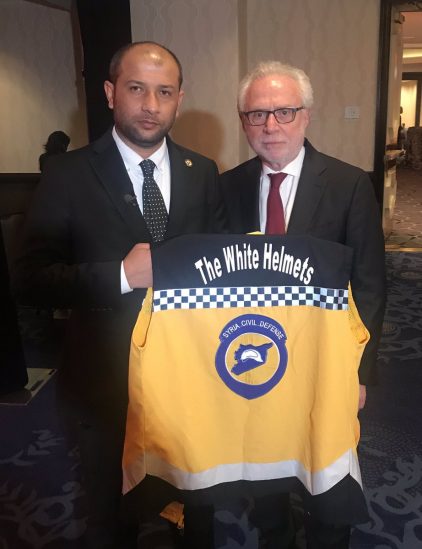
Increasingly, groups and even foreign governments have pandered to Israel and its supporters in the United States because they have come to understand that success in dealing with Washington can be dependent on Jewish support. Last week, Raed Saleh, the leader of the so-called White Helmets, also referred to as the Syrian Civil Defense, a terrorist-affiliated group operating in Syria, was in the United States to “… receive the Elie Wiesel Award from the Holocaust Memorial Museum for his organization’s work in Syria.” He was also dropping by to pick up a check for $5 million courtesy of the U.S. government that “… helps us with acquiring ambulances and helps us with search and rescue operations.”
During his visit, Saleh was treated to a nauseatingly obsequious interview courtesy of National Public Radio, which, inter alia, described how the Helmets “were the subjects of an Oscar-winning documentary two years ago, which captured images of them carrying broken and bloody Syrians from dust and rubble.”
Saleh claimed that the alleged victory of the Syrian regime in the yet to be completed war is an illusion as President Bashar al-Assad presides over a broken country, yet reports from inside Syria indicate that the return of the government to areas formerly controlled by terrorists has been welcomed and refugees from the fighting are now eager to return home. Saleh also claimed, falsely, that his organization has been “providing services to all Syrians and to providing support to all Syrians. Now after six years of war, we have saved more than 116,000 people from under the rubble. We have not asked any of these 116,000 people who did they belong to? Is he a Kurd? Is he a Christian? Is he a Muslim? Is he with Assad? Is he against Assad? Is he with the Kurds? Is he against the Kurds? We have never asked anyone these questions.”
Saleh, whose group has only operated in terrorist-controlled areas, could not, however, maintain his approved narrative. He fairly quickly abandoned his non-partisan quasi-humanitarian rhetoric when asked about how he sees the Syrian conflict developing, saying “We do not call this a civil war, but we rather call it a revolution against a dictatorship… the revolution still goes on. We have not lost.”
Those who are unfamiliar with the White Helmets should understand that the group has been praised by those who hate the government of President Bashar al-Assad in Syria and want to see it removed, which includes the United States, Israel, Saudi Arabia and the Emirates. The White Helmets have played a leading role in the propaganda campaign that seeks to instigate violence or use fabricated information to depict the Damascus government as guilty of slaughtering its own citizens. The propaganda is intended to terrorize the civilian population, which is part of the definition of terrorism.
Favorable media coverage of the group has largely derived from the documentary The White Helmets, which was produced by the group itself and tells a very convincing tale promoted as “the story of real-life heroes and impossible hope.” It is a very impressive piece of propaganda, so much so that it has won numerous awards including the Oscar for Best Documentary Short two years ago and the White Helmets themselves were even nominated for the Nobel Peace Prize. More to the point, however, is the undeniable fact that the documentary has helped shape the public understanding of what is going on in Syria, describing the government in Damascus in purely negative terms.
Nine months ago, with the Syrian Army closing in on the last White Helmet affiliates still operating in the country, the Israeli government, assisted by the United States, staged an emergency “humanitarian” evacuation of the group’s members and their families to Israel and then on to Jordan. It was described in a BBC article that included “The IDF said they had ‘completed a humanitarian effort to rescue members of a Syrian civil organization and their families’, saying there was an ‘immediate threat to their lives.’ The transfer of the displaced Syrians through Israel was an exceptional humanitarian gesture. Although Israel is not directly involved in the Syria conflict, the two countries have been in a state of war for decades. Despite the intervention, the IDF said that ‘Israel continues to maintain a non-intervention policy regarding the Syrian conflict.’”
All of the Israeli assertions are nonsense, including its claimed “humanitarianism” and “non-intervention” in the Syrian war, where it has been bombing almost daily. The carefully edited scenes of heroism under fire that have been filmed and released worldwide conceal the White Helmets’ relationship with the al-Qaeda affiliated group Jabhat al-Nusra and its participation in the torture and execution of “rebel” opponents. Indeed, the White Helmets only operate in terrorist-held territory, which enables them to shape the narrative both regarding who they are and what is occurring on the ground.
The White Helmets were accustomed to traveling to bombing sites with their film crews trailing behind them. Once at the sites, with no independent observers, they are able to arrange or even stage what is filmed to conform to their selected narrative. Exploiting their access to the western media, the White Helmets thereby de facto became a major source of “eyewitness” news regarding what was going on in those many parts of Syria where European and American journalists were quite rightly afraid to go, all part of a broader largely successful “rebel” effort to manufacture fake news that depicts the Damascus government as engaging in war crimes directed against civilians, an effort that has led to several attacks on government forces and facilities by the U.S. military. This is precisely the propaganda that has been supported both by Tel Aviv and Washington.
Perhaps the most serious charge against the White Helmets consists of the evidence that they actively participated in the atrocities, to include torture and murder, carried out by their al-Nusra hosts. There have been numerous photos of the White Helmets operating directly with armed terrorists and also celebrating over the bodies of execution victims and murdered Iraqi soldiers. The group’s jihadi associates regard the White Helmets as fellow “mujahideen” and “soldiers of the revolution.”
For those interested in further details, White Helmet activities have been thoroughly exposed by Maxim Grigoriev of the Russian NGO Foundation for the Study of Democracy. Grigoriev presented his findings at a special meeting of the United Nations just before Christmas 2018. A video prepared based on the U.N. meeting includes interviews with actual witnesses of White Helmet atrocities and participants in the staged chemical attacks that were blamed on the government.
So Raed Saleh was in Washington to pick up his award and his multi-million dollar check on top of the tens of millions that his organization has already received from Congress and the White House. He also met with a number of Congressmen who support his initiatives and was praised by New Jersey’s own seriously corrupt Israel-firster Senator Robert Menendez of the Senate Foreign Relations Committee who observed “that Saleh’s group of about 3,000 volunteers has ‘saved almost 100,000 lives’ doing ‘courageous work on the ground in Syria, while being targeted by Russia.’” Yes, Russiagate is alive and well.
There is considerable irony in the fact that the National Holocaust Museum, which is taxpayer funded, has given an apparently prestigious award to a terrorist group, something which could have been discerned with even a little fact checking. And the museum also might have been sensitive to how the White Helmets have been used in support of Israeli propaganda vis-à-vis Syria. Perhaps, while they are at it, the museum’s board just might also want to check out Elie Wiesel, for whom the award is named. Wiesel, who was a chronicler of Jewish victimhood while persistently refusing to acknowledge what Israel was doing to the Palestinians, notoriously mixed fact and fiction in his best-selling Holocaust memoir Night. Ironically, the award and recipient are well matched in this case as mixing fact and fiction is what both Elie Wiesel and the White Helmets are all about.
May 5, 2019
Posted by aletho |
Deception, Fake News, False Flag Terrorism, Mainstream Media, Warmongering | Israel, Syria, United States, Zionism |
Leave a comment

 Aletho News