Trump’s Golan move shows US contempt for international law and rules-based order
By M. K. BHADRAKUMAR | Indian Punchline | March 22, 2019
US President Donald Trump’s tweet on Thursday that the United States should back Israeli sovereignty over the Golan Heights, seized from Syria in 1967, didn’t quite come like a bolt from the blue. There has been talk about such a thing for sometime. Last December, the US Congress had begun pioneering a resolution expressing the sense of the Senate that the US should recognise Israel’s sovereignty over the Golan Heights.
Last month, new legislation was proposed in both houses of the Congress which called for recognising Israel’s sovereignty over the Golan Heights as part of the strategy to counter Iran and Syria. A copy of the Senate version of the bill stated, “It shall be the policy of the United States… to recognise Israel’s sovereignty over the Golan Heights.” The resolution stated that such a move is critical in the light of new realities on the ground including Iran’s presence in Syria. The resolution argued that Israel’s security from attacks from Syria and Lebanon cannot be assured without control over Golan Heights.
In addition, the bill said it is in US interest that Israel retains control over this territory to ensure that the Syrian government faces “diplomatic and geopolitical consequences” for killing civilians and allegedly using chemical weapons.
The sophistry aside, the fact of the matter is that the influential Jewish lobby began canvassing for such legislation once it became clear that Israel had lost the war in Syria. The primary purpose of the Israeli intervention in the Syrian Conflict by way of equipping and supporting extremist groups to overthrow the government led by President Bashar al-Assad was that a weakened and preferably dismembered Syria would never be in a position to demand the vacation of the Israeli occupation of Golan Heights.
Simply put, Tel Aviv is pulling strings in Washington to get US recognition of the Golan Heights as Israeli territory with the hope that the lone superpower’s opinion would somehow help legitimise the illegal occupation of Syrian territory since the 1967 war. Prime Minister Benjamin Netanyahu had pinned hopes that any Syrian political settlement would also include provisions legitimising the Israeli occupation of Golan.
A sub-plot here is about the timing of the tweet by Uncle Trump. Quite obviously, he is boosting the profile of nephew Netanyahu who is in dire straits at the moment fighting an election where he is trailing and staring at the prospect of a prison term for corruption. What are uncles for, after all, if they don’t help when nephew is in trouble — and big trouble at that?
But then, there is still more to it than meets the eye. The fact of the matter is that Golan Heights is believed to have vast oil reserves that could supply all of Israel’s needs. In fact, Israel began drilling for oil already by 2015 in anticipation of the ouster of President Assad.
US foreign policy is reaching an historic low point in this episode by helping to legitimise the illegal occupation of territories belonging to another sovereign country. Trump is plainly ignoring international law and the UN Charter. Yet, the US pontificates about a rules-based world order. In 2006, the United Nations General Assembly actually had passed a resolution affirming the “inalienable rights” of the Arab population in the Golan over its natural resources. The 1907 Hague Regulations, which is a cornerstone of international law, unambiguously states that an occupying power must “safeguard the capital of these properties.” Stealing resources from an occupied territory constitutes the crime of pillage.
Where such an act of pillage will ultimately lead to, time only can tell. Make no mistake, Syria will never accept the occupation of a part of the country. The US-Israeli conspiracy will meet with Syrian resistance. In fact, Trump is virtually pushing Syria into the resistance camp in the Muslim Middle East. A weakened Syria cannot challenge Israel militarily. But in the fullness of time, Israel is getting surrounded by a circle of hostile nations.
There are strong indications already that a resistance front against the US and Israel is forming in the northern tier of the Middle East stretching from Iran westward to the Mediterranean coast. Assad’s visit to Tehran, Iran’s Supreme Leader Al Khamenei conferring the highest military honour on the commander of Iran’s Quds Force Gen. Qassem Soleimani, Iranian president Hassan Rouhani’s high-profile visit to Iraq, the meeting of the commanders of the armed forces of Iran, Iraq and Syria in Damascus — all these developments in the most recent weeks underscore the emergence of a new strategic alliance that will work toward the purge of US influence in the region.
This trend is also reflected in a pronounced shift in the Iranian foreign policies, which no longer prioritise Iran’s integration into the Western world and would instead attribute centrality to resistance. Ironically, Trump’s cynical move on Golan — as per the wishes of his deep-pocketed Jewish donors such as casino magnate Sheldon Adelson and wife Miriam, influential lobby groups, and far-right Christian fringe — will end up providing strategic depth to Iran in its region to push back at the US’ containment policy.
Iran: Zionist Regime Doesn’t Have Sovereignty over any Arab, Islamic Land
Al-Manar | March 22, 2019
Iranian Foreign Ministry Spokesman Bahram Qassemi strongly condemned US President Donald Trump’s statement on recognizing the so-called “Israeli sovereignty” over the occupied Golan Heights, considering the US decision as “arbitrary” that will plunge the region into new crises.
“The Zionist regime, as an occupying regime, does not have sovereignty over any Arab or Islamic lands and its aggression and occupation should be immediately stopped,” Qassemi said in a statement on Friday, Tasnim news agency reported.
“The Golan is also considered as the occupied territory of the Syrian land according to UN Security Council resolutions,” he said.
There is no solution to the issue other than the end of the occupation, the spokesman went on to say.
He further deplored Trump’s acts as violations of the UN resolutions and the international law and said that his “personal and arbitrary decisions” have only revealed the real policies of the US, which are dangerous for the whole world and will plunge the region into new consecutive crises.
In a tweet on Thursday evening, Trump stated that it was time the United States recognized “Israeli sovereignty” over the Golan Heights, territory it occupied in the 1967 war.
With eye on US, Iran revs up ‘resistance front’
By M. K. BHADRAKUMAR | Indian Punchline | March 19, 2019
A new phase is beginning in Iran’s approach to the situation since last May when the US withdrew from the 2015 nuclear deal. Tehran had thus far prioritised the consolidation of Western opinion against President Trump’s decision with a view to effectively counter the US sanctions. But with hindsight, it appears that Europeans might posture against the US sanctions, but business interests ultimately prevail and the hard reality is that European companies that have exposure to the American market will not risk US sanctions.
Certainly, the drop in oil income following the US sanctions has hurt the Iranian economy and Tehran admits it openly. The Trump administration now plans to unveil an even harsher sanctions regime in May. According to reports, Washington aims to bring down Iran’s oil exports further.
Meanwhile, the US-Israel-Saudi-UAE nexus against Iran is actively working to create instability within Iran, weaken the regime and incapacitate it from playing a regional role. Saudi money is challenging Iran’s towering multi-dimensional presence in Iraq.
Although the US is notionally withdrawing troops from Syria, the efforts continue to roll back Iran’s presence in Iraq and Syria. Iran mentors the battle-hardened Shi’ite militia forces numbering tens of thousands in Iraq and Syria, which fought against the ISIS. Iran’s continuing presence in Syria poses an insurmountable obstacle to Israel’s designs to weaken and dominate Syria and to legitimise its illegal occupation of the Golan Heights.
Suffice to say, Tehran finds itself besieged. Of course, Iran’s regime has lived through dangerous periods through the past 4 decades and there is no question of capitulation. But an inflection point has been reached and a new trajectory has become necessary in terms of Iran’s political economy as well as to overcome the geo-strategic challenges.
There have been incipient signs change in the most recent months — in various statements by the Supreme Leader Ali Khamenei, in particular — indicative of a new pathway that would jettison the earlier obsession with the Western countries and abandon the strategy to put eggs in the EU basket. Khamenei repeatedly stressed Iran’s inner strength and the resilience of ‘resistance’.
Without doubt, the unannounced visit by Syrian President Bashar al-Assad to Tehran on February 27 augured that a Syrian-Iranian alliance with far-reaching geopolitical significance is taking shape. Khamenei stated during his meeting with Assad: “The Islamic Republic of Iran regards helping the Syrian government and nation as assisting the Resistance movement, and genuinely takes pride in it… Syria, with its people’s persistence and unity, managed to stand strong against a big coalition of the US, Europe and their allies in the region and victoriously come out of it… Iran and Syria are strategic allies and the identity and power of Resistance depend on their continuous and strategic alliance, because of which, the enemies will not be able to put their plans into action.”
Khamenei repeatedly used the metaphor of the resistance to characterise the Iran-Syria alliance. The charismatic commander of the Quds Force Gen. Qassem Soleimani neatly summed up that Assad’s visit was a “celebration of victory” for the resistance front.
Indeed, Khamenei has since decorated Soleimani with Iran’s most prestigious medal of honor, the Order of Zulfiqar. There is much symbolism here, since Soleimani happens to be the first Iranian commander to receive the Order of Zulfiqar after the 1979 Islamic revolution. Iran is applauding Soleimani’s profound contribution to the resistance. To be sure, Iran is returning to its revolutionary moorings.
Thus, the meeting between the top commanders of the armed forces of Iran, Iraq and Syria which took place in Damascus on Sunday was geared to flesh out a coordinated plan to meet the challenges in regional security. Some reports mentioned that Soleimani too was in Damascus on Sunday.
While receiving the three army commanders in Damascus, Assad reportedly said that the blood of Syrians, Iranians, and Iraqis “have mixed in the battle against terrorism and its mercenaries, who are considered as a mere façade for the countries that support them.”
Equally, Iranian president Rouhani’s recent visit to Iraq can be put in perspective. As a senior Chinese expert on West Asia has noted, Rouhani’s visit has “long-term geopolitical implications” in terms of expansion of Iran’s regional influence, apart from giving traction to the “resistance” politics (against US and Israel.)
The Chinese expert wrote that Iraq is refusing to be part of US’ containment strategy against Iran and Rouhani’s visit consolidates Iran’s influence in Iraq, which in turn also enhances its capacity to offer a “stark counterbalance” to US influence over Iraq. Again, Iran sees Iraq as a gateway to bust the US sanctions. Geopolitically, the expert underscored, the new dynamic strengthens Tehran’s strategy to create a regional axis between Iran, Iraq, Syria and Lebanon, which would have an edge over Saudi Arabia. Incidentally, Rouhani is likely to visit Syria as well in the near future.
Clearly, resistance politics creates strategic depth for Iran to push back at the US. But there is also a bigger dimension to it. Tehran plans to step up its participation in Syrian infrastructure construction. Ultimately, Iran’s economic relations with Iraq and Syria will be further strengthened in addition to its political and strategic relations with the two countries.
Very few details of yesterday’s meeting of army commanders in Damascus have emerged but one concrete outcome is the reopening of the Syrian-Iraqi border in the “coming days”, which of course, will facilitate a road link connecting Iran with Syria and Lebanon via Iraq. This is a major development insofar as a direct road link becomes possible connecting Iran with Syria and Lebanon. One main objective of the US military presence in Syria was to thwart such a transportation route that would significantly boost Iran’s influence and presence in the Levant. There have been reports that Iran may use Latakia port in Syria to access the world market.
Attempt to prosecute Assad at ICC is aimed at undermining Syrian peace process
Historian John Laughland explains why the International Criminal Court’s attempt to indict President Assad of Syria reveals its dictatorial and warmongering tendencies.
RT | March 18, 2019
The announcement that “a group of Syrian refugees and their London lawyers” have found “a neat legal trick” to press for an indictment against Syrian President Bashar Assad by the International Criminal Court demonstrates, yet again, the dangerous corruption of international justice, against which I have been warning for over a decade.
The Syrian war is nearly over, thanks to the military successes of the Syrian army and its Russian and Iranian allies. Exhaustion on both sides has probably helped. Diplomatic overtures have started to re-integrate Syria into the international system, starting at the regional level: the United Arab Emirates have re-opened their embassy in Damascus; the Sudanese president, Assad’s near namesake, Omar Al-Bashir, has visited Syria, as have senior Egyptian officials; Syrian officials have attended pan-Arab summits; even Israel is maintaining its dialogue with Russia over Syria. In short, the situation is being slowly normalised as Syria herself embarks on the painful search for internal peace.
The attempt to get Assad prosecuted is an attempt to stamp out these seedlings of peace before they take root. Any prosecution against Assad would scupper, or at least severely damage, this slow acceptance that the Syrian president is part of the solution. When even the British government has accepted that Assad is here to stay, and that peace must be made with him, his implacable enemies fear that their prize is about to slip out of their grasp. They do not want peace, if that means keeping Assad.
We know that the goal is to sabotage any peace process because this kind of indictment is old hat in international criminal law. At the end of the Bosnian Civil War in 1995, indictments were issued against the Bosnian Serb leaders, especially Radovan Karadzic, specifically in order to remove them from the Dayton peace talks. Antonio Cassese, then president of the International Criminal Tribunal for the former Yugoslavia, said in 1995, just after the indictment was issued against Karadzic, that it had been issued for that reason: “The indictment means that these gentlemen will not be able to participate in peace negotiations” (quoted in the Italian daily L’Unità, 26 July 1995). Incidentally, Cassese had himself encouraged the prosecutor to bring these prosecutions even though he, as a judge and president of the tribunal, was supposed to be neutral.
The “legal trick” is designed to overcome the fact that Syria is not a state party to the Rome statute of the International Criminal Court and therefore not subject to its jurisdiction. Assad’s enemies are seeking to sidestep the fact that Syria is beyond the ICC’s reach by seeking to apply to Syria a principle which, unfortunately, the ICC itself applied to Burma last year. In September, the ICC judges agreed that a case could be brought against Myanmar (Burma), even though that country is not a state party to the Rome statute, because the crimes it had allegedly committed – deportation – had caused people to flee into Bangladesh, which is a state party. By analogy, Syria’s enemies hope that the presence of Syrian refugees in Jordan, a state party to the ICC statute, will enable them to go after Assad. They seem not to care that this is the first time anyone has ever mentioned “deportation” in Syria, although Damascus has been accused of all manner of other crimes.
The ruling on Myanmar and Bangladesh illustrates everything that is wrong with international justice. Not only did the decision to apply jurisdiction to the Burmese authorities break the fundamental principles of international law, as expressed in the “treaty on treaties,” the 1969 Vienna Convention, which says that the principle of free consent is “universally recognized” and whose Article 34 says, “A treaty does not create either obligations or rights for a third state without its consent,” it also broke an even more fundamental principle by specifically claiming the right to define its own powers (referred to, in English texts, with the French and German expressions la compétence de la compétence and Kompetenz-Kompetenz). The Court described this as “a well-established principle of international law according to which any international tribunal has the power to determine the extent of its own jurisdiction.” In reality, it is no such thing.
On the contrary, the powers of all organisations are determined by law. Even sovereign governments are restricted by national laws in their powers. The idea that an international organisation has the legal right to determine its own powers, and to extend its jurisdiction to states that have not accepted it, is about as blatant a violation of the rule of law as one can imagine. In the past, such claims were equivalent to declarations of war, because a claim like this can only be settled by force. For example, on July 23 1914, Austria demanded the right for its police to carry out investigations inside Serbia for the assassination of the Archduke Franz-Ferdinand in Sarajevo on June 29. It sent an ultimatum to Belgrade to this effect, which Serbia refused. The result was the First World War, launched by Vienna in the name of the right to punish the perpetrators of that crime.
The ICC has already discredited itself massively after the Laurent Gbagbo fiasco. Having collaborated in the politically-motivated indictment of the president of Côte d’Ivoire in 2011 – a collaboration which gave legitimacy to the French military operation to oust him, just as it gave legitimacy to the NATO attack on Libya by also indicting Colonel Gaddafi at the same time – the Court was forced to acquit Laurent Gbagbo eight years later, in January of this year.
By seeking to extend its lamentable rule to Syria, and thereby to disrupt a barely embryonic peace there, the ICC risks destroying its reputation even further. For the rules limiting the jurisdiction of international organisations to states which have consented to accept them are not some arcane technicality of international law. Instead, they reflect the most basic principle of politics, which is that those who wield power need to be constitutionally linked to those over whom they wield it. International organisations which are not based on such consent violate that very basic principle flagrantly, and therefore start to resemble the very dictatorships they pretend to combat.
John Laughland, who has a doctorate in philosophy from the University of Oxford and who has taught at universities in Paris and Rome, is a historian and specialist in international affairs.
Read more:
‘Mask is off’: US shifts to open coercion & manipulation against ICC, analysts tell RT
Journalist taken hostage by Farouk Brigade 2013 – ‘Syrian government didnt use chemical weapons in Ghouta’
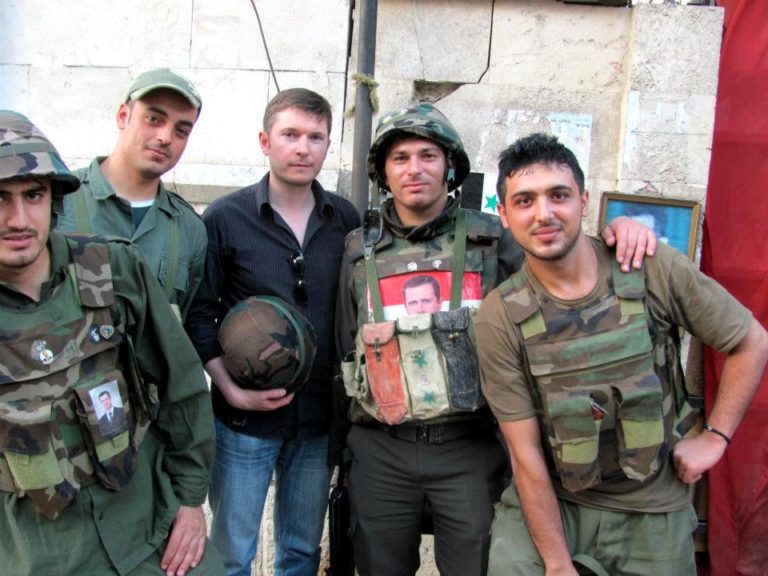
Journalist Pierre Piccinin da Prata with Syrian Arab Army. (Photo: Syria Times)
Syria Times | March 16, 2019
In its zealous pursuit to misinform western public opinion about Syria, MSM has canceled dozens of scheduled interviews with a war reporter after he has declared to Belgian RTL radio: “It wasn’t the government of Bashar al-Assad that used Sarin gas or any other gas in Ghouta”.
Pierre Piccinin da Prata, the Belgian War reporter and Editor-in-Chief of The Maghreb and Orient Courier, held hostage with Italian war reporter Domenico Quirico by Syrian ‘rebels’ for five months, eavesdropped a conversation through a closed door- between their jailers about the chemical weapon attack and saying that President al-Assad was not responsible for Ghouta Sarin gas attack.
“Syrian government had no interest in using the gas. Strategically, it was useless; and that could only ruin his image on the international level, with the risk of an American attack,” the reporter told the Syria Times e-newspaper, calling on western media outlets that have been wrong about Syria, about what has really happened since 2011 to recognize their errors and restore truth for their readers and listeners.
Piccinin, who was sold by the commander of the Katiba of the so-called the ‘Free Syria Army’ he was with al-Farouk for a few hundred dollars, posed the following question: what is the point of being a war reporter if it is not to tell the truth?
Following is the full text of the interview:
ST: Why and how were you taken hostage by the Farouk Brigade as you had been a fierce supporter of the so-called ‘Syrian Arab Army’?
Piccinin: I was kidnapped by al-Farouk Islamists in April 2013, in al-Qouseir, in the governorate of Homs.
I was doing an ’embedded’ report at the time, with the ‘rebels’ of the Free Syrian Army (FSA – when they still existed, before disappearing when the rebellion was completely Islamized).
At that time already (April 2013), the ‘non-Islamist’ rebels realized that they had lost the game. Many were returning home or fleeing to Lebanon or Turkey. Some joined the different Islamist groups. Jabhet al-Nusra, especially (al-Qaeda in Syria). But some groups of the FSA continued to occupy the land they still controlled. But they no longer fought the Syrian army: they behaved like bandits; they ransacked the population, under the pretext of taking money for the war effort. And some FSA chiefs started to kidnap people, to enrich themselves personally. That’s what happened to me: the commander of the katiba of the FSA I was with sold me at al-Farouk for a few hundred dollars.
ST: What is the lesson you have learned from the five months in captivity?
Piccinin: As a war reporter and specialist of Syria, and Islamist circles, this experience (although it was very painful nervously and physically) taught me a lot about the evolution of the conflict and also about the realities and internal functioning of these Islamist groups. On their behavior, their convictions, their vision of the world…
I have not been locked up for five months. I was moved very regularly as the conflict evolved. At this time, the fighting followed one another: the front lines moved a lot. In particular, I experienced the siege and the fall of al-Qouseir. The city was taken over by the Syrian government in early June 2013.
So I was able to observe what was happening, constantly moved between Damascus and Aleppo. And I was not attached, nor blinded. I could even talk to the fighters who held me, regularly and also to the people I met. I was very guarded, sometimes locked up, but very often free to communicate, with the Islamists and with the people who gravitated around them. I took my meals with them. We often slept in the same room. I was even present when they prayed or during their military meetings.
I hoped that someone (among the people I meet) would react and help me to free myself. But the Islamists terrorized the population. People were very afraid of Ammar al-Buqai, the al-Farouk chief, who held me. And nobody dared to defend me. One day (it was in Yabroud, near the Lebanese border), a man told me: “They (the Islamists) are a real problem for us. It’s dangerous to contradict them. They are very dangerous. We must pretend to obey them.”
It was a very hard and painful human experience (for my family, my parents in particular, they are old). But, professionally, I dare to say that it was a great enrichment.
On the human side, moral, I also learned a lot. I have seen what level of cruelty, violence, malice and cynicism the human being can reach…
ST: You have stated that it is not the Syrian government that used Sarin gas or any other gas in Ghouta. Have you tried to give your testimony to international investigation committee about the use of chemical weapons in Syria? And Why?
Piccinin : At the end of this period of detention (it was at the end of August 2013), the jihadists who held me spoke only about this: the events of Ghouta.
And, at that moment, I was transferred to a large building (it was in Bab al-Hawa, near the Turkish border). This building served as a common headquarters for al-Farouk and the Free Syrian Army. It was in this place that we caught a conversation that allowed us to know that, most likely, the gases were used in Ghouta by an Islamist group, to provoke a reaction from the United States of America (I say “we”, because I was kidnapped with an Italian journalist, who sometimes accompanied me to Syria, and we were detained together).
Obama had promised that he would attack Syria if the government used gas. And it was a time when the rebels were losing the war. Everywhere! So… I guess if the rebels did that, it was to try to drag the United States into the conflict, hoping to reverse the military situation.
The Syrian government had no interest in using the gas. Strategically, it was useless; and that could only ruin his image on the international level, with the risk of an American attack.
My testimony was published by some media and I developed this question in several conferences.
But, no … Never the UN institutions have asked me to testify.
It must also be said that very few European media have published this testimony…
To tell you the truth, when I came back to Europe, I was contacted by dozens of media outlets, who wanted to interview me, and a lot of Belgian and French media of course. But when I gave the first interviews on Belgian radio in the morning, the day of my come back … I obviously talked about this issue of gas in Ghouta … Just after, the phone immediately began to ring: the media that had programmed my intervention in their broadcasts (radio and television) called me to tell me that the interview was no longer possible … For various absurd pretexts … The interviews were cancelled! Indeed, all Western media had accused the government of Bashar al-Assad of using the gas and had claimed that he was guilty. And a reporter who has been on the ground for five months was coming to testify to the contrary … That did not suit them …
Even my Italian colleague has preferred to keep quiet … I never asked him directly why, because I would not like to embarrass him … But I’m sure it was his editor-in-chief who told him not to talk about that …
Anyway. I should have shut up too. It is certain that my professional career has suffered a lot because of this revelation.
But, honestly, I ask myself the question: what is the point of being a war reporter if it is not to tell the truth?
ST: Have you visited Syria after your release? Would you like to visit Ghouta after its liberation from terrorist groups?
Piccinin: I have been to Syria many times since 2013. For example, I covered the battle of Raqqa, against the Islamic State …
But mainly with the Kurdish rebels. Never again with the Free Syrian Army (it does not exist anymore besides… apart some groups, manipulated by Erdogan’s Turkey, in the north of Aleppo). And not with the Syrian regular army.
Of course, I would very much appreciate being allowed to go back to Syria, with the government’s agreement to see Damascus again … and Aleppo.
I had an ambitious project… To ask President Al-Assad for a series of long interviews, for a book.
ST: As you have been in Syria during the war, why President Bashar al-Assad is standing strong after 8 years of terror war on the country?
Piccinin: Already in July 2011 (including in the Belgian newspaper La Libre Belgique ), I analyzed the situation in Syria and announced that the Baathist government would remain at the head of the country…
I explained the reasons, complex, for which the president Assad was strong enough to break the ‘rebels’.
Of course, we must mention the complexity of the conflict that President al -Assad had to face. I mean: the complexity of alliances and actors. Syria had to count on faithful and solid allies: Hezbollah party, Iran and, of course, Russia.
But, more than all that, certainly, it is the cohesion of the Syrian army which allowed the victory and the incredible sacrifices of the Syrian soldiers. It is a fact. The Western media have never talked about those boys who gave their lives to defeat the Islamists.
I met them in Syria. They were citizens, young men doing their military service. No monsters, as the media in the West have presented.
More, President Al-Assad had the support of communities, ethnic and faith-based minorities, who have always been protected in Syria and have been able to live in peace in the country (this is not the case in other Arab countries); moreover, President Al-Assad also had a lot of support of the Sunni majority, and particularly in the middle class, who appreciated his policy of economic development and openness.
But, above all, it is obvious that the majority of Syrians have been scared by Islamist fanatics: Syria is a secular country, where the level of education is high, and where there is also a form of social security which ensures the inhabitants of rather good living conditions (in comparison with other countries of the Middle East).
When it became clear that the “revolution” had turned into a fanatic, jihadist, Islamist insurgency, only the regular army could protect the people from the creation of an “Islamic state”. And the vast majority of Syrians supported the government and the army in their efforts to save the country.
ST: Would you like to add anything?
Piccinin: Only one word, for Western media…
It is time for all those who were wrong about Syria, about what has really happened since 2011 … All those who have not understood anything about this conflict … Time to let themselves question… To recognize their errors and restore truth for their readers and listeners.
Unfortunately, the Western press is not as free as it claims … And I doubt that such a questioning will ever take place.
Especially when I read the analyses produced today: Western journalists have not remembered anything, learned nothing from the mistakes they made.
The consequence is that Western public opinion is very badly informed (or even “misinformed”) about Syria. And on this issue, citizens, especially in Europe, have the impression of “knowing”, but it is a “virtual” knowledge, and they live in a “virtual” reality, far removed from the truth.
***
Interviewed by: Basma Qaddour
US War Crimes in Syria Whitewashed in Real Time
Strategic Culture Foundation | 15.03.2019
It was quite amazing to watch reports from Syria this week by US news channel CNN. American bombing of a remaining redoubt of the ISIS terror group near Baghouz on the border with Iraq was presented as some kind of heroic final onslaught against the terror group.
The inversion of reality is a staggering case study in propaganda and “perception management” under the guise of “free media”.
CNN broadcast on-the-ground reports from its correspondent Ben Wedeman in Syria’s Deir ez-Zor province. In the background were evident signs, according to the channel’s video footage, that the US air force was dropping white phosphorus incendiary munitions in support of the offensive against militants.
Indiscriminate use of white phosphorus bombs is arguably a war crime. Yet the US media openly reported this as if it was a legitimate war operation in order to “defeat terrorism”.
Nothing in the CNN reportage suggested anything illegal about the US military campaign. On the contrary, the events were presented as a valorous attempt to “defeat ISIS”.
There are several reasons why this latest US military operation in eastern Syria is disturbing, not least because of mounting civilian deaths as a result of American air strikes.
For a start, American military presence in Syria is a gross violation of international law. The US has no legal mandate to be in that country, operating their since 2015, either as ground forces or warplanes.
Secondly, it is well-documented that Washington has been covertly funneling military aid to various anti-government militia, including terrorist groups like ISIS, in a bid to overthrow the Syrian government of President Bashar al Assad. This has been conducted as part of an eight-year covert war sponsored by Washington and its allies for illegal regime change against the sovereign government in Damascus.
President Trump has given orders for US forces to withdraw from Syria. He says it’s time to bring “our boys” home. As if “our boys” have performed a noble duty there. The fact is American forces in Syria constitute a war crime. They shouldn’t even be there.
So, belated US media reports of American forces bearing down on the remnants of ISIS in eastern Syria are, to say the least, a little anomalous, given the systematic support that Washington has been covertly plying to assorted jihadist terror groups for the purpose of regime change. That is an entirely criminal aggression against Syria.
But the latest operation in eastern Syria is particularly hard to take. It has been the Syrian army along with Russian, Iranian and Hezbollah forces that largely liberated Syria from the scourge of foreign-backed Islamist terror groups. The war in Syria has been won against the US and its malign criminal partners, not, as American media would have us believe, due to Washington’s “heroic efforts”.
Western news media have lately focused on a small pocket of ISIS hold-outs in eastern Syria as if the US is the liberator of the Arab country – a country which Washington and its NATO allies have infiltrated with jihadists for criminal regime change.
CNN’s coverage this week was especially perverse. Ben Wedeman and his team were showing US military dropping banned white phosphorus incendiaries on civilian areas of eastern Syria in the name of “fighting terrorism”.
CNN’s reportage was without the slightest hint that such military actions amount to gross war crimes. The entire US military presence in Syria is an even bigger violation of international law. The “normalization” of such violations and war crimes by the US media in real time is an illustration of how such supposed news channels are nothing but a propaganda arm for Washington’s imperialist warmongering.
The banal normalization by US news media of what should be viewed as enormous war crimes is something to behold, if not to be nauseated by.
American forces in Syria have killed thousands of civilians. Their latest operations to “liberate” the eastern region from jihadists that they infiltrated with in the first place has caused, this week alone, dozens of civilian deaths from US air strikes. This is a gruesome reminder of the horror that US air strikes inflicted on the Syrian city of Raqqa which was flattened in 2017 by American bombardment.
The charnel house that Syria has been turned into is a direct consequence of American regime-change machinations. And yet US media report a microcosm of the horror in terms suggesting that the American forces are somehow liberators. How grotesque.
Such an obscene distortion is partly why Washington is allowed to continue its criminal wars in other parts of the world. It is because of US media whitewashing war crimes in real time. And CNN has the shameless audacity to call its war propaganda “journalism”.
US announces more support for ‘heroic’ White Helmets in Syria
RT | March 14, 2019
The Trump administration is doubling down on backing the White Helmets, the self-proclaimed civil defense group with often controversial activity in militant-held areas of Syria, pledging a $5 million donation at a conference.
The contribution was announced by ambassador James Jeffrey, US special envoy to the anti-Islamic State (IS, formerly known as ISIS) coalition, at the third Conference on Supporting the Future of Syria and the Region, held in Brussels.
The $5 million will fund both the “vital, life-saving operations” by the White Helmets and the work of the International, Impartial and Independent Mechanism (IIIM), a UN body created in late 2016 to investigate – but not prosecute – alleged atrocities in Syria after 2011.
As justification for the support, State Department spokesman Robert Palladino claimed the “heroic first responders” of the White Helmets have saved “more than 114,000” lives since the Syrian conflict began, including victims of “vicious chemical weapons attacks” the US is blaming on the Syrian government. Palladino’s statement, however, acknowledged that the group operates solely “in areas outside of the control of the regime.”
Though the Trump administration announced it would stop funding the White Helmets back in May 2018, it reversed course just a month later, sending $6.8 million to the group.
The Syrian government has repeatedly accused the White Helmets of being part of various Islamist rebel groups, while Russia has accused the group of staging alleged chemical attacks in order to provide pretexts for US military intervention in Syria.
Evidence of White Helmet involvement with anti-government militants and other abuses, such as organ harvesting and endangering children, was presented to the UN in December.
See also:
White Helmets stealing children for ‘chemical attack’ theater in Idlib
Douma “Chemical Attack”: Still Waiting for an Apology
By James O’Neill | OffGuardian | March 13, 2019
On 7th of April 2018 an alleged chemical attack took place in the city of Douma in the Syrian Arab Republic. Dramatic footage of the “victims” was widely broadcast throughout the western mainstream media. Particularly prominent were images of children foaming at the mouth and being hosed down.
The footage for these dramatic depictions was almost entirely sourced from a group known as the White Helmets. They are invariably depicted in the western media as a form of civil defence organisation. They are in fact an arm of Britain’s MI6, trained by the British and financed by the UK and the United States.
The alleged “chemical attack” was used by the US, UK and French governments to make a missile attack upon Syrian targets. The approximately 100 missiles fired destroyed buildings and caused civilian casualties. Many of the missiles failed to reach their target, being either deflected or shot down by Syrian air defences.
Speaking to a press conference on the Sunday following the attacks, the then Australian Prime Minister Malcolm Turnbull made a series of unqualified assertions. He gave his government’s “strong support” for the military action, and urged Russia to exercise its authority to ensure that the chemical weapons were destroyed.
He further called on Russia to use its influence to ensure the “most recent chemical weapons attack is thoroughly investigated.” He blamed the Assad government for the incident and described the military action by the US, UK and France, “targeted, proportionate and responsible.”
He even attempted to link the Douma incident with the Skripal events in Salisbury, England, using both as a stick with which to beat the Russians over the head. Both the timing of and the linking of the two incidents were not a coincidence. They were clearly part of a campaign to discredit Russia, whose intervention in the Syrian war proved a decisive turning point, to the chagrin of the “regime changers” in Washington and London.
As is now almost invariably the case there is a marked distinction between the political rhetoric and the actual situation, both in terms of the relevant international law, and the facts on the ground. That has become glaringly obvious in the Skripal case, as has been well documented elsewhere, by for example, www.theblogmire.com 3 March 2019.
Dealing briefly with the legal situation in the Syrian bombing, there is no such thing as a “targeted, proportionate and responsible” bombing of a sovereign state unless two pre-conditions are met. It must either be in self-defence, if the countries taking the action have themselves been attacked, and that was manifestly not the case; and secondly, in the alternative, it must be an action authorised by the United Nations Security Council. That didn’t happen either.
As in so many of Australia’s military forays around the world, the legal basis for the Syria involvement is notably absent, although in this particular case their role was limited to being cheerleaders on the sidelines. Australia’s participation in the so-called coalition of forces fighting in Syria and allied to the United States, a serial offender against international law, has no legal foundation whatsoever. The Australian government has had legal advice on the matter, and has had such advice since 2014. If it was confident of its legal position, why then does it continue to refuse to release that advice?
The facts on the ground do not support the Turnbull position either. Turnbull criticized Russia for using its Security Council veto to block motions to investigate chemical weapons crimes. In fact, both Russia and Syria asked the Organisation for the Prevention of Criminal Weapons (OPCW) to investigate the Douma incident.
The OPCW fact-finding mission began their investigation on 21 April 2018, two weeks after the alleged attack. Jihadist groups blocked their initial investigation and they were only able to enter the relevant areas with protection provided by the Syrian army and the Russian military police.
An interim report was published on 6 July 2018 in which it concluded, “no organophosphate (sarin) nerve agents or their degradation products were detected in the environmental samples or the plasma samples taken from the alleged casualties.” The use of sarin had been one of the principal accusations against the Syrian government. This interim conclusion received minimal media attention.
The OPCW Final Report of the investigation was released on 1st of March 2019 although one will hunt in vain for an accurate account of that report in the western mainstream media. The reason for the media silence is not difficult to discern. The 0PCW Report effectively destroys the arguments advanced by US President Trump, UK Prime Minister May and Turnbull.
The OPCW’s investigation was hampered in significant ways. The White Helmets and their jihadist allies had either cremated or buried all the deceased “victims” of the alleged chemical attack. Those burial locations were not disclosed to the investigators. No autopsy material was therefore available.
The evidence of the medical staff in attendance at the Douma hospitals at the time began receiving “victims” prior to the timing of the alleged chemical attack. None had symptoms of chemical or nerve agent attack.
The OPCW investigation team carried out a number of analyses from areas said to have been affected by the chemical attack. Again, they found no traces of any banned chemical substances.
They were shown two yellow cylinders claimed to have been responsible for the casualties. Even that “evidence” was compromised as the two cylinders had been moved by the jihadists and were located in two places and in such a manner that they had no probative value.
The OPCW team was unable to say how the cylinders might have been used to release any toxins. Given that no toxic traces could be found anywhere, the likely inference is that the two cylinders were simply stage props.
This inference is reinforced by the fact that the OPCW team did find a further yellow canister similar to the two mentioned above. That canister however, was found in a jihadist workshop that also contained a variety of chemicals and equipment associated with bomb production. Insofar as this finding received any media coverage, it was to suggest that the Syrian government had planted the material. The OPCW made no such suggestion.
What the OPCW team did find were traces of chlorine. Chlorine however, is a common household substance and for that reason it is not on the list of banned chemical weapons. Chlorine would not in any case be likely to cause death, much less the significant casualty figures claimed.
The evidence of the medical professionals interviewed by the OPCW team was that the victims they treated at the hospital were suffering from the effects of dust and smoke inhalation. None had life threatening injuries and none died in hospital.
There was accordingly no basis in fact for the missile attack by the US, UK and France (quite apart from its illegality) and therefore no justification for Turnbull’s unequivocal assertions of Syrian culpability and Russian complicity in a chemical weapons attack upon the civilian population.
Notwithstanding the OPCW’s demolition of the claims made by the US and others, including Turnbull’s ill-advised unequivocal support, the US and mainstream media still refer to Assad’s alleged use of chemical weapons as a reason to justify their continued occupation of Syrian territory.
That occupation itself is a violation of international law. The “debate” within US ruling circles about whether Trump’s original professed desire to leave Syria (since resiled from) should be carried out or not has a surreal tone to it. It never seems to occur to them that they are neither welcome nor legally entitled to be there at all.
Perhaps the final word should go to a senior BBC TV producer, Riam Dilati. On 13 February 2019 he tweeted: “after almost 6 months of investigations I can prove without a doubt that the Douma hospital scene was staged.”

If our own media and politicians could show a similar degree of honesty and integrity, they would be offering Syria and Russia the long overdue apologies to which they are entitled.
That may however, be a long wait.
James O’Neill is a barrister at law and geopolitical analyst. He may be contacted at joneill@qldbar.asn.au.
OPCW likely to hold Damascus responsible for Douma attack, says Russian envoy
TASS | March 11, 2019
THE HAGUE – The incident in Syria’s Douma on April 7 of last year may become the first case of the Organization for the Prohibition of Chemical Weapons (OPCW) using its new attributive functions, Russia’s Permanent Representative to the OPCW Alexander Shulgin stated during a press conference on Monday.
“We have to state that [when preparing a report on Douma], the OPCW experts did not dare to contradict the US, France and the UK, who chose to take justice into their own hands and avoid any other version besides their own, on the involvement of the Syrian government in what took place in Douma on April 7, 2018,” the diplomat said. “The OPCW report is rather vague on this: allegedly, there is an assumption that chlorine was used as a chemical weapon. However, the fact speaks volumes: at that time, Douma was under the militants’ control, therefore, the part about chemical weapons being used definitely prepares the international community to hold the official Damascus responsible.”
“It is likely that this will be one of the first conclusions of the OPCW Attribution team (prosecution team), created in the depths of the OPCW Technical Secretariat under pressure from the USA and in direct violation of the Chemical Weapons Convention,” the envoy said. “It is clear that the US and its allies will use these biased conclusions again, as the guilty have already been assigned. They will use them to carry out unilateral forceful actions against lawful Syrian officials.”
A report consisting of over 100 pages was spread among member states of the Chemical Weapons Convention on March 1. The report claims that on April 7, 2018, a toxic chemical containing chlorine was used in Syria’s Douma as a weapon.
A number of non-governmental organizations, including the White Helmets, alleged that chemical weapons were used in Douma, Eastern Ghouta. According to a statement uploaded to the organization’s website on April 8, 2018, chlorine bombs had been dropped on the city, which caused dozens of fatalities. Many other civilians were rumored to have been taken to hospital.
The Russian Defense Ministry dismissed this as fake news.
On April 14, 2018, the US, the UK and France delivered massive missile strikes at targets in Syria without authorization of the UN Security Council. Missiles hit a research center in Damascus, the headquarters of the Republican Guard, an air defense base, several military airbases, and army depots. Washington, London and Paris claimed the strikes had come as a response to an alleged use of chemical weapons in Douma.
Will Trump’s Hawks Dare to Risk Israel?
By Alastair CROOKE | Strategic Culture Foundation | 11.03.2019
It was the eleventh, and perhaps the most important meeting between President Putin and PM Netanyahu on 27 February, writes the well-informed journalist, Elijah Magnier: “The Israeli visitor heard clearly from his host that Moscow has no leverage to ask Iran to leave – or, to stop the flow of weapons to Damascus … Moscow [also] informed Tel Aviv about Damascus’s determination to respond to any future bombing; and that Russia doesn’t see itself concerned [i.e. a party to such conflict] ”.
This last sentence requires some further unpacking. What is going on here is the mounting of the next phase of the Chinese-Russian strategy for containing the US policy of seeding hybrid disorder – and of pouring acid in to the region’s ‘open wounds’. Neither China nor Russia wish to enter into a war with the US. President Putin has warned on several occasions that were Russia to be pushed to the brink, it would have no choice but to react – and that the possible consequences go beyond contemplation.
In short, America’s recent wars have clearly demonstrated their political limitations. Yes, they are militarily highly destructive, but they have not yielded their anticipated political dividends; or rather, the political dividends have manifested more as an erosion of US credibility, and of its appeal as a ‘model’ for the world to mimic. There is now no ‘New’ Middle East that is emerging anywhere that casts itself in the American mold.
Trump’s foreign policy-makers are not old-style ‘liberal’ interventionists, seeking to slay the region’s tyrannical monsters’, and promising to implant American values: that wing of US neo-conservatism – perhaps unsurprisingly – has assimilated itself to the Democratic Party and to those European leaders desirous of striking (a supposedly morally ‘virtuous’) pose in contra-distinction to Trump’s (supposedly amoral) transactional approach.
Bolton et al however, are of the neoconservative school that believes that if you have power, you use it, or lose it. They simply do not trouble themselves with all those frills of promising democracy or freedom (and like Carl Schmitt, they see ethics as a matter for theologians, and not a concern for them). And if the US cannot, any longer, directly impose certain political outcomes (on their terms) on the world as it used to, then the priority must be to use all means to ensure that no political rival can emerge to challenge the US. In other words, instability and bleeding open-wounds become the potent tools to disrupt rival power-blocks from accumulating wider political weight and standing. (In other words, if you cannot ‘make’ politics, at least disrupt others’ attempts so to do.)
So, how does this play out in President Putin’s messaging to Netanyahu? Well, firstly this meeting occurred almost immediately following President Assad’s visit to Tehran. This latter summit took place in the context of increasing pressures on Syria (from the US and the EU) to try to undo the Syrian success in liberating its land (obviously with much help from its friends). The explicit aim being to hold future Syrian reconstruction hostage to the political reconfiguring of Syria – in the manner of America and Europe’s choosing.
The earlier Tehran summit took place, too, against the back drop of a crystallising mindset for confrontation with Iran in Washington.
The Tehran summit firstly adopted the principle that Iran represented Syria’s strategic depth; and concomitantly, Syria is Iran’s strategic depth.
The second item on the agenda was how to devise a scaffolding of deterrence for the northern tier of the Middle East that might contain Mr Bolton’s impulse to disrupt this sub-region, and attempt to weaken it. And through weakening it, weaken Russia and China (the latter having a major stake in terms of security of energy supply and of the viability of an Asian trading sphere).
President Putin simply outlined the principles of the putative containment plan to Netanyahu; but the Israelis had already got the message from others (from Sayyed Nasrallah and from leaks from Damascus). Its essentials are that Russia intends to stand above any regional military confrontations (i.e. try not get pulled in, as a party to it). Moscow wants to keep ‘doors open’. The S300 air defence system is installed in Syria (and is ready), but Moscow, it seems, will preserve constructive ambiguity about its rules for engagement for these highly sophisticated missiles.
At the same time, Syria and Iran have made plain that there will henceforth be a response to any Israeli air attack on “significant strategic” Syrian defences. Initially, it seems, that Syria likely would respond by launching its missiles into occupied Golan; but were Israel to escalate further, these missiles would be targeted on strategic military targets in the depth of Israel. And if Israel escalated yet further in response, then the option would exist for Iranian and Hizbullah’s missiles to be activated too.
And just to tie the pieces together, Iran is saying that its advisers effectively are everywhere in Syria where Syrian forces are. Which is to say that any attack affecting Syrian forces may be construed by Iran as an attack on Iranian personnel.
What is being constructed here is a complex, differentiated deterrence, with ‘constructive ambivalence’ at all levels. At one level, Russia deploys full ambiguity over the rules of engagement for its S300s in Syria. At another level, Syria maintains some undefined ambiguity (contingent on the degree of Israeli escalation) over the geographic siting of its response (Golan only; or the extent of Israel); and Iran and Hizbullah maintain ambiguity over their possible engagement too (by saying their advisors can be everywhere in Syria).
Netanyahu returned from his meeting with Putin saying that Israel’s policy of attacking Iranian forces in Syria was unchanged (he says this every time) – despite Putin having made it plain that Russia is not able to enforce an Iranian departure on the Syrian government. It was – and is – Syria’s right to choose its own strategic partners. The Israeli PM has however now been formally forewarned that such attacks will be met with a possible reaction that will badly disconcert his public (i.e. missiles landing in the depth of Israel). He knows too, that the existing Syrian air defence systems, (even absent S300 support), are operating with a very high degree of effectiveness (whatever Israeli commentators may claim). Netanyahu knows that Israel’s ‘Iron Dome’ and ‘David’s Sling’ missile defences are not highly rated by the US military.
Will Netanyahu risk further significant attacks on Syrian strategic infrastructure? Elijah Magnier quotes well-informed sources saying: “It all depends on the direction the Israeli elections will take. If Prime Minister Benjamin Netanyahu estimates his chances are high enough to win a second term, then he will not venture any time soon into a new confrontation with Syria and its allies. The date of the next battle will be postponed. But, if he believes he will lose the election, then the possibility of his initiating a battle becomes very high. A serious battle between Israel on one hand, and Syria and Iran on the other hand, would be sufficient enough to postpone the elections. Netanyahu doesn’t have many choices: either he wins the election and postpones the corruption court case against him; or, he goes to jail”.
This thesis may sound compelling, but the calculus on which it rests may prove to be too narrow. It is clear that the differentiated deterrence ploy, outlined by Putin – though framed in terms of Syria – has a wider purpose. The present language used by the US and Europe signal plainly enough that they are largely finished with military operations in Syria. But, in parallel to the disavowal of further military operations in Syria, we have also seen a consolidation of the US Administration mindset towards some sort of confrontation with Iran.
Whereas Netanyahu was always vociferous in calling for confrontation with Iran, he is not known in Israel as a military risk taker (calling for ‘mowing the Palestinian grass’ carries no political risk in domestic Israeli politics). And too, the Israeli military and security establishment have never relished the prospect of outright war with Iran, unless conducted with the US fully in the lead. (It would always be highly risky for any Israeli PM to launch a possibly existential war across the region, without having a sound consensus within the Israeli security establishment.)
Yet Mr Bolton too, has long advocated ‘bomb Iran’ (i.e. in his NYT op-ed of March 2015). Until recently, it was always assumed that it was Netanyahu who was trying to coat-trail the Americans into leading a ‘war’ with Iran. Is it sure that these roles have not become reversed? That it is now John Bolton, Mike Pence and Pompeo who are seeking not all-out war, but to put maximum hybrid pressures on Iran – through sanctions, through fomenting anti-Iranian insurgencies amongst ethnic minorities in Iran, and through Israel regularly poking at Iran militarily, in the hope that Iran will overreact, and fall into Mr Bolton’s trap for ‘having Iran just where he wants it’?
This is the point of the deterrence package – it is all about ‘containing’ the US. The initiative is constructed, as it were, with all its deliberately ambivalent linkages between actors, to signal that any US attempts to foster chaos in the Greater Levant or in Iran, beyond a certain undefined point, now risks embroiling its protégé, Israel, in a much wider regional war – and with unforeseeable consequence. It is a question not so much whether Netanyahu ‘will risk it’, but will Bolton dare ‘risk Israel’?
Featured Video
US IRAN TALKS: Who Are the Crazy Ones Here? /Lt Col Daniel Davis
or go to
Aletho News Archives – Video-Images
From the Archives
Wartime internment camps in Australia
National Archives of Australia
World War I
During World War I, for security reasons the Australian Government pursued a comprehensive internment policy against enemy aliens living in Australia.
Initially only those born in countries at war with Australia were classed as enemy aliens, but later this was expanded to include people of enemy nations who were naturalised British subjects, Australian-born descendants of migrants born in enemy nations and others who were thought to pose a threat to Australia’s security.
Australia interned almost 7,000 people during World War I, of whom about 4,500 were enemy aliens and British nationals of German ancestry already resident in Australia.
Records of World War I internment camps
World War II
During World War II, Australian authorities established internment camps for three reasons – to prevent residents from assisting Australia’s enemies, to appease public opinion and to house overseas internees sent to Australia for the duration of the war.
Unlike World War I, the initial aim of internment during the later conflict was to identify and intern those who posed a particular threat to the safety or defence of the country. As the war progressed, however, this policy changed and Japanese residents were interned en masse. In the later years of the war, Germans and Italians were also interned on the basis of nationality, particularly those living in the north of Australia. In all, just over 20 per cent of all Italians resident in Australia were interned. … continue
Blog Roll
 Aletho News
- US IRAN TALKS: Who Are the Crazy Ones Here? /Lt Col Daniel Davis
- Talks with the US end without a deal over excessive US demands: Iran
- Feeling Better, Getting Worse: How Psychiatric Drugs Create the Illusion They Cure
- ‘Nobody Told Me’: Former Mental Health Patient Calls Out Dangerous Side Effects of Psychiatric Drugs
- Dr. Abu-Sitta: Beirut ‘felt like a day in Shifa Hospital’
- Iran Has Won the War, It Will Be Up to the US to Secure the Peace: Mohammad Marandi
- Iran condemns assassination threats against Iranian negotiators amid US talks
- Brussels cannot say where its own pipeline inspectors are as Hungary’s oil lifeline remains shut
- Israel’s Iran War: Myth and Reality
- Between war and industrial breakdown: The US-Israeli attrition crisis
- If Americans Knew
- Pro-Israel ‘Thinktanks’ and Individuals who Influence U.S. Foreign Policy
- Mearsheimer reveals how Israel dictates US policies on Iran, Gaza – video
- After killing 350+, Israel still has a “score to settle” with Lebanon before ceasefire – Daily Update
- Military aid to Israel emerges as the latest political litmus test for Democrats
- The only Palestinian children’s rights organization closes following years-long Israeli campaign against it
- ‘I Can’t Forget the Smell’: Lebanese Reel After Israel Kills Over 300 in Single Day
- DNC Shoots Down Resolutions Calling Out AIPAC and Limiting Arms to Israel
- TCN: Is Israel Blackmailing President Trump?
- Israel killed at least 303 Lebanese yesterday – who were they? Daily Update
- Amnesty: Urgent – Protect Lebanese civilians from brutal escalation in Israeli attacks
- No Tricks Zone
- German Expert: Heat Dome Led To Record Temps In Western USA…Warmer In 1934, 1936
- New Study: No Linear Warming Or Glacier Retreat Along Northern Antarctic Peninsula Since 1980s
- An Inconvenient Tree: Uncovered In Alps… Europe Much Warmer Than Today 6000 Years Ago
- New Study Reports A 60% Slowdown In Greenland’s Ice Loss Rate In The Last Decade
- Low Intensity Tornado Wrecks Major Solar Farm, Creating A Potential Toxic Dump
- New Study Finds Warming Saves Lives…Cold Temperatures 12 Times More Deadly Than Excess Heat
- German Science Blog Accuses PIK Climate Institute Of Hallucinating Climate Tipping Points
- Devastating Assessment Of Comirnaty Vaccine By Former Senior Pfizer Europe Toxicologist
- New Study: CO2 Is ‘Effectively Negligible’ As An Explanatory Climate Change Factor Since 2000
- Former Pfizer Toxicologist Dr. Helmut Sterz Tells Bundestag Hearing Pfizer Vaccine Should Have Never Been Approved
 Aletho News