US Arms Sales to Taiwan Push Region Toward Conflict – Chinese Embassy
Sputnik – 28.12.2025
WASHINGTON – The arms supply from the United States to Taiwan is pushing the region closer to conflict, the Chinese Embassy in Washington told RIA Novosti.
“Such moves will not reverse the inevitable failure of ‘Taiwan independence,’ and will only push the Taiwan Strait into the danger of military conflict at a faster pace,” Liu Pengyu, a spokesman for the Chinese Embassy in Washington, said, commenting on the Pentagon’s Defense Security Cooperation Agency announcement of $11.1 billion worth of weapons, equipment, and military services approved for sale to Taiwan.
Specifically, the US arms shipment includes Javelin systems, ALTIUS-700M and ALTIUS-600 unmanned aerial vehicles, spare parts for AH-1W SuperCobra helicopters, HIMARS multiple launch rocket systems, M107A7 self-propelled artillery units, and TOW anti-tank missile systems.
“For the US, assisting the ‘independence’ agenda by arming Taiwan will only backfire,” the spokesman added.
China has repeatedly called on the United States to stop selling arms to Taiwan and creating tension in the Taiwan Strait. The Chinese Foreign Ministry noted that military interaction between the United States and the island, as well as the US leadership’s arms sales to Taiwan, grossly violated the “one China” principle and the three joint Sino-American communiques, causing great harm to China’s sovereignty and security interests and threatening stability in the Taiwan Strait.
Official relations between the central government of the People’s Republic of China and its island province were severed in 1949 after the Kuomintang forces led by Chiang Kai-shek, defeated in the civil war with the Communist Party of China, relocated to Taiwan. Business and informal contacts between the island and mainland China resumed in the late 1980s. Since the early 1990s, the two sides have been in contact through non-governmental organizations.
Chinese Embassy lodges solemn démarche with Israeli side at earliest opportunity over Taiwan regional official’s visit
Global Times | December 13, 2025
Asked to comment on reports that Wu Chih-chung, the Taiwan region’s so-called “deputy foreign minister,” had recently paid a secret visit to Israel, a spokesperson for the Chinese Embassy in Israel said that Taiwan is a province of China and there is no such thing as a “foreign ministry.” China has consistently and firmly opposed any form of official interaction between countries that have established diplomatic relations with China and the Taiwan region. The Chinese Embassy in Israel has lodged a solemn démarche with the Israeli side at the earliest opportunity.
The spokesperson noted that the one-China principle is a widely recognized consensus of the international community and a basic norm governing international relations. It is also the political foundation and prerequisite for China’s establishment and development of diplomatic relations with countries around the world, including Israel.
The Joint Communique on China and the Government of the State of Israel on the Establishment of Diplomatic Relations clearly states that “The Government of the State of Israel recognizes that the Government of the People’s Republic of China is the sole legal government representing the whole of China and Taiwan is an inalienable part of the territory of the People’s Republic of China,” said the spokesperson.
The Taiwan question concerns China’s sovereignty and territorial integrity and constitutes the core of China’s core interests. It is a red line that must not be crossed. We once again urge the Israeli side to earnestly abide by the one-China principle, correct its erroneous actions, cease sending any wrong signals to separatist forces advocating “Taiwan independence,” and take concrete actions to safeguard the overall development of China-Israel relations, the spokesperson added.
This Thanksgiving, We’re Being Served ‘Fake China Threats’
By Joseph Solis-Mullen | The Libertarian Institute | November 26, 2025
As a long-time critic of Washington’s obsession with the so-called “China threat”—and having written an entire book debunking it, The Fake China Threat—I could not in good conscience allow this year’s Report to Congress of the U.S.–China Economic and Security Review Commission to pass without comment. If anything, the 2025 edition is an even more sweeping reiteration of the assumptions and exaggerations I have challenged for years. Page after page, the report presents an alarming narrative about Beijing’s intentions and capabilities, while simultaneously insisting that every corner of the globe—and every sector of American life—now constitutes a frontline in a zero-sum geopolitical struggle.
The report opens by accusing Beijing of such dire transgressions as “holding regime security” as “a core interest,” of seeking “control and influence” over “regional spheres,” of cooperating with “authoritarian states” for “geopolitical and strategic benefits,” and of “shaping narratives” through “propaganda, disinformation, and malign influence.” One could easily imagine identical language appearing about the Soviet Union, about Washington itself, or literally any power throughout history—yet when applied to Beijing, these otherwise banal behaviors are transformed into signs of imminent global domination.
Nowhere is this tendency more pronounced than in the section worrying over China’s “electrification drive” and its increasingly important role in global energy markets. More than sixty pages are devoted to the idea that China’s leadership in electric vehicles, solar manufacturing, and critical minerals mining represents a strategic threat. Absent from the report is any acknowledgment that Western corporations themselves eagerly shifted production to China, or that Washington—not Beijing—has been the global pioneer in using export controls as geopolitical coercion. When the United States weaponized semiconductor export restrictions, Beijing responded in kind with export controls on rare earths and battery materials. To portray this sequence of events as evidence of China’s uniquely sinister strategy is simply dishonest.
The Commission displays the same lack of self-awareness in its discussion of China’s space program. According to the report, “China has embarked on a whole-of-government strategy to become the world’s preeminent space power,” viewing space as a “warfighting domain” and seeking “superiority” to achieve “information dominance” in future conflicts. These statements are presented as though they reveal some shocking and destabilizing ambition. Yet even the report itself admits that the United States pursued precisely the same aims throughout the Cold War, beginning with Sputnik and culminating in the Apollo program—a state-directed race for prestige, technological supremacy, and ideological credibility. One could be forgiven for marveling at the Commission’s ability to recount this history without recognizing that China today is behaving exactly as the United States once did.
No area attracts more overwrought commentary than Taiwan. The Commission repeats the standard Beltway line that Taiwan is a “vital national interest,” a geopolitical linchpin whose fate somehow determines the future of American security. Yet as I have argued repeatedly, these claims fall apart under scrutiny. Taiwan is important to Washington because Washington has decided it is important. The obligations cited—the Taiwan Relations Act, American “credibility,” regional “order”—are political choices, not laws of nature. Yes, Taiwan produces world-leading semiconductors. But nothing about that fact requires risking a catastrophic great-power war; supply chains can be diversified or on-shored. Beijing’s pressure, moreover, is far from the unprovoked aggression the report suggests—it is rooted in the unresolved civil war of 1949, the inevitable conclusion of which Washington prevented, and remains largely reactive. None of this is to deny tensions exist, but turning Taiwan into a test of American resolve is precisely how manageable disputes become existential crises.
The report’s alarmism reaches farcical heights in Chapter Five: “Small Islands, Big Stakes: China’s Playbook in the Pacific Islands.” Here the Commission insists that tiny Pacific states—many with populations smaller than a Michigan suburb—constitute a strategic battleground essential to the wellbeing of the American people. Any Chinese port investment, loan program, or diplomatic visit is portrayed as a step toward regional domination. Yet nowhere does the Commission attempt to explain how the average American benefits from micromanaging the political and economic decisions of Kiribati or Fiji.
The underlying logic is clear: assume U.S. hegemony is the natural order of the world, treat any erosion of influence anywhere as an existential threat, and convert distant, marginal islands into “vital interests.” This rhetorical sleight of hand is a hallmark of threat inflation. It serves contractors, think-tankers, and bureaucracies far more than it serves the American public.
Nowhere is this clearer than in the Commission’s sprawling list of recommendations. These range from creating a consolidated economic-statecraft agency with law-enforcement powers, to launching new global initiatives on undersea cable security, to deepening U.S. military and political involvement throughout Southeast Asia and the Pacific Islands. They continue with calls for massive industrial-policy subsidies, a quantum-computing “race,” bioeconomy initiatives, and new industrial-finance mechanisms—all justified by the specter of Chinese power.
The recommendations amount to a blueprint for a vastly expanded national-security state: more intelligence authorities, more intervention abroad, more surveillance tools at home, more taxpayer-funded subsidies for favored industries. It is striking how rarely the Commission pauses to explain how these measures relate to the concrete economic or physical security of ordinary Americans. Instead, all problems—whether involving undersea cables in Micronesia or chip production in Taiwan—are collapsed into a single narrative of geopolitical rivalry requiring endless resources and unquestioned bipartisan support.
This is not a sober analysis of Chinese capabilities or intentions; it is a maximalist wish list for Beltway institutions whose influence grows in direct proportion to the threats they amplify. And when one examines who actually produced the report, the outcome is unsurprising: longtime Nancy Pelosi staffer Reva Price; former Project 2049 Chairman Randall Schriver; and contributions from the Atlantic Council and American Enterprise Institute. This is a who’s who of professional China hawks, each institutionally invested in perpetuating a highly militarized U.S.–China rivalry.
In sum, the Commission’s report is emblematic of the broader problem in Washington: a foreign-policy establishment unable to conceive of international politics except as a struggle for primacy, uninterested in distinguishing vital interests from peripheral ones, and institutionally incentivized to magnify threats rather than manage them. The American people deserve better than a foreign policy driven by inertia, ideology, and bureaucratic self-interest.
The good news is that alternative perspectives exist—and that skepticism toward these narratives is growing. The United States can pursue a stable, prosperous relationship with China without embracing the fear-mongering, militarism, and threat inflation that dominate reports like this one. It only requires the courage to question the assumptions that have guided Washington for too long.
Beijing and Tokyo clash over ‘enemy state’ clause in UN Charter
RT | November 24, 2025
Japan has rebuked China for citing a UN Charter clause that permits action against former Axis powers without Security Council approval, insisting the provision is outdated and irrelevant.
Prime Minister Sanae Takaichi’s new government has been embroiled in an escalating diplomatic tit-for-tat with Beijing, beginning with remarks she made earlier this month supporting the self-governing administration on Taiwan. The Chinese side interpreted her comments that a cross-strait conflict would be a “survival-threatening situation” for Japan as signaling potential Japanese armed involvement and evidence of resurgent militarism.
Last week, the Chinese Embassy in Tokyo published an excerpt from the UN Charter which referred to “enemy states” – nations that fought against the original signatories, the Allied Powers of World War 2. Article 53 allows regional enforcement measures against such states in the event of a “renewal of aggressive policy,” without requiring prior authorization from the UN Security Council.
Beijing then lodged an official complaint with the UN over Takaichi’s statements. The embassy urged Japan “as a defeated country in World War II” to “reflect on its historical crimes” and change course on the Taiwan issue.
Japan’s Foreign Ministry dismissed that argument, accusing China of misinterpreting “obsolete clauses” that it claimed no longer align with UN practice. While the UN General Assembly recommended removing the “enemy state” references in 1995, the formal amendment process was never completed.
Japanese Defense Minister Shinjiro Koizumi visited a military base on Yonaguni over the weekend, an island about 110km east of Taiwan. He reiterated plans to deploy medium-range surface-to-air missiles there as part of a broader build-up on Japan’s southern island chain.
Russia also has outstanding issues with Japan, with whom it still has no formal peace treaty. Tokyo continues to insist on its claim to the four southernmost Kuril Islands, known in Japan as the “northern territories,” which became part of the USSR after World War 2 and remain a long-standing focal point for Japanese nationalists.
Can a second Ukraine on Taiwan be prevented?
By Ladislav Zemánek | RT | November 14, 2025
Taiwan’s political landscape is undergoing a moment of transformation marked by deepening divisions among the island’s elite. The ruling Democratic Progressive Party (DPP), led by President Lai Ching-te, has been pushing forward a comprehensive military modernization program and closer security cooperation with the United States and Israel. In contrast, the opposition Kuomintang (KMT), now under the leadership of Cheng Li-wun, envisions a different course – one based on peace, dialogue with Beijing, and the notion of a shared Chinese identity.
Peace, or war?
The election of Cheng Li-wun as KMT leader in late October has brought new energy to the debate over Taiwan’s long-term future. Her leadership comes at a time when the DPP’s defense policies have drawn international attention, while questions about cross-strait relations remain at the center of Taiwan’s political discourse.
Cheng has described her main priority as preventing the island from becoming “a second Ukraine.” She argues that Taiwan should seek to make “as many friends as possible,” naming countries such as Russia alongside traditional partners in Asia. Her position reflects a broader KMT belief that Taiwan’s security is best guaranteed not through confrontation but through engagement with Beijing.
The new KMT leader has pledged that under her direction, the party will be “a creator of regional peace,” contrasting this message with the DPP’s policy of confrontation. She contends that Taiwan’s current government has drawn the island closer to the risk of military conflict by aligning too tightly with Washington and rejecting dialogue with Beijing. Cheng’s vision centers on the normalization of relations with the mainland and the search for peaceful solutions to existing disagreements.
Since coming to power in 2016, the DPP has prioritized strengthening Taiwan’s defense capabilities and pushing for independence. Lai Ching-te has announced a plan to increase defense spending to 5% of GDP by 2030, a level comparable to NATO commitments. For the 2026 budget year, military expenditures are set to reach 3.32% of GDP. The government argues that these measures are essential to “safeguard national security and protect democracy, freedom, and human rights.”
Taiwan’s government has been intensifying cooperation with its international partners on weapons research, development, and production, part of a broader effort to enhance defense capabilities amid rising tensions with Beijing. Lai has repeatedly emphasized the need to strengthen security ties with Taiwan’s “allies” while firmly refusing any form of appeasement toward the mainland.
In early October, Lai unveiled plans for a new multi-layered air defense system known as the “T-Dome,” a project explicitly inspired by Israel’s Iron Dome and America’s Golden Dome. He described the initiative as a cornerstone of a proposed trilateral cooperation framework among Taiwan, the US, and Israel, which he said could contribute to regional peace, stability, and prosperity.
Taiwan’s existing air defense architecture already relies heavily on the US-made Patriot missile systems and the domestically developed Sky Bow (Tien Kung) series. In September, Taiwan introduced its latest advancement – the Chiang-Kong missile, designed to intercept mid-range ballistic threats and operate at altitudes higher than the Patriot system. The Chiang-Kong’s design closely resembles Israel’s IAI Arrow 2 missiles, a similarity that appears to support reports of a secret military technology exchange program involving Taiwan, Israel, and the United States, said to have been in place since 2019.
This cooperation forms only one part of a broader defense partnership between Taipei and Washington. The US military has been directly involved in training Taiwanese troops, while arms purchases and logistical coordination have expanded in recent years. Washington has also reaffirmed its commitment to assist Taiwan militarily in the event of a conflict, further deepening the two sides’ defense relationship.
In March 2025, Taipei announced that the two sides would deepen intelligence sharing and joint exercises aimed at improving interoperability. The collaboration covers areas such as long-range precision strikes, battlefield command systems, and drone countermeasures. Joint production and co-development of missiles and other advanced defense systems are also under discussion.
Looking for the patriots
Central to the political divide within the island’s elite is the long-standing “1992 Consensus,” an understanding that both the People’s Republic of China and Taiwan’s authorities acknowledge there is only one China. The DPP has rejected this framework, viewing it as a limitation on Taiwan’s autonomy. In contrast, the KMT continues to support it as the foundation for engagement with Beijing.
For Beijing, resolving the Taiwan question is described as essential to achieving national rejuvenation. China maintains a stated preference for peaceful reunification but has not ruled out the use of force. Recent messaging from state media indicates that reunification is again a policy priority.
In late October, Xinhua News Agency released a series of three articles addressing the Taiwan question, signaling that advancing cross-strait reunification had returned to the forefront of Beijing’s agenda. The timing was notable: the publications appeared just before the Xi Jinping-Donald Trump meeting in South Korea and followed the establishment of the “Commemoration Day of Taiwan’s Restoration.” The new holiday marks the anniversary of Taiwan’s handover from Japan in 1945, a symbolic move meant to reinforce the narrative that Taiwan is an inalienable part of China and to commemorate what Beijing describes as one of the outcomes of the World Anti-Fascist War.
Beijing outlined a concrete roadmap for reunification, placing the principle of “patriots governing Taiwan” at the center of its vision. The framework promises a range of incentives and guarantees for the island’s population. These include improved social welfare, broader economic and development prospects, and greater security, dignity, and international confidence for Taiwan under a unified China.
Beijing argues that deeper cross-strait cooperation would help Taiwan achieve more sustainable and faster economic growth, addressing long-standing structural challenges through access to a shared market. Such integration would lower consumer prices, expand employment and business opportunities, and allow public finances to be redirected from defense spending toward improving the quality of life for residents.
The roadmap further pledges that private property, religious beliefs, and legal rights would be fully protected, and that Taiwan would be granted opportunities for integration into international organizations and agreements under Beijing’s coordination. Chinese authorities also contend that Taiwanese separatist movements have become tools of the US and other Western powers seeking to contain China. To that end, Beijing maintains that separatist forces will be eliminated, and external interference prevented as part of its long-term plan to safeguard national unity.
Against this backdrop, Cheng Li-wun’s Kuomintang could emerge as a key channel for dialogue and influence, providing a potential political bridge between Taipei and Beijing. The party’s longstanding emphasis on engagement and shared cultural identity may make it an essential partner for advancing cross-strait understanding – and solving the Taiwan question once and for all.
Ladislav Zemánek, non-resident research fellow at China-CEE Institute and expert of the Valdai Discussion Club
Zionists target Taiwan in the push for a Zionist empire
By David Miller | Al Mayadeen | November 12, 2025
On October 27, President Lai Ching-te of Taiwan made a speech welcoming the first ever AIPAC delegation to the Island. “I extend a warm welcome to the first ever delegation to Taiwan from the American Israel Public Affairs Committee. AIPAC is a prominent nonprofit, dedicated to advancing US-Israel relations.” He said that “Israel” is a model for Taiwan to learn from in strengthening its defences, and he cited the Biblical story of David versus Goliath on the need to stand up to authoritarianism. He said AIPAC was “highly prestigious and infuential.”
The delegation comprised over 200 people and included CEO Elliot Brandt, Board Chair Michael Tuchin, and Board President Bernie Kaminetsky. AIPAC is playing an increasingly international role in the pursuit of a Zionist empire and in recent years has sent delegations to the Persian Gulf, India, and Europe.
AIPAC presented the president with a rather gaudy memento – a model of the US Capitol building in Washington DC – a tribute to US power. But it refrained from naming any of the rest of their delegation.

Reuters reports that “Taiwan has been a strong backer of Israel” since the launch of Al-Aqsa Flood, though “Israel, like most countries, has no formal diplomatic relations with Taipei.”
The president went on to say that “Taiwan is one of the very few countries that holds International Holocaust Remembrance Day events each year”.
Taiwan is a geopolitical anomaly, formerly known as Formosa in colonial times. It should obviously be part of China. However, it was the last bolthole of the counter-revolutionaries of the Kuomintang under Chiang Kai-shek after they were defeated by the Chinese revolution in 1949. They set up a statelet and grandly called it the Republic of China. They then declared martial law, which was only lifted in 1987.
Since then, there has been the much vaunted economic miracle in Taiwan, which has been accomplished under the tutelage of US financial and military aid, labour exploitation and dependent capitalist development, shaped by and serving the interests of global imperial powers and a local exploiting class.
Now, with the emergent Zionist empire – Pax Judaica – we can see the expansion of Zionist influence and involvement in countries as far away from West Asia, as Taiwan.
In his comments, President Lai Ching-te emphasised the ambition to “deepen collaboration in such fields as semiconductors, ICT, and cybersecurity.” He also said it is “very willing to enhance cooperation with Israel under President Trump’s AI Action Plan.” This was launched by Trump in January, where he was flanked by two Zionist billionaires, Larry Ellison of Oracle and Sam Altman of OpenAI. Ellison is, of course, central to the Trump Gaza plan, which intended to smash the Palestinian Resistance and also to win the so called ‘8th front’ information war being waged by the Zionist entity in part via Ellison’s takeover of TikTok, CBS and potentially CNN.
Taiwan is another node in the emergence of Pax Judaica. However, Zionist movement infiltration in Taiwan is relatively recent.
The genocidal Haredi cult, Chabad, first sent Shluchim (or emissaries) to the Island in 2011. Their base is called the Taipei Jewish Center, which provides one of the two Synagogues on the island. Chabad also has a presence in China (including Hong Kong) with more than 10 offices in Beijing, Shanghai, and other places.
According to Chabad, there are 1,500-2,000 Jews in Taiwan of a total population of 24 million, less than 0.001%.
In the 1970s, there were around 50 families of mainly Russian Jews. But it is reported that the community declined to a total of “no more than 150” people around 2007.
Chabad has also been involved in the creation of a new center called the Jeffrey D. Schwartz Jewish Community Center, costing some $16 million. It is named for its main benefactor, who is an American Zionist who has been living in Taiwan since the 1970s. Schwartz was instrumental in the recent AIPAC delegation to the island and was publically thanked by the Taiwanese President for his help.
Schwartz is also a supervisor at the other Synagogue in Taiwan, known as Congregation Lev HaMizrach. It is a Zionist Synagogue and offers up solidarity for the Zionist colony and prayers for the genocidal occupation forces
In 2024, the Synagogue sent a delegation to the BBYO Asia Pacific Conference. BBYO, the Bnai B’rith Youth Organisation, is one of the largest global Zionist youth groups, affiliated to the World Zionist Organisation, which functions to radicalise Jewish youth for genocide.
There is also a Taiwan-Israel Congressional Association, which fosters collaboration with the Knesset and oversees parliamentary delegations and exchanges. In July, for example, a total of 72 Knesset members from coalition and opposition parties signed a joint statement “condemning Taiwan’s exclusion from international forums as ‘unjustified and irresponsible.’”
The Zionist colony is unable to have full diplomatic relations with Taiwan because of its relations with China.
However, it maintains the Israel Economic and Cultural Office in Taipei. Its representative, Maya Yaron, was involved in planning the AIPAC delegation meeting in October.
Also, because of this, much of the interaction between the Settler colony and Taiwan is covert or secret. What is known is that Taiwan secretly bought Israeli missiles in the 1970s.
However, direct arms sales to Taiwan ceased around 1992 as “Israel” established formal diplomatic relations with the People’s Republic of China.
Today at least eight Taiwanese companies are involved in supplying components for drones and armaments to “Israeli” arms firms, including Elbit, Rafael, and IAI.
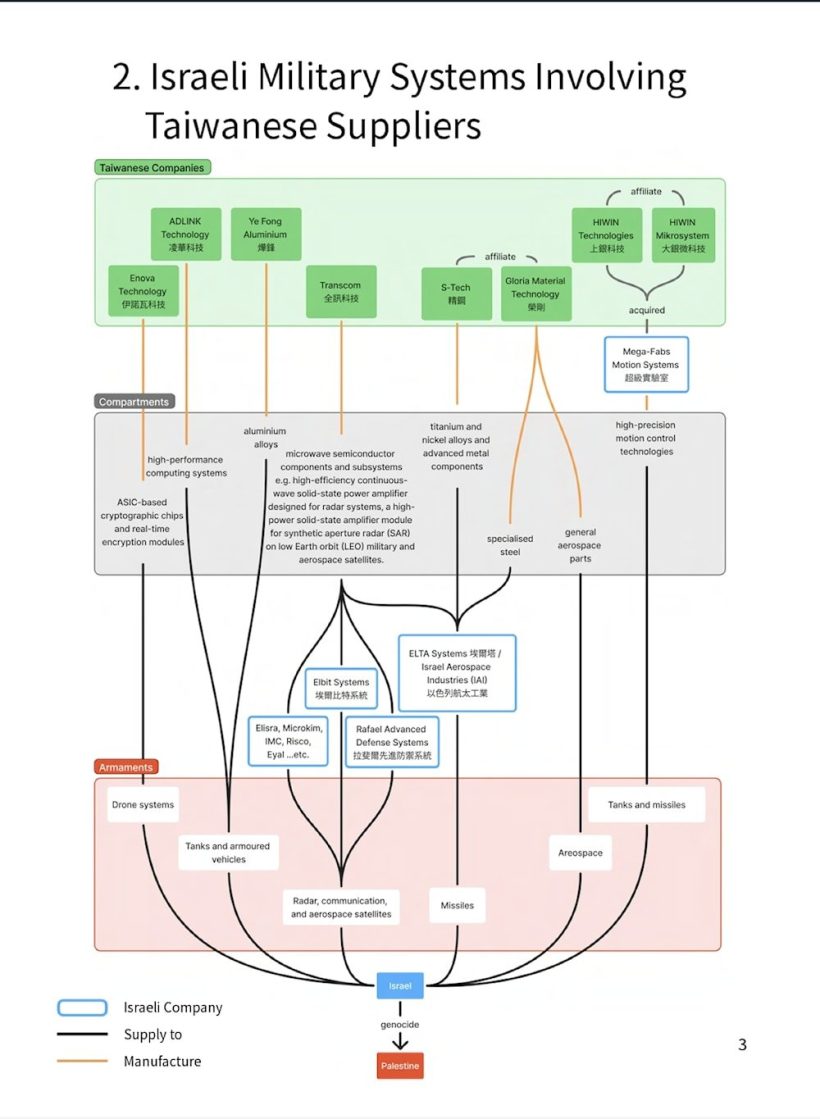
And significant numbers of Israeli firms are active in Taiwan, including in the area of tech firms and cybersecurity, which has a strong Zionist intelligence component.
In addition, the Zionist regime appears to be giving Taiwan a “helping hand” with the development of its own so called “Iron Dome”. Most notably, it is now clear that Taiwan played a role in supply chains for the Zionist pager attacks in Lebanon in 2024.
In July this year, Taiwan became the first foreign government to provide funding for a medical center in an illegal Israeli settlement in the occupied West Bank.
Taiwan is fully on board with the genocide of the Palestinians and the push for a “Greater Israel”. And the Zionist regime is penetrating more deeply in Taiwan than before, as it is in very many places in South and East Asia.
Eurasian Integration as an Anti-Hegemonic Economic System
By Prof. Glenn Diesen | October 30, 2025
We are living in an era of economic disruptions as US-centric globalisation is replaced by a more decentralised format of globalisation spearheaded by the Greater Eurasian continent. The consequence of these disruptions during this transition period is instability in economics, politics, and international security, as economic coercion escalates into war.
The disruptions to the international economy were predictable—and indeed predicted—for decades. When immense economic power is concentrated in a hegemon, the hegemon has incentives to build trust in an economic architecture under its administration. This translates into an open international economic system with access to technologies, industries, energy, food, physical transportation corridors, banks, currencies, and payment systems. This is referred to as a benign hegemon, as building trust in an open system ensures that alternatives are not developed and the world becomes immensely dependent on the hegemon. Subsequently, globalisation meant Americanisation.
Hegemons are, however, inherently temporary. Over the years, the US economy became excessively rent-seeking, financialised, and debt-ridden as its competitive edge declined. A hegemon makes mistakes and fails to prioritise strategically, as it can absorb the costs—until it reaches a breaking point. Around the world, other countries climbed up global value chains and grew concerned about the fiscal irresponsibility and unsustainability of the hegemonic system.
A declining hegemon will predictably behave very differently. It will use its administrative control over the global economy to prevent the rise of rival centres of power. Economic coercion is the new normal—for example, restricting China’s access to key technologies, seizing Iranian tankers and preparing the establishment of maritime choke points, stealing Russia’s sovereign funds, etc. Trust collapses, and efforts to create a more decentralised international economic system only intensify.
The declining hegemon will also attempt to divide rival centres of power: Germany must be severed from Russia, Russia must be split from China, China should be kept at a distance from India, India should reduce its economic connectivity with Iran, Iran should not resolve its disputes with the Gulf States etc. Markets are captured as the declining hegemon, for example, pushes Europe to reduce cooperation with Chinese technology and Russian energy. As the Europeans and other allies develop excessive reliance on the US, economic and industrial power can be transferred to the US. Eventually, Japan, South Korea, Taiwan, and Europe will recognise that hitching their wagon to a declining hegemon to preserve a unipolar order that is already gone, is inherently destructive. The option is to either diversify their economic connectivity for prosperity and political autonomy, or become captured markets that can be cannibalised by the declining hegemon.
The declining hegemon has—much like its adversaries and allies—strong incentives to embrace multipolar realities. New political forces within the declining hegemon will recognise that pursuing hegemonic policies under a multipolar international distribution of power will be punished by the international system. Exhausting its remaining resources and incentivising the rest of the world to collectively balance against the declining hegemon is unsustainable. The ideal strategy for the declining hegemon is to accept a more modest role in the international system as one among many great powers, reducing collective balancing and enabling socio-economic recovery to rebuild former strength.
The rise of Eurasia marks the end of 500 years of Western leadership and dominance in the world, since European maritime powers began connecting the world in the early 16th century. While some panic in the West is therefore understandable, there are nonetheless great opportunities.
Adam Smith famously wrote: “The discovery of America, and that of a passage to the East Indies by the Cape of Good Hope, are the two greatest and most important events recorded in the history of mankind… By uniting, in some measure, the most distant parts of the world, by enabling them to relieve one another’s wants, to increase one another’s enjoyments, and to encourage one another’s industry, their general tendency would seem to be beneficial”.
However, Adam Smith also recognised the problems of the skewed power distribution between the Europeans and the rest of the world. Adam Smith wrote: “To the natives however, both of the East and West Indies, all the commercial benefits which can have resulted from those events have been sunk and lost in the dreadful misfortunes which they have occasioned… At the particular time when these discoveries were made, the superiority of force happened to be so great on the side of the Europeans that they were enabled to commit with impunity every sort of injustice in those remote countries”.
Adam Smith argued that a more even distribution of power could create a more harmonious international economy: “Hereafter, perhaps, the natives of those countries may grow stronger, or those of Europe may grow weaker, and the inhabitants of all the different quarters of the world may arrive at that equality of courage and force which, by inspiring mutual fear, can alone overawe the injustice of independent nations into some sort of respect for the rights of one another. But nothing seems more likely to establish this equality of force than that mutual communication of knowledge and of all sorts of improvements which an extensive commerce from all countries to all countries naturally, or rather necessarily, carries along with it”.
I conclude that the aspiration of Eurasian integration should be to make it anti-hegemonic but not anti-Western by descending into bloc politics.
Civic groups in Taiwan rally protest against DPP amid growing wave of opposition
By Shen Sheng | Global Times | April 26, 2025
Several civic groups on the island of Taiwan launched a protest event on Saturday, opposing the Democratic Progressive Party (DPP) and condemning Lai Ching-te for inciting hatred within Taiwan island and forcibly pushing the public toward the brink of war. They also denounced the DPP for damaging cross-Straits economic and trade exchanges, making it difficult for agricultural and fishery products from Taiwan to be exported.
The event comes as the Lai’s series of regressive actions have triggered a growing wave of denunciations from people across Taiwan Straits, who condemned his trampling of democracy and the rule of law, as well as its damage to the peace across the Straits.
Speakers at the event warned that if the DPP continues to rely on foreign powers and provoke confrontation with Chinese mainland, there will be no space left for peace in Taiwan island, and young people will face an unstable future. They called on the people of Taiwan to transcend ethnic and political divides and stand up against the DPP’s attempt to seek “Taiwan independence.” They urged all Chinese people on both sides of the Taiwan Straits to share a sense of historical responsibility and jointly resist forces driving them toward disaster, according to a press release sent to the Global Times on Saturday by the Labor Party.
Wang Chuan-pin, Vice Chairman of the Labor Party, emphasized at the event that the DPP is actively cooperating with the US to hollow out Taiwan’s industries. She emphasized the need to defend the rights of small and medium-sized enterprises and grassroots workers and urged everyone to courageously stand up against DPP’s harmful actions.
Wang Wu-lang, secretary-general of the Labor Party, noted that Lai Ching-te has damaged cross-Straits economic and trade exchanges, making it difficult for agricultural and fishery products in Taiwan island to be exported, while industrial goods are now subject to high US tariffs. These developments have severely harmed the interests of farmers and workers in the island.
People are now facing stagnant wages, soaring housing prices, and rising living costs, signaling that the DPP is ruining the lives of the people through its political agenda, said Wang.
Xu Mengxiang, Deputy Secretary-General of the Labor Party, stated that the DPP, under the pretext of “security,” is inciting hatred within the island of Taiwan and forcibly pushing the public toward the brink of war. This undermines the progressive values of democracy and leads the entire island down a dangerous path of historical regression.
Participants further stressed that the DPP’s “green terror” has already targeted mainland spouses and other political groups and may extend even further. They warned that if the public does not rise up, everyone could eventually become victims of this “green terror.” They invoked the memory of those who once stood against “white terror” in Taiwan’s history, calling on current and future generations to continue fighting against today’s oppression, and to defend democracy and the rule of law.
Addressing the livelihood issues that concern the public most, speakers at the event repeatedly pointed out that the DPP places ideology above people’s welfare. Its anti-China stance has crippled Taiwan’s economy and society, misallocating resources and distorting internal policies, thereby intensifying livelihood and economic crises.
They stressed that the Lai Ching-te administration is using an anti-China strategy as a cover for its governance failures, leading to worsening economic decline, rising energy risks, and widespread public hardship.
At the conclusion of the event, the civic groups issued an appeal to people in Taiwan, chanting slogans such as “both sides of the Taiwan Straits are of the same family” and “we are all Chinese,” which received strong and enthusiastic support from the public.
Meanwhile, the Kuomintang (KMT) party also held a protest against DPP on the same day, Taiwan-based outlet ETtoday reported. Ma Ying-jeou, former chairman of the Chinese Kuomintang party, attended the protest and delivered a speech. In his remarks, Ma expressed his dissatisfaction with DPP’s actions, and criticized Lai’s incompetence, stating that he cannot bear it anymore.
Taiwan-based media reported that Ma expressed concern that Lai’s recent words and actions could lead Taiwan to a rapid decline. He mentioned that while the US imposed heavy tariffs, Lai and DPP authorities are helpless.
Taiwan: Birth Rate CRATERED -27.66% in June 2022!!!
By Igor Chudov | July 9, 2022
A couple of weeks ago, I wrote an article based on the shocking news that Taiwan’s birth rate in May 2022 fell by 23.34% compared to May 2021.
I explained that in terms of statistics, the change in Taiwan is an unthinkable 26-sigma event of enormous magnitude.
Like most people would, I was hoping, despite evidence from other countries, that this is a data fluke.
Well, it is not, and the data for June was just released in Taiwan. I am very upset.
Compared to June 2021, birth rate in Jun 2022 is down by -27.66%. This is far worse than the previous month (May) drop of -23.34% and indicates a worsening birth rate trend.

Here’s the updated chart:
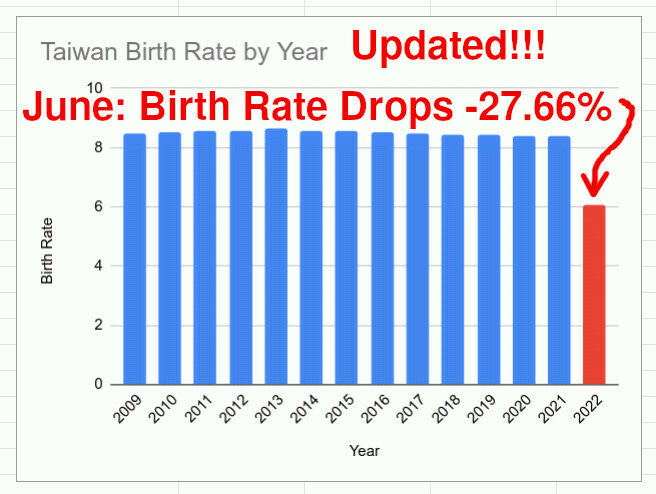
Mind you, last August of 2021, when June 2022 babies were conceived in Taiwan, the people of Taiwan were mostly unaware of what was going to happen, and kept their family making plans intact. They probably did not notice a 27.66% decrease in pregnancies, or an increase in stillbirths. If someone told them, the young people of Taiwan probably thought that it was antivax propaganda that they should dutifully ignore, like their government and TV told them.
Young people were being happily vaccinated.
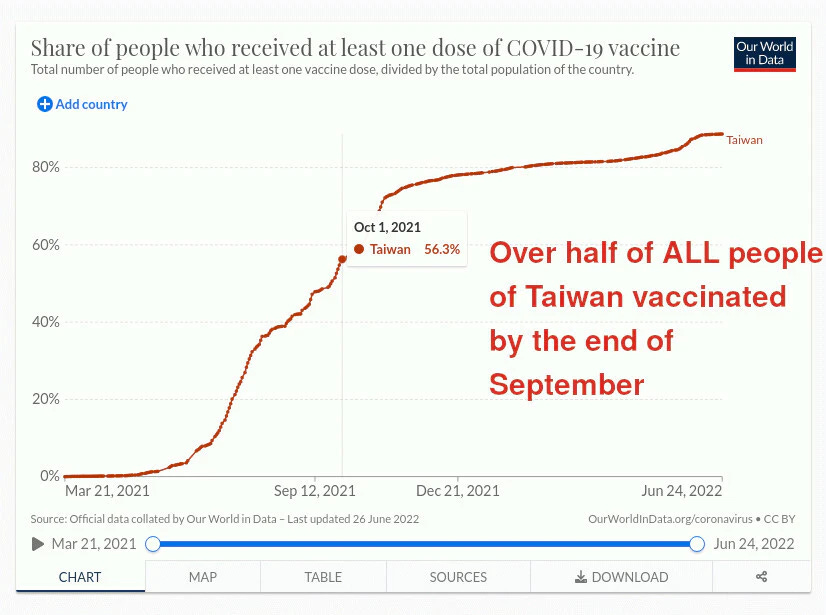
The result? An “impossible” birth rate drop of -27.66% is basically a slow death sentence for the population of Taiwan, if it continues, especially combined with a 26% increase in deaths.
Media Coverage
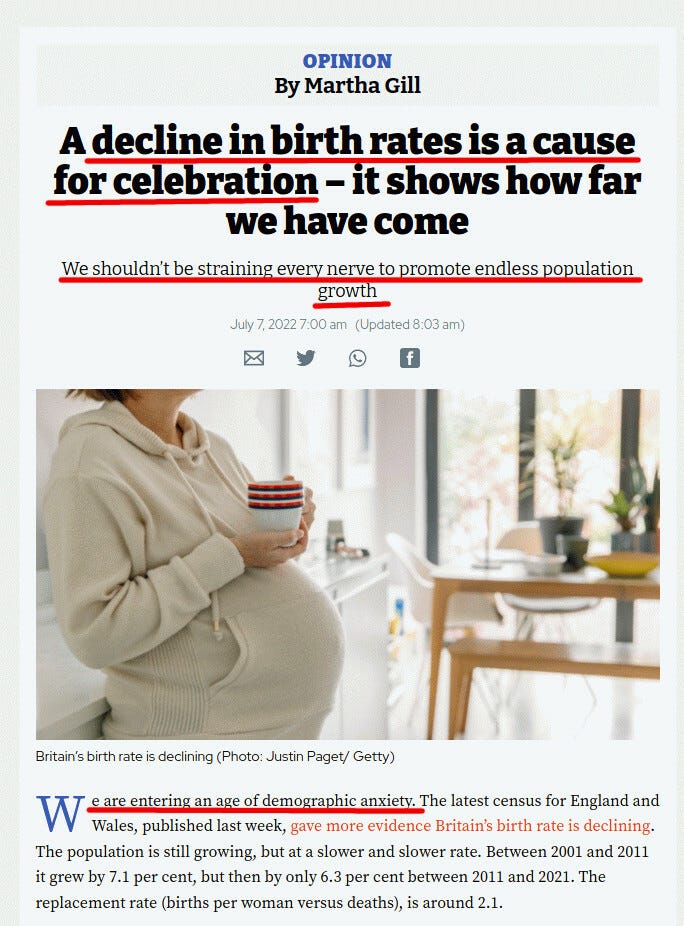
The mainstream media is beginning to cover drops in birth rates:
Further Reading
Concerned?
Check out my “depopulation series”:
Deaths Following Vaccination Reported in Taiwan Exceed Nation’s COVID Death Total
BY BLUEAPPLES | ZERO HEDGE | OCTOBER 14, 2021
Since the onset of the COVID-19 pandemic, few nations have been lauded as much for their management of the disease as Taiwan has. Since the first cases of COVID-19 in the country were reported in February 2020, only 16,313 infections and 846 deaths have been recorded. Despite how successfully the nation had managed the outbreak, it still enrolled itself in the World Health Organization-led COVAX exchange program and began its first wave of vaccinations on March 22, 2021. While the nation hadn’t had even a dozen deaths attributed to COVID-19 by the time the first vaccine was administered, 836 of the 846 deaths attributed to COVID-19 have occurred since the vaccination program began. In an even more dubious display concerning the safety and effectiveness of the vaccines administered in Taiwan, the nation’s Central Epidemic Command Center (“CECC”) has stated that 850 deaths have been reported as adverse events following vaccinations. That totally eclipses the number of fatalities attributed to the virus itself.
Taiwan’s vaccination campaign began much later than many other nations, a lag which many blame on political interference from China which was best illustrated by the island nation’s difficulties procuring orders of Pfizer-BioNTech’s mRNA vaccines. Despite these hurdles, the country was at first able to procure 117,000 doses of AstraZeneca’s vaccines. Additional deliveries of 200,000 and 400,000 doses from the same manufacturer arrived the following two months before another 150,000 vaccines from Moderna were delivered in May 2021. It gave emergency approval to a domestically engineered alternative made by Medigen Vaccine Biologics Corporation with shipments from Pfizer-BioNTech and Johnson & Johnson soon following. As of October 11, 4.48 million Taiwanese, about 19% of the population, have been fully vaccinated and 13.7 million, or about 59% of population, have received one dose. The country has stated that it seeks to have 70% of its population fully vaccinated.
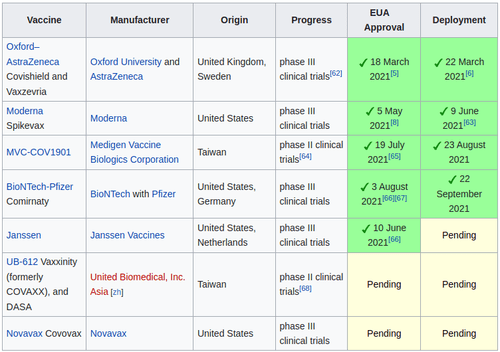
Yet, by the time Taiwan had approved those five vaccines for emergency use, an alarming trend began appearing. The highest seven-day average of new cases of COVID-19 observed in Taiwan before its first vaccines were deployed was just 3. By May 28, 2021, that seven-day average exploded to 597. As the rest of the world grappled with an increase in cases despite the global advancement of vaccination efforts, most those countries had recorded their all-time highs for new cases and deaths before any vaccines were available. One exception to that rule was seen in Israel, where the record for a highest single-day case count was recorded following the beginning of the nation’s campaign to administer third doses of the Pfizer-BioNTech vaccines in the wake of concerns of the delta variant’s impact of the efficacy of vaccines. Yet, even though Israel did surpass its previous one-day high, the amount by which it exceeded that paled in comparison to Taiwan. The seven-day average in Taiwan would not fall under 10 new cases again until September 2021. Since then, despite the increase in vaccinations, that national average has never managed to reach its pre-vaccination levels. The lowest seven-day average Taiwan has seen since it began vaccinating its citizens was recorded at 5 on September 5, 2021.
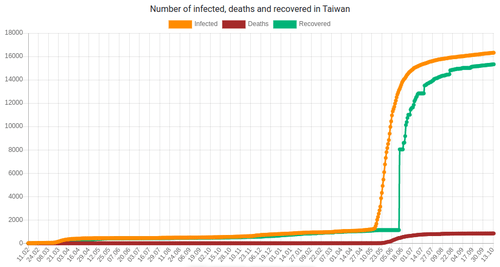
While the increase in viral transmission since March will likely be attributed to mutations like the delta variant, it could also be indicative of the antibody dependent enhancement onset from vaccines that has been forewarned about by scientists and physicians such as Dr. Robert Malone, one of the scientists behind the development of mRNA technology. Though not all vaccines used in Taiwan utilize mRNA technology, the viral vector-based vaccines like AstraZeneca’s still predicate their promotion of antibodies by exposing the immune system of vaccinated patients to the spike protein of SARS-CoV-2. Antibodies based on the genetic fragment of the spike protein alone opposed to a whole genetic sequence of a viral particle are suspected to be less capable of warding off infection. Scientists like Dr. Michael Yeadon, formerly of Pfizer, attest that these inadequate antibodies actually facilitate viral entry because they don’t possess the necessary protein structures, or paratopes, to the corresponding protein structures on the viral particles, called epitopes. This phenomenon was observed in clinical trials of mRNA vaccines aimed at combating the coronavirus which caused Middle Eastern Respiratory Syndrome. Advocates of that theory warning against that risk have expressed concerns that this same outcome of the potential deficiencies in COVID-19 vaccines has been overlooked by a hurried regulatory process.
As far as the 850 deaths reported to the Taiwanese CECC following vaccinations are concerned, 643 have been attributed to patients receiving AstraZeneca doses, 183 received Moderna doses, and just 22 received Taiwan’s own Medigen vaccine. Despite being recorded as adverse events following vaccination, many Taiwanese officials have responded to the CECC report by stating that these deaths may not be inherently due to the vaccines. The CECC has previously affirmed its position that reactions from the Moderna vaccine have resulted in fatal adverse events. As the seven-day average of COVID-19 deaths continues to hover between 0 and 1 as it has over the last several weeks, it’s possible that deaths reported to the Taiwanese CECC following vaccination will continue to exceed those attributed to viral infection for some time.
Covid-19 – Fun With Figures, Food For Thought
By William Walter Kay BA JD | Principia Scientific | September 9, 2021
Contrast Covid’s impact on four East Asian countries (Taiwan, Singapore, Japan and South Korea) with its impact on four US Northeastern states (New York, Massachusetts, New Jersey and Connecticut).
All eight jurisdictions host high-tech societies with market-orientated economies and democratic constitutions.
All boast ultra-modern hospitals, medical colleges and public health programs.
Two differences: a) compared to the US Northeast, the East Asian countries engage in more trade and travel with Covid’s epicentre, China; and, b) Covid toured East Asia before debuting in the US Northeast.
New York state’s population (19.5 million) is slightly smaller than Taiwan’s (23.8 million). Covid has killed 837 Taiwanese, and 54,895 New Yorkers.
Massachusetts’ population (6.9 million) is comparable to Singapore’s (5.9 million). Covid fatalities in Massachusetts – 18,272. Covid fatalities in Singapore – 55.
The combined population of our four Northeastern states (38.7 million) is well below South Korea’s (51.3 million). Covid’s death toll in our Northeastern states is 108,480. Only 2,303 South Koreans have died from Covid.
Our four East Asian countries (207 million) register a total of 19,308 Covid deaths. New Jersey (8.9 million) claims 26,919 Covid deaths.
Per capita, Covid has proven 341 times deadlier to New Jersians than Singaporeans!
Regarding Covid testing rates, Singapore is East Asia’s outlier. By conducting 17.8 million tests Singaporeans have achieved 3 tests per citizen. This still falls short of New York’s 3.3 tests per citizen and Massachusetts’ 3.8 tests per citizen. (You’ve read correctly. Certain people get tested again and again.)
Most East Asian countries, following Japan’s lead, test only patients exhibiting pneumonia-like symptoms. Japan tests 174,000 per 1 million inhabitants. Our four East Asian countries cumulatively have conducted 58 million tests. New York has conducted 66 million.
Massachusettsans test for Covid at 22 times Japan’s rate!
Medical tyranny boosters attribute East Asia’s “success” to harsh public health regimes; but Northeastern states imposed notorious lockdowns, often more Draconian than those deployed in East Asia.
Testing strategies are key. Testing only symptomatic patients is sounder than mass testing.
Asymptomatic Sars-CoV-2 carriers are extremely unlikely to be contagious.
Most people who contract Sars-CoV-2 become neither sick nor contagious.
PCR tests detect: a) miniscule infections that will not take hold; b) dead viruses from infections defeated by natural immune responses; and c) random genetic flotsam resembling Sars-CoV-2.
Mass testing yields positive results from persons who are neither sick nor contagious, and who are unlikely to become so.
By inflating case counts, mass testing makes Covid appear worse than it is.
Likewise, declaring all those who die after testing positive to be “Covid fatalities” – co-morbidities be damned – inflates death tallies; again, making Covid appear worse than it is.
Testing-based legerdemain doesn’t fully explain the whopping discrepancy between Covid’s impact in East Asia and the US Northeast.
This discrepancy also arises from the fact that the US Northeast was one of several areas following Milan’s lead i.e., during the pandemic’s early months health authorities allowed the contagion to rage unchecked through long-term care facilities.
Senior’s homes became Sars-CoV-2 incubators.
Milan, Montreal, the US Northeast et al became continental super-spreaders evidenced by supersized body counts.
Covid-19 is one matter; government response to Covid-19 is quite another.
Sources
Covid fatality and testing stats were extracted from Worldmeter’s Covid database on September 2, 2021.
Featured Video

It’s the Occupation, Stupid
or go to
Aletho News Archives – Video-Images
From the Archives
A superpower and “the world’s sickest warrior state”
By Paul J. Balles | March 8, 2010
Living through five or six major wars has hardened me to what I thought were the extremes of inhuman cruelty and brutality.
Two things made those extremes almost bearable: the brutality always revealed – at least according to the media coverage – the viciousness of the enemy. It was therefore quite understandable when our “brave men and women” pulverized the enemy.
Films of Japanese torturing captive Americans somehow justified holding Japanese Americans in internment camps during World War II; and only a small percentage of Americans found the bombing of Hiroshima and Nagasaki unreasonably vengeful at best, at worst, depraved.
The media giants in America portrayed the North Koreans as barbaric beasts with their captives, quite unlike their southern counterpoints – our allies during the Korean War. No one ever felt the need to explain how the South Koreans were a civilized breed while the North Koreans were absolute savages, at least according to the official line.
In Vietnam, our warriors justifiably (or so the media made us believe) dropped napalm on the North Vietnamese who had the gall to hide in villages and tunnels to ravage our invaders. At least it was accepted practice until some rogue photojournalist filmed a young girl screaming down a Vietnamese road in flames. … continue
Blog Roll
 Aletho News
- Pro-Palestinian French member of European Parliament denied entry to Canada
- Pakistan to Host US-Iran Talks
- How Indonesia’s tilt toward the US left it stranded in the Strait of Hormuz
- US has no choice but to retreat from Iranian borders: Top commander
- Iran Retaliation Strikes Chemical Plant Near Dimona
- AWACS’ Destruction is a Major Loss for US Military – Ex-DoW Analyst
- Israel’s Iran Strategy Uses US Military & Gulf States as Its Pawns
- Iran: Trump wanted regime change, now just begging for Hormuz to open
- IRGC: Israeli, US universities in region legitimate targets after strikes on Iranian university
- Trump admits Iran hit USS Ford carrier: ‘We ran for our lives’
- If Americans Knew
- Israeli police block Catholic cardinal from entering Church of the Holy Sepulchre on Palm Sunday
- Israel is assassinating journalists again, more than any other nation, anywhere, ever – Not a ceasefire Day 170
- Over 300 US service members wounded, majority have brain injuries – Not a ceasefire Day 169
- Researchers at Human Rights Watch Resign Over Blocked Report on Palestinian Refugee Return
- Jewish Groups Are Backing a War Americans Don’t Want
- Eric Fingerhut Thinks He’s the President of the Jews
- Top Jewish Philanthropists, Rabbis Urge Israeli President to Take Action Against ‘Jewish Extremists’
- Don’t Be Fooled. Zionist Leaders Have Always Wanted to Control Southern Lebanon
- Israel’s widespread use of torture is a core element of its genocide against the Palestinian people
- In Israel’s War on Iran, Many Middle East US Bases Rendered “All But Uninhabitable”
- No Tricks Zone
- German Science Blog Accuses PIK Climate Institute Of Hallucinating Climate Tipping Points
- Devastating Assessment Of Comirnaty Vaccine By Former Senior Pfizer Europe Toxicologist
- New Study: CO2 Is ‘Effectively Negligible’ As An Explanatory Climate Change Factor Since 2000
- Former Pfizer Toxicologist Dr. Helmut Sterz Tells Bundestag Hearing Pfizer Vaccine Should Have Never Been Approved
- Energy Expert: Germany’s Nuclear Phaseout Was A “500 Billion Euro Mistake”
- New Research: South Australia’s Mid-Holocene Sea Surface Temperatures Were 4°C Warmer Than Today
- Storing Green Energy To Last Germany 10 Days Would Require A 60-Million Tonne Battery
- New Studies: UK Sea Levels Were 4 Meters Higher Than Today During The Mid-Holocene
- Destructive Green New Deal: German Energy And Metal Group Warns Of Drastic Crisis
- New Study Documents A 20-Year Pause In Arctic Sea Ice Decline – Driven By Internal Variability
 Aletho News