RussiaDidIt: Cheap Meddling, Closet Marxists and Racial Tensions
By Ricardo Vaz | Investig’Action | November 2, 2017
Are you a western journalist or analyst with an issue you cannot explain? Do your symptoms include an unwillingness to learn anything from history and an unconditional embrace of western exceptionalism? Then we have just the thing for you: RussiaDidIt! Taken in the appropriate dosage, RussiaDidIt can be used for just any issue, small and large, old and new, near and far. Call your local US embassy or EU office and order your RussiaDidIt talking points. Side effects may include total paranoia, loss of credibility and a desire to wear the EU flag as a cape.
It seems like all the evils that plague the western world these days have a common cause. Brexit, Catalonia, Trump, racial tensions, the lack of credibility of the EU, all of these have a simple explanation, if we are to believe the mainstream media and pundits: Russia is behind it. And not just Russia, but Putin himself. He must be the busiest villain in history.
True journalists like Robert Parry have analysed and exposed the rise of this new McCarthyism, and how uncorroborated, or sometimes outrightly false, allegations gradually become unquestionable facts.(1)

Screenshots from the Washington Post and Politico
In this piece we examine three articles that have different angles of this RussiaDidIt approach. They have the paranoia of Russian meddling in US elections as a background, but everything applies just as well to similar stories about the EU. Inevitably it all ties back to an inability, or unwillingness, to learn anything from history, and this disgusting myth that everyone should look up to the West as a beacon of superior values. We start of course with the ineffable Guardian.
Cheap journalism and cheap meddling
One day journalism students will study the spiral of lowering standards that took hold of the Guardian. One can sense the denial taking hold of the newspaper as their liberal centrist paradise crumbles. They yearn for a knight in shining armour who can come and save them from Brexit, even if it is Tony Blair, because, believe it or not, the idea of the EU has been here since the Renaissance!(2)
As expected, the Guardian has embraced the idea that the Russians “hacked” the 2016 US elections (whatever that means) wholeheartedly. And it recently reported on new, ground-breaking revelations:
“Russian trolls posing as Americans made payments to genuine activists in the US to help fund protest movements on socially divisive issues […]
[…] the newspaper RBC published a major investigation into the work of a so-called Russian “troll factory” since 2015, including during the period of the US election campaign, disclosures that are likely to put further spotlight on alleged Russian meddling in the election.”
So far it sounds very serious. We then learn that the main “socially divisive issue” was race relations.
“RBC counted 16 groups relating to the Black Lives Matter campaign and other race issues that had a total of 1.2 million subscribers. The biggest group was entitled Blacktivist and reportedly had more than 350,000 likes at its peak.
Last month, CNN also reported that US authorities believed the Blacktivist Facebook group and Twitter account were the work of Russian impostors.”
The liberal media have often thrown these outrageous suggestions that activism like Black Lives Matter is part of a foreign agenda, as opposed to a reaction to the structural racism that exists in the US (more on this later). But the main point that needs to be addressed about this cunning plan is the following: how much did the Russians spend in these devious activities of inflaming tensions in the US? A whopping… 80,000 dollars! The Guardian thinks the activities of some alleged troll factory engaging in social media activity and paying activists a grand total of $80,000 represents unacceptable Russian “meddling”!

Billboard accusing Martin Luther King Jr. of being a communist
Let us put this number in perspective. Hillary Clinton made $3 million out of 12 speeches to big banks. The entire spending in the US presidential election was almost $2 billion. And the Guardian is worried about $80,000 worth of meddling. For comparison USAID spent $4.2 million advancing US interests in Venezuela in 2015 alone. Even if these $80,000 had been spent in a single year, it would still be 50 times smaller than what one of the US empire’s foreign policy branches spent only in Venezuela.
The Guardian piece closes by mentioning that the evil Russians also bought ads on Google and Facebook for “tens of thousands of dollars” and “$100,000”, respectively. So in essence, the Guardian is reporting that it found suspicious grains of sand in the desert.(3) It would seem Putin is not just an evil mastermind, he is also a legendary bargain hunter. It should also be clear that the tech giants are more than happy to play their part in the witch-hunt and the crusade against “fake news”, which is nothing but an attempt by the dominant classes to monopolise their control over information.
Trump is a closet Marxist!
Next we look at an opinion column which has got to be one of the most ludicrous texts ever written. At first glance it could be mistaken for satire, but it was actually written by Cass Sunstein, a professor at Harvard and former member of the Obama administration, for Bloomberg News. The title is “Russia Is Using Marxist Strategies, and So Is Trump”!
While the entire piece should be framed for posterity, we will just quote some of the highlights:
“Karl Marx and his followers argued that revolutionaries should disrupt capitalist societies by “heightening the contradictions.” Russia used a version of that Marxist idea in its efforts to disrupt the 2016 presidential campaign. […]
What is more surprising, and far more important for American politics, is that President Donald Trump is drawn to a similar strategy.
Marx contended that as the conditions of workers started to improve, they would cease to be content with their lot, or to regard their alienation as inevitable. Lenin seized on this idea and transformed it into a revolutionary strategy. […] The job of the communist revolutionary was to “heighten” or “accelerate” those contradictions.
During the 2016 campaign, Russians did something very much like that, not to produce a revolution, but to deepen and intensify social divisions (and to help elect Donald Trump).
In short, the Russians tried to foster a sense of grievance and humiliation on all sides. […] Lenin would have been proud.”
The Russian actions that Sunstein is talking about are none other than the buying of social media ads and fostering of activism that we described in the previous section. But how about that for a deep understanding of Marx and Lenin? Sunstein does try to shield himself with a footnote that says:
“I am giving a brisk summary of some famously complex and ambiguous arguments from both Marx and Lenin.” (my emphasis)

Marx, Engels, Lenin… and Trump? Cass Sunstein of Harvard University and Bloomberg News is on the maximum dosage of RussiaDidIt !
There is nothing ambiguous about Marx and Lenin. Sunstein’s argument, on the other hand, is unambiguously idiotic. The fundamental contradiction in capitalist society is that one (large) group, the working-class, sells its labour, while another one, the bourgeoisie, profits from it because it owns the means of production. These two groups have fundamentally different interests and are irrevocably at odds, this is called class struggle. Marx’s work is monumental because it was the first truly scientific analysis of the capitalist system, which meant it also explained how it could be destroyed.
The “accelerating of these contradictions” means accelerating this class conflict in order to do a little more than “disrupting” capitalism. The goal is to overthrow capitalism altogether, have the workers seize power and the means of production, and have a society free of exploitation(4) and where production is directed to satisfy human need and not the profit of capitalists. In other words, socialism.
Lenin’s contributions to Marxism, both in theory and practice, are of course way beyond the childish arguments in this piece, from his understanding of capitalism’s inevitable development into imperialism, to his development of the role of the vanguard party. Lenin and the Bolsheviks were responsible for the October Revolution of 1917, the first time that capitalism was overthrown, and the starting point for all the liberation movements that followed.
The whole argument, if it were taken seriously, would be about the strategy to “divide and conquer”, which has nothing to do with Marxism. Just like Trump, the real-estate mogul and reality-TV star, has nothing Marxist about him. If anything, Trump is the highest embodiment of western capitalism.
Surely among the vast libraries at Harvard there must be a “Marx for dummies” book that Professor Sunstein can read. But of course, writing these disingenuous pieces is much easier. The goal of course is to simultaneously push the RussiaDidIt argument and discredit a true alternative to the (capitalist) system, which has nothing to do with Hillary Clinton and a lot (or everything!) to do with Marx and Lenin.
Black Power and Red Baiting
The final article we wish to examine appeared in The Atlantic magazine, and it focuses on the long history of Russia’s “involvement in America’s race wars”. First of all, for a country with a history of slavery and segregation of African-Americans, not to mention the internment of Japanese-Americans during WW2, the term “race wars” seems like an awful understatement. One thing that actually has not changed is the red-baiting practices of the mainstream media, accusing anyone who deviates from the approved narrative of being a Soviet/Russian agent.
The article explores the history of the Soviet Union taking advantage of racial injustice in the United States for propaganda purposes. How dare those commies bring up the plight of black people in the US? Anyone who knows a bit of history knows that this is not entirely out of place. For example, in the struggle against apartheid, notably in the war in Angola, the US was on the side of apartheid South Africa and the Soviet Union was on the side of the Angolans (and of black South Africans), even if their hand might have been forced by the Cubans.

Soviet posters about the struggle against colonialism: Left: “Capitalism is doomed!” (Artsrunyan, 1966); Right: “People of Africa Will Overpower the Colonizers!” (Kukryniksy, 1960)
There is plenty to be said about the Soviet Union’s foreign policy, but the fact is that there was not a single liberation struggle in the Third World in which the Soviet Union was on the side of the oppressor/colonist and the US on the side of the liberation movement. In fact it is the opposite that was true in most cases, if not all.
This takes us to the crux of the matter. According to historian Mary Dudziak, quoted in this piece,
“Early on in the Cold War, there was a recognition that the U.S. couldn’t lead the world if it was seen as repressing people of color,”
Dudziak and all these analysts and journalists take for granted that the US, and the west in general, are supposed to lead the world. According to them, these issues of treating black people as second class citizens are a problem mainly because they make the US look bad, and its noble mission of spreading freedom and democracy becomes much harder! It would seem that if racism was a little more polite (or if the Soviets did not bring it up!), then the Sandinistas would have been happy with Somoza, the Viet Cong would have had nothing to fight for, etc.
This unquestioned embrace of US exceptionalism, coupled to a complete ignorance of history, is what ensures that these analysts completely miss the point. For them, people rejecting and resisting US imperialism, or rejecting the EU after years of austerity policies, is just a misunderstanding, which needs to be explained by nonsense such as RussiaDidIt. Had these people actually read Marx and Lenin, as opposed to spewing these idiocies, they would understand that backlash against neoliberalism, or resistance against US imperialism, is to be expected. And there is no amount of fancy speeches by the likes of Obama, saying “freedom” and “democracy” in every other sentence, that will fix that.
The loyal flag-bearers of the imperial establishment are outraged at the idea of someone paying $80,000 to US activists, but the US spending tens of millions funding NGOs and political parties all over the world is more than natural. They are outraged that RT reports on Occupy Wall Street or Ferguson, but Voice of America and Radio Martí are supposed to be welcomed by the rest of the world. Because they stand for the better values… Apart from all the death and misery that is caused by US imperialism, it is this belief in American exceptionalism that makes the US so despised around the world.
Finally, we should stress that our argument is not whataboutism. We are not saying that this issue in place X should not be discussed because there is this other issue in the US. Outlets like RT and Sputnik should have their editorial lines and journalism standards analysed and criticised. The same holds true for Russia’s foreign policy. But, paraphrasing someone who was also accused of being a Soviet agent, it cannot be the greatest purveyor of meddling in the world and media outlets with ever lowering standards bringing these charges forward and pretending to be the Guardians of truth.
Notes
(1) We have also written on the ridiculous report published by the CIA, FBI and NSA on the Russian “hacking” of US elections.
(2) One wonders why the EU is symbolised by the Medici paying Leonardo da Vinci or by Erasmus and Thomas More being friends and not, for example, by the bubonic plague or Lucrezia Borgia’s antics. You know what else was common to all of Europe before the EU? The slave trade.
(3) More recently the Guardian published another bombshell piece, saying that Russia’s Facebook posts reached 126 million Americans. But we are talking about 80,000 posts, only 0.004% of news feed content according to Facebook, during a two year period. The big number is perfect for propaganda, but conveniently it is not made clear whether 126m different users saw the posts, or if for example 10m users on average saw 120 of these posts.
(4) We should clarify that exploitation does not mean having an evil boss that pays low salaries and forces workers to work weekends. Workers in capitalism are exploited simply because there is a value difference between what they earn and what they produce. In other words, profit comes from unpaid labour. Exploitation is the foundation of capitalism and should not be framed in moral terms, which imply that the problem is not the system but a matter of finding “good capitalists”.
Guardian Sells False Image of an Open Jerusalem

By Jonathan Cook | Dissident Voice | October 23, 2017
A Guardian essay on a new Israeli open-rooftops project in Jerusalem, part of a Season of Culture, sadly falls into a standard trap for feelgood articles of this kind. It fails to provide the main context for Jerusalem: that the native Palestinians live under a belligerent Israeli occupation that is ultimately trying to evict them from the city.
Ignoring that context when reporting on life for Jews and Palestinians in Jerusalem is gravely irresponsible journalism.
Does this misrepresentation simply reflect author Hannah Ellis-Petersen’s ignorance? Or is it a consequence of who is footing the bill: the Rockefeller Foundation sponsored the article.
Note these infuriatingly misleading introductory paragraphs:
For its Season of Culture, the ancient capital has thrown open its rooftops to encourage residents to see beyond their blinkered boundaries. But the reality is a city where the divides are growing deeper.
The standfirst sets the mendacious “balanced” tone, as though Palestinians could ever afford the luxury of choosing to be “blinkered” in a city where the Israeli-run, occupation municipality is openly hostile to them, and where their homes can be demolished for the smallest infraction of opaque, Israeli-imposed planning rules.
The city’s divides are not “growing deeper”. They were always deep in a city where the occupying power has sought for five decades to colonise Palestinian East Jerusalem with Jewish settlers. There are now more than 200,000 of these settlers gradually displacing the native Palestinian population.
Living side by side in Jerusalem are communities who exist with no interaction with one another – kept apart by fear, nationalism and religion.
No, that is not what keeps them apart. Just imagine an article on apartheid South Africa stating that whites and blacks had no interaction because they were “kept apart by fear, nationalism and religion”. In reality, the two populations were kept apart by the colour of their skin. For blacks under apartheid, and today for Palestinians under occupation, their inferior status is dictated to them. They have no say in the matter.
Palestinians and Israelis are kept apart by the structural violence of occupation, which confers on them entirely different rights and life choices. Jews in Jerusalem have Israeli citizenship; Palestinians have a residency that Israel can easily revoke. Potentially, Jews can live almost anywhere in the city; Palestinians are confined to ghettoes, where they are being suffocated of space and services to encourage them to leave.
Israel has even built a wall cutting some Palestinian neighbourhoods off from the rest of East Jerusalem and the services they pay for through their municipal taxes. They do not live apart because of fear, nationalism or religion. They have been cut off from family, friends and services by concrete walls and armed checkpoints.
While Israelis typically live in the west and Palestinians in the east of Jerusalem, mixed neighbourhoods do exist. In the winding alleys of the old city and the streets of downtown, the diverse inhabitants peacefully cross paths every day.
“Mixed neighbourhoods”? Is the author referring to Jewish settlers who have forcibly taken over Palestinian properties in areas of occupied East Jerusalem like the Old City, Silwan and Sheikh Jarrah in violation of international law and have then turned their apartment blocs into armed compounds? Is that her idea of “paths crossing peacefully” – that Palestinians must live submissively, in terror of armed Jewish interlopers?
What’s more, the only rooftops of Palestinians that were made accessible are in the old city; there are none in east Jerusalem. … The project traces a line across a divided city via its rooftops. And the stories of the volunteers who have opened their homes to strangers, regardless of ethnicity or creed, speak to a multi-layered Jerusalem, one rarely seen in a conflict-obsessed news cycle: a colourful, fractious and potent city.
Is it really a failure of the news cycle that it wishes to highlight “conflict” rather than accentuate the supposed rough-and-tumble co-existence proposed by this article, and achieved after Israel illegally annexed East Jerusalem?
Israel professes to have created an “eternal, united capital” of Jerusalem, but nothing could be further from the truth. We don’t need from the media less of an obsession with “conflict”. We need greater honesty from them about Israel’s oppression of Palestinians and the harsh reality of a Jewish settler colonial society slowly disappearing the natives.
Only the gullible or dishonest could believe that opening rooftops in the privileged, Jewish side of the city challenges or mitigates the ugliness of what is going on on the other side of Jerusalem, for Palestinians.
The problem with modern “journalism” summed up in one story
By Kit | OffGuardian | October 1, 2107
That a protest Facebook/twitter account focusing on the mistreatment of black people by American police was actually a fake account run by Russians to make the US look bad and spread division in the West… is one hell of a claim. If you were to make it, you’d probably be expected to supply evidence to back up your accusation. That’s only reasonable.
Well, CNN don’t feel the need. Two days ago they reported this story verbatim, here. Under the headline:
Exclusive: Fake black activist accounts linked to Russian government
Now, the headline doesn’t say HOW these accounts were linked to Russia, or indeed who linked them. But that’s OK, because neither does the body of the text. There’s not a single link, source or piece of evidence cited at all. The only basis for the claim is:
two sources with knowledge of the matter told CNN
That’s it. In total. They never say who these two sources are (leaving the very real possibility they don’t even exist), they never say what their supposed “knowledge of the situation” is. They tell us nothing of any note, and have the gall to put “exclusive” in the headline.
“Some guy said so” is NOT an exclusive.
The Guardian then took this one step further down the path of insanity – they reported that CNN had reported, that 2 guys told them something. Their headline…
Did Russia fake black activism on Facebook to sow division in the US?
… at least has the decency to use a question-mark, although none of that implied doubt makes into the body of the article. They don’t mention that CNN never provided any evidence of this claim, or CNN’s anonymous sources. Instead they choose to focus on whether or not it sounds plausible. After providing soundbites from professors who study “Russian interference in elections”, and referencing the Soviet Union’s supposed support of the civil rights movement of the 1960s, they decide that it does sound plausible. And since it’s plausible… it’s probably true. Right?
No reference to the keystone questions of journalism – who, when, where, why, how. No reference to evidence or sources, or agendas. Just a vague analysis of the plausibility of a rumor started by CNN on the basis of two anonymous sources with “knowledge of the situation”. This is the modern method of spreading propaganda – through a concerted effort of repetition without evidence, you can turn a lie into a “fact”.
That is the cancerous absurdity of today’s “journalism” in a nutshell.
Provisional Arctic Sea Ice Minimum
By Paul Homewood | Not A Lot Of People Know That | September 16, 2017
 It’s now looking pretty certain that Arctic sea ice extent has passed its minimum this year. Since Tuesday, it has climbed over three days by 75,000 sq km, according to NSIDC figures:
| 2017 | 9 | 1 | 4.758 |
| 2017 | 9 | 2 | 4.791 |
| 2017 | 9 | 3 | 4.801 |
| 2017 | 9 | 4 | 4.782 |
| 2017 | 9 | 5 | 4.723 |
| 2017 | 9 | 6 | 4.643 |
| 2017 | 9 | 7 | 4.635 |
| 2017 | 9 | 8 | 4.697 |
| 2017 | 9 | 9 | 4.641 |
| 2017 | 9 | 10 | 4.628 |
| 2017 | 9 | 11 | 4.646 |
| 2017 | 9 | 12 | 4.611 |
| 2017 | 9 | 13 | 4.651 |
| 2017 | 9 | 14 | 4.651 |
| 2017 | 9 | 15 | 4.686 |
http://nsidc.org/data/seaice_index/
Provisionally that would make it the 4th highest since 2007.

The ice does not appear to be thin and slushy, as we are often told. According to DMI, much of it is 2 meters or more thick.

http://ocean.dmi.dk/arctic/icethickness/thk.uk.php
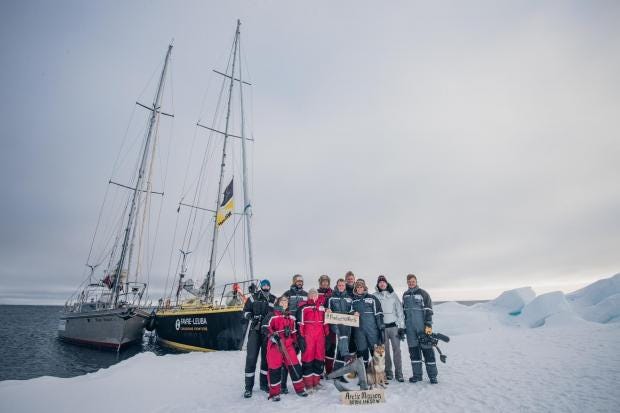
Pen Hadow’s abortive sailing expedition, now safely back in harbour in Nome, certainly ran up against unexpectedly thick and extensive ice 600 miles from the Pole, before being forced to turn tail.

It is far too soon to draw any conclusions about what this means for Arctic sea ice in future years.
But there is certainly nothing to support the wild claims of an Arctic death spiral, that we have been fed over the years.
The climate clown, Prof Peter Wadhams, seems to have kept his head down this year after his own succession of ludicrous claims, like this one last year.

https://www.theguardian.com/environment/2016/aug/21/arctic-will-be-ice-free-in-summer-next-year
Cambodia’s US-Backed Opposition Leader Charged With Treason
By Joseph Thomas – New Eastern Outlook – 04.09.2017
US and European media decried in unison the arrest of Kem Sokha, leader of the Cambodian opposition party, Cambodia National Rescue. Sokha is charged with treason amid an alleged plot to overthrow the current Cambodian government with foreign assistance.
The Guardian in its article, “Cambodia’s strongman PM digs in with arrest of opposition leader,” would report:
The Cambodian opposition leader, Kem Sokha, has been arrested accused of treason, according to the government, in the latest of a flurry of legal cases lodged against critics and rivals of the strongman prime minister, Hun Sen.
The surprise arrest raises the stakes as Hun Sen’s political opponents, NGOs and the critical press are smothered by court cases and threats ahead of a crunch general election in 2018.
The Guardian would also note:
On Saturday night a pro-government website – Fresh News – alleged that Kem Sokha had discussed overthrowing Hun Sen with support from the United States.
The Guardian would conclude by stating:
Last week the US expressed “deep concern” over the state of Cambodia’s democracy after the government there ordered out an American NGO and pursued a crackdown on independent media.
Among the media in the firing line is the well-respected Cambodia Daily, which often criticises the government.
It faces closure on Monday if it fails to pay a US$6.3m tax bill, a threat it says is a political move to muzzle its critical reporting.
The Guardian fails to mention that the Cambodia Daily is owned by an American and that the “American NGO” ordered out of Cambodia was the National Democratic Institute (NDI), an organisation notorious for its role in subverting and overthrowing the governments of sovereign nations.
The Guardian and other American and European media platforms have collectively failed to dive into Kem Sokha’s background. Had they, charges of treason would seem less far fetched and contrived as they have been presented to the public.
Kem Sokha, Made in America
Before taking to politics, Kem Sokha founded a US-European funded front posing as an independent nongovernmental organisation called the Cambodian Center for Human Rights (CCHR).
CCHR on its webpage titled, “History,” states:
Human rights activist Kem Sokha launched and registered CCHR in November 2002. In December 2005 he was arrested and detained with others activists accused of criminal defamation for comments written by an unknown individual on banners displayed at Human Rights Day celebrations. The activists were released following international pressure and a campaign for freedom of expression led by CCHR’s then Advocacy Director, Ou Virak. In early 2007 Kem Sokha left CCHR to pursue a career in politics.
On a page titled “Welcome Message,” CCHR claims to be:
… a leading non-aligned, independent, non-governmental organization that works to promote and protect democracy and respect for human rights – primarily civil and political rights – in Cambodia. We empower civil society to claim its rights and drive change; and through detailed research and analysis we develop innovative policy, and advocate for its implementation.
Yet, according to its own financial disclosures, there is nothing “independent” or “non-aligned” about the organisation.
On its webpage titled, “Donors and Partners,” it lists the Australian and British embassies, the US State Department, the European Union, USAID, Freedom House and Open Society among many other foreign government-funded and corporate-funded foundations as its financial sponsors.
Under “Affiliations and Cooperation,” it lists Human Rights Watch, Amnesty International, Article 19 along with many other primarily US and European-based, organised and funded fronts that leverage human rights advocacy in pursuit of politically-motivated agendas.
Ironically, on this same page, activists are shown demanding the release of then-imprisoned Myanmar politician Aung San Suu Kyi who has recently run afoul with advocacy groups due to her role in ongoing genocide against that nation’s Rohingya minority.
CCHR is clearly not “independent” if it is in fact dependent entirely on US and European cash to operate. Nor is it “non-aligned” if it is clearly aligned unequivocally with US and European-led interference across Southeast Asia through fronts they collectively fund to undermine one government in favour of another.
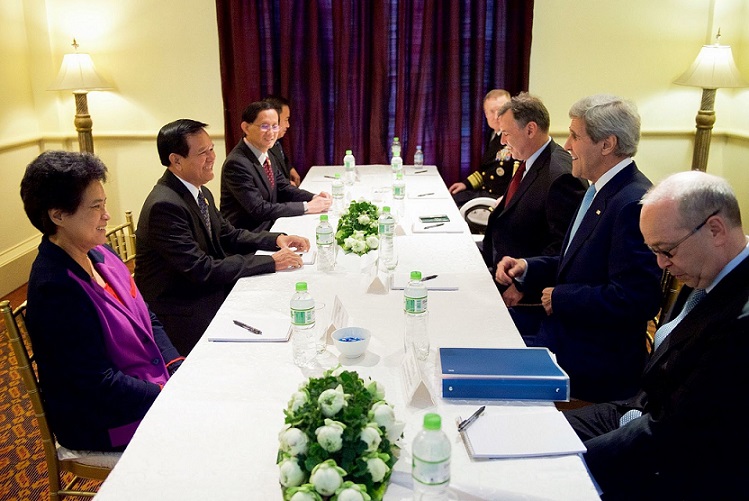
Since taking to politics, Kem Sokha and his opposition party have regularly met with the sponsors of CCHR, including the US Secretary of State John Kerry in 2016.
The aforementioned American-owned Cambodia Daily would report in a 2016 article titled, “Kerry to Meet With Civil Society, CNRP in Visit,” that:
U.S. Secretary of State John Kerry will meet with the CNRP and at least one NGO leader when he visits Phnom Penh next week, in addition to Prime Minister Hun Sen and Foreign Affairs Minister Hor Namhong, as was previously announced.
Kem Monovithya, a spokeswoman for the CNRP and the daughter of CNRP Vice President Kem Sokha, said Mr. Sokha planned to meet with Mr. Kerry, although she declined to give further information.
The director of the Cambodian Center for Human Rights, Chak Sopheap, also said she would meet with Mr. Kerry in a meeting she described as being facilitated by the U.S. Embassy.
The Cambodia Daily would also quote Sopheap, who openly desired the US to pressure her own government in regards to political changes she and her organisation sought:
“I especially wish to inform Secretary Kerry about civil society’s grave concerns regarding the draft trade union law, the proposed cyber crime law, and the implementation of the LANGO,” Ms. Sopheap wrote in an email, adding that she hoped Mr. Kerry would continue to “apply diplomatic pressure” during the U.S.-Asean summit in California next month.
Diplomats meeting with and supporting opposition groups in a host state constitutes clear interference in the host state’s internal political affairs and is beyond the scope of legitimate diplomatic relations.
Those in the opposition hosting foreign diplomats and accepting assistance are clearly engaged in what Merriam Webster defines as treason: “the offense of attempting by overt acts to overthrow the government of the state to which the offender owes allegiance…”
US Interference Poses Direct Threat to National Security
This sort of support provided by the United States in Cambodia has in other nations resulted in the usurpation of governments and even war. Examples include Ukraine, Libya, Syria and Yemen.
The nation of Myanmar is also currently led by a political party propelled into power by extensive US and European support provided over a period of decades.
In neighbouring Thailand, US support for opposition groups has resulted in a protracted political conflict, recently culminating in the fleeing abroad of ousted ex-prime minister Yingluck Shinawatra. Continued US support for Shinawatra and opposition networks will likely lead to further conflict in the near future.
Current Cambodian prime minister, Hun Sen, has repeatedly noted the threat to national security such foreign interference poses.
The Phnom Penh Post, in a 2016 article titled, “US policy destabilised Middle East, says Hun Sen,” stated:
Prime Minister Hun Sen yesterday lauded his own government’s efforts of bringing “peace” to Cambodia without “foreign interference” while calling out the US for destabilising the Middle East, where he said American policy had given rise to destructive “colour revolutions”.
The article would also report:
“Please look at the Middle East after there was inteference by foreigners to create colour revolutions such as in Libya, Syria, Yemen, Egypt and Iraq, where Sadam Hussein was toppled by the US,” the premier said.
“Have those countries received any achievement under the terms of democracy and human rights? From day to day, thousands of people have been killed. This is the result of doing wrong politics, and America is wrong.”
Considering this, the facts regarding Cambodia’s opposition and its ties to US and European interests, it should come as no surprise that foreign-funded organisations posing as NGOs are being shuttered and opposition leaders openly colluding with foreign interests are being arrested for treason.
Cambodia’s style of dealing with what is overt foreign interference lacks subtly, diplomacy and discretion. However, Phnom Penh may calculate that strengthening ties with other nations fighting off foreign interference in the region and its growing political and economic ties with Beijing may be enough to prepare Cambodia for any measures the US and Europe take in retaliation to uprooting their networks.
If left unchecked, the millions of dollars in US and European money and assistance provided to Cambodia’s opposition will continue allowing it to build its capacity to manipulate and win elections. While the opposition will cite election victories as the foundation of its growing legitimacy, the fact that these victories come as a result of foreign sponsorship, on behalf of foreign interests, undermines the opposition’s legitimacy entirely.
Democracy as a means of self-determination does not exist in a system manipulated by foreign interests. In fact, a process infected by foreign interference is fundamentally undemocratic. … Full article
TSA facial biometric body scanners and government watchlists being used in train stations
MassPrivatel | August 22, 2017
The TSA is winning the war on Americans minds as commuters are being tricked into giving away their rights without a fight.
The above video warns that facial recognition body scanners are coming to a train station near you…
“Soon you might have to pass through one of these to get to your train or subway.”
Last week, the TSA Los Angeles Metropolitan Transportation Authority ‘voluntarily’ asked commuters to walk through facial recognition body scanners before being allowed to board a train.
If you watched the video you might have noticed that the mass media (CBS) did not interview a single person who was concerned about their privacy. Instead, they quoted passengers who think body scanners are a good thing.
Nothing suspicious about that, right?
CBS warned that if the LA Metro installs the body scanners next year, commuters won’t be able to opt-out.
According to an article in the LA Times, the LA Metro has begun piloting biometric body scanners that send short-wave radio frequencies through commuters bodies to search for bombs and weapons.
A ‘pilot program’ is really a government euphemism for gauging the public’s response to another intrusive police search.
Bill Gates bankrolled high speed body scanners
According to an article in ‘The Guardian’, the start-up company Evolv Technology is pilot testing high speed body scanners at the Los Angeles’s Union Station, Union Station in D.C., and the Denver international airport.
Evolv has taken a page right out of the TSA playbook citing safety concerns and fear of terror to justify their usage.
Corporations are using Americans fears of terror to make huge profits.
Evolv stands to make hundreds of millions of dollars if commuter train stations install their body scanners. A single scanner will cost taxpayers $60,000, while Bill Gates who helped fund Evolv Technoloy makes a nice profit.
Police use our fears of terror to justify losing of our rights
An LA Times article served as a mouthpiece to justify more government spying.
Mr. Wiggins isn’t done scaring the public just yet…
Curiously, the LA Times devoted only one sentence to privacy concerns.
Three months ago, I warned everyone that California Transit Authorities have a history of using corporate spy gear to spy on commuters.
A class action lawsuit in California revealed that Transit Police are using a ‘Bart Watch’ app and Stingray surveillance to allegedly spy on commuters texts and emails.
Let’s make one thing perfectly clear, the war on terror is a for-profit business being led by private corporations and DHS. (The TSA is part of DHS.)
To learn more I recommend checking out Gary Jacobucci’s article that asked if, ‘DHS is a private offshore corporation.‘ Here are two companies that appear to be fronts for DHS: Homeland Security Solutions and Homeland Security Corporation. (Click here & here to find out more.)
Body scanners use government watchlists
Evolve uses ‘Known Wolves’, watchlist software that can identify people of interest or anyone on a government watchlist.
Getting the public to accept facial recognition body scanners at airports and Disney World is only part of a much greater privacy nightmare.
Evolv’s facial recognition body scanners are being used at public area screenings, sporting events, and employee screenings.
Retail stores and conference centers are also using facial biometric cameras and scanners.
Imagine a future where the police use government watchlists, facial biometric scanners, Stingray cellphone surveillance, Bluetooth, and license plate readers to spy on our every movement.
This is our future unless we fight for our privacy rights.

image credit: CryHavok
The Guardian’s Propaganda on Venezuela
By Ricardo Vaz | Investig’Action | July 25, 2017

With the Constituent Assembly elections due to take place on July 30th, the Guardian published a piece titled “Venezuela elections: all you need to know”. But instead of breaking through the fog of falsehood and misinformation that is typical of the mainstream media’s coverage of Venezuela, the Guardian comes up with another propaganda piece laden with lies, distortions and omissions. In this article we go through the Guardian’s piece, clarifying the falsehoods, adding the conveniently omitted information and questioning the whole narrative that is presented.
*****
What is happening on 30 July?
To be fair to the Guardian, there is one almost-informative paragraph, where the electoral procedure is explained. In a previous article the Guardian stated that
“[…] election rules appear designed to guarantee a majority for the government even though it has minority popular support”,
instead of presenting said electoral rules and letting the reader decide if they are so designed. This time they do present the rules, only omitting to say that everyone not currently holding public office can run for a seat. But then the Guardian brings in the propaganda artillery to ensure the reader’s conclusions do not stray too far off from those of the State Department.
“[…] voter turnout will be exclusively pro-government – and likely very low, given that Maduro’s approval rating hovers around 20%” 1
One assumes the Guardian is citing Datanalisis, their favourite Venezuelan anti-government pollster. Putting aside the fact that other, more reliable polls, demonstrate larger levels of government support, and the massive turnout for last Sunday’s dry-run, there are two obvious questions here. If turnout will be so low, why is the opposition hell-bent on stopping the vote from taking place, barricading streets and killing candidates? And if the opposition has such an overwhelming majority, why did they decide not to participate? This might have been their chance to introduce a Platt Amendment into the Constitution.
“The current constitution was written by an assembly called in 1999 by Maduro’s predecessor and political father, Hugo Chávez. But Chavez made sure he had popular support for the rewrite, by calling a referendum first. This time around, Maduro ordered the constituent assembly by decree.”
Chávez needed to call a referendum because he was working within the legal framework of the 1961 Constitution which did not have anything about such a mechanism. In the 1999 Constitution, article 348 states who can convene a Constituent Assembly.

Venezuelan president Nicolás Maduro has repeatedly urged opposition leaders to engage in dialogue and has backed the Constituent Assembly to guarantee peace.
“On 16 July, a symbolic plebiscite against Maduro’s initiative held by the opposition drew more than seven million people – more than those who voted for Maduro in the 2014 election.”
When it comes to the Venezuelan opposition, the Guardian checks all the journalism tools at the door. In a recent Investig’Action article we examined the opposition’s highly doubtful numbers, Venezuelanalysis did the same. At least the Guardian refrained from explicitly saying this vote could have recalled Maduro, something the opposition could not manage even with a lot of number-cooking (see footnote 2).
“Amid mounting pressure, Maduro vowed last month to hold a popular vote at the end of the process to approve or reject the new constitution.”
This was announced almost two months ago, and if it had been due to “mounting pressure” the mainstream media would have done a victory lap. Here another question springs up: why are the Venezuelan opposition and the Guardian so scared of this process? If they represent this huge majority, can they not just vote down the Constituent Assembly proposal?
Why did Maduro call this vote?
The final paragraph of this section contains the mandatory red-baiting and waving of the Cuban bogeyman.
“Venezuela has been rocked by nonstop street protests since the government’s attempt in late March to strip Congress of its right to legislate. Although the move was partially reversed, demonstrations have continued against an increasingly authoritarian government widely blamed for the country’s tanking economy and soaring crime rate.”
Again, there is very little journalism here to be found. It was not the government that overrode the National Assembly, but the Supreme Court. And they did it because the National Assembly is currently in contempt of court. Three legislators from Amazonas state are being investigated for electoral fraud, and despite repeated warnings from judicial authorities, the opposition went ahead and swore in these legislators. One can agree or disagree with the Supreme Court’s initiative, but omitting this fact is pure dishonesty.
This is also a good point to notice how only the “authoritarian” government and the “beleaguered” president have earned adjectives. “Protests” are referred to five times without a single reference to their violent nature, and a few adjectives (“divided”, “US-backed”, “coup-plotting”) also come to mind when describing the opposition.
“[…] violence and state repression have escalated since, with more than 100 people killed and hundreds arrested.”
Sophisticated newspapers like the Guardian are careful not to state directly that everyone was killed by state repression, only heavily implying it. A breakdown of the cases shows that it is the opposition’s political violence that has been responsible for the large majority of casualties.
What does the opposition say?
“The coalition of opposition forces known as the Democratic Unity Roundtable (known by its Spanish initials, MUD) rejected the move from the start. But criticism extends far beyond the political opposition. According to one pollster, eight out of 10 Venezuelans oppose a new constitution and would prefer general elections.”
One would think this would be an opportune moment to remind readers of the opposition’s constant, repeated calls for a Constituent Assembly in the recent past. And according to a different pollster, 79% of Venezuelans agree that the process should take place, 54% think the process will defend social gains of recent years, and 65% agrees with holding elections in 2018.

Opposition leaders Freddy Guevara and Maria Corina Machado had called for a Constituent Assembly in the past. (Tweets by Misión Verdad)
What happens next?
“Pressure is set to rise after the MUD called a two-day national strike for Wednesday and Thursday, and then mass protests dubbed the “taking of Caracas” on Friday.”
To anyone familiar with the recent history of Venezuela these announcements sound eerily like the events leading up to the failed 2002 coup. In fact, this would be the time to mention that many of the opposition leaders, including Henrique Capriles, Julio Borges, Leopoldo López and Maria Corina Machado, were directly involved in the 2002 coup attempt. Why is there never a mention that the opposition leadership is full of protagonists from that US-backed military coup that ultimately failed? Quite simply because it would undermine the entire “democracy vs. dictatorship” propaganda narrative.
“Maduro has been very vague about the scope of the new constitution – prompting fears that this is simply a move to tighten the government’s hold on power rather than to solve the country’s many problems.”
This is again a distortion. Maduro proposed nine issues to be tackled by the ANC, including the economy, national sovereignty, social missions, communes, and more. Granted, there is some ambiguity on what a “post-oil economy” stands for, with radical sectors looking for a deepening of the Revolution and business leaders looking for more incentives to private investment. But is down to the individual candidates to bring forward their proposals during the campaign. If Maduro specifically said what changes he wanted made to the Constitution, would he not fit into the “authoritarian” label that the Guardian loves to use?
“Maduro threatened to jail two high profile opposition leaders for “treason to the motherland”…”
Once more, it would be useful to put the actions of the Venezuelan opposition in context. There is hardly any other place in the world where opposition leaders openly call for a US military invasion or urge foreign agents to create a financial blockade against their own country!
“According to human rights groups…”
Which rights groups? Why not link to the reports and disclose who funds these groups? Because groups like Human Rights Watch have been beyond partisan when it comes to Venezuela, not to mention the revolving door that puts former US officials as human rights “guardians”. UNICEF, for example, has criticised the use of children in the opposition’s violent protests and the opposition’s attack against a maternity hospital.
“The next presidential elections – which Maduro seems likely to lose – are currently scheduled to be held in 2018, but it is unclear whether this would remain the case under a new constitution.”
Maduro has said that, rain or shine, there will be a presidential election in 2018. And he said it after convening the Constituent Assembly. The omission of this statement is again plain dishonest journalism.

Chavistas march on May 1st. The Venezuelan opposition is fearful of a large turnout for the Constituent Assembly elections on July 30th.
What is the international community doing?
“The Organization of American States has tried repeatedly to chastise Venezuela diplomatically, but Caracas has used oil diplomacy to ensure that small Caribbean states reliant on subsidised oil voted against critical resolutions or abstained.”
It is amazing that countries that are part of PetroCaribe are bullied by oil diplomacy, and yet countries that receive billions in US (military) aid and host US military bases are moved by a genuine love for democracy and human rights. Does it not occur to a journalist that, for a small Caribbean country, if a US-dominated organisation such as the OAS is dictating to Venezuela which elections can take place and when, then soon enough the same will happen to them? By rejecting this interference they are actually asserting their own independence.
It is precisely because this kind of bullying that Venezuela left the OAS. On the other hand, regional organisations that have been formed in the last decade precisely to counter US hegemony, like ALBA or CELAC, have come out in support of Venezuela and its sovereignty. International meetings like the People’s Summit or the Foro de São Paulo have also rejected the imperialist aggression against Venezuela.
“Previous US sanctions have targeted Venezuelan officials accused of drug trafficking or involvement in human rights abuses.”
These accusations have always been very big in terms of publicity and very thin in terms of evidence. They are always based on dubious sources mentioning all-powerful, yet unheard-of, drug cartels, Hezbollah training camps in Latin America and the like.
In summary, the Guardian is passing a pure propaganda piece under the guise of clarifying the upcoming Constituent Assembly elections in Venezuela. Quite clearly the next few days will be crucial, as the opposition ramps up its violent regime change efforts and the US blares out its threats, while on the other side chavismo is mobilising for this important step and (true) solidarity movements are standing with the Venezuelan poor and working-class.
As for the Guardian, whenever they ask you to support “quality, independent journalism”, you should look for it someplace else…)
- Even if this number were true, that would still make Maduro more popular than the presidents of Colombia, Mexico and Brazil, staunch US allies in the region.
More ‘fake news’: NO second secret G20 Trump-Putin summit meeting
By Alexander Mercouris | The Duran | July 19, 2017
That there is an active media campaign to misrepresent President Trump’s actions, and his contacts with President Putin of Russia in particular, is confirmed by the media’s reporting of a wholly fictitious ‘second meeting’ between President Trump and President Putin at the G20 summit in Hamburg.
Reports of this ‘second undisclosed meeting’ are the lead story in news reports in the British media today. Here is the story as it is reported by the BBC, and here it is as reported by the Guardian.
To get a sense of the paranoia surrounding anything to do with Donald Trump, consider what the BBC’s Jonathan Marcus says about the meeting:
Given the poor state of relations between Washington and Moscow and the controversy surrounding Russia’s efforts to interfere with the US presidential campaign, each and every encounter between Mr Putin and Mr Trump is bound to be carefully scrutinised.
Thus the apparently impromptu discussion between the two men at the G20 dinner inevitably raises many questions. What was President Trump seeking to do in approaching the Russian president? Were matters of substance discussed? If so, why was no formal note taken? And why did the US president have to rely upon a Russian official for translation?
This is all highly unusual, especially at a time when relations between the two countries are laden with so many problems.
Mr Trump also appeared unaware of another dimension – the message that his tete-a-tete would send to other leaders in the room, who must have watched the US president’s gambit with some unease.
As for the origins of this story, it is clear that it originates with a single individual, Ian Bremmer the President of the international consulting firm the Eurasia Group. Here is how the Guardian reports his account of the ‘meeting’:
Bremmer said there was a dinner that evening for the G20 heads of state and their spouses, though not all of them attended. “There were a lot of empty seats,” he continued. “Donald Trump got up from the table and sat down with Putin for about an hour. It was very animated and very friendly. Putin’s translator was translating. I found out about it because people were startled.”
There was no one else within earshot, Bremmer added, and it is not known what the men discussed. Trump was not joined in the conversation by his own translator, which is thought to be a breach of national security protocol. The White House later said that the translator who accompanied Trump spoke Japanese, not Russian, and that was why Trump and Putin spoke through the Russian translator.
Bremmer added: “It’s very clear that Trump’s best single relationship in the G20 is with Putin. US allies were surprised, flummoxed, disheartened. You’ve got Trump in the room with all these allies and who’s the one he spends time with?”
Such was the level of concern that someone decided to bring it to Bremmer’s attention. He said he had expected the White House to go public. “I sat on this for days hoping they would talk about it. I knew last week. It didn’t happen. I’m an analyst; I’m not in the business of breaking news,” he said.
This is utterly absurd. Discernable through the hysteria is what actually happened. During a dinner at which other G20 leaders were present Trump and Putin met and spoke with each other, though the amount of time they spent in each other’s company is disputed (the White House denies it was anything close to an hour).
This is not only perfectly normal. It is what such dinners are for: to enable leaders to get to know each other and to speak to each other in informal settings without their aides present.
No one expects serious business to be done during such meetings. In the absence of aides and with the leaders unprepared and with no formal record kept of what is said, conducting formal business during such meetings is impossible. To compare such informal meetings with proper summits is ridiculous.
It is universally acknowledged that establishing a personal relationship between leaders is essential for effective diplomacy. That is why these sort of dinners take place. Trump was simply doing his job by making the most of the opportunity provided by this one.
The White House has provided its response to the reporting of this meeting
During the course of the dinner, all the leaders circulated throughout the room and spoke with one another freely. There was no ‘second meeting’ between President Trump and President Putin, just a brief conversation at the end of a dinner. The insinuation that the White House has tried to ‘hide’ a second meeting is false, malicious and absurd. It is not merely perfectly normal, it is part of a president’s duties, to interact with world leaders.
This is obviously correct, and it has been echoed by this typically pithy comment by President Trump himself:
Fake News story of secret dinner with Putin is “sick.” All G 20 leaders, and spouses, were invited by the Chancellor of Germany. Press knew!
— Donald J. Trump (@realDonaldTrump) July 19, 2017
The Fake News is becoming more and more dishonest! Even a dinner arranged for top 20 leaders in Germany is made to look sinister!
— Donald J. Trump (@realDonaldTrump) July 19, 2017
What is disturbing about this story is not so much the gross misrepresentation of this perfectly innocuous meeting. Rather it is the revelation that the President is being straightforwardly spied on, so that he cannot have a conversation at a dinner party without news of it being broadcast, and having the nature of the meeting completely misrepresented, by the media.
This is straightforward sabotage of the President’s work. One does not have to like President Trump or agree with his policy of seeking a rapprochement with Russia to be deeply disturbed by it.
Featured Video
Alon Mizrahi: ‘Israel Must Be Dismantled’
or go to
Aletho News Archives – Video-Images
From the Archives
Allies Don’t Need Lobbies
By Jay Knott | Dissident Voice | September 24, 2013
In a recent article on Counterpunch, Rob Urie defended the traditional Marxist analysis of US policy in the Middle East. He argues that support for Israel is driven primarily by economic interest, not the Jewish lobby.
He starts by paying tribute to the idea that Western societies are uniquely racist. He says that the “Western narrative” claims there is an “Arab character”, and that this is “antique racist blather”. He gives no definition of these terms. Further, he establishes his credentials as part of the dominant current in the American left by claiming that “over a million people in Iraq died so ‘we’ in the West can drive SUVs.”1
When he tries to criticize bourgeois economics, he makes it clear he doesn’t understand the developments it has made since Marx’s day, using the mathematical discipline known as “game theory”. He dismisses the basic abstraction of economic theory, the idea of the rational individual, on the grounds that it is “devoid of history, culture and political context”. But abstractions are always devoid of something.
He defends a more concrete economic theory, mostly Marxist, with some input from another theorist of capitalist crisis, Hyman Minsky. This concrete theory leads him to the view that US activity in the Middle East is primarily driven by rational capitalist motives, the need to secure a supply of oil.
“Taking the totality of circumstance — former oil company executives launching war on an oil rich nation on a pretext they publicly proclaimed they didn’t believe shortly before taking office — and that upon launching their war proved to be non-existent, requires a willingness to overlook the obvious — that the war on Iraq was for oil, that is difficult to support.”1
Perhaps I’ve misunderstood him, but based on what he says in the rest of the article, this convoluted sentence seems to argue that, because president Bush and vice-president Cheney attacked Iraq on false premises, and they also said it was all about oil, and they are former oil executives, and Iraq has a lot of oil, it’s difficult to deny US attacks on Iraq are all about oil.
In fact, it’s not hard at all. As Urie points out, at times Bush and co. said that attacking Iraq was “protecting the world’s supply of oil.”1 But, as he also points out, they are congenital liars. Why should we believe them when they say they are trying to “protect” the oil supply? Protect it against what? When politicians “admit” attacks on Middle Eastern countries are wars for oil, they are parroting the neo-con party line, feeding the public, both left and right, with a plausible-sounding pretext. For right-wingers, “it’s a war for oil” is a reason to support war, and for leftists, it’s a way to feel better by complaining impotently about corporate greed. Both approaches help the war drive. … continue
Blog Roll
 Aletho News
- Zelensky unnecessarily involves Ukraine in the Middle East crisis
- Turkish tanker blacklisted by Ukraine hit in drone attack – media
- Canada, the U.S., and NATO: the inescapable trap
- Villains of Judea: Leonid Radvinsky
- Alon Mizrahi: ‘Israel Must Be Dismantled’
- Former Head Of MI6 Admits That The U.S. And Israel Are Losing The Iran War
- Scattered Thoughts on War and Peace
- Iran Threatens to Close Red Sea to Shipping in Response to Invasion
- Iran in excellent position to prevail in war with US, Israel: John Mearsheimer
- Iran warns US: Do not call your retreat an agreement
- If Americans Knew
- In the West Bank, life is a constant battle – 3 articles
- Jacob Reses, one of the most powerful pro-Israel operatives in Trump’s Washington
- Israeli-US assaults kill or injure 87 children a day – Not a ceasefire Day 166
- ‘Forever live by the sword’: Understanding Israelis’ massive support for Iran war
- UN’s special rapporteur on human rights says Israel is systematically torturing Palestinians
- Trump White House plagiarized Iran war manifesto from Israel-aligned think tank
- Gaza says 6–10 patients die daily waiting for treatment abroad as Israel blocks medical evacuations
- ‘Substantial evidence’ of double-tap strike in killing of Gaza’s Hind Rajab
- ‘Do Not Want To Die For Israel’: Doubts About Trump’s Iran Strategy Spread Among Troops
- Instead of taking Joe Kent’s claims seriously, the media is disregarding him as an antisemite
- No Tricks Zone
- Devastating Assessment Of Comirnaty Vaccine By Former Senior Pfizer Europe Toxicologist
- New Study: CO2 Is ‘Effectively Negligible’ As An Explanatory Climate Change Factor Since 2000
- Former Pfizer Toxicologist Dr. Helmut Sterz Tells Bundestag Hearing Pfizer Vaccine Should Have Never Been Approved
- Energy Expert: Germany’s Nuclear Phaseout Was A “500 Billion Euro Mistake”
- New Research: South Australia’s Mid-Holocene Sea Surface Temperatures Were 4°C Warmer Than Today
- Storing Green Energy To Last Germany 10 Days Would Require A 60-Million Tonne Battery
- New Studies: UK Sea Levels Were 4 Meters Higher Than Today During The Mid-Holocene
- Destructive Green New Deal: German Energy And Metal Group Warns Of Drastic Crisis
- New Study Documents A 20-Year Pause In Arctic Sea Ice Decline – Driven By Internal Variability
- Wake-up Call: Survey Shows Majority Of Germans Now Favor Postponing Climate Targets!
 Aletho News