Asma Al-Assad: How Western Media turned “A Rose in the Desert” into “A Cheerleader for Evil”
By Sarah Abed | The Rabbit Hole | July 8, 2017
In early March 2011, right before the carefully calculated and planned imposed war and invasion in Syria, Vogue Magazine published a surprisingly positive article titled: Asma al-Assad: A Rose in the Desert.
“Asma al-Assad is glamorous, young, and very chic—the freshest and most magnetic of first ladies. Her style is not the couture-and-bling dazzle of Middle Eastern power but a deliberate lack of adornment. She’s a rare combination: a thin, long-limbed beauty with a trained analytic mind who dresses with cunning understatement. Paris Match calls her “the element of light in a country full of shadow zones.” “She is the first lady of Syria”.
The article gave readers an inside view of what life was like for the Assad’s In Syria. It didn’t exaggerate, or misrepresent information and had a seemingly unbiased tone.
“Back in the car, I ask what religion the orphans are. “It’s not relevant,” says Asma al-Assad. “Let me try to explain it to you. That church is a part of my heritage because it’s a Syrian church. The Umayyad Mosque is the third-most-important holy Muslim site, but within the mosque is the tomb of Saint John the Baptist. We all kneel in the mosque in front of the tomb of Saint John the Baptist. That’s how religions live together in Syria—a way that I have never seen anywhere else in the world. We live side by side, and have historically. All the religions and cultures that have passed through these lands—the Armenians, Islam, Christianity, the Umayyads, the Ottomans—make up who I am.”
“Does that include the Jews?” I ask. “And the Jews,” she answers. “There is a very big Jewish quarter in old Damascus.”
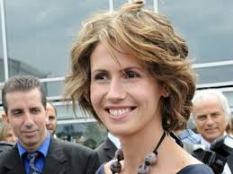 Also included in the article is some background information on the first lady. Asma Akhras was born in London in 1975 to a Syrian-born cardiologist and his wife, a diplomat who had served as first secretary at the Syrian embassy. She went to Queen’s College a private school, graduated from King’s College London, and worked for some time at JP Morgan in Manhattan. She was accepted into the prestigious ivy league school Harvard but instead of attending she accepted a marriage proposal from President Bashar in 2000 after secretly dating for some time.
The article detailed some other information as well, but nothing that would strike the knowledgeable reader as pretentious, over the top, or propaganda material. The response however from other publications written by disgruntled journalists was outrageous. They spoke as if they had more knowledge about conditions in Syria than a journalist that actually went to Syria and wrote about the experience.
Soon after the Vogue article was published the war in Syria began, with a staged uprising in Daraa. Another war against Vogue Magazine and this article, in particular, was waged by many publications, in particular, those that had ties or were sympathetic to the illegal state of Israel.
These publications shamed, insulted, belittled and demanded that this story be retracted or changed to fit the demonization campaign that spawned in mainstream media.
A few years prior in 2009 The Huffington Post published a slide show entitled, “Asma Al Assad: Syria’s First Lady And All-Natural Beauty.”
In 2010 the Harvard Arab Alumni Association’s website promoted an event featuring Asma by praising her as an avid supporter of “a robust, independent and self-sustaining civil society.” Asma convened a conference for the Syria Trust for Development about “the emerging role of civil society in development.”
As reported in Harvard’s Belfer Center for Science and International Affairs website, The First Lady “… opened the conference by declaring that the state wanted to open more space for civil society to work, develop and partner with the government in designing and implementing development-oriented policies. We will learn from our mistakes, she said, and a law will be passed soon — after consultations with civil society — to provide non-governmental organizations the safeguards they need to operate effectively. She challenged them, for their part, to rise to the occasion and achieve higher levels of efficacy and professionalism. Her overall theme of partnership reflected a realization that the government alone could not provide all the expertise or services needed to develop the country at the pace that its citizens expect.“
Syria hosted a conference of Harvard Arab Alumni with Asma leading the event.
The website was enthusiastic about Mrs. Assad’s role in Syrian national life and the connection between her work and that of her husband’s: ‘‘In her role as Syria’s first lady, Her Excellency Asma al-Assad applies her experience, energy, and influence to her country’s social and cultural development. Her role reflects the significant economic, political and social change that is happening in Syria today. Asma al-Assad’s work supports that of President Bashar al-Assad by fostering the emergence of a robust, independent and self-sustaining civil society.’’
Harvard Arab Alumni met in Damascus, “Under the Patronage of H.E. Mrs. Asma al-Assad, The First Lady of Syria.” “We are honored that Harvard Vice Provost for International Affairs, Prof. Jorge Dominguez, will be joining us in Damascus to deliver the Harvard Guest Address.“
In 2010, French Elle voted Asma “the most stylish woman in world politics,” and Paris Match called her “an eastern Diana,” a “ray of light in a country full of shadow zones.”
Even US Politicians appreciated and admired the Assads before this war bloody war was waged on the sovereign nation. Paying them visits and speaking about them in positive and affirmative tones.
Former Speaker of the House Nancy Pelosi stood on Syrian soil in April 2007 and famously declared that “the road to Damascus is a road to peace.” During her visit, Pelosi had an enjoyable shopping tour through Damascus markets.
Even Secretary of State Hillary Clinton bought the Assad-is-a-reformer narrative, telling CBS News on March 27, 2011: “There is a different leader in Syria now. Many of the members of Congress of both parties who have gone to Syria in recent months have said they believe he’s a reformer.”
Senator John Kerry, President Obama’s former informal envoy to Syria. Kerry feverishly pushed to revive diplomatic engagement with the Assad regime. Indeed, he was a frequent guest of Bashar’s; the two men and their wives were known to dine together in Damascus and discuss bilateral relations. He delivered a speech in Washington that heaped praise on Assad for the generosity he personally extended to the former Democratic presidential candidate during his many visits to Damascus.
All seemed well in Syria according to politicians and media alike. Was that all just a front? Were they all lying? Or were they dubbed into believing something that wasn’t true? Maybe they were tricked? Could it be that the Assad’s had put them all under a spell? No, no, no. They were not handed a memo yet that going forward they would be limited to derogatory terms and hate speech however ridiculous or nonsensical it may be when speaking about the Assad’s. It was a requirement or else they would face ridicule much like what happened to Vogue Magazine after they published their article on the first lady. They needed to quickly recant their support, respect, and admiration in order to fit with the new script. New terminology would replace the old, regime and dictator instead of government and president. Also, going forward all mainstream media outlets are required to mention barrel bombs, chemical weapons, and how the US will protect and save poor Syrians who are being bombed by their “brutal dictator” by well.. bombing them. Wait.. what?
Why this sudden change in March 2011? Simply because mainstream media completely flipped it’s script and started to demonize this “Rose in the Desert” along with her husband President Dr. Bashar Al Assad in an all-out propaganda campaign that fit the US/NATO “regime change” narrative. Asma Al-Assad never was nor is she evil. President Bashar Al Assad is not a ruthless dictator but instead they both are very much loved and respected in THEIR country by their people which is all that should matter. Before this invasion took place in 2011 and over 300,000 foreign mercenaries came in from over 80 countries, Syria was one of the safest countries in the world, and the only secular, nonsectarian and united country in the Middle East. For the first ten years of his presidency there were no major issues, no bombings, beheadings by terrorists, none of that so how is this something that President Bashar brought to the country? That is a huge misconception, one of many that the western media has helped instill in the minds of gullible people who have completely refused to use logic and critical thinking or to even question what they are being told.
The agenda in most mainstream media outlets globally soon became to destroy the first Assad’s image by any means possible, with a proliferation of lies and negative press. The same demonization that was used previously by imperialist nations in pursuit of destabilizing yet another country in the region. The modus operandi was the same, create an over the top propaganda media campaign to win the public’s sympathy and wage a “humanitarian intervention” in order to save the people of a country from their corrupt “dictatorship” run government by ousting the elected president, installing a puppet president approved by the US/NATO, stealing their resources, and establishing a long-term military base on the pretense that they are helping to rebuild the nation they themselves unapologetically destroyed. Much like they did with other countries they were “spreading democracy” in prior such as Afghanistan, Iraq, and Libya etc.
The plethora of articles one will find by doing a simple google search that reek of propaganda and are filled to the rim with bias, sectarian hate speech, and outright lies is profound. For the knowledgeable reader, they are simply infuriating to read.
I have included one such propaganda spewing article below published by The Guardian and some interesting information I found about the author as well.
“Asma al-Assad is a cheerleader for evil. Her UK citizenship should be revoked” was written by Nadhim Zahawi.
In this poorly written and utterly pathetic excuse for an article, Zahawi states “The Assad regime has a seemingly infinite capacity for evil, and an inability to be touched by compassion. At the very best he is dangerously deluded about what is happening, and the atrocities he has ordered. But most likely he is a monster.” Even though his article was supposedly about Asma Al-Assad he took whatever invalid and fact-deprived hits that he could at her husband as well.
Interestingly enough Mr. Zahawi a Kurdish Iraqi politician who visited Syria in 2011 and resides in the U.K. also had this to say “Removing Mrs. Assad’s citizenship is not illegal, because she is also a citizen of Syria. The home secretary has the power to do so when she believes it would be “conducive to the public good”. Asma al-Assad should never be welcome in our country again.” On that note, I hope Mr. Zahawi is forbidden to return to Syria as well.
After looking into Mr. Zahawi a little further I found that he is the vice-chair of the All Party Parliamentary Group (APPG) on Kurdistan Region in Iraq, which receives secretarial support from Gulf Keystone Petroleum International, an oil company of which Zahawi is Chief Strategy Officer. Concerns have been raised about how MPs’ independence might be compromised by such links between APPGs and private companies, and specifically about how Zahawi’s connections with the oil industry affect his role as MP. Zahawi has been co-chair or vice-chair of this APPG since it was established in 2008/9. Also worth noting, in November 2013 Zahawi “apologized unreservedly” after The Sunday Mirror reported that he had claimed £5,822 expenses for electricity for his horse riding school stables and a yard manager’s mobile home.[19] Zahawi said the mistake arose because he received a single bill covering both a meter in the stables and one in his house. He would repay the money though the actual overcharge was £4,000.[20] An article in The Independent also drew attention to the number of legitimate but “trivial” items on Zahawi’s expenses.
In January 2011, Zahawi appeared in the Commons debate discussing the end of the Education Maintenance Allowance scheme wearing a musical tie which proceeded to play during his contribution. The Deputy Speaker advised him to be more selective when choosing ties to avoid a musical accompaniment to debate in the chamber.
An investigation by the Guardian has revealed close links between a Conservative MP and two companies based in a tax haven. Nadhim Zahawi has financial ties to Balshore Investments and Berkford Investments, which operate from a lawyer’s’ office in Gibraltar. He does not declare a connection to either company on the MPs’ register of interests.
The same script in mainstream media is used repeatedly yet people still fall for it. Isn’t it time for the masses to recognize this repetition and bring an end to these bankers wars based on lies? We are all of one race, the human race and we need to end these countries destructive imperialist driven plots. World domination by the elite is not in the best interest of humanity.
The United States has been practicing this destructive behavior in toppling sovereign nations for their own benefit since 1898. New imperial influence of U.S. (1898-1917): New territories gained in Spanish American War: Hawaii, Puerto Rico, Guam, Philippines. Up until present day with Afghanistan, Libya, Iraq, Syria, Venezuela, the Philippines etc. At some point, this bloodshed has to end. Sovereignty has to be preserved. Cultures and customs need to be protected against greedy nations who only have their own best interest at heart. Whether it be neo-colonialism, imperialism, economic imperialism, etc. These ruthless regimes will do whatever it takes to complete their bloody missions.
Antikrieg TV -In 2010, the Syria’s First Lady Asma al-Assad talked to diplomats and intellectuals at the Paris Diplomatic Academy. She spoke without notes, about Syria’s history and how that heritage informs daily life.
“Some often ask me how then can Syria remain stable, moderate and influential in a region that is increasingly being surrounded by extremism, ideologism (sic), sectarianism and all other forms of negative perceptions in our society,” she told the gathering. “The typical answer I get is because of military, political, security reasons. Again, I believe I have a different view.
“It’s the very essence of our culture. It’s what our history teaches us of openness and engagement,” she said. “It’s the sense of identity and pride that we have knowing who we are in the world and knowing what we’ve contributed to the world over thousands of years that give us that sense of stability and that sense of moderation.
“Some of you might think I am talking politics. … Trust me, I have no interest in politics,” she continued. “My interests are elsewhere. But living in the region for as long as I have, I realize that politics affects every facet of our lives.”
Many people who have never heard of Syria before it became front page news after this imposed war was launched by outside forces on it’s land, think they have the right to speak ill about a nation that people like myself are originally from. Their profound arrogance is matched by their ignorance. What they may not realize is that they are indirectly contributing to the bloodshed by spreading this false propaganda. It would be better for them to never speak about Syria than for them to carelessly spread information that is nothing more than dirty gossip that they heard on their T.V. If they truly care, they need to educate themselves by reading and watching alternative media sources and listening to independent journalists, that do not have a vested interest in seeing Syria crumble and fall into the hands of the vultures in the West and their allies.
Sarah Abed can be contacted at sarahabed84@gmail.com.
Western Media Blasts Trump After Meeting With Putin

© Sputnik/ Michael Klimentyev
Sputnik – July 9, 2017
The first meeting between Vladimir Putin and Donald Trump at the G20 summit in Hamburg evoked a wave of criticism from Western media, as a number of notable news outlets blasted the US President for his conduct during negotiations.
At least several prominent newspapers took a dim view of President Trump’s handling of this meeting, claiming that the Russian leader apparently managed to outplay and outsmart his US counterpart.For example, Die Welt stated that it was clear to all professional observers that the meeting resulted in Trump’s capitulation.
In an apparent effort to underscore Trump’s relative inexperience in foreign affairs, the newspaper claims that the “political pro” Putin knocked out the newbie US President “by the book.”
The article’s author also emphasized the fact that Putin paused for a moment before shaking Trump’s already extended hand.
The Guardian adds that while US politicians apparently felt relieved that Trump managed to avoid “a major gaffe” during the meeting, it was “hardly cause for celebration.”
“It’s an indication of how rapidly our standards are falling when we’re reasonably pleased that President Trump has not made an obvious error,” Thomas Countryman, former US acting undersecretary for arms control and international security, remarked.
Meanwhile the New York Times insists that the meeting with Putin was probably the best part of the summit for Trump, who apparently found himself increasingly ostracized by other delegates.
“The talks with Mr. Putin oddly turned into a bright spot for Mr. Trump on the first full day of the gathering, where the United States found itself increasingly ostracized by other Group of 20 members on major issues, including climate change, immigration and trade,” the newspaper says.
The Los Angeles Times criticized the way Trump discussed the issue of Russia’s alleged meddling in the 2016 US presidential election, arguing that the US President should’ve been more assertive in his inquiries on the subject.
The news website Vox even took this issue up a notch by outright saying that “Putin got Trump to buy his fake news on election interference and to offer a weak endorsement of upcoming sanctions.”
Interestingly enough, the article’s author insisted that “the entire US intelligence community believes the Kremlin mounted a sophisticated campaign” to help Trump win the election, even though this assessment was made only by four out of 17 US intelligence agencies.
Stating that the US leader did not even properly prepare for the meeting, unlike his Russian counterpart, Vox claimed that “Trump — the dealmaker — got outplayed by Putin.”
The “revolution” is being televised – & we should ask why
By Catte | OffGuardian | June 17, 2107
There is something strange about the media coverage of the Grenfell tragedy. The BBC is giving over acres of space to the pain and anger of the residents. The Guardian’s front page currently looks like The Canary, and in its Opinion section Jonathan Freedland, of all people, is saying Grenfell will “forever stand as a rebuke to the Right”.

He’s correct of course, but that’s not the point. The point is Freedland, the BBC and the Guardian are the “Right” now and have been for many years, in so much as they have been, until a week ago, staunch defenders of the rabid, fascistic and despoiling policies that have characterised the “liberal” agenda since Blair. They have approved illegal wars, mass murder, “austerity”, mass surveillance, the despoiling of the NHS, the deprivation of the weak and vulnerable. They believe the suffering of the poor and powerless is merely a necessary adjunct to social “progress.”
So, what is going on here?
Maybe the “liberal” media is seeing the light and realising the years of deprivation have gone too far? Maybe the Guardian suddenly really supports social justice and the welfare state? Maybe Grenfell will be a catalyst for real change, ignite the dormant sense of decency in our champagne “socialists” and left-of-centre opinion-makers.
Well, maybe. But it doesn’t seem like a good bet does it?
Maybe the media are bandwagon-jumping. Following the story, not creating it because the social tide is currently too strong to ignore?
This is a bit more plausible, but the BBC and the rest of the tame media can easily ignore a crowd of ten thousand marching through central London when it wants to. They do similar things all the time. If they didn’t want us to know about this upsurge of anger wouldn’t they simply not talk about it, just as they didn’t talk about the mass anti-war demos and didn’t cover the anti-austerity demos, and (mostly) didn’t cover the huge crowds Corbyn was collecting?
I think when the BBC’s front page looks like this:

when social unrest is televised by state-controlled channels and when line-toeing neoliberals like Jonathan Freedland are rebuking the “Right” we need to be a bit more sceptical than to simply assume the good guys are suddenly in ascendancy and the media has no choice to but to scutter along in their wake.
There are not many examples in history where major news events or catalysing moments just happened through spontaneous popular movements, with the press corps and establishment running to catch up. Mostly even seemingly spontaneous events have been planned and provoked or exploited by vested interests of one sort or another. “News” isn’t an objective entity. It’s created by the act of narration. If you don’t tell the story the story isn’t “news.” The only reason we ever know an event has occurred is because the paid scribes were detailed to tell us it did. The Peasants’ Revolt may have started as a social protest of sorts but it ended up as a PR exercise for the Divine Right of Kings, and the extant narratives make sure Richard II got all the best lines.
This is the reality of what the establishment-serving media is. It doesn’t exist to pass on facts, it exists purely to create narratives. We shouldn’t just forget that when the current narrative appears to serve decent interests or to tell some sort of truth. Because it probably isn’t ultimately doing either.
Does it matter in this case? Isn’t any publicity good publicity if it helps bring justice and help to the victims of the Grenfell tragedy? If May can be arm-twisted into handing over cash, and if the publicity helps make sure such events become less likely in the future, does it matter what agenda the media may be following
To an extent that is obviously true. And let’s hope some good does come from the publicity being given to the anger of the people in the streets. But that doesn’t mean we shouldn’t question and remain sceptical when the wolf slips on his sheepskin.
The Breaking Of The Corporate Media Monopoly

Media Lens | June 15, 2017
Last week, Jeremy Corbyn humbled the entire political and corporate media commentariat. With a little help from Britain’s student population. And with a little help from thousands of media activists.
Without doubt this was one of the most astonishing results in UK political history. Dismissed by all corporate political pundits, including the clutch of withered fig leaves at the Guardian, reviled by scores of his own Blairite MPs (see here), Corbyn ‘increased Labour’s share of the vote by more than any other of the party’s election leaders since 1945′ with ‘the biggest swing since… shortly after the Second World War’. He won a larger share of the vote than Tony Blair in 2005.
Corbyn achieved this without resorting to angry lefty ranting. His focus was on kindness, compassion, sharing, inclusivity and forgiveness. This approach held up a crystal-clear mirror to the ugly, self-interested cynicism of the Tory party, and transformed the endless brickbats into flowers of praise.
On Twitter, John Prescott disclosed that when Rupert Murdoch saw the exit poll ‘he stormed out of the room’.
As ever, while the generals made good their escape, front-line troops were less fortunate. Outfought by Team Corbyn, out-thought by social media activists, outnumbered in the polls, many commentators had no option but to fall on their microphones and keyboards. LBC radio presenter Iain Dale led the way:
‘Let me be the first to say, I got it wrong, wholly wrong. I should have listened more to my callers who have been phoning into my show day after day, week after week.’
The Guardian’s Gaby Hinsliff, who had written in January, ‘This isn’t going to be yet another critique of Corbyn, by the way, because there is no point. The evidence is there for anyone with eyes’, tweeted:
‘This is why I trust @iaindale’s judgement; he admits when it was way off. (As mine was. As god knows how many of ours was)’
Hinsliff promised:
‘Like everyone else who didn’t foresee the result, I’ll be asking myself hard questions & trying to work out what changed…’
Annoying as ever, we asked:
‘But will you be asking yourself about the structural forces, within and outside Guardian and corporate media generally, shaping performance?’
And:
‘Is a corporate journalist free to analyse the influence of owners, profit-orientation, ad-dependence, state-subsidised news? Taboo subjects.’
Presumably engrossed in introspection, Hinsliff did not reply.
Right-winger John Rentoul, who insisted four weeks ago in the Independent that, ‘we are moving towards the end of the Corbynite experiment’, appeared to be writing lines in detention:
‘I was wrong about Jeremy Corbyn – The Labour leader did much better in the election than I expected. I need to understand and learn from my mistakes’
Channel 4 News presenter and Telegraph blogger, Cathy Newman tweeted:
‘Ok let’s be honest, until the last few weeks many of us under-estimated @jeremycorbyn’
Translating from the ‘newspeak’: many corporate journalists waged a relentless campaign over two years to persuade the public to ‘underestimate’ Corbyn, but were wrong about the public’s ability to see through the propaganda.
Piers Morgan, who predicted the Conservatives would win a ’90-100 seat majority’, wrote:
‘I think Mr Corbyn has proved a lot of people, including me, completely wrong.’
In a typically dramatic flourish, Channel 4’s Jon Snow’s summation was harsh but fair:
‘I know nothing. We the media, the pundits, the experts, know nothing.’
Guardian columnist Rafael Behr, who wrote in February, ‘Jeremy Corbyn is running out of excuses’, also ate humble pie:
‘Fair play to Jeremy Corbyn and his team. They have done a lot of things I confidently thought they – he – could not do. I was wrong.’
In March, Observer columnist Nick Cohen graphically predicted that ‘Corbyn’s Labour won’t just lose. It’ll be slaughtered.’ In an article titled, ‘Don’t tell me you weren’t warned about Corbyn’, Cohen indicated the words that would ‘be flung’ at Corbynites ‘by everyone who warned that Corbyn’s victory would lead to a historic defeat’:
‘I Told You So You Fucking Fools!’
Apparently frothing at the mouth, Cohen concluded by advising the idiots reading his column that, following the predicted electoral disaster, ‘your only honourable response will be to stop being a fucking fool by changing your fucking mind’.
Awkward, then, for Cohen to now ‘apologise to affronted Corbyn supporters… I was wrong’; presumably feeling like a fucking fool, having changed his fucking mind.
Tragicomically, Cohen then proceeded to be exactly as ‘wrong’ all over again:
‘The links between the Corbyn camp and a Putin regime that persecutes genuine radicals. Corbyn’s paid propaganda for an Iranian state that hounds gays, subjugates women and tortures prisoners. Corbyn and the wider left’s indulgence of real antisemites (not just critics of Israel). They are all on the record. That Tory newspapers used them against the Labour leadership changes nothing.’
Former Guardian comment editor and senior columnist Jonathan Freedland spent two years writing a series of anti-Corbyn hit pieces (see our media alert for discussion). Last month, Freedland wrote under the title, ‘No more excuses: Jeremy Corbyn is to blame for this meltdown’, lamenting:
‘What more evidence do they need? What more proof do the Labour leadership and its supporters require?’
Freedland helpfully relayed focus group opinion to the effect that Corbyn was a ‘dope’, ‘living in the past’, ‘a joke’, ‘looking as if he knows less about it than I do’. Freedland has also, now, had no choice but to back down:
‘Credit where it’s due. Jeremy Corbyn defied those – including me – who thought he could not win seats for Lab. I was wrong.’
Like Freedland, senior Guardian columnist Polly Toynbee has relentlessly attacked Corbyn. On April 19, she wrote of how ‘Corbyn is rushing to embrace Labour’s annihilation’:
‘Wrong, wrong and wrong again. Was ever there a more crassly inept politician than Jeremy Corbyn, whose every impulse is to make the wrong call on everything?’
This week, Toynbee’s tune had changed:
‘Nothing succeeds like success. Jeremy Corbyn looks like a new man, beaming with confidence, benevolence and forgiveness to erstwhile doubters…’
Apparently channelling David Brent of The Office, Toynbee added:
‘When I met him on Sunday he clasped my hand and, with a twinkle and a wink, thanked me for things I had written.’
With zero self-awareness, Toynbee noted that the Mail and Sun had helped Corbyn: ‘by dredging up every accusation against him yet failing to frighten voters away, they have demolished their own power’.
Former Guardian political editor Michael White, yet another regular anti-Corbyn commentator, admitted:
‘I was badly wrong. JC had much wider voter appeal than I realised’
Former Guardian journalist, Jonathan Cook, replied:
‘Problem is you *all* got it wrong. That fact alone exposes structural flaw of corporate media. You don’t represent us, you represent power’
White responded:
‘You’re not still banging on, are you Jonathan. You do talk some bollocks’
Guardian, Telegraph, Independent and New Statesman contributor Abi Wilkinson tweeted:
‘Don’t think some of people making demands about who Corbyn puts in shadow cabinet have particularly earned the right to be listened to…’
We paired this with Wilkinson’s comment from June 2016:
‘Any hope I once held about Corbyn’s ability to steer the party in a more positive direction has been well and truly extinguished’
Wilkinson replied: ‘oh fuck off’, before concluding that we are ‘two misogynistic cranks in a basement’, and ‘just some dickheads who aren’t actually fit’ to hold the media to account.
When a tweeter suggested that Corbyn’s result was ‘brilliant’, New Statesman editor Jason Cowley replied: ‘Yes, I agree.’ Just three days earlier, Cowley had written under the ominous title:
‘The Labour reckoning – Corbyn has fought a spirited campaign but is he leading the party to worst defeat since 1935?’
In March, Cowley opined:
‘The stench of decay and failure coming from the Labour Party is now overwhelming – Speak to any Conservative MP and they will say that there is no opposition. Period.’
Like everyone else at the Guardian, columnist Owen Jones’ initial instinct was to tweet away from his own viewspaper’s ferocious anti-Corbyn campaign:
‘The British right wing press led a vicious campaign of lies, smears, hatred and bigotry. And millions told them where to stick it’
And yet, as recently as April 18, Jones had depicted Corbyn as a pathetic figure:
‘A man who stood only out of a sense of duty, to put policies on the agenda, and who certainly had no ambition to be leader, will now take Labour into a general election, against all his original expectations. My suggestion that Corbyn stand down in favour of another candidate was driven by a desire to save his policies…’
Jones has now also issued a mea culpa:
‘I owe Corbyn, John McDonnell, Seumas Milne, his policy chief Andrew Fisher, and others, an unreserved, and heartfelt apology…
‘I wasn’t a bit wrong, or slightly wrong, or mostly wrong, but totally wrong. Having one foot in the Labour movement and one in the mainstream media undoubtedly left me more susceptible to their groupthink. Never again.’
We will see!
To his credit, Jones managed to criticise his own employer (something he had previously told us was unthinkable and absurd):
‘Now that I’ve said I’m wrong… so the rest of the mainstream commentariat, including in this newspaper, must confess they were wrong, too.’
Despite the blizzard of mea culpas from colleagues, George Monbiot also initially pointed well away from his employer:
‘The biggest losers today are the billionaires who own the Mail, Sun, Times and Telegraph. And thought they owned the nation.’
And: ‘It was The Sun wot got properly Cor-Binned’. And: ‘By throwing every brick in the house at Corbyn, and still failing to knock him over, the billionaire press lost much of its power.’
After receiving criticism, and having of course seen Jones’ mea culpa, Monbiot subsequently admitted that anti-Corbyn bias is found ‘even in the media that’s not owned by billionaires’:
‘This problem also affects the Guardian… Only the Guardian and the Mirror enthusiastically supported both Labour and Corbyn in election editorials.
‘But the scales still didn’t balance.’
This is a change from Monbiot’s declared position of three years ago, when he rejected the idea that the Guardian was part of the problem. This week, he recalled his own dumping of Corbyn in a tweet from January: ‘I have now lost all faith.’ The full tweet read:
‘I was thrilled when Jeremy Corbyn became leader of the Labour Party, but it has been one fiasco after another. I have now lost all faith.’
Monbiot blamed media bias on the way journalists are selected – ‘We should actively recruit people from poorer backgrounds’ – and wrote, curiously, ‘the biggest problem, I believe, is that we spend too much time in each other’s company’.
We suggested to Monbiot that this was not at all ‘the biggest problem’ with ‘mainstream’ media, and pointed instead to elite ownership, profit-orientation, advertiser dependence and use of state-subsidised ‘news’, as discussed by Edward Herman and Noam Chomsky in their ‘propaganda model’.
Jonathan Cook responded to Monbiot, describing the limits of free speech with searing honesty:
‘This blindness even by a “radical” like Monbiot to structural problems in the media is not accidental either. Realistically, the furthest he can go is where he went today in his column: suggesting organisational flaws in the corporate media, ones that can be fixed, rather than structural ones that cannot without rethinking entirely how the media functions. Monbiot will not – and cannot – use the pages of the Guardian to argue that his employer is structurally incapable of providing diverse and representative coverage.
‘Nor can he admit that his own paper polices its pages to limit what can be said on the left, to demarcate whole areas of reasonable thought as off-limits. To do so would be to end his Guardian career and consign him to the outer reaches of social media.’
The same, of course, applies to Jones, who made no attempt at all to account for corporate media bias.
Media grandee Will Hutton, former editor-in-chief of the Observer, now Principal of Hertford College, Oxford, wrote of ‘How the rightwing tabloids got it wrong – It was the Sun wot hung it’. On Twitter, we reminded Hutton of his own article, one month earlier:
‘Er, excuse us..! Will Hutton, May 7: “Never before in my adult life has the future seemed so bleak for progressives”‘
Tragicomically, given the awesome extent of his employer’s anti-Corbyn bias, John Cody Fidler-Simpson CBE, BBC World Affairs Editor, tweeted:
‘I suspect we’ve seen the end of the tabloids as arbiters of UK politics. Sun, Mail & Express threw all they had into backing May, & failed.’
We replied:
‘Likewise the “quality” press and the BBC, which has been so biased even a former chair of the BBC Trust spoke out’
Sir Michael Lyons, who chaired the BBC trust from 2007 to 2011, commented on the BBC’s ‘quite extraordinary attacks on the elected leader of the Labour party’:
‘I can understand why people are worried about whether some of the most senior editorial voices in the BBC have lost their impartiality on this.’
Conclusion – The Corporate Media Monopoly Is Broken
One week before the election, the Guardian reported that ‘a new force is shaping the general election debate’:
‘Alternative news sites are run from laptops and bedrooms miles from the much-derided “Westminster bubble” and have emerged as one of the most potent forces in election news sharing, according to research conducted for the Guardian by the web analytics company Kaleida.’
These alternative articles were ‘being shared more widely online than the views of mainstream newspaper commentators’. Remarkably, ‘Nothing from the BBC, the Guardian or the Daily Mail comes close’ to the most-shared alternative media pieces. The Canary reported that it had doubled the number of visitors to its site to six million in May. A story by Evolve Politics, run by just two people, was shared 55,000 times on Facebook and was read at least 200,000 times. These websites ‘explicitly offer a counter-narrative to what they deride as the “MSM” or mainstream media’.
Indeed, the evidence is now simply overwhelming – the 100-year big business monopoly of the mass media has been broken.
It is obvious that the right-wing press – the Daily Mail, the Sun, The Times and Telegraph – play a toxic role in manipulating the public to favour elite interests. But many people are now realising that the liberal press is actually the most potent opponent of progressive change. Journalist Matt Kennard commented:
‘The Guardian didn’t get it “wrong”. It is the mouthpiece of a liberal elite that is financially endangered by a socialist program.’
In truth, the Guardian sought to destroy Corbyn long before he became Labour leader (see here and here). This means that it did not target him because he was an ineffective leader imperilling Labour. And this hostility was no aberration, not a well-intentioned mistake that they got ‘wrong’. To this day, the Guardian remains Blair’s great cheerleader, despite his awesome crimes, just as it was Hillary Clinton and Obama’s cheerleader, and just as it was Bill Clinton’s before them.
While employing a handful of compromised fig leaves, the Guardian has ruthlessly smeared anyone who has sought to challenge the status quo: Julian Assange, Russell Brand, Hugo Chavez, Noam Chomsky, Edward Herman, John Pilger, George Galloway and many others. It has also been complicit in the great war crimes of Iraq, Libya and Syria – accepting fake government justifications for war at face value, ignoring expert sources who made a nonsense of the claims, and propagandising hard for the West’s supposed ‘responsibility to protect’ the nations it so obviously seeks to destabilise and exploit.
In our view, the corporate journalists who should be treated with most caution are precisely those celebrated as ‘dissidents’. Corporate media give Owen Jones, George Monbiot, Paul Mason and others immense outreach to draw 100,000s of progressives back to a filtered, corporate version of the world that favours established power and stifles progressive change. Above all, as Jonathan Cook says, the unwritten rule is that they will not speak out on the inherent structural corruption of a corporate media system reporting on a world dominated by corporations.
This is crucial, because, as last week confirms, and as we have been arguing for 16 years, if change begins anywhere, it begins with the public challenging, exposing and rejecting, not just the right-wing press, but the corporate media as a whole, the ‘liberal-left’ very much included.
In the last month, we witnessed astonishing numbers of people challenging all media, all the time on every bias – we have never seen anything like it. The young, in particular, are learning that they do not need highly-paid, privileged corporate employees to tell them what to think.
We don’t need to tolerate a corporate-filtered view of the world. We can inform ourselves and each other, and we can do so with very much more honesty, courage and compassion than any corporate journalist. If there is one message from last week, it’s a simple one – dump the corporate media; all of it.
Such a “Surprise” in the UK!
By Thomas S. Harrington | CounterPunch | June 12, 2017
I just can’t believe what happened in the British elections.
I can’t get over the fact that that when a politician with real convictions honed over 40 years of political life—generous and forward-looking convictions rooted in an understanding of how social progress for the many has actually been engineered in previous times—speaks out unencumbered by corporate-minded, fraidy-cat image doctors, people actually respond enthusiastically.
It’s shocking, absolutely shocking.
Why am I so confused?
Well, for thirty years, the brilliant people at the NYT, NPR, PBS, the BBC and The Guardian have told me again and again that candidates from Labor in the UK and the Democratic Party in the US must always be oh-so-careful careful to not veer too far left in their policy prescriptions, to not appear too “populist” and, most of all, to not to go “too far outside the mainstream”.
The question of who defines what is the mainstream, or how lavishly-funded pro-business and pro-war think-tanks might actually be the people establishing its functional parameters by funding armies of think-tank “scholars” and “experts” were, of course, a complex hermeneutical problems that I never had the time nor the energy to ponder or deconstruct.
If those smart Ivy and Oxbridge-type guys and gals in the prestige media were telling us time and again that our societies were all fundamentally center-right collectives with a deep suspicion of government action (except, that is, when it came to making unceasing war on a world-wide scale) who was I, an obscure analyst of Iberian nationalisms and other sundry issues, to say anything about it?
Can you imagine someone like me actually believing he had the right to question brilliant and connected people like David Brooks, Tom Friedman or Jonathan Freeland or Polly Toynbee?
It would have been the height of hubris on my part to do so. After all, unlike them, I don’t spend my time networking each day with ambitious like-minded people deeply enamored of power, nor do I have the option of knowing exactly what stories and messages will provoke society’s centers of financial and military power to pressure a media conglomerate to trim a pundit’s paycheck or to convince well-heeled seekers of transcendent insight to stop paying her fat speaking fees.
Because I lack this essential information, I have always assumed my rightful place as an uncritical consumer of their deeply though-out and always prescient nostrums.
True, today I am feeling a little confused and bereft. But I know that by the time the next news cycle comes around they’ll have it all figured out for me, providing explanations that will in no way contradict or vitiate all the brilliant things they’ve been saying over so many years.
Imaginary interior of Saydnaya now has imaginary crematorium – State Dept.
By Catte | OffGuardian | May 16, 2017
Remember “Saydnaya Military Prison”? It was the subject of enormous media attention a while back on the basis of a “report” from Amnesty International that turned out to have been fabricated in the UK by a virtual reality company “using 3D models, animations, and audio software, based on the admittedly baseless accounts of alleged witnesses who claim to have been in or otherwise associated with the prison.”
Well, the totally imaginary interior of Saydnaya now – according to US State Dept – has a totally imaginary “crematorium” added to it in which to dispose of all the totally theoretical corpses being generated by the completely unsubstantiated mass-murders. Here is the impressive and plausible Stuart Jones telling us all about it.
Yes, he lies about the “well-documented” chemical attacks. Yes, he manipulates and exaggerates and omits to the point of fraudulence in his summary of the “civil war.” Yes almost every detail of his claims about the goings-on in Saydnaya is based on Amnesty’s invented “report” and the completely unverified testimony of alleged inmates…
… but, but… they have satellite images! :
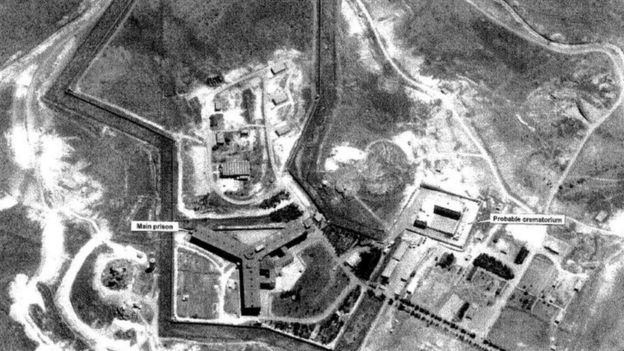
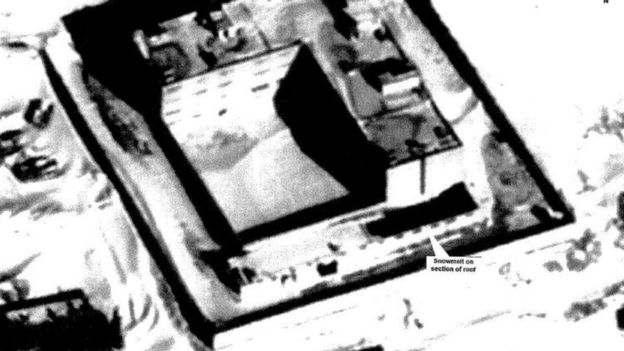
In case you’re not getting the message WaPo kindly enhanced and simplified things:
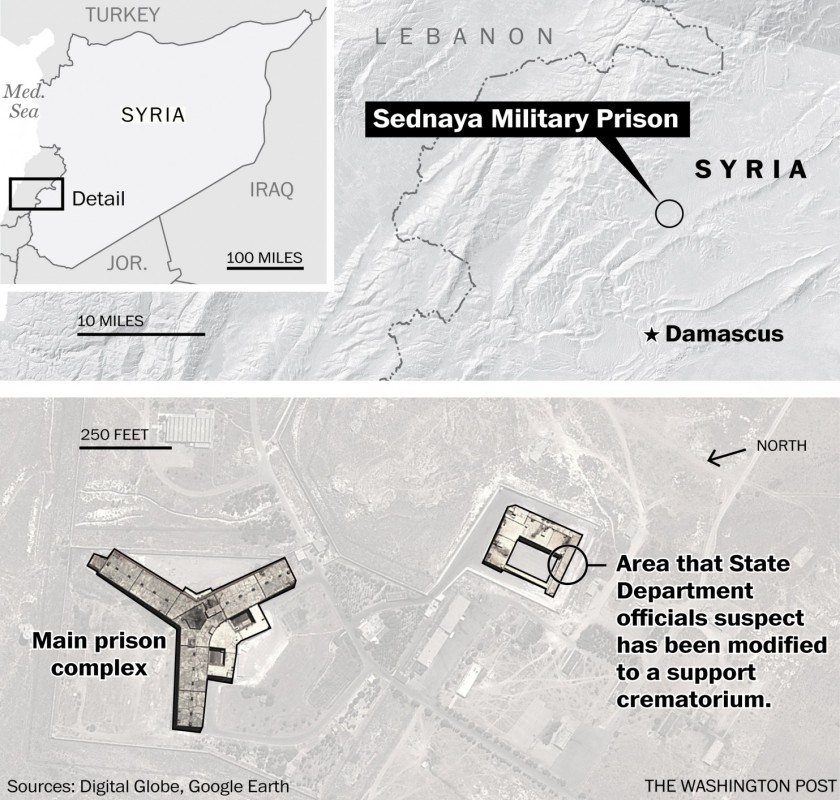
See? That thing on the right that could be absolutely anything is actually a crematorium. The State Department “believes” it with all its heart and wants us to believe it too. As do the Guardian the WaPo and the BBC and every other mainstream outlet. They want us to ignore the total absence of any evidence whatsoever for any part of their narrative and simply take their word.
That’s a “crematorium”. And it’s being used to burn masses of bodies. Just like in the Holocaust.
Because Assad (and Russia) = Hitler.
We need to tear up the ceasefires and ignore the de-escalation zones and invade Syria.
Everyone got that?
Time to Confront the Media’s Anti-Corbyn Bias
By Jonathan Cook | Dissident Voice | June 1, 2017
Those journalists who should have been behind Corbyn from the start – who could have been among his few allies as he battled the corporate media for nearly two years as Labour leader – are now starting to eat humble pie. Polls suggest that Corbyn may be gradually turning the election around, to the point where the latest poll, published in the Times, indicates that Britain could be heading for a hung parliament.
No one is surprised that the Daily Mail, Telegraph and Times have been relentless in their hatchet jobs on Corbyn. But it has been disconcerting for the left that the Guardian and BBC never gave him a chance either. He was in their gun-sights from day one.
Owen Jones, a Labour stalwart and Guardian columnist, should have been Corbyn’s number one ally in the press. And yet he used the invaluable space in his columns not to challenge the media misrepresentations, but to reinforce them. He engaged in endless and morose navel-gazing, contemplating a Labour rout.
In an Evening Standard interview in February, he imparted the following wisdom: “Things change but only if people will it to be.” But then almost immediately ignored his own advice, saying that if another Labour leadership election were held: “I’d find it hard to vote for Corbyn.”
In early May, Jonathan Freedland, the Guardian’s most senior columnist, wrote a commentary entitled: “No more excuses: Jeremy Corbyn is to blame for this meltdown.” In fact, though he did not mention it, he had been making that very same argument for the previous two years.
But as Corbyn has begun chipping away at Theresa May’s lead – and equally significantly, forced the media to widen the public debate into political territory it has avoided for nearly four decades – Freedland finally admitted this week, very reluctantly, that he and others may have misjudged the Labour leader.
Freedland’s reassessment, however painfully made, was still an evasion. He and Jones continue to avoid facing up to the central problem of British politics – and must do, because they are at its very heart.
The lesson of Corbyn’s much-improved polling, according to Freedland, is this:
If May is returned with a Commons presence far below the expectations of even a month ago, it will suggest that one more bit of conventional wisdom needs to be retired along with all the rest. It will prove that campaigns matter.
But that is not the real lesson. The turnaround in Labour’s fortunes is not chiefly about the party getting its act together, staying on-message and communicating better with the media. Rather, it is that the formal requirements of an election campaign – equal coverage, reporting the speeches of candidates, leaders’ debates – have made it much harder for the media, especially the broadcasters, to entirely obscure Corbyn’s winning qualities. His honesty, warmth and humanity eclipse May’s stiff, evasive and charmless demeanour.
It was precisely those qualities in Corbyn that proved so attractive to voters in the Labour leadership elections. He inspires a rare passion for politics when he is heard. That is why he is the only politician filling stadiums. That is why the Labour party now has hundreds of thousands of members, making it the largest party in Europe. That is why young people have been registering for the election in record numbers.
The demographic breakdown of support for Corbyn and May is largely generational. Corbyn enjoys a huge lead among young people, while May can rely on overwhelming backing from those aged over-65.
It may be comforting to imagine this is simply the natural order of things. Radicalism is the preserve of those starting out in life, while old age encourages caution and conservatism. This may be one factor in explaining the generational divide, but it clearly will not suffice. In much of the post-Thatcher era, the young have proved to be even more conservative than their parents.
The reason for the Corbyn-May split has to be found elsewhere.
The fact is that the young are least likely to trust the traditional, corporate media, and most likely to seek out information from alternative sources and social media, which have been fairer to Corbyn. Youtube clips of Corbyn’s speeches, for example, are one way to bypass the corporate media.
Conversely, elderly voters are mostly still relying on the BBC, Sky and the Daily Mail for the bulk of their information about politics. The over-65s have little sense of who Corbyn is apart from what they are told by a media deeply wedded to the current neoliberal order he is threatening to disrupt.
But neither Freedland nor Jones has been prepared to admit that all of the corporate media – not just their trusted scapegoat of the “rightwing press” – have been to blame for preventing Corbyn getting a fair hearing. It is an admission they cannot make because it would expose their own complicity in a media system designed to advance the interests of corporate power over people power, oligarchy over democracy.
A desire to avoid facing this simple truth has led to some quite preposterously contorted reasoning by Freedland. In a commentary before his recent reappraisal of Corbyn, he dismissed suggestions that the media had played any significant role in the Labour leader’s troubles. Freedland cited two focus groups he had witnessed. It is worth quoting the section at length to understand quite how ridiculous his logic is.
With no steer from the moderator, who remained studiedly neutral, they described Jeremy Corbyn as a “dope”, “living in the past”, “a joke”, as “looking as if he knows less about it than I do”. One woman admired Corbyn’s sincerity; one man thought his intentions were good. But she reckoned he lacked “the qualities to be our leader”; and he believed Corbyn was simply too “soft”. …
Corbyn’s defenders will blame the media, but what was striking about these groups was that few of the participants ever bought a paper and they seldom watched a TV bulletin. Corbynites may try to blame disloyal MPs, but, whatever its impact elsewhere, none of that Westminster stuff had impinged on either of these two groups, who couldn’t name a single politician besides May, Corbyn and Boris Johnson. They had formed their own, perhaps instinctive, view.
Blaming others won’t do.
How do people form an “instinctive view” on political matters, if they never read a paper, never watch TV and never attend a political rally? Through the ethers?
The answer should be obvious. They can do so only through conversations with, or impressions gained from, family, friends, acquaintances and work colleagues who do watch TV and read papers. Given that it is impossible for most voters to see Corbyn in the flesh, most are either getting their information and opinions directly mediated for them by the media, or receiving the mediated information second-hand, from people they know who have been influenced by the media.
Freedland’s assumption that it is possible for voters to form a view instinctively that Corbyn is a “dope” – the view of him that has been uniformly cultivated by the media – is laughable. It is evidence of a profound unwillingness to confront the power of the media, and his own irresponsible complicity in wielding that power.
Corbyn is a “dope” not because that’s the way he’s seen by voters. He is a “dope” because that is the way he has been characterised for two years by all of the media, including the Guardian. The fact that a growing number of voters are starting to question whether Corbyn is quite the dope they assumed is because he has finally had a chance to talk to voters directly, even if in the leaders’ debate Jeremy Paxman did his best to prevent Corbyn from forming a complete sentence.
If we had a fair, pluralistic media driven primarily by the desire to serve the public’s interests rather than those of corporations, who can doubt that Corbyn would be winning hands-down in the polls?
George Monbiot, about Syria…
By Tim Hayward | April 28, 2017
I write this open letter, George, because you have been using your public platform to defend claims about Syria that I fear may be damaging for its people.
Most recently, you blogged a note about the 4th April chemical incident in Khan Sheikhoun, Syria, and you related this to the more general issue of competing narratives.
Professor Postol of MIT criticised the NATO/Gulf State account of the incident, and you say his claims ‘should be treated with great caution’. That’s fair enough. Shouldn’t we apply a similar standard of scrutiny to claims made on both sides?[1] You replied to the Media Lens article reporting Postol’s claims without acknowledging that it also mentioned that ‘former and current UN weapons inspectors Hans Blix, Scott Ritter and Jerry Smith, as well as former CIA counterterrorism official Philip Giraldi, had all questioned the official narrative of what happened on April 4.’
We can be cautious about what they all say, of course, but I hope we may avoid the hubris of just dismissing their concerns.
There are serious unsettled questions about every aspect of the incident, not only the anomalies concerning time of incident, identity of victims, causes of death, role of White Helmets, and about whose interests it served, but also concerning the forensic evidence itself. Regarding the latest claim made by France, a very elementary issue is chain of custody: with no French representatives on the ground, the test samples appear to have come from Al Qaeda by way of Turkey. Must we simply trust the testimony of a terrorist organisation in collaboration with a major conduit and supplier of anti-government forces in Syria? Do we find any corroboration? Western powers, you might be aware, have blocked the independent investigation sought by Russia.
The reported results themselves are opaque. The French reports are no clearer on the science than the earlier UK ones (and I note that the UK has since gone rather silent about those rather than address questions about them). Moreover, the French claims rely on the veracity of claims relating to a 2013 incident, which are highly questionable.[2]
Still, even aside from the facts around the Khan Sheikhoun incident, you are confident that there is a mountain of compelling evidence that is disregarded by ‘a few contrarians’. In tweets, too, you seem to be impressed by the sheer quantity of evidence purporting to establish President Assad’s complicity in war crimes and crimes against humanity.
Yet you surely realise that what actually matters is the quality of evidence?
I therefore ask you: what evidence are you referring to? Whose evidence? In your note you link to a Guardian article by an Egyptian, raised in Dubai and living in Lebanon, who conveys reports from an Al Qaeda base; you also link to another Guardian article, by the same author, reporting claims from Turkey – one of the chief supporters of anti-government forces. Meanwhile, on twitter, you respond to ‘contrarians’ with the advice to read a lengthy thread authored by Kuwaiti activist Iyad El-Baghdadi who is renowned for talking up the “Arab Spring”. Based in Norway, he cites evidence from sources like the New York Times.
Why should utterances from your recommended sources inspire less caution than those of MIT professors and professional weapons inspectors? You seem to think that anyone who questions the official narrative is a conspiracy nut, or an ‘Assadist’. I personally find a little condescending your reference to ‘an element on the left that seems determined to produce a mirror image of the Washington Consensus … and denies the crimes of the West’s official enemies.’ [3]
At any rate, that begs the question: what crimes have been demonstrated? We have had mountains of allegations from organisations like Amnesty International since the “Arab Spring”, but what credible evidence have they ever produced?
I earnestly invite you to cite some. Having looked at their reports over the past ten years myself, I have not found it. Instead, I have found very clear traces of a narrative produced in Washington. And not just a narrative, but a strategy for getting the liberal intelligentsia on board with the hawks.
I think we need to look very closely at who is being misled by whom. Wouldn’t you agree?
Meanwhile, with the upcoming UK election to think about – and the imperative of removing this warmongering government – I will understand if you direct your focus and energies towards areas of public life where you have a strong intellectual and political contribution to make.
Best wishes,
Tim
In memory of all Syrian children, taken by violence.
[1] You might start by taking a more dispassionate look at the people you imagine have ‘debunked’ criticism of the mainstream narrative. Your link to Louis Proyect’s attack on Postol, for instance, betrays what I would regard as some want of judgement. In an update to your note, you add a link to further ‘debunkers’ who turn out to rely on the same Guardian evidence you are claiming they offer further support for! Incidentally, when the Guardian tells readers it is ‘the first western media organisation to visit the site of the attack’ it should really be careful what it boasts about, given that the area is controlled by Al Qaeda.
[2] I understand from scientists that the unanswered questions include these:
- Did the Porton Down analysis of samples collected from the alleged attacks on 19 March 2013 support the finding of the Russian Laboratory for Chemical and Analytical Control that the material contained diisopropyl fluorophosphate and that the sarin had been produced under “cottage industry” conditions?
- What were the findings with respect to the synthetic pathway by which the sarin was produced? Specifically, did this synthesis start from trimethyl phosphite (which the Foreign Secretary stated had been sold to the Syrian government by UK companies) or from phosphorus trichloride or elemental phosphorus (which Turkish prosecutors stated was on the procurement list of the Nusra Front members arrested in Adana, Turkey in May 2013)?
- What efforts have been made by the UK government to establish whether or not the sarin used in alleged chemical attacks in Syria originated from Syrian military stocks, based on comparison of the chemical profiles of the environmental samples analysed at DSTL with the stocks of the sarin precursor methylphosphonyl difluoride that were profiled by mass spectrometry under the supervison of OPCW inspectors before they were destroyed on the MV Cape Ray in 2014?
Those of us who struggle even to understand questions like these can very easily be bamboozled by bullshit responses from government spokespersons. But when scientists put such questions, I think they merit answer rather than dismissive tweets bidding us trust the word of foreign activists. I am grateful to Professor Paul McKeigue for the formulation of these questions.
[3] For a more considered view of disagreement on the left, see, e.g., the recent short talk by Jay Tharappel on ‘Syria and the Confusion of the Western Left’: https://www.facebook.com/Chacko.TJ/videos/10158536910055697/
The Guardian Takes Aim at Venezuela’s Democracy
By Joe Emersberger | teleSUR | April 26, 2017
From 2006 to 2012, The Guardian’s output on Venezuela was dominated by its Caracas-based reporter, Rory Carroll, who tirelessly demonized, ridiculed and lied about the government of former president Hugo Chavez as it made rapid progress on reducing poverty.
The Guardian recently published an editorial saying that President Nicolas Maduro’s government must be threatened with “pariah status” by the “international community“ if it does not hold presidential elections by the end of 2018. This comes from a newspaper that continually attempts to rehabilitate former British prime minister Tony Blair, a man who played a key role in launching a war of aggression that killed hundreds of thousands of Iraqis. But no pariah status for him.
The imperial hypocrisy on display is stunning.
The Guardian editors cited the New York Times editorial board to back up their stance on Venezuela. In 2002, the New York Times editorial applauded a U.S.-backed military coup that ousted Chavez for two days.
“With yesterday’s resignation of President Hugo Chavez, Venezuelan democracy is no longer threatened by a would-be dictator. Mr. Chavez, a ruinous demagogue, stepped down after the military intervened and handed power to a respected business leader, Pedro Carmona,” wrote the morally challenged “paper of record.”
In fact, two of the opposition leaders The Guardian mentioned in its editorial, Leopoldo Lopez and Henrique Capriles, not only supported but participated in that coup. They led the kidnapping of government officials on behalf of Pedro Carmona. The Guardian, however, made no mention of the 2002 coup at all.
That coup continues to hover over Venezuela because so many of the opposition’s most prominent leaders either supported or participated in it. Julio Borges, head of the opposition-led Nation Assembly, supported the 2002 coup and routinely makes very thinly veiled appeals for the military to oust Maduro. Borges just did so in the pages of El Universal, one of the country’s largest newspapers, where he regularly publishes op-eds.
The other day, a news report on Venezuela’s largest TV network, Venevision, featured opposition politician Marialbert Barrios making a very similar appeal to the military.
The Guardian editors regurgitate a talking point that has been common in the western media: that Venezuela was “once South America’s richest country.” That’s true if the measure one uses is gross domestic product, GDP, per capita adjusted by purchasing power parity, PPP. But that measure says nothing about distribution.
Venezuela had a poverty rate of 50 percent in 1998 when Chavez was first elected even though it was second in South America at the time by GDP per capita. By the United Nation’s Human Development Index, HDI, a composite measure that takes into account life expectancy, education and national income, Venezuela ranked below several Latin American countries in 1998. Its HDI ranking then improved drastically until 2013, the year Chavez died. Using the U.N.’s most recent data and taking full account of the recent devastating recession it has experienced, Venezuela continues to rank above most countries in South America by HDI despite ongoing economic hardships.
There certainly are avoidable child deaths in Venezuela as The Guardian editors said. There always have been, but such deaths are more prevalent throughout the rest of the region, including Peru, whose right-wing government has loudly demanded that Venezuela deal with its “humanitarian crisis.”
Then there is Colombia, a country that has millions of internally displaced people, rivaling Syria. Colombia is also a country with a military that is being investigated by the International Criminal Court for murdering thousands of innocent people. In The Guardian’s universe, this arms client state of the U.S. and U.K. is just another “respectable” member of the “international community” that must straighten out Venezuela.
The Guardian is inexcusably sloppy in other claims.
It says inflation is at 800 percent. Torino Capital, a source that is very critical of the Maduro government, said inflation averaged 299 percent last year and projects it will average 434 percent next year. Unemployment was at 7.3 percent last year. Torino also projects a very small contraction of real GDP (-0.5 percent) next year and a return to growth by 2018. It has also commissioned polls from Datanalisis, an opposition-aligned pollster. Incidentally, the president of Datanalisis, Luis Vicente Leon, also criticizes the government in the pages of El Universal on a regular basis. As of March, according to Datanalisis, Maduro’s approval rating was 24.1 percent and has been steadily increasing in 2017. At the same time, the approval ratings of the most popular opposition leaders have fallen to 40 percent. These facts have been blacked out by the international press.
The Maduro government has not dealt with the root cause of the economic crisis, but, through direct deliveries of supplies to the poor (where its political support is concentrated) it has clearly alleviated the suffering of the poorest to a significant extent. Rachael Boothroyd-Rojas, and independent journalist based in Caracas for many years, noted that “there is a government store just below where I live and I haven’t seen queues there for months! Last year they were awful.”
Boothroyd-Rojas reports that there are still queues outside stores in Caracas but that they are nothing like they were months ago, and that government direct deliveries to the poor “have made a big difference to those who receive them.”
It should be noted that in December 2015, Datanalisis said Maduro’s approval rating was 32 percent just before his allies won 41 percent of the vote in National Assembly elections. It is not hard to see why opposition leaders have decided to “up their game” in terms of economic and political sabotage. Opposition leaders have openly boasted of working to block the government’s access to external financing.
Boothroyd-Rojas, who lives in a poor Caracas neighborhood, has noted the contradictions the international press has embraced to put the best face it can on the opposition’s violence. Vandalism of public property, including hospitals in poor neighborhoods, is dishonestly pointed to as evidence that the poor are starting to turn on the government: a claim The Guardian editors make. But when the middle and upper-class nature of the protests is too obvious to deny, it is alleged that the poor are simply “too hungry” to join in.
The opposition has resorted to widespread vandalism, including the torching of a Supreme Court office, and marching into areas where they have not been issued authorization — precisely to prevent a repeat of the 2002 coup — to provoke confrontation which it then points to as “repression.”
Honest, informed reporting would quickly expose those cynical tactics which are the same ones used in 2002 and again in 2014, but that’s clearly beyond what The Guardian editors are willing or able to do. We can only hope they won’t run an op-ed about Venezuela written by Blair any time soon.
Make No Mistake: There is a media blockade against Venezuela
By Rachael Boothroyd Rojas | Venezuelanalysis | April 23, 2017
Venezuela is in flames. Or at least parts of it is.
Since April 4th, opposition militants have been carrying out targeted acts of violence, vandalism and arson, as well as deliberately clashing with security forces in an attempt to plunge the country into total chaos and forcefully remove the elected socialist government. It is the continuation of an 18 year effort to topple the Bolivarian revolution by any means necessary — although you may have seen it miraculously recast in the mainstream media as “promoting a return to democracy” in the country.
A catalogue of the violence over the last 18 days is shocking – schools have been ransacked, a Supreme Court building has been torched, an air force base attacked, while public transport, health and veterinary facilities have been destroyed. At least 23 people have been left dead, with many more injured. In one of the most shocking cases of right-wing violence, at around 10pm on April 20th, women, children and over 50 newborn babies had to be evacuated by the government from a public maternity hospital which came under attack from opposition gangs.
Anywhere else in the western world, this would have given way to horrified international and national calls for an end to the violence, and for the swift prosecution of those responsible – making it all the more scandalous that these incidents have at best been ignored, and at worst totally misrepresented by the international press. Instead, those tasked with providing the public with unbiased reporting on international affairs have opted to uncritically parrot the Venezuelan opposition’s claims that the elected government is violently repressing peaceful protests, and holding it responsible for all deaths in connection with the demonstrations so far.
This narrative cannot be described as even a remotely accurate interpretation of the facts, and so it is important to set the record straight.
- To date, three people (two protesters and one bystander) have been killed by state security personnel, who were promptly arrested and in two cases indicted.
- A further five people have been directly killed by opposition protesters, while one person has died as an indirect result of the opposition roadblocks in Caracas (Ricarda Gonzalez, 89, who suffered from a CVA and was prevented from getting to a hospital).
- Five people have been shot in separate incidents near protests but under unclear circumstances. One of these victims was shot by an alleged opposition supporter from a high rise building, although the perpetrator’s political affiliation is yet to be confirmed.
- Nine protesters appear to have died as a result of their own actions (at least nine were electrocuted in the recent looting of a bakery).
A cursory look at the reality reveals that the government is clearly not responsible for the majority of these deaths. However, to paraphrase a remark recently made by Venezuelan author Jose Roberto Duque, the “truth has suddenly become useless”.
The media has failed to go into too much detail surrounding the exact circumstances of these deaths; precisely because the truth presents a serious obstacle to their narrative that all these people were killed during pro-democracy peaceful protests at the repressive hands of the authoritarian regime. This narrative isn’t just overly simplistic; it distorts the reality on the ground and misinforms international audiences.
Take this deliberately misleading paragraph from an article written by Nicholas Casey, the New York Time’s latest propaganda writer for the opposition.
“Protesters demanding elections and a return to democratic rule jammed the streets of Caracas and other Venezuelan cities on Wednesday. National Guard troops and government-aligned militias beat crowds back with tear gas, rubber bullets and other weapons, and at least three people were killed, according to human rights groups and news reports.”
Casey opted to omit the fact that none of those three deaths has so far been attributed to security forces, and one of the victims was an army sergeant killed by protesters themselves. Moreover, those on the receiving end of the “tear gas and rubber bullets” are not quite the “peaceful protesters” he so disingenuously implies. Anyone in the east of the city on April 19th, when both opposition and pro-government forces marched, could see how opposition supporters gathered in total freedom in Plaza Francia in Altamira, even buying anti-government t-shirts, caps, and purchasing ice-creams, and were able to march along the main highway linking the east of the city to the west.
Police “repression” has occurred in two specific scenarios. Firstly, when opposition gangs have set-up burning barricades and carried out violent acts of vandalism on the streets, including the targeting of public institutions – actions deliberately aimed at provoking photo-op worthy clashes with security forces. In the second instance, it has occurred when opposition marchers have attempted to cross a police line blocking them from getting to the working class municipality of El Libertador in the west of the city – where government support is traditionally concentrated. Again, this action is a deliberate attempt to provoke clashes with security forces and their supporters by the opposition, who are well aware that they have not been granted permission to march into El Libertador since a short-lived opposition-led coup in 2002, triggered by an anti-government march diverted towards Miraflores Presidential Palace in the west that left 19 dead by opposition sniper-fire.
It is hard to see how the police would not respond to these violent actions in a similar way, or even more violently, in the rest of the world. I can only imagine what would happen if armed and violent protesters consistently tried to march on the White House in Washington, or on No. 10 Downing Street in London. What if they assaulted police lines outside the White House, or attacked hospitals and looted businesses in London? Not only would they not be granted permission to continue, but protesters would most likely be shot, or end up in jail under anti-terrorism legislation for a very long time. But in Venezuela, the opposition can rely on its carte blanche from the mainstream press as its get out of jail card.
Needless to say, details of the undemocratic actions of opposition leaders and their supporters – ranging from these latest attacks to support for a violent coup in 2002 – are glaringly absent from virtually all news reports. This is despite the fact that the opposition’s current protest leaders – Julio Borges, Henrique Capriles Radonski, Henry Ramos Allup and Leopoldo Lopez – were active players in the 2002 coup.
The above article by Casey is a patent attempt to mislead the public over the dynamic on the ground in Venezuela. But unfortunately this is not just a case of one isolated news agency. The UK’s Guardian, for instance, provided its readers with an image gallery of the opposition’s April 19th march and “ensuing violence”, but failed to acknowledge that a pro-government march of similar size, if not greater, was also held the same day. They simply erased the actions of hundreds of thousands, if not millions, of people. Whichever news agency you check, be it the BBC, the Washington Post, CNN, or any other corporate outlet, you will find the same, uniform consensus in their Venezuela coverage. There are no words to describe this state of affairs other than a total media blockade.
The last time the country witnessed unrest on this scale was in 2014, when opposition militants again unsuccessfully tried to force the “exit” of President Nicolas Maduro using similar tactics, leading to the deaths of 43 people. The majority of those victims were innocent passersby caught in the violence or state security personnel, who were given the somewhat impossible task (just like today) of somehow refraining from responding with violence to people who are deliberately trying to provoke, maim and kill them.
While protests in 2014 were a response to violent unrest headed by the country’s right-wing student movement, this year’s commenced at the beginning of April after the Supreme Court issued a ruling granting the court temporary powers to assume the legislative functions of the National Assembly. It came in response to the Venezuelan parliament having been declared “in contempt of court” for more than six months, after the opposition refused to remove three of its lawmakers under investigation for electoral fraud in violation of a Supreme Court order. This is much like the current legal case hanging over the thirty Conservative MPs in the UK. The only difference in Venezuela is that the legislators were suspended from being sworn into parliament pending the results of the investigations. The opposition immediately hit out at the ruling, declaring it an attempted “coup” by the government that had come out of nowhere. The media swallowed this version of events hook, line and sinker. Although the ruling was overturned almost straightaway, the opposition took to the streets denouncing a “rupture of the constitutional order”.
This soon morphed into a hodgepodge of ultimatums which have dominated the opposition’s agenda since it won control of the country’s National Assembly (one of the five branches of the Venezuelan government) in December 2015, promising to have deposed the national government “within six months” – something beyond the power of Venezuela’s legislative branch. These demands include the release of what they call “political prisoners”, the opening-up of a “humanitarian channel” for receiving international aid and, most importantly, immediate regional and general elections. The street protests were an unmissable opportunity for the opposition, which was suffering from steadily decreasing popularity following an entire year of having squandered its legislative majority in parliament.
Evidently, long term strategy is not the opposition’s strong point. History testifies to the fact that they tend to go for maximum amount of damage in the minimum amount of time, no matter the cost. This brings us to why this kind of violence, which has been employed several times throughout the last 18 years by Venezuela’s well-seasoned opposition, is once again happening at this moment. If the government is so unpopular, as the opposition claims it is, why not just wait for the presidential elections in 2018 for their time to shine?
At this point it should be clear that the opposition’s only goal, far from promoting a “return” to democracy, is to step right over it. They want to remove the elected government more than a year ahead of scheduled elections. But they don’t want to stop there. As one opposition marcher told me on Wednesday: “Get your stuff together Maduro, because you’re going to jail”. The opposition’s goal is the total annihilation of Chavismo.
Whatever the government’s many errors and faults over the past four years under the leadership of Nicolas Maduro, progressives across the globe have an obligation to defend it against the opposition’s onslaught and the international media’s blockade. The alternative is the same savage neoliberalism – currently being mercilessly unleashed by Brazil’s unelected government – which previously squeezed blood from the entire continent throughout the 1980s and 1990s.
The slogan “No Volveran” (they shall not return) has never been more urgent.
BBC redacts article on Idlib to hide unwelcome facts
OffGuardian | April 7, 2017
The push for “action” following the alleged chemical attack in Idlib, Syria is reaching fever pitch. Indeed, it may already have had disastrous consequences. The spokespeople for power that are the Western press consider the case against the Assad regime air-tight. Absent any forensic, or even circumstantial, evidence the mainstream media have resorted to simple arguments from authority looks of bewilderment.
The trouble is “authority” doesn’t seem have any cohesion in this matter – so the press have carefully chosen who they will listen to… and who they will remove from their websites.
Col. Hamish de Bretton-Gordon is the favored voice of “reason” on these matters, he has dismissed any idea other than a deliberate attack by the Syrian government as “fanciful”. And has been cited everywhere from Channel 4, to the Daily Mail to the Guardian, to the BBC. He is universally credited as a “chemical weapons expert” who works as the director of “Medics Under Fire”…. but that’s not his only job, just his most recent.
He was originally in the British army, filling an important role at NATO:
Previously Commanding Officer of the UK CBRN Regiment and NATO’s Rapid Reaction CBRN Battalion, Hamish is one of the most operationally experienced CBRN practitioners in the World and is regarded as one of the leading experts in Chemical and Biological Counter Terrorism and warfare.
With other hints from his biography suggesting some work in espionage or military intelligence:
He has also worked with US networks and British newspapers to smuggle chemical samples out of Syria for verification in UK and France.
… so he’s hardly an objective source.
Of course, “Medics Under Fire” is nothing like what it appears to be, either. Its name conjures up imagery of global charities, along the lines of Medecins sans Frontieres. It is nothing like that, in truth it is a Western-backed NGO working out of Syria, very much like the White Helmets. In fact, their websites are almost completely identical.
On the other side of this narrow divide is Jerry Smith, a chemical weapons expert who took part in the removal of Syria’s chemical weapons stocks in 2013. He is hardly a frothing pro-Assad alternative voice, but he takes a measured approach. He wrote in the Guardian :
Russia’s claim that the latest poisoning is a result of a conventional attack on an opposition arms storage facility should not be dismissed out of hand. While it is true that nerve agent can be destroyed by explosion, it is perfectly possible that some agent could survive and be ejected out as a result of an explosion.
… but obviously nobody there was listening, because “dismissing it out of hand” is exactly what they have done.
Mr Smith was also interviewed on Channel 4 news (curiously absent from their online archive), and ABC news in Australia, both times saying very similar things.
The BBC referenced and quoted his Channel 4 interview in their article on the attack, this quote was included in an article headlined Syria chemical ‘attack’: Trump condemns ‘affront to humanity’:
… the official who led the UN-backed operation to remove Syria’s chemical weapons told the UK’s Channel 4 News that the Russian version of events could not be discounted.
“If it is Sarin that was stored there and conventional munitions were used, there is every possibility that some of those [chemical] munitions were not consumed and that the Sarin liquid was ejected and could well have affected the population,” Jerry Smith said.
This paragraph was completely removed just 35 minutes later. The current version of this article makes no mention of Mr Smith at all. No reason is given, and there is no note referencing that the article had been amended.
A reminder that these are standards deemed acceptable by the “news service” for which we are all forced, by law, to pay.
Our thanks to the media lens twitter for bringing this issue to our attention, and to newssniffer for the very important work they do.
Featured Video
Alon Mizrahi: ‘Israel Must Be Dismantled’
or go to
Aletho News Archives – Video-Images
From the Archives
Allies Don’t Need Lobbies
By Jay Knott | Dissident Voice | September 24, 2013
In a recent article on Counterpunch, Rob Urie defended the traditional Marxist analysis of US policy in the Middle East. He argues that support for Israel is driven primarily by economic interest, not the Jewish lobby.
He starts by paying tribute to the idea that Western societies are uniquely racist. He says that the “Western narrative” claims there is an “Arab character”, and that this is “antique racist blather”. He gives no definition of these terms. Further, he establishes his credentials as part of the dominant current in the American left by claiming that “over a million people in Iraq died so ‘we’ in the West can drive SUVs.”1
When he tries to criticize bourgeois economics, he makes it clear he doesn’t understand the developments it has made since Marx’s day, using the mathematical discipline known as “game theory”. He dismisses the basic abstraction of economic theory, the idea of the rational individual, on the grounds that it is “devoid of history, culture and political context”. But abstractions are always devoid of something.
He defends a more concrete economic theory, mostly Marxist, with some input from another theorist of capitalist crisis, Hyman Minsky. This concrete theory leads him to the view that US activity in the Middle East is primarily driven by rational capitalist motives, the need to secure a supply of oil.
“Taking the totality of circumstance — former oil company executives launching war on an oil rich nation on a pretext they publicly proclaimed they didn’t believe shortly before taking office — and that upon launching their war proved to be non-existent, requires a willingness to overlook the obvious — that the war on Iraq was for oil, that is difficult to support.”1
Perhaps I’ve misunderstood him, but based on what he says in the rest of the article, this convoluted sentence seems to argue that, because president Bush and vice-president Cheney attacked Iraq on false premises, and they also said it was all about oil, and they are former oil executives, and Iraq has a lot of oil, it’s difficult to deny US attacks on Iraq are all about oil.
In fact, it’s not hard at all. As Urie points out, at times Bush and co. said that attacking Iraq was “protecting the world’s supply of oil.”1 But, as he also points out, they are congenital liars. Why should we believe them when they say they are trying to “protect” the oil supply? Protect it against what? When politicians “admit” attacks on Middle Eastern countries are wars for oil, they are parroting the neo-con party line, feeding the public, both left and right, with a plausible-sounding pretext. For right-wingers, “it’s a war for oil” is a reason to support war, and for leftists, it’s a way to feel better by complaining impotently about corporate greed. Both approaches help the war drive. … continue
Blog Roll
 Aletho News
- Zelensky unnecessarily involves Ukraine in the Middle East crisis
- Turkish tanker blacklisted by Ukraine hit in drone attack – media
- Canada, the U.S., and NATO: the inescapable trap
- Villains of Judea: Leonid Radvinsky
- Alon Mizrahi: ‘Israel Must Be Dismantled’
- Former Head Of MI6 Admits That The U.S. And Israel Are Losing The Iran War
- Scattered Thoughts on War and Peace
- Iran Threatens to Close Red Sea to Shipping in Response to Invasion
- Iran in excellent position to prevail in war with US, Israel: John Mearsheimer
- Iran warns US: Do not call your retreat an agreement
- If Americans Knew
- In the West Bank, life is a constant battle – 3 articles
- Jacob Reses, one of the most powerful pro-Israel operatives in Trump’s Washington
- Israeli-US assaults kill or injure 87 children a day – Not a ceasefire Day 166
- ‘Forever live by the sword’: Understanding Israelis’ massive support for Iran war
- UN’s special rapporteur on human rights says Israel is systematically torturing Palestinians
- Trump White House plagiarized Iran war manifesto from Israel-aligned think tank
- Gaza says 6–10 patients die daily waiting for treatment abroad as Israel blocks medical evacuations
- ‘Substantial evidence’ of double-tap strike in killing of Gaza’s Hind Rajab
- ‘Do Not Want To Die For Israel’: Doubts About Trump’s Iran Strategy Spread Among Troops
- Instead of taking Joe Kent’s claims seriously, the media is disregarding him as an antisemite
- No Tricks Zone
- Devastating Assessment Of Comirnaty Vaccine By Former Senior Pfizer Europe Toxicologist
- New Study: CO2 Is ‘Effectively Negligible’ As An Explanatory Climate Change Factor Since 2000
- Former Pfizer Toxicologist Dr. Helmut Sterz Tells Bundestag Hearing Pfizer Vaccine Should Have Never Been Approved
- Energy Expert: Germany’s Nuclear Phaseout Was A “500 Billion Euro Mistake”
- New Research: South Australia’s Mid-Holocene Sea Surface Temperatures Were 4°C Warmer Than Today
- Storing Green Energy To Last Germany 10 Days Would Require A 60-Million Tonne Battery
- New Studies: UK Sea Levels Were 4 Meters Higher Than Today During The Mid-Holocene
- Destructive Green New Deal: German Energy And Metal Group Warns Of Drastic Crisis
- New Study Documents A 20-Year Pause In Arctic Sea Ice Decline – Driven By Internal Variability
- Wake-up Call: Survey Shows Majority Of Germans Now Favor Postponing Climate Targets!
 Aletho News