New Quebec premier scraps tuition hike plan
Press TV – September 21, 2012
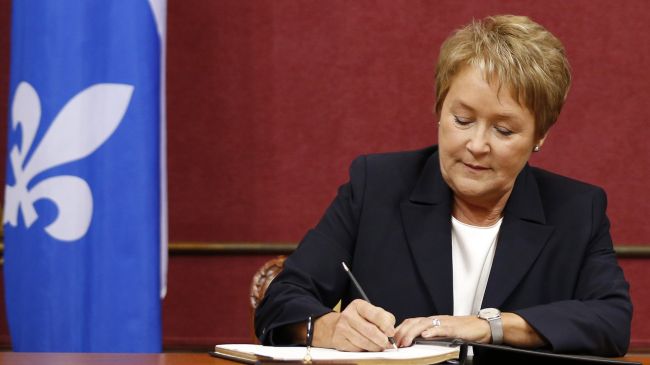
Newly-elected Quebec Premier Pauline Marois has reversed a planned tuition hike that touched off months of violent protests in Canada’s French-speaking province.
Marois, who started her job on Thursday, delivered on her electoral pledge to reinstate the USD 2,220 tuition.
“The new government is now in place,” she told reporters after the first cabinet meeting. “I intend to act rapidly to offer results to Quebecers, starting today, Day One of our mandate.”
The former premier, Jean Charest, had planned to increase tuition fees in a bid to make up for the country’s budget deficit.
Marois said she will also cancel the Liberals’ controversial anti-protest law, known as Bill 78. The draconian law, whose main objective was to restrict freedom of assembly, criminalizes students’ strike and sets rules for gatherings of more than 50 people, requiring organizers to provide an eight-hour notice of the itinerary and length of the event.
“These two decisions will allow us to return peace to our streets and to reestablish rights and liberties,” Marois was quoted as saying.
The new premier’s move drew applause from student groups.
“It’s a victory for justice and equality,” said Martine Desjardins, president of the FEUQ university student association.
“Together, we have written a chapter in the history of Quebec. Together, we have just proven that we can stand up and reach one of the student movement’s greatest victories,” he added.
Ahead of elections earlier this month, Marois had said that if her party – Parti Quebecois (PQP) – won and was able to form a new Quebec government, she would call for a referendum on the separation of Quebec from Canada.
Related articles
- University of Montreal cancels classes for fear of protest (alethonews.wordpress.com)
University of Montreal cancels classes for fear of protest
Press TV – August 30, 2012
Administrators at the University of Montreal (UdeM), the most prestigious French-speaking University in North America, have been forced to cancel dozens of classes for the rest of the week for fear of fresh protests.
The university issued a notice in Tuesday evening, saying that it had suspended classes in the departments that have been targeted by striking students since Monday, the CBC reported.
“They were the classes that we saw in the last two days [in which] the students were giving us trouble,” said Mathieu Filion, a spokesman for the university administration.
The classes were supposed to resume this week after the winter semester was suspended following massive months-long protests across Canada’s French-speaking province of Quebec against proposed tuition fee hikes.
Over Monday and Tuesday, the police stormed the university and arrested more than 30 protesters. The protest erupted following the passage of a new controversial bill, which outlawed obstructing classes and all non-pre-approved gatherings of more than 50.
Students in Quebec have been protesting university tuition hikes since February 2011. The protests later turned into a larger movement, dubbed the “maple revolution,” which, analysts say, reveals deeper social unrest.
The developments come ahead of next week’s provincial elections, which will decide whether Quebec Prime Minister Jean Charest’s ruling Liberal Party, which insists on a plan to increase tuition fees by 82 percent, could be reelected.
The latest opinion survey shows that the separatist Parti Quebecois (PQ), led by Pauline Marois, is heading for a victory in the September 4 polls.
The PQ has promised to hold a referendum on the separation of Quebec from Canada if 850,000 Quebecers sign a related petition.
Related articles
- Quebec police arrest 19 protesting students as classes resume (alethonews.wordpress.com)
- Canadian students arrested after clashing with police (PHOTOS) (rt.com)
Quebec police arrest 19 protesting students as classes resume
Press TV – August 28, 2012
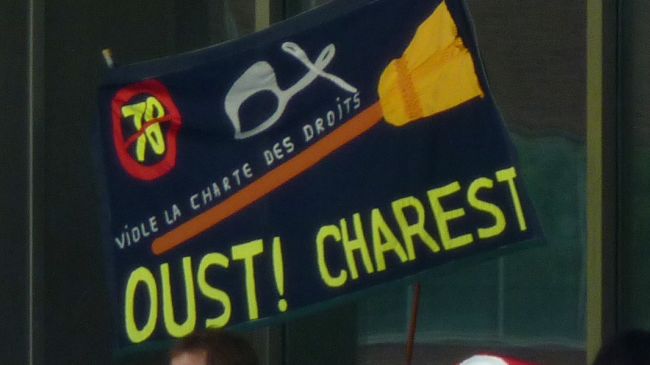 Canadian police have stormed the University of Quebec making 19 arrests, as angry students prevent the beginning of the new semester.
Police arrested 19 students Monday under the terms of Bill 78, which ordered a suspension of university classes back in May and their reinstatement in August even if the students planed to continue their strike. The bill also restricts the student demonstrations and imposes fines for those who impeded classes, starting at CAD 1,000.
The classes were supposed to resume this week, as the winter semester was suspended following massive months-long protests across Canada’s French-speaking province against proposed tuition fee hikes.
Some 2,000 students at the departments of anthropology and cinema voted to continue their protest and prevented the start of classes.
The recent protest comes ahead of next week’s provincial election, which will decide whether the province’s ruling Liberal Party, which insists on a plan to increase tuition fees by 82 percent, could be reelected.
The latest opinion poll shows that the separatist Parti Quebecois (PQ) led by Pauline Marois heading for a victory in the election to be held on September 4th. Marois is the protester’s favorite candidate and has been wearing the red square, the symbol of the demonstrators’ cause, on several public occasions.
If the separatist PQ is elected in the upcoming provincial election, it will consider holding a referendum on separation of Quebec from Canada.
Since February, students have been protesting against the hikes and the provincial government’s controversial anti-protest Bill 78. The protests later turned into a larger movement dubbed the “maple revolution,” which reveals deeper social unrest.
The Threat of Quebec’s Good Example
Peter Hallward | The Bullet | June 6, 2012
The extraordinary student mobilization in Quebec has already sustained the longest and largest student strike in the history of North America, and it has already organized the single biggest act of civil disobedience in Canadian history. It is now rapidly growing into one of the most powerful and inventive anti-austerity campaigns anywhere in the world.

Every situation is different, of course, and Quebec’s students draw on a distinctive history of social and political struggle, one rooted in the 1960s ‘Quiet Revolution’ and several subsequent and eye-opening campaigns for free or low-cost higher education. Support for the provincial government that opposes them, moreover, has been undermined in recent years by allegations of corruption and bribery. Nevertheless, those of us fighting against cuts and fees in other parts of the world have much to learn from the way the campaign has been organized and sustained. It’s high time that education activists in the UK, in particular, started to pay the Quebecois the highest compliment: when in doubt, imitate!
The first reason for the students’ success lies in the clarity of both their immediate aim and its links to a broad range of closely associated aims. Students of all political persuasions support the current ‘minimal programme,’ to block the Liberal government’s plan to increase tuition fees by 82 per cent over several years. Most students and their families also oppose the many similar measures introduced by federal and provincial governments in Canada in recent years, which collectively represent an unprecedented neoliberal attack on social welfare (new user fees for healthcare, elimination of public sector services and jobs, factory closures, wanton exploitation of natural resources, an increase in the retirement age, restrictions on trade unions and so on). And apart from bankers and some employers, most people across Canada already regret the fact that the average debt for university graduates is around $27,000.
The Growth of CLASSE
A growing number of students now also support the fundamental principle of free universal education, long defended by the more militant student groups (loosely co-ordinated in the remarkable new coalition CLASSE), and back their calls for the unconditional abolition of tuition fees, to be phased out over several years and compensated by a modest and perfectly feasible bank tax, at a time of record bank profits. “This hardline stance,” the Guardian’s reporter observed, “has catapulted CLASSE from being a relatively unknown organization with 40,000 members to a sprawling phenomenon that now numbers 100,000 and claims to represent 70 per cent of striking students.” Growing numbers, too, can see how such a demand might help to compensate for the most obvious socioeconomic development in Canada over the last 30 years: the dramatic growth in income inequality, reinforced by a whole series of measures (tax cuts, trade agreements, marketization plans…) that have profited the rich and very rich at the expense of everyone else.
In Quebec, student resistance to these measures hasn’t simply generated a contingent ‘chain of equivalences’ across otherwise disparate demands: it has helped to create a practical, militant community of interest in the face of systematic neoliberal assault. “It’s more than a student strike,” a CLASSE spokesman said in April, “We want it to become a struggle of the people.” At first scornfully dismissed in the corporate media, this general effort to make the student movement into a social movement has borne fruit in recent weeks, and it would be hard to describe the general tone of reports from the nightly protest marches that are now taking over much of Montreal in terms other than collective euphoria.
Nothing similar has yet happened in the UK, of course, even though the British variant of the same neoliberal assault – elimination of the EMA, immediate trebling of fees, systematic marketization of provision – has been far more brutal. But the main reasons for this lie less in some uniquely francophone propensity to defend a particular social heritage than in the three basic (and eminently transposable) elements of any successful popular campaign: strategy, organization and empowerment.
As many students knew well before they launched their anti-fees campaign last summer, the best way to win this kind of fight is to implement a strategy that no amount of state coercion can overcome – a general, inclusive and ‘unlimited’ boycott of classes. One-day actions and symbolic protest marches may help build momentum, but only “an open-ended general strike gives students maximum leverage to make their demands heard,” the CLASSE’s newspaper Ultimatum explains. So far, it has been 108 days and counting, and “on ne lâche pas” (we’re not backing down) has become a familiar slogan across the province. So long as enough students are prepared to sustain it, their strike puts them in an almost invincible bargaining position.
Ensuring such preparation is the key to CLASSE as an organization. It has provided new ways for students previously represented by more cautious and conventional student associations to align themselves with the more militant ASSÉ, with its tradition of direct action and participatory democracy. Activists spent months preparing the ground for the strike, talking to students one at a time, organizing department by department and then faculty by faculty, starting with the more receptive programmes and radiating slowly out to the more sceptical.
At every pertinent level they have created general assemblies, which have invested themselves with the power to deliberate and then make, quickly and collectively, important decisions. Actions are decided by a public show of hands, rather than by an atomising expression of private opinion. The more powerful and effective these assemblies have become, the more active and enthusiastic the level of participation. Delegates from the assemblies then participate in wider congresses and, in the absence of any formal leadership or bureaucracy, the “general will” that has emerged from these congresses is so clear that CLASSE is now the main organizing force in the campaign and able to put firm pressure on the other more compromise-prone student unions.
Assemblies and Collective Empowerment
Week after week, assemblies have decided to continue the strike. In most places, this has also meant a decision to keep taking the steps necessary to ensure its successful continuation, by preventing the minority of dissenting students from breaking it. Drawing on his experience at McGill University, strike veteran Jamie Burnett has some useful advice for the many student activists now considering how best to extend the campaign to other parts of Canada: don’t indulge in ‘soft pickets’ that allow classes to take place in spite of a strike mandate, and that thus allow staff to isolate and fail striking students. “Enforcing strikes is difficult to do, at least at first,” he says, “but it’s a lot less difficult than failing a semester. And people eventually come around, building a culture of solidarity and confrontational politics in the process.”
The main result of this process so far has been one of far-reaching collective empowerment. Resolved from the beginning to win over rather than follow the more sceptical sectors of the media and ‘public opinion,’ the students have made themselves more powerful than their opponents. “[We] have learned collectively,” CLASSE spokesperson Gabriel Nadeau-Dubois said last week, “that if we mobilize and try to block something, it’s possible to do it.” From rallies and class boycotts, in April the strike expanded to include more confrontational demonstrations and disruptive nightly marches through the centre of town. Soon afterwards, solidarity protests by groups like Mères en colère et solidaires started up in working-class districts of Montreal.
In a desperate effort to regain the initiative by representing the conflict as a criminal rather than political issue, the panicked provincial government rushed through its draconian Bill 78 to restrict the marches, discourage strike enforcement and consolidate its credentials (in advance of imminent elections) as a law-and-order administration. In the resulting escalation, however, it’s the government that has been forced to blink. On 23 May, the day after an historic 300,000 people marched through Montreal in support of the students, police kettled and then arrested more than 700 people – a jaw-dropping number by historical standards. But the mobilization has become too strong to contain, and after near-universal condemnation of the new law it is already unenforceable. Since 22 May, pro-student demonstrations have multiplied in ways and numbers the police can’t control, and drawing on Latin-American (and older charivari) traditions, pot-clanging marches have mushroomed throughout the province of Quebec. On Thursday night tense negotiations with the government again broke off without resolution, and business and tourist sectors are already alarmed by the prospect of a new wave of street protests continuing into Montreal’s popular summer festival season.
There is now a very real chance that similar mobilizations may spread further afield. Recent polls suggest that most students across Canada would support a strike against tuition increases, and momentum for more forceful action may be building in Ottawa and across Ontario; in Quebec itself they also show that an initially hesitant public is beginning to swing behind the student demands and against government repression. On 30 May, at the ritual hour of 8pm, there were scores of solidarity rallies all over Canada and the world. In London around 150 casserolistas clanged their way from Canada House to the Canadian embassy at Grosvenor Square.
If enough of us are willing to learn a few things from our friends in places like Quebec and Chile, then in the coming years such numbers may change beyond all recognition. After much hesitation the NUS recently resolved that education should be “free at all and any level,” and activists are gearing up for a massive TUC demonstration on 20 October. After a couple of memorable springs, it’s time to prepare for a momentous autumn. •
Peter Hallward teaches at the centre for research in modern European philosophy at Kingston University London, and is a member of the Education Activist Network. His book on The Will of the People is forthcoming from Verso in 2012. He is the author of the 2008 Damming the Flood: Haiti, Aristide and the Politics of Containment [book launch LeftStreamed].
~~~
Related articles
- Quebec: New poll shows support for Charest’s tuition increases has dropped 41 points in six days (alethonews.wordpress.com)
Quebec: Poll shows support for Charest’s tuition increases dropped 41 points in six days
By Ethan Cox | Rabble | May 25, 2012
Quebec is known for swift and drastic shifts of popular opinion. From the election of the first PQ government, to the rise of the ADQ and the Orange Wave, public opinion in this province is prone to sudden reversals.
The results of the most recent poll, an online survey of 1000 Quebecois conducted between May 23 and 25 by CROP for Radio-Canada, seem to suggest we are in the midst of such a dramatic swing.
When CROP was last in the field, on May 17 and 18, they found that a whopping 68% supported the government’s proposed tuition increase, with only 32% supporting the students. The same poll found 66% supported a “special law” to help end the crisis.
The poll was roundly criticized for asking respondents about a law which had yet to be introduced, and was at that time an unknown quantity. Criticism was also levelled at its methodology. That poll, and the most recent one, were conducted using a representative online panel, which was not randomly selected and as such cannot be assigned a margin of error.
Fast forward six days, through a civil-liberties-crushing special law, the largest protest in Canadian history, and mass arrests of over 700 people, and the results are stunning.
The latest poll did not ask the same question, but instead asked who respondents felt was to blame for the crisis. 44% placed the blame on Jean Charest’s ailing government, while only 36% blamed the students. On the question of what should be done with tuition fees, the poll found 45% supported indexing them to the cost of living, 13% thought they should be frozen at current levels and 11% thought they should be abolished. Only 27% thought they should be increased beyond inflation. Add that up and 70% of the population are now opposed to the Charest government’s proposed increases.
In a period of six days, support for the proposed increases to tuition has gone from 68% to 27%, a drop of 41 percentage points.
Unsurprisingly, the poll found that 60% were opposed to Loi 78, with 42% being strongly opposed. 30% supported the law, with 11% strongly supporting it. This is a drop of 36 percentage points in support for Loi 78, but given that the first poll was conducted before details of the law were public, that’s not as surprising.
The poll also found that 49% believed mediation between the government and student federations was the best way to resolve the dispute, coming in far ahead of a new election, a moratorium or a summit on university financing.
When asked if the student federations and government had been negotiating in good faith, both received failing grades. 48% thought the government had been negotiating in bad faith, over 37% who disagreed, while 58% thought the same of student federations, with 26% disagreeing. 50% did not have faith in either the government or students to resolve the conflict, while 25% had more confidence in the government and 16% more faith in student federations.
Given that both sides have been adamant that they will not back down from their demands, this is hardly surprising.
A friend commented that this showed people “hated Charest, but hated the students more.” I think he’s off the mark. Although there is clearly a warranted pessimism that there will be a swift end to the strike, I imagine 9% more people have greater confidence in the government to resolve the issue because 70% now want the government to make major concessions. People expect the government to fold, and as such expect that this will lead to the resolution of the conflict.
I prefer to compare polls by the same company, because differences in methodology and questions can make comparison between companies difficult, but if we look at the Leger poll done for the Journal de Montreal between May 19 and 21 (prior to the mass demonstration), it really demonstrates the trendline in this province.
The question asked was, given the positions of both sides ($1625 increase vs. freeze) do you support the students or the government? The poll showed an 18% shift in support from government to students over Leger’s previous outing, ten days prior. However, it still left the government with 51% support, and the students with 43%.
The change from 51% supporting the government position to 27% is a drop of 24 percentage points. In four days.
The Leger poll also found that 47% supported Loi 78, with an equal 47% opposing it. With 60% opposition, and 42% strongly opposed in the new CROP poll, we can see that opposition to the law has grown by 13 percentage points and crystalized. Those opposed tend to feel strongly about the subject, perhaps explaining the sudden popularity of the “casseroles” phenomenon (Where Quebeckers in all parts of the province go outside each night at 8 PM to bang on pots and pans in opposition to the law)
Notwithstanding all the normal caveats about polls and their flaws, it seems clear that there is a seismic shift going on in Quebec right now. The introduction of Loi 78 was a political miscalculation of epic proportions. It contributed to hundreds of thousands pouring into the streets on Tuesday, and provoked the casseroles movement.
The protest and ongoing casseroles in turn sent a strong message to Quebeckers that all was not right. They demonstrated to those outside Montreal that this was no longer a student issue alone, but a social one which involved people of all ages. Then that crazy social solidarity I wrote about earlier this week kicked in, and people began to turn on the government en masse.
The CROP poll did not ask for voting intentions, but I will be interested to see if the next provincial poll shows improvement for the PQ, who originally proposed increasing tuition at the rate of inflation.
Assuming this is not a rogue poll, it seems clear that the Charest increase is dead in the water. Most Quebeckers now want an increase at the rate of inflation, if that. These numbers will put wind beneath the wings of tiring students, and indicate that the record for protest attendance set last Tuesday may be challenged sooner rather than later.
The open question now is, will Charest hunker down and defy public opinion in the face of what will certainly be growing protests? And if Charest does offer students an increase at the rate of inflation, does it resolve a conflict which has become about much more than tuition?
While this poll holds some negatives for the students too, Quebeckers rejection of both Loi 78 and the proposed increase will no doubt have many a glass lifting tonight wherever students and their supporters are gathered.
______
Rabble’s Special Correspondent on the Quebec student strike, Ethan Cox is a 28 year-old organizer, comms guy and writer from Montreal. He cut his political teeth accrediting the Dawson Student Union against ferocious opposition from the college administration and has worked as a union organizer for the Public Service Alliance of Canada. He has worked on several successful municipal and federal election campaigns, and was a member of Quebec central office staff for the NDP in the 2011 election. Most recently he served as Quebec Director and Senior Communications Advisor on Brian Topp’s NDP leadership campaign.

As Rabble.ca’s newly minted Special Correspondent on the Quebec student strike, you’ll be seeing me in these pages every few days with all the latest from Montreal’s streets. For more frequent updates follow me on twitter @EthanCoxMTL
~~~
Featured Video

Meet The Ellisons: Zionists, Technocrats, Moguls
or go to
Aletho News Archives – Video-Images
Frlom the Archives
Who Rules America?
The Power Elite in the Time of Trump
By James Petras | Axis of Logic | September 6, 2017
Introduction
In the last few months, several competing political, economic and military sectors – linked to distinct ideological and ethnic groups – have clearly emerged at the centers of power.
We can identify some of the key competing and interlocking directorates of the power elite:
- Free marketers, with the ubiquitous presence of the ‘Israel First’ crowd.
- National capitalists, linked to rightwing ideologues.
- Generals, linked to the national security and the Pentagon apparatus, as well as defense industry.
- Business elites, linked to global capital.
This essay attempts to define the power wielders and evaluate their range of power and its impact. … continue
Blog Roll
 Aletho News
- Sorry, The New Republic, Climate Change Isn’t Causing Somali Migration. Blame Civil Strife and Poverty.
- Expert Guts Claims That HPV Vaccine Reduces Cancer Risk
- No evidence Russia sabotaged Baltic cables – Finnish intel
- The Strategic Folly of a (Serious) US Ground Invasion of Iran
- US-Israeli war of aggression on Iran meant to reshape region: Omani FM
- Iran Does Not Consider Israel Party to Talks to Need Mediators With It – Ambassador
- Macron’s aircraft carrier and warplanes to the Persian Gulf is a dangerous vanity project
- Meet The Ellisons: Zionists, Technocrats, Moguls
- US failures in Iran reveal Russia is key to South Korea’s strategic security
- ‘All ports in Persian Gulf will be legitimate targets if Iranian ports are attacked’
- If Americans Knew
- Are we on the precipice of World War III?
- ‘Catastrophic,’ Says UNICEF: 1,100+ Children Killed or Wounded in Mideast Since US-Israel Launched Iran War
- The Unbelievable Madness of Our War With Iran
- World Council of Churches calls on govts to hold Israel accountable for violations of intl law
- How to end the war on Iran that costs US taxpayers $1M per minute – Not a ceasefire Day 153
- Israeli strategic plans to “remake the Middle East” from the 1950s and since
- Honoring Gaza’s women who refused to let the world look away
- 97% of victims of war on Iran are Iranian, 98% of victims in war on Gaza are Gazans – Not a ceasefire Day 152
- Early Iran strikes cost $5.6 billion in munitions, Pentagon estimates
- Israel Decided the War, But Trump’s America Fights and Pays the Bill
- No Tricks Zone
- Destructive Green New Deal: German Energy And Metal Group Warns Of Drastic Crisis
- New Study Documents A 20-Year Pause In Arctic Sea Ice Decline – Driven By Internal Variability
- Wake-up Call: Survey Shows Majority Of Germans Now Favor Postponing Climate Targets!
- Televised! Leading German Political Candidate Tells Schoolchildren CO2 Makes Sun Hotter!
- New Study: A Century Warming Of 1.1°C Is ‘Commonplace’ And ‘Not Unusual’ During This Interglacial
- New Study: ‘Internal Noise’ And Volcanic Forcing Can Trigger 10-15°C Warming Within Decades
- Glaciers Worldwide Are Suddendly Surging, Experts Blame Warming!
- Surprising Discovery: Sahara Is Greening…Billions Of Trees Where Once Thought To Be Barren
- New Research Reaffirms Clouds, Aerosols, And Surface Solar Radiation Are ‘Driving The Climate System’
- Germany: Electric Car Catches Fire At Charging Station, Sets Off Local “Inferno”, Widespread Damage
 Aletho News