Terror in Syria: a US distraction from Gaza
The Resistance Axis has effectively thwarted US distraction tactics in Syria meant to support Israeli interests as the war on Gaza rages on
By Khalil Nasrallah | The Cradle | May 30, 2024
Western-backed terrorist strongholds in Syria have not remained untouched by the Israeli military assault on Gaza. With the broad activation of the Axis of Resistance in support of Gaza, particularly in Lebanon, it didn’t take too long before Washington began to mobilize its extremist foot soldiers in Syria’s north.
Soon after the 7 October Al-Aqsa Flood Palestinian resistance operation – and even before the war’s trajectory became clear and Hezbollah’s intentions were understood – terrorists in Syria began to escalate their operations. Terror attacks were recorded in northern Latakia and the western Aleppo region, where Hezbollah, Iranian advisors, and the Syrian army are concentrated, as well as along the demarcation line between areas controlled by the state and those controlled by the militants.
This escalation was almost certainly not a coincidence, given the history of similar mobilizations triggered during crucial political and military events in Syria. It is well established that Washington supports terrorist armed groups in northwest Syria to keep the Syrian army and its allies in a state of attrition, serving US and Israeli interests – most notably in the eastern part of the country where the US maintains an illegal military presence.
Moreover, there are clear indications that the uptick in terrorist attacks after 7 October was linked to the war on Gaza. This strategy seems designed to distract resistance forces, particularly Hezbollah, and sends a message that escalation by resistance factions would activate other fronts to alleviate pressure on Tel Aviv.
Idlib, the main northern sanctuary for the terror militias, presents a complex front, not only militarily but also due to its political entanglements and involvement in various regional dynamics. The conditions for launching a major operation there were unfavorable before 7 October and remain unfavorable in the ongoing war.
US support for subversive activities in Syria before 7 October
Before the Hamas-led resistance operation, US efforts were focused on supporting subversive activities in Syria, explicitly backing Al-Qaeda offshoot Hayat Tahrir al-Sham (HTS) led by Abu Mohammad al-Julani.
With British intelligence assistance, Washington sought to strengthen ties with Julani following a series of operations by the Syrian government and its allies in 2020. These military offensives culminated in the recapture of the Aleppo–Damascus M5 motorway and significant territory south of Idlib.
The hostilities concluded with the 5 March ceasefire agreement between Russian President Vladimir Putin and Turkish President Recep Tayyip Erdogan during the latter’s visit to Moscow, marking a new phase in the regional conflict.
On several occasions, the US attempted to rekindle hostilities to influence Turkish–Syrian negotiations, which were sponsored by Moscow and Tehran, aiming to restore relations and reduce tensions between Ankara and Damascus.
However, these talks faced several obstacles, including Erdogan’s domestic political considerations and the challenges posed by US policies regarding the Syrian crisis.
Between 2020 and 2023, the Syrian army and its allies imposed military conditions that restricted the militants’ capabilities, preventing them from launching large-scale operations. Reports indicate that during this period, the militants focused on enhancing their drone warfare capabilities, allegedly with support from French, British, and US intelligence.
These drones were used in several attacks, most notably the 5 October 2023 assault on a graduation ceremony at a military academy in Homs, central Syria, which resulted in over 150 military personnel and civilian casualties.
Post-7 October: Shifting focus and new frontline dynamics
The impact of the terrorist attack in Homs quickly faded as the world turned its attention two days later to the Qassam Brigades storming military sites and settlements around the Gaza Strip, capturing dozens of soldiers and settlers, prompting Israel to declare a state of war. As regional powers shifted their focus to the Gaza Strip, the situation in Idlib subsequently took a different turn.
In late December, terrorists launched a large-scale attack in the western Aleppo area, reaching the 76th Regiment near Urm al-Kubra. Hezbollah and the Syrian army managed to repel the assault, inflicting heavy casualties on the terrorists, many of whom were Uyghurs from China’s Xinjiang region.
Following, several other attacks tried to exploit the broader regional conflict, particularly the tensions in southern Lebanon. These attacks were influenced by external forces and extended beyond Julani’s leadership.
The attacks continued sporadically until the beginning of February, when the Syrian army, supported by Russian forces, introduced FPV (first-person view) suicide drones into the battle. These drones, which had demonstrated high effectiveness in Ukraine, significantly hindered the terrorists’ movements along the front lines to logistical points behind them.
The ability to curb the front lines suggested that disruptive tactics Washington might employ at any stage, especially in Idlib, could be neutralized. This came after the US had agreed to a truce in eastern Syria, accepted the status quo, and made concessions to prevent its bases from being targeted. These developments indicated the Resistance Axis’ capability to manage and prepare for new challenges, maintaining regional stability despite external pressures.
The steadfastness of resistance forces in Syria
Several indicators show that despite US attempts to create distraction fronts for resistance factions, Hezbollah remains steadfast in its fight against terrorism in Syria.
Hezbollah, along with other resistance forces such as Iraqi factions and Iranian advisors, has maintained a presence that supports the ongoing confrontation. Ultimately, the Syrian army and its allies have been successful in countering US distraction tactics through significant terrorist organizations, especially in Idlib.
This success offers several insights for the future. The Resistance Axis forces had anticipated such tactics and responded effectively, adapting to the circumstances of each stage. The American–Israeli reliance on terrorism to alter realities on support fronts has proven to be an unrealistic and losing strategy.
The outcomes of the current conflict may create political conditions favorable for a wide-scale military operation in Idlib in the future. Additionally, resistance forces are not isolated in their efforts to counter terrorist fronts, with Russian involvement playing a significant role that cannot be overlooked.
Turkiye renews supply of construction materials to Israel despite trade ban
The Cradle | May 9, 2024
Turkiye’s Ministry of Trade has issued temporary approval for the renewed supply of construction materials to Israel, according to informed sources who spoke with Israel’s Globes news outlet.
“This is not approval for the export of general building products to Israel, but one that is temporary and only for factories that have already worked with Israel,” the report highlights.
Ankara reportedly announced the decision in letters delivered to these particular factories. In a document reviewed by Reuters, the Turkish Ministry of Trade “outlines the three-month reprieve for companies exporting to Israel.”
Globes cites Turkish sources as saying the decision stems “from a meeting in Ankara that took place [on Wednesday] between senior officials of the Turkiye–Israel Chamber of Commerce and senior officials of Turkiye’s Ministry of Trade.”
“Turkish businesspeople expressed their displeasure at the sweeping ban on the export of goods,” the Israeli outlet reports, adding that the Israeli foreign and finance ministries “have been working feverishly” to end the country’s dependence on Turkish imports.
Separately, Israeli Foreign Minister Israel Katz said on Thursday that Turkish President Recep Tayyip Erdogan “retreated” on his earlier position and lifted many of the trade restrictions he imposed on Israel.
In response to the claim, Turkish Trade Minister Omer Bolat told media that Ankara permanently easing its trade ban with Israel is “absolutely fictional” and has “nothing to do with reality.”
More than six months into the Israeli genocide in Gaza, last week, Turkiye finally announced an official halt to all trade with their longtime partner, building upon the decision in April to restrict some exports.
In a deal that significantly developed Israeli–Turkish economic relations, Turkiye and Israel signed a Free Trade Agreement (FTA) in 1996 that mutually exempted both countries from customs duties on industrial product imports.
According to data from the Turkish Exporters Assembly (TIM), Turkish exports to Israel expanded five-fold from $1.4 billion in the early 2000s to $5.1 billion in 2023. Moreover, Turkiye is among the top four states for Israeli imports.
Until last week’s ban, Turkiye provided Israel with 95 percent of its cement, with notable clients that include the Israeli Ministry of Defense. According to the Turkish Statistical Institute (TUIK), cement exports to Israel totaled $174 million in 2023, with $6.39 million recorded from 7 October to the present.
Turkiye also provided 65 percent of Israel’s steel imports.
Data from the TUIK shows that Turkiye exported $105,000 worth of weapon parts to Israel last October and that in 2023, arms exports amounted to $823,112. This included firearms and accessories, as well as firearm components.
Furthermore, 40 percent of Israel’s annual oil consumption is delivered via the Turkish oil hub port of Ceyhan.
Several Western Countries Propose Cutting Weapon, Technology Transfers to Israel
Sputnik – 30.04.2024
ANKARA – Several Western countries have proposed introducing cuts in weapons sales and impose restrictions on delivering technologies to Israel in a package of measures discussed during a two-day meeting in Saudi Arabia’s capital, Riyadh, Turkish newspaper Hurriyet reported on Tuesday, citing sources.
The Organisation of Islamic Cooperation, the League of Arab States and a number of European countries discussed measures that may be applied against Israel and countries supporting the Jewish state in the Gaza conflict at the meeting in Riyadh on the sidelines of the World Economic Forum, the newspaper reported.
The discussion aimed to involve as many countries as possible in the package of “pressure elements” that contains a proposal on airspace restrictions, among other things, the report said.
Earlier on Tuesday, Politico reported that a group of more than 90 US lawyers, including at least 20 from the presidential administration, called on US President Joe Biden to stop military aid to Israel because of its actions in the Gaza Strip, which they said contradict US and international humanitarian law.
On October 7, 2023, Hamas launched a large-scale rocket attack against Israel and breached the border, attacking both civilian neighborhoods and military bases. Nearly 1,200 people in Israel were killed and some 240 others abducted during the attack. Israel launched retaliatory strikes, ordered a complete blockade of Gaza, and started a ground incursion into the Palestinian enclave with the declared goal of eliminating Hamas fighters and rescuing the hostages. Over 34,400 people have been killed so far by Israeli strikes in the Gaza Strip, according to local authorities.
NATO member blames Israel for Iranian attack
RT | April 16, 2024
Iran’s first direct attack on Israel is the fault of Israeli Prime Minister Benjamin Netanyahu first and foremost, Turkish President Recep Tayyip Erdogan has said.
In a televised address after a cabinet meeting in Ankara, Erdogan said it was unfair to look at last Saturday’s events in a vacuum.
“The one chiefly responsible for the tension that gripped our hearts on the evening of April 13 is Netanyahu and his bloody administration,” he said.
“Since October 7, the Israeli government has opted for provocative moves in order to spread the fire to the entire region. The Israeli government targeted the Iranian consulate in Damascus, violating international law and the Vienna Convention, and that was the last straw,” added Erdogan.
Tehran’s diplomatic mission was struck on April 1, killing seven high-ranking officers of the Islamic Revolutionary Guard Corps (IRGC) Quds Force, including two generals. Israel never officially claimed responsibility for the strike, but has repeatedly bombed Syria, claiming preemptive self-defense from the Iranian presence there.
“We have seen the double-standard approach of Western countries,” Erdogan said, pointing out that only a handful of countries condemned Israel’s move, but rushed to denounce Iran’s response.
Tehran eventually launched scores of drones and missiles against targets inside Israel. The US, UK, France and Jordan helped the Israelis with air defense but some of the projectiles got through, causing unspecified damage.
Erdogan also blamed Israel for the current conflict in general, saying its forces have “indiscriminately” killed tens of thousands of Palestinian civilians in Gaza, including people standing in line for humanitarian aid.
“For more than 132 days, Israel has been implementing genocidal policies,” the Turkish leader claimed.
Netanyahu declared war on Gaza-based Hamas after the Palestinian militant group raided nearby Israeli villages and military bases last October. Much of Gaza has since been reduced to rubble and its civilian population pushed to the edge of starvation. A recent report by UN Human Rights Council special rapporteur Francesca Albanese has accused Israel of intending to commit genocide in the enclave.
Russia-Ukraine Peace Settlement Attempt ‘Sabotaged’ in March 2022 – Erdogan
Sputnik – 01.03.2024
ANTALYA, Turkiye – The attempt to reach a peace deal between Russia and Ukraine in March 2022 was “sabotaged,” Turkish President Recep Tayyip Erdogan said on Friday.
“The Ukrainian crisis has moved into its third year. Here in Antalya, the Istanbul process was launched. At that time, hopes for peace reached a new level. But unfortunately, due to the lack of the necessary support, our efforts have failed. The historic opportunity to achieve peace, to save tens of thousands of lives from destruction and to save tens of thousands of lives was actually missed, or, more precisely, sabotaged,” Erdogan said at the Antalya Diplomacy Forum.
Moscow launched its special military operation in Ukraine on February 24, 2022. Russian and Ukrainian delegations engaged in several rounds of peace talks, including in Turkiye in March 2022, in the early days of the conflict. In October 2022, Volodymyr Zelensky signed a decree stating that Kiev could not hold peace talks as long as President Vladimir Putin is in power in Russia.
In November 2023, Ukraine’s former chief negotiator with Russia, David Arakhamia, said then-UK Prime Minister Boris Johnson talked Kiev out of signing an agreement with Moscow to end the conflict in spring 2022. Johnson denies it.
EU’s Russia sanctions ‘massively circumvented’ – study

RT | February 27, 2024
The EU’s sanctions on Russia are being “massively circumvented” via third countries, Euractiv reported on Monday, citing a study by the IESEG School of Management. The bloc has introduced 13 rounds of restrictive measures against Moscow over the Ukraine conflict.
The research found statistical evidence that the sanctions have been hugely dodged for so-called “high priority items,” which are subject to EU export restrictions and include manufacturing equipment and electrical components with potential military applications.
According to the report, EU exports of such items to Türkiye, the UAE, Kazakhstan, and other “Kremlin-friendly” countries skyrocketed by €2.9 billion ($3.2 billion), or over 80%, in the period from October 2022 through September 2023 compared to the previous twelve-month span. The data shows that at the same time EU exports of such goods to Russia decreased by $3.5 billion, or more than 95%.
The decline in EU sales of advanced technology and dual-use items to Moscow was seen as almost entirely compensated for by a sharp increase in exports of the same goods to countries in West and Central Asia, according to Euractiv.
“The surge of these purchases by third countries is too huge to be entirely caused by an increase in local demand, so that it can be suspected that a big part was thereafter exported to Russia,” the IESEG report claimed.
A senior associate at the German Institute for International and Security Affairs, Janis Kluge, told Euractiv that “Russia’s economy is resilient because it is, for the most part, still a market economy.”
The country adjusted to the sanctions through a “decentralized effort” by “thousands of [businesses] managers” to find their ways around the restrictions and “keep things working” – thus proving to be one of the key factors behind Russia’s relative “resilience” to Western sanctions, according to Kluge.
“There were new traders popping up who specialized in importing these goods through third countries. There’s a whole industry that has appeared, which is dedicated to the circumvention of sanctions – because it’s a billion-dollar business,” he stated.
The EU adopted its 13th package of sanctions against Russia last week ahead of the second anniversary of the start of the Ukraine conflict. The measures target 106 individuals and 88 entities and also further restrict trade in technologies and components that could be used by Russia’s defense industry. Components for the development and production of unmanned aerial vehicles have also been added to the blacklist. Some of the sanctioned entities are located in third countries, such as India, China, and Türkiye.
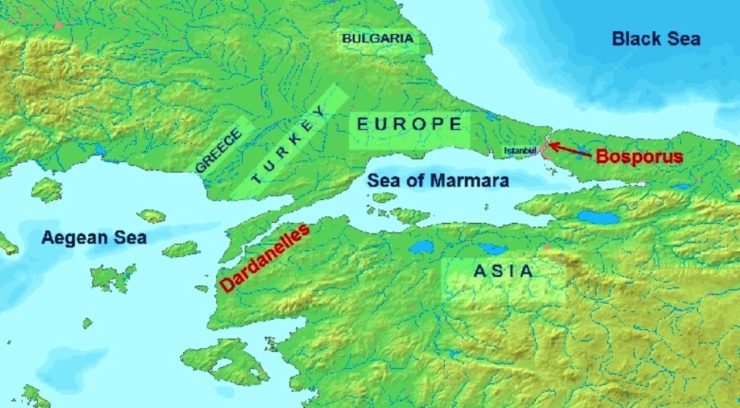
The Black Sea Straits: Turkey balances between the US and Russia
By Alexandr Svaranc – New Eastern Outlook – 22.02.2024
The territory of modern Turkey has economic-geographical and military-strategic advantages due to its control over the Black Sea Straits of Bosporus and Dardanelles. Control of the Black Sea Straits has always been strategically important to the great powers in world geopolitics and trade.
Great Britain and Russia often clashed over the right to control the Straits. In August 1914, German ships, including the cruiser Goeben and light cruiser Breslau, attacked Russian ports after passing through the Black Sea Straits. This led to the Ottoman Empire joining World War I on the side of Germany against Russia. One of the tasks of the Nazi German Ambassador to Ankara, Franz von Papen, in the late 1930s was to obtain Turkish consent for the passage of German ships through the Straits to the Black Sea to participate in the war against the USSR. Stalin later described Turkey’s policy during World War II as “hostile neutrality.”
In the 19th century, Russia’s successful wars against the Ottoman Empire enabled Russian control over the Black Sea Straits. However, Emperor Nicholas I of Russia, for some reason, decided to let in Britain and France in resolving the fate of the regime of shipping in the Black Sea Straits, while this issue could have become a subject of relations between solely Russia and Ottoman Turkey.
As a result, on July 3, 1841, the Straits Convention was signed in London, with the consent of the Russian Tsar, between Turkey, on the one hand, and Russia, Great Britain, Austria, Prussia, and France, on the other. It stipulated that as long as Turkey was not at war, the Straits would be closed to military ships of any nation. During the war, Turkey was granted the right to let ships through the Straits belonging to states with which it wished to reach an agreement. The London Straits Convention in fact buried the decisions of the Russian-Turkish Treaty of Hünkâr İskelesi of 1833, according to the secret articles of which Turkey undertook not to allow warships of any European countries to enter the Black Sea. Russia’s political and military positions have been significantly strengthened by the latter.
Following the results of the First World War, the Versailles Conference of the victorious countries again returned to the topic of the Black Sea straits, which continued with long negotiations, sharp discussions and ended with the signing of the Treaty of Lausanne on July 24, 1923, based on a project of Great Britain. The representatives of the Soviet delegation were actually blocked, and the head of the Russian delegation, Vatslav Vorovsky, was not even officially informed about the resumption of the conference and was not allowed to take part in the negotiations (on May 10, 1923, Vorovsky was assassinated in Lausanne by Russian White émigré named Maurice Conradi).
The Lausanne Treaty was signed between Great Britain, France, Italy, Japan, Greece, Romania, Bulgaria, the Kingdom of Serbs, Croats and Slovenes and Turkey. The USSR did not ratify the convention because its terms violated legal rights and did not guarantee the security of Black Sea countries. In particular, this convention provided for the demilitarization of the Straits Zone, with the Straits themselves coming under the control of a special international commission. In other words, the right to station military units near the straits was taken away from Turkey, through whose territory the straits passed. Simultaneously, all commercial and military vessels from any country in the world were granted free passage through the Bosporus and Dardanelles, with only minor restrictions. The latter created problems for the Black Sea countries, especially for the main Black Sea powers – Turkey and Russia.
The events of 1936 in Spain, the growth of Fascist militarism in Italy and Germany reopened the issue of the Black Sea Straits. Britain was concerned about losing control over Turkey, its naval bases, and its broad interests in the Mediterranean and the Arab East, including the restoration of the German-Turkish alliance. Therefore, London considered it appropriate to make concessions to Ankara on the issue of changing the regime of the Black Sea Straits and replacing the International Special Commission with Turkish control, including the abolition of Turkey’s demilitarization in the Straits Zone.
Consequently, following months of discussions, a new convention on the Black Sea Straits regime was signed on July 20, 1936, in the Swiss city of Montreux. This convention is seen as a compromise in international practice. In times of peace and war, merchant ships of all nations were granted the right of free passage through the Straits. Warships of non-Black Sea states are restricted in transit through the Bosporus and Dardanelles by class, total tonnage, total number and period of stay in the Black Sea not exceeding three weeks. In the case of Turkey’s taking part in a war, and if Turkey considers itself directly threatened by war, it is given the right to authorize or prohibit the passage of military ships through the Straits. Accordingly, the demilitarization regime was abolished, and Turkey was granted the right to station its military garrisons in the Straits Zone. The USSR’s demands for limitations on the military presence of non-littoral states in the Black Sea were mostly taken into account. London and Paris obtained the right to adjust the ratio of naval forces between Turkey and the USSR in the Black Sea.
Overall, the Montreux Convention can be viewed as a compromise that helped stabilize the situation in the Straits Zone. The Convention has been extended twice for 20 years. It remains in force as of now. The issue of the Black Sea Straits is currently being discussed in international diplomacy. This is especially true in times of crisis, when relations between major Black Sea countries, such as Russia and Turkey, become contentious.
With the start of the Russian Special Military Operations in Ukraine, hostilities have been resumed in the Black Sea basin waters. The Collective West, led by the United States, is attempting to alter the international legal norms that regulate the passage of warships through the Bosporus and Dardanelles.
According to US Assistant Secretary of Defense for International Security Affairs Celeste Wallander, Washington plans to collaborate with Ankara regarding shipping in the Black Sea. The Pentagon spokesperson emphasized the need to create a favorable environment in the region, ensuring that the Black Sea is fully accessible for commercial shipping.
Meanwhile, the United States is attempting to use merchant shipping as a cover to alter the regulations for the passage of non-Black Sea NATO warships through the Dardanelles and Bosporus to the Black Sea. For this purpose, the Black Sea Grain Initiative became a convenient opportunity.
The United States and the United Kingdom assert that Russia’s decision to withdraw from the agreement violates international humanitarian law. They propose the formation of an operational group under the convoy of NATO air and naval forces to transport Ukrainian grain through the Straits to foreign markets.
Retired US Navy Admiral James Stavridis announced in July 2023 that a convoy would be created under the control of the United States or NATO. A year earlier, The Wall Street Journal reported that Joe Biden Administration was considering new rules for the passage and navigation of warships in the Black Sea. The North Atlantic Alliance plans to deploy more military aircraft and ships to the Black Sea, according to NATO Secretary General Jens Stoltenberg.
In November 2023, US Congressmen Mike Rogers and Mike Turner urged President Joe Biden to deploy US military forces in the Black Sea to provide military support to Ukraine. Meanwhile, Commander Brian Harrington of the US Navy stated that conducting military exercises outside the scope of the Montreux Convention would undermine Russia’s dominance in the Black Sea. Perhaps these appeals and statements are intended more for the Turkish president.
The British and Norwegians have initiated a program to enhance Ukraine’s capabilities in the Black Sea. However, Turkey refused to allow two Sandown-class minehunters which were conditionally transferred by Great Britain to the Ukrainian Navy in June 2021, to pass through the Bosporus. According to Article 19 of the Montreux Convention, Turkey considers the ships of Russia and Ukraine as belonging to belligerent powers and therefore, they are not permitted to pass through the Black Sea Straits. London officials attempted to pressure Ankara, but were unsuccessful.
As for the warships of the US and other extra-regional countries that used to regularly enter the Black Sea using the right of peaceful passage, Turkey has announced within NATO that it will not allow naval exercises or visits for other purposes as long as the conflict continues. Ankara argues that violating the provisions of the Montreux Convention in the current situation will inevitably trigger retaliatory actions by the Russian Navy, leading to a new military escalation. Despite the dissatisfaction of NATO allies with Turkey’s position, Ankara does not intend to change it, showing the firmness and stubbornness typical of Turks.
The Montreux Convention does not allow the unimpeded passage of warships of non-littoral states in the Black Sea. However, after the collapse of the USSR and the Warsaw Pact, NATO gained an advantage in the Black Sea. In other words, prior to 1991, all Black Sea countries except for NATO’s Turkey were members of the Warsaw Pact and allies. Right now, the situation in the Black Sea is reversed. Namely, Russia on the one hand and NATO members Turkey, Bulgaria, Romania and the North Atlantic Alliance candidates Georgia and Ukraine on the other.
The US is not a signatory to the Montreux Convention at all and can therefore afford to violate its terms. Every five years since the signing of this convention in 1936, changes to its provisions may be proposed, provided that the initiative is supported by a two-thirds vote of the Montreux signatories. However, currently, all signatory countries except Russia are NATO members, and Japan and Australia are strategic partners or allies of the United States.
In this situation, Turkey’s opinion remains key as it still holds the role of “host of the Straits” under the Montreux Convention and maintains an independent policy. A change in the provisions of the convention would be a change in Turkey’s own status quo in the region. This is obviously not what Ankara wants. Crimea is now under Russian control, which could pose a threat to the same straits.
Russian Foreign Minister Sergey Lavrov stated that the Turkish authorities will not change the rules of entrance in the Black Sea for NATO warships under Pentagon’s pressure. However, Russia cannot rely on Turkey’s guarantees forever, as Ankara has shown a willingness to make sudden political reversals.
The US and Turkey are discussing the issue of closing the Bosporus to Russian warships, according to Iranian journalist Hayal Muadzin. In particular, there is information circulating that the US has offered to cede some areas in northern Syria, apparently Kurdish-populated provinces, to Turkey as a gift to Recep Tayyip Erdoğan, in exchange for active cooperation against Russia in the Black Sea.
In January, Turkey ratified Sweden’s NATO status in exchange for the delivery of 40 modernized F-16 fighter jets from the US. Washington is prepared to address the matter of F-16 Block 70 fighter jets for Turkey. Additionally, Deputy Secretary of State Victoria Nuland stated in Ankara that the US is willing to involve Turkey in the production program of fifth-generation F-35 fighter jets and provide them with a Patriot air defense system. This offer is contingent upon Turkey’s refusal to use the Russian S-400 Triumf SAM system. The Americans may be willing to provide soft loans to support the struggling Turkish economy, but only if Turkey refrains from actively cooperating with Russia in trade and economic matters and strictly adheres to the sanctions regime.
It is evident that Turkey faces numerous temptations. However, Recep Tayyip Erdoğan is aware that excessive improvisation towards Russia could jeopardize Turkey’s Great Turan project and its access to Azerbaijan and Turkic countries in Central Asia through the Zangezur corridor. For the time being, therefore, Ankara is trying to keep the “Russian side” of the fence. Turkey refuses to revise the provisions of the Montreux Convention in exchange for the “Swedish case.”
Turkish Foreign Minister Hakan Fidan confirmed that Ankara will continue to use the Montreux convention and stated that it is not up for debate. With the outbreak of the crisis in Ukraine, Turkey exercised its powers under the Montreux Convention and prohibited the passage of warships through the Black Sea Straits. The Turkish Defense Ministry aims to prevent further escalation of military tensions in the Black Sea basin, especially in the Straits area. The Straits pose not only an economic issue for Turkey, but also a security concern. Ankara has the right to charge for the passage of ships through the Bosporus and Dardanelles, which covers expenses for lighthouses, evacuation, and medical care.
In the rapidly evolving situation of the Ukrainian conflict, it is crucial for the Turks to maintain their key positions. There is a domestic political consensus on this issue: the provisions of the Straits Convention must remain unchanged. Turkey’s accession to Western sanctions against Russia is inadmissible; otherwise, Turkey will lose the opportunity to play a mediating role.
The U.S. Steals Syrian Oil, and the Kurds Sell It to Israel at a Discount in Erbil
By Steven Sahiounie | Strategic Culture Foundation | January 22, 2024
Iran’s Revolutionary Guard (IRG) claimed responsibility for missile attacks on an Israeli “spy headquarters.” Kurdish businessman Peshraw Dizayee and four of his family members were killed in the attack on their home on January 16 near the U.S. Consulate in Erbil, in the Iraqi Kurdistan Region (IKR).
Dizayee was the owner of the Falcon Group, which is a business involved in oil and gas, agriculture and security. The IRG claimed its missiles targeted a “Mossad headquarters”.
“No U.S. facilities were impacted. We’re not tracking damage to infrastructure or injuries at this time,” a U.S. official said in response to the recent attack.
Prime Minister of the IKR, Masrour Barzani, condemned the IRG attacks on Erbil.
The Oil business in Erbil
The oil business is thriving in IKR, and the Falcon Group was part of it. Kurdish oil has been exported to Israel, Italy, France and Greece through a secretive trade depending on pre-pay deals.
Israel buys much of its oil from Erbil, and Israel depends on the heavily discounted crude, making it a key customer. The oil is discounted to Israel because it is free, as the source is the stolen Syrian oil. 40% of Israel’s oil supplies were from IKR in the first three months of 2023, which doubled the amount in 2022.
Israel received its first substantial seaborne crude oil shipment from the IKR in 2014, which is the same time the U.S. occupation forces arrived in Syria. Israel was reportedly importing as much as three-quarters of its crude oil needs from the IKR by mid-2015.
Israeli refineries and oil companies imported almost $1 billion worth of Kurdish oil between May and August of 2023, according to shipping data, trading sources and satellite tanker tracking, which represents about 77 % of average Israeli demand, which runs at roughly 240,000 barrels per day. More than a third of all of the northern Iraqi exports, which are shipped from Turkey’s Mediterranean port of Ceyhan, went to Israel over the period.
According to anonymous sources, it was a Mossad agent who first traveled to Erbil to negotiate the deal to buy oil from IKR, which was facilitated by U.S. officials.
The U.S. Consulate in Erbil
The new U.S. Consulate General building in Erbil, near the attack carried out by Iran, is the biggest consulate complex built by the U.S. Embassies and Consulates are under the U.S. State Department, but the consulate in Erbil has a connection to the U.S. Department of Defense, demonstrating the strategic importance of the region for Washington, with a U.S. military base also in IKR.
Irvin Hicks, Jr., the U.S. Consul General in Erbil, stated in January 2023, that the new 800-million-dollar consulate building is a clear statement that the “United States of America is not going anywhere.”
The U.S. first opened a diplomatic office in Erbil in February 2007, and later upgraded to a consulate general in 2011, the same year the U.S.-NATO attack on Syria began for regime change, under the Obama-Biden administration.
The U.S. embassy in Baghdad was built in 2009 and is its biggest mission compound in the world at a cost of $750 million. Iraqi Kurdistan and the Iraqi central government in Baghdad operate separately, as the Kurds are a semi-autonomous region.
Erbil has 30 consulates, six honorary consulates, and six foreign trade offices, with the Japanese consulate the latest to open on Jan. 11.
“Opening more than 30 consulates is not normal,” Iranian Brigadier General Mohammad Hossein Rajabi criticized. Most of these consulates are used for espionage activities.”
Iran views the foreign offices as having the potential to carry out plans aimed at destabilizing the security of Iran, by hosting Iranian separatist groups and bases aligned with Israeli intelligence agency Mossad.
The Iraqi response to the Genocide in Gaza
“On October 20, 2023, the Department ordered the departure of eligible family members and non-emergency U.S. government personnel from U.S. Embassy Baghdad and U.S. Consulate General Erbil due to increased security threats against U.S. government personnel and interests,” according to the State Department’s Iraq travel advisory.
Iraqis have taken to the streets to protest the U.S. complicity in the genocide being committed in Gaza by Israel. U.S. President Joe Biden has defied the American values of human rights and international law by continuing to send weapons to Israel to promote the wholesale slaughter of the Palestinian civilians of Gaza, even in the face of international criticism which has lowered the image of America as a beacon of freedom to a joke.
Protests have taken place outside of the U.S. Embassy in Baghdad, and military groups which are under the central government of Iraq have fired rockets and armed drones at U.S. troops based in Anbar and near Erbil multiple times. Baghdad does not recognize Israel; however, the IKR are aligned with the U.S., and sell the stolen oil from Syria to the prime U.S. ally, Israel.
The U.S. invaded and destroyed Iraq in 2003, and occupied the country for years until a withdrawal. When ISIS reared its ugly head, the Baghdad government requested U.S. troops to come to help in the fight against ISIS, which saw its defeat at the hands of Iraq, Syria, Russia, and the U.S. The Iraqi parliament ordered the U.S. troops to leave after the defeat of ISIS in 2017, but the Department of Defense refused. The Prime Minister of Iraq has recently ordered the U.S. troops to leave immediately following the U.S. assassination of Mushtaq Jawad Kazim al-Jawari in Baghdad on January 4, an Iraqi military commander who was instrumental in the defeat of ISIS.
The PKK in Syria and Erbil
The PKK aligned SDF in north east Syria is U.S. supported. The U.S. military in Syria are occupying the largest oil field in Syria, which prevents the Damascus government from using the oil to provide electricity to the Syrian people, who suffer with just 3 hours of electricity per day.
In December 2023, 44-tanker convoy carrying oil stolen from Syria traveled clandestinely to U.S. bases near Erbil. Just days before, U.S. forces took 95 tankers of oil and a truckload of stolen Syrian wheat to IKR. The Syrian wheat fields are also in the area the U.S. troops occupy and the area is controlled by Kurds who are aligned with the IKR.
Farhan Jamil Abdullah, head of the Syrian Oil Company, said in July that as a result of the U.S. sanctions and military occupation in Syria, oil production has decreased to 15,000 barrels per day from 385,000 barrels before 2011.
Firas Hassan Kaddour, the Syrian Oil Minister, said in July that the losses of the energy sector in Syria are close to 100 billion U.S. dollars.
The main oil field of Al Omar and Conoco in Syria are producing oil which is shipped in tankers by the U.S. Army and refined at Kar Oil Refinery in Erbil.
The U.S. sponsors the SDF militia in Syria which is dominated by the YPG. The YPG is the Syrian branch of the PKK, a group recognized by Turkey, as well as the U.S. and the EU, as a terrorist organization, who have killed more than 40,000 persons over decades.
Turkey has condemned the U.S. alliance with the SDF and YPG, and considers the U.S. is financing terrorism.
The commander of the SDF is General Mazloum Kobani, who is also a member of the PKK. His real name is Ferhat Abdi Sahin, is one of Turkey’s most wanted terrorists. Kobani was chosen by the U.S. as their military ally and it is at Kobani’s command that the stolen Syrian oil is loaded into tankers.
Erdogan has demanded for years that the U.S. must stop supporting the SDF, YPG, and to stop encouraging the Kurds to establish an independent homeland in north east Syria on the border with Turkey, which is a NATO member, and ally of the U.S., housing an American military base there.
Turkish intelligence official warns Israel: Targeting Hamas officials abroad will have ‘serious consequences’

Head of Hamas’ politburo Ismail Haniyeh (Center)
Press TV – December 4, 2023
Turkey has issued a strong warning to Israel, saying the regime would face Ankara’s serious action if it tries to target key figures of the Palestinian resistance movement Hamas who are based outside Gaza, including in Turkey.
“Necessary warnings were made to the interlocutors based on the news of Israeli officials’ statements, and it was expressed to Israel that (such an act) would have serious consequences,” a Turkish intelligence official said on Monday, according to Reuters.
The warning came a day after the Israeli broadcaster Kan released a recording from Ronen Bar, who serves as the head of Israel’s so-called internal security service Shin Bet, in which he said that the regime would hunt down Hamas in countries like Lebanon, Turkey and Qatar even if it takes years.
Bar said the Israeli administration had set a goal to target Hamas officials who are based outside Gaza.
Key Hamas leaders, including its top political officials, live outside the besieged Gaza as part of the group’s policy to garner support from other countries for the fight against the Israeli regime.
Head of Hamas’ politburo Ismail Haniyeh has been shuttling between Qatar and Turkey in recent weeks amid Israel’s aggression on Gaza that has left nearly 16,000 people dead.
Turkish President Recep Tayyip Erdogan has repeatedly condemned Israel for its brutal military campaign against Gaza while warning the regime against political and economic consequences if it continues with the aggression.
The presence of Hamas leaders in Qatar helped the Arab country mediate a seven-day ceasefire in Gaza that ended on Friday.
Israel’s aggression against Gaza began on October 7 after Hamas launched a major military operation into the Israeli-occupied territories near Gaza, killing some 1,400 Israeli settlers and military forces.
Turkey’s intelligence organization foils Mossad attempt to kidnap Palestinian Iron Dome hacker
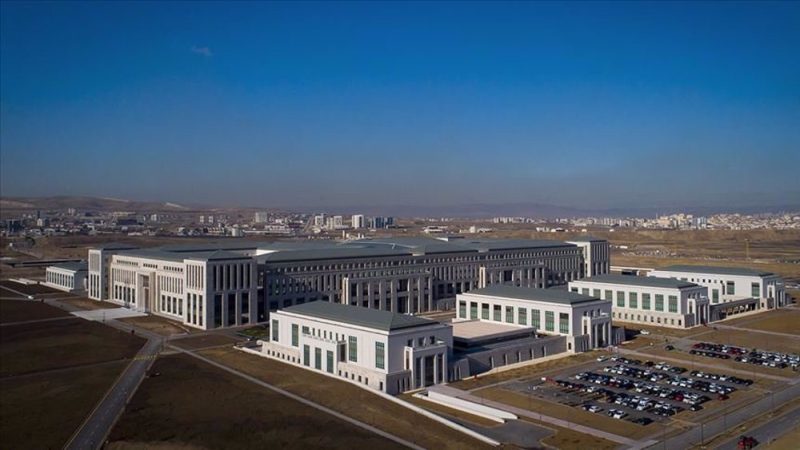
A view of the headquarters of Turkey’s National Intelligence Organization (MIT) in the capital Ankara on January 5, 2020.
Press TV -November 22, 2023
Turkey’s National Intelligence Organization (MIT) has rescued a renowned Palestinian hacker from the Israeli Mossad spy agency seeking to kidnap or possibly kill him.
MIT rescued Omar A, who was behind the disruption of Israel’s Iron Dome anti-missile system in 2015 and 2016, in an international operation and offered him protection as he was targeted by Mossad in Turkey and Malaysia.
The young Gazan hacker was sought by the Israeli regime for a long time after his hacking of the Iron Dome helped al-Qassam Brigades, the armed wing of the Palestinian resistance movement Hamas, launch missile strikes against Israel at the time.
Omar, a computer programming graduate of the Islamic University of Gaza, moved to Istanbul in 2020 after Mossad identified him as the one behind the disruptions. MIT was aware of his residence in Turkey due to his background as a hacker.
In an attempt to deceive him, Mossad offered him jobs at software companies several times but Omar, suspicious of Israel’s involvement, rejected the offers.
Omar was about to accept to join a team for an online project in June 2022 and to travel abroad for the project as Mossad was intent on taking him to Tel Aviv for interrogation. But MIT contacted him and warned him against the scheme.
The Palestinian hacker decided to take a vacation in Malaysia in September 2022. The Istanbul branch of MIT’s counter-intelligence department intervened again and installed tracking software on his cellphone after warning him against a possible abduction while abroad.
Indeed, he was kidnapped days later in Kuala Lumpur and was taken to a remote cabin some 50 kilometers (31.06 miles) from the Malaysian capital.
There, he was interrogated and tortured by suspects working for Mossad and was questioned on the methods he employed to infiltrate Iron Dome.
When MIT became aware of the abduction, Turkish officials contacted Malaysian authorities and through tracking software, helped them pinpoint the location where Omar was held.
Malaysian security forces raided the house and rescued Omar. Eleven suspects were arrested in connection with his abduction. Omar returned to Turkey and was taken to a safe house provided by MIT.
Turkey’s MIT has earlier uncovered similar Mossad plots to spy on Palestinians in the country.
Back in July, Turkish authorities said they had uncovered and disrupted a vast “ghost” Mossad spy network centered in Istanbul, following months of surveillance.
The substantial efforts by Turkey’s MIT exposed 56 operatives allegedly spying on non-Turkish citizens in Turkey in the service of Mossad.
The vast network consisted of citizens from various West Asian countries.
The findings by MIT revealed that the Mossad agents would gather information about foreigners through various surveillance methods, vehicle movements using GPS, and hacking into password-protected networks using Wi-Fi and location tracking devices.
These Mossad spies also used several fake websites in multiple languages, mainly Arabic, to secure technical locations and real IP addresses of the targeted individuals.
Also in May, Turkish media outlets reported that local authorities had managed to arrest 11 people accused of being part of a Mossad-led network.
Turkey has also broken Mossad-aligned spy rings in 2022 and 2021.
Featured Video
Seyed M. Marandi: Negotiations Collapsed – Return to War
or go to
Aletho News Archives – Video-Images
From the Archives
The US-Iran Scenario That Most Scares Israel
By Ali Haydar | Al-Akhbar | October 9, 2013
Israeli Prime Minister Benjamin Netanyahu issued a series of threats toward Iran and its interlocutors in the West, including the US, as serious negotiations on Iran’s nuclear program seem more plausible.
As a possible rapprochement looms between the US and Iran, Netanyahu has attempted to impose impossible Israeli conditions on the negotiators, such as the full dismantling of Iran’s nuclear program, not to mention threatening military force.
Whatever the deal that could materialize between Iran and the West, Israel is going to find itself before an open-ended path. One can foresee three possible scenarios… continue
Blog Roll
 Aletho News
- Trump’s desperate bombasts amount to war crimes
- Most Israelis oppose Iran ceasefire, reject talks: Poll
- Iran to charge ships from ‘hostile’ nations to cross Hormuz – security chief
- UK, Spain reject Trump’s new scheme to blockade Hormuz Strait
- Russian frigate ‘resurfaces’, chases off NATO pirates days after Kiev ‘sank’ it
- Ukraine Targets Russian Merchant Fleet With NATO Intel Support – Presidential Aide
- Russia’s ‘shadow fleet’ makes mockery of UK naval power
- Ukraine plans to attack Russian ships with Norwegian support
- US’s ‘Very Foolish’ Double Blockade of Hormuz Strait Makes Absolutely No Sense: Here’s Why
- China issues rules on countermeasures against foreign states’ unlawful extraterritorial jurisdiction
- If Americans Knew
- Israeli prison authorities are blocking hundreds of solidarity postcards being sent to female Palestinian prisoners
- ‘I wished for death’: Sexual violence in Israel’s prisons is an ‘organized state policy’
- Israeli army shoots, kills 9-year-old girl in her Gaza classroom
- Israel is attacking Lebanon to sabotage the Iran ceasefire, but the media is hiding its true motivation
- Israel’s restriction of aid into Gaza leads to critical shortages in bread, baby formula, and water
- Critical shortages in Gaza, Lebanon in ruins, “piracy” in Iran – Daily Update
- US-Iran ceasefire negotiations make zero progress – Daily Update
- Pro-Israel ‘Thinktanks’ and Individuals who Influence U.S. Foreign Policy
- Mearsheimer reveals how Israel dictates US policies on Iran, Gaza – video
- After killing 350+, Israel still has a “score to settle” with Lebanon before ceasefire – Daily Update
- No Tricks Zone
- Cave Discovery Reveals Today’s Desert Climates Were Recently Far Warmer, Wetter, Teeming With Life
- German Expert: Heat Dome Led To Record Temps In Western USA…Warmer In 1934, 1936
- New Study: No Linear Warming Or Glacier Retreat Along Northern Antarctic Peninsula Since 1980s
- An Inconvenient Tree: Uncovered In Alps… Europe Much Warmer Than Today 6000 Years Ago
- New Study Reports A 60% Slowdown In Greenland’s Ice Loss Rate In The Last Decade
- Low Intensity Tornado Wrecks Major Solar Farm, Creating A Potential Toxic Dump
- New Study Finds Warming Saves Lives…Cold Temperatures 12 Times More Deadly Than Excess Heat
- German Science Blog Accuses PIK Climate Institute Of Hallucinating Climate Tipping Points
- Devastating Assessment Of Comirnaty Vaccine By Former Senior Pfizer Europe Toxicologist
- New Study: CO2 Is ‘Effectively Negligible’ As An Explanatory Climate Change Factor Since 2000
 Aletho News