Syrian Minister of Foreign Affairs, Faisal Mekdad, claimed at the Conference on Disarmament in Geneva on 28 February that “well-known countries had used weapons of terrorism against the Syrian people,” in violation of the United Nations charter and their international obligations.
Foreign Minister Mekdad stated in a video address to the conference that, “Syria faced an unjust war, during which well-known countries employed weapons of terrorism against the Syrian people, sent tens of thousands of foreign terrorists, and provided them with various types of support and weapons, including internationally prohibited ones, to serve their aggressive agendas.”
He added that the policies of these countries have led to terrorist organizations such as ISIS and Jabhat al-Nusra obtaining chemical weapons and using them repeatedly against Syrians, which highlights the need to address the shortcomings in international instruments governing the use of such weapons. Mekdad also called for joint action to find a politically neutral mechanism to coordinate international efforts to address acts of chemical terrorism.
Not only the Syrian government but independent sources have suggested that armed opposition groups supported by the US, Israel, Turkiye, Qatar, and Saudi Arabia used chemical weapons against the Syrian army and Syrian civilians during the conflict, which began in 2011.
Carla del Ponte, a member of the UN’s Independent International Commission of Inquiry on the Syrian Arab Republic and a former war crimes prosecutor, gathered testimonies indicating that opposition armed groups used sarin gas against the Syrian army and civilians in the town of Khan al-Assal in March 2013.
Journalist Seymour Hersh reported that a classified US Defense Intelligence Agency (DIA) briefing in June 2013 indicated that Nusra maintained a sarin production cell and was attempting a large-scale production effort in Syria.
A report published by Rootclaim in 2021 showed that the Saudi-backed armed opposition group, Liwa al-Islam, launched the sarin-filled rockets used in the chemical attack in East Ghouta in August 2013.
A detailed report from the Libertarian Institute showed that the Ghouta attack was a false flag attack meant to trigger Western military intervention in Syria as part of the broader CIA program known as Timber Sycamore.
Foreign Minister Mekdad pointed out that Syria’s experience with the UN’s Organization for the Prohibition of Chemical Weapons (OPCW) showed that the watchdog group had become politicized and a tool of the Western powers to manufacture hostility toward the Syrian government.
Mekdad called on the states who are party to the OPCW to carry out a responsible and careful review of the work of the organization and to correct errors and clear violations of the provisions of the convention that governs the group.
As reported by journalist Aaron Mate, veteran OPCW inspectors provided evidence showing the Syrian government was not responsible for an alleged chemical attack in Douma in April 2018, but their probe was censored and manipulated by top OPCW officials. Under direct US government pressure, the OPCW concealed this evidence provided by its own inspectors and released a report that suggested the Syrian government was responsible for the attack.
Foreign Minister Mekdad also stressed that the Israeli occupation constitutes a source of permanent and serious threat to regional and international peace and security. In addition to launching repeated attacks on Syrian and Palestinian territories, it continues to modernize and expand its arsenal of all types of weapons of mass destruction.
March 1, 2023
Posted by aletho |
False Flag Terrorism, Timeless or most popular | CIA, Israel, Saudi Arabia, Turkey, United States |
Leave a comment
Türkiye will not be joining unilateral sanctions imposed on Russia by the West over the conflict in Ukraine, Turkish Foreign Minister Mevlut Cavusoglu said on Wednesday.
Cavusoglu was asked how long Ankara would be able to resist pressure from the US and its allies to put restrictions on Moscow ahead of talks with his Russian counterpart Sergey Lavrov on the sidelines of the G20 Foreign Ministers Meeting in India’s capital New Delhi.
“We don’t need to resist anyone, we make our own decisions as a sovereign state. We don’t join any unilateral sanctions. We support only those [restrictions that are] introduced with the backing of the UN,” the foreign minister replied, as cited by the media.
“It’s not just about Russia, but we also don’t support sanctions against Iran or any other country,” Cavusoglu pointed out, adding that “no one can put pressure” on Türkiye.
India, which chairs the G20 this year, is hosting the summit of foreign ministers on Wednesday and Thursday.
An Indian foreign ministry official told Reuters on Wednesday that New Delhi didn’t want the conflict in Ukraine to dominate the discussions at the event, but acknowledged that it would likely be among the top issues on the agenda. The host nation’s “intention [is] to continue playing the voice of the Global South [Latin America, Africa, Asia and Oceania] and raising issues pertinent to the region,” the official said.
High-ranking Indian diplomat Vinay Kwatra told reporters that “questions relating to food, energy and fertilizer security, [and] the impact that the conflict has on these economic challenges that we face” will be among those to receive “due focus” in New Delhi.
However, EU foreign policy chief Josep Borrell, who is a stalwart supporter of Kiev, insisted that India should use the G20 gathering to “make Russia understand that this war has to finish.” According to Borrell, the “success” of the whole meeting “will be measured in respect to what we will be able to do on that.”
An EU source said separately the EU delegation in New Delhi won’t support the final statement as a result of the summit if it doesn’t include condemnation of Russia’s conduct in Ukraine, Reuters reported.
March 1, 2023
Posted by aletho |
Economics | European Union, India, Sanctions against Iran, Turkey |
Leave a comment
Western sanctions were supposed to “ruin” Russia not only economically, but also technologically – according to the well-known announcement by German Foreign Minister Annalena Baerbock.
The ban on supplying electronics was intended to paralyze the Russian armaments industry. But Western war planners appear to have gotten even the most basic facts wrong. As is now apparent, an “isolated” Russia has managed to circumvent US-imposed sanctions in the technology sector. What’s more, Russia is importing even more microchips and semiconductors than before the war.
Among other things, the US and the EU banned the supply of microchips and semiconductors to Russia, depriving them of “70 percent” of their imports. The most important companies in the sector, such as Intel, AMD, the Taiwanese chip giant TSMC and Nexperia from the Netherlands, stopped doing business in Russia almost overnight.
At the end of March, US President Biden confidently announced that Russia would no longer be “able to rebuild those devastating weapon systems” and was on its way back “to the 19th century” as a result of the Russian operation in Ukraine, while US Commerce Secretary Gina Raimondo stated: “We have reports from Ukrainians that when they find Russian military equipment on the ground, it’s filled with semiconductors that they took out of dishwashers and refrigerators”.
Raimondo spoke at a Senate hearing in May last year, noting that she had recently met with Ukraine’s prime minister. “Our approach was to deny Russia technology — technology that would cripple their ability to continue a military operation. And that is exactly what we are doing.”
And in September, the President of the EU Commission, Ursula von der Leyen, defiantly announced that Russia’s industry was in ruins. “The Russian military is taking chips from dishwashers and refrigerators to repair their military equipment because they are running out of semiconductors. Russian industry is in tatters,” she claimed in a speech in the European Parliament.
Total Western failure to predict outcomes
But the Russian armed forces never had to do that during the war, as is now evident. Referring to an official report, the weekly German newspaper Zeit reported that Western sanctions in no way reduced Russian imports of electronic components – on the contrary: Russia imported even more processors and semiconductors in 2022 than before the war. Overall, imports in this segment have increased from 1.8 billion euros to 2.45 billion euros.
Beyond that, Russian imports fell by just 16 percent on a yearly basis. This was also confirmed by US economist and sanctions advocate Matthew Klein. According to his calculations, Russian imports in November were only 15 percent below the monthly average for 2021. At the beginning of 2022, shortly after the Russian operation started, Western “experts” had expected a slump of at least 30 to 40 percent.
The fact that Russia was able to circumvent the sanctions is due to countries like China, Turkey or the United Arab Emirates, which quickly filled the gaps left by Western corporations. They also act as a location for Russian intermediaries who obtain Western technology from letterbox companies.
At the same time, Russians have been manufacturing their own goods to fill the gaps that have arisen as a result of sanctions and the withdrawal of western corporations.
IMF expects Russia’s economy to grow
Until recently the West doubted that Russia’s economy would survive under sanctions, but the International Monetary Fund (IMF) is now sounding more optimistic than even the Russian government. Known for its gloomy forecasts, The IMF has predicted that Russia’s GDP will expand this year.
By far the most important trading partner for Russia is China. Overall, imports from China rose by 13 percent in 2022. Many Western companies such as Apple or Ikea had supplied the Russian market before they withdrew. This decision to leave could be compensated for.
China’s companies now deliver the majority of new cars and smartphones, computers, but also heavy equipment such as construction machinery and trucks. In fact, exports of trucks from China more than tripled in 2022 while imports of construction equipment have doubled.
Most importantly from a Russian point of view, however, are the imports of microchips. Together with Hong Kong, China shipped $900 million worth of semiconductors to its neighbour in 2022, more than double than the figure for 2021.
February 11, 2023
Posted by aletho |
Economics | China, Russia, Turkey, UAE |
Leave a comment
US officials have warned Türkiye and the United Arab Emirates against maintaining economic and financial ties with Russia because trade is undermining sanctions, Bloomberg reported on Friday, citing people with knowledge of the matter.
The warnings were reportedly voiced by the undersecretary for terrorism and financial intelligence at the US Treasury, Brian Nelson, during meetings with Turkish officials on Thursday and Friday.
Nelson’s visit to Türkiye comes as part of a regional tour that included the UAE earlier this week, and is said to be aimed at discussing Washington’s concerns over rising exports to Russia that include US goods.
US officials have called on the two countries to clamp down on the flow of goods to Russia, the sources told the news agency, adding that millions of dollars’ worth of export-controlled items were reaching the sanctions-hit country, and could be used by the defense industry to extend the conflict in Ukraine.
Scores of Turkish exporters shipped over $800 million worth of goods to Russia, including $300 million in machinery and another $80 million in electronics in the eight months through October 2022, according to people who spoke on condition of anonymity.
Other areas of concern reportedly include Russian vessels either sanctioned or subject to export controls making port calls in Turkey.
Meanwhile, the UAE has maintained ties with both Ukraine and Russia. The Gulf state’s ruler, Mohammed bin Zayed Al Nahyan, traveled to meet Russian President Vladimir Putin in October amid the continuing conflict in Ukraine. The leaders expressed Moscow and Abu Dhabi’s willingness to develop cooperation on all levels.
February 3, 2023
Posted by aletho |
Economics, Russophobia | Turkey, UAE, United States |
Leave a comment
The US Treasury Department’s top sanctions official will visit Türkiye and the United Arab Emirates next week to warn officials and businesses there that Washington will punish them if they dodge its sanctions on Russia, Reuters reported on Saturday.
Brian Nelson, the department’s undersecretary for terrorism and financial intelligence, will travel to Oman, the UAE, and Türkiye between Sunday and Friday. Meeting with government officials, businesses and financial institutions, Nelson will caution them that they could lose access to US markets “on account of doing business with sanctioned entities,” a Treasury spokesperson told the news agency.
US officials have repeatedly highlighted Türkiye as a potential hub of sanctions evasion, and unnamed Western officials told the Financial Times in August that they were “deeply concerned” about allegations of trade between Turkish firms and sanctioned Russian entities.
Ankara responded that it “would not allow the breaching of sanctions by any institution or person,” following a phone call in which US Deputy Treasury Secretary Wally Adeyemo seemingly threatened the “success of the Turkish economy” and “the integrity of its banking sector.”
The UAE has also received warnings from Washington, with Adeyemo urging the Emirates’ financial institutions last summer to be “exceedingly cautious” about doing business with other institutions connected to “the Russian financial system.” The Treasury spokesperson told Reuters that Nelson will condemn the UAE’s “poor sanctions compliance” during his visit.
In the last month, the US has sanctioned a prominent Turkish businessman over allegedly laundering money for Iran’s Islamic Revolutionary Guard Corps, and a UAE-based aviation firm over alleged sales to Russia’s Wagner private military corporation. Multiple Emirati companies have also been penalized for evading US sanctions on Iran.
Both Türkiye and the UAE voted at the UN General Assembly last year to condemn Russia’s military operation in Ukraine, but neither has imposed sanctions of their own on Moscow. Turkish President Recep Tayyip Erdogan has maintained close contact with his colleagues in both Kiev and Moscow, and said from the outset that his diplomatic handling of the conflict would be “balanced.”
With Türkiye and the US also at loggerheads over Ankara’s refusal to sign off on Finland’s and Sweden’s bids for NATO membership, Erdogan and Russian President Vladimir Putin last week affirmed their intent to “develop comprehensive cooperation,” including by increasing the supply of Russian gas to Türkiye.
January 28, 2023
Posted by aletho |
Economics, Russophobia, War Crimes | NATO, Turkey, UAE, United States |
Leave a comment
In November 2022, Saudi Arabia formally changed its stance on Syria. Saudi Arabia is the political powerhouse of the Middle East, and often shares positions on foreign policy and international issues with the UAE, which has previously re-opened their embassy in Damascus.
“The kingdom is keen to maintain Syria’s security and stability and supports all efforts aimed at finding a political solution to the Syrian crisis,” Saudi Foreign Minister Prince Faisal bin Farhan told the November Arab League summit in Algeria.
Syria was suspended from the Arab League in 2011 following the outbreak of conflict instigated by the US, and portrayed in western media as a popular uprising of pro-democracy protesters.
Arab League Secretary-General Ahmed Aboul Gheit said, “The developments in Syria still require a pioneering Arab effort. It is necessary to show flexibility from all parties so that the economic collapse and political blockage can be dispelled. Syria must engage in its natural Arab environment.”
The next Arab League summit will be held in Saudi Arabia, and there is a possibility of Syria once again taking its seat at the round table.
On January 16, the Syrian Foreign Ministry agreed to resume imports from Saudi Arabia after over a decade of strained relations, and Syria planned to import 10,000 tons of white sugar. This development signals a new beginning between the two countries.
Saudi and the Syrian tribes
The Arab tribes in the north east of Syria have traditionally had strong ties with Saudi Arabia, and have received support from the kingdom. The tribes have opposed the ethnic cleansing and forced displacement of Arab villages which the US-led YPG militia has conducted for years. Even though Saudi Arabia has been viewed as a US ally in the past, this has changed since the US military has supported the Marxist YPG who have oppressed Syrians who are not Kurdish.
The US occupied oil wells in north east Syria may come under attack by Arab tribes who are demanding their homes, farms and businesses back from the US-supported YPG. Some analysts foresee the US troops pulling out of Syria after the Kurds find a political solution with Damascus.
Turkey and Syria repair relationship
Turkey and Syria have begun steps to repair their relationship, which ended after Turkey supported the US-NATO attack on Syria for regime change, and hosted CIA operations funneling weapons and terrorists into Syria, under the Obama administration.
Syrian President Bashar al-Assad recently demanded the withdrawal of Turkish troops from Syria to begin to repair the relationship.
Russia is brokering the reconciliation between Erdogan and Assad, which began with the Moscow hosted meeting of the three defense ministers, and a meeting between the three foreign ministers is upcoming.
The developments between Turkey and Syria are being watched by Iran. Foreign Minister Hossein Amirabdollahian said his country was “happy with the dialogue taking place between Syria and Turkey.” Amirabdollahian will travel to Damascus on Saturday for talks with Syrian Foreign Minister Mekdad.
Iran is looking to establish a new role in the recovery process in Syria. President Ebrahim Raisi will visit both Turkey and Syria soon, his first visit to Turkey since taking office two years ago. While analysts see Saudi Arabia and Iran as antagonists, some feel the kingdom will ultimately realize they have to work with Iran in Syria and Lebanon. Iran is part of the region and can’t be excluded from the geo-political sphere.
Saudi Arabian reforms
Saudi Crown Prince Mohammed bin Salman (MBS) said on April 27, 2021 that the country was undergoing a sweeping reform which would restructure the role of religion in Saudi politics and society. The process began a few years before he became crown prince, but under his leadership it has accelerated. Islamic institutions in the Kingdom have seen changes in procedure, personnel, and jurisdiction. All of these reforms are in line with the future vision of the country.
Some analysts feel the rise of the Muslim Brotherhood in the 1960s eventually gave rise to support for domestic religious institutions, and eventually led to funding of religious activities abroad, while religious leaders at home wielded power over public policy.
Vision 2030
Saudi King Salman, Custodian of the Two Holy Mosques, and his son, MBS have a plan for the country which is known as Vision 2030. MBS is also Prime Minister and Chairman of the Council of Economic and Development Affairs.
The days of unlimited oil and markets are in the decline. Education, training, and employment opportunities are the stepping stones to building a thriving country and MBS is determined to plan for a long future of growth and innovation.
MBS
The Crown Prince is young and has new ideas. He is instituting sweeping reforms to the society which have included more rights and freedoms for women. He has championed projects to place Saudi Arabia as a tourist destination, year round golf and soccer venue, and encouraged cultural arts such as musical productions. MBS is breaking the mold: no longer will Saudi Arabia be a breeding ground for Radical Islam.
Extremist preachers
Saudi Arabia had hosted many extremist preachers. Some were featured on satellite TV channels located in Saudi Arabia, and others were local preachers, authors, or scholars. Some had traveled abroad preaching in pulpits and exporting their hatred and sectarian bigotry.
One of the most famous preachers was Muhammed Al-Arifi, who has had an electronic surveillance device attached to him by Saudi intelligence agents, after they seized all of his social media accounts. His last tweet is said to be on May 6, 2019, when he had 20 million followers, and 24 million likes on Facebook, which ranked him as tenth in the Arab world and in the Middle East. The kingdom is shutting down clerics who are extreme.
In 2014, Great Britain banned Arifi from entering the UK following reports that was involved in radicalizing three young British citizens who went to Syria as terrorists.
A YouTube video in 2013 showed Arifi preaching in Egypt and prophesying the coming of the Islamic State. Egyptian TV reported Arifi meeting with the former Muslim Brotherhood prime minister Hisham Qandil in his office.
Arifi is best remembered for his statement on the media Al Jazeera in which he called for jihad in Syria and supported Al Qaeda.
Adnan al-Arour is another extremist preacher who had appeared regularly on two Saudi-owned Salafist satellite channels. Arour was originally from Syria before settling in Saudi Arabia, and in the early days of the Syrian conflict he would stand up on camera, shake his finger, and call for his followers to ‘grind the flesh’ of an Islamic minority sect in Syria and ‘feed it to the dogs’.
These extremist preachers made it clear that the battles being waged in Syria had nothing to do with freedom or democracy, which the western media was pushing as the goal. The truth was the conflict in Syria was a US-NATO attack for regime change and utilized terrorists following Radical Islam, who fought a sectarian war with the goal of establishing an Islamic State in Syria.
The previous Crown Prince
Muhammad bin Nayef Al Saud (MBN) served as the crown prince and first deputy prime minister of Saudi Arabia from 2015 to 2017. On June 21, 2017 King Salman appointed his own son, MBS, as crown prince and relieved MBN of all positions.
MBN met with British Prime Minister David Cameron in January 2013. He then met with President Obama in Washington, on 14 January 2013. The discussion focused on the US-NATO attack on Syria and its support from Saudi Arabia.
In February 2014, MBN replaced Prince Bandar bin Sultan, then intelligence chief of Saudi Arabia, and was placed in charge of Saudi intelligence in Syria. Bandar had been in charge of supporting the US attack on Syria. Bandar had been trying to convince the US in 2012 that the Syrian government was using chemical weapons. However, research has shown that the terrorists used chemical weapons to push Obama into a military invasion, based on his speech of ‘The Red Line’.
In March 2016, MBN was awarded Légion d’honneur by French President François Hollande, another partner in the US-NATO attack on Syria.
On February 10, 2017, the CIA granted its highest Medal to MBN and was handed to him by CIA director Mike Pompeo during a reception ceremony in Riyadh. MBN and Pompeo discussed Syria with Turkish officials, and said Saudi Arabia’s relationship with the US was “historic and strategic”. Just months later in June MBS would depose MBN and strip him of powers, in a move considered to be “upending decades of royal custom and profoundly reordering the kingdom’s inner power structure”.
US diplomats argued that MBN was “the most pro-American minister in the Saudi Cabinet”. That is what brought MBN down. The days of blindly following the US directives are over in Saudi Arabia. MBS has refused to bow down to Biden when he demanded an increase in oil production. The Vision 2030 that MBS developed does not include financing failed wars in the Middle East for the benefit of the Oval Office. MBS has a strained relationship with Biden, and he wears it as a badge of honor.
Saudi role in the Syrian war
Saudi Arabia played a huge role in the large-scale supply of weapons and ammunition to various terrorist groups in Syria during the Syrian conflict. Weapons purchased in Croatia were funneled through Jordan to the border town of Deraa, the epi-center of the Syrian conflict.
At the height of Saudi involvement in Syria, the kingdom had their own militia in Syria under the command of Zahran Alloush. The Jaysh al-Islam are remembered for parading women in cages through the Damascus countryside prior to massacring them.
In summer 2017, US President Donald Trump shut down the CIA operation ‘Timber Sycamore’ which had been arming the terrorists fighting in Syria. About the same time, Saudi Arabia cut off support to the Syrian opposition, which was the political arm of the terrorists.
Richard Dearlove, former head of MI6, expressed his view at the time that “Saudi Arabia is involved in the ISIS-led Sunni rebellion” in Syria.
Syria has been destroyed by the US and their allies who supported the attack beginning in 2011. Now, Turkey and Saudi Arabia are looking to find a solution which will help the Syrian people to rebuild their lives. Both Turkey and Saudi Arabia have turned away from past policies which found them supporting the conflict in Syria at the behest of the US. There is a new Middle East emerging which makes its own policies and is not subservient US interests.
January 22, 2023
Posted by aletho |
Aletho News | CIA, Middle East, Russia, Saudi Arabia, Syria, Turkey, United States |
Leave a comment
Ankara has called off the planned visit of Swedish Defense Minister Pal Jonson, his Turkish counterpart, Hulusi Akar, revealed on Saturday. The move comes after members of the Kurdish community held an anti-Turkish protest in Stockholm.
“At this point, the visit of Swedish Defense Minister Jonson to Türkiye on January 27 has become neither important, nor meaningful. Therefore, we have canceled the visit,” Akar told reporters on Saturday. He added that his country was still “evaluating” how Sweden and Finland were fulfilling their obligations to Türkiye amid their bids to join NATO.
“We expect Sweden and Finland to do their homework,” the minister stated.
Jonson tweeted that the ministers “decided … to postpone the planned meeting in Ankara until later.”
Last week, Ankara summoned the Swedish ambassador after an effigy of President Recep Tayyip Erdogan was hung upside down on a lamp post in the Swedish capital on January 12. Swedish Foreign Minister Tobias Billstrom condemned the act as “abhorrent.”
However, the Swedish authorities rejected Ankara’s call for an investigation, saying that the protesters had not violated any laws. The move caused further outrage in Türkiye, which considers Kurdish political and militant groups, such as the Kurdistan Workers’ Party (PKK), terrorist organizations.
Relations between Sweden and Türkiye deteriorated further after the Nordic country’s police permitted Rasmus Paludan, an anti-Islam activist and leader of a minor far-right Danish party, Stram Kurs (Hard Line), to burn a copy of the Koran near the Turkish Embassy in Stockholm. The police said the act falls under freedom of expression. This prompted the Turkish authorities to summon the Swedish envoy for the second time, local media reported on Friday.
Left-wing Swedish newspaper Flamman launched a competition for the best satirical drawing of Erdogan on Tuesday, with a prize of 10,000 krona ($971). The paper accused the Turkish president of “trying to pressure Sweden to deport Kurds and restrict the freedom of expression.”
The spat takes place as Sweden and Finland hope that Ankara will not block their path to become NATO members. Last year, Türkiye greenlighted the start of the accession process in exchange for the two Nordic countries addressing requests to extradite people with suspected ties to the PKK and similar groups.
Türkiye has since accused Sweden of not fulfilling its obligations under the NATO deal, as the country’s courts rebuffed some extradition bids.
January 21, 2023
Posted by aletho |
Progressive Hypocrite | NATO, Sweden, Turkey |
Leave a comment
Lebanese newspaper Al-Akhbar reported on 19 January that a meeting was held between a Russian military delegation and Kurdish representatives in the northern Syrian town of Ain al-Arab.
Kurdish sources told the newspaper that the meeting focused on securing Ain al-Arab, also known by its Kurdish name Kobani, as the northern Syrian town is among the principal targets of Ankara’s long-promised ground offensive against Kurdish militants in northern Syria.
According to the sources, the Kurdish representatives were informed by General Alexander Alkous – the Russian general at the head of Moscow’s delegation – that Russia is prepared to support the city in the sectors of health, education, and basic services.
This coincided with a renewal of Turkish military bombardment against positions of the Syrian Democratic Forces (SDF) in Ain al-Arab on 18 January, reigniting Kurdish fears that the Turkish operation is imminent. It also coincided with a meeting between Turkish Foreign Minister Mevlut Cavusoglu and US Secretary of State Anthony Blinken in the US capital.
Al-Akhbar also revealed that the Russian Reconciliation Center is working to recruit volunteers from the Arab tribes across northern Syria, in order to counter US efforts at reviving the Raqqa Revolutionary Brigade, which Washington aims to merge with a ‘restructured’ version of the SDF. The report adds that Ankara, during the 18 January meeting between Blinken and Cavusoglu, expressed a “categorical” rejection of Washington’s plan.
Additionally, Al-Akhbar suggests that Ankara is “sticking to [the] path” of reconciliation with Damascus.
A day before the meeting in Washington, a meeting was held by several EU representatives in Brussels, aimed at confirming “the continuation of the existing EU position, which constitutes a rejection of any normalization with Damascus, a refusal to lift sanctions, and the blocking of attempts to initiate the reconstruction of Syria,” according to Al-Akhbar.
Meanwhile, the sentiment expressed by the US and EU towards Turkish-Syrian reconciliation is shared only by Syria’s armed extremist opposition, led by Hayat Tahrir al-Sham (HTS).
As a result, HTS and other extremist armed groups have stepped up ambush operations and hit-and-run attacks against Syrian army outposts over the past week. Just yesterday, heavy clashes erupted between the forces of Damascus and extremist militants in the countryside of Aleppo.
January 19, 2023
Posted by aletho |
Aletho News | Russia, Syria, Turkey |
Leave a comment
Lebanese newspaper Al-Akhbar reported on 17 January that a Kurdish delegation representing the US-backed Syrian Democratic Forces (SDF) visited Syria’s capital Damascus today, to engage in dialogue with the Syrian government in light of the potential Syrian-Turkish rapprochement.
According to the report, the SDF “welcomed” Damascus’ insistence that the rapprochement not officially begin until Turkiye guarantees its intention to withdraw from Syria. Quoting the head of the Kurdish Autonomous Administration of North and East Syria (AANES) foreign relations office, Badran Jia Kurd, who led the delegation, it has a priority “to develop Syrian-Syrian dialogue as an ideal path to a political solution.”
At the same time, however, in continuation of its attempt to foil any chance of Syrian-Turkish reconciliation, Washington is now trying to, in a sense, reform and restructure the Kurdish organization to make it more acceptable to Ankara.
A 12 January report released by Al-Akhbar stated that in an attempt to do this, the US has asked the SDF to disassociate from Turkiye’s sworn foe, the Kurdistan Workers Party (PKK), and clear Raqqa and Deir Ezzor of Kurdish militants so that they could be overseen by ‘local councils’ made up of Arabs.
It is worth noting that the Kurds have expressed reluctance over this US project and have said that despite being willing to negotiate, they cannot accept to make such large concessions.
Proceeding with this plan, the US is currently recruiting Arab fighters to eventually incorporate into the SDF, thereby working to make it somewhat more acceptable to Turkiye. These Arab fighters are being recruited into the Raqqa Revolutionary Brigade (Liwa Thuwwar al-Raqqa), the revived version of a former extremist faction which was allied to Jabhat al-Nusra in 2012, and then fought ISIS alongside the SDF from 2015 to 2018 under US sponsorship before a dispute saw them break apart.
Having been inactive for a few years, Al-Akhbar reported on 20 December 2022 that Washington has brought this group into action once again, giving it the capacity to recruit fighters, and promised its members monthly salaries. Later reports claimed that the US has already begun making payments to the Raqqa Brigade, which it hopes can remerge with the SDF at some point.
Today, Al-Akhbar reports that the Raqqa Brigade is coordinating with the Syrian National Alliance (SNA), a New York-based opposition group made up of Syrian exiles, which is supposed to make up the brigade’s political wing.
However, as Washington scrambles to forge together alliances in an attempt to keep Turkiye and the SDF away from Damascus and closer to each other, the Kurds have expressed wariness over these efforts.
“This vision cannot be viewed positively, given the difficulty of persuading Turkiye to end hostility towards the Kurds in general … the most appropriate solution for the region lies with Damascus,” Kurdish sources close to the SDF have said.
In other news, the armed opposition’s leading faction, the extremist, former Al-Qaeda affiliate, Hayat Tahrir al-Sham (HTS), has continued to voice its complete rejection of Ankara’s diplomatic turnaround and is currently mobilizing heavy reinforcements.
January 17, 2023
Posted by aletho |
Aletho News | Syria, Turkey, United States |
Leave a comment
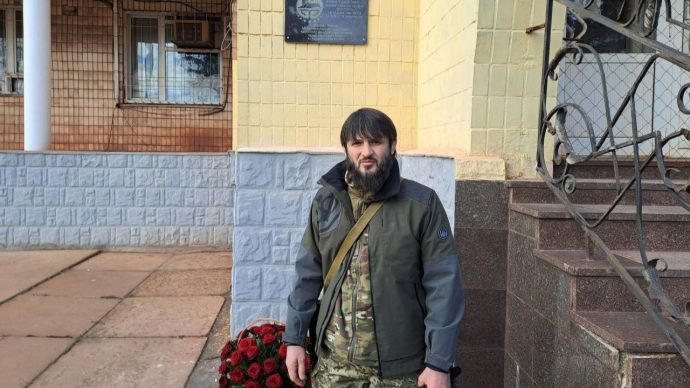
Abdel Hakim al-Shishani, formerly the leader of the foreign ‘Soldiers of the Caucasus’ group in Syria, and now an official member of Ukraine’s international legion (Photo: Atlas News )
As the prospect of a rapprochement between Ankara and Damascus becomes more imminent, the most extreme elements of Syria’s armed opposition have been feeling a sting of betrayal, accelerating a trend that, over the past year, has seen many jihadists relocate to Ukraine.
This is especially true for foreign militants, particularly those from Central Asia or the Caucasus.
On 12 January, Lebanese newspaper Al-Akhbar reported that after several months of disappearance, the well-known Chechen extremist and leader of the ‘Soldiers of the Caucasus’ militia, Abdel Hakim al-Shishani, has reappeared in Ukraine as a member of Kiev’s so-called ‘international legion,’ established in order to attract and recruit foreign fighters against Russia.
According to the report, there has recently been news of an increased number of foreign fighters leaving Syria to make their way over to the “new battlefield,” reinforced by “Turkiye’s lack of need for ‘jihadists’ on Syrian soil” and its “definite interest … to get rid of them.” This comes following recent talks aimed at reconciling Damascus and Ankara, over which the opposition has already expressed a great distaste for.
The report also highlights a leading role played by Turkish intelligence in facilitating this cross-country transfer of extremists, “at least during the first months of the Russian-Ukrainian war.” This could have been Ankara’s way of disposing of militants from Syria and clearing the way for a solution to the Syrian war (provided it was serious about reconciliation at the time, and still is). According to Al-Akhbar, Shishani himself passed through Turkiye on his way to the “new land of jihad,” just as he initially had on his way to join the war in Syria.
Syrian officials have also suggested Washington’s role in facilitating these transfers to Ukraine, as the US has been involved in the relocation of extremists between Syria, Iraq, Libya, and Afghanistan.
On 7 January, the official account of Ukraine’s intelligence agency posted a video on Twitter showing Shishani and a group of fighters engaging in clashes with Russian troops in the Ukrainian city of Bakhmut. The video essentially serves as propaganda designed specifically to attract extremist militants from Syria to Ukraine.
Shishani’s disappearance coincided with the establishment of recruitment centers in northern Syria designed to send fighters off to Ukraine, as Al-Akhbar reported in March last year.
Soon after the start of the Ukrainian war, hundreds of fighters from ISIS and Hayat Tahrir al-Sham (HTS), formerly the Al-Qaeda linked Nusra Front, began making their way to Ukraine to take part in a newer, more direct front against Russia.
On 1 March, before these reports began emerging, Syria’s Deputy Foreign Minister, Bashar al-Jaafari, predicted this.
“We, as a state, have evidence that the US military in Syria is transferring terrorists from one place to another, especially members of ISIS and Jabhat al-Nusra … So, one should not be surprised, and we do not exclude, that tomorrow ISIS terrorists will be sent to Ukraine,” he said.
If the plan for a restoration of ties between Syria and Turkiye is fruitful, and if Ankara chooses to officially abandon Syria’s armed opposition, which the extremists fear has already happened, then it is a likely possibility that the raging battlefield in Ukraine will emerge as a new safe haven for Syria’s jihadist movement.
January 12, 2023
Posted by aletho |
Militarism | ISIS, Syria, Turkey, Ukraine, United States |
Leave a comment
During a speech in Ankara on 5 January, Turkish President Recep Tayyip Erdogan hinted that a meeting with his Syrian counterpart Bashar al-Assad may soon take place, “as part of efforts for peace.” He added that a tripartite meeting between the foreign ministers of Turkiye, Russia and Syria is scheduled to be held in the near future for the first time since 2011.
The upcoming meeting aims to enhance communication after Russian-sponsored talks between the Turkish and Syrian defense ministers were held in Moscow on 28 December. The meeting was the highest-level of official meetings between Ankara and Damascus since the start of the Syrian war.
In a phone call with Russian President Vladimir Putin on 5 January, Erdogan called on the Syrian government to “take the steps to achieve a tangible solution concerning the case of Syria.”
US seeks to establish a middle ground between Ankara and the SDF so as to prevent Turkish-Syrian reconciliation
The Syrian-Turkish rapprochement via declared Russian mediation was paralleled by Emirati-Syrian rapprochement – the latest of which was a “brotherly” meeting aimed at strengthening cooperation and restoring historical relations between Assad and Foreign Minister of the UAE Abdallah bin Zayed Al-Nahyan, according to SANA.
Saudi newspaper Asharq Al-Awsat reported that the UAE seeks “to join Russia in sponsoring Syrian-Turkish relations at a high level,” noting that the Emirati foreign minister’s visit to Damascus sought to arrange Turkiye’s participation in the tripartite meeting of Syrian-Turkish-Russian foreign ministers, making it a quadripartite meeting.
The meeting is meant to pave the way for a presidential meeting between Erdogan and Assad in the presence of Putin. Reportedly, the UAE has offered to host this summit, with a possibility of a high-level UAE official being present at the meeting if it will be held in Moscow.
Asharq Al-Awsat added that Turkish Foreign Minister Mevlut Cavusoglu plans to visit Washington on 16-17 January to brief US officials on the developments of Turkish-Syrian normalization, his meeting with Syrian Foreign Minister Faysal Mikdad, and the “roadmap” sponsored by Moscow in the context of security, military, political and economic fields – as agreed upon by the defense ministers as well as the intelligence chiefs in Syria, Turkiye and Russia over the past weeks.
As Turkiye has been launching successive operations against Kurdish groups both on the Turkish-Syrian border as well as within Syria itself under ‘Operation Claw Sword,’ a Western official informed Asharq Al-Awsat that a high-ranking US official will be visiting Ankara in the coming hours as part of efforts to mediate between Turkiye and the SDF in northeastern Syria.
Ankara has demanded that Moscow and Washington commit to the implementation of the bilateral military agreements signed at the end of 2019. The agreements stipulate the withdrawal of the Kurdish People’s Protection Units (YPG) and the Syrian Democratic Forces (SDF) to beyond 30 kilometers from the Turkish border, and from the areas of Manbij and Tal Rifaat, in addition to the withdrawal of all heavy weaponry.
The SDF says that it has fulfilled its obligations, and will not withdraw its police force – known as the Asayish – nor dismantle its local councils, despite Turkiye’s insistence on dissolving all Kurdish military and civil institutions in the area.
Meanwhile, Cavusoglu told media on 29 December that Ankara is willing to withdraw from the territory it occupies in northern Syria and hand it over to Damascus in the event that “political stability” is reached – after cooperation in “neutralizing ISIS members, the Kurdistan Workers’ Party (PKK) and the YPG.”
The Saudi newspaper’s report stated that US mediation seeks to reach a “compromise” between the Kurdish groups and Ankara without a new Turkish incursion taking place ahead of the Turkish presidential and parliamentary elections in mid-2023. This mediation seems to be an attempt at circumventing the imminent Syrian-Turkish reconciliation.
Another official source disclosed that Ankara was “uncomfortable with the leaks following the meeting of the Syrian, Turkish and Russian defense ministers in Moscow, and that it had agreed to a full withdrawal.” However, the source confirmed that, “it is true that Ankara and Damascus consider the PKK a common threat, and will work against any separatist agenda, because it is an existential threat to both countries,” adding that the two countries will “work to open the Aleppo-Latakia Highway.”
Following the UAE’s visit to Damascus, which came after the US called on its allies and international partners to refrain from normalizing ties with Syria, Asharq Al-Awsat quoted an official as saying that the US has been the only western country to issue a statement against normalization, and is working alongside Paris, Berlin, and London to assume a united stance against normalization with Syria.
Communication is currently underway for a meeting between the representatives of Paris, Berlin, London, and Washington and UN Special Envoy for Syria Geir Pederson in Geneva on 23 January. This meeting will take place before Pedersen’s visit to Damascus to meet with the Syrian foreign minister to “confirm the position against normalization, and support the provision of funding for electricity projects within the timeline of early recovery,” stipulated by a resolution for international aid that will be extended before 10 January.
Asharq Al-Awsat said that the UAE has proposed to contribute to the funding of economic and electrical projects in Syria – within the confines of the Caesar Act.
Simultaneously, Jordan, who was the first to open high-level channels of communication with Damascus, is leading efforts alongside other Arab countries to reach a “united Arab position that defines Arab demands in order to make normalization possible.”
The newspaper quoted another western official as saying that Jordan is calling for coordination to put pressure on Damascus to provide political and geopolitical steps for the coming phase in southern Syria, as Amman confirmed that there has been an increase in the smuggling of Captagon, weapons and ammunition across the Syrian border following the start of the normalization process. Additionally, Amman has said that the Iranian presence in southern Syria near the Jordanian border has not diminished, and that there has been an expansion of ISIS activity in the area, according to the official.
Syria’s Arab League membership was suspended in November of 2011 following the start of the Syrian war, and it has been excluded ever since.
January 8, 2023
Posted by aletho |
Aletho News | Middle East, Russia, Syria, Turkey, United States |
Leave a comment
Turkish President Recep Tayyip Erdogan has expressed the possibility of meeting with his Syrian counterpart Bashar al-Assad in forthcoming talks with Russia to discuss peace and stability in the region and in the Arab country.
Erdogan said on Thursday that a trilateral meeting of the foreign ministers from Turkey, Russia and Syria would first be held to further develop contacts after last week’s landmark talks between the defense ministers of the three countries in Moscow.
“We will bring our foreign ministers together and then, depending on developments, we may come together as the Russian, Turkish, and Syrian leaders. So, our aim is to establish peace and stability in the region,” Erdogan said at a meeting of his Justice and Development (AK) Party in the capital Ankara, without specifying an exact date for the possible meeting.
“Turkish, Russian, and Syrian defense ministers and intelligence chiefs came together in Moscow. Hopefully, the foreign ministers will come together in a trilateral format,” he added.
On December 28, the Turkish, Russian, and Syrian defense ministers gathered in Moscow to discuss counter-terrorism efforts in Syria, and they agreed to continue tripartite meetings to ensure stability in Syria and in the wider region.
The meeting revolved around the Syria crisis, the refugee issue, and joint counter-terrorism efforts against terror outfits in the Arab country.
Turkish Foreign Minister Mevlut Cavusoglu said a second meeting could take place in mid-January.
Turkey severed its relations with Syria in March 2012, a year after the Arab country found itself in the grip of rampant and hugely deadly violence waged by foreign-backed militants and terrorists, including those allegedly supported by Ankara.
Turkey has for the past 11 years backed armed terrorists that unsuccessfully sought to topple the democratically-elected government of Assad, with Erdogan even calling him a “murderer.”
Since 2016, Turkey has also conducted three major ground operations against United States-backed militants based in northern Syria.
The Turkish government accuses the militants, who are known as the People’s Protection Units (YPG), of bearing ties with the Kurdistan Workers’ Party terrorist group.
Turkey has been launching airstrikes on northern Syria and Iraq since November 20, against, what it calls, hideouts belonging to the PKK.
January 5, 2023
Posted by aletho |
Illegal Occupation | Russia, Syria, Turkey |
Leave a comment

 Aletho News