Beyond Kafka: How Youtube & Facebook Keep Purging Alternative Media
Hassan Nasrallah is persona non grata on Social Networks, where Anti-Zionism is the ultimate thoughtcrime
By Sayed Hasan | Resistance news, unfiltered. | January 8, 2019
The guillotine’s blade fell again, one year later. On December 2017 already, my 5-years-old Youtube channel Sayed Hasan, mainly translating speeches from Hezbollah Secretary General Hassan Nasrallah, was completely removed by Youtube, along with its 10 000 subscribers, +6 millions views and +400 subtitled videos of anti-Zionist & anti-Imperialist content. I then denunced this censorship in detail in my article Kafka 2.0: How Youtube’s Political Censorship is Exercised. And just around New Year’s Eve 2019, the +6000 Subscribed Facebook Page Resistance News Unfiltered, along with all its similar content, got deleted without explanation. The only thing left online is a cache view of the page dating back from this summer, in French.
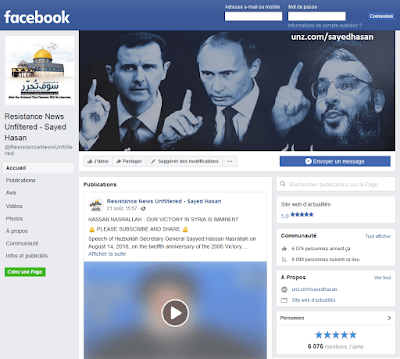
I had created this Page at the beginning of 2018, since no other place can compete with Youtube and its near-monopoly on video content, in order to reach a broader audience. But it was deleted without explanation by Facebook short of its first anniversary. I can’t even know the precise date of termination. Youtube did at least bother to send emails notifying of the removal of a video or of a whole channel, but Facebook has only internal notifications for posts removals. Here is how it happened.
I got two warnings from Facebook, dated December 24th and December 25th, 2018:
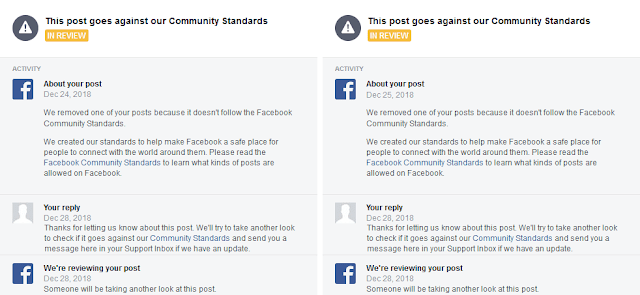
When I logged in on December 28th and saw these messages, I immediately appealed the decisions through the automated procedure, as shown above, though the specific posts alledgedly violating the Communnity Standards weren’t even accessible, since they had been removed. It means that I didn’t –and still don’t– even know which posts got me these “strikes”. At least, Youtube was specific about the videos alledgedly violating their rules –three speeches of Hassan Nasrallah–, though they didn’t say more than that. I don’t know if the whole Page was finally removed because of a third “strike” –Facebook does not even state how much “strikes” you can get before termination– or because of something else, like constant flagging and reports by cyber-IDF soldiers and Hasbara trolls. But I am positive it has to do with my anti-Zionist content. It is a blatant attempt to take down important speech and silence already marginalized voices, as stated by Vera Eidelman from the ACLU.
Of course, one should always protest and complain using the due procedures. After all, Facebook has been known to restore such Pages after the public outcry following their removal without proper reason (TeleSur, VenezuelAnalysis, etc.). I did protest, and I am still expecting an answer from them, without much hope, since earlier appeals as old as September 17th are still awaiting a response almost 4 months later, as shown below (screenshot dated January 4th, 2019).
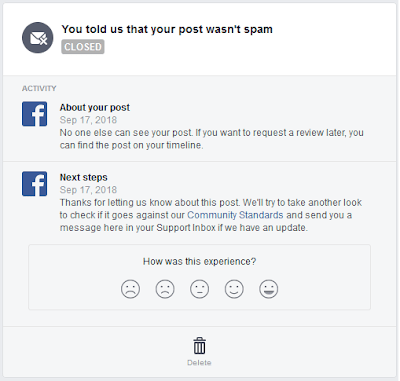
Appeals are not suspensive. Anyway, without any mention of a motive, corpus delicti and mere notification of removal of my page, not even in Facebook’s internal notifications on my personnal account, we are clearly beyond kafkaesque.
This witch-hunt against the voice of the Resistance Axis online, especially Hezbollah Secretary General Hassan Nasrallah (I am the main translator of his speeches in English and French, voluntary and non-affiliated), is not new. Over and over again –most often after Israeli-backed indictment campaigns–, in 2012, 2014, 2016 and June 2018, Facebook, Youtube and Twitter closed down all accounts affiliated to the Lebanese –and Palestinian– Resistance, including Al-Manar TV Channel, banned for good. In 2014 and 2016, Facebook was hunting down Nasrallah’s very picture and temporarily blocking the accounts that featured it, even though they were individuals having no link whatsoever with the organization: not only Hezbollah’s missiles and fighters, but the very voice and picture of its Secretary General are considered as an existential threat for Israel, whose paid trolls keep reporting his videos as terrorist hate-speech to ban mercilessly. The right to information, neutrality or equity is a chimera in the Internet Giants’ turf, where only alternative views, especially videos hostile to Zionism, are subject to censorship and banishment.
On January 8, 2019, Norman Finkelstein commented on the issue:
It is a scandal that the speeches of Hassan Nasrallah are banned on Youtube. Whatever one thinks of his politics, it cannot be doubted that Nasrallah is among the shrewdest and most serious political observers in the world today. Israeli leaders carefully scrutinize Nasrallah’s every word. Why are the rest of us denied this right? One cannot help but wonder whether Nasrallah’s speeches are censored because he doesn’t fit the stereotype of the degenerate, ignorant, blowhard Arab leader. It appears that Western social media aren’t yet ready for an Arab leader of dignified mind and person.
Thankfully, my first article got the attention of Ron Unz, who offered to safeguard my videos in his own website, and I published them back gradually in a new Dailymotion Channel from where they are automatically saved in The Unz Review’s internal storage system. Thus, even if they end up deleted by Dailymotion, they’ll still be accessible in one and same place without need to re-upload them again. I will keep posting my videos on Dailymotion –though it has its own, more subtle way of censorship: age-restricting videos, burying them in the search results… –, and I call on everyone to subscribe to my channel on the Unz Review (RSS feed) and on all those who can to donate to support this work. Whatever happens, the Electronic Intifada to which Hassan Nasrallah called will carry on.
The EU and the warning signs of Fascism
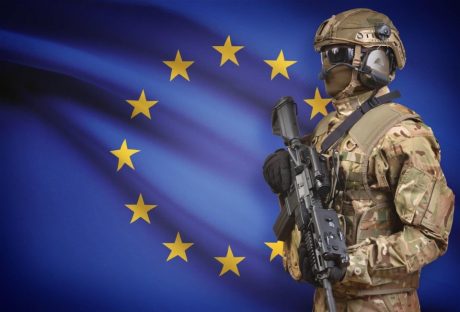
Image source – here
By Kit Knightly | OffGuardian | December 10, 2018
Things are spiralling out of control in Europe, faster than many predicted. Outside of Brexit, there is strong anti-EU feeling in Hungary, Spain, Italy, Greece and France. The EU is in danger of crumbling, and people afraid of losing power are prone to extreme acts of dictatorial control.
How long before the EU truly becomes the authoritarian force that people from both ends of the political spectrum have always feared?
The EU Defence Force
Earlier this year, the EU voted to “punish” one of its own members, Hungary, for the internal policies of its elected government. To be clear about this – whatever you think of Viktor Orban, he was elected by the people of Hungary. He is their legally recognised democratic leader. Hungary voted for him – in contrast, Hungary did NOT vote for any of the 448 MEPs who supported the motion, posed by Dutch MEP Judith Sargentini, that:
The Hungarian people deserve better… They deserve freedom of speech, non-discrimination, tolerance, justice and equality, all of which are enshrined in the European treaties.”
Note that “democracy” is not included on that list. “Tolerance”, “justice” and “equality”, but not democracy. A Freudian slip, perhaps.
The European Parliament vote was, itself, a corrupt nonsense – one in which abstentions were disregarded so the 2/3rds majority could be reached. Forcing through a bill that, essentially, calls for a change of regime in Hungary via:
“appropriate measures to restore inclusive democracy, the rule of law and respect for fundamental rights in Hungary”
One suggested punishment – “The Nuclear Option” – is a loss of voting rights. Hungary would still be a member of the EU, would still have to pay into the EU, would still have to obey all EU laws and regulations, but would no longer have a say in what those laws were.
This would, notionally, be in defence of “inclusive democracy”.
How long before disapproval and punishment of certain leaders turns into outright removal? Can we really say that would never happen?
This month, Paris (and other French cities) have seen the massive Gilets Jaunes protests against the fuel tax, austerity and income inequality. The violent repression of these protests has received no criticism from either individual member states of the EU, or the EU itself. However, an armored vehicle painted with the EU’s insignia was seen on the streets of Paris.
Both Macron and Merkel have talked, recently, of the need for an EU Army – will these protests in France be used as an excuse to implement those plans?
Let’s assume the EU Army is brought about – let us supply the European Union with its coveted “defence force”. 250,000 hypothetical men, drawn from all the member states. What is their purpose? What is their function?
For example, would they have been deployed to Catalonia last year to “keep the peace”? Would an EU army have moved against a peaceful vote to “defend” the integrity of the Union?
Would a possible step in dealing with Viktor Orban’s government be to deploy the EU Defence Force to Budapest and remove the man who is a threat to “equality”? Would that count as “appropriate measures to restore inclusive democracy”?
If Brexit is ruled a “threat to human rights” (or some other collection of buzzwords), would the EU army be rolling armoured vehicles along the streets of London to protect us from ourselves?
There have been, and could be, many situations in the EU’s recent past where military intervention was only avoided because it literally wasn’t an option. An EU Army would make it an option, do we trust Brussels not to avail themselves of it?
Some argue that an EU Army would be a good thing because it would decrease Europe’s reliance on NATO, and remove US influence. I don’t believe that to be the case, and as evidence, I supply the fact that the Carnegie Endowment for International Peace, a well-known US-backed NGO, is very much in favour of the plan.
The EU’s Ministry of Truth
Of course, the increasing possibility of an EU consensus imposed by force is only one part of the threat.
Outside of physical repression – both by the EU (of national sovereignty), and by the state (of the individual right to protest) – there are warning signs of intellectual repression. A coming crackdown on freedom of expression and opinion.
There is a scary article on The Guardian today: Russia ‘paved way for Ukraine ship seizures with fake news drive’ . It’s not scary because of the headline – it’s scary because of the motivations behind it, and the implications for the future of Europe.
The meat of the article is an unsourced, unlinked, evidence-free claim of Russian malfeasance, and as such, Hitchens’ Razor applies.
The first half of the article is riddled with lies, omissions and mistakes. It’s the Guardian, you expect that. Disregard the babble about cholera and nuclear bombs. Disregard the factual errors – many though they are. In this instance, none of it matters.
All that matters is the second half – the proposed “solution” to the “problem” to which this article is a “reaction”. Namely, online disinformation. Specifically, “Russian” online disinformation.
Julian King, former UK ambassador to France and now EU security commissioner, wants tech companies to take steps to prevent the spread of “fake news”. It’s a war against dissent, with three fronts.
One – establish the “truth”:
Last week the European Commission announced it would set up a rapid alert system to help EU member states recognise disinformation campaigns
Essentially, there will be an EU mandated list of acceptable “news”, and anything which deviates from that in the slightest way will be branded “disinformation”. This will allow people to dismiss, rather than engage with, views that differ from their own.
Two – eliminate dissent:
King said social media platforms needed to identify and close down fake accounts that were spreading disinformation.
By “fake accounts”, they mean accounts which spread “disinformation”. Being a “bot” is not about whether or not you are a real person, it’s about whether or not you have the right opinions. As has been demonstrated, they either do not know or do not care who is real and who is not. Perfectly real people have been labelled Russian bots in the media, when they are proven to be neither Russian nor bots. Whether this is incompetence or corruption does not matter, the point is governments have shown they cannot be trusted on this issue.
Three – control the narrative:
We need to see greater clarity around algorithms, information on how they prioritise what content to display, for example. If you search for anything EU-related on Google, content from Russian propaganda outlets like RT or Sputnik is invariably in the first few results…. All of this should be subject to independent oversight and audit.
The Google algorithm is allowing news that either disagrees with the EU, or is directly critical of it, to be shown in their results. This is unacceptable. What the EU security commissioner wants is for Google to “fix” their system, to make sure news that deviates from the EU’s agenda does not show up in their results.
Now, if you think that sounds like censorship, don’t worry because [our emphasis]:
What we are not trying to do is to censor the internet. There is no suggestion that we – or anyone else – should become the arbiter of what content users should or shouldn’t be consuming online. This is about transparency, not censorship.
The EU wants Google to remove certain websites from their algorithm, but it’s about transparency, not censorship. So that’s OK.
Conclusion
To sum up:
- The European Union’s two major figureheads are both in favour of an EU army.
- The European Union’s flag is painted on armoured vehicles repressing anti-government protests in France.
- The European Union is putting aside £4.6 millio (5 million Euros) to “help people recognise disinformation”.
- The European Union wants to pressure social media companies into “shutting down” accounts that spread “fake news”.
- The European Union wants Google to alter their algorithm, to promote news that praises the EU and demote sites critical of it.
- The European Union wants us to understand that this is about “transparency” and is definitely NOT censorship.
Does this sound like an organization of which we want to be a part? Are we supposed to like the proposed multi-national EU “defense force” putting down anti-EU marches on the streets of Barcelona or Rome? To cheer on the idea that the EU Army could be sent into non-cooperative member-states to remove “dangerous” elected leaders because they are a threat to “equality”?
We won’t even be able to get to the truth of those matters, because the EU will be supplying lists of “fake news” social media accounts to Twitter and Facebook, who will dutifully shut them down. While Google alters and re-alters their algorithm to make sure any news covering EU repression of democracy is pushed so far down the results pages it may as well not exist.
The British press, pundits and talking heads are constantly referring to the “Brexit crisis”, but that’s just hysteria and fear mongering. Re-negotiating your position in a trade bloc is NOT a crisis. A crisis is what happens when an unelected, bureaucratic power structure suddenly senses its grip on power is slipping, and acts accordingly.
And a crisis could well be on the horizon. The signs are there, if you want to see them.
Kit Knightly is co-editor of OffGuardian. The Guardian banned him from commenting. Twice. He used to write for fun, but now he’s forced to out of a near-permanent sense of outrage.
Liberal journalists rejoice as controversial British blogger Graham Phillips banned from Twitter
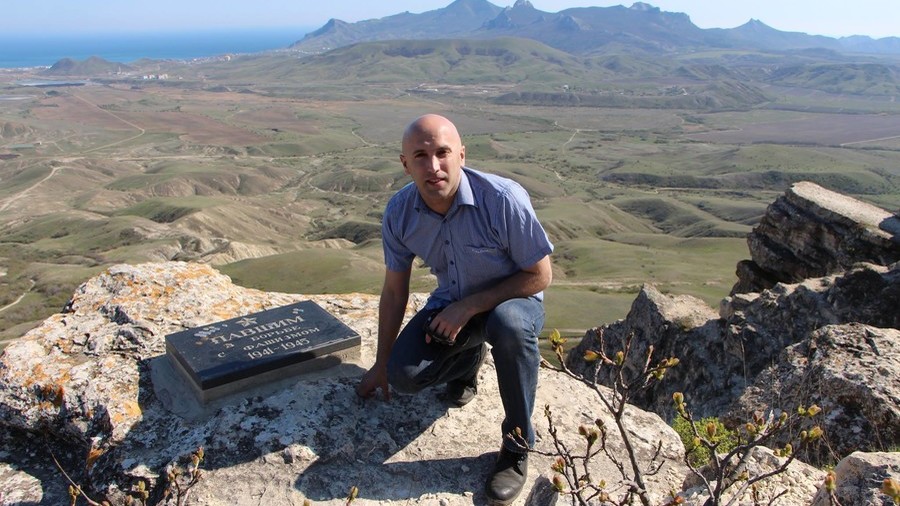
Graham Phillips © Facebook / Graham William Phillips
RT | November 21, 2018
Controversial British blogger Graham Phillips has had his Twitter account permanently suspended, prompting many liberal journalists who have been following his activities to rejoice.
According to Phillips – writing in a Facebook post – his account has been “permanently banned,” adding that Twitter has provided “no examples of the ‘hateful content’ they accuse me of.”
Philips’ often unconventional, always confrontational, practices have led to him being maligned by many of his peers.
After his apparent disappearance from Twitter his detractors were quick to post on the numerous other accusations against him. For example, the UK-based independent journalist and filmmaker Jake Hanrahan, who has worked for the BBC, Bellingcat, and The Guardian, has accused him of looting “a dead Ukraine soldier’s body.”
One such critic who has regularly targeted Phillips is Elliot Higgins, head of Bellingcat, a UK-based investigatory website linked to NATO. Higgins has tweeted his delight at the news.
Higgins had invariably sparred with Phillips over Twitter, namely over NATO’s funding for Bellingcat, a supposedly non-partisan organisation.
Meanwhile, the ‘gonzo’ journalist urged his fans to lobby Twitter’s administrators asking them to unlock the account of “an independent British journalist, telling the truth.” Some of his supporters decried the ban as an attack on freedom of speech, urging Twitter to reverse the decision.
The Russian-speaking blogger came to prominence during the conflict in eastern Ukraine, where he was often accused of bias towards the separatists.
In May 2014, Phillips was detained and interrogated by the Security Service of Ukraine, known as the SBU. His subsequent expulsion from the country has not stopped Phillips targeting the Ukrainian government and those he perceives as their supporters.
Most recently he got into an altercation with Ukraine’s ambassador to Austria Alexander Shcherba, Phillips filmed as the men exchanged insults.
Despite his controversies the apparent banning of Phillips, reportedly without stated reason, will come as a worry for those who fear Twitter is purging its platform of alternative voices. Twitter has drawn the ire of conservative media in recent months for a series of purges targeting online commentators and political figures such as Alex Jones and Louis Farrakhan, among others.
Twitter was contacted for comment but had not yet responded at the time of publication.
Francis Fukuyama and the End of Social Media Freedoms
By Robert BRIDGE | Strategic Culture Foundation | 09.11.2018
The American political scientist known for promoting the “end of history” fish tale following the collapse of the Soviet Union and the spread of Liberal-capitalist values around the world now appears to be angling for ways – wittingly or unwittingly – to curtail the freedom of speech.
Writing in The American Interest as the virtual crackdown on Alex Jones was underway, Fukuyama argued that the usual suspects of the social media universe – Facebook, Twitter, YouTube, Apple, and all of their vast subterranean holdings – need to come clean by entering a two-step rehabilitation program where they must: (1.) “accept the fact that they are media companies with an obligation to curate information on their platforms,” and (2.) “accept the fact that they need to get smaller.”
I think we can safely skip the “need to get smaller” suggestion with a hearty chuckle and focus our attention instead on the question of social media being held to the same rules as those that regulate America’s squeaky clean media divas, like The Washington Post, CNN and MSNBC.

The social media monsters argue that since they do not create original content, but rather mindlessly provide the clean slate, as it were, for third-party developers to post their own thoughts, opinions, news and of course wild-eyed ‘conspiracy theories,’ they cannot be bound by the same rules and regulations as the mainstream media, which must bear ultimate responsibility for its increasingly damaged goods.
“We’re not a media company,” the late Steve Jobs of Apple fame told Esquire in a rough and tumble interview. “We don’t own media. We don’t own music. We don’t own films or television. We’re not a media company. We’re just Apple.” On that note, Jobs reached over and switched off the interviewer’s tape recorder, bringing an abrupt end to the strained conversation.
Thanks to the provisions laid out in Section 230 of the Communications Decency Act of 1996, the social media platforms are granted immunity from liability for users of an “interactive computer service” who publish information provided by third-party users.
The act was overwhelmingly supported by Congress following the verdict in the 1995 court case, Stratton Oakmont, Inc. v. Prodigy Services Co., which suggested that internet service providers that assumed an editorial role with regards to client content thus became publishers and legally vulnerable for any wrongdoing (libel and slander, for example) committed by their customers. At the time, when alternative voices on the social media frontier had not turned into actual competition for the legacy media, legislators deemed it more important to protect service providers from criminal proceedings than to nip freedom of speech in the bud. Honorable? Yes. But I wonder if they’d have made the same decision knowing the powerful forces they had unleashed.
At this point, Fukuyama summarizes the plight regarding the social media platforms with relation to their independent creators, who wish to express their freedom of speech.
“Section 230 was put in place both to protect freedom of speech and to promote growth and innovation in the tech sector. Both users and general publics were happy with this outcome for the next couple of decades, as social media appeared and masses of people gravitated to platforms like Facebook and Twitter for information and communication. But these views began to change dramatically following the 2016 elections in the United States and Britain, and subsequent revelations both of Russian meddling in the United States and other countries, and of the weaponization of social media by far-Right actors like Alex Jones.”
Despite being a learned and intelligent man, Fukuyama jumps headfirst into the shallow end of a pool known as ‘Blame Russia’, while, at the same time, blames the far-Right for the “weaponization” of social media, as though the Left isn’t equally up to the challenge of waging dirty tricks, in a crucial election year, no less.
Next, he genuflects before the Almighty Algorythm, the godhead of Silicon Valley’s Valhalla, which, as the argument goes, was responsible for attracting huge audiences to particular channels and their messages, instead of the other way around.
“Their business model was built on clicks and virality, which led them to tune their algorithms in ways that actively encouraged conspiracy theories, personal abuse, and other content that was most likely to generate user interaction,” Fukuyama surmises. “This was the opposite of the public broadcasting ideal, which (as defined, for example, by the Council of Europe) privileged material deemed in the broad public interest.”
In other words, had Mark Zuckerberg and friends not toggled their algorithmic settings to ‘conspiracy theories,’ then the easily manipulated masses would never have given a second thought to well-known catastrophes based on pure and unadulterated evil, like the Invasion of Iraq in 2003, which, as the tin-foil-hat crowd constantly crows, was made possible by the fake news of weapons of mass destruction.
Here, Fukuyama lays on thick his extra-nutty academic drivel: “This is the most important sense in which the big internet platforms like Facebook, Twitter, and YouTube have become media companies: They craft algorithms that determine what their users’ limited attention will focus on, driven (at least up to now) not by any broad vision of public responsibility but rather by profit maximization, which leads them to privilege virality.”
In other words, internet users are not inquisitive creatures by nature with fully functioning frontal lobe regions like the honorable Francis Fukuyama. They do not actively search out subjects of interest with critical reasoning skills and ponder cause and effect. And let’s not even mention the mainstream media’s disastrous coverage of current events, which led to the alienation of mainstream audiences in the first place. In Fukuyama’s matrix, otherwise normal people subscribe to ‘alternative facts’ or conspiracy theories because those damn algorithms kept popping up!
This ‘more righteous than thou’ attitude on the part of left-leaning Silicon Valley prompted hundreds of independent channels – the overwhelming majority from the right – to be swept away by a force known as ‘private ownership’ where brutal censorship has become the latest fad. Fukuyama, serving as the mouthpiece for both corporate and political interests, shrugs off this noxious phenomenon by arguing: “Private actors can and do censor material all the time, and the platforms in question are not acting on behalf of the U.S. government.”
Let’s give Fukuyama the benefit of the doubt. Maybe there really is no cooperation between the most powerful and influential industries for manipulating public opinion and the U.S. government. Yet we would do well to keep in mind some key facts that strongly suggest otherwise. During the two-term presidency of Barack Obama (2009-2016), Google executives met on average once a week in the White House with government officials. According to the Campaign for Accountability, 169 Google employees met with 182 government officials at least 427 times, a Beltway record for such chumminess. What is so potentially disastrous about such meetings is that Google, the chokepoint on news and information, which has the power to actually rewrite history, is fiercely Liberal in its political outlook as per some whistleblowers who escaped the well-manicured campus known for employee neck massages and free lunches. What was discussed in the White House? Nobody really knows. However, there is already a treasure trove of publicly available information detailing the intimate relationship between US intelligence and Google (as well as the other usual suspects).
Fukuyama tries to conclude with an upbeat, happy message by saying “private sector actors… have a responsibility to help maintain the health of [America’s democratic] political system.” However, judging by everything in the article that preceded that remark, I would have to guess Francis Fukuyama would fully support yet more intolerance in the world of social media as a means of preserving America’s freedom-squashing status quo.
gab.com & the Great Purge on the Horizon
By Kit Knightly | OffGuardian | October 30, 2018
gab.com is an alternative social network, set up and launched in 2016. It’s founder, Andrew Torba, stated he wanted to create a home for free speech, and counter what he perceived as “liberal bias” on other platforms, such as Twitter and Facebook.
Two days ago, their website was taken down. This was in response to being blocked by PayPal, and then having their server space taken away by their hosting service. gab’s founder posted this statement on their stripped-down website.
Why did this happen?
Because Robert Bowers, the alleged gunman at the synagogue shooting in Pittsburgh, had a gab account and posted some things about “the jews” on it.
Is it right, or sensible to punish a platform for the (alleged) actions of ONE user out of 100,000s? And is that really what’s going on?
Robert Bowers also had a Twitter account. And a Facebook page. Neither of these platforms has faced punishment, or censure, from any quarter.
Cesar Sayoc – the alleged MAGABomber – also had a twitter account and allegedly sent threatening messages to some public figures on it. Again, Twitter has not been blocked by PayPal.
In fact, Twitter and Facebook – though occasionally criticised for “not doing enough to combat hate”, have never been blocked, or threatened in any way. Even though Twitter hosted countless pro-ISIS accounts, regularly cited in the media.
So clearly, it can be reasoned, PayPal et al are not only responding to the alleged statements of Robert Bowers. There is a deeper agenda at work.
In fact, this isn’t the first time larger internet companies have tried to stymie gab’s existence. When they were first launched, in 2016, Apple denied them a place in their app store because they allegedly allowed pornography to be posted. When gab installed a filter to block people posting pornography, Apple again denied them access to the app store, this time for breaching their “hate speech” regulations. Google Play did the same in 2017 (reminder – Google allowed ISIS to release their own app on their marketplace).
Early this year a cross-university study conducted on gab (and other “alt-right” sites) found that gab.com used “free speech as shield to protect their “alt-right” views”. (I’m not sure what, if anything, that sentence really means. Surely free speech is a shield protecting all speech? Isn’t that the point?)
In April this year VICE magazine ran an article headlined “Gab Is the Alt-Right Social Network Racists Are Moving to”. It was resoundingly negative about the site, painting it as nothing but a home for racism and “conspiracy theorists”, despite the owner’s protestations that gab is all about free speech, and that anyone is free to join.
Logically, the emergence of networks like gab was inevitable. The internet has always been that way, you shut down one hallway and four more are forced open. Look at Piratebay, notionally banned, yet available through a million different proxies that spring up faster than governments can shut them down.
Social media has undergone unprecedented purges this year. Alex Jones was banned across virtually every mainstream platform. Hundreds of Facebook pages and Twitter accounts were shut down on spurious grounds – allegations of being “Kremlin backed” or “Iran bots”fly around, without any supporting evidence ever being released to the public. This summer, Twitter blocked millions of “fake accounts” (we covered that here).
These actions aren’t independent, either. Alex Jones was banned from multiple platforms, all within 24 hours. Just earlier this month, Facebook unpublished over 800 pages, whilst twitter blocked the accounts of the same pages… all on the same day. Clearly, the companies are either coordinating with each other (possibly in breach of anti-trust laws), or are receiving directions from the same source – almost certainly the government.
In that climate, new platforms were always going to emerge. It’s the classic “Well then I’m gonna build my own theme park, with blackjack and hookers” situation.
YouTube is increasingly corporate, controlled and fake. Demonetising user videos and adding more and more advertisements… so dtube and bitchute open. Twitter censors your free-speech, so we’ll start up a platform where you can say what you want.
Twitter and Facebook both saw their stock-prices tumble as a result of their respective “purges”. So, is the anti-gab movement simply a case of mega-corporations protecting their monopoly by shutting down a budding rival? Is this all just about control of the market and money?
Unfortunately, it seems not. Like the vast majority of media roll-outs, it seems this is a convergence of interests – financial on the one hand, and political on the other.
The push to ban the “alt-right” – or, the even broader term – “hate speech” has been on-going for several years now. It will inevitably pick up in the wake of the events of this week.
Within hours, predictable voices were discussing the “necessary limitations on free speech”:
The #Pittsburgh synagogue terror attack is a reminder of the necessary limits of free speech. Hate speech leads to acts of hatred.
— GeorgeMonbiot (@GeorgeMonbiot) October 28, 2018
Today, CNN ran this piece: “Big Tech made the social media mess. It has to fix it”.
Paul Mason, writing in the New Statesman, argued that YouTube needs to censor all the “alt-right” on their platform.
It’s a two-step process – having first established the need to “limit” hate speech, we can then move on to defining what “hate speech” really means.
They’ve started on that already. Criticising George Soros is “anti-semitic” now. As is the term “neocons”:
Speaking of anti-Semitic dog whistles. It’s not only “globalists” and “George Soros.” “Neocon” is often used the same way–by haters on both the left and the right. https://t.co/DWci2PCZES
— Max Boot (@MaxBoot) October 29, 2018
What else will be deemed hate speech? What does “hate speech” really mean? The simple answer to that is: Whatever they want it to mean.
It seems like there’s a purge coming, you can feel it in the wind. A purge motivated by the greed of multinational companies wielding power that rivals nations, and fuelled by the fascistic need of the “powers-that-shouldn’t-be” to limit and control our existence…just because they can.
It is both authoritarian power grab, and a manifestation of corporate greed. It’s amazing how often those two things come together.
Kit Knightly is co-editor of OffGuardian. The Guardian banned him from commenting. Twice. He used to write for fun, but now he’s forced to out of a near-permanent sense of outrage.
Purge of alt-media by FB is ‘us pushing back, just a beginning’ – censorship insider
RT | October 23, 2018
An employee of a leading Washington DC think tank has reportedly taken credit for the resent purge of alternative media by Facebook and Twitter, claiming it to be necessary to fight against ‘fake news’ from Russia and China.
In the latest act of apparent censorship of political speech online, US-based tech giants this month shut down hundreds of user accounts. Some belonged to well-established alternative media outlets with hundreds of thousands of followers, like The Free Thought Project or The Anti Media. A senior fellow at the German Marshall Fund, a leading think tank advocating US global supremacy, seems to have at least partially taken credit for this.
“Russia, China, and other foreign states take advantage of our open political system,” Jamie Fly said.
“They can invent stories that get repeated and spread through different sites. So we are just starting to push back. Just this last week Facebook began starting to take down sites. So this is just the beginning.”
The remarks were cited by Jeb Sprague, a visiting faculty member in sociology at the University of California-Santa Barbara, in a story he co-authored for The Gray Zone Project, an outlet known for criticism of online censorship.
Sprague said Fly made the comments to him during a lunch break at a conference on Asian security organized by Stiftung Wissenschaft und Politik in Berlin, Germany.
According to the account, Fly complained that any person with an email can set up an account on social media and potentially reach a wide audience. He predicted a long, global struggle to fix the situation.
Fly started his career in US political circles as an adviser to the George W. Bush administration. He was also a foreign policy and national security consultant for Senator Marco Rubio, when he was trying to secure the 2016 presidential nomination from the Republican Party. For four years he headed the Foreign Policy Initiative, a pro-Israeli think tank founded by neoconservative figures Bill Kristol, Dan Senor, and Robert Kagan.
In the last few years, Fly showed up as an expert on social media and ‘Russian disinformation’ on various outlets to speak about alleged Russian interference in the 2016 presidential election in the US. Among other things he teamed up with Laura Rosenberger, the head of the Alliance for Securing Democracy, the organization behind the Hamilton 68 dashboard, a tool that purports to show Russian online interference on Twitter, based on monitoring a number of undisclosed accounts and applying a secret methodology to analyze the data.
According to Sprague, Fly also stated that he was working with the Atlantic Council in the campaign to purge alternative media from social media platforms like Facebook. The social media network has partnered with the Atlantic Council’s Digital Forensic Research Lab (DFRLab) to root out ‘fake news’ on its platform. The think tank is not unlike the German Marshall Fund in terms of the policies it furthers, with some commenters simply calling it ‘NATO’s PR branch’.
Amid Mainstream Hysteria, Twitter Troll Trove Shows Little Evidence of Meddling
By Kit Klarenberg | Sputnik | October 19, 2018
On October 17, Twitter released an archive of over ten million tweets posted by 3,841 accounts affiliated with the Internet Research Agency, the Russian ‘troll farm’ that has been relentlessly accused by Western journalists and politicians of waging an ‘influence campaign’ during the 2016 US Presidential election in support of Donald Trump.
In an official statement accompanying the data dump, the social media giant said it was disclosing the “full, comprehensive archive” of tweets and media “connected with previously disclosed, potentially state-backed operations” on its platform.
Prior releases provoked much comment and analysis, but also controversy — several accounts widely described as ‘bots’ turned out to be real people, their baffled and scandalized owners taking to the airwaves to make their authenticity, and the authenticity of their opinions, clear. This time, Twitter has “high confidence” the named accounts are bots or ‘trolls’ — fake personas concocted and managed by real people.
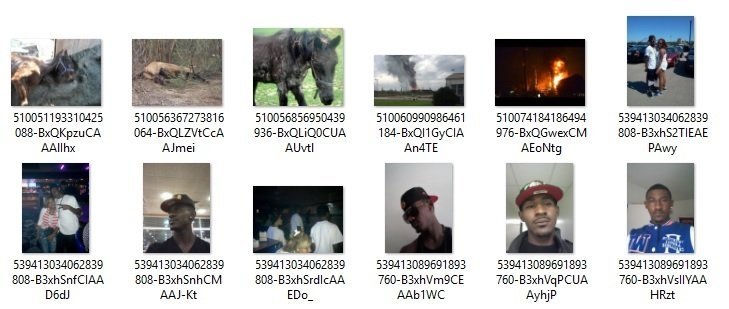
An example of some of the media shared by an alleged Russian troll account
Whether Twitter’s certainty is apt this time round remains yet unclear, given several accounts provided published little in the way of political content, instead favoring comedic memes, tweets about preparing for a night out on the town, or screenshots of their favorite US sitcoms, such as Friends. Quite what impact such activities could’ve had — or could’ve been intended to have — on the US political process is unclear, but perhaps further analysis will unfurl a hidden agenda.
Who’s Influencing Who?
Moreover, if the accounts were involved in an attempt to influence US politics, their tweets are somewhat baffling — the vast bulk posted by the offending accounts were in Russian, and as less than a million US citizens speak the language, it’s fair to say no Americans were influenced by these activities, and indeed that wasn’t the intention of the tweeters in question.
This leaves open the question of what the posters were trying to achieve — although on the basis of the tweets Sputnik has seen so far, it may well have simply been a cynical attempt to drive traffic to certain websites, in order to reap advertising revenue.
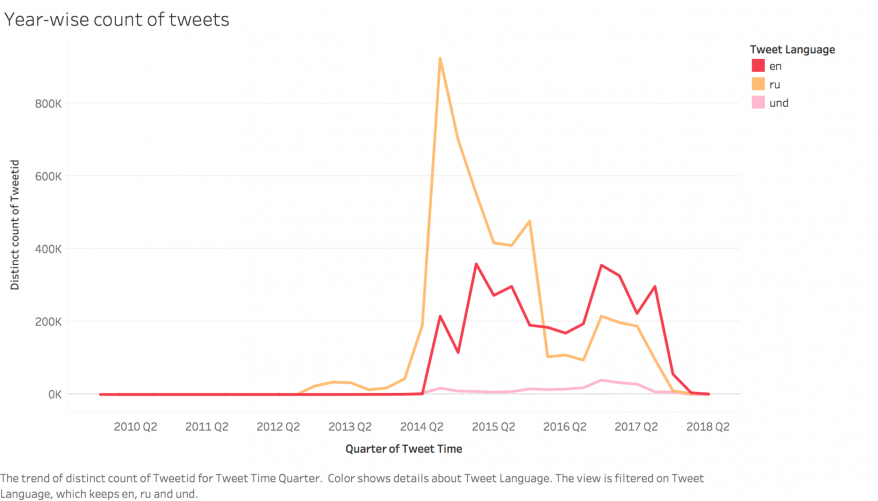
The Atlantic Council’s Analysis of Troll Tweet Language © Atlantic Council 2018
There is much elsewhere to support the notion these accounts’ activities amounted to opportunistic ‘clickbait’ efforts — their tweeting seemingly spiked during and after major events, with trending hashtags bookending often unrelated posts, or politically charged messages accompanied by a shortened link to a third-party website. By piggybacking off anti-Islam or Euroskeptic hashtags, account owners presumably sought to drive traffic elsewhere.
An example of some of the media shared by an alleged Russian troll account
Irreducible Complacency
This lack of apparent overriding objective is palpably divorced from initial claims of a concerted effort to achieve specific results — such as the election of Donald Trump — but the mainstream media seemingly remains undeterred, as the flurry of alarmist articles that have circulated in the wake of the data dump surely attests. Look past the headlines, however, and accompanying articles are scant on information and discussion, leaving readers in search of said proof wanting. For this glaring deficit, major news outlets can perhaps be forgiven — the data amounts to several hundred gigabytes, and it will surely take a vast army of journalists considerable time to wade through and analyze the full cache.
Nonetheless, the Atlantic Council’s Digital Forensic Lab was given a headstart, with Twitter providing the organization’s data scientists an advance look at the trove “in an effort to promote shared understanding of the vulnerabilities exploited by various types on online influence operations, as well as social media’s role in democracy”.
Many articles cite the Council’s analysis, authored by Ben Nimmo, in justification of their paranoid headlines — but while the Lab’s superficial updated conclusion is that troll accounts were intended to divide online communities and exploit polarization and division in society proper, a review of the organization’s detective work suggests journalists haven’t taken the time to actually read that article either. After all, the piece concludes the “troll operations do not appear to have had significant influence on public debate”, “there is no evidence to suggest they triggered large-scale changes in political behavior”, and the accounts’ activities “had little to no discernible impact on the target populations’ political behavior”.
Nimmo concludes the article by despairing of the difficulty of identifying future foreign influence operations, given trolls “use exactly the techniques which drive genuine online activism and engagement”, making it “much harder to separate them out from genuine users”. Nonetheless, Twitter avowedly remains committed to “proactively combat[ing] nefarious attempts to undermine” its integrity, and neutralizing such efforts as “quickly and robustly as technically possible”.
Given Nimmo himself concedes the activities of alleged troll accounts had “little or no impact” whatsoever, with their ‘operations’ “washed away in the firehose of Twitter”, it’s highly questionable if it’s worth undertaking any effort at all.
Despite the paltry yield of information so far, Sputnik journalists will continue analyzing the released data, and report in weeks to come on their findings — if indeed findings are actually forthcoming.
Twitter Data Release Aimed to Discredit Trump Ahead of Midterms – Commentator
Sputnik – October 19, 2018
Twitter has shared an archive of material that could be linked to alleged information campaigns by Russia and Iran. This comes after Twitter CEO Jack Dorsey testified before Congress about foreign interference in US elections. Sputnik has discussed the issue with UK-based political commentator and activist Alan Bailey.
Sputnik: What’s your take on the timing of Twitter’s release of data dating back years? Why now?
Alan Bailey: This is all related to the upcoming US mid-term elections, and further back to the campaign to discredit current US President Trump. There has been a long-running process of undermining Trump’s validity by blaming his victory on external actors. Mainly Russia. According to the US authorities, social media was the main weapon of choice in swinging the public opinion towards Trump and we are now seeing a process of neutering social media so that any dissenting voices outside the mainstream will struggle to be heard.
In its blog post Twitter mentioned some 3,800 accounts it says were affiliated with Russia and some 770 accounts associated with Iran, so over 4,500 accounts overall. How big of a role could these 4,500 accounts have played in the so-called disinformation campaign?
The thing to remember about Twitter is that the vast majority of people only see posts from members they subscribe to. In other words, anyone reading these posts has subscribed to these members’ posts or to someone re-tweeting the posts. It’s not TV. You don’t sit there and watch anything Twitter broadcasts. If the tweets from these members had any effect, then it was because those reading them had sympathy with the content of the tweets anyway.Sputnik: The company also revealed that these accounts have sent over 10 million tweets over the years. Meanwhile, according to Google, some 500 million tweets are sent on Twitter every day. Again, how big of a role could this have played in shaping public opinion?
Alan Bailey: Same as above really. If people were influenced by these tweets, then it is because the mainstream media is not supplying the quality of info they require and this is being fulfilled by the “Russian tweets.” What on earth is wrong with reading a Russian point of view on social media? Nothing. It’s up to the Mainstream to disprove the content and at this, they fail regularly.
Sputnik: In your view, how much of a role do Twitter’s and Facebook’s identification policies play when it comes to setting up new accounts with these networks?
Alan Bailey: Twitter made it official policy that impersonation of another person is a violation of their terms of use and can delete an account upon finding out that this has occurred. Yet many parody accounts exist, mocking celebrities and the like. So this policy, in particular, has been leveraged as a means of deleting accounts producing content that is not in line with US policy and/or representing movements seen in a bad light by the US authorities.
Sputnik: What measures should Twitter take to improve its performance as a safe and unbiased platform, in your opinion?
Alan Bailey: Twitter needs to resist outside pressure to censor its content. Beyond ensuring that only people of a certain age are allowed to sign up for the network, it’s my view that everything else should be open and uncensored. It’s very easy to block or mute a user who is annoying to a user.
CNN: “Twitter has suspended accounts” that “appear” to smear Khashoggi
By Catte | OffGuardian | October 19, 2018
Further indication of the alleged murder of Khashoggi being a narrative issued from high levels in the power structure is rolling out all the time. But this is a significant little pointer:
Twitter has suspended accounts that appeared to be setting out to smear missing journalist Jamal Khashoggi https://t.co/WaWv8GmkUA
— CNN (@CNN) October 19, 2018
The Khashoggi murder narrative, true or false, is being protected and promoted aggressively by the mainstream media. I don’t think this is simply because the press are mad about the attack on “one of their own” or because the scandal is just too big to ignore. In fact I think these frequently-repeated claims are based on a fundamental and dangerous misapprehension about the relationship between the media and its masters and how narratives are currently produced.
Whatever happens with the Khashoggi story we need to keep talking about these misapprehensions because they fatally undermine people’s ability to grasp the reality of our current situation. I guess I’ll be returning to it in the future.
In the meantime, I note several articles in alt media outlets that ought to know better – all discussing what the murder of Khashoggi might mean for this or that foreign policy question, or this or that aspect of the western narrative. None, or shamefully few of them, pointing out that we have as yet seen no evidence the murder has actually happened.
This erosion of our requirement for verification is appalling. I don’t care what beneficial long term interests may be served by climbing on this bandwagon and screaming for vengeance on the Saudis, if we agree to live in a world where allegation becomes evidence simply by repetition, we are allowing the propagandists an easy victory.
Catte Co-founding editor at OffGuardian. Writer. Occasional polemicist. Lives in UK. Email at blackcatte@off-guardian.org
Leaked Google Secret Memo Admits Abandonment of Free Speech for ‘Safety And Civility’
Russia Insider | October 18, 2018
Despite leaked video footage showing top executives declaring their intention to ensure that the rise of Trump and the populist movement is just a “blip” in history, Google has repeatedly denied that the political bias of its employees filter into its products.
But the 85-page briefing, titled “The Good Censor,” admits that Google and other tech platforms now “control the majority of online conversations” and have undertaken a “shift towards censorship” in response to unwelcome political events around the world.

Talk about Russian, er, Jewish, meddling in our ‘democracy’ … Sergey Brin, Billionaire founder of Google
Examples cited in the document include the 2016 election and the rise of Alternative for Deutschland (AfD) in Germany.
Responding to the leak, an official Google source said the document should be considered internal research, and not an official company position.
The briefing labels the ideal of unfettered free speech on the internet a “utopian narrative” that has been “undermined” by recent global events as well as “bad behavior” on the part of users. It can be read in full below.
It acknowledges that major tech platforms, including Google, Facebook and Twitter initially promised free speech to consumers. “This free speech ideal was instilled in the DNA of the Silicon Valley startups that now control the majority of our online conversations,” says the document.
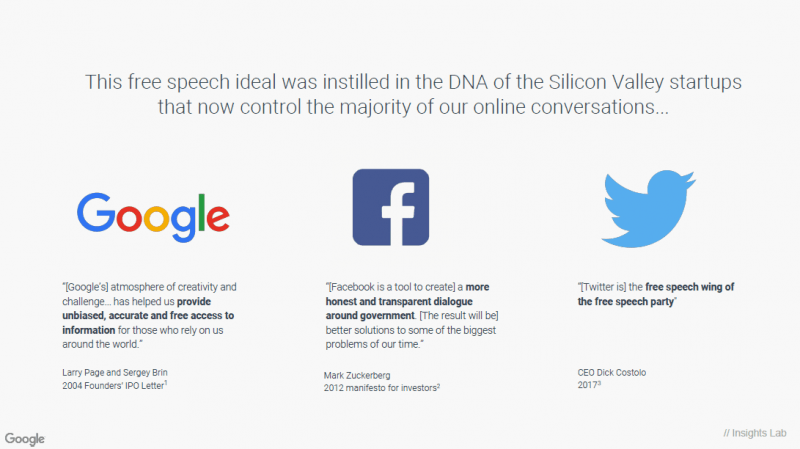
The briefing argues that Google, Facebook, YouTube and Twitter are caught between two incompatible positions, the “unmediated marketplace of ideas” vs. “well-ordered spaces for safety and civility.”
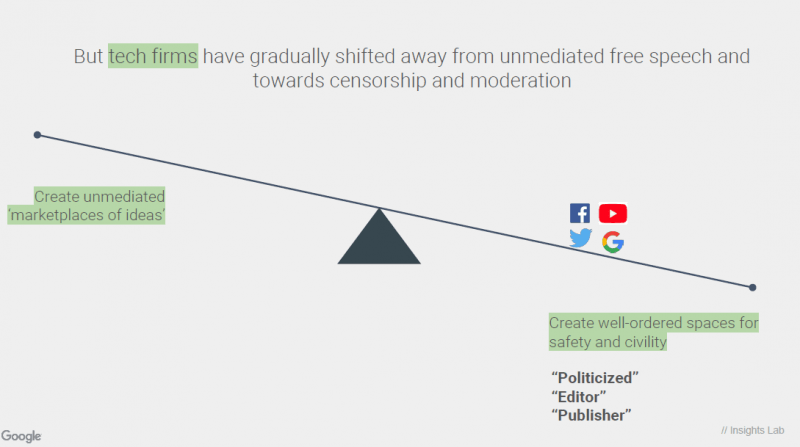
The first approach is described as a product of the “American tradition” which “prioritizes free speech for democracy, not civility.” The second is described as a product of the “European tradition,” which “favors dignity over liberty and civility over freedom.” The briefing claims that all tech platforms are now moving toward the European tradition.
The briefing associates Google’s new role as the guarantor of “civility” with the categories of “editor” and “publisher.” This is significant, given that Google, YouTube, and other tech giants publicly claim they are not publishers but rather neutral platforms — a categorization that grants them special legal immunities under Section 230 of the Communications Decency Act. Elsewhere in the document, Google admits that Section 230 was designed to ensure they can remain neutral platforms for free expression.
Trump, Conspiracy Theorist
One of the reasons Google identifies for allegedly widespread public disillusionment with internet free speech is that it “breeds conspiracy theories.” The example Google uses? A 2016 tweet from then-candidate Donald Trump, alleging that Google search suppressed negative results about Hillary Clinton.
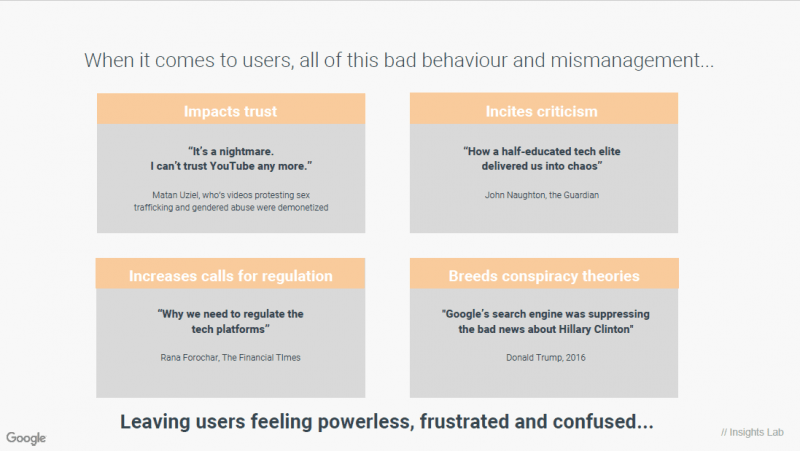
At the time, Google said that it suppressed negative autocomplete suggestions about everybody, not just Clinton. But it was comparatively easy to find such autocomplete results when searching for Bernie Sanders or Donald Trump. Independent research from psychologist Dr. Robert Epstein also shows that Google search results (if not autocomplete results) did indeed favor Clinton in 2016.
Twice in the document, Google juxtaposes a factoid about “Russian interference” in American elections with pictures of Donald Trump. At one point, the document admits that tech platforms are changing their policies to pre-empt congressional action on foreign interference.
The document did not address the fact that, according to leading psychologists, the impact of foreign “bots” and propaganda on social media has a negligible impact on voters.
From Suggestions to Company Policy
It is unclear for whom the “Good Censor” was intended. What is clear, however, is that Google spent (or paid someone to spend) significant time and effort to produce it.
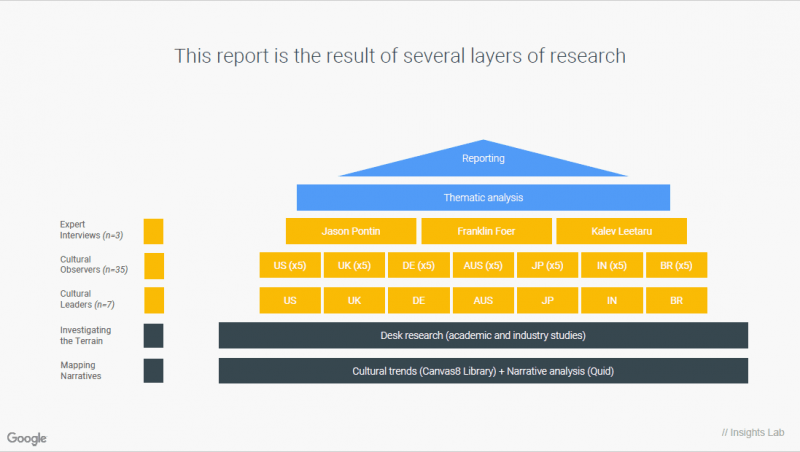
According to the briefing itself, it was the product of an extensive process involving “several layers of research,” including expert interviews with MIT Tech Review editor-in-chief Jason Pontin, Atlantic staff writer Franklin Foer, and academic Kalev Leetaru. 35 cultural observers and 7 cultural leaders from seven countries on five continents were also consulted to produce it.
What is also clear is that many of the briefing’s recommendations are now reflected in the policy of Google and its sibling companies.
For example, the briefing argues that tech companies will have to censor their platforms if they want to “expand globally.” Google is now constructing a censored search engine to gain access to the Chinese market.
The document also bemoans that the internet allows “have a go commenters” (in other words, ordinary people) to compete on a level playing field with “authoritative sources” like the New York Times. Google-owned YouTube now promotes so-called “authoritative sources” in its algorithm. The company did not specifically name which sources it would promote.
Key points in the briefing can be found at the following page numbers:
- P2 – The briefing states that “users are asking if the openness of the internet should be celebrated after all” and that “free speech has become a social, economic, and political weapon.”
- P11 – The briefing identifies Breitbart News as the media publication most interested in the topic of free speech.
- P12 – The briefing says the early free-speech ideals of the internet were “utopian.”
- P14 – The briefing admits that Google, along with Twitter and Facebook, now “control the majority of online conversations.”
- P15 – Section 230 of the Communications Decency Act is linked to Google’s position as a platform for free expression. Elsewhere in the document (p68), Google and other platforms’ move towards moderation and censorship is associated with the role of “publisher” – which would not be subject to Section 230’s legal protections.
- PP19-21 – The briefing identifies several factors that allegedly eroded faith in free speech. The election of Donald Trump and alleged Russian involvement is identified as one such factor. The rise of the populist Alternative fur Deutschland (Alternative for Germany) party in Germany – which the briefing falsely smears as “alt-right” – is another.
- PP26-34 – The briefing explains how “users behaving badly” undermines free speech on the internet and allows “crummy politicians to expand their influence.” The briefing bemoans that “racists, misogynists, and oppressors” are allowed a voice alongside “revolutionaries, whistleblowers, and campaigners.” It warns that users are “keener to transgress moral norms” behind the protection of anonymity.
- P37 – The briefing acknowledges that China – for which Google has developed a censored search engine – has the worst track record on internet freedom.
- P45 – After warning about the rise of online hate speech, the briefing approvingly cites Sarah Jeong, infamous for her hate speech against white males (Google is currently facing a lawsuit alleging it discriminates against white males, among other categories).
- P45 – The briefing bemoans the fact that the internet has until recently been a level playing field, warning that “rational debate is damaged when authoritative voices and ‘have a go’ commentators receive equal weighting.”
- P49 – The document accuses President Trump of spreading the “conspiracy theory” that Google autocomplete suggestions unfairly favored Hillary Clinton in 2016. (Trump’s suspicions were actually correct – independent research has shown that Google did favor Clinton in 2016).
- P53 – Free speech platform Gab is identified as a major destination for users who are dissatisfied with censorship on other platforms.
- P54 – After warning about “harassment” earlier in the document, the briefing approvingly describes a 27,000-strong left-wing social media campaign as a “digital flash mob” engaged in “friendly counter-commenting.”
- P57 – The document juxtaposes a factoid about Russian election interference with a picture of Donald Trump.
- P63 – The briefing admits that when Google, GoDaddy and CloudFlare simultaneously withdrew service from website The Daily Stormer, they were “effectively booting it off the internet,” a point also made by the Electronic Frontier Foundation and the FCC in their subsequent warnings about online censorship.
- P66-68 – The briefing argues that Google, Facebook, YouTube and Twitter are caught between two incompatible positions, the “unmediated marketplace of ideas” vs. “well-ordered spaces for safety and civility.” The first is described as a product of the “American tradition” which “prioritizes free speech for democracy, not civility.” The second is described as a product of the “European tradition,” which “favors dignity over liberty and civility over freedom.” The briefing claims that all tech platforms are now moving toward the European tradition.
- P70 – The briefing sums up the reasons for big tech’s “shift towards censorship,” including the need to respond to regulatory demands and “expand globally,” to “monetize content through its organization,” and to “protect advertisers from controversial content, [and] increase revenues.”
- P74-76 – The briefing warns that concerns about censorship from major tech platforms have spread beyond the right-wing media into the mainstream.
Read The Good Censor in full below. Alternative download option available here.
The Good Censor – GOOGLE LEAK by on Scribd.
Self-Censorship: Where The Real Damage Is Being Done

By Caitlyn Johnstone | Medium | October 15, 2018
I was going to write another article today about a different topic, but I backed down because I didn’t think I could deliver the kind of fiery, forceful, unmitigated argument it would need to be without risking getting banned from social media and blogging platforms.
The article I was planning on writing, which you’ll just have to imagine now, would have been titled “ ‘Assange Can Leave Whenever He Wants!’ No, Idiot, He Can’t.” The feature image was going to be a screen shot of a blue-checkmarked empire loyalist named Greg Olear tweeting the infuriatingly dopey argument that Assange is free to just waltz out the embassy doors whenever he wants, so therefore he isn’t actually being imprisoned by an Orwellian power establishment for publishing authentic documents about powerful people. Never mind the fact that you can say exactly the same thing about literally anyone under political asylum; they are all free to leave the political asylum they’ve been granted at any time, and pointing this out is just describing the thing that political asylum is. Never mind the fact that a UN panel ruled that Assange is being arbitrarily detained by the threat of imprisonment. Never mind that the same US government which tortured Chelsea Manning is currently openly pursuing Assange’s arrest because of his publications, making the assertion that he’s “free to leave” the same as saying he’s “free” to jump off a cliff. People don’t want to believe that their government imprisons journalists, so whenever Assange is in the news you see this argument making the rounds.
It would have been a firecracker of an article, but when it came time to write it, I backed down. I’d generally rather scrap an article than write something tepid and boring that won’t make any impact, so the risk of losing access to my platforms outweighed my desire to write what I’d planned on writing.
I’ve been self-censoring more and more lately, especially since the latest round of coordinated cross-platform silencing of multiple alternative media outlets the other day. Back in August I had my Twitter account temporarily deleted when I said the world will be better off without John McCain and a bunch of #Resistance accounts mass reported me; Twitter cited “abusive behavior” as its justification. The only reason my account was restored was because there was a large objection from many high-profile journalists and activists who understand the dangers of internet censorship, and I’m not willing to gamble that I’d get that lucky should something similar happen again. Being able to disrupt establishment narratives on a high-traffic website like Twitter outweighs the benefits of speaking in an unmitigated way.
And that ultimately is precisely the point. If the social engineers can make an example of a few dissident voices in the public eye, everyone else will rein in their own speech and behavior to avoid the same fate. The overall effect of this phenomenon is actually far more effective in suppressing dissident speech than the overt censorship is by itself, because self-censorship actually silences exponentially more anti-establishment opinions. For every one voice you crack down on overtly, a thousand more silence themselves out of self-preservation, not saying things they would otherwise say and not doing things they would otherwise do.
Meanwhile empire loyalists know that they can consistently get away with saying anything they want with total impunity. The other day for example I criticized the fawning media accolades that professional Atlantic Council propagandist Eliot Higgins has been receiving lately, and he responded by calling me “Grotbags”, an obese witch character from a nineties children’s television show. The joke being, you see, that I am overweight, and I am also a woman, so I am therefore similar to the character Grotbags. Ha ha ha. Eliot has been repeating this hilarious joke for months with zero consequences. He also made headlines back in June with his repeated public invitation for people who disagree with him on Twitter to suck his balls, also with zero consequences.
After my August Twitter suspension a #Resistance account publicly doxxed me, posting my home address, phone number and other information. I didn’t make a public ordeal out of it at the time because I obviously didn’t want to draw attention to it, but I did report it because I wanted it deleted. I was not expecting Twitter Support to reject my report, especially after they had me jump through a bunch of hoops to prove that I did in fact live where the doxxer was saying I lived, but they did.
“We understand that you might come across content on Twitter that you dislike or find offensive,” Twitter wrote back. “However, after investigating the reported content we found it was not in violation of Twitter’s private information policy. As a result, it won’t be removed at this time.”
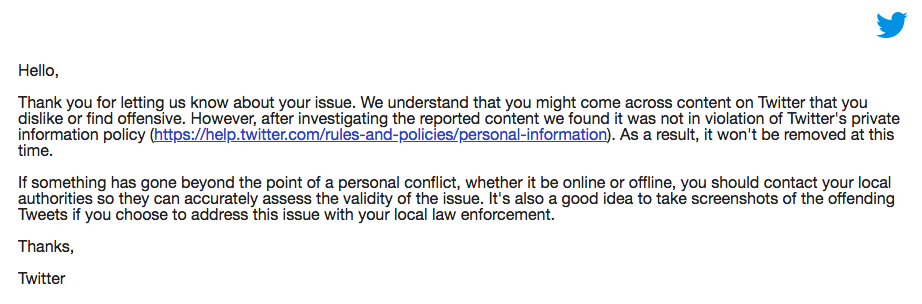
I see this routinely across all platforms; some accounts act without any fear of consequences, others seem primed for hair-trigger suspension. The bias is distinctly slanted in the favor of those who support CIA/CNN narratives and attack anyone who speaks out of alignment with the agendas of the US-centralized empire.
So while we are mitigating our speech more and more, the Eliot Higginses of the new media environment consistently get away with all manner of abusive behavior without any repercussions. We’re fighting a media war in which we are not just outnumbered and outgunned, but are increasingly forced to fight with one arm tied behind our backs. The only thing we have going for us at this point is that authenticity is attractive and oligarchic funding can’t buy creativity or inspiration.
So anyway, there’s my confession that I have been caving to self-censorship to avoid being de-platformed. Rather than denying it, I think it’s best that we all admit to it when we do it and call it what it is, because it’s an unseen part of the people’s media rebellion that is generally overlooked and under-appreciated. I haven’t really figured out what to do about it beyond that, but in my experience drawing the light of attention to these things is always a good idea.
Featured Video
Chinese jet fuel and the myth of energy independence
or go to
Aletho News Archives – Video-Images
From the Archives
The Dirty Little Secret behind the “Global Terrorism Index”
The Omission of Israeli Terrorism in the Occupied Palestinian Territories
By Karin Brothers | Global Research | December 6, 2014
… The Israeli settlements — all of which are illegal – have been identified as a major impediment to peace. The refusal of a major “global” terrorism report to name the Israeli settlers as one of the groups most responsible for terrorism not only misrepresents a major source of regional violence but exposes the Global Terrorism Index as a propaganda tool that supports a U.S. agenda.
In recent years, governments have been attempting to thwart terrorism by blocking supportive fund-raising. When it comes to Israeli settlements, however, the US and Canada actually encourage fund-raising by giving organizations (such as Christian Friends of Israeli Communities (CFOIC) and the Jewish National Fund) financial support in the form of donor tax-deductions.
Charities which provide funds for the Israeli settlements should be regarded as terror-financing organizations. They should not only lose their tax-deductible status, but they should be banned because they support the violation of international humanitarian law. The terror-financing laws that are being strictly enforced for Muslim charities should be applied to Christian and Jewish charities as well. … Read full article
Blog Roll
 Aletho News
- Chinese jet fuel and the myth of energy independence
- Ukraine Sea Drone Fired From Libya Hit Russian Tanker in Mediterranean
- IRGC: Iranian forces launched no attacks during ceasefire hours
- Trump Administration Moves To Automate U.S. Military Draft Registration
- Spain orders reopening of Tehran embassy, condemns Israel’s carpet bombing of Lebanon
- Israel faces ‘unsustainable’ strategic crisis following 40-day war against Iran: Analyst
- Iran restricts Hormuz access to 15 vessels per day under ceasefire terms: Report
- The ‘Opposition Party’ Has Done Nothing to Stop the Iran War and Much to Goad Trump Into Continuing It
- Moscow backs Tehran on status of Lebanon in US-Iran deal
- How UK Regulator Ofcom Quietly Bypassed International Law to Police American Speech
- If Americans Knew
- Amnesty: Urgent – Protect Lebanese civilians from brutal escalation in Israeli attacks
- Is The War Against Iran Over?
- Inside the Israeli army’s propaganda wing
- Hundreds of Gaza Amputees Stranded in Legal Limbo
- The gallows law: Israel moves toward executing Palestinian children
- Tucker Carlson: The Path to Peace requires ending ‘special alliance’ with Israel
- This is ceasefire? Israel’s biggest massacre yet in Lebanon, another journalist killed in Gaza – Daily Update
- Tucker Carlson on Israel: This Is the Behavior of an Ally? Really?
- Gazans face a triple crisis: severe shortages of water and bread, healthcare in tatters
- NY Times reports how Netanyahu took the US into Iran War
- No Tricks Zone
- An Inconvenient Tree: Uncovered In Alps… Europe Much Warmer Than Today 6000 Years Ago
- New Study Reports A 60% Slowdown In Greenland’s Ice Loss Rate In The Last Decade
- Low Intensity Tornado Wrecks Major Solar Farm, Creating A Potential Toxic Dump
- New Study Finds Warming Saves Lives…Cold Temperatures 12 Times More Deadly Than Excess Heat
- German Science Blog Accuses PIK Climate Institute Of Hallucinating Climate Tipping Points
- Devastating Assessment Of Comirnaty Vaccine By Former Senior Pfizer Europe Toxicologist
- New Study: CO2 Is ‘Effectively Negligible’ As An Explanatory Climate Change Factor Since 2000
- Former Pfizer Toxicologist Dr. Helmut Sterz Tells Bundestag Hearing Pfizer Vaccine Should Have Never Been Approved
- Energy Expert: Germany’s Nuclear Phaseout Was A “500 Billion Euro Mistake”
- New Research: South Australia’s Mid-Holocene Sea Surface Temperatures Were 4°C Warmer Than Today
 Aletho News