Emirati official: We oppose anti-Iran coalition in region

Anwar Gargash, the UAE president’s diplomatic adviser
Press TV – July 15, 2022
An Emirati official has dismissed the idea of forming a NATO-like military alliance in the region, saying the United Arab Emirates does not intend to form a regional coalition against any country, in particular Iran.
Speaking to reporters on Friday, the UAE president’s diplomatic adviser said a Middle East NATO was merely a “theoretical” concept and that confrontation was not an option for Abu Dhabi.
“We are open to cooperation, but not cooperation targeting any other country in the region and I specifically mention Iran,” Anwar Gargash said. “The UAE is not going to be a party to any group of countries that sees confrontation as a direction.”
He also said that the UAE was in the process of sending an ambassador to the Islamic Republic of Iran.
“Our conversation is ongoing … we are in the process of sending an ambassador to Tehran. All these areas of rebuilding bridges are ongoing,” Gargash maintained.
“We have an open eye. We are very clear if something is defending the UAE and its civilians, of course we are open to these ideas, but not to the idea of creating any axes against this or that country,” he added.
In recent months, Iran and the UAE have intensified their efforts to rebuild relations affected by the years-long war in Yemen and other regional issues.
Last August, Iran’s President Ebrahim Raeisi said that the Islamic Republic is determined and open to the expansion of relations with the UAE, stressing that Tehran sees no boundaries to the promotion of such ties, particularly trade and economic ones.
Iranian Foreign Minister Hossein Amir-Abdollahian said after a May visit to the UAE that warm relations among neighbors disappoint the enemies.
“A new page was opened in the relations between the Islamic Republic of Iran and the UAE,” the top Iranian diplomat tweeted after meeting Mohammed bin Zayed Al Nahyan, the newly-appointed president of the UAE, in Abu Dhabi on May 16.
“We warmly shake hands with our neighbors. The warmth of the neighbors’ relations disappoints the enemies of the region,” he added.
UAE forces are displacing Yemenis from Abd Al-Kuri Island
MEMO | June 29, 2022
Emirati forces have been accused of displacing local residents from Yemen’s Socotra archipelago in preparation to establish a military base on the island of Abd Al-Kuri.
Yesterday they continued to forcibly evict dozens of families from their homes at gunpoint, reported the Yemen Press Agency, citing local sources. The sources added that the recent displacement came after construction work began to build the base, which is speculated to host joint UAE and Israeli forces stationed in the archipelago.
In April, it was reported that UAE forces have been expelling dozens of families from their villages on Abd Al-Kuri Island, the second largest in the archipelago.
The displacements come amid increased cooperation between the UAE and Israel – who normalised ties in 2020, to set up a military and spy base on the strategically-located islands. This is in line with Israel’s ambitions to gain a foothold in the Bab El-Mandeb Strait.
Despite the UAE’s withdrawal in 2019 from the southern port city of Aden on Yemen’s mainland, it has steadily been increasing and consolidating its influence elsewhere in the southern provinces, including in Socotra. Its actions are seen by many locals as an occupation.
Israel Reportedly Seeks US Go-Ahead to Provide Arab Gulf States With Laser Weaponry
Bennett expressed hope that the system would come online by 2023

Samizdat – 28.06.2022
Last week, Israel’s defense minister announced that Tel Aviv was working on a ‘Middle East Air Defense Alliance’ with Arab governments, but provided no details. On Sunday, US media reported that Washington brokered a secret meeting in the spring of top Israeli and Arab military officials to discuss regional air defense coordination against Iran.
Israeli officials are planning to ask US President Joe Biden for his formal blessing to provide an Iron Beam laser-based air defense system to Gulf Arab states including the United Arab Emirates and possibly Saudi Arabia, Israel’s Channel 12 has reported.
The unsourced Hebrew-language report, cited by the Times of Israel, indicated the delivery of the system to the Gulf countries would assist with the US-led push to ramp up air defense cooperation between Tel Aviv and a loose regional coalition including Egypt, Jordan, Bahrain, the UAE, Saudi Arabia and Qatar.
The Jewish State does not have formal diplomatic relations with the latter two country, and Riyadh has repeatedly stated that it would not establish formal ties with Israel until the Palestinian question and the creation of a Palestinian state was settled.
On Sunday, the Wall Street Journal reported, citing US and Middle Eastern sources, that the Pentagon had organized a hush-hush meeting in Sharm El Sheikh, Egypt in March to discuss ways to improve air defense cooperation against Iranian ballistic missiles and drones. The meeting was said to have been chaired by then-US Central Command chief Frank McKenzie, and attended by top military commanders from Israel and the Arab countries who were invited.
Israeli Defense Minister Benny Gantz, who announced the formation of a regional anti-Iranian air defense alliance last week, appeared to signal the veracity of WSJ’s reporting on Monday, saying Israel was “building” a “wide partnership with additional countries in the region to ensure a secure, stable and prosperous Middle East,” and that “among other things, this also includes aerial defense.”
“We will strengthen this, as a stable Middle East is an international, regional and Israeli interest of the highest order,” Gantz said.
Iran’s military also appeared to issue an indirect response to WSJ’s report, with Armed Forces Chief of Staff Mohammad Bagheri warning Monday that Tehran “will not tolerate” the threats posed by Israel and its cooperation with CENTCOM, and “will definitely react to them.”
Israel has long touted the purported advanced capabilities of its so-called ‘Iron Beam’ laser-based air defense system, a prototype of which was unveiled last year. Earlier this month, Prime Minister Naftali Bennett said the “game-changer” weapon would shift the balance in Israel’s favor, with the estimated $2 in electricity required per burst to intercept enemy rockets just a drop in the bucket compared to the tens of thousands of dollars a rocket might cost. Bennett expressed hope that the system would come online by 2023.
Last week, Breaking Defense reported that Israel would ask Biden for more money for Iron Beam’s development, on top of the $3.3 billion in annual US subsidies already received by the Israeli military and defense establishment. The outlet’s sources indicated that Israel will likely ask the US president to shell out about $300 million in additional cash.
“The relations between the US and Israel are solid. The issues that will be on the table during the visit are of utmost importance to both the US and Israel. I’m confident that the talks will be fruitful to both sides,” a senior defense source told the outlet.
During his trip to the Middle East next month, Biden is expected to tour an Israeli airbase and get a firsthand look at the prototype laser weapons being developed by Israeli defense giants Rafael and Elbit Systems.
Lasers for use against aircraft, missiles, drones, ships, and ground equipment have been on the drawing board of weapons developers since the Cold War, with engineers spending decades mulling over the prospects of replacing conventional missile and shell projectiles with the futuristic beam pulse. But energy-directed weapons have long faced what have previously been deemed unsolvable issues, such as the immense amounts of power required to operate them, as well as interaction between combat lasers and natural phenomena such as rain, fog, smog or dust, all of which dissipates their strength.
Last month, US weapons maker Raytheon reported that its own laser weapon, fitted aboard an Army Stryker vehicle, had successfully downed incoming mortar rounds in testing.
Macron reveals if Saudis and UAE can rapidly ramp up oil output
Samizdat – June 28, 2022
Oil-rich countries Saudi Arabia and the UAE cannot radically increase crude production anytime soon, French President Emmanuel Macron was overheard saying to his US counterpart Joe Biden on Monday.
The leaders were contemplating how to curb Russia’s oil revenue without triggering more energy price increases.
The brief conversation between Macron and Biden was filmed by reporters on the sidelines of the Group of Seven (G7) summit in southern Germany.
Macron told his US counterpart that he had a call with Emirati leader Sheikh Mohammed bin Zayed Al Nahyan. “He told me two things. ‘I’m at a maximum [production capacity]’. This is what he claims,” Macron said.
The French president continued: “And then he said [the] Saudis can increase by 150 [thousands barrels per day]. Maybe a little bit more, but they don’t have huge capacities before six months’ time.”
Emirati Energy Minister Suhail Al Mazroui clarified on Twitter that “the UAE is producing near to our maximum production capacity based on its current OPEC+ production baseline” of 3.168 million barrels per day. He said the Gulf state would stay “committed” to the same baseline until the end of the year.
Western countries have been looking for ways to curb Russia’s revenue from the oil trade, all while trying to avoid further energy price hikes at home. Saudi Arabia and the UAE were seen as nations with spare capacity to boost oil production in order to reduce prices, according to Reuters.
Why India must decouple from I2U2
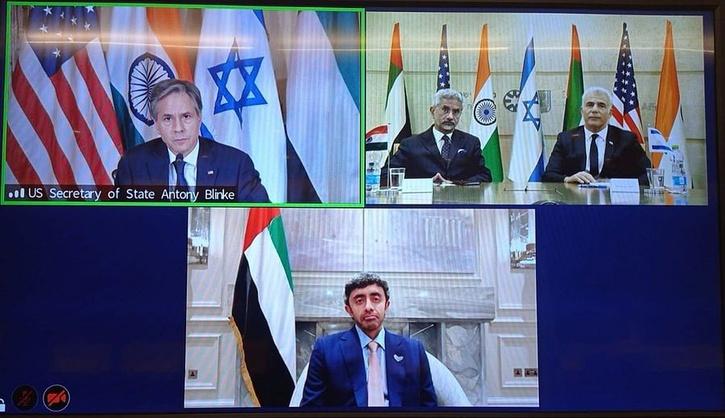
Foreign Ministers of India, Israel, UAE, US (clockwise) held a videoconference in October 2021 to launch a ‘Quad’ for West Asia
BY M. K. BHADRAKUMAR | INDIAN PUNCHLINE | JUNE 17, 2022
Indian diplomacy is descending from the sublime to the absurd. Such wild swings signal rank opportunism. These are extraordinary times when to be smart is equated as being opportunistic.
Hardly a week passed since PM Modi received the Iranian Foreign Minister Amir-Abdollahian in Delhi and expressed high hopes for India-Iran relationship. Now it transpires that India also forms part of the Gang of Four led by US President Joe Biden to “contain” Iran, from a new platform called I2U2 — the ‘I’ being India and Israel, and ‘U’ being US and UAE.
The I2U2 summit in mid-July between Biden, Israeli Prime Minister Bennett, Modi, and Emirati President Mohammed bin Zayed is destined to be a signpost in the geopolitics of West Asia. This new Quad first appeared on 18th October 2021 as an offspring of External Affairs Minister Jaishankar’s 5-day trip to Israel when from Tel Aviv he pulled a rabbit out of the hat, leaving the Indian public wonder what new grandstanding their impulsive minister was indulging in.
Between October and July this year, the I2U2 is getting an upgrade from foreign minister to prime minister/president level. On Tuesday, while announcing Biden’s first West Asian tour as president in mid-July, Washington has made some effort to rationalise Biden’s intentions in undertaking the planned visits to Israel and Saudi Arabia. A senior White House official said Biden intends:
- To demonstrate “the return of American leadership to bring countries together”;
- To create “new frameworks that aim to harness unique American capabilities to enable partners to work more closely together, which is essential to a more secure, prosperous, and stable Middle East region over the long term”;
- To build on the “resounding vote isolating Iran last week at the IAEA Board of Governors in Vienna where 30 countries condemned Iran’s lack of compliance with safeguard obligations” (where India, by the way, had abstained from supporting the US move);
- “To make sure we’re doing all we can to strengthen Israel’s security, prosperity, and integration into the larger region, both now and over the longer term”;
- To “focus on Israel’s increasing integration into the region” through new formats other than Abraham Accords, such as the “entirely new grouping of partners… what we call I2U2”!
So, that’s it. India will lend a hand to assist the US to refill the fizz that has gone out of the Abraham Accords. The hope that more countries would join Abraham Accords is withering away. Israel needs to be shown around to prospective suitors in its neighbourhood. I2U2 is, in essence, a dating agency. When it concerns Israel, the role of pandar comes naturally to the US presidents. But why should India squander away its soft power?
The US prestige and influence in West Asia has suffered a severe jolt during the Biden presidency. Not too long ago, Biden had called Saudi Arabia a “pariah” and pledged to make a horrible example of it on account of its human rights record. But now the shoe is on the other foot. Biden is craving for attention from Saudi Arabia. He had taken a second vow not to have any dealings with the powerful Saudi Crown Prince Mohammed bin Salman. But he is now beseeching the proud Prince for an audience. His recent phone calls weren’t answered.
The White House official explained Biden’s U-turn this way: “we have important interests interwoven with Saudi Arabia, and engagement is essential to protecting and advancing those interests on behalf of the American people.” In reality, Biden is swallowing pride and reviving the old matrix of US-Saudi relationship riveted on the petrodollar.
With poll rating falling abysmally low, Biden is desperate to tackle the rising inflation in the US economy, and the soaring price of oil is fuelling public disaffection. Saudi Arabia can help Biden salvage his standing.
However, it is the turn of the Saudis now to tell Americans there’s no free lunch. They want a written treaty to the effect that the US won’t ditch them when the crunch time comes or if the Kingdom or the ruling family feels insecure. Put differently, they want the Americans to act as their Praetorian guards as before.
In return, of course, Saudis will generate massive business for the US military-industrial complex, recycle their petrodollar to strengthen the Western banking system and create lucrative business for American companies — in short, help the beleaguered Western economies to pursue their post-pandemic recovery that is getting derailed by the war in Ukraine.
Indeed, the Saudis also have a rich history of lavishly greasing the palm of the American elite in the administration, the Pentagon and the Congress. In a nutshell, Biden as a seasoned operator in the Beltway knows which side of the bread is buttered.
But to rationalise his U-turn, an alibi is needed. So, Biden has decided to hoist “Iranian threat” as the leitmotif of the revamped US-Saudi security alliance. All signs are that Biden has acceded to the Saudi demand to scuttle the JCPOA and pile new sanctions against Iran, although the negotiations in Vienna are in home stretch and an agreement is within sight.
Biden’s West Asian agenda is completely US-centric, aimed at securing US business interests and shoring up its regional influence. Israel, of course, is a “holy cow”. Very soon Biden will begin fund-raising for his re-election bid in 2024, and Jewish donors are a generous lot.
However, the million dollar question remains: What has India got to do with Biden’s agenda? There are real risks, for the subplot here is that Biden hopes to nix India’s plans to revive its atrophied relationship with Iran. The recent visit of the Iranian foreign minister to India would have set alarm bells ringing in Washington and Tel Aviv.
Biden has a game plan for leaders like Modi who have a tendency to disregard the US diktat occasionally. Biden’s national security advisor Jake Sullivan spoke candidly just the other day:
“We’re playing the long game here. We are investing in a relationship (with India) that we are not going to judge by one issue even if that issue is quite consequential, but rather that we are going to judge over the fullness of time, as we try to work to convergence on the major strategic questions facing our two countries.
“On one of those questions — how to deal with the challenge posed by China — there’s much more convergence today, and that is important to US foreign policy. On the question of Russia, obviously, we have different historical perspectives, different muscle memories, but we feel confident that the dialogue we have going with India right now will bear fruit over time.”
Sullivan was discussing India’s time-tested relationship with Russia — how Washington hopes to erode and dissolve it all in good time.
Plainly put, Americans estimate that Indians have no “staying power,” or “big picture.” They probably estimate that the Indian government would grab the I2U2 platform to burnish its international image. But if there is any sanity left in the Indian foreign policy establishment, a subaltern role to serve US and Israeli interests cannot enhance India’s prestige in West Asia where, as it is, Modi government is perceived as an Islamophobic regime backed by religious fanatics.
In the life of individuals and nations alike, there are moments when one has to learn to say “no.” This self-serving, cynical overture from 78-year old Biden is one such moment. That’s why, despite zero chance of India turning down Biden’s invite, not to urge Modi to say “Nyet” to I2U2 will be a serious lapse.
South Block is underestimating the gravity of its folly. India never ever got entangled in the intra-regional issues in West Asia. It never acted as the surrogate of extra-regional powers, either. Most important, it never sought the “containment” of any regional state. That’s how it held its head high in the choppy waters of the Persian Gulf.
State Dept. Not Investigating Saudi Use of US Weapons in Alleged War Crimes: GAO
Samizdat | June 16, 2022
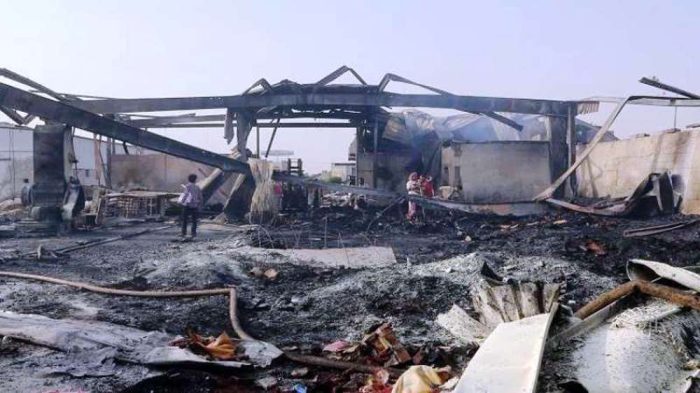
The Government Accountability Office (GAO) published a scathing report Monday which found that the Department of Defense and the Department of State “have not fully determined the extent to which U.S. military support has contributed to civilian harm in Yemen.” The news comes on the heels of the announcement that US President Joe Biden will be paying a visit next month to Saudi Arabia, a country which in 2019 he pledged to turn into a “pariah.”
“Despite several reports that airstrikes and other attacks by Saudi Arabia and UAE have caused extensive civilian harm in Yemen, [the Department of Defense] has not reported and [the State Department] could not provide evidence that it investigated any incidents of potential unauthorized use of equipment transferred to Saudi Arabia or UAE,” the GAO report concluded.
In February 2021, US President Joe Biden declared he was ending “all American support for offensive operations” in the Saudi war on Yemen. GAO monitors pointed out that while US Military Training Mission staff claimed that “all of the equipment the US sells… to Saudi Arabia must be for defensive purposes,” the “officials could not provide a definition for equipment that is defensive in nature when asked how they distinguish between equipment used for defensive purposes and equipment used for offensive purposes.”
Instead, the report’s authors noted, State Department officials “told us they have no specific definitions for what constitutes ‘offensive weapons’ and ‘defensive weapons’ to direct the sale of weapons to Saudi Arabia.”
The report also found that from fiscal year 2015 to 2021, the “Department of Defense administered at least $54.6 billion of military support to Saudi Arabia and the United Arab Emirates, of which over a third, or $18.3 billion, came in the form of missiles. The remaining military aid was reportedly spent as follows: $7.6 billion on equipment maintenance, $6.2 billion on aircraft, $4.9 billion on “special activities,” $4.6 billion on communication, detection, and coherent radiation equipment, $3.3 billion on ships, $2.8 billion on training, $1.4 billion on construction, $1.2 billion on ammunition, $1.1 billion on support equipment, $900 million on weapons, and $1.8 billion on other expenditures like combat, tactical, and support vehicles, as well as research and development.
Although “the United Nations has characterized the conflict in Yemen as one of the world’s worst humanitarian crises,” the report’s authors explain that the US has “long-standing security relationships with Saudi Arabia and UAE—two primary actors in the conflict—and has continued to provide them military support, including for operations in Yemen since 2015.”
In April, 32 US Congress members urged Secretary of State Anthony Blinken to commit to a “recalibration of the US-Saudi partnership,” noting that the US’ “continued unqualified support for the Saudi monarchy, which systematically, ruthlessly represses its own citizens, targets critics all over the world, carries out a brutal war in Yemen, and bolsters authoritarian regimes throughout the Middle East and North Africa, runs counter to US national interests and damages the credibility of the United States to uphold our values.”
But with Biden’s announcement that he’ll be flying to Riyadh next month for what the Saudi embassy described as “official talks” between Joe Biden and Prince Mohammed bin Salman, the odds of such an adjustment taking place–and of US agencies taking a more proactive approach towards American involvement in alleged Saudi war crimes–are growing ever-slimmer.
Iran vs. UAE – ‘Russia and Ukraine Gulf edition’ coming soon?
By Gavin O’Reilly | OffGuardian | June 15, 2022
Although receiving miniscule media coverage, Thursday’s announcement that Israel had deployed military infrastructure to the UAE and Bahrain in the shape of radar systems, ostensibly to counter an alleged missile threat from nearby Iran, should be a cause for concern amongst onlookers.
Coming in the same 24 hour period in which Israeli Prime Minister Naftali Bennett paid a surprise visit to the Emirates, and in which Israeli Forces bombed Damascus International Airport, the announcement that both Abu Dhabi and Manama had agreed to host Israeli military infrastructure should be seen as the first step towards current tensions between Tel Aviv and Tehran being placed on a possibly irreversible path towards conflict in the region.
Indeed, Israeli encirclement of Iran via Tel Aviv-allied Arab states possibly triggering a war between Tehran and both the UAE and Bahrain bears a stark similarity to the nine-year long build-up of provocations which would ultimately led Russia to launch a military intervention into neighbouring Ukraine in February of this year.
In November 2013, following the decision by then-Ukrainian President Viktor Yanukovych to suspend a trade deal with the EU in order to pursue closer ties with Russia, a CIA-orchestrated regime change operation, known as ‘Euromaidan’, would be launched in order to depose Yanukovych’s leadership and replace him with the pro-Western Petro Poroshenko – whose coalition government would contain rabid far-right sympathisers hostile to Moscow.
Indeed, such was the anti-Russian sentiment amongst the new US-backed Kiev government that the predominantly ethnic-Russian Donbass region in the east of the country would breakaway to form the independent republics of Donetsk and Luhansk in April 2014, following the previous month’s successful reunification of the Crimean Peninsula with the rest of Russia.
The establishment of these two pro-Russian Republics however, would spark a near eight-year long conflict in the eastern European country, in which Kiev would use neo-Nazi paramilitaries such as Azov Battalion and Right Sector to wage an ethnic cleansing campaign against the inhabitants of the Donbass.
In spite of Western media descriptions of ‘Russian aggression’ however, Moscow had sought to resolve the conflict in Donbass through peaceful mean via the Minsk Agreements – which would see both Republics granted a degree of autonomy whilst still remaining under the rule of Kiev.
With 14,000 dead in the Donbass conflict, NATO failing to honour a post-Cold War agreement not to expand eastwards, and the subsequent confirmation that US-funded labs were developing bioweapons in Ukraine however, Moscow’s hand was ultimately forced in February of this year when a Russian military intervention was launched into Ukraine in order to remove neo-Nazi elements from power and to destroy any military infrastructure that would ultimately have been used by NATO had Kiev gone on to become a member.
This is where the similarities with Iran and the neighbouring Gulf states of the UAE and Bahrain come into play, with both countries having formalised diplomatic links with Tel Aviv via the September 2020 US-brokered Abraham Accords.
Lauded as a ‘peace deal’ by the then-administration of Donald Trump, despite Israel, the UAE and Bahrain never actually being at war, the ‘normalisation’ agreements, coming eight months after the US had nearly triggered a new Gulf war with the assassination of Iranian Quds Force commander Qasem Soleimani in a drone strike, were seen by many geopolitical observers as a means to contain Iran within the region, a long-time foreign policy aim shared by both Washington and Tel Aviv.
Indeed, despite the relationship between Israel and both states initially starting off on a purely diplomatic basis, the announcement that Israeli radar systems are to be moved into both the UAE and Bahrain marks a dangerous step towards a scenario were Israeli military infrastructure is placed within striking distance of Iran – a situation that would likely lead to a major regional conflict, one that could reach far beyond the Persian Gulf.
Gavin O’Reilly is an Irish Republican activist from Dublin, Ireland, with a strong interest in the effects of British and US Imperialism; he was a writer for the American Herald Tribune from January 2018 up until their seizure by the FBI in 2021, with his work also appearing on The Duran, Al-Masdar, MintPress News, Global Research and SouthFront. He can be reached through Twitter and Facebook and supported on Patreon.
Is a Social Credit System Coming for Us?
By Tessa Lena | May 13, 2022
A Social Credit Score System Is Piloted in Bologna, Italy
The city administration of Bologna, Italy, is piloting a program that brings the beast of the Fourth Industrial Revolution straight to the citizens. It’s an early reiteration of Klaus’ Schwab’s Fourth Industrial Revolution, the honey moon, so to speak — so it comes to the citizens wrapped in gift paper, with balloons, prizes, and party language. But make no mistake: underneath, there is cruel man-eating machine that wants to mine your data and control your behavior!
So, what exactly is happening in Bologna? The administration is “digitizing” their relationship with the citizens. For starters, they are launching an app — with a catch — that will provide an interface to get access to various local services. Without saying it, the they are implementing the “digital governance” aspect of the Fourth Industrial Revolution. Quoting the Italian source:
“We will give citizens services based on their needs – says the Mayor – and this will allow us to personalize their experience. People will be able to find everything the administration will do on their mobile phones or computers. The physical branches, however, will not disappear.
“We will maintain a ‘physical’ support for all people who do not use the web, especially the older ones,” assures Lepore [Mayor of Bologna]. But the goal is computer literacy that leaves no one behind.”
If we read this announcement with innocent eyes, it sounds like yet another initiative that the bureaucrats are launching, perhaps benevolently, to keep up with the times and with the buzzwords. And in an ideal world — a world filled with flowers, butterflies, rainbows, and harmless, caring bureaucrats — there would be nothing wrong with adding on a little extra convenience via technology.
Technology can be very helpful if done right, and if it comes to us without Trojan horses. But alas, at the moment, we don’t live in such a world!
We live in a world where Klaus Schwab and his buddies and masters are fighting with each other over who gets to eat the most peasants! We live in a world where those who already have great power are seeking even more power — and that world is quickly going back to the feudal-time psychological standards (while, ironically, keeping the modern standards for the levels of industrial poisons in everything around us.)
As far as Trojan horses, the Bologna municipal app actually comes with a social credit system! The “virtuous citizens,” doing nice things, such as using public transport, keeping their energy use low, etc., get “perks,” like points in gaming. For those points, they may be able to get discounts or prizes or access to additional services. Nice Trojan horse, right?
“Among the most innovative interventions is the smart citizen wallet [emphasis mine]. ‘The wallet of the virtuous citizen,’ explains Bugani, who had worked on the project with the Raggi [Virginia Raggi, Mayor of Rome from 2016 to 2021] administration (in Rome today the platform is active in an experimental phase). The idea is similar to the mechanism of ‘a supermarket points collection,’ as the councilor himself points out.
‘Citizens will be recognized if they separate waste, if they use public transport, if they manage energy well, if they do not incur sanctions from the municipal authority, if they are active with the Culture Card.’ Virtuous behaviors that will correspond to a score that the Bolognese will then be able to ‘spend’ on prizes, such as discounts, cultural activities and so on.”
In other words, it’s the “nice” face of digital control. Nice, for now. But we need to be clear: we are looking at the digital control of everything we do in the end of that journey!
Integrated Citizen Relationship Management in Rome
The Italian news source mentions that this approach is already in experimental use in Rome, Italy. In March 2022, Salesforce published the following announcement:
“Salesforce, the global leader in CRM, today announced that the Municipality of Rome has chosen Salesforce to create an Integrated Citizen Relationship Management platform …
Leveraging Salesforce Service Cloud and Marketing Cloud will deliver omni-channel self-service capabilities, seamless collaboration between local government departments, and empower citizens to receive the information they need faster through AI-powered chatbots.
The launch of the MyRhome platform is another step on the Municipality’s path to creating a ‘smart city’ [emphasis mine] — an ecosystem of public and private stakeholders serving citizens wherever they are”.
Of course! We can’t expect any less from Salesforce, given that Marc Benioff is on WEF Board of Trustees!
Also, remember the famous “lockstep scenario” document released by the Rockefeller Foundation and the Global Business Network? The document that the Rockefeller Foundation says today has been misinterpreted by the conspiracy theorists — because the good and virtuous Rockefeller Foundation totally didn’t mean to predict what actually happened in 2020 (and also probably had nothing to do with eugenics)?
Well, keeping in mind that “lockstep scenario” document, here is Peter Schwartz, the Senior Vice President of Strategic Planning at Salesforce and “an internationally renowned futurist and business strategist, specializing in scenario planning and working with corporations, governments, and institutions to create alternative perspectives of the future … Prior to joining Salesforce, Peter was co-founder and chairman of Global Business Network [emphasis mine].” In the words of George Carlin, “It’s a big club, and you ain’t in it! You and I are not in the big club!”
Their Motive for the “Digital Governance” Model? It’s the Data, Stupid!
At first, it’s the data (to train our future boss, the robot) — and then, increasingly, it’s mainly about control!
Let’s look at a very “interesting” 2017 write-up on digitizing governments on the World Economic Forum’s website. It talks about the importance of collecting data to build and train their beloved AI. It also complains about the fact that a lot of the data kept by governments just sits there in paper format and, dammit, is not making itself useful to the sacred goal of training the AI! Not good, they say, what a waste!
Therefore, to “open” that data to the AI beast, they want the governments to digitize their services — sorry that was the quiet part — what they actually say is that the citizens are craving those digital government systems because, who doesn’t know that the elimination of privacy is … good for us?
The World Economic Forum also suggests that the governments should develop new legal frameworks and data management systems to make data available for free. What a great idea! In 2017, the World Economic Forum mouthpieces were more upfront that today, so it is useful to read exactly what they said back then:
“Need for data is quickly becoming a central theme that applies to all aspects of our evolving digital society. A case in point is the field of artificial intelligence, which promises to revolutionize society (governments included). Companies such as Google, Facebook and Microsoft are using AI-related techniques to train computers to recognize objects in photos and understand human language.
It is possible to train computers to perform these difficult feats because we have the enormous quantities of data that is required. The same applies to all forms of machine learning, smart manufacturing and every other tech-driven trend shaping the future. They are all reliant on data, and are only as good as the data they crunch. In this context, data has been described as the new oil.'”
“Today, a large majority of the world’s data is in the hands of the private sector … The remainder of the global data sits in government hands, mostly stored in paper format, or legacy systems. To maximize the societal benefits of the data age, a new movement started promoting open data.
While government data is all data or information that government entities produce or collect, making it open refers to publishing and sharing data that can be readily and easily consulted and re-used by anyone with access to internet with no fees or technological barriers.
Most of this data currently remains locked up and proprietary (private property of companies, governments and other organizations). This severely limits its public value.
Data is now a new social good and governments will need to think of some form of data responsibility legislation that guides the private sector and other data owners on their duties in the data age: the duty to collect, manage and share in a timely manner [emphasis mine], as well as the duty to protect.
This legislation is needed over and above a government’s own open and big data management systems, and will need to cover all data stakeholders (irrespective of ownership or other governing rules).”
“Once a clear legal framework is in place, governments need to develop, and quickly master, a new core capability: data curation … Most governments around the world still struggle with legacy databases that are incompatible with each other, and work against any kind of data-sharing or data-driven design. Laws and regulations are still in their infancy and struggling to cope with the pace of change …”
“Governments must review a vast number of laws and regulations [emphasis mine]. From harmonizing and enforcing privacy regulations and protecting against data-breaches, to regulations that ensure net neutrality and data flows. Today’s debates over the future of big data are based on the assumption that the internet will remain a series of open networks through which data easily flows.
Some countries have begun to harden their internet systems, and the concept of net neutrality is uncertain. If the internet becomes a network of closed networks, the full potential of big data may not be realized.”
“Governments must also improve their capabilities when it comes to citizen engagement to effectively and actively engage with both providers and users of data. This requires governments to create a culture of open data [emphasis mine] – something governments are starting to do with various degrees of success.
The level of citizen engagement is not the typical government communication function, but a more open, horizontal, and fast-paced G2C platform.”
Must, must, must. So I am guessing, national sovereignty is a sore thumb in the way of our aspiring Davos masters because in their minds, they have already decided that they want our data (but not theirs) to be openly available, and that they don’t want any questions from the peasants.
A tangential comment: As a musician, I am remembering with some bitterness how Big Tech was pushing for “open data” and “open access” back in the day, selling it as “free expression” and “democracy,” and as a result — since buying music became unfashionable — musicians lost much of their income … and nobody cared!
I am glad that now at least, a lot more people are realizing what liars whose Big Tech companies are, and what liars they have always been all along, when they were talking about “free expression”! Look at them now, with their “free expression”! They are quite happy to censor! So it’s only our data that they want to be open — not our opinions!
And Here Is Another Curiosity From the World Economic Forum
They published this article in 2018:

“The Fourth Industrial Revolution is expected to wreak havoc on labour markets, with AI and robots replacing various white-collar jobs. One job category largely excluded from scientific reports is that of government leaders, despite being one of the most critiqued, scrutinized and ridiculed jobs of all.”
“However, commentators from countries as diverse as India, the UK, New Zealand and Japan have started to suggest that robots as government leaders could drastically improve decision-making, by being much less irrational and erratic than their inherently flawed human counterparts.”
After freaking us out, the World Economic Forum writers chuckle and let us continue being governed by human politicians, at least for now:
“For the time being, it seems neither possible nor optimal for robots to replace government leaders, despite the clear imperfections displayed by the latter group … Ultimately, a more realistic and desirable scenario is one in which AI and automation are neither competitors nor substitutes to humans, but tools that government leaders can engage effectively and sometimes defer to, in order to make better, fairer and more inclusive decisions.”
Phew, it’s almost like … you know, when a street robber first tells us to give him all of your money but then agrees to take only half! Such a kindly, generous robber! We are so lucky!
World Economic Forum’s “Agile Nations”
The 2017 WEB write-up about digital governance reads like a “wish list” and a blueprint for the governments to act upon. (I guess, given the bribing and coercive power of the people who’ve composed the wish list, their wish list had a strong chance of becoming the bureaucrats’ blueprint the moment it was written.) So in 2020, seven nations got together and signed an agreement to essentially implement it. A quote from “Agile Canada“:
“In November 2020, seven countries signed on to the Agile Nations Charter, establishing Agile Nations as a forum for countries to collaborate on creating a global regulatory environment in which innovation can thrive.
Member countries include: Canada, Denmark, Italy, Japan, Singapore, the United Arab Emirates, the United Kingdom. The Organisation for Economic Cooperation and Development (OECD) and the World Economic Forum (WEF) also participate as observers.”
“Priority areas for cooperation are: data and communications, transportation, medical diagnosis and treatment, clean technology, legal and professional services, pro-innovation regulatory approaches.”
And here’s from the Organisation for Economic Co-operation and Development:
“The COVID-19 pandemic has wrought economic and social disruption worldwide. As people and businesses focus on recovery, governments must ensure that innovation, which will power economic growth and solve the world’s most pressing social and environmental challenges, is not held back by outdated regulations [emphasis mine].”
Translation from Orwellian to English: “We want your data, including your medical and biometric data — and we want it now. Look at how lovely our AI is … my precious! (Sorry couldn’t help it!) The so called national laws and regulations interfere with the speed at which we can get a hold of your data.
Like we said, we want it now, and so we would very much like it if so called national laws and regulation got replaced with a digital framework that we write and that we can update any time we like! Sounds like a good idea or what? Who wants some funding? You know what you need to do to get that funding, don’t you?” The quote continues:
“As part of the development of the OECD principles on Effective and Innovation Friendly Rule-Making in the Fourth Industrial Revolution, the Organisation for Economic Cooperation and Development (OECD) and the World Economic Forum (WEF) have been co-operating to look deeper into the interlinkages between regulation and emerging technologies …
Ministers from Canada, Denmark, Italy, Japan, Singapore, United Arab Emirates and United Kingdom announced their plan to lead the world in fostering responsible innovation and entrepreneurship.”
“In addition, in support of the mission of the Agile Nations, representatives of Facebook also offered to launch a call for research – overseen by an independent steering committee of experts in the field of law, regulation and entrepreneurship – into what approaches to rulemaking (e.g. regulatory sandboxes, policy prototyping) were the most effective for the Fourth Industrial Revolution.
As this initiative continues to develop, other businesses will be encouraged and invited to co-sponsor this initiative, and to venture their own ideas to support the work of the Agile Nations.”
“In sum, the Agile Nations Charter sets out each country’s commitment to creating a regulatory environment in which new ideas can thrive. The agreement paves the way for these nations to cooperate in helping innovators navigate each country’s rules, test new ideas with regulators and scale them across the seven markets.
Priority areas for cooperation include the green economy, mobility, data, financial and professional services, and medical diagnosis and treatment.”
“Scientific Management”
The World Economic Forum’s agenda is a strange mix of religious fundamentalism and “scientific management.” As I wrote earlier in an article about the mind of a technocrat, scientific management is a “method of industrial optimization developed by Taylor in the late 19th and early 20th century. The essence of his method was extreme fragmentation and compartmentalization of the production process.”
It required taking a complex process, breaking it down into very simple tasks, timing each task, optimizing it to the maximum using the stopwatch, and then assigning each of those simple tasks to different workers, while insisting that the workers should only use the pre-optimized motor patterns and work as efficiently as possible. Under scientific management, there was no room for workers’ creativity.
And while Taylor and Ford intended the scientific management method for the purpose of streamlining industrial production, the Davos charlatans aim to manage our entire lives, and justify it with some bogus “public good” and “community values”!
Whose “Community Values” Are Those, Anyway?
Here is the elephant in the room: It’s the Davos charlatans — and I want to repeat the word “charlatans” because that’s who they are underneath their bank accounts and their important speeches — who are writing our so called “community values”! They are trying to latch onto our natural social instincts and weaponize our good instincts against us!
They want us to be unassuming, guilty “good citizens” who put a limit on our carbon footprint and on the number of children we have — while they, the self-appointed “guardians” of the world, fly private jets to climate change conferences and have as many kids as they damn like!
And here’s the thing. There is nothing wrong with real community values! We are social creatures, and it benefits us to live together well. However, community values are only as good as the people who propose them — and community values turn into a pumpkin the moment someone like Schwab touches them!
As Good as the People
Let’s even forget about Schwab for a second and think how community values work in principle. Let’s imagine a small village. If the people living in that village are mostly healed and grounded, they will raise their children to seek wisdom and live well with others — from the heart, not from the letter.
However, if the people in the village have been abused, and abused, and abused again — and never healed — then even the authentic community values in that village could end up being anxious, rigid, and detrimental to freedom.
Hurt people tend to teach their children that life is meant to be joyless. They tend to slap their children’s wrists for wanting to be free, saying it’s a selfish folly. Hurt people hurt people! And at one point, the rigid rules might have been an invention of a cunning predator — but after prolonged abuse, people might have internalized them and passed them on to their children! (And look at how many people in the West sincerely adopted the religion of the Mask … they have internalized it!)
Another example: in my birth homeland of Russia, there are many small communities where the people carry so much hurt and sadness that the gloom is almost palpable in the air. I am saying this from personal experience, and with much pain and love for my people. I ran away from that gloom and immigrated to America because the “community values” felt too joyless!
So when it comes to Klaus Schwab and friends, they are only as powerful as we let them. I believe that that healing ourselves and our relationships is at the top of our priorities list in the battle against transhumanism — because anything we do from a place of love has more power than anything we do from the place of fear!
Why Will Transhumanism Fail?
This system, the entire man-eating beast, will eventually fail, I have no doubt — but we don’t know when, and we need to stay humble, brave, and very patient. The cruel beast may fail very soon, or it may take a while to fail. I think it depends on how quickly we remember to relate to each other in spirit, with love and happy humility — instead of labeling and judging each other based on ancestry, politics, or differences in opinion.
I think it depends on how quickly we realize that the freedom taken away from the people everywhere, throughout history, has been as existentially precious as the freedom that is being taken away from us right now — because there is no fundamental difference between us and other people, and never has been.
We, here and now, are dealing with the same dilemma that many in the past have dealt with, and some have died from. Spirit is spirit, and freedom is freedom! And I think that when we remember to stand together and honor each other and each other’s love and each other’s courage, we’ll be undefeatable. No Klaus Schwab can do anything to us if we refuse to betray our fellow human beings for any reason.
And sooner or later, spiritual clarity will prevail, and this transhumanist beast, the culmination of abuse, will fail. The reason why it will fail is simple. We are not machines, and when we are managed like machines — increasingly so over the centuries — our souls bleed badly. When we are managed like slaves, we suffer unbearably — and suffering, while it’s not a preferred way of obtaining clarity, still mysteriously leads to spiritual clarity. Life puts no suffering to waste!
And when the pain gets unbearable, and there is nowhere to go but toward our heart of hearts, our souls scream to the skies, and we pray for answers with no arrogance and no talking points, and then something magical happens. When our fear and pain become too much but we keep pushing, we grow our souls to where solutions show up out of nowhere.
And then we cry, laugh, and pray more for healing, and more solutions show up, and we look back and we suddenly know why we had to suffer, and why the sweetness was worth it. And then we start living well because, after all this suffering, we finally remember that everything in the world, everything-everything, has always been about love — and that living well with each other is not just pleasant but also very practical.
Israel to send military attache to Bahrain soon, says envoy after Negev summit with Arab states
Press TV – March 29, 2022
Israel will “soon” appoint a military attache to the US Navy’s Fifth Fleet headquarters in Bahrain, says the Israeli ambassador to Manama, as diplomats from the Persian Gulf country and three other Arab states attend a meeting in the Negev desert in occupied Palestine.
“This will happen soon – an attache to the fleet,” Eitan Naeh told Israel’s Army Radio. “It is in the midst of various bureaucratic processes. I reckon that, by the summer, we will have a fuller staff, along with other officials who will join the embassy.”
Last month, the Israeli minister of military affairs, Benny Gantz, visited the US fleet in Bahrain and met with its commander, Vice Admiral Brad Cooper, and Bahraini naval commanders.
Bahrain, a tiny island in the Persian Gulf and a former Iranian province, is some 300 kilometers to the south of the coastal Iranian province of Bushehr, which hosts a key nuclear power plant.
In Tehran, an Israeli presence so close to the Bushehr nuclear site is deemed a threat to the country’s national security, as the regime in Tel Aviv has in the past covertly carried out acts of sabotage against Iran’s nuclear facilities and assassinated Iranian scientists while overtly threatening to launch attacks on Iran’s nuclear program.
On Sunday, top diplomats from the United Arab Emirates (UAE), Morocco, Bahrain, Egypt, the United States, and Israel met in the Negev desert to press ahead with a US-brokered normalization of relations between the Arab states and the Israeli regime.
Egypt was the first Arab country to have diplomatic ties with Tel Aviv, while the UAE and Bahrain reached normalization agreements with Israel in 2020 through the mediation of former US President Donald Trump’s administration.
Morocco and Sudan later reached similar US-brokered deals, which have been roundly condemned by Palestinians as a brazen betrayal of their cause.
US, Israel launch naval exercise
Also on Sunday, the US Navy’s Fifth Fleet and the Israeli Navy launched a 10-day maritime exercise in the Red Sea.
The drill, dubbed Intrinsic Defender, focuses on maritime security operations, explosive ordnance disposal, health topics, and unmanned systems integration.
Over 300 American personnel as well as US Navy guided-missile destroyer USS Cole (DDG 67), dry cargo ship USNS Wally Schirra (T-AKE 8), and various unmanned vessels are also scheduled to participate in the exercise.
The drill comes amid Washington’s diminishing role in the region, including its withdrawal from Afghanistan and a change in its role in Iraq from military to advisory under the pressure of Iraqi resistance groups.
The US military is also expected to be expelled from Syria, where it has retained an illegal military presence throughout a foreign-sponsored conflict that began in 2011.
Observers believe Washington is scaling down its presence in the Middle East to focus on a large-scale confrontation with China, which is poised to soon overtake the US economically.
UAE: There is no substitute for Russian oil
Samizdat | March 28, 2022
The world’s energy markets need Russian oil and no producer can replace it, United Arab Emirates (UAE) Minister of Energy Suhail al-Mazrouei said on Monday.
Russia produces some 10 million barrels of oil a day, which makes it a critical member of the OPEC+ energy alliance, al-Mazrouei explained during an energy forum in Dubai.
“Leaving the politics aside, that volume is needed today,” he insisted, adding that “unless someone is willing to come and deliver that amount, we don’t see that someone can substitute Russia.”
Russia is the world’s second biggest crude exporter after Saudi Arabia. Following Russia’s military operation in Ukraine, some nations, led by the US, have pledged to stop buying Russian oil and gas. The United States, Europe, and others have been calling on Gulf Arab oil producers to ramp up production and help bring down crude prices, which at one point shot above $120 a barrel.
The International Energy Agency announced earlier this month that it had decided to release 60 million barrels of oil from its emergency reserves, saying that global oil markets were already tight with highly volatile prices and commercial inventories at their lowest level since 2014.
Many have expressed doubts, however, about whether it was possible to ditch Russia’s energy resources.
Last week, the EU stepped back from imposing an embargo on Russian crude and petroleum products, despite pressure from the US. An immediate embargo on Russia’s fossil fuels “from one day to the next would mean plunging our country and the whole of Europe into a recession,” German Chancellor Olaf Scholz said last week. Europe gets nearly 30% of its crude and roughly 50% of its petroleum products from Russia.
Reducing dependence on natural gas – something that the EU hopes to achieve over the next few years – may prove difficult as well. Qatar – which holds the third-largest natural gas reserves in the world – said last week that it was practically impossible to replace Russian gas on the European market, as between 30 and 40% of the total volume of gas supplied to the world market comes from Russia.
UK’s Johnson fails to secure public oil rise pledges after talks with Saudi, UAE
MEMO | March 16, 2022
British Prime Minister, Boris Johnson, held talks about energy security on Wednesday with the de facto leaders of Gulf oil exporters, Saudi Arabia and the United Arab Emirates, but secured no public pledge to ramp up production, Reuters reports.
Johnson’s trip to Abu Dhabi and Riyadh was aimed at securing oil supplies and raising pressure on President Vladimir Putin over Russia’s invasion of Ukraine, which led to sweeping Western sanctions on Moscow and soaring world energy prices.
Johnson’s office said that, in his meeting with Abu Dhabi Crown Prince, Sheikh Mohammed bin Zayed Al-Nahyan, he stressed the need to work together to stabilise global energy markets.
After his talks in Riyadh with Saudi Arabia’s Crown Prince,Mohammed bin Salman, Johnson was asked whether the Kingdom would increase oil production.
“I think you’d need to talk to the Saudis about that. But I think there was an understanding of the need to ensure stability in global oil markets and gas markets,” he said.
So far, Saudi Arabia and the UAE, whose close ties with Washington are under strain, have snubbed US pleas to ramp up oil production to tame the rise in crude prices that threatens global recession after the Russian offensive in Ukraine.
“The world must wean itself off Russian hydrocarbons and starve Putin’s addiction to oil and gas,” Johnson said before his meetings. “Saudi Arabia and the United Arab Emirates are key international partners in that effort.”
The two Gulf States are among the few OPEC oil exporters with spare oil capacity to raise output and potentially offset supply losses from Russia. But they have tried to steer a neutral stance between Western allies and Moscow, their partner in an oil producers’ grouping known as OPEC+.
The group has been raising output gradually each month by 400,000 barrels a day, resisting pressure to act more quickly.
The UAE remains committed to the OPEC+ deal, a source with knowledge of the matter told Reuters before the meeting.
It has deepened ties with Moscow and Beijing in the last few years and abstained, last month, in a US-drafted United Nations Security Council resolution to condemn the invasion of Ukraine, which Russia has described as a “special military operation”.
Johnson “set out his deep concerns about the chaos unleashed by Russia’s unprovoked invasion, and stressed the importance of working together to improve stability in the global energy market”, his office said after his talks in Abu Dhabi.
Johnson and the Crown Prince also agreed on the need to bolster security, defence and intelligence cooperation to counter threats,including from Houthi forces who have fought a lengthy conflict in Yemen against Saudi and UAE forces.
Saudi executions
Johnson is only the second major Western leader to visit Saudi Arabia since journalist, Jamal Khashoggi’s 2018 killing by Saudi government agents in Istanbul.
The CIA concluded that the Prince approved an operation to “capture or kill” Khashoggi. He has denied any involvement in the killing.
The Prime Minister’s trip also came just four days after Saudi Arabia executed 81 men, the largest number in a single day for decades, for offences ranging from joining militant groups to holding “deviant beliefs”.
Asked about criticism of Saudi Arabia’s human rights record, Johnson said: “I’ve raised all those issues many, many times over the past … and I’ll raise them all again today.
“But we have long, long standing relationships with this part of the world, and we need to recognise the very important relationship that we have … and not just in hydrocarbons.”
Saudi press agency, SPA, said Johnson and Prince Mohammed discussed the conflict in Ukraine and international issues, adding that Saudi Arabia and the United Kingdom signed a memorandum of understanding to establish a strategic partnership.
UAE ‘directly benefiting’ from illegal Israeli settlement enterprise
MEMO | February 7, 2022
The UAE is directly benefitting from Illegal Israeli settlements and is in violation of international law according to recently signed bilateral trade agreements between Abu Dhabi and the occupation state, Hugh Lovatt, Senior Policy Fellow at the European Council on Foreign Relations, has pointed out in a series of tweets.
Lovatt has worked to advance the concept of EU Differentiation, which includes a variety of measures taken by the European bloc and its member states to exclude settlement-linked entities and activities from bilateral relations with Israel.
The EU has never recognised the legality of Israeli settlements in the occupied territories (including those in East Jerusalem and the Syrian Golan Heights that have been formally annexed by Israel). This means that the EU has an obligation to practically implement its non-recognition policy by fully and effectively implementing its own legislation against Israel’s incorporation of settlement entities and activities into its external relations with the EU.
In 2016, Lovatt worked to have this measure enshrined within UN Security Council Resolution 2334. It passed in a 14–0 vote, with the US notably abstaining. The Resolution states that Israel’s settlement activity constitutes a “flagrant violation” of international law and has “no legal validity”. It demands that Israel stop such activity and fulfil its obligations as an occupying power under the Fourth Geneva Convention.
Lovatt claims that recently released details of bilateral agreements between the UAE and Israel show that that the Gulf State is in violation of Resolution 2334 and the principal of differentiation which all UN member states are expected to abide by.
“Has the UAE respected international law and its obligations to differentiate between Israel and the settlements as per UNSCR 2334?” asked Lovatt in his tweet. “The answer: No.”
Lovatt explained that “to comply with UN Security Council Resolution 2334, every bilateral agreement signed with Israel should contain a ‘differentiation’ clause defining the territorial scope of its application to Israel’s pre-June 1967 borders. This is not the case in this UAE-Israel agreement”. He shared a screen shot of a clause from the bilateral agreement indicating that no such territorial distinction was made.
The definition of territory applied in the agreement includes all the land that is under “Israel’s jurisdiction”, which Lovatt explained include Israeli settlements on occupied Palestinian territory.
Notably Japan’s trade agreement with Israel includes a definition of “Israeli territory” which upholds the differentiation principal and, therefore, does not fall foul of Resolution 2334, Lovatt said. The absence of this distinction in the bilateral agreement between Abu Dhabi and Tel Aviv means that the UAE is “directly” befitting from illegal settlements through its normalisation with Israel.
Lovatt admits that the UAE may have a different interpretation of the agreement than he does, in which case “it would be incumbent on the UAE government to clarify the agreement’s territorial applicability as soon as possible,” he added.
Featured Video

or go to
Aletho News Archives – Video-Images
From the Archives
Israel Would Have No Qualms About USS Liberty-Style FALSE FLAG If Iran Campaign Falters – Analysts
By Ilya Tsukanov – Sputnik – 18.06.2025
Donald Trump is mulling whether or not to join Israel’s aggression against Iran as Tel Aviv faces problems sustaining its defenses against growing counterstrikes, and apparently lacks a realistic game plan for an end to hostilities after failing to achieve its goals. Analysts told Sputnik how the US could be ‘nudged’ into the conflict.
“The US is already assisting Israel with supplies, intel, refueling support, etc. One of the many US posts in the region could be attacked for a casus belli,” former Pentagon analyst Karen Kwiatkowski explained.
“If Trump doesn’t comply with Israel’s demand” and join its aggression voluntarily, “a false flag may be needed” to drag the US in, Kwiatkowski, retired US Air Force Lt. Col.-turned Iraq War whistleblower, fears.
Netanyahu has a diverse array of options at his disposal, according to the observer, including:
- a false flag against US assets abroad blamed on Iran or one of its Axis of Resistance allies, like the Houthis
- a US domestic attack or assassination blamed on Iran
- Iranian air defenses ‘accidentally’ hitting a civilian jetliner carrying Americans
- use of a dirty bomb or nuclear contamination somewhere in the region blamed on Iran
- even blackmailing by threatening to use nukes against Iran if the US doesn’t join the fight
Kwiatkowski estimates that Israel probably has “enough blackmail power” against President Trump and Congress to avoid the necessity of a false flag operation, but a “USS Liberty-style” attack, targeting the soon-to-be-retired USS Nimitz supercarrier that’s heading to the Middle East, for example, nevertheless cannot be ruled out entirely, she says. … continue
Blog Roll
 Aletho News
- Top PMU commander, over a dozen fighters killed in new US strikes on Iraq
- Is Netanyahu’s war gamble threatening the future of ‘Israel’?: FT
- Smotrich calls for annexation of South Lebanon to Litani River
- Echos of Gallipoli? Hormuz and the Geography of Hubris
- Pakistan PM backs Iran’s right to self-defense amid tensions
- Hungary blasts ‘fake’ EU accusation
- SAFE Debt Trap: Poland’s €43.7 Billion Bet on Unipolar Illusion
- War on Iran threatens global Gulf capital flows: FT analysis
- Mossad De Facto Admits To Inciting Riots In Iran
- Tehran: World grown thoroughly exhausted with US-Israeli ‘false flag storylines’
- If Americans Knew
- From Sde Teiman, the truth about Israel’s military justice system has been set free
- Child denied life-saving bone marrow transplant by Israel ‘because he is from Gaza’
- Raffi Berg: BBC Middle East Editor Exposed as CIA, Mossad Collaborator
- Jerusalem Archbishop Rebukes Netanyahu’s Statements on Christianity
- US to embed Palantir AI across entire military: Report
- Israeli-US war on Iran to drag on “a few more weeks” – Not a ceasefire Day 164
- Lebanon deaths top 1,200; Palantir AI to be embedded across US military – Not a ceasefire Day 163
- Israel’s assassination game: Take all pragmatists off the board
- Food shortages return to Gaza as Israel tightens aid restrictions under the cover of its war on Iran
- Trump demands trillions in payments from Gulf countries, billions from Harvard – Not a ceasefire Day 162
- No Tricks Zone
- Devastating Assessment Of Comirnaty Vaccine By Former Senior Pfizer Europe Toxicologist
- New Study: CO2 Is ‘Effectively Negligible’ As An Explanatory Climate Change Factor Since 2000
- Former Pfizer Toxicologist Dr. Helmut Sterz Tells Bundestag Hearing Pfizer Vaccine Should Have Never Been Approved
- Energy Expert: Germany’s Nuclear Phaseout Was A “500 Billion Euro Mistake”
- New Research: South Australia’s Mid-Holocene Sea Surface Temperatures Were 4°C Warmer Than Today
- Storing Green Energy To Last Germany 10 Days Would Require A 60-Million Tonne Battery
- New Studies: UK Sea Levels Were 4 Meters Higher Than Today During The Mid-Holocene
- Destructive Green New Deal: German Energy And Metal Group Warns Of Drastic Crisis
- New Study Documents A 20-Year Pause In Arctic Sea Ice Decline – Driven By Internal Variability
- Wake-up Call: Survey Shows Majority Of Germans Now Favor Postponing Climate Targets!
 Aletho News