London faces calls to make its case for a possible war before parliament
Press TV – August 27, 2013
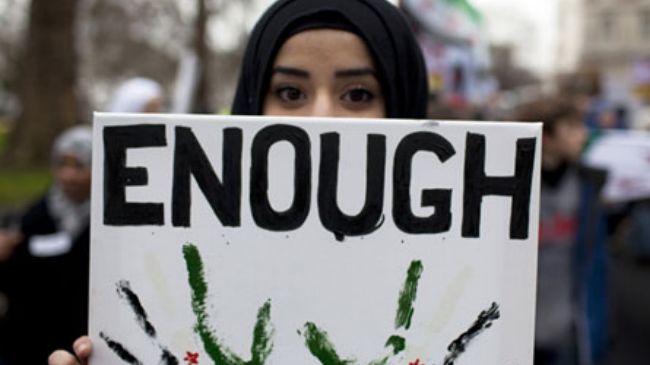
Opposition to a possible military intervention in Syria has intensified in Britain with the Labour party demanding that the government “make their case” before the parliament.
An alleged chemical attack hit parts of the Syrian capital Damascus on Wednesday killing hundreds of people.
Foreign-backed terrorists in the country claimed that the government forces were behind the assault in the Damascus suburbs of Ain Tarma, Zamalka and Jobar while medical charity Medecins Sans Frontieres, which treated those affected in the attack, said it cannot even “scientifically confirm” the use of chemical weapons.
Shadow Foreign Secretary Douglas Alexander said on Monday that the cabinet has to “make their case” in the parliament before they can make a decision whether to go to a new war, if any such decision is to be made.
“Given both the seriousness of the reported chemical weapons strikes in Syria, and the enduring and complex nature of the conflict itself, ahead of any action being taken I would fully expect the Prime Minister to make his case to Parliament,” Alexander said.
“[The Prime Minister must be] open about the objectives, the legal basis, and the anticipated effect of any [British military action],” he added.
Meanwhile, British Conservative MP John Baron, who is leading MPs’ demands for a parliamentary session on the matter, expressed serious concerns about Britain going to war without the approval of the UN Security Council because of a Russian opposition to military intervention in Syria.
“Essentially, it is a civil war. If the West intervenes without a UN resolution … I think there is a more serious risk of this escalating beyond Syrian boundaries,” he said.
This comes as legal experts have seriously questioned the legality of a military move against Syria, saying it would create a “controversial situation”.
“The difficulty here is there’s no threat as I understand it to the security of this country or the United States and therefore on what basis can we intervene?” Michael Caplan, an international lawyer, asked during an interview on BBC Radio 4.
Following the alleged chemical attack in Syria, which government forces say was a false flag attack by foreign-backed militants, Britain, the US and France have been beating drums of war to punish what Washington described as a “moral obscenity” by Bashar al-Asad government in Syria.
Russia has demanded evidence from the three on their claims but no proof has yet been presented or even announced to exist.
The situation has sparked fears that Britain is assisting the US to justify another war based on totally unfounded claims after former British PM Tony Blair tampered with evidence related to Iraq weapons of mass destruction to facilitate the invasion of the country in 2003.
The fears are especially strong because the Syrian government cannot have sensibly carried out a large-scale attack when UN weapons inspectors were stationed almost 20 kilometers away from the site of the attack, waiting to probe earlier claims of poisonous gas strikes.
Qualms are also fueled by sporadic reporting of Syrian foreign-backed militants being in possession of chemical weapons, including a Twitter post by Abdola Al-Jaledi, a former high-ranking member of the Jabaht al-Nusra militant group, which said his colleagues were in possession of chemical weapons.
Related article
- Syrian war drums beat ever louder (morningstaronline.co.uk)
Snowden Accuses UK Gov’t Of Leaking Documents He Never Leaked To Make Him Look Bad
By Mike Masnick | Techdirt | August 23, 2013
The UK’s Independent newspaper today had an “exclusive” article, in which they claim that documents from Ed Snowden’s leaks revealed a secret internet surveillance base in the Middle East run by the UK government. There’s just one problem. While the article implies (though does not state) that it got those documents from Snowden, Snowden says he’s never talked to nor given anything to The Independent. Instead, he argues, that he’s worked carefully with key journalists (namely, Glenn Greenwald, Laura Poitras, and Barton Gellman) to make sure that the things they publish don’t reveal anything that might put anyone in danger. Snowden suggests, instead, that this is the UK government itself releasing this information in an attempt to “defend” the detention of David Miranda.
I have never spoken with, worked with, or provided any journalistic materials to the Independent. The journalists I have worked with have, at my request, been judicious and careful in ensuring that the only things disclosed are what the public should know but that does not place any person in danger. People at all levels of society up to and including the President of the United States have recognized the contribution of these careful disclosures to a necessary public debate, and we are proud of this record.
It appears that the UK government is now seeking to create an appearance that the Guardian and Washington Post’s disclosures are harmful, and they are doing so by intentionally leaking harmful information to The Independent and attributing it to others. The UK government should explain the reasoning behind this decision to disclose information that, were it released by a private citizen, they would argue is a criminal act.
If you read the Independent’s coverage carefully, they never actually claim they got the documents from Snowden, even if they leave that impression. Instead, they claim that “information on [the base’s] activities was contained in the leaked documents obtained from the NSA by Edward Snowden.” In other words, they got that information from someone else — almost certainly the UK government. And, yes, that’s convenient timing for the UK government to claim that some of the documents that Snowden downloaded might contain useful information to terrorists, so that they can then turn around and argue that they detained Miranda and took all of his electronics (and destroyed a Guardian hard drive) to avoid having this information “fall into the hands of terrorists.”
The Independent article also implies that the UK government is afraid that Greenwald is going to start revealing this type of info in response to the Miranda detention, even though there’s no basis to believe that all. Greenwald has been quite careful so far not to reveal any information that puts anyone at risk, so it’s odd to believe that he’d start doing so now. Of course, it’s fairly bizarre since the Independent story itself contains tons of details — the kinds of details that Greenwald has avoided.
If Snowden’s assertion is correct — and it does seem like the most plausible argument at this point — then it highlights the ridiculous lengths to which the UK government is going: releasing potentially damaging information that Snowden himself has avoided revealing just to suggest that Snowden was leaking damaging information. Incredible.
Related articles
Britons’ phone calls spied on routinely by UK police: Report
Press TV – April 20, 2013
British police forces are making as many as 250,000 requests to snoop on people’s email and phone call details every year, a new report reveals.
According to a survey, which was carried out by civil liberties and privacy campaign group Big Brother Watch, 25 police forces across Britain made 506,720 requests for people’s “communications data” over the past three years, The Telegraph reported.
The survey released under the freedom of information laws found that the number of requests for Britons’ phone or email records has risen from 158,677 in 2009-10 to 178,985 in 2011-12. However, the figure could be increased to up to 250,000 including estimates for the forces that failed to reply to the research.
This comes as the UK government is seeking more snooping powers through the controversial Communications Data Bill, which is due to be published in the summer.
The draft bill is dubbed as the Snooper’s Charter, because it is considered as a significant threat to British citizens’ privacy.
The measures mark a serious increase in the powers the British government has to order any communications provider to collect, store and provide access to information about emails, online conversations and texts.
Former British shadow home secretary David Davis said, “It is frankly not good enough that the government is considering introducing a snoopers’ charter without even being able to tell us what they have used communications data for in the past.”
Featured Video

No Threat Can Force Iran’s Surrender /Trita Parsi & Lt Cl Daniel Davis
or go to
Aletho News Archives – Video-Images
From the Archives
An Expert Military Analysis of War with China
Actually, None is Necessary
By Fred Reed • Unz Review • December 13, 2020
The Correlation of Armed Forces: U.S. goods and services trade with China totaled an estimated $634.8 billion in 2019. Exports were $163.0 billion; imports were $471.8 billion. The U.S. goods and services trade deficit with China was $308.8 billion in 2019. Trade in services with China (exports and imports) totaled an estimated $76.7 billion in 2019. Services exports were $56.5 billion; services imports were $20.1 billion. The U.S. services trade surplus with China was $36.4 billion in 2019.
There is talk within the Washingtoniat of a possible war with China. Steve Bannon, who apparently was dropped on his head as a child, actually favors such a war. We hear the usual shoo-the-boobs alarm about how the Chinese are doing something terrible and we must gird our loins and American values and show them what for, bow wow, woof. The danger is that the current game of who-blinks-first in Asian waters might actually provoke a shooting war. You know the kind of thing: One warship refuses to get out of the way of another, a collision ensues, some retard lieutenant who signed up on waivers opens fire, and we’re off and running. It is not a good idea to let children play with matches.
The said war is discussed either in emotional terms by idiots or in purely naval terms by those familiar with such things, so we hear of the First Island Chain and the Second Island Chain and whose missiles against the other’s missiles and so on. This would be appropriate if we were fighting World War Two again. Which we aren’t. Let’s take a quick-and-dirty look at how such a war might go.
To begin the war, America would overestimate itself and underestimate China. This is doctrine in the Pentagon. … continue
Blog Roll
 Aletho News
- Iran To Target Military Industrial-Tech Complex That Facilitated Gaza Genocide
- Collapsing Empire: The Resistance Disarms ‘Israel’
- Suicide Should Not Be a Government Service
- Rethinking America’s greatest threat: Iran vs. Israel-Firsters
- Iran accuses adversaries of false flags to strain Turkey ties
- Poland rules out sending Patriot missiles to US/Israel amid war on Iran
- Tehran approves new Hormuz plan with major restrictions
- No Threat Can Force Iran’s Surrender /Trita Parsi & Lt Cl Daniel Davis
- UK’s New Pandemic Plan Would Turn Big Tech Into a Mass Location Tracking Network
- Growing insecurity, soaring prices fuel protests in north as regime bans evacuation: Sources
- If Americans Knew
- Ann Coulter Rips Into Fox News for Iran War Coverage, Compares to False Rigged 2020 Election Reporting
- Joe Kent Urges Americans To Call White House and Congress To Object To Sending Troops Into Iran
- DNC Resolution to Reject AIPAC Funding Puts Democratic Leaders in the Hot Seat
- Swedish foundation to build 400 schools as over 650,000 Gaza children remain without education for 2 years
- Israeli army admits photshopping image of slain Lebanese journalist
- This is how Israel is systematically killing health workers under the cover of war in Lebanon
- Carrying life under fire: Israeli invasion of Lebanon leaves pregnant women facing deadly risks
- Champagne all around for the new death penalty (for Palestinians) law – Not a ceasefire Day 172
- Why are Palestinian books struggling to be seen on Amazon?
- The Line Between Affinity and Conspiracy
- No Tricks Zone
- New Study Finds Warming Saves Lives…Cold Temperatures 12 Times More Deadly Than Excess Heat
- German Science Blog Accuses PIK Climate Institute Of Hallucinating Climate Tipping Points
- Devastating Assessment Of Comirnaty Vaccine By Former Senior Pfizer Europe Toxicologist
- New Study: CO2 Is ‘Effectively Negligible’ As An Explanatory Climate Change Factor Since 2000
- Former Pfizer Toxicologist Dr. Helmut Sterz Tells Bundestag Hearing Pfizer Vaccine Should Have Never Been Approved
- Energy Expert: Germany’s Nuclear Phaseout Was A “500 Billion Euro Mistake”
- New Research: South Australia’s Mid-Holocene Sea Surface Temperatures Were 4°C Warmer Than Today
- Storing Green Energy To Last Germany 10 Days Would Require A 60-Million Tonne Battery
- New Studies: UK Sea Levels Were 4 Meters Higher Than Today During The Mid-Holocene
- Destructive Green New Deal: German Energy And Metal Group Warns Of Drastic Crisis
 Aletho News