Europe kills democracy to save liberalism
By Raphael Machado | Strategic Culture Foundation | September 8, 2025
The latest opinion polls are extremely indicative of a radical political shift in the European landscape.
In Germany, the Alternative for Germany (AfD) gathers the preferences of 26% of voters, which clearly positions it as the largest opposition party. When the voting intentions for the CDU and CSU are separated, the AfD then becomes the most popular German party.
Meanwhile, in France, the National Rally (RN) — now led by Jordan Bardella — already enjoys the support of 37% of citizens, placing it far ahead of its Macronist and progressive rivals. In the United Kingdom, Nigel Farage’s Reform UK also leads in the polls with 30% of voting intentions. Also leading is the Freedom Party of Austria, with 37% popular support. And in a similar situation, we see the Party for Freedom in the Netherlands, with 33% of voting intentions.
Further down in their respective countries, we see Chega in Portugal as the second most popular party, with 23% of voting intentions. Also in second place are the Sweden Democrats, with 20% of voting intentions, and Norway’s Progress Party, with 22%.
Other European countries see similar parties in solid third-place positions, such as in Denmark, Belgium, Finland, and Poland. And if we discount Meloni’s “Brothers of Italy,” we also see the Lega in Italy in a similar situation.
We are very clearly facing a political trend that goes far beyond a localized phenomenon. The phenomenon is continental and, as it represents a gradual increase over years, apparently lasting. These parties will not eventually return to political marginality and seem to be here to stay.
It is inevitable to consider that the rise of these parties challenging the liberal order is a consequence of the special military operation. The trade and energy rupture generated some significant economic problems in Europe. The German economy shrank, while the French and Italian economies stagnated. Most European countries also faced an inflationary crisis in 2022 and, to control inflation, had to further tighten public spending with austerity policies, as well as increase interest rates. Unemployment also rose, especially in Germany, where several factories have been closed in the last 2 years.
Furthermore, it does not go unnoticed that the leaders of the UK, France, and Germany have increasingly resorted to inflammatory rhetoric hinting at sending their countries’ youth to fight against Russia in Ukraine.
But the strengthening of conservative populism in Europe is not a new phenomenon. It is a gradual evolution that has been building for 20 years, and its main cause is mass immigration, with all its nefarious consequences in the realms of security, economy, culture, etc.
We imagine that such a phenomenon is not considered desirable by the current European elites. Otherwise, one could not explain the judicial offensive against the AfD aimed at banning the party, nor the lawfare practiced against Marine Le Pen making her ineligible, and even less the entire mobilization to arrest Calin Georgescu in Romania, as well as the strange maneuvers that led to the defeat of George Simion in that country’s presidential elections.
But apparently, the situation does not stop at lawfare and potentially illegal judicial maneuvers.
In France, a wave of deaths seems to be linked to Macron, with center-right legislator Olivier Marleix and François Freve (a plastic surgeon linked to Brigitte Macron) on the list of suspicious deaths. Now, more recently, there are reports of at least 7 mysterious deaths of AfD politicians from North Rhine-Westphalia on the eve of local elections.
Probably, these waves of mysterious deaths in France and Germany will never be solved, but a different atmosphere is clearly felt in Europe today. An atmosphere that is certainly less free than that of Europe a few decades ago.
Election manipulation, imprisonment of opposing candidates, mysterious deaths of critics, curtailment of freedom of expression; Western European countries are beginning to check all the boxes of typical dystopian tyrannies — what has been said about China, Russia, and North Korea that has not already become reality in the UK, Germany, and France?
It seems that to preserve “liberal democracy” against “extremists,” Europe is voluntarily abandoning all remnants of democracy.
Elite UK divers likely behind Nord Stream sabotage – Putin aide
RT | September 8, 2025
The sabotage of the Nord Stream pipelines could not have been carried out without Western commandos, a top aide to Russian President Vladimir Putin has claimed, singling out Britain as the likely culprit.
German prosecutors have attributed the explosions in international waters in September 2022, which disabled the twin pipelines supplying Russian gas to Germany via the Baltic Sea, to a group of Ukrainian nationals.
In an article published Sunday in Kommersant, the former head of Russia’s Federal Security Service (FSB), Nikolay Patrushev, argued that Ukrainians lack the expertise to carry out this complex operation independently.
The sabotage was likely “planned, overseen, and executed with the involvement of highly trained NATO special forces,” Patrushev wrote, adding that the perpetrators were experienced in deep-sea operations and familiar with working in the Baltic.
“Few armies or intelligence services have divers capable of executing such an operation correctly and, above all, covertly. One unit with the necessary skills is the British Special Boat Service,” he said. Founded during World War II, the SBS is the Royal Navy’s elite squad specializing in amphibious warfare.
Russia has criticized the German investigation for a lack of transparency and for not including the Russian authorities. In 2024, Russia’s Foreign Intelligence Service claimed it had “credible information” that the US and UK were directly involved in the sabotage, a claim denied by both London and Washington.
UK arrests nearly 900 over support for Palestine Action activist group
Al Mayadeen | September 7, 2025
Nearly 900 people were arrested in the United Kingdom over the weekend during a protest in London in support of the banned pro-Palestinian group Palestine Action, according to the Metropolitan Police.
Authorities confirmed that 857 individuals were arrested under the Terrorism Act of 2000 for supporting a proscribed organization, with another 33 detained for separate offences, including alleged assaults on police officers.
Solidarity with Gaza targeted in crackdown
The protest, described by organizers as an expression of solidarity with Gaza, was held outside the UK Parliament and drew around 1,500 participants.
Many demonstrators carried signs condemning “Israel’s” aggression and genocide in Gaza and expressing support for Palestine.
This comes as “Israel” intensified its bombardment of Gaza and launched new strikes with the stated aim of seizing Gaza City to defeat the Palestinian resistance.
Critics have accused the UK government of using counterterrorism laws to suppress peaceful activism.
The United Nations and other human rights groups have condemned the July decision to designate Palestine Action as a terrorist organization, citing threats to civil liberties and free speech.
Police claim violence; organizers insist protest was peaceful
Of the 33 non-terrorism-related arrests, 17 were allegedly for assaults on officers. The police claimed their officers faced “intolerable” abuse. However, organizers from Defend Our Juries (DOJ), who coordinated the “Lift the Ban” rally, described it as “the picture of peaceful protest.”
Reports noted that many of those arrested were older individuals, some holding signs like “I oppose genocide. I support Palestine Action.”
If convicted, the majority face up to six months in prison, while organizers could face sentences of up to 14 years.
Public figures, UN slam ban as legal overreach
The ban on Palestine Action was pushed by former interior minister Yvette Cooper, who accused the group of engaging in “aggressive and intimidatory attacks” against public and private institutions.
She also claimed that court-imposed reporting restrictions have limited public understanding of the group’s actions.
Nonetheless, public support for Palestine Action has grown since the group’s proscription, with many viewing the UK’s actions as an attempt to silence those who speak out against the war on Gaza and stand in solidarity with Palestine.
Elbit Systems shuts down UK site targeted by Palestine Action
Al Mayadeen | September 6, 2025
Elbit Systems UK’s arms factory in Bristol has gone quiet after years of determined resistance by Palestine Action, according to The Guardian, marking what campaigners see as a major victory against “Israel’s” largest weapons producer.
The Aztec West facility, repeatedly targeted by direct actions, now sits deserted save for a lone security guard at the gate. Although Elbit had a lease lasting until 2029, the company has offered no explanation for the site’s status.
Factory Silence
Palestine Action staged dozens of disruptive actions against the site, ranging from rooftop occupations and blockades to smashing windows and covering the premises in red paint to symbolize Palestinian blood. The latest protest, on July 1, came just days before the UK government banned the group under the Terrorism Act.
Campaigners argue that their actions have exacted a tangible toll. Elbit Systems UK swung from a £3.8 million profit in 2023 to a £4.7 million loss last year, with rising security costs and repeated shutdowns cited as key factors.
“This closure is extremely significant,” arms trade expert Andrew Feinstein told The Guardian. “We need to remind ourselves that Elbit (Systems) is one of the two most important Israeli arms firms, along with IAI, that is it is obviously a key component of Israel’s military industrial complex.”
Elbit Retreat
The closure in Bristol fits a broader pattern of Elbit’s retrenchment in Britain. In Oldham, an 18-month wave of roof occupations and blockades led to the sale of Ferranti P&C in 2022. In Tamworth, the company’s Elite KL subsidiary, targeted repeatedly by Palestine Action, was sold in 2024 after profits collapsed; its new owners, rebranding as Calatherm, pledged to scrap all defense contracts with Elbit.
Long-running campaigns at Shenstone in Staffordshire and at Instro Precision in Kent have also seen repeated shutdowns, rooftop occupations, and trials of activists, showing the breadth of pressure across Elbit’s UK operations.
Still, the company has not disappeared from Britain, The Guardian noted. Its Filton site in Bristol remains active, and 24 activists face trial for actions carried out there, including charges of criminal damage and aggravated burglary. Meanwhile, Elbit is reportedly close to securing a £2 billion Ministry of Defence contract as a “strategic partner”, a deal that former Labour minister Peter Hain has urged the government to block, citing “the devastation unfolding in Gaza.”
Defiant Resistance
Palestine Action has vowed to continue targeting Elbit and its partners. Though proscribed in July, the group has secured permission for a judicial review of the government’s decision in November. The Home Secretary is set to appeal that ruling later this month.
For campaigners, the deserted Aztec West site stands as proof that sustained action can shake even the most entrenched corporations. It also sends a message: as long as companies profit from “Israel’s” assault on Gaza, they will face resistance on British soil.
Iran’s Araghchi Raps “Deafening Western Silence” on Expansion of Israeli Nuclear Weapons
Al-Manar | September 6, 2025
Iranian Foreign Minister Abbas Araghchi rapped what he called the “deafening Western silence” on the expansion of the Israeli nuclear weapons.
“Iran has long warned that the Western hysteria over nuclear proliferation in our region is all fluff. The issue, in their view, is not the existence—or expansion—of atomic weapon arsenals. It is about who gets to advance scientifically, even with peaceful nuclear programs,” Araqchi wrote in a post on his X account on Friday.
“It is therefore not a surprise that there is deafening Western silence over the apparent expansion of the only nuclear weapons arsenal in our region—the nukes in the hands of their genocidal ally. The E3 and the US may be in denial, but their silence is eliminating any credibility to utter anything about non-proliferation,” the Iranian foreign minister said.
The remarks by the top Iranian diplomat came as new revelations point to intensified construction at the Dimona nuclear site, long suspected of housing the Israeli regime’s undeclared nuclear arsenal.
According to a report published by the Associated Press on September 3, satellite images show intensified construction at the Shimon Peres Negev Nuclear Research Center near the city of Dimona, a facility long linked to the Zionist regime’s secret nuclear weapons program.
Experts who analyzed the images suggested the work could either be a new heavy water reactor —capable of producing plutonium for atomic bombs— or a facility for assembling nuclear weapons. They highlighted that the Zionist entity’s current heavy water reactor, which dates back to the 1960s, may soon require replacement.
The Defunct Weaponization of the U.S. Dollar. The SCO Summit and the Decline of the West’s Financial Hegemony.
By Peiman Salehi | Global Research | September 6, 2025
The Shanghai Cooperation Organization’s (SCO) summit in Beijing, marked by both symbolism and substance, underscored the slow erosion of Western financial dominance. While mainstream coverage focused on China’s military parade, the real significance lies in the economic agenda advanced by SCO members. Discussions of a potential SCO Development Bank, expanded use of local currencies, and closer coordination with BRICS initiatives point to a growing determination across Eurasia and the Global South to challenge the monopoly long exercised by the United States and its allies through the IMF, the World Bank, and the dollar system.
For decades, these Western-controlled institutions have functioned as instruments of geopolitical leverage. Structural adjustment programs dismantled social protections, imposed privatization, and locked countries into cycles of debt dependency.
The dollar, presented as a neutral global currency, has been repeatedly weaponized through sanctions, financial exclusion, and manipulation of international payment systems. In this context, the SCO’s economic discussions must be seen for what they are: not technical proposals, but acts of resistance. By seeking alternatives to dollar-based finance and conditional lending, SCO members are asserting that the age of Western financial coercion is no longer uncontested.
China and Russia, the central actors in this process, have both experienced the coercive use of Western financial power.
Sanctions on Russia and tariffs on China have reinforced the urgency of building parallel institutions. For smaller states, particularly in the Global South, the stakes are even higher. Access to credit that is not tied to Washington’s geopolitical priorities could mean the difference between austerity and investment, between dependency and sovereignty. The SCO’s proposals are embryonic, but they point toward a broader trend: the emergence of multipolar finance as a shield against unilateral domination.
Critics in the West have rushed to dismiss these efforts, portraying them as impractical or politically motivated. But such dismissals miss the point. The very fact that alternatives are being openly discussed and partially implemented signals the weakening of Western monopoly. The creation of the BRICS New Development Bank, the use of local currencies in trade between Russia, China, and India, and now the SCO’s initiatives all mark a shift from rhetoric to practice. Each new mechanism reduces the ability of the United States to dictate terms unilaterally.
This does not mean China or Russia will replace Washington as the new hegemons. Rather, it means that unipolarity is ending. The world is moving toward a multipolar order in which no single state can control the flows of finance, trade, and development. For Global South nations, this creates both opportunities and risks. It offers the possibility of diversifying partnerships and rejecting conditionality, but it also requires vigilance to avoid reproducing dependency under new patrons. Multipolarity is not a guarantee of justice, but it is a necessary precondition for breaking the cycle of Western domination.
The SCO summit should therefore be understood as part of a larger civilizational struggle over the architecture of world order. Western hegemony has rested not only on military alliances and cultural influence, but on financial coercion. By weaponizing the dollar, Washington has sought to enforce compliance far beyond its borders. The SCO’s economic agenda represents an attempt to reclaim sovereignty in the face of this coercion, to create breathing space for states that refuse to align with U.S. geopolitical priorities.
What emerges from Beijing is not a fully formed alternative, but a direction of travel. Multipolar institutions are being built step by step, challenging the illusion that Western institutions are eternal or indispensable. For countries in Africa, Asia, and Latin America, this is a call to action. It is an invitation to participate in the shaping of a world where development is not dictated from Washington or Brussels, but negotiated among equals.
The mainstream media will continue to focus on parades and symbols, but the real revolution is occurring in the realm of finance. The SCO summit was a reminder that the West’s monopoly on money and credit is cracking, and that the future of global order will be defined not by a single hegemon but by the collective efforts of states refusing to submit. For those seeking peace, justice, and sovereignty, this is a development to be welcomed, nurtured, and defended.
Peiman Salehi is a Political Analyst & Writer from Tehran, Iran.
Is the West still capable of keeping its maritime trade routes functioning?

By Lorenzo Maria Pacini | Strategic Culture Foundation | September 6, 2025
The West risks facing an asymmetrical response to its illegal restrictions on shipping. Unlike Russia, most developed countries depend on the stable and secure functioning of maritime trade routes. The application of the measures used by the West against itself could trigger a crisis in maritime supply chains due to disruptions in the delivery of strategically important goods and raw materials.
A difficult dependency to manage
Unlike Russia, the West bases its economy and strategic security on a widely interconnected and stable global maritime trade system, established as a founding principle of the maritime power of sea-faring civilizations (Seapower, in the classical geopolitics of Mackinder and Mahan). Most developed Western countries are heavily dependent on the smooth and secure functioning of maritime trade routes to ensure the continuous supply of strategic goods, raw materials, and energy products. Maritime trade is an irreplaceable and essential pillar of Western supply chains, with the increasing complexity and vulnerability of these systems due to geopolitical and environmental dynamics.
This dependence means that illegally imposed restrictions on navigation, or pressure on key maritime routes such as the Suez Canal or the Red Sea passage, can have significant not only economic but also geopolitical impacts. The West as a whole, unlike Russia, which has developed an autonomous strategy to diversify its trade routes, does not have established and functional alternatives for many of its maritime supply lines. And this is a problem that is not easily solved.
In military science, the term ‘asymmetry’ refers to the use of strategies, tactics, and tools that do not mirror those of the enemy, but aim to exploit differences in capabilities, organization, and objectives to strike at the enemy’s weak points. Applied to the maritime domain, asymmetry describes how an actor, often weaker in conventional terms, can challenge a superior naval power by avoiding a head-on confrontation and instead seeking to destabilize its freedom of maneuver, logistics, and route security.
In the current geostrategic context, in fact, a crucial aspect concerns the risk that the West will face asymmetric responses to its illegal restrictions on navigation. This concept of asymmetry is central to the theory of contemporary maritime threats: Western powers, by unilaterally imposing restrictions on the routes or maritime activities of other states (e.g., through sanctions, blockades, or “no sail zones”), could generate unconventional reactions that are difficult to manage structurally, especially now that dominance of the seas is no longer the exclusive preserve of the old Atlantic empires.
The case of Russia is emblematic: despite being heavily affected by sanctions and restrictions on global maritime traffic, it has developed a maritime strategy aimed at building autonomous infrastructure and new routes—such as the development of the Northern Sea Route—to bypass Western restrictions and ensure internal and external economic continuity. The West, on the other hand, despite having provided important regulatory and military tools to ensure freedom of navigation, finds itself exposed to more damaging forms of retaliation precisely because it is unable to easily circumvent the key routes on which it depends.
The application of the same restrictive measures used by the West against itself would, in perspective, result in a potentially acute crisis in maritime supply chains. Disruptions in access to and passage through key trade routes would cause delays in the delivery of strategic raw materials and essential goods, with knock-on effects on industry, agriculture, energy, and final consumption.
The consequences of blockages or restrictions on strategic passages such as the Suez or Panama Canals include not only higher costs due to longer and more expensive alternative routes (with additional costs for fuel, insurance, and sailing time) but also port congestion, increased emissions, and misalignments between supply and demand in global chains. Furthermore, insecurity in maritime routes can raise insurance premiums, contributing to increased international transport costs and fueling market volatility.
Structural differences between the West and Russia and growing instability
Western vulnerability must be viewed in light of the structural differences in maritime management and strategy between the West and Russia.
Russia is gearing up to become a major maritime power, investing in infrastructure, shipbuilding, and new logistics hubs on its territory, aiming for more direct control of its export routes for resources (natural gas, coal, agricultural products) to non-Western markets such as Asia, which are becoming geopolitical and economic priorities.
For example, the Navy’s key role in Arctic routes is already a global excellence, for which the collective West lags far behind. The West, on the contrary, relies on an international maritime trade network that is increasingly subject to high interdependence and multilateral cooperation, and has not yet developed an equivalent system of autonomous routes and infrastructure capable of circumventing unilateral restrictions. This creates an imbalance that can result in asymmetric risk: while Russia can tolerate or circumvent certain restrictions due to its alternative shipping options, the West cannot do the same without serious disruption in terms of trade flows and costs.
Current geopolitical trends increase the likelihood that illegal restrictions on navigation, applied for political reasons, will translate into significant crises in Western supply chains. The effects manifest themselves in:
- Increased delays and misalignments in the delivery of raw materials and finished products (e.g., critical materials, energy, agricultural products);
- Higher costs for maritime transport and insurance, reflected in higher prices and potential pass-through to end consumers;
- Risk of port congestion and logistical disruptions that can trigger temporary regional or global economic crises;
- Increased geopolitical tensions in key regions, with exposure to maritime conflicts or asymmetric actions by state and non-state actors.
The application of restrictive Western measures on oneself is not only a technical challenge, but also a factor that could trigger chain reactions that are difficult to control, as other maritime powers and regional actors could adopt asymmetric strategies, including the militarization of routes, piracy, and targeted sabotage.
A war of maps
But how did the West construct these restrictions? This corresponds to a ‘war of maps’: whoever controls cartography and security warnings dominates the very perception of freedom of navigation.
Three types of restrictive measures have been applied: economic sanctions, maritime exclusion zones (mainly in areas of open or potential conflict) and the updating of maritime charts. And when sailing, maps are essential.
The map war is a cognitive and regulatory domain, in which the representation of space becomes a weapon, more or less directly. Those who control the maps, i.e., decide what to show, what to obscure, and which routes are safe or prohibited to follow, effectively exercise strategic dominance that influences many actors.
The map war at sea is played out on several levels:
Cartographic: updates to official charts (e.g., NOAA for the US, UKHO for Great Britain) can delimit restricted areas, minefields, and training areas. This forces civilian and military ships to change their routes, even if the sea remains physically free.
Digital: ECDIS and AIS systems, which are mandatory in commercial navigation, receive updates from Western sources (Navtex, Inmarsat, IMO). By adding or removing “digital layers,” the West can channel traffic.
Narrative-legal: maps are never neutral; they reflect a vision of the law of the sea. A NATO map will show as “international waters” areas that Russia or China consider “territorial waters.” It is a form of “cartographic lawfare.”
Operational: navies reinforce on the ground what the map represents. If an area is marked as “restricted” and is patrolled by frigates or naval drones, the cartographic representation becomes reality.
Cognitively controlling space means dominating representation, i.e., conditioning the movements of commercial and military fleets, driving up insurance and logistics costs, legitimizing a certain view of maritime law and, most importantly, transforming the sea into a sort of “mosaic” made up of mandatory corridors and prohibited areas. In other words, it is no longer just the strength of ships that determines control, but also the use of the power of representation, which constrains reality geopolitically speaking.
The problem is that the West, with its maritime powers of glorious memory, cannot be denied, is still convinced that it has immeasurable and unchallenged power. However, this perception does not correspond to the truth. Western leaders have promoted sanctions and restrictive policies, driven by the desire to maintain control that has long since ceased to belong to them, and have ended up compromising their own economies and damaging their interests. The schizophrenia seems never-ending.
Even sanctions have not worked
Economic sanctions and export controls are now the main weapons of US national security. With a simple administrative act, Washington can exclude its adversaries from the dollar-dominated international financial system and limit their access to advanced technology supply chains. These tools, designed to reinforce foreign policy and defense objectives, are often used as an intermediate response: more effective than diplomacy alone, but less risky than direct military intervention. Their apparent low cost and ease of use have encouraged their frequent use, with the risk of gradually reducing their effectiveness and raising doubts about the stability of the dollar as a global reserve currency.
Over the past two decades, these tools have been applied against a growing range of adversaries. The campaign against Iran saw intensive use of financial leverage, in particular through pressure on European banks to sever ties with Tehran, a model that inspired the approach towards Russia after the annexation of Crimea in 2014: targeted sectoral sanctions were introduced, calibrated to affect future growth prospects without causing immediate shocks to energy markets. Subsequently, attention shifted to China, with technological restrictions directed at giants such as Huawei and ZTE in an attempt to slow down the development of advanced capabilities in areas such as artificial intelligence and defense.
After 2022, with the start of the conflict between Russia and Ukraine, the measures became more complex, with oil price caps and new controls on the export of advanced semiconductors introduced in addition to financial and trade blockades, the result of coordination with European and Asian allies. This combination of instruments showed how economic measures can be integrated into a single strategy, even if they fail to produce positive effects. Arrogant rhetoric clashed with harsh reality: sanctions are no longer as effective a deterrent as they once were, and their effect is much less controllable and predictable.
Behind every sanctions package lie intricate decision-making processes, in which coordination with allies and calculation of the effects on global markets play a decisive role, and, above all, a discreet sense of masochism. Countless hours of work, commissions, discussions, and proclamations in the media have produced only an unprecedented accumulation of disadvantages.
Because, to be honest, the sanctions system simply does not work. On the one hand, sanctions have evolved in response to increasingly sophisticated threats, combining financial, commercial, and technological levers, but entirely in a self-congratulatory sense, as they are not pragmatically effective. on the other hand, they have rarely produced significant political change in the affected states on their own, instead generating side effects on the global economy and tensions with the private sector or with Western partners themselves, creating a disastrous boomerang effect.
If the West does not decide to stop, it will be forced to pay the price for all its misdeeds, a price that is much higher and more painful than it can imagine. And then it will be too late to turn back.
UK anti-genocide activists face dozens of terrorism charges
The Cradle | September 5, 2025
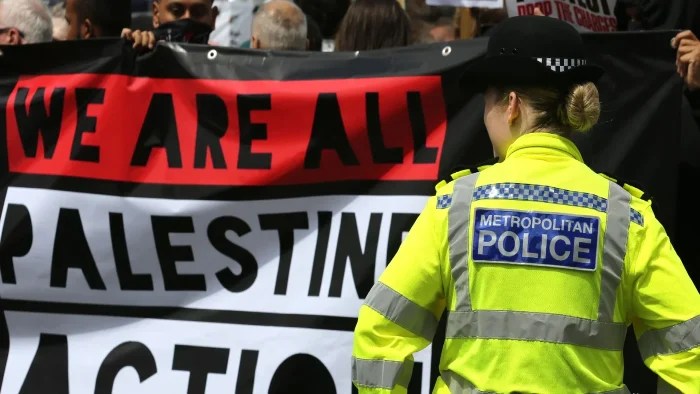
UK authorities charged six campaigners with 42 terrorism offenses on 3 September over their efforts to challenge the ban on Palestine Action.
They were released on bail the following day and placed under a strict curfew. Following hearings at Westminster Magistrates Court, the defendants, including former government lawyer Tim Crosland, were granted bail after the Crown Prosecution Service (CPS) requested they be held on remand.
Defend Our Juries (DOJ), the advocacy group to which the activists belong, said the judge’s decision prevented them from facing up to 18 months in custody due to court backlogs.
According to DOJ, the bail conditions include a tagged curfew between 7:00 am and 9:00 pm, a ban on contacting co-defendants, and a prohibition on supporting Palestine Action either “directly or indirectly.”
A DOJ spokesperson described the outcome as both relief and outrage. “We welcome the release of our key spokespeople and the judge’s decision to reject the CPS’s absurd attempt to remand them in prison for what could have been many months. However, the fact that they are now facing 42 charges between six of them and extraordinarily draconian bail conditions for hosting public Zoom calls is nothing short of a scandal.”
Police said the charges stem from an investigation led by the Counter Terrorism Command into allegations that the defendants coordinated protests and held 13 Zoom calls supporting Palestine Action.
Section 12 (2) of the Terrorism Act makes it a criminal offense to arrange a meeting in support of a proscribed organization, while Section 12 (3) criminalizes addressing such a meeting with the intent of encouraging support.
DOJ said the six were targeted by UK authorities when their homes were raided earlier this week, hours before they were due to announce details of a mass action planned for Saturday.
The group reported that homes were searched and the activists were held beyond the 24-hour custody limit before being charged.
The case follows the UK government’s 4 July decision to proscribe Palestine Action under anti-terror laws, a move triggered by an incident in which members broke into RAF Brize Norton and vandalized two military aircraft with paint and crowbars. The aircraft are reportedly linked to the genocidal war in Gaza and wider military operations across West Asia.
The designation equates the group with Al-Qaeda and the Islamic State, making public support for its activities punishable by up to 14 years in prison, a move strongly condemned by various groups and individuals as “grotesque,” “chilling,” and an “unprecedented legal overreach.”
The Zionist lobby put the final nail in the coffin of my career, here are the details
By Doc Malik | September 4, 2025
In November 2023, complaints were made about me from within my hospital, most likely by other staff, other doctors, who I suspect were sympathetic to Israel. Just before my suspension from the Princess Grace Hospital, two jewish surgeons contacted me to complain that I had Eva Bartlett on my podcast. The very next day, I was suspended. That was no coincidence.
And my story is not unique.
The Price of Speaking Out
Take Dr Rameh Aladwan, a Palestinian British trauma and orthopaedic surgeon. For almost two years she has been harassed, attacked, threatened. Attempts were made to strip her of her licence, her livelihood, even her home. Her crime? Speaking out against the genocide in Palestine.
In my case, my “sin” was hosting Eva Bartlett, an independent journalist. She stated that Israeli officials, after October 7, openly called for ethnic cleansing of Gaza. That was factually correct. I simply gave my guest the freedom to speak. For that, I was punished in my personal life, outside of my medical work. You can watch the episode here.
I was suspended for five months. Cleared at the end, yes, but by then my career was destroyed. And all this came after earlier suspensions for speaking out against the COVID gene jabs, transgender mutilation surgery, and finally the persecution of Palestinians.
The Hidden Hand
The Zionist lobby is powerful. Finance, media, culture, medicine, judiciary, they have influence in every corner. They whisper in shadows, smear your name, use policies, regulations, and institutions to destroy you. They rarely confront you face to face.
After waiting over a year, I finally obtained my file from the Princess Grace Hospital: 154 pages. Almost all of it was just my CV, contract, and medical records. One or two letters about my suspension. No evidence of who complained. No record of how the decision was made. No outcome of the investigation.
And then there were eight completely blacked-out pages.
What are they hiding? Who are they protecting?
A Sign of the Times
My case, Dr Rameh’s case, and the persecution of academics like David Miller all point to one truth: we do not live in a free society. Question the Zionist regime, question its influence on our country, and you will be labelled antisemitic and persecuted.
Criticising Israel is NOT the same as criticising all Jews. That distinction should be obvious. But they have made it otherwise. And that is dangerous.
We are told to worry about migrants invading our nations. Yes, to some extent. But that is not the real story. The invasion already happened. Our institutions are captured. Every branch: who are you not allowed to criticise?
There lies the real problem.
Here is the original letter announcing my suspension.


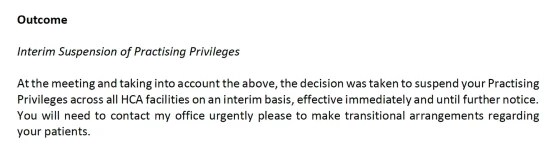
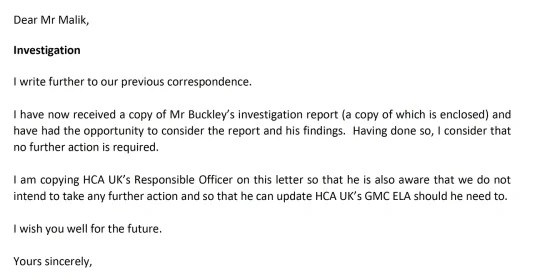
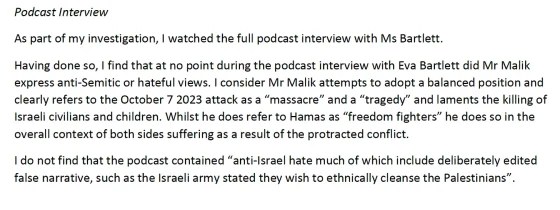
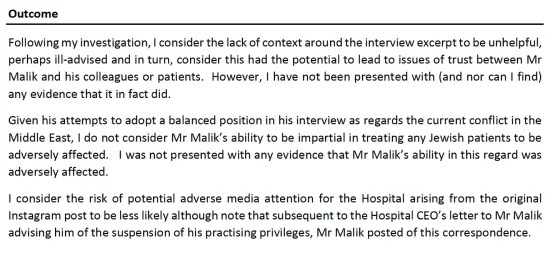
Here is the outcome of my investigation that I received 6 months after my suspension, and was sent to me by accident. Within minutes of receiving the copy of the investigation I was told to delete it as it had been sent in error. Please note I was NOT invited to defend myself, provide evidence or challenge the accusations.
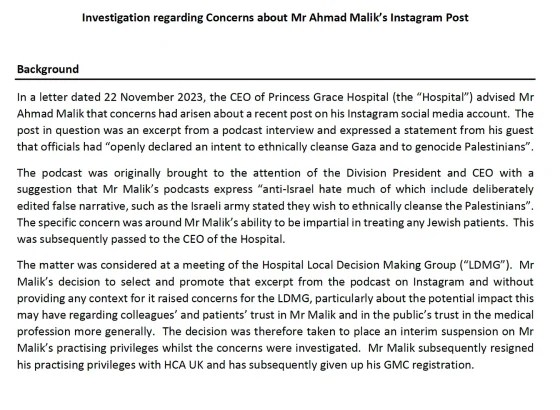
Here is the investigation they did NOT want me to see.
The Smear
Who brought my podcast “to the attention of the Division president and CEO with a suggestion that Mr Malik’s podcasts express “anti-Israel hate much of which include deliberately false narrative”.
The claim was made that “the specific concern was around Mr Malik’s ability to be impartial in treating any Jewish patients.”
Think about that.
In 25 years of practice, I have never treated any patient differently based on colour, sex, gender, sexual preference, ethnicity, or religion. Not once. I have never received a single complaint on those grounds. On the contrary, I have treated many Jewish patients over the years, who left glowing reviews and referred their friends and families to me.
To suggest that my criticism of a government could mean I would treat Jewish patients improperly is not only false, it is offensive. If I criticise the UK government, does anyone imagine I would mistreat English patients? If I criticise Saudi Arabia, would I treat Saudis with prejudice? Of course not. I am perfectly capable of separating governments from people. That is basic human decency. And when those governments wage wars on others, kill innocents, or carry out genocide, then yeah, I will not keep my mouth shut.
And yet this was the narrative used against me.
Perhaps this is why the hospital refused to release the outcome of their so-called investigation. An “investigation” in which I was never invited to participate, never allowed to present evidence, never given the chance to defend myself against anonymous accusations.
The Verdict They Buried
And here is the most damning part. In the summary of the investigation itself, the key line reads:
“As part of my investigation, I watched the full podcast interview with Miss Bartlett. Having done so, I find that at no point during the podcast interview with Ava Bartlett did Mr. Malik express anti-Semitic or hateful views. I consider Mr. Malik’s attempts to adopt a balanced position, and he clearly refers to the October 7, 2023 attack as a massacre and a tragedy, and laments the killings of Israeli civilians and children. Whilst he does refer to Hamas as freedom fighters, he does so in the overall context of both sides suffering as a result of the protracted conflict. I do not find that the podcast contained anti-Israeli hate… Given his attempts to adopt a balanced position in his interview as regards the current conflict in the Middle East, I do not consider Mr. Malik’s ability to be impartial in treating any Jewish patients to be adversely affected. I was not presented with any evidence that Mr. Malik’s impartiality in this regard was adversely affected.”
In other words, even their own process exonerated me. No hate. No anti-Semitism. No evidence whatsoever that my ability to treat patients impartially was in doubt.
And yet I was still suspended. My career was still destroyed.
What does that tell you about the real forces at play here?
What happened to me is not just about one surgeon, one hospital, or one podcast. It is about the kind of society we now live in. A society where speaking the truth about powerful interests can cost you your career, your reputation, even your freedom.
When institutions redact evidence, silence dissent, and smear critics with false accusations, we should all be alarmed. Because if they can do this to me, they can do it to anyone.
Freedom of speech is not the right to repeat approved slogans. It is the right to question, to challenge, to criticise, even when it makes people uncomfortable. Especially then.
Whether it be challenging lockdowns, masking, experimental jabs, wars, or genocides.
We must defend that principle. If we allow it to be eroded, if we allow powerful lobbies to decide who may speak and who must be silenced, then we are already living in captivity.
The real invasion has already happened. The question is: will we wake up and see it?
Britain’s Example Vindicates Rand Paul’s Opposition to ‘Kids Online Safety Act’
By Jack Hunter | The Libertarian Institute | September 4, 2025
In July 2024, Rand Paul (R-KY) was one of only three senators who voted against the Kids Online Safety Act (KOSA), legislation that sought to protect children from harmful material online. The other two were Senator Mike Lee (R-UT) and Senator Ron Wyden (D-OR).
Senator Paul said of his decision:
“How would platforms comply with KOSA’s requirement to mitigate and prevent undefined harms such as anxiety, depression, and eating disorders? Should platforms stop children from seeing war coverage because it could lead to depression? Should pro-life messages be censored because platforms worry it could impact the mental well-being of teenage mothers? Would sites permit discussion of a teenager overcoming an eating disorder?”
Fair questions, all. KOSA passed in overwhelming bipartisan fashion in the Senate but has not advanced through the U.S. House. Paul’s problem with it, with giving the government this power, was the many potential unintended consequences—ones that his senate colleagues apparently didn’t even consider.
Yet, Senator Paul’s worries are being proven in real time in the United Kingdom where their Online Safety Act (OSA) has just gone into effect, creating all sorts of problems, great, small, and dangerous.
Wikipedia has threatened to throttle traffic coming from the UK due to the law, where the platform is expected to block minors from “harmful” content, including articles covering “Bulimia nervosa” and “Oxford child sex abuse ring.”
A student might need to research eating disorders or child sexual abuse for educational purposes, but if Wikipedia allows this access, the platform could face fines of eighteen million in British pounds, or 10% of the website’s annual revenue.
Companies aren’t going to want to subject themselves to that kind of punishment.
How would—how can—Wikipedia actually police this? How would the many social media companies be able to keep tabs on the endless labyrinth of potentially worrisome material shared by millions on their platforms and the ages of users who have access to them?
The downsides to such laws are almost impossible to predict. Thanks to OSA, British users who did not want to verify their age have lost access to Spotify. The same was true for some Brits and pizza delivery. No pepperoni pie for you, young lad. Don’t worry, it’s for your own good.
The backlash against OSA has been significant. U.S.-UK dual citizen Liz Mair reported at Real Clear Policy:
“VPN apps, which allow a user to disguise their actual location, became the most downloaded apps in the UK—as Brits sought to dodge the restrictions. And in a matter of days, 500,00 Brits—approaching 1 percent of the population of England—signed a petition urging Parliament to debate a repeal of the law (10,000 signatures are all it takes to force an official response from the government; after 100,000 signatures, Parliament must consider a debate).”
So far, Paul’s KOSA worries looks prescient.
But the unforeseen negative effects of OSA get worse than pizza delivery and streaming services. Far worse.
There is a “Grooming Gangs” scandal in the United Kingdom that is a threat to young women and girls. Mair notes that with the OSA:
“… there have also been some really serious, adverse effects that actually could jeopardize, not enhance kids’ safety. It all demonstrates what many of us who criticized the law when it was a bill, and who have criticized the US companion bill, KOSA, have been saying for a long time: One man’s definition of ‘protecting’ children online can easily wind up hurting kids when a well-intentioned rule comes into effect.”
She’s not wrong.
“If you read up on the scandal, you will discover that it’s not really about ‘grooming’ at all, and much more about really horrific mass rape and abuse of kids orchestrated by gangs here in Britain,” Mair writes.
She notes as a practical matter:
“Maybe tween and teenage girls in areas where these gangs have operated don’t need to be exposed to every last detail, but surely they need to have some idea of the fact that if they accept gifts from an older ‘boyfriend,’ the end result may be really, really atrocious, almost unthinkable abuse—and not groping or unwanted kissing (and not just by the ‘boyfriend’ but dozens of his ‘friends’)?”
This is an important point. Shouldn’t young British girls be able to learn about the methods used by men who might harm them? But instead are being shielded by harsh but useful information in the name of protecting them?
In reality, is OSA really just making kids more vulnerable?
These are the sorts of problems Sen. Paul warned about with KOSA.
Politicians in both parties are always quick to support any legislation that is intended to “protect” children. But maybe they should pause and think about what the negative effects could be, for even a second? Thinking is not popular among politicians and this is bipartisan, with KOSA being co-sponsored by Senator Marsha Blackburn (R-TN) and Senator Richard Blumenthal (D-CT).
Americans of a certain age will recall the PATRIOT Act ushered in rapidly after 9/11 to supposedly better “protect” us was done so by overwhelming majorities in both parties. But instead of targeting foreign terrorists, that law ended up being used more to go after drug dealers.
Giving the federal government these sorts of extra-constitutional powers is never a good idea, and can be used against political opponents across the ideological spectrum depending on which party is in power. As Paul wrote in opposing KOSA, “This bill does not merely regulate the internet; it threatens to suppress important and diverse discussions that are essential to a free and healthy society. That is why a legion of advocacy groups on the left and the right, such as Students for Life and the American Civil Liberties Union, oppose KOSA.”
Rand Paul is right about KOSA and how it might not only harm liberty but endanger Americans if it passes.
The United Kingdom’s example should be proof enough.
Western European powers are facing major problems
By Mohammed Amer – New Eastern Outlook – September 5, 2025
The policies of major Western European countries are not understood by the majority of the population of these states because they do not serve their national interests. In fact, they have led to an economic recession and threaten a serious deterioration in the standard of living of many segments of the working population.
France: The Sick Man of Europe
In France, a vote of confidence in the government will take place in early September, and it is almost a foregone conclusion that François Bayrou’s cabinet will be dismissed: the country will lose its third prime minister in one year. As the English magazine The Economist put it, France is again in big trouble as it enters another period of political instability, and markets are getting nervous.
Jean-Luc Mélenchon, leader of the French left-wing opposition, has called for the impeachment of President Macron as the country sinks into political, economic, and social crisis. Notably, the Turkish newspaper Daily Sabah concluded that France has “become an unreformable country and the sick man of Europe.”
Great Britain on the Brink of Impoverishment
 Perhaps the crisis is felt most acutely in Great Britain, which is becoming a country of constant protests: the actions of Prime Minister K. Starmer are being increasingly harshly criticized. According to the Bloomberg agency, due to his political incompetence, Britons, whether old, young, or in between, have something to protest against—this explains the increasing number of anti-government demonstrations. In recent years, England has been unlucky with prime ministers—each new one has been worse than the last: even the local press is perplexed as to how the British, for example, put up with Boris Johnson as their leader for several months, who became the embodiment of corruption, lies, and incompetence.
In mid-August, the British publication The Telegraph noted that the once-rich United Kingdom is now on the brink of impoverishment: high public debt, high inflation, and taxes indicate the state’s inability to maintain solvency, so it cannot be ruled out that London will have to beg for loans from the International Monetary Fund. Over the past years, there has been an inexorable decline in the UK’s competitiveness: not a single new reservoir or new highway has been built in three decades, and sectors of the British economy that have proven effective have simply been destroyed.
“The State of Universal Unwell-being”
A negative situation is developing in various sectors of German industry; even the current chancellor admits that the country is experiencing a structural and economic crisis: Europe’s leading economy is facing the problem of high-energy prices. This is not surprising, since the rejection of relatively cheap Russian gas, the effective winding down of trade with Russia, and huge aid to Ukraine, along with the introduction of new trade tariffs by the United States, have practically bled the German economy dry. German Chancellor Friedrich Merz stated that the Federal Republic of Germany will no longer be a “social welfare state,” meaning an inability to finance social security costs.
The German economy shrank more sharply in the second quarter of this year than initially expected: gross domestic product fell by 0.3% compared to the previous three months, and investment also fell by 1.4%.
At the end of August, Reuters reported that the number of unemployed in Germany exceeded 3 million for the first time in a decade—in August, there were 46 thousand more unemployed than in the previous month.
Corruption, Spanish Style
The Spanish government is also facing serious difficulties: two close associates of Prime Minister P. Sánchez have been accused of corruption. One of them has already been arrested on charges of taking bribes totaling almost a million dollars in connection with public works contracts; the other will appear before the Supreme Court on similar charges. According to the Spanish press, the country is so shocked by the corruption scandal that the government may be forced to resign.
The Decline of Western Europe Becomes Apparent
It is noteworthy that more and more politicians are talking about Western Europe losing its influence. Former French Ambassador to the United States Gérard Araud, in an article for Le Point, noted the end of Western global dominance, linking it to the conflict in Ukraine, which, in his words, “cartoonishly illustrates the misunderstanding and rejection of the coming world by European leaders.”
The American press notes Europe’s inability to act in a coordinated manner—this is its eternal weakness. Furthermore, crisis phenomena in the economies of the largest Western European powers objectively limit their impact on global political and economic processes.
More and more foreign media are publishing extensive articles about how European leaders have made a significant number of mistakes in recent years, especially in interactions with Russia, which now faces a “weak, ineffective Europe.” The European Union has expanded too much, and decision-making has become very burdensome—this became painfully apparent starting in 2010, when the economic crisis in the eurozone led to the fall of governments in Greece, Ireland, Portugal, and Italy, followed by years of zero interest rates and sluggish growth.
Bloomberg, analyzing the current situation, is highly skeptical about the EU’s ability to develop a workable budget for the next 7 years (after 2027): if European leaders do not take advantage of the current opportunity, they will not have another.
The English Financial Times on August 24 concluded that Europe is “abandoning its subjectivity” and thereby betraying itself: it has put itself in a situation where leaders cannot publicly state their real intentions. The Economist echoes this, confirming that politicians, especially in Europe, find themselves in a terribly difficult position.
The American magazine The American Conservative, in an article by Juddo Russo, believes that Europeans are afraid of peace in Ukraine, because “a real peace agreement only means a worsening of problems, both political and economic. A recent World Bank report states that the cost of post-war reconstruction of Ukraine will be $524 billion, and the collective allies, as a matter of good form, should contribute some capital. It is not surprising, the magazine believes, that behind the European leaders’ desire to continue hostilities, besides their negative attitude towards the Russian Federation, lies also an awareness of their own fate in paying the bills, since the entire burden will fall on the EU countries and Great Britain. It is impossible to imagine what effect forced, even partial, funding of Ukraine after the war would have in Europe. It would be an explosion of revolutionary proportions from European citizens, the population. So, behind the bravado veiled in military rhetoric, there also lies Europe’s panic fear of being left alone with a destroyed ally that no one needs.”
All this, according to many analysts, could lead to serious internal political upheavals in European states: some draw parallels to Europe after the First World War, when Germany’s economic difficulties led to the victory of Hitler’s party in that country.
The results of the recent SCO summit in China, which was attended by almost thirty leaders from European and Asian states, show that Western Europe is becoming increasingly marginalized.
Mohamed Amer is a Syrian political analyst.
Follow new articles on our Telegram channel
‘Coalition of the Willing’ Ready to Deliver Long-Range Missiles to Ukraine — What Could Go Wrong?
Sputnik – 04.09.2025
Members of the “Coalition of the Willing” have expressed their readiness to supply Ukraine with long-range missiles, Downing Street said on Thursday.
A meeting took place in Paris earlier on Thursday in a hybrid format, chaired by UK Prime Minister Keir Starmer and French President Emmanuel Macron.
“The Prime Minister also welcomed announcements from Coalition of the Willing partners to supply long range missiles to Ukraine to further bolster the country’s supplies,” the prime minister’s office said in a statement.
Russian President Vladimir Putin previously stated that Ukrainian forces could only carry out such operations with NATO personnel involved, signaling direct Western participation in the conflict. This could fundamentally change the nature of the confrontation, with NATO members effectively fighting against Russia.
At the same time, Europe’s vision of security guarantees for Ukraine involves stationing troops away from the front lines for demonstration and training purposes, the Washington Post reported Thursday, citing unnamed officials with direct knowledge of the plans.
The deployment will include a “demonstration” element, with troops serving as a deterrent against Russia, and a “regeneration” element, which implies training and rebuilding the country’s military force. The ultimate goal is transforming the Ukrainian military into what EU leaders call a “steel porcupine,” the daily reported.
On Wednesday, French President Emmanuel Macron said that work on preparing security guarantees for Ukraine had been completed. The so-called coalition of the willing will meet in Paris on Thursday in a hybrid format to thrash out details of security arrangements. Following the meeting, several European leaders and Ukrainian President Volodymyr Zelenskyy will call US President Donald Trump, French media reported.
On August 18, US President Donald Trump held a meeting in Washington with Ukrainian and European leaders, after which he announced that France, Germany and the United Kingdom want to deploy troops on Ukrainian territory. He added that there would be no US troops in Ukraine during his presidency. Russian Foreign Minister Sergey Lavrov said previously that the presence of NATO allies’ troops on Ukrainian soil — under any flag and in any capacity, including as peacekeepers — was a threat to Russia, and that Moscow would not accept it under any circumstances.
Featured Video

Chinese jet fuel and the myth of energy independence
or go to
Aletho News Archives – Video-Images
Book Review
Former Insiders Criticize Iran Policy as U.S. Hegemony
By GARETH PORTER | CounterPunch | February 27, 2013
“Going to Tehran” arguably represents the most important work on the subject of U.S.-Iran relations to be published thus far.
Flynt Leverett and Hillary Mann Leverett tackle not only U.S. policy toward Iran but the broader context of Middle East policy with a systematic analytical perspective informed by personal experience, as well as very extensive documentation.
More importantly, however, their exposé required a degree of courage that may be unparalleled in the writing of former U.S. national security officials about issues on which they worked. They have chosen not just to criticise U.S. policy toward Iran but to analyse that policy as a problem of U.S. hegemony. … continue
Blog Roll
 Aletho News
- What is fueling unrest across the EU?
- Why no power can undermine Iran’s eternal dominance over the Strait of Hormuz
- Is The War Against Iran Over?
- Iran war will leave long-term ‘scar’ on Wall Street, investors warn
- How Iran decimated US power projection in West Asia: Military lessons of 40-day war
- Iran’s report details US-Israeli war crimes in targeting schools, hospitals, livelihoods
- NATO’s Slow Fracture: How Trump’s Iran War Exposed the Instrument of Hegemony
- Chinese jet fuel and the myth of energy independence
- Ukraine Sea Drone Fired From Libya Hit Russian Tanker in Mediterranean
- IRGC: Iranian forces launched no attacks during ceasefire hours
- If Americans Knew
- Military aid to Israel emerges as the latest political litmus test for Democrats
- The only Palestinian children’s rights organization closes following years-long Israeli campaign against it
- ‘I Can’t Forget the Smell’: Lebanese Reel After Israel Kills Over 300 in Single Day
- DNC Shoots Down Resolutions Calling Out AIPAC and Limiting Arms to Israel
- TCN: Is Israel Blackmailing President Trump?
- Israel killed at least 303 Lebanese yesterday – who were they? Daily Update
- Amnesty: Urgent – Protect Lebanese civilians from brutal escalation in Israeli attacks
- Is The War Against Iran Over?
- Inside the Israeli army’s propaganda wing
- Hundreds of Gaza Amputees Stranded in Legal Limbo
- No Tricks Zone
- New Study: No Linear Warming Or Glacier Retreat Along Northern Antarctic Peninsula Since 1980s
- An Inconvenient Tree: Uncovered In Alps… Europe Much Warmer Than Today 6000 Years Ago
- New Study Reports A 60% Slowdown In Greenland’s Ice Loss Rate In The Last Decade
- Low Intensity Tornado Wrecks Major Solar Farm, Creating A Potential Toxic Dump
- New Study Finds Warming Saves Lives…Cold Temperatures 12 Times More Deadly Than Excess Heat
- German Science Blog Accuses PIK Climate Institute Of Hallucinating Climate Tipping Points
- Devastating Assessment Of Comirnaty Vaccine By Former Senior Pfizer Europe Toxicologist
- New Study: CO2 Is ‘Effectively Negligible’ As An Explanatory Climate Change Factor Since 2000
- Former Pfizer Toxicologist Dr. Helmut Sterz Tells Bundestag Hearing Pfizer Vaccine Should Have Never Been Approved
- Energy Expert: Germany’s Nuclear Phaseout Was A “500 Billion Euro Mistake”
 Aletho News