Is Europe pushing for Palestinian statehood or Palestinian surrender?
By Malek al-Khoury | The Cradle | July 28, 2025
Since its inception in 1948, Israel has never operated within fixed borders. Expansion has always been its doctrine – not constrained by law, but propelled by force and endorsed by unwavering western support. Israel has refused to define its boundaries for almost eight decades because its very identity is rooted in a colonial ambition that has never truly ended.
From the Nakba (Catastrophe) to the Naksa (Setback), from territorial invasions to the annexation of Jerusalem, the Golan Heights, and the West Bank, the occupation state has continued to redraw its borders according to power, not legitimacy.
This expansionist project has only grown stronger with the rise of the messianic-nationalist current inside Israel, which sees full control over “Greater Israel” as a historical right that cannot be compromised.
Today, 77 years since the Nakba, Israel has advanced to full-throttle expansion mode – dispossessing Palestinians, destroying entire towns and villages, entrenching illegal Jewish settlements, and enforcing apartheid. Yet paradoxically, European states like France and the UK are preparing to recognize a “Palestinian state” precisely when Palestinian political geography is at its most fragmented, and when the Zionist project is at its most aggressive.
So what does this recognition actually mean? Is it a strategic achievement for Palestinians, or a diplomatic ruse that rebrands surrender as success?
A state without borders, a project without restraint
The 1917 Balfour Declaration marked the formal launch of a settler-colonial project in Palestine. What followed was not immigration but calculated dispossession – from British-facilitated land seizures and massacres, to the mass expulsions of the 1948 Nakba, which ethnically cleansed over 750,000 Palestinians.
This was not mere colonialism. It was ethnic replacement: Land was seized under imperial protection, then militarily conquered. This campaign never ended. It continued with the occupation of Gaza, Jerusalem, and the West Bank, and escalated after 1967. Israel’s goal has never been coexistence. It has always been Jewish supremacy.
The 1947 UN Partition Plan (Resolution 181) granted over 55 percent of historic Palestine to the Zionist movement, despite Jews owning just six percent of the land. The Zionist movement accepted this on paper to gain international legitimacy, then immediately violated its terms, occupying 78 percent of the territory by force.
To this day, the occupation state has not adopted a formal constitution, and the reason is that basing itself on the Partition Plan would have constrained its expansionist ambitions. The Zionist doctrine never recognized final borders, instead establishing a state with no official frontiers – because its ambitions stretch beyond Palestinian geography to include parts of Jordan, Syria, Lebanon, and Egypt.
The internal debate in Israel over declaring a “Jewish state” is not merely a legal argument, but an attempt to solidify an exclusionary and replacement-based identity – one that legally enshrines racial discrimination and denies Palestinians their status as an indigenous people.
Resistance realignment: 7 October and the Two-State shift
The earthquake triggered by Operation Al-Aqsa Flood shook not only Israel but also the political discourse of the Palestinian movement. Strikingly, Palestinian factions – including Hamas – have begun explicitly voicing support for the “Two-State Solution” after years of insisting on liberating historic Palestine in its entirety.
In an unprecedented statement, senior Hamas official Khalil al-Hayya said in May 2024:
“We are ready to engage positively with any serious initiative for a two-state solution, provided it entails a real Palestinian state on the 1967 borders with Jerusalem as its capital and without settlements.”
This tactical adaptation signals a significant shift. Key Palestinian actors are now openly considering a truncated state. Is this a reflection of changing power dynamics? Or an imposed realignment under regional and international duress?
Recognition as Leverage: France, Saudi Arabia, and normalization
Last week, in a post on X, French President Emmanuel Macron said:
“Consistent with its historic commitment to a just and lasting peace in the Middle East, I have decided that France will recognize the State of Palestine. I will make this solemn announcement before the United Nations General Assembly this coming September … We need an immediate ceasefire, the release of all hostages, and massive humanitarian aid for the people of Gaza. We must also ensure the demilitarization of Hamas, secure and rebuild Gaza. And finally, we must build the State of Palestine, guarantee its viability, and ensure that by accepting its demilitarization and fully recognizing Israel, it contributes to the security of all in the region. There is no alternative.”
France’s anticipated recognition of a Palestinian state in September is not driven by principle, but is a hard, cold geopolitical maneuver. It would appear that Paris is seeking closer ties with Riyadh, which has tethered normalization with Tel Aviv to progress on the Palestinian file. French recognition is thus a calculated signal to Saudi Arabia – not a gesture of solidarity with Palestinians.
In this equation, Palestine becomes currency. Its statehood is not affirmed as a right, but dangled as a precondition in normalization deals between Arab monarchies and the occupation state.
Strategic alignments: The Ankara–London Axis
With a third of MPs calling on British Prime Minister Keir Starmer to recognize Palestine, pressure is also piling on London.
In a statement, Starmer said:
“Alongside our closest allies, I am working on a pathway to peace in the region, focused on the practical solutions that will make a real difference to the lives of those that are suffering in this war. That pathway will set out the concrete steps needed to turn the ceasefire so desperately needed, into a lasting peace. Recognition of a Palestinian state has to be one of those steps. I am unequivocal about that.”
Britain, too, is not moving toward recognition out of moral clarity, but to reinforce its post-Brexit strategic axis with Turkiye. Ankara, a key trading partner of Israel and political backer of Hamas, views the recognition of Palestine as a tool to elevate its regional stature and energy leverage. For London, deepening ties with Turkiye promises economic and geopolitical dividends. The result is a converging Paris–Riyadh and Ankara–London recognition track.
Thus, two informal axes are forming: Paris–Riyadh and Ankara–London, both converging on the recognition of a Palestinian state. Yet neither axis approaches it from a principled belief in Palestinian rights, but rather through the lens of power, influence, and realpolitik.
The Palestinian state: Recognition without sovereignty
Even if every European country were to recognize Palestine, it would amount to little more than symbolism without enforcement. There would be no defined borders for the state, no control over its own territory, and no halt to the settlement expansion or annexation policies pursued by the occupation state.
Tel Aviv rejects the premise entirely. Israeli Prime Minister Benjamin Netanyahu has insisted that any future Palestinian state would be “a platform to destroy Israel,” and that sovereign security control must remain with Israel. He has repeatedly ruled out a return to the conditions that existed prior to 7 October.
The reality is that 68 percent of the West Bank, classified as Area C, remains under full Israeli control. More than 750,000 settlers are embedded across that territory, under the full protection of the occupation army. How can a state exist on occupied, fragmented land, under constant siege, and without sovereignty?
“I’ve just returned from a lecture tour around the world, and I can confidently say Israel’s global image and position are at their lowest point in history,” writes Israeli journalist Ben-Dror Yemini.
Yet despite this, Netanyahu’s far-right government is doubling down – pushing for full annexation of the occupied West Bank, eyeing new territorial footholds in Sinai, southern Syria, even Jordan, while maintaining military positions in south Lebanon.
Israel’s global brand may be eroding, but its strategic project is advancing.
If Israel is expanding and entrenching, while the Palestinian movement scales back demands and regional states normalize ties, what exactly has been achieved?
Resistance factions that once rejected Tel Aviv’s existence now propose statehood on its terms. European recognition comes with no teeth. Settlements grow. Displacement continues. This is not liberation. It is the burial of the dream under the guise of diplomacy.
The interim solution will become the final arrangement. The Palestinian “state” becomes a diplomatic euphemism – an empty structure praised in speeches, but denied on the ground.
UK cautions it could fight China over Taiwan
RT | July 27, 2025
The United Kingdom could resort to military force against China in the event of an escalation over Taiwan, British Defense Secretary John Healey has said, though he emphasized that London continues to prefer a diplomatic resolution.
Speaking to The Telegraph during a visit to Australia, Healey said Britain would “secure peace through strength” if necessary – marking one of the clearest signals yet from a senior UK official regarding the possibility of direct confrontation with Beijing.
Healey made the remarks as the HMS Prince of Wales, a British aircraft carrier equipped with F-35 fighter jets, docked in the northern Australian city of Darwin. It is the first time in nearly 30 years that a British strike group has arrived in the region. The carrier is on a nine-month Pacific deployment, participating in Australia’s Talisman Sabre exercise and visiting ports in Japan and South Korea.
”If we have to fight, as we have done in the past, Australia and the UK are nations that will fight together. We exercise together and by exercising together and being more ready to fight, we deter better together,” Healey said when asked what London would do in case of an escalation around Taiwan.
The secretary then said he was speaking in “general terms.” According to Healey, London’s approach to Taiwan has not changed.
China considers the island of Taiwan part of its territory under the One-China principle, and insists on eventual reunification. According to the Chinese government, peaceful reunion is preferable, but it reserves the right to use force if necessary.
Taiwan has been self-governed since 1949, when nationalist forces retreated to the island after losing the Chinese Civil War. Most nations, including Russia, recognize Taiwan as part of China. The UK, as well as the US, also formally stick to the One-China principle while maintaining informal ties with Taiwan and supplying it with weapons and ammunition.
Last month, Beijing criticized a British warship’s passage through the Taiwan Strait in Chinese territorial waters. Such actions “deliberately cause trouble” and undermine peace in the area, it said.
UK Reveals New Details of Upcoming Pandemic Exercise Similar to Event 201 That Preceded COVID
The Defender | July 25, 2025
The U.K. this month released new details for a sweeping pandemic response exercise — the largest in its history — to take place over multiple days between September and November 2025.
Exercise Pegasus, the first of its kind in nearly a decade, aims to span all regions and government departments in the U.K., and will involve opening a “resilience academy” to train over 4,000 people from public and private sectors annually in emergency roles, Minister for Intergovernmental Relations Pat McFadden told Parliament on July 8.
The response plan also includes developing a national “vulnerability map” to highlight populations most at risk in a crisis. The tool, which uses data on age, disability, ethnicity and whether the person is receiving care, can share that data instantly across government departments.
Comedian and political commentator Russell Brand, quoting Jon Fleetwood on Substack, pointed out that news on the U.K. government tracking tool comes as, in the U.S., the Department of Defense “prepares AI-driven simulations for pandemics caused by ‘natural or man-made infectious agents,’” while funding researchers who want to “infect humans with aerosolized influenza under the guise of improving disease models.”
Britain’s Exercise Pegasus was developed in response to the July 2024 recommendations made by the UK Covid-19 Inquiry, an ongoing public investigation into the handling of the pandemic.
The U.K. is also testing its ability to instantaneously reach its citizens by sending an alert to 87 million cellphones at once. McFadden said it will be the second time the test has been used on a nationwide basis since its launch in 2023.
“These changes will improve our resilience and preparedness and help to safeguard our citizens,” McFadden said in a January 2025 press release announcing the U.K.’s rough proposals.
However, others say the plans are less about safeguarding citizens and more about controlling them.
“The timing has sparked concerns that governments and international agencies may be coordinating future lockdown scenarios under the guise of preparedness, raising the specter of another orchestrated pandemic event,” Fleetwood wrote on Substack.
In May, U.K. Prime Minister Keir Starmer signed an international pandemic treaty, designed to help the World Health Organization (WHO) “co-ordinate the international response to any future pandemics,” according to The Telegraph.
The U.K. is also legally obligated to “develop, strengthen and maintain the core capacities” tied to the WHO because it “failed to reject the 2024 amendments to the International Health Regulations,” said independent journalist James Roguski.
These core capacities include “surveillance,” “rapidly determining the control measures required to prevent domestic and international spread,” and “addressing misinformation and disinformation.”
“Sounds to me like control,” Brand said. “Control of observation and the control to implement the use of medicines. Do you remember last time? How they shamed, how they blamed, how they shot down protests, how they condemned people that were opposed to vaccines?”
The newly enacted amendments allow the WHO “to order global lockdowns, travel restrictions, or any other measures it sees fit to respond to nebulous ‘potential public health risks,’” the U.S. Department of Health and Human Services (HHS) said in a July 18 press release announcing its rejection of the regulations.
In a video released July 18, U.S. Health Secretary Robert F. Kennedy Jr. said:
“The new regulations employ extremely broad language that gives the WHO unprecedented power. They require countries to establish systems of risk communications so that the WHO can implement unified public messaging globally. That opens the door to the kind of narrative management and propaganda and censorship that we saw during the COVID pandemic.”
In early 2021, before Kennedy led the HHS, he was deplatformed on numerous social media sites for criticizing regulatory corruption and authoritarian public health policies.
Kennedy described the efforts of Microsoft founder Bill Gates, who in 2019 helped organize an exercise of four simulations of a worldwide coronavirus pandemic. At Gates’ direction, Kennedy said, participants primarily focused on planning industry-centric, fearmongering, police-state strategies for managing an imaginary global coronavirus contagion culminating in mass censorship of social media.
The exercise, referred to as Event 201, included representatives from the World Bank, the World Economic Forum, Johns Hopkins Center for Health Security, the Centers for Disease Control and Prevention, various media powerhouses, the Chinese government, a former CIA/National Security Agency director, vaccine maker Johnson & Johnson, the finance and biosecurity industries and Edelman, the world’s leading corporate PR firm.
However, when the COVID-19 pandemic hit, Gates claimed the simulation didn’t occur. Despite videos of the event, he told BBC on April 12, 2020, “Now here we are. We didn’t simulate this, we didn’t practice, so both the health policies and economic policies, we find ourselves in uncharted territory.”
One segment of Gates’ Event 201 script focused on the manipulation and control of public opinion. The presumption among participants was that such a crisis would provide an opportunity to promote new vaccines and tighten controls by a surveillance and censorship state.
“There is nothing intrinsically wrong with preparedness, or rehearsals,” said Dr. David Bell, a public health physician and biotech consultant. The problem is that, in order to achieve this, governments “have to undermine the basic tenets of democracy such as free speech and movement.”
Related articles in The Defender
- ‘Defining Moment in Human History’: U.S. Rejects WHO’s International Health Regulation Amendments
- Before COVID, Gates Planned Social Media Censorship of Vaccine Safety Advocates With Pharma, CDC, Media, China and CIA
- Trump Orders U.S. to Withdraw From World Health Organization
- ‘We Will Not Comply’ with Pandemic Treaty, 26 Republican Governors Tell WHO
This article was originally published by The Defender — Children’s Health Defense’s News & Views Website under Creative Commons license CC BY-NC-ND 4.0. Please consider subscribing to The Defender or donating to Children’s Health Defense.
The UK’s Online “Safety” Act Is Already Causing Protests To Be Hidden
By Cindy Harper | Reclaim The Net | July 26, 2025
British users attempting to view videos of anti-mass migration protests on X found themselves blocked on Friday, coinciding with the day the UK’s sweeping Online Safety Act took effect.
Enacted by the previous Conservative government, and continued by the current Labour government, the legislation is already being condemned for facilitating online censorship under the veil of child protection.
Although sold to the public as a safeguard against minors encountering explicit content, the enforcement mechanisms are now being used to restrict access to politically charged material.
The protests in question were sparked by outrage over an incident in Epping, where a migrant allegedly sexually assaulted a 14-year-old girl while living in a taxpayer-funded hotel. Demonstrations followed swiftly, but footage of these events is now being filtered from UK audiences.
Users attempting to access the protest content were met with a message stating, “Due to local laws, we are temporarily restricting access to this content until X estimates your age.”
The restricted material reportedly included scenes of arrests and clashes during the protests, not the kind of content the law claimed to target.
To meet the law’s requirements, X has implemented various age estimation strategies.
These techniques, originally framed as tools to shield minors from graphic material, are now being used to restrict access to politically relevant video.
With companies facing penalties of up to £18 million ($24M) or 10 percent of their global revenue, platforms are expected to err heavily on the side of caution.
The result is a system that punishes openness and silences dissent under threat of financial ruin.
Elon Musk, who owns X, did not refer directly to the blocked protest videos, but spoke bluntly about the law’s broader intent. “… purpose is suppression of the people,” he posted on Saturday.
The Free Speech Union, which had repeatedly warned about the law’s implications, responded quickly. “If you have a standard X account in the UK – presumably the majority of British users – it appears that you may not be able to see any protest footage that contains violence. We’re aware of one censored post that shows an arrest being made,” the organization stated. “We warned repeatedly about how censorious this piece of legislation would be.”
A petition to repeal the Online Safety Act has now gathered more than 160,000 signatures, surpassing the threshold that requires Parliament to consider it for debate.
At the same time, searches for virtual private networks (VPNs), which allow users to access the internet as if they were located in another country, surged by over 700 percent in the UK.
Rather than safeguarding young users, it is granting extraordinary power to censor politically inconvenient material and narrowing the digital space available for public dissent.
Voices from the Terror List: Palestine Action Members Speak Out After UK Ban
By Kit Klarenberg | MintPress News | July 25, 2025
On July 1, British Home Secretary Yvette Cooper announced that Palestine Action (PA), a crusading campaign effort, would be proscribed as a terrorist group. Describing the movement as “dangerous,” she charged that its “orchestration and enaction of aggressive and intimidatory attacks against businesses, institutions and the public” had “crossed the thresholds established in the Terrorism Act 2000.” As a result, PA is now the country’s first protest group to be formally branded a terrorist entity, placing it in the same league as al-Qaida and ISIS.
Based on Cooper’s characterization, a typical consumer of mainstream media might conclude PA posed a grave threat to Britain’s public safety and national security. However, other comments by Cooper appeared to undermine her incendiary headline charges. In justifying PA’s proscription, the Home Secretary cited recent actions conducted by the movement. These included “attacks” on factories owned by defense contractors Thales in 2022 and Instro Precision in 2024, each causing more than £1 million in damages.
As hundreds of lawyers and multiple U.N. experts argued in the week before the proscription took effect, the move set an extremely dangerous precedent not only in Britain but for Palestine solidarity efforts worldwide. The group did not engage in activities that could plausibly be categorized as “terrorism”—a highly contentious concept, popularized by Israel for political reasons—in other Western jurisdictions. Average citizens were not in Palestine Action’s crosshairs, and not once did the group’s activism harm a human being.
Instead, PA engaged in multifaceted civil disobedience, targeting firms closely tied to Israel’s slaughter of Palestinians, most prominently the Israeli-owned defense giant Elbit Systems. Entities providing services to those targets—such as companies leasing commercial space to Elbit—were also in the group’s crosshairs. These actions proved devastatingly effective, hitting Elbit’s bottom line at home and abroad. PA’s disruption also brought unwelcome mainstream attention to Elbit’s operations, spotlighting the firm in ways it clearly sought to avoid.
In proscribing Palestine Action, the British government may have been motivated, in part, by a desire to avoid awkward questions and inconvenient disclosures. In one of the group’s final actions, on June 19, several members broke into Royal Air Force base Brize Norton and defaced two military planes parked there. The site is a key hub for refueling and repairing British jets that have conducted hundreds of reconnaissance flights over Gaza since the genocide began in October 2023.
These routine surveillance flights are just one component of London’s active involvement in the genocide, which authorities systematically seek to conceal from public view. Another is the presence of the SAS conducting “counterterrorism” operations in Gaza, which has been covered up via direct state decree. However, the origins of Palestine Action’s proscription stretch back much further. The story behind the ban is a sordid and largely hidden one marked by long-running, opaque collusion between British and Israeli authorities and the global arms industry.
The Legal and Political Fallout
As a result of PA’s proscription, it is now a criminal offense to be a member of, or to express “support” for, the group, punishable by up to 14 years in prison. However, an Actionist who wishes to remain anonymous predicts many will deliberately breach the proscription order, knowing they’ll face legal consequences, to increase pressure on authorities. Already, dozens of British citizens — including an 83-year-old priest — have been arrested for peacefully displaying signs declaring, “I oppose genocide. I support Palestine Action.”

“Things are going to happen, without doubt. The group may be proscribed, but you can’t proscribe ideas, whether that’s opposition to the Holocaust in Gaza, sympathy with Israel’s innocent victims, or a desire to disrupt the network of genocide in Britain to which Elbit and its subsidiaries and suppliers are so central,” the Actionist tells MintPress News. “Still, the chilling effect on Palestine solidarity is obvious, and no doubt deliberate.”
The mass arrest of peaceful demonstrators for simply expressing sympathy for Palestine Action highlights a deeply troubling aspect of British “counterterror” legislation. The term “support” isn’t even clearly defined, and according to legal precedents, can extend far beyond practical or tangible assistance, to “intellectual” support, including “agreement with and approval” or “speaking in favor” of a proscribed group. In December 2024, UN experts expressed immense disquiet over this “vague and overbroad” interpretation, warning that it could “unjustifiably criminalize legitimate expression.”
“The proscription of Palestine Action is unprecedented. It’s the first time Britain has banned as ‘terrorist’ a protest group which has never used guns or bombs,” Asa Winstanley of Electronic Intifada tells MintPress News. “It seems like a massive overreach, and therefore it’s not surprising there’s been lots of civil disobedience in response.”
Surprisingly, even The Times, typically a reliable megaphone for Britain’s intelligence, military and security apparatus, published an editorial on July 7 intensely critical of “the heavy-handed branding of Palestine Action as terrorists,” dubbing the proscription “absurd.” While describing the group as “a malign force” and “antisocial menace,” the outlet argued that activists’ damage to commercial and private property could be “prosecuted into submission” under existing criminal law and the use of “lighter-touch measures” given the level of threat posed by Palestine Action.
Notably absent from The Times editorial was any consideration of the fact that criminal proceedings against Palestine Action frequently ended in failure. In several cases, Actionists who caused mass disruption or damage to Elbit sites walked free even on relatively minor charges, because the company declined to provide police or prosecutors with witnesses or other evidence.
Elbit is extremely wary of advertising the central role its arsenal plays in the killing of Palestinians. The company’s marketing brochures typically omit mention of its Israeli ownership, instead emphasizing the supposed economic and social benefits its operations deliver to British communities. A January 2023 puff piece on UAV Systems, an Elbit subsidiary repeatedly targeted by Palestine Action, even referred to the company as a “little company making repurposed Norton motorbike engines.”
In cases where Elbit did provide evidence, Actionists used the opportunity to turn the tables and place the company and the Israeli state on trial. In November 2022, five of the group’s activists who vandalized Elbit’s London HQ were acquitted. In defending their actions, several of the accused testified to witnessing first-hand atrocities committed by Israeli occupation forces in Gaza and the West Bank. While Elbit argued Palestine Action’s buckets of red paint were “improvised weapons,” the jury was not persuaded.
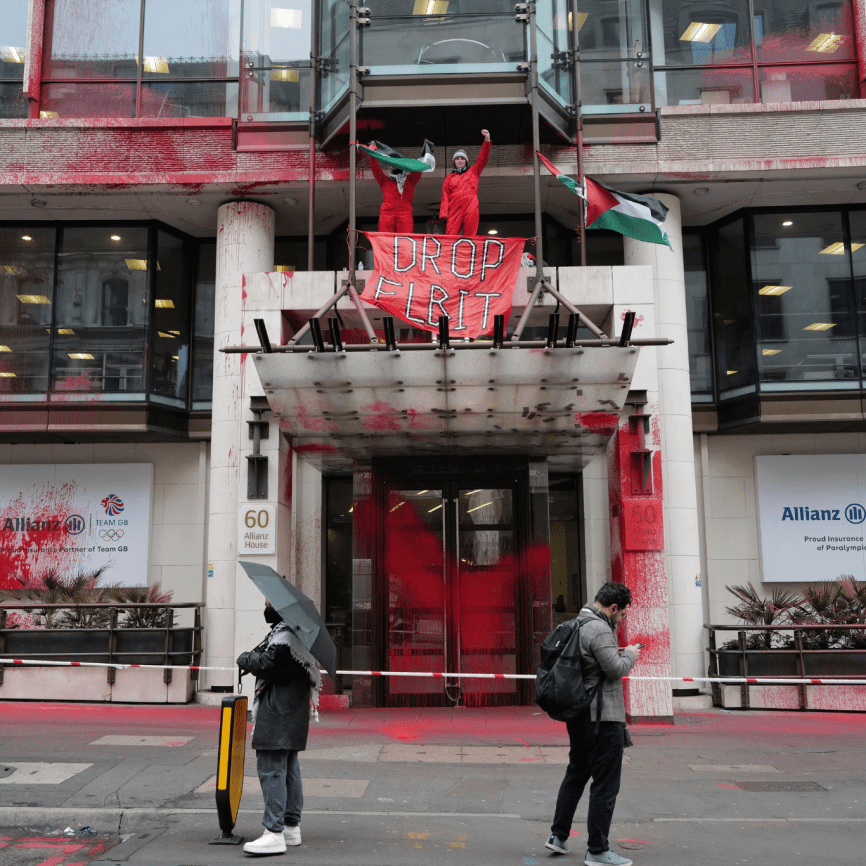
Palestine Action members target Allianz offices in London, demanding it stop insuring Israeli arms maker, Elbit Systems. Joao Daniel Pereira | AP
Judicial Battles and Public Defiance
Fast forward to today, and the anonymous Actionist is under no illusions that the British legal system alone will be enough to reverse Palestine Action’s proscription. “It has to be fought amongst the public, on the streets and in the courts,” they tell MintPress News. The group has applied for a judicial review in an effort to overturn its ban. This follows an application for interim relief to delay the proscription, which was denied after Yvette Cooper’s announcement.
Despite submitting an extensive witness statement outlining the serious implications that Actionists—and ordinary British citizens—could face if the ban took immediate effect, a panel of three judges took less than 90 minutes to reject the request. The justices acknowledged that there would be “serious consequences” from the government’s ban, including the risk that individuals could “unwittingly commit” criminal offenses and that those associated with the group might face “social stigma and other more serious consequences at university or at work.”
Palestine Action had warned the ban would create confusion and chaos. Police responses to pro-PA protests across Britain have varied wildly. Some resulted in no arrests, while in Wales, protesters were not only arrested under terror legislation but also had their homes raided. Videos of interactions between Palestine solidarity protesters and police suggest officers themselves are unsure about what is now lawful. In Scotland, four people were arrested for wearing T-shirts that didn’t even mention the group.
Speaking to MintPress News, the anonymous Actionist expressed frustration over the court’s decision. “A UN Special Rapporteur supported us, warning the proscription breached international standards, but apparently British judges know better. It just shows how corrupt the entire system is. Every part of it is rotten,” they lament. “The government, almost unanimously supported by parliament, rammed through the conscription without warning or any public debate whatsoever, after falsely briefing the media we might be funded by Iran. Who will they target like this next?”
As Declassified UK has documented, nearly every major British outlet ran with the Home Office’s Iran narrative, without offering PA a rebuttal. In a particularly revealing twist, the pro-Israel lobby group We Believe In Israel—which does not disclose its funding sources—openly took credit for the government’s decision. In an X post, the organization called the proscription its “victory,” claiming it was the direct result of months of “sustained research, strategic advocacy, and evidence-based reporting” contained in a report it had published earlier in the year.
Collusion and Israeli Influence
Again, the anonymous Actionist is unsurprised that British policy—if not legislation—is effectively being written by Israeli lobby groups. Yvette Cooper, Foreign Secretary David Lammy, Chancellor Rachel Reeves and Prime Minister Keir Starmer were all named as supporters of Labour Friends of Israel, before the list was scrubbed from the internet ahead of the 2024 general election. LFI, which praised the proscription, maintains a close relationship with Tel Aviv’s London embassy, which is widely believed to be infested with Mossad agents—a connection the group works to obscure.
In recent months, PA and independent journalists have uncovered compelling evidence that the Home Office has been in secret contact with Elbit representatives and Israel’s London embassy almost since the group’s founding in 2020. The full scope of this collusion is still unknown and may never come to light. However, documents released under Freedom of Information laws raise serious concerns about whether this concealed relationship influenced both the prosecution of Actionists and the decision to proscribe the group.
For example, in March 2022, then-Home Secretary Priti Patel met privately with Elbit UK CEO Martin Fausset to reassure the firm—and, by extension, its Israeli handlers—that the British government was taking “criminal protest acts against Elbit Systems UK” seriously. At the time, officials acknowledged that Palestine Action’s activities did “not meet the threshold for proscription” under British law. Before that meeting, no PA members had been successfully prosecuted. In the months that followed, legal actions against the group escalated dramatically.
Still, many Actionists continued to walk free. In December 2023, six members—including co-founders Huda Ammori and Richard Barnard—were acquitted of nine charges by a jury. The following month, internal correspondence revealed Elbit UK’s security director wrote to British officials expressing concern that “a re-trial is not a certainty” and suggesting it was “very much in the public interest” for the trial to be reheard.
Mere days later, a retrial was announced—for 2027. That would mark six years since the alleged offenses took place. One Actionist called the drawn-out process a “form of psychological warfare on defendants,” saying it prevents them from making long-term plans or securing employment. Meanwhile, other PA members are imprisoned awaiting trial, some already incarcerated for extended periods. There are disturbing signs that their detention and prosecution are being coordinated with Israeli authorities.
Among the most alarming revelations are heavily redacted emails showing that, in September 2024, the British Attorney General’s Office shared contact details for the Crown Prosecution Service and counterterrorism units with the Israeli embassy. The timing raises suspicions of Israeli interference in the prosecution of PA members who, earlier that month, broke into Elbit’s Filton factory and destroyed quadcopters—weapons routinely used to maim and kill Palestinians in Gaza.

Source | Kit Klarenberg | The Grayzone
In all, 18 Actionists involved are currently remanded in prison, their pre-trial detention period running to 182 days, well in excess of standard limits for non-terror-related cases. Their contact with the outside world has also been severely restricted, in violation of international legal norms. On July 15, another five PA members were arrested and charged in connection with Filton.
If the Israeli government played any role in these prosecutions, it would represent a flagrant breach of Crown Prosecution Service guidelines, which prohibit “undue pressure or influence from any source.”
In May, British prosecutors announced they would consider “terrorism connections” in the case of 10 Actionists who targeted Instro Precision, an Elbit supplier, in June 2024. While the charges—aggravated burglary, criminal damage and violent disorder—do not qualify as terrorism under British law, prosecutors say those connections may factor into sentencing. If upheld, that designation could lead to significantly harsher penalties than standard criminal charges would normally carry.
Legal Challenges Mount
On July 21, London’s High Court heard arguments from lawyers representing Huda Ammori, seeking permission to challenge Palestine Action’s proscription. In addition to citing devastating figures related to the genocide in Gaza and Elbit’s direct involvement, the legal team also emphasized the legal uncertainty now faced by activists and journalists as a result of the ban.
In response, government lawyers argued that the Proscribed Organisations Appeal Commission—not a judicial review—was the appropriate forum to challenge the designation. At the hearing’s conclusion, the judge stated a full ruling would be issued on July 30.
Earlier, on June 24, Jewish News revealed that British authorities had hesitated to proscribe PA out of concern that a judicial review “could overturn” the decision. That concern reportedly contributed to initial “reticence” from the Home Office. Even if the review is authorized, it could take months for a ruling to be reached.
In the meantime, journalist and legal scholar Leila Hatoum offered a stark assessment of the situation. She told MintPress News that the British state’s targeting of the group “for standing against genocide and oppression” was “nothing short of tyranny.” She added that the ban not only threatens basic rights—particularly freedom of speech and freedom of the press—but also violates international law.
The Convention on the Prevention and Punishment of the Crime of Genocide, which was adopted by the UN in 1948, notes it is the duty of all nations and peoples to act to stop a genocide. By legally pursuing those who are seeking to prevent Israel’s ongoing apartheid, occupation and genocide against the Palestinians in Gaza, especially members and supporters of Palestine Action, the UK has positioned itself against the international law, and alongside the forces of darkness. The country has failed humanity.”
A Legacy of Resistance
Despite this bleak outlook—and the possibility that the group could remain proscribed regardless of any court challenge—Palestine Action’s example remains an inspiration to people across Britain and beyond. A volunteer group of ordinary citizens, spanning every age, ethnicity, faith and gender, without financial or institutional backing, posed such a threat to entrenched power that the British government, for the first time in history, resorted to a legal “nuclear option” to neutralize them.
Civil disobedience aimed at disrupting military operations has a long and established history. Since the early 1980s, the Christian pacifist Plowshares movement has carried out sabotage against U.S. military bases and nuclear installations. In 2003, five activists were prosecuted for damaging American bombers at a British base to prevent their use in the Iraq War. One of the defendants was represented by none other than Keir Starmer, who argued successfully that although their actions were technically illegal, they were justified as an effort to prevent war crimes.
Palestine Action represents the first group to maintain this legacy during an active, ongoing genocide, but ever since its launch, it has achieved major victories. In January 2022, Elbit sold off one of its component factories, and a British government prosecutor acknowledged that PA’s sustained actions against the site “forced the closure.” Two additional Elbit sites targeted by the group have since been shut down. Governments around the world, including Brazil and even Britain, have canceled lucrative contracts with the company.
Had the British state not acted so forcefully, it is likely that Palestine Action’s momentum would have continued building, possibly forcing Elbit out of the UK entirely. Yet despite the risk of arrest or prison, solidarity with Palestine and overt support for Palestine Action show no sign of fading. As Israel’s favorability plummets to historic lows across the West, there are countless individuals around the world ready to follow PA’s example, risking their liberty to stop the ongoing genocide.
After all, it is not just a moral duty. It is a legal one.
UK could ‘easily’ stab US in the back – Putin aide
RT | July 25, 2025
The United Kingdom would not hesitate to sabotage a potential thaw in US-Russia relations, a top aide to Russian President Vladimir Putin claimed on Friday.
Nikolay Patrushev, a longtime national security official and senior Kremlin adviser, accused London of being prepared to carry out a false flag in order to derail efforts by US President Donald Trump to resolve the conflict in Ukraine and normalize ties with Moscow.
“If necessary, London would easily stab Washington in the back. I believe officials in the White House realize what kind of ‘ally’ they are dealing with,” Patrushev told RIA Novosti.
His comments followed a statement last month by Russia’s Foreign Intelligence Service (SVR), which alleged that British intelligence was directly involved in orchestrating covert Ukrainian operations. The SVR claimed the UK had acquired torpedoes of Soviet and Russian design for potential use in a false flag incident – specifically, a staged attack on an American naval vessel in the Baltic Sea.
Since Trump’s return to office in January and the departure of Joe Biden’s Democratic administration, Russian officials have frequently pointed to London as the primary force behind the continued conflict in Ukraine. They argue that the British government’s firm support is an obstacle to peace and a strategic effort to block reconciliation between Washington and Moscow.
Moscow has portrayed the Ukraine conflict as a NATO-driven proxy war meant to weaken Russia at the expense of Ukrainian lives.
Past reporting by The New York Times and The Times of London has confirmed that both US and British officials have played more active roles in directing Ukrainian military strategy than publicly acknowledged by their governments.
Pentagon Quietly Returns Nuclear Bombs to UK for First Time Since 2008
Sputnik – 21.07.2025
WASHINGTON – The United States has reportedly returned its nuclear weapons, including an unspecified number of B61-12 thermonuclear gravity bombs, to the British Lakenheath air force base in Suffolk, the UK Defense Journal reported, citing multiple sources.
For the first time since at least 2008, the United States has transported weapons from the US Air Force Nuclear Weapons Center at Kirtland Air Force Base in New Mexico to a newly established secure storage facility in Suffolk, UK, the journal reported on Sunday.
The Lakenheath base stored US nuclear weapons during the Cold War, with their removal occurring in 2008 as part of disarmament initiatives. The potential reintroduction of nuclear bombs to Europe coincides with worsening relations between NATO and Russia, particularly due to the ongoing conflict in Ukraine and the military alliance’s efforts to enhance its readiness.
The B61-12 bomb is an enhanced version of the B61 nuclear bomb, featuring advanced guidance systems and variable yield capabilities. As a key element of the United States’ strategic nuclear arsenal, it is designed for deployment through various delivery systems, including F-35A Lightning II aircraft and other platforms.
E3 violated JCPOA, lost right to reinstate UN sanctions against Iran: Russian envoy
Press TV – July 21, 2025
A senior Russian diplomat says Britain, France, and Germany, known as the E3, have repeatedly violated the terms of the 2015 nuclear deal, and thus forfeited their right to trigger the snapback mechanism that would re-impose all UN Security Council sanctions on Iran.
Russia’s Permanent Representative to International Organizations in Vienna, Mikhail Ulyanov, made the remarks in an interview with Izvestia newspaper on Monday, days after the E3, in coordination with the US, threatened to initiate the 30-day snapback process if there is no progress on Iran’s nuclear talks by the end of August.
“As for the threats of Westerners to initiate a mechanism for restoring sanctions, it is quite rightly noted that this idea is illegitimate,” Ulyanov said.
“The Americans themselves withdrew from the JCPOA, renouncing the rights and obligations of a participant in the nuclear deal, and the United Kingdom, Germany and France are violators of both the JCPOA and UN Security Council resolution 2231. This means that they have also deprived themselves of the right to initiate a ‘snapback.’”
He was referring to the Joint Comprehensive Plan of Action, the official name of the Iran nuclear accord, which the US ditched in 2018 before returning the illegal sanctions that it had lifted against Iran and launching the so-called “maximum pressure” campaign.
Following the US withdrawal, the European signatories to the JCPOA failed to uphold their commitments and made no efforts to save the agreement.
Also in his remarks, the Russian envoy criticized the Europeans and Americans for using “the tactics of forceful pressure” against Tehran, saying such an approach has no chance of success.
“The habit of Europeans and Americans to set certain deadlines all the time is quite counterproductive,” he said, citing the negotiations aimed at restoring the JCPOA in 2021-2022 as an example.
In an X post on Sunday, Ulyanov emphasized that the E3 “has no legal or moral right” to activate the snapback procedure.
Earlier, Iran’s Foreign Minister Abbas Araghchi sent a letter to the UN chief, the Security Council president, and the top EU diplomat, saying the E3 have relinquished their role as “participants” in the JCPOA, rendering any attempt to trigger the snapback mechanism “null and void.”
Russia, China, and Iran to hold nuclear talks – Tehran
RT | July 21, 2025
Russia, China, and Iran will hold talks on Tuesday to discuss Tehran’s nuclear program, Esmaeil Baghaei, a spokesman for the Iranian Foreign Ministry, has announced. He noted that a separate round of talks with European nations is scheduled for later this week.
Speaking to reporters on Monday, Baghaei said that the trilateral talks would also focus on the threats by Britain, France, and Germany to reimpose UN sanctions on Iran over its nuclear program. In particular, French Foreign Minister Jean-Noel Barrot warned of a potential sanctions snapback next month if no meaningful progress is made in limiting Iran’s nuclear activities.
Baghaei noted that Russia and China remain members of the 2015 nuclear deal and hold significant influence in the UN Security Council. He added that Iran had had “good consultations” with the two countries regarding the potential sanctions snapback. “Legally and logically, there is no reason for the return of sanctions lifted under the [nuclear deal],” he stressed.
The spokesman also confirmed that Iran would hold a separate meeting at the deputy foreign minister level with Britain, France, and Germany in Istanbul on Friday, adding that Tehran has “no plans to talk with the US” at this time.
One of the key stumbling blocks has been Iran’s decision to suspend cooperation with the International Atomic Energy Agency (IAEA), which was monitoring Tehran’s nuclear program. Tehran has accused the IAEA of releasing a biased report, which was allegedly used as a pretense by Israel to launch a 12-day war against Iran.
The Israeli attack came after Iran-US nuclear talks ended up at an impasse due to Washington’s demand that Tehran fully abandon uranium enrichment. While the US has argued that Iran could use the capacity to create a nuclear bomb, Iran has dismissed any plans of doing so, insisting that it needs enrichment to fuel its civilian energy industry.
Both Russia and China maintain that the Iranian nuclear crisis can only be resolved through political and diplomatic means.
Dozens arrested in London as protests against Palestine Action ban sweep UK

A protester is arrested at a rally in support of Palestine Action in Parliament Square, central London, on July 19, 2025. (AFP)
Press TV – July 19, 2025
British police have arrested more than 50 people in central London during protests against the ban of the pro-Palestinian group Palestine Action.
Similar demonstrations were held across the United Kingdom in Manchester, Edinburgh, Bristol, and Truro on Saturday
In London, protesters gathered in Parliament Square carrying white placards that read: “I oppose genocide, I support Palestine Action.”
The Metropolitan Police said in a post on X: “55 people were arrested in Parliament Square for displaying placards in support of Palestine Action, which is a proscribed group.”
Several protesters were led away in handcuffs, while others were physically carried off by officers.
Eight people were arrested near Truro Cathedral, police said. Another 16 arrests were also reported in Manchester.
Palestine Action, which targets UK-based Israeli arms factories and their supply chains through direct action—such as splashing red paint and destroying equipment— was officially proscribed on July 5 under the Terrorism Act 2000.
The designation makes it a criminal offence to support or be a member of the group, punishable by up to 14 years in prison.
The Met had threatened that it would take action against any public displays of support for proscribed organizations, including chanting, clothing, and placards.
Over the past two weekends, police said they have detained 70 people at demonstrations in Parliament Square alone.
Defend Our Juries, which is coordinating the demonstrations, said a total of 120 people had so far been arrested across the UK.
Saturday’s protests come ahead of a key High Court hearing on Monday, where Huda Ammori, the co-founder of Palestine Action, is seeking to challenge the ban.
Palestine Action says direct action is “necessary in the face of Israel’s ongoing crimes against humanity of genocide, apartheid and occupation, and to end British facilitation of those crimes.”
Europe Faces Backlash Over Climate Speech Crackdown Suggestions
By Cindy Harper | Reclaim The Net | July 17, 2025
Tensions over how climate change is discussed, and who gets to control that conversation, are escalating across Europe.
At the European Parliament’s environment committee this week, the European Commission defended its campaign against “climate disinformation,” facing down strong opposition from lawmakers who fear the erosion of free expression.
Meanwhile, in the UK, Labour donor and green energy tycoon Dale Vince added fuel to the fire by publicly calling for criminal penalties against climate skeptics.

Opening the committee session in Brussels, Commission official Emil Andersen attempted to draw a line between belief and verifiable fact: “As citizens of a free society, we are each entitled to our own opinions but not entitled to our own facts.” That assertion quickly ran into fierce resistance, with several parliamentarians warning of state overreach cloaked in scientific authority.
Anja Arndt of Germany’s AfD challenged the prevailing climate consensus and accused the EU of weaponizing disinformation policy. “A front-on attack on freedom of expression, freedom of science, and the truth,” she declared. Her colleague Marc Jongen warned that if the European Commission took it upon itself to decide what constitutes truth, then “we’re on the road to a totalitarian system.”
Those concerns found parallels in the UK. Dale Vince, founder of Ecotricity and a major Labour Party financier, stated that climate skepticism should not only be rebutted but also punished. Writing on X, he said, “I’d make climate denial a criminal offence myself – given the incredible harm that it will cause, even by slowing down progress to net zero.” Rather than promoting dialogue or transparency, Vince called for punitive action against dissenting opinions.
His comments came shortly after Energy Secretary Ed Miliband lashed out at both the Conservatives and Reform UK for resisting rapid decarbonization. “Future generations” would hold them accountable, he said in an interview with The Times.
While many agree on aspects of environmental responsibility, calls to outlaw disagreement threaten to undermine core democratic values. Branding opposing views as dangerous, rather than countering them with argument and evidence, risks transforming public discourse into a one-sided echo chamber.
Inside the European Parliament, skepticism about the Commission’s disinformation push was not confined to the political fringes. Sander Smit of the centre-right European People’s Party expressed concern that Commission-backed “fact-checking” could suppress debate, especially during elections. He argued that this approach might render “a certain type of discussion” impossible.
Others in the chamber took the opposite view. Members of liberal and social democratic groups insisted that denying climate science was not an acceptable position in democratic debate. Gerben-Jan Gerbrandy of the Renew group maintained that accepting climate science was based on evidence, while rejecting it was “precisely” ideological. He urged lawmakers to maintain integrity in public discourse and to form a coalition against climate denial. He also asked the Commission to formally refute what he described as the AfD’s “nonsense,” though no assurance was given.
Featured Video

Deception – Submarines against Olof Palme
or go to
Aletho News Archives – Video-Images
From the Archives
Woolsey Fire started at Santa Susana Field Lab — where “radioactive materials released were never accurately measured”
By John Laforge | CounterPunch | November 30, 2018
In my Nov. 16 column, I reported on potential radiation risks posed by California’s Woolsey wildfire having burned over parts or all of the Santa Susana Field Laboratory—south of Simi Valley, Calif., 30 miles outside Los Angeles—site of at least four partial or total nuclear reactor meltdowns.
The field laboratory operated 10 experimental reactors and conducted rocket engine tests. In his 2014 book Atomic Accidents, researcher James Mahaffey writes, “The cores in four experimental reactors on site … melted.” Reactor core melts always result in the release of large amounts of radioactive gases and particles. Clean up of the deeply contaminated site has not been conducted in spite of a 2010 agreement.
Los Angeles’s KABC-7 TV reported Nov. 13 that the Santa Susana lab site “appears to be the origin of the Woolsey Fire” which has torched over 96,000 acres. Southern Calif. Public Radio said, “According to Cal Fire, the Woolsey Fire started on the afternoon of Thursday, Nov. 8 … on the Santa Susana site.” … continue
Blog Roll
 Aletho News
- What is fueling unrest across the EU?
- Why no power can undermine Iran’s eternal dominance over the Strait of Hormuz
- Is The War Against Iran Over?
- Iran war will leave long-term ‘scar’ on Wall Street, investors warn
- How Iran decimated US power projection in West Asia: Military lessons of 40-day war
- Iran’s report details US-Israeli war crimes in targeting schools, hospitals, livelihoods
- NATO’s Slow Fracture: How Trump’s Iran War Exposed the Instrument of Hegemony
- Chinese jet fuel and the myth of energy independence
- Ukraine Sea Drone Fired From Libya Hit Russian Tanker in Mediterranean
- IRGC: Iranian forces launched no attacks during ceasefire hours
- If Americans Knew
- Military aid to Israel emerges as the latest political litmus test for Democrats
- The only Palestinian children’s rights organization closes following years-long Israeli campaign against it
- ‘I Can’t Forget the Smell’: Lebanese Reel After Israel Kills Over 300 in Single Day
- DNC Shoots Down Resolutions Calling Out AIPAC and Limiting Arms to Israel
- TCN: Is Israel Blackmailing President Trump?
- Israel killed at least 303 Lebanese yesterday – who were they? Daily Update
- Amnesty: Urgent – Protect Lebanese civilians from brutal escalation in Israeli attacks
- Is The War Against Iran Over?
- Inside the Israeli army’s propaganda wing
- Hundreds of Gaza Amputees Stranded in Legal Limbo
- No Tricks Zone
- New Study: No Linear Warming Or Glacier Retreat Along Northern Antarctic Peninsula Since 1980s
- An Inconvenient Tree: Uncovered In Alps… Europe Much Warmer Than Today 6000 Years Ago
- New Study Reports A 60% Slowdown In Greenland’s Ice Loss Rate In The Last Decade
- Low Intensity Tornado Wrecks Major Solar Farm, Creating A Potential Toxic Dump
- New Study Finds Warming Saves Lives…Cold Temperatures 12 Times More Deadly Than Excess Heat
- German Science Blog Accuses PIK Climate Institute Of Hallucinating Climate Tipping Points
- Devastating Assessment Of Comirnaty Vaccine By Former Senior Pfizer Europe Toxicologist
- New Study: CO2 Is ‘Effectively Negligible’ As An Explanatory Climate Change Factor Since 2000
- Former Pfizer Toxicologist Dr. Helmut Sterz Tells Bundestag Hearing Pfizer Vaccine Should Have Never Been Approved
- Energy Expert: Germany’s Nuclear Phaseout Was A “500 Billion Euro Mistake”
 Aletho News