UK proposes North Sea drone fleet to target tankers – Sunday Times
RT | February 9, 2026
Britain is planning to launch a seaborne drone fleet to seize oil tankers it claims are linked to what it calls a Russian “shadow fleet,” the Sunday Times has reported.
London banned the import of Russian crude and oil products in 2022, along with related maritime transportation, insurance, and financing, imposing sanctions on over 500 vessels.
Despite those measures, Moscow has shipped 550 million tonnes of oil legally through the English Channel with an estimated value of $326 billion, according to the outlet, which said the sanctions are “failing to bite.” At the same time, Politico reported an estimated 40% of diesel-grade petroleum products the UK imported from India and Türkiye over four years originated from Russian oil.
The Royal Navy has drafted proposals for a command center for a remotely piloted flotilla of unmanned boats to police the North Sea. The drones are intended to gather evidence of “illicit activities” by tankers heading to and from Russian ports, which would form the basis for outright seizure of the vessels in the English Channel.
Under the UN Convention on the Law of the Sea, which guarantees freedom of navigation, Western powers lack a clear legal basis to enforce sanctions against cargo on the high seas.
Despite this, two tankers have been seized so far this year: the Marinera by the US with UK support in the North Atlantic, and the Grinch by France in the Mediterranean. British Defense Secretary John Healey confirmed afterwards that the two allies were coordinating to detain more vessels.
The Sunday Times noted, however, that the plan faces a significant financial hurdle, as holding seized tankers incurs high costs. To help offset this, London is reportedly considering selling the oil from impounded vessels.
Russian officials have consistently slammed tanker seizures a “blatant violation” of international maritime law. President Vladimir Putin last October called France’s detention of a vessel in neutral waters “piracy.” Foreign Ministry spokeswoman Maria Zakharova previously characterized piracy as “one of the English traditions,” adding that historically pirates were forbidden to attack English ships but were allowed to plunder rival vessels.
Bad Science, Big Consequences
How the influential 2006 Stern Review conjured up escalating future disaster losses
By Roger Pielke Jr. | The Honest Broker | February 2, 2026
For those who haven’t observed climate debates over the long term, today it might be hard to imagine the incredible influence of the 2006 Stern Review on The Economics of Climate.1
The Stern Review was far more than just another nerdy report of climate economics. It was a keystone document that reshaped how climate change was framed in policy, media, and advocacy, with reverberations still echoing today.
The Review was commissioned in 2005 by the UK Treasury under Chancellor Gordon Brown and published in 2006, with the aim of assessing climate change through the lens of economic risk and cost–benefit analysis. The review was led by Sir Nicholas Stern, then Head of the UK Government Economic Service and a former Chief Economist of the World Bank, from the outset giving the effort unusual stature for a policy report.
As the climate issue gained momentum in the 2000s, the Review’s conclusions that climate change was a looming emergency and that virtually any cost was worth bearing in response were widely treated as authoritative. The Review shaped climate discourse far beyond the United Kingdom and well beyond the confines of economics.
One key aspect of the Stern Review overlaps significantly with my expertise — The economic impacts of extreme weather. In fact, that overlap has a very surprising connection which I’ll detail below, and explains why back in 2006 I was able to identify the report’s fatal flaws on the economics of extreme weather in real time, and publish my arguments in the peer-reviewed literature soon thereafter.
But I’m getting ahead of myself.
I have just updated through 2025 the figure below that compares the Stern Review’s prediction of post-2005 increases in disaster losses as a percentage of global GDP with what has actually transpired.
Specifically, the figure shows in light grey the Stern Review’s prediction for increasing global disaster losses, as a percentage of GDP, from 2006 through 2050.2 These values in grey represent annual average losses, meaning that over time for the prediction to verify, about half of annual losses would lie above the grey bars and about half below.
The black bars in the figure show what has actually occurred (with details provided in this post last week). You don’t need fancy statistics to see that the real world has consistently undershot the Stern Review’s predictions over the past two decades.
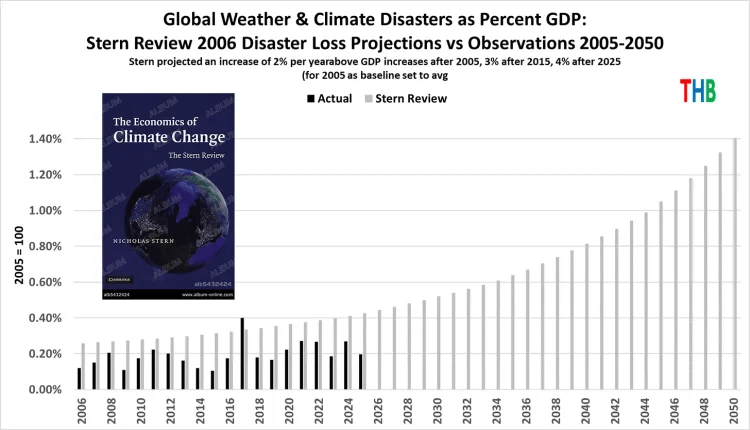
The Stern Review forecast rapidly escalating losses to 2050, when losses were projected to be about $1.7 trillion in 2025 dollars. The Review’s prediction for 2025 was more than $500 billion in losses (average annual). In actuality losses totaled about $200 billion in 2025.
The forecast miss is not subtle.
How did the Stern Review get things so wrong?
The answer is also not subtle and can be summarized in two words: Bad science.
Let’s take a look at the details. The screenshot below comes from Chapter 5 of the Review and explains its source for developing its prediction, cited to footnote 26.

As fate would have it, footnote 26 goes to a white paper that I commissioned for a workshop that I co-organized with Munich Re in 2006 on disasters and climate change.
That white paper — by Muir-Wood et al. — is the same paper that soon after was played the starring role in a fraudulent graph inserted into the 2007 IPCC report (yes, fraudulent). You can listen to me recounting that incredible story, with rare archival audio.
But I digress . . . back to The Stern Review, which argued:
If temperatures continued to rise over the second half of the century, costs could reach several percent of GDP each year, particularly because the damages increase disproportionately at higher temperatures . . .
The report presented its prediction methodology in the footnote 27, shown in full below, which says: “These values are likely underestimates.”

Where do these escalating numbers come from? Who knows.
They appear to be just made up out of thin air. The predictive numbers do not come from Muir-Wood et al., who do not engage in any form of projection.
The 2% starting point for increasing losses — asserted in the blue highlighted passage in the image above — also does not appear in Muir-Wood et al. which in fact says:
When analyzed over the full survey period (1950 – 2005) the year is not statistically significant for global normalized losses. . . For the more complete 1970-2005 survey period, the year is significant with a positive coefficient for (i.e. increase in) global losses at 1% . . .
The Stern Review seems to have turned 1% into 2% and failed to acknowledge that over the longer-period 1950 to 2005, there was no increasing trend in losses as a proportion of GDP. The escalating increase in annual losses from 2% to 3%, 4%, 5%, 6% every decade is not supported in any way in the Stern Review, nor is it referenced to any source.
When the Stern Review first came out, I noticed this curiosity right away, and did what I thought we scholars were expected to do when encountering bad science with big implications — I wrote a paper for peer review.
My paper was published in 2007 and clearly explained the Muir-Wood et al. and other significant and seemingly undeniable errors in the Stern Review.
Pielke Jr, R. (2007). Mistreatment of the economic impacts of extreme events in the Stern Review Report on the Economics of Climate Change. Global Environmental Change, 17(3-4), 302-310.
I explained in that paper:
This brief critique of a small part of the Stern Review finds that the report has dramatically misrepresented literature and understandings on the relationship of projected climate changes and future losses from extreme events in developed countries, and indeed globally. In one case this appears to be the result of the misrepresentation of a single study. This cherry picking damages the credibility of the Stern Review because it not only ignores other relevant literature with different conclusions, but it misrepresents the very study that it has used to buttress its conclusions.
Over my career in research, I’ve had some hits and some misses, but I’m happy to report that I got this one right at the time and it has held up ever since. Of course, perhaps a more significant outcome of this episode, and a key part of my own education in climate science, is that my paper was resoundingly ignored.
One reason that science works is that scientists share a commitment to correct errors when they are found in research, bringing forward reliable knowledge and leaving behind that which doesn’t stand the test of time.
I learned decades ago that in areas where I published, self-correction was often slow to work, if not just broken. Over the decades that pathological characteristic of key areas of climate science has not much improved (e.g., see this egregious example).
The Stern Review helped to launch climate change into top levels of policy making around the world. Further, we can draw a straight line from the Review to the emergence of (often scientifically questionable) “climate risk” in global finance a decade later. It still rests on a foundation of bad science.
1 My ongoing THB series on insurance and “climate risk” in finance prompted me to revisit the 2006 Stern Review, hence this post.
2 Note that the Review explicitly referenced the tabulation of global economic losses from extreme weather events as tabulation by Munich Re, which is the same dataset that I often use, such as in last week’s THB post on global disaster losses. The comparison here is thus apples to apples.
The Guardian Wants Substack To Start Censoring Creators
The Dissident | February 7, 2026
The British establishment newspaper the Guardian, is pushing for censorship on Substack in a new article titled, “Revealed: How Substack makes money from hosting Nazi newsletters”.
The article used the oldest censorship trick in the book: to scour for examples of obscure individuals who hold extremist or hateful views and use them to push for a broader censorship agenda.
In this case, the author of the article, Geraldine McKelvie, scoured Substack to find Neo-Nazi pages, some with as few as 241 subscribers, and used these examples to demand that Substack further crack down on speech.
The Neo-Nazi pages listed in her article have next to no following, with the biggest one listed at 3,000 subscribers, including paid and not paid.
One of the Neo-Nazi accounts listed in the article, “Erika Drexler”, has only ever written on Substack notes and has never even published a single article .
The real censorship agenda behind listing obscure Nazi accounts on Substack becomes clearer when it goes on to quote Danny Stone, the Chief Executive of the UK Charity, “Antisemitism Policy Trust”, calling for more censorship of “anti-semitism” on Substack.
The charity, which “Works with British parliamentarians, policy makers and opinion formers to address policy issues relating to antisemitism” like many organizations pretending to oppose antisemitism, includes harsh criticism of Israel and its genocidal slaughter in Gaza as “antisemitism”.
The charity’s “Glossary of Anti-Semitic Terms”, includes “Zionist/Zio/Zio-Nazi” as “anti-semetic” terms.
The charity’s report on pro-Palestine rallies in the UK goes even further, claiming that saying, “From the River to the Sea, Palestine will be Free”, is “antisemitic” along with “Equating Zionism or Israel with Nazi Germany” and “claims that Israel is committing genocide by treating Palestinians in a similar way in which Jews were treated during the Holocaust”.
The charity even claimed that saying that “Jewish/Israeli soldiers target Palestinian children” is an “antisemitic blood libel”, despite the fact that credible international doctors working in Gaza have proven that IDF snipers routinely target Palestinian children.
Also listed as “anti-semetic” blood libel in the report was, “Israelis are presented as blood-thirsty (and there have even been disgraceful allegations of organ harvesting)”, despite the IDF’s history of organ harvesting being well documented.
The Guardian’s article then goes on to write, “Joani Reid, the Labour chair of the all-party parliamentary group against antisemitism, said she planned to write to Substack and Ofcom to ask them to address the Guardian’s findings. She said antisemitism was ‘spreading with impunity’ and getting worse.”
Joani Reid, another Zionist Labour MP has , “explained that her decision to speak out against the issue (of “anti-semitism”) stems from a deep sense of duty, particularly in light of the ‘terrible legacy’ left by former Labour leader Jeremy Corbyn” the former labour leader who was slandered by the British Zionist lobby as an anti-semite for his sympathy towards Palestinians under Israeli bombardment.
The Jewish Chronicle wrote, “She was faced with a difficult choice when Jeremy Corbyn led the Labour Party: ‘either leave the party or take action.’ She chose the latter, becoming actively involved in addressing the rise of antisemitism within the party”, in reference to the “anti-semitism in Labour” hoax, where Corbyn and his allies were painted as anti-semites for their criticism of Israel.
The point of the Guardian’s article is clear: to list off a few random extremist Substack pages in order to usher in a censorship regime on Substack policing “anti-semitism”, to be driven by people like Joani Reid and Danny Stone, who want to silence criticism of Israel.
The EV Car Crash
With the petrol and diesel car ban less than four years away, there’s one big problem: nobody wants to buy electric cars
By Paul Homewood | The Climate Skeptic | February 6, 2026
With the ban on the sale of new petrol and diesel cars less than four years away now, there remains one seemingly insurmountable obstacle: nobody wants to buy electric cars.
Last year, sales of EVs achieved a market share of just 23.43%. Newly released figures for last month show this fell to 20.6%. The Government has set a target this year of 33%, rising to 66% in 2029.
Once petrol and diesel cars (known as ICE vehicles, short for Internal Combustion Engine) are banned in 2030, zero emission cars must make up at least 80% of the market, with the rest filled with hybrids. However, the latter will also be gradually phased out by 2035. Zero emission essentially means battery-electric, although hydrogen fuel-cell vehicles would also qualify.
To enforce the switch to EVs, the government introduced the ZEV (Zero Emission Vehicle) mandate. Motor manufacturers who fail to hit their ZEV target for the year must either buy credits from manufacturers who have exceeded targets or pay a fine of £15,000 for every car below target.
There are certain allowances available, but these are not significant. The only other option open to manufacturers who fall short is to carry forward their deficit, in the hope they are in surplus in a year or two time. Understandably, this has been likened to taking out a payday loan!
The first year of the ZEV mandate was 2024, when the target was 22%. Actual EV sales that year only reached 19.6%, leaving an effective shortfall of 47,000 cars. At £15,000 a time, that means a fine of around £700 million. The Department for Transport will publish its full analysis next month, which will list surpluses and shortfalls by manufacturer and the actions they have taken to comply, e.g. pay a fine, buy allowances or carry forward.
Last year, EV sales increased to a share of 23.9%, but this was still well below the target of 28%. Motor manufacturers it seems are building up massive deficits in EV sales, which sooner or later will have to be paid for.
Worse still, most EV sales go to fleet and business sectors, driven by generous tax breaks. It is estimated that only about 10% of private buyers go for electric.
The reasons are well known. EVs cost much more to buy, and most models don’t have the range that drivers need. On top of that, buyers face massive losses when trading them in because second hand prices are so low.
But there is one other factor which is often overlooked.
It is reckoned that four in 10 households don’t have off-street parking, so cannot easily charge at home. Using a public charger means that running costs would typically be triple those of a petrol car when fuel duties are excluded. That is, I should point out, if you can actually find one on the way home from work that is not already in use.
Local councils such as my own have already made it clear that trailing cables across the pavement is not permitted and that enforcement action will be taken. Where then will EV drivers be able to charge their cars?
There are plenty of fine words from central and local government about installing more public chargers. But the simple reality is that there will never be enough – local councils don’t have the money, and it is not their job anyway to waste taxpayer money in this way.
Cardiff City Council are a case in point. It is estimated that there are about 200,000 cars in Cardiff, about half of which don’t have access to off street parking. The City Council has just announced plans to install 80 new EV charging stations, plugged into lampposts outside residents’ homes.
The plan won’t make the slightest difference when there are 100,000 cars which all need charging. But it will create real difficulties for the poor beggars who happen to live next to one and will have to find somewhere else to park. The thought of all the other motorists on the street competing to get to that lamppost first every night and the aggro which will undoubtedly follow is frightening.
It is hard to avoid the conclusion that the objective of successive governments and council planners all along has been to force us out of our cars and onto public transport.
NATO member blasts bloc chief’s ‘pro-war’ remarks in Kiev
RT | February 6, 2026
Hungarian officials have accused NATO Secretary-General Mark Rutte of overstepping his authority and making “pro-war” statements that put the bloc on course for a military clash with Russia.
Rutte visited Kiev this week in a show of support, saying member states would maintain military aid to Ukraine, possibly including troop deployments on Ukrainian soil. Moscow has repeatedly called such a scenario unacceptable.
“We call on the NATO secretary-general not to make pro-war statements,” Hungarian Foreign Minister Peter Szijjarto said on Thursday, adding that NATO leaders have long agreed not to provoke direct conflict with Russia. Rutte’s comments contradict that policy, he asserted.
Rutte suggested troops deployments could be approved by Moscow as part of a US-backed peace deal. Budapest fears pro-Kiev nations – including France, Germany, and the UK – would push to send troops despite Russian objections. Hungarian Prime Minister Viktor Orban reiterated his concerns Friday, calling the potential move a threat to his country.
“If the Western plan is implemented, then the war will come closer to Hungary, we will be much more directly affected by this,” he said. “Then not only the economic effect, but also the physical destructive effect could reach Hungary.”
Orban’s government has opposed Brussels’ Ukraine policy, arguing that bankrolling Kiev and imposing sanctions on Russia have damaged the EU’s economy while pursuing an unwinnable cause.
That stance and Budapest’s resistance to the Ukrainian bid to join the EU has strained relations with Kiev. Ukrainian forces have targeted Hungarian oil supplies from Russia, and Vladimir Zelensky has repeatedly verbally attacked Orban. At last month’s World Economic Forum, Zelensky said the Hungarian leader should be “smacked” for purportedly “liv[ing] off European money while trying to sell out European interest.”
Budapest says Zelensky is interfering in Hungarian politics ahead of April’s parliamentary election, and that Kiev is hoping for a more compliant government to take power.
‘Israel’ bulldozes part of Gaza war cemetery holding allied graves

Al Mayadeen | February 5, 2026
Israeli occupation forces have bulldozed sections of the Gaza War Cemetery in Gaza City’s al-Tuffah neighborhood, damaging graves of British, Australian, and other allied soldiers from the First and Second World Wars, according to an investigation by The Guardian.
Satellite imagery shows systematic earthworks in the cemetery’s southern corner, including removed gravestones, churned soil, and a large earth berm indicating the use of heavy machinery. The damage was not visible in images from March last year but appeared clearly in satellite photos taken in August and December.
Essam Jaradah, the cemetery’s former caretaker, told The Guardian that Israeli bulldozers first cleared land around the cemetery walls before later entering the graveyard itself, flattening nearly one dunum of land that included graves of Australian soldiers.
“The bulldozing covered the area from the bench where foreign visitors used to sit up to the memorial monument,” Jaradah said, adding that the operations took place after Israeli occupation forces withdrew from the area in late April or early May.
Israeli army cites combat operations
Responding to questions from The Guardian, the Israeli military command said the area was an “active combat zone” at the time and claimed its actions were taken for defensive reasons.
“At the relevant time, the area in question was an active combat zone,” a military spokesperson said, alleging the presence of underground “terrorist infrastructure” within and around the cemetery.
The Royal British Legion said it was “saddened” by reports that allied war graves had been damaged, stressing that such sites “deserve to be treated with the utmost respect”.
Idea of strategically defeating Russia an ‘illusion’ – Lavrov
RT | February 5, 2026
European leaders have “changed their tune” toward Russia, moving from calls to inflict a strategic defeat on Moscow to cautious reassessment, Russian Foreign Minister Sergey Lavrov has told RT.
Speaking with RT’s Rick Sanchez ahead of Diplomats’ Day on Wednesday, Lavrov noted how many European politicians had initially “spoken in unison, demanding firmness, insisting on unwavering support for Ukraine, continued arms shipments, sustained financing – all to ensure Russia’s defeat, a strategic defeat on the battlefield.”
Over time, European leaders “realized it was all an illusion,” he said in a wide-ranging interview. Western military strategists, who orchestrated the Ukraine conflict and “prepared Ukrainians to fight and die advancing European interests against Russia,” are finally recognizing that their plans had collapsed, the top diplomat stated.
Lavrov added that Western governments had learned nothing from history, citing Adolf Hitler and Napoleon’s failed attempts to defeat Russia. He said Europe had once again rallied nearly the entire continent under the same ideological banners, “only this time, unlike Napoleon and Hitler, not yet as soldiers on the battlefield, but as donors, sponsors, arms suppliers.” He said this attempt had produced outcomes similar to the failures of Napoleon and Hitler, adding that the West, particularly Germany, “learns history poorly.”
Lavrov noted that German Chancellor Friedrich Merz had “lifted constitutional restrictions on military spending, then declared this was necessary for Germany to once again – I emphasize that word, once again – become Europe’s dominant military power.” The minister said the stance “speaks volumes” about Merz’s mindset, arguing that in practice it amounts to preparation for war.
Lavrov also noted Russia’s status as the largest country in the world, but highlighted its place in Eurasia, saying “every attempt so far to establish security in this space has focused exclusively on the western part of Eurasia – so-called Europe.” He criticized NATO as a US-led structure, asserting that Americans never intended to leave Europeans to act independently while maintaining oversight of their allies.
European countries portray Russia as militarily and economically exhausted, he said, yet immediately assume they must prepare for an attack from the same Russia, calling this approach “pathetic diplomacy.”
According to Lavrov, Europe has “walked into their own trap by adopting this uncompromising stance” toward Russia, and “all they’re doing now is trying to sabotage” peace negotiations on Ukraine that “finally began taking shape between Russia and the United States, and now are joined by Ukrainian representatives.”
Douglas Macgregor: Russia, China & Iran Seek to Contain U.S. Military
Glenn Diesen | February 4, 2026
Douglas Macgregor is a retired Colonel, combat veteran and former senior advisor to the U.S. Secretary of Defense. Col. Macgregor explains how the military adventures of the U.S. are incentivising greater military cooperation between Russia, China and Iran.
Follow Prof. Glenn Diesen:
- Substack: https://glenndiesen.substack.com/
- X/Twitter: https://x.com/Glenn_Diesen
- Patreon: https://www.patreon.com/glenndiesen
Support the research by Prof. Glenn Diesen:
- PayPal: https://www.paypal.com/paypalme/glenndiesen
- Buy me a Coffee: buymeacoffee.com/gdieseng
- Go Fund Me: https://gofund.me/09ea012f
British journalism hits rock bottom with latest shocking revelations
By Martin Jay | Strategic Culture Foundation | February 2, 2026
From the truth about who really killed Diana to the depraved world of government officials sexually abusing children and the subsequent cover-up, it is now clear that nearly all major stories are either blocked from publication or rewritten by Soviet-style propaganda agents working for the British deep state.
Virtually nothing you read in British newspapers about security, defense, and wars is honest journalism. Instead, it is propaganda crafted by a new secret UK military department tasked with rewriting journalists’ copy or, in some cases, simply ensuring their articles never see the light of day.
That is the shocking conclusion of a new investigation by The Grayzone, which obtained secret documents exchanged between the UK and Australian governments over Canberra’s plans to adopt Britain’s “off-the-shelf” operation and incorporate it into its own government practice for handling journalists.
The impressive reporting by Kit Klarenberg and William Evans reveals, in short, that the UK military has created its own censorship department. It either blocks journalists from exposing major stories of public interest or, more commonly, redrafts the thrust of journalists’ pieces to present a different version to the gullible public.
A trove of secret communications reveals how the secretive Defence and Security Media Advisory (DSMA) Committee censors the output of British journalists while categorizing independent media as “extremist” for publishing “embarrassing” stories. What sounds like an account of secret police operations in Eastern Europe during the Soviet era, the documents show that this army intelligence department regularly blocks journalists from continuing to investigate a subject through a formal system called “D Notices” – which, remarkably, journalists almost always respect.
“The DSMA imposes what are known as D-Notices, gag-orders systematically suppressing information available to the public,” The Grayzone report states.
The files provide the clearest view to date of this underground committee’s inner workings, exposing which news items the state has sought to shape or keep from public view over the years. These include “the 2010 death of a GCHQ codebreaker, MI6 and British special forces activity in the Middle East and Africa, the sexual abuse of children by government officials, and the death of Princess Diana,” the report reveals.
British media, it seems, is in a crisis it never anticipated. Its journalists are, in reality, no longer working as journalists but as propaganda agents of the state. Under this system, which nearly all journalists sign up to, when a reporter wants to pursue a story, they must consult this department, which then effectively controls both the journalist and the story from that point forward. The absurd practice of ‘copy approval’ – where journalists send their final draft before submitting for publication – is routinely enforced.
This practice, a milestone in the death of British journalism, comes as no surprise to me. For decades, I have sent questions to the UK’s Foreign Office and Ministry of Defence, only to become a victim of the comical, if not pathetic, game that follows. A spokesperson asks for your deadline and then, mysteriously, 30 minutes before that time, you receive a “response” meant to serve as a quote from a senior official. It not only looks computer-generated but is often irrelevant to the subject. This is Britain – a country once seen by the whole world as a beacon of freedom and democracy, now operating like a cheap West African dictatorship, pumping out lies and manufacturing consent on an industrial scale.
That such a secret censorship department exists and flourishes should shock no one. In 2023, my own investigation discovered that UK and US weapons were being resold on the dark web. It wasn’t exactly a great scoop, but the hard work lay in substantiating the story with expert opinions and forensic analysis of photos and website postings. I was amazed as weeks passed while I badgered the Daily Mail’s absurdly young Defense Editor to run the story. He played every trick in the book to avoid it until finally he and others agreed to publish – but watered it down so much, removing all the top quotes from hardcore military and political experts that supported the story’s thrust. Clearly, he and others were under the control of these DSMA censor agents, who could not allow a piece alleging that shoulder-mounted rocket systems used by both the US and UK armies were being openly sold on the black market.
A second, much more detailed investigation – which supported the belief that barely a third of all UK military kit was actually reaching frontline Ukrainian soldiers – I didn’t bother sending to the Daily Mail but published on Patreon. One of its chief findings was that a senior Conservative MP admitted to me in a WhatsApp exchange that the UK had, in fact, installed tracking devices in some of the more expensive equipment, like Armoured Personnel Carriers (APCs), but at a certain point these devices were simply switched off and disappeared from the screens. It also revealed the bombastic stupidity of the then–UK Defence Minister, Ben Wallace, who conveniently chose to ignore a UN report identifying the influx of cheap Western-made assault rifles into the Libyan arms bazaar as a main reason for the spike in terrorism in the Sahel region – while insulting the Nigerian president who had made the claims, saying he “probably watches RT television.” When I suggested to Mr. Wallace that a simple way to verify these claims would be to send agents to Libya to conduct their own surveillance, his reply was, “Why don’t you do that?” before blocking me.
Wallace’s extraordinary rudeness shocked me at the time. But it was clear he was used to a much more servile, sycophantic manner from UK journalists who didn’t ask difficult questions – and that I was obviously breaking from tradition. Clearly, the DSMA department controls all those Westminster-based hacks, their stories, and even their story ideas, so it’s understandable that his rage boiled over.
The Grayzone’s findings make for depressing reading for anyone old enough to remember when British journalism was the finest in the world. But they also raise other questions, chiefly: Who is actually behind British titles? Or more specifically, who is funding them? Most UK newspapers don’t make any money, so it’s understandable that a new relationship with the deep state might help them remain relevant – especially now that the news is being baked for them, ready to be served. This has changed the role of the British journalist: no longer the baker, but relegated to the delivery boy on the moped.
Yet where the big titles get their revenue to stay in business remains a mystery. Is part of the same deal on censorship and copy control that the state funds them through surreptitious, murky channels – perhaps via companies with close links to the heart of power? Follow the money.
American Zionists are using Trump’s Republican Party to create a multicultural supremacist elite

By Matt Wolfson | Al Mayadeen | February 2, 2026
On January 13, 2025, seven days before Donald Trump’s second inauguration as president, The Free Press, the online magazine created by the Zionist operator Bari Weiss who has powerful connections to the Trump Administration, ran a profile which may say more about the ultimate causes of America’s current policies, and where those policies will likely lead, than any other public document.
The profile was of Amy Chua, famously the author of Battle Hymn of the Tiger Mother, a mostly well-received cri de Coeur for what Chua sees as rigorous Chinese parenting; and less famously the John M. Duff, Jr. Professor of Law at Yale Law School. The profile, drawing explicitly on Chua’s most publicly recognizable achievement, was titled “The Tiger Mother Roars Back,” and its subtitle reinforced its approach, an ardent rave: “Yale tried to run Amy Chua out. Now her former students, J.D. Vance and Vivek Ramaswamy, are headed to Washington. So is she.”
For people who follow the politics of America and so of America’s empire, the forwardness of this profile raises questions. Construed as a gesture of support for two politicians, Vance and Ramaswamy, who are attempting to woo the public on populist credentials, it seems misthought. There is nothing populist about Chua—and her lacks are tells about the lacks of her mentees. Indeed, it was under Chua’s mentorship that Vance wrote a bestselling book with the encouragement of another Chua mentee, Vance’s future wife Usha, blaming the failures of his lower-income Appalachian upbringing on the “cultural” deficiencies of the community which raised him. This is a view that, since entering politics with the aim of appealing to precisely that community, he has quickly disavowed. Ramaswamy, for his part, has fallen deeply and predictably afoul of populist Americans precisely by making that case in public.
So why would Weiss, who if nothing else is a strategic operator, run a piece on Chua connecting her to Vance and Ramaswamy as well as broadcasting Chua’s views, which are anathema to the people from whom Vance and Ramaswamy want support?
The answer is that, though Weiss is an ideologue focused on advancing “Israel’s” immediate interests, there is a “positive,” longer-term Zionist play in the works among her and her allies. I have reported in miniature on this play last year, in a September investigation of the philanthropic education donations of Bill Ackman, the Zionist financier: to seed a new ruling elite based on technological and management skills. But the project goes deeper. It amounts to the legitimation of a new ruling class in America centered on a narrow cadre of elites of three groups— Zionists, Hindutvas (Hindu supremacists), and, discernably but least specifically definably, East and Southeast Asian supremacists often with connections to countries where Buddhism has exercised significant influence.
These elites use their present success in America’s military corporate complex to make claims to group superiority. They then use those claims to justify special treatment for their groups and nations that allow them to solidify their power, and to solidify the hold of American empire, which they see as the rightful disseminator of “merit.” Their accelerating project will likely realize itself through the Republican Party, via Chua’s mentees, the Vances and Ramaswamy, among others, and it may ally itself with other right-wing influences as seemingly dissimilar but actually imitative as the white supremacy of Nicholas J. Fuentes. It is only now taking recognizable shape, and understanding its origins and spread is crucial to understanding the havoc it is already beginning to wreak in America and abroad.
That understanding begins with examining the arguments which influenced Vance and Ramaswamy; arguments made by Amy Chua and Jed Rubenfeld, her husband, a Yale Law professor and Jewish Zionist who writes for The Free Press. These arguments are noteworthy in that they look for “warps” in cultures to explain problems which other scholars have put down to military corporate power and its brute effects (outsourcing, conglomeration, the Wars on Crime and Drugs, unauthorized and some kinds of authorized immigration) on American life.
Indeed, the most straightforward reason why Vance’s Appalachian Americans as well as Black and Latino Americans have notably struggled is American imperial policy that has started at the top: labor outsourcing and urban mis-development, misthought immigration policies, and military corporate buildup. These policies have accrued for 60 years, and academics and writers have made the case against them for almost 50.
This book of Chua and Rubenfeld’s, where they lay out their view (The Triple Package: How Three Unlikely Traits Explain the Rise and Fall of Cultural Groups in America) does not emphasize these structural, practical explanations. Instead, Chua and Rubenfeld put “winners’” success in America over the last sixty years down to three group traits: specifically, “a superiority complex,” “insecurity,” and “impulse control.” According to The Triple Package, “a superiority complex” means “a deeply internalized belief in your group’s specialness, exceptionality, or superiority” flowing from religion, civilization, or social traits. “Insecurity” means “a sense of being looked down on, a perception of peril, feelings of inadequacy, and a fear of losing what one has.” And “impulse control” means “the ability to resist… the temptation to give up in the face of hardship or quit.”
But the paradox of Chua’s and Rubenfeld’s explanation, which they don’t appear to realize, is that, taken logically on its face, it supports the structural, practical explanations they apparently ignore. Political theory and history show that groups in the grip of triple package holders’ emotional Cartesianism (possessing an a priori thesis, superiority, in the face of insecurity, and so willing to do anything to prove the thesis right) are reliable tools of arbitrary imperial power. Indeed, empires moving aspirant, insecure, determined groups into their own managerial elite is a defining feature of the Roman Empire; the British Empire in the American colonies and India; the German Empire; and the United Arab Emirates. In America’s empire, these co-opted groups have most prominently been the three which Chua and Rubenfeld write about most often and with whom they and their family most identify: Jewish Americans, Indian Americans, and East and Southeast Asian Americans.
All three of these groups experienced marginalization and persecution at the hands of various empires (the Russian and German; the British; the American) before 1950. Their members have attendantly experienced heightened levels of insecurity; and elite cadres of two of the three groups have adopted what most scholars consider to be clearly definable supremacist ideologies: Zionism, which was founded in 1897 and Hindutva ideology, which was founded in 1925. The third type of supremacy, East and Southeast Asian supremacy, is more diffuse but clearly discernable.
Unlike Zionism, which is linked to “Israel”, and Hindutva ideology which is linked to India, there are multiple countries at play and multiple labels under which claims of East and Southeast Asian supremacy are raised. Also, the way these claims are raised often surfaces less as outright supremacy and more as “cultural essentialism”—that there’s something in this group’s cultural “essence” that makes members more “successful.” Finally, research into outright supremacist manifestations from groups associated with them is more recent, usually under the headings of Buddhist or East Asian supremacy. Nonetheless, taking these distinctions into account, East and Southeast Asian success in America’s imperial complex and corresponding claims like Chua’s to superiority are recognizable trends: some of them embraced by supremacists who praise thinkers like Chua for what critics call their cultural supremacy.
I have reported at some length about how the process of these groups claiming power in American empire played out, beginning with Jewish Zionist elites in the 1960s. I examined these Zionist elites’ acceptance into the American military corporate complex by WASPs (White Anglo-Saxon Protestants). I also pointed out that Zionists’ overall success accessing this complex came from their pursuit of narrow applied skills valued by the WASPs: economics, management theory, administrative law, engineering, finance, and technological proficiencies; a model the WASPs took quite consciously from European Empires. Zionists, in their own description, were easy marks for this kind of invitation to power that ultimately deracinates the culture of the people who accept it.
Theodor Herzl, the founder of the movement who embodies the terms of its successes and failures, was a marquee possessor of Chua’s and Rubenfeld’s triple package. He had grown up a secular Jew with little connection to his religion but a strong sense of his own superiority, and only embraced Zionist Judaism with a manic intensity when the Dreyfus Affair made him decide that he could never realize his ambitions without identifying as Jewish.
An instructive echo of Herzl’s mentality comes in the memoir of Martin Peretz, one of the early entrants into America’s corporate complex in the 1960s. Peretz, who taught at Harvard, owned The New Republic, the most influential Zionist magazine in the country, and played a prominent connective role in and near Wall Street, is in many senses a later-day Herzl. He is a high-status secular Jew with an admitted sense of insecurity who is also a fervid Zionist, and he writes in his memoir about himself and his friends who “made it” that
We were… from a strong culture that was an outsider culture, in the first generation when that culture could assert itself in American institutions. We weren’t constrained by old obligations because we were coming into a world that didn’t want us anyway. We had each other’s backs because we knew the kind of resentment arrivistes, and Jewish arrivistes, unleashed… We were the first ethnicity to break through into the ruling class institutions following the wane of Protestant influence, and we saw those institutions as the key to our flourishing.
Peretz’s Harvard mentee, Bill Ackman, the Zionist financier, is a good example of how younger Zionists operating in Herzl’s and Peretz’s tradition have swallowed this model whole. Ackman’s view of Harvard, where he is also a donor, falls along just these lines of imperial functionality:
As one of the oldest and perhaps the most notable of this country’s academic institutions, Harvard represents the gateway to elite status and to ‘making it’ in modern day American society. One need only look at the disproportionate numbers of Presidents, Nobel Laureates, and chairmen of Fortune 500 companies who have graduated from Harvard to understand the power of the Harvard degree. As a result, admission to Harvard has become the target of groups seeking upward mobility.
What goes unacknowledged here is that “elite status,” “upward mobility” and the skills that create them have only been an aspiration for most Americans since 1945, when the Cold War allowed WASPs to expand their institutions and use them to try to mold the country in their image. Before this point, most Americans understood their country as being predicated on towns and cities and states; and on a high degree of associational thickness, communal coherency, and decentralized government which allowed individuals a say in the terms of their lives. But Zionists were never open to an argument like this. Their strategy, like Herzl’s, was to enter empire and use it to rise, and it is not a coincidence that, almost immediately on accessing America’s military corporate complex, they opened America’s doors to Hindu and East and Southeast Asian operators who approached the matter of institutions and power on their terms.
The Zionists’ tool was the 1965 Immigration and Nationality Act, which was sponsored by staunch Jewish Zionist Congressman Emmanuel Celler. The Act opened America’s elite universities to “high-skilled,” often upper-middle class arrivals from undemocratic or less democratic countries like India and China: people not particularly versed in constitutionalism but extremely well-versed in applied technical proficiencies valued by empire.
The most obvious beneficiaries were Hindu Americans. It was the 1965 legislation and its 1990 expansion by George H.W. Bush, the penultimate WASP president, which brought into this country the parents of Usha Vance; Vivek and Apoorva Ramaswamy; the pro-Zionist Republican operative and current Assistant Attorney General for Civil Rights Harmeet Dhillon; and the U.S. Representatives Ro Khanna, Raja Krishnamoorthi, and Suhas Subramanyam. More decisively, as I reported in December, it has brought into the defense-tech mecca of Silicon Valley aggressive Hindu financial operators who have deep political sway. Much as, in the telling of anti-Zionist Jews like Norman Finkelstein, the converging success of Israelis and American Zionists off the largesse of America’s imperial complex hardened these players’ Zionistic belief in their Jewish supremacy, so a similar trend appears to have taken place with American Hindus who adopt some version of Indian Prime Minister Narendra Modi’s Hindutva ideology. Their influence, as outlined by Andrew Cockburn in a groundbreaking article in Harpers, reaches deep and wide, in part through their connections to Zionists.
Somewhat more subtle than the Hindutva assumption of influence in America, but equally noteworthy has been the East and Southeast Asian, especially Chinese, accrual of influence here. WASPs had used their educational and financial influence to foster relationships with China going back to the 1870s. Later, Zionists took up that task: bringing Chinese elites into philanthropy and finance, aided by the 1965 legislation, which led to a sharp increase in high-skilled East and Southeast Asian immigration to America. Arguably the clearest window onto this process is the Committee of 100: a group with connections to Amy Chua founded in the late 1980s by influential Chinese Americans at the urging of Peretz ally and “Israel” defender Henry Kissinger, and with the aid of Peretz’s friend Yo-Yo Ma. As I traced in my report last year on the Committee’s growth, the Committee and some of its members have assiduously inserted themselves at crucial educational and philanthropic junctures. As I reported about their propaganda last April:
The obvious part of their message is that… America is a colorblind nation where, minus prejudice, anyone can succeed. In this schema, anyone questioning the loyalties or actions of those who have succeeded, like [members of the Committee] and their allies, are acting off of lower motives, and are anti-merit.
What is also instructive is that, despite vocal pushback to Chua’s ideas by regular readers, prominent East and Southeast Asian Americans and East Asian American organizations, including but not limited to the Committee of 100, have embraced Chua since she gained fame with her ideas and given her a public platform. Allies of Chua’s echo her arguments in a gentler way, among them the Chinese-American writer Sherryl WuDunn, a connection of Chua’s via other East Asian American organizations, whose husband Nicholas Kristof made a less constrictive, “essentialist” version of Chua’s cultural supremacist arguments in The New York Times. And cultural, ethnic, and even racial supremacists like the neoconservative Charles Murray have embraced Chua’s claims.
Jewish Zionists have been forging alliances with Hindu and East and Southeast Asian American arrivals at an accelerating rate for nearly 40 years. They have used these groups’ shared success to argue that any opposition to those groups with an outsized place in America’s military corporate complex comes from resentment and envy among people who don’t measure up.
In 1988, only 23 years after the Immigration and Nationality Act was signed, two years before the inception of the Committee of 100, and eight years before the Silicon Valley boom began, Bill Ackman, on the advice of his Harvard mentor Peretz, wrote an honors thesis entitled “Scaling the Ivy Wall: The Jewish and Asian Experience in College Admissions.” In the thesis, Ackman “draws parallels between the experience of Jews trying to gain admission to Harvard in the 1920s with the experience of applicants from Asia during the 1980s.” In 2024, gearing up for his crusade against anti-Zionism in universities, Ackman began making the rounds of newspapers, magazines, and online interviews, armed with his undergraduate thesis, arguing that the groups he wrote about in the 1980s (Jews and Asians) are technical achievers being discriminated against by opponents of merit.
That same year, Ackman’s ideological ally Bret Stephens featured in his Zionist magazine Sapir a piece quoting Ackman’s 1988 thesis by an ardent backer of Ackman’s ardent ally Vivek Ramaswamy: Rajiv Malhotra, arguably the most prominent Hindutva operating outside of India. Malhotra began this essay, an argument for “A Hindu Jewish Partnership”, by arguing that, like Asian Americans and Jews, Hindu Americans are “‘model minorities’ who have made much of the American dream” and must come together “to safeguard the world from the regressive movement against merit.” This notion that any resentment against those groups which seem to be steering American Empire flows from jealousy or resentment is shared by Amy Chua, who said, in a recent interview, that
There is tremendous resentment, fear, and insecurity about Asian-Americans because of college admissions… And then you’ve got China, a whole different source of insecurity.… Now on campus, I noticed that this anti-Chinese resentment slash fear is coming from both the Left and the Right, which is very unusual.
Tellingly, none of these arguments about “safeguarding merit” define merit as anything other than technical skills fit for empire, and this is not a bug but a feature of supremacist argument. Jewish, Hindu, and East and Southeast Asian supremacists justify their traditions based on their ability to impart skills that help empires claim power. Examples of this pattern range from Hindutvas who boast that “ancient Indians were proficient in stem cell technology and built aircrafts” in “an imagined Hindu golden age of scientific progress,” to equally remote Zionist narratives claiming that consumer innovations of all kinds originated with “Israel” to Amy Chua’s “conceptually loose” and factually dubious appropriation of her “meretricious” heritage for raising “successful” children. None of these arguments address the arguments of dissenters from within their traditions who think that, by attaching their traditions to a project of empire based on technical skills, supremacists have distorted the moral, intellectual, and cultural essences that made these traditions worth having. The most accurate description of the supremacists may in fact be “ethnopreneurs”: players who use their groups’ access to empire to show a public they assume is aspirant how to be like them, gaining recognition or profit by doing so.
The supremacists also have imitators, sometimes in the most seemingly unlikely of places. It was Nicholas J. Fuentes, nominally on the other side of the new Republican coalition from Ramaswamy and Chua and Rubenfeld and Weiss, who recently told Piers Morgan that “In Israel, they have my politics. If they had their way, it would only be Jewish people.” In fact, in “Israel”, it’s not Jewish people who are welcome; it’s only Jews openly committed to Jewishness as an imperial supremacist project, much as Fuentes is openly committed to an imperial supremacist project around white male Americans whom he says are victimized based on the superiority of their race.
Chua’s mentee J.D. Vance appears to be working to stabilize the Republican coalition in ways that may function, whatever his intent, to unite the supremacists. Even as Vance speaks implicitly in favor of including Nick Fuentes in the Republican Party and Vance’s ally Tucker Carlson gives Fuentes a platform, Vance’s most prominent ally, Erika Kirk, who is publicly committed to his 2028 presidential bid, is appearing in interviews with Zionists like Bari Weiss and Andrew Ross Sorkin. Vance only recently helped ink the deal that put Zionists, including Jared Kushner and the Ellisons, in control of TikTok; and in 2025 both Vance’s wife Usha and his mentor Chua gave rare, exclusive interviews to Weiss’s Free Press, which the Ellisons now own.
This year, Vance is scheduled to appear on CBS’s new Town Hall series, where he will be interviewed by Weiss. This looks like the rudiments of a new coalition of elites with nominally different heritages united by a shared conviction of supremacy. And policy is following suit to privilege these elites—not so much shrinking the “deep state” as Trump promised during his reelection campaign but redirecting it in ways that serve their interests:
“Israel”, with American support, is “modernizing” and “improving” Latin America and the Middle East using its technical prowess, compromising the sovereignty of nations and regions. Hindutva ideologists are coming to Silicon Valley, where Zionists arbitrate power. East and Southeast Asians are entering the Ivy League in record numbers with the aid of lawsuits from Zionist operatives, even as the Trump Administration has made no effort to shrink these universities’ power as the “gateway” to political influence.
The Muslim world, arguably Zionists’ and Hindutvas’ and Buddhist East Asians’ greatest enemy, has become our enemy. American Zionist operatives are using artificial intelligence to track anti-Zionist opinions online in conjunction with imperial outgrowths like Harvard in ways that sound quite similar to the Hindutva ideologue Rajiv Malhotra’s proposal in the Zionist magazine Sapir for an “Intellectual Iron Dome” in imitation of Israel’s defense system the Iron Dome. (This is a project seemingly imitative of Philip K. Dick’s dystopian novella The Minority Report: “to harness the powers of AI… to monitor and examine trends in antisemitism and Hinduphobia online and predict problems before they manifest.”) And, thanks to the Zionist Stephen Miller, the Trump Administration is deporting migrants of color while deracinating their “sh**hole” countries of oil in the name of serving the people for whom Fuentes claims to speak. Namely, a mostly white American population now “freed” from “third world” “leeches, killers, and entitlement junkies” but indentured in the same servitude to the military corporate elite.
In the face of unrelenting infiltration by these colonial supremacists of all sorts in pursuit of their own global Raj flowing from America, anti-imperial resistance at home and abroad, using law and popular politics, is the only sensible path.
From Iraq war crimes to Gaza’s ‘board of peace’: Why Tony Blair belongs in The Hague
By David Miller | Press TV | February 1, 2026
In the grotesque circus of international power plays, few performers rival Tony Blair for sheer audacity. The former British Prime Minister (1997-2007), once celebrated for his “Cool Britannia” sheen and Third Way politics, is now indelibly stained by the Iraq War debacle, a war built on deception that claimed hundreds of thousands of lives and shattered the region.
Yet in January 2026, Donald Trump appointed him to the Board of Peace, a White House-created entity chaired indefinitely by Trump himself to oversee Gaza’s “reconstruction” under a controversial 20-point plan.
The board’s founding executive includes heavyweights like Marco Rubio, Jared Kushner, Steve Witkoff, Marc Rowan, Ajay Banga, and Robert Gabriel—figures tied to Trumpworld and Zionist interests, with no Palestinian representation.
Blair’s role is lending “statesmanlike” cover to what is seen as a colonial oversight mechanism that could facilitate displacement and control in Gaza. This isn’t redemption; it’s impunity on steroids.
Blair belongs in The Hague facing charges for aggression and complicity in atrocities—not jet-setting as a “peace” architect. This article lays bare his record, his Zionist alliances, his profit-driven institute, his billionaire backer, and why his latest gig risks making him complicit in Gaza’s ongoing nightmare.
Blair’s war crimes: Lies, invasion, and bloodshed
Blair’s gravest sin remains the 2003 Iraq invasion, sold on bogus claims of weapons of mass destruction (WMDs) and Saddam Hussein’s imminent threat.
The Chilcot Inquiry (2016), an exhaustive British investigation, demolished his case: “We have concluded that the UK chose to join the invasion of Iraq before the peaceful options for disarmament had been exhausted. Military action at that time was not a last resort.”
It highlighted “flawed intelligence” that went “unchallenged” and Blair’s overestimation of his influence on George W. Bush. The infamous “dodgy dossier” asserted Iraq could deploy WMDs in 45 minutes—a claim later exposed as hyped and unreliable.
Under the Rome Statute, Blair could face ICC charges for:
- Crime of aggression: Planning and executing an illegal war without UN Security Council approval, violating the UN Charter.
- War crimes: Complicity in detainee abuses, including British forces’ role in cases like the death of Baha Mousa in custody.
- Crimes against humanity: Contribution to systematic civilian harm via indiscriminate tactics, with excess Iraqi deaths estimated in the hundreds of thousands. For example, studies estimated over 650,000 by 2006, as reported by The Guardian, citing a study in The Lancet medical journal. Later estimates put the toll at over a million.
What has been Blair’s response? “I did not mislead this country, I made a decision in good faith,” as he stated post-Chilcot. Prosecutors have tried—private attempts failed due to political barriers, as reported by the BBC on the High Court’s rejection of a 2017 bid by an Iraqi general—but the evidence mounts: the war was unnecessary, illegal, and devastating.
Blair’s Zionist ties: PM to quartet envoy, always ‘Israel First’
Blair’s pro-Israel stance is longstanding and blatant. As the British PM, he cultivated ties with Labour Friends of Israel (LFI) and accepted funding from Zionist-linked donors. He defended Israel’s actions during the Second Intifada, prioritising “security” while downplaying occupation and settlements.
Blair’s inner circle was riddled with pro-Israel influencers. Take Lord Michael Levy, a former record producer, dubbed “Lord Cashpoint” for his fundraising prowess: Introduced to Blair in 1994, Levy raised millions for New Labour, including from pro-Israel sources, and became Blair’s Middle East envoy post-2007.
Levy praised Blair’s “solid and committed support of the State of Israel,” as reported by Mishpacha Magazine. Another key figure was Sir Trevor Chinn, a major donor to Blair’s campaigns and LFI, who also funded Conservative Friends of Israel—showing cross-party Zionist commitment.
Chinn donated six-figure sums to keep Blair in power, as Lobster Magazine detailed. Then there’s Peter Mandelson, Blair’s spin master and a self-proclaimed pro-Israel advocate with family ties to the Jewish Chronicle—his father was the paper’s advertising manager as the Chronicle itself reported.
Mandelson revealed in his memoirs his “pro-Israel sentiments”, and close alliance with Levy in shaping Blair’s foreign policy. Most recently, in September 2025, Mandelson was sacked as British Ambassador to the US by Prime Minister Keir Starmer because of the disclosure of new information on his closeness to paedophile financier and Zionist intel asset Jeffrey Epstein.
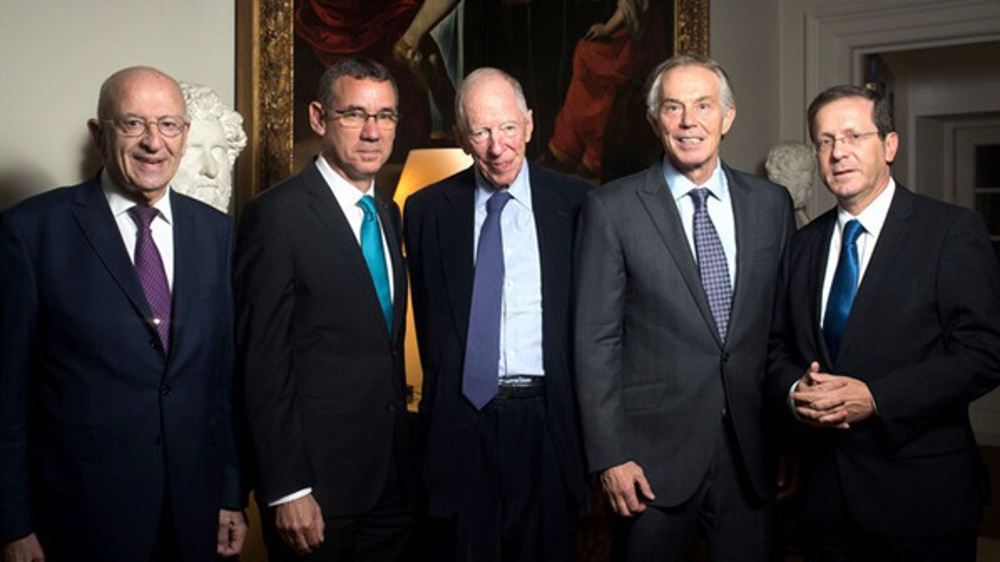
The Genocide Alliance: Chinn, Mark Regev, Jacob Rothschild, Blair and Isaac Herzog (2018)
This network fuelled scandals, like the 2006-2007 cash-for-honours affair, where Levy was arrested (though not charged) over allegations of selling peerages for donations, many from pro-Israel businessmen. The probe destabilised Blair, exposing how Zionist money influenced Labour.
Enter Lord Jon Mendelsohn: As Labour’s chief fundraiser in 2007, Mendelsohn was embroiled in a donations row involving illegal third-party contributions from property developer David Abrahams, who funnelled funds through proxies.
Mendelsohn admitted knowing about the scheme but claimed ignorance of its illegality, according to The Guardian. Fast-forward: Mendelsohn now directs Abraham Accords (UK) and co-chairs the APPG for the Abraham Accords.
Both promote normalisation between the Zionist colony and Arab states—essentially “Zionising” West Asia by embedding Zionist influence in economies and politics.
In a 2023 House of Lords speech, Mendelsohn hailed the Accords as a “historic opportunity,” ignoring Palestinian erasure. This evolution from Blair-era lobby scandals to regional normalisation underscores how Zionist networks persist, repackaging occupation as “peace.”
Blair’s fingerprints are all over the Abraham Accords, the sham “peace” deal normalising Israel’s apartheid with some regional countries while burying Palestinian rights.
In 2015, Blair brokered the first secret meetings between Benjamin Netanyahu and UAE officials in London, planting the seeds for the 2020 agreements. He attended the White House signing ceremony, gushing in a statement: “This is a momentous day… a new pathway is opening up for the Middle East.” Netanyahu later credited him with the Accords’ success, per reports from 2025.
As Quartet Envoy, Blair’s “economic peace” mantra—focusing on the occupied West Bank development while sidelining Gaza and sovereignty—paved the way for these deals, which critics slam as economic bribes to Arab states to ignore Israel’s horrendous war crimes.
Blair’s involvement wasn’t altruistic; it burnished his “peacemaker” image while entrenching Zionist hegemony, bypassing UN resolutions and Palestinian self-determination. His denial of Palestine, as Le Monde put it, is complete—treating the occupied as economic pawns in a Zionist game.
As Quartet Envoy (2007–2015), tasked with advancing the peace process, Blair faced repeated accusations of bias. Palestinian officials called him an “Israeli diplomat” in all but name; he focused on Palestinian “reform” while rarely challenging Israeli policies like Gaza’s blockade or settlement expansion.
The Guardian reported in 2011: Palestinian critics attacked him for favouring Israeli “security” needs over Palestinian rights. During Israel’s 2008-2009 Gaza offensive (1,400+ Palestinian killings), Blair echoed Israeli narratives blaming the Hamas resistance movement without addressing root causes.
A Source News analysis labelled him a “complete failure” for perceived one-sidedness. He resigned in 2015 amid conflicts of interest, but his record shows transactional Zionism—aligning with power to maintain influence.
Tony Blair Institute: Policy peddler with a dark side
The Tony Blair Institute for Global Change (TBI), launched in 2016, poses as a nonprofit promoting “good governance” and tech-driven reform. Before Larry Ellison’s funding in 2021, TBI had about 267 staff in 2020, per its annual accounts.
Post-Ellison, it ballooned to over 800 by 2023, nearing 1,000 in 45+ countries by 2025, with plans for 1,000+ by end-2026, as Ellison’s $375M+ pledges fuelled explosive growth, per POLITICO. Turnover jumped from $81M in 2021 to $121M in 2022, then over $150M, enabling global ops.
Beyond AI and digital IDs, TBI advises on climate policy, net-zero transitions, and governance—often to countries like Saudi Arabia and the UAE, drawing fire for whitewashing abuses.
It pushes “tech for good” like surveillance systems and economic reforms, but critics see neocolonialism. In Africa and the Global South, TBI embeds in governments, promoting privatisation and AI integration that favours Western tech giants.
Controversies pile up: TBI has consulted for many governments while raking in fees – including Saudi Arabia, the UAE, and Bahrain. Most damningly, reports linked TBI discussions to Gaza “reconstruction” plans condemned as ethnic cleansing blueprints, including ideas of “paying Palestinians to leave” or redeveloping Gaza as a “Riviera.”
Middle East Eye revealed TBI’s involvement in talks evolving into proposals critics slam as displacement schemes. The Guardian noted staff participation in such calls.
TBI pushes surveillance tech and net-zero policies, often funded by questionable sources, turning “global change” into elite profit. A 2024 Consultancy.uk critique ridiculed its AI studies as overhyped, while UnHerd questioned its opacity—meaning a lack of transparency in operations and funding that raises concerns over accountability and potential conflicts of interest.
Blair and Larry Ellison: Cash for influence, Zionism, and security risks
Oracle founder Larry Ellison, a staunch Zionist lobbyist and one of the world’s richest men, has poured at least £257 million ($375M+) into TBI since 2021 via his foundation.
Lighthouse Reports exposed how this cash transformed TBI into an Oracle sales and lobbying arm—pushing cloud tech, AI, and government contracts (for example, UK NHS data deals). Ellison gets policy access and favourable regs; Blair gets funding to sustain his empire and personal brand.
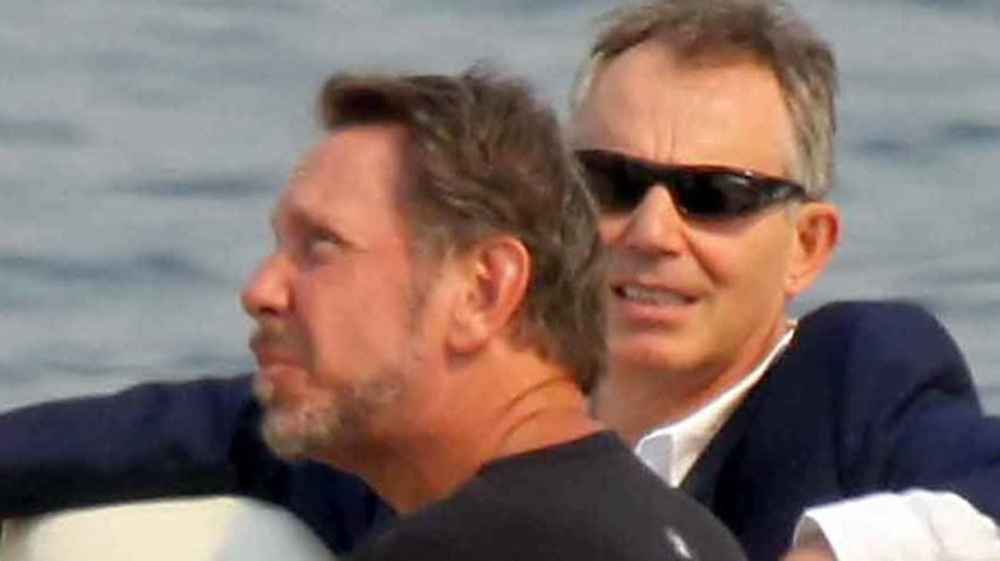
Larry Ellison and Blair
Ellison’s Zionism runs deep: He’s donated over $26M to Friends of the Israel Defense Forces (FIDF), including a record $16.6M in 2017—the largest single gift ever—and $10M in 2014.
At a 2017 gala, he declared: “Since Israel’s founding, we’ve called on the brave men and women of the IDF to defend our home,” as reported by The Times of Israel.
In videos and speeches, Ellison emphasised: “For two thousand years, we were stateless. Now we have our own country, defended by the brave men and women of the IDF,” as shared on Instagram. Oracle execs echo: CEO Safra Catz once told staff to “love Israel or maybe this isn’t the job for you”.
Ellison reportedly vetted Marco Rubio for Israel loyalty as revealed in leaked emails, and Oracle built a massive underground data center in Israel amid Gaza ops.
Oracle’s ties to the Israeli military are insidious and extensive, embedding the company as a pillar of Israel’s military machine. Since 2006, Oracle has held multi-year contracts with the Israeli military affairs ministry, supplying databases, Fusion middleware, and cloud services integral to its operations.
Oracle’s complicity in occupation and genocide includes training Israeli military personnel and providing tech that bolsters military logistics and intelligence.
Post-October 7, 2023, Oracle declared “We stand with Israel,” donating $1M to Magen David Adom, sending supplies to Israeli soldiers, and inscribing “Oracle Stands with Israel” on company premises at Catz’s demand.
Oracle’s ERP systems, databases, and IT infrastructure fuel the Israeli military’s genocidal campaigns. Oracle “married the IDF,” with employees embedded in military training and cloud services enabling real-time warfare.
Palantir’s role
This rot extends to Palantir, another Zionist tech behemoth that Blair’s orbit intersects via shared pro-Israel ecosystems. Palantir, co-founded by Peter Thiel ( who “defers to Israel” on AI ethics), signed a strategic partnership with the Israeli regime in 2024 for battle tech, meeting with military officials to deploy AI platforms.
Palantir provides militarized AI to Israeli intelligence, including Unit 8200’s Data Science and AI Center, enabling automated targeting in Gaza—essentially AI-generated kill lists amid genocide.
Palantir— fueled by Jeffrey Epstein funds and Thiel’s backing—has treated Gaza as a testing ground for surveillance tech that spies globally. The tech company, alongside Google and Amazon, arms Israel’s genocidal atrocities, with AI systems predicting and facilitating mass killings.
Blair’s TBI, Oracle-infused, echoes this by designing “data-driven” Gaza plans that could integrate such tech, turning “reconstruction” into perpetual occupation.
Infiltrating British intelligence cloud services
This alliance raises alarms: Oracle holds UK national security contracts. The Ministry of Defence (MoD) signed a 2026 cloud deal for AI and legacy migration. The Foreign, Commonwealth & Development Office (FCDO) uses Oracle Fusion for HR and finance. The Home Office inked a £54M ($72M) cloud pact in 2025.
These departments house most of the British intelligence community, like MI6 and GCHQ (FCDO), MI5 and the Homeland Security Group (Home Office), and Defence Intelligence and the Intelligence Corps (MoD). In 2021, the Cabinet Office terminated a specific procurement plan to migrate its own on-premises Oracle ERP system, so it is the only department housing British intelligence groups (including the Joint Intelligence Organisation, National Security Secretariat, National Security Council and Joint Intelligence Committee) that is not supplied by Oracle.
With Ellison’s Israeli military ties and Oracle’s Israel operations (potentially involving Unit 8200 cyber spies), backdoors pose risks—data leaks to Israeli intel could compromise UK security.
In the real world, such back doors are known to exist in the products of Israeli/Zionist firms like NSO Group with Pegasus spyware, exploited by intelligence to hack phones worldwide, as reported by The Guardian, and Cellebrite, whose tools unlock devices for surveillance as detailed by The New York Times.
Critics speculate Ellison wants Blair’s clout to secure more contracts, while Blair eyes Ellison’s billions for global sway.
Their shared obsession with digital IDs amplifies the menace, forging an Orwellian nightmare where surveillance becomes the new chains of empire.
In a World Government Summit discussion, Ellison told Blair: “The first thing a country needs to do is to unify all of their data so it can be consumed and used by the AI model,” advocating biometric IDs to replace passwords for total, inescapable control. Blair’s TBI relentlessly pushes digital IDs as “essential for modern governance,” per a September 2025 report, estimating UK implementation at £1.4 billion—but this is sinister code for dystopian tracking.
This convergence isn’t benign; it’s a blueprint for genocidal domination. In Gaza and the Levant, digital IDs could entrench Israel’s ethnic cleansing by enabling granular, AI-fuelled surveillance of Palestinians, restricting movement like digital cattle brands, and feeding into Oracle and Palantir’s targeting systems that have already slaughtered thousands.
Byline Times reported Blair’s institute designed Gaza recovery plans on “data-driven lines echoing Oracle-Palantir war systems,” potentially turning bombed-out ruins into a panopticon of apartheid, where every breath is monitored to crush resistance.
For pacification, these IDs would “identify” survivors in “humanitarian zones,” as in Blair’s Gaza International Transitional Authority proposal, which includes “digital government services and identity systems” for civil registry and permits—euphemisms for logging dissenters, enforcing starvation sieges, and facilitating forced expulsions under the veneer of “peace.”
Oracle’s Lebanon deal risks similar exposure, with data vulnerabilities amid Israel’s invasions, turning the Levant into a testing lab for Zionist tech tyranny. Blair and Ellison’s digital dystopia isn’t progress; it’s a genocidal wet dream, pacifying Gaza through algorithmic oppression while they rake in blood-soaked billions from the rubble.
It is difficult to imagine this techno-dystopia will not be enforced everywhere else the Zionists want, if they can get away with it, as they push forward with their so-called “Greater Israel” and “Pax Judaica” hews into view.
“Board of Peace”: Colonial control, potential complicity
Trump’s so-called “Board of Peace,” formalised in January 2026, vests sweeping authority in Trump (no term limit, veto power) to implement Gaza’s “humanitarian zones,” stabilisation force, and reconstruction—excluding Hamas and NGOs with “ties.”
Blair, credited with shaping elements, joins a roster heavy on Trump allies and pro-Israel figures. Al Jazeera critiqued it as putting “rights abusers in charge.”
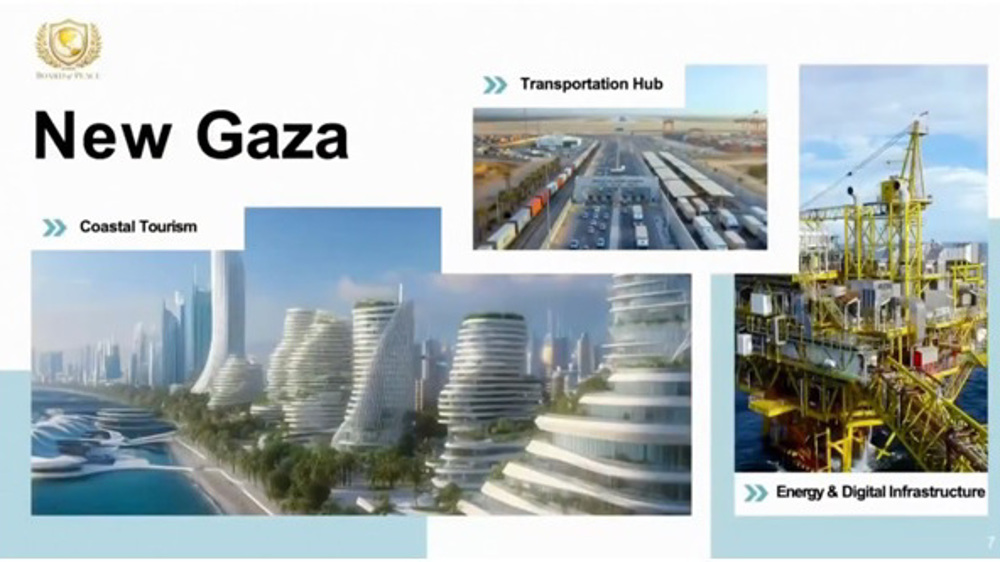
Kushner’s vision for Gaza
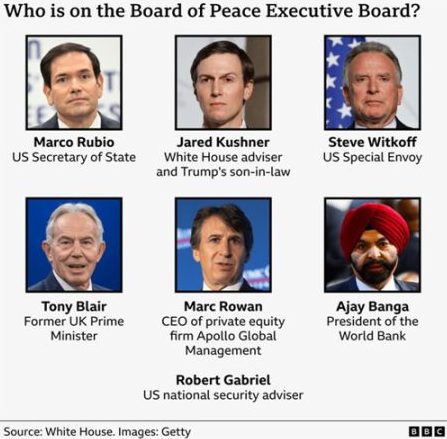
The Executive Board of the Board of Peace
Key members of the board
- Jared Kushner: As an Orthodox Jew, mega donor to the genocidal ultra-Orthodox Chabad-Lubavitch cult and architect of the Abraham Accords, Kushner has described Gaza as “valuable waterfront” property, suggesting redevelopment that critics argue implies ethnic cleansing. His role on the board aligns with his history of prioritising Israeli interests, having facilitated normalisation deals that sidelined Palestinian rights, as detailed by CNBC. Kushner’s Affinity Partners firm has ties to Middle Eastern sovereign wealth funds, raising concerns over conflicts of interest in Gaza’s reconstruction, as noted by the European Council on Foreign Relations.
- Steve Witkoff: This Jewish real estate mogul and mega Trump donor is a staunch pro-Israel advocate, serving as US Special Envoy to the Middle East (West Asia), where he has emphasised close US-Israel partnership on Gaza as reported byThe Times of Israel. Witkoff, described as having a “warm Zionist Jewish heart,” has been instrumental in delivering messages to Netanyahu and advancing Trump’s Gaza plan, as highlighted by OnePath Network. His background in property development fuels speculation that he views Gaza’s rebuilding as a business opportunity, aligning with pro-Israel policies that prioritise security over Palestinian sovereignty.
- Marc Rowan: The Jewish CEO of Apollo Global Management is a major AIPAC donor and led donor revolts against universities over perceived antisemitism, including boycotting the University of Pennsylvania for hosting a Palestinian literary festival, as reported byThe New York Times. Rowan’s anti-Palestine activism includes calling for the resignation of university leaders amid pro-Palestinian protests, as detailed byThe American Prospect. On the board, his financial expertise is poised to oversee investment in Gaza’s reconstruction, but critics argue his pro-Israel stance will entrench Zionist control, as noted by the BBC.
- Martin Edelman: This Jewish lawyer with pro-Israel ties specialises in international real estate transactions and has shaped US-UAE relations, facilitating deals that align with Zionist interests as reported by Watan. Edelman’s involvement in West Asia diplomacy includes roles that support normalisation efforts, bypassing Palestinian rights as highlighted by JNS.org. His position on the board likely focuses on legal frameworks for Gaza’s redevelopment, raising concerns over favouring Israeli interests as discussed by the Jerusalem Center for Foreign Affairs.
- Benjamin Netanyahu: As Israel’s Prime Minister and the chief architect of the Gaza genocide, Netanyahu embodies ideological Zionism, adhering to the “Iron Wall” doctrine of military dominance over Palestinians as explained byThe Conversation. His unwavering expansionism has led to policies even the New York Times calls apartheid. On the Board, Netanyahu’s inclusion ensures Israeli veto power, despite fuming at the presence of Turkish and Qatari officials, as reported by CNN.
- Tony Blair: As detailed throughout this article, Blair’s transactional Zionism and history of enabling Israeli policies make him a fitting but hypocritical addition to the board.
- Marco Rubio: This evangelical Christian is a fervent pro-Israel advocate, viewing support for Israel as biblically mandated as stated in his 2015 speech to the Republican Jewish Coalition. Rubio has pushed sanctions against Hezbollah and legislation to move the US embassy to occupied al-Quds, as reported by Liberty University. His role on the board aligns with Trump’s hardline stance, emphasising US-Israel alliances as critiqued by Sojourners.
- Susie Wiles: Wiles is reportedly an Episcopalian, but is not clearly a Christian Zionist. This is despite being aligned with Mike Huckabee through Florida politics and Trump’s circle, as noted by the Sarasota Herald-Tribune. She consulted for Likud in 2020, as detailed by The Washington Post. Despite her role on the BOARD, she has been described as a stabilising force who reportedly looked “alarmed” or shot “daggers” at Trump during press conferences where he proposed the genocidal mass relocation of Gaza’s inhabitants, as reported byThe Daily Beast.
- Ajay Banga: This Indian-American Sikh has not publicly taken a position on BDS or Zionism; however, Mastercard and Citigroup under his leadership opposed BDS and reportedly maintained operations in the occupied Palestinian territories. Banga described his board role as a “once-in-a-lifetime opportunity” to rebuild Gaza. Typically, he tried to ‘both-sides’ the genocide by condemning “unbelievable loss of life” on both sides as “unconscionable,” but critics like Ghada Karmi argue his participation aligns with a pro-Western, Zionist-adjacent framework, sidelining Palestinian self-determination.
- Robert Gabriel: As Deputy National Security Advisor since May 2025, Gabriel has served in Trump’s administration with a focus on policy, having worked as a special assistant to Stephen Miller, as reported by Wikipedia. His consulting firm, Gabriel Strategies, and closeness to Miller and Susie Wiles underscore his role in advancing hardline pro-Israel policies as detailed by LegiStorm. Gabriel’s background in Trump’s campaign positions him as a key enforcer of Zionist-aligned security measures in Gaza, as noted by the Brookings Institution.
Gaza’s death toll is in excess of 70,000 since 2023, according to the Palestinian Health Ministry, which even the Zionist military accepts. Academic studies suggest around 400,000 deaths or disappearances. With the ongoing crippling blockade, the board risks enabling further atrocities—restricted access, forced compliance, displacement under “redevelopment.”
Blair’s involvement lends false legitimacy, potentially making him an accessory to crimes if the plan entrenches occupation or ethnic cleansing. As the BBC reports, no Palestinians are on the board, though some Arab/Muslim leaders have joined, such as Bahrain’s Isa bin Salman Al Khalifa, Morocco’s Nasser Bourita, Jordan’s Ayman Al Safadi, UAE’s Reem Al Hashimy, Egypt’s Hassan Rashad, Qatar’s Ali al-Thawadi, and Turkey’s Hakan Fidan, as listed by CNBC.
Despite optimism from some quarters and claims that Netanyahu was not fully informed, as CNN reported, these figures are Zionist collaborators, with Turkey as a NATO member and most notably the UAE facilitating normalisation that sidelines Palestinian rights.
Does Trump see himself as “King of the World”? Chairing for life with vetoes, the Board positions him as a global arbiter. We might ask who, upon his death, would inherit the crown? Kushner, his Zionist son-in-law, is an obvious suspect, reinforcing Zionist control over Palestine’s fate.
Arrest Blair: End the impunity
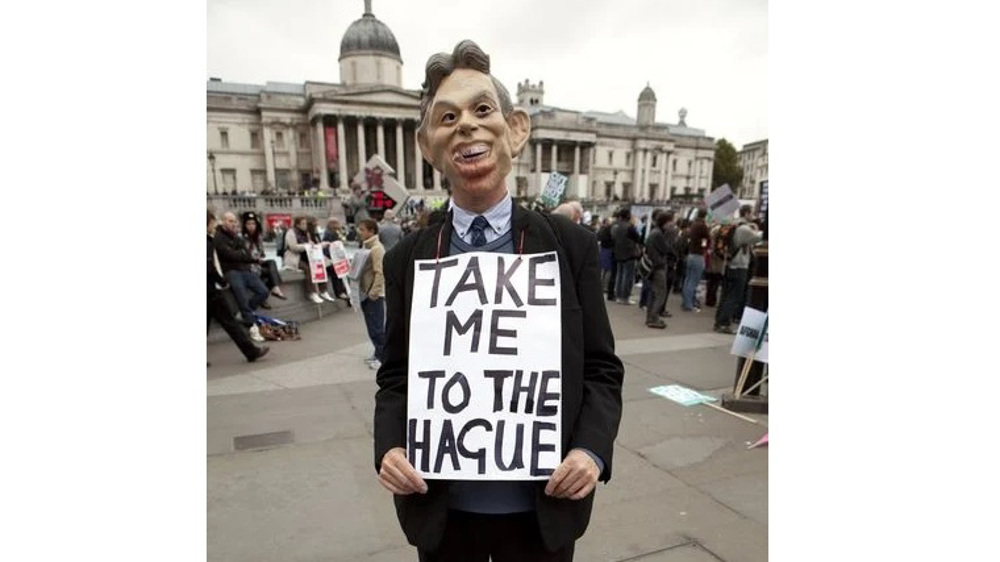
Message from London: Off to the Hague
As human rights advocates argue, Blair should face The Hague for his role in the invasion of Iraq and the war crimes there (based on the Chilcot report and the legal consensus) and his pattern of enabling power abuses—from Zionist bias to Gaza-linked schemes.
Public outrage persists: X users echo this, with posts declaring “Tony Blair should be in prison for war crimes” and calls like “Tony Blair should be heading to The Hague, not to Gaza.”
Strip his honours, prosecute under universal jurisdiction. Anything less mocks justice, say human rights campaigners worldwide as well as social media users.
Blair’s role on Trump’s board is seen widely as an ultimate insult—a war criminal overseeing “peace” in a land ravaged by over two years of genocide that his country facilitated.
Epstein email reveals plan to pursue frozen Libyan assets with help from former MI6, Mossad figures
MEMO | January 31, 2026
Newly released documents tied to Jeffrey Epstein show the convicted sex offender and an associate discussed plans to pursue access to Libya’s frozen state assets, including potential support from former British and Israeli intelligence officials, according to an email included in the files, Anadolu reports.
The correspondence surfaced after the US Justice Department released an additional batch of documents Friday related to the Epstein investigation.
The newly highlighted material includes a July 2011 email sent to Epstein that outlines what the sender described as financial and legal opportunities linked to political and economic uncertainty in Libya at the time.
According to the email, about $80 billion in Libyan funds were believed to be frozen internationally, including roughly $32.4 billion in the US. The sender described “stolen and misappropriated” Libyan assets as potentially worth three to four times that amount.
The correspondence argued that identifying and recovering even a small portion of such funds could generate “billions of dollars” in gains.
It also referenced expectations that Libya would need to spend at least $100 billion in the future on reconstruction and economic recovery, describing the situation as a broader opportunity.
The email characterized Libya as a country with significant energy reserves and strong literacy rates, factors it said could be advantageous for financial and legal initiatives.
It also stated that discussions had been held with some international law firms about working on a contingency-fee basis.
The message said certain former members of Britain’s foreign intelligence service, MI6 and Israel’s external intelligence agency, Mossad, had expressed a willingness to assist in efforts to identify and recover assets described in the email as “stolen.”
The email emphasized that early involvement in such a process could represent a “significant opportunity.”
Featured Video
Chinese jet fuel and the myth of energy independence
or go to
Aletho News Archives – Video-Images
From the Archives
The Dirty Little Secret behind the “Global Terrorism Index”
The Omission of Israeli Terrorism in the Occupied Palestinian Territories
By Karin Brothers | Global Research | December 6, 2014
… The Israeli settlements — all of which are illegal – have been identified as a major impediment to peace. The refusal of a major “global” terrorism report to name the Israeli settlers as one of the groups most responsible for terrorism not only misrepresents a major source of regional violence but exposes the Global Terrorism Index as a propaganda tool that supports a U.S. agenda.
In recent years, governments have been attempting to thwart terrorism by blocking supportive fund-raising. When it comes to Israeli settlements, however, the US and Canada actually encourage fund-raising by giving organizations (such as Christian Friends of Israeli Communities (CFOIC) and the Jewish National Fund) financial support in the form of donor tax-deductions.
Charities which provide funds for the Israeli settlements should be regarded as terror-financing organizations. They should not only lose their tax-deductible status, but they should be banned because they support the violation of international humanitarian law. The terror-financing laws that are being strictly enforced for Muslim charities should be applied to Christian and Jewish charities as well. … Read full article
Blog Roll
 Aletho News
- Chinese jet fuel and the myth of energy independence
- Ukraine Sea Drone Fired From Libya Hit Russian Tanker in Mediterranean
- IRGC: Iranian forces launched no attacks during ceasefire hours
- Trump Administration Moves To Automate U.S. Military Draft Registration
- Spain orders reopening of Tehran embassy, condemns Israel’s carpet bombing of Lebanon
- Israel faces ‘unsustainable’ strategic crisis following 40-day war against Iran: Analyst
- Iran restricts Hormuz access to 15 vessels per day under ceasefire terms: Report
- The ‘Opposition Party’ Has Done Nothing to Stop the Iran War and Much to Goad Trump Into Continuing It
- Moscow backs Tehran on status of Lebanon in US-Iran deal
- How UK Regulator Ofcom Quietly Bypassed International Law to Police American Speech
- If Americans Knew
- Amnesty: Urgent – Protect Lebanese civilians from brutal escalation in Israeli attacks
- Is The War Against Iran Over?
- Inside the Israeli army’s propaganda wing
- Hundreds of Gaza Amputees Stranded in Legal Limbo
- The gallows law: Israel moves toward executing Palestinian children
- Tucker Carlson: The Path to Peace requires ending ‘special alliance’ with Israel
- This is ceasefire? Israel’s biggest massacre yet in Lebanon, another journalist killed in Gaza – Daily Update
- Tucker Carlson on Israel: This Is the Behavior of an Ally? Really?
- Gazans face a triple crisis: severe shortages of water and bread, healthcare in tatters
- NY Times reports how Netanyahu took the US into Iran War
- No Tricks Zone
- An Inconvenient Tree: Uncovered In Alps… Europe Much Warmer Than Today 6000 Years Ago
- New Study Reports A 60% Slowdown In Greenland’s Ice Loss Rate In The Last Decade
- Low Intensity Tornado Wrecks Major Solar Farm, Creating A Potential Toxic Dump
- New Study Finds Warming Saves Lives…Cold Temperatures 12 Times More Deadly Than Excess Heat
- German Science Blog Accuses PIK Climate Institute Of Hallucinating Climate Tipping Points
- Devastating Assessment Of Comirnaty Vaccine By Former Senior Pfizer Europe Toxicologist
- New Study: CO2 Is ‘Effectively Negligible’ As An Explanatory Climate Change Factor Since 2000
- Former Pfizer Toxicologist Dr. Helmut Sterz Tells Bundestag Hearing Pfizer Vaccine Should Have Never Been Approved
- Energy Expert: Germany’s Nuclear Phaseout Was A “500 Billion Euro Mistake”
- New Research: South Australia’s Mid-Holocene Sea Surface Temperatures Were 4°C Warmer Than Today
 Aletho News